Corrections for the Week of February 3, 2016

Our January 27 Legalization Nation column, “Cannabis Regulations Heat Up,” misstated the date of the California Cannabis Industry Association meeting. It was January 19 — not January 20. It also misstated the date of the California Growers Alliance San Francisco-Oakland chapter meeting. It was January 20 — not January 27. And HempCon did not cancel its event in San Jose this month; rather, it moved the event to Daly City.

Our January 27 art review, “Defying the Neat, Tidy, and Eurocentric,” neglected to state that Jeepneys collaborated with artist some times, aka Meghan Gordon, on the sculptural installation for Visions into Infinite Archives at SOMArts.


Photographing Forgotten Cities

The motivation behind Brittani Sensabaugh’s photography practice can be traced back to a New York City subway ride. It was 2013, and she was wearing a hoodie with “Oakland” emblazoned on the chest. An older white woman stopped her with a warning: “Don’t ever go there,” she said. “It’s not safe.” The stranger spewed accusations of “gang bangs” and a prevalence of “thugs” in the area. Sensabaugh let the woman speak until she was about to exit the train. “I’m actually from there,” she responded, “and I’m not any of those things.”

Sensabaugh grew up in deep East Oakland on 85th Avenue. As a teenager, she wanted to be a journalist in order to tell the stories that she witnessed around her. When she graduated from high school in 2005, her older brother gave her a digital camera and suggested that she capture the visuals to accompany those stories as well. Two years later, when her brother died in his sleep at the age of 28, the suggestion finally took hold. Stricken with grief, she decided to master the tool that he had given her. Two years after that, she moved to New York City to pursue her dream of becoming a fashion photographer.

Soon, Sensabaugh began photographing behind the scenes at runway shows and, similar to The Sartorialist blogger Scott Schuman, taking photos of fashionable people on the street. But the excitement quickly started to fade. “I found myself feeling more connected with the story behind the person than the garment,” she said in a recent interview. And when she visited home a few months after her subway encounter, she couldn’t get the interaction out of her head. “I just remember saying to myself, I have to change this,” she said. “I need to plant a seed to change the perception about Oakland and about my people in general.” (Sensabaugh is Black, but she prefers the term “melanated” because it’s less politically loaded.)

That day, Sensabaugh picked up her camera and began walking around East Oakland, documenting everything she saw. That was the beginning of 222 Oakland, a photo series aimed at visually dissolving the disconnect between the popular, media-informed perception of Oakland and the reality of the people who live there. The numerical title is inspired by the six most formative years of her life, the two after receiving her camera, the two after her brother died, and the two after she moved to New York. “It’s an example of anybody that is breaking society’s boundaries, giving unconditional love and compassion to their craft, building — just anyone that’s out here battling,” she said of the project. “Around the time when I created it, I was battling so much and creating was really my only outlet.”


Sensabaugh soon developed a method for her documentation. She would start around 60th Avenue and walk up to 100th Avenue, talking to people along the way. Sometimes her conversations would last fifteen minutes, other times over an hour. She simply asked residents for their stories and perspectives, sharing her own intentions for her art practice — an exchange she refers to as “building.” Only after that process of gaining trust would she begin to photograph. The resulting photos feel relatively candid — not overly prepared for. While snapshots taken on the street often belie a level of alarm, especially when taken in low-income neighborhoods, Sensabaugh’s reflect a distinct authenticity. Even her elderly subjects adopt the wide-eyed honesty of young children, sometimes almost in tears — a gaze both exposed and empowered.

After returning to New York, Sensabaugh continued her work by documenting neighborhoods throughout Brooklyn, particularly a project in Brownsville. Those photos became her 222 Brownsville series. Over the next few years, she set out to create the overarching series, 222 Forgotten Cities, by adding 222 Chicago, 222 Houston, 222 Philadelphia, 222 Baltimore, and 222 Watts, Los Angeles. She would show up unannounced, stay in a hotel near the neighborhood, and spend most of her week talking to people in parks, on stoops, and in the street — only photographing toward the end of her stay. Often, people were initially afraid of being exploited. “I just tried to communicate to them that I’m there because I want to know about them,” she said, “to show that they matter and that they are worthy and that they are beautiful.”

Sensabaugh said she encountered the same fear and disenfranchisement in all of the communities she visited, but also the same resilience. “The love in each of these communities is the same and the struggle in all of these communities is the same.” Her work is meant to highlight that shared tension, depicting places that she describes as in a state of “destruction,” clearly overlooked; but also capturing the vibrant characters that endure in those settings. Some of her best photographs are of young girls with awesomely intricate braids. Others portray wrinkled hands showing off a bright red manicure while clutching a pack of Newports, and a group of young children embracing each other on a public bus, laughing.

Thirty-five of Sensabaugh’s photos will be on view at Betti Ono gallery in the show 222 Forgotten Cities: The Power of Melanin, opening February 5 with a reception and artist talk from 6–9 p.m. The exhibit will also feature a slideshow of more of Sensabaugh’s work. Ultimately, though, the project is intended for future generations, so that they may have another way to remember these communities. “When I move on … these photos will be here for them to reference,” said Sensabaugh. “It’s an archive.”


Food Court Noodles

America’s complicated relationship with Japanese food somehow dictates that the only way to do it justice is to make it extra fancy and expensive. The Bay Area is home to some of the tastiest sushi, ramen, and izakaya-style fare in the United States. You just wouldn’t ever mistake most of it for everyday Japanese cuisine.

Leave it to a couple of industry outsiders, then, to break that mold, at least in the increasingly hip world of ramen. Jake Freed and Hiroko Nakamura, two former chemists with a love of noodles, wondered why the Bay Area didn’t have ramen shops like the ones in Japan — where, at even the most highly regarded places, the prices tend to be low; the service, blindingly fast; and the setting, usually little more than a bar counter.

That’s the approach the fledgling restaurateurs have brought to Shiba Ramen, their two-month-old ramen shop in the newly renovated Emeryville Public Market. The goal was to serve ramen that’s as good — or at least nearly as good — as what you can find at a thousand different noodle shops in Japanese cities such as Tokyo or Sapporo. And they wanted to serve it quickly, with little fuss, and at a reasonable price point.

That’s the theory, anyway. What Nakamura and Freed might not have anticipated is just how popular their little food court stall would become. During one visit at the peak of the lunch rush, the line snaked toward the food court’s rear entrance — a solid fifteen-minute wait just to place my order, exacerbated by the fact that there was only one copy of a paper menu with descriptions of the different ramen varieties. (The main menu board only lists dishes’ names, which tend to be enigmatically minimalistic: “White Bird” or “Soy Milk.”)

Freed and Nakamura acknowledged that Shiba Ramen has faced its fair share of growing pains — unforgiving Yelp reviews, the difficulty of finding and retaining skilled line cooks, and so forth. All this was on top of the fact that the owners are total newcomers to the food business. Apart from a ten-day stint at a “ramen school” in Japan, Nakamura, the chef, is entirely self-taught.

And so there’s been a bit of a learning curve. During my first visit, on a chilly evening about a month after the restaurant opened, each bowl of ramen came out barely warm (the result of some faulty kitchen equipment, Nakamura later told me in a phone interview), and the pork gyoza, while tasty enough, lacked the crisp bottoms that are the hallmark of proper pan-fried dumplings.

But even during these somewhat shaky early days, Shiba Ramen more or less delivered on what it promised. No matter how long I had to wait in line, my ramen was always ready before I had a chance to warm up the counter stool — usually within five minutes after I put in my order. More importantly, the ramen itself was on par with what I might expect to find at a nice sit-down ramen restaurant. If you’ve ever used the term “food court fare” as a slur — well, this isn’t that.  

So far Nakamura has about eight different ramen recipes in her repertoire, with three to five typically listed on the menu at a time. The first one I tried was the one that surprised me the most — a vegetarian ramen with a soy milk-based broth that was topped with bamboo shoots, thick slices of kabocha squash, and halves of a soft-boiled egg (which vegans can omit). The noodles, sourced from Honolulu-based Sun Noodle, had that springy bounce to them that I look for in a bowl of ramen. (These are the same noodles that virtually every well-regarded ramen-ya in the South Bay uses.) But the standout was the soup itself: The soy milk, mixed into the broth at the very end, contributed a creaminess and a luxurious mouthfeel, and a drizzle of garlic-infused oil added yet another layer of richness. I liked this better than just about any other vegetarian ramen broth I can recall eating — better, even, than Ramen Shop’s much-vaunted Meyer lemon shoyu broth.

If richness is the main thing you look for in a bowl of ramen, look no further than the White Bird, a chicken-based tonkotsu ramen whose broth was so thick and viscous, it resembled a cream sauce more than it did a soup — the result of simmering what comes out to about a half-pound of chicken bones per serving, Nakamura explained. I found the soup reasonably tasty, but too heavy for me to want to eat the entire bowl — especially since the pork chashu (a slice of fatty pork shoulder) lacked the hint of sweetness that it often has at other ramen shops. The result was that both the White Bird and the “Clear” ramen (with its comparatively light, salt-based shio broth) were a little too one-dimensional — no element of sweetness or acidity to balance out all that savory richness.  

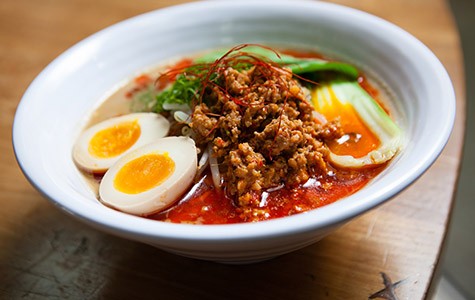
My favorite dish at Shiba was the “Spicy,” a version of the tantanmen ramen style. A mass of noodles came in a thick, porky, red-tinged gravy and was topped with ground pork cooked in (only slightly) spicy fermented miso — basically more of a meat sauce than a broth, but not heavy enough to keep me from slurping down the entire bowl in a minute.

Heartier eaters might long for the ability to pay a few more dollars to upsize Shiba Ramen’s relatively modest-sized bowls, but with most bowls running $11–$12, tip-inclusive, the ramen is a good value. Anyway, it’s worth your while to add an appetizer or two to your order. The sesame seed-flecked fried chicken wings, tossed in a heady mixture of soy sauce, garlic, and ginger, were a standout. Cool strips of spicy cucumber, reminiscent of a milder version of a dish you might find at a Sichuan eatery, were another.  

And those with a sweet tooth won’t want to skip the Shiba Scream, the restaurant’s version of an ice cream sandwich, but with custom-made Fentons Creamery flavors (dark chocolate and green tea for now) and adorable Shiba-branded monaka shells imported from Japan — basically, thin wafers made with mochi flour.

You can enjoy all of this in the recently renovated and, for now, sparsely populated wing of the Emeryville Public Market food court — on your office lunch break, perhaps, or to reward yourself after a trip to the dentist’s office in the complex. That’s the real breakthrough of Shiba Ramen: It’s not necessarily serving the best ramen you’ve ever had in your life, but this ramen is pretty darn good for the setting. In Asia’s major metropolises, it’s an everyday occurrence to find food of this quality in a food court, but here in the United States, this still feels like a revolutionary stroke. And that’s the blunt truth of the matter: If every mall in America had a ramen stall as good as Shiba Ramen, we wouldn’t have to talk about bad food court food ever again.

When Landlords Lie

Last April, after Adrian Rish bought a two-story, three unit apartment building on 58th Street in North Oakland, he issued eviction notices to all of the tenants in the complex. And Rish made the move even though he knew that one of the tenants in the building, Charles Oshinuga, is a defense lawyer with trial experience who is now an attorney with the Eviction Defense Collaborative, a nonprofit legal center in San Francisco that defends low-income renters.

Nonetheless, Rish forged ahead with the evictions. So Oshinuga and his roommate, Jamin Horn, who is also an attorney, fought back. The battle ended up in court, and Oshinuga and his roommates convinced a jury that Rish had violated Oakland’s tenant protection laws in his effort to force them out. They successfully stopped the eviction, but that wasn’t the end of their ordeal. Rish, a business consultant with a degree from the London School of Economics, served them with eviction notices again.

Oshinuga said his case exemplifies how rigged the system is against tenants. “A landlord can continue to serve you with sixty-day notices, even if they’re bogus, take you trial, bleed you of money, and there’s nothing you can do,” he said. “We need to fix this system.”

Rish declined to speak to the Express for this story. But according to court records, Rish said during the eviction trial that he planned to move into the three-unit apartment building on 58th Street and occupy one of the units himself. According to public records, when Rish bought the building in March, he was living in a condo in downtown Oakland that he also owned, and which he considered his primary residence. Rish said in court that his mother moved into his condo last year, and that by May, it was no longer his home.

Rish’s tenants suspected, however, that their new landlord had a different motive when he bought their building. “His motive was to capture the [high] rents in Oakland, and the easiest way to do that is to get rid of the tenants,” said Oshinuga. “So he faked an owner move-in.” What ensued was a complicated game of chess in which Rish and his attorneys tried various strategies to convince and eventually force Oshinuga and his friends to leave.

Oshinuga and Horn moved into 770 58th Street in 2011, and as of last year, were paying $1,429 in rent for their three-bedroom unit. By the time Rish had bought the building, rents in North Oakland had doubled, but the building’s rental prices were fixed below-market due to Oakland’s rent control law, which caps rent increases at the rate of inflation for most apartments — so long as the same tenants continue living there.

On April 14, Rish sent letters to Oshinuga, Horn, and their neighbors, Colin Hoefle and Brady Hemenway, informing them that he intended to move into both of the upstairs units after converting them into a single unit. Rish said he also planned to convert the single apartment on the first floor into two apartments and then rent them out. He told the tenants they would have to leave before the end of May, and he offered the leaseholders a small buyout of $1,000 if they would voluntarily move out before May 17. Rish requested that they reply in three days to his offer.

But the tenants had no intention of leaving. So a few days after receiving the tenants’ response, Rish sent an email asking about their roommates who weren’t named on their leases. “Were the tenants living in your unit whose names (e.g. John, Zane, etc.) aren’t listed on your current lease agreement ever approved by the previous owner[?],” Rish wrote in an email, according to court records. Rish then ordered the property management company that collected rent for him to send his tenants a letter warning that their roommates would need to leave immediately, or he would file an eviction lawsuit. The roommates moved out until Oshinuga and Hoefle were able to show that the previous landlord had allowed them to have roommates. Oshinuga believes this was the beginning of retaliatory moves by Rish to pressure them to move out.

Then on May 1, Rish sent letters to all of the tenants giving them sixty days to move out of their apartments. The letters stated that the basis for the eviction was that Rish “seeks in good faith, without ulterior reasons and with honest intent, to recover possession [of the apartments] for his own use and occupancy as his principal residence[.]”

Rish was relying on a portion of Oakland law that allows an owner of a building with three units or less to evict tenants if he or she plans to move into one of the units. An owner-move-in eviction requires the owner to live in the building for three years after the eviction, but it allows the owner to rent out the other units at whatever prices he or she wants.

Rish actually offered his tenants in both the upstairs apartments the option of moving into the building’s bottom unit, which was empty at the time, at a substantially increased amount of rent. But, according to court records, the bottom apartment was uninhabitable at the time Rish was seeking to push out his remaining tenants. After he bought the building, Rish had construction workers tear out the unit’s interior walls, gutting it down to the studs and cement floor. According to court records, Rish had construction workers show up at 8:30 a.m. for weeks on end. The tenants testified in court that the demolition activities shook the building and caused serious disruptions.

After it became clear that his tenants had no intention of moving out, Rish hardened his stance and changed his strategy. On May 13, Oshinuga, Horn, Hoefle, and Hemenway received a letter from Rish’s attorney, Alana Conner, a lawyer with Fried & Williams, a San Francisco firm that specializes in representing landlords in eviction cases. The letter revoked Rish’s offer to rent out the bottom apartment. Instead, the letter stated “as you may already know, the owner has begun occupying the [bottom-floor apartment] while repairs are being completed.” Rish’s attorneys then sent sixty-day notices to move out, no concessions.

“Oakland’s Rent Ordinance says that if you’re a landlord and your building is three or less units, and if you live in one of those units, you’re exempt from the ordinance, and you can evict everyone in the building,” said Oshinuga. “His attorneys probably understood that he actually didn’t want to live in the building, and so they told him there’s an easier way to do this than an owner move-in into the tenants’ units: Just say you live downstairs.”

Still, the tenants refused to budge, so Rish, claiming he was living in the downstairs unit, sued them for eviction. The only problem was, Rish wasn’t actually living downstairs.

“We took pictures of the construction to show that no one could possibly be living down there,” Oshinuga said in an interview. “We knocked on the unit’s door every night, no answer.” Rish’s tenants presented video and photographic evidence in court showing that the downstairs apartment was not Rish’s primary residence, therefore he couldn’t avail himself of Oakland’s rule that allows landlords living in buildings with three or less units to evict their tenants.

Rish’s attorney, David Semel, insisted, however, that his client lived in the uninhabitable space. Semel told the jury, “[E]ven if it’s down to the studs and you’ve got a floor, as long as you’ve got running water,” it was possible to live in the apartment. “You don’t even need electricity necessarily. There are billions of people in this world who live without electricity. You have candles.”

The jury disagreed. They ruled in favor of Oshinuga, Horn, and their neighbors.

But just two weeks after the jury’s decision, Rish served his tenants again with a new sixty-day eviction notice.

At that point, Oshinuga and the other tenants decided to moved out. Even though they had won in court, they realized that the law allows for Rish to keep suing them for eviction over and over again — even if they prove in court that he is lying.

“A landlord can lie to try to evict a tenant, the lie can be proven in court, and a tenant still has no remedy,” said Oshinuga, noting that there is no penalty under the law for landlords who bring bogus eviction suits.

The Kinkification of the East Bay

For the uninitiated, the small gathering of fewer than a dozen people at the Albatross Pub in Berkeley last Thursday could have been a meeting for just about anything. But the conversation wasn’t the kind that’s typically dished between casual acquaintances over beers and pizza boxes. One of the participants spoke about total surrender, specifically the kind that only bondage can bring.

The group was meeting as the first happy-hour edition of an event called Boundless, which hosts a monthly “krunch” and a yearly retreat in Northern California for polyamorous and kink-minded folks. The “krunch” is short for “kinky brunch,” and typically takes place at Rudy’s Can’t Fail Cafe in Oakland on the second Saturday of the month. Daddy James started hosting the events with his partner nearly three years ago. His event is one of several that have popped up during the past few years as the alternative sex scene has spread from San Francisco to the East Bay.

James (the Express has agreed to not use his real name because he said some of his family members do not know about his sexual orientation) first moved to San Francisco in the late 1980s to study at San Francisco State University. But he also had a hidden agenda of tapping into the burgeoning BDSM scene in the city. He discovered the Society of Janus, one of the nation’s oldest BDSM education and support groups, where he was able to explore his own sexuality, access parties, and meet like-minded people, he said. “I had a lot of personal growth there.”

At the time, the San Francisco sex community was still under the shadow of the AIDS crisis that had swept the city in the Eighties, recalled Carol Queen, a sexologist and co-founder of the Center for Sex and Culture. She started hosting a play party in the early Nineties called Queen of Heaven, which, unlike similar events at the time, allowed intercourse. But it also required everyone to wear condoms as a way of destigmatizing people who were HIV positive.

“What people would do in those days … they wouldn’t use a condom, but they would only fuck people they thought were safe,” Queen recalled. “That’s not very scientific. We wanted to level the playing field.”

Over the years, San Francisco has remained at the center of the sex revolution. It’s still home to Kink.com, the Folsom Street Fair, the San Francisco Sex Information center, and a number of large sex education conferences, and is the birthplace of Mission Control and Kinky Salon, among others. But in recent years, more and more people involved in the alternative sex scene have moved to the East Bay because of the tech boom and out-of-control rents in San Francisco.

The influx of new residents has allowed not only the proliferation of events like Boundless, which have counterparts in Berkeley, Piedmont, Hayward, and other East Bay locales, but it also allowed the events to become much more niche, said Charlie Glickman, a sex educator and author.

Caroline Carrington, an Oakland-based sex educator who will be teaching a series of three workshops with Glickman in February, said she’s seen a huge increase in the number of tantra events (a Hindu tradition focused on channeling erotic energy) happening now in the East Bay. She said she’s also noticed play parties geared specifically for electric play, flogging, latex fetishes, and just about everything else. “It’s very blessed here,” she said.

Carrington said she was first exposed to tantra during a workshop that Reid Mihalko was running in Oregon. Mihalko, who first began hosting Cuddle Parties with Marcia Baczynski in the mid-Aughts, said the East Bay has become a nexus for members of the alternative arts community. “Now, with Fifty Shades of Grey, you have a lot more ‘vanilla’ people who are now having permission to explore BDSM, non-monogamy, and the kink scene,” Mihalko said.

Perhaps the one exception to the recent influx is the swinger scene, which has always had a robust East Bay presence, said Jessy J., a musician who hosts heterosexual, transgender, transsexual, and cross-dresser-specific swinger parties in Oakland. One of the big differences in the East Bay, as compared to San Francisco, is the lower level of comfort people have with public displays, Queen said. Like Jessy J.’s party, o.m.g. tgurl, many of the play parties take place in private residences, and while there is at least one public dungeon operating in Oakland, it doesn’t list its address on its website and requests that guests enter and leave the location with discretion.

There has always been an element of confidentiality among participants in the kink scene. Jessy J. said it was a matter of privacy and protection. Edward Fish, who runs the East Bay Trinity Munch, a kink-centered meetup in Hayward, said many people are still worried about getting fired from their jobs for participating in a kink, polyamorous, or alternative sex lifestyle.

When Mission Control was evicted from its space in San Francisco’s Mission district in 2013, some blamed rising rents, while others blamed the tech boom, but one of the play space’s founders, Polly Whittaker, blamed the city attorney for tipping off their unsuspecting landlord. The space has since found a new permanent home in the Bay Area, but Whittaker declined to confirm where that is, saying the situation is “complex.”

“East Bay cities are not historically towns that identify with the sexual communities the way that San Francisco does,” Queen said. Referencing the upheaval caused by Mission Control’s exodus from San Francisco, Queen said, “How much more likely might that sort of thing be in the East Bay?”

For now, the consensus among many engaged in the alternative sex scene in the East Bay is: wait and see. Several people, like James and Jessy J., are encouraged by the increased activity and don’t see it abating. James equated it with the gay movement of the 1970s.

“I think the BDSM scene will follow a similar path as the homosexual agenda did and will gain more acceptance as people are more comfortable about being open about who they are,” James said. “For me, BDSM is not just about spanking and flogging. It’s a very deep and profound life-changing activity that is a way of connecting and building bonds with people in a very spiritual and emotional way.”

Letters for the Week of February 3, 2016

“Cap and Clear-Cut,” Feature, 1/20

You Got It Right

As a member of Ebbetts Pass Forest Watch, which has been working to reduce the huge amount of clear-cutting in California by, especially, Sierra Pacific Industries, I very much appreciate the comprehensiveness of this article. And I appreciate that it makes clear the timber industry’s stranglehold on politicians, agency personnel, and the creating and enforcing of regulations. Initially, it looked as though the California Air Resources Board would acknowledge in its protocols that clear-cutting is in direct opposition to its mandate to reduce carbon emissions. But pressure from the industry resulted in clear-cutting being included and rewarded in the protocols. Governor Jerry Brown may take credit for some positive actions in response to climate change, but when it comes to clear-cutting, a huge carbon-emitting activity, he and his administration are partners in the damage being done.

Penny Sarvis, Murphys, California

You Got It Wrong

Your coverage of REDD is inaccurate and biased. REDD proponents have been discussing and refining their methodologies for more than ten years, grappling with all of the issues you mention. California is one of the players in a vast global effort.

Jim Hight, Eureka, California

REDD Isn’t that Bad

The anti-REDD protestors who confronted Governor Brown on December 8 were apparently assuming that California’s climate policy could somehow empower and enable land-grabbing schemes that have been falsely labeled as “REDD,” which is simply not true.

We (Earth Innovation Institution) are happy to see the Express cover REDD and the event we co-hosted with the Governors’ Climate and Forests Task Force in Paris that featured a keynote address by Brown. However, we are dismayed to see important errors in the way REDD is described. Contrary to the main message of the article, the kind of REDD program that California could eventually support — called “sectoral REDD” — is already delivering important benefits to indigenous peoples and is endorsed by organizations that represent hundreds of indigenous communities throughout the Amazon and Meso-America, including the Meso-American Alliance for Peoples and Forests (AMPB) and the Amazon Basin Indigenous Coordination (COICA). The coordinator of COICA, Edwin Vasquez, participated in the second panel of the December 8 event after most protestors had departed. COICA represents 390 indigenous groups and 5,000 communities across the Amazon Basin, and its leaders were in Paris voicing their support for REDD as a mechanism for supporting tribal life plans.

Daniel Nepstad, executive director and president of the Earth Innovation Institute, San Francisco

“Oakland’s Banking Contractor Favors White, Wealthy Residents,” News, 1/13

Fire These Clowns

Are the folks sitting on the Oakland City Council dense between the ears? They actually have the nerve to express surprise that JP Morgan Chase failed to live up to their contractual requirements?

The original rationale for selecting them as the city’s bank was that they would do specific things to reach out and provide loans and financial services to underserved and lower-income neighborhoods. This was seen as an attempt to partially cure the predatory lending and discriminatory behaviors of big banks that led to the recession of 2008.

We now find that they have apparently done the opposite. They have closed the only bank in East Oakland and served mainly white residents in white neighborhoods with higher incomes.

Jamie Diamond and JP Morgan were one of, if not the most blatant violators of banking laws that caused the recession. They have operated with impunity and have a long history of arrogance and disregard for rules of the game. These people basically do what they want and challenge you to hold them accountable. The worst that can happen is that they have to pay a fine. Access to money is not a problem for them. They have not changed at all.

The city council needs to require immediate compliance with the agreement or get these clowns out of here!

Gary Patton, Hayward

The Return of Don Perata,” Seven Days, 1/13

A Familiar Stench

The tide must be out. The smell of fish is very strong. A stimulating and familiar sensation for an Oakland morning.

Hobart Johnson, Oakland

Miscellaneous Letters

Nebraska Is More Progressive Than Berkeley

I recently moved to Berkeley from Omaha, Nebraska. Last year, the citizens of the State of Nebraska passed a minimum wage initiative that will raise the minimum wage to $9 per hour by 2016. Adjusted for the cost of living, this is about $15.60 in San Francisco dollars. In 2016, Berkeley’s minimum wage will only be about $12.56 — effectively $3 less than Nebraska’s minimum wage.

I’m shocked that the question of whether the Berkeley City Council should raise the city’s minimum wage has serious opposition right now. Berkeley is supposed to be on the front lines of guaranteeing a living wage, not falling behind one of the most Republican states in the country.

If Berkeley doesn’t think that someone working full-time deserves a roof over his or her head, three square meals, and health insurance, then I don’t know what this city stands for.

Rob Moore, Berkeley

Why We Should Protect Farmland

Fifteen percent of the agricultural area in the Bay Area is at risk of being developed into subdivisions and other sprawling suburban forms. Every Bay Area urbanite — from Silicon Valley computer engineers and banking gurus in San Francisco’s Financial district to teachers in Oakland and community organizers in Richmond — should flock to their local elected official’s office and planning commission meetings to express their unanimous support for policies that help keep these lands free of development and that make farming a viable means of making a living.

Why should the preservation of the Bay Area’s agricultural land concern citizens of our lovely region? There are many reasons, both quantifiable and not (think of the educational benefit of knowing how food is grown), but I will focus on two important ones. First: Farmland acts as a buffer against sprawl. Second: Local farms are a crucial component of our regional food economy.

Having policies and regulations that limit sprawl redirects development to existing urban areas. This is known as infill development. Studies have found that limiting sprawl and promoting infill is one of the single most efficient ways to reduce the greenhouse gas emissions of cities. Infill development reduces the carbon emission of vehicles by shortening daily commutes, and also reduces the consumption of residential energy by creating dense urban areas. Establishing greenbelts — protected green areas around cities for farming, grazing, recreation, or conservation — is one very efficient way to promote infill and limit sprawl. Of these greenbelts, farmland and grazing land are the most economical for cities. Another reason to preserve farmland? Once agricultural land is developed, it is essentially gone for good, and we’ve already lost thousands of acres in high-quality farmland to the construction of subdivisions.

Consuming locally produced foods and goods makes economic sense; we’ve been doing it since the first farms appeared. It’s better for the region’s economy. It’s also backed by sound science and analytics. A recent analysis found that the Bay Area’s food industry provides 12 percent of all private sector jobs. The food industry employs more people in the Bay Area than the information, finance, construction, and insurance sectors combined. That’s right, combined. Conserving farmland means that food processors, distributors, and retailers can meet a growing and voracious demand for locally grown produce. Thus, more of the Bay Area’s monetary wealth stays in the Bay, creating what is known as the multiplier effect. Purchasing from locally owned businesses — be they restaurants, farms, or clothiers — brings a greater economic benefit to the area.

One caveat: Locally produced food is not necessarily “green” food — if we define “green” as any activity or product that reduces greenhouse gas emissions. If a tomato travels fewer miles to get to your table, this does not mean that in choosing to buy this tomato you’ve lessened your carbon footprint for the day. This is because 80 percent of a food product’s carbon footprint is in the production process — meaning, choosing to buy an organic tomato grown using sustainable farming practices in Mexico has less of an environmental impact than buying a local tomato grown using “traditional” single-crop farms in Santa Clara County. This is why supporting local farmers has to go hand-in-hand with calling for, in ballot boxes and grocery stores, sustainably grown produce. This is also why those of us who are self-conscious about spending $5 on two tomatoes at Whole Paycheck can stop feeling guilty about our contribution to the “wealthy and crunchy” ethos of the Bay Area.

Given the climatic and natural-resource challenges we’re already experiencing, and the threat of future global warming in unprecedented proportions, locally and sustainably grown produce should be the rule and not the exception of agricultural practice, and protecting our local farmland is the most crucial step towards greater sustainability in the Bay Area.

Diana Perez-Domencich is a City Planning student at UC Berkeley, Oakland

Corrections

Our January 27 Legalization Nation column, “Cannabis Regulations Heat Up,” misstated the date of the California Cannabis Industry Association meeting. It was January 19 — not January 20. It also misstated the date of the California Growers Alliance San Francisco-Oakland chapter meeting. It was January 20 — not January 27. And HempCon did not cancel its event in San Jose this month; rather, it moved the event to Daly City.

Our January 27 art review, “Defying the Neat, Tidy, and Eurocentric,” neglected to state that Jeepneys collaborated with artist some times, aka Meghan Gordon, on the sculptural installation for Visions into Infinite Archives at SOMArts.

The Wilbur Theatre

A large crowd braved a snowstorm to come out to Savage Love Live at Boston’s Wilbur Theatre last week. Questions were submitted on index cards, which allowed questioners to remain anonymous and forced them to be succinct. I got to as many of them as I could over two long, raucous, boozy hours. Here are some of the questions I didn’t have time for in Boston …

What do you think of poop play?

I think of it rarely.

How long should I keep my partner locked in male chastity?

Until Rick Santorum is president.

What exactly causes relationships to end?

Relationships end for all sorts of different reasons — boredom, neglect, contempt, betrayal, abuse — but all relationships that don’t end survive for the same reason: The people in them just keep not breaking up. Sometimes people in relationships that need to end never get around to breaking up.

I was in an open relationship once and was heartbroken in the end because my partner broke the rules we made. My current partner wants to make our monogamous relationship open, but I am hesitant because of my previous burn. How do I get over this and become comfortable with an open relationship again?

Rejecting nonmonogamy because your last nonmonogamous relationship failed makes about as much sense as rejecting monogamy because your last monogamous relationship failed. If people applied the same standard to closed relationships that they apply to open ones (“I was in one that failed so I can never enter into another one!”), most of us would’ve had two relationships in our lives — one open, one closed — and then either taken a vow of celibacy or pledged to stick to NSA sex for the rest of our lives.

Our choices are informed by our experience, of course, and you had a bad experience with an open relationship. Open relationships might not be for you. But it’s also possible that the problem with your last relationship wasn’t the openness but the partner.

Advice for happily child-free people in a baby- and parent-worshipping world?

You could take comfort in your free time, your disposable income, and your vomit-free wardrobe. You could also see baby and parent worship for what it is: a desperate attempt on the part of the busy, broke, and vomit-spackled (and the people trying to sell stuff to us) to make ourselves feel better about the consequential and irrevocable choice we made to have kids.

Magnum condoms are just marketing, right?

Wrong — but you don’t have to take my word for it. Just spend ten minutes on Tumblr and you’ll see for yourself.

I accidentally told my dad about your podcast when teaching him how to use iTunes. I called home a couple of weeks later, and Dad told me he’s been listening and Mom yells, “I’m not gonna pee on you!”

It could’ve been worse. Mom could’ve yelled: “We can’t talk right now! I’m peeing on your father!”

My husband and I (thirties, M/F, two kids) found out our best friends of twenty years were secretly poly. And we didn’t know! Well, we all fucked. Now our relationship/friendship is fucked, too. How do we move on from this mess?

People who are poly say they want more love, sex, and joy in their lives — but some poly people seem to want more chaos, drama, and hurt in their lives. Unless you know a couple well, or unless you’ve noticed the trail of destruction they’ve left in their wake, there’s just no way to tell what they’re really after until after you’ve slept with them. Anyway, how do you move on? You send a note, you apologize for your part in the chaos, drama, and hurt, and you express a desire to mend the friendship. Hopefully you’ll hear from them.

What is the deal with a “blumkin”? Like, honestly, why? Why? WHY? They freak me out and confuse me.

Take it away, Urban Dictionary: “When a man is sitting on the toilet taking a shit and has his woman come in and give him head during the act of shitting.”

I’ve been writing this dumb sex-advice column for a long time, and while I’ve received a few questions like yours over the years (“What’s the deal with blumkins?!?”), I’ve never once received a question about an IRL blumkin session gone wrong. So blumkins aren’t for real, and they’re not really about sex. As you can see from the UD definition, it’s not about sex or kink, it’s about misogyny and implied violence, i.e., the man takes a shit and orders “his woman” to come in and give him head. Consensual degradation and power play can be hot, of course, but blumkins and donkey punching and dirty sanchezes — and the scared little boys who talk about them — are bullshit. Sexist bullshit.

Like most gay men in their early thirties, I enjoy chatting and sending pics of my nether regions via dating apps. My conflict is that I am a public school teacher. While I believe I have a right to a sex life, what if someone I send a pic to disagrees? Do you think I should stop?

We need to pick a day for everyone on earth to intentionally release a pic of their nether regions online. It should be an annual holiday — just to get it over with and to prevent moralizing scolds from going after people whose pics go unintentionally astray. But schoolteachers have been fired for sexting. So … whether you stop or not depends on the degree of risk you’re comfortable with and the faith you have in the discretion of the folks you’re meeting on apps.

Why is the term “monogamy” and not “monoamory”?

Monogamy comes from the Greek “monos” for “single” and “gamos” for “marriage.” So the term literally means “one marriage” not “one love.” Since you can be monogamous without being married, and married without being monogamous, perhaps the term really should be “monoamory,” meaning “one love at a time, married or not.” But meaning follows usage, and an effort to get people to use monoamory would be just as futile as efforts to stop people from using polyamory because it mixes Greek (“poly”) and Latin (“amory”).

We’re both over forty, married ten years. He wants a threesome, and I’m ambivalent. He says +1 girl, I say +1 boy. What do we do?

Upgrade to a foursome with +1 opposite-sex couple.

Thanks to everyone who came out to the Wilbur! I had a blast!

Migratory Movement

Some emotions defy explanation; they simply must be felt. And that, according to Randee Paufve, is why we dance. “Dance and live performance are a way of bringing ourselves back to our bodies,” said the award-winning Berkeley choreographer in a recent interview, “and sharing an experience that we don’t have to put words to.”

Paufve channels powerful, and in many ways unresolved, emotions through her newest work, Strangers Become Flowers, a fifty-minute meditation on the global migrant crisis set to an adaptation of jazz drummer Scott Amendola’s album Fade to Orange. Developed over two years of improvisation and collaboration, the long-awaited piece premieres Saturday at the intimate, one-hundred-seat ODC Commons in San Francisco (351 Shotwell St.).

Inspired by her experiences traveling solo through Europe, Paufve set out to make a piece about human kindness and the blossoming of friendships between strangers — an early work-in-progress depicted a meet-cute that evolves into a budding crush. But urgent headline news about the ongoing refugee crisis made it impossible for her to exclude humanity’s darker side.

“The dancers and I had to really think about what it feels like to be thrust into a strange time and place,” Paufve explained. “I would never say that I know what the refugee experience is like. But this dance has become a poetic response to what is happening in our world.”

Strangers is an offering rather than a story, grounded but abstract and open to interpretation. Paufve cast six of the Bay Area’s most expressive and versatile contemporary dancers, and they move together in impressionistic choreography that conjures tension and trust, vulnerability and hope.

“There are moments of meeting and synchrony and harmony, and then it implodes through what feels like natural forces, a gust of wind, swimming through water,” said dancer Nadia Oka. “We are trying to find each other amidst a lot of chaos.”

The cast is a diverse group, from body type to ethnicity to training, including balletic Elizebeth Randall Rains, Aikidoist Oka, postmodernists Andrew Merrell and Rogelio Lopez, and contemporary dancers Juliana Monin and Mechelle Tunstall. Each brings a unique technical mastery that is a pleasure to watch. What they share is sensitive artistic intuition and a gift for revealing emotion through movement. “They’re very full human beings, and that matters to me,” Pauvfe said. “I want great dancers, but their humanity is just as important. Otherwise, it’s just mechanics.”

It was only after she cast Lopez, though, that she heard about the lived experience he brings to Strangers. Lopez emigrated from Mexico in 1989, at age thirteen, leaving difficult circumstances behind. “I am definitely attaching some of my own feelings to this character, and that feels very vulnerable,” he said.

In spite of the sorrows at its core, Paufve said, “I want Strangers to shed light, not darkness.” The dancers second her. “I’m not trying to compare myself to the refugees,” Lopez said. “But we feel for these people we don’t know — that is the kindness of strangers.”

Proposed Dam Sparks Government Fight

Early last year, four US Bureau of Reclamation officials came to Anita Lodge’s seven-acre property deep in the San Joaquin River gorge, 33 miles northeast of Fresno. They explained in careful detail the legal process by which the federal government forces people to abandon their homes to make way for new infrastructure. A childhood picture of Lodge’s mother, who is buried on the land, loomed over the kitchen table where Lodge served her guests freshly baked chocolate chip cookies.

If the state and federal governments construct Temperance Flat Dam, a roughly $3.3 billion undertaking sought for several decades by San Joaquin Valley agribusinesses, real estate developers, and Central Valley politicians, Lodge’s property would drown under 300 feet of water. The 665-foot-high dam, which would be the fifth tallest in the nation, is one of several proposed water infrastructure projects that have gained popularity during the state’s epic four-year drought.

But Lodge, 59, has no interest in leaving, nor do other family members who reside just down the road. Seven generations of the Lodge and Woody families have lived on their riverfront spread, which is part of a much larger homestead that Lodge’s great- great-grandparents acquired in the mid 19th century — most of which now resides in a federal wildlife reserve. For several summers in the 1950s, while Lodge’s father was building the house where she now lives, she camped out under the branches of a sprawling fig tree, listening to the roar of the river as raccoons nibbled on figs at the foot of her bed.

Whenever the government uses eminent domain to remove someone from his or her home, it’s required to provide one of equal market value. But Lodge rejects the idea. “How do you put a pricetag on something like this?” she asked during a recent interview. “The family history is something you can’t replace.”

Temperance Flat is one of four potential new dams or dam expansions that I profiled in the October 21 Express feature story “Damning California’s Future.” Besides the Lodge and Woody families, those who would be uprooted by these new dam projects include indigenous people, like the Winnemem Wintu tribe members, who lost roughly 90 percent of their land base when Shasta Lake, near Redding, was completed in the 1940s.

But Temperance Flat Dam is now also the subject of an interdepartmental battle within the US Department of Interior. The US Bureau of Land Management (BLM), which administers a 1,000-acre reserve surrounding Lodge’s property, proposed last year to make a six-mile stretch of the San Joaquin River part of the US Wild and Scenic Rivers system, which would make it off-limits to dam development.

Lodge is now one of the most vocal champions of the BLM proposal. “You’re not going to find a foothill watershed area that’s as pristine and unspoiled anywhere else in the state of California,” she said. “It’s just not there.”

The BLM’s proposal, and the possible fate of Temperance Flat Dam, is now in the hands of Interior Secretary Sally Jewell. Ronald Stork, river policy advocate for the environmental group, Friends of the River, is urging dam opponents to contact Jewell and ask her to support the Wild and Scenic Rivers designation, but he cautions that “the Bureau of Reclamation is accustomed to winning these kinds of battles.”

Over the years, environmentalists and other advocates have challenged the logic behind the dams proposed in California. Temperance Flat, in particular, has been “long regarded as one of the most crazy dam ideas in California,” Stork noted. That’s because the 1.26-million-acre-foot reservoir that would fill behind the dam would only expand the federal government’s capacity to deliver water by roughly 70,000 acre-feet in an average year, equivalent to 1 percent of its existing annual deliveries.

The reason is straightforward: Temperance Flat would be constructed just 6.8 miles upstream of Friant Dam, partially inside the back-end of 520,000 acre-foot Millerton Lake, which already impounds much of the Upper San Joaquin River’s available water supply. As a result, even though Temperance Flat would store lots of water, it would not add much to the state’s overall ability to ship water and would only be used to fulfill existing water rights contracts.

Dam proponents argue that Temperance Flat’s water would nonetheless be valuable in the driest parts of the year and in drought years, when California’s existing reservoirs have sported “bathtub rings” where water once was. But Stork notes that, in exchange for a relative pittance of water, the cost of Temperance Flat would single-handedly double the debt of California’s largest water system, the Central Valley Project, even as water recycling projects would yield far more water at the same price.

Moreover, the San Joaquin River has already sustained considerable harm from existing dams. Historically, the river was home to the southernmost salmon runs on the Pacific Coast of North America, with an annual Chinook salmon migration estimated at 200,000 to 500,000. But the bureau blocked the fish’s migration with the construction of Friant Dam in 1949. At the same time, a 60-mile stretch of the river running from Madera to Merced dried up except in high water years — a consequence of so many dams and diversions.

And many opponents of Temperance Flat assert that the project’s main function would be to provide an exorbitant taxpayer subsidy to San Joaquin Valley agribusinesses and developers, who continually advocate for a greater share of water from the Sacramento-San Joaquin River drainage — the source of about two-thirds of California’s developed water supply.

In late October, a spokesperson for the US Bureau of Reclamation wrote to the Express requesting a correction of my article’s characterization that the bureau’s lawyers had threatened Anita Lodge with eminent domain. But in a subsequent interview, bureau spokesperson Shane Hunt acknowledged that his agency does acquire property through eminent domain if landowners refuse to leave. “We have a general process where if a project moves forward, we will try to negotiate with a landowner over several phases,” he said. “After following those several steps, it’s possible you could end up in eminent domain proceedings.”

Lodge and the other San Joaquin gorge property owners are only some of the most recent state residents to have the federal government’s property acquisition specialists approach them as California readies for new dams. “Within the last decade, we’ve looked into undertaking a property acquisition process related to a dam project in Northern California,” Hunt acknowledged, although he declined to say what that dam project was or where these properties are located. Roughly ten years ago, the bureau relocated several property owners in the area that would have been flooded by the Auburn Dam on the Feather River, a project that was scuttled after it proved to be too geologically unstable to support a dam.

When I visited Lodge’s home in early December, she was in the midst of planting daffodils on her mom’s gravesite. Ironically, her 97-year-old uncle is a retired engineer who had a managerial role in several Army Corps of Engineers dam projects in the Pacific Northwest. “My mom never believed Temperance Flat could happen, because her brother always assured her it made absolutely no sense,” she said.

Celebrating Solo

0

In any given year, for a large portion of the population — namely, the single portion — Valentine’s Day is a dreaded holiday. While most of those going solo survive by staying in until the storm of roses and chocolates passes, it doesn’t have to be that way. There are many ways that East Bay singles can celebrate their freedom from obligatory overpriced dinners on February 14. Here are five that we recommend:

Heart and Dagger’s Annual Anti-Valentine’s Day Bash

Once again, Heart and Dagger Saloon (504 Lake Park Ave., Oakland) promises to be a safe haven for people who hate all that mushy love stuff. Starting at 8 p.m., the bar will screen horror movies that showcase the dark side of romance, including My Bloody Valentine, The Loved Ones, Bride of Chuckie, and Valentine. The lesson to be learned is that the foolishly in love always die first. In between films, enjoy an anti-love playlist and cocktail specials for washing away your loneliness or fueling your hatred for honeymooners. And, of course, strictly no kissing allowed.

Free. HeartAndDaggerSaloon.com

Second Halloween
at BRIX 581

It all began with an internet meme featuring the ever-optimistic SpongeBob SquarePants with a sparkly rainbow over his head and some utopian words: “Let’s get rid of Valentine’s Day and replace it with second Halloween.” This year, that will finally become a reality (sort of) at the restaurant and dance club BRIX 581 (581 5th St., Oakland). According to the description for the Second Halloween party, the objective is to “rave Valentine’s Day into the ground once and for all.” And if seven hours of dancing (3­–10 p.m.) to everything from hip-hop to house doesn’t do it, we don’t know what will. The evolving lineup currently features eight local DJs who will spin throughout the party. And the BRIX kitchen will be open throughout the event as well. The most important reminder is to wear a costume: Swap out hearts and red for an all-out Halloween get-up in the middle of winter. Cupid can’t stop you.

21+. $5 before 5 p.m., $10–$15 after. (415) 724-7274.

The New Parkway

This one is a little risky if you’re the type of person who pukes around lovey-dovey couples, because you will likely encounter them here. For Valentine’s Day, The New Parkway (474 24th St., Oakland) is going all-out with special features, including Titanic and The Notebook. Realistically, those movies are just as good — if not better — for watching with friends. (We all know how they end, and it’s not exactly uplifting.) The Titanic screening even includes a pasta dinner buffet beforehand ($30). Garlic bread and young Leonardo DiCaprio sound like a splendid squad night out, even if the lineup may have been meant for couples.

TheNewParkway.com

Piedmont Springs

Perhaps the best thing about being single on Valentine’s Day is having an excuse to treat yourself in a big way. If you’d be willing to devote funds to buying some present you’re not even sure your partner would like just to receive an overpriced bouquet that will soon die, why not spend that money on some serious self-care? The East Bay has plenty of spas with a range of affordability and services that are perfect for just that. At Piedmont Springs, you can rent private wooden outdoor hot tubs, a sauna, or the two together. They also offer high-quality massages, from Swedish to Shiatsu, and an array of skin treatments, including sugar butter body scrubs and “full deluxe” facials. Afterward, it will feel absurd that you ever spent Valentine’s Day any other way.

Prices vary. PiedmontSprings.com

Oakland Floats or FLOAT

If you’re looking to celebrate being solitary, what better way than to shut out the world completely? That’s the service being offered at Oakland Floats (344 40th St.) and FLOAT (1091 Calcot Place, Oakland). Patrons can rent flotation tanks filled with extra-buoyant Epsom saltwater that are completely enclosed in order to cause sensory deprivation. FLOAT claims that one hour of floating is equivalent to four hours of sleeping because the body begins to fully relax. Whether or not that’s true, sensory deprivation is an opportunity to fully embrace being with you and only you.

$75 and up. OaklandFloats.com and TheFloatCenter.com

Corrections for the Week of February 3, 2016

Our January 27 Legalization Nation column, "Cannabis Regulations Heat Up," misstated the date of the California Cannabis Industry Association meeting. It was January 19 — not January 20. It also misstated the date of the California Growers Alliance San Francisco-Oakland chapter meeting. It was January 20 — not January 27. And HempCon did not cancel its event in San...

Photographing Forgotten Cities

The motivation behind Brittani Sensabaugh's photography practice can be traced back to a New York City subway ride. It was 2013, and she was wearing a hoodie with "Oakland" emblazoned on the chest. An older white woman stopped her with a warning: "Don't ever go there," she said. "It's not safe." The stranger spewed accusations of "gang...

Food Court Noodles

America's complicated relationship with Japanese food somehow dictates that the only way to do it justice is to make it extra fancy and expensive. The Bay Area is home to some of the tastiest sushi, ramen, and izakaya-style fare in the United States. You just wouldn't ever mistake most of it for everyday Japanese cuisine. Leave it to a couple...

When Landlords Lie

Last April, after Adrian Rish bought a two-story, three unit apartment building on 58th Street in North Oakland, he issued eviction notices to all of the tenants in the complex. And Rish made the move even though he knew that one of the tenants in the building, Charles Oshinuga, is a defense lawyer with trial experience who is now...

The Kinkification of the East Bay

For the uninitiated, the small gathering of fewer than a dozen people at the Albatross Pub in Berkeley last Thursday could have been a meeting for just about anything. But the conversation wasn't the kind that's typically dished between casual acquaintances over beers and pizza boxes. One of the participants spoke about total surrender, specifically the kind that only...

Letters for the Week of February 3, 2016

"Cap and Clear-Cut," Feature, 1/20 You Got It Right As a member of Ebbetts Pass Forest Watch, which has been working to reduce the huge amount of clear-cutting in California by, especially, Sierra Pacific Industries, I very much appreciate the comprehensiveness of this article. And I appreciate that it makes clear the timber industry's stranglehold on politicians, agency personnel, and the...

The Wilbur Theatre

A large crowd braved a snowstorm to come out to Savage Love Live at Boston's Wilbur Theatre last week. Questions were submitted on index cards, which allowed questioners to remain anonymous and forced them to be succinct. I got to as many of them as I could over two long, raucous, boozy hours. Here are some of the questions...

Migratory Movement

Some emotions defy explanation; they simply must be felt. And that, according to Randee Paufve, is why we dance. "Dance and live performance are a way of bringing ourselves back to our bodies," said the award-winning Berkeley choreographer in a recent interview, "and sharing an experience that we don't have to put words to." Paufve channels powerful, and in many...

Proposed Dam Sparks Government Fight

Early last year, four US Bureau of Reclamation officials came to Anita Lodge's seven-acre property deep in the San Joaquin River gorge, 33 miles northeast of Fresno. They explained in careful detail the legal process by which the federal government forces people to abandon their homes to make way for new infrastructure. A childhood picture of Lodge's mother, who...

Celebrating Solo

In any given year, for a large portion of the population — namely, the single portion — Valentine's Day is a dreaded holiday. While most of those going solo survive by staying in until the storm of roses and chocolates passes, it doesn't have to be that way. There are many ways that East Bay singles can celebrate their...
19,045FansLike
17,709FollowersFollow
61,790FollowersFollow