P-Lo.
Credits: Bert Johnson/File Photo
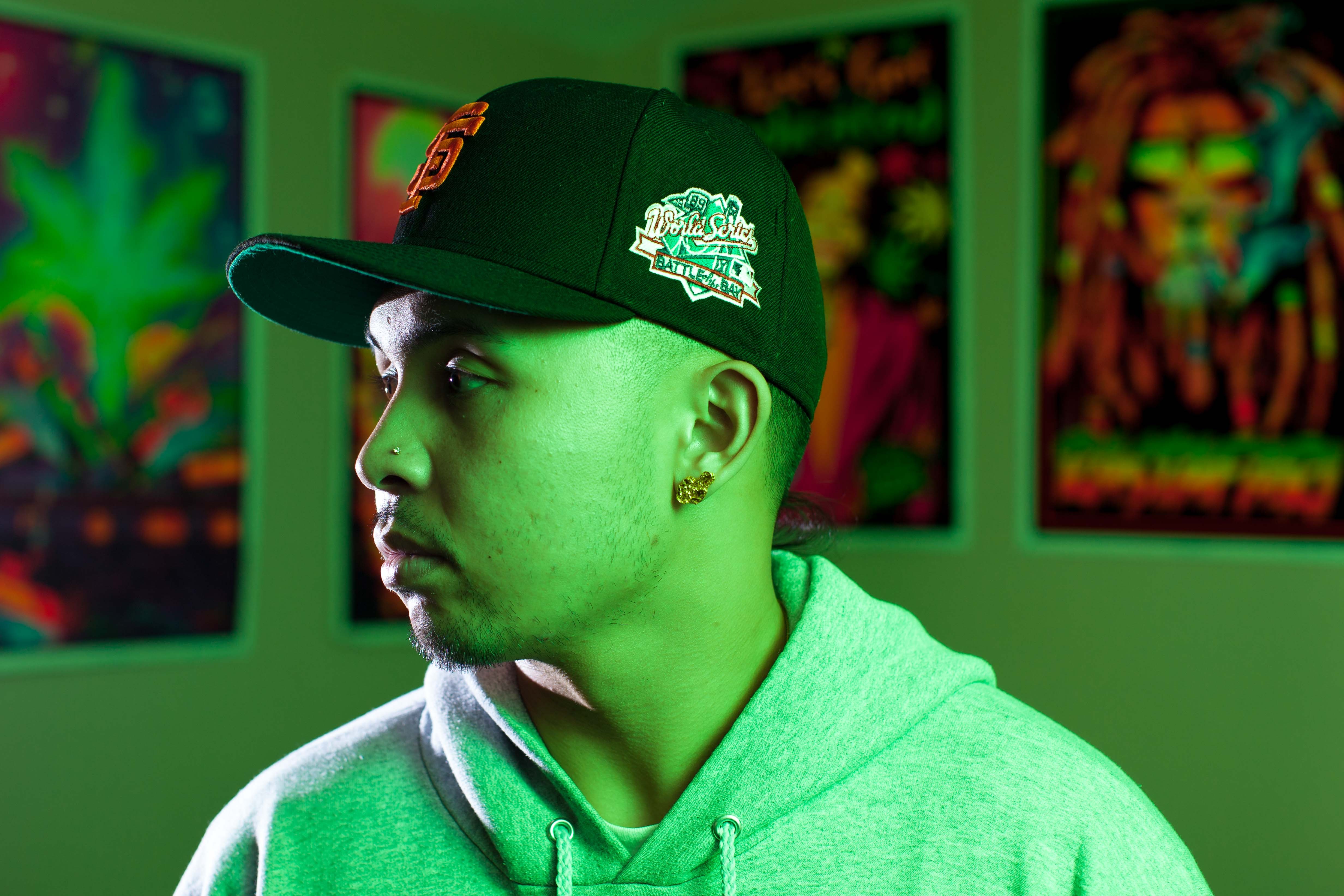
The Express last caught up with P-Lo, a rapper and HBK Gang’s most prolific producer, not long after he returned from tour promoting his collaborative album with Kool John, Moovie!, which made our list of top local releases of 2015. Fans have come to know P-Lo through his bare-bones, minimalist slappers that are deeply indebted to the hyphy movement. Apart from producing Moovie! in its entirety, his recent productions have included Nef the Pharaoh’s “Meantime” and Jay Ant’s “Let Me Ball,” which he co-produced with Jay Ant and Tario.
See more: Welcome to the Shmoplife Top Fifteen Local Releases of 2015
[jump]
Last week, P-Lo announced that he’d be releasing a surprise mixtape today (not Beyonce-level surprise, but still), Before Anything — a seven-track project that showcases his dimensionality as an artist. While the project certainly has its turnt-up moments (“In That” is irresistibly catchy and the most likely track to incite a mosh pit at a function), it also highlights P-Lo’s penchant for R&B production and sensual lyricism.
“It’s a lot of different moods. It’s very representative of who I am — I’m not always partying,” he said in a phone interview this morning, adding that few people know that he’s an R&B fan.
“Make It Last,” one of the project’s stand-out tracks, is particularly seductive, with Oakland singer 1-O.A.K. lending it a syrupy hook as P-Lo rhymes over a sensuous, slow-moving bass line with sparse, atmospheric keys. The song is a certifiable baby-making anthem, as is “Say You Will,” a devotional track in which P-Lo reflects on relationships and loyalty.
P-Lo said Before Anything is the first installment for a three-part series. He plans to follow it up with two more mixtapes: More Than Anything and Anything Is Possible. Stream the new project below and catch P-Lo at The New Parish on January 31 for his first headlining show with support from Noodles and 1-O.A.K.
This year’s High Times Southern California Medical Cannabis Cup is turning into a veritable Coachella of Chronic.
[jump]
Cannabis contest season runs year-round in California now, and organizers of the pot magazine’s fifth annual bacchanalia in San Bernardino have stretched the SoCal Cannabis Cup into two weekends this year (Jan. 30–31, and Feb. 5, 6, and 7), instead of just one.
And the music lineup has become downright enviable, featuring: The Roots, De La Soul, Wiz Khalifa, Method Man & Redman, and just announced — Ghostface Killah and Killah Priest. Tickets start at $55 per day and are limited to adults. A medical marijuana recommendation is required to consume pot in designated toking areas. Doctors are usually on-hand to write recommendations.
As usual, there will be thousands of different medical marijuana products, formulations, and accessories on display, for sale, or given away at the sprawling event, which takes place about an hour outside of Los Angeles in the City of San Bernardino.
The event is a real gift to Inland Empire patients, because San Bernardino city and county has some of the state’s poorest access to life-saving medical cannabis products.
While pot shops remain banned, San Bernardino County is home to roughly 120 gun stores, as well as America’s most recent ISIL-inspired mass shooting.
San Bernardino also went bankrupt in 2012, and fired one-quarter of its police force. Since then, massive marijuana parties at the National Orange Show (NOS) Center have become a rich source of revenue.
The NOS Center is booked for two, huge hash celebrations: the ABRACADABS Cup March 26, and the 2016 Chalice Festival July 9.
1. Backers of a November ballot measure that would raise the minimum wage to $15 an hour in California by 2021 turned in petition signatures to the state, the Chron reports. Currently, about 4 million California workers make less than $15 an hour. The wage increase is being pushed by the SEIU-United Healthcare Workers West and is opposed by many businesses in the state. The Service Employees International Union’s state council is collecting signatures for a separate measure that would also raise the minimum wage to $15 an hour — but by 2020.
2. Childhood vaccination rates have soared in Oakland and Alameda County thanks to a new statewide mandate that eliminated the so-called “personal belief” exemption and requires all schoolchildren to be vaccinated unless they have a medical excuse. KQED reports (h/t Rough & Tumble) that vaccination rates in Oakland public schools jumped from 74 percent in 2014–15 to 97 percent this year. In Alameda County overall, rates increased from 89 percent to 97 percent.
3. Pro-development members of the California Coastal Commission, which is in charge of protecting the state’s coastline, are attempting to oust Executive Director Charles Lester, who is backed by environmentalists, Capitol Weekly reports (h/t Rough & Tumble). The pro-development coalition, which is aligned with Governor Jerry Brown, has been in a fight with environmentalists over the future of the California Coast.
Aries (March 21–April 19): The next four weeks could potentially be a Golden Age of Friendship — a state of grace for your web of connections; a lucky streak for collaborative efforts. What can you do to ensure that these cosmic tendencies will actually be fulfilled? Try this: Deepen and refine your approach to schmoozing. Figure out what favors would be most fun for you to bestow, and bestow them. Don’t socialize aimlessly with random gadabouts, but rather gravitate toward people with whom you share high ideals and strong intentions.
Taurus (April 20–May 20): On a clear day, if you stand at the summit of Costa Rica’s Mount Irazú, you can see both the Atlantic and Pacific Oceans. It’s not hard to get there. You can hop a tourist bus in the nearby city of San José and be 11,200 feet high two hours later. This is a good model for your next assignment: Head off on a stress-free jaunt to a place that affords you a vast vista. If you can’t literally do that, at least slip away to a fun sanctuary where you’ll be inspired to think big thoughts about your long-range prospects. You need a break from everything that shrinks or numbs you.
Gemini (May 21–June 20): A filmmaker working on a major movie typically shoots no more than four pages of the script per day. A director for a TV show may shoot eight pages. But I suspect that the story of your life in the near future may barrel through the equivalent of 20 pages of script every 24 hours. The next chapter is especially action-packed. The plot twists and mood swings will be coming at a rapid clip. This doesn’t have to be a problem as long as you are primed for high adventure. How? Take good care of your basic physical and emotional needs so you’ll be in top shape to enjoy the boisterous ride.
Cancer (June 21–July 22): The city of Paris offers formal tours of its vast sewer system. Commenting at an online travel site, one tourist gave the experience five stars. “It’s a great change of pace from museums full of art,” she wrote. Another visitor said, “It’s an interesting detour from the cultural overload that Paris can present.” According to a third, “There is a slight smell but it isn’t overpowering. It’s a fascinating look at how Paris handles wastewater treatment and clean water supply.” I bring this up, Cancerian, because now is a favorable time for you to take a break from bright, shiny pleasures and embark on a tour of your psyche’s subterranean maze. Regard it not as a scary challenge, but as a fact-finding exploration. What strategies do you have in place to deal with the messy, broken, secret stuff in your life? Take an inventory.
Leo (July 23–Aug. 22): “When I look at a sunset, I don’t say, ‘Soften the orange a little on the right hand corner, and put a bit more purple in the cloud color.'” Pioneering psychologist Carl Rogers was describing the way he observed the world. “I don’t try to control a sunset,” he continued. “I watch it with awe.” He had a similar view about people. “One of the most satisfying experiences,” he said, “is just fully to appreciate an individual in the same way I appreciate a sunset.” Your assignment, Leo, is to try out Rogers’ approach. Your emotional well-being will thrive as you refrain from trying to “improve” people — as you see and enjoy them for who they are.
Virgo (Aug. 23–Sept. 22): The future is headed your way in a big hurry. It may not be completely here for a few weeks, but even then it will have arrived ahead of schedule. Should you be alarmed? Should you work yourself into an agitated state and draw premature conclusions? Hell, no! Treat this sudden onrush of tomorrow as a bracing opportunity to be as creative as you dare. Cultivate a beginner’s mind. Be alert for unexpected openings that you assumed would take longer to appear.
Libra (Sept. 23–Oct. 22): More than one-third of all pregnancies are unintended. The two people involved aren’t actually trying to make a baby, but their contraceptive measure fails or isn’t used at all. According to my analysis, you heterosexual Libras are now more prone to this accidental experience than usual. And in general, Libras of every sexual preference must be careful and precise about what seeds they plant in the coming weeks. The new growth you instigate is likely to have far-reaching consequences. So don’t let your choice be reckless or unconscious. Formulate clear intentions. What do you want to give your love to for a long time?
Scorpio (Oct. 23–Nov. 21): I was a rock musician for years, which meant that I rarely went to bed before dawn. I used to brag that my work schedule was from 9 to 5 — 9 p.m. to 5 a.m., that is. Even after I stopped performing regularly, I loved keeping those hours. It was exhilarating to be abuzz when everyone else was asleep. But two months ago, I began an experiment to transform my routine. Now I awake with the dawn. I spend the entire day consorting with the source of all life on earth, the sun. If you have been contemplating a comparable shift in your instinctual life, Scorpio — any fundamental alteration in your relationship to food, drink, exercise, sleep, perception, laughter, love-making — the next few weeks will be a favorable time to do it.
Sagittarius (Nov. 22–Dec. 21): You Sagittarians are often praised but also sometimes criticized for being such connoisseurs of spontaneity. Many of us admire your flair for unplanned adventure, even though we may flinch when you unleash it. You inspire us and also make us nervous as you respond to changing circumstances with unpremeditated creativity. I expect all these issues to be hot topics in the coming weeks. You are in a phase of your cycle when your improvisational flourishes will be in the spotlight. I, for one, promise to learn all I can from the interesting detours that result from your delight in experimentation.
Capricorn (Dec. 22–Jan. 19): Capricorn world-changer Martin Luther King Jr. was arrested and sent to jail on 29 different occasions. His crimes? Drawing inspiration from his Christian faith, he employed nonviolent civil disobedience to secure basic civil rights for African Americans. He believed so fiercely in his righteous cause that he was willing to sacrifice his personal comfort again and again. The coming months will be a favorable time to devote yourself to a comparable goal, Capricorn. And now is a good time to intensify your commitment. I dare you to take a vow.
Aquarius (Jan. 20–Feb. 18): The birds known as mound-builders are born more mature than other species. As soon as they peck themselves out of their eggs, they are well-coordinated, vigorous enough to hunt, and capable of flight. Right now I see a resemblance between them and many of you Aquarians. As soon as you hatch your new plans or projects — which won’t be long now — you will be ready to operate at almost full strength. I bet there won’t be false starts or rookie mistakes, nor will you need extensive rehearsal. Like the mound-builders, you’ll be primed for an early launch.
Pisces (Feb. 19–March 20): You are not purely and simply a Pisces, because although the sun was in that astrological sign when you were born, at least some of the other planets were in different signs. This fact is a good reminder that everything everywhere is a complex web of subtlety and nuance. It’s delusional to think that anyone or anything can be neatly definable. Of course it’s always important to keep this in mind, but it’s even more crucial than usual for you to do so in the coming weeks. You are entering a phase when the best way to thrive is to know in your gut that life is always vaster, wilder, and more mysterious than it appears to be on the surface. If you revere the riddles, the riddles will be your sweet, strong allies.
Jerry Brown basked in adulation during his whirlwind trip to Paris, and the evening of December 8 figured to offer more of the same. Standing alongside governors of states and provinces from Brazil, Mexico, and Peru, California’s governor planned to tout his state’s leadership role on global climate policy. The event was one of 21 presentations that Brown delivered during a five-day swing through France during the United Nations Framework Convention on Climate Change (COP 21). His busy schedule included a stately private meeting with UN Secretary General Ban Ki Moon and presentations at events organized by the French, German, Chinese, and US governments.
The December 8 event was held at a mid-19th-century-mansion-turned-hotel and was hosted by the Governors’ Climate and Forests Task Force, which is a collaboration of 29 states and provinces in forest-rich countries that are preparing to join a program called Reducing Emissions from Deforestation and Forest Degradation (REDD). Crucially, though, it was Brown’s only Paris presentation to which non-invited members of the public could purchase tickets.
Jeff Conant of Friends of the Earth.
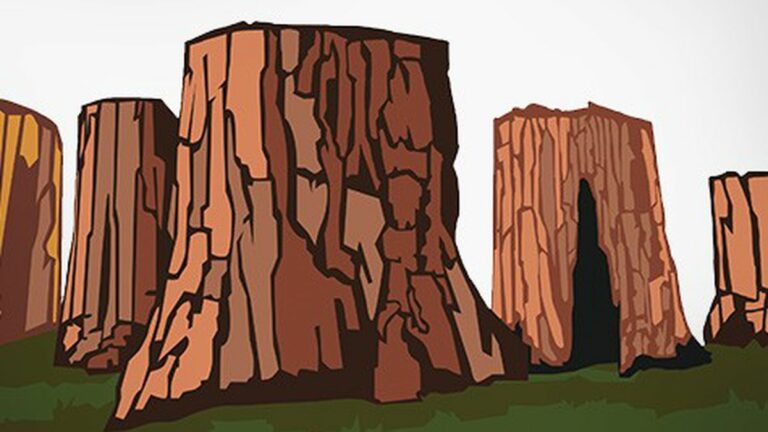
Credits: Bert JohnsonThe state’s cap-and-trade program gives timber coompanies “credits” for clear-cutting.
Credits: Jodi Frediani
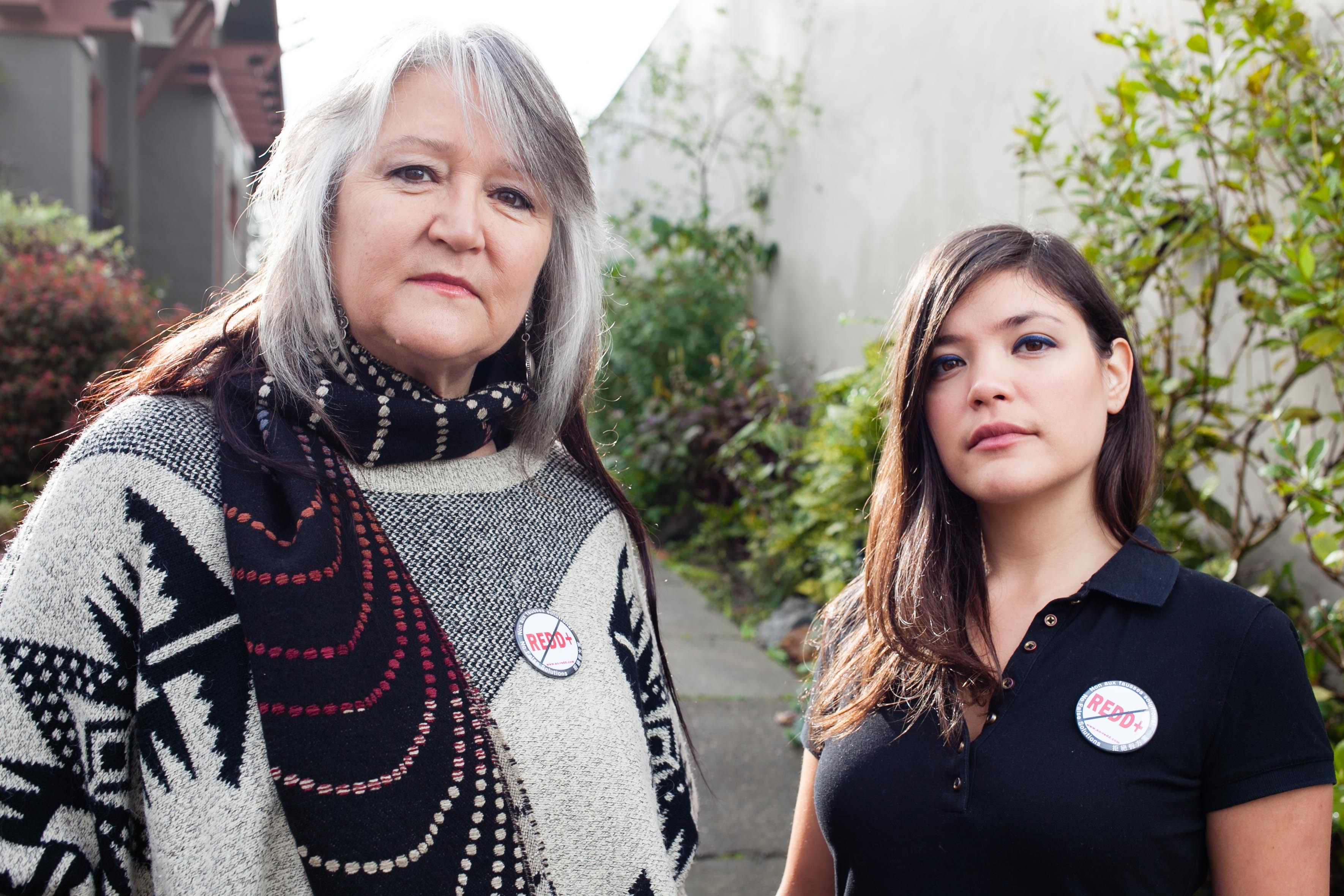
As Brown concluded his remarks, Pennie Opal Plant, an East Bay resident and member of the group Idle No More Solidarity San Francisco Bay, stood up near the front of the room, directly in front of the governor. “Richmond, California says ‘no’ to REDD!” she shouted, ‘”no’ to evicting indigenous people from their forests, and ‘no’ to poisoning my community!”
About thirty people, who had dispersed themselves throughout the room to avoid prior suspicion of coordinated dissent, soon joined in a chant of “No REDD! No REDD!”
Organizers quickly escorted the flustered Brown to a nearby exit. Before disappearing, the governor claimed to agree with the protesters, witnesses said.
Credits: Illustration by Roxanne Pasibe
Brown and California are widely regarded as global leaders in the fight against climate change in large part because of the state’s cap-and-trade program, which was authorized by the 2006 California Global Warming Solutions Act (Assembly Bill 32). The law caps the total amount of carbon emissions in the state and is designed to reduce emissions by allowing polluters to buy “credits” or “offsets” from carbon-saving projects or to sell credits themselves if they’ve significantly reduced their own emissions. California’s largest polluters — including power plants and refineries, like the Chevron refinery in Richmond — can also invest in carbon-saving projects elsewhere in the United States, or in Québec, on a commodity exchange market. The oil giant Shell, for example, is using forests in Michigan to offset its carbon dioxide (CO2) emissions from its refinery in Martinez.
California’s cap-and-trade program is the first of its kind in the nation. And the state’s leaders are pushing to become the only jurisdiction in the world that also offsets its climate pollution through investments in tropical forest regions in the Southern Hemisphere. The common name for such efforts is REDD. Several industrialized countries, as well as the World Bank and the United Nations, have already invested money in REDD pilot projects.
Proponents say that REDD is urgently needed to prevent the degradation and loss of forests, a problem that accounts for roughly 20 percent of greenhouse gas emissions worldwide — more than the entire global transportation sector and second only to the energy sector.
But critics warn that California’s adoption of REDD would have far-reaching human rights and environmental consequences. Initial investments by the World Bank and United Nations in REDD have already precipitated violent evictions of indigenous people from their forested homelands in the Democratic Republic of the Congo and Kenya — to make way for carbon-saving projects. In fact, countless activists and grassroots organizations regard REDD as a recipe for a global land grab, prompting them to dub it a case of “CO2lonialism.”
Given California’s trailblazing status with regard to climate policy, its adoption of REDD would likely trigger similar policies throughout the globe. “People all over the world are terrified that California will open the floodgates on REDD,” said Ayse Gürsöz, an Oakland resident who was among those who joined in chanting “No REDD!” at Governor Brown in Paris last month. A video producer and volunteer for the Indigenous Environmental Network, Gürsöz has gathered video testimonies in Africa and Peru from indigenous people who oppose California’s program.
Yet despite the opposition, California appears poised to adopt REDD. And Brown might do so at a time when many environmentalists have increasingly challenged the climate benefits of the state’s own cap-and-trade program. They note that California’s cap-and-trade system allows large lumber companies to generate and sell carbon credits when they engage in standard logging practices and clear-cut forests. As a result, cap-and-trade in California is proving to be a financial boon for timber corporations that practice many of the same forms of destructive logging that occur in tropical regions of the Global South.
The world’s forests are in deep trouble. Since 1970, the year of the first Earth Day celebration in the United States, more than 1 billion acres of tropical forest have vanished: They’ve been cut or burned, or have died from insects and disease. The amount of forest lost equals an area about half the size of the continental United States. The environmental group Rainforest Action Network estimates that 2.5 acres of forest are cut worldwide every second — equivalent to two and a half football fields — which translates to about 215,000 acres every day, an area larger than New York City.
In the past several years, though, conservation of these forests has gained a fresh impetus as many scientists have begun to view them through a new lens: as global sponges that soak up heat-trapping carbon dioxide molecules emitted from burning coal, oil, and natural gas. Ecologists have started to measure the ability of every major forest in the world to absorb CO2, a process known as sequestration.
They have figured out — with the precise numbers deduced only recently — that forests have been absorbing the equivalent of about one-quarter of the carbon dioxide emitted from burning fossil fuels and other activities. Trees store an amount equal to the emissions from all of the world’s cars and trucks.
The imperative to preserve the world’s forests in order to stave off catastrophic climate change has led to arguments that they be monetized and sold as credits or offsets to greenhouse gas emitters who need them to comply with regulatory limits. And under cap-and-trade programs, such as that in California, owners of forestland, including timber companies, can generate carbon credits after they enlist licensed certifiers who use complex methodologies to tally the volume of carbon dioxide being stored in the trees on their property.
Critics contend that offsets awarded to lumber companies represent a loophole that could undermine greenhouse gas reduction efforts. They say pledges of carbon reductions by timber corporations cannot be considered real, because those companies might have conducted the same amount of logging anyway without the extra money from selling credits. “Poorly measured offsets could lead to an increase in emissions,” said Brian Nowicki of the conservation group Center for Biological Diversity.
Under California’s rules, businesses can offset up to 8 percent of their total emissions through purchasing credits. The number of metric tons of carbon dioxide emissions allowed in the state is capped, and the allowable levels of pollution are steadily reduced, creating an economic incentive for companies to cut emissions. The state’s overall emissions cap declined 2 percent each year from 2012 through 2014. From 2015 to 2020, the cap is dropping by 3 percent per year.
Because companies are required to purchase pollution permits, the state is expected to collect about $5 billion a year in fees by 2020, with the bulk of the money being recycled into clean-energy projects, the construction of housing near mass transit hubs, and building the state’s high-speed rail system.
But, overall, California’s cap-and-trade system has split environmental organizations. Many progressive groups question its effectiveness, while some more moderate ones — including The Nature Conservancy, Pacific Forest Trust, and the Natural Resources Defense Council — have joined state officials and large timber companies in supporting it.
“It’s been a huge success,” said Laurie Wayburn, president of the Pacific Forest Trust, which has been instrumental in developing California’s program. “This really has gone from a what-are-you-smoking kind of reception to every single forest owner who manages their land looking at the protocols as part of a business approach.”
But both the California and European Union cap-and-trade systems have countless critics, perhaps the most famous of whom is Pope Francis, who surprised many observers last year when he took the programs to task in his wide-ranging encyclical on the environment and global warming. “The strategy of buying and selling ‘carbon credits’ can lead to a new form of speculation which would not help reduce the emission of polluting gases worldwide,” Francis wrote.
“This system seems to provide a quick and easy solution under the guise of a certain commitment to the environment, but in no way does it allow for the radical change which present circumstances require,” Francis continued. “Rather, it may simply become a ploy [that] permits maintaining the excessive consumption of some countries and sectors.”
The legislative history of California’s cap-and-trade program dates to 2002, when then-state Senator Byron Sher, D-Palo Alto, sponsored Senate Bill 812, which helped create California’s first voluntary carbon market. Jeff Shellito — a former longtime aide to Sher who worked on the bill — made it clear in a recent interview that he thinks the program has become irredeemably corrupted. And he identified the culprits. “The process went off the rails ethically,” he said, “when it allowed corporate timber interests like Sierra Pacific Industries to rewrite the protocols to fit their business models.”
SB 812 was originally sponsored by Pacific Forest Trust, and it expanded the responsibilities of the California Climate Action Registry, a Los Angeles-based nonprofit. SB 812 directed the registry, which was created two years earlier by the state legislature, to adopt procedures for monitoring, calculating, and certifying CO2 emissions resulting from the conservation of California’s native forests. The registry’s rules were designed to reward individuals and companies doing the most to protect California’s forests. Specifically, they forbade clear-cutting of forests included in carbon-sequestration projects and required offset-project developers to establish forest conservation easements that restricted logging and did not allow the forest to be converted to other land uses.
Four years later, the legislature passed AB 32, thereby established a mandatory carbon trading market. And the state’s powerful timber industry — particularly, Sierra Pacific Industries (SPI), a corporate behemoth based in Redding — was determined to modify the registry’s rules. Of the roughly 4.5 million acres of California land zoned for timber production, SPI owns about one-third, making it, by far, the state’s largest private landowner. The main architect of the company’s success is Archie Aldis “Red” Emmerson, who, according to Forbes, is worth $3.6 billion.
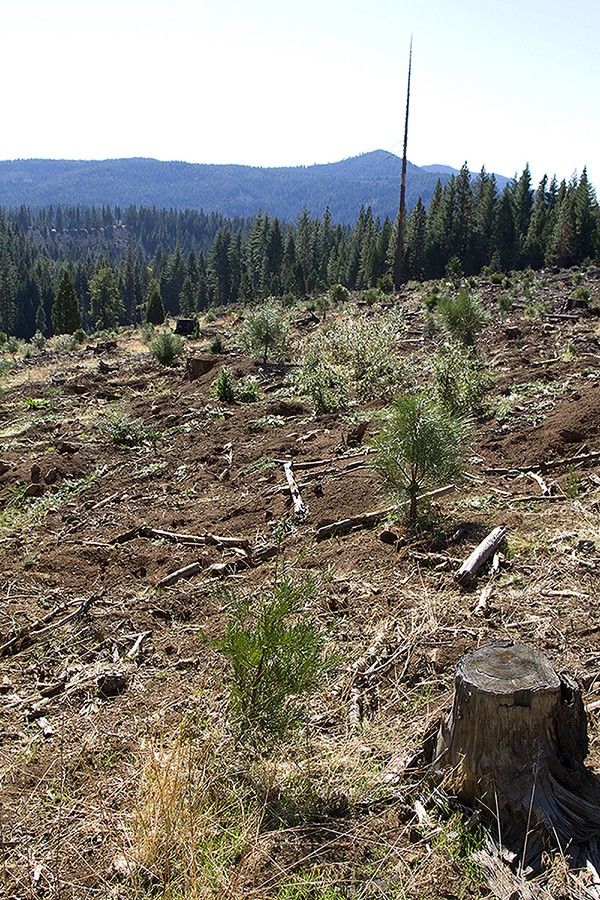
While clear-cutting in national forests was phased out in the late Nineties (except for so-called “salvage logging” following fires), SPI still depends heavily on this method of denuding its own forestland. Between 1999 and 2006, SPI received approval from the California Department of Fire and Forestry Protection (Cal Fire) to clear-cut roughly 239,300 acres of forest in the Sierra, Klamath, and Coast mountain ranges, according to a study by the environmental group Forest Ethics. Since then, SPI has continued a similar rate of clear-cutting. Other large timber firms, such as Seattle-based Green Diamond Resources Company, which owns more than 400,000 acres of mainly redwood and Douglas fir forestland in Humboldt, Del Norte, and Trinity counties, also rely heavily on clear-cutting.
Under intense pressure from the timber lobby, the California Air Resources Board in 2009 jettisoned the registry’s forestry protocols, which had stemmed from Sher’s 2002 legislation. CARB then rubber-stamped a new set of protocols that had been developed by a new “stakeholders” group. This 27-member group included a who’s who of timber company managers and foresters, staff members of large conservation organizations, academics, and government representatives. Among them was an SPI forester named Ed Murphy.
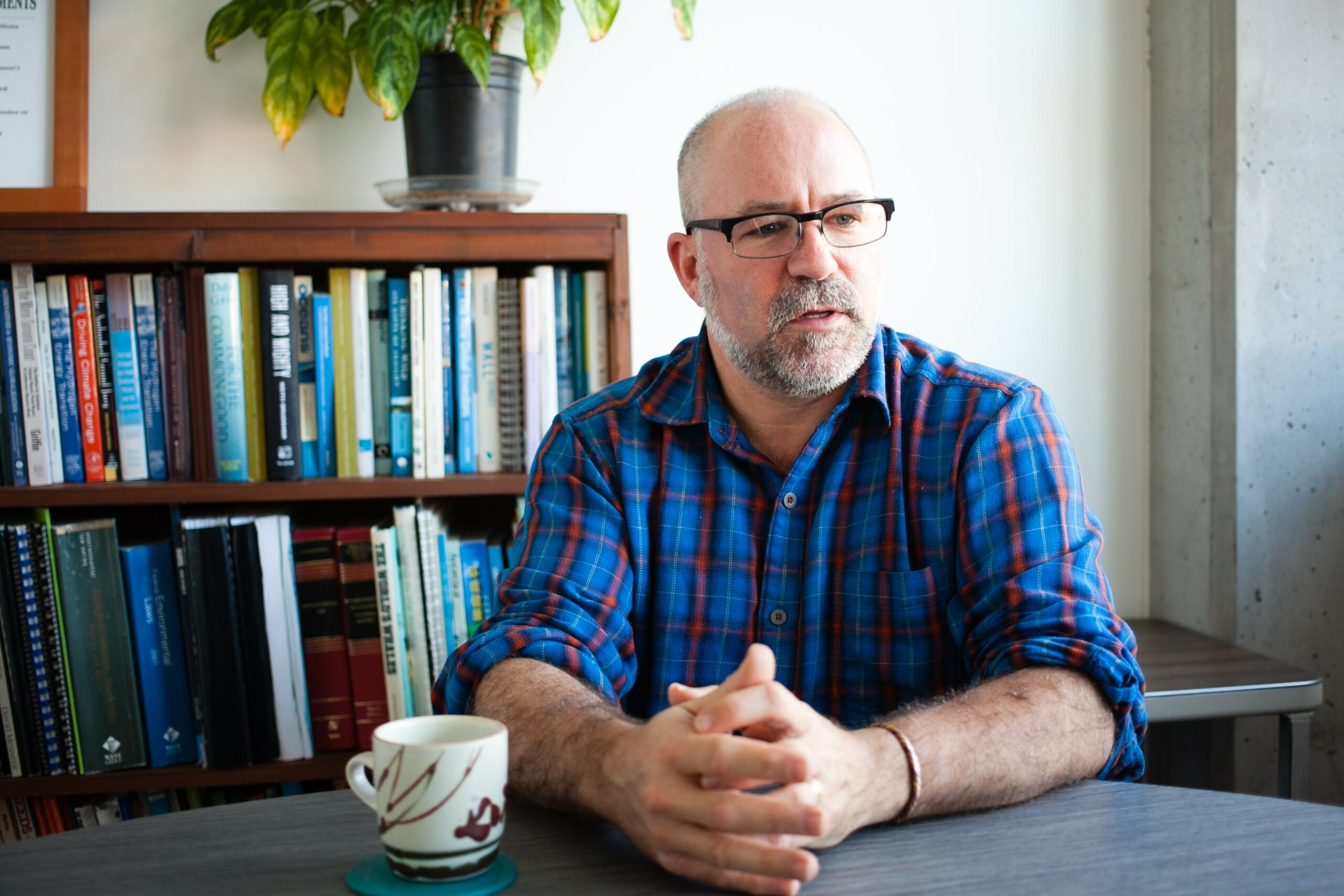
In October 2009, Nowicki of the Center for Biological Diversity, logged onto CAR’s website from his Sacramento office. He said that according to the “Properties” function in the PDF that he downloaded, the final person to edit the state’s new forest protocols before CAR posted them online was Ed Murphy.
Dominick DellaSala questions the timber industry’s claims that it sequesters more carbon than it emits.
Credits: Courtesy of Dominick DellaSala
The new protocols, which CARB adopted in 2010, lifted the requirement to place forestland in conservation easements in exchange for assigning them carbon credits, in favor of a practice called “improved forest management,” which essentially permits traditional logging under the standards established in 1973 by the California Forest Practice Act. The new protocols also allowed timber operators to generate carbon credits when they clear-cut a forest, so long as the cut is no larger than forty acres in size.
University of Oregon forestry professor Mark Harmon was among the many critics of CARB’s new protocols. A member of the US Environmental Protection Agency’s Biogenics Carbon Emissions Panel, which is reviewing the EPA’s accounting framework for CO2 emissions from biologically based materials, including forests and soil, Harmon is regarded as a leading expert on the dynamics of carbon storage and sequestration. “I have to say I was a bit shocked by what they were proposing,” Harmon recalled in a recent interview. “Frankly, it didn’t make scientific sense. Timber harvest, clear-cutting in particular, removes more carbon from the forest than any other disturbance, including fire. The result is that harvesting forests generally reduces carbon stores and results in a net release of carbon to the atmosphere. So, if the goal was to increase carbon storage in US forests, the California program totally missed the mark.”
But proponents of the revised protocols staunchly defend them. They note that timber companies must replant the areas they clear-cut in order to generate carbon credits, and that the projects must demonstrate that they are meeting carbon storage targets over a one-hundred-year span.
However, critics note that clear-cutting produces serious environmental problems. It eliminates canopy cover, thereby warming the soil surface and increasing the rate at which logging debris and tree roots decompose, resulting in a dramatic increase in carbon emissions. They also argue that, rather than reducing fossil fuel emissions at the source — like at refineries and power plants — cap-and-trade provides extra income for business-as-usual timber operations.
“As it’s set up, [California’s cap-and-trade] program allows timber companies to get millions of dollars in carbon credits for the sorts of logging they are already doing,” Nowicki noted.
Sierra Pacific Industries has already developed more than 20 projects involving more than 200,000 acres of forestland. The projects have been approved for carbon offsets on the state’s voluntary market, and two of them are on the verge of generating offsets to be traded as part of California’s cap-and-trade program. They are the Buck Mountain Forest Improvement Project, which encompasses 12,487 acres in Siskiyou County, and the Sacramento River Canyon Forest Improvement Project, which covers 16,491 acres nearby. CARB staffers are currently performing spot checks on each property in advance of approving SPI’s sale of offsets.
In an interview, Mark Pawlicki, director of Corporate Affairs and Sustainability at Sierra Pacific Industries, said he was unable to say how much these projects are worth. But Pawlicki argued that the projects show that his company is a key player in preventing climate change, and that its practices represent an optimal way to sequester greenhouse gases. “We think that forestry has a great story to the tell, and that the more forests we grow, and continue to keep in a healthy state, the better off the air is,” he said. “We can continue to harvest as long as we grow at least the volume we sell in the carbon market, and as long as we maintain that level of carbon storage for one hundred years. And we’re doing that.”
The forestry protocols stakeholders group included three members of Pacific Forest Trust. The organization’s president, Wayburn, also defended the effectiveness of the protocols, in spite of the inclusion of timber industry-friendly provisions. If environmentalists want to change logging practices, she said, they should focus on the existing laws related to forest management. She noted that CARB essentially adopted the logging practices established in the 1973 Forest Practice Act, and deemed them helpful in the fight against climate change. “If your goal is to change forest practices, you should focus on changing the Forest Practice Act,” she said. “That’s the law that governs logging in the state.”
CARB’s controversial protocols also made California the first place in the world to assign carbon credits to wood products, such as decking. In an interview, CARB spokesperson Dave Clegern defended the inclusion of wood products in the agency’s accounting. “The main point to keep in mind with carbon in wood products is that the carbon must stay in place for at least one hundred years,” he said. “So we’re talking about wood used in large items intended to be permanent, like homes.”
But professor Harmon’s research raises doubt about this aspect of CARB’S program as well. In a 1994 study of carbon storage in wood products using historical data and modeling in the states of Washington and Oregon, Harmon and two colleagues found that only 23 percent of carbon in wood products remained sequestered from 1902 to 1992. Most of the rest had been disposed of and is decomposing in landfills.
Although much of the global zeal to protect forests focuses on tropical regions of the Global South, recent scientific studies have turned conventional wisdom on its head. An analysis of NASA satellite imagery, for example, found that forest disturbance from logging in the southern United States is actually four times greater than that in the South American rainforests on a per-acre basis.
Moreover, before the advent of modern logging, Northern California and the Pacific Northwest housed an “unprecedented carbon budget,” according to Jerry Franklin, a University of Washington professor of ecosystem analysis who is known as “the father of old-growth research.” As Franklin explained at a conference sponsored by Pacific Forest Trust in Arcata in August 2014, the conifer-dominated Pacific temperate rainforest, which runs from Prince William Sound in Alaska through the British Columbia coast to California’s Central Coast, contains the largest mass of living and decaying material of any ecosystem in the world. Redwood forests, he noted, exceed the capacity of any on Earth to store carbon “by a factor of three or four.” The mixed Douglas fir and hardwood forests that grow adjacent to the redwoods, as well as the montane-mixed conifer ecosystems of the Cascades and Sierra mountain ranges (where Sierra Pacific Industries conducts its clear-cuts), among other forests of the so-called “Pacific Slopes,” also play a notable role in regulating atmospheric carbon.
But while much global attention has focused on emissions caused by deforestation in the Global South, the United States has broadly failed to prevent degradation of its own forests in the name of fighting climate change. For example, the US Department of Agriculture has determined that the Tongass National Forest in southwestern Alaska — the world’s largest continuous stretch of temperate rainforest — accounts for 8 percent of all forest carbon stored in the United States. But a plan approved by the Obama administration will allow an estimated 676,000 board-feet of old-growth in the forest, or about 27,000 acres, to be logged in the next ten years. The administration has promised to transition away from old-growth logging after that, but the phase-out won’t be complete for another fifteen years.
Credits: Illustration by Roxanne Pasibe
Last month, John Talberth of the Center for Sustainable Economy in Oregon, conducted a climate assessment of Oregon’s forestry practices and determined that logging and clear-cutting were emitting roughly the same amount of greenhouse gases as those produced each year by 2 million vehicles, or seven coal-fired power plants. That makes forestry one of the biggest polluters in the state. Yet Oregon — like other US states — has failed to account for these emissions in its climate mitigation planning.
“Oregon has not done proper accounting,” said Dominick DellaSala, president and chief scientist of the Geos Institute in Ashland, Oregon, one of the sponsors of the climate assessment, in an interview. “They’ve been unquestioningly accepting what the timber industry is saying, which is, ‘We’re a net sink for carbon.'” DellaSala was referring to the fact that the industry maintains that it sequesters more carbon than it emits.
California Air Resources Board chairperson Mary Nichols has defended the cap-and-trade protocols by arguing that rules established by the 1973 Forest Practice Act are the most stringent in the world. But environmentalists say the protections that the rules afford are limited, as witnessed by the ongoing degradation of the state’s forests since the state adopted the rules. One of the most rapid depletions of California’s remaining redwood forests occurred in the 1980s and ’90s, when companies such as MAXXAM, Louisiana-Pacific, and Georgia-Pacific (which is now owned by the right-wing Koch brothers) logged the majority of the remaining mature redwood forests.
Even in the Nineties, the main political bulwark against the adoption of stronger forest protections was Sierra Pacific Industries. Former Cal Fire director Richard Wilson called SPI’s Red Emerson “a genius at generating profitable lumber from a mill.” But Wilson said his efforts in the Nineties to reform California forestry practices to be more sustainable failed due to SPI’s opposition.
“The whole [California] Board of Forestry was sort of an SPI cabal,” Wilson recalled. “Forest practices were not going to see much change in California, and that’s mainly because of the relationship between Sierra Pacific, [then-Governor] Pete [Wilson], and the Board of Forestry.”
SPI has also had close ties with the administrations of Gray Davis, Arnold Schwarzenegger, and Jerry Brown. According to data from the California Secretary of State’s Office, the company donated $115,000 to the 2012 campaign for Proposition 30, Brown’s tax measure. This contribution has raised eyebrows among environmentalists, particularly in light of the Associated Press’ revelation last year that Brown had fired two state regulators who stood in the way of expedited oil leases in Southern California, after which he received a $500,000 donation toward the same campaign from the company that stood to benefit the most from the firings — Occidental Petroleum.
According to critics, timber industry influence has long caused the agency that regulates timber harvesting, Cal Fire, to be an industry captive. Correspondence between Cal Fire staffers and Sierra Pacific Industries personnel, obtained via the California Public Records Act, strongly supports this view.
For example, in an April 26, 2013 document, Cal Fire’s Deputy Director of Resource Management, Duane Shintaku, who oversees the state’s timber harvest review process, coached a staffer on how to rebuff concerns that the California Department of Fish and Wildlife had raised about the detrimental impacts of SPI’s herbicide spraying and clear-cutting on the gene pool of a protected plant species — the Klamath Manzanita.
“The governor is the one who could force immediate change at Cal Fire,” said a Cal Fire staffer who spoke on the condition of anonymity. “But his integrity is in question.”
Another revealing incident took place in 2014, after a California Air Resources Board staffer issued a proposal that sought to tighten restrictions on clear-cutting as a feature of carbon offsets projects. At the December 2014 Board of Forestry meeting, Executive Officer George Gentry sought permission to send CARB a letter on the board’s behalf. The board approved, directing him to ask CARB formally for clarifications about its intentions.
Yet in his actual December 15, 2014 letter, Gentry went beyond seeking clarification and instead actively backed the timber industry’s position, complaining that “recently proposed changes … may have the unintended consequences of preventing participation of over half of the private timberland base in California. The proposed changes may also conflict with the Forest Practice Rules of this [s]tate … the BOF has unanimously asked me to forward this concern to you.”
In a classic case of revolving-door politics, Gentry soon thereafter left the Board of Forestry to take a position as the vice president of Regulatory Affairs at the California timber industry’s main lobbying organization, the California Forestry Association. CARB later backed away from the proposal to curb clear-cutting, with the staffer involved saying her original proposal was misconstrued.
Pennie Opal Plant (left) and Ayse Gürsöz both chanted “No REDD” at Governor Brown in Paris last month.
Credits: Bert Johnson
As opponents of REDD and California forest protection activists alike regularly note, a forest is not just composed of inert stocks of carbon. Logging, the use of heavy equipment, and the spraying of herbicide before and after logging to kill native vegetation all can take a profound toll on soil and wildlife. Historically, logging has caused enormous quantities of soil erosion that discharge sediment into streams. Sedimentation results in flooding, landslides, diminished water quality, and scoured and destabilized streambeds (and damage to property). Streams become impaired. Fish suffocate.
In the Battle Creek watershed of the Sacramento River, which lies between Redding and Lassen National Park and Forest, SPI has logged 21,000 acres of forest since 1998. Battle Creek Alliance founder Marily Woodhouse, a resident of the western slopes of Mount Lassen, has campaigned for years for a ban on clear-cutting in California, due to its impacts on local residents, wildlife, and, indeed, climate change. “Sierra Pacific Industries is doing essentially the same things that are occurring in the Amazon,” she said. “Yet there it’s categorized as ‘bad’ while here it’s ‘no problem.'”
Throughout the Global South, indigenous people commonly depend on their traditional forested homelands as the basis of their cultures and subsistence. According to a 2008 World Bank study, areas in which indigenous people occupy or control their traditional territory encompass 22 percent of the world’s land surface and coincide with areas that hold 80 percent of the planet’s biodiversity. In addition, the greatest diversity of indigenous groups in the world reside in the globe’s largest tropical forest wilderness areas in the Americas (including the Amazon), Africa, and Asia, and 11 percent of world forestlands are legally owned by indigenous peoples and communities.
In October 2015, CARB released a white paper regarding its progress on establishing REDD as part of cap-and-trade. “CARB staff believes there is value in developing proposed regulatory amendments and pursuing a sector-based REDD linkage in time for the third compliance period of the Cap-and-Trade Program,” it stated, referring to the years 2017–2020. It notes that the “sub-national” governments that California is targeting for inclusion in cap-and-trade include Acre, Brazil and Chiapas, Mexico. Establishing such links, the paper notes, “could result in partnering on other mutually beneficial climate and low emissions development initiatives.”
Under the proposed program, the state would use satellite technology to track deforestation rates as a way to prevent “leakage” — curbing logging in one area while allowing logging in another. As the thinking goes, any attempt to do so would show up on the satellites. But critics note that moving bulldozers and chainsaws across state lines would still be perfectly legal under the program, even though this also represents leakage.
“Capital flows to where it finds a profit, and if there is money to be made in deforestation for whatever purpose — for palm oil or cattle ranching or hardwoods that are there — resource shuffling will lead to increased levels elsewhere,” said Nowicki of the Center for Biological Diversity. “All the concerns we had about US carbon credits under the California cap-and-trade program are bearing out, and the problems in this country will be even greater when it comes to international offsets.”
For Nowicki and other critics, concerns about human rights are every bit as important as these practical considerations. When California conducted a public forum in Sacramento concerning REDD last fall, Jeff Conant of Friends of the Earth was on hand, and Gary Hughes of the same organization was in Chiapas. The Chiapas region, which was the location of the well-known 1994 Zapatista rebellion, is also a hotbed of opposition to REDD. In 2012, when a previous meeting of the Governors’ Forest and Climate Task Force convened in the city, indigenous people gained entry to the proceedings and read a statement denouncing REDD.
“People on the ground there see REDD as a threat to their livelihood, to their connection with place and the land, in much the same way they perceive a timber company, a gold mine, or someone coming for fossil fuels,” Hughes said.
Corrections: The original version of this report stated that the Geos Institute conducted a climate assessment of Oregon’s forestry practices. The assessment was developed collaboratively by the Center for Sustainable Economy, the Geos Institute, and Oregon Wild. It also stated that 676,000 acres of old-growth forest in Tongass National Forest in Alaska would be logged in the next 10 years; it is actually 676,000 board-feet, or about 27,000 acres. It also stated that Marily Woodhouse lives on the eastern slope of Mt. Lassen. She lives on the western slope.
Sitting in a circle inside a community performance space in Richmond, not everyone seemed entirely comfortable with the task at hand — sharing intimate feelings in front of complete strangers. The roughly thirty participants were mostly Black and Latino youth, along with a smattering of community leaders and a few outsiders, like myself. But as each person took his or her turn, moments of honest reflection slowly emerged, and by the end, one young man stood to share his commitment to the group: A promise to connect to a family member serving a life sentence in prison. The earnest and solemn vow silenced the room.
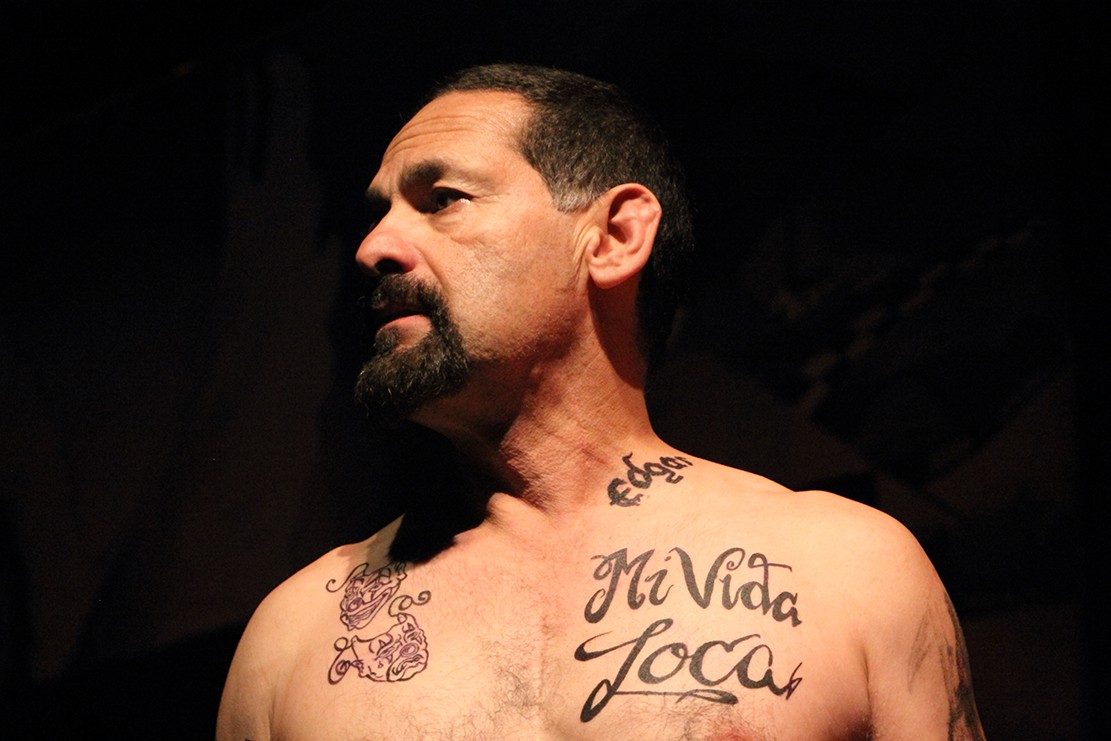
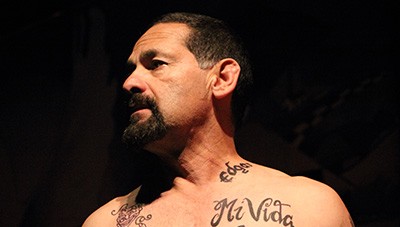
The healing circle, held last week, was one of three workshops tied to the performance of Placas: The Most Dangerous Tattoo, a play opening on Thursday at the East Bay Center for Performing Arts in Richmond, where the healing circle was also held. The play’s author, San Francisco resident and nationally recognized spoken-word artist Paul Flores, said moments like the one involving the young man’s commitment are what healing circles are intended to draw out.
Actor Ric Salinas in Placas.
Credits: John Liu
Paul Flores opened his eyes to the potential for Placas to be used a tool for sustainable change.
Credits: Jay Franco
“I’m looking for a moment of leadership from boys like him over the course of the two hours,” Flores said in a recent interview. “He went from being squirrely and jokey to committed to connecting back and setting an example for his other family members.”
On the surface, Placas is a play about Salvadoran gang life in the states. The word “placas” is barrio slang for a tattoo identifying an individual’s membership and unswerving loyalty to the gang. The play grapples with the practice of tattoo removal as a possible path for former gang members to show violence prevention workers, police, probation offices, and judges that they’ve renounced their past.
Actor Ric Salinas in Placas.
Credits: John Liu
The play premiered in San Francisco in 2012 and has been touring in California and across the nation on and off over the past three years. The circle I attended was part of a four-city tour sponsored by the California Endowment Center for Healthy Communities. The healing circles and other workshops are conducted before the play debuts in each city to address issues that are raised in the work. The Central American Resource Center, in partnership with the San Francisco International Arts Festival, commissioned Flores to write a play about tattoo removal in the wake of the 2008 slaying of Anthony Bologna and his two sons, Michael, 20, and Matthew, 16, in San Francisco’s Excelsior district. Police ultimately arrested Edwin Ramos, an MS-13 gang member who reportedly believed the victims were members of a rival gang.
The mainstream media was “attacking every Central American youth as a drug-dealing gang member,” Flores recalled. The resource center wanted a piece of theater that could speak to the beauty of Central and South American culture while also providing a humanistic portrayal of gang violence in its proper historical context.
With help from local journalist Josue Rojas and an incarcerated former gang member, Alex Sanchez, who acted as guides to the city’s street life, Flores began interviewing gang members and intervention workers. He also conducted a workshop with a cohort of fifteen young men, most of them members of the Norteño gang who were on probation and had court mandates to have their tattoos removed. Flores, with help from the nonprofit, National Compadres Network, conducted healing circles as a way to build trust with the cohort, which often led to stories that Flores would then use as material for the play.
The men also helped Flores write parts of the script, ensuring that everything from scenes depicting the initiation of new gang members to depictions of the father and son relationship in the play were authentic.
Flores sees the programming tied to the play, which also includes a documentary theater workshop and peacekeeping panel, as a platform for healing within the community. At the same time, Placas is, at its heart, the story of an estranged father seeking a second chance to connect with his son. It’s that relationship that universalizes the narrative, making it accessible even to audience members who don’t share in the play’s cultural context.
“Communities in crisis are made up of people just like us,” Flores said. “[This play] is about building love for people who are fucking despised … And, it’s a form of community building that can then start the transformative work in the community to create sustainable change.”
Nestled in a bedazzled booth in an over-the-top, Hong Kong-style cafe in Oakland Chinatown, Jader (Justin Edwards) sipped on a fluorescent green and orange drink while explaining how he measures the success of his performances. “I’ve literally gotten maybe one dollar in tips ever,” he said. “And I take that as a compliment.”
It’s not that Jader isn’t good enough at what he does. It’s that he’s too good.
“(Hana as) Megan” from A Pie Cools in an Open Window.”
Credits: Courtesy of the artist.
“Biomimicry (Robert)” from the series, Biomimicry
Credits: Courtesy of the artist.
Jader, who works as the executive coordinator for the Oakland Museum of California during the day, usually performs at drag nights or queer dance parties — and there are elements to his work that fit with that context. His most recent performance, at Vinyl in Downtown Oakland, for example, involved him lip-synching to the secret track on Alanis Morissette’s Jagged Little Pill while wearing “some Gillian Anderson wig that was on sale.” But he also has a taste for the grotesque that sets his work apart. That same performance also involved a bulging, prosthetic pregnant stomach and ended with a loud, bloody miscarriage. To Jader’s pleasure, the club’s patrons were disgusted.
For his #candydiet series, Jader (above) satirized his addiction to sweets.
Credits: Courtesy of the artist.
Jader’s preference is to irk his audience — not to entertain. When boiled down, his work aligns with fundamental art theory from artists like Bertolt Brecht: Thought-provoking art must demand a certain level of distance from its audience in order to allow space for critical thought. Or, in other words, kicking people out of their comfort zones is necessary to challenge the status quo.
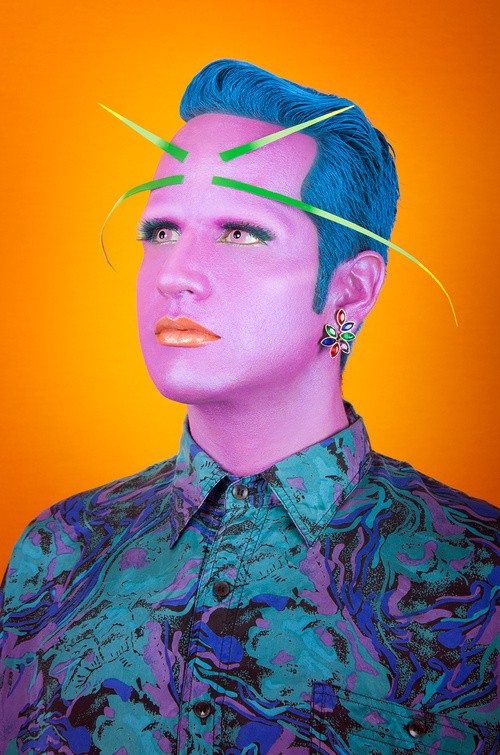
Discomfort generated by grotesque aesthetics is key for Jader’s visual art practice as well, but rather than gore, he uses camp. Jader specializes in theatric portraiture that channels the romantic kitsch of Pierre et Gilles, the creepy character development of Cindy Sherman, and the pop sensibility of David LaChapelle. He revels in artificiality, often taking it to a surreal extreme — achieving the opposite of most portrait-makers by disguising the identity of his subject rather than attempting to epitomize it. He goes as far as to transform his subject’s features, using special effects make-up or painting them entirely with neon paint, turning them into alien creatures.
“Being an image-maker today, I have no interest in reality at all,” said Jader. “There is a photo of fucking everything that you can see in real life somewhere on the internet. … I want to make something that no one has seen before, and the only way that I imagine doing that is through artifice, through fantasy.”
“Finger Lickin’ Good” from Bubble Guts.
Credits: Courtesy of the artist.
Jader’s 2014 “Biomimicry” series achieves that originality by projecting into the future — to a time when people can accessorize with genetic mutations, and the trend is to mimic motifs found in nature. Exquisitely lit in front of gradient backgrounds, the subjects appear in shades of colors, such as baby pink and chartreuse, some with talon-like nails, and others with long, whisker-like eyebrows that extend past their foreheads. All of the painstaking makeup is executed by Jader himself — a talent that originated in the ritual of creating drag looks for going out to queer clubs that he has perfected over the past few years with the help of YouTube tutorials. (Although he has hired a professional special-effects make-up artist for other projects in the past.) The subjects appear to inhabit a future where conventional indicators of gender and ethnicity are eclipsed by eccentric styling, an aesthetic that challenges notions of normality and makes room for differences that would be deemed “unnatural” by the conservative set.
“I think the ability to be queer is part of evolution, absolutely, and so I definitely think of this kind of mutation-based work as a continuation of that [evolution],” said Jader. “So many other species, their gender identity isn’t binary, and I think that that’s something to really be celebrated.”
Jader’s most recent series, which is currently on view at Shadow Office (308 15th St., Oakland) through February 5, is called “Bubble Guts.” It’s his attempt at divorcing his portraiture from the conventional human form even further by elaborating on the idiom, “You are what you eat.” The unappetizing images show dolled-up human facial features emerging from various junk foods — a Twinkie, donuts, pizza, beef stroganoff. The result is an absurdly enticing mixture of gross and glamorous.
The origin of the idea lies in a stint during which Jader started consuming massive amounts of candy. Finally, after eating candy for breakfast for a week straight, he began researching sugar addiction. That inspired “#candydiet,” a series that considers the perverse allure of consuming artificial foods by playing off super sweet palettes and junk food marketing aesthetics. “Bubble Guts” is a more technically refined follow up, probing deeper into the darker side of the food industry.
For his “#candydiet” series, Jader (above) satirized his addiction to sweets.
Credits: Courtesy of Jader
The most grotesque piece in the series so far is “Finger Lickin’ Good,” in which a bloody face appears on a piece of raw chicken breast in a pile of chicken guts and feet. It’s Jader’s favorite piece in the show, so, naturally, he made it his Facebook profile picture after the opening. But unlike his more glam portraiture, the response to the work was less than enthusiastic in terms of “likes.” Luckily, Jader is only heartened by its unpopularity: “I’m acknowledging that as an unconventional metric for success.”
Like any self-respecting New Jersey native, Jeff Mason won’t hesitate to regale you with memories of the delicatessens of his youth. Mason — who recently moved his popular lunchtime pop-up Pal’s Take Away to Uptown Oakland — spent his formative sandwich-eating years at places like the Town Hall Delicatessen in South Orange, New Jersey. Town Hall specialized in triple-decker sloppy joe sandwiches that were made not with ground beef, but with assorted cold cut meats, which the German deli men would layer atop slabs of rye bread with coleslaw and Russian dressing. And Pals Cabin, a West Orange restaurant that was Mason’s go-to spot for a late-night Reuben, became so embedded in his consciousness that he decided to name his own fledgling sandwich business after it.
“All these places, they just sort of live inside you for a while,” Mason said. “Now, you try to carry that spirit.”
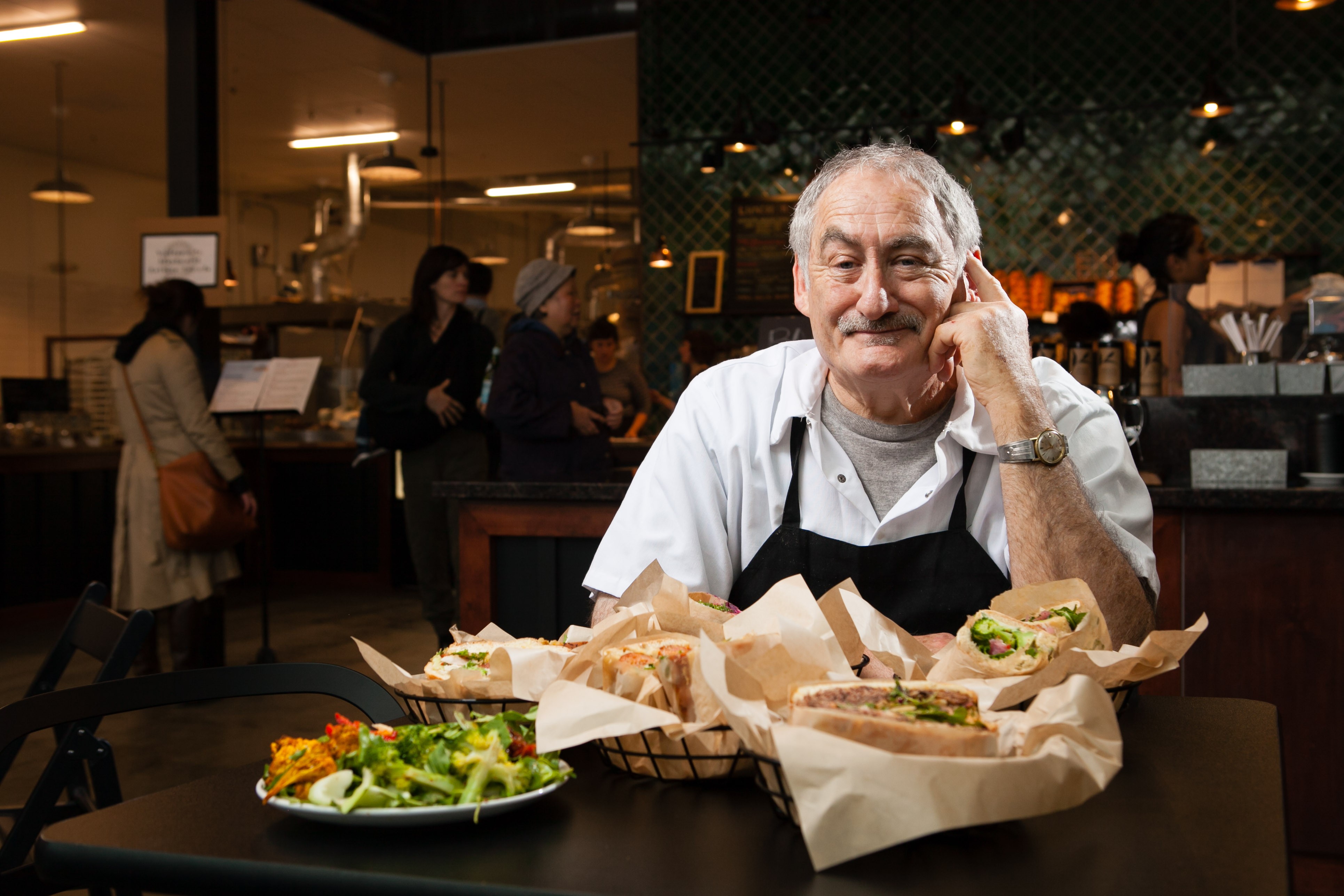
Aunt Malai’s Lao sausage sandwich (top), American Kobe roast beef sandwich (right), and the seasonal veggie salad.
Credits: Bert Johnson
In November, Pal’s Take Away moved from its modest liquor store digs to a fully equipped kitchen inside the Firebrand Artisan Breads bakery.
Credits: Bert Johnson
Aunt Malai’s Deep-Fried Lao Sausage Sandwich is one of chef Jeff Mason’s classic creations.
Credits: Bert Johnson
However, Pal’s, which Mason, started seven years ago in the back of a San Francisco Mission district liquor store, is not a traditional East Coast-style deli. In fact, the place is best known for the uniqueness of Mason’s excellent sandwiches. For example, fried Laotian sour sausage and mayonnaise spiked with yuzu and soy sauce are the main components of one of his most popular sandwiches. And another of his sandwiches features roast wagyu (“American Kobe”) beef and house-made pimento cheese.
In November, the shop moved from its modest liquor store digs to a fully equipped kitchen inside the Firebrand Artisan Breads bakery in Uptown’s Hive complex. The bakery’s owners, Matt Kreutz and Colleen Orlando, recently set up shop there and brought on Mason to run a lunch program that puts their bread to good use. For Mason, a Berkeley resident, it’s both a homecoming and an upgrade: Pal’s is now open seven days a week instead of just on weekdays, and the full kitchen allows Mason to put seven or eight sandwiches on the menu at a time instead of just three or four.
And despite the ritziness of the deli’s new location and the fact that most of the sandwiches are priced at $11 or $12, Pal’s Take Away has some of that same old-school, no-nonsense vibe as the East Coast delicatessens Mason remembers frequenting when he was a kid. The humble sandwich window sits in the middle of the cavernous bakery — a sort of walled-off kitchen within a kitchen. Through that literal hole in the wall, I watched Mason assembling each sandwich, tearing roast chicken apart with his bare hands and tapping a bell with a little “ding” — old-school — to let the cafe employees know that another order was ready. Thick-rimmed glasses give him the look of a 19th-century watchmaker or some other professional tinkerer.
Jeff Mason in his element.
Credits: Bert Johnson
In a phone interview, Mason told me what he tells other food writers — that he doesn’t have any “secrets,” that he tries not to take himself too seriously as a cook. “I take it as seriously as Thomas Keller takes his food, for sure,” he said of the noted chef and founder of The French Laundry in Napa. “But you’re making food for people. You’re doing something that’s real basic.”
The fact that Mason doesn’t take cooking too seriously is evidenced in the playfulness of some of his sandwiches — and that playfulness is an essential part of what makes them great. A sandwich Mason dubbed the “Almost a Lamb Sloppy Joseph” was a riff not on the North Jersey-style sloppy joe, but instead the more typical ground beef version — but with ground lamb, cooked down slowly like a chili with spices, including sumac and Aleppo pepper, which gave the sandwich a Middle Eastern bent. The unexpected crowning touch: a couple of corn chips inserted right in the middle of the sandwich, adding a bit of crunch and recalling, for me, the moment of wonder and pride I felt the first time I added Doritos to an otherwise run-of-the-mill turkey sandwich.
The best sandwiches at Pal’s inspired me to pull them apart to figure out what exactly made them so good. A sandwich featuring olive oil-poached local albacore tuna was a luxurious take on a tuna salad sandwich — the fish as thick as my wrist and slightly pink in the center. Layers of flavor and texture revealed themselves one at a time: the tangy crunch of chopped cornichons; steamed stalks of gailan-like sprouted broccoli; and slow-roasted cherry tomatoes that were spiked with sherry vinegar for a bright pop of acidity; and, because why not, a layer of potato chips. The Firebrand kaiser roll was just sturdy enough to hold it all together.
The aforementioned fried Lao sausage sandwich balanced the heat and the tangy, fermented funk of the sausages — from Vientian Cafe, which, not coincidentally, makes the best version in Oakland — with the cooling crunch of a cilantro-cucumber relish and the creamy richness of Mason’s house mayonnaise. A thick layer of arugula resembled a stack of frilly dollar bills — more arugula than I’d ever think to add, but just the right amount, it turned out, to keep the toasted torpedo roll from getting soggy.
Aunt Malai’s Deep-Fried Lao Sausage Sandwich is one of chef Jeff Mason’s classic creations.
Credits: Bert Johnson
Every sandwich had similarly thoughtful touches. The “veg” sandwich, which looked unpromising at first glance, like a bunch of lettuce on a bun, was loaded with good stuff: hard-boiled egg that smooshed rich yolkiness into every bite, broccoli rabe that added an intriguing bitter note, and pickled onion to perk things up. When I opened up the sandwich, I saw that Mason had hollowed out the bun — the same tactic banh mi makers use to ensure the proper bread-to-stuff ratio. House-made pimento cheese gave the roast beef sandwich the decadent quality of a good cheesesteak; a sweet cabbage slaw cut into that richness without being too sweet or too mayonnaise-y.
Even my carb-phobic dining companion was able to cobble together a good lunch at Pal’s by ordering the seasonal veggie salad, which was made up of similar stuff as the veg sandwich — plus turmeric-tinged roasted cauliflower, the crunchy lower stalks of some bok choy-like vegetable, and a tub of Firebrand’s excellent, garlicky croutons (which tasted like an “everything” bagel). Add a cup of the seasonal soup — a mildly spicy curried cauliflower-and-carrot purée during each of my visits — and you’ll have a helluva satisfying vegetarian meal (meat eaters can add some smoked trout or roast chicken to their salad).
More than anything, my visits to Pal’s made me want to make better sandwiches myself — to incorporate more roasted and steamed vegetables, and to be on the lookout for outside-the-box possibilities that Mason simply calls “good stuff to put between two pieces of bread.”
What I’m hoping, then, is that now that Pal’s has come home to the East Bay, the place will stick around for a while and become a local institution — like what Mason remembers from his childhood. It isn’t too hard to imagine an Oakland kid — some future sandwich savant — coming in with mom or dad, marveling at that Lao sausage sandwich, and soaking in all these impressions of what a kick-ass sandwich shop that doesn’t take itself too, too seriously looks like.
Correction: In the original version of this report, we listed the incorrect phone number for Pal’s Take Away. The correct phone number is 415-203-4911.
She’s old, she’s cantankerous, and she stinks to high heaven. What more could anyone ask for in a houseguest? Movie fans who enjoy the conjoined British arts of character acting and eccentricity are in for a treat with Nicholas Hytner’s The Lady in the Van, the ideal pastime for a chilly, drizzly winter night.
The place is chilly, drizzly London, circa 1970, where playwright Alan Bennett (portrayed by Alex Jennings) falls prey to a seemingly helpless but actually wily and combative senior citizen named Mary Shepherd (Maggie Smith, in high dudgeon). She and her cluttered van have been hopscotching up and down Bennett’s street in Camden Town, where the neighbors either smother the homeless Miss Shepherd with liberal-guilt-driven kindness or utter snide putdowns every time they catch a whiff of her (she eats raw onions and gives no evidence of having bathed recently).
Maggie Smith and Alex Jennings star in The Lady in the Van.
Maggie Smith and Alex Jennings star in The Lady in the Van.
By the time she gets around to Bennet and his driveway, it’s established that Miss Shepherd is also a devout Roman Catholic as well as a semi-repentant sinner on the run. Veteran actress Dame Smith, who has been impersonating willful females on stage and screen for sixty years, from Hedda Gabler to The Prime of Miss Jean Brodie to Richard III to the Harry Potter series, cements another unforgettable lady into her monumental career with Miss Shepherd. Arrayed in scavenged clothes and wielding an iron will, she steals scenes as easily as arching an eyebrow. And never, ever says thanks.
Smith is so overpowering that it takes half the movie for us to realize how good Jennings is. As adapted from the real-life Bennett’s stage play, it’s the put-upon host’s job to accede to Miss Shepherd’s every desire, but then to chide himself for being such a pushover. This is accomplished by giving him a doppelganger. One Alan leads his life, including cleaning up after Miss Shepherd as she sets up a fifteen-year residency in his driveway; the other Alan comments disapprovingly from his writing desk, with the same bland Northern English accent. Together, they’re the perfect foil for the perfect dominatrix. And as we learn more about the lady’s past, Bennett’s mincing comic acquiescence turns into something resembling ultimate compassion, simply by a shift in his perspective, and ours. What a brilliant sitcom setup.
For those who care to go deep, Bennett and Hytner stock the film with numerous in-jokes and cameos. The separate subplots involving Bennett’s mother (Gwen Taylor), a blackmailing policeman (Jim Broadbent), and the key disappointment in Miss Shepherd’s life all add to the kaleidoscopic richness of the story. For a movie with so many characters passing through, The Lady in the Van could arguably work just as well as a two-person dramedy. But then we’d miss out on the fine grain of her van’s homemade paint job with the plastic trash bags beneath, and the Greek chorus of the neighbors on Gloucester Crescent, each with his or her own carefully drawn situation. This is a movie that rewards repeated viewings, just to appreciate all its facets. Enjoy.
On Twitter, Jay Ant (Jay Anthony Fort) recently described himself as Mac Dre meets Disclosure, and he wasn’t far from the truth. The rapper, singer, and producer — who is a member of the ultra-prolific music collective HBK Gang — deftly juxtaposes the hyperactive tempos of hyphy and house music with glassy synth melodies, alternating his vocal style from smooth, raspy crooning to Auto Tune-ed rap-singing and punchline-filled bars.
Jay Ant is currently mastering his next album, Blue Diamond Dreams, which he has been hinting about dropping for nearly a year now. But the fact that he’s kept listeners waiting for the full-length project makes him anxious. So to make up for the delay, he recently released a new, seven-track mixtape — White Rabbit, a collection of saccharine, R&B-tinged songs that he said are solid but don’t quite mesh with his vision for Dreams.
Jay Ant’s new mixtape, White Rabbit, deftly combines elements of R&B, house, and hyphy.
Credits: Erin Baldassari
Jay Ant.
Credits: Erin Baldassari
“The white rabbit was late for a very important date,” he said, explaining the Alice in Wonderland reference in the mixtape’s title. “And he was running into a dream. This project is pretty much gonna lead you into that.”
Still, White Rabbit doesn’t sound like a filler project by any means, and contains several earworms that attest to Jay Ant’s skills as a hooksmith as well as a beatmaker with a gift for catchy yet challenging productions.
It bears pointing out that the members of HBK are at varying levels of regional and mainstream success. The group’s founder, IAMSU, for instance, has garnered a national audience with his single with Dej Loaf, “Famous,” and The FADER magazine and 106.1 KMEL have touted his new single, “Game Time” as anticipation builds for his next album, Kilt3. And Kehlani’s self-released 2015 mixtape, You Should Be Here, is up for a Grammy. While many fans have come to know Jay Ant through his work with the more prominent members of HBK, on White Rabbit he carves out a genre-defying niche that sets him apart from his collaborators and demonstrates his pop star potential.
“Let Me Ball,” the mixtape’s standout track that Jay Ant co-produced with Tario and fellow HBK member P-Lo, is a breezy, mid-tempo bop that has the makings of a summer anthem despite its cold-weather release date. A thudding, staccato synth riff with a hyphy bounce to it drives the beat while a baby-voiced vocal sample and layers of metallic, twinkling keys imbue it with a shimmering quality.
The hook — I can’t worry bout a bitch/I’m dipped, I’m too saucy — is infectious, and Jay Ant said his choice of vocabulary is significant. His lyrics are part of his larger mission to promote and preserve the singularities of Bay Area hip-hop culture, namely its slang. It’s a widely held opinion in the local rap community that the region’s innovations in production, flows, and vocabulary often go overlooked or unattributed in the mainstream music industry (see my feature, “Flow Jack City,” 4/1/2015). When Texas rapper Post Malone popularized the word “saucin'” with his 2015 hit, “White Iverson,” Jay Ant wasn’t convinced it was entirely original. He saw it as an evolution of “saucy,” which the godfather of hyphy, Mac Dre, had used as early as 2002 — a piece of hometown pride that Jay Ant sought to reclaim with “Let Me Ball.”
“The Bay Area gets robbed of a lot of culture, not just musically, but in every arena,” said the rapper, who grew up in Richmond and Hercules. “It doesn’t seem like people notice or give the appreciation for it that they should. I’m not mad at people using it or liking it. … ‘Saucin” is cool, I fuck with it, too. But people should be aware of where it came from.”
We compared notes about useful words with East Bay origins. It’s important to keep them in use, Jay Ant noted, especially as the Bay Area becomes increasingly gentrified and less of a hub for street culture. “I’m waiting for the rest of the world to start saying ‘yee’ and ‘bootsy.’ Those are up for grabs,” he added, laughing.
Jay Ant’s new mixtape, White Rabbit, deftly combines elements of R&B, house, and hyphy.
Credits: Erin Baldassari
Despite the sunshine-y melody and boastful hook of “Let Me Ball,” Jay Ant’s lyrics occasionally touch upon more melancholic subjects as he contemplates how his pursuit of success has impacted his relationships. “If you have a girlfriend that’s in a conventional workspace on a conventional paycheck and conventional everything — being an artist or a creative, that shit is crazy,” he said. “It’s hard to have structure all the time. If you’re young and you’re trying to get shit poppin’, you gotta be places and just go. … You have to be in the moment and make things happen.”
Navigating relationships with women with drastically different lifestyles has been a challenge, he continued. That idea also drives the plot of a forthcoming short film, also titled Blue Diamond Dreams, which Jay Ant scored, produced, and co-directed. He plans to release it around the same time as the album.
Blue Diamond Dreams, the movie, is part of Jay Ant’s effort to foray into various other, more visual-oriented creative fields, including apparel design. He currently has design collaborations with indie street wear labels Pink Dolphin and Rare Panther in the works, and has been working to brand his music and online presence with visuals inspired by fashion editorials. Clean, minimalist photos of Jay Ant, his collaborators, as well as models — dressed to the nines in impeccably styled athleisure looks — have accompanied his latest musical releases. With Kanye West’s Adidas collaboration, Rihanna’s role as a creative director at PUMA, and A$AP Rocky’s denim line with Guess, hip-hop and fashion are more intertwined than ever, and Jay Ant has his sights set on a similar partnership for himself.
“I like to do a little bit more than rap,” he said, “I’m more of a creative. I just like to make tight shit, whether it’s sound or visual or lyrics — creating experiences for people through art.”
P-Lo.
Credits: Bert Johnson/File Photo
The Express last caught up with P-Lo, a rapper and HBK Gang's most prolific producer, not long after he returned from tour promoting his collaborative album with Kool John, Moovie!, which made our list of top local releases of 2015. Fans have come to know P-Lo through his bare-bones, minimalist slappers that are deeply indebted to...
This year's High Times Southern California Medical Cannabis Cup is turning into a veritable Coachella of Chronic.
Cannabis contest season runs year-round in California now, and organizers of the pot magazine’s fifth annual bacchanalia in San Bernardino have stretched the SoCal Cannabis Cup into two weekends this year (Jan. 30–31, and Feb. 5,...
Stories you shouldn’t miss:
1. Backers of a November ballot measure that would raise the minimum wage to $15 an hour in California by 2021 turned in petition signatures to the state, the Chron reports. Currently, about 4 million California workers make less than $15 an hour. The wage increase is being pushed by the SEIU-United Healthcare Workers West and is...
Aries (March 21–April 19): The next four weeks could potentially be a Golden Age of Friendship — a state of grace for your web of connections; a lucky streak for collaborative efforts. What can you do to ensure that these cosmic tendencies will actually be fulfilled? Try this: Deepen and refine your approach to schmoozing. Figure out what favors...
Jerry Brown basked in adulation during his whirlwind trip to Paris, and the evening of December 8 figured to offer more of the same. Standing alongside governors of states and provinces from Brazil, Mexico, and Peru, California's governor planned to tout his state's leadership role on global climate policy. The event was one of 21 presentations that...
Sitting in a circle inside a community performance space in Richmond, not everyone seemed entirely comfortable with the task at hand — sharing intimate feelings in front of complete strangers. The roughly thirty participants were mostly Black and Latino youth, along with a smattering of community leaders and a few outsiders, like myself. But as each person...
Nestled in a bedazzled booth in an over-the-top, Hong Kong-style cafe in Oakland Chinatown, Jader (Justin Edwards) sipped on a fluorescent green and orange drink while explaining how he measures the success of his performances. "I've literally gotten maybe one dollar in tips ever," he said. "And I take that as...
Like any self-respecting New Jersey native, Jeff Mason won't hesitate to regale you with memories of the delicatessens of his youth. Mason — who recently moved his popular lunchtime pop-up Pal's Take Away to Uptown Oakland — spent his formative sandwich-eating years at places like the Town Hall Delicatessen in South Orange, New Jersey....
She's old, she's cantankerous, and she stinks to high heaven. What more could anyone ask for in a houseguest? Movie fans who enjoy the conjoined British arts of character acting and eccentricity are in for a treat with Nicholas Hytner's The Lady in the Van, the ideal pastime for a chilly, drizzly winter night.
The place is chilly, drizzly London,...
On Twitter, Jay Ant (Jay Anthony Fort) recently described himself as Mac Dre meets Disclosure, and he wasn't far from the truth. The rapper, singer, and producer — who is a member of the ultra-prolific music collective HBK Gang — deftly juxtaposes the hyperactive tempos of hyphy and house music with glassy synth melodies, alternating his vocal...