1. Cities throughout the Bay Area established heat records yesterday, as temperatures soared into the seventies and eighties, the Chron reports. Oakland International Airport set a record of 74 degrees, as did Richmond at 77, San Francisco at 77, and Santa Rosa at 80. Forecasters expect Tuesday to be another warm day, but predict rain on Wednesday with temperatures returning to normal. Despite a wet January, much of the Bay Area remains below normal for precipitation this winter.
2. Managers of California’s proposed high-speed rail system may bring bullet trains to the Bay Area much faster than expected under a dramatically revised plan, the Chron$ reports. The proposal calls for fast-tracking high-speed rail along the Caltrain line between Gilroy and San Francisco because it would be cheaper than going forward with the original plan of first building the bullet-train line between the Central Valley and Los Angeles. The Southern California route is expected to be costly and time-consuming because it needs to cross the rugged Tehachapi mountains.
A poster by Emory Douglas endorsing Bobby Seale for Oakland mayor and Elaine Brown for city council.
Credits: http://bad.eserver.org/issues/2004/65/gaiter.htmlHonoring Black leaders: To celebrate Black History and Heritage Month, the full city council will honor twelve Black leaders, including Paul Cobb, the publisher of the Oakland Post newspaper; Ryan Coogler, who wrote and directed the film Fruitvale Station; and Emory Douglas, who, as minister of culture in the Black Panther Party, created memorable cultural weaponry for the Black freedom movement. The other honorees are Bishop Frank Pinkard Jr., William “Bill” Riley, Pastor George Cummings, Egypt King, Preston J. Turner, Assata Olugbala, Jean Blacksher, Gloria Jeffery, And Theo Aytchan Williams
[jump]
Coal: This week, the Oakland City Council is expected to hire an environmental consulting firm to determine whether or not shipping coal through the city will have negative health and safety impacts on workers and Oakland residents. The coal consultant will cost the city $208,000. If the consultant judges that shipping coal through Oakland would harm workers and the community, the city will likely ban coal as one of the commodities that can be transported through the OBOT facility planned for construction at the old Oakland Army Base. The city council and Mayor Libby Schaaf have tread carefully on the subject of coal for almost a year now because of fears that the master developer of the old Army Base, Phil Tagami’s Prologis-CCIG Oakland Global, will sue the city if it moves to prevent coal shipments through the OBOT. As I’ve reported, pro-coal businesses have already lawyered-up and are closely watching the city council’s interactions with anti-coal environmental and community groups. The coal consultant, Environmental Science Associates, isn’t expected to deliver a report to the city council until June.
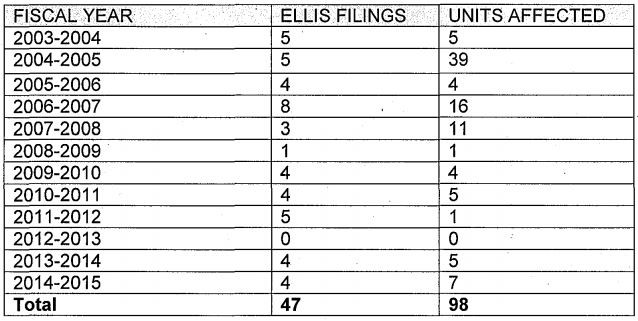
There were four Ellis Act filings in the 2014-2015 fiscal year affecting seven Oakland apartments.
Credits: City of OaklandEllis Act eviction assistance: The full city council will consider this week whether or not tenants displaced from their apartments through Ellis Act evictions should receive greater financial assistance from their landlords. The Ellis Act allows a landlord to evict a tenant from their apartment if the landlord intends to “go out of business” by removing the building’s apartments from the rental market. Ellis Act evictions have been a common occurrence in San Francisco where landlords turn apartments into condos to sell them. In Oakland, use of the Ellis Act has been less common, but city officials and tenant advocates fear that a small recent uptick in Ellis Act evictions portends a much larger increase in future years. The average rent in Oakland is currently $2,500 for a two-bedroom apartment, therefore the city is proposing to set baseline assistance for displaced tenants at $8,000 so that tenants can pay the average move-in cost of first and last month’s rent and a security deposit, plus $500 for moving expenses. Currently, Oakland only requires landlords to provide assistance to displaced tenants who are considered low-income, and the amount of assistance is only equal to two months of the tenant’s current rent, which in rent-controlled units is often far below the average fair market rent that displaced tenants will have to pay if forced to relocate.
Police settlement: The council is also set to approve a $2.75 million payout to settle a lawsuit against the Oakland Police Department stemming from a fatal accident last year. Bien Cam Tran, a 58 year-old man was crossing East 12th Street last year on foot when he was struck and killed by a car being driven by Oakland police officer Devin Underwood.
1. Organic food can significantly lower the amount of pesticide residue in children, the Bay Area News Group$ reports, citing a new UC Berkeley study. The Cal researchers studied groups of low-income kids from Oakland’s Fruitvale district and from the Salinas Valley, and found that the amount of pesticide residue in the children dropped as much as 50 percent after they began eating an organic diet. However, pesticides still lingered in the children, likely because of environmental exposure.
2. Even though the massive methane gas leak near Porter Ranch in Southern California has been plugged, the state is riddled with small gas leaks that produce more methane emissions than the one generated near Porter Ranch, the Chron$ reports. The small leaks come from old pipes that the state’s utilities have failed to properly maintain.
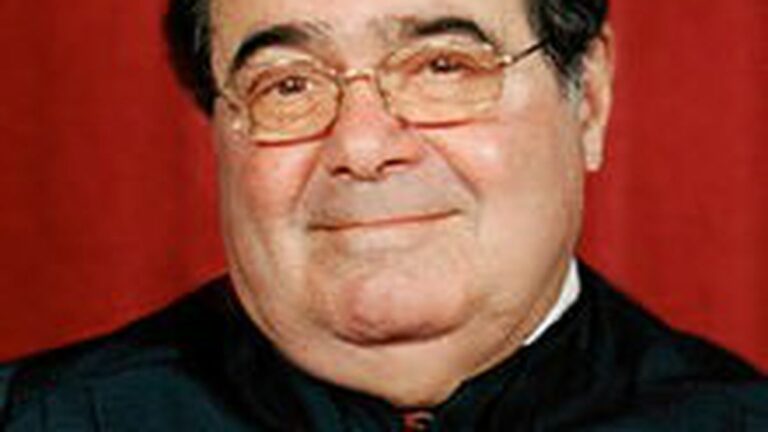
Antonin Scalia.
3. The death of US Supreme Court Justice Antonin Scalia — along with the insistence by Senate Republicans that they will not confirm any appointment by President Obama — means that several key high court rulings this year could be decided in favor of liberals, the Chron$ reports. There are several cases in which Scalia’s death likely will result in the high court being deadlocked 4-4 — including ones involving the power and influence of unions, access to abortion, voting rights, and affirmative action in education. If that were to happen, then the lower court rulings in favor of liberals would prevail.
Valero Refinery in Benicia.
Credits: Wikimedia Commons
The little town of Benicia is looking to become the next link in the chain barring crude oil from traveling by rail to the West Coast. After four evenings of contentious hearings, the Benicia Planning Commission on Thursday unanimously rejected Valero refinery’s proposal to build a rail spur that would allow it to import up to 70,000 barrels a day of “North American crude oil” — meaning extra-polluting crude from Canada’s tar sands and the highly explosive crude from North Dakota’s Bakken shale fields. Both fossil fuels have been involved in numerous derailments, explosions, and fires, including a 2013 fire and explosion in Lac Megantic, Quebec that killed 47 people.
[jump]
Starting on Monday, planning commissioners, led by Commissioner Steve Young, grilled staff members about their decision to recommend approval of the Valero project, identifying inconsistencies and pointing to problems that the project would create, from blocking traffic to increasing pollution to potential oil spills and other emergencies that the city would not be able to cope with. The central issue that emerged, however, was whether the city had the authority to make decisions about the project.
The staff report actually said the benefits of the project did not outweigh the potential harm. Shipping crude oil by rail, the staff found, would have “significant and unavoidable” impacts on air quality, biological resources, and greenhouse gas emissions. These impacts would conflict with air quality planning goals and state goals for reducing greenhouse gas emissions. But the city can’t prevent any of this, the staff report said, because only the federal government has the authority to regulate railroads.
Bradley Hogin, a lawyer whom the city hired on contract to advise on this project, said federal law prevents local governments from interfering with railroads, a principle referred to as “preemption.” According to the interpretation of “preemption” described by Hogin and city staff, local governments are not permitted to take actions that “have the effect of governing or managing rail transport,” even indirectly. And they are not allowed to make decisions about a project based on impacts of rail shipping connected with that project.
“Hogin is making a case that would affect cities across the nation dealing with crude by rail,” said environmental activist Marilyn Bardet in an interview. “They were going to create a legal precedent on preemption here.”
Bardet reported that public testimony by representatives of environmental organizations and “two young women from the Stanford-Mills Law Project made it clear that “there are many people who would disagree with Hogin’s interpretation.”
Roger Lin, lawyer with Communities for a Better Environment, said in an email that, contrary to Hogin’s claims, the California Environmental Quality Act actually requires local governments to consider “indirect or secondary effects that are reasonably foreseeable and caused by a project, but occur at a different time or place.” Valero is not a railroad, he said, so the “preemption” doctrine does not bar the city from using its land-use power to reject the project.
However “preemption” is interpreted, Bardet said, “the commissioners seemed uncomfortable with being told they would have to approve the project based on considerations they couldn’t accept.” Late in the hearing process, commission chair Donald Dean said, “I understand the preemption issue on a theoretical legal level, but I can’t understand this on a human level.”
Bardet expressed appreciation for the commissioners’ concern. “My sense was that these guys are real human beings,” she said. “They all listened carefully. None of them was asleep.”
Project opponents packed the hearing room for four straight nights, filling two overflow rooms on the first night. People came from “uprail” communities, including Davis and Sacramento, as well as allies from across the Bay Area, Bardet said.
Opposition to the project has been led by a community group, Benicians for a Safe and Healthy Community, formed in 2013 when the city seemed ready to approve the project without requiring any environmental impact study. “We joined with other refinery communities in the Bay Area Refinery Corridor Coalition” and in a coalition working to persuade the Bay Area Air Quality Management District to pass tough new regulations on refinery pollution, Bardet said. She said support from the National Resources Defense Council and Communities for a Better Environment was also important. “The grassroots came alive together,” she said.
Many of these organizations, like the Benicia group, are concerned, not only about the hazards of shipping crude by rail, but by the impact of refining the extra-polluting crude oil from Canada’s tar sands, Bardet said. She noted that the city’s environmental review of the project made no mention of this issue, although it is well established that refining dirty crude oil, like oil from tar sands, emits more health-harming pollution as well as more greenhouse gases.
Valero is expected to appeal the planning commission decision to the city council, which could meet to decide on the issue as early as mid-March. “The city council is going to be hard-pressed to reject the views of their own planning commission,” Bardet said.
She emphasized the significance of this decision for the national and international issue of shipping crude oil by rail. “The whole world is watching,” she said. “I just got a message from a guy in New Jersey congratulating us.”
Dungeness crab.
Credits: Bert Johnson/File photo
1. California public health officials lifted the ban on recreational fishing for Dungeness crab in the Bay Area, the Chron reports. The ban on commercial fishing for Dungeness crab is also expected to be removed soon. The fishery has been closed all season because crabs were infected with a dangerous neurotoxin — domoic acid. But health officials said that the toxin has now “declined to low or undetectable levels.”
2. Oakland Raiders owner Mark Davis agreed to a one-year lease extension at the Oakland Coliseum, the Chron$ reports. The deal includes options to extend the lease for two more years. Last month, the NFL denied Davis’ bid to move the team to Los Angeles, but left the door open for the team to move in 2017 should the San Diego Chargers decide not to join the St. Louis Rams in Los Angeles. Davis also announced that he has hired real estate executive Larry MacNeil, who headed up the San Francisco 49ers new stadium project in Santa Clara, to lead the effort for a new stadium in Oakland.
3. President Obama created three new national monuments in the Mojave Desert of Southern California, thereby expanding federal protection to 1.8 million acres of land, the LA Times$ reports. The designations came at the request of US Senator Dianne Feinstein. During his tenure, Obama has set aside 265 million acres of land and water for federal protection — more than any other president.
[jump]
4. Southern California Gas announced that it has finally plugged the massive methane gas leak near Porter Ranch, the LA Times$ reports. The gas company must still cap the leaking well with concrete before the state declares it officially fixed. The leak, which began in October, has spewed massive amounts of greenhouse gases and has forced nearly 5,000 people to flee their homes.
5. The private contractor that built the new Bay Bridge — a project that has been riddled with leaks, corrosion, broken steel rods, and numerous other problems — claims that state taxpayers still owe the company $50 million, the Chron reports. The financial dispute between American Bridge/Fluor and Caltrans is now headed for arbitration.
You’ve read enough think pieces about Bernie Sanders and Beyonce. Seriously, get outside and do something fun. Here are out top five suggestions:
Still Not Quiet on the Western Front
Founded in 1982, Maximumrocknroll is a non-profit publication that covers punk and hardcore scenes from around the world. The magazine has clung to its staunchly DIY ethos over the years. Even as it has grown into something of an institution, it has continued to eschew corporate sponsorship and coverage of major-label acts, positioning itself as an ardent champion of formidable underground bands that may not otherwise have a chance at coverage in the mainstream press. This Thursday, MMR will kick off its festival, Still Not Quiet on the Western Front, which features dozens of bands playing shows at various venues in both San Francisco and the East Bay through the end of the weekend. A few events under the Still Not Quiet umbrella to look out for? Noise-punk outfit Criminal Code at Thee Parkside on Thursday; Saturday’s record swap at LoBot (which precedes that day’s concert with Uranium Club, The World, Neighborhood Brats, and Neutrals); and Cold Beat and Flesh World at Oakland Metro Operahouse that same night. Refer to Maximumrocknroll.com/Fest for the complete schedule.— Nastia Voynovskaya
Feb. 11-14 Prices vary per show Maximumrocknroll.com/Fest
[jump]
Haus Party
Alfonso Dominguez and Hunter Marshall, the organizers of the Oakland Music Festival each fall, have a proven sixth sense for booking artists on the verge of blowing up: SZA, one of the headliners of the 2014 edition, was recently featured as the only other guest vocalist besides Drake on Rihanna’s acclaimed album, ANTI. Anderson Paak, who was just starting to get buzz as Dr. Dre’s protégé when he headlined OMF in 2015, stunned fans and music industry heads alike with his soulful LP, Malibu, released last month. At OMF’s new monthly event, Haus Party, audiences can now check out the pair’s prescient tastes year round. Held at the recently re-opened Uptown Nightclub in Oakland, the concert series is dedicated to spotlighting local talent. This month’s edition features R&B crooner 1-O.A.K., Berkeley rapper Rexx Life Raj, and San Francisco producer Julia Lewis. DJs Azure and Agana will be behind the decks, with bilingual Oakland rap duo Los Rakas as hosts.— N.V.
Fri., Feb. 12, 9 p.m. $3 before 11 p.m. with RSVP. WhoseHausParty.com
Ravish SF
RavishSF Erotic Underground Dinner Valentine’s Day is a holiday that, for most folks, is all about food and sex. But there aren’t many V-Day dinners that make that connection as explicitly as RavishSF, a San Francisco-based “erotic underground dinner series” that will host its first Oakland event on Saturday at a rooftop garden at 344 Thomas L. Berkley Way. Every dish in chef Peter Jackson’s prix-fixe menu will have sexual undertones, either in its appearance or its actual substance — from oyster ceviche to sliced pig heart, plus a boozy marshmallow “hot mess” dessert courtesy of Sugar Knife Artisan Sweets. Guests are invited to come bedecked in lingerie and to play with their food — and each other. Tickets are available via RavishSF.com.— Luke Tsai
Sat., Feb. 13, 7 p.m. $99. RavishSF.com
Mercury 20 at 10 A piece by Ruth Tabancay.
Credits: Dana Davis
Mercury 20 at 10 In 2006, a handful of artists joined together to turn a small space in Uptown Oakland into an artist-run gallery. Since then, the collective’s membership and gallery space has grown into what is now Mercury 20 (475 25th St., Oakland). In celebration of its ten-year anniversary, the gallery is hosting Mercury 20 at 10, a group exhibit showcasing the collective’s many artists, including mesmerizing installation artist Nick Dong, masterful paper cutout artist Carlo Fantin, and innovative textile specialist Ruth Tabancay. The show is also a snapshot of the gallery at a critical moment in its evolution, during a time when the Uptown area is poised for another rapid transformation. While Mercury 20 consistently exh
ibits its members’ work, it’s rare that so many of them are shown together at once. Mercury 20 at 10 is a varied portrait of a tight-knit group of local talent.— Sarah Burke
Through Feb. 20.MercuryTwenty.com
Blood Tango
Blood Tango If adapting the story of Count Dracula for the stage is a tricky task, then adapting it as a musical must be really challenging. But Piedmont Oakland Repertory has met this challenge with Blood Tango, an original musical adaptation of the Dracula story first popularized by Bram Stoker’s 1897 novel and immortalized in various adaptations for the stage and screen in the decades since. Opening on February 13 at the Pacific Boychoir Academy (215 Ridgeway Ave., Oakland), the play will run through March 13. Blood Tango was written by Piedmont Oakland Repertory producer and artistic director John McMullen, who was joined by composer and pianist Tal Ariel and actress and singer Elizabeth Jane Dunne in composing the musical’s score, which includes fifteen original numbers. Set in an asylum on the English coast in 1922, Blood Tango borrows some of its character names and broad plot points from Stoker’s novel, but as its title may suggest, reimagines them in light of a certain craving not for blood, but for a dance craze nearly as dangerous: the tango. — Sarah Elizabeth Adler
Starts Feb. 12. Fridays-Sundays, 7:30-9:45 p.m. Continues through March 13 800-838-3006 $14-$19. PiedmontOaklandRep.org
If your pockets are feelin’ light and you’re still yearning for more suggestions, we’ve got a ton, and these ones are all FREE! We’re Hungry: Got any East Bay news, events, video, or miscellany we should know about? Feed us at Sa*********@************ss.com.
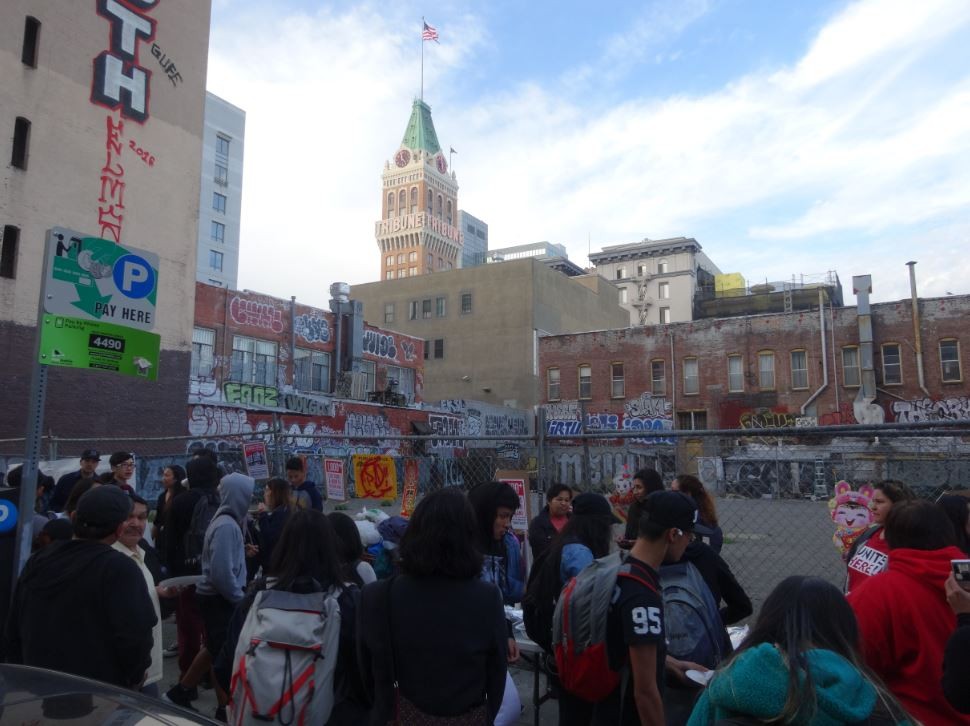
Hotel workers and Chinatown community groups protesting outside the lot where a new hotel is proposed.
Credits: Darwin BondGraham
Hotel workers and Chinatown community groups are asking the City of Oakland to deny construction permits for a proposed Hampton Inn Hotel because city investigators found that the company behind the project, Balaji Enterprises, violated Oakland’s minimum wage and sick leave laws at another hotel in the city. Protesters rallied at the site of the proposed new hotel on 11th Street between Franklin and Webster this afternoon.
“This company wants to bring low wages and no-benefit jobs to downtown Oakland,” said Aida Gonzalez, a worker at the nearby Marriott Hotel who is a member of UNITE HERE 2850.
Gonzalez lives in downtown Oakland and said that she fears being displaced if the hotel industry’s jobs do not continue to pay decent wages. She said permitting the construction of a hotel by a company that has violated Oakland’s wage laws and other worker protections would establish a bad precedent that could harm hotel workers across the city.
[jump]
Balaji Enterprises is owned by the local hotelier family, the Patels, who currently operate the Holiday Inn Express near the Oakland Airport and the Hampton Inn and Suites in Alameda. They also own the Vue Hotel in Mountain View, as well as other properties.
Last year, workers at the Patel’s Holiday Inn Express complained to the City of Oakland that their employer was committing wage theft. The city conducted an investigation and on February 3 of this year, Oakland’s contracts and compliance office issued findings that Balaji Enterprises had cheated its workers out of their wages, interfered with workers exercising paid sick days, and that the hotel also retaliated against its workers after passage of the new minimum wage law, Measure FF, by “inconsistently” cutting their hours. The city also found that Balaji Enterprises illegally took back accrued and unused vacation time from employees and that the hotel managers prevented workers from taking breaks.
“We are extremely disappointed in the way the investigation was conducted and the lack of due process,” said Drhuv Patel in a statement issued today through Full Court Press, a public relations firm. “We plan to respond to all of the allegations.”
In a statement issued last November, after a similar protest, Drhuv Patel said that the hotel workers union was turning a land use issue into an opportunity to “slander” the Patel family’s business. The Pates’ hotels are currently not unionized. “We own two small hotels in the East Bay and have a great track record of retention and growth from within. Some team members have worked for us for over 16 years,” said Patel.
Francisco Coronado worked at the Hampton Inn in Alameda for nine months in 2009 and 2010. He said workers at that hotel also had wages stolen from them by Balaji Enterprises, but that hotel was not part of Oakland’s investigation. According to Coronado, the Hampton Inn’s managers would often round down the time logged on employee punch cards, resulting in as much as an hour shaved off their pay. “The owners of these hotels really don’t deserve to build another hotel in Oakland because they stole wages from me and my co-workers,” said Coronado.
Deborah Barnes of Oakland’s contracts and compliance department said that the city’s recent findings of wage theft and other legal violations at the Patel’s hotels are preliminary. She said Balaji Enterprises has the opportunity to respond to the city’s report, and that if the company objects to the remedies proposed by the city, Balaji Enterprises can opt for a hearing before an independent arbitrator.
The Patels are major political donors in Oakland. According to city records the Balaji company and members of the Patel family contributed at least $10,520 to city council candidates and political action committees since 2012.
The oil industry spent a record $22 million lobbying California legislators and officials last year, allowing it to largely determine which bills passed and which bills didn’t pass through the Legislature.
This “gusher” of lobbying money in 2015 yielded alarming results: Every environmental bill opposed by Big Oil was either shelved, or in the case of SB 350, a climate change/green energy bill, was amended under pressure from the oil industry.
The 2015 lobbying brought the total expenses by the oil and gas industry to a whopping $127 million over the past ten years, according to a report from the American Lung Association in California written by Will Barrett. The report data is obtained from the annual reports filed with the California Secretary of State.
The record $22 million spent amounts to $60,000 a day on oil lobbyists.
The Western States Petroleum Association (WSPA) spent a record $11 million ($10,949,150) on lobbying, making it the number-one spender in California for the fourth year in a row. Of the WSPA’s $11 million, $9 million — 82 percent — was reported in the uncategorized “other” spending category.
[jump]
Barrett noted that WSPA’s “other” spending would rank number one on its own among all spenders in California. WSPA paid $1.5 million to KP Public Affairs, the top-grossing lobbying firm in 2015.
Second to WSPA in oil industry lobbying expenses was the San Ramon-based Chevron corporation, which spent almost $4 million ($3,982,671) — the fifth most of any organization in California in 2015. Coming in third in oil industry lobbying expenses was Phillips 66, with $1,483,032 spent.
The report also revealed that Big Oil spent a staggering $42 million on lobbying California lawmakers over the past two years.
In 2015, Big Oil spent its $22 million “attacking healthy air and climate legislation,” according to Barrett. Under intense pressure from WSPA, the legislature and governor removed a provision from SB 350 to reduce petroleum use in California by 50 percent in the next fifteen years. In addition, Big Oil forced SB 32 (Fran Pavley), which would have set greenhouse gas reduction limits to 80 percent below 1990 levels by 2050, to be shelved until the next legislative session.
The oil industry also defeated legislation, SB 788, which sought to close a loophole in state law that currently allows slant oil drilling through a marine protected area — the Vandenburg State Marine Reserve, created under the Marine Life Protection Act (MLPA) Initiative, and the Tranquillon Ridge.
Catherine Reheis-Boyd, the president of the Western States Petroleum Association (WSPA) who led the opposition to SB 788 and other environmental legislation, chaired the Marine Life Protection Act (MLPA) Blue Ribbon Task Force to create so-called “marine protected areas” in Southern California. She also served on the task forces to create “marine protected areas” on the Central Coast, North Central Coast, and North Coast.
For an in-depth report on the environmental bills that Big Oil lobbied to defeat with the help of the “Oil Caucus,” a group of Assemblymembers whose campaigns are funded directly and indirectly by polluter money, click here.
In 2014, Big Oil spent $20 million “attempting to limit industry responsibility under carbon policy,” said Barrett, as well as defeating legislation to impose a moratorium on fracking in California.
But lobbying is just one way that Big Oil exerts its inordinate influence in California politics and regulatory processes. The industry also wields its money and power through massive campaign spending, capturing regulatory panels and commissions, and creating Astroturf groups.
The Top California Lobbying Spenders in 2015 Total:
1. Western States Petroleum Association $10,949,150
2. California Hospital Association $8,977,831
3. CA State Council of Service Employees $6,203,372
Credits: Paul Heintz
Sanderistas were still filing into the Concord High School gymnasium Tuesday night when New Hampshire’s polls closed and the networks called it, instantaneously, for Senator Bernie Sanders (I-Vt.).
Just like that, a man who’d toiled in obscurity through decades in public life had done the impossible: defeated Hillary Clinton in a state that, until that night, had always had her family’s back.
Eighty minutes later, after watching Clinton concede on a television screen suspended from the rafters, the crowd erupted as Sanders appeared onstage.
“Together,” he said, “we have sent the message that will echo from Wall Street to Washington, from Maine to California — and that is that the government of our great country belongs to all of the people and not just a handful of wealthy campaign contributors and their super PACs.”
With the nation watching, some for the first time, Sanders delivered a nearly half-hour speech that has grown familiar to Vermonters over the years — a speech that even Clinton had begun to mimic in her remarks earlier that evening.
“Tonight, we served notice to the political and economic establishment of this country that the American people will not continue to accept a corrupt campaign finance system that is undermining American democracy and will not accept a rigged economy,” he said.
Sanders credited his victory to, as he put it in his native Brooklyn-ese, a “yuuuge voter turnout.” His supporters, imitating the candidate they hope will be president, interrupted him and yelled “yuuuge” right back at him.
The Vermonter’s margin of victory also appeared pretty yuuuge. Sanders swamped Clinton by 21 percentage points.
[jump]
Even the Clinton campaign couldn’t spin numbers like that into a positive, though it had spent the week lowering expectations and playing up Sanders’ advantages in a state that neighbors his own.
Sanders’ success was about more than demography or geography. It was about more than his 108 paid staffers in the state, his 18 field offices and his 7,200 volunteers. It was about more, even, than his 3-1 television-advertising advantage in the weeks leading up to the primary.
It was about the message Sanders delivered and the messenger who delivered it.
Sanders landed at Manchester-Boston Regional Airport a week ago Tuesday with the political winds at his back. His “virtual tie” at the Iowa caucuses had electrified his campaign, filled its coffers with another $3 million and rattled Team Clinton.
The two candidates quickly engaged in what would turn into a days-long war of words over who was the real progressive in the race.
“A progressive is someone who makes progress,” Clinton argued Thursday night during an MSNBC debate at the University of New Hampshire. “That’s what I intend to do.”
It was the first time she and Sanders shared a debate stage since former Maryland Governor Martin O’Malley dropped out days earlier — and the difference in tone and tenor was palpable. Clinton lit into her rival for making promises she said he could not keep, while Sanders continued to attack her ties to the financial sector.
Both candidates had their moments, and both left with wounds. Clinton failed to put to rest questions about the more than $1.8 million in speaking fees she has received from Wall Street banks, while Sanders continued to look stumped by the most basic foreign policy questions.
Out on the campaign trail, the senator tested new lines of attack. Speaking at the Rochester Opera House on Thursday, he alluded to his opponent’s shifting policy positions, saying that it was “easier to apologize for a bad vote fifteen or twenty years later, when the tide has changed” than it was to “stand up, even though you are outnumbered, and cast the right vote.”
Friday night at the New Hampshire Democratic Party’s annual McIntyre-Shaheen 100 Club Celebration, Clinton tried to reach out to the young voters who had largely abandoned her for the Sanders campaign. Speaking to thousands of party activists at Manchester’s Verizon Wireless Arena, she recounted her days campaigning for Eugene McCarthy in 1968.
“I learned what you all are proving every day: You can make change without being elected to anything,” she said. “So I respect not only your enthusiasm but also your seriousness about helping to make our country what it can and should be.”
But Clinton’s words seemed to fall on deaf — or, perhaps, absent — ears: Sanders had addressed the crowd an hour earlier and most of his supporters had immediately left the building.
Over the weekend, the two rivals went their separate ways: Sanders to New York City to appear with comedian Larry David on Saturday Night Live and Clinton to meet with the mayor of Flint, Michigan, to discuss the city’s contaminated-water crisis.
But the campaign didn’t stop just because the candidates left the state. Clinton’s top allies made waves when two of them — former secretary of state Madeleine Albright and feminist icon Gloria Steinem — appeared to disparage women who had chosen Sanders over Clinton. Former president Bill Clinton went even further, launching a harsh attack on Sanders Sunday afternoon in Milford — accusing the candidate of hypocrisy and his supporters of sexism.
Sanders responded the way a front-runner might: by ignoring it. During his final day of campaigning Monday, he barely mentioned the former secretary of state. Whisked around the state in an eleven-vehicle Secret Service motorcade, the senator kept his focus on his core message, from Nashua to Durham.
“Tomorrow is a very big day,” he told several hundred students Monday night at a get-out-the-vote concert at UNH. “I hope that at the end of the night, New Hampshire will have told America that we are no longer accepting establishment politics or establishment economics — that we want this country to move forward in a different direction.”
With New Hampshire in the rearview mirror, Sanders now turns to a pair of states — Nevada and then South Carolina — where Clinton appears to have certain advantages in terms of organizational strength, name recognition and cachet with nonwhite voters.
“She got here earlier,” said Jon Ralston, a longtime reporter and political analyst in Nevada. “She hired all the right people from Obama and Clinton ’08. They have the infrastructure set up. They’ve been here almost a year now.”
But Jeff Weaver, Sanders’ campaign manager, says the Vermonter is ready to compete in the Silver State.
“In Nevada, we’ve got over four dozen staffers on the ground,” he says. “We’ve got more field offices than any other campaign.”
Like Iowa, Nevada employs a caucus system to allocate delegates. But unlike Iowa, it has only served as an early-nominating state since 2008.
“So we need to make people who support Bernie know that there is a caucus going on and where it is and what time it is and how you participate and what have you,” Weaver said.
Nevada, which holds its Democratic caucuses a week from Saturday, is the first state in the process with significant populations of Hispanic and African-American voters. That’s led some to conclude that Sanders won’t find traction there, since he tends to draw more support from white liberals. But despite the state’s diverse population, whites accounted for nearly two-thirds of Nevada’s electorate in the 2008 caucuses.
A bigger challenge could be reaching voters who live outside the state’s population center of Las Vegas. In 2008, Clinton won Nevada’s popular vote by turning out Clark County voters in droves, but Obama’s strategic focus on delegate-rich regions netted him one more delegate than his rival.
“The bottom line is that what Hillary has to do is use her institutional advantages, endorsements, her ability to tap into the infrastructure she’s built up,” Ralston said. “And what Sanders has to do is get new voters registered and engaged on the day of the caucuses.”
A week after Nevada comes the South Carolina primary, which awards 53 pledged delegates — more than twice as many as New Hampshire’s 24. Its Democratic primaries boast a majority-black electorate.
The Sanders campaign has invested heavily in South Carolina — it already has more than fifty paid staffers on the ground — and has particularly focused on wooing Black voters. But according to Scott Huffmon, a pollster and political scientist at Winthrop University, Sanders will have a tough time breaking through Clinton’s “strong ties” in the African-American community.
“I expect there to be a lot of movement toward Bernie Sanders, but not enough,” Huffmon said. “It is simply such a different constituency.”
Sanders himself sounds confident. He told reporters during a press call last Friday that his Palmetto State staffers “are feeling very, very good” about his prospects there.
“Let me just say this — and people can play it back a month from now,” he said. “I think we are going to do a lot better in South Carolina than people think we will.”
Joining Sanders on the call was a critical new ally: Ben Jealous, a former president and CEO of the NAACP. Referring to Obama’s come-from-behind victory in the state in 2008, Jealous said, “I know how things can turn very, very quickly.”
That year, an unexpected win in Iowa bolstered Obama in South Carolina. This year, Sanders’ New Hampshire blowout could do the same for him.
Three days after South Carolina comes the biggest test of all: Super Tuesday. That day, eleven states — including Sanders’ own — will cast ballots or hold caucuses.
“It’s obviously a challenge in terms of allocation of resources,” Weaver says. “I mean, you have Vermont, and you have Texas … In terms of television advertising, you could spend your entire presidential budget in Texas.”
One advantage the Sanders campaign has is that, unlike the Republican nominating system, the Democrats have no winner-take-all contests. That means that even if Sanders wins only 40 percent of the vote in a state, he’ll still be racking up delegates.
“That’s the beauty for us: It’s all proportional,” Weaver says. “The key is how you maximize your delegates.”
Also key will be funding a prolonged and dispersed television advertising war. Tad Devine, Sanders’ senior strategist, thinks the campaign’s ability to attract and retain small donors will keep his boss in the game longer.
“That is one of the great strengths of this campaign — not just the amount of money that we’ve raised, but the way we’ve raised money,” he says. “We’re building a big, national campaign.”
They’re not the only ones. And they’re up against a rival who, in 2008, learned a thing or two about waging a protracted fight for delegates.
Clinton also brings to the table certain strengths that Sanders will never be able to match: an auxiliary war chest in the form of three super PACs and a massive advantage among so-called “super delegates” — party leaders who can choose to support whomever they want. According to the Associated Press, Clinton has already locked down 362 of 712 super delegates, while Sanders has won the support of just eight.
“This is a delegate race,” said Clinton campaign manager Robby Mook. “We’re not looking to win every single contest every single time. We have a strategy and a plan for the long term.”
To win the party’s nomination, a candidate must win the support of 2,382 of 4,763 delegates at the convention. So far, excluding super delegates, just 66 have been awarded.
In other words, it’s gonna be a long haul, with a lot of mile markers.
But this week, at least, Sanders is in the driver’s seat.
Dominique Crenn (via Facebook).
Credits: Ed Anderson
Welcome to the Mid-Week Menu, our roundup of East Bay food news.
1) Earlier this week, Dominique Crenn, the latest big gun to hit the East Bay restaurant scene, unveiled her first project on this side of the bay, Eater reports. Located inside the newly rebranded Claremont Club & Spa (in the former Paragon spot), Antoinette (41 Tunnel Rd.) aims to be a French brasserie with a luxurious bent (not to mention an amazing panoramic view of the bay). And whoa if the opening night menu — posted here by Inside Scoop — doesn’t have some seriously eye-popping dishes: roasted monkfish tail for $95? A whole duck with foie gras and abalone mushrooms — meant to serve three to four — for $200? The brasserie also offers versions of French classics such as coq au vin ($29) and salade Lyonnaise made with mangalitsa lardo ($15).
[jump]
Crenn, best known for her Michelin two-starred restaurant Atelier Crenn, drove the concept and designed the menu. But chef de cuisine Justin Mauz, another fine-dining vet, will be the one running the kitchen at Antoinette day-to-day.
2) Good news and bad news for lunchtime regulars at Hawker Fare (2300 Webster St., Oakland): Inside Scoop reports that the Uptown Oakland rice bowl slinger will temporarily suspend lunch service while chef James Syhabout uses the kitchen there to work on developing recipes for his upcoming Hawker Fare-themed cookbook. The silver lining is that in the coming month, he’ll host a “pop-up lab” lunch at the restaurant each Friday, starting on February 26. On a first-come, first-serve basis, customers will be able to buy a single dish cooked by Syhabout himself — whatever recipe he happens to be working on that week.
New food offerings at Blue Bottle.
3) Having ended its short-lived partnership with Tartine Bakery, Blue Bottle is now expanding its food menu on its own, Eater reports. For now, the only East Bay location offering the new menu — which includes more substantial dishes such as Belgian waffles, eggs and cauliflower on Firebrand toast, and a breakfast sandwich — is the W.C. Morse location at 4270 Broadway in Oakland.
4) Berkeleyside Nosh has a profile of SoDoI (“So do I”), a self-styled coffee “tasting house” that recently opened near campus in Berkeley’s Telegraph Channing Mall.
5) Elsewhere in Berkeley, Endless Summer Sweets (2370 Shattuck Ave.) is open, Inside Scoop reports. The restaurant specializes in foods you’d normally find at the county fair — funnel cake, corn dogs, and so forth. That means that along with The Snack Shack — the subject of my review this week — there are now two restaurants that prominently feature corn dogs in the vicinity of the U.C. Berkeley campus.
6) Preserved, a popup store for the DIY food crowd, has announced that it will be opening a permanent brick-and-mortar shop in Temescal — at 5032 Telegraph Ave., in a space next door to Bakesale Betty formerly occupied by a hair salon and women’s clothing store. The new shop will open on March 4.
7) Hopsy, the Albany-based beer growler delivery service, has now added on-demand delivery — via the Caviar food delivery service — for a limited selection of its craft beer offerings.
8) Here’s an unconventional Valentine’s Day event: a CUESA-sponsored tour of three prominent grain-centric businesses in the East Bay.
9) Finally, this week I wrote about Oakland’s new draft proposal for a city-wide mobile food policy that would greatly expand the areas where your favorite food truck or churro cart would be allowed to operate. Got tips or suggestions? Email me at Luke (dot) Tsai (at) EastBayExpress (dot) com. Otherwise, keep in touch by following me on Twitter @theluketsai, or simply by posting a comment. I’ll read ‘em all.
Stories you shouldn’t miss:
1. Cities throughout the Bay Area established heat records yesterday, as temperatures soared into the seventies and eighties, the Chron reports. Oakland International Airport set a record of 74 degrees, as did Richmond at 77, San Francisco at 77, and Santa Rosa at 80. Forecasters expect Tuesday to be another warm day, but predict rain on Wednesday...
A poster by Emory Douglas endorsing Bobby Seale for Oakland mayor and Elaine Brown for city council.
Credits: http://bad.eserver.org/issues/2004/65/gaiter.html
Honoring Black leaders: To celebrate Black History and Heritage Month, the full city council will honor twelve Black leaders, including Paul Cobb, the publisher of the Oakland Post newspaper; Ryan Coogler, who wrote and directed the film Fruitvale Station; and Emory Douglas, who,...
Stories you shouldn’t miss:
1. Organic food can significantly lower the amount of pesticide residue in children, the Bay Area News Group$ reports, citing a new UC Berkeley study. The Cal researchers studied groups of low-income kids from Oakland’s Fruitvale district and from the Salinas Valley, and found that the amount of pesticide residue in the children dropped as much as...
Valero Refinery in Benicia.
Credits: Wikimedia Commons
The little town of Benicia is looking to become the next link in the chain barring crude oil from traveling by rail to the West Coast. After four evenings of contentious hearings, the Benicia Planning Commission on Thursday unanimously rejected Valero refinery’s proposal to build a rail spur that would allow it to import...
Stories you shouldn’t miss:
Dungeness crab.
Credits: Bert Johnson/File photo
1. California public health officials lifted the ban on recreational fishing for Dungeness crab in the Bay Area, the Chron reports. The ban on commercial fishing for Dungeness crab is also expected to be removed soon. The fishery has been closed all season because crabs were infected with a dangerous neurotoxin — domoic...
You've read enough think pieces about Bernie Sanders and Beyonce. Seriously, get outside and do something fun. Here are out top five suggestions:
Still Not Quiet on the Western Front
Founded in 1982, Maximumrocknroll is a non-profit publication that covers punk and hardcore scenes from around the world. The magazine has clung to its staunchly DIY ethos over the years....
Hotel workers and Chinatown community groups protesting outside the lot where a new hotel is proposed.
Credits: Darwin BondGraham
Hotel workers and Chinatown community groups are asking the City of Oakland to deny construction permits for a proposed Hampton Inn Hotel because city investigators found that the company behind the project, Balaji Enterprises, violated Oakland’s minimum wage and sick leave laws at...
The oil industry spent a record $22 million lobbying California legislators and officials last year, allowing it to largely determine which bills passed and which bills didn't pass through the Legislature.
This “gusher” of lobbying money in 2015 yielded alarming results: Every environmental bill opposed by Big Oil was either shelved, or in the case of SB 350, a...
Sanderistas were still filing into the Concord High School gymnasium Tuesday night when New Hampshire's polls closed and the networks called it, instantaneously, for Senator Bernie Sanders (I-Vt.).
Just like that, a man who'd toiled in obscurity through decades in public life had done the impossible: defeated Hillary Clinton in a state that, until that night, had always had her...
Dominique Crenn (via Facebook).
Credits: Ed Anderson
Welcome to the Mid-Week Menu, our roundup of East Bay food news.
1) Earlier this week, Dominique Crenn, the latest big gun to hit the East Bay restaurant scene, unveiled her first project on this side of the bay, Eater reports. Located inside the newly rebranded Claremont Club & Spa (in the former Paragon spot),...