3. Environmental groups have sued the National Park Service, contending that thousands of cows that graze at Point Reyes National Seashore “are causing erosion, polluting waterways with manure, harming endangered salmon and other species, and blocking public access,” the Mercury News$ reports. The groups want the park service to conduct thorough environmental studies of the cattle ranches operating in Point Reyes before they extend the ranches’ leases. The park service, however, said it has no plans to reduce the number of cattle — which now number about 6,000 — at Point Reyes, because cattle ranchers helped establish the park in the first place.
5. Strict voter ID laws are resulting in lower voter turnout for minorities and Democrats, the San Diego Union Tribune reports (h/t Rough & Tumble), citing a new study from UC San Diego. The survey found that voter turnout among Democrats has plunged 8.8 percent in states that have enacted the strictest voter ID laws in recent years.
7. State Senator Mike McGuire, D-Healdsburg, introduced legislation that would establish a 15 percent sales tax on medical marijuana in California, the SacBee$ reports. The tax would raise an estimated $150 million in revenues for the state.
9. And City of Berkeley inspections of buildings with balconies, outdoor stairways, decks, and landings found that more than four hundred of them need work, Berkeleyside reports. The mass inspection was prompted by the collapse of a rotted wooden deck last year that killed six people.
Deadpool, Ryan Reynolds’ second crack at Marvel’s most in-your-face character (following a forgotten appearance in the misbegotten X-Men Origins: Wolverine) is a terrifically faithful adaptation of some awfully obnoxious source material. If you’re a pre-existing devotee, the film’s nonstop assortment of cartoony assholes and elbows to the ribs might very well make your head pop off in a paroxysm of joy. (Seriously, the employees at the crammed preview screening I attended probably wished they had put down plastic beforehand.) Viewers who aren’t quite as in touch with their filthy inner child, however, may find the experience of being ceaselessly clobbered over the head with the fourth wall to be a bit much. One of the things that made Tex Avery and Chuck Jones such geniuses is that they knew to keep it under 10 minutes.
Kicking off with some inspired opening credits, Deadpool‘s flashback-heavy plot follows a wise-ass mercenary whose storybook romance is derailed by a cancer diagnosis. Too late, he discovers his shadowy cure comes with both a mutant healing factor and some nasty cosmetic drawbacks. Cue the guns, swords, and, oh, so many jokes about ball-related trauma.
Ryan Reynolds stars in Dead Pool.
Ryan Reynolds stars in Dead Pool.
First-time director Tim Miller, a video-game veteran, brings a nicely bouncy style to the action scenes, especially when a couple of the less-distinguished X-Men are dragged in to be mocked. As great as the splatter often is, however, the relentless superheroic winking and piss-taking would most likely be insufferable without Reynolds, who manages to somehow be endearing even when he’s muffled by spandex. While this ADD do-over ultimately isn’t half as clever as it wants to be, this is the role Reynolds was clearly born to play. (Which is great, so long as he still finds the time for a Mississippi Grind now and then.) If this sounds like your sort of thing, you’re already in line.
1. The Oakland City Council moved a step closer to adopting housing impact fees that would generate much-needed funds for affordable housing in the city, the Trib$ reports. The council’s Community and Economic Development committee gave tentative approval to a plan pushed by four councilmembers, calling for launching the fees in September and gradually increasing them to $24,000 by July 2018. The plan also calls for higher fees in downtown, North Oakland, and the hills than in West and East Oakland. Numerous other Bay Area cities already have enacted such fees. The plan is slated to come back to the council committee later this month.
2. Despite the fact that state funding for higher education increased this year, UC Berkeley is facing a $150 million budget deficit, the Bay Area News Group$ reports. The deficit was caused by the rising costs of health and pension benefits and the fact that the university has to pay for its own seismic upgrades. University officials are considering layoffs and cuts to sports programs to balance the campus’ budget.
[jump]
3. BART officials admitted that 70 percent of the transit agency’s security cameras are fake, and that 7 percent of the real ones don’t work, the Chron reports. BART said it’s new fleet of train cars, which is coming on line beginning next year, will have real cameras.
4. Bay Area transportation officials plan to open a set of toll lanes opening Interstate 580 from Pleasanton to Livermore later this month, the Chron$ reports. Toll lanes, also known as express lanes, allow single drivers to pay a fee to drive in the carpool lane, and they’ve generated criticism for favoring wealthy drivers who can afford to pay more to be free of traffic.
6. And Bernie Sanders beat Hillary Clinton by a landslide in the New Hampshire Democratic presidential primary, winning 60 percent of the vote compared to Clinton’s 38 percent, The New York Times$ reports. Among Republicans, Donald Trump won easily over second-place finisher John Kasich.
Last month, Berkeley’s Inkworks Press closed its doors after 42 years. It marked the end of a bold experiment in worker ownership and political control of the media in the service of social justice.
Inkworks started in 1974 when Berkeley activists who had been learning offset printing at an alternative school set up a shop. The various streams of activism — against the Vietnam War, for international solidarity, civil rights, feminism, LGBT rights — were in full bloom, and there was a deep need for community-based media facilities. This was political work that could support itself. The shop would be self-sufficient, blending commercial and political work and charging on a sliding scale. The shop became a nonprofit (though not tax-exempt) corporation with a collective structure in which everyone owned it together. It was a source of employment for women and people of color in a white-male-dominated trade.
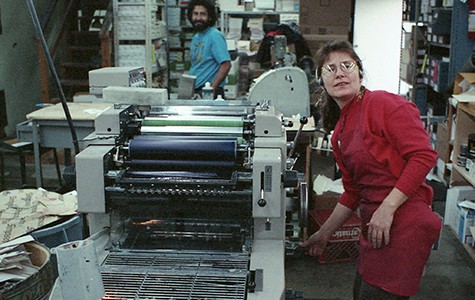
Guillermo Prado (L) and Cheryl DeYoung were among the Inkworks staff in 1995.
Credits: Lincoln Cushing
Inkworks remained steadfastly independent of any party or political grouping (and there were many contenders in the late 1970s and early 1980s). To establish reasonable working conditions and align with the labor movement, Inkworks became a union shop (International Printing and Graphic Communications Union, now part of the Teamsters) in 1978. Yet in a defiant resistance to conformity, everyone was paid the same hourly wage.
In this age of effortless blogging and web streaming, it’s hard to understand how difficult it was to publish political content in the mid-1970s. If you wanted to announce a benefit concert for Chile, or rally citizens around an antiwar demonstration, or issue a report on corporate environmental pollution, you had few choices. In many cities, there was often a public access radio station, such as Berkeley’s KPFA, and if you were lucky, there were one or two alternative newspapers that might carry such information. But a third, powerful, channel was that of printed documents such as posters, fliers, and handbills. That required a sympathetic print shop.
The iconoclastic American journalist A.J. Liebling wrote, “Freedom of the press is guaranteed only to those who own one.” He meant newspapers, but those of us in the energetic political movements of the late 1960s and early 1970s knew it also meant offset printing. Learning to print was a political act. Other such pioneers of the New Left included David Lance Goines’ small shop for Berkeley’s Free Speech Movement in 1964; Glad Day Press in Ithaca, New York and Peace Press in Los Angeles (1967); and Chicago’s Salsedo Press and Red Sun in the Boston area (1973). Of those, only Salsedo and Red Sun remain. But other shops, such as Brooklyn’s Radix Media, continue this noble trade. And the graphic design department of Inkworks, which spun off in 2002, is now the Design Action Collective, a very successful visual communications business in Oakland.
As a young printer and activist in conservative San Diego, I always made a pilgrimage to Inkworks whenever I visited the Bay Area. The shop represented proletarian heaven to me — a union outfit that was collectively-owned and operated, serving a vibrant and diverse community. They had big presses, cool posters, and political authenticity as thick as printer’s ink. I joined in 1981 as a small press operator and left in 2001 as an estimator. My young children would delight in seeing our union “bug” on incoming mail. To this day, I still meet people who remember me taking in their job across the counter. It was — is — a community. Inkworks was such a huge part of my life that I still refer to it as if I work there.
As one of the preeminent movement print shops in the United States, Inkworks would regularly host visitors from all over the world — El Salvador and Vietnam, South Africa and Cuba. We sent material aid to Nicaragua and printed campaign materials for Haiti. We hosted conferences for the Progressive Printers Network, a support group for similar shops in the United States and Canada. One of those shops, the cooperatively owned Community Printers of Santa Cruz, has since established a strong link with the Bay Area and has been designated as our recommended successor for our clients.
Inkworks has unquestionably been an eight-hundred-pound gorilla of social justice publication. The monthly East Bay Community Calendar was a stylish and insightful broadsheet published in editions of 7,500 between 1976 and 1979. Inkworks printed thousands of stunning posters on subjects such as ending South African apartheid, San Francisco Mime Troupe performances, support for gay and women’s liberation, and opposition to racist ballot initiatives. Many of these posters are reproduced in our acclaimed 2007 book Visions of Peace & Justice: 30 years of political posters from Inkworks Press; a 2016 addendum is now being issued.
Inkworks made the painful decision to close down as a consequence of the recession in the 2000s, a general shakeout in the printing industry, and an aging collective membership that deserved to retire. Graciously, another beloved Bay Area collective — the Cheese Board — helped Inkworks by buying their building at 2827 Seventh Street and leasing it back to Inkworks at an affordable rate.
So what is Inkworks’ legacy?
It offered proof that economically sustainable political work was possible. It was a test bed for alternative ways of working, of practical group decision-making, of offering a service that genuinely met community needs. It was midwife for a wealth of publications that document the energy and passion of more than forty years of social change. It was a safe haven for hundreds of publishing activists. It was a giant in movement printing history.
Inkworks Press — and the extended collective that ran it — is no more.
I’m a gay male in my late twenties. I recently ended things with a guy. Our relationship started as a strictly sexual one. We’re both involved in the kink scene in our city and have interests that align in a particularly great way. Quickly it became clear there was a real connection. The next two months were great! I had a toothbrush at his place within three weeks. But early on, I noticed that he was a much more extroverted person than I was. He would laugh loudly at movies, work the room at parties, say things about kink in the middle of crowded restaurants. I prefer to blend in. Initially I thought of this as “the price of admission,” one I was willing to pay, but it soon became tiresome. I ended things, telling him that there were conflicts with our personalities that made a relationship difficult, not specifying what. He fell for me — he’s stated it over and over — but I don’t want him to think he has to change who he is to be with me. I’m confused, Dan. I loved being in a relationship again (I’ve been single for a VERY long time), the sex is great, and finding someone who shares your kinks and you’re attracted to emotionally is rare. We have a ton in common when he’s being down-to-earth. He’s asking me to reconsider. Was I right to end this?
Tired Of Being Single
He shouldn’t have to change who he is to be with you, TOBS, but what if he wants to?
It’s unlikely he’ll morph into an always-quietly-tittering, always-discreetly-kinking introvert, just as you’re unlikely to morph into a braying, oversharing extrovert. But if making an effort to dial it back is the price he has to pay to be with you — along with reserving convos about his kinks (and, by inference, your kinks) for fetish clubs and play parties — why not let him decide if he’s willing to pay?
Gays represent a tiny percentage of the general population, TOBS, and kinky gays represent a not-so-tiny-but-still-smallish percentage of the gay population. I don’t think you have to marry this man, regardless of his flaws, just because you’re gay and your kinks align. But you should think twice about discarding a guy who’s gay and kinky and whose company you enjoy most of the time just because he gets on your nerves now and then.
At the very least, you owe it to yourself, just as you owe it to him, to be specific about the reasons you pulled the plug — because he might want to make an effort to win you back.
There’s a lot that’s good here — your kinks align (rare!) and you enjoy spending some-but-not-all of your time together (common!)—and there are always work-arounds for the bad. An example from my own life: My husband is way more extroverted than I am. So sometimes he goes to movies, restaurants, clubs, and concerts without me. I stay home and read, or sleep, or clean. And then, when he gets home, we have something to talk about — how the movie was, whether the restaurant was any good, who was out at the clubs, and if there were any cute boys in the band. He doesn’t make me go out; I don’t make him stay home. It’s a work-around that works for us.
With some effort, TOBS, you could find the work-arounds that work for you two: He makes an effort, when you nudge him, to dial it back; he goes to comedies with his friends, dramas with you; if he’s working a room, he won’t take offense if you slip into another room.
Give it — give him — a chance.
I’m a gay male college student in a healthy D/s relationship with a bisexual guy. My boyfriend posts pictures of our kink sessions to his Tumblr. (No faces.) A trans woman active in campus queer politics confronted me today. Ze had seen my boyfriend’s Tumblr (!) and recognized me (!!!). Ze demanded I stop engaging in BDSM because ze has to see me on campus and knowing my boyfriend “controls and abuses” me is triggering for zir. Ze said images of me in medical restraints were particularly traumatizing. Ze was shaking and crying, and I wound up comforting zir. I stupidly let zir think I would stop. Now what?
Scenario Utterly Bananas
P.S. Ze also threatened to out my boyfriend if ze saw new pictures go up on his Tumblr. My boyfriend is already out — about being bi and being kinky — so he laughed it off. But how fucked up is that?
You tell this woman you take orders from your boyfriend, SUB, not from random campus nutcases. You advise zir to stay away from Tumblr porn ze finds traumatizing. And if ze pushes back, you explain to zir that if anyone’s being controlling and abusive here, it’s zir. And if ze starts shaking and crying, SUB, direct zir to the student health center.
And for your own protection, SUB, tell zir all of this with at least one witness present. Document everything, and if ze keeps getting in your face about your consensual, nonabusive D/s relationship, take the ironic step of filing a restraining order against zir.
I’m a 24-year-old gay male. My boyfriend and I have been together for just over a year. I have a hang-up when it comes to anal sex. I like bottoming, and I’ve had my fair share of great experiences, but I’ve bottomed only once with my boyfriend. I think I’ve identified why: The ceremonies around anal sex (the lube and condoms part) turn me off due to the smell of the lube and the sound of the condom wrapper. It brings up memories of times when I didn’t have a great time bottoming. Additionally, he is a little bigger than most, so there’s that. What do you suggest? Would it be as simple as finding a lube that doesn’t smell so much? When I top him, which is something we both enjoy, there isn’t a problem.
Wants Anal Now, Goddamnit!
Usually when someone complains about an unpleasant smell associated with anal sex … lube isn’t the issue. But that’s an easily solved problem, WANG, so easily solved that you bundled the answer up with your question: There are ten million brands of lube on the market, kiddo. Shop around until you find one that doesn’t offend your nostrils.
As for the condom-wrapper issue, try opening condoms ten or twenty minutes in advance. Condoms are likelier to be an interruption — one that derails hot butt sex — if you wait until the split second before penetration to bust one out. Open condom packets early, WANG, and put the condom on the BF during foreplay. That way, if the fumbling deflates your bottom-boner (which is a state of mind), you’ll have time to make out, roll around, rim each other, stroke yourself—whatever it takes to get your bottom-boner back.
To get a handle on your performance anxiety and those negative associations — bad memories of lousy experiences, fear of your boyfriend’s big ol’ dick, concerns about whether you’ll have to bail — get some butt toys of varying sizes, and use ’em when you’re alone. With no boyfriend around to disappoint, the penetration will be about your pleasure. In a month or two, with a little effort and non-stinky lube, you’ll have built up a store of positive associations and gained some confidence.
And finally, WANG, if nothing works … maybe you’re a top?
The end of a marriage isn’t necessarily the end of the world, unless you’re the couple at the center of Mark Jackson’s play Little Erik. For them, the decay of their relationship signals an impending catastrophe that has the power to consume everyone around them — audience included.
The family drama, currently playing at Aurora Theatre (2081 Addison St., Berkeley) until February 28, tackles a slew of weighty themes, from guilt to technological dependence. And Jackson uses his vast experience as a playwright and director to plumb each with the tenacity that has earned him a reputation as one of the Bay Area’s most intelligent auteurs. This time, he has adapted and modernized Henrik Ibsen’s Little Eyolf, one of the least-revived works by the acclaimed Norwegian playwright. And although Jackson’s probing of one of Ibsen’s last pieces occasionally comes up short, it will still manage to transfix the Bay Area audiences that it was undoubtedly updated for.
Marilee Talkington as Joie.
Credits: David Allen
Viewers are first introduced to Joie (Marilee Talkington), an uptight San Francisco tech executive who has been funding her husband’s extended sojourn across the globe. She resents his absence for many reasons, but chiefly because she was left to care for their ailing son, Erik, who broke his spine in a tragic accident. Motherhood was never in Joie’s plans, and she clearly has a more meaningful relationship with her iPhone 6 than the little boy she never really wanted. Her husband, Freddie (Joe Estlack), doesn’t seem authentically interested in Erik, either. He’d much rather hang with his beloved and likeable sister, Andi (Mariah Castle), and talk about their secretive past together. It’s no wonder the fledgling author can’t write his long-planned novel about responsibility. After all, he’s never been forced to assume any, as his wife frequently points out.
The resentment between the married pair is palpable and much more believable than the sexual chemistry that supposedly binds them together. Jackson would like us to believe that Joie is “hard” and Freddie is “soft,” and that the sex between them was once so intense that it alone fueled a happy marriage, but the encounters that are meant to illustrate that tension fall flat. Each character carries deep-rooted contempt for the other, and the play seems sharper and altogether more exciting when it allows them time to revel in that bitterness. Talkington is especially good in those scenes as well; she is unapologetic even when she shouldn’t be and hurls snarky insults with aplomb. Not to be outdone, Estlack brings a steely stoicism as a luddite slacker who would rather absorb the insults than throw them back.
Fortunately, those bitter moments become more frequent as the play continues and another tragic accident occurs: Erik never returns after venturing down to the river near the family’s Northern California-based cabin, and the only person who seems to know what happened — the creepy housekeeper (Wilma Bonet), who has far too few scenes — has disappeared.
The mysterious circumstances surrounding Erik’s death have a devastating ripple effect that’s acutely felt by all who occupy the stage. What follows is a series of explosive reveals that are best left unmentioned here, although it’s safe to note that the play’s inability to create sexual tension in its first half is not repeated in its second. The play largely centers on a series of heated arguments, and these exchanges are most profound when the character’s long-held secrets are tragically exposed.
Surprisingly, however, the most inventive strength of Jackson’s Little Erik lies not in its commentary about anger or betrayal, of which there is plenty. Rather, it’s in the production’s ability to convincingly characterize a Bay Area fueled by a dependency on technology. It’s presumed that Joie works for a successful start-up (she just wants to “connect people virtually”), and every scene is punctuated by the light beaming from the screen of her iPhone. When Erik dies, it’s not her husband she embraces — it’s the Apple device. And she is infuriated that she can’t sync with the cabin’s wifi, but the fact that she shares no connections with the people around her seems of little concern.
Little Erik suggests that this is the future — a world in which our memories are stored in megabytes and familial bonds are considerably weaker than shoddy internet connections. For its fictional characters, the repercussions are literally apocalyptic, and Jackson’s not-so-subtle suggestion is that the digital era may be equally damning for the rest of us.
Let’s not bury the lede: This week’s review is about deep-fried candy bars.
With its food politics and pristine farmers’ markets, the Bay Area doesn’t tend to look favorably on this kind of gaudy, greased-up fare — the more populist dining tendencies of the typical undergrad notwithstanding. Here in the East Bay, anyway, we haven’t really had a restaurant that prominently featured fried junk food since the now-defunct Sumo Grub, which, until the downtown Berkeley eatery closed in 2013, had clogged arteries and attracted reality TV camera crews with its menu of tempura-fried things: fried Twinkies, fried pizza, fried mac ‘n’ cheese — you name it. But whereas Sumo Grub seemed to embrace its identity as a purveyor of glorified stunt food, The Snack Shack has somewhat broader, loftier ambitions.
The Reuben featured slow-cooked pork belly in place of corned beef.
Credits: Bert JohnsonThe infamous deep-fried candy bar.
Credits: Bert Johnson
So, yes, brave souls can come here to indulge in batter-fried Milky Ways, but the menu is also dotted with seasonally specific salads and even the occasional French cooking term. This is still Berkeley, after all.
Located on the north side of campus, The Snack Shack occupies a garage-like space inside the Hearst Food Court — one of several clusters of mostly Asian restaurants around campus that have long served as “Fallback Dinner Option Number One” for frugal Cal students. With its AstroTurf-like fake-grass carpet, abundance of corrugated metal, and prominent flat-screen TV, The Snack Shack resembles a nice-ish sports bar more than it does, say, a literal shack.
The proprietors of the three-month-old eatery are first-time restaurateurs Rachel Spector and Scott Wortmann, the latter of whom is the main chef and handles most of the day-to-day operations. Their idea was to serve updated versions of “ballpark style” food, as well as a hodgepodge of the kinds of dishes you’ll find at diners, dive bars, and county fairs — burgers, corn dogs, waffle fries, buffalo wings, fried cheese sticks, and so forth.
Ultimately, it’s gussied-up comfort food — but much of it is tastier than you might expect. The pork belly Reuben featured all of the classic flavor components: the sauerkraut, melted Swiss, grilled rye bread, and tangy Russian dressing. But the use of pork belly (slow-roasted; sliced into girthy, uniform slabs; and seared on the griddle) in place of corned beef proved to be more than just a put-bacon-on-everything gimmick. The sandwich was a little less salty and a lot more tender and unctuous than most traditional versions.
Anything with that pork belly is likely to be good. During one visit, the daily special was a pair of pork belly schnitzel pretzel-stick sliders (a string of words I had to re-read several times). If anything, this was even better than the Reuben: The belly had been breaded and fried (hence, the “schnitzel”), then placed, along with a smear of mustard and some arugula, on a salt-studded soft pretzel that had been sliced in half to form a “slider” bun. Despite the outlandishness of the premise, it was a fairly straightforward — and straightforwardly delicious — sandwich.
Meanwhile, the corn dog I tried was an excellent exemplar of the genre, with a corn flour-based batter that wasn’t overly heavy or thick, and clung fastidiously to the juicy pork andouille sausage within. Like many of the dishes on the menu, the corn dogs also happen to be gluten-free. (More on that in a second.)
If you aren’t counting calories — and, let’s face it, what’s the point if you’ve come this far? — you’ll want to wash your meal down with one of The Snack Shack’s excellent milkshakes, which are made with Dreyer’s vanilla ice cream blended with however many house-made syrups and mix-ins you’d like. I’m a sucker for a thick milkshake, and these were thicker and more satisfying than the shakes at far tonier burger joints. The strawberry and peanut butter shake made for a particularly great combination. There’s even a milkshake happy hour, a promotion I’ll henceforth demand — or at least politely request — at all of my favorite diners and ice cream parlors. (Thanks to The Shake Shack’s newly-acquired beer and wine license, the shake discount — fifty cents off — is now folded into the restaurant’s broader 3–6 p.m. happy hour.)
Given the aforementioned schnitzel sliders and deep-fried candy bars, it’s easy to peg The Snack Shack as a disciple of the Food Network frat-bro-in-chief Guy Fieri’s school of melt-your-face-off stunt food. But there’s an earnestness to the food that I found surprising. After all, one of the restaurant’s signature dishes is a lamb and goat cheese slider. The seasonal salad featured roasted butternut squash, candied pecans, and a thyme dressing. (It was pretty good, although I would rethink the inclusion of raw, fresh cranberries.) All this makes sense when you consider that before they settled into their food court location, Wortmann and Spector had originally planned to open a more upscale wine bar.
That sincerity comes across even in dishes that weren’t strictly successful. The most ambitious item on the menu is the shrimp roll — a play on a mini lobster roll, basically — that featured shrimp poached in a creamy beurre blanc sauce. The flavors were great, but nothing could save the fact that all of the shrimp were mushy. Likewise, The Shack Burger — topped with frizzled onion strings and a tangy “special sauce” — would have benefited from a higher-quality protein. This would have been a fine stand-in for an In-N-Out burger but for the fact that the beef itself was dry and oddly flavorless. When Wortmann later told me he was using pre-formed patties, it all made sense.
One thing that won’t be immediately obvious to most customers is that most of the food is gluten-free, to accommodate the fact that Spector (who is also Wortmann’s girlfriend) doesn’t eat gluten. In fact, the bread for the full-size burgers and sandwiches are just about the only thing on the menu that contains gluten. Even the sliders, served on house-made brioche buns, are gluten-free, and Wortmann uses breadcrumbs from those buns to bread his schnitzel.
The odd thing is that you’d never know that this was the case. Wortmann said he didn’t want to market the restaurant as gluten-free for fear that customers might be less inclined to try certain things — that the place might wind up marginalized in some kind of “gluten-free ghetto,” so to speak. It’s a fair point. Spend enough time eating, say, overpriced, overly “tweezified” bar fare, and the prospect of spending a week writing about weird fried food can seem oddly appealing. But would I still have made the trek up to Northside if I had known that all of that fried food was gluten-free? Maybe not.
Still, it would have been nice to be able to manage my expectations, so I wouldn’t be left thinking, after a follow-up phone interview with Wortmann, “So that’s why a handful of dishes were inexplicably terrible.” There’s no need to proclaim it from the rooftops, or to rename the restaurant “Shack of No-Gluten Snacks.” A brief note at the bottom of the menu would suffice so that gluten eaters won’t be flying blind when, for instance, they order a strawberry mini-doughnut that turns out to be chalky and artificial-tasting.
More importantly, a lot of people who don’t eat gluten would love this place, which joins North Oakland’s Grease Box in smashing the notion that gluten-free food must, by necessity, be a sad cuisine of self-denial.
After all, would you believe that even the deep-fried Reese’s candy bar was gluten-free? You wouldn’t think it from looking at the thing, served, as it was, on a stick — indistinguishable from a corn dog until you bite into its melted-chocolate, peanut-studded core. Sure, this isn’t anyone’s idea of gourmet cuisine, and, in all honesty, I couldn’t eat more than a bite or two. But if you don’t embrace that kind of oozy, deep-fried decadence at least once in your life, how can you say you’ve really lived?
Our February 3 Then and Now column, “The Real Brooklyn,” misspelled the last name of Thomas Eagar, the settler who suggested that the towns of Clinton and San Antonio consolidate into a town called Brooklyn, which was in an area now known as East Oakland.
There’s a good reason why much of California’s coastline remains wild and pristine — and doesn’t resemble East Coast cities like Miami and Atlantic City. In 1972, California voters passed Proposition 20, establishing the California Coastal Commission, a state agency that, over the past four decades, has protected the state’s coast from over-development. In fact, many environmentalists agree that the coastal commission is one of the few state agencies that has not been captured by the people and companies it regulates.
But the coastal commission’s legacy of independence is in danger. This week, pro-development forces aligned with Governor Jerry Brown are expected to mount an attempt to fire the commission’s executive director, Charles Lester, a conservationist lawyer who is known for his staunch defense of the state’s scenic coastline.
Charles Lester.
“What we’re seeing here is an attempt to oust an independent executive director,” said Stefanie Sekich-Quinn of the Surfrider Foundation, an environmental group that keeps close tabs on the commission.
So far, coastal commissioners have remained silent on Lester’s fate, but Lester’s critics have quietly raised concerns about his management style and say the commission’s staff needs to become more diverse. Lester responded late last week with a memo, detailing strategies for improvement. “More can be done to meet our goal of reflecting the broad diversity of California, and we must pursue any and all permissible methods to achieve this goal,” he wrote.
Environmentalists contend that the real reason behind the attempted ouster is that pro-development forces want to gain control of the coastal commission and change it from an agency that regulates coastal development to one that facilitates development — just like the oil and gas industry has done with the California Division of Oil, Gas & Geothermal Resources, and the state’s utilities, including PG&E, have done with the California Public Utilities Commission.
“The coastal commission has been a target since it was formed,” said Jeff Miller of the Center for Biological Diversity, a conservation group that won a lawsuit settlement last week that halts new fracking off California’s coast. “It is one of our few remaining defenses” against industry.
Three of the current commissioners who are believed to be pushing for Lester’s ouster were appointed by Brown: Martha McClure, Effie Turnbull-Sanders, and Erik Howell.
Along with the Surfrider Foundation, the environmental groups WildCoast and Environment California keep an annual scorecard of votes by coastal commissioners, and according to the 2015 scorecard, McClure, Turnbull-Sanders, and Howell have consistently voted on the pro-development side. The scorecard ranks commissioners on a scale of 0 to 100 percent, with 100 percent being pro-environment. McClure scored the lowest last year, with 32 percent, while Turnbull-Sanders scored 33 percent, and Howell, 42 percent.
Another commissioner who is suspected of wanting Lester fired is commission chairperson Steve Kinsey, a pro-development Democrat who serves on the Marin County Board of Supervisors. A few years ago, Kinsey was not happy with the fact that Lester had taken a tough stance against a controversial oyster farm at Point Reyes National Seashore.
Kinsey, who represents the Point Reyes area of West Marin, was an avid supporter of the Drakes Bay Oyster Company and its owner, Kevin Lunny. In 2012, then-US Interior Secretary Ken Salazar refused to extend Lunny’s lease at Point Reyes, noting that Congress had designated the area occupied by the oyster farm to become the first federally protected marine wilderness on the West Coast. Numerous Republicans and pro-development Democrats rushed to Lunny’s defense. But one of the few state agencies that stood up to Lunny and his allies was the coastal commission.
Lunny and his supporters had maintained that he was operating an eco-friendly operation. But in 2012, Lester penned a strongly worded enforcement letter to Lunny, noting that the oyster farm had repeatedly violated California’s environmental laws and had failed to obtain the proper state permits for five years. “As you know, your facility remains unpermitted under the Coastal Act,” Lester wrote.
Environmentalists from West Marin were not surprised by Kinsey’s support of Lunny and the oyster farm. “He’s got many developer buddies,” Miller said. “And he has no trouble approving development that is environmentally damaging.”
As of early this week, Governor Brown was still refusing to publicly intervene in the attempted firing of Lester — which is also not surprising. California environmentalists have known for years that Brown often prizes style over substance when it comes to the environment.
Michael Lee started living on the streets of San Francisco last May. He had traveled to the city from Las Vegas to seek medical treatment. When he arrived, he searched for cheap, temporary housing in some of San Francisco’s most affordable neighborhoods, but he had seriously underestimated the cost of living in the nation’s most expensive city.
“I was under the impression the rent was $300 a month, and I brought the resources for sixty days,” he said in an interview. “I was going to go back to Las Vegas afterwards … . But the first place I walked into, they told me it was $300 a week. The next was $400 a week, and then $500. People were laughing at me — $300 a week is actually cheap on Skid Row. So I wound up living on the streets.”
Homeless people created “Liberty City,” a tent city on the lawn in front of Berkeley’s old City Hall, to protest the city council’s proposal to enact stricter rules targeting the homeless.
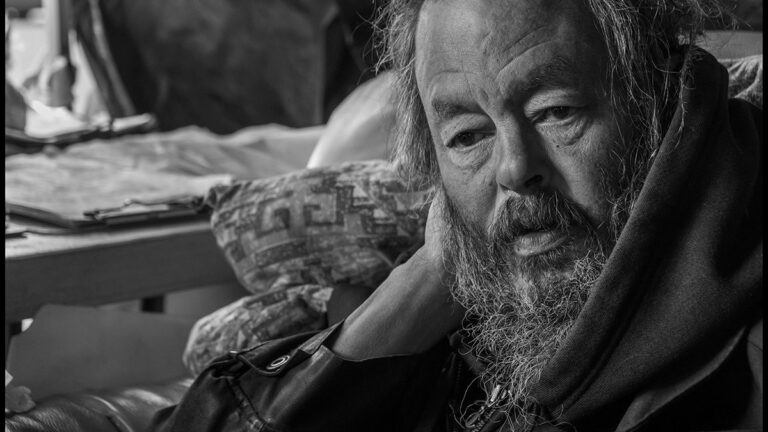
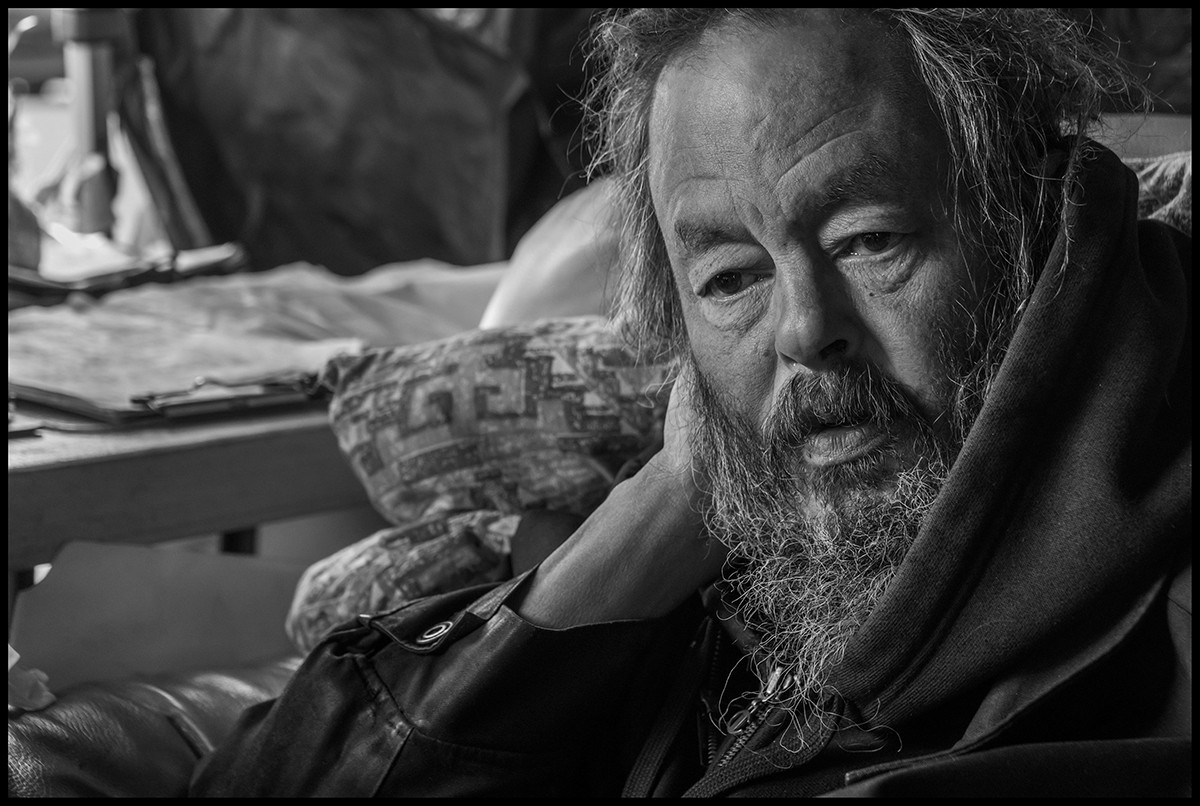
Credits: David BaconMichael Lee became a leader of the Berkeley post office camp.
Credits: David BaconHomeless people set up the Berkeley post office camp to protest the US Postal Service’s planned sale of the historic downtown Berkeley post office.
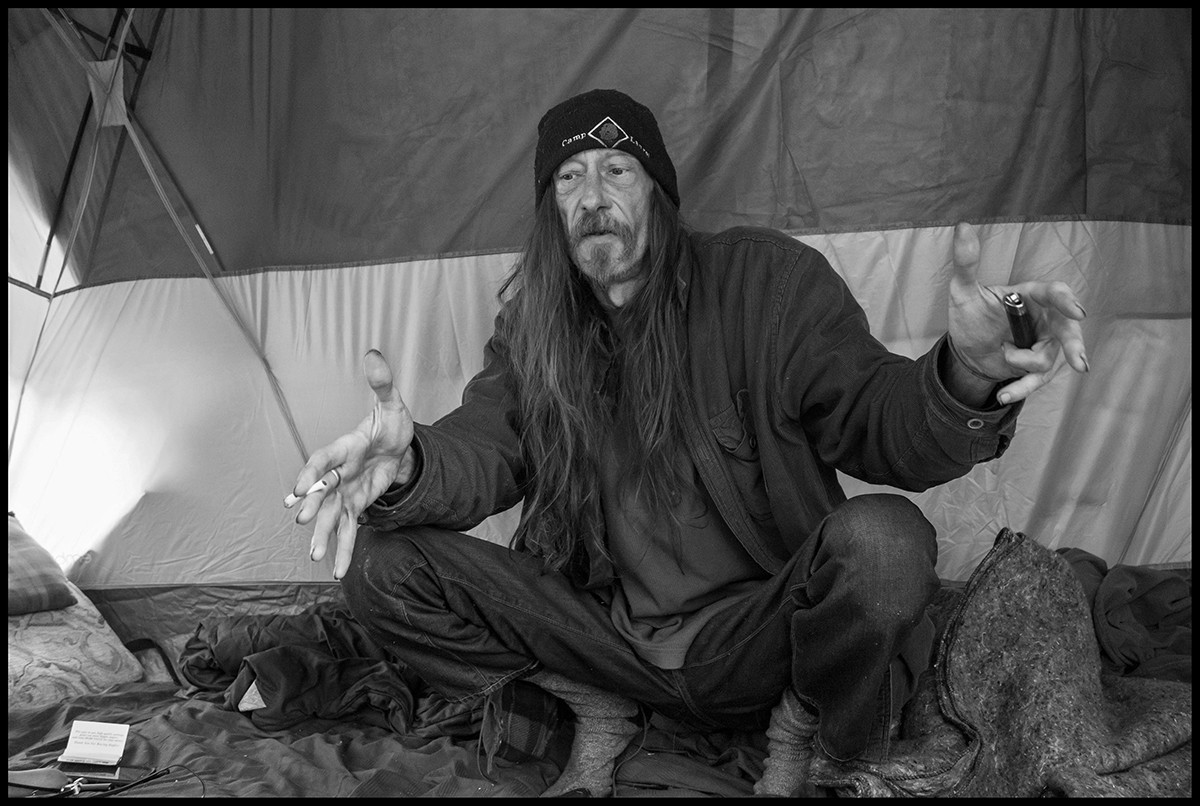
Credits: David BaconMike Zint said he and other homeless people hoped to create “an actual city through a bunch of homeless people coming together.”
Credits: David BaconAndre Cameron said some Berkeley residents were more accepting of the homeless.
Credits: David Bacon
Lee soon heard of a large encampment in Berkeley that activists had set up to protest the US Postal Service’s controversial plan to sell Berkeley’s historic downtown post office building. The plan sparked fierce opposition in Berkeley, not only from homeless people, but also from progressive activists and the city’s elected leadership. Lee decided to move across the bay and join the protest and quickly became a leader of the Berkeley encampment. He advocated for a plan to transform the old post office building into a community resource: “A homeless contact center run by homeless people,” he said.
“Why [were] homeless people the main defenders?” Lee asked rhetorically, referring to the post office. “Without community resources we can’t get a hand up. There’s just no place to go. This is where we live, unfortunately — on the sidewalks. We don’t want to live in a community where private developers, the One Percenters, have everything.
“We’re not going to be homeless forever,” Lee continued. “Eventually, we will recover from homelessness because we’re pretty determined individuals. That’s something that people with houses truly need to understand. We are going to be rejoining the community.”
After a federal judge granted the City of Berkeley’s request for a temporary restraining order to block the US Postal Service’s planned sale of the downtown post office, the USPS announced that it was shelving its plans to sell the building. Several months later, some of the people in the post office camp set up a larger homeless encampment, which became known as “Liberty City” or “Liberty Village.” They established this camp on the lawn in front of old City Hall, a block away, to protest a new city council plan to enact stricter rules targeting homeless people. During the holidays, the City of Berkeley cleared out Liberty City, and the homeless people who had been part of it scattered to other spots in the city and to locations throughout the Bay Area. But the post office camp, now more than four hundred days old, still remains.
Over the years, Berkeley, like most liberal communities, has been comfortable with the idea of the homeless being victims. But many Berkeley residents and business owners grow uneasy when homeless people organize and use the creative tactics of the labor and civil rights movements.
Last year, Berkeley’s homeless people did just that. They created what they called, “intentional communities” or “occupations,” like Liberty City and the post office camp, not just as a protest tactic, but also as places where they could gain more control over their lives and implement their own ideas for dealing with homelessness.
Many drew on previous experience in other movements. “A lot of us are older activists,” Lee explained. “Our ideas come out of the 1960s, and even before, from the 1930s. Homeless people have always formed communities, whether we were considered hoboes or homeless people or just bums. Hobo jungles were intentional communities, too, based on an unconscious understanding of the need for mutual aid and voluntary cooperation.”
During an interview while Liberty City was still operating, Lee said, “People police themselves. I see people out there in the middle of the night with flashlights picking up trash. I see them chase off anti-social elements. If you want to talk about the solution to homelessness, all you have to do is walk down to Berkeley City Hall and the post office. Is it a perfect solution? No. Housing is the permanent solution to homelessness. But this is a helluva good start.”
City Councilmember Jesse Arreguin, who is running for mayor this year, said he thinks the residents of Liberty City did a good job of keeping it safe and well-run. “Liberty City shows that homeless people can create a community,” he said. But he cautioned that such communities can’t “be completely removed from the city. There should be an ongoing city presence, that might include homeless outreach staff, mental health workers, or others.”
Nearly everyone agrees that the answer to homelessness is permanent housing. But the state and federal governments do not provide the funding needed to build permanent housing for homeless people. In fact, over the decades, national policies have eliminated housing for poor people and cost hundreds of thousands of jobs.
Local governments provide homeless shelters and services, but they are unable to meet the needs of the huge number of people living on the streets. Berkeley alone has 1,200 homeless residents, according to city officials. Further, many homeless people don’t like shelters, because they can’t bring their pets, or because most shelters require you to be inside by a certain hour in the evening and to leave during the day.
As a result, some cities, including Portland and Seattle, have approved the creation of tent cities as an alternative form of temporary housing for homeless people. And Berkeley’s experience with Liberty City revealed that a tent city has the potential to work in the East Bay as well.
But while Berkeley views itself as a progressive community, it remains to be seen whether the city would ever approve a tent city plan. After all, the council voted on December 1 to green-light the city’s crackdown on the homeless.
Mike Zint has been homeless since 2000. For many years, he lived out of his car, moving from town to town. He said he began organizing during the Occupy movement several years ago in San Francisco.
Zint said that after San Francisco police “crushed” the Occupy encampment, he and other homeless activists staged a series of protests, including one during the America’s Cup yacht race. Then they set up an “Occupy Staples” protest in San Francisco to demonstrate against Staples’ decision to open postal kiosks, which activists viewed as a further “privatization of the post office,” he said.
Zint said that, over the years, San Francisco has hardened its stance against marginalized people, like the homeless. Politicians “pass laws to get the homeless out of sight of the businesses, so shoppers don’t see them,” he said. “San Francisco has an image as a world class city, but there are no bathrooms. There are no shower facilities. They say there are only a few thousand homeless when there are twice as many. With the shuffle going on, they just move them. One day this street looks good because they’ve cleared people out, and then they get rid of them somewhere else.”
Eventually, Zint and other demonstrators moved the San Francisco protest in front of Staples to the Staples store in Berkeley. Then, “last year, we learned the post office was going to sell the main building downtown. So we removed everything from Staples, and took the corner of the post office instead,” he said. “We put the occupation right there.
“Over the last year, we’ve been organizing the homeless into an actual movement,” he continued. “Our intention has always been to occupy a much larger piece of property, and get one of the Bay Area cities to allow homeless people to take care of themselves. Berkeley, because of its reputation, is a good place to do this. People here are genuine and care. The university and high school students are incredible. The teachers are very good. It’s night and day compared to San Francisco.”
At first, fighting the Postal Service in Berkeley brought homeless people together with city authorities in a loose-knit coalition that included Mayor Tom Bates, Councilmember Linda Maio, and local legal and political activists. While rallies and court actions sought to halt the sale of the post office building, the encampment on the post office steps became a constant presence and visible evidence of resistance.
Within the encampment, homeless people developed their own community. They organized themselves and worked together. They made decisions collectively. And they developed their own ideas about what causes homelessness and devised short-term and long-term solutions to it.
Last fall, while Liberty City was still operating, Michael Lee said, “People in the community came out and looked at us, and maybe at first they thought, ‘Look at the poor homeless people.’ But now we’re creating the new world in the shell of the old. What we’re doing in terms of mutual aid and cooperation can be applied anywhere. They’re going to have to finally see that organizing is the solution to homelessness.”
Paul Kealoha Blake, who is director of the East Bay Media Center on Addison Street and a business owner sympathetic to the homeless, said residents of Liberty City maintained order in their camp. “I think that Liberty Village and its organizers did an excellent job of setting standards of no drugs and alcohol,” he said.
But the coalition of homeless activists and city politicians didn’t last beyond the post office battle. Several months after the Postal Service announced that it no longer planned to sell the building, Bates and Maio brought the homeless-crackdown ordinance, sought by the Downtown Business Association, before the council. The new ordinance prohibits people from lying in planter beds, tying possessions to poles or trees or keeping them within two feet of a tree well or planter, taking up more than two square feet of space with belongings, and keeping a shopping cart in one place for more than an hour during the day. It also further penalizes urinating and defecating in public, which are already against the law.
Both Blake and Arreguin, who voted against the new ordinance, believe that homelessness has become an overly polarized issue in Berkeley, rather than one in which different parts of the community find common ground. “The business community would like to see people not camping out in doorways,” Arreguin noted. “Business people want a long-term solution. Homeless people did a good job on changing perceptions of homelessness at Liberty City. They set ground rules and enforced them. They had a process for that, where everybody participated in the meetings.”
Before Berkeley cleared out Liberty City, Zint told me that he and other homeless activists were attempting to develop “an actual city through a bunch of homeless people coming together. We have a community here. And if we can pull it off properly here, we can use this as a model to be done all over. They’ll begin listening to our message, and that is ‘that we should be able to take care of ourselves.'”
Berkeley is not the only community where homeless people have proposed running their own encampments. A homeless protest and occupation in Portland last year evolved into Dignity Village, which now exists with the city’s approval. Portland, in fact, is debating the creation of new, similar encampments.
The Seattle City Council has already approved three new tent cities, each housing one hundred residents, although they will be run by service providers, rather than the homeless themselves. They’re estimated to cost $200,000 per year in trash collection and portable toilets, but that cost is less than a traditional shelter. In Honolulu, which has also passed multiple ordinances cracking down on sitting and sleeping in public, Mayor Kirk Caldwell has set up a new homeless camp that is made up of shipping containers.
Berkeley also had an earlier experience with a homeless camp, called Rainbow Village, in what is now Cesar Chavez Park at the marina. Mostly, it consisted of an area where people could park and live in their cars. After an incident in which someone was killed, however, the city closed it down.
“But I do not believe that the Rainbow Village should be evaluated solely on that tragedy,” Blake cautioned. “A close and collaborative relationship between homeless leadership and the City of Berkeley can work and was in fact working at Liberty City.”
One big question is where such a camp could be located in Berkeley. Rainbow Village was far from transit and services needed by homeless people. Arreguin said, however, that when Liberty City was operating in downtown, his office got complaints from neighbors living near the old City Hall. “The camp had a spillover of people who were attracted to it and who engaged in inappropriate behavior,” he said. “Not everyone respects our laws, and the perception of homeless people is often based on those examples. But we need to be sensitive to the concerns of neighbors.”
For their part, however, most homeless people in Berkeley complain that they are demonized, and they established Liberty City partly in response. Many homeless people are also veterans, and have to reconcile the irony of having fought in the military, only to later find themselves social outcasts in the country that they had defended.
“I spent ten years in the Navy upholding the Constitution, from 1979 to 1989,” said James Kelly, a former resident of Liberty City. “I believe a person should not have to worry day-to-day where they’re going to lay their head or get their next meal. That should just be a given.”
Andre Cameron, another Liberty City resident, said his experience in Berkeley at the encampment was dramatically different from the time he spent in Los Angeles, the last city he lived in. “In LA, they don’t have anything like this. They have Skid Row,” he said. “A huge amount of people live on the street in downtown LA. There’s no help for them. Here, there’s a community. I feel the love here. I feel that, here in Berkeley, there’s at least some hope. There are people here that care. If I had to choose to be homeless anyplace in the world, it would be here in Berkeley.
“It’s embarrassing, if you’ve never been homeless,” he continued. “People in LA look at homeless people like a plague. Here, there’s more of an acceptance of this subculture of homeless people. I think it’s a tribute in some small cultural way to the community as a whole. I’ve never gotten that sense anywhere else.”
Ultimately, Arreguin said, the city needs to hear from the homeless themselves and treat them as normal members of the body politic. “When the city passed a law last year that criminalizes homelessness, there was no conversation about what the homeless need, and the city didn’t have any input from them. But it can be done,” he said. “We do have a crisis, and all options should be on the table. Berkeley should consider a temporary encampment until we have more permanent housing. People need a place to go.”
Cameron added, “They should have a place, a park, some sort of a space where people can set up tents, and live peacefully, with porta potties and showers and trash pickup, and that’s organized. We need a place for people to be human — eat, sleep, utilize restrooms. That need doesn’t stop because of a law.”
Stories you shouldn’t miss:
1. In a major defeat for environmentalists, Governor Jerry Brown’s appointees spearheaded a successful effort on Wednesday to fire Charles Lester, who was the executive director of the California Coastal Commission and a fierce advocate for protecting the state’s pristine coastline from development. Pro-development forces, led by Brown’s appointees — Martha McClure, Effie Turnbull-Sanders, and Erik Howell...
Deadpool, Ryan Reynolds' second crack at Marvel's most in-your-face character (following a forgotten appearance in the misbegotten X-Men Origins: Wolverine) is a terrifically faithful adaptation of some awfully obnoxious source material. If you're a pre-existing devotee, the film's nonstop assortment of cartoony assholes and elbows to the ribs might very well make your head pop off in a paroxysm...
Stories you shouldn’t miss:
1. The Oakland City Council moved a step closer to adopting housing impact fees that would generate much-needed funds for affordable housing in the city, the Trib$ reports. The council’s Community and Economic Development committee gave tentative approval to a plan pushed by four councilmembers, calling for launching the fees in September and gradually increasing them to...
Last month, Berkeley's Inkworks Press closed its doors after 42 years. It marked the end of a bold experiment in worker ownership and political control of the media in the service of social justice.
Inkworks started in 1974 when Berkeley activists who had been learning offset printing at an alternative school set up a shop. The various streams of activism...
I'm a gay male in my late twenties. I recently ended things with a guy. Our relationship started as a strictly sexual one. We're both involved in the kink scene in our city and have interests that align in a particularly great way. Quickly it became clear there was a real connection. The next two months were great! I...
The end of a marriage isn't necessarily the end of the world, unless you're the couple at the center of Mark Jackson's play Little Erik. For them, the decay of their relationship signals an impending catastrophe that has the power to consume everyone around them — audience included.
The family drama, currently playing at Aurora Theatre (2081 Addison St., Berkeley)...
Let's not bury the lede: This week's review is about deep-fried candy bars.
With its food politics and pristine farmers' markets, the Bay Area doesn't tend to look favorably on this kind of gaudy, greased-up fare — the more populist dining tendencies of the typical undergrad notwithstanding. Here in the East Bay, anyway, we haven't really had a restaurant that...
Our February 3 Then and Now column, "The Real Brooklyn," misspelled the last name of Thomas Eagar, the settler who suggested that the towns of Clinton and San Antonio consolidate into a town called Brooklyn, which was in an area now known as East Oakland.
There's a good reason why much of California's coastline remains wild and pristine — and doesn't resemble East Coast cities like Miami and Atlantic City. In 1972, California voters passed Proposition 20, establishing the California Coastal Commission, a state agency that, over the past four decades, has protected the state's coast from over-development. In fact, many environmentalists agree that...
Michael Lee started living on the streets of San Francisco last May. He had traveled to the city from Las Vegas to seek medical treatment. When he arrived, he searched for cheap, temporary housing in some of San Francisco's most affordable neighborhoods, but he had seriously underestimated the cost of living in the nation's most expensive city.
"I was under...