No Place to Go

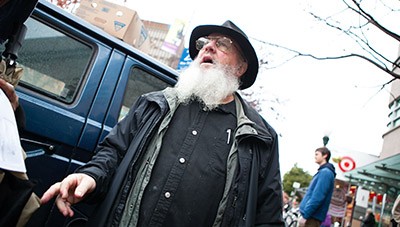
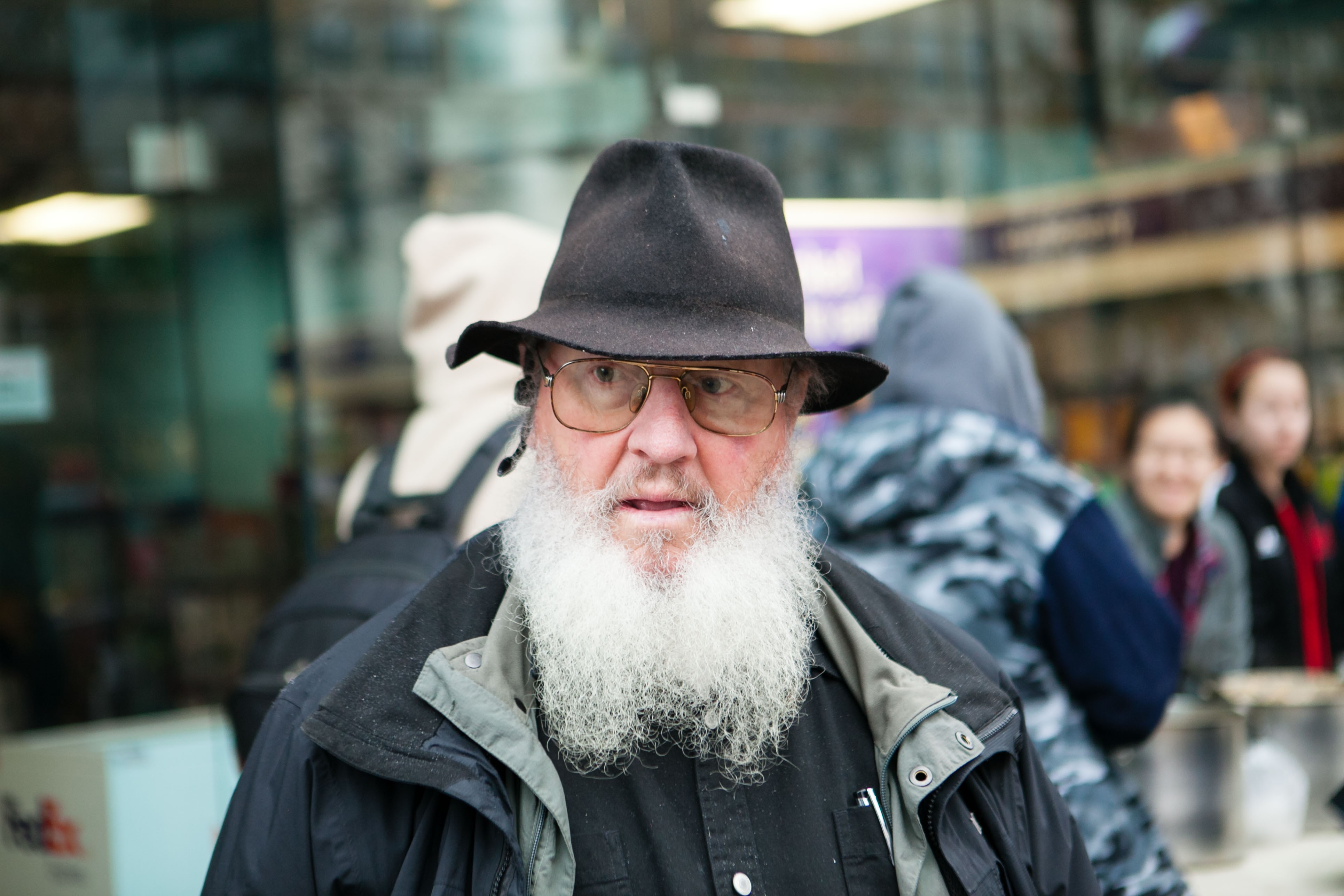
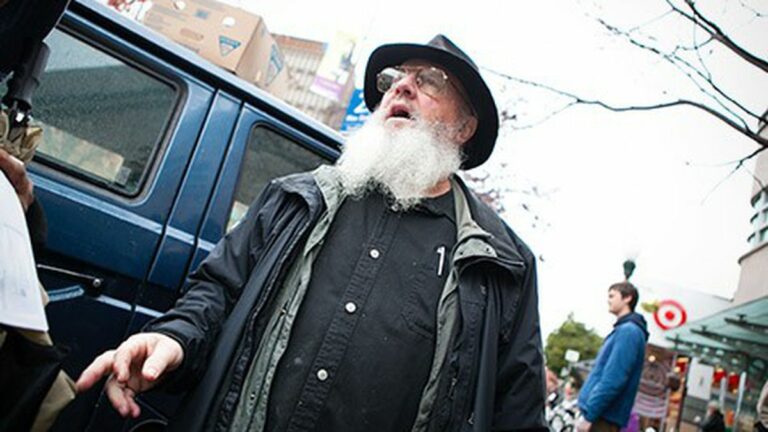
“There’s nowhere to go to the bathroom around here,” said Rick Briscoe, who is homeless and has been living on the streets of Berkeley for about a year now. Although the city does have public restrooms, the closest ones to where Briscoe hangs out are several blocks away, which makes it difficult for him because of recent health problems. He said he’s also hesitant to leave his belongings unattended for long. “It’s not easy to pack all this stuff up — it can take forty minutes!” he said, as he pointed to his things sprawled around him on the Shattuck Avenue sidewalk.

Homeless advocates say that people like Briscoe will be deeply impacted by new measures that the Berkeley City Council recently greenlighted to deal with the city’s homeless population. The measures are designed to eliminate urinating and defecating in public parks and open spaces, and to prevent homeless people from sleeping in planters boxes for trees.

“We want people to use the bathrooms — that’s the bottom line,” said Berkeley Councilmember Linda Maio, who backed the new measures. “If the police have to urge them to do that because they see them doing their business, then they’ll be much more likely to do it now that the language is strengthened.”

The controversy over Berkeley’s new measures has received a substantial amount of news coverage. But some experts say that what has been overlooked in the debate is the lack of access that many homeless people have to restrooms. Briscoe said that if it were not for some shopkeepers who let him use their facilities after their customers leave, he would have few choices.

“The thing that resonates with most people is that lack of toilets really leads to this global burden of disease caused by diarrhea. From the public health perspective, I think that’s the biggest issue,” said Rachel Sklar, a public health researcher at the Environmental Health Sciences Department of UC Berkeley’s School of Public Health. Sklar’s work goes beyond urban toilets, to focus on the 2.5 billion people globally who lack reliable, safe access to a bathroom, although the problem certainly isn’t limited to the developing world.
In the wealthy Bay Area, the scarcity of clean, safe restrooms remains a harsh reality for many people. According to the Alameda Countywide Homeless Count and Survey Report, more than 4,200 homeless persons were estimated to be living in Alameda County at the time of the last survey in 2013. Of those, about 2,300 were categorized as “unsheltered persons,” or people not housed in a shelter or transitional housing service.

Maio said the council recognizes the need for restrooms that are open around the clock, but she also pointed out the challenges with providing them. “We had a bathroom at People’s Park, which required a person to be there. It became a place where people did drugs, it was pretty horrible,” she said. She also mentioned the public toilets behind City Hall, which are closed for part of the day. “This is a bathroom in a building, and it’s closed from 10 [a.m.] to 4 [p.m.] because we found people in there during the day engaging in sexual acts. … That was not good.”

Outside a McDonald’s on Shattuck, Neil Mortensen agreed that downtown Berkeley is a challenging place to find a public restroom for homeless people like him. Recently, they seem to be even less available, and the ones that are open often have a line, he said. “I understand that they’re worried about prostitution and drugs,” he said, “but these things have been going on for years. In the meantime, we need a place to go to the bathroom!”

The council is looking into ways to meet the demand for more public restrooms. Options include keeping some public restrooms open 24 hours, adding mobile shower units, which would include restrooms, or fostering a relationship with BART. The transit agency closed its underground public restrooms after the 9/11 terrorist attacks, based on a recommendation of the US Department of Homeland Security. “The recommendation still stands. BART directors, staff, and BART police are reviewing options of reopening the closed restrooms if remodeled in a way that keeps them safe,” BART spokesperson Alicia Trost wrote in an email to me. “We want to provide a restroom, but safety is important as underground stations continue to be a threat.”

Homeless advocates say that Berkeley’s new measures won’t work without more public restrooms — and will only serve to criminalize homeless people for a problem that isn’t their fault. “The public toilets are better described as shit houses! They’re absolutely horrible,” said. J.C. Orton, who works with the Berkeley-based group, Night on the Streets Catholic Worker.

Each year, in an effort to get local high school students to think about the plight of homeless people with empathy, Orton sends out a group of students with no wallets, keys, or phones for a day and challenges them to find a toilet to use without being a paying customer. “It’s a poor, poor job that the government and private citizens and businesses have done with regards to providing access to toilet facilities,” he said. “And I don’t mean just toilet bowls and urinals, but showers, sinks — the whole bit.”
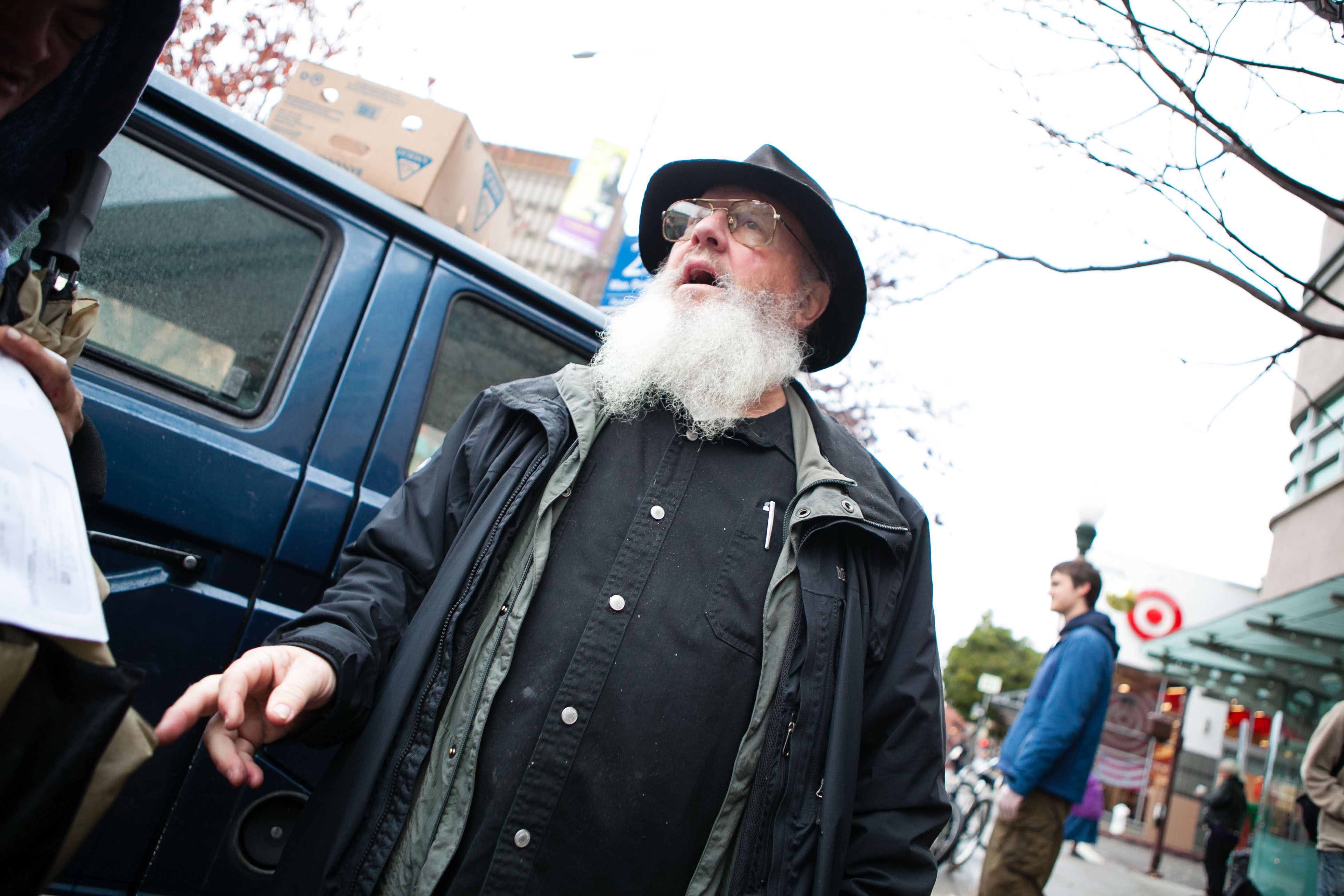
Orton added that the porta-potties installed by the city are unfit for use. “I suggested to people, ‘Go ahead and use the public toilet that’s over there, the porta-potty-type toilet the city puts up,'” he said. “They go in there, and say, ‘Oh I can’t do that.’ Homeless people are considered by some as second-class citizens — they’ll just make do. But this is one main problem, is that the toilets that are there, that are public, they’re absolutely horrible!”

According to the city website, Berkeley has 24 public restroom locations. The hours of availability range from 5:15 a.m. to 2 a.m., but that changes by the day of the week and by location. None are currently open continuously.

“We do have a maintenance schedule for all of them,” said city spokesperson Matthai Chakko. “If there are complaints, then we try and figure out different ways to change the maintenance schedule, or increase the maintenance schedule. We do our best, but if people have complaints, they can always let us know.”

Cost is a factor in scaling up sanitation efforts. According to estimates compiled by BART staff, installation of a street level restroom unit can cost $300,000 to $400,000, while an underground restroom could cost anywhere between $100,000 to $525,000. Continued maintenance for a street level unit could cost $30,000 each year, while an underground restroom could cost $75,000 to $100,000. “Obviously, we don’t have unlimited funds, so seeing how we can be more efficient and still meet our residents’ needs is super important,” Chakko said.


Oakland Needs to Okay Medical Cannabis Delivery Services

Delivery-only dispensaries have done business in the Bay Area for years alongside the more prominent brick-and-mortar dispensaries that most residents are familiar with. Due to the cap on storefront dispensary permits (currently only eight allowed in Oakland), these delivery-only services exist in a robust and fairly saturated space. But we operate in the shadows, without the protection of clear laws that are established for the brick and mortars. The City of Oakland is currently considering an increase in its number of licenses, and for the first time, a formal acknowledgement of the delivery-only market.

We urge the Oakland City Council to allow for an unlimited number of delivery-only permits, to increase accessibility for patients, allow growth of existing community-based collectives, and to capitalize on the potential tax revenue for the city. Taking this step should be part of a commonsense local regulatory plan that respects and supports the responsible cannabis businesses and benefits patients. This will help to build relationships with law enforcement, incentivize cannabis businesses to develop high-level operating standards, and enable those businesses to contribute to the city’s tax base.

As an African-American woman who bootstrapped my collective one year ago, I hope the city continues to lift barriers that limit the innovation and economic opportunities that the cannabis collectives can provide in Oakland. As an entrepreneur, I personally developed and implemented a business plan that I am living out each day. But my efforts are not without risk. Our collective works hard to serve our patients seven days a week without the benefit of angel investors, police protection, or even a clear legal framework. We are not here as a way to supplement another business — this is our primary focus, our passion, and our purpose. We are ready to be allowed to be proud of that.

We believe in cannabis culture: a culture that embraces art, music, love, and most significantly, the medically proven, healing benefits of the plant. We support the funding of cannabis research and education, and we exist to support patients who have been denied access to medicine that can profoundly improve their lives. Additionally, we encourage the opportunities for economic independence that the cannabis industry has brought for women and people of color.

Supporting patients and the canna community is our mission, not an afterthought. Many in this industry have given up careers, put their families at risk, and formed collectives despite the lack of access to funding — and all with the constant fear of everything from the inability to reenter the workforce to federal prosecution.

Permit limits encourage an unfair advantage in Oakland’s cannabis industry and stall the growth opportunities for brave new collectives. This is a critical moment for the city as it decides how to promote access to cannabis for patients, and it is a turning point for Oakland’s entrepreneurs who are ready to bring our passion, innovation, and tax revenue to the community. There is a need in the cannabis community for cautious creativity that operates without attracting unwanted attention. This careful inventiveness informs how we disseminate information to patients, the way we develop apps, hold job fairs, serve cannabis dinners, host product education events, and sponsor research.

Our patient community includes women, veterans, seniors, student athletes, working professionals, and critically ill patients who do not have access to a storefront. There has been significant growth in the number of diverse entrepreneurs ensuring that patients have access to the widest range of treatment options available. Delivery-only dispensaries provide alternative outlets for those products.

We are members of a community of like-minded collective members who support our patients and promote responsible consumption. The beauty of cannabis is not only that it heals, but it unifies. We share cannabis, we pass it, and we “gift” it to those that need it. It is our hope that Oakland’s cannabis professionals can find a way to keep that spirit alive.

Hard Work

I’m a 24-year-old gay male with few resources and no “marketable” skills. I have made a lot of bad choices and now I struggle to make ends meet in a crappy dead-end job, living paycheck to paycheck in an expensive East Coast city. Recently, someone on Grindr offered me $3,000 to have sex with him. He is homely and nearly three times my age, but he seems kind and respectful. I could really use that money. I have no moral opposition to prostitution, but the few friends I’ve spoken to were horrified. Part of me agrees and thinks this is a really bad idea and I’ll regret it. But there’s another part of me that figures, hey, it’s just sex — and I’ve done more humiliating things for a lot less money. It makes me sad to think the only way I can make money is prostituting myself, because my looks aren’t going to last forever. And let’s face it: Prostitution is an ugly and messy business, and it wouldn’t impress a potential future employer.

Stressed Over Taking Elderly Man’s Payment To Eat Dick

I shared your letter with Dr. Eric Sprankle, an assistant professor of psychology at Minnesota State University and a licensed clinical psychologist. “This young man is distressed that he may have to resort to ‘prostituting himself,’ which suggests he, like most people, views sex work as the selling of one’s body or the selling of oneself,” said Dr. Sprankle, who tweets about sexual health, the rights of sex workers, and secularism @DrSprankle.

But you wouldn’t be selling yourself or your body, SOTEMPTED, you would be selling access to your body — temporary access — and whatever particular kind of sex you consented to have with this man in exchange for his money.

“Sex work is the sale of a service,” said Dr. Sprankle. “The service may involve specific body parts that aren’t typically involved in most industries, but it is unequivocally a service labor industry. Just as massage therapists aren’t selling their hands or themselves when working out the kinks of some wealthy older client, sex workers are merely selling physical and emotional labor.”

Massage therapists who haaaaate seeing their occupation referenced in conversations about sex work — all those hardworking, never-jerking massage therapists — might wanna check their privilege, as all the cool kids on campus are saying these days.

“Massage therapists have the privilege of not worrying about being shamed and shunned by friends,” said Dr. Sprankle, “and not worrying about being arrested for violating archaic laws.” You will have to worry about shame, stigma, and arrest if you decide to go ahead with this, SOTEMPTED.

“He will have to be selective about whom he shares his work experiences with and may have to keep it a lifelong secret from family and coworkers,” said Dr. Sprankle. “This could feel isolating and inauthentic. And while I am not aware of any empirical evidence to suggest men who enter sex work in this manner later regret their decision, this young man’s friends have already given him a glimpse of the unfortunate double standard social stigma of pursuing this work.”

Because I’m a full-service sex-advice professional, SOTEMPTED, I also shared your letter with a couple of guys who’ve actually done sex work — one a bona fide sex worker, the other a sexual adventurer.

“I was struck by the words SOTEMPTED used to describe sex work: ugly, messy, humiliating,” said Mike Crawford, a sex worker, sex-workers-rights activist, and self-identified “cashsexual” who tweets @BringMeTheAx. “For many of us, it’s actually nothing like that. When you strip away the moralizing and misinformation, sex work is simply a job that provides a valuable service to your clients. Humiliation or mess can be involved — if that’s what gets them off — but there is absolutely nothing inherently ugly or degrading about the work itself.”

What about regrets?

“It’s true that he could wind up regretting doing the paid-sex thing,” said Crawford. “Then again, there’s a chance of regret in almost any hookup. Lots of people who didn’t get paid for sex wind up having post-fuck regrets. I’d also encourage him to consider the possibility that he might look back and regret not taking the plunge. I’ve met plenty of sex workers over the years who wish they had started sooner.”

“I don’t regret it,” said Philip (not his real name), a reader who sent me a question about wanting to experience getting paid for sex and later took the plunge. “I felt like I was in the power position. And in the moment, it wasn’t distressing. Just be sure to negotiate everything in advance — what’s on the table and what’s not — and be very clear about expectations and limits.”

Philip, who is bisexual, wound up being paid for sex by two guys. Both were older, both were more nervous than he was, and neither were lookers.

“But you don’t really look,” said Philip. “You close your eyes, you detach yourself from yourself — it is like meta-sex, like watching yourself having sex.”

You may find detaching from yourself in that way to be emotionally unpleasant or even exhausting, SOTEMPTED, but not everyone does. If your first experience goes well and you decide to see this particular guy again or start doing sex work regularly, pay close attention to your emotions and your health. If you don’t enjoy the actual work of sex work, or if you find it emotionally unpleasant or exhausting, stop doing sex work.

It has to be said that there are plenty of people out there who regret doing sex work — their stories aren’t hard to find, as activists who want sex work to remain illegal are constantly promoting them. But feelings of regret aren’t unique to sex work, and people who do regret doing sex work often cite the consequences of its illegality (police harassment, criminal record) as chief among their regrets.

One last piece of advice from Mike Crawford: “There is a pretty glaring red flag here: $3,000 is a really, really steep price for a single date. I’m not implying that SOTEMPTED isn’t worth it, but the old ‘if it sounds too good to be true’ adage definitely applies in sex work. Should he decide to do this, he needs to screen carefully before agreeing to meet in person. The safety resources on the Sex Workers Outreach Project website (SWOPUSA.org) are a great place for him to learn how to do just that.”

I’m a straight, twenty-something woman. I recently gave my partner a blowjob. He was enjoying it, obviously, and then he said, “I’m feeling brave. I want you to finger me.” I have never fingered a man before, and he has never suggested that he might be into that, so I was caught off guard. I responded, “But we don’t have lube!” He didn’t say anything, and I finished him off without fingering him. He hasn’t brought it up since. He is a manly man and conservative. I want him to be able to experience that if it’s something he wants to experience, but I don’t know what to say!

2 Prod Or Not 2 Prod

You don’t have to say anything. Just buy a little bottle of lube — not a full-size bottle (most of those look like giant cocks, and we don’t want to scare this manly man to death) — and set it on the nightstand. When he notices it, 2PON2P, smile and say, “That’s for the next time you’re feeling brave.”

Guy Colwell’s Anti-Escapist Art

Guy Colwell is upfront about the fact that he rarely sells paintings. And although his work is technically impressive, his admission doesn’t come with surprise. For his mostly large-scale depictions, the Berkeley artist abandons the figurative veil employed by many popular political artists and instead opts for an adamant sense of realism, creating vivid windows into an unfair world.

Colwell, now seventy years old, was born in Oakland but has lived in Berkeley for most of his life. For years, he built up a portfolio and practice as an abstract painter. Such was the dominant form of expression in the fine art world of the Sixties. Plus, Berkeley at the time was steeped in a cloud of social idealism and psychedelic experimentation, which dreamy abstraction lent itself to depicting. But something triggered Colwell to change. “In one word: Vietnam,” he said in an interview.

In the late Sixties, Colwell was sentenced to two years in prison for refusing the draft. When released, he was determined to make work that would cut through the haze. “What I was doing before that, the abstractions, the psychedelic stuff, started to seem pretty trivial when there was so much going on — this was ’68 and ’69,” said Colwell. “There was civil rights, there was turmoil in society, there was rumblings of revolution, there was thermonuclear stand off in the world and, you know, I had to be engaged in something — not just producing pretty spots of color to decorate peoples walls.”

In 1971, Colwell started drawing comics to better capture the stories developing around him. “By then, I had moved from Oakland to San Francisco and basically plopped myself down in the middle of the inner city, surrounded by this swirl of drug addiction and prostitution and extreme poverty and occasional violence — and, in some ways, I was kind of jazzed by the whole scene,” said Colwell. “There were other parts of it. There was culture, there was music, there was political activism going on.”

Colwell started a series called Inner City Romance, which ran for five issues and drew directly on his experiences, highlighting both the vibrancy and depravity. It’s gritty, explicit, and honest — often steadying an eye on scenes that would normally cause us to look away. But the underlying story arcs are ones that deal with social justice, agency, and inequality. That same year, Colwell started doing social realist paintings with a similarly trained eye, and his devotion to political artistry crystallized.

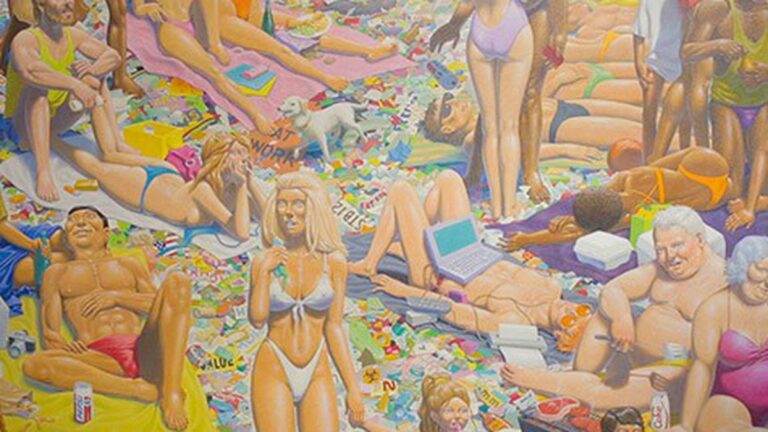
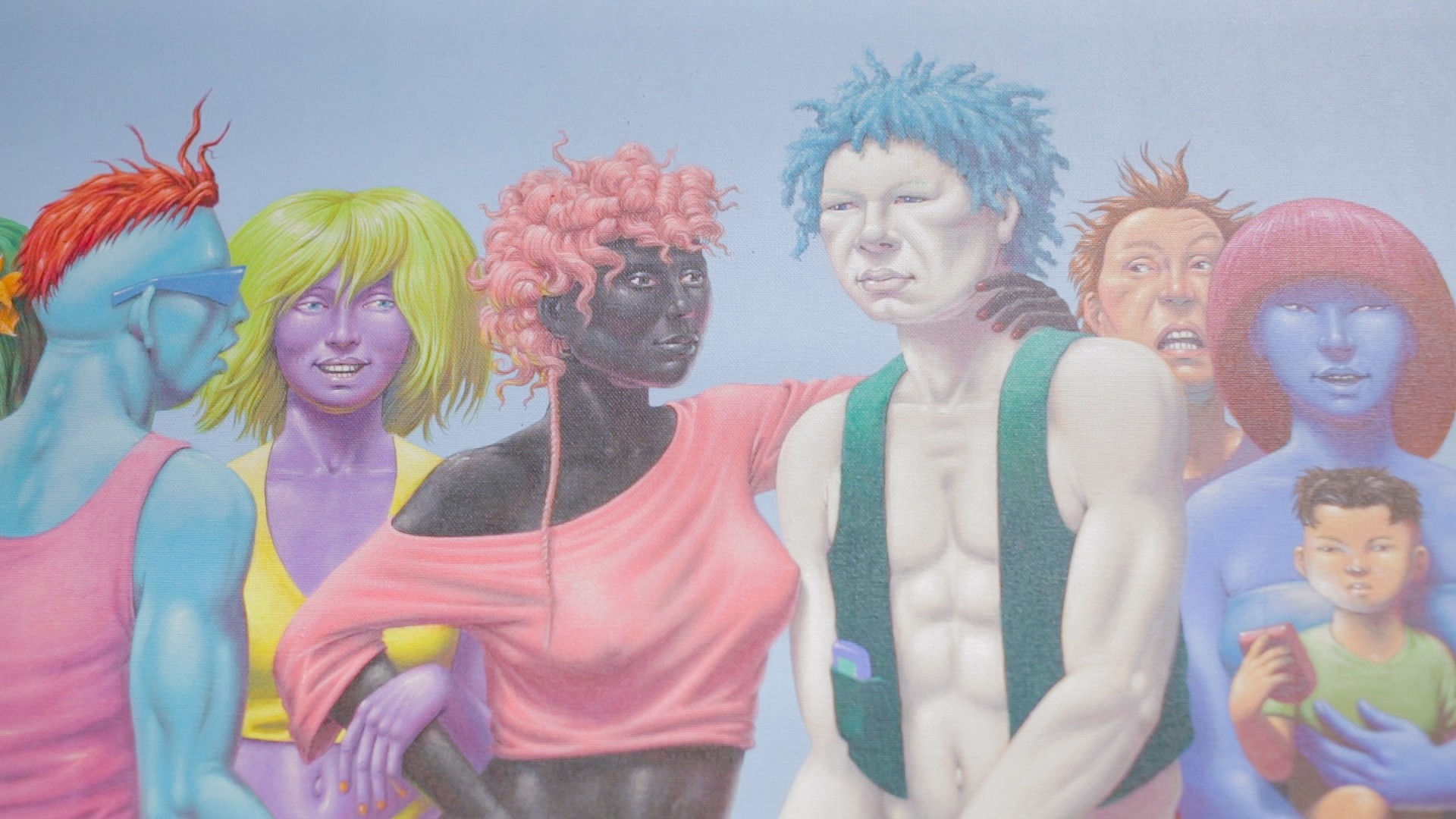
Since then, Colwell has continued to make work spurred by current events, changing his subject matter with the times. Not Exactly Peaceable Kingdom, a current showcase of his work at the East Bay Media Center (1939 Addison St., Berkeley) features a selection of his most recent paintings ranging back to 1990, plus a series of drawings. The paintings are mostly large-scale, and incorporate gatherings of people in crowded compositions that form into critiques — each figure engaging in some symbolic action, like a modernized renaissance painting. He employs a low-brow figurative caricature style, which appears to draw equally from Hieronymus Bosch (best known for The Garden of Earthly Delights) and underground comic book illustrators. With a cartoon-y quality and often bright palette, the paintings allure graphically in a manner almost incongruous with their subject matter.

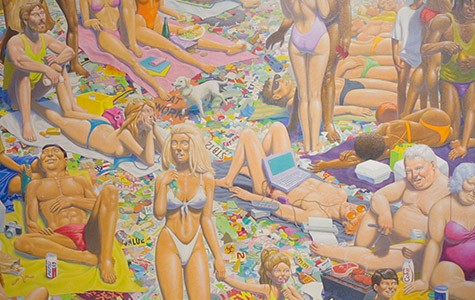
“Litter Beach” best embodies this pop art appeal, featuring a crowd of people enjoying a beach made entirely out of brightly colored trash — every figure holding some kind of product in their hands. (Colwell’s work is best when hyperbolic and overwhelming.) Other paintings are more literal, showing an Ebola treatment center, and a scene of prisoners being tortured in a manner that mimics photos from the infamous Abu Ghraib incident in 2003. “There are issues of social unrest, economic inequality, terrorism, conflict, starvation,” said Colwell of the works in the show. “… This is basically my 21st century collection of serious work.”

Today, Colwell is mostly known for Inner City Romance, which garnered a cult fanbase in the underground comic scene and still remains a popular read. (Earlier this year, all five issues were republished together as an anthology by Fantagraphics.) And he enjoyed success as a painter early on as well. But over the years, fewer and fewer galleries have been interested in showing his work — likely because it has a kind of political blatancy that has grown both artistically unfashionable and commercially unviable. But he laments what he identifies as a growing societal obsession with escapism, and such disengagement makes his work feel more necessary than ever.

Not Exactly Peaceable Kingdom focuses on Colwell’s most political work, but he does less pointed, more personal work as well. His 2012 painting, “The Celebrated Artist,” is an apparent self portrait that didn’t make it into the show. In it, a brightly lit gallery is filled with dolled up attendees gawking at colorful shapes hung on the walls, and outside, looking in from the shadows, is a canvas-toting man resembling Colwell — unsung yet unrelenting.


Cal Student Calls for More Black Voices in Film Studies

On a breezy afternoon in mid-October, 21-year-old UC Berkeley student Summer Mason found herself feeling alone and isolated. But she was actually sitting with approximately seventy other students in an undergraduate class on avant-garde film, which had just finished a screening of Our Trip to Africa, a 1966 movie by Austrian director Peter Kubelka. The experimental film was uncomfortable to watch for many reasons, but it was the close-up of an African woman’s face followed by a shot of a hunted animal carcass that sent shivers down Mason’s spine. To her — and to only her, it seemed — Kubelka’s work reeked of racism and cultural appropriation.

“I’ve never felt so uncomfortable in my own skin as a Black woman,” Mason said.

Though professor Jeffrey Skoller, who teaches the avant-garde film class at Cal every year, explained that Kubelka’s film was intended to be an indictment of European colonialism “meant to challenge and disturb,” Mason saw it as another instance of racism parading itself as art. As one of the few people of color in the class, she felt a sense of obligation to speak out, she said. But her argument — that a white filmmaker had no business making ethnographic films that “distorted, dismantled, and deconstructed” the Black experience — drew criticism from her mostly white classmates, sparking a heated classroom debate. By the time the lecture had finished, she felt as is she had become a lone voice speaking up for all minority voices, she said.
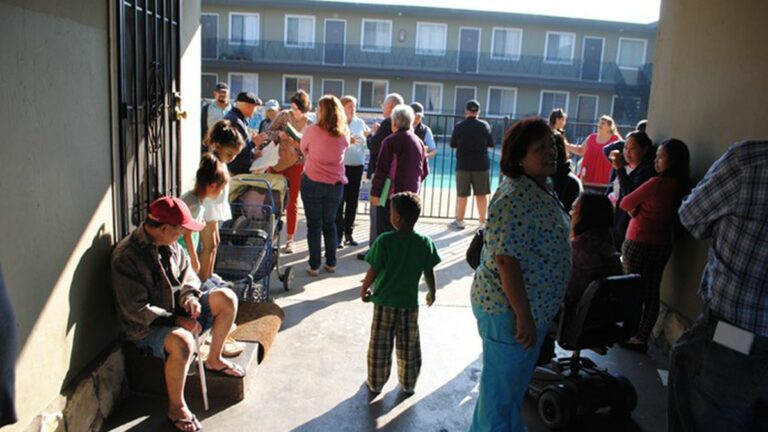
When Skoller got word of Mason’s complaints, he invited her to show a film of her choosing and lead a discussion about racial issues, but by that point, Mason had already rallied student allies from outside of the class to join her in a protest and walkout of his following lecture. In the months since the first protest, she has been continuing to raise awareness about the lack of Black voices on campus and what she sees as underlying racism in film classes’ whitewashed curricula and discussions. The film student has been leading a grassroots campaign using social media and has also been making speeches on campus, urging listeners to question the value of films that allow white filmmakers to explore and potentially profit from the experiences of minorities.

“I was told that these images are important, that they provide a critical view of racism,” she said in a speech before the walkout. “And I ask you for who? Not for me. … I don’t need older white males to explain to me how malleable the world has made my image, how violent the world has made my image, how hyper-sexualized the world has made my image.”

Mason’s complaints contribute to a nationwide debate that was spurred earlier this year about trigger-warnings, and whether content that is potentially offensive or might trigger memories of trauma within students should be prefaced with warnings or excluded from curricula altogether. It also comes at a time when racial tensions are especially high at colleges across the country, resulting in a number of large protests at Yale University, University of Missouri, UCLA, and Brown University, among others.

Skoller described himself as “ambivalent” toward trigger warnings specific to films, although he includes a general warning in the course syllabus. He said that in his experience, telling the class “what they are about to see and feel before it happens often removes some of the artistic aspects that the film was made for.” The films, he said, are part of a canon of cinema that has “been deemed unacceptable or controversial by the mainstream film industry” and are therefore supposed to be shocking and spur passionate responses from audiences.

And though Mason concedes that films like Our Trip to Africa have a place within critical analysis, she said that discussions about them are inadequate without Black or minority input. Professors, she said, should also be prepared to intervene when heated debates transform classes into racially charged environments: “When someone is being ostracized, especially when a minority is being ostracized, know when to step in,” Mason said.

Isolating experiences like Mason’s are not uncommon on the UC Berkeley campus, where out of 36,204 students enrolled in 2015, only 1,257 — a little more than 3 percent — are Black.

A UC Berkeley study from 2013 also revealed that only 47 percent of Black respondents felt comfortable on campus, prompting Chancellor Nicholas Dirks to unveil a $20 million scholarship plan earlier this year that uses donations from private, nonprofit organizations to fund scholarships for Black students. Called the UC Berkeley African American Initiative, the plan is meant to combat some of the deleterious effects of California’s 1996 approval of Proposition 209, which prohibits publicly funded universities from offering scholarships that consider race, sex, or ethnicity.

In an interview, Skoller lamented the lack of racial diversity among his students and agreed with Mason on a need for critical conversations about race in the classroom. “I think that if there had been more students of color in the class, people might have been more careful about what they said,” Skoller said. “It wouldn’t have all been on [Mason’s] shoulders.”

But it appears that the problem amounts to a lack of diversity in faculty as well. None of the permanent film department professors or current adjunct lecturers are Black, and within the department, there were no classes specifically focused on Black experiences in film this year, even though many feel that it’s a crucial topic within the field of study.

Since her protest, Mason has been speaking with professors and administrators about ways to improve academic spaces for students of color. Next semester, she will be part of a new seminar course in the Film and Media Studies department that will be a space for about a dozen upperclassman undergraduates to discuss race and media. Mason hopes that the class will address some of the injustices that Blacks are subjected to on film and has been invited by the professor, Kristen Whissel, to provide input on how the syllabus should look.

For Mason, the ability to help curate the class curriculum is tantamount to having her voice heard. “It made me feel like there was value to what I was doing,” she said. “But the next class that will be taught, I don’t want it to end there. I hope this is something that makes people aware that Black voices — all Black voices — need to be heard.”

Time Is Running Out for Oakland

Oakland’s downtown housing market is hotter right now than perhaps it’s ever been. In the past several months, developers have come forward with at least six major projects that would add 1,450 new housing units to downtown and Uptown. If built, the new housing should provide some relief to Oakland’s extremely tight rental market. But the plethora of new market-rate development proposals also shows that if the City of Oakland is going to stem the tide of displacement, it must quickly adopt measures to help fund more affordable housing. If Oakland drags its feet, as it has done in the past, it may miss its chance to capitalize on the current development boom.

It’s no secret that the affordability crisis in Oakland is staggering. The recent experiences of affordable housing developer Bridge Housing show just how bad things have become. For its 68-unit AveVista housing project at 460 Grand Avenue in Oakland, Bridge was flooded with applications from residents desperate for affordable housing — it received 5,200 requests, according to Bridge’s communications director Lyn Hikida. Similarly, for Bridge’s 90-unit Mural housing project at the MacArthur BART station, the nonprofit received more than 5,000 applications. “It gives you a sense of the high demand,” Hikida said.

It certainly does. But the problem for Bridge and other affordable housing developers — and for cities like Oakland — is securing funds to build more affordable units. Ever since Governor Jerry Brown eliminated redevelopment financing in 2011, cities like Oakland have been without a dedicated funding stream for affordable housing construction. As a result, many cities, including Berkeley, Emeryville, and San Francisco, have established a range of fees on market-rate housing and adopted other funding mechanisms to help build more affordable units. Oakland, however, has not yet approved any of these measures. And it’s not clear when it will.

Some local activists have recently called for a moratorium on new market-rate housing development approvals in Oakland until the city gets its act together. Although it’s a tempting proposal, it would be a mistake. Oakland needs a lot of housing as soon as it can get it, especially apartments — otherwise rents will continue to skyrocket and create even more displacement.

According to the real estate site Zumper, Oakland is now the fifth most expensive rental market in the nation. The median price for a one-bedroom in October was $2,160 a month, and for a two-bedroom, $2,520. Both represented increases in excess of 13 percent in the past year.

These record-high rents are pricing many people out of the city, and the only means available right now for stabilizing prices in Oakland is to build more new housing — both market-rate and affordable.

But Oakland must act immediately to fund affordable housing before it misses its window of opportunity. Here’s an unofficial list of six major housing projects recently proposed for downtown that could raise millions of dollars in funds for more affordable housing in the city:

• 1100 Clay Street. Strada Investment Group plans to build a 262-unit, 13-story building.

• 1900 Broadway. Developer Seth Hamalian is proposing to construct a 19-story tower with 345 housing units.

• 1800 San Pablo Avenue. Sunfield Development wants to build a 209-unit housing project (including 10–15 percent affordable).

• 2100 Telegraph Avenue. Dones 2B2 Retail Complex LLC plans to build 250 residential units (including 15 percent affordable).

• 14th and Alice streets. Bay Development Group is proposing to build a 126-unit, 17-story tower.

• 14th and Jackson streets. Wood Partners is proposing 258 units of housing.

Except for the 2100 Telegraph and 1800 San Pablo projects, which already include affordable housing, the proposed projects above are for market-rate units and thus offer an opportunity for Oakland to raise much-needed funds. Here’s how other cities have done it:

• Impact fees. Berkeley and Emeryville both have established impact fees of $28,000 per unit on market-rate housing for developers that do not include affordable housing in their projects. Oakland is still studying impact fees and how much to charge. Mayor Libby Schaaf has said she favors phasing in an impact fee in order to not stifle development, but an extended phase-in could result in the city losing out on millions of dollars for affordable housing.

• Inclusionary zoning. Many cities, including Berkeley and Emeryville, require market-rate condo developers to include affordable housing in their projects or pay an in-lieu fee. Oakland has no such law.

• Density bonus fee. Under state law, developers can build higher than local zoning rules normally allow if they include affordable housing in their projects. But Berkeley has moved one step further by adding a $10,000 fee per unit of market-rate housing in developments that take advantage of the state’s density bonus.

These are all sensible proposals that Oakland can and should adopt quickly. The city can also follow San Francisco’s example and propose a large bond to pay for affordable housing. Last month, San Francisco voters overwhelmingly approved a $310 million bond measure for affordable housing — and probably would have okayed an even larger one if it had been proposed.

In addition, Oakland could easily revise its policies to ensure that it prioritizes affordable housing on excess public property. And it should be heavily lobbying Sacramento to roll back the state’s anti-rent control law, known as Costa Hawkins, in order to keep existing housing affordable for more residents.

Spinning Stories in Sculpture

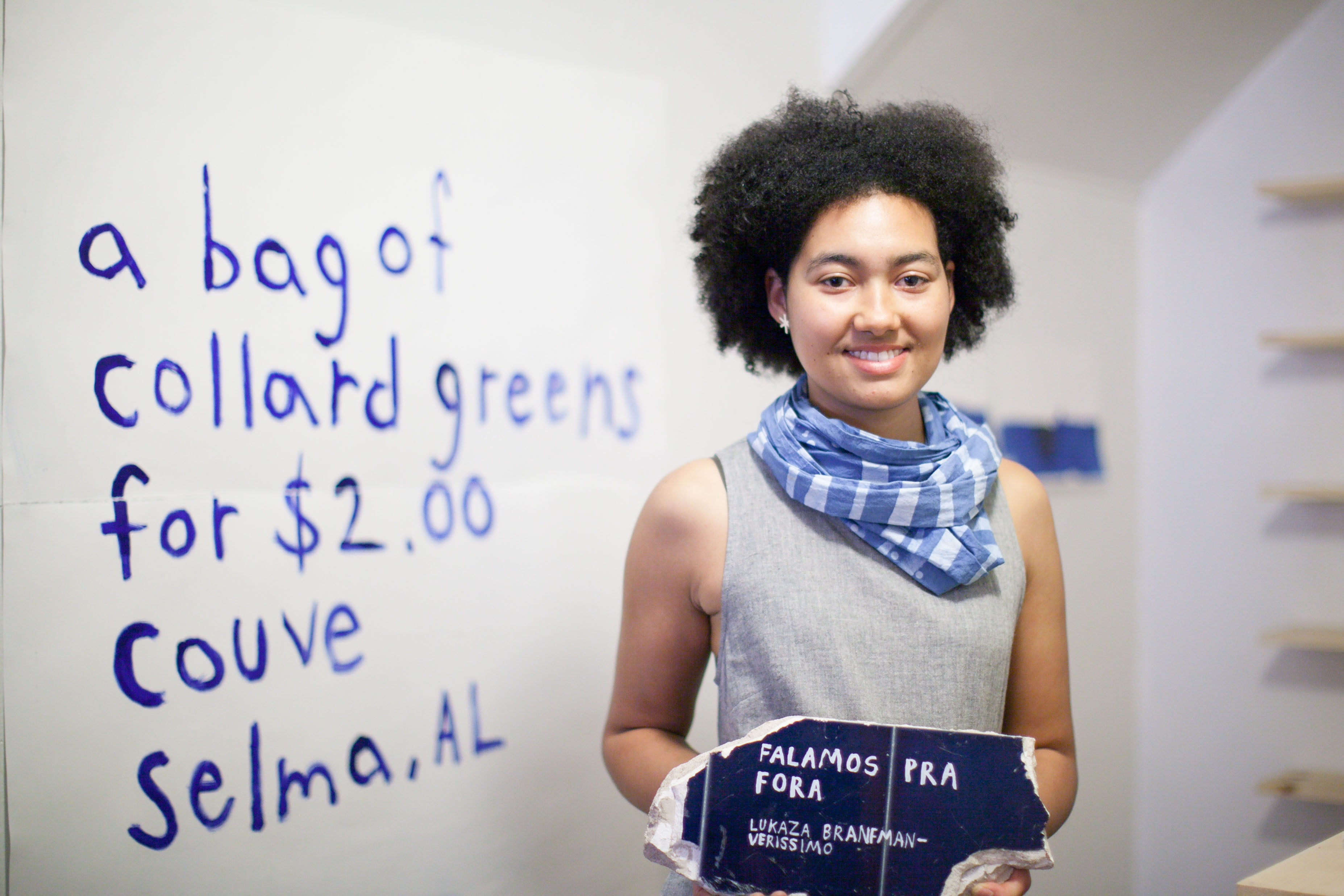
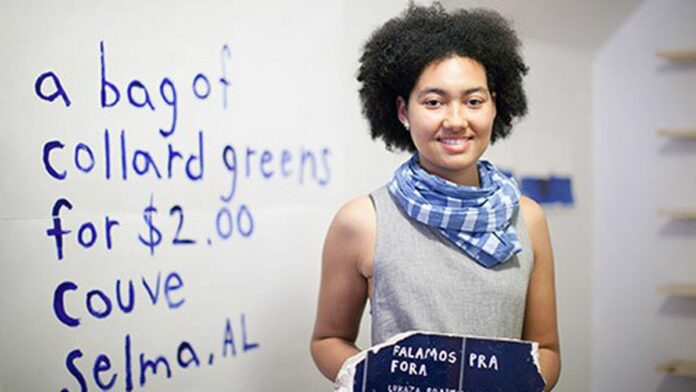
In the back of E.M. Wolfman General Interest Small Bookstore (410 13th St., Oakland), there are six shelves, all empty besides one object — a pair of shoes that are wrapped in blue ribbon and paper. The shoes once belonged to Lukaza Branfman-Verissimo, but now they are a sculptural homage to her great-great-grandmother, who was born into the slave trade in Brazil, and — according to the stories that Verissimo heard — never had the privilege of owning shoes. 

The shoes are one of few foundational pieces in Branfman-Verissimo’s current show in the Wolfman gallery entitled Falamos pra fora — Portuguese for “We speak out.” Another, the centerpiece of the show, is a blue muzzle made of crocheted and printed paper. The mask is meant to be a replica of the one that is said to have been used on Escrava Anastacia, an Afro-Brazilian slave remembered for bravely speaking out against her masters.

Branfman-Verissimo wants to test the power of stories and the politics intertwined with telling them: “Whose story is getting told, and whose stories are hidden, and what do we raise above, and what do we write on the wall?” Being of Afro-Brazilian heritage, she started where she felt the desire to dig: her own cultural past. But, eventually, she hopes to build a more varied portrait of the ways in which language can be used as a form of resistance, filling the shelves of the gallery throughout her residency.

The main component of Branfman-Verissimo’s show is a time-based process piece that’s an active archiving endeavor. During four sessions of public drop-in story collecting hours segmented throughout the show (Dec. 8, 12, and 19, and Jan. 5), the artist will ask participants to share stories of speaking out, record them, and collaborate with the storyteller to envision a sculptural manifestation of their story. She will then create that sculpture in her own style — often involving raw wood, screen-printing, and indigo textiles. The sculptures will gradually fill the shelves, until storytellers are invited to retrieve the pieces when the show closes on January 15.

The stories don’t have to be personal to the storyteller, but simply stand out to them as an exemplification of voice being used as a form of resistance. “It always rings a different bell for different people,” said Branfman-Verissimo, “whether that’s through resistance in their own history or a story of today or a story that they overheard.”

Branfman-Verissimo is originally from Los Angeles, but graduated from California College of the Arts this past spring. Over the summer, she traveled across the country with her mother — a choreographer — doing a “van residency” and conceptual art project called Rooted America. Traveling with a miniature printing press in the back of their car, the two visited historical sites of resistance — from Selma to Detroit — and met with artists and community members, collecting their stories through collaborations in movement and printmaking. Branfman-Verissimo is currently finishing a book about the project featuring prints made along the way, transcriptions of interviews, and personal reflections. The book will be published by E.M. Wolfman and released in February.


Communing with the Based God

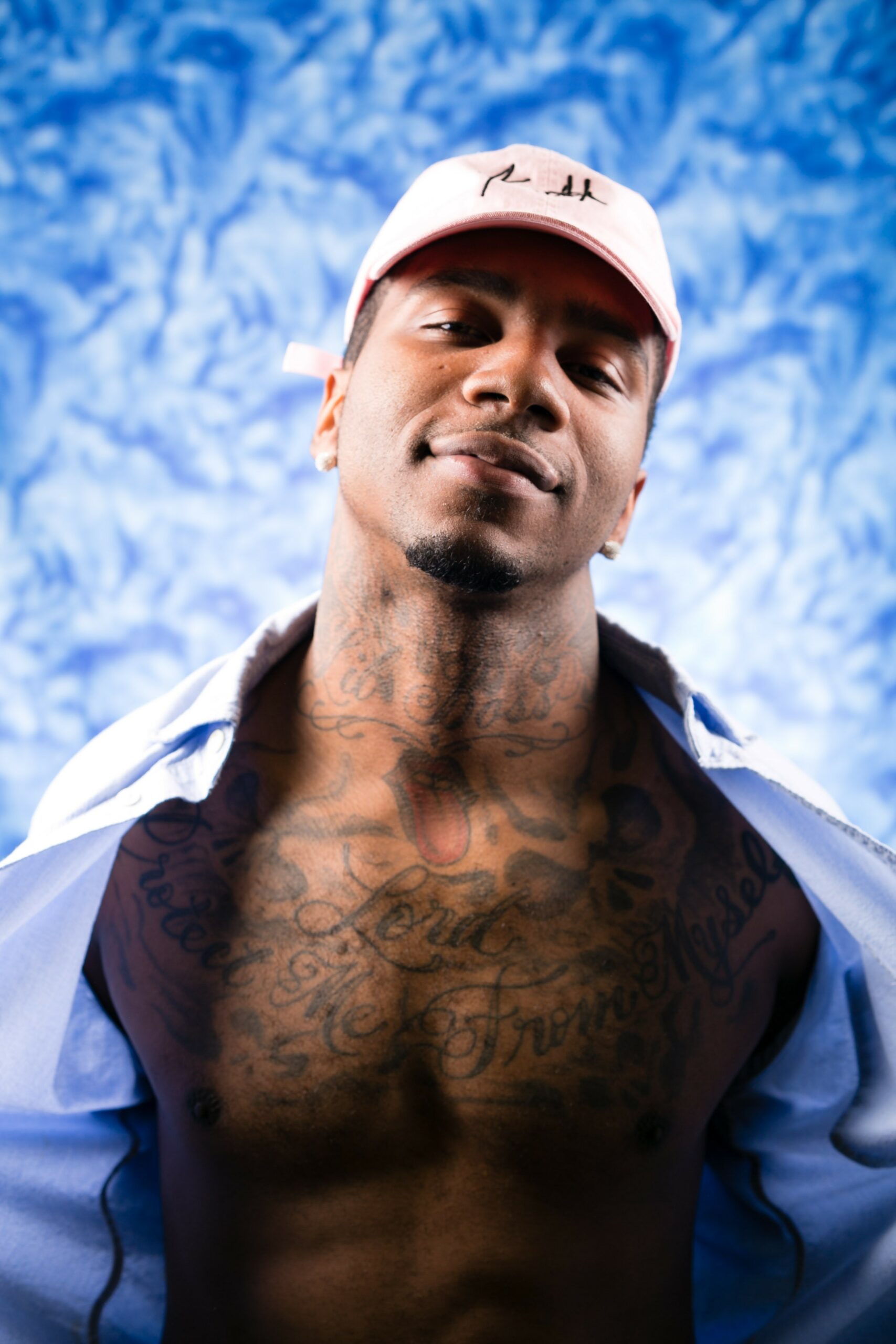
East Bay rapper Lil B (Brandon McCartney), 26, has had one of the most unusual career trajectories in the music industry, and is perhaps one of the most influential yet easily dismissed artists out there today. Although he has a remarkably devoted fan base, his popularity still mystifies the uninitiated, and he continues to face backlash for his staunchly unorthodox approach to, well, pretty much everything.

For starters, Lil B, who grew up in Berkeley, has been manically prolific over the years, and at times, his volume of musical releases has reached an almost Shakespearean level. During the past six years, he has self-released dozens of mixtapes and thousands of songs, including an impressive five-gigabyte mixtape that contained more than 850 freestyles, which he dropped in 2012 in addition to several other album-length projects. While hip-hop purists have doubted Lil B’s technical skills as a rapper, his idiosyncratic, unrehearsed-sounding flow was a precursor to the sing-song, adlib-filled style that dominates the radio today. Given the stylistic turns that hip-hop has taken in recent years, his early solo releases at the end of the Aughts and beginning of the 2010s have proven to be ahead of their time.

But rapping is just one of Lil B’s occupations, and a large part of his appeal comes from his self-appointed role as a spiritual guru. His fans hail him as the Based God, and his eponymous philosophy, which he describes only with the adjective “based,” centers on maintaining a positive outlook, respecting all living things, and staying curious about all that life has to offer.

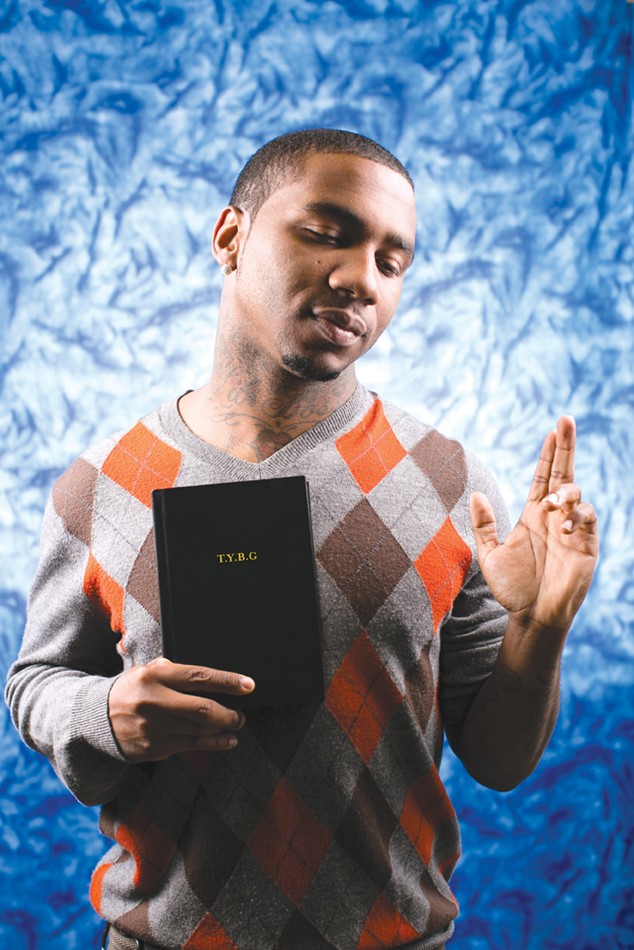
Although Lil B doesn’t explicitly brand himself as a religious leader, his social media following is vast and cult-like. He frequently posts affirmations, life advice, and Based God-centric memes on Twitter and Facebook to the adulation of millions of followers. When he follows fans back, they often respond with the fervor of someone who spotted the Virgin Mary’s silhouette on a piece of toast. Dedicated fans call themselves the Bitch Mob and sign posts with #ProtectLilB and #TYBG (Thank You Based God). He has given guest lectures akin to religious sermons at UCLA, MIT, and NYU that have included teachings such as, “Pay attention to bugs and insects and how they vibe.”

Then, there’s Lil B’s role as a cultural commentator. Because of his large social media presence, he gained national attention for levying a “curse” on Oklahoma City Thunder forward Kevin Durant after the basketball star decried Lil B’s musical ability on Twitter. The Thunder subsequently failed to win an NBA championship, and Durant has been plagued by a series of injuries, prompting memes and internet lore about the Based God’s curse. After Lil B cursed Houston Rockets player James Harden last spring for imitating the rapper’s signature cooking dance without attribution, the Golden State Warriors won the Western Conference Finals against the Rockets, and the rest was history.

The uncanniness of the Based God curse prompted several major sports outlets, including ESPN and CBS Sports, to interview Lil B about his seemingly supernatural powers. As more media outlets picked up the story, the national spotlight on this curious public figure even led several news networks — including CNN and MSNBC — to interview Lil B about his predictions for the 2016 presidential election. (He’s voting for Bernie Sanders, though he confirmed that Hillary Clinton has not been cursed.)

How an unsigned, DIY artist could become such a bizarre and powerful cultural icon continues to befuddle casual observers. But after spending an afternoon with Lil B, I came to realize that one of the main reasons his multitudes of followers are so drawn to him — other than the music and the memes — is his willingness to be publicly vulnerable and, in doing so, affirm others’ experiences and struggles.

Indeed, when Lil B came to the Express’ office in Oakland for a photo shoot, I was surprised by his immediate warmth and openness. After he put on a playlist of his favorite Antony and the Johnsons songs, our conversation turned to personal topics at times as the band’s melancholic piano ballads played in the background. We even chatted about what music we like to cry to, our favorite Facebook emojis (we both love the chubby, cartoon cat Pusheen), weird body insecurities, and other secrets I would only ever disclose to my closest friends. It was then that I realized that there’s not really a code you have to crack to get Lil B: You pretty much just have to be open to his kindness.

“I feel like when I speak unfiltered, people respond to it in a good way,” said Lil B, reflecting on his recent mainstream media attention. “When I speak how I feel, I get rewarded for it — whether people love what I say, don’t understand what I say, or go against what I’m saying.”

Despite the fact that fans and the media have mythologized and even deified Lil B, there are plenty of contradictions in his messaging. While many of his songs promote positive thinking and social justice, some of his lyrics also have blatantly misogynistic themes that seem incompatible with his overall happy-go-lucky, pacifist public persona.

On one hand, there are tracks like “All Women” from his mixtape Rain in England, on which he celebrates women of all ages, ethnicities, shapes, and sizes, rhyming, Have you appreciated a woman’s knowledge?/Pay attention to her comments. But then there are farcically offensive lyrics on songs such as “Swag My Bitch Up” — on which Lil B says I respect women/And I respect all people/But I don’t love hoes/They suck dick and they’re evil — or “Murder Rate,” where he raps If you don’t twerk we gon’ up the murder rate.

As a listener, it’s sometimes difficult to mediate these mixed messages or decide when to take Lil B seriously. So is he playing different characters?

“The Lil B entertainment experience is a mix of a lot of different emotions,” he explained. “It’s on the level of me being a movie director or content creator. I look at the Lil B entertainment experience the same way: different scenes, different locations.”

While sometimes the explicitness in his lyrics is gratuitous, if anything, the id-like contradictions in Lil B’s music have allowed him to avoid the kind of holier-than-thou preachiness — both in his music and public image — that people often find off-putting about conscious rap. Across his body of work and social media presence, Lil B has purposely exposed the flaws in his thinking as a way to demonstrate his commitment to learning and self-improvement (which may be a more effective way to spur social change than telling people how to live).

Earlier this year, for instance, he faced a backlash for tweeting offensive comments about trans women. After his followers responded with criticism, he admitted his ignorance, tweeting, “I wanna say I love you and I apologize for that transphobic comment I made today and shows how immature and still insensitive I am,” and “my insecurity comes from deep-rooted issues and respecting women’s boundaries.” While his initial comments were undeniably sexist, declaring his willingness to learn from his mistakes was far more authentic than the PR-team-manufactured celebrity apologies we often see in the media.

Lil B said that over the past year, he has made it a point to reveal his flaws in order to humanize himself in the public eye and demonstrate the transformative power of self-reflection. “I choose to be transparent and honest because people can see me learning and see my mistakes so it’s not a shock,” he added. “I want people to really know me and know Lil B — really just know the flaws and love them; really know who you’re supporting.”

He also pointed out that there is a critical distinction between Lil B and the Based God, and that the Based God is the model for his behavior rather than his identity proper. While he often refers to himself as the Based God in his songs, he explained that the Based God is a higher being that works through him, adding that the Based God came to him through doing hundreds of based freestyles: “The Based God is perfect, and Lil B wants to be the Based God — I really want to be the Based God.”

Interestingly enough, out of Lil B’s extensive musical output, the only projects he attributes to the Based God are Choices and Flowers and Tears 4 God, which he said he “executive produced” with the Based God. Neither of these are hip-hop mixtapes — they’re atonal, ambient electronic albums that Lil B describes as “classical music.” Though the two lengthy, experimental releases were derided as amateurish in the press, Lil B said that he is proud of the works because they truly reflect what he sees as the Based God’s essence. The Based God also makes an appearance on Rain in England, which features Lil B rapping over similarly challenging, new age-y electronic tracks.

In 2015, Lil B’s musical output slowed down considerably in comparison to past years. Previously, he would release off-the-cuff freestyles without giving it much thought. But apart from a based freestyle mixtape he did with Chance the Rapper called Free, he has spent the better part of this year working on his long-awaited release, Thugged Out Pissed Off. His slower, more deliberate songwriting process is part of his goal to make Lil B “more accessible” in 2016, he said, though he wouldn’t reveal specifics about what he intends to do to make that happen.

Has anything changed about Lil B’s songwriting approach? “My music is inspired by life and inspired by what I’m going through. I never force my music, either. This year, there was a lot of learning and a lot of lessons — being in an apartment and having the neighbor’s house blowing up next door, burning me out of my apartment,” he said, referencing the fire that devastated his then-Concord duplex last January. “It was a lot of blessings and learning experiences, too, from lecturing at UCLA and MIT, to my apartment burning down, to The Jacka dying and another friend passing away, to learning more about adult life, to making sure you don’t get too serious and still have fun.”

Thugged Out Pissed Off, Lil B said, is a platform for him to process these life difficulties and growing pains.

“There’s gonna be a lot of different emotions and feelings, and a lot of stuff out the journal,” he said. “I got a chance to get a lot of angry stuff out — just anything that I felt. A lot of positivity, too. A lot of gems, a lot of knowledge on there. And just a lot of stuff in general that’s really gonna shock people and have people on edge — I think that’s really what Thugged Out Pissed Off represents.”

Last year, Lil B released an impactful single titled “No Black Person is Ugly,” a rallying cry against systemic racism that came out just as Black Lives Matter protestors began to take to the streets across the country. In a similar vein, he hopes Thugged Out Pissed Off will speak to people form marginalized communities, which he explained is one of his key missions as an artist.

“I want to help people that might not be getting too much attention from the city — high crime rate areas. I’m trying to figure out ways I can bring hope, love, plant trees — and that’s not a joke, I really do plant trees.”

Correction: The file size of Lil B’s mixtape with over 850 songs was five gigabytes, not megabytes.

Alameda Landlord Who Evicted 33 Families Slams Councilmembers

The Alameda landlord who has become the face for greater rent control restriction after he issued notices of eviction to 33 families in the Bay View Apartments last month, sent an inflammatory letter to city leaders strongly opposing regulations that support tenants’ rights. Matt Sridhar, the CEO of San Jose-based Sridhar Equities, LLC, also slammed a proposal to establish rent control in Alameda, and criticized Oakland for its rent control regulations.

In a three-page email sent to the mayor and city council just hours before a 65-day moratorium on rents and eviction was approved on November 4, Sridhar the new landlord at the Bay View Apartments, commonly referred to by its address, 470 Central (Avenue), said he would sell the property if rent control is enacted in Alameda.

Sridhar accused Alameda city leaders of caving to political pressure being applied by many tenants fearful of steeply rising rents and mass evictions in the city. “I am surprised and disappointed that Alameda would entertain this politically-motivated and reactionary agenda that simply interferes with free market enterprise and creates substantial government bureaucracy.” In boldface type, he continued, “I will tell you with certainty that if you pass rent control, I will SELL my property in Alameda and move on to improve another town.”

In an interview, Sridhar said he does not regret sending the letter, which was obtained through a public records request. “This is what you call a storm in a tea kettle,” he said. “I don’t regret it. People are free to speak the truth.” The entire situation with the mass evictions at the Bay View Apartments, he added, “is counterproductive for the town and personally a waste of my time.”


[jump] Sridhar, who said he built his equity firm from little, voiced strong criticism of Alameda’s elected officials and their handling of the moratorium last month and the revisions they approved on December 1. “The council is totally incompetent,” he told me. “They chose to change the moratorium because they don’t know what they’re doing. They have three lawyers [on the council] and a two-page moratorium. They didn’t know what was in it?”

Sridhar moved to evict all the tenants at 470 Central just days after the council enacted a moratorium on evictions in the city. Sridhar took advantage of a loophole in the moratorium that allowed evictions of landlords plan to do major capital improvements on the building. Earlier this week, the council voted to close that loophole.

When I asked about a well-read opinion piece by Don Lindsey, an influential landlord’s advocate in Alameda, that charged Sridhar with “acting out of panic” by quickly issuing the mass evictions last month, Sridhar lashed back. “He’s small-time. I don’t care about what he thinks.”

Sridhar wrote in his letter to the council that he plans a complete large-scale renovation of the Bay View Apartments. “Every project we do improves the lives and quality of our residents.” He later told me the building currently loses up to $30,000 a month and is unsafe. “470 Central is not the American Dream,” said Sridhar. “It needs to be renovated. … Alameda is very unappreciative.”

In the letter, Sridhar boasts of his altruism, writing that he once footed the bill for an uninsured tenant’s kidney dialysis. In the interview, Sridhar said he also helped a former tenant pay for college and often wrote them college recommendations. “I’m not the villain here,” he told me.

Sridhar also alleged in our interview that attorneys from a nonprofit tenants group called Tenants Together are using the renters at 470 Central as political pawns in order to push for rent control in Alameda. “Nothing would benefit them more than to have tenants on the streets,” he said. “We’re the only one helping the tenants.”

Last week, one renter at 470 Central said he and his neighbors would not leave after the 60-day eviction notice expires in mid January. Sridhar told me, “It’s not realistic that they will be there for an indefinite time. At some point an attorney working for a nonprofit might give me some problems, but we’re a company that paid $6 million for a building and are planning $2 million in renovations. We have money to litigate.”

Catherin Pauling, a spokesperson for the Alameda Renters Coalition, said Sridhar is resorting to scare tactics. “This is exactly what his company did while trying to circumvent the moratorium and kick families out of their homes over the holidays. He couldn’t bully the Bay View residents, so now he’s trying to bully our city council.”

Much of Sridhar’s letter to the council read like a manifesto in opposition to rent control. He also alleged that nonprofits will use rent control restrictions to game the courts and “encourage tenants to demand jury trials for every simple eviction case…and then ‘shake down’ landlords for $10,000–$15,000 to move out.” Sridhar wrote he has been engaged regularly in such cases. “While this is something I can afford to fight and do so regularly, what will the ‘mom and pop’ and retired owners do?”

He also asserted in his letter that rent control in Oakland is squeezing small-time landlords. “The City of Oakland is too stupid to realize who they are hurting,” he wrote. Sridhar also pointed to San Leandro, which has no rent control restrictions as example of what Alameda should follow, rather than Oakland, which does have rent control. “I suggest you simply take a short drive from San Leandro into Oakland,” he wrote. “You will see property dilapidation and the effects of rent control. Is this what you want for our city? I don’t think people understand the nonsense that comes with this type of regulation.”

California’s Leading Legalization Initiative Gathers Momentum

California’s leading legalization initiative is gathering momentum, and has announced a raft of amendments that add input from hundreds of stakeholders and consolidated support from the main rival legalization group.

Proponents of the Adult Use of Marijuana Act (AUMA) formally amended their initiative with the Secretary of State on Monday — boosting protections for children, workers, and small canna-businesses.

Also, the board of ReformCA, a rival to AUMA, formally withdrew its own proposal, and six ReformCA Board Members voiced their support for AUMA.


[jump] An AUMA release todays states that ReformCA board members endorsing AUMA include leading figures in the legalization movement:
  • David Bronner, CEO of North America’s top-selling brand of natural soaps
  • Nate Bradley, Executive Director, California Cannabis Industry Association
  • Stacia Cosner, Deputy Director, Students for Sensible Drug Policy
  • Neill Franklin, Executive Director, Law Enforcement Against Prohibition (LEAP)
  • Antonio Gonzalez, President of the Latino Voters League and the William C. Velasquez Institute in Los Angeles 
  • Richard Lee, founder of Oaksterdam University in Oakland
Also, Dr. Larry Bedard, co-proponent of the ReformCA measure and former President of the American College of Emergency Physicians, has withdrawn as a official proponent of ReformCA and now supports AUMA.
 
An AUMA release also states that over the weekend, a majority of the ReformCA Board formally agreed to vote to withdraw the ReformCA measure from the ballot qualification process. ReformCA has not made any public statements.
 
“We have carefully reviewed amendments submitted by the proponents of the Adult Use of Marijuana Act, and we’re convinced it’s time to endorse that initiative and unite everyone behind a single, consensus measure to achieve a legal, regulated system, which a majority of voters have consistently said they want,” stated Bronner, in an AUMA release Tuesday.
 
“This amended measure strikes a thoughtful balance between civil liberties and protecting public safety and the safety and health of our children,” stated Franklin.  “I’m pleased to endorse it and have every confidence it will pass in November.”   
 
“As amended, this measure reflects the voices and vision of communities all across California,” stated Gonzalez.  “This represents best practices and the best chance California has to replace a failed system of prohibition with an effective, legal and regulated system that protects children, workers and small businesses.”
 
Last week, Lee announced his support for AUMA.

AUMA’s official proponents are Dr. Donald O. Lyman, an award-winning physician and former chief of the Division of Chronic Disease and Injury Control at the California Department of Public Health, and environmentalist Michael Sutton, former president of the California Fish and Game Commission and former vice president of National Audubon Society.

Launched on November 2, AUMA has the support of leading reform groups Drug Policy Alliance and Marijuana Policy Project, as well as technologist-turned-philanthropist Sean Parker. The group should have the funds for a $20 million campaign.

But the emergence of a well-funded, well-connected leader is also polarizing existing groups. Groups from legalization’s far left as well as some mainstream legalizers have joined right-wing conservatives in publicly opposing AUMA — each for their own reasons. 

AUMA’s new updates Monday sought to mollify some of those concerns.

The group states that amendments include:
·         Mandates the toughest and most explicit warning labels on marijuana products, including an American Medical Association-recommended message that marijuana use during pregnancy or breastfeeding may be harmful.

·         Enhances the strict ban on advertising to minors to clarify that marketing to minors is also strictly prohibited, as is all health-related advertising for non-medical marijuana.

·         Requires a comprehensive study to determine effectiveness of the packaging and labeling requirements and advertising and marketing restrictions on preventing underage access to non-medical marijuana.

·         Provides funding for a public information campaign, emphasizing that marijuana remains illegal for anyone under the age of 21.

·         Accelerates funding for expert outcome research on the effects of the new law, including its impact on minors and whether teen use decreases (as it has in other states with legal, regulated systems such as Colorado).
 
Maintaining Local Control
 
·         Aligns with the bipartisan medical marijuana legislation to provide complete local control over non-medical marijuana businesses within their jurisdiction, including the authority to ban commercial marijuana activity by ordinance.

·         Ensures that local governments which allow commercial marijuana businesses to operate have the authority to determine the time, manner and location of those businesses within their jurisdiction.

·         Ensures that local governments have the authority to establish their own taxes on medical and non-medical marijuana consistent with existing state law.  Explicit authority to do so is granted to counties.

·         Requires state licensing authorities to take action to suspend or revoke a state marijuana business license when notified that a corresponding local license has been revoked, ensuring businesses must remain in compliance with local laws to operate.
 
Protecting Workers in an Expanding Industry
·         Requires state regulators to set specific safety standards for drivers and vehicles that are employed in the legal commercial distribution of marijuana.

·         Clarifies that the labor peace agreements included in the medical marijuana legislation will also extend to this new law.

·         Clarifies that labor violations are grounds for disciplinary action against a marijuana business licensee, including potential suspension or revocation.

·         Clarifies that all administrative costs of the new law must be fully funded, including reasonable costs for state agencies to oversee workplace safety.

·         Mandates the state comprehensively study which workplace safety standards are necessary to fully protect marijuana workers, including against risks unique to the industry.
 
Preventing Monopolies and Encouraging Small Business Growth   
 
·         To allow smaller growers to establish themselves in a legal, regulated market, large cultivation licenses (as defined by the medical marijuana legislation) for non-medical marijuana will not be issued for the first five years the new law is in effect.

·         Only after those first five years can large cultivation licenses be issued at the discretion of state regulators but they must include the same restrictions on vertical integration that are contained in the medical marijuana legislation.

·         Strengthens opportunities for minority-owned businesses to enter the legal, regulated marijuana market.

·         Sets a September 1, 2016 deadline for existing medical marijuana businesses to come into compliance with current law and qualify for priority licensing under AUMA, providing greater access for existing small businesses to enter the legal, regulated market.

·         Requires public universities in California to conduct a study and issue recommendations on whether additional protections are needed to prevent unlawful monopolies or anti-competitive behavior.  Additional technical amendments and suggested changes were included to provide increased clarity to state regulators.
We’ll have more analysis and reactions this week.

No Place to Go

"There's nowhere to go to the bathroom around here," said Rick Briscoe, who is homeless and has been living on the streets of Berkeley for about a year now. Although the city does have public restrooms, the closest ones to where Briscoe hangs out are several blocks away, which makes it...

Oakland Needs to Okay Medical Cannabis Delivery Services

Delivery-only dispensaries have done business in the Bay Area for years alongside the more prominent brick-and-mortar dispensaries that most residents are familiar with. Due to the cap on storefront dispensary permits (currently only eight allowed in Oakland), these delivery-only services exist in a robust and fairly saturated space. But we operate in the shadows, without the protection of clear...

Hard Work

I'm a 24-year-old gay male with few resources and no "marketable" skills. I have made a lot of bad choices and now I struggle to make ends meet in a crappy dead-end job, living paycheck to paycheck in an expensive East Coast city. Recently, someone on Grindr offered me $3,000 to have sex with him. He is homely and...

Guy Colwell’s Anti-Escapist Art

Guy Colwell is upfront about the fact that he rarely sells paintings. And although his work is technically impressive, his admission doesn't come with surprise. For his mostly large-scale depictions, the Berkeley artist abandons the figurative veil employed by many popular political artists and instead opts for an...

Cal Student Calls for More Black Voices in Film Studies

On a breezy afternoon in mid-October, 21-year-old UC Berkeley student Summer Mason found herself feeling alone and isolated. But she was actually sitting with approximately seventy other students in an undergraduate class on avant-garde film, which had just finished a screening of Our Trip to Africa, a 1966 movie by Austrian director Peter Kubelka. The experimental film was uncomfortable...

Time Is Running Out for Oakland

Oakland's downtown housing market is hotter right now than perhaps it's ever been. In the past several months, developers have come forward with at least six major projects that would add 1,450 new housing units to downtown and Uptown. If built, the new housing should provide some relief to Oakland's extremely tight rental market. But the plethora of new...

Spinning Stories in Sculpture

In the back of E.M. Wolfman General Interest Small Bookstore (410 13th St., Oakland), there are six shelves, all empty besides one object — a pair of shoes that are wrapped in blue ribbon and paper. The shoes once belonged to Lukaza Branfman-Verissimo, but now they are a sculptural homage to her great-great-grandmother, who...

Communing with the Based God

East Bay rapper Lil B (Brandon McCartney), 26, has had one of the most unusual career trajectories in the music industry, and is perhaps one of the most influential yet easily dismissed artists out there today. Although he has a remarkably devoted fan base, his popularity still mystifies the uninitiated, and he continues to...

Alameda Landlord Who Evicted 33 Families Slams Councilmembers

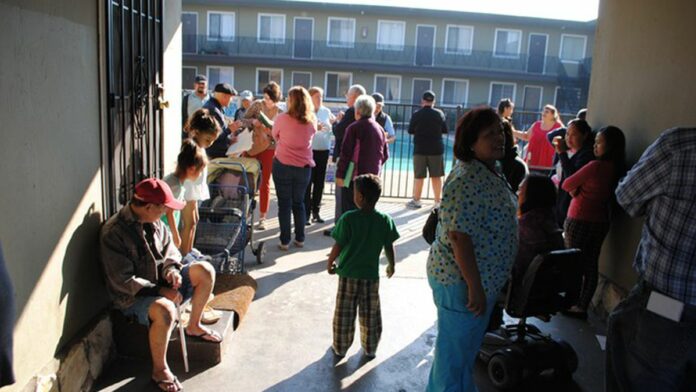
Tenants at the Bay View Apartments received eviction notices from Sridhar. Credits: Steven Tavares/File photo The Alameda landlord who has become the face for greater rent control restriction after he issued notices of eviction to 33 families in the Bay View Apartments last month, sent an inflammatory letter to city leaders strongly opposing regulations that support tenants’ rights. Matt Sridhar, the...

California’s Leading Legalization Initiative Gathers Momentum

California’s leading legalization initiative is gathering momentum, and has announced a raft of amendments that add input from hundreds of stakeholders and consolidated support from the main rival legalization group. Proponents of the Adult Use of Marijuana Act (AUMA) formally amended their initiative with the Secretary of State on Monday — boosting protections for children, workers, and small...
19,045FansLike
17,709FollowersFollow
61,790FollowersFollow