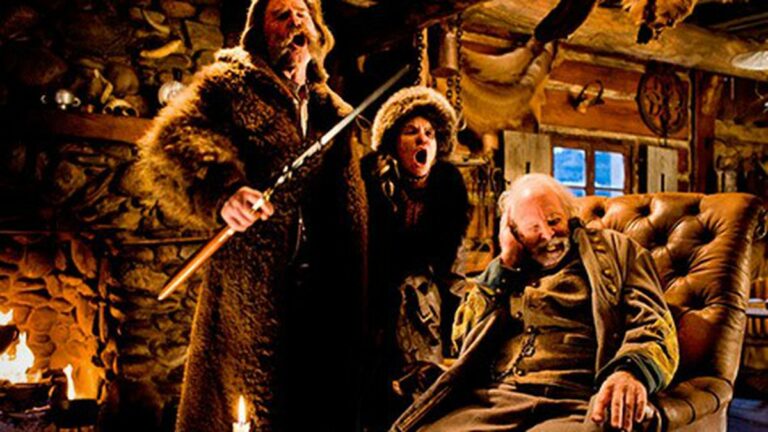
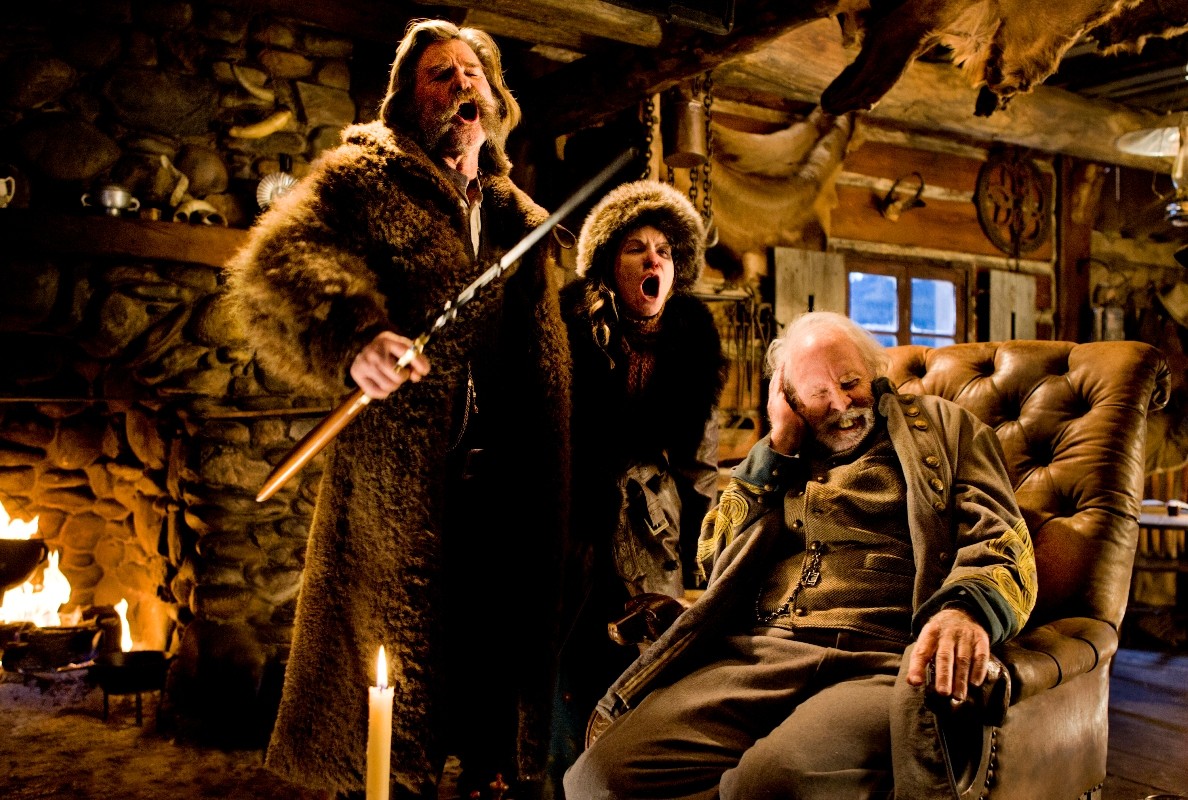
Quentin Tarantino conclusively runs out of gas with The Hateful Eight, his second western in a row and the stodgiest holiday gift package he’s ever shoved down the chimney to his faithful fans.
An eight-pack of nasty desperados hole up in a Wyoming mountain lodge in a fierce blizzard, and slowly, steadily get on each others’ nerves until they start to kill each other. The big question: Who’s going to be the last man (or woman, as in Jennifer Jason Leigh’s Daisy Domergue) standing? Hint: Professor Plum in the library with the rope is not an option. Despite the snowy scenery (shot on location near Telluride, Colorado), the action is stage-bound, mostly confined to the lodge. On hand in Minnie’s Haberdashery are the requisite members of the QT stock company — Samuel L. Jackson, Kurt Russell, Tim Roth, Michael Madsen, James Parks — as well as a few promising newbies, most exciting of which is Jason Leigh.
Kurt Russell, Jennifer Jason Leigh, and Bruce Dern star in The Hateful Eight.
Kurt Russell, Jennifer Jason Leigh, and Bruce Dern star in The Hateful Eight.
Tarantino’s knack for sizzling dialogue fails him early and often, and characters’ speeches seem painfully long and drawn out. The dialogue covers much of the same subject matter as Django Unchained: race hatred, the Civil War, ordinary meanness, etc. Words are wasted, something very rare in a Tarantino screenplay. It occurs to us during the three-hour-plus running time that we’re also missing the presence of Christoph Waltz, the most interesting character in Inglourious Basterds and Django Unchained, who’s presumably safely occupied doing other movies. He’s better off.
Alongside homages to Sergio Leone, Samuel Fuller, and Jess Franco, Tarantino pays tribute to the old-fashioned “road show” exhibition formula of long movies equipped with an overture and intermission. In this case, he needn’t. The flick could easily lose an hour, maybe ninety minutes, with no harm done. An Ennio Morricone music score and 70mm cinematography cannot rescue it. It’s probably time we put Tarantino under the same scrutiny as any other filmmaker and quit cutting him slack in the story department. Maybe he could have hired a script doctor. Is the maker of Pulp Fiction and Jackie Brown out of ideas? Your guess is as good as mine.
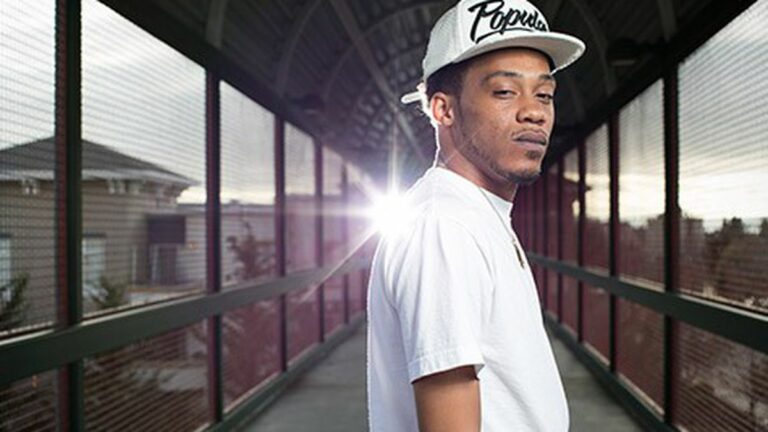
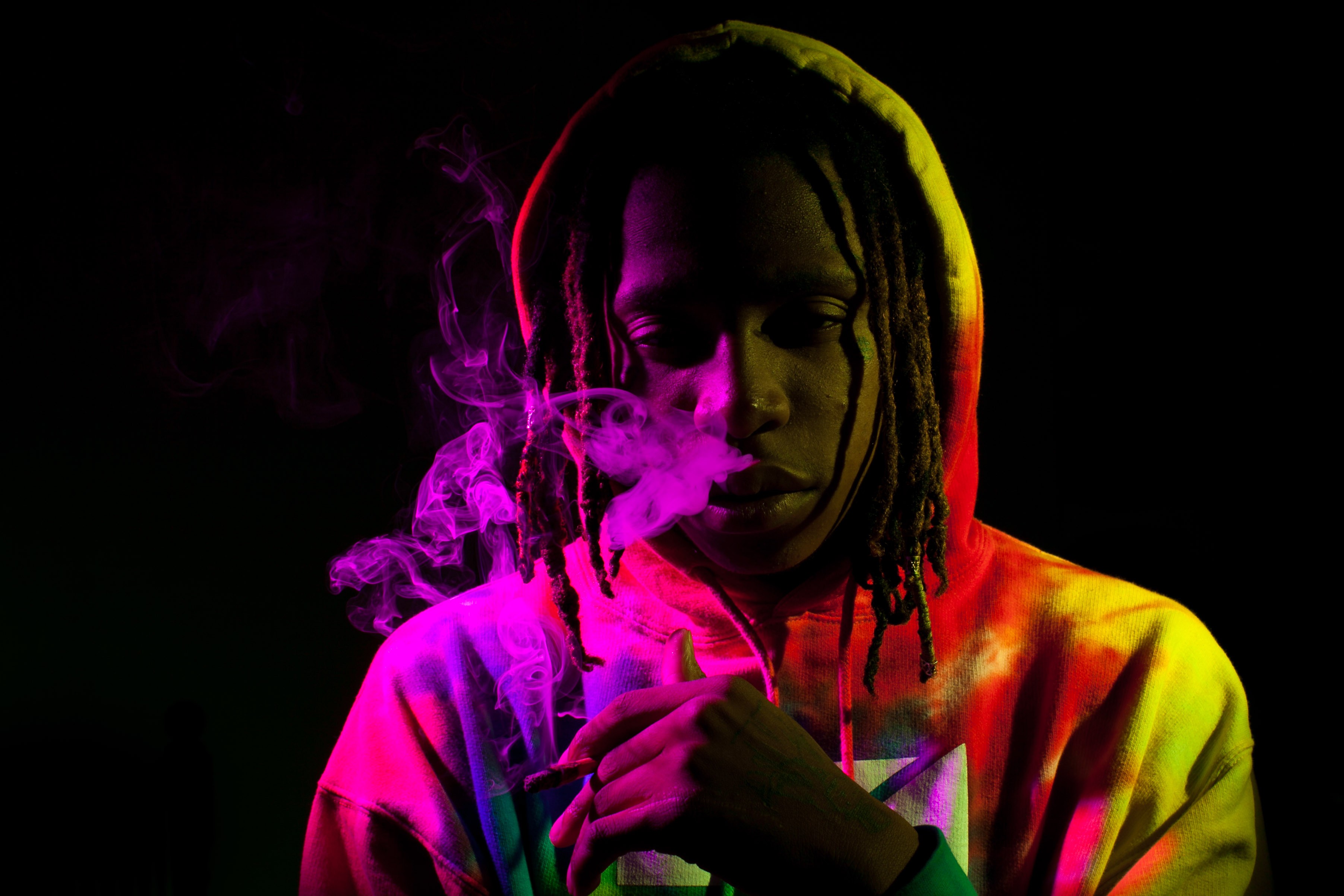
Young Gully’s Bermuda is a 33-track album in three parts — God, Devil, and Human — the first two of which the Oakland rapper released in eleven-track installments over the course of the past two months. Throughout God and Devil, Gully spits densely packed bars with a palpable urgency, cramming as many syllables into each line as possible. As he expels each verse, he seems to purge past mistakes, doubts, and regrets, laying bare the memories that haunt him.
Above all, Bermuda is about redemption. Gully (Michael Watkins), 28, recorded the project during a recent consciousness shift he experienced after becoming interested in spirituality and studying the Bible. Throughout the album, he reflects on the death of friends, the ups and downs of personal relationships, and the hustler mentality he adopted to survive in his struggling East Oakland neighborhood, while invoking his religious beliefs in subtle ways. After confronting these difficulties, he emerges with a sense of hope.
Young Gully.
Credits: Bert Johnson
Young Gully’s new album, Bermuda, delves into spiritual themes.
Credits: Bert Johnson
“In my past, I’ve done a lot of dirt,” Gully said in an interview. “Turning this around is what the album is about — in so many ways, though. I’m really owning up to a lot of mistakes I’ve made in the past in a real way. … I’m making it vivid for people to understand.”
The island nation of Bermuda is at times a specter and at times a fantasy that looms throughout Gully’s lyrics. Gully had never been to it before recording the album, though he did eventually have his release show for part one, God, there in October. While writing the record, he imagined Bermuda as an idyllic paradise that was a counterpoint to his harsh reality at home. The lore of the infamous Bermuda Triangle appealed to him as well. As a lyricist, Gully often explores the ways in which beauty and treachery can exist simultaneously.
As he developed the album, Bermuda became less of a tangible destination and more of a symbol of escape and transcendence into a “more spiritual zone.” I’m in the land of parasites/Where’s paradise?/The only way to it is through it, he raps on “Come on Down,” underscoring the importance of emotional healing.
Indeed, in our interview, Gully described the process of writing and recording Bermuda as a form of therapy. He recalled breaking down in tears as he wrote many of the verses. “Sometimes, I had to pull away from it because it was too much for me,” he said, reflecting on the year and a half it took to pen the lyrics.
Young Gully.
Credits: Bert Johnson
Having his friends watch him lay down the tracks in the studio proved to be a powerful experience, as well. Gully had previously made music that spoke to his community’s resilience in the face of struggle, such as his Hustla Movement mixtape series and his Oscar Grant tribute album, The Grant Station Project. However, on Bermuda, he turns the focus on himself rather than society. He said that throughout the writing and recording process, he felt hesitant about creating an album that’s so specific to his life experiences for fear of alienating his audience. But when some of his longtime friends joined him in the studio, their positive feedback gave him the validation he needed to see the project through to completion.
“Seeing some of them cry when they heard me record it was kind of the key thing that let me know I need to put this out,” he said, comparing the emotional high points of the recording session to an intervention.
“It’s a very truthful album,” he continued. “It’s talking about a lot of my life stories and my past. God would be the spiritual side of what I deal with; the devil would be the hatred, the aggression; the human side is like a lack of care — just living.”
Because the cutting edge of rap has moved on from lyrically dense spitting to more of an emphasis on idiosyncratic flows in recent years, Gully’s verbose style can be seen as somewhat nostalgic. However, on Bermuda, his signature flow comes through sounding up-to-date. Though the technical side of rapping has decreased in importance in the eyes of many fans and critics, Gully’s ability to adapt his best skills to a novel sound is admirable and refreshing and even lends his work a certain timelessness. After all, he became known through his single “Definition of Gas,” a manifesto for rapping with acrobatic dexterity. He’s keenly aware of his strengths and when to deploy them, and on Bermuda, his speedy rhymes emphasize the importance of his subject matter. They’re also pretty damn impressive. Listening to the record, it’s hard not to wonder when he will gasp for air.
In contrast to Gully’s aggressive flow, the production on part one, God, is airy and uplifting, with gospel samples, soulful hooks, and big, sweeping beats rife with analog instrumentation. On “Show You Love,” a melancholic flute sample plays over shimmering percussion; “God” juxtaposes the gentle strum of a guitar with rapid-fire high hats and interlocking, layered vocal samples. However, on Devil, the vibe completely shifts. The second installment of the series opens with “Temporary,” a bass-heavy track with an ominous church bell sample that evokes Memphis horrorcore. Got these demons in me, boy/Just trying to get ’em out, Gully announces at the beginning of the song, almost like a prologue. Throughout Devil, he cranks up the intensity of his delivery. In a rare feat, the record manages to be intricately poetic and catchy at once, largely thanks to his savvy choices of dark-yet-danceable production.
“I call it mood music because from the first one to the third one, you’ll see the mood shift in each album,” said Gully. “It goes from love and owning up and trust issues — truth, things like that — to anger and aggression, and then it comes to actually escaping. It’s kind of a story from beginning to end.”
We’ll have to wait until early 2016 to see how the final chapter plays out, but if God and Devil are any indication, Bermuda should end with a strong finale.
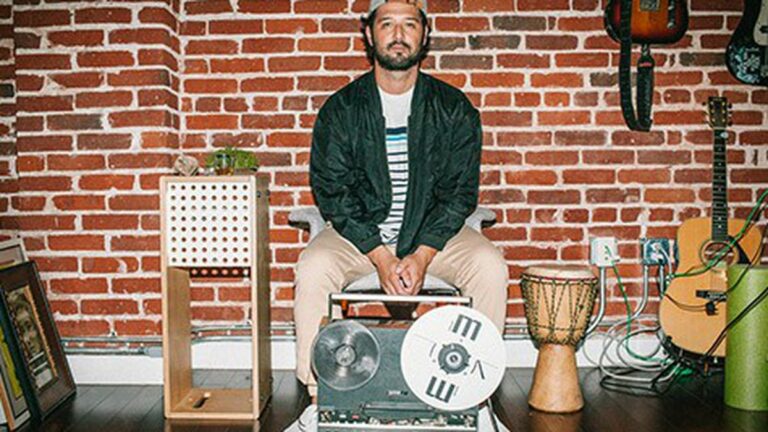
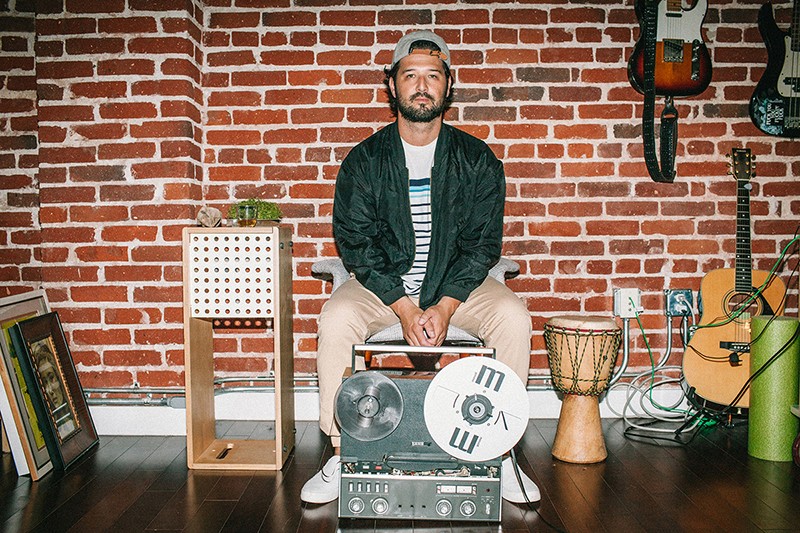
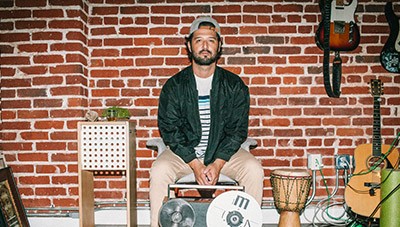
Collaj (Jayson Martinovich) called me from his bathtub at the scheduled time of our interview — which might seem like an odd thing to do, but it was actually an on-brand move. His new style of bubbly, island-tinged pop calls to mind images of fruity drinks, saltwater, and warm nights. In between studio sessions working on his forthcoming full-length album, the San Francisco singer and producer has developed the guilty pleasure of taking luxurious, scented baths to get into his sunny creative zone in spite of the current chilly weather.
In addition to writing songs for his next album, Collaj is currently overhauling his music career. Formerly known as 8th Grader, he released a well-received, self-titled EP and performed at the most recent edition of Austin’s South by Southwest before coming to the realization that he wanted to go in a new creative direction. As 8th Grader, he penned sultry R&B slow jams that were at times sleazy and kitschy, but he wanted to find a way to incorporate his love for Caribbean and African rhythms and traditional percussion into his work.
Collaj.
Credits: Lance SkundrichCollaj.
Credits: Lance Skundrich
Even though he was starting to pick up hype as 8th Grader, he abruptly dropped the project and renamed himself Collaj to better represent the patchwork of sounds he seeks to incorporate into his music. Plus, he added, the name 8th Grader felt incongruous with the R-rated themes in his lyrics.
Under the new moniker, Collaj has released several singles with more upbeat rhythms, lush layers of playful synths, and a wide variety of percussion instruments from different cultures. There’s “Tropical Vacation,” a breezy, synth-driven dance-pop song with notes of funk and dancehall that — rather refreshingly — celebrates mutually satisfying, mentally healthy relationships. When I’m with you/I’m never seeking validation, I can be myself, he croons heart-meltingly in an earnest falsetto. “You Deserve It All” is similarly syrupy and devotional, with pulses of retro-sounding synths bouncing up and down like the folds of an accordion.
“I’ve been writing songs that are really celebratory and, you could say, ‘tropical,’ even through they’re more ‘world beat,'” he said. “Because, nowadays, ‘tropical’ is like ‘Sorry’ by Justin Bieber, and it’s commercial.”
Collaj recently quit his job as a social worker and currently splits his time between the Bay Area and Los Angeles as he vies for commercial pop songwriting work. He has begun shopping around songs to mainstream artists, though he won’t mention who quite yet. He did admit, though, that he wrote a track that was up for consideration for Bieber’s successful new album, Purpose, though it ultimately didn’t make the cut.
As far as his personal music project goes, Collaj’s jubilant singles draw from his background studying various types of African and Caribbean drumming. Over the years, he had dabbled with different instruments, including guitar, piano, synth, and drum machine, but he attributes his tracks’ complex rhythm structures to his interest in the traditional drumming of the African diaspora. He took up congas, which originated from Afro-Cuban music, and the djembe, a type of West African drum.
“Growing up in [Sonoma County], I was around a bunch of fucking hippies and drum circles and ate a lot of mushrooms and did a lot of weird stuff,” he said. “But after a while, the drum circles got kind of boring and I wanted to learn the actual instruments. … There’s definitely a pulse and a groove that is really important for me in all my songs that I think comes from African music.”
Collaj explained that his songwriting begins with laying down a drum beat and adding layers of melody on top of it through intuitive improvisation. He said that his process is roughly half analog and half digital, though he professed that he never uses a loop pedal, instead playing repeating phrases over and over on an 808 drum machine or a synth. Though he works with some recurring collaborators, such as Oakland’s Jackson Phillips of Day Wave, by and large, he plays the majority of the instruments on his tracks and considers himself self-taught.
“I love writing pop songs so I don’t need to get super technical with one particular instrument,” he explained. “Songwriting itself can be seen as a study of all the various elements that make up a song. It’s a lifelong study.”
When director Ayodele Nzinga stepped onto The Flight Deck’s stage to introduce Lower Bottom Playaz’ rendition of playwright August Wilson’s Radio Golf, she warned the audience to watch out for parallels to Oakland’s struggles with gentrification and displacement. Indeed, Lower Bottom Playaz’ production of the 2005 piece — which is set in Pittsburgh, Pennsylvania in 1997 — delves into issues of race, class, and power that resonate deeply with the East Bay’s sociopolitical situation. Although its allegorical elements are less than subtle, Radio Golf is timely and accessible, and the Lower Bottom Playaz’ skilled cast lends its thought-provoking script an immediate emotional poignancy.
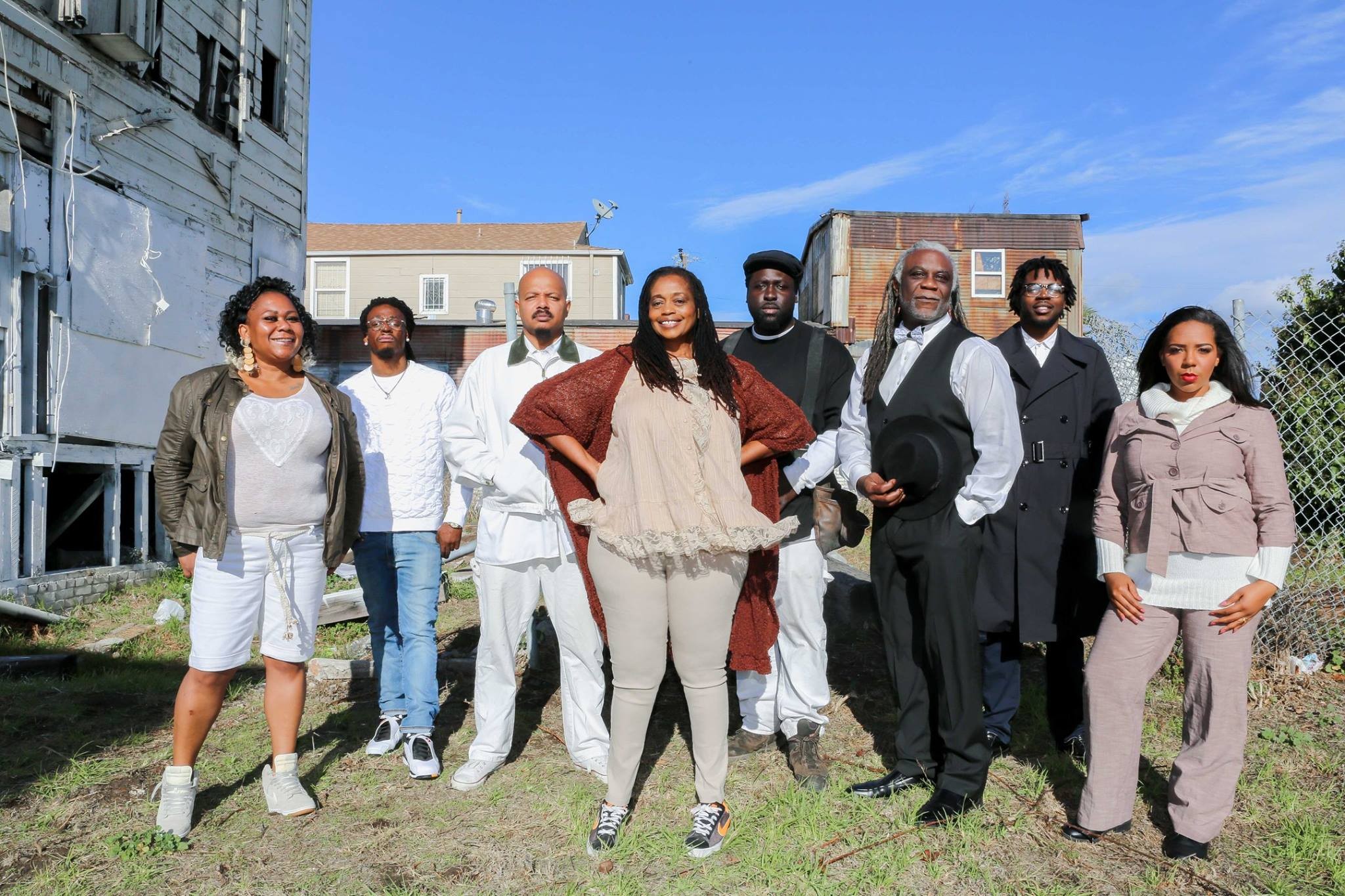
Radio Golf is the final play in Wilson’s American Century Cycle, a ten-play series that purports to chronicle one hundred years of Black issues in America. Lower Bottom Playaz is now the first theater company to ever stage the ten plays chronologically, a feat it began in 2010. The play’s protagonist is Harmond Wilks (Stanley Thomas Hunt, II of Licks fame), a successful Black real estate developer and mayoral candidate. He faces myriad moral conflicts as his plans to develop Pittsburgh’s historically Black Hill District threaten to illegally displace its longtime residents. His ambitious wife, Mame Wilks (Venus Morris), and social-climbing business partner, Roosevelt Hicks (Koran Streets), both urge him to pursue power and money. Meanwhile, two eccentric elders, Sterling Johnson (Pierre Scott) and Joseph Barlow (Adimu Madyun), warn him against perpetuating the disenfranchisement of his own community for the sake of profit.
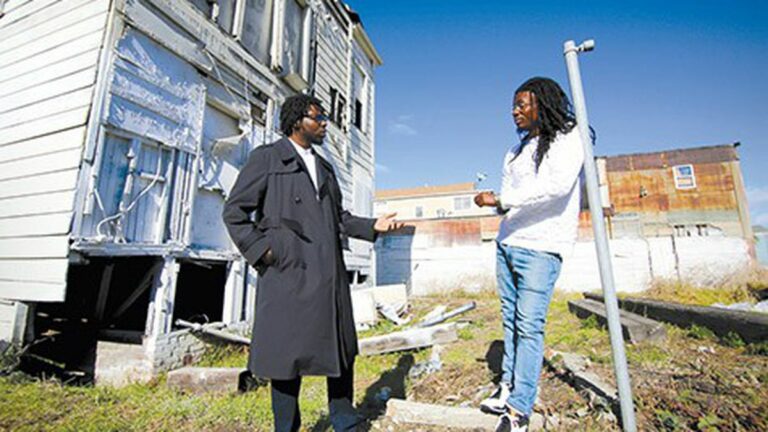
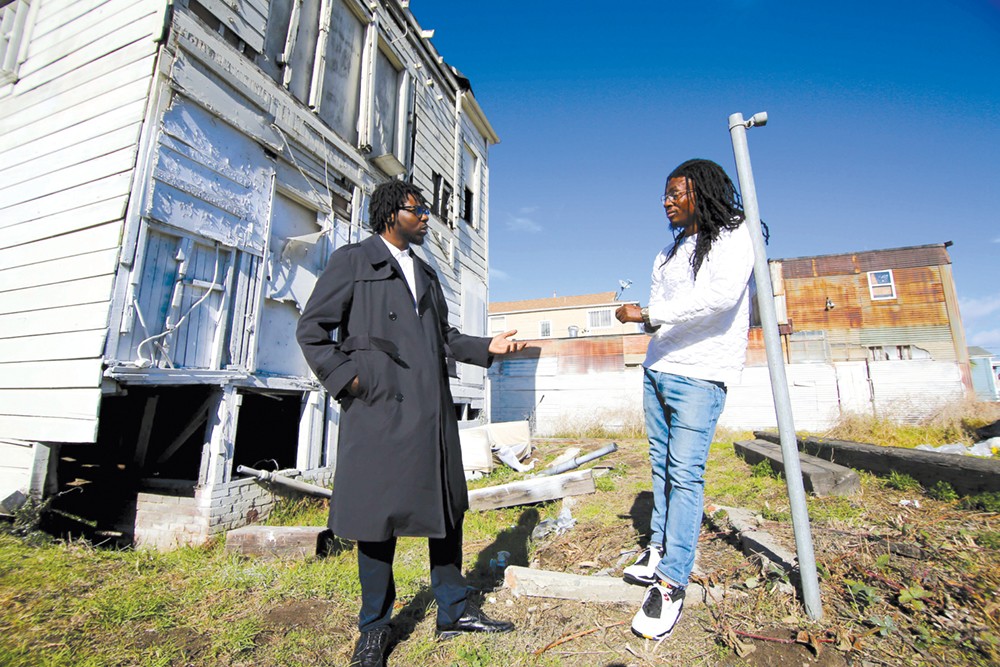
Stanley Thomas Hunt, II (L) and Koran Streets star as Harmond Wilks and Roosevelt Hicks.
Credits: TaSin Sabir
The cast of Radio Golf.
Credits: TaSin Sabir
Stanley Thomas Hunt, II (L) and Koran Streets star as Harmond Wilks and Roosevelt Hicks.
Credits: TaSin Sabir
Throughout the play, Wilks — who comes from a more privileged background than the other characters — grapples with the meaning of success and confronts the realities of systemic inequality. His heated, high-stakes discussions with Mame and Hicks add to the plot’s tension, but the most rewarding interactions to watch are his conversations with Johnson and Barlow. Adimu Madyun delivers a particularly spirited performance as Barlow, who adds comic relief to the plot while providing unexpected insights. His character’s levity is a welcome respite from the otherwise heavy and densely packed dialogue.
While not all the plot points in Radio Golf reach tangible resolutions, Hunt’s emotive performance as Wilks lends the script a sense of catharsis. With his short dreadlocks and numerous hand tattoos, he doesn’t have the clean-cut look of an aspiring politician but portrays one valiantly nonetheless. Part of the charm of Lower Bottom Playaz’ rendition of Radio Golf is its DIY feel rather than its verisimilitude. And as an all-Black theater troupe composed of Oakland and Berkeley natives, the company’s rendition of this topical play feels necessary and urgent.
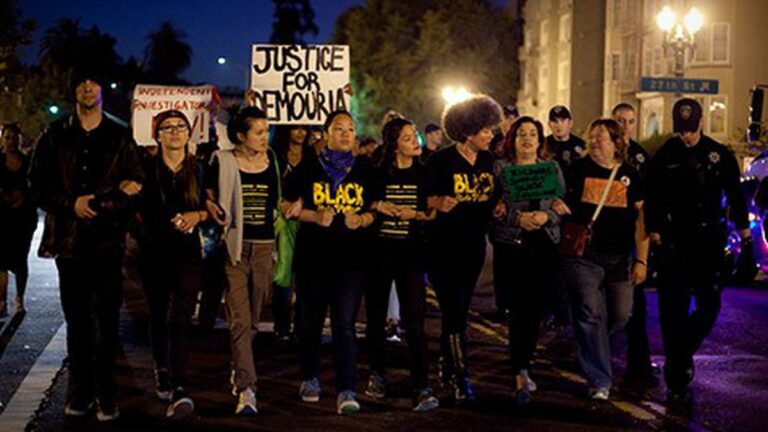
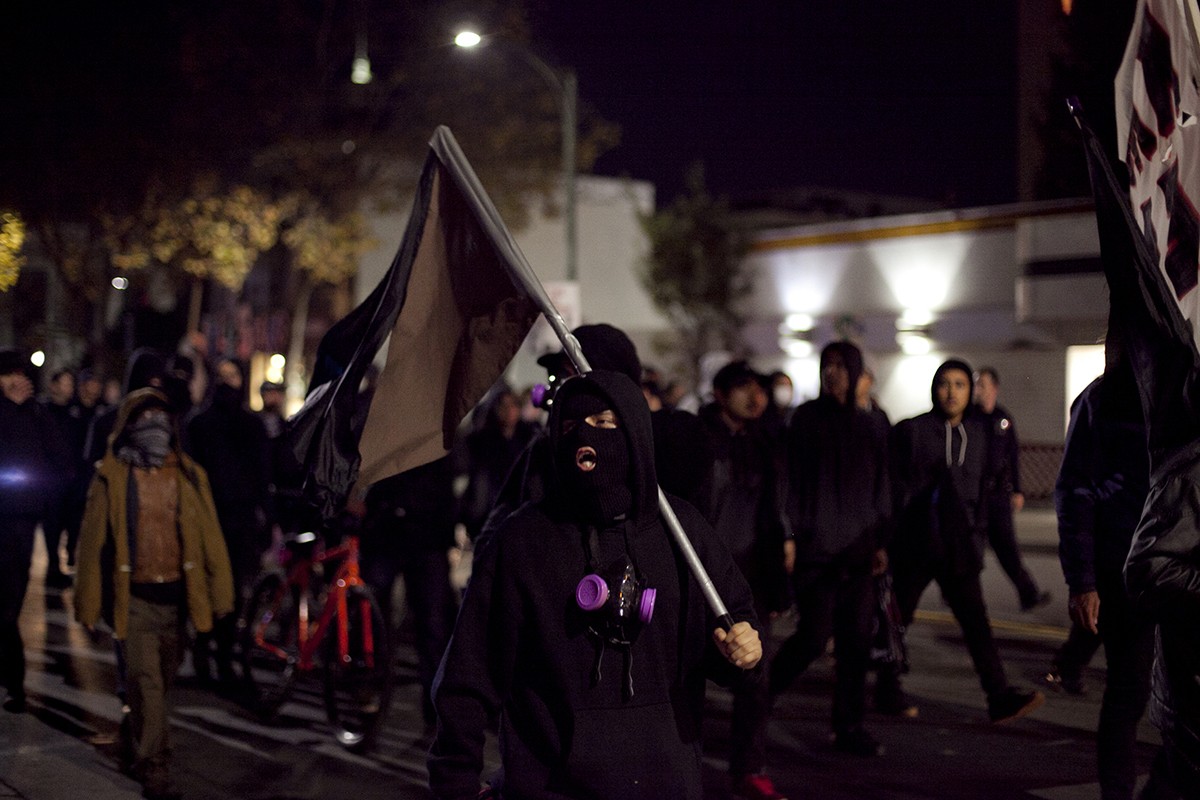
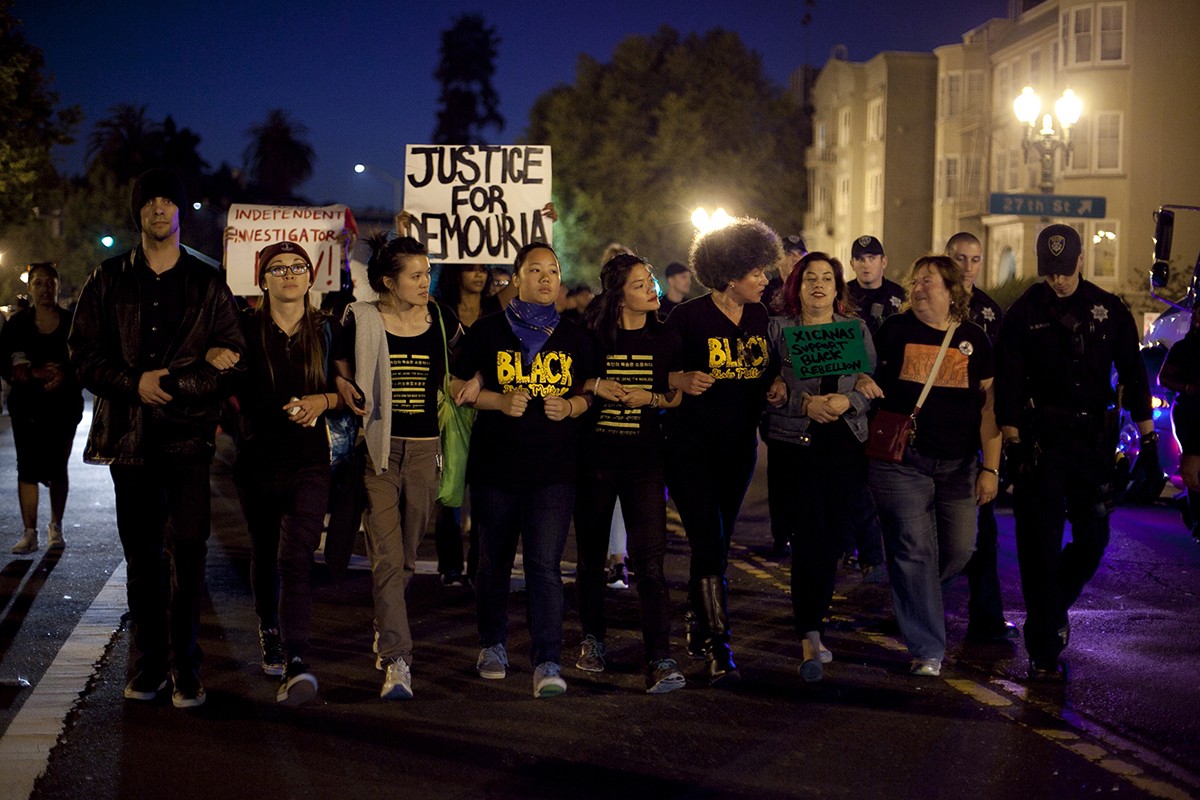
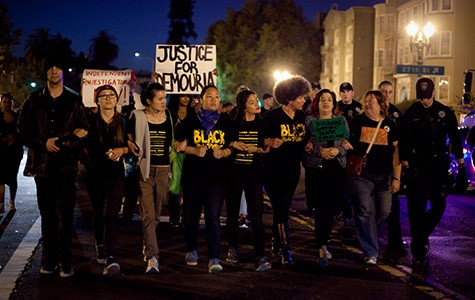
In the fall of 2014, two grand juries failed to indict white police officers in the deaths of unarmed Black men. The decisions in Ferguson, Missouri and Staten Island, New York were a clarion call for many who were fed up with the repeated loss of Black lives at the hands of police. Ferguson burned. The East Bay seethed. People took over city streets, shut down highways, and blocked public transit. Oakland police, in a report issued to the city council in March, counted 23 protests during a 38-day span, from November 24 to December 31, drawing nearly 10,000 people — not including demonstrations in Berkeley.
Though the heat of the uprisings has since cooled, the clamor for accountability has moved to city council meetings, community gathering spaces, and public forums. During the past year, activists have won policy changes, built and fortified community organizations, and kept the demands of the Black Lives Matter movement at the forefront of political conversations and popular culture. Despite this progress, all of the activists I spoke to recently said their work was far from over.
Black Lives Matter activist are demanding more accountability from law enforcement.
Credits: Erin Baldassari
Roughly 50 protestors marched from Fruitvale to City Hall in Oakland to protest the death of Richard Perkins, who was shot by police on Nov. 15.
Credits: Erin Baldassari
Black Lives Matter protesters marched against police brutality in Oakland in June.
Credits: Erin Baldassari
For Sanyika Bryant, national secretary of the Malcolm X Grassroots Movement and member of its Oakland chapter, the uprisings last year were just part of a series of demonstrations nationwide that began in the mid-Aughts with the response to the Jena Six — six Black teenagers who were arrested following the December 2006 beating of a white high school student in Jena, Louisiana. Five of the teens were initially charged with attempted murder, and more than 10,000 people rallied to condemn what they saw as unduly harsh treatment within the justice system. Bryant said that since then, incidents nearly every year have brought demonstrators out to the streets, including in the East Bay, where demonstrators protested following the 2009 shooting death of Oaklander Oscar Grant by BART police.
“Every year we’ve had something that’s popped off. It’s been building and building and building,” Bryant said. “So, we look at it as a continuation of events, but more and more people are really starting to see what’s going on.”
An important outcome of the surge in protests last year — which began locally in November when a Ferguson grand jury decided not to indict Officer Darren Wilson in the death of 18-year-old Michael Brown — was the growth of community organizations focused on advancing racial justice that are more inclusive for women, queer, and trans people, Bryant said. He pointed to the Black Lives Matter group, which began in 2012 with an all-female leadership, as one example of women taking on high-ranking positions, traditionally dominated by men, in the Black liberation movement.
In Oakland, the group Black.Seed formed out of the Black Brunch protests — several demonstrations that harkened back to the sit-ins of the Civil Rights movement and were a response to the non-indictments of Wilson and New York police Officer Daniel Pantaleo, whose chokehold of 43-year-old Eric Garner led to the Staten Island resident’s death. The Black Brunch protests were a way to channel outrage over those events in a direct, nonviolent way and call attention to the lack of accountability for the officers involved. But the primary focus of Black.Seed has been to nourish its members and the community both spiritually and emotionally, said member Michal Jones. “Some of that work is invisible and won’t make headlines,” Jones said. “It’s about cultivating community.”
Black.Seed later did make headlines by shutting down an Oakland City Council meeting in May, along with several other groups, to protest a proposed development at East 12th Street that would have allowed luxury housing on public land. The council approved the deal but then scuttled it after the Express revealed that the pact violated state law.
Like many of the activist organizations involved in the broader struggle for racial and social justice, Jones sees the fight for parity as not just a law enforcement or criminal justice issue, but one that manifests along economic, educational, and social lines.
The Malcom X Grassroots Movement was one of several organizations that sponsored the first State of Black Oakland, a Black community forum focused on methods for addressing racial justice from a holistic point of view. The March 2015 event hosted several hundred people who were split up into nine listening sessions. Next year, Bryant said the forum will aim to draft a Black people’s agenda for the city, which will include actionable outcomes that community groups and individuals can work toward advancing.
“We’ve seen time and time and time again that the government is going to do the exact opposite of what is in the interest of Black lives — or any oppressed people,” Bryant said. “In order to combat that, we’re going to have to make decisions for ourselves and build leadership in a way that we really rely on ourselves.”
Bryant pointed to the Anti Police-Terror Project as an important example of an independent grassroots organization. Rather than rely on government institutions, the group sends representatives to respond immediately to officer-involved shootings and gather witness statements, provide legal support, and offer emotional counseling.
Black Lives Matter protesters marched against police brutality in Oakland in June.
Credits: Erin Baldassari
Within local government in Oakland, perhaps the most salient response to the Black Lives Matter movement has been the creation of the Department of Race and Equity. Councilmember Desley Brooks first proposed the new department at a January 29 rules committee meeting, and the council voted unanimously to establish it in June. Brooks looked at what other cities were doing to address what she saw as systemic problems relating to racial and social justice nationwide and then modeled the proposal on similar departments in Portland and Seattle, she said. “It was about watching what’s going on in the community both nationally and locally and feeling like something has to change,” Brooks explained.
The department will be tasked with reviewing city policies and coordinating with other departments to ensure they align with the goal of racial and social equity, among other responsibilities. In November, the council voted to hire the head of the Portland Office of Equity and Human Rights, Dante James, on an interim basis to help establish the department. Brooks said James would likely begin working in Oakland early next year.
Cat Brooks, a member of the Black Lives Matter group and co-founder of the Anti Police-Terror Project, lauded the move, though she remained cautiously optimistic. “What I hope is that the department is able to actually address the other ways people of color face oppression,” Cat Brooks said. “But you know, once its in the hands of government, who knows what will happen?”
With trust in the government’s ability to keep people of color safe running thin, Frank Tucker, president of the Bay Area chapter of 100 Black Men, drafted a series of resolutions in April aimed at addressing police accountability and systemic racism. The eleven resolutions include provisions that range from instituting regular psychological screenings for police officers to reviewing the effectiveness of the department’s use of force policies. One of the resolutions, adopted by the council in September, called on the city to affirm the public’s right to photograph, videotape, and audio record police officers and dovetailed with a state law that the governor signed in August.
Another resolution went a step further, calling for a “Do Shoot” public service campaign to urge anyone seeing someone pulled over by the police or being arrested to shoot video of the incident with his or her cellphone camera. Tucker said the city will begin advertising the campaign, renamed “100 Cameras,” sometime in the new year. And though Tucker said his group wasn’t able to institute regular psychological screenings of police officers, the city did dedicate $400,000 to establish a “wellness center” within the police department, which officers could access on a voluntary basis. Councilmember Brooks said the police department is still determining where to site the “one-stop shop” for mental wellness but said it would “be up and running, hopefully by the beginning of the next year.”
Tucker’s group also called for the police department to review its use of force policies. US District Court Judge Thelton Henderson, who has been overseeing OPD reforms since a 2003 settlement of a police misconduct lawsuit, ordered the department to the do the same. Henderson set a deadline for this week for the department to strengthen its review of fatal officer-involved shootings.
Earlier this year, the city hired a consultant to review the department’s stop data and recommend possible changes. The council also established an ad hoc committee on police recruitment and retention that is specifically tasked with determining ways to attract more African-American, Asian, Latino, and Oakland-dwelling officers. Council President Lynette Gibson McElhaney said that more than anything, the movement has raised critical questions on bias and allowed people to connect in ways that ensures the movement will be sustained.
“When you start dealing with racial injustice in policing, it opens up the conversation around disparate treatment in all other sectors — like employment, education, and housing,” she said. “It allows us to talk about how there’s not yet equal treatment in all of these other various systems.”
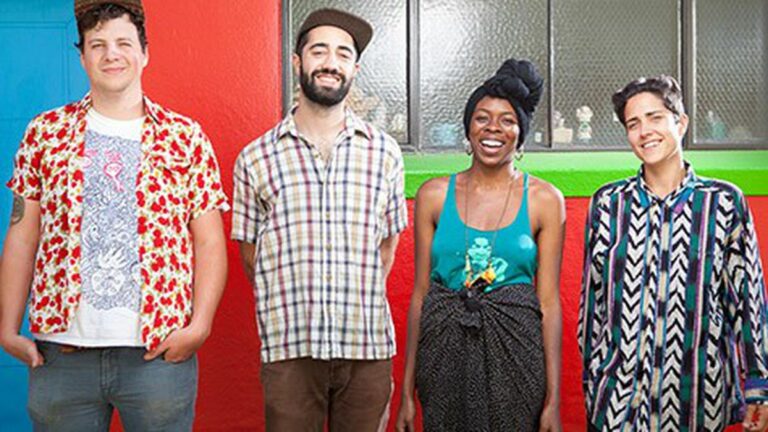
Bells Atlas’ EP Hyperlust fuses high-caliber musicianship with bright, glistening pop. Though the song structures are digestible and familiar, the EP’s arrangements are multilayered and expansive, and there’s an iridescent quality to the way each song effortlessly shifts melodies and tempos, like light refracted by a glass prism: Keys shimmer, percussion twinkles, bass lines bounce, and the soulful vocals glide throughout with impressive range. Three of the Oakland quartet’s musicians have formal jazz backgrounds. Their skilled instrumentation is bold and apparent, though no single player gets overpowered by another. Despite its complexity, Bells Atlas’ music never sounds overwrought. Hyperlust is a light, playful blend of jazz, neo-soul, and indie pop that doesn’t make a show of the laborious technical training at its core.
Lil B and Chance the RapperFree (The Based Freestyle Mixtape)
While fans have long regarded the East Bay’s Lil B as a digital-age spiritual guru, Chicago’s Chance the Rapper’s socially conscious social-media presence and upbeat music have also garnered him an ardent following of youthful idealists. The two artists come together as a well-suited yet somewhat unexpected duo on Free (The Based Freestyle Mixtape), a whimsical, improvisational project that brings out the best in the two vocalists. Chance and Lil B’s camaraderie is palpable in the humorous ways they play off of each other’s lines. While Chance pushes his vocal range, Lil B delivers tighter, denser verses, resulting in a complementary juxtaposition of divergent styles. There are plenty of moments when the project sounds off-the-cuff and unpolished, but that only contributes to its unabashedly childlike sense of play.
Nef the Pharaoh.
Credits: Bert Johnson/File photo
MansionEarly Life
Oakland rock four-piece Mansion creates an inimitably severe, alchemical sound on its debut LP, Early Life. On a first listen, its guitar-driven instrumentation might come off as a barrage of shrill distortion, but in actuality, its compositions are carefully articulated and rife with unexpected twists. Cacophonous pounding often lapses into digestible pop melodies; grating, messy chords fall into recognizable rhythms that borrow from doom metal and surf rock. Each track contains an assault of jarring noise but pulls back at the right moments to give the instruments room to breath. The musicians use intentionally out-of-tune guitars and broken distortion pedals to cultivate textured sounds that scrape, scratch, and howl, creating an aesthetic that’s singularly disconcerting and brutal.
Kool John and P-LoMoovie!
Kool John and P-Lo portray themselves as partners in crime on a quest for the greatest night of their lives in Moovie!, the HBK Gang affiliates’ effervescent collaborative album. Its tracks seduce listeners into the rappers’ dimly lit, smoke-filled world, which seems to exist somewhere between last call and the after-party. Piggybacking off each other’s lines with wordplay aplenty, the duo is cocky and exuberant and its lyrics offer no shortage of secondhand ego boosts. As the album’s sole producer, P-Lo created slow, pared-down beats with ominous bass lines and laser-beam synths that lend the danceable tracks a dark edge. Some of P-Lo’s strongest work yet, Moovie! is a testament to why he has become known as one of the central producers defining the current wave of Bay Area rap.
BotanistEP2: Hammer of Botany
Botanist is the solo project of San Francisco auteur Otrebor, who has developed a distinct mythology through his high-drama, melodic black metal discography. With lyrics alluding to a fictional world he calls the Verdant Realm, Botanist’s releases chronicle nature’s vengeance against humankind, which he presents as an invasive species ravishing the planet. The unrelenting intensity of Botanist’s five-track project EP2: Hammer of Botany underscores the misanthropic themes in his work. A hammer dulcimer is his primary melodic instrument rather than a guitar, and its resounding acoustics reverberate, hum, and occasionally soar over the violent rattling of his rapid-fire drumming. Botanist’s pitch-shifted vocals demonically croak and screech, embodying the earthen spirits that make his self-created lore so intriguing.
EP2: Hammer of Botany by BotanistBells Atlas’ EP Hyperlust combines a pop sensibility with deft jazz musicianship.
Credits: Bert Johnson/File photo
Nef the PharaohNef the Pharaoh
Vallejo rapper and E-40 protege Nef the Pharaoh made waves locally and nationally with his single “Big Tymin,” a summer anthem rife with infectious exuberance and hometown pride. The single enjoyed near-ubiquitous popularity, and Nef’s self-titled EP soon followed. The project features “Big Tymin” and “Boss Me,” another big, upbeat party song, but also delves into vulnerable themes that fans might not expect from the young lyricist. While “Boss Me” and “Meantime” are graphic and raunchy, the EP’s other tracks eschew shock factor in favor of subtle, poetic verses. “Come Pick Me Up” is the project’s unexpected stand-out song and a testament to Nef’s capacity for insightful storytelling. On it, he reflects on his tumultuous upbringing, becoming a father at a young age, and the cycle of poverty and crime in his South Vallejo neighborhood. Amid personal confessions, he delivers poignant societal observations. His ability to pen thoughtful verses as well as infectious hooks positions him as one of the Bay Area’s most promising rising artists.
King WomanDoubt
Bandleader Kristina Esfandiari’s voice floats over crashing cymbals and clamorous guitars like a looming fog on King Woman’s Doubt, the Oakland quartet’s four-song doom EP. Its sinister melodies crest into torrential downpours of pounding, heavy instrumentation, and Esfandiari’s resounding voice cuts through distorted guitar chords before unleashing into tempestuous, resonant howling. Massive percussion underscores the slow-building tension of her vocals. Esfandiari, who grew up in a Charismatic Christian community she described as “cult-like” in a previous interview with the Express, revealed that she uses rock ‘n’ roll as a way to exorcise the specters of her past. On Doubt, she converts her angst into a potent source of power, and the record culminates with a satisfying sense of catharsis.
Caleborate Hella Good
Caleborate was a relatively unknown Berkeley MC before releasing Hella Good, a full-length album that has made him one of the year’s most talked-about East Bay artists. The record is multi-faceted and introspective, with production that manages to sound at once novel and vintage with its warm, soulful sonic palette. Analog instrumentation and doo-wop vocal samples factor prominently into its mid-tempo beats, calling to mind the old-school methodology of digging through record store crates for vinyl. Ambition is a major theme on Hella Good, but Caleborate uses it to give listeners candid insights into his creative process rather than indulging in excessive self-aggrandizement. His verses parse through his coming-of-age experiences, emerging with many pieces of wisdom in the process. He speaks to struggling artists, loners, and stoners, positioning himself as an underdog worth rooting for.
Tia Nomore#Holloween
There’s little doubt that Tia Nomore’s got bars, but she’s also a perfectionist and takes her time releasing material. Though she only had a few singles out at the time, in 2014, the hip-hop blog Thizzler on the Roof named her one of its Bay Area Freshman 10 (its last annual selection of notable local rappers before discontinuing the series). During the last weeks of 2015, Nomore released #Holloween, a three-track EP that she said is a teaser for her 2016 debut album. Her mentor, the producer Exclusive, created rambunctious, bass-heavy beats for the project, deploying glossy synth lines and mechanical samples with impeccable timing. The unostentatious, upbeat production allows Nomore’s rapid-fire flow and cheeky, incisive lyrics to assume the foreground, demonstrating her songwriting chops and versatile vocal abilities.
Bells Atlas’ EP Hyperlust combines a pop sensibility with deft jazz musicianship.
Credits: Bert Johnson/File photo
TonerToner LP
Toner’s self-titled LP is a deceptively simple pop-punk project with plenty of unexpected earworms that prompt repeated listening. It’s the brainchild of Oakland’s Samuelito Cruz, who also fronts the bands Never Young and Happy Diving — grittier, noisier counterpoints to Toner’s swaying, melancholy tracks. TonerLP is guitar-driven and lo-fi. Though three other musicians accompany Cruz for Toner’s live shows, it’s easy to picture him strumming the tracks alone in his bedroom. Indeed, the record’s appeal is in its introspective qualities. In his lyrics, Cruz meditates on feelings of dejection and alienation, fantasizes about leaving suburbia, and gripes about being stuck in bed. As a guitarist, he cleverly wraps somber chords in hooky progressions that add buoyancy to the music’s downcast content.
Kaitlyn Aurelia Smith has a conservatory background but switched from classical piano and guitar to electronic production after she began to experiment with a Buchla 100 synthesizer. On her album Euclid, so named after the Ancient Greek mathematician, Smith found inspiration in 3D shapes, creating psychedelic, playful songs whose structures are based on her musical interpretations of geometry. Though Smith’s work is deeply rooted in theory, it doesn’t come across as such. Instead, the layers of her synthesizer-driven compositions are bubbly and sparkly, with warm tones burbling throughout. The sprightly instrumentals attest to her deft ability to create innovative compositions that remain accessible and, above all else, genuinely fun.
Berner and The JackaDrought Season 3
Berner and The Jacka worked on Drought Season 3 before The Jacka was gunned down by an unknown assailant on 94th Avenue near MacArthur Boulevard in East Oakland last February. A purveyor of mob music, The Jacka first rose to prominence in the late Nineties with his group, Mob Figaz, before launching a successful solo career and establishing himself as a stalwart of Bay Area hip-hop. Needless to say, his death was deeply felt across the music scene and the community at large. While Berner told the Express in a previous interview that Drought Season 3 was incomplete at the time of his collaborator’s death, one would be hard-pressed to guess that this was the case. Nostalgic, lush production with earthy, soulful sounds colors the sepia-toned mixtape, with the two rappers rhyming back and forth throughout. In the context of The Jacka’s death, his and Berner’s narrative-driven verses about the downsides of hustling and street life seem particularly foreboding.
Yassou Video EP
In a rather SEO-unfriendly move, North Bay indie pop quintet Yassou released its 2015 EP as a series of five music videos that don’t have a collective title. The project speaks to the feeling of longing for something that never was, and the human tendency to romanticize the past. I dreamed a dream/I had a daughter/Fell asleep again/Just to hold her, bandleader Lilie Bytheway-Hoy croons on “To Sink.” It’s an airy, melancholic track with a wistful keyboard melody that drifts over a pitter-pattering drumbeat. Like “To Sink,” the project’s other songs have a doleful, contemplative sonic palette that imbues them with a sense of poetic sadness.
There’s little available information about Techie Blood, the new hardcore band that features members of Stressors and Cudgel, other than its abrasive, seven-minute mixtape, Neighborhood Watch #12 aka Millions of Dead Techies. The short recording was uploaded to a mysterious YouTube channel called Guy Fieri Official in August, though the account does not appear to belong to the bleach-blond, hedgehog-haired celebrity chef. Techie Blood’s music is punchy, fast, and violent, with distorted, steely instrumentation that culminates in a barrage of noise. Though Neighborhood Watch #12 sounds mechanized and industrial, it ends with a washed-out, distorted beat that strangely evokes R&B. Techie Blood’s extreme name and aesthetic resonate with the anti-gentrification current in the Bay Area’s rock scene, with many bands reacting to the region’s skyrocketing cost of living with aggressive, angry music that departs from the garage pop of years past.
Sister CrayonDevoted
Terra Lopez’ expansive vocals assume the foreground on Sister Crayon’s downtempo electropop album, Devoted. Her voice tiptoes to precarious highs, rising from breathy spoken verses to long stretches of emotive falsetto. Lopez and producer Dani Fernandez wrote Devoted under the mentorship of The Mars Volta’s Omar Rodriguez Lopez. The record finds its strength in its deft use of negative space, with Fernandez’ minimally percussive beats and surging, dark synth riffs leaving enough room for Lopez’ operatic voice to flourish. Lopez gives equal weight to heavy-hearted lyrics and the technical aspects of singing. Much of the album is about loving tenaciously, to the point that it becomes painful. Her confessional lyricism and ornamental style remain poignant and evocative throughout.
Percentage of Americans who support cannabis legalization for adults: 58 (Gallup)
Percentage of likely California voters who support cannabis legalization for adults: 56 (Public Policy Institute of California)
Percentage of 18- to 34-year-old voters in the United States who support legalization: 71 (Gallup)
Percentage of US seniors who support legalization: 35 (Gallup)
Estimated wholesale value per pound of high-quality, dried, trimmed, outdoor California cannabis: $1,500–$1,800 (interviews with farmers)
Estimated domestic retail expenditures on marijuana per year: $30–$41 billion (WhiteHouse.gov)
Estimated domestic medical marijuana market: $3.5 billion (ArcView Group)
Percentage of national medical pot sales that occur in California: 49 (ArcView Group)
Estimated number of pot farms in California: 40,000 (California Department of Fish and Wildlife)
Amount raised by Privateer Holdings to make investments in cannabis: $75 million (Privateer)
Amount raised by medical cannabis delivery tech company Eaze in April: $10 million (Eaze)
Percentage of cannabis industry execs who are women: 36 (MJ Business Daily)
Percentage of US business execs who are women: 22 (MJ Business Daily)
Percentage of US Congress members who are women: 20 (MJ Business Daily)
Number of US marijuana arrests in 2014: 700,993 (FBI)
Percentage of reported rapes that US police did not solve in 2014: 60 (FBI)
Percentage of homicides that US police agencies did not solve in 2014: 35 (FBI)
Rank of marijuana arrests among all drug arrests: 1 (FBI)
Rank of drug arrests among all criminal arrests: 1 (FBI)
Amount of money spent on domestic marijuana arrests: $3.6 billion (ACLU)
Percentage drop in pot arrests in Washington, DC since legalization: 99.2
Colorado cannabis tax revenue in 2015 (fiscal): $70 million (Colorado Department of Revenue)
Colorado alcohol tax revenue in 2015 (fiscal): $42 million (Colorado Department of Revenue)
Amount of Colorado cannabis tax revenue earmarked for schools: $40 million (Colorado Department of Revenue)
Percentage of summer travelers in Colorado who were at least partially attracted by legal recreational cannabis: 48 (Colorado Tourism Office)
Percentage decrease in violent crimes in Denver from 2013 to 2014: 2.2 (City of Denver)
Percentage decrease in overall property crimes in Denver from 2013 to 2014: 8.9 (City of Denver)
Washington cannabis tax revenue in 2015 (fiscal): $154.6 million (Washington Economic and Revenue Forecast Council)
Washington cannabis market value: $1.3 billion (Washington State Liquor and Cannabis Board)
Total recreational sales for first week of Oregon legalization: $11 million
Potential California cannabis tax revenue and savings per year under legalization: $1 billion (California Attorney General’s Office)
Percentage increase in US teen marijuana use since 2010: 0. (National Institute of Drug Abuse)
Medicine
Percentage decrease in likelihood of bladder cancer among cannabis users compared to non-users in studies: 45 (National Cancer Institute)
Percentage decrease in likelihood of diabetes among cannabis users compared to non-users in studies: 30 (Epidemiology)
Percentage drop in pediatric epileptic seizures during clinical trials of cannabis extract Epidiolex: 47 (American Epilepsy Society)
Percentage of pediatric epilepsy patients who became seizure-free during clinical trials of cannabis extract Epidiolex: 9 (American Epilepsy Society)
Rank of cannabis on US government list of most dangerous drugs: 1. (US DEA)
Rank of prescription opioid hydrocodone on US government’s list of most dangerous drugs: 2 (DEA)
Number of overdose deaths from cannabis in recorded history: 0 (Kaiser Permanente)
Number of overdose deaths from opioids in 2014 in the United States: 28,647 (CDC)
Percentage of deaths from overdose of opioids as a percent of all drug overdose deaths: 61 (CDC)
Rank of oxycodone and hydrocodone in opioid overdose deaths: 1 (CDC)
Number of opioid pain medication prescriptions written in 2012: 259 million (CDC)
Estimated number of Americans who die every day from opioid overdose: 100 (CDC)
Number of minutes that will pass before another American woman goes to the ER for prescription painkiller abuse: 3 (CDC)
Percentage drop in opioid overdose deaths in states that legalize medical cannabis: 33 (JAMA)
Number of signatures on petition calling for resignation of head of DEA after he called medical cannabis a “joke”: 125,000 (Change.org)
California
Number of words in California’s new Medical Marijuana Regulation and Safety Act of 2015: 30,000-plus (California Secretary of State’s Office)
Number of words in California’s original Compassionate Use Act of 1996: 376 (California Constitution)
California’s new standard “dose” of THC, in milligrams: 10
Number of marijuana-related adult-use initiatives filed in California: at least 10 (California Secretary of State’s Office)
Estimated amount of campaign funds needed to pass a cannabis legalization measure in California: $20 million (Marijuana Policy Project)
Number of marijuana-related initiative groups with funding: 1
Odds of California passing legalization in 2016, if effort is unified: 55 (Ben Tulchin of Tulchin & Associates)
Odds of California passing legalization in 2016 if effort is fractured: 0 (Ben Tulchin of Tulchin & Associates)
Percentage of Californians who rate legalization “not very” or “not at all” important: 50 (PPIC)
Estimated net worth of Sean Parker, who is matching all donations to California legalization: $2.5 billion (Forbes)
Top price of tickets to one of the Grateful Dead’s final sold-out shows: $116,000 (StubHub)
Grams of dried flower legal adults 21 and over could obtain, carry, and give away under the leading 2016 ballot initiative, the Adult Use of Marijuana Act: 28.5 (AUMA)
Grams of hash that the AUMA would make legal for adults 21 and over to obtain, carry and give away: 8 (AUMA)
Number of plants that the AUMA would make legal for adults 21 and over to grow: 6 (AUMA)
Dollar amount for infraction of exceeding personal possession limit: $100 (AUMA)
Number of days until the November 8, 2016 election: 321
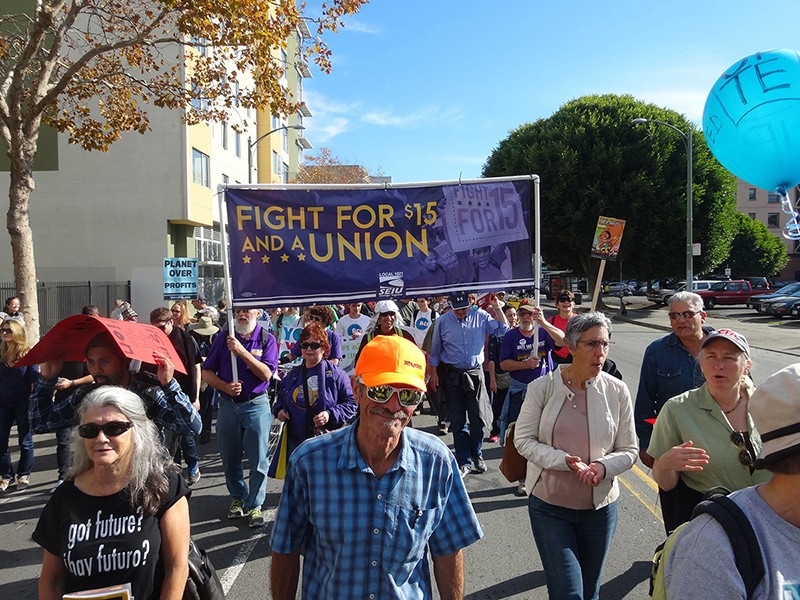
Bay Area labor unions had a big year in 2015, waging battles for social, economic, and environmental justice, not only to benefit their own members, but for the common good. Labor’s signature achievement in 2015 was the breakthrough Fight for 15 campaign. The proposal to raise the minimum wage to $15 gained mainstream legitimacy this past year among not only workers, but also an increasing number of politicians and business leaders. Even mainstream economists like Lawrence Summers of Harvard University now argue that worker power, expressed through unions, is the best bulwark against rising inequality.
In 2015, East Bay workers followed up their victorious 2014 minimum wage ballot measure in Oakland and new minimum wage laws in Berkeley and Richmond with a push toward the $15 mark. Emeryville passed one of the highest city minimum wages in the nation this year — it will reach $16 by 2019. “The success of the Lift Up Oakland ballot initiative in 2014 gave us more incentive to push forward, especially toward the 2016 election, so now we’re focusing statewide so that everyone in California will benefit from raising the minimum wage,” said Shonda Roberts, an Oakland fast-food worker and organizer.
Union members have joined in protests with climate activists and others this year.
Credits: Darwin BondGraham
Union members have joined in protests with climate activists and others this year.
Credits: Darwin BondGraham
Another noteworthy trend in 2015 involved unions becoming increasingly focused on issues that are not directly related to the representation of their members on the job. For example, Service Employees International Union (SEIU) Local 1021, which represents 54,000 public and nonprofit workers in Northern California, worked to build a progressive coalition centered on a broad social justice platform. “In some ways, the definition of the labor movement has expanded in the Bay Area,” said Gary Jimenez, vice president of Local 1021. “We are working together in a larger, progressive coalition that includes housing activists, immigrant rights fighters, and Black Lives Matter. Economic inequality is the issue of our day and it is driving new kinds of organizing. It’s very exciting.”
Other Bay Area unions are also spearheading campaigns for the common good. The Oakland-based California Nurses Association (CNA), for example, has been leading an effort to stop the secretive Trans Pacific Partnership trade agreement and has helped organize climate justice rallies, including opposition to a proposed coal export terminal on Oakland’s waterfront. In May, members of the International Longshore and Warehouse Union Local 10, who handle cargo at the Port of Oakland — one of the busiest US seaports — stopped work to protest against police brutality. Rallying near the gate of an idle port terminal, Bay Area longshore workers were joined by labor leaders representing BART train operators, city and county workers, port workers from Los Angeles, and hundreds of community members.
Yet despite all this, union strength remains fragile. A serious threat to the power of public sector unions emerged in 2015 when the US Supreme Court agreed to hear a case, Friedrichs v. California Teachers Association, contesting the mandatory fees paid by public sector workers who enjoy the benefits and representation provided by union contracts, but who aren’t members of the union that bargained for those contracts. “This lawsuit is one more attempt of the moneyed class to use their power and influence to weaken protections for working people,” said Trish Gorham, president of the Oakland Education Association, the main teachers’ union in the city. Gorham said that if labor loses the case, “the teachers, firefighters, and nurses who provide vital public services will struggle even more to maintain their tenuous place in the shrinking middle class.” A ruling against the unions would decimate public union treasuries and the ability of unions to engage in political campaigns — an outcome that conservative foes of organized labor have been trying to accomplish for decades. Friedrichs will be decided in 2016, and the odds look ominous for labor.
As if existential threats like Friedrichs were not enough, this year, healthcare union leaders remain pitted against one another in brutal fights over strategy, leadership, and turf, wasting tens of millions of dollars of worker dues. A three-person ego-driven cage match continued during the year, involving Dave Regan of SEIU-United Healthcare West (SEIU-UHW), Sal Roselli of the National Union of Healthcare Workers (NUHW), and Rose Ann DeMoro of the California Nurses Association (CNA). NUHW, a militant split-off from SEIU, successfully negotiated a good contract for its Kaiser members after a multi-year struggle. But it has had a difficult time adding members and maintaining financial stability. Two years ago it merged with the CNA, but then CNA leadership officials misfired when they spent millions on NUHW’s bid to wrest tens of thousands of Kaiser members from SEIU-UHW. NUHW/CNA suffered a crushing defeat in a subsequent decertification election, however, and the alliance is now on the ropes.
This year the state and national leadership of SEIU also mounted an effort to curb the power of SEIU-UHW’s Regan. Sadly, the two groups now have dueling state-wide minimum wage initiatives headed for the November 2016 ballot in California. If the unions don’t settle their differences and back one initiative, confused voters may reject both.
The most unusual development in California’s labor movement in 2015 was the rise of New Labor nonprofits. Mainly financed by foundations, these groups emphasize worker betterment rather than worker power. New Labor leaders are smart and full of energy, and want to succeed, but some of them seem to be hampered by a fascination with Silicon Valley, and appear to be naïve about the extent and harm of corporate power.
One interesting experiment is the Workers Lab, an Oakland-based incubator that mimics a venture capital accelerator. The Workers Lab is trying to apply the principles of Silicon Valley to worker organizing — supporting young, energetic activists hoping to build the killer organization and app to benefit workers in exploitative industries.
Another is the Restaurant Opportunities Center, or ROC, which also has a large Bay Area presence. ROC has developed a training app, TopServer, for restaurant workers who wish to advance from lower paying food gigs to higher paying fine dining establishments. ROC recently entered into a relationship with the Ella Baker Center — a well-known, Oakland-based racial justice nonprofit — and Google funders to open a restaurant in Oakland. The eatery will pursue a high-road model, paying its employees well.
Meanwhile, on-demand economy workers increasingly realized in 2015 that Uber and other companies are not what they seem — that it’s a fallacy to think that these businesses are some kind of wonderful new creation for those seeking to maintain middle-class lifestyles. This year, Uber drivers confronted the company’s leadership, moving ahead with a class action lawsuit alleging that Uber has been fattening profits at their expense by misclassifying them as “independent contractors.” The case may go to trial in 2016, and if the drivers win, it could be a significant victory against the on-demand industry.
Unfortunately, in 2015, a number of New Labor groups lent their names and credibility to tech companies and investors who are trying to stop worker misclassification lawsuits — like the Uber case. For example, in October, the nonprofit National Domestic Workers Alliance, the Freelancers Union, and other New Labor groups joined with on-demand companies, including Lyft and Handy, in an open letter calling for a set of “portable benefits” that would allow independent contractors to obtain employment benefits on the open market or through a new government program. However, the effort lacked any discussion of worker involvement or the willingness of companies to pay what is needed. And given that the profits of many on-demand businesses are largely due to non-payment of benefits, like Social Security taxes, for their workers, participation by New Labor was unfortunate. But New Labor folks appear to be well-intentioned, and any fledgling effort is bound to make mistakes. The question is, what will happen in 2016.
One final bright spot this year was the cooperation in the global labor movement to achieve worker protections in sweatshops, especially in the garment and electronics industries. In November, the international labor movement signed a global compact with H&M, the Swedish clothing mega-retailer, to do away with dismal working conditions at the chain’s Asian factories. H&M is a popular brand in the Bay Area and has a store in Emeryville. “[The compact] covers 1.6 million workers in 1,900 factories worldwide,” said John Logan, a professor of labor studies at San Francisco State University. Global compacts are no panacea, but given the pace of globalization, the strategy is worth watching.
And for soccer fans, Sharan Burrow, head of the biggest international union federation, has led the fight for justice for the oppressed workers building the World Cup 2020 facilities in Qatar.
Given all that they face in United States in 2015, workers and unions should be proud of their efforts. But they need some rest as 2015 comes to a close, because 2016 is going to be a doozy. 
For the East Bay art scene, 2015 was a year characterized by ambivalence. As the months wore on, more and more artists began expressing a shared sentiment: They were wavering between being motivated by the rich and diverse creative community that the East Bay has to offer and exhausted by a constant fear of displacement and cultural erasure.
In July, Rock Paper Scissors Collective, a community arts center and Art Murmur founding member that existed on 23rd Street and Telegraph Avenue for eleven years, announced that it could no longer afford its rent. Soon after, drummers, churches, and community centers began receiving noise complaints. A young muralist was shot in West Oakland while completing a community-fueled mural project. And Mills College nearly shut its legendary Book Art department due to budget cuts.
Heavy Breathing was a summer-long series of critical theory aerobics classes.
Credits: Lisa Rybovich CralléCredits: Bert Johnson/File photo
But in the face of this challenging reality, disparate corners of the art community have banded together, spurred by a sudden sense of urgency. Under the leadership of the newly formed Oakland Creative Neighborhoods Coalition, drummers, dancers, curators, artists, and pastors have been strategizing ways to demand security for crucial art spaces in the city. Meanwhile, the Black Artists on Art project began building a roster of Black artists and organizing a radically inclusive showcase of their work in order to ensure representation for Black artists both locally and internationally.
In terms of artwork, that ambivalence emerged as a heightened drive to amplify voices and perspectives often excluded from mainstream discourse coupled with a perpetuation of the Bay Area’s long-held inclination for conceptual experimentation. At best, that intersection produced forward-thinking work that feels, in many ways, distinctly exemplary of contemporary East Bay culture. Following is my list of the ten best East Bay art shows, art projects, and poetry releases of 2015, in chronological order.
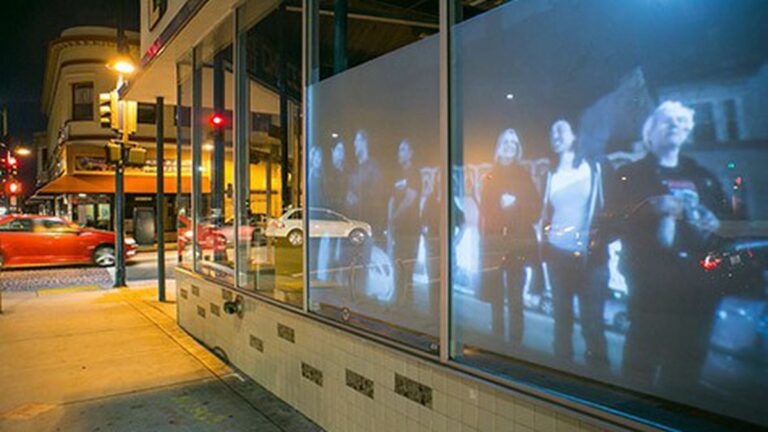
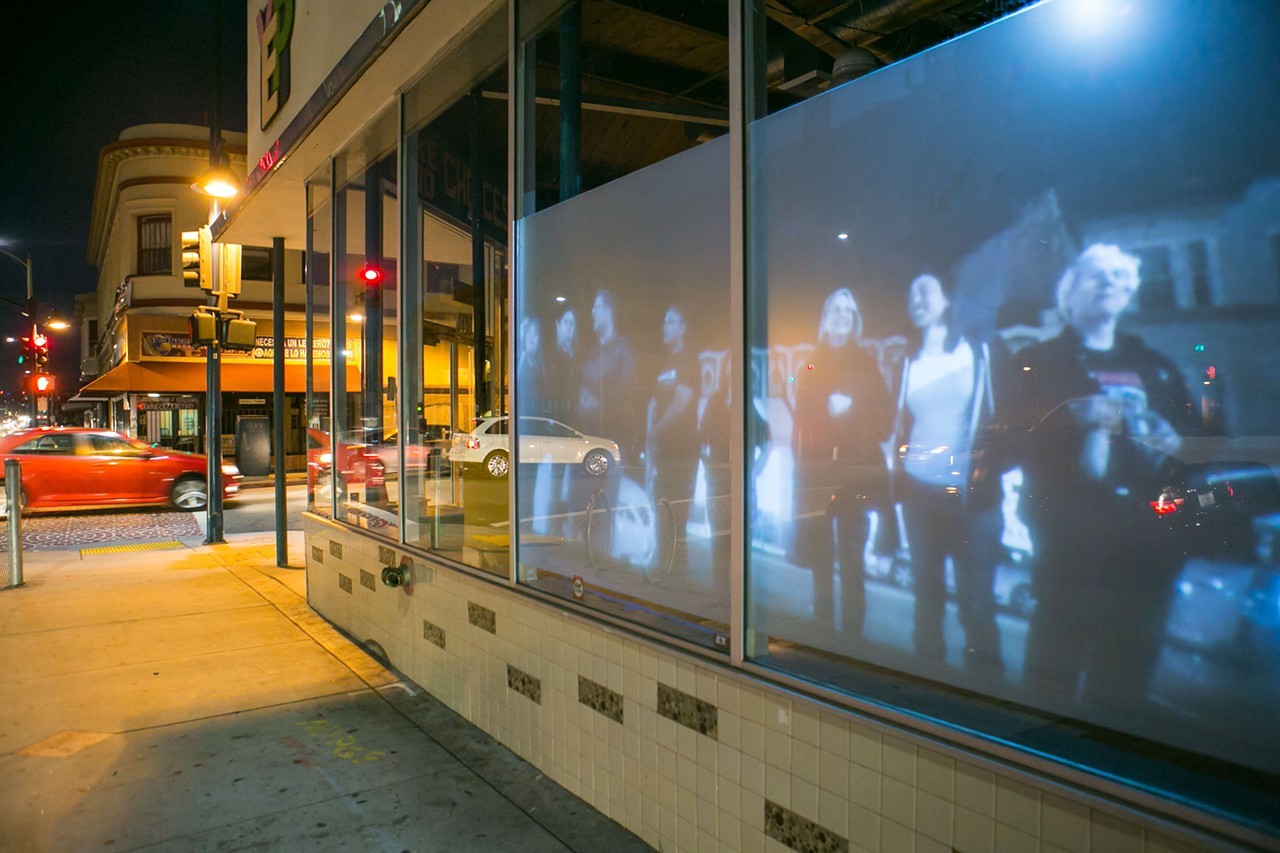
In late January, artists Ellen Sebastian Chang and Maya Gurantz set up a portal between Cole Hardware on College Avenue in Rockridge and Youth Employment Partnership on International Boulevard in East Oakland. They discreetly installed cameras, projectors, and mics, transforming each storefront into a video chat platform connecting unsuspecting pedestrians on either side. Mostly, passersby ogled in bewilderment, sometimes they ran past in fear, and on rare, magical occasions they stopped to engage in conversation with someone on the other side. The project was based on a famous 1980 installation entitled A Hole in Space, which used the same concept to connect pedestrians in Los Angeles and New York City. But Chang and Gurantz’ version flipped the initial piece on its head by connecting two communities that are geographically close yet, in many ways, worlds apart. In doing so, it crucially reminded Oakland residents to always acknowledge their neighbors.
Drifting Islands By Michelle Dizon Oakland Museum of California
This year, the Oakland Museum of California offered a number of excellent shows highlighting local culture. Fertile Ground: Art and Community in California was an ambitious survey of important artists throughout Bay Area history, ranging from Diego Rivera to Barry McGee, while Who is Oakland? highlighted a diverse array of prominent local voices attempting to answer that impossible question through art. But Drifting Islands (April through November) was its most thoughtfully challenging show this year. Michelle Dizon, a Filipino-American former Oakland resident, presented three experimental films unpacking the LA riots, systems of production in the Philippines, and breast cancer-related trauma. Probing into each, Dizon used formal techniques to relay her philosophical musings in a way that questioned the nature of representation altogether, solidifying the museum’s willingness to feature both traditional and avant-garde cultural homages.
Tender Points By Amy Berkowitz Timeless, Infinite Light
This year, the public dialogue on consent and rape was perhaps more audible in mainstream media than ever before. But few personal contributions to that discussion are as complex and thought-provoking as Amy Berkowitz’ book of poetic prose, Tender Points, released by Oakland’s Timeless, Infinite Light in April. It’s an account of Berkowitz’ experiences as a rape survivor living with fibromyalgia — an invisible illness that causes chronic pain and exhaustion, often associated with sexual abuse. In fragments that range from a paragraph to a few pages, the author compiles research on her illness, memories of trauma, descriptions of her pain, quotes from both internet trolls and medical professionals bent on discrediting her illness, snippets from the history of female hysteria, and thoughts on mortality and noise music. Together, they form a searingly honest story about the aggravating dangers of being a woman in a world in which men consistently attempt to claim authority over your body.
A Hole in Space (Oakland Redux) created a video chat portal between East Oakland and Rockridge.
Credits: Bert Johnson/File photo
Heavy Breathing
Curated by Sophia Wang and Lisa Rybovich Crallé
Last summer, artists Sophia Wang and Lisa Rybovich Crallé curated an event series that merged critical theory seminars with absurd aerobics classes. They aimed to engage people’s physical and mental capacities simultaneously to see how thinking while moving could change both our idea of exercise and our understanding of the concepts being learned. The series included a dozen classes all led and created by local artists, including a tutorial on tactics for people of color to survive the racist patriarchy during a run around Lake Merritt, an underwater aerobics class and feminist reading of the Aristotelian notion of topos, and a lecture on the unexpected relationship between global risk management systems and the nervous system delivered from inside a bounce house. Fantastically executed, the series drew out important questions about what it means and how it feels to actually embody theory. Also, it was fun.
A+P+I Jacqueline Kiyomi Gordon, Zarouhie Abdalian, and Weston Teruya
Mills College Art Museum
Adding to its legacy of artistic experimentation, the Mills College Art Museum offered a generous six-month residency to three artists this year, entitled A+P+I (Artist + Process + Ideas), which culminated in one of the year’s most memorable exhibitions. It featured sharp work by Weston Teruya, Zarouhie Abdalian, and Jacqueline Kiyomi Gordon, but it was Gordon’s contributions that garnered the show a spot on this list. For her complementary sound installations, Linda and Tammy 3, Gordon positioned high-frequency directional speakers around the gallery, each emitting simple tones directed at her sculptural targets that functioned as diffusers. The set-up constituted the boundaries of a sonic sculpture invisibly occurring between the tangible components of the piece. As viewers moved throughout the apparatus, they became the sculptor, determining the sound with their own positioning. In an excitingly interactive way, the pieces highlighted the subjectivity of sound reception, and, more broadly, perception altogether.
In early August, CultureStrike, a national pro-migrant arts organization based in downtown Oakland, unveiled an online exhibition of artwork depicting the experiences of migrant families being held in a detention center in Arizona. To create the project, CultureStrike artist program manager and local illustrator Julio Salgado paired artists (including Oakland’s Favianna Rodriguez and Robert Trujillo) with detained mothers and children. Through letters, the pairs worked together to create a vivid depiction that felt accurate to the author. Over the course of a few weeks, CultureStrike released the eye-opening illustrations online at VisionsFromTheInside.Tumblr.com along with scans and English translations of the original letters (they can still be found online).
A Hole in Space (Oakland Redux) created a video chat portal between East Oakland and Rockridge.
Credits: Bert Johnson/File photo
That Winter the Wolf Came By Juliana Spahr Commune Editions
Juliana Spahr’s That Winter the Wolf Came is one of this year’s most important pieces of local literature. It was released in September by Commune Editions, a newly established imprint of Oakland’s AK Press that Spahr co-edits with Jasper Bernes and Joshua Clover. (Both Bernes and Clover also released worthwhile books of poetry this year.) In the book’s best moments, Spahr describes the arousing, intoxicating quality of protest — the ways in which it can make one feel peculiarly animated and exceptionally emotional — and the extent to which it can be difficult to distinguish between your personal desire to fight for a cause and to simply be involved in something bigger than yourself. Although the allure of collectivity is typically overshadowed by politics, Spahr lets the two play, pinpointing a feeling that many Oakland residents are familiar with — that of hearing helicopters overhead and wanting, more than anything, to be out in the streets yelling, “Fuck the police!”
MATRIX 258 Tarek Atoui Berkeley Art Museum
While BAMPFA’s move to downtown Berkeley limited its typically excellent curation in 2015, for MATRIX 258, Lebanese-born Paris-based sound artist Tarek Atoui did an eight-month residency that didn’t need a gallery space. Instead, he worked with UC Berkeley students to develop instruments specifically designed to be played and listened to by deaf and hearing-impaired people. For years, Atoui has been at the forefront of developing compositions for deaf listeners and has been working with deaf communities to research the experience of music from the perspective of hearing-impaired people, and to optimize music for them. To culminate his residency, Atoui gave two presentations of the “sub-bass” and “infrasound” instruments that he and the students designed. The instruments employ extremely low frequencies to heighten the physical experience of the music by creating noticeable vibrations. For hearing audiences, the performances prompted an expanded understanding of what it means to listen.
Some of Us Did Not Die By Tammy Rae Carland Land and Sea
Some of Us Did Not Die, Tammy Rae Carland’s book of photography published by Land and Sea in October, is heart-wrenching and personal. To create it, the California College of the Arts professor culled content from her archive of seminal Riot Grrrl and queercore zines that she made in her twenties, ephemera from her tenure running the feminist music label Mr. Lady Records, and a recent series of photography commemorating friends that she lost to the AIDS epidemic during the same period. The contents are cryptic, poetically alluding to the queer experience of existing without fully being seen. Rather than singular photographs, most of the pages feature scanned contact sheets. Others hold scans of crumpled pieces of paper with esoteric notes scrawled on them or envelopes with no indication of what was inside. Many pages show mixtapes without their song lists, others: a box of letters, record sleeves, two clocks side by side, a single pin that reads “SILENCE = DEATH.” The catalog of analog media functions as a romantic metaphor for mortality that intimately evokes the ethos of a past era.
Year-long Experimental Residency Program at Krowswork
For the entire year of 2015, Krowswork gallery director Jasmine Moorhead decided to feature a series of ten artist residencies rather than traditional shows. For the viewer, that difference makes the gallery feel more like a platform than a display case, and offers a sense that the process behind each show was one of incubation rather than curation, because it offers remarkable depth. The program began with a “radical medicine” series of healing workshops. In March, it featured lectures on the African-diasporic aesthetic by local scholar Duane Deterville. In July, it became a space for the Malidoma Collective, a women-of-color artist collective that presented interactive work celebrating the spectrum of womanhood. Most recently, throughout November, it featured the last works of pioneering feminist multimedia artist Sonya Rapoport, who died in June at the age of 91 while completing her residency. As a whole, the series produced some of the most pleasingly provocative local exhibitions of the year.
Aries (March 21–April 19): The raw materials you have at your disposal in 2016 may sometimes seem limited. You might not have access to all the tools you wish you did. You could be tempted to feel envy about the vaster resources other people can draw on. But I honestly don’t think these apparent inhibitions will put you at a disadvantage. Within your smaller range of options, there will be all the possibilities you need. In fact, the constraints could stimulate your creativity in ways that would have never occurred if you’d had more options.
Taurus (April 20–May 20): You know what physical hygiene is. But are you familiar with imaginal hygiene? Educator Morgan Brent defines it like this: “Imaginal hygiene is the inner art of self-managing the imagination, to defend it from forces that compromise, pollute, colonize, shrink, and sterilize it, and to cultivate those that illuminate, expand, and nourish it.” It’s always important for everyone to attend to this work, but it’s especially crucial for you to focus on it in 2016. You will be exceptionally creative, and therefore likely to generate long-lasting effects and influences out of the raw materials that occupy your imagination.
Gemini (May 21–June 20): Your mind sometimes works too hard and fast for your own good. But mostly it’s your best asset. Your versatility can sometimes be a curse, too, but far more often it’s a blessing. Your agile tongue and flexible agenda generate more fun than trouble, and so do your smooth maneuvers and skillful gamesmanship. As wonderful as all these qualities can be, however, I suggest that you work on expanding your scope in 2016. In my astrological opinion, it will be a good time for you to study and embody the magic that the water signs possess. What would that mean exactly? Start this way: Give greater respect to your feelings. Tune in to them more, encourage them to deepen, and figure out how to trust them as sources of wisdom.
Cancer (June 21–July 22): Swedish movie director Ingmar Bergman won three Academy Awards and was nominated for eight others. Numerous filmmakers have cited him as an important influence on their work. His practical success was rooted in his devotion to the imagination. “I am living permanently in my dream, from which I make brief forays into reality,” he said. Can you guess his astrological sign? Cancer the Crab, of course! No other tribe is better suited at moving back and forth between the two worlds. At least potentially, you are virtuosos at interweaving fantasy with earthy concerns. The coming year will afford you unprecedented opportunities to further develop and use this skill.
Leo (July 23–Aug. 22): Avoid pain and pursue pleasure. Be kind, not cruel. Abstain from self-pity and ask for the help you need. Instead of complaining, express gratitude. Dodge time-wasting activities and do things that are meaningful to you. Shun people who disrespect you and seek the company of those who enjoy you. Don’t expose yourself to sickening, violent entertainment; fill your imagination up with uplifting stories. Does the advice I’m offering in this horoscope seem overly simple and obvious? That’s no accident. In my opinion, what you need most in 2016 is to refresh your relationship with fundamental principles.
Virgo (Aug. 23–Sept. 22): Many of the atoms that compose your flesh and blood were not part of your body 12 months ago. That’s because every year, 98 percent of you is replaced. Old cells are constantly dying, giving way to new cells that are made from the air, food, and water you ingest. This is true about everyone, of course. You’re not the only one whose physical form is regularly recycled. But here’s what will be unique about you in 2016: Your soul will match your body’s rapid transformations. In fact, the turnover is already underway. By your next birthday, you may be so new you’ll barely recognize yourself. I urge you to take full charge of this opportunity! Who do you want to become?
Libra (Sept. 23–Oct. 22): The English word “ain’t” can mean “am not,” “is not,” “are not,” or “have not.” But it ain’t recognized as a standard word in the language. If you use it, you risk being thought vulgar and uneducated. And yet “ain’t” has been around since 1706, more than 300 years. Most words that are used for so long eventually become official. I see your journey in 2016 as having resemblances to the saga of “ain’t,” Libra. You will meet resistance as you seek greater acceptance of some nonstandard but regular part of your life. Here’s the good news: Your chances of ultimately succeeding are much better than ain’t’s.
Scorpio (Oct. 23–Nov. 21): My old friend John owns a 520-acre farm in Oregon’s Willamette Valley. Blueberries are among the crops he grows. If he arranges their growing season so that they ripen in July, he can sell them for $1.75 a pint. But if he designs them to be ready for harvest in late summer and early fall, the price he gets may go up to $4 a pint. You can guess which schedule he prefers. I urge you to employ a similar strategy as you plot your game plan for 2016, Scorpio. Timing may not be everything, but it will count for a lot.
Sagittarius (Nov. 22–Dec. 21): In 1803, the U.S. government bought a huge chunk of North American land from the French government at a price of three cents per acre. The new republic doubled its size, acquiring what’s now Louisiana and Montana and everything between. I don’t think you’ll add that much to your domain in 2016, Sagittarius, but it’s likely you will expand significantly. And although your new resources won’t be as cheap as the 1803 bargain, I suspect the cost, both in terms of actual cash and in emotional energy, will be manageable. There’s one way your acquisition will be better than that earlier one. The Americans bought and the French sold land they didn’t actually own — it belonged to the native people — whereas your moves will have full integrity.
Capricorn (Dec. 22–Jan. 19): The coming year will be a favorable time for you to nourish a deeper devotion to truth, beauty, and goodness. Anything you do to make your morality more rigorous will generate benefits that ripple through your life for years to come. Curiously, you can add to the propitious effect by also cultivating a deeper devotion to fun, play, and pleasure. There is a symbiotic connection between the part of you that wants to make the world a better place and the part of you that thrives on joy, freedom, and wonder. Here’s the magic formula: Feed your lust for life by being intensely compassionate, and vice-versa.
Aquarius (Jan. 20–Feb. 18): I predict that 2016 will be your Year of Fruitful Obsessions. In giving this positive spin to the cosmic tendencies, I’m hoping to steer you away from any behavior that might lead to 2016 being your Year of Fruitless Obsessions. One way or another, I think you’ll be driven to express your passions with single-minded intensity. Focused devotion — sometimes verging on compulsive preoccupation — is likely to be one of your signature qualities. That’s why it’s so important to avoid wasteful infatuations and confounding manias. Please choose fascinations that are really good for you.
Pisces (Feb. 19–March 20): Your symbol of power in 2016 will be the equal sign: =. Visualize it in your mind’s eye every morning for 20 seconds. Tattoo it on your butt. Write it on an index card that you keep under your pillow or on your bathroom mirror. Gestures like these will deliver highly relevant messages to your subconscious mind, like “Create balance and cultivate harmony!” and “Coordinate opposing forces!” and “Wherever there is tension between two extremes, convert the tension into vital energy!” Here are your words of power in 2016: “symbiosis” and “synergy.”
Quentin Tarantino conclusively runs out of gas with The Hateful Eight, his second western in a row and the stodgiest holiday gift package he's ever shoved down the chimney to his faithful fans.
An eight-pack of nasty desperados hole up in a Wyoming mountain lodge in a fierce blizzard, and slowly, steadily get on each others' nerves until they start...
Young Gully's Bermuda is a 33-track album in three parts — God, Devil, and Human — the first two of which the Oakland rapper released in eleven-track installments over the course of the past two months. Throughout God and Devil, Gully spits densely packed bars with a palpable urgency, cramming as many syllables into each line as possible....
Collaj (Jayson Martinovich) called me from his bathtub at the scheduled time of our interview — which might seem like an odd thing to do, but it was actually an on-brand move. His new style of bubbly, island-tinged pop calls to mind images of fruity drinks, saltwater, and warm nights. In between studio sessions working on his forthcoming full-length...
When director Ayodele Nzinga stepped onto The Flight Deck's stage to introduce Lower Bottom Playaz' rendition of playwright August Wilson's Radio Golf, she warned the audience to watch out for parallels to Oakland's struggles with gentrification and displacement. Indeed, Lower Bottom Playaz' production of the 2005 piece — which is set in Pittsburgh, Pennsylvania in 1997 —...
In the fall of 2014, two grand juries failed to indict white police officers in the deaths of unarmed Black men. The decisions in Ferguson, Missouri and Staten Island, New York were a clarion call for many who were fed up with the repeated loss of Black lives at the hands of police. Ferguson burned. The East...
Bells Atlas Hyperlust
Bells Atlas' EP Hyperlust fuses high-caliber musicianship with bright, glistening pop. Though the song structures are digestible and familiar, the EP's arrangements are multilayered and expansive, and there's an iridescent quality to the way each song effortlessly shifts melodies and tempos, like light refracted by...
Estimated amount of cannabis that Americans consume annually: 8.8–17.6 million pounds (WhiteHouse.gov)
Estimated number of "chronic" marijuana users (use at least four times per month): 12.9–17.6 million (WhiteHouse.gov)
Estimated number of daily and near-daily users: 5.96 million (WhiteHouse.gov)
Rank of California among domestic suppliers: 1 (WhiteHouse.gov)
Rank of Mexico among all suppliers: 1 (WhiteHouse.gov)
Percentage of Americans who support cannabis legalization for adults: 58...
Bay Area labor unions had a big year in 2015, waging battles for social, economic, and environmental justice, not only to benefit their own members, but for the common good. Labor's signature achievement in 2015 was the breakthrough Fight for 15 campaign. The proposal to raise the minimum wage to $15 gained mainstream legitimacy this past year among not...
For the East Bay art scene, 2015 was a year characterized by ambivalence. As the months wore on, more and more artists began expressing a shared sentiment: They were wavering between being motivated by the rich and diverse creative community that the East Bay has to offer and exhausted by a...
Aries (March 21–April 19): The raw materials you have at your disposal in 2016 may sometimes seem limited. You might not have access to all the tools you wish you did. You could be tempted to feel envy about the vaster resources other people can draw on. But I honestly don't think these apparent inhibitions will put you at...