I’m a straight 26-year-old man who wants advice on helping my fiancé realize a particular fantasy. We have been dating for three years and are in a happy monogamous relationship. I was always vanilla, but she enjoys rougher sex and light bondage. We’ve incorporated some of this into our sex lives, and we are both happy with how fun it is. She has expressed interest in a rape fantasy. Both of us want to be safe when we do this, and we trust each other completely. But I cannot think of a way in which she can get the experience she desires while still maintaining a safe dynamic. I am wondering if you have advice on how I can help act out her fantasy in a way that we both have fun.
Seeking Erotic Advice Now
You and the fiancée are obviously capable of communicating about varsity-level sex play, SEAN; your track record with bondage and rougher sex demonstrates that. Now you just have to use the same interpersonal skills that made your past kinky fuckfests possible — along with the same respect for limits, boundaries, and each other — to negotiate and realize your girlfriend’s edgy-but-thoroughly-common fantasy.
I recommend reading “Rape Fantasy: How to Carry It Out Safely,” a long and thoughtful post at Slut Lessons (SlutLessons.wordpress.com), an engaging sex blog that’s sadly no longer being updated. The first recommendation from Educated Slut, the site’s anonymous author: Maybe we shouldn’t call them “rape fantasies” at all.
“A rape fantasy is almost invariably more about forced sex and not a desire to actually BE raped by someone,” writes Educated Slut. “Very few people have the desire to be put through the physical and emotional trauma of a real rape. This is the primary reason I refer to this as ‘forced sex fantasy’ rather than rape fantasy; it just gives the wrong impression to some people.”
You might to be one of those people, SEAN. You seem to be under the impression that there’s something inherently more dangerous about realizing/role-playing your way through a forced-sex scenario. And it may be more dangerous and/or triggering on an emotional level — talking through any past traumas or fears will be important — but slapping the label “rape fantasy” on rough(er) sex shouldn’t result in you having some sort of out-of-body experience that leads you to go apeshit on your helpless fiancé. Talk things through in advance, just like you have before, agree on a safe word — a word that stops the action cold should either of you utter it — and take it slow the first few times you go for it.
I’m a single straight guy and this is probably going to sound really stupid, but … I basically stumbled over the cuckold fetish and I can’t get it out of my mind. I’ve tried to stay away from it because I’m pretty sure you aren’t supposed to feel like garbage after enjoying porn. But I can’t get it out of my head. It’s worrying, since I fear that one day it might end up spoiling things when I fall in love with someone since I’m a bit of a jealous person. The idea of a cheating woman is really hot in spite of all of that. But there’s this lingering feeling of disgust surrounding the whole thing. Is it possible to have a fetish you hate?
Baffled About Romantic Future
Don’t you just hate it when someone leaves a fetish sitting on the steps and then you come along and stumble over it and — bam! — you fall and hit your head and when you come to you’ve got a brand-new fetish?
Yeah, no. We don’t know exactly where people’s fetishes and kinks come from — how or why someone’s erotic imagination snaps on an inanimate object (high heels, leather gear, rubber masks) or a particular sexual scenario (cuckolding, role-play, outdoor sex) — but we can safely say that people don’t stumble into their fetishes or kinks.
Forgive me for being a pedantic asshole, BARF — I’m sure you didn’t mean you literally stumbled over a cuckold. But misinformed, sex-negative, kink-negative pornophobes routinely talk about fetishes and kinks — and fetish/kink porn — like a moment’s exposure can transform an innocent person with purely vanilla tastes into a horned-up, slobbering, gimp-outfit-wearing kink monster. And that’s not the way it happens.
So what did happen to you, BARF? You found some cuckold porn online, and your dick said: “DUDE. THIS IS IT. THIS IS WHAT WE’VE BEEN LOOKING FOR. RUN WITH THIS.” Your particular kink was already in there somewhere, already rattling around in your erotic subconscious, but you couldn’t articulate it — it didn’t take shape — until you finally “stumbled over” the images and narratives you were looking for all along. And your kink, like the kinks of so many other people (see SEAN’s fiancé, above), seems to be grounded in insecurity and fear — you’re the jealous type, you fear being cheated on, and your erotic imagination/reptile brain took your fears and spun them into a kink. Congrats.
On to your question: Yes, you can have a fetish you hate, i.e., you can have a kink you don’t want to act on because the fantasy can’t be realized for moral or ethical reasons (it involves children, nonconsensual acts, Donald Trump) or because you’re fairly certain doing so would suck for emotional or physical reasons (potentially traumatizing, physically dangerous, Donald Trump).
But if your only issue with your kink are those lingering feelings of disgust, BARF, those feelings may diminish the more time you spend thinking/jacking about your newly revealed kink. Time will determine if your feelings of disgust are merely your run-of-the-mill, beneficial-to-overcome kink negativity or if they’re a sign cuckolding should remain a go-to masturbatory fantasy for you, BARF, without ever become a cheating-woman reality.
I’ve been dating a girl for a while, and I take our relationship seriously. Sometimes sex is a little difficult because of her pubic hair. She shaves it close to the labia, which is right where my cock is going in and out, and it’s very prickly. I don’t mean lightly prickly — it’s like a bunch of wooden chopsticks have been filed down and shaped into a cylinder, and I’ve been asked to let them clench my dick. I brought it up once and tried to gently suggest a waxing or letting the hair grow back. She didn’t want to talk about it. I get it: Nobody likes having their genital area critiqued. But the problem keeps recurring. I understand that I don’t really have the right to dictate her grooming habits. And if waxing is out of the question for her — maybe there are philosophical implications I’m not up to speed on —how can I suggest that maybe there are other solutions?
The only solution is your girlfriend letting her pubic hair grow back permanently, SCRAPE, since waxed labia will eventually become stubble-covered labia. Here’s how you suggest letting those pubes grow back: Start by letting your girlfriend know you’re aware that women have had to endure millennia of misogynistic/religious garbage about their genitals — but you shouldn’t have to silently endure painful sex because that garbage has made discussing her choices around genital grooming unnecessarily fraught. This isn’t about appearance or preferences or clashing philosophies about pubic grooming. You’re in pain. Address the matter directly.
Mustafa Solomon doesn’t want to leave Oakland. The 59-year-old photographer and activist has been a city resident for 35 years, but in recent months, he’s become unsure if he’ll be able to stay. After losing their longtime housing in North Oakland earlier this year, he and his daughter have been living in a temporary housing setup in East Oakland with someone he met through Causa Justa/Just Cause, the tenants’ rights advocacy group. Solomon said they can’t stay in their current place much longer, and that he’s applying to move into any affordable housing he can find in Oakland. There aren’t many options.
“I just can’t afford what the Bay Area is providing. I’m out there everyday, but it’s stressful,” said Solomon, who is one of more than 5,000 people who recently applied for housing at a recently completed ninety-unit project near the MacArthur BART station — one of the only affordable housing projects constructed in Oakland in 2015. “I’m just waiting and hoping for something permanent.”
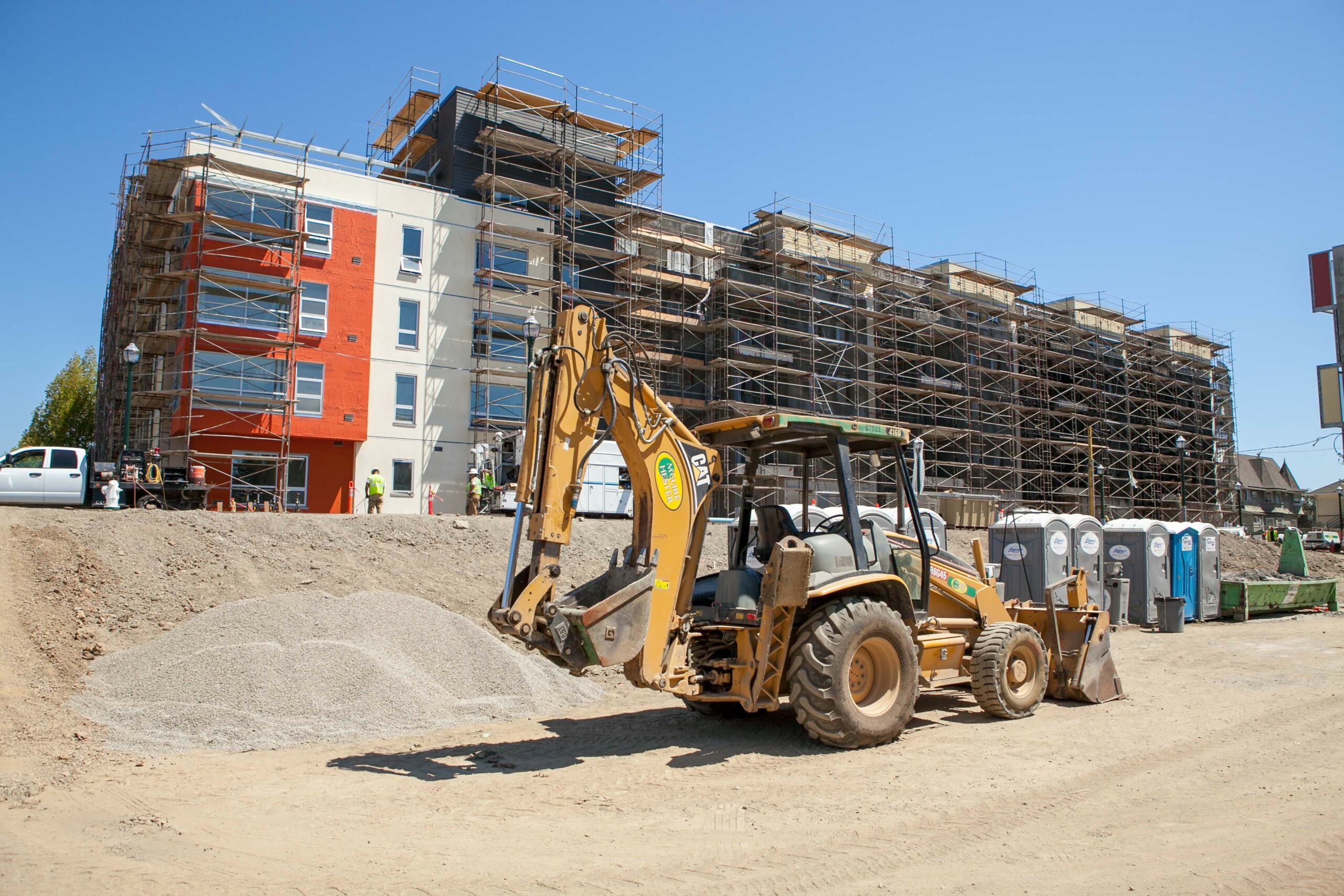
Bridge Housing’s ninety-unit project near the MacArthur BART station in North Oakland was one of the only affordable housing projects constructed in the city this year — resulting in a highly competitive lottery.
Credits: Bert Johnson/ File photoBridge Housing’s ninety-unit project near the MacArthur BART station in North Oakland was one of the only affordable housing projects constructed in the city this year — resulting in a highly competitive lottery.
Credits: Bert Johnson/ File photo
Solomon is one of many longtime residents feeling the pinch of the region’s housing crunch, which reached crisis levels in the East Bay in 2015. The median home price in Alameda County is now $691,200, and the average rent for a one-bedroom is $2,891, according to the real estate firm Zillow. Those prices exceed the heights of the housing bubble in the 2000s — and many people’s incomes have failed to keep pace. Relatively little new housing is being built, especially affordable housing, even though thousands of new residents are moving here. Meanwhile, local and state officials have been slow to address the crisis, and battles have erupted over high-profile projects across the region. Here’s our look back at some of the major projects and policy disputes of the past year — and some debates and developments to look forward to in 2016.
New Projects
In Oakland in 2015, about thirty new housing developments were under construction with a total of roughly 1,300 units, according to data provided by Rachel Flynn, the city’s planning and building director. Out of those new units — of which about half are finished or nearly complete, with the rest slated for completion in 2016 — about 430 (32 percent) are considered “affordable,” meaning below market-rate. So while the city is experiencing a relative surge of new development — with many new projects in the pipeline for coming years — a supermajority of the units recently added to Oakland’s housing stock are simply too expensive for low- and middle-income residents.
“We’ve seen a real shift,” Flynn said, noting that in previous years, Oakland built relatively minimal market-rate housing. In 2014, new developments added 715 housing units to the market — of which 82 percent were affordable. And in 2013, 93 percent of the 589 units constructed in Oakland were affordable. There were fewer total units built in 2012 — only 453 — and 82 percent of them were affordable. “If we don’t build in general — whether it’s market-rate or affordable — we’re not going to keep up with demand,” Flynn said.
This year, however, few affordable projects took hold. Bridge Housing, a local developer that does affordable projects, completed the ninety-unit project by MacArthur BART called Mural (for which Solomon applied) and a 68-unit project at 460 Grand Avenue in Oakland, called AveVista. All those units are affordable. Additionally, the East Bay Asian Local Development Corporation began construction on a 71-unit project in Chinatown (1110 Jackson Street), slated for completion in 2016. Other than some senior housing and two smaller affordable projects — 18 units at 618 21st Street and 26 units at 1701 Martin Luther King Jr. Way — the rest of the 2015 housing developments were market-rate.
Of those projects attracting higher-income residents, one of the most notable was the Hive, a mixed-use development along Broadway between 24th and 25th streets — a section of Uptown that is experiencing a significant amount of new economic activity. The Hive — a project of Signature Development Group, a major Oakland real estate company — will feature 115 units total when it is fully complete. Madison Park Financial Corporation, another prominent market-rate developer based in Oakland, is behind one of the other major projects under construction this year — a one hundred-unit building at 3900 Adeline Street in West Oakland. And developer CityVentures began construction this year on a fully market-rate project called Station House with 171 units at 1401 Wood Street in West Oakland.
According to Flynn, Oakland is also on track to break ground on numerous large housing developments in 2016 and beyond. The biggest market-rate projects scheduled to start construction next year are: 435 units at 3093 Broadway (developers Blackstone Group and CityView); 200 units at 2302 Valdez Street (Wood Partners); and 162 units at 2935 Telegraph Avenue (Madison Park). Bridge Housing will also build 286 units as part of a second phase of its MacArthur BART project — but only roughly 6 percent of those will be affordable. In 2017 and onward, Oakland has major buildings scheduled for development across the city’s neighborhoods — with more than 10,000 new units in the pipeline.
The City of Berkeley, too, had a busy year for development — most notably with the approval this month of an 18-story, 302-unit project at 2211 Harold Way in downtown. Though the controversial project is entirely market-rate, the developer, HSR Berkeley Investments, has agreed to pay $10.5 million for affordable housing in the city. Developer Nautilus Group also moved forward with construction of a high-profile project, called Garden Village, on Dwight Way and Fulton Street near UC Berkeley. Ten percent of the building’s 77 units will be affordable, and the project is unique in that it includes no on-site parking. That means it’s a more environmentally friendly project that doesn’t encourage driving and would be a good match for students and others who prefer to walk, bike, or take public transit.
Throughout the East Bay, cities must rapidly build more low-income housing that the most vulnerable residents can afford if they want to curb the crisis, said Louis Chicoine, executive director of Abode Services, a nonprofit that helps homeless people find housing. “The equation is just getting more and more upside down in terms of how many people need affordable housing and how much stock is available,” he said. “We’re going to see more people on the streets for sure — and more desperation.”
Policy Debates
According to the State Controller’s Office, eleven redevelopment agencies in Alameda County allocated half a billion dollars for housing between 2001 and 2011 and built 10,207 affordable housing units. But Governor Jerry Brown eliminated redevelopment in 2011, thereby ending the single biggest affordable housing program in California. The biggest housing policy shift in 2015 was probably the passage of AB 2, which Brown signed into law in September. It allows cities to establish Community Revitalization Investment Authorities (CRIAs). And another new state law that took effect this year allows cities to create Enhanced Infrastructure Financing Districts (EIFDs).
CRIAs and EIFDs will have the power to buy and sell land, issue bonds, incur debt, and build housing. According to Dan Carrigg, legislative director of the League of California Cities, no local government has established a CRIA or EIFD yet, but lots of cities and counties are talking to each other. “The tools of redevelopment are back in the basket,” he said.
Another major housing policy development was the California Supreme Court’s ruling in June that local governments can require homebuilders to set aside a certain percent of houses or condos at affordable prices. It’s known as “inclusionary zoning,” and San Jose’s version of the law came under fire in court by the California Building Industry Association, which called inclusionary zoning an “uncompensated taking” of property. The court ruled, however, that it is within a city’s police powers to ensure a broad mix of housing for all income groups. So as the single family and condo construction markets heat up in 2016, cities with inclusionary housing policies will be able to ensure some new housing is affordable.
Inclusionary zoning is still illegal for rental units, however, due to a 2009 state appeals court decision that said inclusionary zoning interfered with landlords’ rights under Costa Hawkins, a state law that limits rules on rental units. Several East Bay cities have gotten around this by assessing impact fees on market-rate rental housing and allowing developers to forgo paying the fee if they include affordable rentals in their buildings. For example, in 2015, Emeryville enacted an impact fee of $28,000. Berkeley also has an impact fee of $28,000. And Albany, Fremont, Hayward, San Leandro, and Union City are joining with Alameda County to conduct a study, likely to be approved in 2016, necessary to assess impact fees of their own.
But the biggest East Bay city, Oakland, has been slow to adopt an impact fee. Oakland is also the only city in the county that doesn’t have an inclusionary zoning ordinance. In 2015, affordable housing became the single biggest, and most divisive political issue in Oakland, partly because of the perception that the city hasn’t been doing enough.
One battle in 2015 that encapsulated the divide between the city’s affordable housing advocates and its development boosters involved publicly owned property on East 12th Street, near Lake Merritt. The city had planned to sell the parcel to a developer for construction of a luxury apartment tower, but activists battled against it, and even shut down a city council meeting to prevent a vote. The city council scuttled the deal after the Express reported on a leaked legal opinion written by the Oakland City Attorney’s Office that stated that the property sale would violate the Surplus Land Act, which requires public land to be offered first to affordable housing developers. Currently, the city is negotiating with five development teams, all of which are proposing some mix of affordable housing on the site.
“The East 12th Street campaign created a really important conversation about what local governments legally and morally should be doing with public land,” said David Zisser, a staff attorney with Public Advocates, a nonprofit public interest law firm.
But there is widespread agreement that the affordable housing crisis can’t be solved entirely at the local level. State laws need to change, and governments need to cooperate regionally. But Governor Brown has not made affordable housing a priority of his administration. In 2015, he vetoed several bills that could have raised billions for affordable housing construction, including AB 35, which would have raised billions through a tax credit. AB 1335, meanwhile, would have raised $400 million a year for affordable housing by tacking a $75 fee on the recording of real estate sales documents. But that bill didn’t receive the votes it needed to advance to the governor’s desk. Also in early 2015, the East Bay region was abuzz with talk of governments joining forces to issue a regional housing bond to raise hundreds of millions or even billions, but nothing came of it. All of which means that the housing affordability crisis will continue to be the issue in 2016.
Although 2015 was an off year for politics in the East Bay, it’s clear that 2016 is shaping up to be a pivotal one for elected offices throughout the region. It could mark the return of a respected East Bay legislator to Sacramento, and it could feature two expensive Assembly races, along with a growing list of challengers to Oakland City Council President Lynette Gibson McElhaney — and, yes, the return of Jean Quan. The Berkeley mayor’s race is expected to be a close battle, plus there will be several contested council races in Berkeley, along with contests in San Leandro and Alameda in which progressives could gain some seats amid growing calls to solve the housing crisis.
Legislature
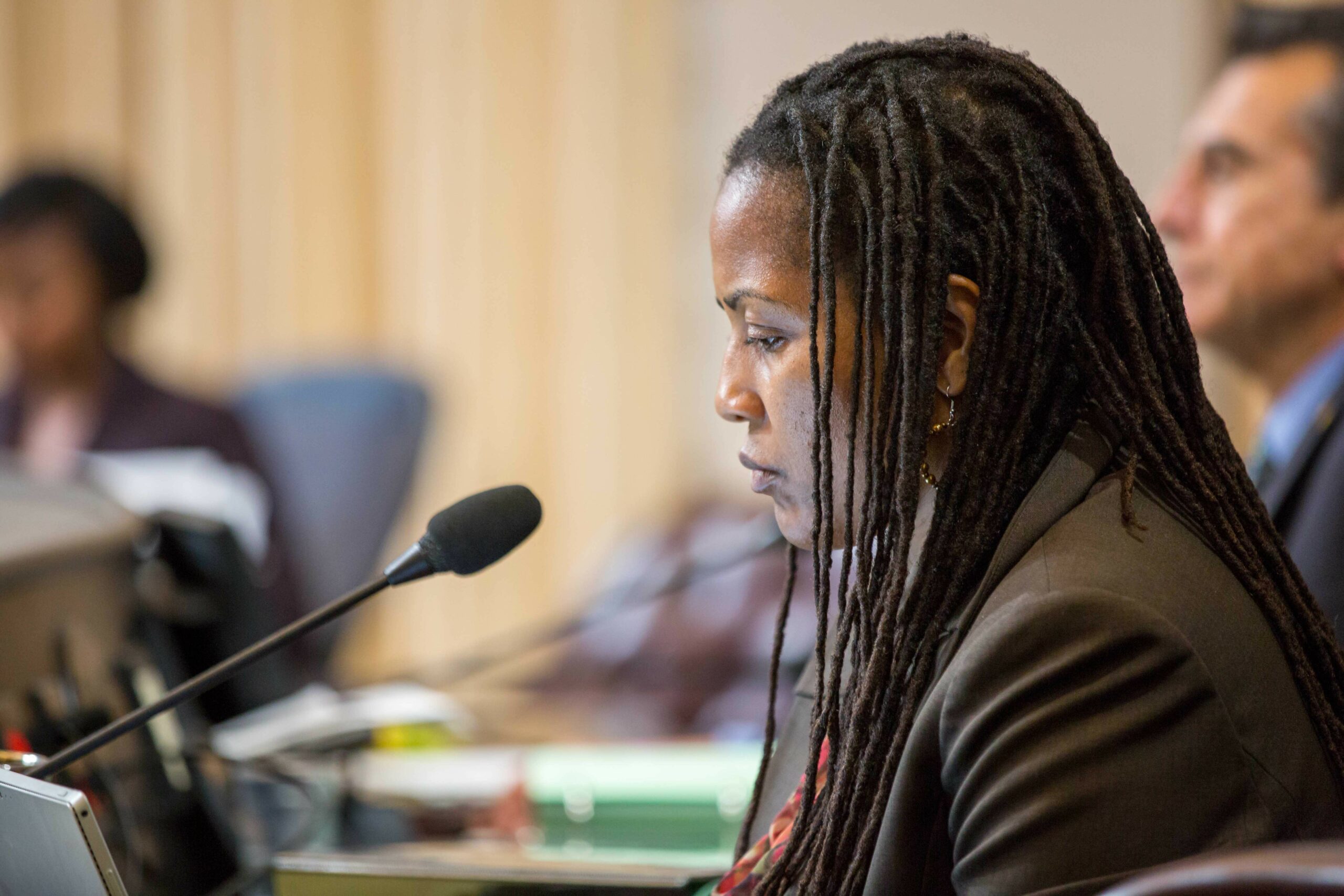
Oakland Councilmember Rebecca Kaplan might be challenged by ex-Mayor Jean Quan.
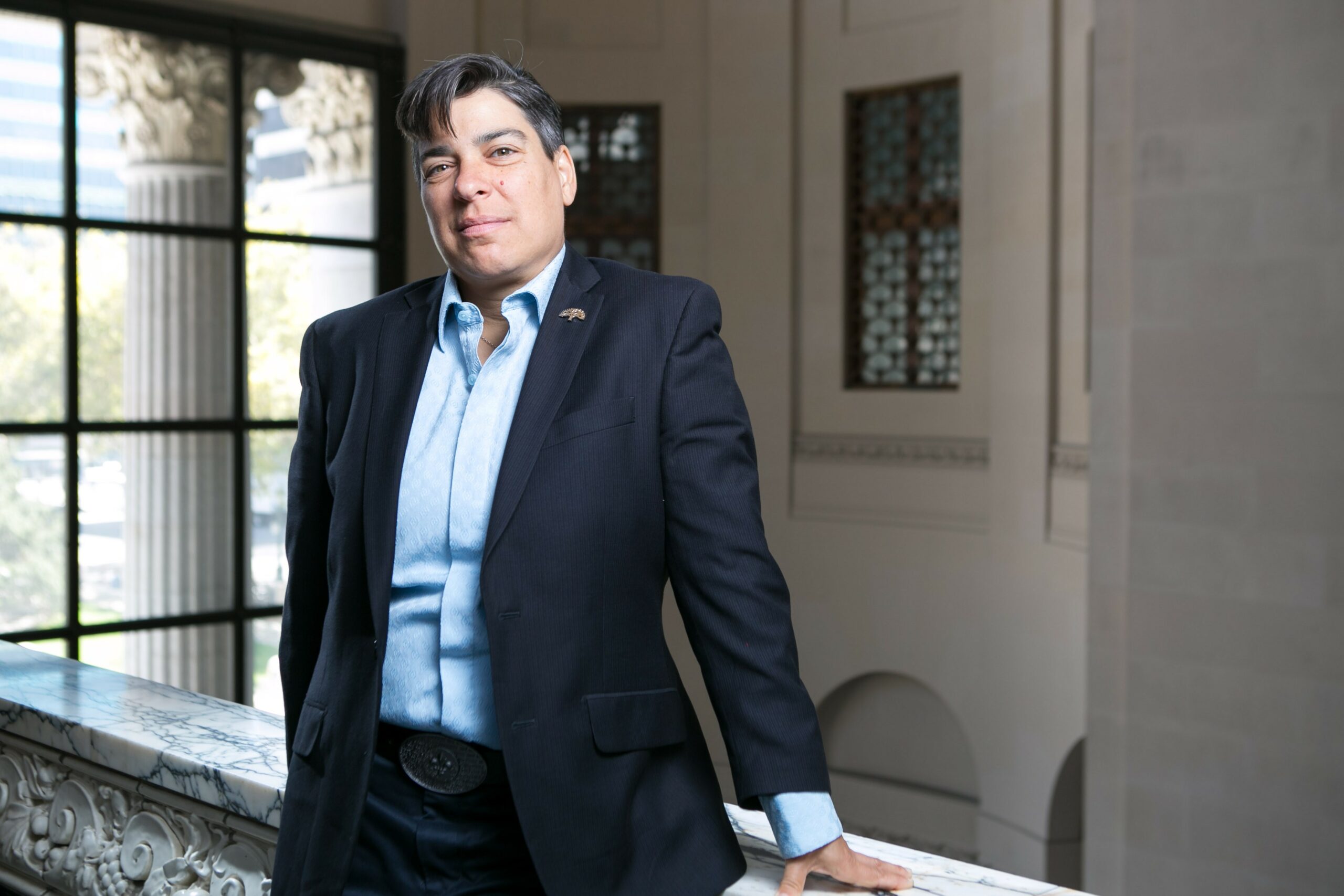
Credits: Bert Johnson/File photoOakland Councilmember Lynette Gibson McElhaney will likely face at least one challenger next year..
Credits: Bert Johnson/File photo
The race to replace termed-out state Senator Loni Hancock in the East Bay’s Ninth State Senate District will dominate the June primary season. The frontrunners are long-time former Democratic assemblymembers Nancy Skinner and Sandré Swanson, both strong progressives with significant local support — Skinner in Berkeley and Swanson in Oakland and Alameda. Hancock’s husband, Berkeley Mayor Tom Bates, said that while this contest likely will be tight, he thinks Skinner’s got the edge, in part because of the huge advantage she has in fundraising. “She’s a great campaigner,” said Bates, who is backing Skinner. But Swanson has amassed an impressive number of endorsements, including from Hancock.
A wildcard could be newly registered Democrat Katherine Welch, a state education reformer and former Republican. The daughter of former General Electric Chairman Jack Welch may be able to tap deep pockets, not only from her father’s contacts, but also from statewide independent expenditure groups looking to overhaul California’s education system. San Pablo Vice Mayor Rich Kinney, a Republican, is also running for the seat. Alameda County Supervisor Wilma Chan exited the race in late September.
In the Seventh State Senate District, covering areas in Contra Costa County and the Tri Valley in Alameda County, state Senator Steve Glazer, who won a bruising special election last May over Assemblymember Susan Bonilla, is not expected to face any serious challenge. Many political observers believed a rematch was in the cards, but Bonilla announced in October that she would not enter what would have been another expensive and difficult election. The race last spring invoked more than $7 million in special interest money.
In the Assembly, a majority of the contests feature incumbent Democrats nearing entrenched status. Assemblymembers Rob Bonta of Oakland, Tony Thurmond of Richmond, and Hayward’s Bill Quirk are not expected to face any credible challengers. But the same cannot be said for 16th Assembly District member Catharine Baker, the only Republican in the East Bay’s legislative caucus. Last month, outgoing Assembly Speaker Toni Atkins, a Democrat, recruited former Pleasanton councilmember Cheryl Cook-Kallio, also a Democrat, to face Baker in the moderate outer East Bay district. Insiders believe the race could be impacted by the presidential election. If Republicans nominate a reactionary candidate, Democrats could turn out in greater numbers in this toss-up district.
Bonilla is termed out next year in the 14th Assembly District leaving three Democrats to battle for the West Contra Costa County seat. Mae Torlakson, the wife of State Superintendent of Instruction Tom Torlakson, is facing Concord Mayor Tim Grayson and clinical psychologist Harmesh Kumar.
Congressmembers Barbara Lee and Eric Swalwell are not expected to face any serious challengers, but liberal Mike Honda will once again square off in a tough race against moderate Ro Khanna.
Alameda County
Alameda County Supervisor Nate Miley is facing a potentially strong challenge from Bryan Parker, the Port of Oakland commissioner who ran a well-funded campaign in 2014 for Oakland mayor. Parker is expected raise significant financing for his supervisor campaign and will give Miley his first real re-election test since Miley first won a seat on the board in 2000. Supervisors Scott Haggerty and Keith Carson are also up for re-election in June, but challengers are not likely.
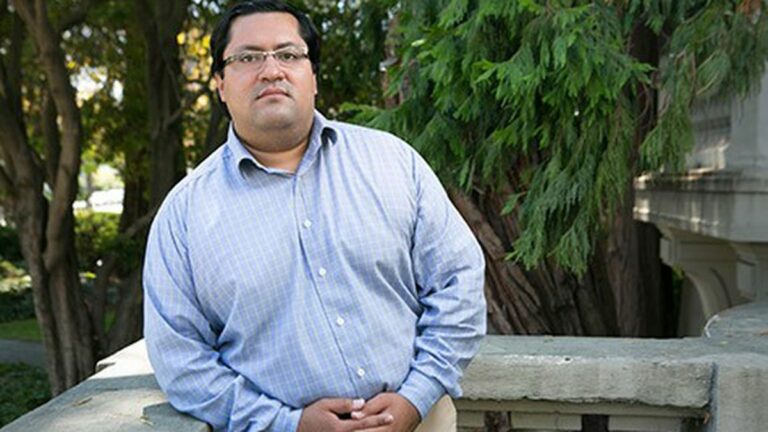
Berkeley Councilmember Jesse Arreguin will square off against fellow Councilmember Laurie Capitelli in next year’s mayor’s race.
Credits: Bert Johnson/File photo
Oakland
In January 2015, city councilmembers elected Gibson McElhaney to be council president after she had served just two years in office. But of the four contested council races in Oakland next fall, Gibson McElhaney is so far the only incumbent attracting potential challengers. Former Councilmember Nancy Nadel has indicated that she may run for the District Three, West Oakland-downtown, seat. Tyron Jordan, a legal analyst at the state attorney general’s office, formed a campaign committee in October, and at least one of Gibson McElhaney’s opponents in the 2012 campaign could enter next year’s race. Some political observers think Gibson McElhaney is vulnerable because of her ethical lapses, as outlined in a series of Express investigative stories late last year and early this year.
Oakland’s At-Large race, however, could end up overshadowing the District Three contest — if ex-Mayor Quan decides to challenge incumbent Rebecca Kaplan. Kaplan has recently taken a larger profile in the city, leading the effort to stem gun violence in Oakland. Some believe that she’s worried Quan is angling for her seat. In recent months, Quan has shown through her monthly newsletters a keen interest in offering specific solutions to combat the city’s affordable housing crisis. The potential blockbuster race could be hard-fought. In 2014’s mayoral race, Quan beat out Kaplan for first-place votes, but ranked-choice voting showed Kaplan had greater citywide support.
In Fruitvale’s District Five, Councilmember Noel Gallo is not expected to face any serious challengers, even though he recently contemplated retirement. East Oakland Councilmember Larry Reid (District Seven) also raised the possibility of retirement this fall, and if he exits the council, his daughter, Treva Reid, is likely to run for the seat. But Reid’s behavior at a recent council committee meeting suggests he still has passion for the job; he gave a rousing campaign-like speech about his district’s bright economic future. Councilmember Dan Kalb, District One (North Oakland) appears to be the least likely of the group to face serious competition next year.
Berkeley Councilmember Jesse Arreguin will square off against fellow Councilmember Laurie Capitelli in next year’s mayor’s race.
Credits: Bert Johnson/File photo
Berkeley
One of 2016’s closely watched contests in the East Bay will likely be the race to replace Mayor Bates, who is retiring. Councilmembers Laurie Capitelli and Jesse Arreguín are expected to engage in a tight, contentious battle, with the issues of affordable housing and downtown development expected to dominate the campaign.
Capitelli is an ardent supporter of smart growth — dense housing projects built along major transits lines. He was one of the leading backers of the eighteen-story Harold Way development, which was recently approved by the council and also netted $10.5 million in funds for affordable housing. Arreguín, by contrast, abstained from voting for the Harold Way project, arguing that the developer should have paid even more money for affordable housing. Although Arreguín is not a member of the city’s anti-growth contingent, that group likely will support him because he often votes against or abstains from voting for downtown development projects on the grounds that they don’t include enough affordable housing. Arreguín is also popular among progressives, in part because of his advocacy for the city’s homeless population. Bates, who is backing Capitelli, said he expects Arreguín to run a strong grassroots campaign, while Capitelli will likely have big advantage in fundraising.
Another must-watch contest in Berkeley next year will be the one for Capitelli’s District Five (North Berkeley) seat. Capitelli is giving up his spot to run for mayor, and the race is expected to be a two-person contest between Sophie Hahn, an anti-growth activist who lost to Capitelli in 2012 and is a member of the zoning board, and Planning Commission Chair Stephen Murphy, a smart-growth advocate who was appointed to the commission by Capitelli. If Hahn wins, the balance of power on the council would shift toward the anti-growthers.
And the third interesting race in Berkeley will be the contest to replace progressive councilmember Max Anderson, who is also retiring. The District Three (South Berkeley) race is expected to feature planning commissioners Benjamin Bartlett, who was appointed by Anderson and is backed by him, squaring off against Deborah Matthews, a smart-growth advocate appointed by Councilmember Darryl Moore.
District Two’s Moore is also up for reelection, but is not expected to face a serious challenge. Councilmember Susan Wengraf is also expected to cruise to reelection, although there is speculation that she might step aside if former state Assembly candidate Elizabeth Echols decides to run for her District Six seat.
Richmond
Three councilmembers are up for reelection — Nat Bates, Jael Myrick, and Vinay Pimplé — in Richmond, which has no council districts. The Richmond Progressive Alliance, which won three council seats in 2014, is expected to run a slate of candidates in the hopes of gaining a clear majority (although Myrick often votes with the progressive bloc).
But Mayor Tom Butt said the real wildcard in Richmond is Chevron. Last year, the oil giant spent more than $3 million backing Chevron-friendly candidates, but those candidates all lost. There’s speculation that Chevron might decide to sit out the 2016 campaign, considering the company’s losses last year. But Butt is skeptical that the oil giant will resist trying to influence Richmond’s elections. “It’s just not in their bones,” he said.
Alameda
Alameda’s recent inability to attract candidates for its municipal elections could continue in 2016. Two seats on the five-member city council are up for grabs. Incumbent Councilmembers Marilyn Ezzy Ashcraft and Tony Daysog are expected to seek re-election. Like Richmond, Alameda uses an at-large election system to choose its city council. Although the names of various people interested in running have periodically surfaced, the most credible is Malia Vella, an attorney employed by the Teamsters who briefly served as Assemblymember Quirk’s district director. In a city in which rent control has become a hot-button issue, Vella’s potential candidacy and her early support for restrictions on rents could drive the conversation in this race.
San Leandro
Long-time councilmembers Jim Prola and Ursula Reed are termed out. The early outlook in each race features a pair of first-time candidates with experience on the city’s boards and commissions. Prola’s District Six seat is a potential race between Pete Ballew, a former San Leandro police lieutenant and current member of the personnel relations board, and Janet Palma, a former zoning commissioner. In District Two, Planning Commissioner Ed Hernandez is facing Recreation and Parks Commissioner Bryan Azevedo, who has union ties and has already attracted early support from current councilmembers. No serious challenger has stepped up yet to face incumbent District Four councilmember Benny Lee.
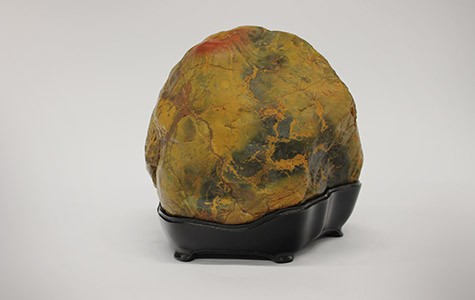
Most of the artworks in Unearthed: Found + Made were plucked from a riverbed. The exhibit, currently on view at the Oakland Museum of California (1000 Oak St.), showcases local suiseki, the traditional Japanese art of stone collecting. Inside glass cases, smooth, richly colored rocks perch gloriously on hand-carved wooden daiza (settings), looking as magnificent as any ancient marble figure.
Usually, in a science museum, rocks would be presented as geological artifacts. But in Unearthed, they are matter-of-factly displayed as aesthetic objects, comfortably coalescing notions of art and nature.
A suiseki piece by Robert Gould.
Credits: Courtesy Oakland Museum of California
Work by Jedediah Caesar.
Credits: Courtesy Oakland Museum of California
Northern California is one of few places in the world where suiseki is popularly practiced. The tie is geological —many stones that can be found in certain areas of the region are finely suited for the art form. Unearthed features work from two Bay Area amateur suiseki clubs, the California Suiseki Society (based in Oakland) and San Francisco Suiseki Kai (which meets in both San Francisco and Oakland). According to the show curator Christina Linden, when the San Francisco club was founded in 1981, most Bay Area suiseki practitioners were aging Japanese immigrants, but today the membership varies widely and the classes are taught in English.
The practice of suiseki, as performed by these clubs, begins with a trip to a riverbed. There, members wade in the water, looking for stones that call out to them. The goal is to find rocks that resemble miniature landscapes, such as mountain ranges or waterfalls. Then comes the critique — clubs meet again to examine the stones, questioning what makes each worthy (or unworthy) of collecting. Next, the stone must go through a secondary aging process. For up to a decade, collectors appreciate their stones, placing them in their yards to weather and rubbing them every day. Finally, when the collector feels it’s time, he or she carefully carves a wooden mount that perfectly cradles the stone’s curvature. Then, it is suiseki, ready to be displayed indoors.
A suiseki piece by Robert Gould.
Credits: Courtesy Oakland Museum of California
The suiseki pieces constitute the “found” portion of Unearthed, but the “made” portion is composed of new works by Oakland-born Los Angeles-based artist Jedediah Caesar. If suiseki were to be considered nature imitating art, then Caesar’s sculptures are art imitating nature. Caesar collects objects to create his own sped-up sedimentary processes — anything from personal mementos to trash will do. For his pieces Green(gre-y?) prologue:1–6, Caesar stacked such objects in a square vat and filled it with resin. After the concoction hardened, he had it sawed into sections exposing dark, muddy surfaces filled with unrecognizable cross sections, like a slice of heavily polluted earth. But the more stunning piece is one Caesar made with turmeric. He found that when the spice is mixed with resin, it expands violently, creating a frothy surface that’s magma-like and textured by movement. The massive, golden cube sits at the entrance to the gallery, introducing the show with a contemporary edge.
Unearthed inevitably prompts the question of what constitutes art — one that’s notoriously impossible to answer. Even the suiseki club memberships are undecided. While most practitioners consider themselves hobbyists, some are sure they’re artists, said Linden. Like the museum’s concurrent show Yo-Yos & Half Squares: Contemporary California Quilts (see “Jazz Seams,” 9/16), Unearthed maneuvers around prescribed notions of craft, hobby, and fine art, to insist that creative practices rooted in cultural tradition can be challenging and relevant. According to Linden, the museum will continue this trend of thought next year with a series of shows that, like Unearthed, pair a local cultural creative practice with a contemporary artist whose work is in someway similar.
There is also the issue of existing restrooms that have been closed, like the one in the [BART] bike station, which then throws bicyclists onto the street looking for a restroom and competing with all the others for the same. The reason I was given for the partial closing (you now need to request a key from bike shop, as opposed to 24/7 before) was that, horrors!, people were using it who were not cyclists parking bikes in the bike station?! We need an integrated policy that prioritizes human needs and coordinates the various agencies to do it (BART, the city, the county, library, and others).
Joe Berry, Berkeley
Oh, the Irony
Berkeley — the domain of tolerance — now seems to be caught in a dilemma of its own making, and the “tolerance” level is taking the hit. With some 2,300 unsheltered homeless people in the area and only 24 public restrooms in Berkeley — that could mean up to eight bathroom uses per hour (one every 7.5 minutes) even if those 24 toilets were open 24/7. Now, Berkeley officials lament they don’t have the money for more public restrooms. Well, they have money for buying parking meters monitoring more than 4,000 spaces charging $1.50 an hour — and above all that money collected from those meters, the city levies more than $8 million a year in parking fines — so why can’t they figure out a way to find money for public toilets? Ironic that the city, long crowing about its tolerance, is now refusing to fork out for the infrastructure such tolerance mandates.
William H. Thompson, Walnut Creek
“Time Is Running Out,” Seven Days, 12/9
Let’s Find a Middle Ground
Everyone wants to prevent displacement and get skyrocketing rents under control, but disparities in perceived causes turn potential allies into enemies. Many pro-growth advocates will tell you that a totally free market will solve our problems through increased supply. This ignores the fact that high construction costs in Oakland make massive numbers of new units profitable only after property values are substantially higher than they are now — which will only happen once displacement has already taken a huge toll. The new units being proposed today are negligible in comparison to the scale of our supply shortage, but displacement is ongoing. We need new affordable housing as a buffer for the middle class until the whole region begins to solve our supply shortage in a meaningful way.
Many anti-displacement activists will tell you that market-rate units will be filled with wealthy yuppies, driving up nearby rental prices and causing displacement. They’ll tell you we need to build only affordable housing and ban market-rate units. This ignores the fact that the crisis we’re in is caused by short supply, and that the only realistic source of revenue for new affordable housing is real estate investment itself. We need market-rate housing growth wherever we can get it, because high prices are a direct result of drastically short supply, and because this investment presents our best opportunity for an affordable housing revenue source. Otherwise, those wealthy yuppies will keep coming, and instead of buying a new condo, they’ll be buying a West Oakland Victorian or a Fruitvale Craftsman.
Recognizing Mr. Gammon’s list of projects providing the potential for revenue means recognizing that we both need these projects to exist to provide the capital to attack the problem, and that there is a problem that needs to be tackled that the private sector won’t solve on its own. If both sides can agree on this middle ground, we’ll have the potential to make real progress on the housing crisis issue. Failing that, we’ll be left either with a capitulation to private interests at a marginal public benefit, or with a foolhardy rebuke of the same industry that could help us when we need it most.
Tony Albert, Oakland
“Lone Voice on Campus,” Culture Spy, 12/9
Clarification Needed
I applaud the Express for covering issues around the shameful lack of diversity at UC Berkeley, just as Summer Mason did when she spoke out so courageously and forcefully about the dearth of African-American voices in my classroom and department and across the UC Campus. Along with many of my colleagues on the UC faculty, I have long been an advocate for greater student and faculty diversity as well as for affirmative action and increased education budgets for our public universities.
It is essential that our campuses reflect the rich racial and ethnic diversity of our state. I see every day on campus how current state admissions laws and drastic state budget cuts for education together have contributed to the current lack of diversity in student admissions and faculty hiring. This is a result of political decisions that continue to be argued across the country, from the state legislature to the US Supreme Court. African-American students and other students of color are right to be speaking out and disrupting business as usual.
At the same time, I must clarify some of the article’s representations of my pedagogy as an embodiment of the current racial insensitivities on campus. Our Trip to Africa, the film I screened in class that was condemned as “racism parading as art,” is, in my reading and those of many other film scholars, a visceral cinematic critique of the violence, brutality, and racist paternalism of the remnants of European colonialism in Africa. It is also a central work in the history of the genre the class was studying. As course instructor, I would have been negligent not to show this important film to an upper-level class of Cinema Studies majors, despite the film’s challenges. Furthermore, the article neglects to mention that the film was shown in the context of a weeklong unit on experimental ethnographic film that also included films by African-American and Vietnamese filmmakers, and by both men and women, and that all were supplemented by the reading of critical texts. The films were chosen in order to show a range of approaches to ethnographic representation from different subject positions using different cinematically formal means. The controversial nature of some of the films shown in my classes is purposeful, despite the risks of offending or angering. It is in the challenges that the films create that real life enters, and that is precisely what makes them so invaluable and necessary to study.
I hope the Express will continue to cover the issue of faculty and student diversity on UC campuses and will now move beyond ever-popular archetypal narratives of older out-of-touch-faculty and bold young students at odds over what kinds of materials are appropriate to be studied. It is important for local media to cover the deeper political, legal, and economic decisions that are currently being made about college admissions and education budgets — decisions that lead directly to the lack of diverse voices on UC campuses. This is crucial knowledge for our community.
Jeffrey Skoller, associate professor of Film and Media, UC Berkeley
These days, when newcomers to Oakland ask me where to eat, often the first recommendation out of my mouth is Swan’s Market. Which is to say, even with all of The Town’s gastronomical riches, I’m sending folks to a food court.
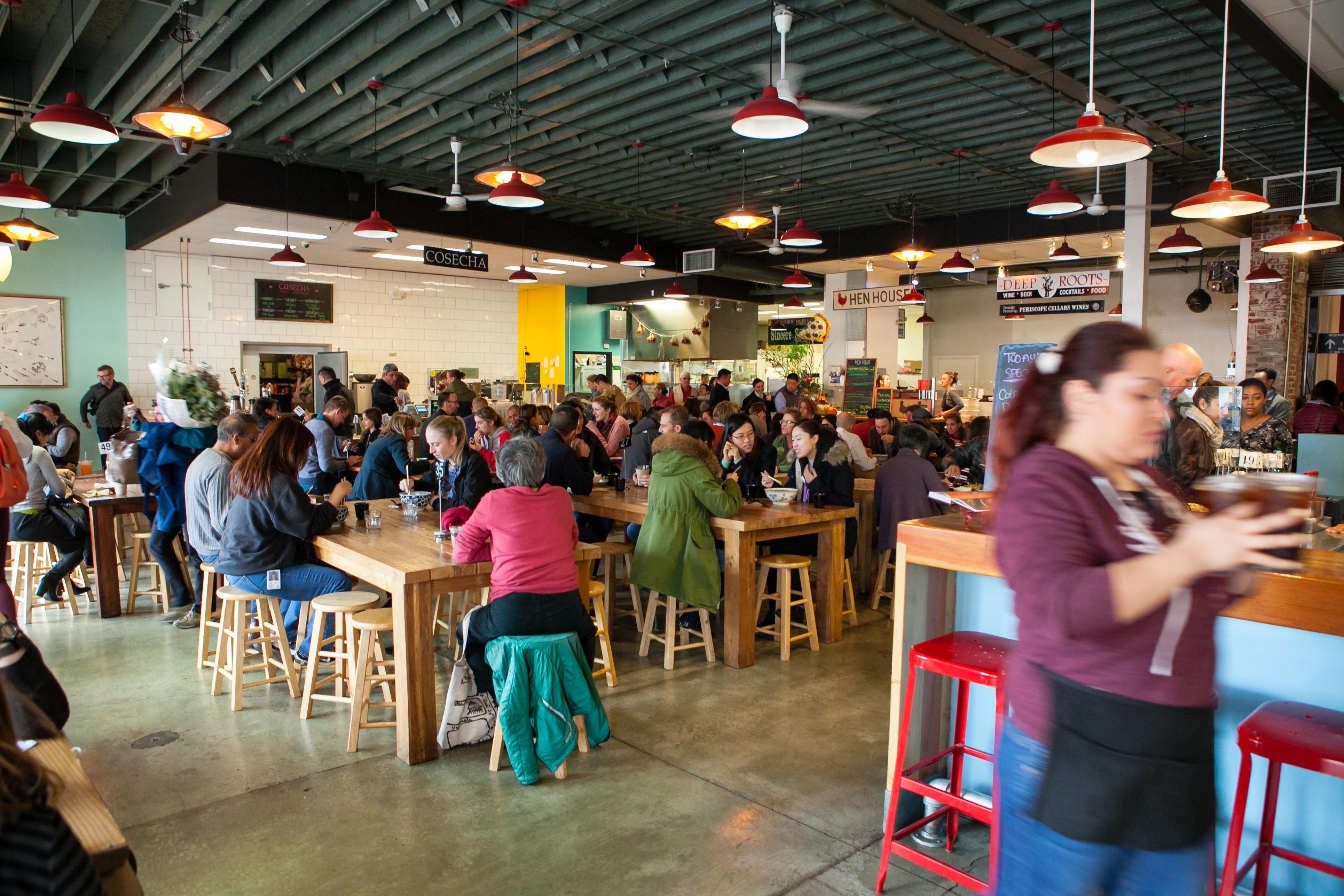
But this is hardly your typical mall food court: Walk in almost any night and you’ll see diners in the large communal seating area huddled around bowls of Japanese hot pot from AS B-Dama, ladling noodles and steaming broth from a traditional cast-iron vessel. On the other side of the room, there’s almost always a long line of customers waiting to order fried fish tacos or mole verde from Cosecha, a farm-to-table Mexican food stall with a Chez Panisse pedigree. Others, seated at the counter at The Cook and Her Farmer, might start a seafood-centered meal by slurping down a half-dozen creamy, fresh-shucked Miyagi oysters from Tomales Bay.
Credits: Bert Johnson
Credits: Bert Johnson
Swan’s Market isn’t exactly new — the building will celebrate its one hundred-year anniversary in 2017, and nearly all of the gourmet food hall’s current occupants opened for business prior to this year. And yet, I don’t think it’s a stretch to say that the ascendance of Swan’s Market has been, in many ways, the biggest East Bay food story of 2015. This is the year the market hit full occupancy and started firing on all cylinders, both in terms of its popularity and the quality of the food each kitchen was putting out. The result? Swan’s is now packed all the time, and — with prominent shout-outs in both Bon Appetit and TheNew York Times — the buzz about this humble food court has gone national.
All in all, it’s a stunning turnaround for the market, which, just four or five years ago, had largely been forgotten. Dominica Rice-Cisneros recalled that when she first started testing the waters to see if she could get a small business loan to open Cosecha, everyone she spoke to tried to talk her out of it: “They were all like, ‘Don’t do it. Don’t invest in that market.'” Or, if she insisted on opening at Swan’s, people suggested that Rice-Cisneros build a wall — to separate her restaurant from what was then a mostly empty, somewhat forlorn-looking building.
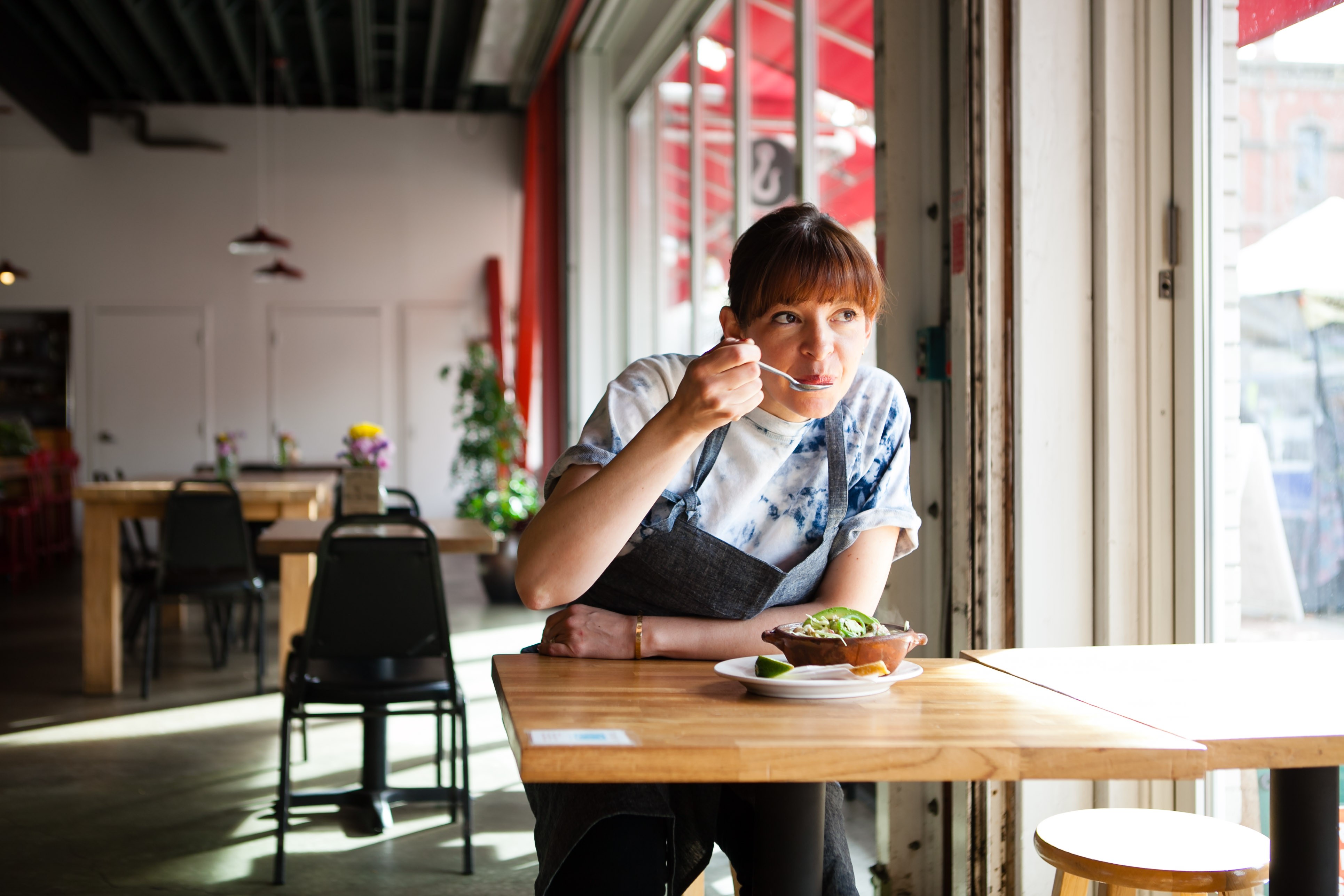
Dominica Rice-Cisneros helped spearhead the revival of Swan’s Market.
Credits: Bert Johnson
That was in 2011, and Oakland’s food renaissance was already well under way, spearheaded by a handful of critics’ darlings in neighborhoods like Rockridge and Temescal. But no one was saying much about Old Oakland — least of all about Swan’s Market, despite the presence of a well-liked sausage shop and fishmonger (Taylor’s Sausage and Sincere Seafood, respectively) and the building’s long history as a bustling community gathering place.
But Rice-Cisneros, whose resume includes a stint at Chez Panisse, had a vision for the market that was inspired by a childhood spent growing up around Los Angeles’ Chinatown, as well as the time she spent as a chef in Mexico City, where the vibrant mercados are the heart and soul of the city’s food scene. She wanted to be part of a place like that, not walled off in her own stand-alone eatery.
Still, Rice-Cisneros admitted that, in the beginning, she wasn’t sure if Swan’s Market would ever take off. “I was just like, let’s treat it like a three-month art installation, and let’s see if we’re relevant to the neighborhood,” she said.
Of course, much of the success of Swan’s Market can attributed to the arrival of heavy hitters such as Miss Ollie’s (at the end of 2012) — probably the best Afro-Caribbean restaurant in the Bay Area — and the popular sausage-and-beer slinger Rosamunde (in 2013), both of which have stand-alone locations that are separate from the rest of the market. But the core of what most folks now think of as Swan’s Market is the big communal dining area that’s shared by the current occupants of the “food court”: Cosecha, AS B-Dama, The Cook and Her Farmer, and Deep Roots Oakland/Henhouse (a combination wine bar and pizza restaurant).
According to Rice-Cisneros, part of the reason for the success of the Swan’s food court is the diversity of options available to customers now that all of the individual stalls are up and running. She said she has one family of regular customers who embody this: The wife, a Japanese American, always orders a bunch of izakaya-style dishes from AS B-Dama. The husband, who’s Jewish, usually picks up something from Cosecha, and then they’ll order a pepperoni pizza from Henhouse for their five-year-old daughter. Then, the whole family sits down for dinner together, and they all share — or not, if they aren’t in the mood.
Of course, even a mall food court anchored by a Sbarro, a Panda Express, and an Auntie Anne’s pretzel shop nominally offers “something for everyone.” What sets Swan’s Market apart is the quality of the food, which is as good as you’ll find anywhere in the East Bay — even compared to far ritzier restaurants. As Chikara Ono, owner of AS B-Dama, pointed out, each of the food stalls is committed to using sustainable, mostly organic ingredients. “It’s totally different compared to other food courts,” he said.
According to Rice-Cisneros, it makes a difference, too, that everyone has decided to serve their food on real plates with real silverware — there’s no styrofoam or plastic forks. And, even as the market has gotten busier, the service has remained remarkably personal. The owners of each respective eatery are on-site almost every day. If you order something from AS B-Dama, for instance, the odds are fairly high that Ono himself will be the one to take your order, or to hustle your karaage out to the table.
Dominica Rice-Cisneros helped spearhead the revival of Swan’s Market.
Credits: Bert Johnson
The restaurateurs at Swan’s Market talked about the sense of collaboration that’s fostered by the wide-open food court-style setup, wherein the more foot traffic the venue as a whole attracts, the better everyone’s business will do. Romney Steele, chef-owner of The Cook and Her Farmer, said that sense of collaboration provides a kind of safety net that she wouldn’t have if she ran a stand-alone restaurant. Often, she said, she has run over to Cosecha to borrow some eggs, for instance, when she was in a bind. When Steele says that Swan’s Market is “like a family,” she means it literally: The daughter of one of Cosecha’s cooks is now the main daytime cook at The Cook and Her Farmer.
The recent success of Swan’s Market has heralded a boom, if not of outright food courts, then at least of restaurants and markets that have food court-like characteristics. “The One-Stop Market Invasion,” a story in the Express‘ September 30 Taste issue, documented the trend in Oakland of new hybrid restaurant-markets, and many of the proprietors of these businesses surely drew at least some of their inspiration from Swan’s in their desire to offer a wide variety of high-quality food options in a casual setting.
Meanwhile, the recent failure of one such market, Oakland’s Grand Fare — which shuttered in November after being open just one month, despite its talented fine-dining chef and gorgeous outdoor patio — might serve as a cautionary tale. Some of the criticism directed at Grand Fare was that the prices were just too high, and according to Rice-Cisneros, one big reason for Swan’s Market’s popularity is the fact that the prices are relatively low. “All these new markets want to start charging San Francisco prices,” she said. “It’s still Oakland.”
What’s clear is that in 2016, the East Bay will be home to even more hybridized markets and gourmet food courts — whether it be Newberry Market, which is slated to occupy the first floor of the Uber building in Uptown, or the newly remodeled Emeryville Public Market, which, after several years’ worth of starts and stops, is finally rolling out its own revamped food court.
Shiba Ramen is the first of the Public Market’s new crop of eateries to open, and co-owner Jake Freed said that, despite whatever stigma there might be, he embraced the food court location from the start. For Freed, the benefits are obvious: He and co-owner Hiroko Nakamura (his wife) didn’t have to build a dining room or a bathroom. All they had to worry about was building a kitchen and making sure that their food was as good as possible.
If last year’s big East Bay food trend was that of food trucks opening brick-and-mortar restaurants, perhaps this is the logical extension of that trend. It’s no coincidence that several of the Public Market’s new tenants — KoJa Kitchen, Mayo & Mustard, and We Sushi — are Bay Area-based food truck operators who are opening their first or second brick-and-mortar location.
Once it’s fully populated, the Public Market should in many ways resemble a permanent, non-mobile version of an Off the Grid-style food truck gathering, Freed said. Like a food truck, a food court stall offers relatively low barriers to entry, at least compared to a stand-alone restaurant. But because Shiba Ramen and its Public Market neighbors have the benefit of fully equipped kitchens, Freed believes that the food has the potential to be better and served even more quickly than what you can get from most trucks.
Freed said that in the two weeks since Shiba Ramen opened, he’s gotten a handful of Yelp reviews in which customers expressed surprise at finding high-quality ramen in a food court. But if Swan’s Market and its successors continue to change the paradigm, that might not be a surprise for much longer.
There is no doubt that in East Bay sports, 2015 was the year of the Golden State Warriors. The Oakland A’s finished with the worst record in the American League, and while the Raiders showed marked improvement this year under new coach Jack Del Rio, the Silver and Black missed the playoffs again for the thirteenth straight season. The Warriors, on the other hand, not only won the NBA title in June, but then opened the 2015–16 campaign with a league record 24 straight wins.
Just three months ago, things didn’t look so rosy for the Dubs. Sure, they were coming off a record-breaking season in which they went an absurd 83–20, but concern swirled around the squad because of a surprising health complication for the guy who simultaneously kept every member of the Warriors sharp and loose: Head Coach Steve Kerr. After two offseason back surgeries, Kerr couldn’t participate in the Warriors’ preseason, and then missed much of the first part of the regular season.
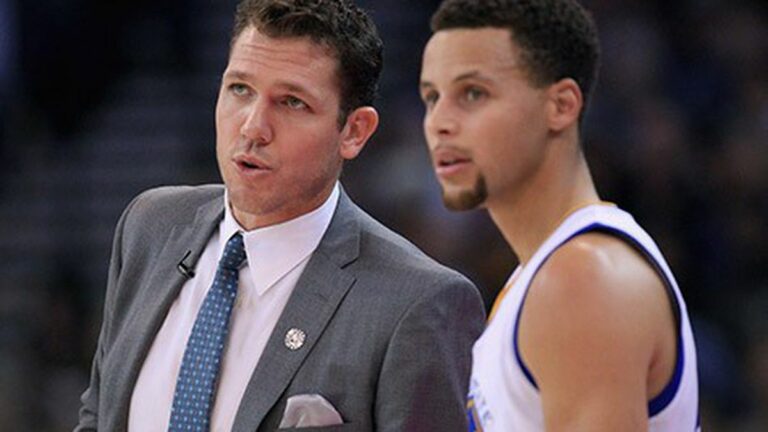
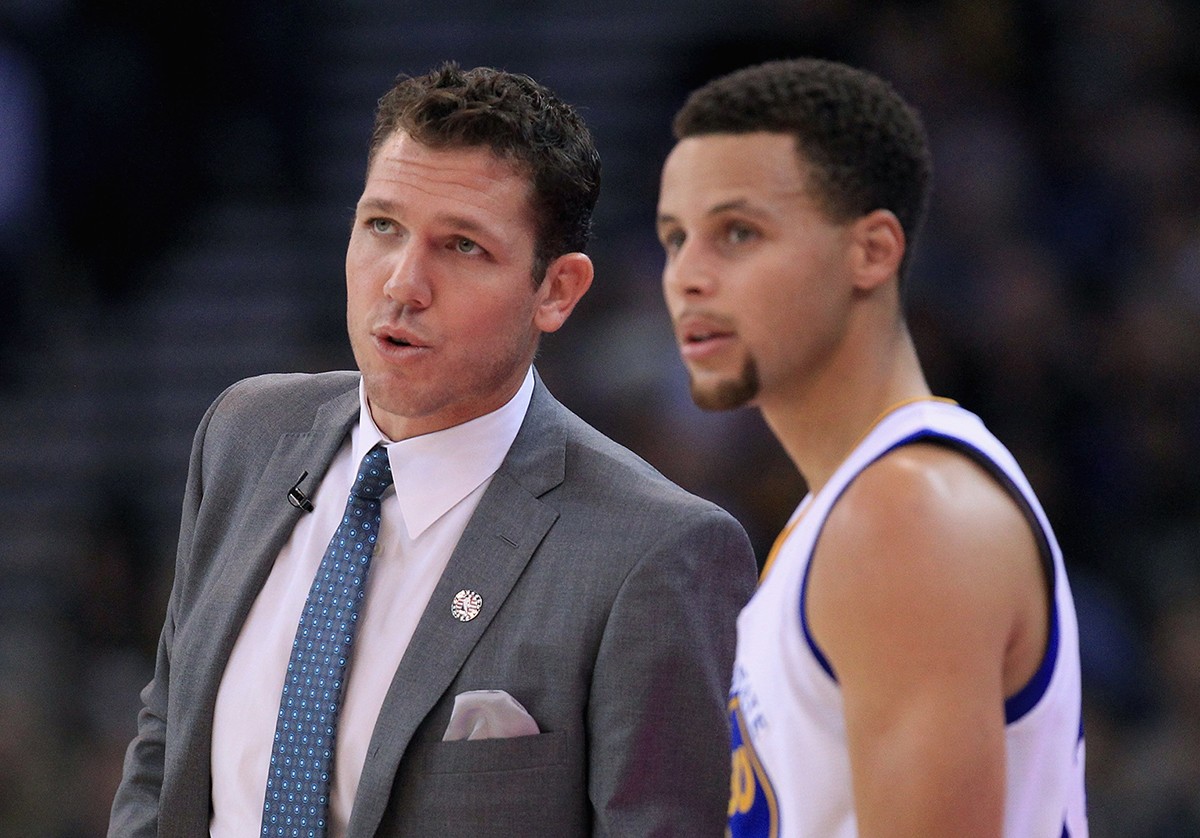
Interim Head Coach Luke Walton (left) and star guard Stephen Curry have led the Warriors to a record-breaking season.
Credits: Courtesy of the Golden State Warriors
Interim Head Coach Luke Walton (left) and star guard Stephen Curry have led the Warriors to a record-breaking season.
Credits: Courtesy of the Golden State Warriors
Many observers, including General Manager Bob Myers and Kerr himself, expected that losing Kerr would mean losing games,. “It could’ve been like when I was in school and you announce a substitute teacher and the students slump, read comic books, and take advantage,” Myers told KNBR.
“I figured the first part of the season would be tough,” Kerr added. “I was hoping we would just win enough games where [Interim Head Coach Luke Walton] could get his feet wet. And lo and behold, he wins his first 24.”
There are other reasons that happened, of course, including the baby-face assassin: Stephen Curry. He leads the league in scoring, true plus-minus differential, true shooting percentage, and lovability. The most striking demonstration of his dominance has become how mightily announcers struggle to describe his blend of ball handling and shot making, from TNT’s Chris Webber (“He’s a human video game”) to KNBR’s Tim Roy (“Curry has a new middle name: ‘Are You Kidding Me?!'”) to ESPN’s Mike Greenberg (“He’s the reigning MVP and the most improved player”) to Kerr himself (“He’s [Steve] Nash on steroids”).
Another reason: the coaching team that Kerr put in place. With assistant head coach Alvin Gentry absconding to New Orleans after last season, Walton stepped into the lead the team at the young age of 35. “We see the game the same way,” Kerr told reporters, referring to Walton. “He was a brilliant passer as a player — he could pass, cut, and move. He has a great mind for the game, great feel for the players.”
Curry added: “He’s smart. He knows the game. He understands the players’ mentality, the ups and downs of the season.”
Walton deflects credit, pointing to the team’s play and back to Kerr. “We talk every day and run ideas off each other,” Walton told ESPN Radio. “He constantly tells me, ‘it’s your call to make.’ For him to have that trust in me as a coach gives me a lot of confidence. But his biggest influence is what he’s already put in place: How we practice, the way we approach games, the overall attitude we have. Everything we do has his fingerprints all over it.”
Having defensive guru Ron Adams, who play-by-play announcer Bob Fitzgerald calls “Cerebral and direct, the truth teller,” on board helps provide continuity. Adams took all of about a week off after the NBA Finals before resuming work developing the Warriors in summer league.
In addition to designing Golden State’s defense — whether that calls for more switches or schemes for stars like James Harden (the Warriors are back near the top in field goal percentage defense) — Adams works one-on-one with the Ws’ big men.
Meanwhile, former Stanford star and NBA veteran Jarron Collins rose from player development coach to de facto offensive coordinator, helping script out-of-bounds plays, track the success of different lineup combinations, and manage players’ minutes. “I grew up playing with JC,” Walton told reporters. “There’s a lot of trust, and he’s constantly giving me information.”
Like his fellow coaches, Collins ducks credit. “I’m involved a little bit more in coaching duties,” he told reporters. “But, honestly, it comes down to our players.”
Player Development Coach Bruce “Q” Fraser plays a central role in keeping those players sharp, and one player in particular. The so-called Curry Whisperer works closely with the MVP in practice on all the different pressure fronts he’ll face, helps him run through his now-famous pregame drills, and monitors Curry’s technique forensically. “Fraser will suggest things — ways to pass, move side to side … he has a mental focus,” Fitzgerald said. “He doesn’t talk too much, but Stephen listens.”
Fraser is also known for being Kerr’s best friend since their days at Arizona University, and for tucking a Gumby figurine in his sock when he played there. Collins is best known as the brother of one of the most famous gay athletes in the country, his twin Jason. Adams might be known for defense, but he calls himself the “oddball” of the group. And Walton is most widely known as the son of a Hall of Famer named Bill Walton.
But if they’re not careful, these diverse members of the Warriors coaching staff could ultimately be known as one of the better ones ever assembled. For now, they’ll settle on being remarkably close — “Like a brotherhood,” is how Adams put it.
Since the beginning of last season, the Warriors are 109–21. Like Fitzgerald wondered out loud during a recent telecast, “Is this the greatest stretch in NBA history?” Here, a look at some facts that help make the case that it is:
• In the October 27 season opener versus the New Orleans Pelicans, Curry became the third player to score forty points after winning the NBA MVP award and a championship. The other two — Kareem Abdul Jabbar and Wilt Chamberlain — are Hall-of-Fame centers. Four days later, Curry dropped 53 on the Pelicans in Nola. He leads the league in scoring with 31.8 points.
• The Ws’ regular season home winning streak stands at 30 going back to last year. They’re 51–2 at Oracle the last two seasons.
• The Dubs boast the most comebacks from 15 points down or more in the league during the last three seasons, including a soul-rattling resurgence from down 23 versus the Clippers in Los Angeles on November 18.
• Curry has had five 20-point quarters this year — double the rest of the league, not counting Klay Thompson who notched 27 in the third quarter alone versus the Phoenix Suns last week
• The Warriors own the number-one spot for jersey sales as a team, with Curry ranked number one, ahead of the likes of LeBron James and Kevin Durant, with Thompson (number five) and Draymond Green (fifteen) not far behind. Curry’s jersey sales have increased 581 percent since the start of last season. His jersey is the top-seller in 38 states.
• Golden State’s 24-0 start was the best in any major North American professional sports league, eclipsing a St. Louis Maroons record that stood for 131 years. (The Maroons won 20 straight baseball games to start the season in 1884.) The Warriors fourteen straight road wins to start a season is also a record.
• Curry’s 131 three-pointers to date put him on pace to detonate his record of 286. As a team, the Brooklyn Nets have 135.
• Last month, Draymond Green became the first Warrior to post back-to-back triple doubles since Chamberlain more than a half-century ago. Against the Boston Celtics on December 11, he became the first player since Hakeem Olajuwon in 1993 to amass 20 points, 10 rebounds, 5 assists, 5 steals, and 5 blocks. Green currently leads the NBA in triple doubles and all forwards in assists, with 7 a game.
• Six different Warriors currently average better than 40 percent from behind the three-point line. Curry, shooting better than 45 percent on the year, only trails Steve Kerr for career three-point percentage.
• The last time a team scored more than 100 points in each of its first 20 games — as the Warriors did this year — was the 1966–67 season.
• Benjamin Morris of statistical analysis hub FiveThirtyEight evaluated NBA shooters based on distance, shot clock, and defender distance. Among his findings: Curry is the league’s most valuable shooter “by a lot.” He shoots as well with a defender 2 to 4 feet away as an average shooter does with the nearest defender 12 feet away. He shoots significantly better with less time on the shot clock, while the rest of the league shoots worse. And he’s measurably improving in scoring efficiency. “Curry is making his MVP season seem pedestrian,” Morris wrote.
• The Warriors set the league record for threes in a half with 15 against Phoenix November 23, finishing with a team record 22. The team averages more than 13 threes a game. Curry averages five by himself.
• Only Lebron James’ Cleveland Cavaliers trump the Warriors average road attendance of 19,596, or the 96.2 percent rate for sell-out crowds on the road.
• Warriors games have been five of the top six highest-rated national broadcasts on ESPN and TNT this season.
• The trendy plus-minus stat measures the point differential for a team when the player is on the court. The four highest ranking plus-minus players in the entire league are Warriors: Curry (16.1 per 36 minutes), Green (15.6), Andre Iguodala (13.2) and Thompson (12.6).
Late in the afternoon of November 4, Berkeley High School sophomore Alecia Harger received a disturbing text message. Someone had discovered a horrific, racist message that an unknown individual had left on a school library computer that day. A student sent Harger, co-president of the school’s Black Student Union (BSU), a screenshot of the frightening threat that was starting to circulate among students. The message stated, in part: “KKK forever public lynching December 9th 2015” and “I hung a [n-word] by his neck in my backyard.”
“I couldn’t believe that this was something that somebody would actually write,” recalled Harger, who is fifteen years old, in a recent interview. “We always talk about racism in Berkeley. … But I didn’t expect that there could be such acute racism, such anti-Blackness in our community.”
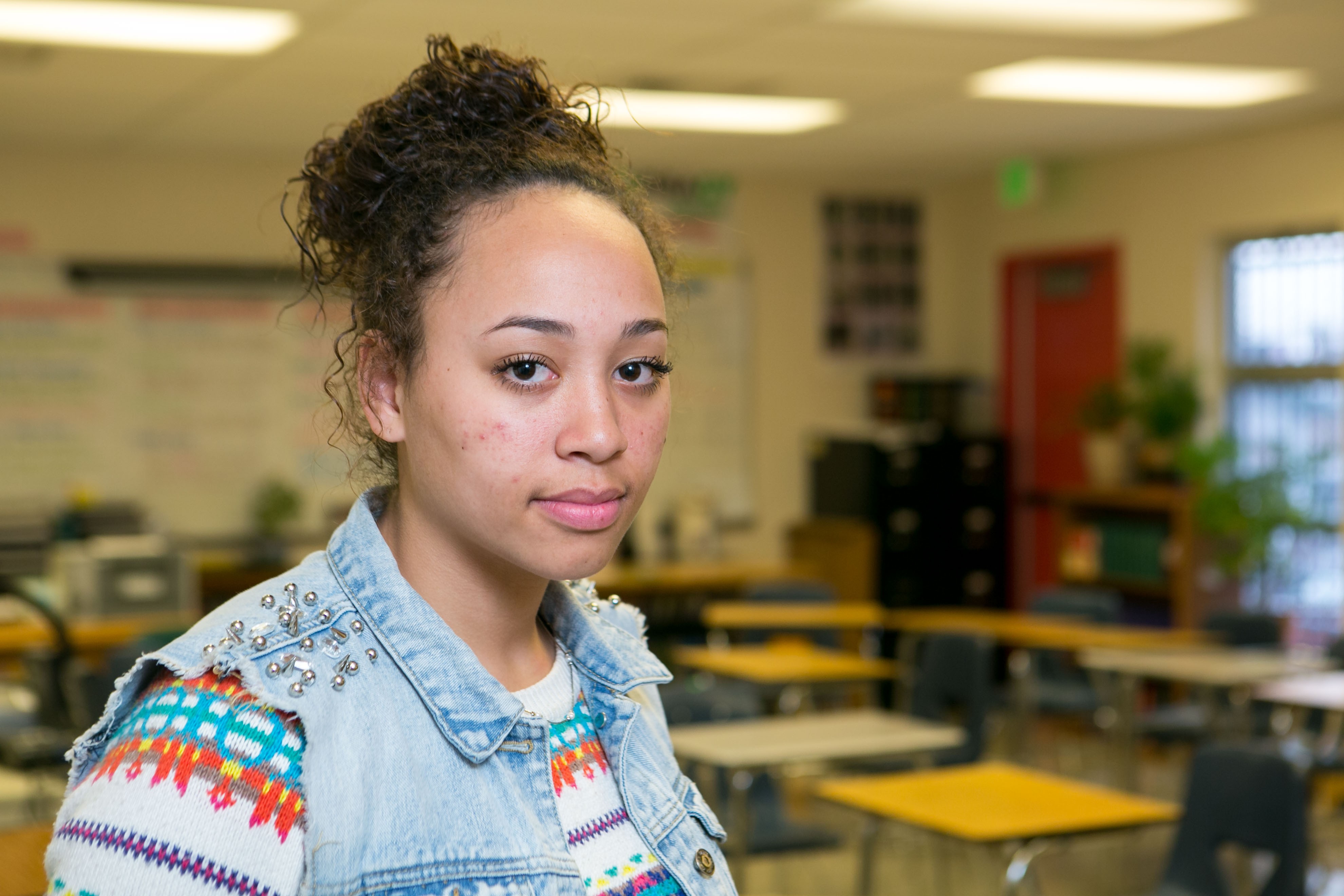
Loata Fine, 2015 graduate of Fremont High School, helped plan Oakland school board protests.
Credits: Bert Johnson/File photo
Loata Fine, 2015 graduate of Fremont High School, helped plan Oakland school board protests.
Credits: Bert Johnson/File photo
Once the initial shock wore off, Harger realized how scared she felt for herself and other Black students. She and other BSU leaders decided they needed to mobilize a response as quickly as possible; the image was spreading on social media, and students deserved information from a reliable source, Harger said. Administrators hadn’t yet issued any statement. That evening, the BSU fired off a press release warning of the “act of blatant terrorism towards the Black students and staff members at Berkeley High.” The statement also demanded that administrators and the Berkeley Police Department address the threat (which officials later determined came from a student).
The next day, the BSU helped facilitate a massive walkout that drew thousands of students to the streets of Berkeley — and national media attention. “This is an opportunity not just for the Black community to heal together, but also to let our message be heard on a greater scale,” Harger said of the protests.
The actions of the BSU — including a series of student-led events and assemblies on December 9, the day cited in the original message — capped off a year of high-profile student protests in the East Bay. High school activists in Oakland, Berkeley, and beyond have used Twitter, Instagram, Facebook, and YouTube to strategically coordinate marches and protest events and to pressure school officials and politicians to respond to their widely circulated messages. Armed with viral hashtags that have helped unify student organizers and attract substantial media coverage, teen activists have launched rallies calling for equitable resources for struggling public schools, actions opposing potential school closures, and protests against police brutality.
“I feel like we had a very big impact,” said Loata Fine, who in the spring graduated from Fremont High School in East Oakland and is now studying political science and public service at UC Davis. Fine, who is eighteen years old, helped coordinate a series of protests this year at Oakland Unified School District (OUSD) public meetings concerning a controversial plan to overhaul five schools, including Fremont High.
As part of OUSD’s so-called “Intensive Support Schools Initiative,” the district solicited proposals to revamp the targeted schools, including allowing outside, private charter school operators to submit applications. The process prompted an intense backlash: Some teachers, students, and parents feared that the potential charter takeovers would only further erode the educational opportunities for disadvantaged students. At Fremont High and McClymonds High School in West Oakland, another school identified for turnaround, students repeatedly spoke out at meetings and played a significant role in calling for increased transparency and student input in the process.
“We indicated that we cared about the school and that these decisions heavily impact us,” recalled Fine, noting that students used the #IAmFremont hashtag on Twitter to get alumni and others interested in the cause. “We showed them that we were not going to back down.” After numerous protests in which students gave thoughtful and passionate speeches in front of large crowds at school board meetings, the district made a more serious effort to reach out to students and let them voice their concerns and offer perspectives on potential reforms, Fine said. “They actually began attempting to work with faculty and students,” said Fine, who later took on a role as a student delegate in the process.
Ultimately, charter school operators did not take over any of the five schools.
This year’s student-driven protests weren’t just limited to internal school politics and conflicts. On November 17, dozens of students at Castlemont High School in East Oakland used a coordinated walkout to help shine a light on a fatal police shooting of a man allegedly armed with a fake gun. A video of the protest that circulated on Twitter showed a crowd of students chanting “Stop police brutality!” after they marched out of class to an intersection near the school where days earlier a group of Oakland cops days had shot and killed the man (who OPD later identified as 39-year-old Richard Perkins). The rally was one of many this year in Oakland in response to violent OPD incidents — but it was notable for the role youth played in organizing the event.
Meanwhile, at East Bay Arts High School in Hayward — a public school within the San Lorenzo Unified School District — sustained student protests this fall appear to have played an important role in blocking the proposed closure of the magnet arts school. “We made it such a publicized issue, and that really made a big difference,” said junior Doug Richman, who helped reach out to reporters in September when students and teachers first learned that the district’s superintendent, Fred Brill, was proposing an imminent shutdown of the school.
Richman and other students drove news coverage highlighting the consequences of the potential closure and spoke up at public meetings. Eventually, officials decided to delay the plan, and the school board ultimately voted unanimously this month to keep the school open. Brill also reversed his position and recommended against closure, saying he was deeply impressed by “the passion and the commitment and the advocacy and the love coming from this community,” according to the Contra Costa Times. He told students at the board meeting: “You guys made me cry many times in this process.”
Angela’s Kitchen, a Mediterranean restaurant that opened three months ago in Alameda’s bustling Park Street corridor, has the feel of the kind of eatery I can imagine finding in a suburban New Jersey strip mall — a classed-up Italian-American red-sauce joint, perhaps, or a little New American bistro. The restaurant is, in fact, located in a kind of shopping plaza, next door to a Smashburger and across the parking lot from the Alameda Marketplace’s assorted food shops. It’s the kind of place where Sinatra (or some Sinatra analog) plays on the speakers, and where your waiter is the kind of incorrigible ham for whom that joke about how you must really hate the food to have cleaned your plate so thoroughly is never not worth repeating.
If you’ve spent enough time in the small towns of America, you know the kind of place. The fact that there isn’t a single trendy thing about Angela’s is part of its charm. The other, more significant part is the food: Afghan flavors filtered through the lens of old-school French cooking techniques and other Western influences. And just like those rare strip-mall discoveries I’d scout out in the Jersey suburbs where I grew up, Angela’s Kitchen serves food that is tastier and more ambitious than just about anything else you’ll find in its immediate vicinity. Pound for pound, it might just be the best restaurant in Alameda.
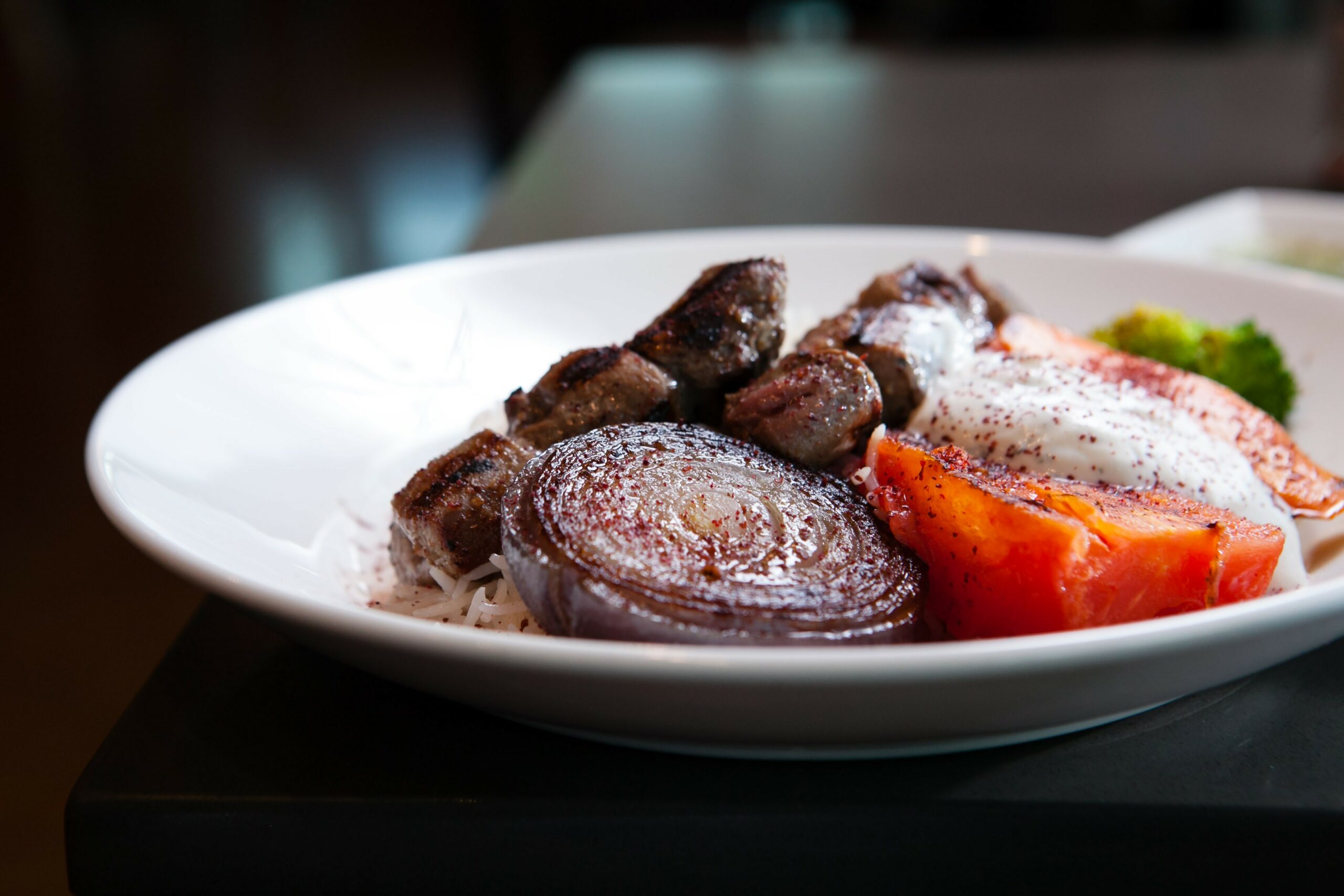
The kebab at Angela’s Kitchen.
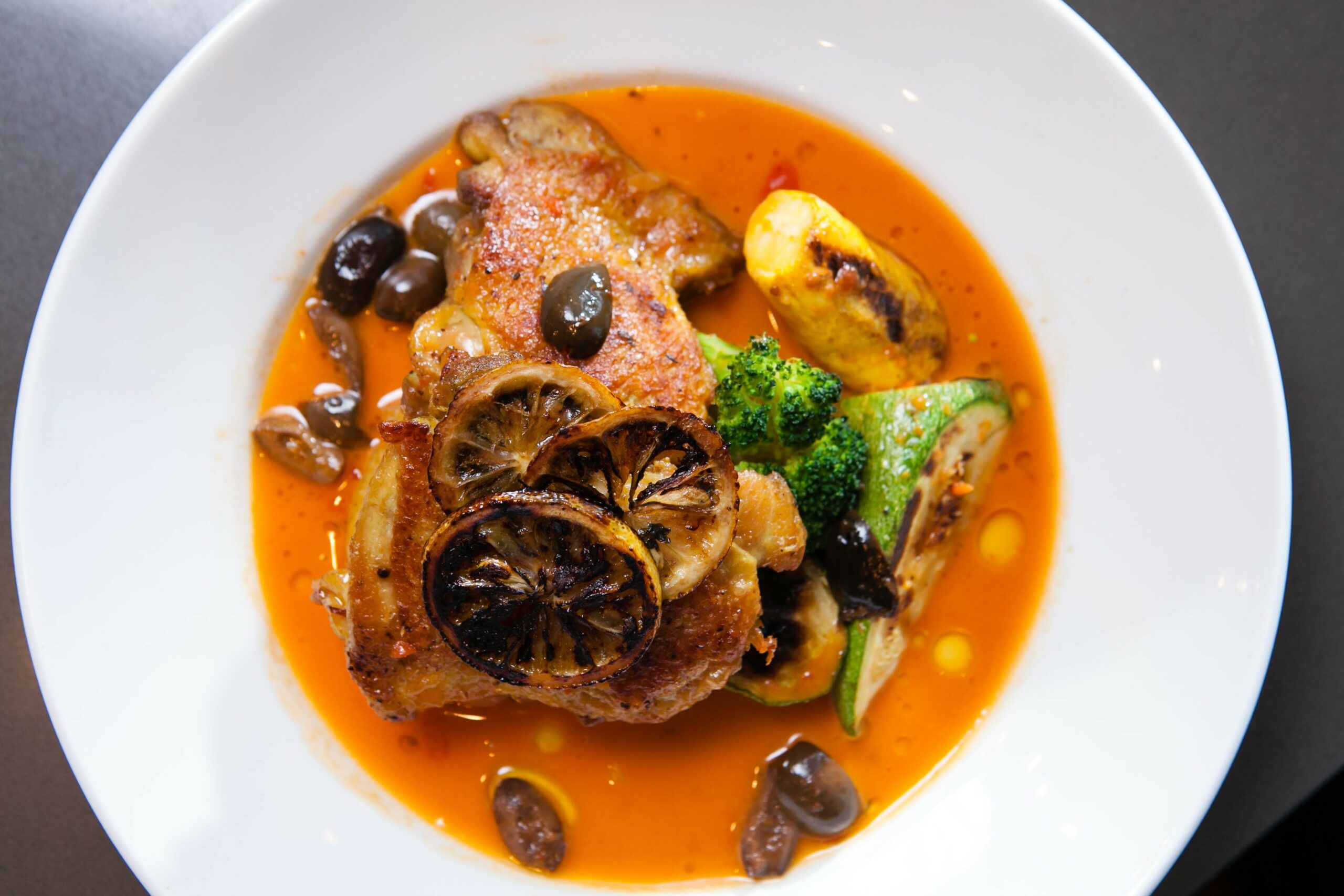
Credits: Bert JohnsonMoroccan chicken.
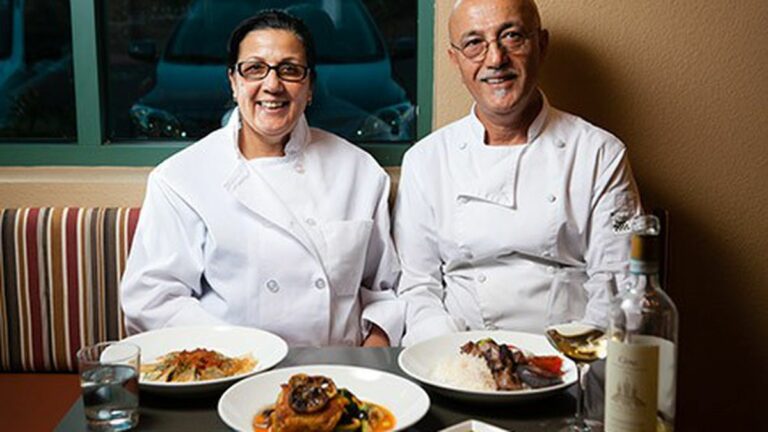
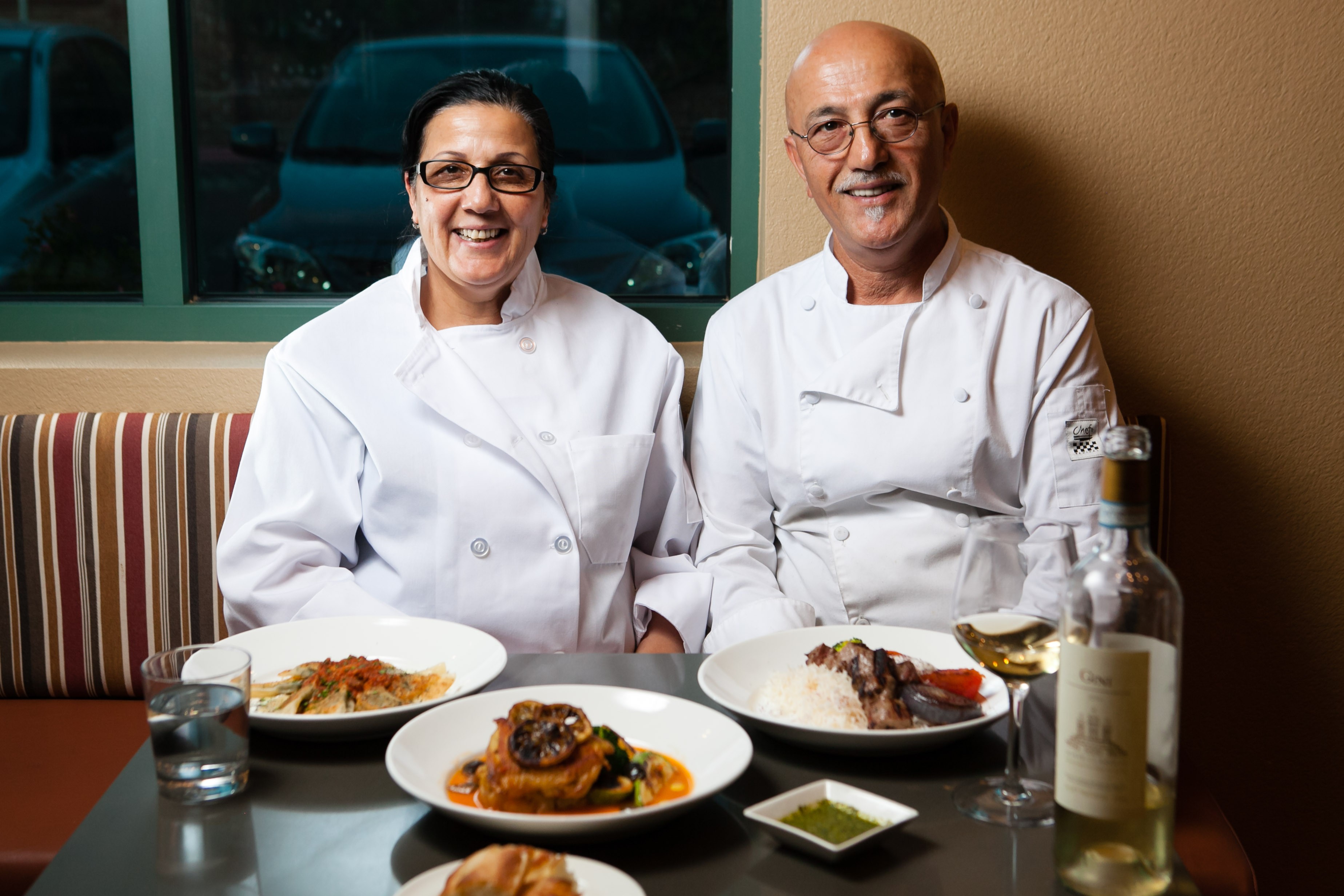
Credits: Bert JohnsonMaria and Saboor Zafari serve Afghan dishes with a distinctive, slightly Westernized stamp.
Credits: Bert Johnson
Chef-owner Saboor Zafari, a native Afghan, came to the United States in 1977 to visit his brother, a college student in Madison, Wisconsin. Within months of his arrival, the pro-Soviet faction in Afghanistan had staged a military coup. Over the next ten years and beyond, everything in Zafari’s homeland went to hell. “The rest is history,” he said. “I’ve never been back.”
In Wisconsin, Zafari taught himself to cook, with help from the classically trained chef at the French restaurant that he and his brother bought in the early Eighties. This was where Zafari was schooled in the nuances of how to make a proper beurre blanc, and where the seeds of the first Angela’s — which Zafari opened in 2001 in a strip mall on the other side of Alameda — were planted. Named after his daughter, Angela’s took the Afghan spice palette of saffron, coriander, and dried mint and applied it to Zafari’s favorite French and Italian dishes.
The current Angela’s is actually the fourth incarnation of the restaurant. Zafari said the second, Angela’s Bistro, was an investor-driven project that served more generic Mediterranean food until it closed in 2013. In September 2014, just weeks before Zafari was set to open a new Angela’s on Park Street, the restaurant was gutted by fire. Angela’s Kitchen opened a year later almost directly across the street from the fire-ravaged site — a testament, Zafari said, to an outpouring of community support after it turned out that he didn’t have fire insurance.
The aushak are pan-fried.
Credits: Bert Johnson
For Zafari, Angela’s Kitchen is something of a return to his roots. It’s a family-oriented affair: His wife, Maria, is also a chef at the restaurant. (She does most of the baked goods and will run lunch service when it kicks off in the next month or two.) And compared to his earlier restaurants, Zafari said, the new Angela’s is probably the most Afghan in its focus — with kabobs and other mostly traditional dishes occupying at least as much menu space as more obviously fusion-y dishes such as pasta and risotto.
Still, it was clear from the very start of the meal, when our server brought out a basket of warm, olive-oil-tinged bread that was halfway between a focaccia and a dense Afghan flatbread — with a bright walnut-mint pesto for dipping — that this was no traditional Afghan restaurant. Presentation tended more toward fine-dining than rustic, and in many of the dishes, it was Zafari’s background in French cooking that shined through. This is the kind of old-school French cuisine that leans heavily on rich, buttery wine reductions — a throwback to a style that was trendier in the Nineties and early Aughts.
Take the duck strudel appetizer, which, in many ways, is Zafari’s signature dish. The chef said he invented the dish back in his Wisconsin days as a way to use up some duck legs he had in the freezer and a cranberry wine that no one was ordering. The resulting dish is a stunner: crisp phyllo dough wrapped around duck confit, wild rice, and sautéed mushrooms. The meaty little pastry is served in a cranberry wine reduction that’s made with duck stock, caramelized shallots, and cream — a not-too-sweet, intensely caramel-y sauce that evoked everything good about Thanksgiving dinner, and was so heady and aromatic, I swore it perfumed not just the dining room but also the parking lot outside.
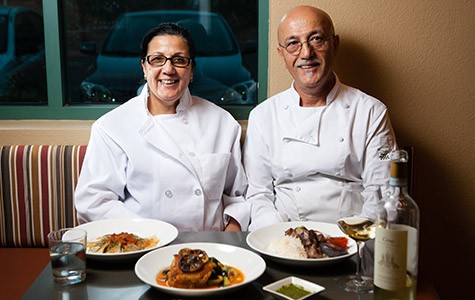
Maria and Saboor Zafari serve Afghan dishes with a distinctive, slightly Westernized stamp.
Credits: Bert Johnson
Even the dishes that hewed pretty closely to traditional Afghan recipes had a distinctive, slightly Westernized stamp. My favorite of these was Zafari’s take on aushak, a kind of Afghan leek-and-spinach ravioli that’s traditionally served steamed. At Angela’s, these were pan-fried as though they were pierogies, adding an element of caramelized crispness that made this a more decadent entrée — and went beautifully with the accompanying layer of yogurt underneath and the tomato-based meat sauce on top.
The borani was a fairly straightforward version of another Afghan classic, borani banjan: thick slices of grilled eggplant, topped with a savory tomato sauce and dried mint and, again, served over yogurt. At Angela’s, though, the cross-cultural connections seem to be everywhere: Close your eyes, and it’s not hard to imagine that you’re eating a not-so-distant cousin of eggplant parmigiana.
Other dishes were more broadly “Mediterranean.” A shrimp risotto special featured creamy, al dente rice that was a bit too oatmeal-like in its texture, but also impeccably grilled shrimp that were tinged with a well-spiced slick of red oil — the one Afghan touch. Meanwhile, I read “Moroccan lemon chicken” on the menu and mistakenly conjured up an image of a rotisserie chicken that you’d find at certain Middle Eastern restaurants, served over a heap of fragrant rice. Instead, this was more akin to a tagine: tender thigh meat served in its own tomato-infused braising liquid. The warm bread pudding we had for dessert was soaked in a sweet whiskey reduction — very good, but Afghan only in the choice of fruit to include (persimmon and pomegranate).
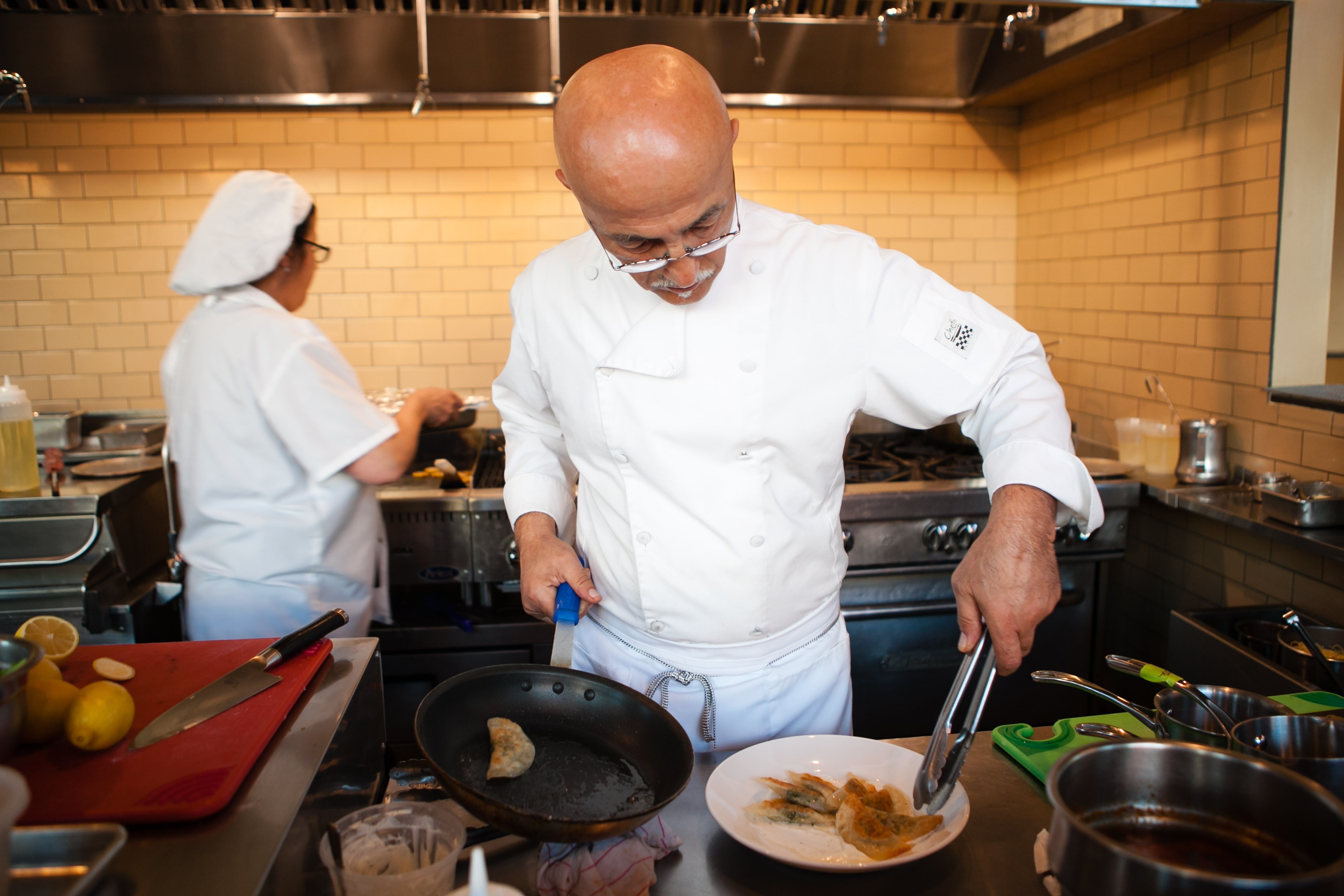
Saboor Zafari.
Credits: Bert Johnson
Perhaps the one dish that best embodied both the strengths and weaknesses of the restaurant’s modern, Westernized approach to Afghan cuisine was the lamb kabob. On the one hand, the cubes of lamb tenderloin were well seasoned and — most strikingly — impossibly tender. But on the other, the meat was served with a bland version of pallow (the traditional Afghan rice dish) and, to add insult to injury, a side of even blander steamed broccoli and baby carrots — a stuck-in-the-Eighties vegetable offering that seemed designed to fill a health quotient rather than to add flavor.
During my meals at Angela’s, I didn’t notice any customers of Middle Eastern descent, but I did see couples who were there to celebrate an anniversary and children dressed up for their birthday or from have just performed at a holiday concert — this being just the right kind of low-key, special occasion-worthy place to bring a kid who has an appreciation for good food. Like many restaurants in Alameda, the customer base seemed to skew toward young families and the elderly. Would such an audience embrace some bolder Afghan flavors? Seeing how much they’ve already taken to the place, I wouldn’t be shocked if they did.
Friday, December 25
Purple Rain (111 min., 1984). (The New Parkway, Oakland, 10:30)
Sunday, December 27
The King and I (133 min., 1956). (Parkway, 1:00)
Wednesday, December 30
Plutocracy: Political Repression in the U.S.A. (110 min., 2015). Showing the first half of the film (Humanist Hall, Oakland, 7:30)
I'm a straight 26-year-old man who wants advice on helping my fiancé realize a particular fantasy. We have been dating for three years and are in a happy monogamous relationship. I was always vanilla, but she enjoys rougher sex and light bondage. We've incorporated some of this into our sex lives, and we are both happy with how fun...
Mustafa Solomon doesn't want to leave Oakland. The 59-year-old photographer and activist has been a city resident for 35 years, but in recent months, he's become unsure if he'll be able to stay. After losing their longtime housing in North Oakland earlier this year, he and his daughter have been living in a temporary housing setup in...
Although 2015 was an off year for politics in the East Bay, it's clear that 2016 is shaping up to be a pivotal one for elected offices throughout the region. It could mark the return of a respected East Bay legislator to Sacramento, and it could feature two expensive Assembly races, along with a growing list of challengers to...
Most of the artworks in Unearthed: Found + Made were plucked from a riverbed. The exhibit, currently on view at the Oakland Museum of California (1000 Oak St.), showcases local suiseki, the traditional Japanese art of stone collecting. Inside glass cases, smooth, richly colored rocks perch gloriously on hand-carved wooden daiza (settings), looking as magnificent as any...
"No Place to Go," News, 12/9
We Need to Prioritize Human Needs
There is also the issue of existing restrooms that have been closed, like the one in the bike station, which then throws bicyclists onto the street looking for a restroom and competing with all the others for the same. The reason I was given for the partial closing...
These days, when newcomers to Oakland ask me where to eat, often the first recommendation out of my mouth is Swan's Market. Which is to say, even with all of The Town's gastronomical riches, I'm sending folks to a food court.
But...
There is no doubt that in East Bay sports, 2015 was the year of the Golden State Warriors. The Oakland A's finished with the worst record in the American League, and while the Raiders showed marked improvement this year under new coach Jack Del Rio, the Silver and Black missed the playoffs again for the thirteenth straight season. The...
Late in the afternoon of November 4, Berkeley High School sophomore Alecia Harger received a disturbing text message. Someone had discovered a horrific, racist message that an unknown individual had left on a school library computer that day. A student sent Harger, co-president of the school's Black Student Union (BSU), a screenshot of the frightening threat that...
Angela's Kitchen, a Mediterranean restaurant that opened three months ago in Alameda's bustling Park Street corridor, has the feel of the kind of eatery I can imagine finding in a suburban New Jersey strip mall — a classed-up Italian-American red-sauce joint, perhaps, or a little New American bistro. The restaurant is, in fact, located in a kind...