Our December 9 music story, “Communing with the Based God,” incorrectly stated that the file size of Lil B’s 850-song mixtape was five megabytes. It was five gigabytes. Our December 9 feature, “New Year’s Eve Guide,” misstated the date for the event “Light On! Kwanzaa.” It is December 30, not 31. That same story incorrectly stated that food would be included with the ticket price for La Orchestra la Moderna Tradición’s performance at La Peña Cultural Center. Food will be available for purchase from Los Cilantros, which is located in the center’s adjacent cafe space.
It’s been a long time since we’ve had a good bear-attack movie. A smattering of outdoor adventures have featured competent grizzlies-on-a-rampage scenes — the young Ethan Hawke had an especially memorable encounter in 1991’s White Fang — but they are few and far between. Happily, Alejandro González Iñárritu’s The Revenant has now arrived to remedy the situation. But we will say no more about that. You’ll have to wait for it.
The rest of The Revenant — meaning “one who has returned from the dead” — follows along in the “realistic Old West” movie tradition of the past fifteen years, meaning facial hair for almost all the male characters (only one woman appears in the film, without beard), dirty clothes, matter-of-fact frontier cruelty, and mayhem, etc. That is, a complete changeover from the days when, say, Kirk Douglas would ride into town clean-shaven, wearing a neatly pressed cowboy outfit, on a fluffy-maned horse, to romance Rhonda Fleming in sanitary, brightly lit rooms, and shoot down Dennis Hopper in a fair gunfight.
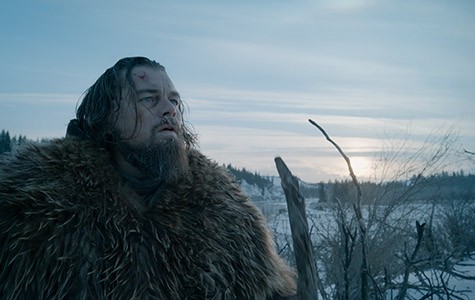
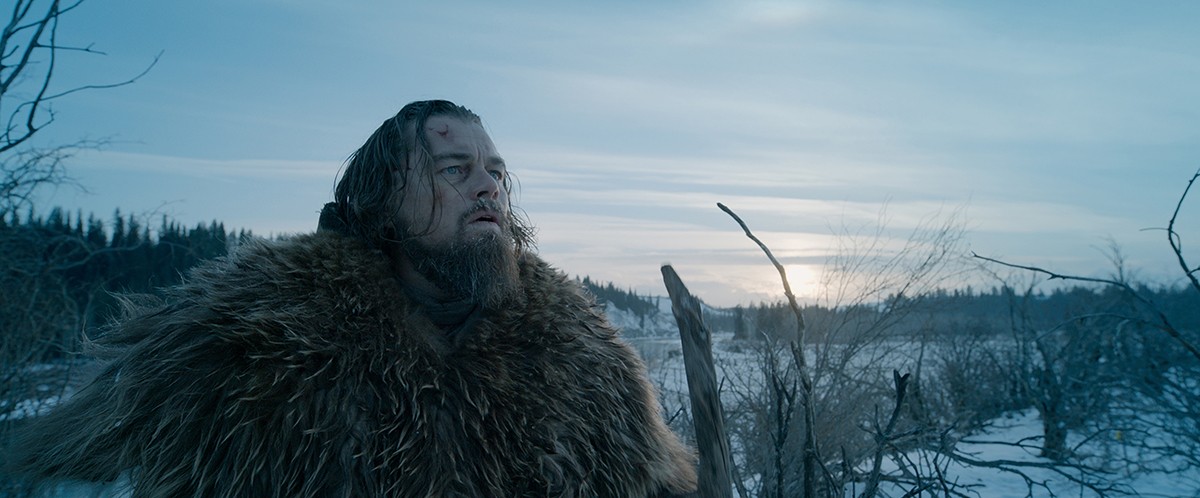
Leonardo DiCaprio starts in The Remnant.
Leonardo DiCaprio starts in The Remnant.
None of that for Iñárritu. He and his co-scenarist Mark L. Smith, adapting Michael Punke’s novel, fill their fur-trappers-take-on-all-comers tale with utterly believable grunge and blood, plus the overriding expectation that at any moment, when you least expect it, you will be savagely bushwhacked from out of nowhere. The title character is Hugh Glass (Leonardo DiCaprio), a hunter accompanying a party of trappers in the Missouri River territory in the 1820s. Glass, a comparatively meditative sort who has lived with Native Americans and witnessed how unfairly they are treated by marauding white men, travels with his half-Pawnee son Hawk (Forrest Goodluck) in an expedition led by US Army Captain Henry (Domhnall Gleeson). In that group of scruffy skinners is one particularly loathsome albatross, Fitzgerald (Tom Hardy), a half-scalped blowhard in whose company you would be ill-advised to turn your back. Glass and Fitzgerald have their differences, and settle them at length.
Iñárritu now seems fully recovered from his dreadful string of early hyperlink films, and with the backstage portrait Birdman in the bank, continues his run through the genres. The Revenant may be one of the chilliest-looking westerns in captivity. Shot on location in Canada and Southern Argentina, the pic’s winter setting and its putative commitment to no computer-generated imagery give cinematographer Emmanuel Lubezki the opportunity for some extravagant winter scene-setting. Frosty mountain passes, raging rapids, heavy snows, pesky critters — DiCaprio’s Glass and his erstwhile comrades struggle mightily amid some of the most convincingly harsh wilderness locations since Akira Kurosawa’s Siberian survival tale Dersu Uzala (1975). The music score (by Ryuichi Sakamoto, Bryce Dessner, and Alva Noto) and sound engineering contribute eloquently to the mood of desolation.
The driving force in the story is a combination of revenge — on the part of Glass and also a tribe of natives searching for a kidnapped squaw named Powaqa (played by Melaw Nakehk’o) — and pure orneriness, as embodied by Fitzgerald. Busy English actor Hardy, in his third major-release appearance of 2015 (alongside Mad Max: Fury Road and Legend), tears up the woods with his redneck nastiness. His “God is a squirrel” speech is a high point. DiCaprio, by necessity, operates at a slow simmer, drifting in and out of feverish dreamscapes and building to an explosion of righteousness. Nothing very complicated here, just richly textured suffering by men with very little to lose. A movie of sustained ferocity to arguable effect, with superior visuals. Consumers’ alert: Try to bring a cup of coffee or hot chocolate into the screening, to keep your teeth from chattering.
Jerry Brown made quite a splash at the UN Climate Change talks in Paris this month. The mainstream press fawned over California’s governor, lavishing praise on him for supposedly being a world leader in the fight to reduce greenhouse gas emissions. But environmentalists in California have long known that while Brown talks a good game on climate change, his actual record is far from green. The governor, for example, has steadfastly refused to ban fracking in the state and has ignored calls for California to tax oil companies like other states do.
And in Oakland, which is still Brown’s official city of residence, the governor has remained steadfastly silent on the most important local environmental issue of 2015: the controversial plan to build a coal shipping terminal at the former Army Base at the Port of Oakland. The terminal, which is part of a $500 million project spearheaded by local developer Phil Tagami, would ship millions of tons of coal mined in Utah and other states to ports in Asia each year. The project, as a result, would not only greatly add to greenhouse gas emissions worldwide but also threatens to worsen air pollution in West Oakland, a largely low-income area that already suffers from some of the dirtiest air in the region.
One developer wants to start coal shipping terminal at the former Army Base at the Port of Oakland.
Credits: Port of Oakland
One developer wants to start coal shipping terminal at the former Army Base at the Port of Oakland.
Credits: Port of Oakland
Brown’s spokesperson Gareth Lacy said on Monday that Brown had no comment on the coal shipping facility.
Oakland Mayor Libby Schaaf, who is friends with Brown and served as an aide to him when he was mayor of Oakland, said in an interview that she was “disappointed” about his silence on coal. Schaaf, who is a staunch opponent of the coal terminal, said that in Paris, when the issue of coal came up, Brown dodged the subject by saying it was up to the United States to create a “national policy” on coal.
“I was disappointed in his answer,” Schaaf said. “If we wait for national policymakers to get their act together, it’ll be too late.”
Schaaf also noted that the governor’s response contradicted their reason for traveling to Paris in the first place. Schaaf and Brown, along with other city and state officials, were on hand to extol the abilities of local governments to impact climate policy around the globe.
So why is Brown ducking the issue of coal in Oakland? Although the governor has long had a reputation for being a cautious politician who shies away from controversial issues, coal is not that controversial — at least not in California. The state has no coal industry to speak of, and California’s utilities long ago shifted away from the dirty fossil fuel and now depend largely on natural gas, hydroelectric power, and renewables. And in October, Brown even signed a law requiring the state’s two major pension funds to stop investing in coal companies. Coal, in short, has virtually no impact on the state’s economy — and no effect on California politics.
So what is causing Brown’s reticence? Perhaps it has to do with his longtime relationship with Tagami. The two are close friends and real estate investment partners in Oakland. In fact, Brown and his wife Anne Gust were married in Tagami’s Rotunda Building in 2005. Brown also houses his charter school, the Oakland School for the Arts, in the Tagami-refurbished Fox Theater in Uptown. And it was Brown who originally made Tagami his point man on the Army Base redevelopment authority when Brown was mayor of Oakland.
Unfortunately for Oakland, there may not be a lot the city can do to block the coal terminal unless Brown steps in. Schaaf, who has said that Tagami originally promised that the terminal would not include coal, noted that the city’s only hope may be to use a clause in its contract with Tagami that concerns the public health impacts of the project. The clause would allow the city to modify the deal if the project puts either workers or neighbors “in a condition substantially dangerous to their health or safety.”
Schaaf also argued that the state legislature and Brown should establish a ban on all coal shipments from California. Her proposal includes a grandfather clause for existing ports that ship coal that would let them phase out their shipments over time.
State Senator Loni Hancock, who represents Berkeley and Oakland, is also adamantly opposed to the coal terminal plan. “In light of California’s climate goals, this would be a tremendous step back — a tremendous blow to our reputation,” she said in an interview.
Hancock recently sent a letter to the California Transportation Commission (CTC) urging it to reexamine its 2013 approval of a $242 million grant to the Army Base redevelopment project. “Coal was not part of the project approved by [the CTC],” she noted.
Schaaf pointed out, however, that the city can’t afford to lose any portion of the CTC grant. She and other opponents of the project, including councilmembers Rebecca Kaplan, Dan Kalb, and Lynette Gibson McElhaney, just want the new terminal at the former Army Base to exclude coal, and to instead rely on other bulk products, like grain.
And the best way to achieve that would be for Brown to come off the sidelines and tell his friend Tagami that shipping coal through Oakland is a nonstarter. After all, Mr. Governor, that’s what a real climate leader would do. Right?
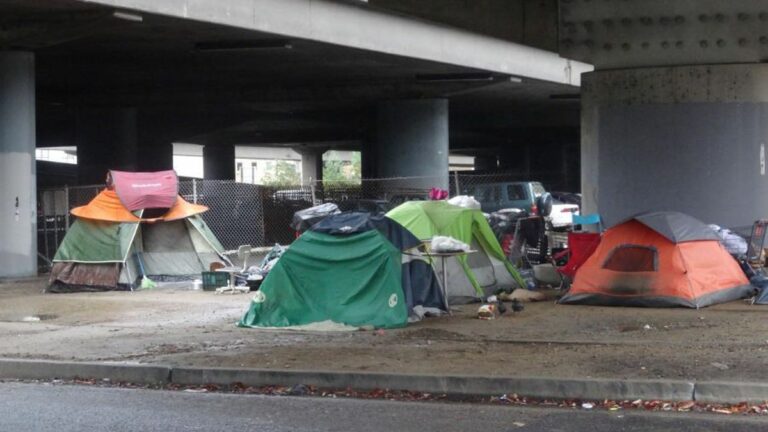
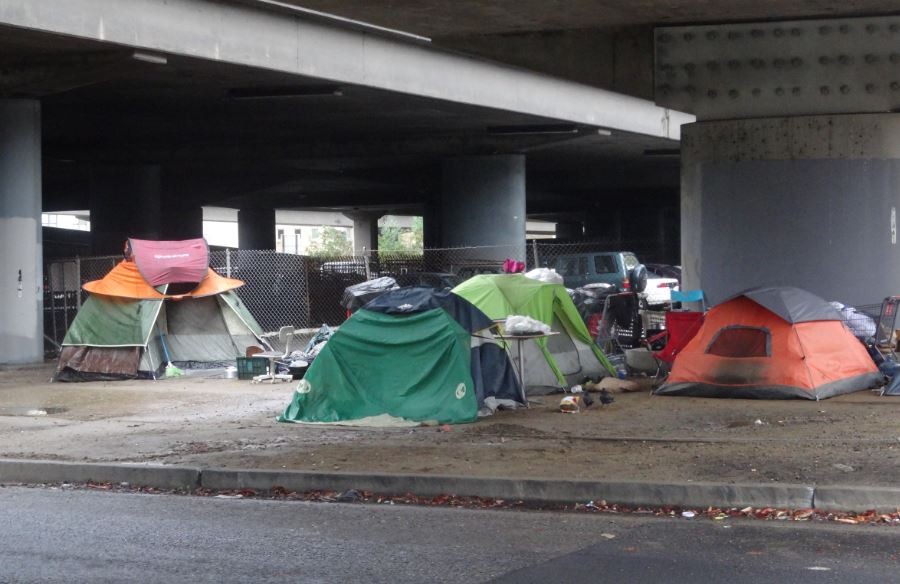
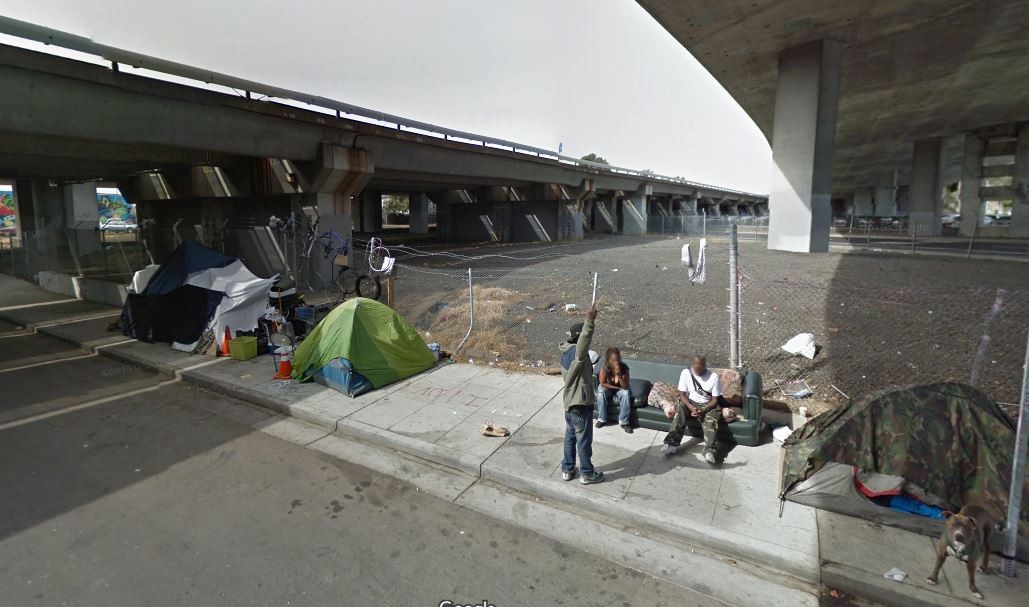
A homeless camp under the 880 Freeway in downtown Oakland.
Credits: Darwin BondGraham
Since January, the City of Oakland spent $72,212 to close 162 homeless encampments and to dispose of garbage and the belongings of homeless people who are living on the city’s streets and in its parks, according to city records.
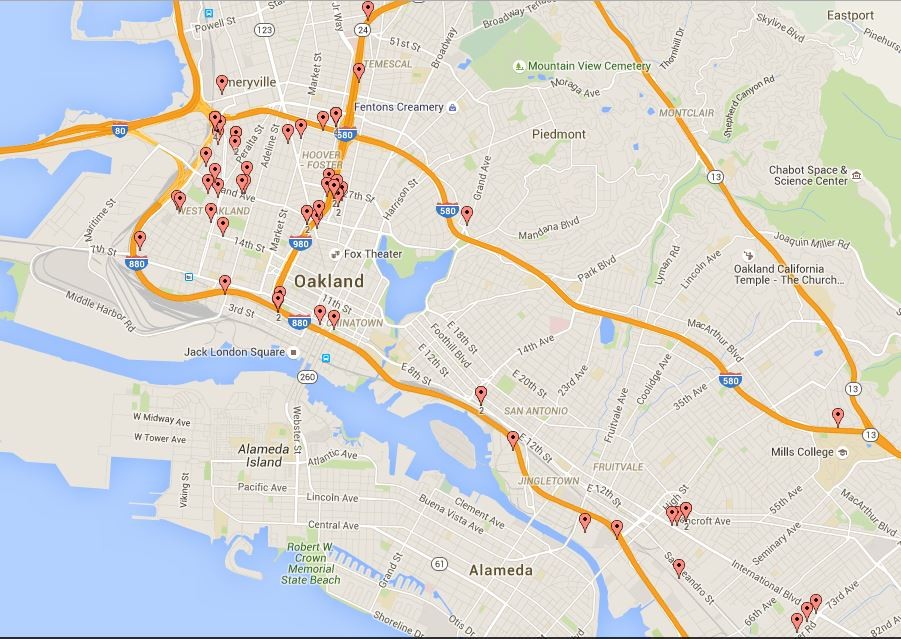
The Public Works Department closed 66 homeless camps at locations all around the city, but mostly at locations in the flatlands near freeways, along street medians, and on sidewalks in industrial areas. The Parks and Recreation Department closed another 96 homeless camps in parks, again mainly located in the flatlands of East and West Oakland and downtown. Many of the camps targeted for closure were reoccupied immediately after the city attempted to remove them.
[jump]
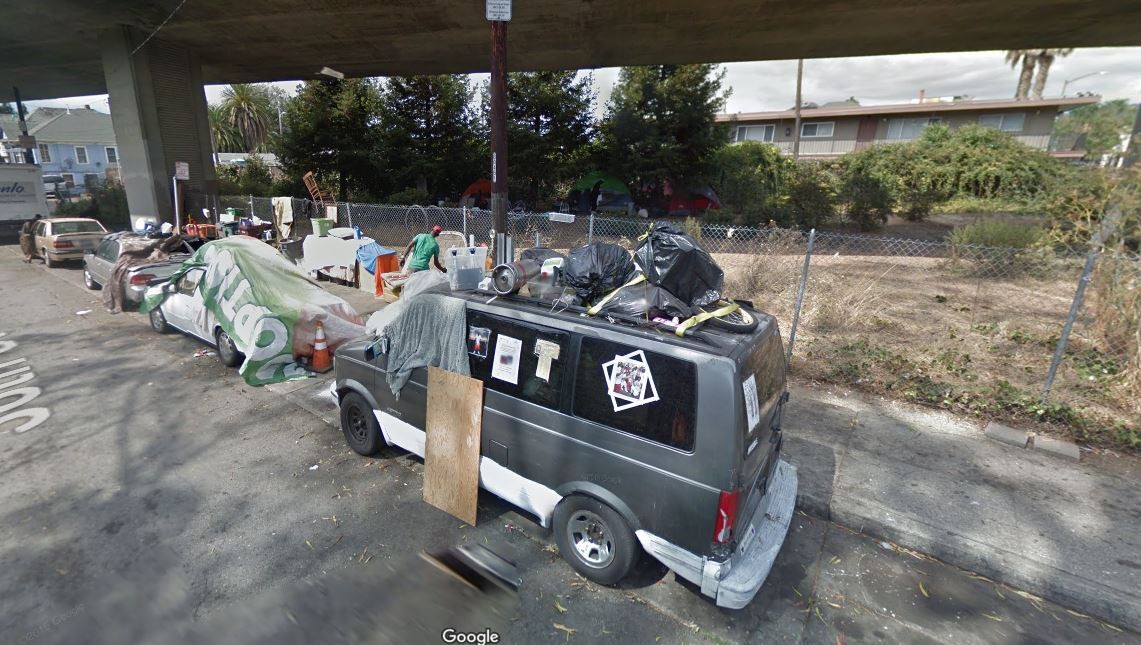
A homeless camp near the intersection of Sycamore Street and Northgate Avenue that was closed in 2015.
Credits: Google streetmap
There are currently 4,040 homeless people in Alameda County, according to the most recent count by Everyone Home, a nonprofit that coordinates Alameda County’s homeless services. About half of the county’s homeless, 2,190 people, live in Oakland. But there are only 350 to 410 shelter beds in Oakland, according to the city, so approximately 1,384 homeless people sleep on Oakland’s streets and in its parks every night.
As rents continue to reach record highs, many fear that the numbers of newly homeless people will increase.
According to city records, 69 percent of Oakland’s homeless are Black, even though only 28 percent of the city’s total population is Black.
A homeless camp on 36th Street near Martin Luther King, Jr. Way that was closed in 2015.
Credits: Google street map
Children are also prone to becoming homeless in Oakland. In 2013, the Oakland Unified School District estimated that more than six hundred students experienced homelessness at least once.
Veterans are also at increased risk of homelessness. A 2013 survey of the homeless in Oakland found that 20 percent previously served in the military.
The Oakland City Council recently acknowledged that the city has a severe shortage of shelters available for its homeless residents. But city leaders also insist on closing homeless camps. According to a staff report to the City Council on December 8:
“[a]n outgrowth of these limited shelter options is the growing number of unauthorized homelessness encampments throughout the City. These encampments present public health and safety threats to the persons who live in them in multiple ways: crime, lack of sanitation and debris collection facilities, weather exposure, traffic hazards and other risks.”
Representatives of the Oakland Public Works Department didn’t respond to a request for comment about the closure of homeless camps this year. But records show that in 2015, the city disposed of 500 cubic yards of materials while closing the camps, enough to fill 50 dump trucks.
Updated 9:50 a.m. 12/23: According to Kristine Shaff, spokeswoman for the Oakland Public Works Agency, in addition to ordering homeless people to leave their camps before city workers clean the area, the City of Oakland also partners with Operation Dignity to reach out to camp residents and offer hygiene kits, blankets, clothing, and services including shelter.
Shaff also said the city takes care not to throw away valuable belongings left behind during camp closures and cleanup operations. “This is one of the updates in the protocol we did years back when we did the encampment at City Hall for occupy,” said Shaff, referring to the 2011 and 2012 closures of the Occupy Oakland encampment. “We set up a process so that if there is something of personal value we store it, tag it, and reach out to people at the camp and hold those possessions to try to return them.”
Correction: the original version of this post incorrectly described the Parks and Recreation Department as part of the Public Works Department. They are separate departments.
The Oakland Public Works Agency closed 66 homeless camps in 2015. Most were located near freeways and industrial areas of West and East Oakland.
1. California regulators are proposing to ease water restrictions for hot inland areas of the state and for fast-growing regions, the LA Times$ reports. Those areas have complained loudly about the state’s water cutback requirements. Overall, the proposal, if approved next month, would reduce the mandated water cuts from 25 percent to about 22 percent in California. The plan to ease restrictions is not related to the recent rainstorms.
[jump]
3. The US Food and Drug Administration has lifted a decades-old ban on gay and bisexual men from giving blood, but critics say the new rules are still discriminatory and not based on sound science, the Chron reports. The FDA’s new regulations would still prohibit gay and bisexual men from donating blood if they’ve had sex with a man in the past year.
“What I want you to know about children with incarcerated parents is that we are a group of children who seem to be rare, but actually we are around you every day,” said Daniel Zechao Yan, one of the subjects photographed for the show The Sentence Unseen: Celebrating Resilience, currently on view at the African American Museum & Library at Oakland (659 14th St.). The exhibit offers a portal into the oft-overlooked lives of people, especially youth, whose loved ones are incarcerated. Featuring portraits by documentary photographer Ruth Morgan and mixed-media artwork by Dee Morizono, the show challenges assumptions about people who are currently behind bars and promotes alternatives to incarceration through models of restorative justice. It confronts the trauma and loss endured as a result of incarceration while also shining a light on the ways in which art can be used to heal broken communities. As one of the youth in the exhibit, Jazree “Jaz” Ridley, put it, “My father did the crime, do I have to do the time? I am not my father’s choices.”
The holiday season is also the season of prime shopping opportunities for people who want to fill their homes with local art, but can’t quite afford to invest in large-scale pieces. Small Works, currently on view at Mercury 20 gallery (475 25th St., Oakland), is one of many affordable art group shows designed for holiday shoppers. But it continues through January 9, so after you’ve celebrated and all of your relatives have finally left, you can collect something for your own wall. This year, the annual cash-and-carry show features work from many of Mercury 20’s member artists, with pieces ranging widely in medium from ceramics to mixed media collage. That includes Carlo Fantin’s incredibly intricate paper cut-outs, which often employ religious and otherwise iconic figures to critique our relationship to technology. It also includes works by Ruth Tabancay, who often uses textile art and embroidery to thoughtfully reflect on and reimagine scientific symbols and tools.
The Space Needler’s Intergalactic Bar Guide, independently published this past summer, isn’t actually a cosmic book of cocktail recipes. Rather, it’s a collection of retro-futurist sci-fi stories detailing astronauts’ (sometimes amorous) encounters with aliens. It was authored by Will Viharo, the writer behind The Thrillville Pulp Fiction Collection Volumes 1–3 and The Vic Valentine Classic Case Files; Scott Fulks, a writer who collaborated with Viharo on the novel It Came from Hangar 18; and Becca Morris, a bartender at the Forbidden Island Tiki Lounge in Alameda; and it features illustrations by Michael Fleming. Fulks and Viharo will be signing copies of the book on December 27 at Forbidden Island (1304 Lincoln Ave., Alameda) — a kitschy bar for a kitschy literary event. The tiki bar even has a “Space Needler” cocktail created and named by Morris, so you can fully live out your intergalactic bar fantasies.
Oakland rapper and producer Trackademicks is known for lush, synth-driven tracks with a nostalgic flavor that comes from his penchant for sampling vinyl and using analog equipment. Over the past ten years, he has made a major impact on Oakland’s music scene with his solo projects as well as his endeavors with his crew, HNRL, which also includes singer and producer 1-O.A.K., rapper L-Deez, and others. To celebrate his birthday and the holiday season, the HNRL crew is hosting Holidaze, a dance party at The Rock Steady in downtown Oakland that will feature a DJ set from Trackademicks in addition to 1-O.A.K., Azure of Richmond’s HBK Gang, and Darling Duck, a DJ and producer from New York City. Show up to work off your Christmas feast on the dance floor to their soulful jams and certified slaps.
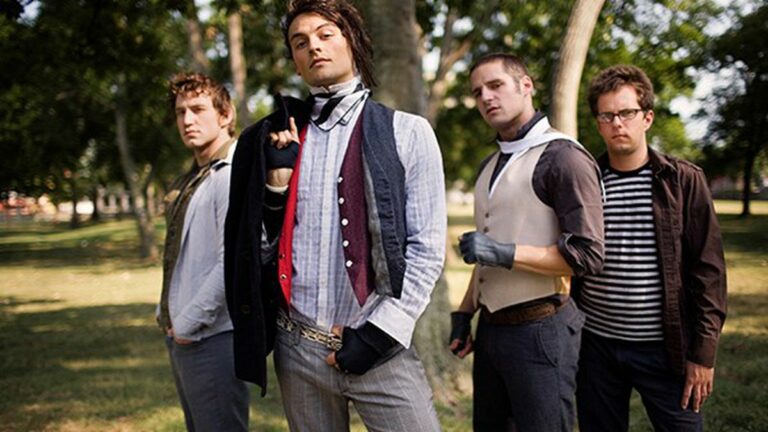
Oakland band The Matches rose to prominence at a time when East Bay pop-punk had garnered a national audience, with bands such as Green Day topping radio charts in the early Aughts. While The Matches were not quite as ubiquitous, their album E. Von Dahl Killed the Locals, with track names like “Sick Little Suicide” and “Destination: Nowhere Near,” earned them widespread acclaim among angsty, Hot Topic-dwelling teens. (In fact, having grown up in the area, I remember spending my middle school days chatting about how cool The Matches were with my friends on AOL Instant Messenger.) Ten years after the major label release of E. Von Dahl, in 2014, The Matches reunited for a successful national tour, drawing out now-grown fans who are nostalgic for their emo days. As their only shows of the year, they will perform back-to-back at The Fillmore in San Francisco on December 27 and 28.
Our December 9 music story, "Communing with the Based God," incorrectly stated that the file size of Lil B's 850-song mixtape was five megabytes. It was five gigabytes. Our December 9 feature, "New Year's Eve Guide," misstated the date for the event "Light On! Kwanzaa." It is December 30, not 31. That same story incorrectly stated that food would...
It's been a long time since we've had a good bear-attack movie. A smattering of outdoor adventures have featured competent grizzlies-on-a-rampage scenes — the young Ethan Hawke had an especially memorable encounter in 1991's White Fang — but they are few and far between. Happily, Alejandro González Iñárritu's The Revenant has now arrived to remedy the situation. But we...
Jerry Brown made quite a splash at the UN Climate Change talks in Paris this month. The mainstream press fawned over California's governor, lavishing praise on him for supposedly being a world leader in the fight to reduce greenhouse gas emissions. But environmentalists in California have long known that while Brown talks a good game on climate change, his...
A homeless camp under the 880 Freeway in downtown Oakland.
Credits: Darwin BondGraham
Since January, the City of Oakland spent $72,212 to close 162 homeless encampments and to dispose of garbage and the belongings of homeless people who are living on the city’s streets and in its parks, according to city records.
...
Stories you shouldn’t miss:
1. California regulators are proposing to ease water restrictions for hot inland areas of the state and for fast-growing regions, the LA Times$ reports. Those areas have complained loudly about the state’s water cutback requirements. Overall, the proposal, if approved next month, would reduce the mandated water cuts from 25 percent to about 22 percent in California....
“What I want you to know about children with incarcerated parents is that we are a group of children who seem to be rare, but actually we are around you every day,” said Daniel Zechao Yan, one of the subjects photographed for the show The Sentence Unseen: Celebrating Resilience, currently on view at the African American Museum & Library...
The holiday season is also the season of prime shopping opportunities for people who want to fill their homes with local art, but can’t quite afford to invest in large-scale pieces. Small Works, currently on view at Mercury 20 gallery (475 25th St., Oakland), is one of many affordable art group shows designed for holiday shoppers. But it continues...
The Space Needler’s Intergalactic Bar Guide, independently published this past summer, isn’t actually a cosmic book of cocktail recipes. Rather, it’s a collection of retro-futurist sci-fi stories detailing astronauts’ (sometimes amorous) encounters with aliens. It was authored by Will Viharo, the writer behind The Thrillville Pulp Fiction Collection Volumes 1–3 and The Vic Valentine Classic Case Files; Scott Fulks,...
Oakland rapper and producer Trackademicks is known for lush, synth-driven tracks with a nostalgic flavor that comes from his penchant for sampling vinyl and using analog equipment. Over the past ten years, he has made a major impact on Oakland’s music scene with his solo projects as well as his endeavors with his crew, HNRL, which also includes singer...
Oakland band The Matches rose to prominence at a time when East Bay pop-punk had garnered a national audience, with bands such as Green Day topping radio charts in the early Aughts. While The Matches were not quite as ubiquitous, their album E. Von Dahl Killed the Locals, with track names like “Sick Little Suicide” and “Destination: Nowhere Near,”...