Aries (March 21–April 19): John Koenig is an artist who invents new words. Here’s one that’s applicable to your journey in 2016: “keyframe.” Koenig defines it as a seemingly mundane phase of your life that is in fact a turning point. Major plot twists in your big story arrive half-hidden amid a stream of innocuous events. They don’t come about through “a series of jolting epiphanies,” Koenig says, but rather “by tiny imperceptible differences between one ordinary day and the next.” In revealing this secret, I hope I’ve alerted you to the importance of acting with maximum integrity and excellence in your everyday routine.
Taurus (April 20–May 20): The coming months look like one of the best times ever for your love life. Old romantic wounds are finally ready to be healed. You’ll know what you have to do to shed the tired traditions and bad habits that have limited your ability to get the spicy sweetness you deserve. Are you up for the fun challenge? Be horny for deep feelings. Be exuberantly aggressive in honoring your primal yearnings. Use your imagination to dream up new approaches to getting what you want. The innovations in intimacy that you initiate in the coming months will keep bringing you gifts and teachings for years to come.
Gemini (May 21–June 20): In ancient times, observers of the sky knew the difference between stars and planets. The stars remained fixed in their places. The planets wandered around, always shifting positions in relationship to the stars. But now and then, at irregular intervals, a very bright star would suddenly materialize out of nowhere, stay in the same place for a while, and then disappear. Chinese astronomers called these “guest stars.” We refer to them as supernovae. They are previously dim or invisible stars that explode, releasing tremendous energy for a short time. I suspect that in 2016, you may experience the metaphorical equivalent of a guest star. Learn all you can from it. It’ll provide teachings and blessings that could feed you for years.
Cancer (June 21–July 22): Be alert for an abundance of interesting lessons in 2016. You will be offered teachings about a variety of practical subjects, including how to take care of yourself really well, how to live the life you want to live, and how to build the connections that serve your dreams. If you are even moderately responsive to the prompts and nudges that come your way, you will become smarter than you thought possible. So just imagine how savvy you’ll be if you ardently embrace your educational opportunities. (Please note that some of these opportunities may be partially in disguise.)
Leo (July 23–Aug. 22): The silkworm grows fast. Once it hatches, it eats constantly for three weeks. By the time it spins its cocoon, it’s 10,000 times heavier than it was in the beginning. On the other hand, a mature, sixty-foot-tall saguaro cactus may take thirty years to fully grow a new side arm. It’s in no hurry. From what I can tell, Leo, 2015 was more like a silkworm year for you, whereas 2016 will more closely resemble a saguaro. Keep in mind that while the saguaro phase is different from your silkworm time, it’s just as important.
Virgo (Aug. 23–Sept. 22): “The sky calls me,” wrote Virgo teacher and poet Sri Chinmoy. “The wind calls me. The moon and stars call me. The dense groves call me. The dance of the fountain calls me. Smiles call me, tears call me. A faint melody calls me. The morn, noon and eve call me. Everyone is searching for a playmate. Everyone is calling me, ‘Come, come!'” In 2016, Virgo, I suspect you will have a lot of firsthand experience with feelings like these. Sometimes life’s seductiveness may overwhelm you, activating confused desires to go everywhere and do everything. On other occasions, you will be enchanted by the lush invitations, and will know exactly how to respond and reciprocate.
Libra (Sept. 23–Oct. 22): In the 19th century, horses were a primary mode of personal transportation. Some people rode them, and others sat in carriages and wagons that horses pulled. But as cities grew larger, a problem emerged: the mounting manure left behind on the roads. It became an ever-increasing challenge to clear away the equine “pollution.” In 1894, a British newspaper predicted that the streets of London would be covered with nine feet of the stuff by 1950. But then something unexpected happened: cars. Gradually, the threat of an excremental apocalypse waned. I present this story as an example of what I expect for you in 2016: A pressing dilemma that will gradually dissolve because of the arrival of a factor you can’t imagine yet.
Scorpio (Oct. 23–Nov. 21): The Nile is the longest river in the world. It originates below the equator and empties into the Mediterranean Sea. Although its current flows north, its prevailing winds blow south. That’s why sailors have found it easily navigable for thousands of years. They can either go with the flow of the water or use sails to harness the power of the breeze. I propose that we make the Nile your official metaphor in 2016, Scorpio. You need versatile resources that enable you to come and go as you please — that are flexible in supporting your efforts to go where you want and when you want.
Sagittarius (Nov. 22–Dec. 21): In many cases, steel isn’t fully useful if it’s too hard. Manufacturers often have to soften it a bit. This process, which is called tempering, makes the steel springier and more malleable. Car parts, for example, can’t be too rigid. If they were, they’d break too easily. I invite you to use “tempering” as one of your main metaphors in 2016, Sagittarius. You’re going to be strong and vigorous, and those qualities will serve you best if you keep them flexible. Do you know the word “ductile”? If not, look it up. It’ll be a word of power for you.
Capricorn (Dec. 22–Jan. 19): In his essay “The Etiquette of Freedom,” poet Gary Snyder says that wildness “is perennially within us, dormant as a hard-shelled seed, awaiting the fire or flood that awakes it again.” The fact that it’s a “hard-shelled” seed is a crucial detail. The vital stuff inside the stiff outer coating may not be able to break out and start growing without the help of a ruckus. A fire or flood? They might do the job. But I propose, Capricorn, that in 2016 you find an equally vigorous but less disruptive prod to liberate your dormant wildness. Like what? You could embark on a brave pilgrimage or quest. You could dare yourself to escape your comfort zone. Are there any undomesticated fantasies you’ve been suppressing? Unsuppress them!
Aquarius (Jan. 20–Feb. 18): Frederick the Great was King of Prussia between 1740 and 1786. He was also an Aquarius who sometimes experimented with eccentric ideas. When he brewed his coffee, for example, he used champagne instead of water. Once the hot elixir was ready to drink, he mixed in a dash of powdered mustard. In light of the astrological omens, I suspect that Frederick’s exotic blend might be an apt symbol for your life in 2016: a vigorous, rich, complex synthesis of champagne, coffee, and mustard. (P.S. Frederick testified that “champagne carries happiness to the brain.”)
Pisces (Feb. 19–March 20): My Piscean acquaintance Arturo plays the piano as well as anyone I’ve heard. He tells me that he can produce 150 different sounds from any single key. Using the foot pedals accounts for some of the variation. How he touches a key is an even more important factor. It can be percussive, fluidic, staccato, relaxed, lively, and many other moods. I invite you to cultivate a similar approach to your unique skills in 2016. Expand and deepen your ability to draw out the best in them. Learn how to be even more expressive with the powers you already possess.
On a cold December Sunday, people filtered into the New Parish in downtown Oakland where DJ Leydis (Leydisvel Freire) hosts her recurring Cuban dance party, La Rumba Q’Tumba. Smoke from Cuban cigars, which a man in the corner of the patio was rolling by hand, curled into dense clouds. Attendees were scattered around the tables lining the walls, feasting on grilled chicken, yucca, and moros — the Cuban version of rice and beans.
DJ Leydis looked at home behind the turntables, a smile sliding easily across her face, her head bobbing in time with the rhythms of rumba, timba, and Cuban hip-hop. Her goal, she said in an interview, was to bring a little bit of Cuba to the East Bay. “For a little moment, you travel to another country because you cannot see this kind of party every day in the Bay Area,” she said.
DJ Leydis.
Credits: Erin BaldassariDJ Leydis was one of Cuba’s first female DJs.
Credits: Erin Baldassari
DJ Leydis first arrived in the United States ten years ago after traveling for 29 hours in a boat across the Gulf of Mexico. She still remembers the fear she felt leaving everything she knew behind. “If I had to do it again, I would never,” she confessed. “People who had done it told me, ‘If you do it, make sure you have big dreams.'”
DJ Leydis had a lot to lose. She had a daughter back home, and she had already made a name for herself as one of the Cuban hip-hop movement’s first female DJs. After moving from her native Camagüey to Havana at the age of seventeen, DJ Leydis started studying música Cubana, or traditional Cuban music, but quickly fell in love with hip-hop. With racism still persistent in her hometown, DJ Leydis said listening to hip-hop made her feel proud of her African heritage for the first time.
“Beyond the words, I felt a connection with my color, my skin, my hair, my race,” she said.
DJ Leydis.
Credits: Erin Baldassari
Inspired by artists like Most Def, Busta Rhymes, Queen Latifah, and Erykah Badu, DJ Leydis got in on the ground floor of Havana’s nascent hip-hop movement in the late Nineties. She recalled using large antennae to capture radio broadcasts from Miami. In lieu of turntables, she used two CD players and a mixer to move between tracks, she said. Along with DJ Yaris, she recorded her country’s first all-female DJ mixtape, Platos Rotos, and co-founded the hip-hop collective Omegas Kilay in 2005.
DJ Leydis said that in Cuba, it didn’t matter how hard she worked or how much recognition she received. The government didn’t acknowledge hip-hop as an art form and didn’t support it, she said, limiting how far she could go in music.
“The best thing that happened in my life was when I left Cuba and came to the Bay Area,” she said.
When DJ Leydis first arrived in the East Bay, she connected with Clenched Fist Productions and ANKH Marketing, who helped her book shows. Her reputation from Cuba preceding her, it wasn’t hard to find work, she said. Within two years, she had already opened for Mos Def. Eventually, she performed alongside Erykah Badu and ?uestlove and toured with the bilingual Oakland hip-hop duo Los Rakas. But that didn’t mean life in the states was easy.
“I left my child, my mom, I lost my father — he died in a car accident, and I couldn’t go back to say goodbye. For the first few years, it was very painful for me,” she said. “Music is the only thing that’s made me continually happy in life without my family.”
With President Obama significantly loosening the embargo against Cuba nearly a year ago, DJ Leydis said her next goal is to found a cultural center that will bring artists from the Bay Area to the island nation for a cross-cultural exchange. She hopes the center will enable young people in Cuba to invest in their own community instead of leaving for the United States or elsewhere to pursue their passions. While she doesn’t regret leaving Cuba when she did, she wishes there had been more opportunities available so she could have stayed.
“Yes, I’m here right now, and I’m happy to be here, but you leave a lot,” she explained. “You leave your soul in Cuba, and that can never make you happy. Even if you make a lot of money, if you do whatever you want, it’s hard. Because you’re here, and your heart is in Cuba.”
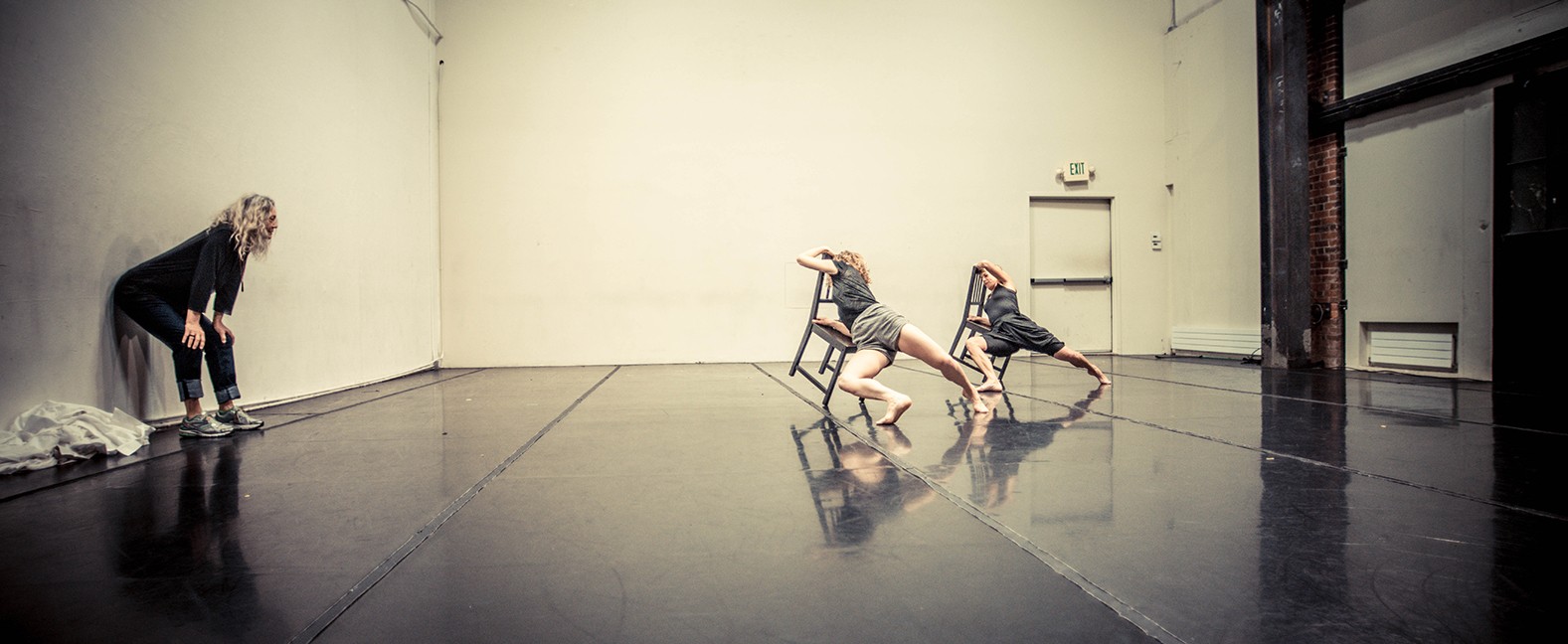
Much of Bay Area dance embodies a quintessentially regional flavor. It’s a familiar blend of experimentation; political engagement; and a DIY, community-oriented ethos. For dancers more accustomed to the comparatively rigid dance practices of the East Coast and many institutional performance programs, a taste of that looseness can be valuably liberating. In part, that’s what San Francisco’s annual FRESH Festival aims to offer its attendees. And the upcoming seventh annual FRESH will be the biggest yet by far.
The festival was founded in 2009 as a week-long intensive taught by San Francisco choreographer Kathleen Hermesdorf and her frequent musical collaborator Albert Mathias. Over the years, more instructors joined in, including the influential Sara Shelton Mann, who is now a core contributor. Over time, the festival also added performances, and last year, free community events — panels, open mics, and parties — became another crucial element. But in 2016, for the first time, FRESH will span three weeks (January 3–23).
José Navarrete.
Credits: Yvonne M. Portra
Debby Kajiyama.
Credits: Yvonne M. Portra
The dance practice portion of the festival is its core programming, taught almost entirely by Bay Area dancers (approximately half of whom are based in the East Bay) at the Joe Good Annex (401 Alabama St., San Francisco). Each day features four workshops (which change every week), with one long workshop on each weekend. The only recurring class, GUT Motives, is by Hermesdorf and Mathias; it runs throughout the festival and investigates “the act of motion from internal impulse to external expression.”
Sarah Shelton Mann, Abby Crain, and Kathleen Hermesdorf.
Credits: Robbie Sweeney
Every morning begins with somatic learning practice, such as yoga or bodywork. And each day ends with a non-traditional movement practice. For the first week, the end-of-day sessions will be taught by Sherwood Chen, who will do Body Weather — a series of sensory exercises meant to develop kinesthetic awareness and challenge the body’s limits. During the second week, Abby Crain will teach Luminous Annihilation/Clear Eyes, a practice based on Skinner Releasing, a movement method for letting go of stress. And during the third week, Sara Shelton Mann will be teaching Writing for Your Life — Dancing Because You Can, a workshop in composing choreographies based on personal journal writing. (Registration prices for the intensive range from $400 for one week to $1,200 for three weeks, including weekends).
The performances, which take place at the Joe Goode Annex on Friday and Saturday nights during the festival, each feature three pieces based on a theme that changes every weekend — “species/age/race,” “the female POV,” and “partnerships.” The performances include Hana Leed Erdman’s Animal Companion Dance, which explores the human-animal dynamic; Violeta Luna’s For Those Who Are No Longer Here, which reflects on various types of violence inflicted on female bodies; and NAKA Dance Theater’s Listen to the Gun, which draws parallels between the displacement caused by the Olympics occurring in Brazil and the recent tech boom in San Francisco. (Tickets range from $20–$30).
Sarah Shelton Mann, Abby Crain, and Kathleen Hermesdorf.
Credits: Robbie Sweeney
For those who can’t afford to do the intensives or don’t have the time, the “exchange” events, which are free and open to the public, are an easy opportunity to get involved. These will include a lead “open movement” class, a long “Works + Process” series in which dancers present and discuss a work in progress, a community performance open mic, and a few social gatherings. It also includes a “Discourse” series filled with panels on movement theory, including Phenomenology & Feminisms, or Ladies Night with Fauxnique (open to everyone), lead by local feminist drag performer Monique Jenkinson.
Ultimately, what sets FRESH Festival apart from other dance intensives, aside from its embrace of experimental techniques, are its focus on community and its effort to eliminate competition. The theme of this year’s festival is “Future Gaze,” in response to the mass exodus of artists out of the Bay Area. “How can we envision a future that’s supportive to artists here and how can we actually build interests and care that we support experimental art?” said Maryanna Lachman, one of four curators of the festival. “That’s why we chose the name, as a way to imagine how we can keep the amazing quality of the Bay Area and actually grow it rather than just working from a point of scarcity.”
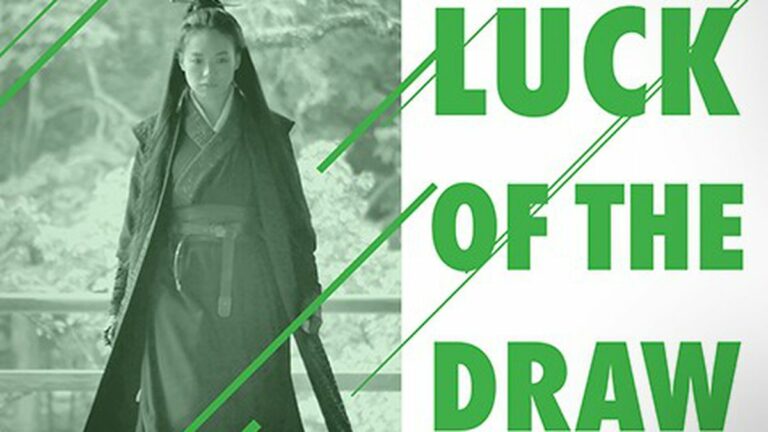
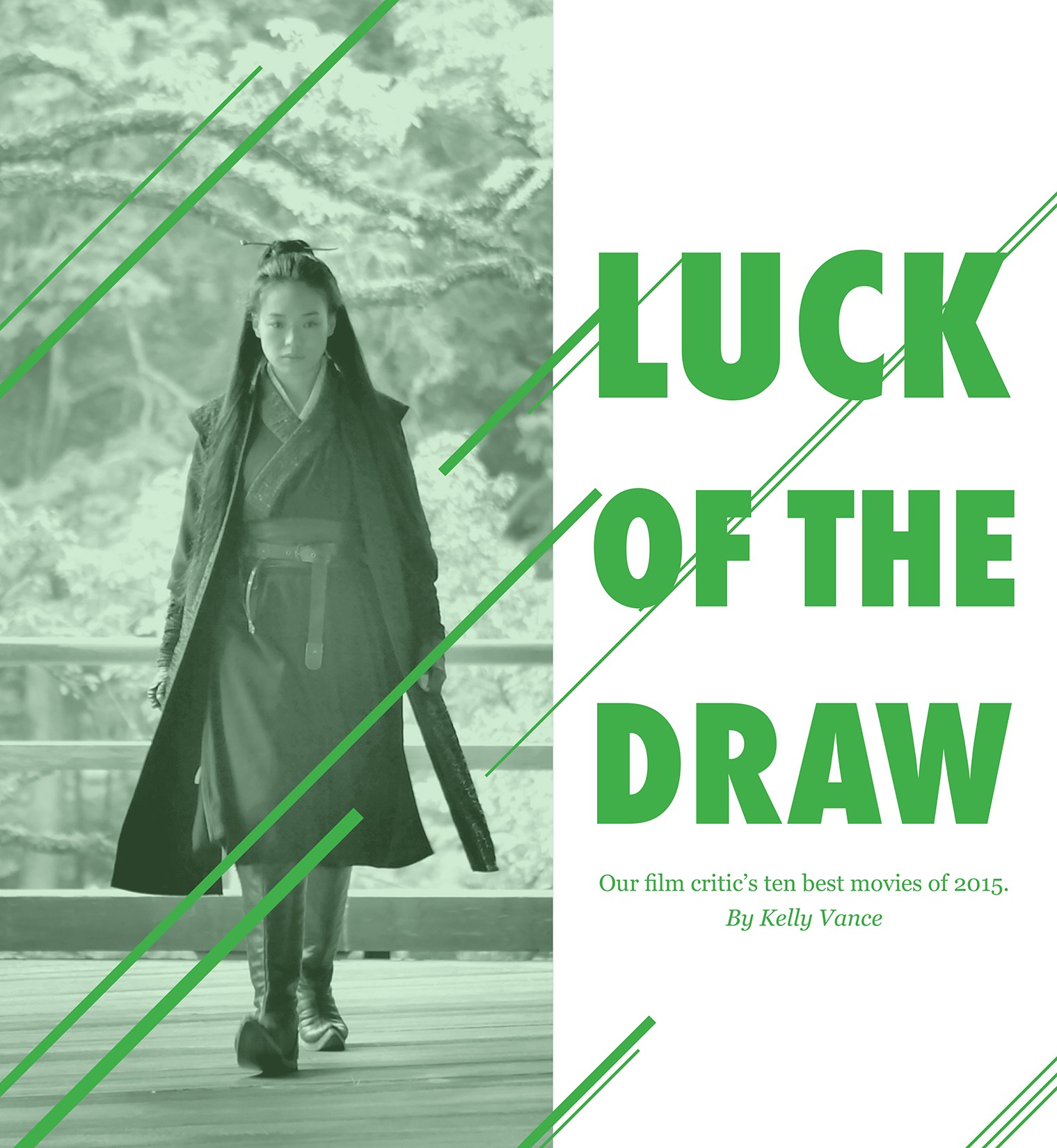
A good year, but not a great year.” That’s the word from the screening rooms on 2015. Every motion picture release schedule has its hits and flops, its moments of enchantment and wastes of time, but 2015 has been a fairly perplexing year at the movies. There was a bounty of solid, worthwhile films but relatively few — about a dozen, in fact — that made us immediately jump up and say, “Wow!” Might as well throw a year’s worth of titles in a hopper and pick them out at random, with the first ten getting the trophies, luck of the draw.
Then again, it all depends on your point of view. No roster of films that contains Love & Mercy and The Assassin can be that bad. We can’t resist believing it’s still possible to find nirvana in a dark room full of strangers, with or without popcorn. Before we go any further, here are the Ten Best Movies of 2015, in alphabetical order:
Spotlight reminds audiences of the importance of investigative journalism.
Straight Outta Compton showcases the rise and ultimate dissolution of N.W.A.
Qi Shu stars in the Assassin.
Don’t Think I’ve Forgotten: Cambodia’s Lost Rock and Roll showcases an almost forgotten era in Cambodia’s music history.
1. The Assassin
2. Brooklyn
3. The Diary of a Teenage Girl
4. Don’t Think I’ve Forgotten: Cambodia’s Lost Rock and Roll
5. Love & Mercy
6. Mad Max: Fury Road
7. Room
8. Spotlight
9. Straight Outta Compton
10. 99 Homes
[image-10]
A Reviewer’s Journal, in ten chapters:
The Assassin came and went in late October, like an autumn wind off a holy Chinese mountain. The nineteenth feature by Taiwan-based film master Hou Hsiao-Hsien (A Time to Live, A Time to Die; The Puppetmaster; Flowers of Shanghai) was probably never destined to become an art-house hit in the United States — its Tang Dynasty history is a bit of a chore for American audiences to untangle. But the story of Nie Yinniang (played by movie idol Shu Qi), a general’s daughter trained to be a silent assassin of corrupt officials, is something anyone can understand. She has to choose between duty and love. Hou’s adventure is unlike any martial arts epic that ever was: elliptical, hushed, apprehensive, with graphic violence exploding out of silence, then subsiding back into an eerie stillness. Forget the dynastic legacy and let the rhythm sweep you up into the eaves of the castle, where the assassin crouches, waiting to drop. The superb cinematography of Mark Lee Ping Bin and production design by Huang Wen-Ying enhance the director’s subtle mood of imminent fate.
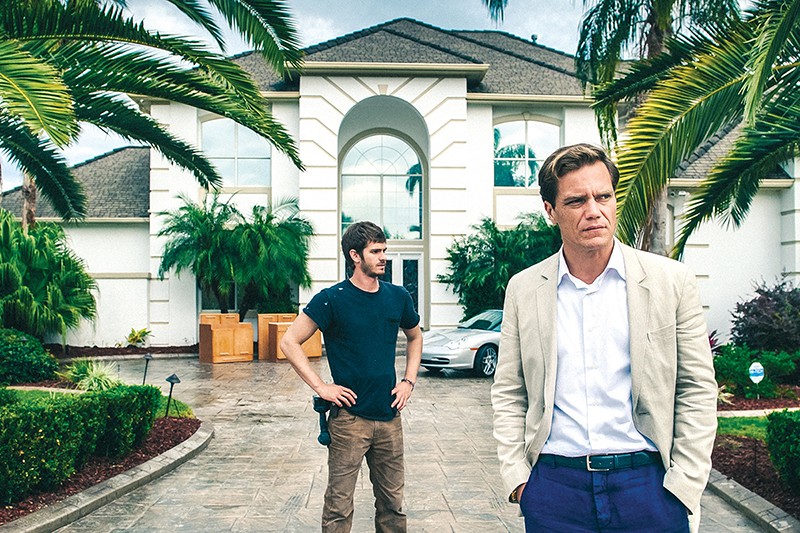
Andrew Garfield (left) and Michael Shannon star in 99 Homes.
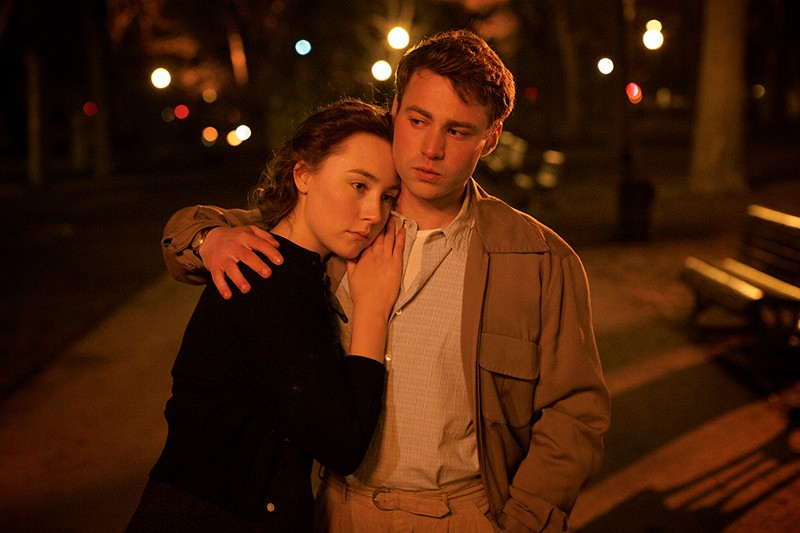
Moviegoers who have followed Saoirse Ronan’s career from Atonement through The Lovely Bones, The Way Back, How I Live Now, and the violent female-empowerment yarn Hanna, could easily imagine the young Irish actress scaling the heights and one day taking her place at the top of the movie pyramid, playing the parts Cate Blanchett does now. With Brooklyn, that day has arrived. Ronan’s performance as immigrant Eilis Lacey, newcomer to the title New York City borough in the early 1950s — adapted by Nick Hornby from Colm Tóibín’s novel, and directed in something like a state of grace by John Crowley — takes a far different tack than the slapstick Hollywood Irish malarkey of past years. Eilis’ dilemma is a turbulent one. A world of emotion plays across her face. And when the simple, oft-told tale is finished, we might feel something like pride that the “calm, civilized, and charming” Eilis has become one of us.
Shu Qi stars in The Assassin, one of this year’s best films.
Credits: Design by Roxanne Pasibe
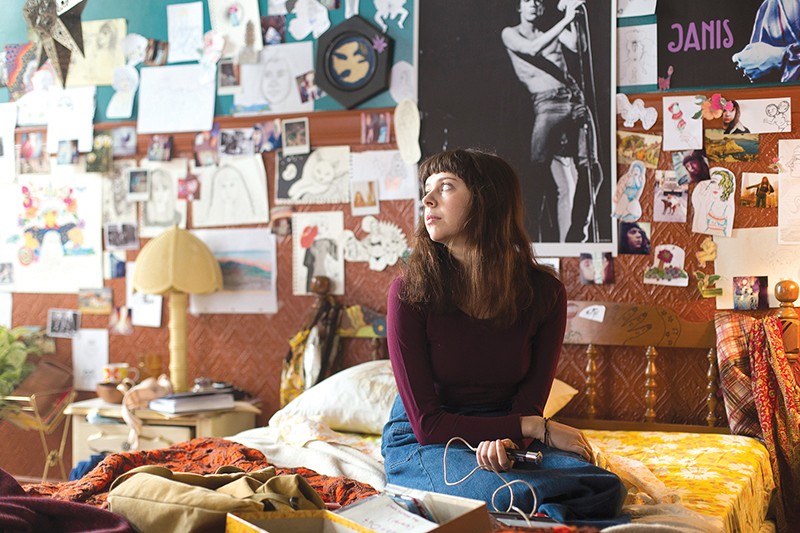
Coming-of-age flicks are thick on the ground, even ones about insecure “ugly duckling” females who freely experiment with sex. But Marielle Heller’s The Diary of a Teenage Girl is the most exotic bird in the jungle, the energetic, ironic, humorous, touching, frank, playful, salty-sweet, all-embracing saga of a liberated 1970s San Francisco teenager named Minnie Goetze (played by English actress Bel Powley) and her tussles with life and love. Writer-director Heller, who once upon a time portrayed Minnie on stage, adapts Phoebe Gloeckner’s graphic novel as if her life depended on it, with bravura playacting by Powley, Kristen Wiig, and Alexander Skarsgård. San Francisco plays itself, winningly. We reviewed it last summer, but the frank sex scenes — very rare in the juvie showbiz arena — and the nifty jukebox of period rock tunes by Television, Nico, Heart, T. Rex, Iggy and the Stooges, and Mott the Hoople are still reverberating. So are the family dynamics of Minnie’s picturesquely dysfunctional relatives. Powley’s perf is one the year’s best surprises.
[image-11]
Don’t Think I’ve Forgotten: Cambodia’s Lost Rock and Roll should, by all rights, be one of the most depressing films of the year. Instead, director-producer-cinematographer John Pirozzi’s documentary is one of 2015’s most bracing entertainments — the story of how rock music flourished in Phnom Penh, Cambodia in the 1960s and ’70s, and how despite the Khmer Rouge’s horrendous reign of terror, that spirit still lives on. Cameraman-turned-filmmaker Pirozzi (he made the music doc Sleepwalking Through the Mekong with the band Dengue Fever) unearths a treasure trove of period footage. Dapper guys in skinny suits and sexy, bouffant-haired girl singers perform for sophisticated Phnom Penh nightclub crowds. The country seems prosperous and happy. And then they disappear into the killing fields. The look on the faces of the few survivors, interviewed in today’s Cambodia, is something you’ll not soon forget. But these days the voices of such singers as Ros Serey Sothea, Huoy Meas, Pen Ran, and Sinn Sisamouth are available in Cambodian markets, as if the Khmer Rouge had never existed. Best of all, the music sounds as cool today as ever.
Shu Qi stars in The Assassin, one of this year’s best films.
Credits: Design by Roxanne Pasibe
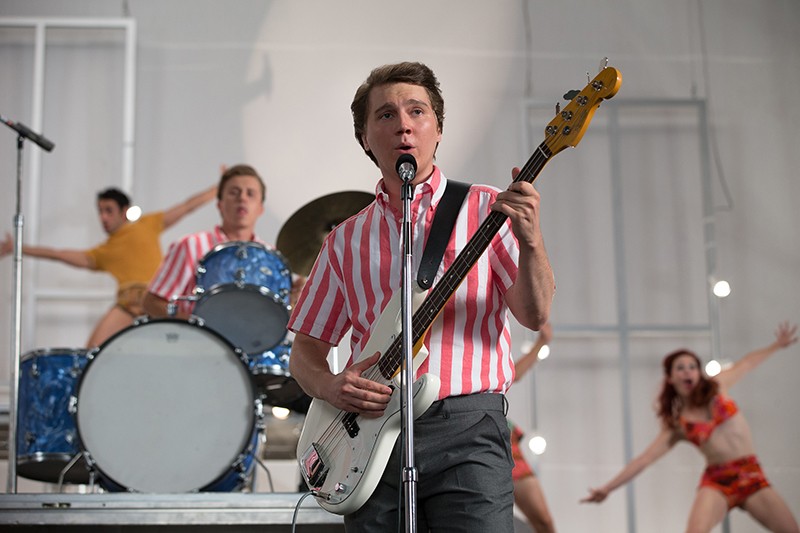
If this Ten Best list seems slightly skewed toward pop music, that’s because nothing, not even film, tells a story like a song. Proof of that hypothesis: Love & Mercy. If we were to strip away director Bill Pohlad’s extravagant visuals, the mini-stream-of-consciousness imagery built into the chronicle of the Beach Boys’ Brian Wilson, we could listen to the soundtrack and almost get the same effect. The tunes keep on coming as Wilson — played by Paul Dano and John Cusack at different stages of his life — creates, comes unglued, suffers, and then is re-glued by girlfriend Melinda Ledbetter (Elizabeth Banks, in one of the year’s warmest acting turns).
Both Dano and Cusack tap directly into the tormented-genius vibe. The sound mixing, sound editing, and film editing are of masterpiece quality, rich and multilayered. Love & Mercy was released in June and has been the year’s most rewarding film ever since. Special kudos to Paul Giamatti for his role as monster-in-chief Dr. Eugene Landy, yet another example of the actor’s range. A triumph for everyone involved, especially producer-turned-director Pohlad and the ace screenwriting team of Oren Moverman and Michael Alan Lerner, adapting Brian Wilson’s true life story. Wouldn’t it be nice if every movie this year were this full of unbridled emotion? Nominated as this movie’s companion on a twin bill: Denny Tedesco’s session-players-heaven doc, The Wrecking Crew, in which Wilson gets prominent mention.
Paul Dano stars as a young Brian Wilson in Love & Mercy.
Cut with utmost precision, packed with striking physiognomies, and dedicated to the proposition that all fleeing creatures, male and female, are created equal, George Miller’s Mad Max: Fury Road is the year’s most provocative actioner by far, a rip-roaring environmentalist opera on wheels. A few literal-minded critics have scoffed that Miller’s return to his dystopian outback fantasy franchise, after a thirty-year hiatus, is “nothing more than a chase movie.” One might as well disparage The Searchers for dwelling on cowboys and Indians. Somewhere on the road to Gas Town, the kinetic thrust of the Mad Max saga snaps into place as if it had only been paused for a moment or two, and we’re off. A revolt in the harem, rolling molotovs, blue night-time mud flats, a skooch of Burning Man (ahem), the holy bag of seeds, Furiosa’s fury, feminocracy versus patriarchy, and film editing that would have impressed Russ Meyer — no other film spectacle this year comes close to Max’s apocalyptic doorbell buzzer, one more reason to study Australian filmmaking. The most convincing of Tom Hardy’s three starring roles in 2015 (alongside Legend and The Revenant) and complete vindication for Charlize Theron. Victory! Water! Equal rights! A splendid blur, wondrous to gaze upon.
Tom Hardy and Charlize Theron star in Mad Max: Fury Road.
Room is one of those films that slipped past unobtrusively in the hurly-burly of the autumn rush, only to reveal itself later as something wise and compassionate. What might have been a lurid crime thriller instead magicks itself into a guardedly hopeful family drama with redemption on its mind, powered by Brie Larson and professional child actor Jacob Tremblay’s perfs as an unlucky-lucky mother and her star-crossed son, who gets his chance to explore the world’s most basic wonders long past his rightful infancy. Director Lenny Abrahamson, screenwriter-novelist Emma Donoghue, lead combo Larson and Tremblay, supporting actress Joan Allen, and Stephen Rennicks, composer of the film’s original score, all deserve praise. Whatever mood you’re in when you start watching Room, you’ll be in a different state when the final credits roll.
Saoirse Ronan stars in Brooklyn.
Spotlight belongs to the “bad old days” school of storytelling. As in Black Mass and Truth, we’re reminded that sometime in the past, things were not quite so safe and secure for certain overlooked groups of people. In the case involving predatory Roman Catholic priests in Boston exposed by crusading newspaper reporters, the overlooked people were mostly little kids, the sexual-assault victims of men who went unpunished for years. The inherent pathos of that vector of criminality is what sets Spotlight apart — that, and the comradely workings of the Boston Globe‘s team of investigative news hounds, winningly played by Michel Keaton, Mark Ruffalo, Liev Schreiber, Rachel McAdams, John Slattery, and Brian d’Arcy James, with the added strength of Stanley Tucci and Billy Crudup. With such a platoon of scene-stealing character actors, we might be tempted to say that Spotlight doesn’t need any help from writers Tom McCarthy (who also directed) and Josh Singer. But we’d be wrong. This is one “ripped from the headlines” social commentary that ultimately rewards us for our feelings of revulsion.
A scene from Room.
One aspect of rap music that doesn’t get discussed enough is the sheer spectacle of it. Straight Outta Compton delivers that. Plus, the expected sex and violence. And of course, social commentary. Gotta have that. In common with the Beach Boys and the Wrecking Crew, the founders of N.W.A. spent a lot of time in recording studios, only instead of walking right in and getting to work, all too often they got braced and slapped around by the LAPD on the sidewalk in front, presumably because they looked too “ghetto,” like they didn’t belong there. That’s only one of the big takeaways of F. Gary Gray’s blistering behind-the-scenes peek at the life and times of Ice Cube (O’Shea Jackson Jr.), Dr. Dre (Corey Hawkins), Eazy-E (Jason Mitchell), DJ Yella (Neil Brown Jr.), MC Ren (Aldis Hodge), Suge Knight (R. Marcos Taylor), and the rest of the heavily mythologized practitioners of this country’s best-selling indigenous music. Matthew Libatique’s camera work is sensational. So is the anger. And yes, that’s Paul Giamatti again, as another slippery facilitator, manager Jerry Heller. No other film on our list explains more about life in modern urban America than Straight Outta Compton.
More “bad old days,” the Florida foreclosure debacle during the Great Recession, a time we might prefer to forget, except that it has meaning — 99 Homes takes us there and shows us who did what, and to whom, and why. Actors’ actor Michael Shannon plays the chief baddie, a carrion-eating real estate mogul-in-training whose routine (for him) eviction of family man Andrew Garfield and his dependents (disastrous for them) sets in motion a story of near-biblical irony. Instead of murdering his tormentor in the street, newly homeless Dennis (Garfield) goes to work for sharpie Rick (Shannon), passing the misery on to a new succession of sub-prime-mortgage chumps. Think D.W. Griffith, from his Intolerance days. Or Kurosawa Kiyoshi’s Tokyo Sonata. Or insert your favorite meltdown/gentrification/Golden Age horror story, where applicable. Filmmaker Rahmin Barani (At Any Price, Goodbye Solo) is trying to tell us something about ourselves. Some of us are listening. You should too.
Bel Powley gives an impressive performance in The Diary of a Teenage Girl.
Some of the “merely good” movies that made it so difficult to choose the very best this year, in no particular order: The Revenant by Alejandro González Iñárritu; The Wonders by Alice Rohrwacher; Trumbo by Jay Roach; Bridge of Spies by Steven Spielberg; The Martian by Ridley Scott; Carol by Todd Haynes; The Danish Girl by Tom Hooper; Dope by Rick Famuyiwa; Sicario by Denis Villeneuve; The End of the Tour by James Ponsoldt; Truth by James Vanderbilt; Mistress America by Noah Baumbach; Infinitely Polar Bear by Maya Forbes; Testament of Youth by James Kent; The Clouds of Sils Maria by Olivier Assayas; Irrational Man by Woody Allen; Concussion by Peter Landesman; The Gift by Joel Edgerton; ’71 by Yann Demange; Queen and Country by John Boorman; The Taking of Tiger Mountain by Tsui Hark; Black Souls by Francesco Munzi; Theeb by Naji Abu Nowar; Results by Andrew Bujalski; Jimmy’s Hall by Ken Loach; and Far from the Madding Crowd by Thomas Vinterberg.
More decent movies that fell just a bit short: Beasts of No Nation by Cary Joji Fukunaga; Time Out of Mind by Oren Moverman; The Walk by Robert Zemeckis; Kumiko the Treasure Hunter by David Zellner; Experimenter by Michael Almereyda; Jafar Panahi’s Taxi; Mr. Holmes by Bill Condon; Tangerine by Sean Baker; The Big Short by Adam McKay; Legend by Brian Helgeland; Still Alice by Richard Glatzer and Wash Westmoreland; Timbuktu by Abderrahmane Sissako; Good Kill by Andrew Niccol; Breathe by Mélanie Laurent; The Stanford Prison Experiment by Kyle Patrick Alvarez; Beloved Sisters by Dominik Graf; Hard to Be a God by Aleksey German; Marshland by Alberto Rodríguez; Gett:The Trial of Viviane Amsalem by Ronit Elkabetz and Shlomi Elkabetz; and Cash Only by Malik Bader. Plus, these designated 2015 releases that are receiving play dates in 2016 and are still to be reviewed: The Lady in the Van by Nicholas Hytner; Aferim! by Radu Jude; Son of Saul by László Nemes; 45 Years by Andrew Haigh; and Mustang by Deniz Gamze Ergüven.
Underwhelming as 2015 was for narrative features, it was a banner year for documentaries, especially musical profiles. In that category, Janis: Little Girl Blue; The Wrecking Crew; Cobain: Montage of Heck; Amy; A Poem Is a Naked Person; Lambert & Stamp; Song of Lahore; and What Happened, Miss Simone? stand out. Notable docs on the world of film include: Hitchcock/Truffaut; Neorealsim: We Weren’t Just Bicycle Thieves; Listen to Me Marlon; and Tab Hunter Confidential. On general subjects: Meru; The Black Panthers: Vanguard of the Revolution; The Royal Road; A German Youth; Deep Web; Cartel Land; Steve Jobs: The Man in the Machine; 3 ½ Minutes, 10 Bullets; In Jackson Heights; The Creeping Garden; Peggy Guggenheim: Art Addict; Best of Enemies; Where to Invade Next; Steak (R)evolution; Dark Star: H.R. Geiger’s World; Drunk Stoned Brilliant Dead; Deli Man; The Look of Silence; Something Better to Come; Live from New York!; Merchants of Doubt; Red Army; She’s Beautiful When She’s Angry; We Come as Friends; and a marvelous one-off at the San Francisco International Film Festival, Beyond Zero: 1914-1918, a live, onstage collaboration of filmmaker Bill Morrison, composer Aleksandra Vrebalov, and the Kronos Quartet, on the subject of World War I.
One showbiz documentary deserves particular mention: Andrew Leavold’s The Search for Weng Weng, a light-hearted documentary profile of Weng Weng, aka Ernesto de la Cruz (1957–1992), the diminutive Filipino star of such spy and detective spoofs as For Y’ur Height Only and The Impossible Kid of Kung Fu — in which we learn that he was more than just a figure of fun, especially to his colleagues.
Re-release of the year: Satyajit Ray’s Apu Trilogy — Pather Panchali (1955), Aparajito (1956), and Apur Sansar (aka The World of Apu, 1959) — is rightfully ranked as one of world cinema’s finest achievements. Janus Films’ summertime theatrical re-release, screened locally at Landmark movie houses, offered movie lovers a chance to see Ray’s timeless coming-of-age tale in all its large-screen glory, complete with Subrata Mitra’s entrancing images and a beautiful musical score by Ravi Shankar.
And now we come to the “Thematic Material and Some Disturbing Images” file, or as we call it, the Storm Cellar. Writer-director David Robert Mitchell’s It Follows is the horror film of the year, with Ana Lily Amirpour’s Farsi-language, California-made vampire pic A Girl Walks Home Alone at Night as runner-up. Guy Maddin’s the Forbidden Room secures the sustained oddness award. The junkies-on-holiday double feature of the year is Ben and Joshua Safdie’s Heaven Knows What, plus Collin Schiffli’s Animals. Rounding out the Storm Cellar playlist are: Scott Cooper’s Black Mass; Gaspar Noé’s Love; Severin Fiala and Veronika Franz’s Goodnight Mommy; Sebastian Schipper’s Victoria; Céline Sciamma’s Girlhood; Mia Hansen-Løve’s Eden; Anne Fletcher’s trashy romp Hot Pursuit; and the most indescribable film of the year, Roy Andersson’s A Pigeon Sat on a Branch Reflecting on Existence.
Most feature films are about winners. After all, those are the people the majority of movie fans buy tickets to see. It requires a certain amount of courage to depict the other side, where the bulk of the world’s population resides. Here’s a provisional lineup for the 2015 Have-Nots Film Festival: 99 Homes, The Lady in the Van, Beasts of No Nation, Time Out of Mind, We Come as Friends, Something Better to Come.
It takes real effort to produce entertainments as off-putting as the items that dwell on Rotten Row. As a combination of dubious subject matter and impenetrable treatment, Danny Boyle’s Steve Jobs is hard to top. But for high-profile tedium as well as shameless mercantilism, Brad Bird’s two-hour-plus Disney infomercial Tomorrowland takes the cake as the worst movie of the year. It faced determined competition, however. For your consideration: Pierre Morel’s The Gunman; Andrew Mogel and Jarrad Paul’s The D Train; Noah Baumbach’s While We’re Young; Susanne Bier’s Serena; David Cronenberg’s Maps to the Stars; Richard LaGravenese’s The Last Five Years; Michael Mann’s Blackhat; and, vying with The Hunger Games movies for the title of All-Time Ill-Founded Series, Fifty Shades of Grey — the first stop on what promises to be a trail of fake orgasms.
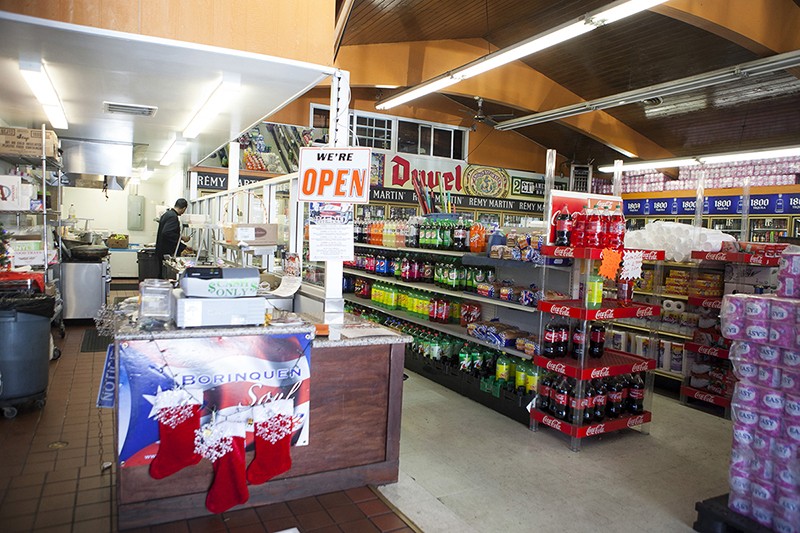
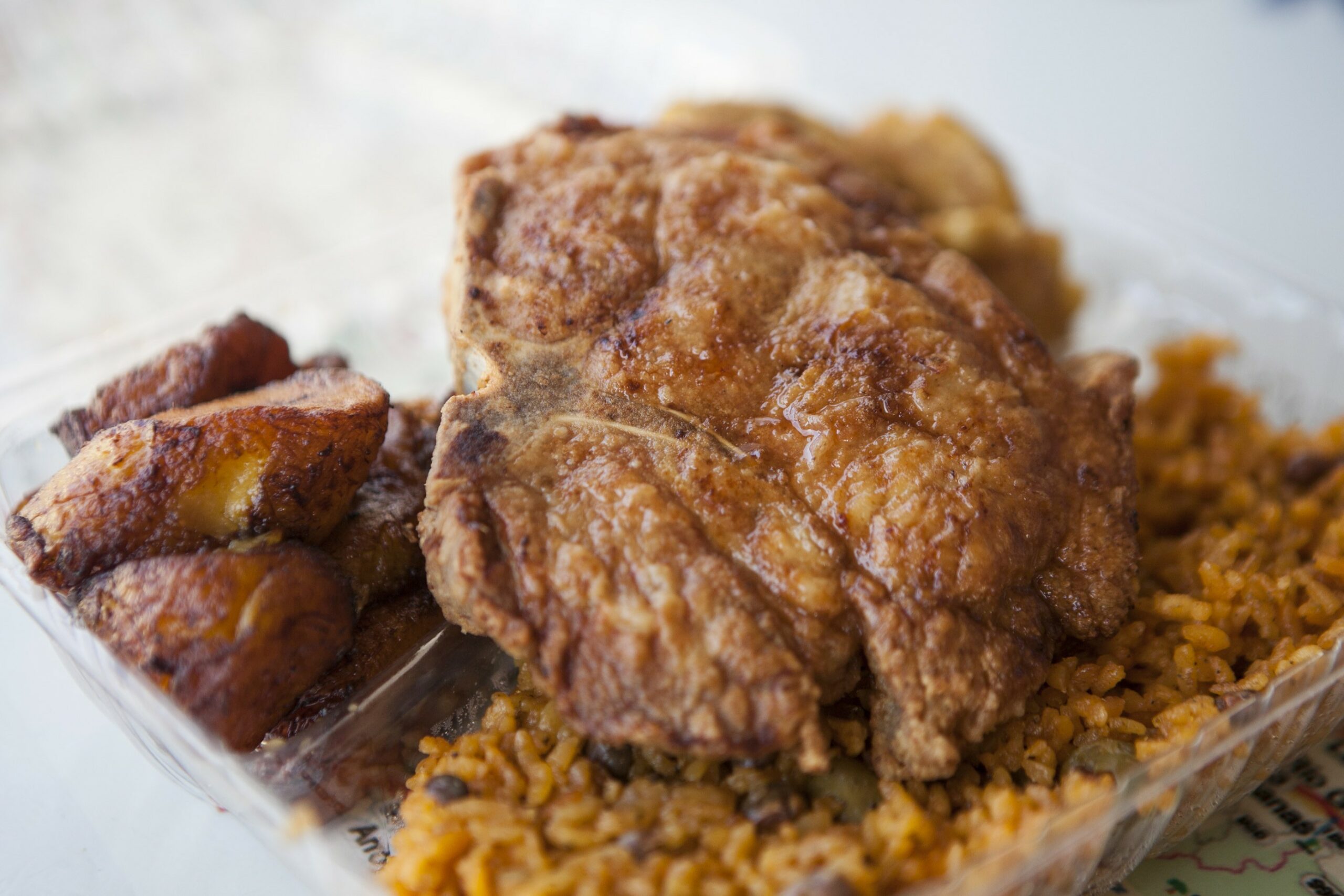
Every Latin cuisine has its own take on rice and beans, but few are as singular, or as delicious, as the arroz con gandules at Borinquen Soul, a Puerto Rican kitchen that has taken up permanent residence inside the Two Star Market convenience store in Oakland’s Dimond district. Here, the rice is orange-red, as though stained with ketchup, and studded not with black or kidney beans, but with pigeon peas (the gandules), which you might mistake for plain old green peas — but have the starchiness and the satisfying al dente bite of a much sturdier dried legume.
Mostly, though, what you’ll notice is the smell of the rice — the heady mix of cooked onions, garlic, sweet peppers, cilantro (and its cousin, culantro), and other aromatics known as sofrito, which forms the base of almost all Puerto Rican cooking.
Borinquen Soul is housed inside the Two Star Market.
That smell — along with the proliferation of Puerto Rican flags on every available wall and counter surface, and the lilting hook of the reggaeton number playing on the speakers — is the unmistakable signal to any homesick Boricua who walks in the door: Real-deal Puerto Rican food, like what your abuela used to make, now has a home in Oakland.
Sandwiched between two hair salons, the Two Star Market is your run-of-the-mill convenience store — neat aisles well stocked with assorted junk food and brand-name booze — apart from the fact that it houses a fully equipped commercial kitchen. For a while, the takeout counter was known as The Snack Bar, a kind of stoners’ paradise that specialized in late-night burgers and fried foods. In July, Borinquen Soul started serving its Puerto Rican dishes during the lunch shift, and, soon after, took over the convenience store’s food operation altogether.
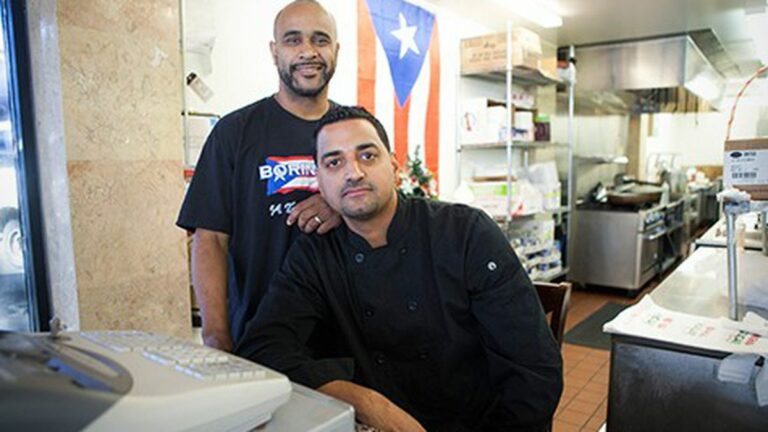
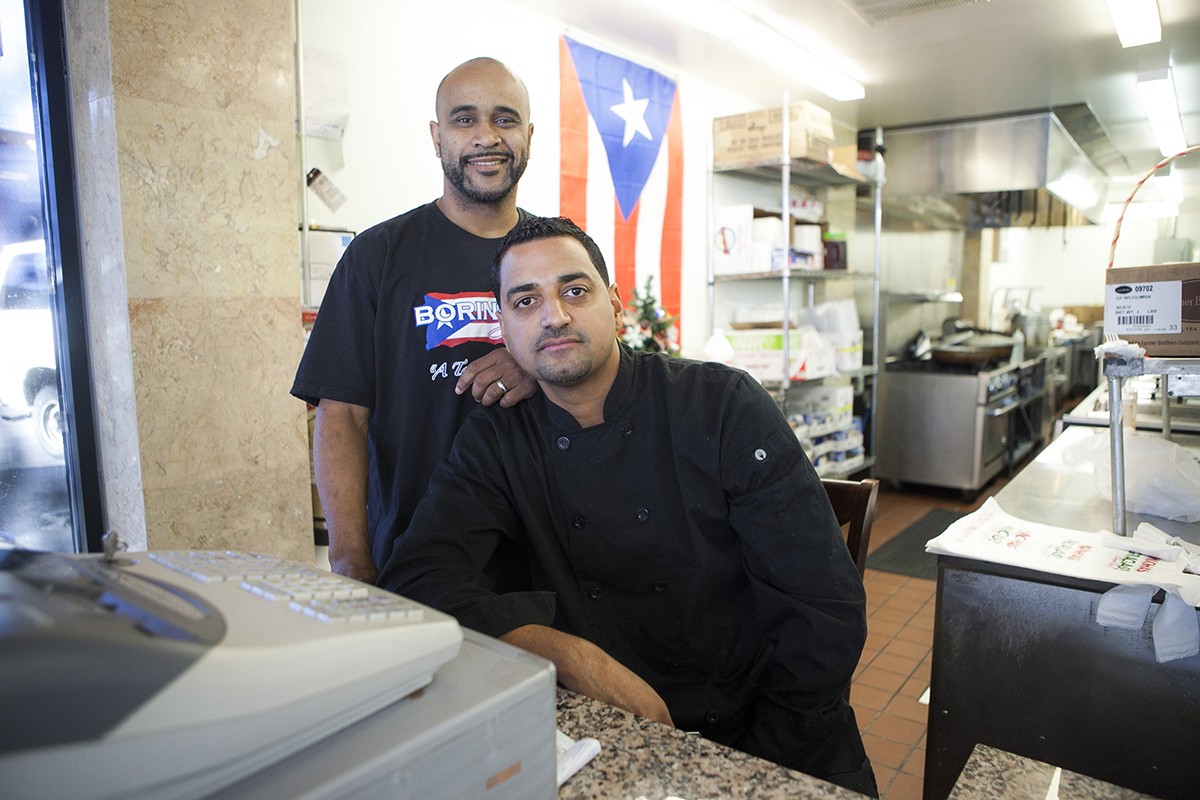
Eric Rivera (left) and Christopher Caraballo.
Credits: Erin Baldassari
According to co-owner Christopher Caraballo, Borinquen Soul is a scrappy “startup company” that he and fellow Bronx native Eric Rivera built up over the course of the past four years. The first incarnation was touted by its owners as the Bay Area’s first and only Puerto Rican food truck. But a year ago, just as the business was making a name for itself on the local festival and food pod circuit, the truck was sideswiped by a hit-and-run driver. The company’s insurance policy didn’t pay out nearly enough for a new truck, and so for several months, before the Two Star Market opportunity came up, the future of Borinquen Soul was very much in question.
Now, the business appears to have a steady stream of takeout customers, many of them Puerto Rican expats and transplanted East Coasters. The obvious reason is that for all intents and purposes, Borinquen Soul is the only full-fledged Puerto Rican restaurant, really, in the entire East Bay.
The more important reason is that the food is damn good by any standard. Caraballo serves as head chef of the operation, but he said most of the credit belongs to his mother, Isabel Caraballo, whose recipes serve as the starting point for most of Borinquen Soul’s dishes. This is Puerto Rican grandma food, literally. In fact, Caraballo said the name of the business — after the indigenous Taino people’s name for the island of Puerto Rico, “Borinque” — is meant to represent their old-school, “old soul” cooking philosophy.
In case you have any doubt: The rice alone is worth a special trip — so savory and aromatic, with that telltale orange tint that comes not from tomato sauce, as one might suspect, but from the annatto oil that’s used to cook that sofrito paste, imbuing it with an extra layer of nutty complexity. The arroz con gandules form the base for all of the four or five combo meals that make up a standard order on Borinquen Soul. In addition, you get the entrée of your choice, plus either plantains — either the impeccably ooey-gooey sweet maduros or crisp and savory twice-fried tostones, which are made from green plantains and are like a cross between a smashed potato and a yucca chip — or a salad.
Caraballo and Rivera originally built their reputation on a dish of grilled chicken and caramelized onions, which I tried and enjoyed back in Borinquen Soul’s food truck days — and am happy to report is better than ever, thanks to their decision to switch to chicken thighs instead of the breasts, which were prone to dryness. The meat comes topped with “Borinquen Soul Sauce,” which is Caraballo’s version of mayuketchu, Puerto Rico’s default condiment, which is normally a straight-up mixture of mayonnaise and ketchup. The “soul sauce” turns the dial up on this otherwise basic condiment by adding a dash of chili spice and some of that house-made sofrito, which adds its earthy vegetal quality to the mix.
Eric Rivera (left) and Christopher Caraballo.
Credits: Erin Baldassari
Whatever you order, ask for a couple extra tubs of this amped-up mayuketchu. It goes well with everything on the menu, but especially with the empanadillas (Puerto Rican-style fried empanadas) and the bacalaito, a pancake-like salt-cod fritter that I loved for its golden-brown exterior crunch and surprisingly mellow salted-fish flavor.
In a drastic departure from the food truck days, when vegetarians had to content themselves with a meal of plantains and, well, that’s about it, Borinquen Soul is now, as Caraballo put it, 100-percent “California-friendly.” Though they aren’t listed explicitly on the menu, the restaurant now sells vegetarian empanadillas in addition to its more typical stewed-chicken and ground-beef options. And the house salad, with its tangy-sweet dressing and its enormous cubes of cucumber and avocado, speaks to the local farmers’ market crowd as much as it does the tropics.
Still, the restaurant — if you can call a convenience store without proper seating and just a few stools where takeout customers can wait for their orders a restaurant — reserves its greatest pleasures for meat lovers. On Saturdays only, there is pernil, a slow-roasted pork shoulder that’s typically reserved for major holidays. Whole pork shoulders get marinated for 24 hours with garlic, peppercorns, and various aromatics, the fatty skin peeled back so that the flavors can penetrate the meat. The meat is roasted, first at a high heat to crisp the skin, then low and slow, until it is unspeakably tender and pulls apart like good Mexican carnitas, except saltier and more garlicky. The best part is how the pork is slicked with the concentrated meat juices, which are flavored with all the caramelized bits from the pan. Or, scratch that: The best part is the crispy skin — or cuero — which is reserved on the side, only given to customers who ask for it, which any seasoned pernil connoisseur knows to do.
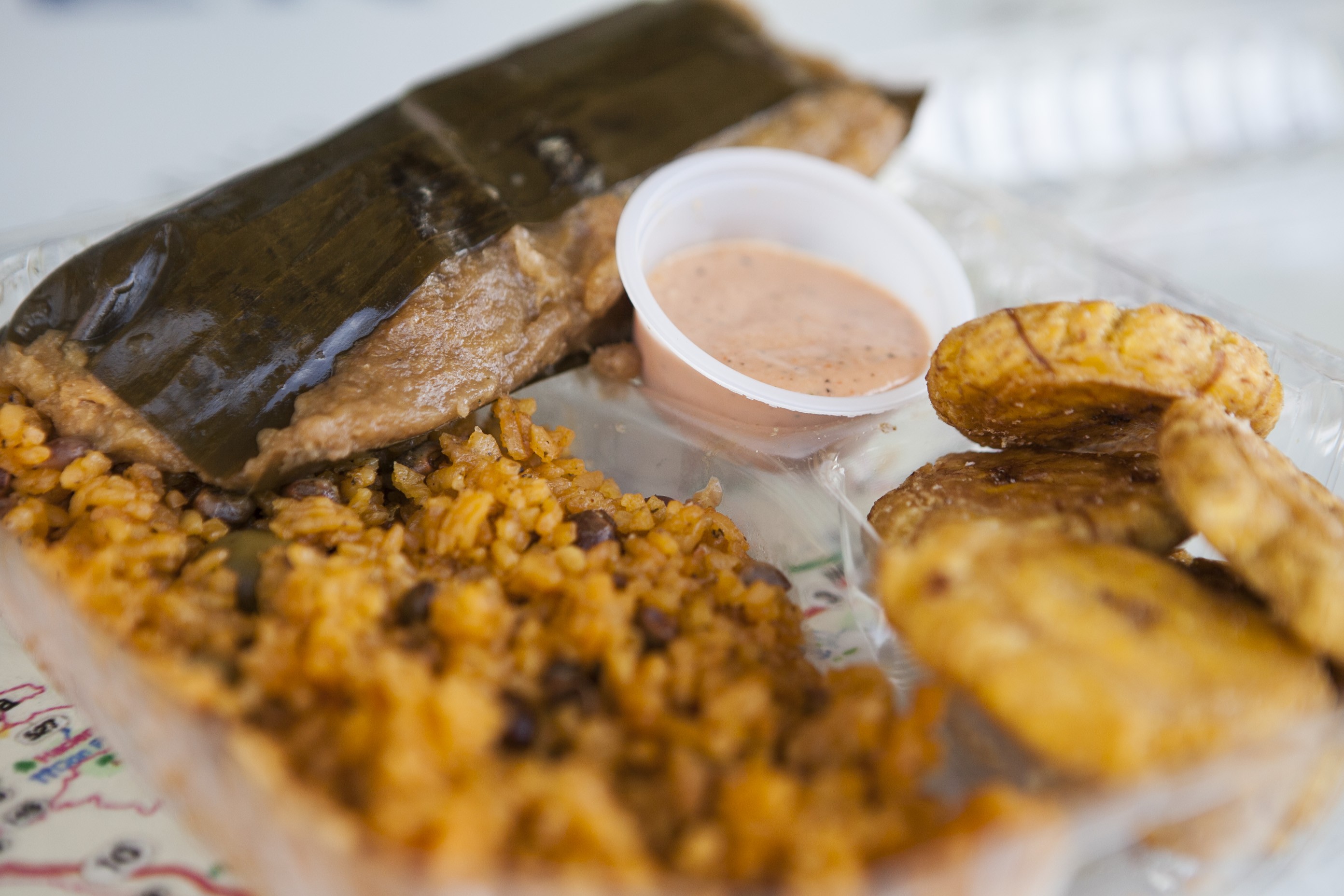
Borinquen Soul is also probably the only place in the Bay Area where you can buy scratch-made, freshly steamed pork pasteles — Puerto Rico’s plantain-leaf-wrapped version of tamales and the island’s quintessential Christmas dish — on a daily basis. This was easily the most interesting dish I had in my visits to Borinquen Soul. The masa for the pasteles is made not with corn but rather grated green plantain and yautia, a root vegetable similar to taro.
Once you open the steamed bundle, you’re struck by the masa’s somewhat slimy texture and how extraordinarily fragrant it is. After steaming in that masa for an hour, the pork takes on a striking earthiness that reminded me of dried scallops, giving the whole package a flavor profile that I found strikingly similar to zhongzi (aka “Chinese tamales“).
Coincidentally, it turns out that pasteles are delicious with sriracha — not a traditional condiment on the Puerto Rican holiday table, I’m sure. But here in Oakland, we’re lucky: We can eat pasteles every day.
Pork pastel, tostones, and arroz con gandules, with a side of the house mayuketchu.
Credits: Erin Baldassari
Although this article describes the storm quite well, it fails to find a solution, largely because it seems to promote the very criteria that caused the storm to begin with. The problem arises from government policies that discourage the construction of new housing. Misguided policies such as rent control and eviction control have discouraged the building of new units in Oakland. In addition, anti-police rhetoric and excessive crime discourage law-abiding developers who want to build in safe and secure neighborhoods.
After putting in place government policies that restrict new housing, discourage the construction of new housing, and punish landlords, the proponents now want to put into place additional legislation that again restricts the rights and economic opportunities of housing developers and owners.
This article has it right regarding the problem: not enough housing. But it fails to address the solution: how to build more housing. Remember, the government does not build new housing, people build new housing. If you discourage the builders — people — you discourage new housing. I would end with the best and truest statement in the article: “Fundamentally, Oakland’s housing crisis is a problem of supply and demand — more people at all income levels need more housing than what is available.”
Jerry Udinksy, Oakland
“Berkeley’s Win-Win,” Seven Days, 12/16
You Missed Something
Two small corrections to this piece, which is otherwise great:
1. Many other cities require two parking spaces per unit. One is less common.
2. UC Berkeley has done a lot more than “essentially nothing.” In particular, several student housing projects have been built in the last few years, and a large new one was just proposed on an existing parking lot.
Chris Harrelson, Berkeley
Activists Helped
The council only approved the additional $4.5 million in affordable housing funds ($6 million would have been required of any development) for this project because of pressure from housing advocates and the actions of the Zoning Adjustment Board. Initially, these extra funds were not in the cards. I am one of the people fighting for affordable housing who is not against large buildings. We are looking for a reasonable balance of housing at all levels.
Kate Harrison, Berkeley
“Why The Curtain Fell,” Then and Now, 12/16
Great Job
A nicely done story, Laurel Hennen Vigil! And thanks for the photos. Despite looking at hundreds of old Oakland theater photos, I hadn’t seen either of the [ones featured on EastBayExpress.com].
Bill Counter, Sacramento
An Untold Story
A lost footnote to this story is a fact about East Bay movie theaters in Richmond, Berkeley, and Oakland told to me by my grandfather. He, like thousands of other African-American men, came to Oakland in the 1940s from Texas, seeking jobs at East Bay shipyards and a better life, away from discrimination, racism, and terror in the South. The story he told was that although there were jobs to be had, there was not adequate housing for the men who came here to fill them. According to him, many men who had no place to live spent many nights sleeping in the back of movie theaters. They would then wash up and have breakfast at a restaurant along San Pablo or Shattuck avenues before going to work. The men got paid on Friday and many went to San Francisco and got hotel rooms in the city for weekend partying. Some survived for months in this routine until they could find more stable housing situations. If it were not for these movie theaters, who knows how these men would have made it.
Gary Patton, Hayward
“No Place to Go,” News, 12/9
It’s Lunacy
Thank you for “No Place to Go,” which states squarely the lunacy of decrying and criminalizing the obvious result of a lack of convenient restrooms without providing any. Your readers might be interested to know that the Downtown Berkeley Association, which had a hand in creating this new law, lobbied against a public bathroom in the upcoming [Downtown Berkeley] BART Plaza renovation on the grounds that it would become an “attractive nuisance.”
On January 12, the Oakland City Council’s Community and Economic Development committee will consider detailed proposals for applying development impact fees to new market-rate housing projects. It will also be the first chance for the public to weigh in on the city’s newly proposed impact fees, which could raise as much as $60 million for affordable housing over the next ten years, according to estimates by city staffers. Two smaller fees for capital improvements and transportation could raise an additional $18 million during that time.
But the total amount of money that the city will raise will depend on what projects the city council exempts from paying the fees, whether the council applies different fees to different parts of the city, and how long it will take to phase in the fees. Affordable housing advocates are worried that too many real estate projects could end up being exempted, and that the fees might be set too low, resulting in less affordable housing production over the coming decade. Developers, by contrast, worry that high fees phased in too quickly will make their projects financially infeasible.
Under the city’s plan, this proposed apartment building in downtown would pay $5,000 a unit if the developer gets a building permit after July 1, 2016.
Credits: Wood Partners
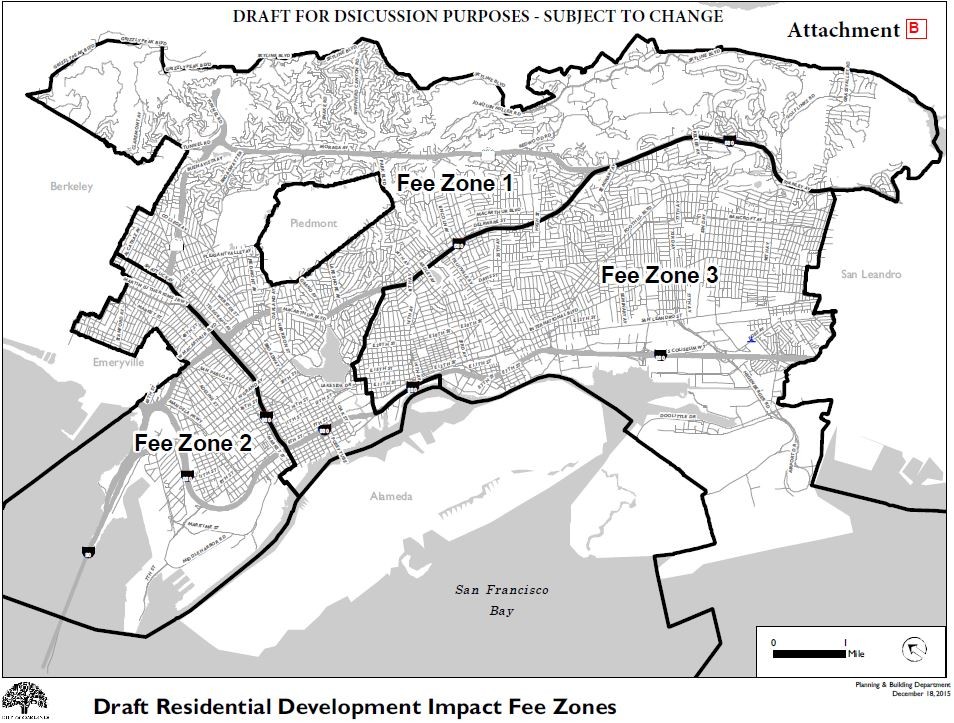
Oakland’s planning staff have proposed three different zones where developers would be charged different affordable housing fees.
Credits: City of Oakland
Before the holiday break, city planning department staffers released a detailed proposal for the new fees, in which Oakland would be divided into three geographic zones, and each zone would have different fees. The highest fee for new development would be in Zone 1, an area that would include downtown, Uptown, Temescal, Rockridge, and most neighborhoods adjacent to Lake Merritt, plus all of the Oakland hills above Interstate 580. Zone 2 would encompass West Oakland and the portion of North Oakland west of Shattuck Avenue. And Zone 3 would include everything East of Lake Merritt that is below 580, excluding Cleveland Heights and Haddon Hill (which would be in Zone 1).
Under the city’s plan, this proposed apartment building in downtown would pay $5,000 a unit if the developer gets a building permit after July 1, 2016.
Credits: Wood Partners
The city’s proposal further varies the fee level by the type of housing a developer builds. For example, developers who construct apartments in Zone 1 would pay a $20,000 affordable housing impact fee, as well as a $710 transportation fee, but not a capital improvement fee. Townhouses in Zone 1 would trigger a $17,000 affordable housing impact fee, a $3,000 capital improvement fee, and a $1,000 transportation fee. And single-family homes would trigger a $20,000 affordable housing impact fee, a $4,000 capital improvement fee, and a $1,000 transportation fee. The city’s information memo doesn’t include proposed fee levels for Zones 2 and 3, but they are expected to be lower than Zone 1 because West Oakland and East Oakland are considered less desirable areas for new development.
Further complicating the city’s proposal is the plan to phase in each impact fee over the next three years. For example, the city proposes to set the affordable housing impact fee for new apartments in Zone 1 at $5,000 on July 1, 2016, and then increase it to $10,000 on July 1, 2017, before finally raising it to $20,000 on July 1, 2018.
Finally, there’s the question of when to apply the fee. Is it when a developer obtains a building permit? Or is it when a developer submits his or her application to the city? Depending on what the city council decides, tens of millions of dollars in city revenue could be raised — or left on the table.
“We’re happy to see the [city] administration finally has a proposal out,” said Jeffrey Levin, policy director for East Bay Housing Organizations, an affordable housing advocacy group. Levin said he would like to see a higher final fee amount, and one that is phased in faster. In the past few years, both Berkeley and Emeryville established housing impact fees of $28,000 with no phase-in periods (although Berkeley later discounted its fee to $20,000). Oakland Mayor Libby Schaaf has said she favors phasing in an impact fee.
Levin said he opposes Oakland’s proposal to break the city into three separate zones with differing fee levels. “The city went through a process over many years doing specific area plans,” said Levin, referring to a series of plans that rezoned and established development rules for five areas of the city. “Every time we asked for affordable housing policies specific to each area, the response was they didn’t want to do it. The city told us that affordable housing needed to be a citywide policy.”
But Levin supports the city’s plan to apply the impact fees when a developer obtains building permits — rather than when he or she submits an application to the city. Currently, there are 26 different multi-unit housing developments being built in Oakland, and another 30 single-family homes are going up, totaling 1,346 units under construction. The majority of these units — 717 units, or 68 percent — would be exempt from impact fees, because they already have their building permits. However, another 14,000 market-rate housing units are in Oakland’s development pipeline and have not yet obtained building permits. Most of these could be subject to affordable housing impact fees ranging between $5,000 and $20,000, under the city’s proposal.
About half of these projects have already submitted applications to the planning department, and developers want to exempt these projects from paying impact fees. A one-page document submitted to the city — apparently by developers — proposes that the fee amount for a specific project be determined at the time a developer submits a completed planning application to the city. This would exempt thousands of units from paying impact fees, and allow thousands more to only pay $5,000 or $10,000 by submitting an application in 2016 or 2017.
A recent information memo from city staffers notes that if the council picks this option it “would exempt the most projects and capture the least number of projects to pay the fees.” City representatives declined to identify which developers submitted the proposal to exempt the maximum number of projects from the affordable housing impact fee.
The Oakland Builders Alliance and the Oakland Chamber of Commerce, both representing developers, met with the city to shape the impact fee proposal. Neither group responded to requests for comment. But developers have said that if impact fees are set too high, or phased in too fast, it could kill projects by imposing too high a cost.
Joel Ramos, regional planning director of TransForm, a transportation advocacy organization, said his organization is happy to see the bulk of the impact fees go toward affordable housing because the displacement crisis is worsening. But Ramos is worried about the city’s proposal to divide Oakland into different zones with different fees. He pointed to the International Boulevard corridor, where AC Transit’s $178 million bus rapid transit project will realign streetscapes and establish a “rail on wheel” mode of transportation, and the Coliseum area, which is slated for major redevelopment, including thousands of units of market-rate housing. Both projects are within the proposed Zone 3 where impact fees would be lower.
“Those are two areas that are scheduled for massive investment,” said Ramos. “Hundreds of millions are coming to that corridor, and once that happens it’s going to start to glow and attract investment, so I think it makes more sense to set a fee structure that will capture value now rather than waiting ’til it’s too late.”
In 2015, I learned that straightforward California cuisine can still surprise and delight; that the classics are classics for good reason; and that while expensive, high-concept tacos might win my begrudging respect, the down-home taco will always have my heart. After a year’s worth of delicious dishes eaten at new (or new-to-me) East Bay restaurants this year, here are my ten favorites, listed in the order in which I discovered them:
Nan Gyi Thoke at Grocery Cafe
El Mono’s pescado a lo macho rewards the patient diner.
Credits: Bert Johnson/File photoThe KronnerBurger from KronnerBurger.
Credits: Bert Johnson/File photo
2248 10th Ave., Oakland
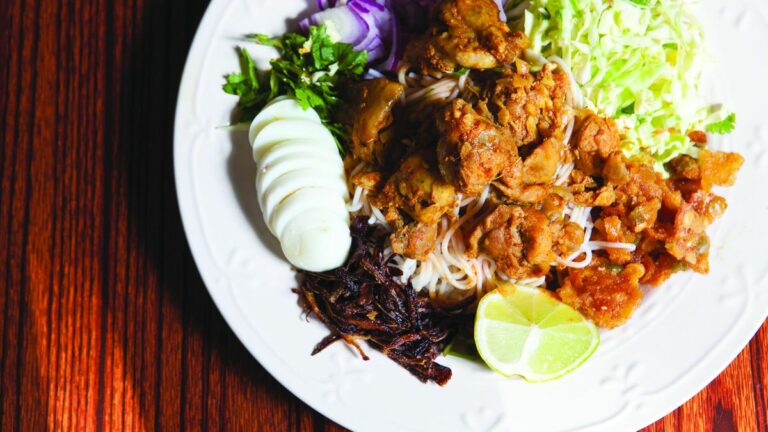
Crowd-pleasers at this tiny, homespun Burmese spot include the samusas and the tea leaf salad. But this noodle salad is the dish that most triggers the part of my palate reserved for comfort foods — the kind of thing I wolf down on days when the craving for Asian home cooking hits me like a punch in the gut. I’ve probably ordered Grocery Cafe’s nan gyi thoke three or four times at this point, and it comes out a little bit different each time — the temperature ranges from cold to slightly warm, and chunks of ham may or may not be included. What’s consistent is the dish’s singular deliciousness, which is derived from a combination of spaghetti-like rice noodles, curry-slicked chicken, crunchy bean fritters, and slices of raw onion and cabbage.
Tripa Taco at El Paisa@.com
4610 International Blvd., Oakland
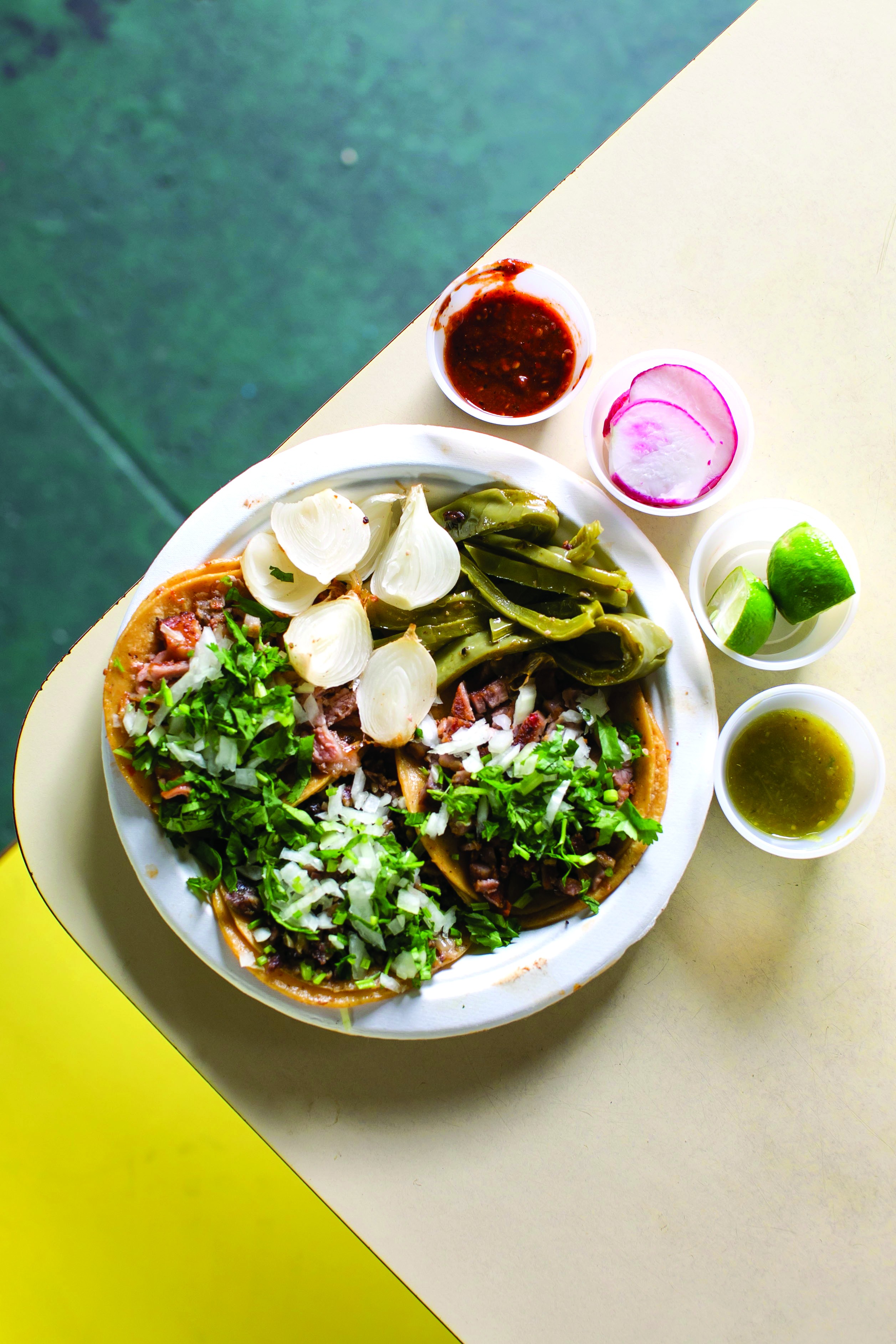
The best taco at what is probably the best taqueria in Oakland features beef tripe that’s stewed slowly until it pretty much reaches the pinnacle of soft, squishy unctuousness. I’d happily eat a bowl of El Paisa’s tripa all by itself, but as with all great tacos, the true genius lies in the combination of ingredients: the griddled corn tortillas, the light scattering of cilantro and chopped onions, your choice among the taqueria’s potent red and green salsas, and, of course, a generous heap of the meat itself. Enough words: Just go now and buy yourself a plate of tacos.
Shrimp Combo Plate at A Taste of Africa
6638 Bancroft Ave., Oakland
The bountiful combo plates at this Cameroonian spot in Deep East Oakland have been a favorite of mine since Malong Pendar’s itinerant pop-up days, when I’d arrive at some club or dive bar to find the chef set up at a table in back, blessing lucky patrons with heaping platters of jollof rice, black-eyed peas, gingery mashed yams, the deeply savory peanut-spinach stew known as ndole, and — always, always — a scoop of his potent habanero hot sauce. Now that the restaurant has a brick-and-mortar home, the food is better than ever, as evidenced by the previously unavailable option to get your combo plate topped with shrimp. Sautéed gently to preserve their delicate quality, the shrimp are laced with just a touch of chili heat. This dish truly brings together the best of the land and sea.
Kronnerburger at KronnerBurger
4063 Piedmont Ave., Oakland
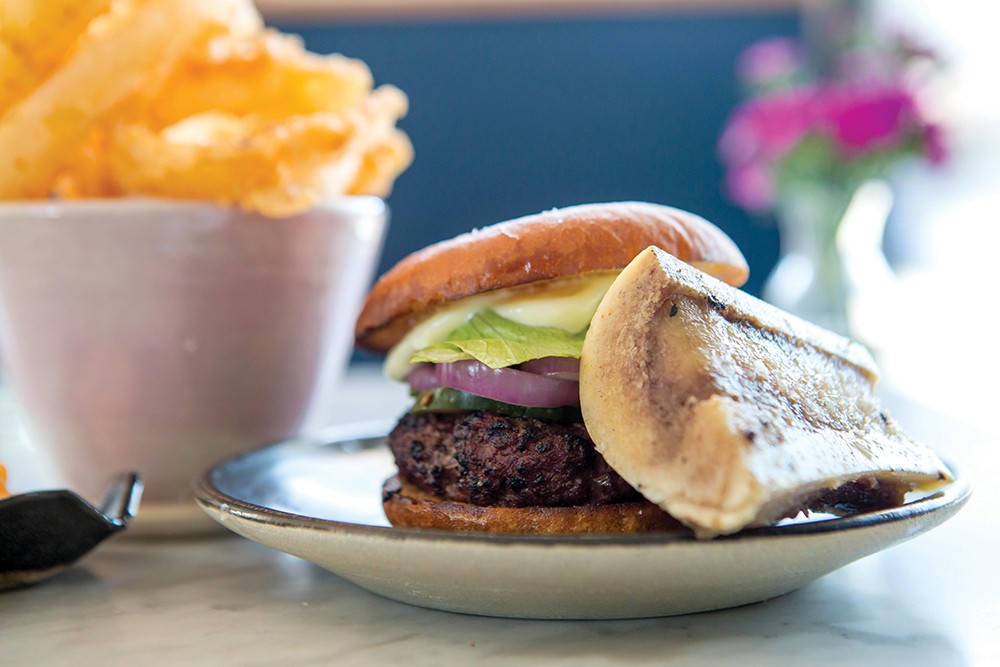
Chris Kronner talks about how his updated American diner isn’t “just some burger joint.” And it’s true: KronnerBurger also serves artful little salads, and the restaurant’s daily selection of bistro-style small plates might feature sea urchin, fermented chilies, or some obscure edible weed. And yet whenever I order something else, I always wind up feeling slightly regretful that I didn’t stick with the restaurant’s namesake dish — a burger known for its saltiness and its blood-red, inimitably beefy patty, and for the simplicity of its condiments (just iceberg lettuce, onions, pickles, and a cheddar-cheese mayonnaise). Though it might seem like overkill, don’t omit the roasted bone marrow add-on: A mere spoonful of those soft, fatty nubs helps turn an indulgent meal into an occasion unto itself.
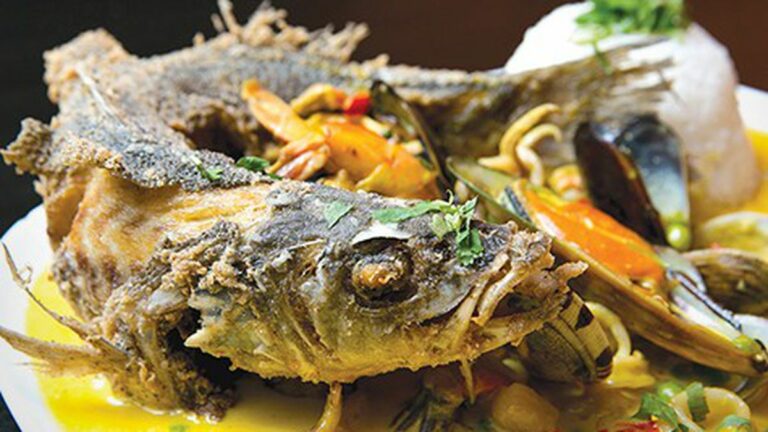
El Mono’s pescado a lo macho rewards the patient diner.
Credits: Bert Johnson/File photo
Hummus with Lamb at Ba-Bite
3905 Piedmont Ave., Oakland
The East Bay is experiencing a golden age of hummus, with new restaurants of various Middle Eastern and North African origins springing up every few weeks, it seems, each with their own version of the world’s most popular bean dip. But the Israeli-style hummus at Ba-Bite is in its own stratosphere — smooth, ethereally light, and rich and full-flavored beyond all expectation. All you really need to turn this dip into a lavish meal is several wedges of Ba-Bite’s excellent pita, but I like to gild the lily by ordering it topped with grilled lamb. The way the swirl of meat juices mixes into the hummus — crowned, as it is, with high-quality olive oil — is impossible to resist.
Breakfast Sandwich at Sequoia Diner
3719 MacArthur Blvd., Oakland
Even a mediocre breakfast sandwich has its charms — eggs, breakfast meats, and toasted bread products being foods difficult to butcher completely. And when each component is done just right, you wind up with something that’s damn near magical. The virtues of Sequoia Diner’s breakfast sandwich include its fluffy, folded-up egg omelet and your choice of sausage or bacon, both of which are house-made and of superior quality. The best parts, however, are the slather of garlicky aioli and, if you choose to sub it in for the also-excellent English muffin, the intensely buttery biscuit — a peerless vehicle for a breakfast sandwich.
Spicy Sichuan Boiled Fish Fillet at King Tsin
1699 Solano Ave., Berkeley
Of all the restaurants I wrote about this year, King Tsin is probably the one I’ve returned to the most frequently, and with the greatest eagerness. Any number of dishes at this Sichuan restaurant could have made the list: the decadently fatty five-spice braised pork shoulder that was tender enough to cut with a spoon, or perhaps the surprisingly enjoyable “squirrel fish” — wherein the fish’s flesh is scored in such a way that it puffs out like a squirrel’s tail when fried. But the Sichuan classic I kept going back to was this: tender slices of fish cooked gently in a pool of Sichuan peppercorn-infused red sauce that numbs your mouth while simultaneously setting it aflame. An order of King Tsin’s version, along with a big bowl of rice and an order of the restaurant’s puffy sesame flatbread to help soak up all that sauce, is pretty much my ideal dinner.
Pescado a Lo Macho at El Mono
10264 San Pablo Ave., El Cerrito
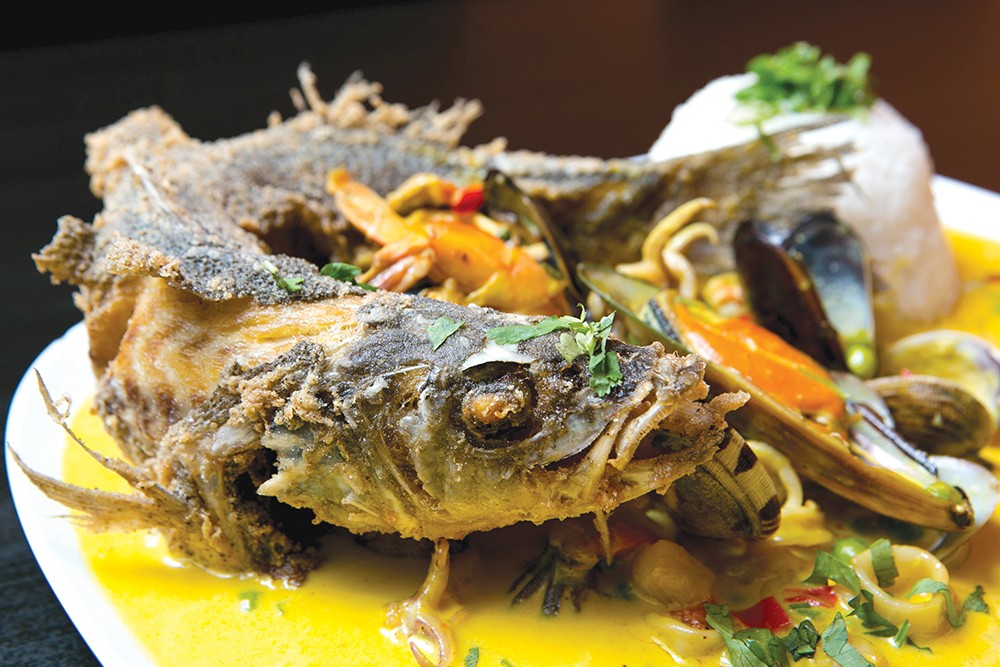
Staying with the seafood theme, I can’t recall another year when so many East Bay restaurants put whole fish preparations on their menu. It’s a trend I heartily endorse. The best of the bunch was the pescado a lo macho at El Mono, a scrappily ambitious Peruvian spot in El Cerrito. This is a dish for serious whole-fish eaters: a fried sea bass that’s positively sea serpent-like in its appearance, curled, as it is, around a rich, bright-yellow stew of clams, mussels, shrimp, calamari, and scallops. This is a dish that rewards the patient diner — the one who dispenses with cutlery to pick every last morsel of flesh off the bone, and who asks for extra rice to soak up every drop of the ajiamarillo-infused sauce.
Chicken Liver Toast at The Advocate
2635 Ashby Ave., Berkeley
I wouldn’t have guessed that something as seemingly mundane as chicken liver toast would be one of the most delicious things I’d eat this year, but, then again, The Advocate’s take on the classic is hardly your run-of-the-mill cocktail-party crostini. Every component of the dish is exceptional. The wood-grilled bread is thick-sliced and luxurious, and the generous smear of whipped chicken-liver terrine is as decadent as it is remarkably moist and light (especially if you’re expecting Grandma’s chopped liver). The coup de grace, at least in the early-autumn permutation of the dish that I sampled: a mixture of almonds and tiny, exquisitely sweet grapes that provided just the right counterbalance to all that liver-y richness.
Drowned Fried Chicken Torta at Salsipuedes
4201 Market St., Oakland
I like a sandwich that’s stolidly portable and sog-proof, with anything saucy or liable to squirt its juices safely contained within the bun. But let us also praise the sandwich that embraces its sogginess — the Chicago-style Italian beef, the Turkish islak burger, and this Oakland original: the “drowned” fried chicken sandwich at Salsipuedes. I love everything about this inspired piece of New Baja fusion cooking: the impeccable juiciness of the katsu-style chicken, the funk and tang of the kimchi, and, best of all, the torpedo-shaped bolillo roll that’s soaked through — in the style of a Mexican torta ahogada — with an umami-spiked house-made katsu sauce. The sandwich comes cut into three sections for ease of sharing, but believe me: You’ll want to eat the whole thing yourself.
Nan gyi thoke.
Credits: Bert Johnson/File photo
In 2015, I learned that straightforward California cuisine can still surprise and delight; that the classics are classics for good reason; and that while expensive, high-concept tacos might win my begrudging respect, the down-home taco will always have my heart.
After a year’s worth of delicious dishes eaten at new (or new-to-me) East Bay restaurants this year, here are my ten favorites, listed in the order in which I discovered them:
[jump]
Nan Gyi Thoke at Grocery Cafe
2248 10th Ave., Oakland
Crowd-pleasers at this tiny, homespun Burmese spot include the samusas and the tea leaf salad. But this noodle salad is the dish that most triggers the part of my palate reserved for comfort foods — the kind of thing I wolf down on days when the craving for Asian home cooking hits me like a punch in the gut. I’ve probably ordered Grocery Cafe’s nan gyi thoke three or four times at this point, and it comes out a little bit different each time — the temperature ranges from cold to slightly warm, and chunks of ham may or may not be included. What’s consistent is the dish’s singular deliciousness, which is derived from a combination of spaghetti-like rice noodles, curry-slicked chicken, crunchy bean fritters, and slices of raw onion and cabbage. Tacos at Taqueria El Paisa@.com.
Credits: Bert Johnson/File photoTripa Taco at El Paisa@.com
4610 International Blvd., Oakland
The best taco at what is probably the best taqueria in Oakland features beef tripe that’s stewed slowly until it pretty much reaches the pinnacle of soft, squishy unctuousness. I’d happily eat a bowl of El Paisa’s tripa all by itself, but as with all great tacos, the true genius lies in the combination of ingredients: the griddled corn tortillas, the light scattering of cilantro and chopped onions, your choice among the taqueria’s potent red and green salsas, and, of course, a generous heap of the meat itself. Enough words: Just go now and buy yourself a plate of tacos.
Shrimp Combo Plate at A Taste of Africa
6638 Bancroft Ave., Oakland
The bountiful combo plates at this Cameroonian spot in Deep East Oakland have been a favorite of mine since Malong Pendar’s itinerant pop-up days, when I’d arrive at some club or dive bar to find the chef set up at a table in back, blessing lucky patrons with heaping platters of jollof rice, black-eyed peas, gingery mashed yams, the deeply savory peanut-spinach stew known as ndole, and — always, always — a scoop of his potent habanero hot sauce. Now that the restaurant has a brick-and-mortar home, the food is better than ever, as evidenced by the previously unavailable option to get your combo plate topped with shrimp. Sautéed gently to preserve their delicate quality, the shrimp are laced with just a touch of chili heat. This dish truly brings together the best of the land and sea. A Kronnerburger with a side of marrow.
Credits: Bert Johnson/File photo Kronnerburger at KronnerBurger
4063 Piedmont Ave., Oakland
Chris Kronner talks about how his updated American diner isn’t “just some burger joint.” And it’s true: KronnerBurger also serves artful little salads, and the restaurant’s daily selection of bistro-style small plates might feature sea urchin, fermented chilies, or some obscure edible weed. And yet whenever I order something else, I always wind up feeling slightly regretful that I didn’t stick with the restaurant’s namesake dish — a burger known for its saltiness and its blood-red, inimitably beefy patty, and for the simplicity of its condiments (just iceberg lettuce, onions, pickles, and a cheddar-cheese mayonnaise). Though it might seem like overkill, don’t omit the roasted bone marrow add-on: A mere spoonful of those soft, fatty nubs helps turn an indulgent meal into an occasion unto itself.
Hummus with Lamb at Ba-Bite
3905 Piedmont Ave., Oakland
The East Bay is experiencing a golden age of hummus, with new restaurants of various Middle Eastern and North African origins springing up every few weeks, it seems, each with their own version of the world’s most popular bean dip. But the Israeli-style hummus at Ba-Bite is in its own stratosphere — smooth, ethereally light, and rich and full-flavored beyond all expectation. All you really need to turn this dip into a lavish meal is several wedges of Ba-Bite’s excellent pita, but I like to gild the lily by ordering it topped with grilled lamb. The way the swirl of meat juices mixes into the hummus — crowned, as it is, with high-quality olive oil — is impossible to resist.
Breakfast Sandwich at Sequoia Diner
3719 MacArthur Blvd., Oakland
Even a mediocre breakfast sandwich has its charms — eggs, breakfast meats, and toasted bread products being foods difficult to butcher completely. And when each component is done just right, you wind up with something that’s damn near magical. The virtues of Sequoia Diner’s breakfast sandwich include its fluffy, folded-up egg omelet and your choice of sausage or bacon, both of which are house-made and of superior quality. The best parts, however, are the slather of garlicky aioli and, if you choose to sub it in for the also-excellent English muffin, the intensely buttery biscuit — a peerless vehicle for a breakfast sandwich.
Spicy Sichuan Boiled Fish Fillet at King Tsin
1699 Solano Ave., Berkeley
Of all the restaurants I wrote about this year, King Tsin is probably the one I’ve returned to the most frequently, and with the greatest eagerness. Any number of dishes at this Sichuan restaurant could have made the list: the decadently fatty five-spice braised pork shoulder that was tender enough to cut with a spoon, or perhaps the surprisingly enjoyable “squirrel fish” — wherein the fish’s flesh is scored in such a way that it puffs out like a squirrel’s tail when fried. But the Sichuan classic I kept going back to was this: tender slices of fish cooked gently in a pool of Sichuan peppercorn-infused red sauce that numbs your mouth while simultaneously setting it aflame. An order of King Tsin’s version, along with a big bowl of rice and an order of the restaurant’s puffy sesame flatbread to help soak up all that sauce, is pretty much my ideal dinner. The pescado a lo macho rewards the patient diner.
Credits: Bert Johnson/File photo
Pescado a Lo Macho at El Mono
10264 San Pablo Ave., El Cerrito
Staying with the seafood theme, I can’t recall another year when so many East Bay restaurants put whole fish preparations on their menu. It’s a trend I heartily endorse. The best of the bunch was the pescado a lo macho at El Mono, a scrappily ambitious Peruvian spot in El Cerrito. This is a dish for serious whole-fish eaters: a fried sea bass that’s positively sea serpent-like in its appearance, curled, as it is, around a rich, bright-yellow stew of clams, mussels, shrimp, calamari, and scallops. This is a dish that rewards the patient diner — the one who dispenses with cutlery to pick every last morsel of flesh off the bone, and who asks for extra rice to soak up every drop of the aji amarillo-infused sauce.
Chicken Liver Toast at The Advocate
2635 Ashby Ave., Berkeley
I wouldn’t have guessed that something as seemingly mundane as chicken liver toast would be one of the most delicious things I’d eat this year, but, then again, The Advocate’s take on the classic is hardly your run-of-the-mill cocktail-party crostini. Every component of the dish is exceptional. The wood-grilled bread is thick-sliced and luxurious, and the generous smear of whipped chicken-liver terrine is as decadent as it is remarkably moist and light (especially if you’re expecting Grandma’s chopped liver). The coup de grace, at least in the early-autumn permutation of the dish that I sampled: a mixture of almonds and tiny, exquisitely sweet grapes that provided just the right counterbalance to all that liver-y richness. Pleasantly sogged.
Credits: Bert Johnson/File photo Drowned Fried Chicken Torta at Salsipuedes
4201 Market St., Oakland
I like a sandwich that’s stolidly portable and sog-proof — with anything saucy or liable to squirt its juices safely contained within the bun. But let us also praise the sandwich that embraces its sogginess — the Chicago-style Italian beef, the Turkish islak burger, and this Oakland original: the “drowned” fried chicken sandwich at Salsipuedes. I love everything about this inspired piece of New Baja fusion cooking: the impeccable juiciness of the katsu-style chicken, the funk and tang of the kimchi, and, best of all, the torpedo-shaped bolillo roll that’s soaked through — in the style of a Mexican torta ahogada — with an umami-spiked house-made katsu sauce. The sandwich comes cut into three sections for ease of sharing, but believe me: You’ll want to eat the whole thing yourself.
Aries (March 21–April 19): John Koenig is an artist who invents new words. Here's one that's applicable to your journey in 2016: "keyframe." Koenig defines it as a seemingly mundane phase of your life that is in fact a turning point. Major plot twists in your big story arrive half-hidden amid a stream of innocuous events. They don't come...
On a cold December Sunday, people filtered into the New Parish in downtown Oakland where DJ Leydis (Leydisvel Freire) hosts her recurring Cuban dance party, La Rumba Q'Tumba. Smoke from Cuban cigars, which a man in the corner of the patio was rolling by hand, curled into dense clouds. Attendees were scattered around the tables lining the...
Much of Bay Area dance embodies a quintessentially regional flavor. It's a familiar blend of experimentation; political engagement; and a DIY, community-oriented ethos. For dancers more accustomed to the comparatively rigid dance practices of the East Coast and many institutional performance programs, a taste of that looseness can be valuably liberating. In part, that's what San Francisco's...
A good year, but not a great year." That's the word from the screening rooms on 2015. Every motion picture release schedule has its hits and flops, its moments of enchantment and wastes of time, but 2015 has been a fairly perplexing year at the movies. There was a bounty of solid, worthwhile films but relatively few...
Every Latin cuisine has its own take on rice and beans, but few are as singular, or as delicious, as the arroz con gandules at Borinquen Soul, a Puerto Rican kitchen that has taken up permanent residence inside the Two Star Market convenience store in Oakland's Dimond district. Here, the rice is orange-red, as...
"Oakland's Perfect Storm," Feature, 12/16
No More Barriers
Although this article describes the storm quite well, it fails to find a solution, largely because it seems to promote the very criteria that caused the storm to begin with. The problem arises from government policies that discourage the construction of new housing. Misguided policies such as rent control and eviction control have...
On January 12, the Oakland City Council's Community and Economic Development committee will consider detailed proposals for applying development impact fees to new market-rate housing projects. It will also be the first chance for the public to weigh in on the city's newly proposed impact fees, which could raise as much as $60 million for affordable housing...
Friday, January 1
The Rocky Horror Picture Show (100 min., 1975). (The New Parkway Theater, Oakland, 10:30)
Saturday, January 2
Benvenuto Cellini (176 min., 2015). English National Opera 2015-2016 Season (Rialto Cinemas Elmwood, Berkeley, 10:00 a.m.)
Monday, January 4
Jane Eyre (TBA, 2016). National Theatre Live (Rialto Cinemas Cerrito, El Cerrito, 7:00)
Tuesday, January 5
Jane Eyre (TBA, 2016). National Theatre Live (Elmwood, 7:00)
Sherlock: The Abominable...
In 2015, I learned that straightforward California cuisine can still surprise and delight; that the classics are classics for good reason; and that while expensive, high-concept tacos might win my begrudging respect, the down-home taco will always have my heart. After a year's worth of delicious dishes eaten at new (or new-to-me) East Bay restaurants this year,...
Nan gyi thoke.
Credits: Bert Johnson/File photo
In 2015, I learned that straightforward California cuisine can still surprise and delight; that the classics are classics for good reason; and that while expensive, high-concept tacos might win my begrudging respect, the down-home taco will always have my heart.
After a year’s worth of delicious dishes eaten at new (or new-to-me) East Bay...