1. Fog in the Bay Area is laced with toxic mercury, the Chron reports, citing a new study from researchers at UC Santa Cruz and other institutions. The mercury likely comes from the burning of coal and other fossil fuels. While the levels of mercury in fog in the Bay Area are not considered dangerous, the neurotoxin accumulates in animals and plants over time. Some animals along the California Coast have levels of mercury in their systems above the US safety threshold.
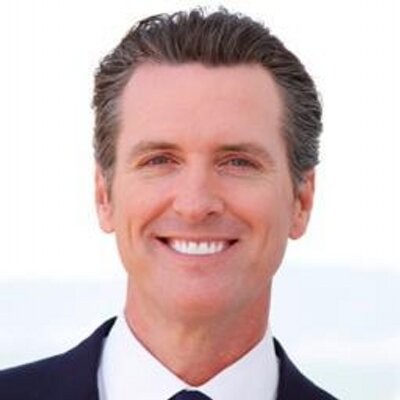
Gavin Newsom.
2. Lieutenant Governor Gavin Newsom, who is also the frontrunner in the 2018 governor’s race, predicts that California’s last nuclear power plant — Diablo Canyon — will close by 2025, the Chron$ reports. Newsom is pushing for PG&E to conduct a full environmental review on the nuclear facility in order to extend its lease on public coastal land near San Luis Obispo. The lease expires in 2018.
3. Heavy exposure to electronic cigarettes causes DNA damage in cells, which could lead to cancer, the San Diego Union-Tribune reports (h/t Rough & Tumble), citing a new study by researchers at UC San Diego and other institutions. The new study on e-cigs is among the first to show that they’re unhealthy.
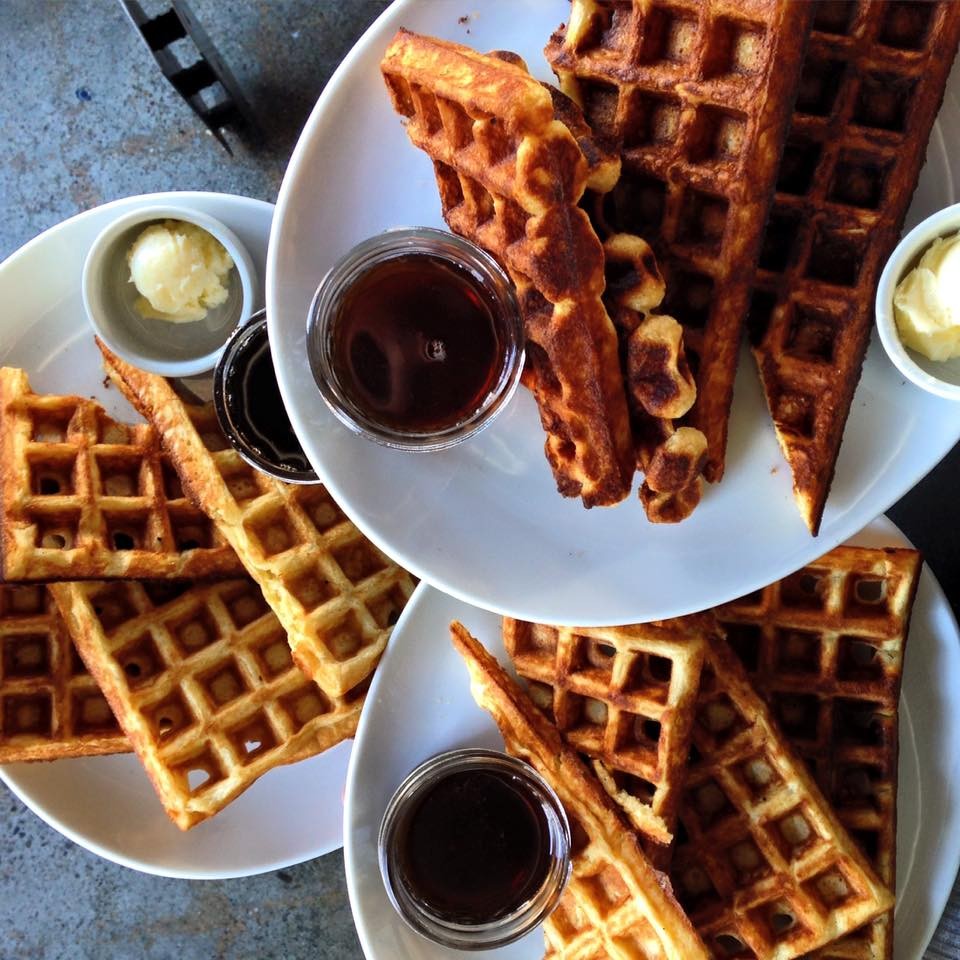
Waffles at Hog’s Apothecary (via Facebook).
Good morning, and happy new year!
Perhaps you’ve just awakened, groggy-eyed, in need of sustenance and some kind of hangover cure. If so, here are a few East Bay spots open for brunch on New Year’s Eve:
3. In a similar theme, Camino (3917 Grand Ave., Oakland) will be open 11 a.m.–3 p.m. with counter service only, serving pozole ($20–$22), chicharrones ($6), and donuts ($5).
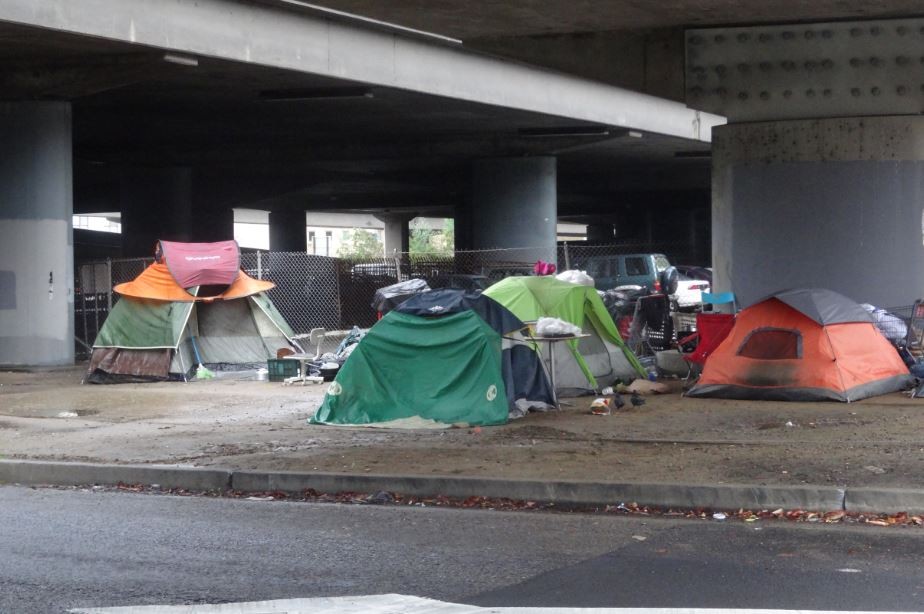
A homeless camp under the 880 Freeway in downtown Oakland.
Credits: Darwin BondGraham
A report by UC Berkeley Goldman School of Public Policy researchers prepared for the City of Oakland last May found that Oakland’s method for dealing with homeless encampments does more harm than good, and that the city’s various departments don’t have a coherent strategy to help the homeless. The result is that the city’s homeless population continues to struggle to find safe spaces to exist.
According to the report, each city department approaches the problem of homeless encampments with its own goals.
“These often contradictory approaches became problematic when one department’s definition of a successful outcome directly undermined another’s,” the Berkeley researchers wrote.
[jump]
The police department told the research team that they are “reluctant to issue citations against homeless individuals due to both the inefficiency of criminalizing homelessness, as well as the potential political ramifications.”
However, city councilmembers and the City Administrator’s office are under intense pressure from homeowners, especially in West Oakland and North Oakland, to remove homeless camps. The result is that the Department of Public Works is increasingly directed to clean up and close homeless camps, and the police have been increasingly called to crack down on the homeless for crimes such as loitering and trespassing.
According to the researchers:
“The tension between Oakland’s housed and unhoused residents is exemplified in Councilmember Lynette McElhaney’s [West Oakland and downtown] district, which has a disproportionate concentration of homeless encampments. The office receives numerous complaints from housed residents concerned about crime and other encampment-specific problems. While the Councilmember’s office agreed that the primary problem is a shortage of housing, the short-term concern of the office is addressing the immediate concerns of their constituents, which often requires directing Public Works to remove the encampments.”
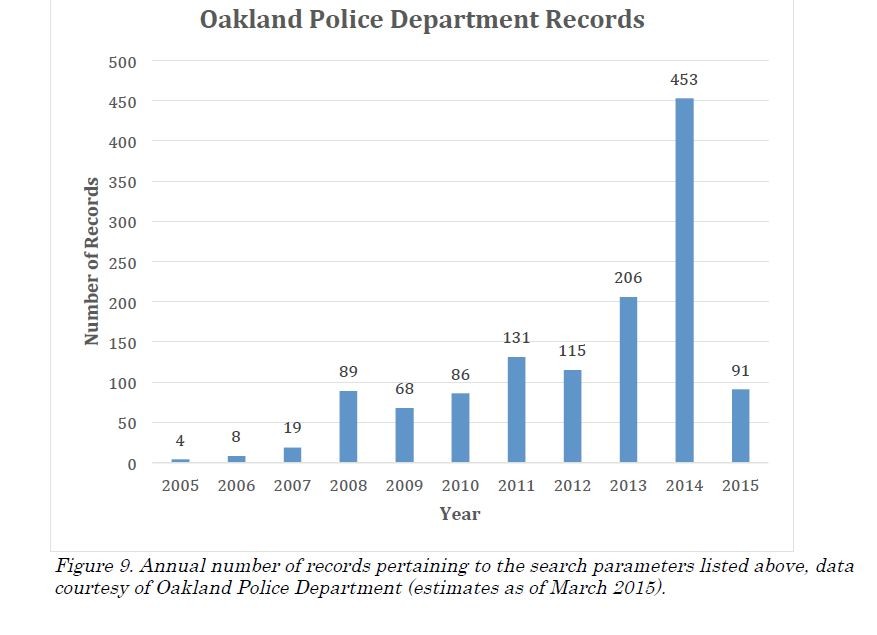
The researchers found that between 2005 and March of 2015 there were 1,270 OPD records of enforcement actions against “homeless” and “transient” camps, with a noticeable peak between 2013 and 2014.
Oakland police records show a recent spike in calls regarding homeless camps.
Credits: UC BerkeleyEmail records reviewed by the Express illustrate the pressures put on city councilmembers to close homeless camps. For example, one homeowner in Rockridge wrote to Councilmember Dan Kalb earlier this year that the presence of homeless people living under the Highway 24 Bridge was a “direct conflict” with families living in homes nearby.
“While I feel sympathetic for their plight, it isn’t fair that hard working residents who have worked their tails off to earn the privilege of living in this neighborhood must be subjected to daily torment by the homeless,” wrote the upset homeowner, whose identity was redacted by the city before the emails were made public. “We are done with this and expect more effective, more confident and more assertive action by OPD.”
The homeowner concluded the email with a warning: “Do we have the right to be free of danger to our children and illicit behavior unfolding right before our very eyes every day? Seems like not in Oakland, where the rights of the homeless far outweigh the rights of good law abiding homeowners and residents. You should not be surprised to see many good families moving away, seeking relief, refuge and safety beyond the hills in Orinda, Lafayette and Moraga.”
The UC Berkeley team found that closing homeless camps can be harmful to camp residents whose belongings are sometimes confiscated or thrown away. “[E]ncampment residents may refuse to leave camps during cleanups in order to ensure that their belongings are not removed or discarded. As such, they often miss scheduled doctor, employment, or case manager appointments. Thus, cleanup efforts themselves contribute to the broader systemic problem that keeps encampment residents in a cycle of homelessness.”
The UC Berkeley study recommends that Oakland follow the lead of cities like Seattle and Portland and establish sanctioned homeless camps. Doing so could reduce the cost to the city of cleaning and closing the dozens of encampments throughout the city, while providing homeless people with more secure and healthy spaces to live. The full report can be downloaded here.
When the Express last caught up with East Bay rapper and social media guru Lil B earlier this month, he said he was roughly sixty percent finished with his highly-anticipated mixtape, Thugged Out Pissed Off.
Lil B had slowed down his manically prolific output in 2015, releasing only a collaborative project with Chance the Rapper (the excellent mixtape, Free, which made our list of top local releases of the year) and a few singles. His internet following had pretty much come to accept that his next solo effort would come out next year. But, in the nick of time, Lil B dropped the whopping, 63-track Thugged Out Pissed Off today on DatPiff.
See More: Communing with the Based God
[jump]
[embed-2] “There’s gonna be a lot of different emotions and feelings, and a lot of stuff out the journal,” Lil B said in our previous interview. “I got a chance to get a lot of angry stuff out — just anything that I felt. A lot of positivity, too. A lot of gems, a lot of knowledge on there. And just a lot of stuff in general that’s really gonna shock people and have people on edge — I think that’s really what Thugged Out Pissed Off represents.”
Does the mixtape live up to the hype? Listen to it here and let us know in the comments. And, if you’re still looking for New Year’s Eve plans, Lil B performs at The Regency Ballroom (1300 Van Ness Ave., San Francisco) tomorrow night.
Via Facebook.
Welcome to the Mid-Week Menu, our roundup of East Bay food news.
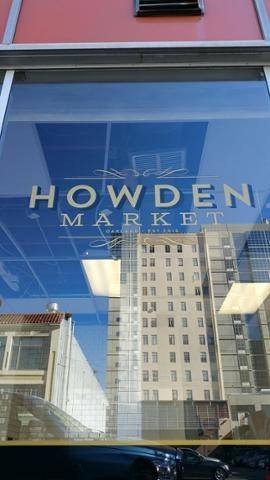
1) One of the big trends of this past year was an explosion of one-stop market-restaurant hybrids that opened, or were slated to open — some more successful than others. Oakland’s latest, Howden Market (1630 Webster St.), is slated to open officially the beginning of next week, on January 4, but word on the street is that the market is in soft opening mode this week. Run by the folks behind the Spice Monkey restaurant next door, the market-deli-cafe will sell a mix of fresh produce, coffee, to-go foods, spices, and house-made sauces.
[jump]
2) Eater reports that Cafe Eugene (1175 Solano Ave., Albany), a restaurant specializing in Pacific Northwest cuisine, will open for business — breakfast, lunch, and dinner — on January 13, in the old Little Star Pizza space. The restaurant is run by the team behind nearby Boss Burger and Little Star (the latter of which moved down the block a few months back).
3) Blue Bottle is opening a new cafe in downtown Berkeley, on the first floor of the building that houses the WeWork co-working office space at 2011 Shattuck Avenue, Berkeleyside Nosh reports.
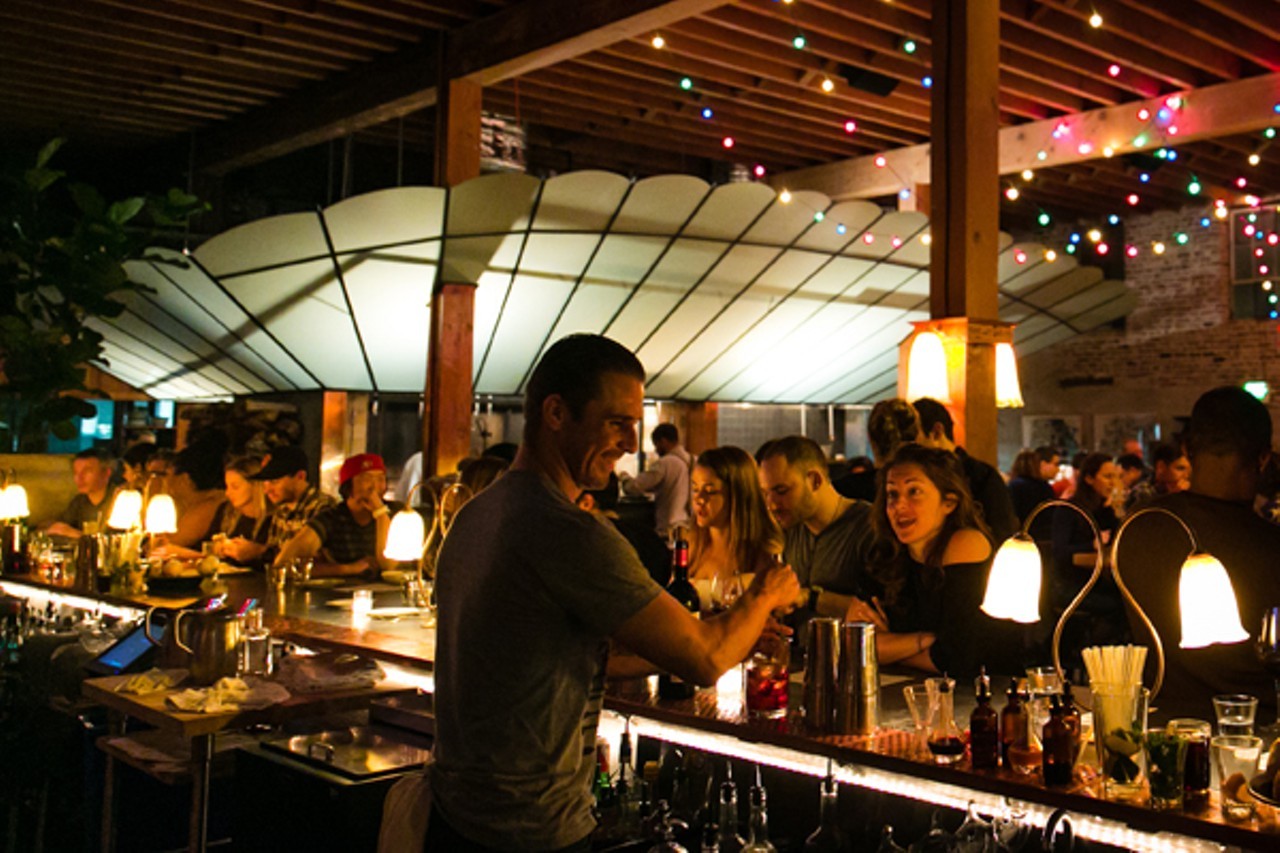
The bar at Penrose.
Credits: Stephen Loewinsohn/File photo
4) Tablehopper notes that Penrose (3311 Grand Ave., Oakland), Charlie Hallowell’s North African-inspired small plates restaurant, will serve Saturday and Sunday brunch starting this Sunday, January 3. Options include a $25/pp “Moorish Breakfast” served for the whole table: a selection of flatbreads and spreads, Merguez sausages, scrambled eggs, clementines, dates, honeyed almonds, French feta, and more.
5) Berkeleyside Nosh notes that B-Side Baking Company (3303 San Pablo Ave.) — the Tanya Holland-owned bakery in West Oakland that replaced B-Side BBQ earlier this year — appears to have closed. Indeed, the message on the bakery’s answering machine indicated that the business has actually been closed since the end of September. We’ll update if we get more details on the future of the space.
6) Premier Cru (1101 University Ave., Berkeley), a high-end wine business that has been embroiled in a series of lawsuits regarding failure to deliver on promised wine futures — has shuttered its brick-and-mortar retail store, Berkeleyside reports.
7) Still haven’t made New Year’s Eve plans? Lots of food-centric options in this year’s Express guide.
8) It’s that time of year when food writers compile various top-ten lists. Berkeleyside Nosh compiled a pretty good two-partlist of East Bay-centric picks from chefs and other local experts.
Got tips or suggestions? Email me at Luke (dot) Tsai (at) EastBayExpress (dot) com. Otherwise, keep in touch by following me on Twitter @theluketsai, or simply by posting a comment. I’ll read ‘em all.
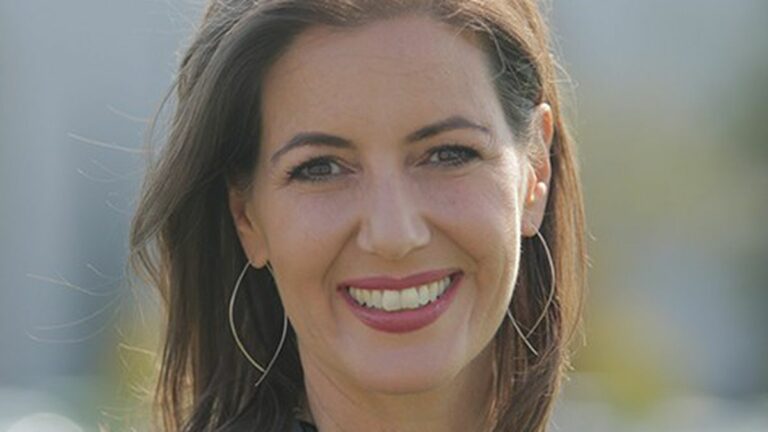
Libby Schaaf.
1. In a letter to the National Football League, Oakland Mayor Libby Schaaf stood firm in her commitment to not spend public dollars on a new stadium for the Raiders, the Bay Area News Group$ reports. Schaaf has repeatedly vowed not to publicly subsidize new facilities for Oakland’s professional sports teams. Raiders owner Mark Davis, who wants the city to give his team more than 120 acres of free land at the Coliseum, decried Schaaf’s letter, saying that Schaaf and her administration “just don’t want to play with us.” Schaaf has pointed out that it would be illegal for the city to give the Raiders taxpayer-owned property.
2. A Castro Valley woman who hurled anti-Muslim epithets at a group of Muslim Americans and threw coffee in the face of a Muslim-American man who filmed her has been banned from Lake Chabot Regional Park, the Bay Area News Group$ reports. Denise Slader, who works for the state corrections department, also was ordered by a judge to have no contact with Rasheed Albeshaeri, the man she threw coffee at. Slader is charged with misdemeanor battery and hate crime charges.
[jump]
3. Ex-CPUC chair Michael Peevey is at the center of a criminal probe involving the shutdown of a nuclear power plant in Southern California, the San Diego Union-Tribune reports (h/t Rough & Tumble). State investigators allege that Peevey had illegal backchannel communications with Southern California Edison in a controversial deal in which ratepayers are being forced to finance 70 percent of the shutdown costs for the troubled San Onofre nuclear facility.
I am a 30-year-old straight man and I’ve been with a 28-year-old bisexual woman for a year. Early in our relationship, after much discussion, we established that it would be open. I would have the liberty to see other women and so would she. We just had to be safe and always keep each other informed. The key was that she agreed to see only other women. I was uncomfortable with the idea of her being with another man, and she went along with it. Fast-forward a few months, and she told me that she had drunkenly kissed a male coworker. Hearing her say that hurt me. However, since then she has explained to me that the rule that she can be only with women is unfair because she’s bisexual and she’s attracted to both men and women. I can see whomever I might find attractive, but she has to limit herself. After much soul-searching, I came around to her point of view and she now has the option to see men too. My question: How do I deal with the jealousy and emotions that will come up when she does kiss another man? Or does even more with another man? We love each other, and I think it’s important to note that while we have both been on dates with other people, neither of us has had sex with someone else yet.
Having Emotional Reaction Means Asking Nervously
“Hard Truth #1: Renegotiating is crucial to the survival of all long-term relationships — even more so in unconventional, custom-designed relationships where there’s no established template,” said Christopher Ryan, author of Sex at Dawn: How We Mate, Why We Stray, and What It Means for Modern Relationships. “And while I don’t see any unfairness in HERMAN’s girlfriend wanting to have the same freedom he has (to see whomever she wants), if he agreed to the open relationship on the condition that she ‘see only other women,’ then renegotiating is going to be difficult.”
Your description of that particular limitation — only other women — as “key” to opening up your relationship, HERMAN, left Ryan feeling less than optimistic.
“Hard Truth #2: It’s a time-wasting mistake to negotiate non-negotiables,” said Ryan. “I’m not saying we shouldn’t be willing to learn and grow by trying new things. But our first task is to ‘know thyself’ and take it from there. For example, if you’re certain you want or don’t want kids, then that shouldn’t be open to negotiation just because you met someone you like (or love) whose dreams go the other way.”
Assuming you’re willing to renegotiate, HERMAN, where do you start?
“Perhaps the question of why he’s more bothered by her being with men than women,” said Ryan. “Maybe he could ask her to set up a three-way with a man they both like so he can face the dragon, so to speak. See if the flip side of his fear isn’t that he’s actually turned on by the thought of her with other men. Lots to explore, once he’s certain he wants to explore it. But, again, if this is a nonnegotiable — if this really isn’t something HERMAN wants, despite his desire to be fair — it might be better to end the relationship than to attempt to be someone he’s not or agree to something he’ll never be at peace with.”
Follow Christopher Ryan on Twitter @ChrisRyanPhD, and check out his podcast (Tangentially Speaking), videos, and swag at ChrisRyanPhD.com.
What are your thoughts on two Doms sharing one sub? The scene I envision includes the domination of the other Dom. Do some Doms enjoy the submission to another Dom while also enjoying dominating the sub? It’s probably best to put it into the context of my fantasy. I tie my sub to a chair or tie her down and then send a Snapchat to her other Dom. I invite the other Dom to come over and have his way with her. I would then leave, but they must stop immediately when I return, no matter where they are. The other Dom must then leave, and I do what I want from that point. Is this something I should talk with the other Dom about beforehand or should I just do it and see what happens? I’ve talked to my sub, and she is really into that scene, but she doesn’t know how her other Dom would feel about it.
Dominate Other Man
Sharing a sub could strike me as a great/hot idea, DOM, but my feelings are irrelevant — the scene isn’t going to work if the other Dom thinks the idea is terrible/lame. That said, I don’t see any harm in waiting until your sub is tied down to propose this scene — lay out the details in advance on Snapchat, not once he’s in the room, so he’ll be free to take a pass if the scene doesn’t appeal to him. But by waiting, you run the risk of discovering, after it’s all set up, after you’ve sent the Snapchat, that her other Dom loves the idea but is out of town/watching the GOP debate/sitting shiva/whatever.
Longtime reader and listener (magnum podcast subscriber!) here, and I have a conundrum. My partner and I have a DADT agreement in regards to extramarital relations. I’m a fortysomething woman who travels a lot on business, and I find those trips a great opportunity to have NSA flings with younger men, all in good fun. So far, Tinder seems to be a good way to meet people, and I try to take precautions to ensure they are who they say they are by checking them out on social media and meeting them first in a public place. But a girl can’t be too careful. Sometimes I wish I had someone I could call and just say, “Hey, I’m hosting a stranger tonight at my hotel. Could you call me at a specific time to check he hasn’t chopped me up into little pieces?” My partner can’t be that person because of the whole DADT thing. My friends don’t know about my flings. And the front desk seems inappropriate. Is there an app out there providing this kind of service? Or does someone need to create one?
Seeks Discreet Call Service
A Tinder-like app to hook up random people who are about to hook up with other random people so the randos who met via the Tinder-like app can verify neither was murdered by the randos they met via Tinder itself? Sounds a little complicated, SDCS, and I’m not sure the market for your proposed app is big enough to attract investors. I also don’t think introducing a second potentially unreliable and/or sinister stranger into the mix is going to make your hotel hookups appreciably safer.
Here’s a better idea/simpler life hack: Schedule a wake-up call for an hour or two after your Tinder rando is due to arrive. You can schedule wake-up calls for any time of day, SDCS, and in nicer hotels you can even ask the front desk to ring you personally instead of scheduling a robocall. Just tell the receptionist you’re a heavy sleeper and you need them to verify that you’re awake/alive in time for your big meeting.
Or you could take a risk and confide in a friend about your open marriage, your flings, and your need for a safety buddy.
There was a bloody body lying on a dusty road outside a small town in a desert in the Middle East. It was February 2014 and Kara Platoni, an Oakland-based journalist and lecturer at the UC Berkeley Graduate School of Journalism, was inside a Humvee not far from the body, listening to American soldiers in the vehicle debate what to do. Suddenly, the man in the road lifted his head. “Damn, he’s alive,” said one of the soldiers in the convoy. They argued about whether they should help him — or whether he might be a trap armed with improvised explosives.
“A lot of people are in the car, yelling very forcefully,” Platoni recalled in a recent interview. “Seeing the body on the road is kind of viscerally very upsetting.”
Kara Platoni.
Credits: Justine Quart
Although it was frightening and emotional, Platoni wasn’t actually in the Middle East with real soldiers. Rather, she was sitting inside a dark room at the Buckley Air Force Base in Colorado, trying out a cutting-edge form of virtual reality (VR) equipment. Users wear special goggles that transport them to a three-dimensional, lifelike landscape where they can see an alternate world around them in every direction. In this case, Platoni was immersed in a fictional, computer-generated scene — one that real soldiers enter virtually from the military base as part of their training before they deploy to Afghanistan.
Platoni’s visit to Colorado was part of extensive travels in 2013 and 2014 that took her to four countries and eight states and formed the basis of her new book, We Have The Technology, a vivid exploration of the most unbelievable innovations in sensory science. A veteran science journalist and former staff writer for the Express, Platoni interviewed more than one hundred experts for the book — a diverse mix of scientists, researchers, psychologists, engineers, doctors, biohackers, entrepreneurs, chefs, and others who are pushing the boundaries of how science and technology can alter human perception. Platoni traveled to labs and research centers — observing experiments in real-time and trying out groundbreaking technology herself. With her rich reporting and narrative writing, Platoni provides readers with an accessible and engaging firsthand account of the inventions that are likely to shape science, technology, and human perception for many years to come. In this way, Platoni’s book is an on-the-ground-tour of research advancements that at times sound more like science fiction than science.
Platoni embedded herself with do-it-yourself (DIY) “biohackers” — the scientists who want to hack human biology, or, as she describes it in her book, the people impatient “with the weaknesses and limitations of the basic human unit; with the slow pace of evolution; with the unwillingness of major research corporations to develop — and sell — the kind of sci-fi sensory apparatus that biohackers desire to keep things moving along.” She spent time at labs developing robotic limbs that are controlled by thoughts and could one day provide a sense of touch to people with prosthetics. She interviewed researchers who are restoring sight to the blind with advanced visual implants. She studied “Smell A Memory,” a project that uses scents to help people with Alzheimer’s fight memory loss.
In her writing career, Platoni has covered the frontiers of sensory science, robotics, neuroscience, and “wearable” technologies (such as smart wristbands that track fitness levels). In recent years, it became clear to her that the rapid progress in so many of these fields merited a more in-depth journalism project. “It seemed to be the tip of the iceberg,” she said of her early reporting in the field.
Eventually, Platoni decided to take time off from teaching at UC Berkeley and dedicate herself full-time to researching the wide-open field of sensory science. It was a whirlwind year.
She began in May 2013, visiting a “piercing parlor” where biohackers implant magnets into people’s hands, giving them something of a sixth sense through which they can perceive magnetic fields. In the DIY science of “body modification artists,” biohackers with implanted magnets can essentially feel another layer of information in their environments. Platoni finished writing her book just before the fall 2014 semester started, and in between, traveled across the United States and the globe for the book, often crashing on couches of people she met through various journalism contacts.
Platoni’s writing offers an informed outsider’s perspective on intriguing fields and innovations that can sometimes be difficult for the average reader to grasp. Along the way, she grapples with broader questions about human development and perception, exploring the science behind how we experience time, pain, and emotion.
In one of her most colorful chapters, “Pain,” Platoni scrutinizes the ways in which the brain interprets social pain — mainly heartbreak and rejection — and examines potential remedies that could alleviate this hurt. She interviewed researchers who studied whether Tylenol helps mend broken hearts and found it could, in some ways, offer temporary relief. As part of her research for this section, Platoni — who worked hard to find personal, human stories to bring all of her subjects to life — hung out at the Night Light bar in Oakland’s Jack London district, interviewing bartenders and patrons about unrequited love.
In a thought-provoking section on VR technology, Platoni offers a window into the world of progressive psychologists who are using alternative realities to treat soldiers with post-traumatic stress disorder (PTSD); the idea is that through “exposure therapy,” soldiers can face their fears and traumas in a powerful, imaginary landscape — with a therapist guiding them through the process. When she tried out the simulation in Colorado, Platoni was testing out an even more revolutionary concept — whether psychologists could use VR to pre-treat soldiers for PTSD before they deploy. That means exposing them in advance to the kinds of stressors they will face so they are more resilient and prepared for the traumas of war by the time they arrive.
In reporting We Have The Technology, Platoni said she learned to dramatically shift the way she thinks about human perception. “There is no one reality. There’s only your construction of it,” she said in interview, noting that we all have unique filters, cultural experiences, and pasts that shape how we perceive the world. With that foundation, she said she came to understand how powerful the brain is in controlling perception — and how science is enabling us to enhance and alter our senses and experiences. “I really gained a lot of appreciation for how sophisticated and wonderful and amazing the human brain is,” she said.
At first, I thought the members of the San Francisco punk band Toyota were trolling me when they asked me to meet them at Hard Rock Cafe at Pier 39. Toyota has a well-documented interest in kitsch and corporate branding, so I obliged because I thought it would be funny to interview the four musicians under Hard Rock’s giant, plastic statue of a guitar.
However, as I trudged there from the East Bay on a rainy Friday night, I got a text from one of the bandmembers letting me know that Hard Rock Cafe was closed for a private event. He suggested an equally corny, surf-themed tourist spot, Wipeout Bar and Grill, where we could chat over too-sweet tropical cocktails with terrible names like Sex on Baker Beach.
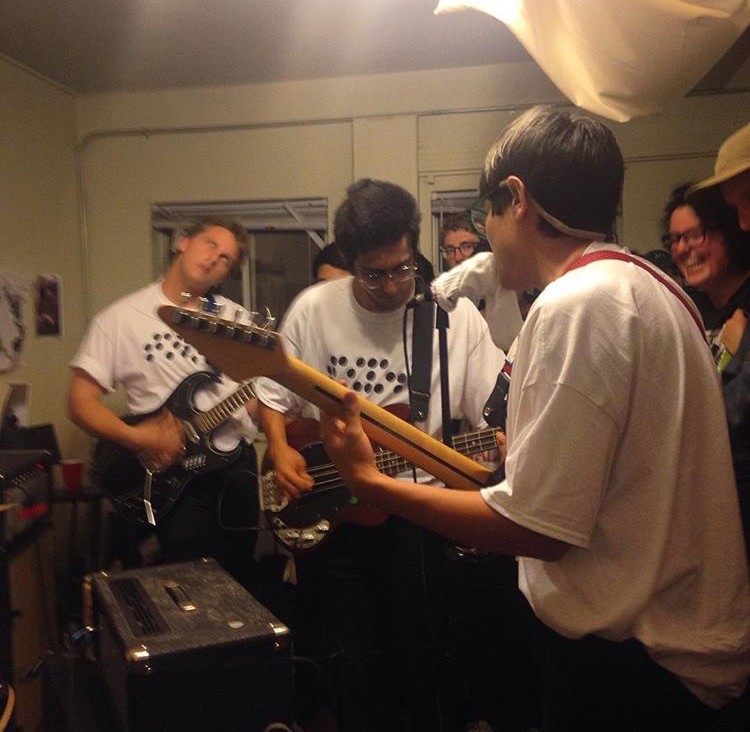
The members of Toyota said starting a capitalist band makes sense in a capitalist society.
Credits: Sean Robles
The members of Toyota said starting a capitalist band makes sense in a capitalist society.
Credits: Sean Robles
Toyota is a fairly new group, formed less than six months ago, and there’s little information available about it online. Even so, it has garnered a substantial following in the underground house show circuit on both sides of the bay, largely through its live performances and ten-minute-long demo tape Concept Model(s) I–V, which it released on cassette and digitally on Bandcamp through its own label, Discontinuous Innovation Inc.
Concept Model(s) I–V is obnoxiously hyperactive, but it’s also infectiously fun. The tape features rapid bursts of punchy, staccato instrumentation. Its repetitive song structures wind into tight spirals, becoming faster and more climactic through the reiteration of each phrase. With its wiry guitars, jolts of drumming, and off-center bass, Toyota largely eschews melody. Its vocals at times sound like maniacal chatter or mean-spirited kids jeering on the playground. And yet its bright, bouncy sonic palette and catchy riffs still tether its sound to pop.
No one — except those who have seen Toyota play live — knows who the members of the band look like, let alone who they are. Toyota has become steeped in a sort of mystique, prompting rumors to swirl around on Facebook that Samuelito Cruz (the ultra-prolific guitarist behind local punk outfits Toner, Happy Diving, and Never Young) is part of the band — which he isn’t.
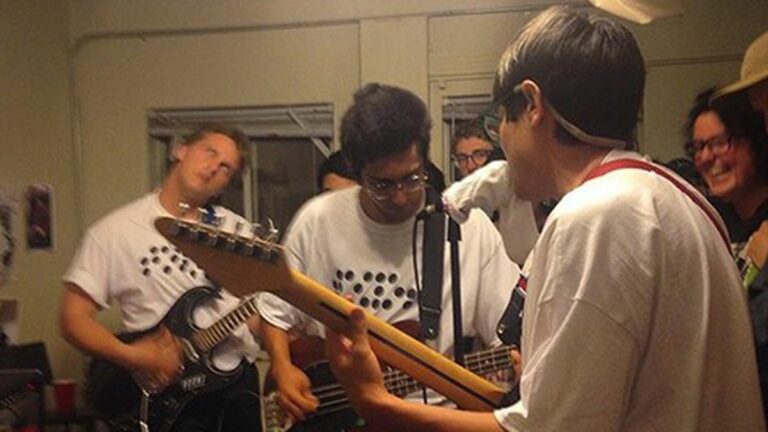
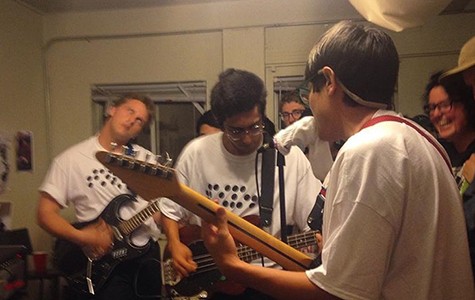
The musicians seem to be enjoying the hype they’ve been building through their anonymity. They wouldn’t give me their real names, instead opting to introduce themselves as car models. Camry Toyota, the bandleader, plays guitar and sings. Tundra is the bassist, Toyota Previa is the other guitarist, and Prius Toyota is the drummer.
“[Prius] is the most efficient member of the band,” said Camry.
“And I chose Tundra because I’ve got sub-zero bass lines,” Tundra added.
Camry quipped, “The Camry is very popular and I’m a very popular person. Just kidding, they usually get key-scratched. I usually get key-scratched at shows.”
Throughout the conversation, the members of Toyota responded to my questions with joke answers — some of which turned out to be flat-out false. “To begin, we’re a business, not a band,” Tundra said, correcting me as I attempted to ask about the themes of mass production and technology in the group’s work. Toyota’s Bandcamp page — which features logos that appear to have been created on MS Paint or a similar, out-of-date software — appropriates corporate design tendencies in a very off-brand, bootleg-looking way. The band’s logo features four, Braille-like dots and the letters D.I. Inc. (for Discontinuous Innovation), lending it the look of branding from a previous decade.
Prius agreed with Tundra. “We live in a capitalist society — why not start a capitalist band?” Tundra enjoyed his answer so much that he asked Prius to repeat it with his mouth closer to my iPhone’s microphone, making sure that it made it onto my recording in the noisy restaurant.
Though they’ve played many house shows in the past, the bandmates professed that they would be moving away from them in order to focus on gigs that offered them greater compensation. That’s surprising, I replied, as many of the punk bands I’ve interviewed have expressed their love for performing in DIY spaces.
“It’s fake. … No one actually enjoys house shows. People just wanna party,” Previa said bluntly, shutting me down.
“We don’t wanna be part of the punk scene, that’s not our goal at all,” Tundra added.
The rest of the bandmembers tossed around potential slogans about efficiency as they slurped their colorful margaritas through straws. I noticed that they wore identical, white polo shirts with the four-dot logo hand-painted onto them.
“There’s no joy in Toyota,” said Camry.
Prius added, “The joy is in our revenue stream.”
“We go to our Bandcamp and see how many people chose to pay [for our music] when they didn’t have to pay,” Previa said as everyone else sneered. “Idiots,” they all said, almost in unison.
Prius then stopped the interview to ask me if I wanted a balloon animal. He and Tundra both do balloon animals as a side hustle in addition to studying at San Francisco State, he explained, handing me his card and then taking it back to cross out his real name and write “Prius” in Sharpie. They pulled out pumps and balloons from their backpacks. Prius made me a gray elephant and Tundra made me a dark blue shark.
While it’s tempting to call Toyota’s gimmick a parody of the capitalist tendencies in music today — with independent artists taking pains to create catchy personal brands in order to vie for attention on social media — labeling the band’s work satire wouldn’t be entirely accurate. Three of the four bandmembers said they’re majoring in business-related fields at SF State, including marketing and accounting. Though Toyota’s lo-fi, abrasive brand of punk is a far-cry from any of today’s mass-marketed music, the band’s appropriation of corporate branding doesn’t contain an obvious critique, either. In fact, Camry said that he chose to name their label Discontinuous Innovation Inc. based on a concept he learned in marketing class: “It is a product that comes to market that is so new and innovative, it completely changes the existing market. Like the Apple iPhone — that was a discontinuous innovation.”
“Everything the label puts out is a discontinuous innovation,” said Tundra. “That’s the impetus behind the band and the label. We want every product we put out to be a discontinuous innovation.”
In 2014, after Mark Salinas lost by just 735 votes his bid to jump from the Hayward City Council to the mayor’s office, he lamented the lack of voter participation in Hayward. “We have to be more aware about local issues, local politics, and we have to be more aware of the impact our local elected officials have in our everyday quality of life,” Salinas wrote at the time in a letter to supporters.
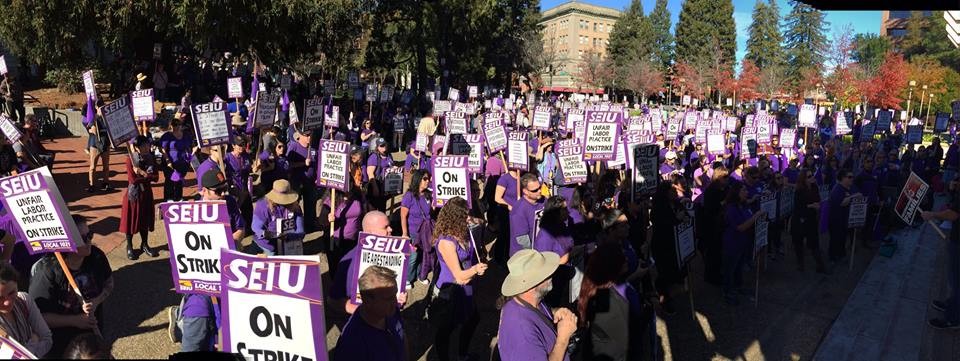
The Service Employees International Union (SEIU) Local 1021 — which has strongly opposed Salinas ever since his vote in 2013 to impose wage cuts on workers in the City of Hayward — agrees. The union is seeking a ballot initiative next year for a charter amendment that would move Hayward’s mayoral and city council elections from June to November when voters typically vote in far larger numbers. Hayward has held its mayoral and city council elections in June since 1994 when voters approved an initiative to align their elections with the June primary schedule.
The SEIU Local 1021 is seeking a ballot initiative next year for a charter amendment that would move Hayward’s mayoral and city council elections from June to November when voters typically vote in far larger numbers.
The SEIU Local 1021 is seeking a ballot initiative next year for a charter amendment that would move Hayward’s mayoral and city council elections from June to November when voters typically vote in far larger numbers.
Most political observers agree that low-voter turnout in Hayward is a serious problem. In recent election cycles, its electorate has consistently registered some of the worst turnout numbers in Alameda County. During the June 2012 election, just 28 percent of Hayward’s registered voters went to the polls. Overall, county participation was 32 percent in that election. Later, in the November 2012 presidential election, which typically attracts substantial attention, Hayward’s turnout was 69 percent, but still less than the 74 percent average countywide.
The results for the June 2014 primary were similar, with 22 percent of Hayward voters participating in the mayoral and council election compared to 26 percent overall in the county. In fact, the disparity in voter participation during the most recent election in November 2014 was the largest in recent years. Just 33 percent of registered voters in Hayward marked a ballot, as opposed to 45 percent of all county voters
“There’s a broad movement in municipal circles to move their election cycles when more is going on,” said Jim Ross, a veteran Bay Area consultant, who is a spokesperson for the Hayward Votes Together campaign. Oakland and Berkeley both hold their mayoral and city council elections in November, when more voters tend to vote.
In addition, Ross said “a broader goal” of the campaign in Hayward “is to create a situation where we have a city council that is more reflective of the city.”
The Alameda County Democratic Party is also seeking to increase voter participation. In recent weeks, the party deployed volunteers to register new voters in Hayward.
But Salinas, who is again a candidate for the city council in 2016, is skeptical of the proposed charter amendment, despite his previous call for greater voter participation. He echoed a concern offered by other elected officials that Hayward’s local elections will be crowded out by highly publicized state and national campaigns.
“I prefer flexibility in June,” said Hayward Mayor Barbara Halliday, who beat Salinas in 2014, while garnering just 4,897 total votes in a city of more than 150,000 people. “I think city elections will get lost in November.”
Ross said this line of thinking is false and numerous studies show presidential elections “drive interest all the way down the ballot.”
In play in Hayward is an oft-cited rule of thumb in politics that low turnout greatly favors incumbents. The existence of a union-backed initiative to stoke voter participation may be unsettling to the status quo in Hayward even though its passage will have no effect until 2018. “There’s nothing for them to be afraid of. By the time the changes are implemented, most will have moved along,” said Ross. Yet there is much mistrust on each side.
Since the council’s move following a lengthy contract dispute with city employees to force 5- percent salary cuts on SEIU Local 1021’s members two years ago, the relationship between the union and elected officials has been icy — despite the fact that the two sides finally agreed to a new contract earlier this year that was fairly generous to workers.
As pushback to the council’s action in 2013, SEIU Local 1021 spent more than $120,000 to support two labor-friendly candidates during the June 2014 council election. The large outlay for Hayward politics shocked many City Hall observers and resulted in one of the labor-backed candidates — Sara Lamnin — winning a seat.
The council, however, with four of its seven members up for re-election next June, is not sitting idle when it comes to election reforms. In November, it approved a municipal election ordinance requiring candidates in the June election to disclose their top four campaign donors, along with amounts and city of origin on mailers and other related paraphernalia. While good government advocates welcomed the ordinance, its impetus was SEIU Local 1021’s large independent expenditure in the 2014 election.
“Elections are becoming more and more expensive,” said Councilmember Marvin Peixoto, while referencing the expensive East Bay state Senate race last May between Steve Glazer and Susan Bonilla in which special interests spent more than $7 million. “That’s too much for a campaign and it’s not democracy,” said Peixoto.
Stories you shouldn’t miss:
1. Fog in the Bay Area is laced with toxic mercury, the Chron reports, citing a new study from researchers at UC Santa Cruz and other institutions. The mercury likely comes from the burning of coal and other fossil fuels. While the levels of mercury in fog in the Bay Area are not considered dangerous, the neurotoxin...
Good morning, and happy new year!
Perhaps you've just awakened, groggy-eyed, in need of sustenance and some kind of hangover cure. If so, here are a few East Bay spots open for brunch on New Year's Eve:
1. Hog's Apothecary (375 40th St., Oakland) is open from 10 a.m. to 2:30 p.m., and even takes brunch...
A homeless camp under the 880 Freeway in downtown Oakland.
Credits: Darwin BondGraham
A report by UC Berkeley Goldman School of Public Policy researchers prepared for the City of Oakland last May found that Oakland's method for dealing with homeless encampments does more harm than good, and that the city's various departments don't have a coherent strategy to help the homeless....
When the Express last caught up with East Bay rapper and social media guru Lil B earlier this month, he said he was roughly sixty percent finished with his highly-anticipated mixtape, Thugged Out Pissed Off.
Lil B had slowed down his manically prolific output in 2015, releasing only a collaborative project with Chance the Rapper (the excellent mixtape, Free, which...
Welcome to the Mid-Week Menu, our roundup of East Bay food news.
1) One of the big trends of this past year was an explosion of one-stop market-restaurant hybrids that opened, or were slated to open — some more successful than others. Oakland’s latest, Howden Market (1630 Webster St.), is slated to open officially the beginning of next week, on...
Stories you shouldn’t miss:
1. In a letter to the National Football League, Oakland Mayor Libby Schaaf stood firm in her commitment to not spend public dollars on a new stadium for the Raiders, the Bay Area News Group$ reports. Schaaf has repeatedly vowed not to publicly subsidize new facilities for Oakland’s professional sports teams. Raiders owner Mark Davis, who wants...
I am a 30-year-old straight man and I've been with a 28-year-old bisexual woman for a year. Early in our relationship, after much discussion, we established that it would be open. I would have the liberty to see other women and so would she. We just had to be safe and always keep each other informed. The key was...
There was a bloody body lying on a dusty road outside a small town in a desert in the Middle East. It was February 2014 and Kara Platoni, an Oakland-based journalist and lecturer at the UC Berkeley Graduate School of Journalism, was inside a Humvee not far from the body, listening to American soldiers in the vehicle...
At first, I thought the members of the San Francisco punk band Toyota were trolling me when they asked me to meet them at Hard Rock Cafe at Pier 39. Toyota has a well-documented interest in kitsch and corporate branding, so I obliged because I thought it would be funny to interview the four musicians under Hard Rock's giant,...
In 2014, after Mark Salinas lost by just 735 votes his bid to jump from the Hayward City Council to the mayor's office, he lamented the lack of voter participation in Hayward. "We have to be more aware about local issues, local politics, and we have to be more aware of the impact our local elected officials have in...