Locals call it Triangle Park. At less than a quarter-acre, bounded by San Pablo Avenue and 32nd and Filbert streets, the concrete plaza is officially called St. Andrews Plaza and includes dusty planter beds and a smattering of trees lining its edges. For years, area homeowners have complained about the park, saying it attracts drug dealers, sex workers, and violence.
The City of Oakland received a $456,000 grant in July to renovate the space, and crews erected a fence thin this week so that workers can begin the demolition before the remodel, which is expected to start at the end of the year. Though relatively obscure to people outside the neighborhood, the renovations proposed for the tiny park are stirring up mixed feelings among residents, many of whom laud the changes but are concerned about what will happen to the current park users.
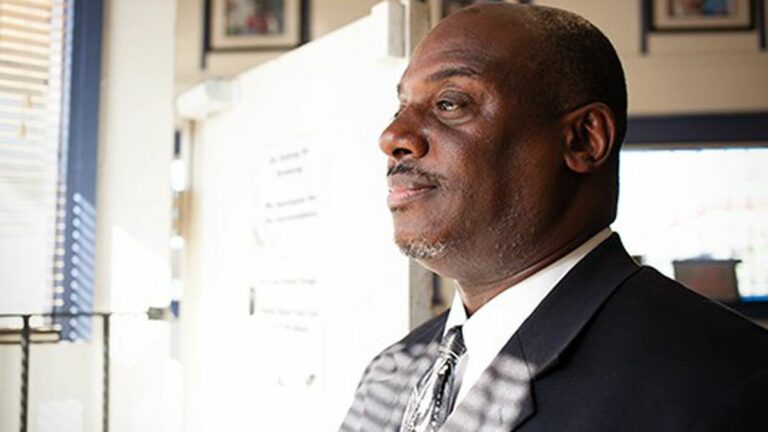
Pastor Raymond Lankford.
Credits: Bert Johnson
Tiny Gray-Garcia, an Oakland resident and co-founder of POOR magazine was eleven when she and her mom lost their housing. While they were living out of their car, her mom would often park near the plaza, and they would sit in the park during the day, she said in a recent interview. For her, Triangle Park was a refuge. She recalled elders in the park asking how she was doing and watching after her. When she became homeless as an adult, she went back to the plaza. It was the one place where she felt comfortable talking to others about the crisis of gentrification, she said.
Gray-Garcia, along with other social justice activists, was planning a protest at the park on Tuesday. She’s worried about what will happen when the fences go up. “The crucial line is public space for the public,” she said.
The San Pablo Avenue corridor is poised for change. The West Oakland Specific Plan, a roadmap for future development in the area, identified commercial buildings on San Pablo adjacent to the plaza as “opportunity sites” for mixed-use construction. And the nonprofit East Bay Asian Local Development Corporation (EBALDC) has spearheaded a partnership with multiple community-based organizations and city and county agencies called the San Pablo Avenue Revitalization Collaborative, which aims to address health disparities among West Oakland residents, increase opportunities for affordable housing, promote economic development, and combat blight, said Romi Hall, EBALDC’s healthy neighborhoods manager. City officials say they’re not trying to displace anyone or bar any of the current users from enjoying the plaza. Rather, they’d like to see changes in the types of activities happening there.
“Everyone is absolutely welcome to use the park now and in the future,” said Joe DeVries, an assistant to the Oakland city administrator.
DeVries began working in the Hoover neighborhood, which abuts but does not technically include the plaza, more than a decade ago as part of the City-County Neighborhood Initiative, a collaboration of city and county agencies, community-based organizations, neighborhood groups, and UC Berkeley. DeVries said he went on walks with seniors in the area, and the plaza was high on their list of concerns then and still is now. From November 2014 to November 2015, public works employees responded 140 times to reports of illegal dumping at the plaza, and Oakland police responded 239 times to calls for service within 1,500 feet of the plaza, DeVries said. Residents in the area say it’s been that way for decades.
The turning point, said multigenerational resident Madeline Wells, was “the total destruction of the neighborhood” when Interstate Highway 580 was built in the 1960s. Whole blocks were razed, including the St. Andrews Roman Catholic Church, which was moved from the corner of 36th and Adeline streets to Brockhurst Street and San Pablo Avenue, across the street from where the plaza is now.
The entire San Pablo Avenue corridor “deteriorated into a dumping ground,” Wells said. It became what Alternier Cook, another multigenerational resident, called “apathy valley.” Like many longtime Black residents, Cook and Wells said they are tired of seeing trash, hypodermic needles, and human excrement littering the sidewalks that border the plaza. But the legacy of eminent domain has left many in the community wary of city policies aimed at improving the area in the name of progress, Cook said. Although she said she would like the plaza to be a place where parents feel comfortable taking their children, Cook said she also doesn’t want to see people who use the park “rounded up like cattle.”
Many of the people who use the park live in the area and have been going there for decades, said Pastor Raymond Lankford, president and CEO of Healthy Communities, Inc., a health clinic founded in 2004 at the corner of 25th Street and San Pablo Avenue. His organization has been providing outreach to people along San Pablo since its inception, he said, but over the last few years they’ve made a more concentrated effort to address the needs of people who frequent St. Andrews Plaza. Healthy Communities also partnered with the City of Oakland to embed an outreach worker at the park every day for four months to complete a needs assessment. Lankford said he saw the park users stopping people from fighting at the park and cleaning it daily — as was the case when I visited on a recent Thursday afternoon. On the other hand, Lankford said he saw some young men selling drugs in the plaza as well. But Lankford said that after speaking with them, they expressed a willingness to find new occupations, provided they had an opportunity. “When you have young men of color who have been incarcerated multiple times, especially since their youth, it’s hard to get a job,” Lankford said. “So what do they do? They hang out. You get pulled into things that create problems for you.”
He proposed purchasing a building adjacent to the plaza that could serve as a drop-in center for the park users, a place where they could take showers and receive medical and dental care, substance abuse counseling, and job training. City officials are interested in creating such a center, but no spaces have been identified and no funding is currently allocated, said Brigitte Cook, a community liaison for council President Lynette Gibson McElhaney. Cook noted that along San Pablo, there are already at least four sites where someone can get a meal and at least five drop-in centers, including St. Mary’s Center, which sits directly across the street from the plaza (though it only serves seniors aged 55 or older). Cook said there’s a need to coordinate the efforts of these various agencies and concentrate outreach for park users.
No matter how people feel about the proposed plans to renovate the park, nearly everyone I spoke to said the renovations would change nothing unless there is a concerted effort from the city, community-based organizations, and residents to address the long-term needs of not just the park users, but of the entire neighborhood.
On Thursday, March 10, from 6–8 p.m., at West Oakland Youth Center, 3233 Market Street, the public will have the opportunity to weigh in on three potential designs for St. Andrews Plaza.
“A larger investment needs to be made to look at the surrounding area and make some serious investment in this community,” said Carol Johnson, executive director of St. Mary’s Center. “It has to be larger than the triangle.”
To Oakland musician Chuck Johnson, a graduate degree in electronic music and a homespun acoustic guitar style are perfectly compatible: “What appealed to me about electronic music — that’s something I get at with the guitar, in terms of harmonics and texture.” His discography, however, is compartmentalized: Synth excursions under an array of monikers, notably Pykrete; solo guitar under his own name. And he’s best known for the latter.
That made Johnson’s full band performance the other week especially significant. It was the release event for his latest album, Velvet Arc, at the Starline Social Club, and Johnson, 47, assumed a monastic disposition on stage, swaying in time while the brim of a ball cap obscured his face. The group performed album opener “As I Stand Counting,” setting the low, droning thrum of Johnson’s fingerpicked electric guitar atop drummer Alex Vittum’s syncopated shuffle. Johnson simultaneously thumbed a lustrous low-end motif and elicited elliptical melodies from the guitar, all while minding the rhythm section’s nimbly fragmented groove. Like the recording, it evoked western and psychedelia alike, but absorbed the audience with its idiom-resistant emphasis on collaborative expression.
Chuck Johnson, with Bubbles.
Credits: Bert Johnson
“It ended up with a German kosmische feel,” Johnson said, referring to pulsing, synthesizer-oriented Seventies rock. “We didn’t set out to do country Neu, but that’s the benefit of not rehearsing.”
Johnson recorded the bulk of Velvet Arc in 2014 alongside his previously released album, Blood Moon Boulder, in sessions at a West Oakland warehouse that belongs to the New Music figure and experimental ensemble leader Paul Dresher. Blood Moon Boulder, like most material Johnson releases under his own name, principally features solo acoustic guitar. For Velvet Arc, however, he invited Vittum and bassist Ben Bracken, among other guests, to collaborate in the studio. It’s his first album with a full band in more than ten years — since his tenure in avant-rock outfits such as Shark Quest and Idyll Swords back in Chapel Hill, North Carolina — and it signals Johnson’s growing interest in colliding his disparate influences and tendencies more overtly.
Johnson is often associated with the so-called American Primitive guitar tradition. Typified and nurtured in the Sixties by John Fahey and his Takoma label, it venerates expanding on the acoustic, usually fingerpicked stringed-instrument techniques found in earlier American folk music. In recent years, players such as Steve Gunn and Daniel Bachman have brought the lineage forward, galvanizing critics and younger listeners alike. Johnson joined their ranks in 2010, when an acoustic piece of his, “A Struggle, Not a Thought,” opened the Tompkins Square label’s Beyond Berkeley Guitar compilation, curated by local guitarist Sean Smith. It was Casey Bull, daughter of Sixties psych-folk player Sandy Bull, who brought Johnson to Smith’s attention.
However, Johnson isn’t a revivalist. He identifies most with Fahey’s original emphasis on celebrating autodidacts. In that sense, teaching himself guitar and, lately, pedal steel, is a way to offset his graduate degree in electronic music from Mills College.
Johnson works in a studio apartment in downtown Oakland. He lived there until about a year ago, when he moved in with his girlfriend, Marielle Jakobsons, another Mills alum (who plays violin on two Velvet Arc tracks). Now, the apartment is devoted to music: Mixing consoles, compression units, instruments, and a soldering station crowd the living room. There, he writes and records music for film and TV. Sometimes he consults with Bubbles, his girlfriend’s scruffy dachshund. His projects include the PBS show A Chef’s Life (the brisk fingerpicking at the start of each episode complements the host’s Southern pep) and the 2014 documentary Private Violence.
Often, ideas for scores find their way onto albums. Take one circuitous example: “Private Violence” — a woebegone dialogue between guitar and pedal steel from Blood Moon Boulder — was inspired by the documentary (which focused on domestic violence). And “Anamet,” from Velvet Arc, recapitulates the same melody on electric guitar, adding tidal cymbal swells and a walking synthesizer pattern.
A diffuse mélange of synth and pedal steel belies much of the acoustic instrumentation on Velvet Arc and Blood Moon Boulder. Steve Lowenthal, a Fahey expert and operator of the guitar-focused VDSQ label, detected the instruments seeping into Johnson’s recent work and requested that he bring them to the fore on a new record (which is currently untitled but slated for release later this year). Synthesizers were a focus of his at Mills, but Johnson is approaching pedal steel much like he once did guitar. “Any time I’m learning an instrument, I immediately want to put it to my own uses,” he said. “Even if that’s a perverted version of what the instrument is meant to do.”
“With pedal steel, there’s levers that you move with your knees and pedals and then you’re fingerpicking and using a bar — it’s like trying to do something expressive with a typewriter, that sort of machinery.” He went on, “Doing a record based on pedal steel was kind of a dare, but with the sound of it, I’m enthralled.”
In the studio, Johnson played me a selection of the forthcoming record. Suffused with tape decay, the pedal steel’s expected twang instead cedes to polished glisten and mingles with vibrant synth. It sounds gossamer and plush, dotingly textured like Brian Eno’s Apollo but with a bolder presence. Johnson and his yappy dachshund settled into a reverie. “I have three solo guitar records,” he said. “That’s a good number.”
A few months ago, Lucille Edwards was working a day shift at John George Psychiatric Emergency Services when a man began to cry out. Edwards was making her nursing rounds in the central room, where she and a handful of other nurses tend to dozens of patients. Edwards and several other nurses then went over to the distressed man in hopes of calming him down. “He was distraught, very agitated,” said Edwards in a recent interview.
It didn’t take long for the nurses to understand what had happened. The man had been taking a nap in one of the large reclining chairs that are placed around the room, and when he awoke, he reached over, grabbed a juice cup that he had put on a table, and took a thirsty gulp. The man yelled and pointed to another patient who sat next him, accusing the other man of urinating in his cup while he was asleep. Edwards and other nurses did their best to prevent a fight, but other patients grew anxious by the man’s screams. Fortunately, they resolved the problem before anyone became violent.
Many patients arrive at John George Hospital Psychiatric Emergency Services via ambulance.
Credits: Bert Johnson
A water-logged hospital pillow in the bushes where someone slept outside John George PES.
Credits: Bert Johnson
For people unfamiliar with John George Psychiatric Emergency Services (PES) — Alameda County’s sole emergency mental health care facility, located in the hills above San Leandro — this incident might seem like an everyday hazard associated with treating mentally disturbed people, and perhaps resembles a tragicomic scene from One Flew Over the Cuckoo’s Nest. But according to Edwards and other nurses, the urine-drinking incident wasn’t caused by a “crazy” person who, for reasons unknown, peed in another person’s cup. In fact, nurses maintain the incident was due to severe overcrowding that has plagued John George for years.
According to nursing staffers, on that particular day, the central room at John George PES was full of patients. Every seat was taken, and more than a few patients were forced to sit on the floor or stand. When the central room, which is about 35-feet-by-45-feet in size, becomes crowded, patients become territorial: Those who have comfortable seats are reluctant to get up for any reason, because if they do, someone else will take their spot, and they will be forced to stand or sit on the cold floor. There are only a few other spaces in PES where patients are permitted to rest, and because patients must be accompanied at all times by multiple staff members, the routine is to keep almost everyone in the central room.
“The guy put his drink down and the other guy urinated in the cup probably because he was afraid to get up and go to the bathroom, because if he did, he would have lost his seat,” explained Edwards.
Nursing staffers say this incident was an example of the many kinds of conflicts that frequently erupt due to cramming so many mentally ill people into a small room with too few nurses to care for them. “There’s always a possibility of a riot if a fight breaks out because of the cramped, close quarters that people are in and the agitated states they are already experiencing,” said Stephanie Johnson, who is a John George nurse of thirteen years, has witnessed numerous brawls, and has been injured while trying to separate patients.
There are no beds at John George PES because it’s not considered an inpatient facility, and patients are only supposed to be kept for a maximum of 24 hours before they are discharged or transferred to a bed in the nearby inpatient unit of John George Psychiatric Hospital for more intensive care. As a result, many patients sleep sitting upright in chairs at night, while the rest crowd onto the floor, making it difficult to walk through the room.
People end up at John George PES for many reasons. Some arrive in ambulances, while others are escorted in police vehicles, and still others walk through the front door by themselves or are accompanied by concerned family and friends seeking help for their loved one. Many are committed involuntarily under the authority of California’s Welfare and Institutions Code 5150, which allows law enforcement officers and healthcare workers to hold a person against his or her will when they deem a person to be dangerous.
The purpose of John George PES is to stabilize people who are experiencing a mental health emergency, whether or not they have medical insurance. Many of the patients treated at the facility are chronically homeless or unemployed. Some suffer from alcohol and drug addiction, which compounds their psychological troubles. Some of them also have chronic physical ailments that make caring for them in their mental distress much more difficult. A big proportion of PES patients have fallen through the cracks of other institutions, or don’t have family members and friends who can help care for them. For those suffering from an acute psychological crisis, PES is the last thin mesh of the social safety net.
In recent months, nurses and other staffers at John George have increasingly been speaking out about the cramped conditions at the hospital, warning administrators and county health officials about troubling issues inside the facility that they say are undermining patient and worker safety and preventing patients from receiving adequate care. At public meetings of the Alameda Health System’s Board of Trustees, the governing body that oversees the John George Psychiatric Hospital, and before the Alameda County Board of Supervisors, which ultimately pays the hospital’s bills, nurses and other healthcare workers have noted that the number of patients admitted to the facility has nearly doubled in the past decade, while staffing levels have not kept pace, thereby increasing the number of injuries and violent incidents.
Staffers said during a series of recent interviews that it’s especially common for male patients to explode in anger at nurses and other patients when they feel that their personal space is being invaded, or when they’re asked to make room for people with disabilities or health problems who need to lay down.
“The stronger people sleep on the couch,” explained Johnson, referring to one of the few pieces of full-length furniture in the main room where a patient can comfortably recline. “We recently had a little lady with arthritis who needed to lay down, and we wanted to put her on one of the few couches that we have, and a man who was sleeping on the couch, when we asked him to please let the lady have it, he began yelling, ‘Hell no!’ and got very angry.” Johnson said they had to back off and find another spot for the woman for fear that the situation would escalate.
Nurses and other staff members say that while the problem of overcrowding is not new at John George, the situation is growing increasingly dangerous. And they blame hospital administrators not only for management decisions that they allege have made matters worse but also for creating a culture of fear in which speaking out could cost nurses their jobs.
<hr width="20%" align="center" noshade
Ruby Sloan, a mental health specialist who has worked at John George Hospital since it opened in 1992, and who previously worked in the psychiatric ward at Highland Hospital, has seen lots of fights break out, but in recent years the problem has intensified, and the hospital administration has been unresponsive to pleas from nurses and other staffers, she said. “The PES has been overcrowded for more than ten years now,” said Sloan in an interview. “I’ve seen people bitten and stomped. I’ve had two concussions myself.”
In 2006, Sloan was working her shift at PES when a male patient became agitated and began lashing out at staffers. Sloan was standing nearby when the man threw a wild punch that landed square on the side of Sloan’s head, behind her ear, causing a concussion. Then in 2014, another male patient struck Sloan in almost the same spot with his fist, causing a second concussion. Both injuries forced Sloan to go on medical leave while she recovered. Sloan believes that her injuries, along with similar wounds sustained by her co-workers and other patients, could have been prevented if there were fewer patients crowded into PES and more nurses to look after them.
Overcrowding also results in critical gaps in patient care, said several other PES staff members whom the Express has agreed not to identify because they fear retaliation by hospital management. According to several accounts, last year nurses had difficulty providing care to a patient experiencing a life-threatening medical emergency inside PES. “We had to try to help this person right there on the spot,” said a PES staff member. “This was a lady who was in serious trouble, but because it was so overcrowded, and because some of the patients don’t know any better, we had people interrupting us the whole time, coming up behind us, asking for snacks, for cookies, or if they could go to the bathroom.”
In multiple emails and phone messages, I repeatedly asked the Alameda Health System’s communications director Jerri Randrup and agency spokesperson Jennifer Schutz about recent events in PES, but neither responded to my questions. Instead they emailed me the same undated, unresponsive one-page statement three times.
Edwards, Johnson, and Sloan all said that frequent overcrowding inside John George PES also means that many patients have to eat their meals — which are served in Styrofoam trays with plastic utensils — while sitting on the tile floor, and that at night, some of the patients are expected to sleep on the hard floor with only a pad and a blanket to insulate them. According to the Alameda County Mental Health Board, a public committee that advises the county board of supervisors on mental health services, there are frequently upwards of twenty patients sleeping on the floor at night in PES because the facility is overcrowded.
“There’s nothing therapeutic about this,” said Johnson. “We’re going backward.”
“The floor is cold, and there’s no good ventilation in the PES,” added Edwards. The room is normally pungent with the smell of soiled clothing. Because the toilets are locked, and a nurse must accompany a patient when they need to use the toilet, patients frequently urinate on themselves. “A lot of people end up leaving the hospital more traumatized than when they came in,” said Edwards.
On November 24, 2015, Edwards, Johnson, Sloan, and about forty other nurses and staffers went to the meeting of the Alameda Health System Board of Trustees, which oversees the John George Psychiatric Hospital, and implored the board to find a solution to the overcrowding. The public appearance of so many hospital staff at a board of trustees meeting — effectively going over the heads of their own hospital’s administrators — was unprecedented.
“Overall morale at John George is at an all-time low,” said BJ Wilson, a nurse who has worked for many years at John George’s PES, during the public comment period. Wilson added that in the months leading up to the trustees’ meeting, PES had exceeded its capacity on multiple days, and that if the conditions are allowed to continue, violence will ensue and the quality of patient care will further decline. “Sooner or later,” Wilson warned the trustees, “something bad is going to happen.”
<hr width="20%" align="center" noshade
John George PES has a long history of bad things happening. In 1998, state regulators investigated the facility and found that the hospital’s administration had set up substandard injury-prevention programs, and that assaults committed by patients against other patients and against staff were common. The state issued citations, but not much changed. Again in 2003, state regulators made the same findings. Dean Fryer, a spokesperson for the California Occupational Health and Safety Administration (OSHA), told news reporters at the time that John George’s administrators had made a “dismal showing,” and that, in fact, the hospital’s leaders had behaved in a “defiant” manner during the summer of 2003 by not increasing security and staffing as OSHA had advised.
Then in November 2003, tragedy struck. Rene Pavon, a 48-year-old patient who was being examined by veteran physician Erlinda Ursua, picked up a heavy blunt object and knocked the doctor over the head. Pavon then strangled Ursua to death using the doctor’s scarf. The attack was not discovered for at least thirty minutes because Ursua had been examining Pavon alone, in an isolated examination room, a practice that OSHA and others had previously advised the hospital’s administrators to end. Then in December 2003, Mark Oyarzo, a 38-year-old patient, hanged himself with a shoelace. Further investigation concluded that both of these deaths were preventable and partly due to under-staffing and poor safety practices.
Then in 2005, another patient committed suicide by hanging herself from a bathroom door hinge with a piece of clothing. This spate of tragedies — Ursua’s death, multiple suicides, and even more numerous assaults, some of which the hospital’s administrators did not immediately report to state health officials — caused the Alameda County Civil Grand Jury to investigate John George PES. The grand jury wrote in its final report, published in 2006, that the hospital appeared to be undertaking reforms suggested by state regulators but that “questions still remain regarding how well the training program is implemented and how policies and procedures are enforced” and that “safety concerns will remain until the facility’s staffing needs are met.”
The grand jury singled out the hospital’s tendency to have too few nurses on shift and too many patients crowded into PES, calling it an “ongoing challenge.” The number of patients often swelled to levels far exceeding the state mandated nurse-to-patient ratio, which, according to the grand jury report, should have been one-to-five.
Then, starting in 2007, the county’s mental health care budget began taking hits — damaging cutbacks that undermined any progress that had been made. At an Alameda County Board of Supervisors meeting on January 11 of this year, Manuel Jimenez, director of the county’s Behavioral Health Care Services, which helps pay for mental health care at John George Hospital, said that more than $70 million had been cut from the county’s mental health care budget since 2007.
“I know there are problems at John George,” said Jimenez during the meeting. When asked by county Supervisor Keith Carson to explain the problem of overcrowding, Jimenez listed factors mostly beyond the hospital’s control. According to Jimenez, budget cuts have reduced the capacity of John George Hospital’s inpatient facilities, which has forced the hospital to hold more patients in PES, rather than transferring some of them to the inpatient beds. Jimenez added that budget cuts have been compounded by the fact that John George PES is the sole psychiatric emergency services facility for the entire county, and Alameda County has a large and growing population of poor people living in “concentrated poverty” and other conditions of stress and trauma that produce an abnormally high incidence of mental health crises. Jimenez told the board of supervisors that social and economic conditions in Alameda County have caused it to have “one of the highest 5150 rates in the state.” In fact, according to California’s Office of Statewide Health Planning and Development, Alameda County has the highest per capita incidence in the state of involuntary holds placed on individuals experiencing a mental health emergency — 11 per every 100,000 people — with the next highest county only having placed 6.4 involuntary holds per 100,000.
Another factor causing overcrowding in PES is the hospital’s high readmission rate. According to the county’s Mental Health Board, too many patients make repeated visits, because there are too few mental health services available to them. For many mentally ill people, especially those who are homeless or very low-income and lack medical insurance, it’s difficult to obtain treatment for substance abuse, to get into transitional housing, and to access medication, counseling, and other resources and therapies that would keep them from spiraling into another crisis. According to a recent Mental Health Board report, the high readmission rate at John George PES had the potential to feed a “vicious cycle of overcrowding,” resulting in “patients being discharged and being readmitted when they fail to function outside the hospital setting.”
Nurses at PES are already familiar with this cycle. Sloan said in an interview that lots of patients return to PES week after week, often as walk-ins, but others arrive repeatedly in ambulances after having fallen into a manic or severely depressed psychosis.
“There is nowhere else for many of these people to go to,” said Sloan. She said many of the mentally ill who are homeless sleep in the bushes around the John George Hospital campus, spending the night out in the elements, or wandering the streets of San Leandro and East Oakland before making their way back to PES.
I recently walked around the hospital grounds and noticed pillows, blankets, sheets of cardboard, and possessions stashed in crawl spaces dug out beneath palm trees and shrubs. There were impressions of curled human bodies in the compacted dirt where people had recently slept.
“There is not enough in the way of services to help this population deal with their lives and stay out of the hospital,” said Sloan.
<hr width="20%" align="center" noshade
According to Sloan and other caregivers who work at John George, some of the causes of overcrowding in PES are also due to ill-advised decisions made by hospital administrators. In fact, staffers say PES became dangerously overcrowded because of a solution devised by administrators for another problem.
In the past, people experiencing a mental health crisis could take themselves, or be taken by police or paramedics, to any emergency room at any hospital in the county. Under this old system, psychiatric patients were diagnosed and sometimes treated at public and private hospitals in Berkeley, Oakland, San Leandro, Fremont, Livermore, and elsewhere. But this all changed with the introduction of the “Alameda Model.”
The Alameda Model was developed by Scott Zeller, an award-winning physician who until last year was the chief of psychiatric emergency services at John George Hospital. The problem that Zeller was trying to solve was the unreasonable and inefficient wait times that patients in Alameda County faced when they arrived at a standard hospital emergency room in the midst of a mental health crisis. According to a paper published by Zeller in the Western Journal of Emergency Medicine in 2013, a survey of emergency department directors in California found that “the average wait time for adult patients with a primary psychiatric diagnosis in the [emergency department], from the decision to admit until placement into an impatient psychiatric bed or transfer to an appropriate level of care, was 10.05 hours.” Zeller concluded that this time-consuming method — called “boarding” — amounted to a “costly practice, both financially and medically,” and that “the psychiatric symptoms of these patients often escalate while they are boarded in the [emergency department].”
Zeller sought a way to reduce these wait times and more quickly provide care for psychiatric emergency patients. His solution was to assign one hospital as the primary point of intake for mental health patients in need of emergency care and to guarantee that other hospital emergency departments could immediately transfer psychiatric patients to John George’s PES. The result is that other hospitals now send psychiatric patients to John George, rather than boarding them and treating them. And the police and EMTs also bring psychiatric patients directly to the John George PES.
Troy Nixon, who works as a nurse in the emergency intake area of John George PES, where patients arrive in ambulances, assesses patients to determine whether they should be admitted to PES or referred to a counselor or a substance abuse center. “I want them to have full awareness of what’s going to happen and what to expect if we admit them,” Nixon said in an interview. “But if a person says, ‘I want to kill myself,’ then it’s automatic. They have to come in, even if they don’t want to.”
According to Nixon, the Alameda Model has drastically increased the number of patients being admitted to PES, and while this might be good for emergency departments at other hospitals, which have fewer resources to care for those experiencing a mental health crisis, it has also put a crushing burden on PES staff and undermined patient safety and care.
Nixon and other nurses believe that the John George PES needs to cap the number of patients it can hold at any given time. According to Nixon and his fellow nurses, the hospital’s administration has purposefully designated PES as a special facility that not only has no cap, but also does not have to abide by any nurse-to-patient ratio or a capacity limit set by the county fire marshal.
“Because we are encouraging patients to be sent here, or to just come in on their own, we end up having to deal with the huge number of people who may not really need to be in our care, and it takes our attention away from the people who seriously need our help,” Nixon said. “It’s almost like an assembly line, this higher volume of people. It’s like we’re a McDonald’s and we got 1,000 customers, and we are having to take short cuts to serve people, to get them in and out the door.”
PES staffers have petitioned Alameda Health System (AHS) managers to assign a cap of fifty patients and to ask other hospitals delay transferring psychiatric patients and treat them in their own facilities, and for police and paramedics to transport patients to other emergency departments whenever PES reaches its cap. PES staffers also have requested that AHS hire more mental health crisis workers to be assigned to emergency rooms in Alameda, San Leandro, and Highland hospitals so that these locations can provide care for patients who can’t be transferred to the PES when its cap is reached.
When I asked AHS representatives why John George PES has no cap or a capacity limit set by the fire marshal, I received only a single-page statement thanking me for my interest. “JGPH is the only provider available within Alameda County to care for patients experiencing a psychiatric emergency,” the statement read. “Similar to medical emergency departments, there are times when the need exceeds a manageable volume.”
The statement did not explain why the hospital’s PES has no patient cap or building capacity limit, nor why the hospital shifted to the so-called Alameda Model. In fact, AHS spokeswoman Jennifer Schutz would not even respond to my question as to what year the Alameda Model was first implemented.
Zeller, who now works for a private Houston, Texas-based healthcare company called JSA Health Telepsychiatry, wrote in an email to me that the Alameda Model has been in effect since 2005. Zeller contended, however, that it can’t be blamed for overcrowding at John George PES. He also said PES can’t cap the number of patients it admits. “Federal law recognizes psychiatric emergencies as emergency medical conditions, technically equivalent to medical emergencies like heart attacks or car accidents. So it is impossible for the John George Psych ER to ever say, ‘We are full, no patients can come here,'” wrote Zeller. “Some concerned staff may have told you that they believe John George should be able to have a ‘cap’ at a certain number of patients. But no ER in Alameda County is permitted to do this. And only John George has psychiatric professionals on duty 24/7. Where would the patients having psychiatric emergencies then go if the Psych ER said they were ‘full’?”
But PES staffers said they are not advocating for turning anyone away who shows up at the facility. Rather, they want John George PES to inform first responders and other emergency hospital rooms when PES becomes overcrowded, and to prevent transfers of patients to PES from other emergency rooms until conditions improve.
Zeller argued that this would be “not fair” to non-psychiatric patients with medical emergencies in other emergency rooms that are overcrowded, as well. In his 2013 research article about the benefits of the Alameda Model, Zeller also noted that emergency rooms can save $2,264 for each psychiatric patient they do not have to board. But PES staffers maintain that Zeller’s commitment to have PES absorb all psychiatric patients, without limits, is doing more harm than good for patients and workers.
In public meetings and in letters to the AHS board and Alameda County supervisors, PES staffers have asked to end the Alameda Model in order to reduce overcrowding. “In a space that is full at 50 [patients], PES regularly reaches a census of 80 [patients] on weekends and 70 is seen with increasing frequency on weekdays,” wrote PES staff members in an open letter that they distributed at the AHS trustees meeting in November 2015.
They wrote that the overcrowding is caused by the absence of any policy to divert patients away from PES when it’s already filled. “For patients in need of acute stabilization, they arrive in PES finding resources stretched thin. They often find that there are no benches where they can sit or rest, which leads to assaults and agitation. They find that psychiatrists are grappling with bloated caseloads and demanding deadlines, leading to rushed interactions. They find that nurses are often assigned to 8 or 9 patients, in violation of state law and safe practice standards, and have little time for therapeutic intervention aside from preventing violence, crowd control and administering medications to those most in need.”
In public meetings and official reports, AHS administrators have acknowledged the overcrowding problem at John George PES but have refused to speak about it with the news media. I requested an interview with Guy Qvistgaard, chief administrative officer of John George Hospital, and Judy Linn, director of nursing, but AHS communications director Jeri Randrup and spokeswoman Schutz did not acknowledge my request.
However, an internal report conducted last December by Rick Kibler, vice president of compliance and internal audit for AHS, found that the nurse-to-patient ratio of one nurse per every six patients, which is the standard for the entire John George Psychiatric Hospital under its state license, is “not consistently met” in the PES. The same report noted, however, that there is no legal classification for the John George PES facility, and therefore under state law, there is no specific nurse-to-patient ratio that the PES is mandated to follow. However, because the PES fits the state and federal criteria for being both an emergency department and a psychiatric unit, the facility must adhere to either a one-to-four or a one-to-six nurse-to-patient ratio. According to Kibler’s report, “the California Department of Public Health is investigating the matter of licensed nurse-to-patient ratio for PES, and will provide a recommendation at a later date.”
PES staffers believe that AHS administrators have exploited this lack of clarity in order to accept more patients, while keeping staffing numbers down, in order to maximize the hospital’s billing revenue.
According to Nixon and other nurses, AHS management has tried to keep the problem of overcrowding and staffing shortages at John George from becoming public, and has been unresponsive when staffers have raised the issue of overcrowding in internal meetings. In fact, the internal AHS audit conducted by Kibler was only conducted because forty PES nurses and other staffers approached the AHS board of trustees at its November 24 public meeting last year and spoke at length about the problems at John George.
And PES staffers are continuing to raise the issue publicly. At the January 11 meeting of the Alameda County Board of Supervisors health committee, Nixon presented a graph showing that total annual visits by patients to John George PES jumped from 9,645 in 2007 to 16,116 last year, while staffing hasn’t increased sufficiently to meet this explosion in admissions. “It’s great that we are finally acknowledging these problems exist,” Nixon told the supervisors and county health officials during a public comment period. “We need to set a maximum capacity at which we can safely, therapeutically manage things. Right now, there’s simply no floor space, and we’re being forced to free up space, and figure out who we can discharge faster. It’s a tragedy.” Nixon ended his comments by noting that John George PES is possibly the only hospital in the state without a cap on the number of patients who can be in the building.
I contacted the Alameda County Fire Department’s fire marshal about Nixon’s claim. According to spokesperson Aisha Knowles, John George Hospital’s original building and permitting plans dating back to 1989 do not indicate an occupant load for the building housing the PES. State health and fire officials told the county fire marshal that a waiver was granted in 2004 to convert a building on the John George campus into the PES facility. The county fire marshal has requested records from the state related to this waiver, which should indicate if an occupant load was ever assigned to the PES by state fire and health officials. The county fire marshal, however, has yet to receive these records.
<hr width="20%" align="center" noshade
Nurses and other staffers say that last year, after they began demanding action on the issue of overcrowding, John George Hospital administrators became increasingly hostile, and that some staffers have been punished for speaking with state regulators and county officials.
“I have seen a lot of different administrations over my career,” said BJ Wilson about the executives who run John George Hospital and other AHS mental health facilities. “The current group, which has been here for the last eight years or so, they have not been receptive to the staff’s concerns. Some things, they do appear to be punitive, and when people have to work in a situation where they feel like their livelihood is jeopardized, it’s working in fear.” Wilson said fear has kept many AHS mental health workers from raising the issue of overcrowding with administrators. (In fact, all of the nursing staffers interviewed for this story declined to be photographed because of fear of retribution.)
Another nurse, speaking on the condition of anonymity, said many of the current AHS executives came to the system from private sector hospitals where nurses and other employees have fewer protections and work for less pay, and where the goal of increasing hospital profits often takes precedence over issues such as staffing and patient care. “In the private sector, if you piss off the boss, they get rid of you,” said the nurse, who believes that many current AHS executives are bringing this mentality into the county’s public health system.
Lucille Edwards was one of the speakers who addressed the AHS trustees at their board meeting last November about problems at John George PES. According to Edwards, after that meeting, her immediate supervisor called her into the office at least five times and reprimanded her for things like using an “irritated voice” in the workplace.
“We all know this stems from my going to the board of trustees with the other nurses and speaking about the problem. I was one of the main speakers,” Edwards told me. “I had no problems from 2011, when I started working here, up until the trustees meeting. So the record speaks for itself.”
Wilson told AHS trustees at their November board meeting that nurses used to only “fear being assaulted by patients, but now the fear is staff is being assaulted by the administration. … If you talk, speak out, you’re going to be reprimanded, hauled in, questioned, and your credibility is going to be on the line.”
AHS spokesperson Schutz did not acknowledge my request to interview Judy Linn, director of nursing at John George, so I was unable to ask hospital executives about any recent disciplinary actions at the facility. Schutz also did not return my phone calls seeking comment about discipline issues.
Another nurse who spoke to me on the condition of anonymity said that PES workers who are injured on the job are sometimes treated as though their injuries are their own fault. “When you get assaulted by one of the patients, it’s almost like you get another punishment afterward from the management,” the nurse said. “They try to reassign you or keep you from being able to work again. They don’t say it to you, but they do things to make it clear.”
According to AHS records and other sources, John George administrators attempted last year to remove a PES manager who sided with nurses over the issues of overcrowding and the demand to establish a nurse-to-patient ratio. According to an open letter distributed publicly by PES nurses, Frederick Tatum, the nurse manager in PES, was placed on administrative leave after he communicated with state regulators about possible fire code violations and requested clarification regarding nurse-to-patient ratios from hospital executives and state regulators. According to the open letter, the hospital administration placed Tatum on administrative leave and investigated him for reasons that were not disclosed, but the administration found no evidence of misconduct, so AHS executives then offered Tatum a “hefty severance package” if he would agree to voluntarily resign.
Tatum declined to be interviewed for this story. But another nurse, again speaking on condition of anonymity, said that Tatum’s administrative leave was viewed by PES staffers as a signal from administrators that any communication with regulators, AHS trustees, county officials, and the public, would be punished. The nurse called the situation “administrative bullying.”
Many PES staffers view the current situation as a crisis. Late last year, 150 John George PES staff members signed a petition calling for a cap on the number of patients who can be admitted the facility. They also called for Tatum’s reinstatement. And the PES workers called for the removal of Linn, the John George Hospital’s director of nursing, “for her responsibility in targeting whistleblowers [and] creating a hostile work environment.”
According to a letter sent on December 8, 2015 by Derrick Boutte, an AHS employee and the AHS chapter president of the union SEIU 1021, to Delvecchio Finley, the CEO of AHS, a majority of John George workers represented by SEIU 1021 voted that they have no confidence in Linn’s ability to function as the facility’s director of nursing. Tatum’s administrative leave was recently rescinded, but Linn remains the director of nursing. And John George PES still has no patient cap or a clear nurse-to-patient ratio.
When and how these larger issues will be resolved is unclear. In the meantime, the underlying social and economic problems that many believe are the cause of mental health emergencies are only getting worse. “The housing crisis and the rapid gentrification of previously low-income neighborhoods has impacted the population of homeless and hungry in Alameda County,” wrote PES staffers in their open letter. “Even when not in a mental health crisis, John George is a refuge for the needy, indigent, and historically under-served in our community.”
Oaklanders, cannabis fans, and museum-goers alike will get an unprecedented, massive museum exhibition on marijuana starting on April 16. Oakland Museum of California is putting the finishing touches this week on Altered State — a big budget, ten-part exhibition in the OMCA Great Hall that also includes a series of live events and pop-up shops through September.
The opening of Altered State: Marijuana in California represents a major milestone for OMCA’s evolution from a quiet museum to museum-as-platform pulpit and raucous megaphone, said communications director Kelly Koski. “This is the kind of work we’ve been hoping to do,” said Koski. “How do we really create exhibits that are relevant to the community?”
Neon signs in the window of a medical cannabis club on Haight Street in San Francisco.
Credits: Thomas Hawk/Creative Commons
Cannabis is the second-most popular recreational substance on the planet behind alcohol. Thirty-five states have medical pot laws, and four states and Washington, DC have legalized weed for recreational use. Yet major institutions — like museums — are typically the last to acknowledge pot professionally.
The OMCA exhibit is the first of its scale in California and likely the world, Koski said. There’s a cannabis museum in Amsterdam, and small exhibitions have existed at places like Oaksterdam University in downtown Oakland. But nothing like this.
Altered State took seven core team members a year to develop, cost a half-million dollars, and required more than one hundred research interviews. The sprawling 3,700-square-foot exhibit will include ten interactive art installations, focusing on cannabis science, medicine, the recreational vote, religion, creativity, commerce, criminalization, propaganda, politics, and the youth.
The decision to confront a controversial topic at OMCA came from the top, Koski said. About 55 percent of Californians support marijuana legalization, and an exhibit timed to coincide with the 2016 ballot initiative on legalization in California proved hyper-relevant — and a coup for museum marketing.
Altered State is also exhibition curator Sarah Seiter’s directorial debut in the Great Hall.
Seiter, associate curator of Natural Sciences, knows the topic of cannabis is vast, so she decided to focus on California, Oakland, and recent history — as opposed to the plant’s 3,000 years of global medical use, or the history of industrial hemp. Last summer, Seiter’s team made a mock-up exhibit for visitor feedback. Early reviewers wanted the exhibit to examine drug arrest disparities, as well as issues involving marijuana and youth. “I was amazed at how political it still feels for a lot of people — they have experienced discrimination around this,” said Seiter, a transplant from Colorado.
“We had a great quote from a kid saying, ‘It’s better to learn about it here when you’re twelve, than from your friends when you’re sixteen,'” said Seiter.
A cannabis confession booth also got heavy use in early trials. “We got really honest stuff,” said Seiter. “Everything from like, ‘I’ve been smoking weed and going to work every day, and it’s the only thing that makes the job tolerable,’ to other people are saying like, ‘My partner smokes weed all the time, and I’m so frustrated. They’re just not present.'”
Altered State will open just across from the museum’s ticket kiosk, and will feature a living pot plant from medical cannabis company Dark Heart nursery encased in a sealed box with full life-support. “It’s the front-and-center thing,” Seiter said. “We call it ‘the alien case,’ because it’s like the one sci-fi movies use when they’re doing the alien in glass.”
Visitors will also be able to handle bud leaf through special cases that have built-in gloves, similar to those in a biohazard lab. “It’s a bit ironic to have biohazard tools to handle a fairly benign plant,” said Seiter.
In the “Criminal Dope” module, visitors will be exposed to the differing odds of being arrested for pot, depending on their race and where they live. Altered State is also designed for events and activities.
The “Politically Loaded” part of the exhibition includes a desk where people can leave notes for each other. Once a month, experts from NORML and the ACLU will hold office hours where people can get their questions answered.
And OMCA’s “Makers and Tasters” series will include popups that feature The Natural Cannabis Company, pot for dogs outfit TreatWell, and 21st Amendment Brewery.
The exhibit likely will transform many people’s opinions on weed. Seiter says the federal designation of pot as one of the world’s most dangerous drugs “is a really big barrier to knowledge.”
As a progressive, she said she’s realized legalization is not a binary, yes or no vote.
“This exhibit is making me think about, ‘What are my deal-breakers?’ We’re a water-poor state in a drought, and we’re going to add a really big cash crop to that, and we have to be careful about how we do that.”
Oakland has an opportunity to be a leader in creating mixed-income neighborhoods that address the housing crisis. Research shows that mixed-income neighborhoods with space and activities designed to bring neighbors together provide the most equitable opportunities for people with low incomes and educational levels.
The nonprofit East Bay Asian Local Development Corporation (EBALDC) has partnered with local developer,= UrbanCore Development to propose a new mixed-income, multi-family community on the publicly owned East 12th Street site near Lake Merritt in Oakland. Our proposal includes the maximum feasible number of affordable housing units (30 percent of our complex) and market-rate units; requires the least amount of subsidies from outside sources; and provides two-, three- and four-bedroom homes, along with a range of additional community benefits.
We explored a number of different affordable housing possibilities — including locating both market-rate and affordable units in the same building. After analyzing the scenarios, we determined that if we created a separate condominium building for the affordable apartments, we could build more affordable homes at deeper affordability; design for larger households (two- and three-bedroom homes); and create a market-rate building that targets a range of incomes — one that would include units that have rents that are accessible to working families. EBALDC would also have full control over the affordable housing building without the influence of market-rate investors in order to provide a range of resident services — such as healthcare services; computer training; childcare; after-school youth programs; individual counseling and referral services; resident organizing; and leadership development to engage residents in their own communities.
Our proposal calls for a market-rate tower that includes affordable units next to a standard seven-story affordable complex designed for families. To maintain affordability, most affordable housing complexes are no more than seven stories tall, because buildings taller than that require a steel frame, which is significantly more expensive to build. Our two buildings will be on a common platform with a single entrance and shared facilities. Our plan will create a truly mixed-income community and provide housing options for the full range of Oakland’s workforce.
When the state eliminated redevelopment agencies, Oakland lost a major funding source for community improvement. This left the city with few resources to address the tremendous pressure on the city’s housing market. With a number of companies now moving to Oakland, the number of people looking for housing will continue to increase. Yet, even if the entire city budget for a year was spent on building affordable housing, we could not build enough to solve the current problems. However, by building 252 market-rate apartments and 108 affordable apartments on the same site, we will have fewer families bidding up the cost of existing housing across the city. Driven by economic reality and needs of the city, we believe that our project is a model for addressing the affordable housing crisis by developing mixed-income communities.
As housing prices continue to increase, the people who have the stability of affordable housing are the most reliable potential workforce for the increasing number of employers in Oakland. Our housing is designed to be family-friendly for Oakland’s workforce and accessible to households with wage-earning family members employed as teachers, caregivers, security guards, home-health aides, administrative workers, construction workers, artists, clergy, nonprofit workers, as well as technology and finance workers.
We see the East 12th Street site as an opportunity to demonstrate the viability of healthy mixed-income developments in Oakland. EBALDC remains committed to providing longtime residents with options to stay and not be priced out of the area. We will continue our advocacy work with the community to support enforcement of tenants’ rights, including rent-controlled land, inclusionary zoning, impact fees, and other policy tools. In addition to new developments, we are seeking opportunities to buy existing apartment buildings and stabilize the rents to make them more affordable. And finally, we are also committed to addressing economic opportunities through our healthy neighborhoods collaborations, where we bring assets and resources to neighborhoods, such as fresh-food access, educational opportunities, healthcare, small business development, and job opportunities.
Many years of not building enough market-rate and affordable housing throughout the entire Bay Area has caught up with us in the form of higher rents. Significant amounts of new market-rate and affordable housing will be required to accommodate the thousands of families who are moving to this region. Our organization has been building innovative affordable and mixed-income housing and community facilities for more than forty years. We strongly believe that mixed-income neighborhoods that are designed to connect neighbors are healthier, more equitable places that provide more opportunities for residents in Oakland.
Who would want to hang out in a graveyard — except perhaps ghosts and maybe a zombie or two? But Oakland’s Mountain View Cemetery, at the top of Piedmont Avenue, is much more than a city for the dead. The cemetery contains an estimated 200,000 graves, but you’re more likely to spot runners, dog-walkers, photographers, and even picnickers than you are ghouls. It’s easy to see why: The lush, 220-acre burial ground is filled with verdant lawns and bubbling fountains, as well as many winding paths and vistas with breathtaking views of San Francisco Bay. Beyond its aesthetic appeal, Mountain View Cemetery also boasts a fascinating past and is the final resting place of many distinguished local figures.
Mountain View was not the first graveyard built in Oakland — that honor goes to a short-lived cemetery formerly located at 7th and Oak streets, followed by another at 17th and Harrison streets. It is, however, the most notable and the longest-operating graveyard in the city. Mountain View “finally [gave] the city a burial ground it could be proud of,” said Dennis Evanosky, a local historian and the author of the 2007 book, Mountain View Cemetery.
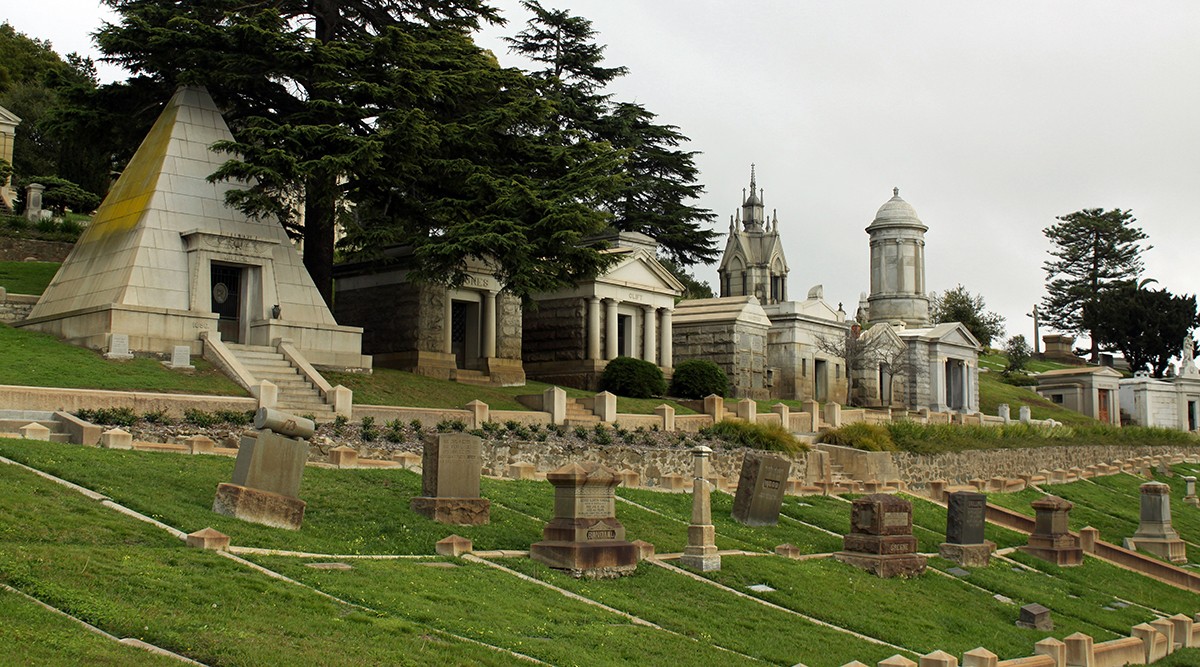
Mountain View Cemetery’s “Millionaire’s Row.”
Credits: Laurel Hennen Vigil
In 1864, after the first two graveyards became overcrowded, Reverend Isaac Brayton, a principal of the College of California (the precursor to UC Berkeley), sold a large parcel of land for the new cemetery to a group of trustees. The trustees erroneously believed that Oakland would never spread to what was then rural land.
When they found out that Frederick Law Olmsted, the famed landscape architect responsible for New York’s Central Park, was in the area, the trustees convinced him to draw up a plan for the cemetery. “Mountain View is not only the only cemetery he designed, it is the only design he ever undertook on his own,” said Evanosky, in a recent interview. “His others, including Central Park, were done with his partner, Calvert Vaux.” Olmsted returned to New York while the project was underway and never collected the promised second installment of $1,500 for his work.
Though Mountain View’s general layout remains the same today, more plots have been added and the cemetery now includes three different types of burial grounds. The plots located along the main paths near the cemetery’s entrance are known as the “rural cemetery” style, a variety that originated in the 1830s. It is typically adorned with mausoleums, sculptures, and elaborate gardens. Another graveyard type, the “lawn cemetery,” was conceived in 1855 and is what comes to mind when most people think of a cemetery: upright tombstones in neat rows. The third style, the “memorial garden,” which emerged between 1906 and 1917, is an open grassy area with flat grave markers.
Mountain View Cemetery officially opened on May 25, 1865, and the first burial was of Jane Waer — an Oakland mother who perished from bilious fever, according to cemetery records — in July of that year. In the beginning, it was slow going for the death business: a second burial did not take place for another eight months. Business eventually picked up and as time went on, many of Oakland’s most notable figures were laid to rest in an area that docents have since named Millionaire’s Row, which features two tiers of paths lined with elaborate mausoleums. The most expensive monument is that of railroad baron Charles Crocker, namesake of the Oakland neighborhood Crocker Highlands. The Crockers spent $90,000 on the mausoleum in 1888 (approximately $2.4 million in today’s dollars). Other residents of Millionaire’s Row include Oakland Mayor Samuel Merritt, after whom Lake Merritt was named; Frederick William Delger, a shoe manufacturer who became Oakland’s first millionaire; Key System founder Francis Marion “Borax” Smith; and famed chocolatier Domingo Ghirardelli.
Mountain View is also the final resting place of many politicians, including five California governors, several mayors, and a number of US Senators, as well as iconic local architects Julia Morgan and Bernard Maybeck. One of the cemetery’s more infamous residents is Elizabeth Short, the so-called “Black Dahlia” whose brutal murder in 1947 captivated the public and remains unsolved.
While many of those buried in Mountain View lived long ago, the cemetery is still a vital part of Oakland today, both as “a place to visit to learn about California’s history,” as Evanosky says, as well as a tranquil refuge from the commotion of the city. Filled with engrossing historical details, gorgeous landscape architecture, sunny meadows, and stunning panoramas, Mountain View Cemetery is well worth a visit.
Docent-led tours are held at 10 a.m. every second and fourth Saturday of the month (visit MountainViewCemetery.org for details). More information about Mountain View’s interees can be found at MountainViewPeople.blogspot.com. Maps that list famous burial sites are also available at the office inside the cemetery’s main gates.
In Alex Abramovich’s new book, Bullies: A Friendship, Trevor Latham, president of Oakland’s East Bay Rats Motorcycle Club, destroys a bus stop on Telegraph Avenue with a large ax. Glass shatters around the author as Latham “calmly, methodically” bashes the walls, bench, and ceiling. A friend of Latham’s had been mugged there, and her companion had been hit on the head with a bottle, landing her in the hospital with a scalp full of surgical staples. “Whatever he’d hoped to do to the mugger he did to [the bus stop],” writes Abramovich. That passage is one of several in which Latham plays the avenging role in an area where law enforcement is conspicuously absent.
“You remember those old Seventies movies where they flush the baby crocodile down the toilet and ten years later you’ve got a sixty-foot man-eating crocodile rampaging down the streets?” asked Abramovich in a recent phone interview. “Trevor’s like the little boy who was flushed down the toilet, and he came out as this fearsome guy … In a sense, he’s not a bad example of what happens when you take a place and you brutalize it for decades on end, and you take services away, and you take people’s houses away, and you take the schools away. You take everything away and this is sort of what you get.”
Trevor Latham rules the ring at the East Bay Rats’ clubhouse.
Credits: Bert Johnson
As fourth graders growing up in Long Island, New York, Latham and Abramovich traded punches in the classroom, and for many years following, Latham stalked Abramovich’s memory as a terrifying bully. In 2006, Abramovich scored a chance to confront his former adversary face-to-face while writing a story for GQ about the Rats’ notorious fight nights, where people (often untrained) whale on each other in the boxing ring behind their clubhouse on San Pablo Avenue. Instead of facing off with a brute, Abramovich discovered a complicated man with a violent childhood similar to his own. The two formed a friendship, and in 2010, Abramovich returned to Oakland to write a nonfiction account of the Rats and the rubble that birthed them.
But as Abramovich dug into The Town’s history, Bullies morphed into a story about the city as a whole — and ultimately America — with Latham and the Rats as its bloody, beating heart. Tellingly, the book begins not with a bike, but with a tank. On the second page, there’s a 1960 photograph of a WWII Sherman tank heading toward a West Oakland home that it’s about to demolish to make way for new construction. When out-of-town friends would ask, “How did Oakland get to be so fucked up?” Abramovich would pull out a copy of the photo from his wallet. To him, the image is emblematic of “urban renewal, industrial decay, brute force, and bullying.” In other words, the themes he threads throughout the rest of the book.
“I’d like to say that [while working on Bullies] I learned that this country is born in blood, and still neck deep in it … and violence in fact is the connecting thread in American history and certainly in Oakland,” said Abramovich. “But the truth is that I knew that already.”
The infamous Your Black Muslim Bakery trials started a few months after Abramovich arrived, and he spent days in the courtroom listening to Devaughndre Broussard, the man who shot and killed journalist Chauncey Bailey, describe the murder and the unfortunate life that led him to the bakery in the first place. Near the end of the year, Occupy took over the city’s center. He met Scott Olsen, an Iraq War vet whose skull was fractured by a police-fired beanbag round at one of the protests. Abramovich was also at the BART stop immediately after Kayode Ola Foster, a 25-year-old who had briefly joined the tent city, was shot there.
But Abramovich also witnessed the lighter side of violence at Hoodslam, an underground professional wrestling event, where he watched Chupacabra battle Man in a Prawn Suit and Zombie versus Circus Clown. “All of these stories connected for me — the wrestlers, Your Black Muslim Bakery, the Rats,” said Abramovich. “These paramilitary organizations had sprung up to fill this void left by the withdrawal or absence of basic social services.”
According to Abramovich, the conditions that gave rise to post-World War II Oakland parallel the conditions that gave rise to modern motorcycle clubs. Before WWII, motorcycle clubs were sort of like sportsmen’s clubs. People wore sweaters. The mayor of San Francisco belonged to the local motorcycle club. “After the war, all these fucked-up soldiers came back with PTSD,” explains Abramovich. “There was no diagnosis; there was no help for them.” So veterans banded together and found support through a new breed of motorcycle club. As an industrial city full of mechanics and gear heads, Oakland was ripe for this sort of brotherhood.
“If you look at stats for when motorcycle clubs became big in terms of membership and cultural profile, it coincides with WWII, Korea, Vietnam, and the wars in the Gulf,” he said. “Many of the Rats are former soldiers and that’s not a coincidence.”
Amid all the turmoil, Abramovich also fell deeply in love with Oakland. “It struck me as one of the most creative places I’d ever lived,” he said. “Driving through East Oakland, there’s no roller rink, there’s no movie theater, there’s no place to go, so people just have to do for themselves. It’s just this very DIY, super creative place.”
Bullies isn’t an account of Oakland that will sit well with everyone, especially those who may have a problem with an East Coast writer publishing an opinion on the place after living here for just four years. But there is something fascinating about the aggressive angle from which Abramovich tackles the subject, and, at times, it’s exhilarating to see the city from the back of a Rat bike.
I’m your average straight 42-year-old white guy. Married for a little less than a year (second marriage for both). We have an active sex life and are both GGG. My wife wants to be forcibly fucked — held down and raped. Normally I’d be all over this because I do love me some rough sex. My issue: She told me she was traumatically raped by a man she was dating prior to me. All I know is that it involved a hotel room and him not stopping when she said “no.” So for now, I play along, but I know I’m not taking things as far as she’d like. I’m over here wondering if her previous trauma was a result of her encouraging forceful sex and regretting it later, and I worry the same thing could happen to me. Or is she trying to relive the experience? Should I fear her motivation and the potential consequences? Am I overthinking things?
Tremulous Husband Is Needing Knowledge
When it comes to rough sex — particularly when it involves role-playing forced-sex scenarios — overthinking is preferable to underthinking. But before we think through your specific issues, THINK, a few points of clarification.
A woman who’s into rough sex, even forced-sex/rape-role-play scenarios, can still have been raped by a partner — and a rape can occur during what was supposed to be a consensual forced-sex/rape-role-play scene. If your wife withdrew her consent and her former partner continued, it was rape.
Also, THINK, lots of women fantasize about “rape,” which I’m putting in quotes here because these fantasies typically involve a woman being “taken” by someone she’s attracted to, and lots and lots and lots of women are victims of rape. Obviously there’s going to be overlap between these two groups. Your wife’s forced-sex fantasies could have nothing to do with her rape — it could be a coincidence — or your wife may be one of those people (not all of them women) who have eroticized a past sexual trauma (not always rape), and playing with a partner she trusts provides her with feelings of control and catharsis, empowerment, and pleasure.
But what about you, THINK?
You worry “the same thing could happen to me.” By that you don’t mean, “I could be raped!” You mean, “I could be falsely accused of rape.” That’s a pretty big and disrespectful leap. What you’re saying is, “I think my wife is lying when she says this other man raped her — and I don’t want her to do the same to me.” I’m not sure what to do with that. I mean, I don’t think your wife is lying, THINK, and I don’t know or love your wife. You presumably know and love your wife, and yet you’re worried she may be setting you up for a false rape accusation. That’s some dark shit — that’s some Gone Girl shit, that’s the plot of some horrible Kathleen Turner/Michael Douglas shit movie from the 1980s.
If you’re really concerned about protecting your own butt, THINK, then have a nice long conversation with your wife about her fantasies over email. I’ve given that advice to people negotiating edgy and/or forced-sex scenes with strangers or near-strangers. It feels odd to give that advice to someone negotiating a fantasy role-play scenario with his spouse. But here we are.
Don’t tell your wife you wanna chat over email because you’re worried about needing an alibi. I would suggest that you believe your wife, first off, and that you have this conversation over email — two anonymous accounts created just for this purpose — because it will allow you both to be more thoughtful and less inhibited (sometimes these things are hard to discuss face-to-face). Tell her you don’t want to accidentally traumatize or trigger her, first and foremost, but you also don’t want to wind up traumatizing yourself. You would feel like a monster if you hurt her while attempting to fulfill her fantasies.
Finally, THINK, this isn’t something your wife will wanna do just once. So take baby steps: Increase the intensity gradually, from scene to scene, check in afterward, google “sexual aftercare” and read the piece on Curve that pops up (it’s a lesbian website, but the lessons/advice/insight are generally applicable), and keep having long conversations — via email or face to face — about what’s working for her and what isn’t.
Good luck.
I had given up on relationships after a failed marriage and another partner trying to kill me (no joke). Then, after five years single, abstinent, and lonely, I met a man who frustrated me, turned me on, and was understanding about my trust issues. I’m excited about a future with him — except for two things. First, he says he loves me but he’s not sure yet if he wants to spend the rest of his life with me — he’s not sure if I’m “The One.” He also has needs I’m not able to fulfill. It may not seem like a big deal to most people, but swallowing is out for me, as I was orally raped when I was a teenager. I’ve worked my way up to enjoying giving head, but come in my mouth makes me cry. And I can’t give head after anal. He says these are the things that make him come the hardest. I’ve asked him if my inability to provide these things are a “deal breaker” for him and he says no, but when we get into bed, he talks about me doing them the entire time we’re having sex. I’ve asked him to stop, and he says he will, but it doesn’t stop. He will also have sex only in the positions he likes, and if I ask for something different, he’ll just stop having sex with me, leaving me frustrated. If letting him go so he can find the right person to fulfill his needs makes him happier, then I feel it’s the right thing to do, as much as it would hurt.
Failing At Intimacy/Love
You need to let this guy go for your own happiness and sanity.
I know you were alone for a long time — alone and lonely — and you know who else knows that? Your shitty boyfriend, FAIL, and he’s leveraging your desire to be with someone against your right to sexual autonomy and your need for emotional safety. You have an absolute right to set your own limits, to rule things in and out, and to slap “not open for discussion” labels on some things. Ruling two things out — swallowing and ATM — particularly for the reasons you cite, is perfectly reasonable. If he can’t accept that, if he’s going to hammer away at those two things endlessly, that should be a “deal breaker” for you.
You see his inability to determine if you’re “the one” as a separate issue, FAIL, but it’s of a piece. He’s refusing to make you the one — “the one” is an act of will, not an act of God — in hopes that you will submit to his sexual demands. I have a hunch that swallowing and ATM aren’t really the things that make him come the hardest. If it was anal and cunnilingus you couldn’t do, FAIL, then those would be his favorite things. Because the issue here isn’t whether he’s “sure” you’re the one or the sex acts that make him come the hardest. This is about him controlling and degrading you.
DTMFA.
Please ignore KISSES and write as much as you want! I read your column because I like what you write!
Dan Should Go On At Length
I’ve obviously reverted to form already, DSGOAL, but thanks for your support!
For modern audiences, there are few surprises in Macbeth, Shakespeare’s study of the corrosive nature of unchecked ambition. Even so, the play continues to intrigue audiences as a grim psychological portrait of Lord and Lady Macbeth, who, motivated by a shared desire for power and the seemingly favorable prophecies of a trio of witches, plot and murder their way to the Scottish crown.
Director Daniel Sullivan’s rendition of the tragedy, now playing at Berkeley Repertory (2015 Addison St., Berkeley) through April 10, attempts to capture the urgency of the script’s ever-changing political and emotional terrain. But, despite its technical savvy and star-studded cast, the production lacks necessary emotional resonance at times.
Conleth Hill as Macbeth.
Credits: Kevin Berne
Overall, Sullivan’s cast tends toward meekness in the portrayal of their characters. For instance, Macbeth (Conleth Hill) so convincingly lacks resolve that it’s difficult to discern whether the character is truly interested in gaining political power or merely has an appetite for praise. Similarly, Lady Macbeth (Frances McDormand) is far from the cruel seductress that she is often portrayed as. Instead, McDormand depicts her as a matronly figure who, perpetually harried and plainly dressed, must compel her husband to commit the gruesome acts he lacks the courage to carry out.
In this staging, unlike others, Macbeth and his wife don’t share easygoing sexual chemistry, though that appears to be an intentional choice rather than a misstep. Instead, Hill and McDormand play the duo’s union as a longstanding and long-suffering one, devoid of physical intimacy but presumably propelled by a shared lust for power. Unfortunately, this lust never fully materializes for either character. Without a clear sense of why Macbeth and, to a lesser extent, his wife, crave political control in the first place, the couple’s emotional upheaval following the murders they commit is less engrossing than it could be.
Although Sullivan’s Macbeth is set in the play’s typical medieval time period, the production boasts frequent digital projections by video designer Alexander V. Nichols. These images — the best of which include ominously churning storm clouds, a ghastly crimson moon, and a variety of architectural tableaus — are especially effective when mounted against scenic designer Douglas W. Schmidt’s vertical panels, which are covered with tattered, mummy-like gauze and offer a metaphor for the play’s decaying moral atmosphere. Some projections, like a moving black-and-white forest or a set of large, Oz-like faces that is summoned by the three witches in the fourth act, are technically impressive, but seem too cinematic for the otherwise historically faithful production.
The production is at its best when it deals with supernatural interventions, as in the riveting opening scene in which the three witches (Rami Margron, Frances McDormand, Mia Tagano) gather around a flayed soldier and recite their hex-like incantations. Lady Macbeth’s sleepwalking scene, which contains the famous “Out, damned spot!” soliloquy, is similarly unsettling and also undeniably powerful, as McDormand performs the monologue in a state of catatonic terror that leaves no doubt as to how deeply disturbed her character has become.
Though the play picks up fantastic momentum at the end of its first half, that energy tapers off after intermission and never fully recovers. Instead, much of the production feels like a slog through two hours of dense material while certain scenes, like the banquet at which Macbeth is haunted by the ghost of Banquo (Christopher Innvar) — a nobleman assassinated on Macbeth’s orders just one scene prior — would be well-served by additional stage time.
Though it isn’t ruinous, the production’s tepid pacing flattens even otherwise commendable performances by members of the supporting cast. Malcolm (Adam Magill) is Macbeth’s entirely mild-mannered successor and seems almost as young and naïve as Macduff’s (the compelling Korey Jackson) beguiling young son (Leon Jones). Bay Area theater veteran James Carpenter juggles the roles of Duncan, Porter, and Doctor with ease, while Lennox (Scott Coopwood) and Ross (Billy Eugene Jones) are also dignified presences on the stage.
At the play’s end, Ross reunites with Malcolm and Macduff, who have fled to England from Scotland. Gloomily, Ross updates the pair as to the state of their homeland. “Alas, poor country!” he exclaims. “Almost afraid to know itself.”
If only the actors in this staging seemed adequately afraid of their characters and the horrible acts they’ve committed. While Berkeley Rep’s Macbeth does much to set the gruesome scene, it sometimes skims over the tremendous depth the play has to offer.
“Wired” by Nigel Sussman
Credits: COURTESY OF TELEGRAPH BUSINESS IMPROVEMENT DISTRICT
For the last ten months, blank plywood has covered the once iconic Berkeley bookstore, Shakespeare & Co., which for 51 years stood at the corner of Telegraph Avenue and Dwight Way. Now, passersby have a captivatingly silly, insightful, and even mouth-watering mural called “Wired” to look to in remembrance of both the closed bookstore and the overall spirit of Telegraph Avenue.
[jump]
Nigel Sussman, the artist who completed “Wired” late last month, said he was hoping to capture the history and character of the street in the piece. “The overall theme is Telegraph — it’s history and the name of street,” Sussman said. The mural depicts a telegraph receiver on one end and a transmitter on the other. Between them, a wire ties together what Sussman refers to as the “urban iconography that exemplifies the district.“
That iconography includes a record to highlight both the record stores along the stretch of street and its strong music history. There’s a book, an homage to the lamented Shakespeare & Co., as well as a skateboard that Sussman says captures the street-culture, youth, and energy of the corridor. Then there’s the pizza and ramen, both a nod to the city’s diverse food culture. “I could have picked many other foods, but I went with my gut,” Sussman said with a laugh. There’s even a turtle by popular Bay Area artist Turtle Wayne, who completed his own segment of the mural beside Caffe Mediterraneum.
An East Coast native, Sussman moved to the Bay Area in 2003 when he decided to transfer to California College of the Arts (CCA) from Carnegie Mellon University. At CCA, where he graduated with a BA in illustration, Sussman says he found the community and approach to art he was looking for.
“I was jonesing to find somewhere else to move to. I’m from Maryland originally, so there was some exploration part that was attractive to moving here. I also didn’t like how gallery-focused [Carnegie Mellon] was. There was no way of taking the art and applying it to something more practical.” The craft focus of CCA, which was then California College of Arts and Crafts, is what drew him in thirteen years ago.
As far as snagging the wall space, Sussman said he responded to a Craigslist ad in the “creative gigs” section asking for muralists in Berkeley. The ad came from a post made by the Telegraph Business Improvement District (TBID), a Berkeley nonprofit that aims to create a positive pedestrian experience on Telegraph. TBID commissioned Sussman for the piece, but Sussman said the group gave him full freedom in terms of determining what the mural would look like.
“Most of my murals are for businesses because it’s easier to justify spending time on something that I am getting paid for. I’m an illustrator and muralist, that’s all I do,” said Sussman. “This was a bit more casual and I was given some creative freedom, and that’s worth something. The tradeoff for creative freedom is worth not getting paid as much and saying something publicly that people can enjoy.”
More of Sussman’s art can be seen at Lanesplitter Pizza (4799 Telegraph Ave.), where there will be an art opening and pizza party on April 1 from 6-9 p.m..
Locals call it Triangle Park. At less than a quarter-acre, bounded by San Pablo Avenue and 32nd and Filbert streets, the concrete plaza is officially called St. Andrews Plaza and includes dusty planter beds and a smattering of trees lining its edges. For years, area homeowners have complained about the park, saying it attracts drug dealers, sex workers, and...
To Oakland musician Chuck Johnson, a graduate degree in electronic music and a homespun acoustic guitar style are perfectly compatible: "What appealed to me about electronic music — that's something I get at with the guitar, in terms of harmonics and texture." His discography, however, is compartmentalized: Synth excursions under an array of monikers, notably Pykrete; solo guitar under...
A few months ago, Lucille Edwards was working a day shift at John George Psychiatric Emergency Services when a man began to cry out. Edwards was making her nursing rounds in the central room, where she and a handful of other nurses tend to dozens of patients. Edwards and several other nurses then went over to the distressed man...
Oaklanders, cannabis fans, and museum-goers alike will get an unprecedented, massive museum exhibition on marijuana starting on April 16. Oakland Museum of California is putting the finishing touches this week on Altered State — a big budget, ten-part exhibition in the OMCA Great Hall that also includes a series of live events and pop-up shops through September.
The opening of...
Oakland has an opportunity to be a leader in creating mixed-income neighborhoods that address the housing crisis. Research shows that mixed-income neighborhoods with space and activities designed to bring neighbors together provide the most equitable opportunities for people with low incomes and educational levels.
The nonprofit East Bay Asian Local Development Corporation (EBALDC) has partnered with local developer,= UrbanCore Development...
Who would want to hang out in a graveyard — except perhaps ghosts and maybe a zombie or two? But Oakland's Mountain View Cemetery, at the top of Piedmont Avenue, is much more than a city for the dead. The cemetery contains an estimated 200,000 graves, but you're more likely to spot runners, dog-walkers, photographers, and even picnickers than...
In Alex Abramovich's new book, Bullies: A Friendship, Trevor Latham, president of Oakland's East Bay Rats Motorcycle Club, destroys a bus stop on Telegraph Avenue with a large ax. Glass shatters around the author as Latham "calmly, methodically" bashes the walls, bench, and ceiling. A friend of Latham's had been mugged there, and her companion had been hit on...
I'm your average straight 42-year-old white guy. Married for a little less than a year (second marriage for both). We have an active sex life and are both GGG. My wife wants to be forcibly fucked — held down and raped. Normally I'd be all over this because I do love me some rough sex. My issue: She told...
For modern audiences, there are few surprises in Macbeth, Shakespeare's study of the corrosive nature of unchecked ambition. Even so, the play continues to intrigue audiences as a grim psychological portrait of Lord and Lady Macbeth, who, motivated by a shared desire for power and the seemingly favorable prophecies of a trio of witches, plot and murder their way...
"Wired" by Nigel Sussman
Credits: COURTESY OF TELEGRAPH BUSINESS IMPROVEMENT DISTRICT
For the last ten months, blank plywood has covered the once iconic Berkeley bookstore, Shakespeare & Co., which for 51 years stood at the corner of Telegraph Avenue and Dwight Way. Now, passersby have a captivatingly silly, insightful, and even mouth-watering mural called “Wired” to look...