Welcome to the Mid-Week Menu, our roundup of East Bay food news.
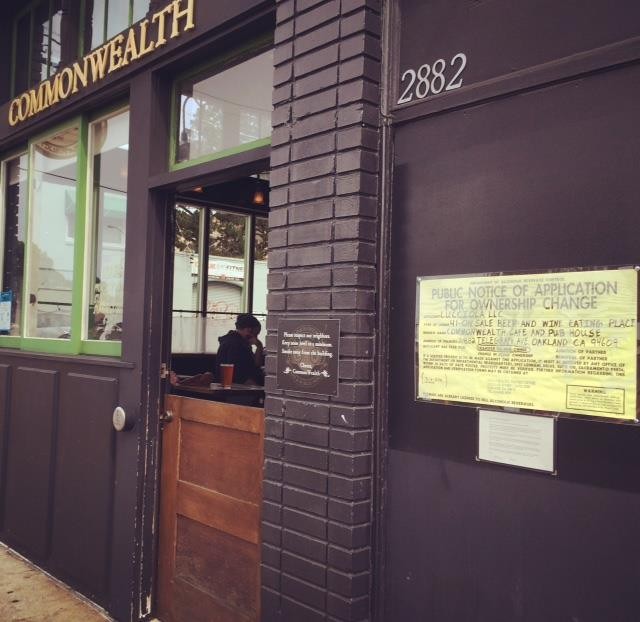
1) CommonWealth Cafe & Pub (2882 Telegraph Ave.), the popular Uptown Oakland watering hole, has new owners. In a Facebook post earlier this week, Ahna and Ross Adair announced that they’ve sold the pub to two longtime customers: Lizzie Alford (a CommonWealth employee for the past two years) and Josh Rosenberg.
It’s unclear whether any major changes are forthcoming, but the Adairs say the bar will continue to offer customers “all the things you’ve come to know and love.” Beloved by Anglophiles, soccer fanatics, and Scotch egg eaters, CommonWealth is known, among other things, for its large selection of British beer. The pub’s sister location in Emeryville closed in December.
[jump]
2) After closing abruptly this past fall after being open just two months (the weekend before my review was due to drop, no less), Grand Fare is now planning to reopen, according to the Splash Pad Newsletter. I’ve reached out to owner Doug Washington and will update with additional details, but for now it sounds like changes will include indoor seating and a smaller and less expensive grocery section.
3) With the newly rebranded Temescal Brewing already in the works, Oakland’s Temescal neighborhood will be home to yet another brand new small-batch craft brewery and taproom. Inside Scoop has the scoop on Rose’s Taproom (4930 Telegraph Ave.), which aims to be a “human-scale” brewery that will offer a rotating selection of six beers, all brewed on-site. Look for a late-summer opening.
4) After having been shut down for ten days as a result of a small fire, Chop Bar reopened today — Wednesday, March 9 — with regular business hours.
5) Inside Scoop reports that Noodle Theory Provisions (5849 San Pablo Ave.), an offshoot of the Rockridge pan-Asian noodle shop, will open for business in North Oakland on Monday, March 14.
6) Herb n’ Chicken (1511 Shattuck Ave., Berkeley), the rotisserie chicken spot in North Berkeley’s Epicurious Garden — from the owners of nearby Tigerlily — has closed just five months after opening, Berkeleyside Nosh reports. It will be replaced by Guacamole 61, a taqueria co-owned by Willy Perez (one of the owners of Sliver Pizzeria) and head chef Gustavo Orozco.
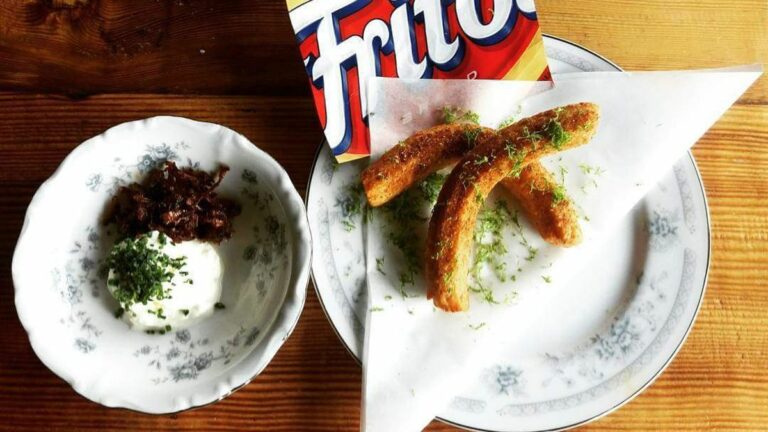
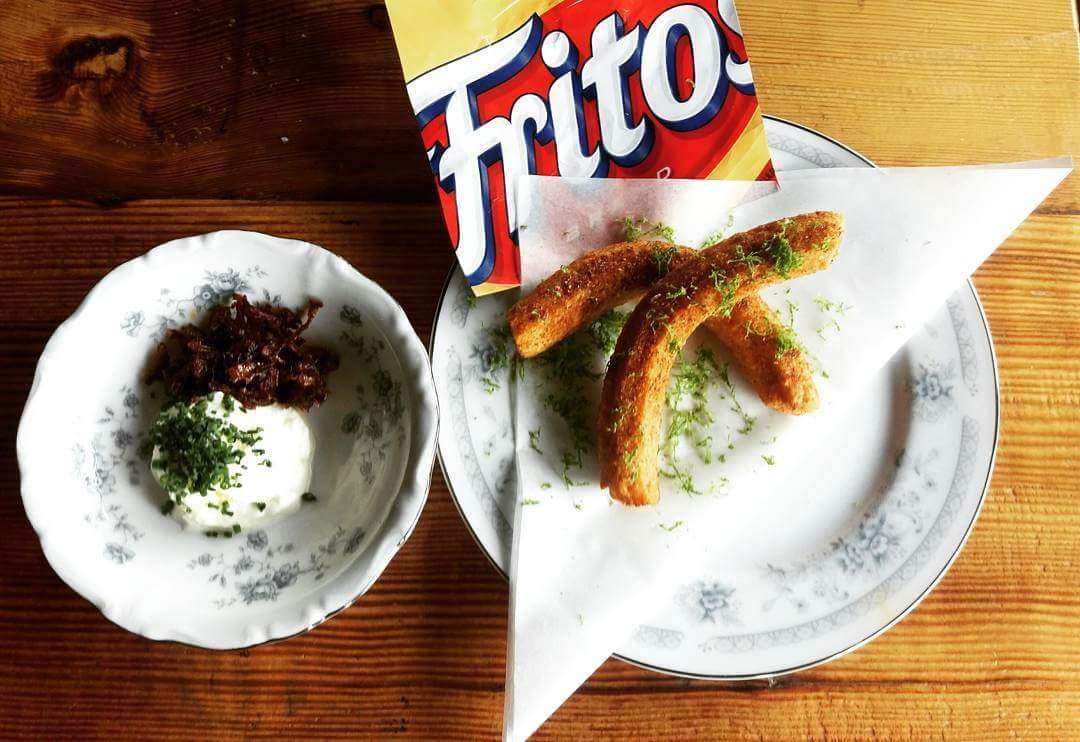
Frito pie churros.
Credits: Journeymen
7) The “Journeymen,” the ambitious chefs behind the monthly pop-up dinner at Temescal’s Blackwater Station (4901 Telegraph Ave., Oakland), are back. Next week’s pop-up — on Monday, March 14 (6–10 p.m.) — will have a “staff meal” theme: dishes inspired by the kinds of decadent, over-the-top kinds of foods that chefs like to cook for each other. So there will be Frito pie churros, tater tots fried in schmaltz, and lasagna made to look and taste like a McDonald’s cheeseburger. Tickets are $59.02 on Eventbrite.
8) Umami Mart and the UC Berkeley Center for Japanese Studies are hosting a fundraising dinner to commemorate the fifth anniversary of the Fukushima tsunami/nuclear disaster. Check out the details here.
9) One more upcoming event: a six-course “Soil to Soul” vegetarian tasting menu at Guerilla Cafe (1620 Shattuck Ave., Berkeley) inspired by the book Bread, Wine, Chocolate: The Slow Loss of Foods We Love (whose author, Simran Sethi, will be a guest speaker at the event). The meal will be prepared by Jocelyn Jackson, whose company, Justus Kitchen, is organizing the event.
10) ICYMI, I wrote about how a recent federal court decision has prompted some East Bay restaurants to again consider going tipless.
Got tips or suggestions? Email me at Luke (dot) Tsai (at) EastBayExpress (dot) com. Otherwise, keep in touch by following me on Twitter @theluketsai, or simply by posting a comment. I’ll read ‘em all.
The world’s biggest cannabis contest will tighten its contamination rules and publish the names of growers and dispensaries who fail screenings for pesticides and residual solvents, Legalization Nation has learned.
The Emerald Cup, held in December in Santa Rosa each year, also will add contest categories for butane hash oil and CO2 hash for 2016, organizers told me this week, but all entrants will have to meet stringent new cleanliness standards and face the public.
The announcements promise to spur better quality control in the state’s multibillion-dollar medical pot market, addressing a serious issue: America’s medical cannabis crop is routinely tainted with pesticides, as well as high levels of dangerous bacteria, mold, and fungi.
More than 15,000 attendees flocked to The Emerald Cup each day in December. Contest screenings tighten up in 2016.
Credits: David Downs
[jump]
As I report for CULTURE magazine this month, Colorado has issued a record nineteen recalls in nineteen weeks due to pesticides. Washington state regulators fined two growers for use of disallowed pesticide use. States officials nationwide are promulgating historic new guidelines for allowable pesticides on medical cannabis and recreational cannabis, but experts note that no currently allowed pesticide has been tested by the EPA and determined to be safe to spray on cannabis.
In the 2015 Emerald Cup, which drew hundreds of entries from across California, about one in six entries failed lab tests for pesticides or pathogens like mold, bacteria, and fungi, according to contest organizer Tim Blake. “Quite a few people failed,” Blake said.
The Cup did not publicly name and shame contestants who failed the 2015 screening, but in 2016, it will.
“Last year, it wasn’t spelled out clearly,” Blake said. “People said, ‘You’ll ruin us. It wasn’t or fault. We got tainted clones,’” referring to the small starter plants growers often obtain from a third party.
“This year — for all edibles, topicals, tinctures, flowers, and extracts — we’re going to raise the bar and hold people accountable,” Blake added. “It’s all going to be tested, and we’re posting all results on the Emerald Cup website. It’s going to be a fair playing field for people.”
Past Emerald Cups excluded butane hash oil because of the explosions and fires associated with amateur producers of the high-potency product. But the high-flavor extracts are also enormously popular with patients and pot aficionados.
“We had so many people complaining to us, and saying, ‘Look, this isn’t fair,’” Blake said. “It’s by popular design.”
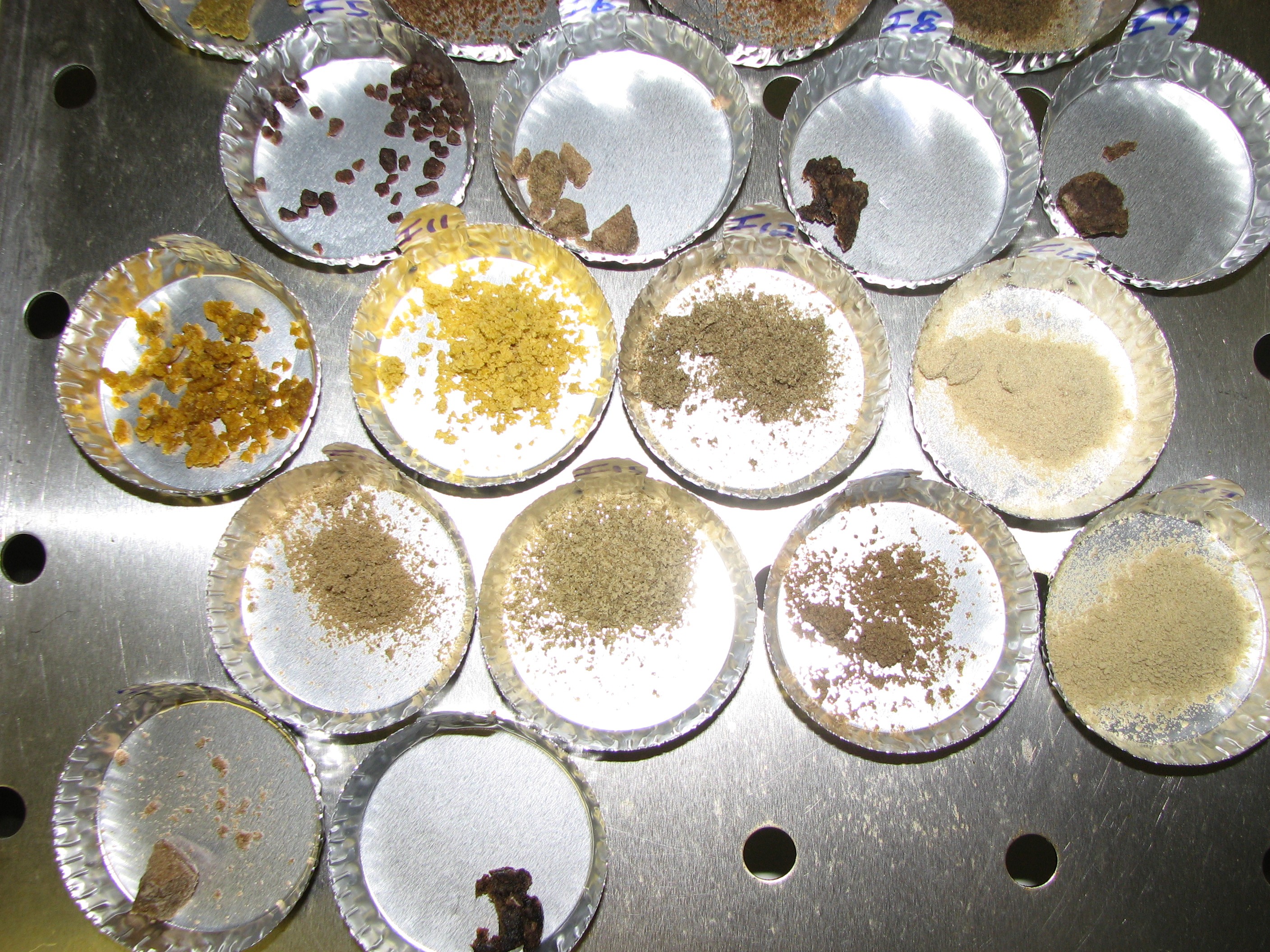
After discussions with extract experts and lab operators, the Cup decided to allow BHO entries. But they will be heavily screened for residual solvent, as well as pesticides.
The advent of quality lab testing for BHO purity, as well as a new era of state licensing for butane hash manufacturers in the United States, means there is now a way to safely host a BHO contest in good conscience, Blake told me in an interview Tuesday.
Cannabis extracts being prepared for lab screening.
Credits: David Downs
BHO entries in the 2016 Cup must pass an ultra-low threshold of fifty parts per million of solvent in the extract.
The Cup is working with SC Labs on a pesticide screening that’s affordable yet broad enough to catch the two dozen or so of the most common active ingredients in popular chemical pesticides, like Avid and Eagle 20.
“We’re going to be very strict,” Blake said. “People are not going to get away with anything.
“We can’t have our judges smoking pesticides or mold,” he continued.
Because of the increased testing hurdles, Cup organizers are moving up contest deadlines to allow SC Labs time to screen all entries. The Cup will announce specifics for its December 2016 contest by April 20, said Blake.
Blake also disclosed that the 2015 Cup had an estimated $15 million to $40 million economic impact on the North Bay city of Santa Rosa. The event has secured the rights to return to the Sonoma County Fairgrounds for the next five years.
New state regulations barring medical pot licensees from selling outside of their store, or giving away products will not stop the Cup, Blake added.
The City of Santa Rosa is prepared to override state law with a local law with regard to marijuana gatherings, he said. If true, the override will be among the first instances in which long-cherished “local control” over California medical pot laws serves patients and the industry. Most cities have used “local control” to ban medical cannabis commerce.
“[Santa Rosa] leaders let us know that every hotel and restaurant in a fifty-mile radius was filled up during an otherwise rainy, December, off-season weekend,” said Blake. “Law enforcement said, ‘You guys are great. No problems. You guys are cool.’ We’re here for the long-haul.”
In related news today, the High Times US Cannabis Cup has pretty much been run out of Colorado — where the rules of legalization like no freebies have pretty much killed the party’s buzz. The US Cannabis Cup has relocated to San Bernardino, which bans medical dispensaries.
1. A 65-year-old Oakland man who was arrested for a crime he didn’t commit died over the weekend after being taken to Santa Rita Jail in Pleasanton, the Bay Area News Group$ reports. Melvin Stubbs, who is an amputee and a diabetic, was arrested by Oakland police on suspicion of murdering his wife, Terry Cameron, but the Alameda County Coroner’s Office later determined that Cameron died of acute bacterial meningitis and that Stubbs was innocent. Stubbs’ family contends that he should never have been taken into custody in the first place.
2. A statewide charter schools group has sued the Oakland Unified School District, claiming that the district has failed to share facilities with charter schools as required by law, the Bay Area News Group$ reports. The California Charter Schools Association contends that under Proposition 39, a statewide measure approved by voters in 2000, OUSD must offer to share public facilities with charter schools when the district is no longer using portions of them. The charter schools group won a similar suit against Los Angeles Unified last year.
[jump]
4. Southern California’s most powerful water agency moved forward with a plan to buy a cluster of islands in the Sacramento-San Joaquin River Delta in an effort to help pave the way for Governor Jerry Brown’s controversial plan to build two giant water tunnels in the area, the SacBee$ reports. The Metropolitan Water District of Southern California would be one of the main beneficiaries of the water tunnels, which, if built, would make it easier to ship Northern California river water to the south.
5. Faculty members in the California State University system plan to go on strike next month because of an ongoing contract dispute with CSU administrators, the LA Times$ reports. Union members, who want a 5 percent pay raise, plan to go on strike on April 13 at all 23 CSU campuses, including at Cal State East Bay.
6. And Democratic presidential candidate Bernie Sanders pulled off a big upset in Tuesday’s Michigan primary, defeating Hillary Clinton after he had trailed in the polls by an average of 20 points last week. GOP frontrunner Donald Trump also won big.
“In Praise of Old Restaurants,” Insider’s Guide, 2/24
Landlords Are Vultures
Landlords are like vultures, ruining merchants with rate hikes. It’s up to government to build out affordable spaces for restaurants, or we won’t have any left that are affordable. We also need to extend rent control to commercial spaces before cities are made unlivable.
Will the Express consider writing about the greater narrative of the Black-owned business? We are more than three restaurants, a bookstore, and a record shop. Oakland is home to architects, financial advisors, engineers, doctors, etc. By repeatedly writing about the same six stores, you perpetuate the image that Black people are no more than retail entertainment.
I hope with this note the Express will stop, take a look, and truly write about us all. I want the Express to raise its educational bar. Ask yourself, why are you not aware of Black professionals to the point where you assume we do not exist? Become curious. Then print another story about us — the wider narrative of Black professionals.
June A. Grant, Oakland
“Oakland Cops Implicated in Home Invasion and Assault,” News, 2/24
Hmm
Gee, I wonder why those two cops haven’t been charged with anything yet. Can you spell corruption?
Wendy Enright, Hidden Valley Lake
“Save Oakland Art,” Opinion, 2/24
What a Bunch of Spin
Fund Oakland arts — yes! Subsidize private art galleries without any public oversight — heck no! What a bunch of spin. Shame on those who thought they could just slip that past us. If the operators of Betti Ono Gallery or Rock Paper Scissors Collective so desire, they can bring arts programs to any one of Oakland’s numerous community centers.
Matt Chambers, Oakland
Support the Arts
The reason why there is so much interest in Oakland is specifically because of the artist community and the history of social activism in the area! If the city officials are looking first toward the money and not toward the long-term implications, we should work as a community to vote them out of office and find other candidates more sympathetic to the artist community. I’d really love to attend an open hall or some type of community forum to hear what officials have to say and would love Oakland Art Murmur to post these events on Facebook so we can collectively make our grievances heard.
Mia Case, Oakland
“Fish Fight,” Eco Watch, 2/24
Regulate It
The week after I saw the herring run in January of this year, my local farmers’ market in Fremont had a stand selling herring. There were more than six huge coolers, and the herring was selling at $2.50 per pound, or three pounds for $6. I estimate that each cooler stored at least 100 pounds. I think both commercial and recreational fishing need to be regulated to ensure the herring stock is not wiped out.
Lisa Kau, Fremont
“Bridging Cultural Gaps with a Snap,” Event Pick, 2/24
A Little Piece of Genius
Hurray for your article about Snap Judgment! That show displays a little piece of genius in creating a very human way to get people to understand and empathize with each other’s life experiences. And as Glynn Washington says, if we can’t find a way to do that, we are lost.
Years ago, I cut out a newspaper ad that read (paraphrasing): Lost: one family of man; color: white, black, brown, yellow, red; is in the habit of fighting and displays tendencies toward self-destruction.
Snap is a beautiful path to counter that concept. Keep it up, Washington! Love you!
It’s distressing to have to announce this, but Terrence Malick’s transformation, from the film world’s most intriguing living legend to its most conspicuous coaster, is now complete. Knight of Cups seals the deal.
Once upon a time, when the former philosophy prof-turned-art-film auteur let twenty years go by between his second feature release (Days of Heaven, 1978) and his third (1998’s The Thin Red Line), the merest whisper of a new Malick project was enough to send his larger-than-cultish following into fits of anticipation. Malick was the thinking person’s Ridley Scott, Middle America’s answer to Stanley Kubrick, and the anti-Steven-Spielberg, rolled into one.
Christian Bale in Knight of Cups.
From Badlands forward, he carefully scattered his films — downbeat fables of ordinary people achieving their cloudy destinies amidst lustrous scene-setting — like rare pearls of compassion. That it took him so long to select his properties and produce his movies only burnished his reputation as a wise man. A Malick was worth waiting for. The sighs that filled auditoriums in the opening moments of The New World (2005) heralded a genius with an all-embracing empathy for the underdog — a champion of tenacious humanism, a prophet for audiences who normally shunned prophets.
With The Tree of Life (2011), however, a schism opened up. What many latecomers to the party considered an apotheosis — starring Brad Pitt, no less — seemed to some longtime Malick fans pretentious and forced. His once-vaunted excursions suddenly provoked skepticism. The omnipresent visual cues multiplied, to the point at which they swamped the slender narrative — which seemed, on close inspection, to be a rehash of “stolen moments” from before. Then came To the Wonder in 2012, the quickest-arriving Malick by far. The filmmaker’s writing problems multiplied and his trademark gestures began to look rote. Grumpy critics noted that if the director had released a new movie every two years instead of every ten, we would have tired of his shenanigans long ago.
Knight of Cups, Malick’s latest, is long on shenanigans. In fact, thirty minutes into it, the effect is that of a never-ending stare upward into the trees — in this case the palms of Los Angeles, where Rick (Christian Bale), a disaffected movie-biz man about town, is dejectedly surveying the wreckage of his life via flashbacks and voiceovers. Ninety percent of the dialogue in Knight of Cups is in voiceover. And establishing shots outnumber expository sequences two to one. The two previous movies’ skimpy narratives slim down almost to the vanishing point. Wait, it gets worse.
In between meeting with horrid entertainment execs and staring out the window, Rick absent-mindedly runs through his collection of ex-wives and girlfriends, all of whom have great bodies. This depresses him but provokes only boredom in us. No one feels sorry for handsome, rich guys who go to Hollywood and Las Vegas parties and have sex with babes. Natalie Portman and Cate Blanchett stand out among the numerous femmes, and Portman’s scenes at the beach house do contain the germ of a promising drama, but Malick does not seem interested.
In his provocative filmed essay, Los Angeles Plays Itself, critic Thom Andersen chides “low-tourist outsider” filmmakers like Woody Allen for getting Andersen’s hometown wrong in their movies. Sad to say, Rick’s morose tour of the Southland puts Malick — who ironically made his name capturing the mystique of quintessential American locations — firmly in the tourist bag. When Rick ends up at the Los Angeles River (arrgghhh!), it would actually have been a relief to see giant ants come out of their holes in the concrete river bank, à la Them!, and devour Christian Bale. Such are our frustrations.
We can admire Malick’s fascination with images and montage, but the net impression of Knight of Cups is of one long TV commercial for Apple, or maybe a sensational new fragrance, take your pick. All the tendencies we’ve been worrying about in Malick’s career have come terribly true. He’s a hopeless coaster. Maybe he should go back to costumed period dramas, or abandon the spiritual subtexts altogether. Regardless, he should definitely seek writing help in his future projects, maybe try an adaptation. His cup is empty, and that’s a shame.
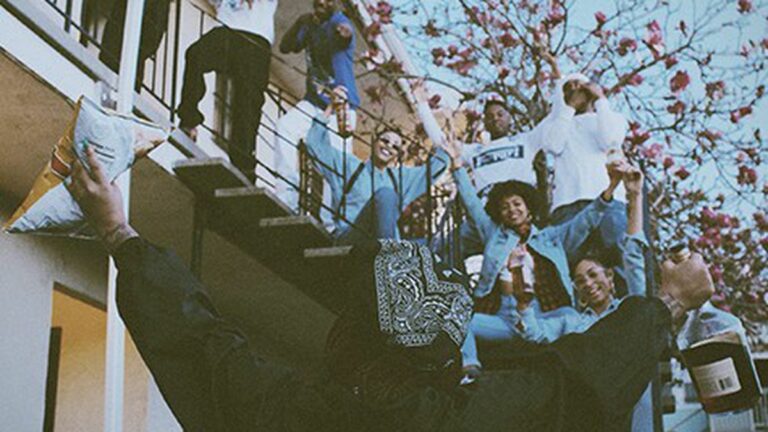
It was 9 p.m. on a recent Friday night in a recording studio in San Francisco’s SOMA district. Kamaiyah cracked open a bottle of Jameson and a plastic, lemon-shaped container of lemon juice and poured herself a stiff cocktail. A buoyant, bare-bones beat with an old-school, West Coast funk filled the room — the last incomplete track off her highly anticipated debut mixtape, A Good Night in the Ghetto, which the rising Oakland rapper will self-release on March 14, the day after her 24th birthday.
Francois Wiley, Kamaiyah’s manager, sat behind the studio’s sprawling mixing console and played the beat on repeat to get Kamaiyah in the headspace to lay down her last verse. Meanwhile, Kamaiyah’s brother and eight or so friends piled onto the studio’s couches. I later recognized some of them the following Monday when she posted the cover art for A Good Night, which features a shot of Kamaiyah greeting her beaming posse with a bottle of Hennessy in hand. The giddy squad chatted, rolled blunts, and checked Snapchat as they waited for Kamaiyah to finish working.
Kamaiyah’s debut mixtape, A Good Night in the Ghetto, drops on March 14.
“I’m just working on one song, and then it’s kind of a free-for-all. That’s why I have all the homies in here,” she explained as she ushered me upstairs to do our interview.
Sporting gray sweats; square-tipped, zombie-green acrylic nails; and golden-brown box braids trimmed into an angular bob, Kamaiyah exuded a tomboyish cool that’s palpable in her music.
Her breakout hit, “How Does It Feel,” is an infectiously catchy, feel-good anthem that makes a case for making the most of life when you’re young and poor. I been broke all my life/Now I wonder/How does it feel to be rich, she sings over a bouncy bass line with a g-funk flavor, with bursts of jubilant, horn-like synths cheering her on. “How Does It Feel” is a boast rap for the 99 percent — a soundtrack for those whose definition of riding foreign is driving a busted Honda.
With endorsements from high-profile local artists such as Nef the Pharaoh and Kehlani, “How Does It Feel” has skyrocketed to regional popularity in recent months, and has caught the attention of tastemakers such as MTV’s Meaghan Garvey and The FADER‘s Naomi Zeichner, who have touted it on Twitter. It’s a solid earworm that strikes a balance between catchiness and carefully crafted lyricism — a debut strong enough to inspire widespread faith in Kamaiyah’s hit-making potential, even though, at the time of the single’s release, she didn’t have enough published material to tell for certain whether or not the hit was a fluke. (For the record, I listened to A Good Night in the Ghetto during the interview, and can attest that nearly every track is a banger.) Tellingly, her first major piece of national press was a high profile interview in Pitchfork, which came out several months before A Good Night even had a release date or publicly known title. Before even booking a local release show, she’s already preparing to head to Austin to perform at South by Southwest next week.
Now on rotation on 106 KMEL, “How Does It Feel” is slowly cresting to regional ubiquity, and all signs point to the fact that Kamaiyah’s debut mixtape will likely rise to national acclaim. Though she’s relatively new to the music business (her Instagram features photos of her excitedly rubbing shoulders with heavyweights like 50 Cent and YG), Kamaiyah spoke about her sudden success with the levelheadedness of an industry vet. “When I recorded [‘How Does It Feel’], I knew there was something different about the record, and I had faith that it would be one of my biggest,” she said coolly. “But you don’t know the magnitude of how big it’s gonna reach.”
Kamaiyah has a strong sense of self and is keenly aware of how she fits into the scene on a local and national scale. In addition to networking with Nef and IAMSU — the foremost young, local rappers at the moment — she watches the moves of the top female rappers in the industry, such as Nicki Minaj and Dej Loaf. And though the West Coast doesn’t have any female hip-hop superstars — like Missy Elliot or MC Lyte, who helped pave the way on the East Coast — the prospect of becoming California’s first rap queen is a major motivator for her.
“I might be one of the staple artists in the game in the next five or ten years, who’s considered one of the best — or even the greatest,” she enthused, tapping her fingernails emphatically on her iPhone screen. Releasing her mixtape while “How Does It Feel” is still hot was a calculated move, she continued, to back up its success with a solid body of work that proves that she’s not a one-hit wonder.
Kamaiyah knows the rap industry favors female artists with hyper-sexualized images, and that there are plenty of fans who are eager to see more diverse representations of womanhood in music in general. She views her androgynous look and nostalgic hairstyle — which she said is based on one she rocked in elementary school — as a testament to her commitment to individuality.
“I’m 23 years old with a fuckin’ braid bob in 2016,” she laughed, “That lets you know how much I care about perception.”
Kamaiyah’s pride in her quirky image underscores the relatable way she portrays herself in her lyrics — one of the main reasons she believes “How Does It Feel” took off so quickly. She grew up in East Oakland on High Street, and while the track doesn’t dwell on her life’s struggles, it has no pretenses about living the glamorous lifestyle that so many rappers portray.
“Everybody’s not rich,” she said. “Nobody has a foreign car. Especially when you’re between 18 and 25 — you’re still trying to figure out life.”
She continued, “You have all these artists that are broke themselves, but because they have this machine behind them, they’re perceived as this rich individual. I don’t want you to look at me like that. That way I can still do normal shit — like ride the BART.”
At restaurants around the country, it has long been common practice for servers to “tip out” at the end of a shift, giving a cut of their tips to the bussers and bartenders — and, often, to the back-of-house kitchen employees, such as the line cooks and dishwashers. After all, one good turn deserves another, and for a waiter whose tip is often tied to the timeliness and skill of the kitchen team, it only seems decent to spread the wealth.
But because of a recent 2–1 decision from the Ninth Circuit Court of Appeals, that kind of tip-sharing arrangement is now illegal — at least in cases when a restaurant tries to make it mandatory. The case in question (OregonRestaurant and Lodging Association v. Perez) is of particular relevance to dining establishments in California, where some restaurateurs have taken advantage of the previous legal gray area to give their cooks and dishwashers some extra money. Here in the East Bay, at least a couple of restaurateurs said the recent court ruling might prompt them to reconsider their compensation model — to perhaps move toward an all-inclusive, tipless approach.
Liz Sassen (center), who co-owns Homestead with her husband Fred, abolished tips for front-of-house staff after Oakland’s new minimum wage was approved by voters.
Credits: Bert Johnson/File photo
The backdrop for all this is a growing sense, industry-wide, that there is an untenable pay disparity between front-of-house and back-of-house employees at restaurants. For my February 18, 2015 cover story, “The Tipping Point,” which examined the effect of Oakland’s then-looming Measure FF minimum wage increase on local restaurants, restaurateurs told me it wasn’t uncommon for a server to make more than three times as much as a typical line cook, once tips were factored in. The minimum wage increase, which primarily benefited servers (who make minimum wage plus tips), only exacerbated that disparity.
At the time, a number of Oakland restaurateurs, including Sal Bednarz (Actual Cafe, Victory Burger) and Preeti Mistry (Juhu Beach Club), said the minimum wage hike would likely lead them to be even more aggressive in their tip-pooling policies, as a way to make sure that cooks and dishwashers would also reap some of the rewards of the change. In an email, Bednarz said he found the court ruling “worrisome” and that it likely pushes him “one step closer to tipless service” — though he still has deep reservations about how successful that would be at counter-service restaurants like the ones he runs. Meanwhile, Jay Porter (The Half Orange, Salsipuedes) said that while he believes the federal court ruling will eventually be overturned, he is thinking about instituting a 20-percent service charge in place of tips for the time being.
In some ways, the fears over the legal and financial ramifications of the court decision provides some measure of validation for the small handful of Oakland restaurants that did go tipless in response to the minimum wage increase. At Homestead, co-owners Fred and Liz Sassen abolished tips last March and simply raised their prices by 20 percent across the board — a move that allows them to distribute that revenue however they see fit. The upshot was that cooks and other back-of-house employees all received a sizeable raise. Servers, on the other hand, got paid significantly less, once tips were taken out of the picture.
Of course, one of the reasons the tipless movement still hasn’t taken off in the Bay Area is because it is not without its challenges — most notably, in terms of retaining experienced waitstaff. Homestead’s Liz Sassen acknowledged that the restaurant lost almost its entire front-of-house staff in the immediate aftermath of the change — an understandable development, given that a server might make $10 or $15 more an hour with tips at another restaurant nearby. And even now, she has trouble hiring the most experienced servers, who know they can make a lot of money pulling in big tips. Instead, the restaurant’s new approach is to hire less experienced workers and simply give them a lot of training up front.
But Sassen said she has no regrets: “I can look my line cooks in the eye and know that they’re getting a fair cut,” she said. Since replacing those initial departees, the restaurant has had almost zero staff turnover — a product, Sassen believes, of an improved staff culture. And, of course, the restaurant is unaffected by any current and future legal rulings related to tipping.
Many restaurateurs have talked about how difficult the minimum wage increase has made it to do business. She said she wants them to know that, with the tip-free model, “We’re not struggling that badly.”
Ultimately, though, Sassen believes that even with the court ruling, most restaurants will just continue to do what they’re doing. Indeed, at Juhu Beach Club, Mistry said that she feels comfortable continuing her tip-sharing policy because it isn’t strictly mandatory. Upon hiring, all of her employees are made to understand that the expectation and the culture of the restaurant is for servers to give some cut of their tips to the back of the house. But the servers are free to decide exactly how much on their own, and Mistry herself never touches their tip money.
Similar to Sassen, Mistry said the important thing is trying to create a sense of camaraderie and fairness among her staff — both in the front and back of the house — so that when the party of six comes in ten minutes before closing, the cooks feel like they benefit, too.
That said, Mistry believes that the tip-free model will eventually become the norm. “I look forward to being part of it,” she said.
Photographer Stephanie Lister’s new book, East to El Rancho, West to Walt Disney, is perfectly titled. In the opening pages, the Florida-grown, but Oakland-based artist begins to explain what it means: “It’s a mnemonic device my mother handed me when I started driving to help remember directions on the Interstate.” But by the end of the 136-page compilation, the phrase feels soaked with meaning — heavy, like wet locks emerging from a pool on a humid afternoon in Orlando.
A photo from East to El Rancho, West to Walt Disney.
The El Rancho was a motel near Orlando owned by Lister’s grandparents. When she was born, her parents moved there from Palm Springs. For a few years, Lister’s father ran the office, and her mother cleaned the rooms. Meanwhile, she forged short-lived friendships with tourists by the pool, rode along with the towels in the cleaning cart, and helped her mother stretch clean sheets across cheap mattresses. Spending her early childhood living in a motel seemed typical to Lister at the time. “It didn’t really sink in until I got older,” she said in an interview. “It was pretty normal, but then everything seems normal when you’re living it.”
A photo from East to El Rancho, West to Walt Disney.
The titular Disney reference is more easily deciphered. In Orlando, Disney World is “always there in the background,” said Lister. It wasn’t merely a landmark, but a setting saturated with artificial colors that stained everything it touched. Even Lister has Disney ink on her, albeit an unholy tattoo of an upside-down Mickey Mouse. “Disney has always been such a weird, pervasive, evil shadow in my life,” she said.
Neither the El Rancho nor Disney World make it into the book explicitly, but the aesthetics of those places loom over its contents, which are mostly the product of Lister’s compulsion to process her surroundings photographically. Almost entirely shot between 2006 and 2013, the photos range from when Lister first started taking photographs in high school, to after she had graduated with an associate’s in photography from a community college in Daytona, to when she and her sister decided to move to Oakland on a whim two years ago. Collectively, the mostly candid images amount to a romantic portrait of central Florida that feels somehow both authentic and artificial — like when you’ve been immersed in an amusement park for so long that the illusion begins to look like reality.
A photo from East to El Rancho, West to Walt Disney.
In one photo, Lister’s feet emerge from the bottom of the frame holding her sister, in a floral bathing suit, up into the air. With the sun behind her head, the girl’s golden hair glows in the light, but her face is counterintuitively lit up, too. A fill-flash illuminates her freckles, also causing the necklace that she’s holding to create a confusing shadow on her chest. It’s visually alienating, as if she’s superimposed into the sky, yet also utterly intimate. On the following page, Lister’s mother stands in the sun with a bright orange tan, mouth agape, wearing a visor and fake floral lei. It’s as if she’s inhabiting an amusement park version of her own life, performing an outsider’s idea of what Florida is like. She was dressed up for a tourist-themed party, Lister told me, but the viewer doesn’t know that. “[In Orlando], you’re a tourist in your own town,” said Lister. “That was always kind of isolating.”
About a year later, Megan Mirro of the Oakland publisher Mirro Editions, asked Lister to put together a book of her work after seeing her present a slideshow as part of artist and archivist Justin Clifford Rhody’s monthly series Vernacular Visions. It was a welcome request, especially since Lister hasn’t shown her photography in the Bay Area since she moved (lately, she’s mostly focused on the performance practice she maintains with her sister under the moniker Oracle Plus). So she began sifting through her personal “archive,” which she said consists largely of long ribbons of negatives draped on hangers around her bedroom. During that time, Lister came to realize that she was finally far enough away from Florida that she could look back at her experiences there — a process familiar to anyone who has moved away from their childhood home. It’s that complicated distance that makes her book feel relatable, even to those who may have never been to the swamplands.
A photo from East to El Rancho, West to Walt Disney.
In this way, the book serves as both a portrait of growing up in Florida and a visual metaphor for memory. As Lister depicts it, the act of remembering is like trying to gain access to a dream that grows increasingly alienating as you age. Eventually, the distance is so great that you feel like a tourist taking a trip to your own past.
Alongside the perfect title, Lister’s book has a pleasingly apt photo on its cover. In what looks like a drab hotel room, two neon lamps shaped like pink flamingos adorn a bedside table. Within the collection, the photo is an anomaly — Lister took it last year during a trip to Oregon. She described it as a shot of her looking at Florida from afar, similar to how she describes the book as a whole: “It’s me understanding where I’m from now that I’ve left.”
Aries (March 21–April 19): “He in his madness prays for storms, and dreams that storms will bring him peace,” wrote Leo Tolstoy in his novella The Death of Ivan Ilych. The weird thing is, Aries, that this seemingly crazy strategy might actually work for you in the coming days. The storms you pray for, the tempests you activate through the power of your longing, could work marvels. They might clear away the emotional congestion, zap the angst, and usher you into a period of dynamic peace. So I say: Dare to be gusty and blustery and turbulent.
Taurus (April 20–May 20): Quoting poet W. H. Auden, author Maura Kelly says there are two kinds of poets: argument-makers and beauty-makers. I think that’s an interesting way to categorize all humans, not just poets. Which are you? Even if you usually tend to be more of an argument-maker, I urge you to be an intense beauty-maker in the next few weeks. And if you’re already a pretty good beauty-maker, I challenge you to become, at least temporarily, a great beauty-maker. One more thing: As much as possible, until April 1, choose beauty-makers as your companions.
Gemini (May 21–June 20): To have any hope of becoming an expert in your chosen field, you’ve got to labor for at least 10,000 hours to develop the necessary skills — the equivalent of 30 hours a week for six and a half years. But according to author William Deresiewicz, many young graphic designers no longer abide by that rule. They regard it as more essential to cultivate a network of connections than to perfect their artistic mastery. Getting 10,000 contacts is their priority, not working 10,000 hours. But I advise you not to use that approach in the coming months, Gemini. According to my reading of the astrological omens, you will be better served by improving what you do rather than by increasing how many people you know.
Cancer (June 21–July 22): “I sit before flowers, hoping they will train me in the art of opening up,” says poet Shane Koyczan. “I stand on mountain tops believing that avalanches will teach me to let go.” I recommend his strategy to you in the coming weeks, Cancerian. Put yourself in the presence of natural forces that will inspire you to do what you need to do. Seek the companionship of people and animals whose wisdom and style you want to absorb. Be sufficiently humble to learn from the whole wide world through the art of imitation.
Leo (July 23–Aug. 22): The marathon is a long-distance footrace with an official length of over 26 miles. Adults who are physically fit and well-trained can finish the course in five hours. But I want to call your attention to a much longer running event: the Self-Transcendence 3100-Mile Race. It begins every June in Queens, a borough of New York, and lasts until August. Those who participate do 3,100 miles’ worth of laps around a single city block, or about 100 laps per day. I think that this is an apt metaphor for the work you now have ahead of you. You must cover a lot of ground as you accomplish a big project, but without traveling far and wide. Your task is to be dogged and persistent as you do a little at a time, never risking exhaustion, always pacing yourself.
Virgo (Aug. 23–Sept. 22): In old Vietnamese folklore, croaking frogs were a negative symbol. They were thought to resemble dull teachers who go on and on with their boring and pointless lectures. But in many other cultures, frogs have been symbols of regeneration and resurrection due to the dramatic transformations they make from egg to tadpole to full-grown adult. In ancient India, choruses of croaks were a sign of winter’s end, when spring rains arrived to fertilize the earth and bestow a promise of the growth to come. I suspect that the frog will be one of your emblems in the coming weeks, Virgo — for all of the above reasons. Your task is to overcome the boring stories and messages so as to accomplish your lively transformations.
Libra (Sept. 23–Oct. 22): “Your anger is a gift.” So proclaims musician and activist Zack de la Rocha, singer in the band Rage Against the Machine. That statement is true for him on at least two levels. His fury about the systemic corruption that infects American politics has roused him to create many successful songs and enabled him to earn a very good living. I don’t think anger is always a gift for all of us, however. Too often, especially when it’s motivated by petty issues, it’s a self-indulgent waste of energy that can literally make us sick. Having said that, I do suspect that your anger in the coming week will be more like de la Rocha’s: productive, clarifying, healthy.
Scorpio (Oct. 23–Nov. 21): “Even now, all possible feelings do not yet exist,” says novelist Nicole Krauss. In the coming weeks, I suspect you will provide vivid evidence of her declaration, Scorpio. You may generate an unprecedented number of novel emotions — complex flutters and flows and gyrations that have never before been experienced by anyone in the history of civilization. I think it’s important that you acknowledge and celebrate them as being unique — that you refrain from comparing them to feelings you’ve had in the past or feelings that other people have had. To harvest their full blessing, treat them as marvelous mysteries.
Sagittarius (Nov. 22–Dec. 21): “Look at yourself then,” advised author Ray Bradbury. “Consider everything you have fed yourself over the years. Was it a banquet or a starvation diet?” He wasn’t talking about literal food. He was referring to the experiences you provide yourself with, to the people you bring into your life, to the sights and sounds and ideas you allow to pour into your precious imagination. Now would be an excellent time to take inventory of this essential question, Sagittarius. And if you find there is anything lacking in what you feed yourself, make changes!
Capricorn (Dec. 22–Jan. 19): According to a report in the journal Science, most of us devote half of our waking time to thinking about something besides the activity we’re actually engaged in. We seem to love to ruminate about what used to be and what might have been and what could possibly be. Would you consider reducing that amount in the next fifteen days, Capricorn? If you can manage to cut it down even a little, I bet you will accomplish small feats of magic that stabilize and invigorate your future. Not only that: You will feel stronger and smarter. You’ll have more energy. You’ll have an excellent chance to form an enduring habit of staying more focused on the here and now.
Aquarius (Jan. 20–Feb. 18): One of the legal financial scams that shattered the world economy in 2008 was a product called a Collateralized Debt Obligation Squared. It was sold widely, even though noted economist Ha-Joon Chang says that potential buyers had to read a billion pages of documents if they hoped to understand it. In the coming weeks, I think it’s crucial that you Aquarians avoid getting involved with stuff like that — with anything or anyone requiring such vast amounts of homework. If it’s too complex to evaluate accurately, stay uncommitted, at least for now.
Pisces (Feb. 19–March 20): “I wish I knew what I desire,” wrote Palestinian poet Mahmoud Darwish, born under the sign of Pisces. “I wish I knew! I wish I knew!” If he were still alive today, I would have very good news for him, as I do for all of you Pisceans reading this horoscope. The coming weeks will be one of the best times ever — EVER! — for figuring out what exactly it is you desire. Not just what your ego yearns for. Not just what your body longs for. I’m talking about the whole shebang. You now have the power to home in on and identify what your ego, your body, your heart, and your soul want more than anything else in this life.
At first, Aztecali wasn’t going to serve burritos. Co-owner Juana Ojeda, who hails from the southwestern Mexican state of Guerrero, didn’t grow up eating the foil-wrapped bundles, and, strictly speaking, didn’t consider them a traditional Mexican food. So when Ojeda and her business partner (and girlfriend) Claudia Mercado opened their pint-sized Oakland taqueria, burritos weren’t part of the plan — that is, until customers kept asking for them.
The holdout didn’t last long, but even when Ojeda added burritos to the menu, they were her own idiosyncratic version. In that respect — and several others — Aztecali stands out from the dozens upon dozens of taquerias in Oakland.
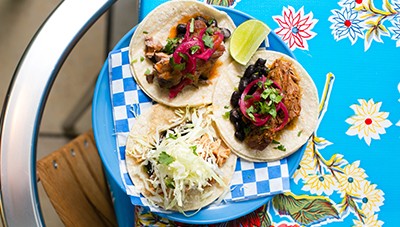
Clockwise from top: Carnitas, barbacoa, and chicken tinga.
Credits: Bert Johnson
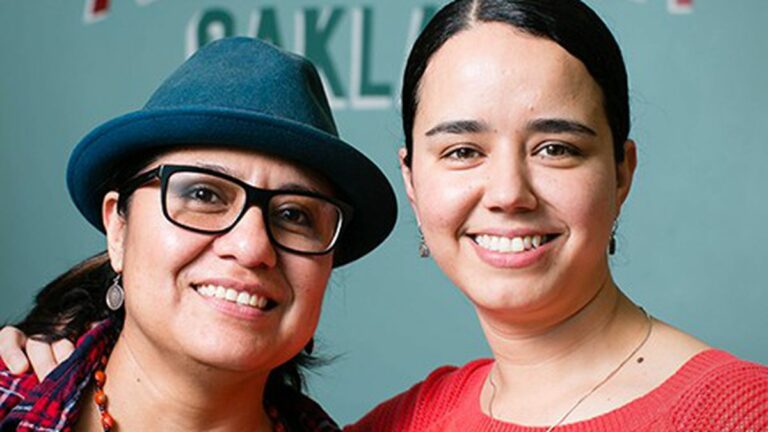
Juana Ojeda (left) and Claudia Mercado.
Credits: Bert Johnson
Start with the physical location, which is neither in the Fruitvale district (with its dense concentration of immigrant-oriented Mexican restaurants), nor in one of the city’s trendy gourmet neighborhoods — say, Rockridge or Temescal, where $3.50 tacos like the ones Aztecali specializes in usually congregate. Instead, Aztecali, is more or less the only dining establishment in walking distance for folks who live on a mostly residential stretch of Oakland Avenue between the Whole Foods Market and the I-580 on-ramp. As such, the two-month-old taqueria really feels like a neighborhood place. Most of the customers appear to be regulars — regular enough to have a standard order, anyway. And the restaurant has no shortage of good vibes, which extend from the cool blue shade of the paint on the walls to the friendliness of the service — the latter mostly courtesy of Mercado. (A shout-out here to small acts of kindness to the picky toddler in our party.)
Meanwhile, Ojeda, who does the cooking, said that Aztecali is the culmination of about twenty years that she has spent working at Mexican restaurants in the Bay Area — most recently as sous chef at Cala, the high-profile US debut for Mexico City chef Gabriela Cámara. As the restaurant’s name suggests, the food is a mash-up of the “Aztec” and the “Cali” — a combination of Ojeda’s Guerrero roots and the California ingredients and flavors that she has embraced since moving to the Bay Area in 1995.
Of course, the East Bay has no shortage of Cal-Mexican eateries, with their Chez Panisse pedigrees, immaculate farmers’ market produce, and higher-priced versions of traditional Mexican dishes. (In spirit and quality, the restaurant’s closest analog is probably Cosecha, the Cal-Mexican powerhouse that has spearheaded the revival of Old Oakland’s Swan’s Market food hall.) But I have found few examples of the genre as unpretentious as Aztecali. Yes, the tortas are served on Acme deli rolls instead of traditional telera rolls. Yes, you can order Highwire cold-brew coffee that’s mixed with Ojeda’s house-made horchata — a refreshing, just-sweet-enough version, in case you were wondering.
In the end, it was the homey simplicity of Ojeda’s cooking that won me over. Unlike your typical taqueria, where grilled meats such as carne asada and al pastor are the main attraction, the focal point of Aztecali’s concise menu is a selection of guisados, or stews. (Part of this is sheer logistics: Ojeda doesn’t have room for a grill.) For now, there are three main options, served on the vessel of your choice: taco, burrito, or torta. My favorite of the guisados, by a large margin, was the chicken tinga: gently poached chicken breast — as tender as you can imagine — shredded and tossed in a chipotle sauce whose smoky heat was incredibly addictive. The tinga was delicious on a taco, topped with crunchy raw cabbage, a scattering of Cotija cheese, and a garlicky tomatillo salsa. But it was even better on the torta, which was one of the best chicken sandwiches I’ve had recently. The flavors were layered brilliantly — mashed avocado, like any good Cal-cuisine cook knows to spread on thick toast, and a little smear of mayonnaise and uncommonly moist refried bean. I especially loved how the tinga sauce soaked into the bread, creating an appealing contrast of sog and crunch.
The two other guisados were also enjoyable. The carnitas consisted of pork shoulder that had been braised in citrus and beer. This is the kind of carnitas that’s served as a soupy, slow-cooked stew — not the stringy, fried pork bits you’ll find at the typical taco truck. Meanwhile, the braised beef barbacoa owed its delicate flavor to Ojeda’s use of avocado leaves, a hard-to-find herb. Again, the meat was served shredded, but as tender as the chuck steak had become after several hours of low-and-slow cooking, I found it somewhat bland — a bit too delicate. Ask for an extra helping of that green tomatillo salsa, which Ojeda said is the traditional accompaniment to barbacoa in Guerrero.
Indeed, if you are the kind of Mexican food devotee who has found “California-fied” versions of these traditional dishes to be to be too bland and watered-down in the past, both of Ojeda’s house-made salsas — the bright, garlicky salsa verde and a red salsa, which comes in a squeeze bottle and is meant to complement the carnitas — offer some proof that Aztecali isn’t afraid of big, bold flavors. Same goes for the chilaquiles rojos, offered as a brunch special on the weekend. For that dish, tortilla chips were topped with crema and a fried egg, but what was most notable was the fiery red chilaquile sauce. My only criticism was that the dish was a little bit too spicy for me to eat quickly enough to keep the chips from getting soggy.
Other highlights: A chicken tinga tostada piled high with fresh ingredients — cubes of ripe avocado, thin radish rounds, and salsa verde. A vegetarian tostada, whose main ingredient was basically mashed potato, was just as good.
As for Aztecali’s aforementioned burrito, which Ojeda said is now her number-one seller, I was of two minds. On the one hand, I’ve been known to rail against burritos stuffed with too much rice and beans — empty filler, in my view. The barbacoa burrito I ate at Aztecali was packed with about as much rice as I recall ever seeing in a burrito, constituting more than half of the filling. Then again, the rice was delicious — perhaps the fluffiest and most delicate I’ve encountered at a Mexican restaurant in the East Bay. The secret, Ojeda said, is to use jasmine rice and to sauté it in rice bran oil with onions and garlic before cooking. The rice is what will make me order one of those burritos again, and it makes a side order of rice and beans — the simplest, and most inexpensive of indulgences — worth a trip to Aztecali on its own.
If you are very lucky, though, you will have timed your visit for a day when Aztecali is serving its chicken pozole verde — just on the third Sunday of each month, for now. Ojeda’s version of the famed hominy stew takes more than ten hours to make, in a process that starts with whole chickens cooked until they’ve given up all their flavor to the broth. A bright mole verde (a purée of fresh chilis, pumpkin seeds, tomatillos, and herbs) — a dish that actually originated in Guerrero — supplies the rest of the flavor. I appreciated the freshness and crunch of the accompanying tostada shells (sourced from Oakland-based La Finca, though Ojeda eventually plans to make her tortillas from scratch). And Aztecali is surely one of just a small number of restaurants in Oakland that nixtamalizes (i.e., soaks in limewater) its own corn for its pozole in-house — a plump, purple-tinged variety that resembles little chunks of ham in the bowl.
The dish is in the running for best pozole in Oakland and is one of a handful of dishes at the restaurant that’s wholly traditional. No California fusion here — just soulful food prepared just as Ojeda’s mother or grandmother would have done in Guerrero.
Welcome to the Mid-Week Menu, our roundup of East Bay food news.
1) CommonWealth Cafe & Pub (2882 Telegraph Ave.), the popular Uptown Oakland watering hole, has new owners. In a Facebook post earlier this week, Ahna and Ross Adair announced that they’ve sold the pub to two longtime customers: Lizzie Alford (a CommonWealth employee for the past two years)...
The world’s biggest cannabis contest will tighten its contamination rules and publish the names of growers and dispensaries who fail screenings for pesticides and residual solvents, Legalization Nation has learned.
The Emerald Cup, held in December in Santa Rosa each year, also will add contest categories for butane hash oil and CO2 hash for 2016, organizers told me...
Stories you shouldn’t miss:
1. A 65-year-old Oakland man who was arrested for a crime he didn’t commit died over the weekend after being taken to Santa Rita Jail in Pleasanton, the Bay Area News Group$ reports. Melvin Stubbs, who is an amputee and a diabetic, was arrested by Oakland police on suspicion of murdering his wife, Terry Cameron, but the...
"In Praise of Old Restaurants," Insider's Guide, 2/24
Landlords Are Vultures
Landlords are like vultures, ruining merchants with rate hikes. It's up to government to build out affordable spaces for restaurants, or we won't have any left that are affordable. We also need to extend rent control to commercial spaces before cities are made unlivable.
Steve Redmond, Berkeley
"Supporting Historical, Black-Owned Businesses," Insider's...
It's distressing to have to announce this, but Terrence Malick's transformation, from the film world's most intriguing living legend to its most conspicuous coaster, is now complete. Knight of Cups seals the deal.
Once upon a time, when the former philosophy prof-turned-art-film auteur let twenty years go by between his second feature release (Days of Heaven, 1978) and his third...
It was 9 p.m. on a recent Friday night in a recording studio in San Francisco's SOMA district. Kamaiyah cracked open a bottle of Jameson and a plastic, lemon-shaped container of lemon juice and poured herself a stiff cocktail. A buoyant, bare-bones beat with an old-school, West Coast funk filled the room — the last incomplete track off her highly...
At restaurants around the country, it has long been common practice for servers to "tip out" at the end of a shift, giving a cut of their tips to the bussers and bartenders — and, often, to the back-of-house kitchen employees, such as the line cooks and dishwashers. After all, one good turn deserves another, and for a waiter...
Photographer Stephanie Lister's new book, East to El Rancho, West to Walt Disney, is perfectly titled. In the opening pages, the Florida-grown, but Oakland-based artist begins to explain what it means: "It's a mnemonic device my mother handed me when I started driving to help remember directions on the Interstate." But by the end of the 136-page...
Aries (March 21–April 19): "He in his madness prays for storms, and dreams that storms will bring him peace," wrote Leo Tolstoy in his novella The Death of Ivan Ilych. The weird thing is, Aries, that this seemingly crazy strategy might actually work for you in the coming days. The storms you pray for, the tempests you activate through...
At first, Aztecali wasn't going to serve burritos. Co-owner Juana Ojeda, who hails from the southwestern Mexican state of Guerrero, didn't grow up eating the foil-wrapped bundles, and, strictly speaking, didn't consider them a traditional Mexican food. So when Ojeda and her business partner (and girlfriend) Claudia Mercado opened their pint-sized Oakland taqueria, burritos weren't part of the plan...