
California Natives Oppose Canonization of Junipero Serra

When Spanish soldiers and missionaries arrived in the land they called Alta California in the 1700s, they were entering an astoundingly diverse array of indigenous cultures’ homelands. Then deadly waves of epidemic diseases swept over the terrified indigenous populations — an outcome the Spanish had anticipated. Military and religious officials subsequently used a combination of bribes and physical force to incarcerate the survivors in filthy, disease-ridden, and crowded labor camps. By 1836, at least 100,000 aboriginal people had died as a result of the Spanish mission system.

On September 23, Pope Francis will canonize the father of that system, Junipero Serra, at a ceremony in Washington, DC. Serra will thus become a “saint” in the Roman Catholic Church.

To the descendants of those who survived the mission system, Serra’s canonization is essentially a celebration of genocide. It is a reflection of a society that “wants people to pretend that historical events do not affect our contemporary lives,” said Deborah Miranda, a member of the Ohlone-Costanoan Esselen Nation of the Monterey Bay Area and an English professor at Washington and Lee University.

“Canonization instructs everyone, Indians and non-Natives included, the essential missionizing myth,” Miranda added, “which is that California Indians existed in a state of sin before Catholicism, that we needed to be saved, that even a 90 percent death rate was worth it because those dead ancestors went to their deaths safe in Christ, that indigenous religious and spiritual beliefs were not good enough, that we were, and still are, savage children in need of help to become civilized.”

Corina Gould, a Chochenyo Ohlone from Oakland whose ancestors were enslaved at Mission Dolores in San Francisco and Mission San Jose in Fremont, agrees with Miranda. “Making Junipero Serra a saint is basically a way of saying California Indians still don’t count,” she said. “It conveys that we’re still not considered full human beings.”

Of all the Spanish colonial leaders in California, Junipero Serra, who first arrived in California in the late 1760s, has remained both the most well-known and the most controversial figure. His statue stands in San Francisco’s Golden Gate Park and in Washington, DC. The latter is one of two statues California is allowed in the National Statuary Hall Collection. The other is of Ronald Reagan.

Earlier this year, state Senator Ricardo Lara (D-Bell Gardens) introduced legislation to remove Serra’s statue from the nation’s capital, prompting Governor Jerry Brown to intervene. During a July visit to the Vatican to support Pope Francis’ papal letter on climate change, Brown, who once studied to become a Jesuit Catholic priest, proclaimed that the Serra statue will remain where it stands “until the end of time.”

Serra’s canonization was originally proposed in the 1930s. Pope Francis fast-tracked the process earlier this year after it had languished for several decades, by eliminating the need to show proof of two miracles, asserting instead that Serra is an exception to the rules because he was such a great evangelizer.

Santa Clara University history professor Robert Senkewicz speculated in an interview that Francis may be attempting to appeal to his Latin American base. A demographic shift in the Catholic Church has occurred in the United States during the past several decades, and Serra is a celebrated figure among many Catholic Hispanics. According to a 2008 survey by the Pew Forum, 54 percent of Catholics in the American West are now Hispanic.

Indigenous groups and their supporters in the American Southwest and in Latin American countries have also opposed the canonization, however, and have held mock human rights tribunals in Los Angeles, Phoenix, and Guatemala in which the Franciscan padre has been posthumously charged with genocide and torture.

In addition to his role in designing the mission system, Serra was involved in the murder and torture of indigenous people who did not willingly submit to the Spanish Crown’s program of conquest and religious conversion. During his tenure, the preferred methods of abuse included floggings with heavy leather straps (“Cat o’ Nine Tails”) or metal-tipped straps; staking out “bad Indians” in the sun for days; putting them in stocks; forcing them to attend Catholic services on pain of beating; and imprisoning them in fetid, disease-riddled rooms.

Some scholars have defended Serra’s individual character by pointing to instances in which he protected Indians from soldiers’ rape and abuse. Indigenous scholars and other historians counter that his overriding concern in these cases may have been preserving the Spanish Crown’s efforts to maintain a stable labor pool, which was threatened by soldiers’ kidnapping and murdering the people Serra and other padres maintained as slaves.

Overall, Serra wielded enormous political power because his missions served the economic and political purposes of the Spanish empire. These include production of the colony’s cattle and grain and providing a fortification against potential Russian or English expansion along the Pacific Coast.

Corine Fairbanks, director of the American Indian Movement of Southern California, has been organizing against Serra’s canonization since Pope Francis’ announced it in January. She notes that California’s public school system is still “saturated with the glorification of the mission system,” and that it remains a required part of fourth-grade curriculum. “The issue of Junipero Serra is bringing back to the forefront something that has been continuously operating since the Doctrine of Discovery, if not longer,” Fairbanks said.

Because indigenous cultures are inextricably linked to the lands they have historically inhabited, their survival necessarily depends on preserving those lands, which face countless threats at any given time. In California and beyond, contemporary indigenous people are engaged in battles over mineral rights, water rights, federal recognition, honoring of treaties, repatriation or honorable treatment of sacred sites, healthcare, language preservation, and more.

The struggle against erasure of indigenous culture and identity plays out in ways both public and personal. “My father grew up deeply ashamed of being Indian,” Miranda said. “He was taught by his parents and elders to hide it, to claim he was Mexican, to speak only Spanish and English, even though his elders spoke at least two indigenous languages at home well into the 1950s. He passed that shame on to me, and I’ve struggled mightily to shed it.”

Confronted by the glorification of a man who led a campaign of state terror against them, indigenous people and their allies are working to transform their grief into healing. On September 23, for example, Ohlone people and their allies are conducting a day of action and interfaith prayer at 1:15 p.m. at Mission Dolores in San Francisco.

Caroline Ward Holland, who is of Tataviam descent from what is now the Santa Clarita Valley in Southern California, has helped organize an 650-mile pilgrimage to each of the 21 California Missions to honor those who suffered and died at them, and to “assert California Indian rejection of sainthood for Junipero Serra.” The walk’s website is WalkfortheAncestors.org.

“We don’t want to forget, and we’re not going to forget,” she said during a September 8 visit to Mission Sonoma. “Until we make things right.”


‘Black Mass’ Is a Remarkably Effective Fright Film

0

He stands apart, even in the midst of his underlings, coolly weighing the situation with dead blue eyes and a grim, implacable expression on his face. Combined with his thinning gray hair and unnaturally pallid complexion, the man’s crooked, discolored teeth and the set of his jaw give him a feral look, as if he were an animal of prey, waiting for the right moment to come in for the kill. It’s the face of a buzzard or a nightmare rat. But the lingering impression is that of a vampire. This calm, wiry, predatory being exists to suck the life force out of whatever comes into his radius, leaving nothing but waste.

Arch-criminal James “Whitey” Bulger, subject of Scott Cooper’s rewarding but chilly true-crime thriller Black Mass, treated the Boston area to a New England clambake of mayhem and corruption for more than four decades, before he went underground in 1994. Captured, tried, and convicted in 2013 for eleven murders and 31 other criminal counts (racketeering, extortion, weapons charges, money laundering), Bulger was sentenced to two consecutive life terms plus five years, and currently resides in a federal prison in Florida. The Irish-American one-time kingpin of Southie represents, for many, the shame of his hometown, a repulsive thug who took the concept of crime boss to unheard-of new levels.

The job of impersonating Jimmy Bulger (he evidently disliked the nickname Whitey) is probably the last thing we’d expect from movie star Johnny Depp. For most of the past twenty years, Depp has portrayed fey, whimsical characters along the lines of Jack Sparrow, the Mascara’d hero of the hit Pirates of the Caribbean series, or the Mad Hatter from Alice in Wonderland. The epitome of harmless. With Black Mass, the 52-year-old actor turns over a new page in his filmography, in a performance so startling he can never go back. He completely disappears into a “horror” role of singular loathsomeness. Introducing Whitey Scissorhands.

As laid out by director Cooper (Crazy Heart, Out of the Furnace) and screenwriters Mark Mallouk and Jez Butterworth — adapted from the book by reporters Dick Lehr and Gerard O’Neill — Bulger’s career is related in chronological flashbacks. Boiled down to its essence and leaving aside the incidental murders and betrayals, the South Boston leader of the Winter Hill outfit figured out a way to use the FBI — with the connivance of neighborhood pal and turncoat G-man John Connolly (Joel Edgerton) — to run interference against Bulger’s chief rivals in the Boston rackets, the Patriarca family, in exchange for carefully doled-out “tips” that effectively gave Bulger and his associates immunity from prosecution and turned the Boston branch of the FBI into gold-plated suckers. Factor in the protective influence of Bulger’s politician brother Billy (Benedict Cumberbatch), a Massachusetts state senator, plus the clannish devotion of thousands of working-class Irish Americans on the street, and Bulger held the power of life and death over an American city.

Black Mass is packed to the rafters with intense, unforgettable supporting characters. Julianne Nicholson is outstanding as Connolly’s wife, who instinctively recoils from Bulger — when he corners her, the way he wipes his hand across her face is as ugly as any rape scene. The killing of cocaine dealer “Balloonhead” Halloran (Peter Sarsgaard, in fine form) is likewise unnerving. Actors Jesse Plemons, Rory Cochrane, and W. Earl Brown are all excellent as Bulger henchmen, matched against John Morris, Cory Stoll, and Kevin Bacon on the FBI side. We get the full mickey when Edgerton’s Connolly and Cumberbatch’s Billy Bulger sit down and iron things out the old-fashioned Irish way with a glass of whiskey — a pair of hyenas, the ideal antidote to Auld Sod sentimentality. For the likes of them and Bulger, it’s the Irish against the world.

Creepy guy, creepy movie. Cooper’s somber tone extends to Junkie XL’s music score and the Seventies-style cinematography of Masanobu Takayanagi. Depp gives a career performance, but Bulger, his friends, and their brutal milieu are not something you’d want to take home with you at night. The Martin Scorsese/Jack Nicholson version of the same general story in The Departed was an evening at the carnival compared to the sepulcher Depp and Cooper build for Whitey. If you can take it, it’s a remarkably effective fright film.

Town Eats Offers a Lower-Key, Oakland-Centric Alternative to Eat Real

As much as the Eat Real Festival is intertwined with the continued growth of Oakland’s vibrant food scene, at least two longtime Eat Real participants have decided that they’d like to organize their own mini food festival this year — one that’s more focused on representing Oakland.

[jump] Organized by Angela Tsay, owner of the apparel company Oaklandish, and restaurateur Chris Pastena, Town Eats will be a three-day, Oakland-centric celebration of food held at Pastena’s waterfront restaurant, Lungomare (1 Broadway, Oakland). On Saturday, September 19, five Oakland restaurants — Lungomare, Chop Bar, Haven, AlaMar, and Chowhaus — will participate in a pig roast-off, with $4 pig plates (or a $20 all-you-can-eat option) available from 1 p.m. until the last portion of pork has been eaten.

On Sunday, five local restaurants — Abura-ya, Lucky Three Seven, Blackwater Station, Revival Bar + Kitchen, and Chop Bar — will set up inside Lungomare to sell $4 bites from 11 a.m. to 5 p.m. To top it all off, event sponsors Drake’s Brewing Company and Hangar One Vodka will offer $4 drink specials all weekend long, and a number of Oakland musicians and DJs will perform.

Of course, with Town Eats positioning itself as being a festival that’s more about Oakland — and scheduling its events the same weekend as Eat Real, just a few steps further up Jack London Square — the implication seems to be that Eat Real isn’t Oakland-centric. On that subject, Tsay demurred, stressing instead the fact that Town Eats will be more low-key, appealing to locals looking for a place to do their “usual weekend kick-it” and Eat Real attendees who want to take a break from the long lines.

“The intent is for everyone to enjoy both,” she said.

In any case, Eat Real director Ally DeArman said there’s no conflict as far as she’s concerned. On the one hand, Eat Real receives far more vendor applications each year than it is able to accommodate, which has led some to have what she believes is a false perception that the festival doesn’t support Oakland vendors or that it doesn’t care about the “little guy” — despite the fact that half of this year’s vendors are based in Oakland, and almost all of them are small businesses. She acknowledged, however, that the festival poses a real challenge to the restaurants in Jack London Square and said she encourages them to run special promotions instead of just rolling with their regular menu.  

For Tsay, the important thing is that Town Eats will highlight everyday Oakland businesses so that all of the out-of-towners who come for Eat Real have a reason to return.

“Oakland is just a great place to hang out even when there’s not any special event happening,” she said.

Report Illustrates How Incarceration Traps Inmates’ Families in Debt And Poverty

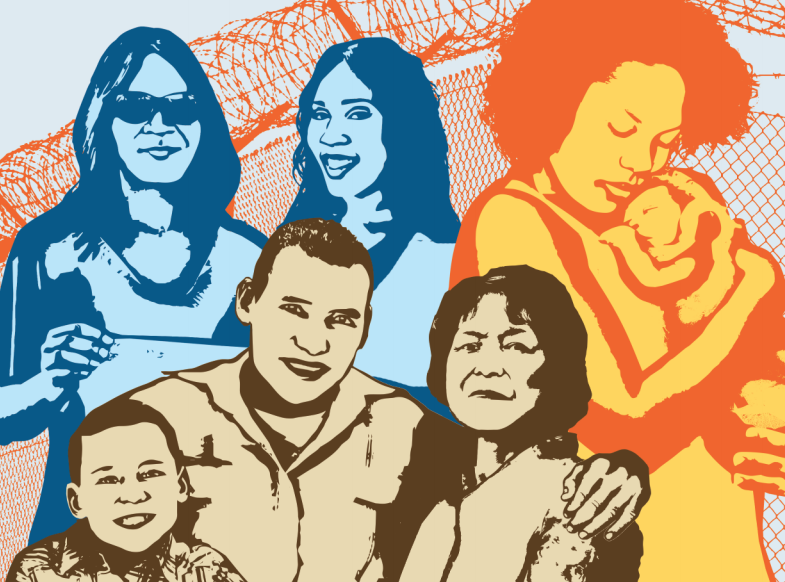
A new report co-authored by the Ella Baker Center for Human Rights details how the harms of mass incarceration extend far beyond prison walls with the criminal justice system trapping inmates’ families in poverty with a wide range of fines, fees, and debts. The report, called Who Pays? The True Cost of Incarceration on Families, is the result of extensive surveys and focus groups that researchers conducted over the last year across fourteen states with formerly incarcerated people and their families. The project — spearheaded by the Oakland-based Ella Baker Center, Forward Together, and Research Action Design — quantifies the many financial burdens that families face when their loved ones are incarcerated and illustrates the various ways a prison sentence can send family on the outside on a downward spiral. 

The US spends $80 billion each year incarcerating more than 2.4 million people in jails and prisons, but the collateral costs that impact families have largely gone undocumented, according to the report. Working with twenty community-based organizations across the country, the researchers studied the many financial costs inmates’ families face, the resulting effects on physical and mental health, and the obstacles families encounter when their loved ones reenter society. The research team completed surveys with 712 formerly incarcerated people, 368 family members, and 27 employers and also conducted 34 focus groups with families of the incarcerated — collecting alarming data and stories on the devastating costs of incarceration on low-income people. 

[jump] For starters, convictions come with a wide range of fines and fees that each inmate must pay in addition to the time he or she is serving behind bars. My March 2014 cover story, “Unfair Punishment: Sentenced to Poverty,” explored this topic in-depth, illustrating how prisoners in California — including those convicted of low-level offenses — have to pay for all kinds of basic necessities and privileges behind bars, such as soap, deodorant, snacks, and phone calls. At the same time, they have to pay so-called “restitution fines” as part of their sentences, which can saddle formerly incarcerated people with debt for many years even after they are released. 

The Who Pays? reports documents how this system of fees ends up directly hurting families at a time when they may already be losing income and economic stability due to the incarceration of a loved one. Of the families the researchers surveyed, 48 percent said they were unable to afford the costs associated with the conviction. And when it comes to low-income families — those making less than $15,000 per year — 58 percent said they couldn’t afford these costs. The financial challenges continue after a prisoner is released; the research found that 67 percent of the formerly incarcerated people they surveyed were still unemployed or underemployed five years after they returned home.

See Also: 
The High Cost of Driving While Poor
County to Spend More Money on Jails, Not Services


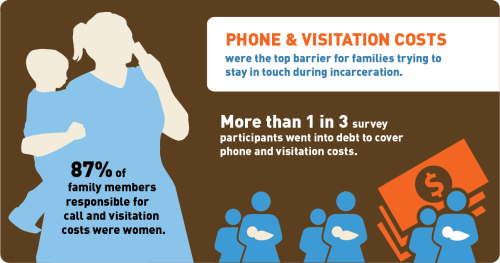
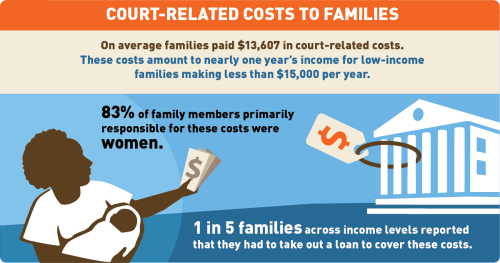
Inmates and their families have to pay a wide range of legal expenses, court fines and fees, and charges for phone privileges and visitations, according to the report. Those costs can add up to one year’s total household income for a family, forcing them into significant debt. Across families of all income levels, the average debt incurred for court-related fines and fees was $13,607, the report found. And maintaining basic contact with incarcerated family members carries a hefty price tag as well. More than one in three families surveyed went into debt to pay for phone calls and visits alone. Those who were unable to talk or visit their loved ones regularly also were much more likely to experience negative health impacts related to the incarceration. 

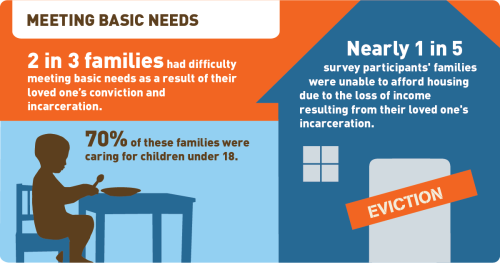
As a result of all these financial burdens combined, 65 percent of families in the survey said they were unable to meet their families’ basic needs. Additionally, 49 percent said they struggled with basic food costs, and 48 percent said they struggled to pay housing costs.

The study also uncovered that women are disproportionately impacted by these hidden costs of incarceration. In 63 percent of cases, family members on the outside were primarily responsible for court-related conviction costs. And of those family members paying the costs, 83 percent were women, according to the report. 

“This study confirms what society has ignored for too long — that already vulnerable families and the women who sustain them are being plummeted into greater poverty, stress, and strain when their loved ones are incarcerated,” Alicia Walters, movement building director at Forward Together, said in a statement. “Decades of bad policy have torn families apart, typically leaving mothers to make up the difference and bear the brunt of these costs.” 

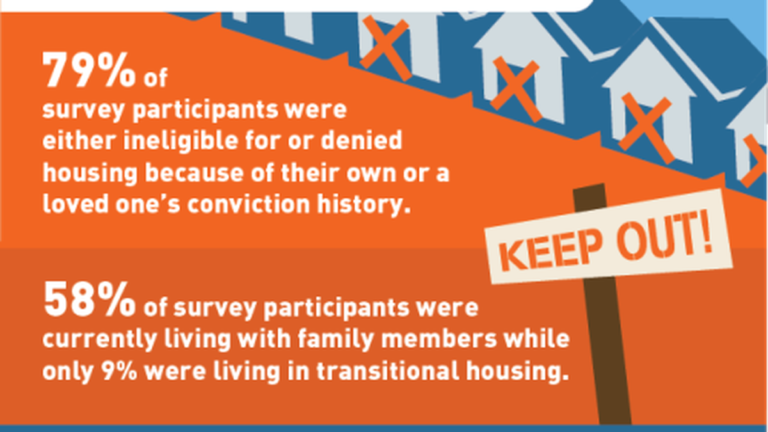
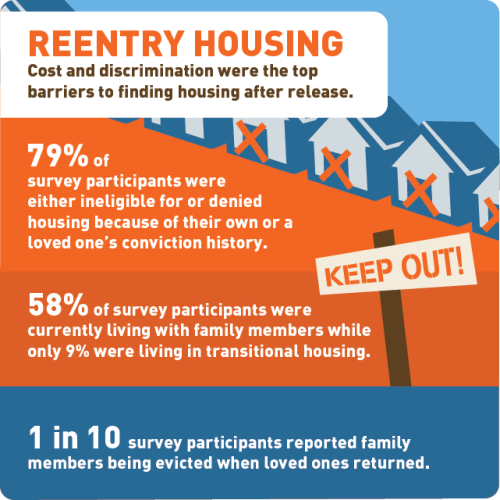
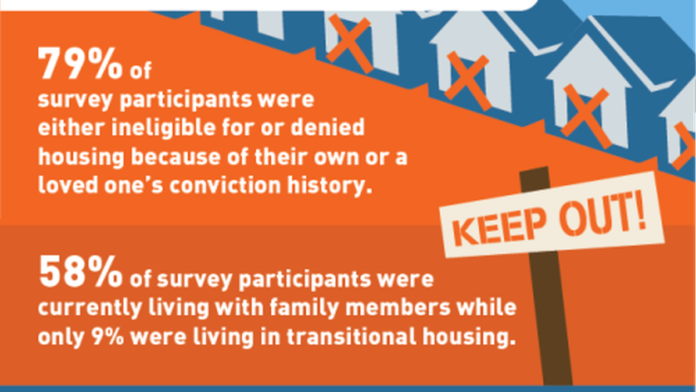
Additionally, because funding for reentry services are so limited, families end up functioning as the primary resource for housing, employment, and health needs when their loved ones are released. The surveys found that 67 percent of families helped formerly incarcerated people find housing, and 18 percent of the families faced eviction, were denied housing, or did not qualify for housing once a formerly incarcerated family member came home. 

The report advocated for a number of solutions, including restructuring jails and prisons so that fewer people spend time behind bars and so that the lengths of sentences are reduced. The resulting financial savings should then be invested in community-based services that make it less likely people will reoffend — including substance abuse programs, stable housing, and job training. Additionally, the organizations advocated for removing the costs and other barriers that prevent families from visiting their loved ones behind bars. Regular contact with people on the outside can increase the likelihood of successful reentry, the report noted.

Ending discriminatory policies that make it hard for people reentering society to turn their lives around — and make it harder for families to support them — could also go a long way in creating a fairer system, according to the report. For example, many former inmates are denied public benefits, such as food stamps, or can’t pursue training or education due to their past run-ins with the law. And these restrictions also impact families who can risk losing support due to the criminal records of a loved one. 

You can read the full report at WhoPaysReport.org. The organizations are also hosting a launch event for the project tonight at 6:30 pm at Impact Hub Oakland (2323 Broadway, Oakland).

And here are some graphic highlights from the report: 


Best Thursday Event This Week? Our World-Class Cannabis Author Showcase!

We’re proud to announce that our world-class Cannabis Author Showcase IV is one of the Bay Area’s best free events to attend Thursday night.

SF FunCheap has dubbed the free night of author talks, book signings, refreshments and fun a Top Pick for Thursday, and it is. 

Listen to the event description with our new spot on The Hash podcast, or read below:

[jump]

[embed-1]

Experience the cutting-edge of cannabis science, policy, history and society for free in Uptown Oakland at “The Cannabis Author Showcase IV”. The East Bay’s “Best Bar for Free Events” The Rock Steady hosts a night of author interviews, exclusive book sales, signings, as well as delicious food and drinks.

Lineup includes:

  • Harborside Health Center founder Stephen DeAngelo, author of The Cannabis Manifesto, 2015
  • Ellen Komp, Tokin’ Women, 2015 
  • Michael Backes, Cannabis Pharmacy, 2014 
  • Cheri Sicard, Mary Jane, 2015

Free! Guarantee your spot by RSVPing at our podcast TheHash.org/contest.

Sponsored by East Bay Express, Legalization Nation, The Hash podcast, Smell the Truth, Oaksterdam University and ReformCA.

Everything You Need to Know About This Weekend’s Eat Real Festival

When Oakland’s Eat Real Festival made its debut in 2009, gourmet street food was still somewhat of a novelty in the Bay Area, and the national media was still several years away from deigning to recognize Oakland as a world-class food destination. Now in its seventh year, Eat Real simply feels like an inevitability. The sprawling three-day street food festival will take over Jack London Square again this weekend, with a lineup of eighty-plus food and beverage vendors — about a quarter of them making their first Eat Real appearance, according to Ally DeArman, director of the nonprofit Food Craft Institute that organizes the event.  

[jump] The festival kicks off on Friday, September 18 and will run from 1 to 9 p.m. on Friday, 10:30 a.m. to 9 p.m. on Saturday, and 10:30 a.m. to 5 p.m. on Sunday. Admission is free, and the price for all food items will be capped at $8.

For many festivalgoers, it will be Herculean enough a task to map out a sensible plan of attack to hit every appealing-sounding food vendor — see the full list here — without spending hours standing in line. (My to-try list might include a tea leaf salad from Burma Bear, a California burrito from Fritas Shack, and some socially conscious donut kebabs courtesy of Oakland’s own Mamacitas Cafe.)

But here are a few other points of interest:

1. Drought-Friendly Fare
Given that there appears to be no end in sight to California’s extended drought, it makes sense for a food festival to give the topic some attention. This year’s edition of Eat Real will have several “DIY DRY” demos, including tips on water-wise gardening (courtesy of Jack London Square newcomer Sunset Magazine) and cooking demos that will feature drought-tolerant legumes. In addition, the Belcampo Meat Co. booth will sell burgers made with beef from organic dairy cows all weekend long — a burgeoning trend in the beef industry, because it’s more environmentally friendly, since the same amount of water can go toward producing both beef and milk instead of just beef alone.

2. Sharks and Guppies
Before the festival itself starts, fans of the reality show Shark Tank may want to check out the Food Craft Institute’s FOOD.FUND.FEST kickoff event on Thursday, 6:30–9:30 p.m., during which five relatively new food entrepreneurs will pitch a panel of “Slow Money” local food system investor types. DeArman said the event would be like Shark Tank without the “sink or swim” element. That said, only one competitor will win a $1,500 cash prize. Tickets are $10, plus an optional donation that will go toward sweetening the reward pot.

3. The Redefinition of Fast Food
On Friday, several Oakland chefs, including Juhu Beach Club’s Preeti Mistry and Cosecha’s Dominica Rice-Cisneros, will do a series of cooking demonstrations focused on the theme of global fast food — no Big Macs, then, but rather Indian chaat and Mexican street tacos.

4. Praise the Lard
For the past few years, Chico-based pork purveyor Rancho Llano Seco has run “Offal Wonderful” as a parallel event on the Saturday and Sunday of Eat Real. This year’s theme is “Skin and Fat,” which provides a dual benefit to festival attendees: First, ambitious home cooks can check out chef demos for dishes such as lard biscuits and pork skin chorizo. More importantly, the promotion is designed to build demand for less popular cuts — in this case, the skin and fat — on the part of both chefs and customers. If that happens, pork-fat enthusiasts will find that Bay Area menus might start to get a little more lard-y.

Check out the Eat Real website for additional details, including a map and full schedule of events.

Tuesday Must Reads: Berkeley Council to Consider $19 Minimum Wage Tonight; Sierra Snowpack Lowest in 500 Years

Stories you shouldn’t miss:

1. The Berkeley City Council is scheduled to consider a proposal tonight to raise the minimum wage to $19 an hour by 2020, Berkeleyside reports. The proposed increased, put forward by the city’s Labor Commission, would give Berkeley the highest minimum wage in the region. The Berkeley Chamber of Commerce is expected to oppose the plan — which was proposed by the Labor Commission without input from the city’s business community.

2. The snowpack in the Sierra Nevada last winter was the lowest in more than five hundred years, the LA Times$ reports, citing a new study by paleoclimatologists in the journal Nature Climate Change. Although the four-year drought has had a punishing effect on water supplies on the state, scientists said that higher-than-normal temperatures also impacted the mountain snowpack. The snowpack accounts for at least one-third of California’s water supplies.

[jump]
3. A retired teacher with advanced multiple sclerosis died in the fast-moving Valley Fire that roared through Lake County over the weekend, ravaging two towns — Middletown and Cobb — and decimating the popular resort Harbin Hot Springs, the Chron reports. Barbara McWilliams, 72, was unable to flee from the blaze because of her illness.

4. Governor Jerry Brown warned that, because of climate change, wildfires and droughts likely will worsen in California in the decades ahead, the LA Times$ reports. There are currently three major, destructive fires burning in the state, and the Mercury News$ notes that the worst part of the fire season may be yet to come.

5. And the California building industry has asked the US Supreme Court to overturn a California Supreme Court ruling that had upheld the right of cities to require developers to include affordable housing in their condo projects, the Mercury News$ reports. The appeal stems from San Jose’s so-called inclusionary zoning law. 

Monday Must Reads: Harbin Hot Springs and Two NorCal Towns Ravaged by Fire; Blazes Envelop Dry California

Stories you shouldn’t miss:

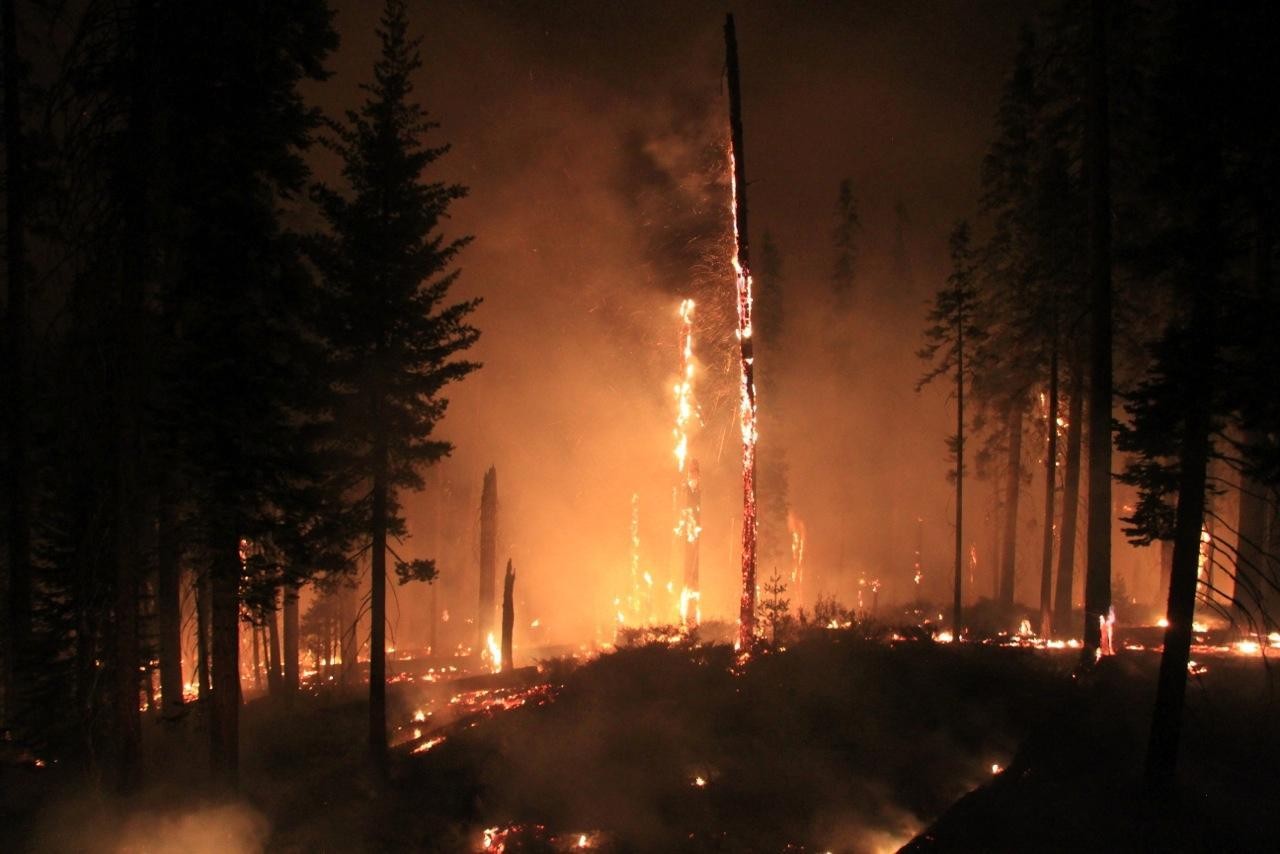
1. A raging wildfire in Lake County, north of Napa County, destroyed Harbin Hot Springs, a popular resort, and ripped through the towns of Middletown and Cobb over the weekend, the Chron reports. The intense fire spread quickly through drought stricken areas, destroying hundreds of homes and forcing thousands of people to flee. The Valley Fire grew to 61,000 acres over night, and was one of three major blazes burning in dry California.

2. Another major fire, the Butte Fire, roared through Amador and Calaveras counties in the Sierra foothills, the SacBee$ reports. The 65,000-acre blaze destroyed 86 homes and enveloped much of the Sierra in thick smoke. Fire crews were also busy battling the Rough Fire, east of Fresno, which, at 129,000 acres, is the largest fire burning in the state.

[jump]
3. State lawmakers on Friday sent a landmark aid-in-dying bill to Governor Jerry Brown that would allow physicians to prescribe life-ending drugs to terminally ill patients, the Mercury News$ reports.

4. The state legislature also approved a bill that would expand unpaid family leave to include taking time off to care for siblings, grandparents, grandchildren, domestic partners, and parents-in-law, the SacBee$ reports.

5. And faced with staunch opposition from law enforcement lobbyists, the Assembly defeated legislation that would have banned the seizure of assets, including cars, cash, and property, in legal cases in which the person was not convicted of a crime, the LA Times$ reports.

Historic California MMJ Bills Head to Governor Brown’s Desk

With a midnight deadline looming, California lawmakers passed a series of bills to regulate the country’s oldest, largest medical marijuana system for the first time.

Assembly Bills 266 and 243, and Senate Bill 643 passed both the Senate and Assembly before midnight Friday — all but guaranteeing their signature by Governor Jerry Brown.

You can read details of the vote here, and analysis of the bills here, here, and here, as well as learn about the legislation’s road to the Governor’s Office here.

See you Monday with more analysis.

California Medical Marijuana Regulations — What’s in SB 643?

On Friday evening, both the California Senate and Assembly are expected to pass amended versions of Assembly Bill 266, AB 243, and Senate Bill 643 — the three bills containing California’s historic new medical cannabis regulations.

What precisely was in those amendments had been anyone’s guess, right up until they dropped.

Here is the latest text of SB 643, which passed the Assembly Friday evening to be voted on by the Senate by midnight.


[pdf-1]
In summary:

— The governor, under the Medical Marijuana Regulation and Safety Act, appoints, subject to confirmation by the Senate, a Chief of the Bureau of Medical Marijuana Regulation inside Department of Consumer Affairs.

— The Department of Food and Agriculture regulates cannabis cultivation. The DFA will also create a track and trace  program for reporting the movement of medical marijuana items throughout the distribution chain.
\


— The State Department of Public Health regulates manufacturing and testing of medical cannabis.

— The rules around doctors recommending cannabis aren’t really going to change.

— A qualified patient “does not provide, donate, sell, or distribute cannabis to any other person is not thereby engaged in commercial cannabis activity and is therefore exempt from the licensure requirements of this chapter.”

— Primary caregivers can have up to five patients.

— All non-personal, non-caregiver activity is considered commercial, and requires licensing.

— All licensees will have to submit a full set of fingerprints for the purposes of conducting criminal history record checks.

— You may be denied a license for breaking the regulations, a felony conviction for the illegal possession for sale, manufacture, transport, or cultivation of drugs, or a violent or serious felony.

— We’re going to get certified Humboldt appellations, and growers will be able to sue for trademark violations.

— SB 643 authorizes counties to impose a tax on medical cannabis.

— Cannabis businesses of twenty or more employees must get a “labor neutrality agreement”.

California Natives Oppose Canonization of Junipero Serra

When Spanish soldiers and missionaries arrived in the land they called Alta California in the 1700s, they were entering an astoundingly diverse array of indigenous cultures' homelands. Then deadly waves of epidemic diseases swept over the terrified indigenous populations — an outcome the Spanish had anticipated. Military and religious officials subsequently used a combination of bribes and physical force...

‘Black Mass’ Is a Remarkably Effective Fright Film

He stands apart, even in the midst of his underlings, coolly weighing the situation with dead blue eyes and a grim, implacable expression on his face. Combined with his thinning gray hair and unnaturally pallid complexion, the man’s crooked, discolored teeth and the set of his jaw give him a feral look, as if he were an animal of...

Town Eats Offers a Lower-Key, Oakland-Centric Alternative to Eat Real

As much as the Eat Real Festival is intertwined with the continued growth of Oakland’s vibrant food scene, at least two longtime Eat Real participants have decided that they’d like to organize their own mini food festival this year — one that’s more focused on representing Oakland. Organized by Angela Tsay, owner of the apparel company...

Report Illustrates How Incarceration Traps Inmates’ Families in Debt And Poverty

A new report co-authored by the Ella Baker Center for Human Rights details how the harms of mass incarceration extend far beyond prison walls with the criminal justice system trapping inmates' families in poverty with a wide range of fines, fees, and debts. The report, called Who Pays? The True Cost of Incarceration on Families, is the result of extensive surveys and...

Best Thursday Event This Week? Our World-Class Cannabis Author Showcase!

We're proud to announce that our world-class Cannabis Author Showcase IV is one of the Bay Area's best free events to attend Thursday night. SF FunCheap has dubbed the free night of author talks, book signings, refreshments and fun a Top Pick for Thursday, and it is.  Listen to the event description with our new spot on The Hash podcast, or...

Everything You Need to Know About This Weekend’s Eat Real Festival

Last year's Eat Real Festival brought hundreds of thousands of visitors to Jack London Square. Credits: Rob Levy When Oakland’s Eat Real Festival made its debut in 2009, gourmet street food was still somewhat of a novelty in the Bay Area, and the national media was still several years away from deigning to recognize Oakland as a world-class food destination. Now...

Tuesday Must Reads: Berkeley Council to Consider $19 Minimum Wage Tonight; Sierra Snowpack Lowest in 500 Years

Stories you shouldn’t miss: 1. The Berkeley City Council is scheduled to consider a proposal tonight to raise the minimum wage to $19 an hour by 2020, Berkeleyside reports. The proposed increased, put forward by the city’s Labor Commission, would give Berkeley the highest minimum wage in the region. The Berkeley Chamber of Commerce is expected to oppose the plan —...

Monday Must Reads: Harbin Hot Springs and Two NorCal Towns Ravaged by Fire; Blazes Envelop Dry California

Stories you shouldn’t miss: 1. A raging wildfire in Lake County, north of Napa County, destroyed Harbin Hot Springs, a popular resort, and ripped through the towns of Middletown and Cobb over the weekend, the Chron reports. The intense fire spread quickly through drought stricken areas, destroying hundreds of homes and forcing thousands of people to flee. The Valley Fire grew...

Historic California MMJ Bills Head to Governor Brown’s Desk

With a midnight deadline looming, California lawmakers passed a series of bills to regulate the country’s oldest, largest medical marijuana system for the first time. Assembly Bills 266 and 243, and Senate Bill 643 passed both the Senate and Assembly before midnight Friday — all but guaranteeing their signature by Governor Jerry Brown. You can read details of the vote here,...

California Medical Marijuana Regulations — What’s in SB 643?

On Friday evening, both the California Senate and Assembly are expected to pass amended versions of Assembly Bill 266, AB 243, and Senate Bill 643 — the three bills containing California’s historic new medical cannabis regulations. What precisely was in those amendments had been anyone’s guess, right up until they dropped. Here is the latest text...
19,045FansLike
17,709FollowersFollow
61,790FollowersFollow