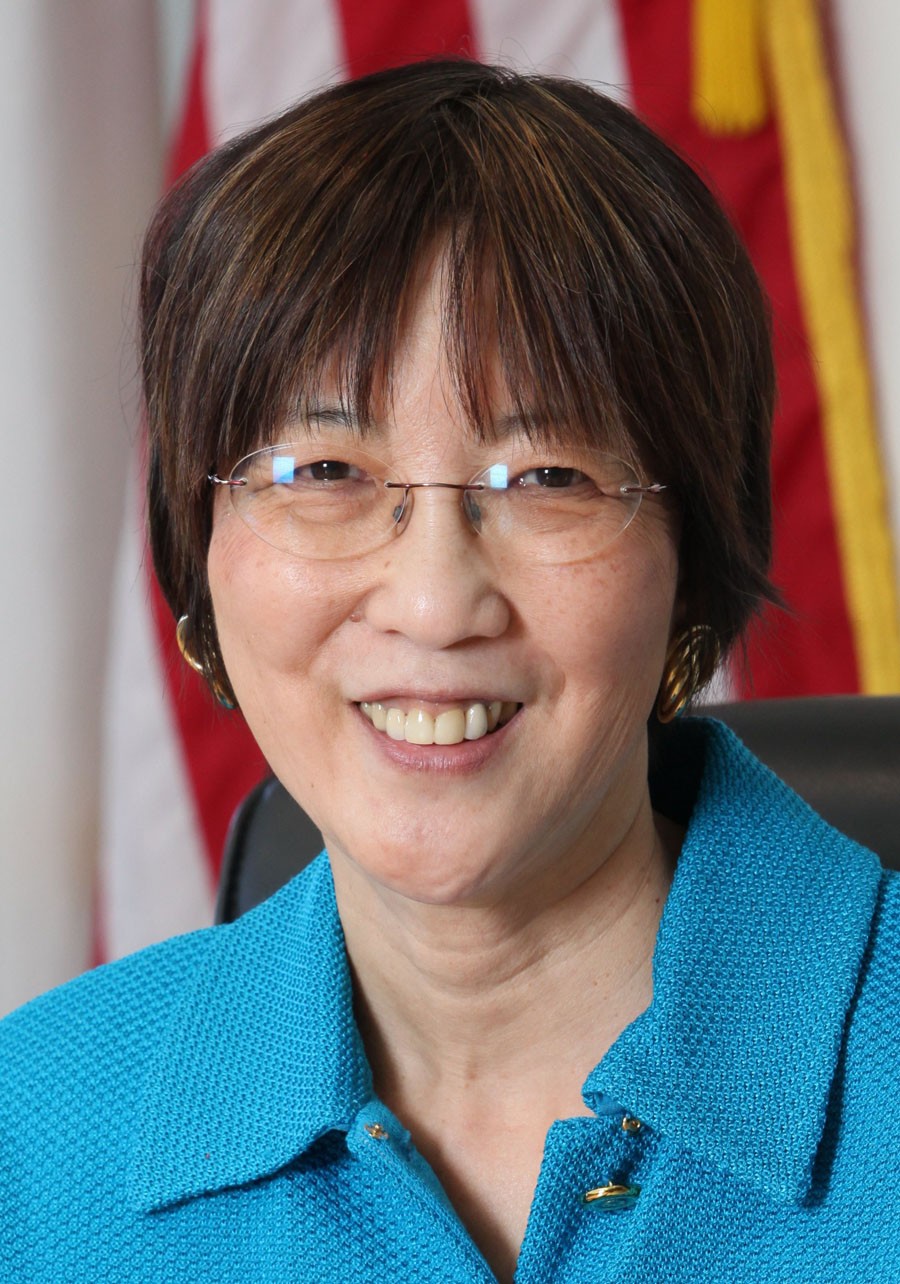
Wilma Chan.
Alameda County Supervisor Wilma is abandoning her bid for next year’s open state Senate race in the East Bay’s Ninth District. Chan cited a struggle to raise what she believes is the requisite amount of money needed for a likely grueling June primary and general election campaign, while still performing her duties as a county supervisor and being with her family. She leaves the field to fellow Democrats Sandré Swanson and Nancy Skinner. They both have sizable support in the East Bay among progressives following three terms each in the state Assembly.
While Chan said she was successful in building a campaign based on local support, she also found that raising at least $1.6 million to run an effective race was an “exceedingly high bar.”
[jump]
“Unfortunately, political races are increasingly dependent on money and less on grassroots support and action,” Chan wrote to her supporters. “It has become clear that the window of time I have to raise the necessary funds will be difficult given my responsibilities to my constituents. It has also become clear that the needs of my family must come first.”
Skinner has an already sizable lead in campaign fundraising. Through the most recent campaign finance filing period, Skinner reported more than $925,000 in cash reserves, which included a large transfer from her previous Assembly account. Chan’s campaign, meanwhile, posted promising fundraising numbers with more than $129,000 raised during this calendar year. But it apparently wasn’t enough for her to continue.
In her letter to supporters, Chan said she will return contributions to her senate campaign from State Political Action Committees and refund any individual donations, if requested by November 1. In addition to a bleak financial outlook, Chan was largely left on the outside looking in when it came to crucial early endorsements.
Although Swanson has struggled early to raise money — his campaign reported just $80,000 in cash on hand through the end of June — he has snapped up endorsements from nearly every local Democratic heavyweight, including Congresswoman Barbara Lee, Assemblymembers Rob Bonta and Tony Thurmond, and the current holder of the Senate seat, termed out State Senator Loni Hancock.
Earlier this week, Swanson also announced the endorsement from Teamsters Joint Council 7, which represents 110,000 union members in Northern California. San Pablo Vice Mayor Rich Kinney, the lone Republican in the primary race so far, and public education advocate Katherine Welch are also still vying for the seat.
Correction: The original version of this post misstated how many two-year terms that Sandré Swanson and Nancy Skinner served in the state Assembly. They each served three — not two.
Latifa Lewis of Causa Justa :: Just Cause told the council that she and her children are facing displacement from their home.
Credits: Darwin BondGraham
Last night the the Oakland City Council approved a housing equity roadmap, which includes a palette of measures that the city can use to make housing more affordable for everyone in Oakland. The council approved the roadmap after a lengthy special hearing on the city and region’s housing crisis.
But approving the housing roadmap doesn’t mean any of the policies spelled out in it – from restricting condo conversions, to implementing a housing impact fee, to dedicating public lands for affordable housing – will actually be put into practice. Each of these ideas, and other laws that could address the housing crisis, must be brought to the council separately and voted on. Therefore it remains an open question as to when, and if, the city will take action to address the growing crisis of affordability and displacement that is pushing out longtime residents, especially low-income households.
[jump]
Oakland residents, who waited several hours to address the council, are clearly frustrated by what they see as the slow pace of the city to address the problem.
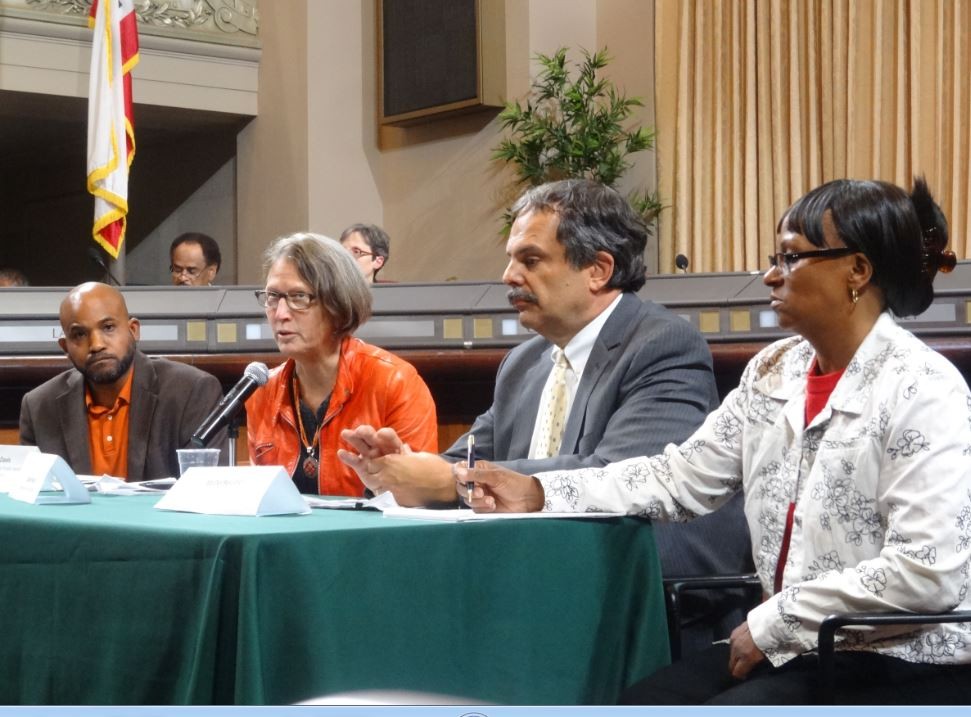
A panel of experts addressed the Oakland city council at Wednesday’s hearing on the housing crisis.
Credits: Darwin BondGraham
“We’re beyond talking. We need action now,” said Oakland resident Jabari Wilson during the public comment period.
Speaker after speaker, many of the members of Oakland’s shrinking Black community who have been hit hardest by rising rents and home prices, came to the microphone to tell stories of displacement and dispossession from neighborhoods they grew up in.
And an expert panel assembled by Council President Gibson McElhaney laid out some of the causes and consequences of Oakland’s housing crisis.
Alma Blackwell, a housing rights organizer with Causa Justa/Just Cause, said the current change in Oakland’s affordability began when Jerry Brown was mayor and the city was purposefully geared toward attracting higher income residents by building expensive condos and apartments around downtown. She said that while Oakland has done a lot in recent years to attract capital to the city, there hasn’t been enough attention on preventing the influx of more affluent newcomers, and the redevelopment of vast portions of the city, from squeezing out the poor. Blackwell added that while it’s necessary for the council and mayor to pass new laws and find new sources of funding to keep housing affordable, the city also needs to enforce its current housing laws, especially for building code violations and tenant protections.
Many policies to protect tenants and create affordable housing require council action.
Credits: City of Oakland
Ed Del Beccaro, condo conversion ordinance needs to be fixed soon, or else Oakland could experience a wave of tenant evictions similar to what has happened in San Francisco as landlords convert rental apartments into condos for higher-income buyers. Currently, there are 29,000 apartments in two- to four-unit buildings that are unprotected by Oakland’s existing condominium conversion ordinance. Landlords are free to push out tenants and convert these apartments into condos, and there is no requirement that they replace the apartments with new rental housing stock.
Councilmember Dan Kalb’s office is working on reforming the Oakland condominium conversion ordinance, and this morning Mayor Libby Schaaf announced her support for expanding tenant protections in two- to four-unit apartment buildings that are threatened with condo conversion. City staff have estimated that as many as 2,000 apartments are threatened with conversion into condos over the next seven years if nothing is done.
City staff is also working with a consultant on studying impact fees, but the process has dragged on for well over a year. In contrast, other cities such as Emeryville and Berkeley have been quick to implement and fine-tune their housing impact fees. The council is expected to receive a staff report on impact fees early next year, but it’s unclear where different councilmembers stand on the issue.
A staff report on housing describes the possible timeline for new policies.
Credits: City of Oakland
High-tech medical cannabis delivery companies are racing to take marketshare in the Bay Area’s advanced and influential pot economy.
Today, San Francisco-based delivery leader Eaze announced that it will begin serving patients in the city of Oakland. Starting this morning, Eaze promises to drop your order wherever you and your smartphone are located, in under 20 minutes. (We’ve gotten drops in 10 minutes.) You pay in cash. Eaze powers the online menu and driver dispatching, while the bud, extracts, and edibles all come from a regional collective.
[jump]
Adding Oakland comes after months of service in Berkeley, Alameda, and Emeryville. Eaze has also spread to San Diego and Los Angeles — serving a total of 82 cities, up from just a handful in February.
In April, Eaze announced that it had raised $10 million in venture capital funding to rapidly expand its service footprint. Rapper Snoop Dogg is reportedly an investor. For the homebound, Eaze offers telemedicine recommendations through its new Eaze.MD.
Eaze isn’t the only one rushing around the East Bay. Meadow competes with a wider menu, and also offers telemedicine. Flow Kana‘s edge is artisanal small-batch sungrown buds. More traditional delivery collectives like Berkeley’s C.R.A.F.T. carry only top-shelf. Many dispensaries also run their own deliveries, and Harborside has started to use Green Rush.
Eaze — ushering in the gilded age for weed delivery.
Credits: courtesy of Eaze
1. The Oakland City Council voted this week to reduce compost rates for restaurants and other businesses following an outcry over a new rate structure that made it cheaper to throw away food waste than to compost it, the Chron reports. Under the new plan, compost rates will become 30 percent lower than trash rates. The council also rejected a proposal to increase recycling rates by 10 percent. The request was made by Oakland’s recycling contractor, California Waste Solutions, which claimed that the city had misrepresented the total number of homes it would have to serve.
2. Governor Jerry Brown approved a traffic ticket amnesty program that provides deep discounts for low-income residents who cannot afford to pay the high fees, the Chron reports. The state will cut ticket fees in half for everyone who received one prior to 2013 and will offer discounts of up to 80 percent for low-income residents. More than 4 million Californians have lost their drivers’ licenses because of unpaid tickets.
5. In a victory for the California teachers’ union, a federal judge dismissed a lawsuit backed by conservative groups that sought to limit the use of teachers’ union dues on political campaigns and causes, the LA Times$ reports. Anti-union activists plan to appeal the ruling.
6. A super-majority of Californians — 69 percent — supports raising cigarette taxes in the state, and a large majority — 55 percent — wants to reform Prop 13 to close a loophole that helps corporations avoid paying property taxes, the Bay Area News Group$ reports, citing a new Public Policy Institute of California survey. However, only a plurality of voters — 49 percent — favor extending Prop 30 taxes on the wealthy and taxing the extraction of fossil fuel in the state.
Highway signs will now display hit-and-run “yellow alerts.”
Credits: wikimedia commons / Bob Bobster
Governor Jerry Brown has signed legislation to enact a hit-and-run “Yellow Alert” system that will enable police to broadcast information on freeway signs about vehicles suspected of fleeing serious or fatal crashes. This new alert system — proposed in Assembly Bill 8, authored by Assemblymember Mike Gatto (D-Glendale) — could be particularly useful for Oakland, which has consistently had the highest rate of hit-and-crashes of any large city in the state. As we reported earlier this year, the Oakland Police Department solves only a small fraction of hit-and-run cases: In 2013, out of 346 hit-and-runs in which victims were injured or killed, only 14 cases — 4 percent — led to criminal charges. And in 2014, police solved only 3 percent of serious hit-and-run cases. And there is an alarming number of hit-and-runs here; roughly one out of every six motorists who injure or kill a victim flees the crime scene.
The Yellow Alert system will function in a similar manner as the emergency “Amber Alerts” that law enforcement currently send out to spread the word about child abductions. The state will only use Yellow Alerts when local law enforcement agencies have sufficient descriptions of a vehicle or the identity of a suspect — and only for collisions that are fatal or result in “serious bodily injury.” Brown vetoed similar legislation last year, citing concerns about the emergency system being overloaded with alerts.
[jump]
The California Highway Patrol had again expressed concerns earlier this year about AB 8, arguing that Amber Alerts are successful because they are so rare and raising concerns that an increase in alerts could make the emergency system less effective. But Gatto’s office has emphasized that the hit-and-run alerts would be geographically limited and further has noted that the state’s freeway signs are not currently overburdened, considering that they sometimes display public service announcements, such as “buckle up” or “conserve water.”
And supporters of the bill have argued that there is a great need for these kinds of alerts, considering that many cities are suffering from local hit-and-run epidemics. Gatto’s office — which has cited Oakland’s high rate of hit-and-runs and low rate of arrests — has noted that officials in the City of Los Angeles are now offering $50,000 rewards for information on hit-and-run cases. The Los Angeles Police Department also failed to solve 80 percent of hit-and-run crimes from 2008 to 2012, according to Gatto.
Additionally, similar Yellow Alert systems have been very successful outside of California. In Denver, Colorado, a hit-and-run alert system implemented in 2012 led to a 76 percent arrest rate in cases in which the authorities activated the alert. Colorado lawmakers subsequently expanded the program statewide.
With AB 8 signed into law, local authorities can request Yellow Alerts starting on January 2016.
In a statement yesterday, Gatto said the new system could also have a deterrent effect. “This bill is just as much about preventing hit-and-runs as it is about solving them. If people know that their information will be broadcast on these signs and there’s a chance they’ll be caught, the likelihood of them fleeing will decrease.”
Bike and pedestrian advocates have also supported the bill. Dave Snyder of the California Bicycle Coalition said in a statement yesterday, “Many victims of hit-and-run crashes are walking and biking, especially in low-income communities. … We know from Colorado’s experience that a yellow alert works to help law enforcement find hit-and-run perpetrators, and find justice for victims.”
Chickens on the rotisserie at Herb n’ Chicken.
Credits: Yelp user Joel D.
Welcome to the Mid-Week Menu, our roundup of East Bay food news.
1) As previously reported, the folks behind nearby Tigerlily have taken over the Epicurious Garden’s former vegan spot, the Source Mini, and rebranded it as a salad bar and rotisserie. Now, the new restaurant — Herb n’ Chicken (1511 Shattuck Ave., Berkeley) — is softly open for business and will serve a limited menu until its official grand opening on Friday, October 2. Overseen by Tigerlily sous chef Josh Gjersand, the menu will feature Rosie organic chickens cooked whole on the rotisserie, handcut fries, and an assortment of salads, including a build-your-own option. Herb n’ Chicken — did you catch the pun? — is positioning itself as a healthy grab-and-go option for Cal students and families in the North Berkeley area.
[jump]
2) Office workers in the Jack London district have a new casual, inexpensive lunch option: Steel Rail (439 Water St., Oakland), a sandwich shop with a reggae soundtrack, is now open, Inside Scoop reports. Check out the menu, which covers all of the typical cafe-deli territory with its selection of soups, salads, and sandwiches — for me, the muffuletta is the one that immediately jumps off the page. Lots of California beer and wine on tap.
3) Victory Point Cafe (1797-A Shattuck Ave.), Berkeley’s first board game cafe, is open for business, Berkeleyside Nosh reports. Admission is $5 a pop — to stay and play as long as you’d — and the menu consists of snack bowls, baked goods, a handful of sandwiches, plus the full spectrum of coffee drinks.
Meanwhile, over in Old Oakland, the Endgame board game shop’s new cafe expansion is “about 90%” ready, with construction entering its final stages, according to a recent Kickstarter update. Look for a soft opening sometime in October.
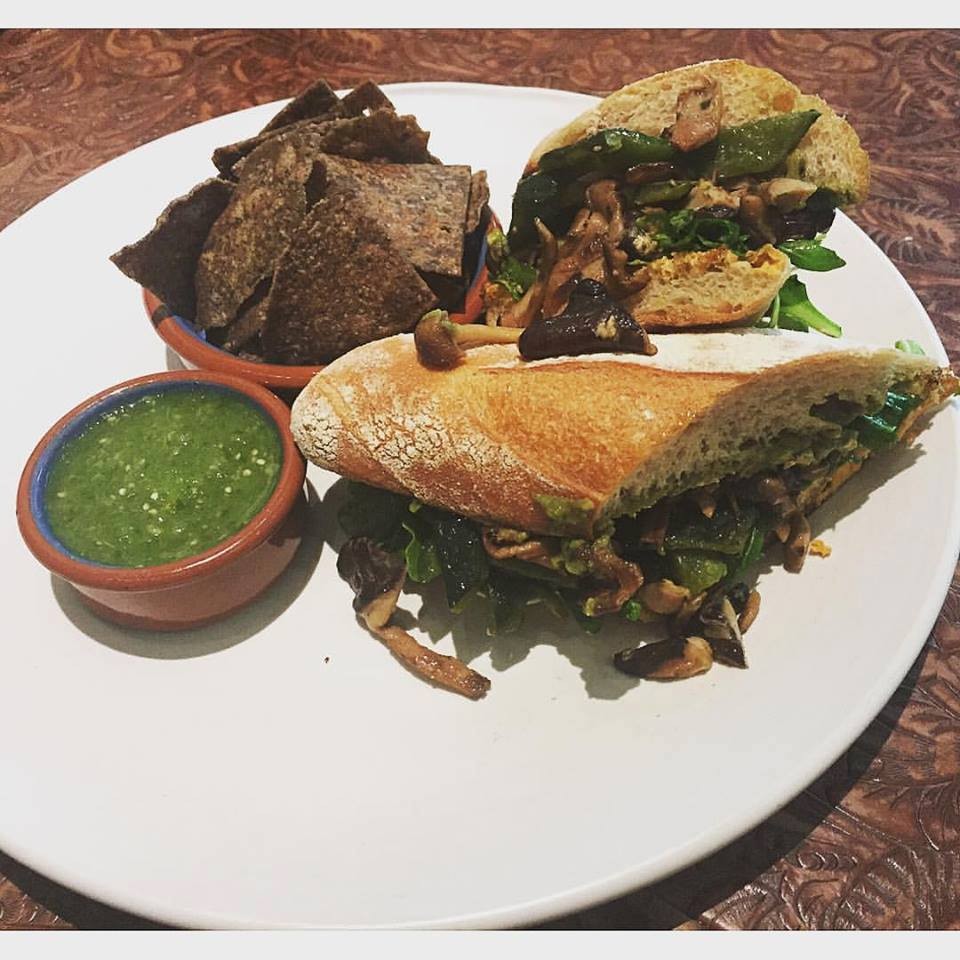
Mushroom torta at Calavera (via Facebook).
4) Calavera (2337 Broadway, Oakland), the subject of last week’s restaurant review, has launched both lunch and brunch service within the past couple of weeks. For lunch, the main menu addition is a couple of $13–$14 tortas, served with a side of the restaurant’s excellent housemade chips. Brunch, served 10 a.m.–3 p.m. on both Saturday and Sunday, will feature a handful of egg dishes, such as an enchilada dish with a 63-degree egg, and a version of chilaquiles.
5) As previously noted, the folks behind the Ñora Spanish Cuisine caterer and mobile paella vendor — a fixture at Bay Area food festivals — are opening a brick-and-mortar tapas bar called La Marcha in the former Tomo’s Japanese Cuisine space at 2026 San Pablo Avenue. The latest update: Inside Scoop reports that the restaurant will offer complimentary bites with the purchase of a drink during its two happy hour periods — on in the late afternoon and another just before closing. Look for a mid- to late-October opening.
6) In other news of mobile operations going brick-and-mortar, Berkeleyside Nosh reports that Brittany Crepes and Galettes — whose stand you can find at, among other places, the Grand Lake, Temescal, and Montclair farmers’ markets in Oakland — has taken over the former Wrap N’ Roll location at 913 University Avenue in West Berkeley. That’s great news for crepe lovers, but let us take a minute, too, to mourn the passing of Wrap N’ Roll’s awesome kathi roll, which, sadly, I hadn’t gone back to try in far too long. Hopefully, the creperie will do better in that somewhat out-of-the-way location.
7) Here’s a novel, community-minded recipe contest: The HOPE Collaborative is sponsoring a “Corner Store Chef Challenge” that will give chefs — both pros and amateurs — the opportunity to come up with recipes for healthy, delicious dishes that can served at corner stores in East and West Oakland for less than $5. It might be a little late to submit unless you already have something up your sleeve (the deadline is 5 p.m. today), but everyone’s invited to buy a ticket for the culminating event, held on Monday, October 5, 5–8 p.m. at Oakland’s Humanist Hall (390 27th St.). Chef-restaurateur Charlie Hallowell (Pizzaiolo, etc.) will MC, Sarah Kirnon (Miss Ollie’s) will serve as judge, and all guests will have a chance to taste and vote for their favorite dishes. Bay Area Bites has additional details about the event.
Pescado a lo macho at El Mono.
Credits: Bert Johnson / file photo
8) You’ve heard of the Oakland and Berkeley incarnations; now, the city of El Cerrito is hosting its very first Restaurant Week, from Thursday, October 1 to Sunday, October 4. It might be a good time to check out some of the outstanding Peruvian dishes at El Mono (which is offering a 15 percent discount) or to perhaps pay a visit to interesting regional-Chinese newcomer Noodles Fresh (which is offering free appetizers with the purchase of an entrée).
9) Oktoberfest is coming up, and for those looking to make merry — and drink plenty of beer — this weekend, Diablo Dish has a nice roundup of East Bay celebrations, including Oaktoberfest, on Saturday, October 3, in Oakland’s Dimond district, and the Oakland Nature Friends Festival, up in the Oakland hills, on Sunday, October 4.
Got tips or suggestions? Email me at Luke (dot) Tsai (at) EastBayExpress (dot) com. Otherwise, keep in touch by following me on Twitter @theluketsai, or simply by posting a comment. I’ll read ‘em all.
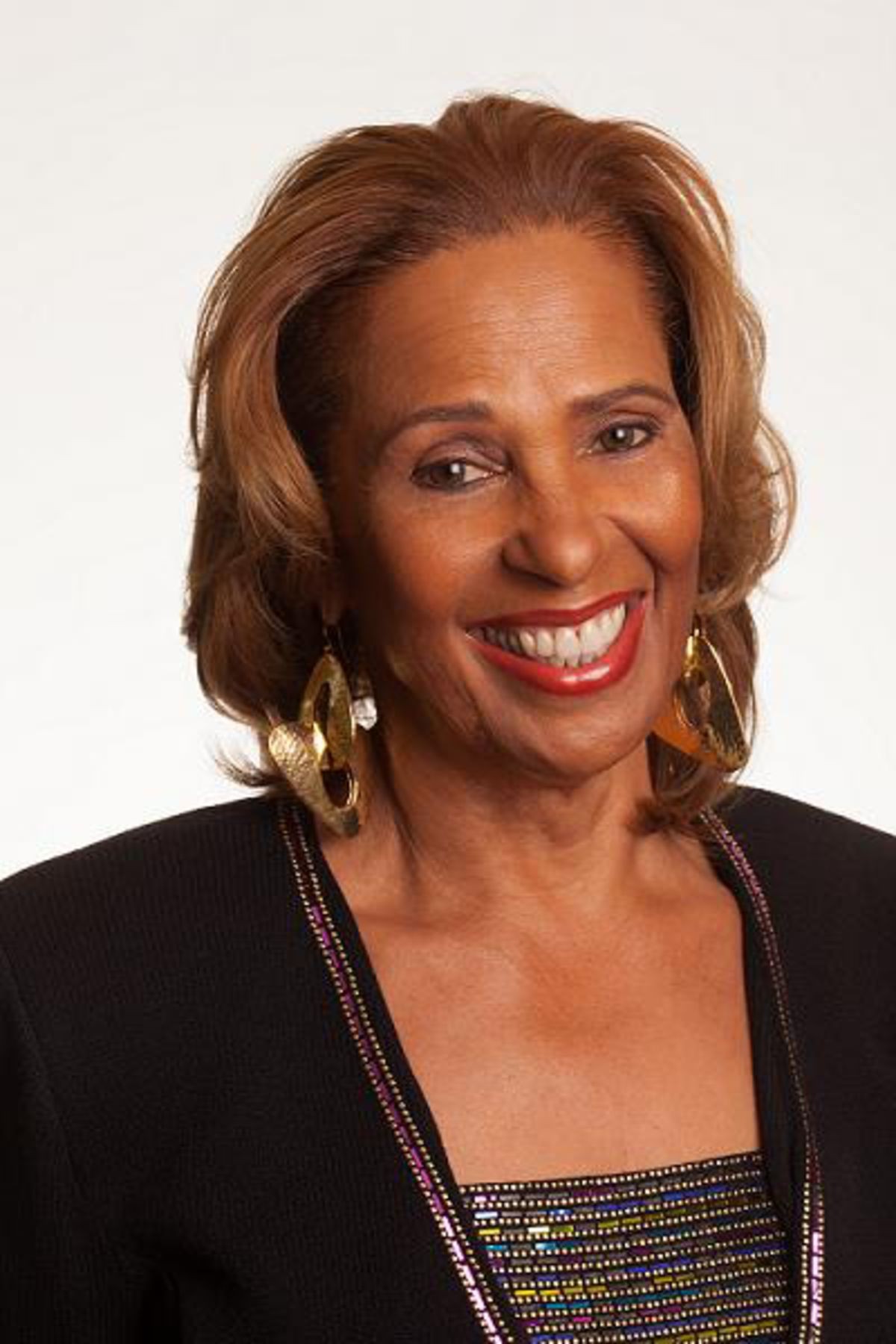
Senior wellness advocate Sue Taylor.
Credits: Sue Taylor
Senior citizens could get a medical marijuana dispensary of their own, under a new proposal that advanced at the Berkeley City Council meeting last night.
The council agreed to move forward with six different proposals vying to become Berkeley’s fourth dispensary. Among them — something of a unicorn in the industry: a dispensary to be owned and operated by a senior, African-American woman.
In an industry dominated by young white males, Berkeley resident Sue Taylor’s proposal stands out.
Taylor is a former senior outreach coordinator for Harborside Health Center, who was featured in our 2011 story “No Cannabis For the Sick and Dying” about medical cannabis access issues for seniors.
She’s authorized by the State of California to teach the state’s medical cannabis program to nursing home directors and staff.
[jump]
In the latest episode of our podcast The Hash, Sue Taylor explains why senior citizens are turning toward medical cannabis and why they need a senior-focused club.
Last night, Taylor and five other groups advanced to round four of the selection process for what will be Berkeley’s fourth club. The city will post notices within 300 feet of the applicant’s proposed club, and hold public hearings that will stretch for months.
The council agreed with staff recommendations to forward the six finalists. Ten had applied, but four were disqualified. One group — 40 Acres — which runs a pot speakeasy on San Pablo Avenue — is suing the city over the process. Two disqualified groups petitioned for their re-inclusion.
For her part, Taylor intends to plow profits from medical cannabis into senior wellness programs, and serve as a model for more black and senior-owned cannabis businesses. Listen to her riveting story on The Hash.
[embed-1]
Libby Schaaf.
1. Mayor Libby Schaaf secured a $750,000 anonymous grant to train local residents to become Oakland police officers, the Trib$ reports. The city plans to use the funds to expand the Oakland police cadet program in conjunction with Oakland public schools. The grant, along with $450,000 in funds appropriated by the city council, will pay for 25 new cadet positions for recent high school graduates. More than 90 percent of the Oakland police force lives outside of the city — a problem that city officials have struggled to fix for years.
[jump]
3. Fisheries experts are raising alarms about the sudden die off of fur seals along the West Coast, the Chron reports. The die off, which scientists from the National Oceanographic and Atmospheric Administration are calling an “unusual mortality event,” appears to be tied to abnormally warm waters in the western Pacific.
5. And after GOP presidential candidate Ben Carson declared that Muslims are unfit to serve in the White House — a racist declaration that has stirred controversy within the Republic Party — he has skyrocketed to the top of the polls and is now in a virtual tie with Donald Trump. Trump’s poll numbers jumped significantly this summer after he falsely claimed that undocumented immigrants were rapists and murderers.
Aries (March 21–April 19): The next seven weeks will not be a favorable time to fool around with psychic vampires and charismatic jerks. I recommend you avoid the following mistakes, as well: failing to protect the wounded areas of your psyche; demanding perfection from those you care about; and trying to fulfill questionable desires that have led you astray in the past. Now I’ll name some positive actions you’d be wise to consider: hunting for skillful healers who can relieve your angst and aches; favoring the companionship of people who are empathetic and emotionally intelligent; and getting educated about how to build the kind of intimacy you can thrive on.
Taurus (April 20–May 20): You may have seen websites that offer practical tips on how to improve your mastery of life’s little details. They tell you how to de-clutter your home, or how to keep baked goods from going stale, or why you should shop for shoes at night to get the best fit. I recently come across a humorous site that provides the opposite: bad life tips. For instance, it suggests that you make job interviews less stressful by only applying for jobs you don’t want. Put your laptop in cold water to prevent overheating. To save time, brush your teeth while you eat. In the two sets of examples I’ve just given, it’s easy to tell the difference between which tips are trustworthy and which aren’t. But in the coming days, you might find it more challenging to distinguish between the good advice and bad advice you’ll receive. Be very discerning.
Gemini (May 21-June 20): On a windy afternoon last spring I was walking through a quiet neighborhood in Berkeley. In one yard there was a garden plot filled with the young green stems of as-yet unidentifiable plants. Anchored in their midst was a small handwritten sign. Its message seemed to be directed not at passers-by like me but at the sprouts themselves. “Grow faster, you little bastards!” the sign said — as if the blooming things might be bullied into ripening. I hope you’re smart enough not to make similar demands on yourself and those you care about, Gemini. It’s not even necessary. I suspect that everything in your life will just naturally grow with vigor in the coming weeks.
Cancer (June 21–July 22): “I am rooted, but I flow,” wrote Virginia Woolf in her novel The Waves. That paradoxical image reminds me of you right now. You are as grounded as a tree and as fluid as a river. Your foundation is deep and strong, even as you are resilient in your ability to adapt to changing circumstances. This is your birthright as a Cancerian! Enjoy and use the blessings it confers. (P.S. If for some strange reason you’re not experiencing an exquisite version of what I’ve described, there must be some obstacle you are mistakenly tolerating. Get rid of it.)
Leo (July 23–Aug. 22): Should I offer my congratulations? You have corralled a gorgeous mess of problems that are more interesting and provocative than everyone else’s. It’s unclear how long this odd good fortune will last, however. So I suggest you act decisively to take maximum advantage of the opportunities that your dilemmas have cracked open. If anyone can turn the heartache of misplaced energy into practical wisdom, you can. If anyone can harness chaos to drum up new assets, it’s you. Is it possible to be both cunning and conscientious, both strategic and ethical? For you right now, I think it is.
Virgo (Aug. 23–Sept. 22): Let’s say you have walked along the same path or driven down the same road a thousand times. Then, one day, as you repeat your familiar route, a certain object or scene snags your attention for the first time. Maybe it’s a small fountain or a statue of the Buddhist goddess Guanyin or a wall with graffiti that says “Crap happens, but so does magic.” It has always been there. You’ve been subconsciously aware of it. But at this moment, for unknown reasons, it finally arrives in your conscious mind. I believe this is an apt metaphor for your life in the next week. More than once, you will suddenly tune in to facts, situations, or influences that had previously been invisible to you. That’s a good thing! But it might initially bring a jolt.
Libra (Sept. 23–Oct. 22): The 20th century’s most influential artist may have been Pablo Picasso. He created thousands of paintings, and was still churning them out when he was 91 years old. A journalist asked him which one was his favorite. “The next one,” he said. I suggest you adopt a similar attitude in the coming weeks, Libra. What you did in the past is irrelevant. You should neither depend on nor be weighed down by anything that has come before. For now, all that matters are the accomplishments and adventures that lie ahead of you.
Scorpio (Oct. 23–Nov. 21): A windbreak is a line of stout trees or thick bushes that provides shelter from the wind. I think you need a metaphorical version: someone or something to shield you from a relentless force that has been putting pressure on you; a buffer zone or protected haven where you can take refuge from a stressful barrage that has been hampering your ability to act with clarity and grace. Do you know what you will have to do to get it? Here’s your battle cry: “I need sanctuary! I deserve sanctuary!”
Sagittarius (Nov. 22–Dec. 21): Your fellow Sagittarian Walt Disney accomplished a lot. He was a pioneer in the art of animation and made movies that won numerous Academy Awards. He built theme parks, created an entertainment empire, and amassed fantastic wealth. Why was he so successful? In part because he had high standards, worked hard, and harbored an obsessive devotion to his quirky vision. If you aspire to cultivate any of those qualities, now is a favorable time to raise your mastery to the next level. Disney had one other trait you might consider working on: He liked to play the game of life by his own rules. For example, his favorite breakfast was donuts dipped in Scotch whisky. What would be your equivalent?
Capricorn (Dec. 22–Jan. 19): October is Fix the Fundamentals Month. It will be a favorable time to substitute good habits for bad habits. You will attract lucky breaks and practical blessings as you work to transform overwrought compulsions into rigorous passions. You will thrive as you seek to discover the holy yearning that’s hidden at the root of devitalizing addictions. To get started, instigate free-wheeling experiments that will propel you out of your sticky rut and in the direction of a percolating groove.
Aquarius (Jan. 20–Feb. 18): Have you made your travel plans yet? Have you plotted your escape? I hope you will hightail it to a festive playground where some of your inhibitions will shrink, or else journey to a holy spot where your spiritual yearnings will ripen. What would be even better is if you made a pilgrimage to a place that satisfied both of those agendas — filled up your senses with novel enticements and fed your hunger for transcendent insights. Off you go, Aquarius! Why aren’t you already on your way? If you can’t manage a real getaway in the near future, please at least stage a jailbreak for your imagination.
Pisces (Feb. 19–March 20): Pablo Neruda’s Book of Questions consists entirely of 316 questions. It’s one of those rare texts that makes no assertions and draws no conclusions. In this spirit, and in honor of the sphinx-like phase you’re now passing through, I offer you six pertinent riddles: 1. What is the most important thing you have never done? 2. How could you play a joke on your fears? 3. Identify the people in your life who have made you real to yourself. 4. Name a good old thing you would have to give up in order to get a great new thing. 5. What’s the one feeling you want to feel more than any other in the next three years?. 6. What inspires you to love?
In the summer of 2013, Daniella Tavake woke up every day and cried. Some days, she slept for twelve hours straight, then woke up and glanced at her unshaven beard in the mirror, which caused her to break down again. At the time, Tavake, a transgender woman, was isolated in a cell in Salinas Valley State Prison — a California correctional facility for men. According to letters she wrote that July, as soon as the state transferred her to that prison, an inmate started harassing her, calling her “faggot,” and eventually physically attacking her. As a result of the incident, Tavake said she was separated in a cell by herself for weeks with no access to clippers — forcing her to wear a beard, which was painful because she has long identified as a woman. “To me, that’s not only mental abuse, but it’s abuse to your soul,” recalled Tavake, now forty years old, in a recent interview. “You’re telling me I can’t be me.”
Tavake, who lives in San Mateo after her release in December 2014, shared stories of her experiences behind bars as part of The Women of San Quentin: Soul Murder of Transgender Women in Male Prisons, a new nonfiction book from Berkeley-based journalist and photographer Kristin Schreier Lyseggen. Over the last two years, Lyseggen exchanged letters and conducted extensive interviews with nine trans women who were previously or are currently locked up in men’s prisons. Named after California’s oldest prison, Marin County’s San Quentin, the book offers a rare, in-depth look at the abuse, trauma, harassment, and violence that trans women face when they are trapped in a prison system that insists that they are men.
Daniella Tavake, left, wrote letters to Kristin Schreier Lyseggen while she was incarcerated.
Credits: Bert Johnson
Unless transgender inmates have completed gender reassignment surgery, the California Department of Corrections and Rehabilitation (CDCR) — like jail and prison systems across the country — houses them in facilities that correspond to the gender assigned to them at birth. In California’s prisons, hundreds of trans inmates are denied access to facilities that match their preferred gender. CDCR spokesperson Terry Thornton told me recently that there are currently 363 trans women living in men’s prisons — inmates who the state considers to be men, but who are undergoing hormone therapy for “gender dysphoria” — and 22 trans men in women’s prisons.
Daniella Tavake, left, wrote letters to Kristin Schreier Lyseggen while she was incarcerated.
Credits: Bert Johnson
Lyseggen provides readers with a disturbing picture of the psychological impacts of a prison system that rejects the gender identities of the people it houses — whether inadequate medical and mental health treatment, physical violence, or repeated sexual assault. Lyseggen moved to Berkeley from her hometown of Norway in 2012 and said she was shocked to learn of the harsh prison system here — especially when it comes to the treatment of trans women. In Norway, the maximum prison sentence is 21 years and the number of prisoners per capita is a tiny fraction of the rate in the United States.
After reading about a trans female immigrant locked in solitary confinement, Lyseggen contacted the Transgender Gender Variant Intersex Justice Project (TGIJP), an Oakland-based advocacy group that provides support to trans inmates. “I was really shocked that we weren’t talking about this,” she said. “This system is so horrendous and so inhumane.” In spring 2013, TGIJP connected Lyseggen to trans women living in men’s prisons, who then became the author’s regular pen pals.
Those communications, along with subsequent in-person meetings and photo shoots inside and outside the prisons, formed the basis of The Women of San Quentin. In the book, Lyseggen chronicles how the women got caught up in the criminal justice system, the discrimination they faced at home and behind bars, their uphill climb to reenter society, and how they overcame countless obstacles to live as women while incarcerated. Lyseggen describes her own experiences building relationships with her subjects through correspondences and meetings inside prison. But the most compelling sections are the lengthy inmate letters, which give readers a firsthand account of life behind bars. The unfiltered narratives of the letters offer an intimate look at the depression and fear of these women, their desires to tell their stories and connect to people on the outside, and the rare moments of hope they find in prison.
In Tavake’s letters, for example, she writes about falling in love behind bars, battling anxiety, the harmful side effects of changes in her hormone prescriptions, and her dreams of life after prison. “You don’t understand how bad I want to slip into some heels and a cute dress and go job hunting with a cute-ass handbag and briefcase,” she wrote in one of her final letters before her release.
Lyseggen is releasing her book amid numerous policy debates and legal battles surrounding the rights of incarcerated trans people. Notably, the San Francisco Sheriff’s Department announced this month that it will allow transgender women to receive daytime programming in the women’s jail. And in August, as part of a lawsuit settlement, CDCR agreed to pay for the gender reassignment surgery of Shiloh Quine, a trans woman serving a life sentence for murder. Quine is also featured in Lyseggen’s book, and wrote letters to her about how access to surgery is just one of the many rights trans women are denied in prison.
Tavake — who spent 21 years in and out of prison for a range of offenses tied to her drug addiction — told me that she was immediately drawn to Lyseggen’s project as an opportunity to speak out about trans discrimination behind bars. California lets trans inmates receive hormone treatment, but prison staffers may refuse to refer to trans women as women or deny them access to basic commissary items such as bras and makeup, she said.
Noting that she felt luckier than most because she didn’t experience the kind of abuse and sexual assault that many of her fellow trans inmates did, Tavake said prison officials need to do a better job protecting trans women. One CDCR report, for example, found that while 4 percent of the general population of inmates report facing sexual assault, 59 percent of trans inmates said they were sexually assaulted. “The research does show that transgender people both in prison and outside of prison are unfortunately victimized more often,” said Thornton.
Tavake argued that prisons also need to provide appropriate psychological services for inmates who may be in the process of transitioning and, further, need to make it easier for them to return home, where it can be difficult to find safe housing and employment. “Prison officials just don’t give a damn about our plight and don’t care that we identify as women,” she said, adding that she worked hard to be herself behind bars — even if the system treated her like a man. “I’m a gentle woman who is kind, caring, loving, and loyal. And I had the spirit to survive and live.”
Alameda County Supervisor Wilma is abandoning her bid for next year’s open state Senate race in the East Bay’s Ninth District. Chan cited a struggle to raise what she believes is the requisite amount of money needed for a likely grueling June primary and general election campaign, while still performing her duties as a county supervisor and being with...
Latifa Lewis of Causa Justa :: Just Cause told the council that she and her children are facing displacement from their home.
Credits: Darwin BondGraham
Last night the the Oakland City Council approved a housing equity roadmap, which includes a palette of measures that the city can use to make housing more affordable for everyone in Oakland. The council approved the roadmap...
High-tech medical cannabis delivery companies are racing to take marketshare in the Bay Area’s advanced and influential pot economy.
Today, San Francisco-based delivery leader Eaze announced that it will begin serving patients in the city of Oakland. Starting this morning, Eaze promises to drop your order wherever you and your smartphone are located, in under 20 minutes. (We've...
Stories you shouldn’t miss:
1. The Oakland City Council voted this week to reduce compost rates for restaurants and other businesses following an outcry over a new rate structure that made it cheaper to throw away food waste than to compost it, the Chron reports. Under the new plan, compost rates will become 30 percent lower than trash rates. The council...
Highway signs will now display hit-and-run "yellow alerts."
Credits: wikimedia commons / Bob Bobster
Governor Jerry Brown has signed legislation to enact a hit-and-run "Yellow Alert" system that will enable police to broadcast information on freeway signs about vehicles suspected of fleeing serious or fatal crashes. This new alert system — proposed in Assembly Bill 8, authored by Assemblymember Mike Gatto (D-Glendale) —...
Chickens on the rotisserie at Herb n' Chicken.
Credits: Yelp user Joel D.
Welcome to the Mid-Week Menu, our roundup of East Bay food news.
1) As previously reported, the folks behind nearby Tigerlily have taken over the Epicurious Garden’s former vegan spot, the Source Mini, and rebranded it as a salad bar and rotisserie. Now, the new restaurant — Herb n’...
Senior wellness advocate Sue Taylor.
Credits: Sue Taylor
Senior citizens could get a medical marijuana dispensary of their own, under a new proposal that advanced at the Berkeley City Council meeting last night.
The council agreed to move forward with six different proposals vying to become Berkeley's fourth dispensary. Among them — something of a unicorn in the industry: a dispensary...
Stories you shouldn’t miss:
1. Mayor Libby Schaaf secured a $750,000 anonymous grant to train local residents to become Oakland police officers, the Trib$ reports. The city plans to use the funds to expand the Oakland police cadet program in conjunction with Oakland public schools. The grant, along with $450,000 in funds appropriated by the city council, will pay for 25...
Aries (March 21–April 19): The next seven weeks will not be a favorable time to fool around with psychic vampires and charismatic jerks. I recommend you avoid the following mistakes, as well: failing to protect the wounded areas of your psyche; demanding perfection from those you care about; and trying to fulfill questionable desires that have led you astray...
In the summer of 2013, Daniella Tavake woke up every day and cried. Some days, she slept for twelve hours straight, then woke up and glanced at her unshaven beard in the mirror, which caused her to break down again. At the time, Tavake, a transgender woman, was isolated in a cell in Salinas Valley State Prison...