Young Thug has elevated mumbling to an art form, and his often indiscernible, melodic flows set him apart as one of today’s most innovative rappers. Controversy follows the young MC, who became embroiled in a beef between his mentors, Birdman and Lil Wayne, earlier this year. Lil Wayne objected when Young Thug originally announced that he would call his April mixtape Carter 6. The title choice seemed particularly trollish considering that Lil Wayne and Birdman were at odds over the release date of Lil Wayne’s Tha Carter V on Birdman’s Cash Money Records. (Tha Carter V never actually came out.) Thug acquiesced and renamed his tape Barter 6. When it dropped, the project was an instant hit among fans and music critics, and proved to be a testament to the rapper’s unique gift for weaving melodies from unusual cadences and seemingly discordant vocal flourishes. He further developed Barter’s stripped down aesthetic on his subsequent tape, September’s Slime Season, which balances Thug’s over-the-top flows with London on da Track’s sparse, minor-key production. He performs at Regency Ballroom in San Francisco this Saturday.
Empty Spaces | Revisited is choreographer Rogelio Lopez’s attempt to resurface his memories of growing up as a gay man in Mexicali, Mexico — “the faint, painful, lovely, scary, lonely, and sacred reminiscence discarded in darkness,” as his description reads. The dimly lit, intimate evening of dance will take place at the homelike Shawl-Anderson Dance Center (2704 Alcatraz Ave., Berkeley) on October 9 and 10, at 8 p.m. The choreography will be sprawled out into four rooms, each with a pre-show installation that audiences can take in before the show. Then, the audience will be broken up into groups of no more than fifteen people and seated in various rooms while the cast of twelve dancers splits up, switching between rooms, performing four slightly different shows simultaneously. Empty Spaces premiered at Shawl-Anderson in March to sold-out audiences. The revisited version involves new scenes and new dancers, offering another chance to experience Lopez’s shadowy recollections.
¡sPRUNg! is the monthly dance party of Nic Feliciano and Jason Stinnett (aka Jaysonik) — formerly of the rap group Hot Tub — who, along with DJs Neto 187 and Kool Karlo, bring booty-popping jams to the Legionnaire every second Thursday. The DJs’ penchant for spinning new rap releases, Miami bass, and hyphy throwbacks makes for a vivacious dance floor, which should be going harder than usual this month with Joe Quixx joining the resident DJs on the ones and twos. Quixx, who is also a producer, is a stalwart of the East Bay’s hip-hop scene and a member of the well-known DJ collectives Oakland Faders and Latin Soul Brothers. In addition to its music offerings, ¡sPRUNg! has a lot in store: nail artist Kiyomi Tanouye will be there for partygoers’ manicure needs. And as per usual, the popup kitchen SUP Southeast Asian Street Food will be posted up outside serving spring rolls, coconut shrimp, and other munchies all night.
With his project, Bollywood Masala Orchestra, artistic director Rahis Bharti sought to combine the big sound of a New Orleans-style brass band with traditional, Indian musical instruments and compositions. The eighteen-piece ensemble features musicians from the state of Rajasthan in North India, as well as three dancers whose performances infuse traditional routines with Bollywood choreography and acrobatics. Bollywood Masala Orchestra’s upbeat songs feature traditional instruments such as the sitar, tabla, and harmonium, as well as Western accompaniments that include the bass drum and trombone. The orchestra’s live show, The Spirit of India, brings a colorful medley of modern takes on Indian musical traditions to UC Berkeley’s Zellerbach Hall on Sunday, October 11.
Berkeley City Councilmember Lori Droste is hoping to encourage developers to build more affordable housing in the city by allowing them to construct fewer parking spaces in new buildings. Droste’s “Green Affordable Housing Package [PDF]” — on the agenda at tomorrow’s city council meeting — requests that the city Planning Commission and City Manager’s Office explore a number of policy changes that would eliminate barriers to the creation of affordable housing in Berkeley. One key part of her proposal seeks to address major flaws in outdated municipal parking policies — a topic which I explored in a recent cover story focused on Oakland’s laws (see “A Green Solution to Oakland’s Housing Crisis“).
Like cities across the country, Oakland has not updated many of its archaic zoning rules that require developers to build large parking garages in new residential buildings, which are very expensive to construct and can significantly drive up the cost of housing and lead to higher rents. As a result of the high costs associated with parking requirements, developers can also end up offering fewer affordable units or ultimately build less housing altogether. These parking rules further contradict sustainability goals since they encourage high rates of driving and car ownership.
Droste, citing the recent Express story and other research on the impacts of overly strict parking rules, said that reforms in Berkeley could go a long way toward increasing the supply of affordable housing and promoting more sustainable modes of transportation. In some ways, Berkeley already has more progressive policies than Oakland, but still requires a relatively large amount of parking in certain new residential projects.
[jump]
In Oakland, the standard requirement for many neighborhoods is one parking space per unit, meaning developers must build a garage on site that can accommodate at least one car owner in each apartment. Data shows that these requirements are too strict and that developers are wasting money and space on a significant number of parking spots that remain vacant.
Berkeley’s current parking requirements vary depending on the type of housing and the applicable neighborhood zoning policies. The city’s 2012 Downtown Area Plan changed the requirements in downtown Berkeley so that developers only have to construct one parking space for every three units in new single-family homes or apartment buildings (outlined on page fourteen of the plan). Additionally, the downtown plan also enabled developers to build even fewer parking spaces when they apply for a special permit and pay a so-called “in-lieu fee” — funding to the city that goes toward providing enhanced transit services. In one 77-unit project underway near UC Berkeley, a development firm was able to gain approvals for a building with no onsite parking. The resulting savings allowed the developer Nautilus Group to include some affordable housing and a number of amenities for residents that encourage alternative modes of transit, such as car-share memberships, extensive bike parking, and a cycling fix-it station in the building.
While the ratio of one space per three units in downtown is fairly progressive, Berkeley’s parking requirements for other parts of the city should be updated, Droste said. In many areas, Berkeley’s zoning rules still mandate one space per unit (the specifics are outlined on page sixty of the Berkeley Housing Element). Droste’s proposal on the agenda tomorrow seeks to “designate units and funding for affordable housing by prioritizing housing over parking spaces in new developments.” That includes policy changes that would reduce or eliminate minimum residential parking requirements if a project is within 1,200 feet of a transit hub or within 1,200 feet of an area that includes both a major transit corridor and a commercial or mixed-use district. She is also asking the city to consider reducing or removing minimum parking rules when developers provide car-sharing spaces to residents.
The proposal further calls on the city to consider adopting parking maximums — meaning barring developers from building excessively large garages in transit-accessible locations. And Droste is asking the city to reevaluate and potentially reduce parking space requirements in buildings located within one-half mile of a transit hub.
“This is addressing this really old way of thinking about development and parking and the way people move around,” Droste said in an interview last week. “My aim is to prioritize people over cars and help our city achieve climate action goals and secure millions of dollars for affordable housing.”
Express cover.
Credits: Illustration by Roxanne Pasibe
Some of the transportation and urban planning experts I interviewed for my cover story argued that cities should scrap parking minimum requirements altogether and allow developers to build the amount of parking the market demands — which can be relatively low in tranit-friendly neighborhoods where people are increasingly choosing to live without cars.
Droste’s proposal notes that it costs roughly $1 million to construct twenty parking spaces — money that could otherwise be dedicated toward affordable housing. The proposal further notes that the legislature has signaled its support of this kind of reform, recently passing Assembly Bill 744, which would allow affordable housing developers to bypass certain parking requirements. That bill is currently on the desk of Governor Jerry Brown.
Droste’s Green Affordable Housing Package also notes that a reduction in parking requirements would support many policy goals already on the books in Berkeley. That includes efforts to increase housing affordability, expand the city’s housing supply, expand car-sharing, encourage dense development near transit, and fight climate change by reducing vehicle trips and supporting alternative modes of transit.
“In Berkeley of all places, we pride ourselves on caring for the environment and being concerned about wealth inequities,” Droste said. “This is a really great way for people to connect the dots and provide tangible solutions.”
Efforts to reform parking policies or build fewer parking spaces in new projects can sometimes face loud resistance from residents or businesses. The conventional thinking is that there is already a lack of parking and that if new buildings attract new residents but don’t provide enough spaces to house their cars, then on-street parking will become overcrowded. Parking research in the Bay Area, however, has repeatedly found that these fears are overblown and that if cities creatively manage their existing parking supply, there are more than enough spaces to accommodate residents and visitors. And environmentalists also argue that cities need to actively discourage car ownership by building housing near transit with limited parking. Activists say that buildings can still include some parking — and Droste’s proposal would not prevent that — but residents who have cars should pay extra for the parking. That way, car-free households aren’t forced to subsidize the construction and maintenance of parking garages they aren’t using.
Droste’s council proposal also calls on the city to explore broader ways to streamline the development review process for affordable housing. The ordinance asks city officials to review and compare Berkeley’s process to those of neighboring cities. That part of her proposal doesn’t include specifics, but Droste said that the city needs to make it easier for developers to move forward with projects that provide housing that is below market-rate. If the city allowed these projects to be fast-tracked, “It would incentivize developers to look at affordable housing projects,” Droste said. She added: “We need affordable housing today and not in two years. … We’re in a housing crisis now.”
Droste’s ordinance asks the city to propose specific solutions based on her recommendations by September 1, 2016. She is introducing her proposal on the heels of a heated debate and public hearing at the Oakland City Council last week, regarding the city’s various policy efforts to address the housing crisis.
1. The US Supreme Court rejected an appeal today by the City of San Jose, thereby effectively ending the city’s bid to attract the Oakland A’s to the South Bay, the Mercury News$ reports. The high court refused to hear San Jose’s appeal of a lower court ruling that had dismissed the city’s anti-trust claims against Major League Baseball. The high court’s decision effectively means that the owners of the Oakland A’s, who want a new ballpark, cannot move their team to San Jose.
2. The chief designer of the $6.4 billion new Bay Bridge said the span’s main cable is at risk of corrosion and catastrophic failure because rainwater has been leaking into the cable’s anchorages, the Chron reports. The new suspension bridge would collapse if the cable breaks. “In a suspension bridge, the cable is what holds the whole thing up,” said Russell Kane, a corrosion expert in Texas who has advised companies in the oil and aerospace industries. The concerns over the cable are just the latest in a long-running scandal involving construction defects on the bridge.
Laurie Capitelli.
3. Berkeley City Councilmember Laurie Capitelli personally profited from a taxpayer-funded home loan awarded to Berkeley Police Chief Michael Meehan, the Bay Area News Group$ reports. Capitelli served as Meehan’s real estate agent on the home deal. The councilmember, however, maintains that he did nothing wrong because he said he voted for awarding the loan to Meehan before he became the chief’s realtor.
4. Governor Jerry Brown signed an anti-racial profiling measure, despite strong criticism from law enforcement groups, the LA Times$ reports. The new law requires police agencies throughout the state to begin collecting race and demographic data on all police stops. Police chiefs decried the legislation, contending that it would be too burdensome.
8. California’s wildfire prevention fund is sitting on $43 million in unspent reserves, despite the fact that the state has faced one of the worst-ever fire seasons this year due to the drought, the SacBee$ reports.
9. Alameda County prosecutor Sharmin Bock, who was caught up in the San Francisco public corruption scandal, has been cleared to return to work following an internal DA’s investigation, the Bay Area News Group$ reports.
Hayward school Superintendent Stan “Data” Dobbs, who is alleged to have verbally abused and made physical contact with some school boardmembers at a closed session meeting last month, will keep his job. In addition, a third boardmember substantiated the violent tenor of the incident while reciting her own version of what happened.
No official announcement about Dobbs’ future was actually made during Wednesday’s meeting. And during the meeting, Hayward school boardmember Annette Walker admonished some boardmembers for previously disclosing publicly what Dobbs had done during the closed-session meeting. “What happens in closed session, stays in closed session,” Walker said before disclosing that the board had decided in the same closed session not to terminate Dobbs.
[jump]
Walker went on to add more details about the September 16 incident that led fellow boardmembers Luis Reynoso and William McGee to file police reports against Dobbs. Both boardmembers told police that Dobbs had erupted during the meeting with a string of profanities directed toward them before aggressively hovering over them. Reynoso also told police that Dobbs bumped into his head and chest during their incident.
“There was physical contact between Superintendent Dobbs and myself and that’s because I was standing between Stan Dobbs and Mr. Reynoso,” said Walker, who then chortled, “So, the physical contact that occurred was Stan pushed up against little ol’ me and all you had to do is measure us and all I’m going to do is fall back.”
She added, however, that she felt no threat from Dobbs. In an interview, Reynoso corroborated a portion of Walker’s account, but added that a combination of Walker being off-balance and Dobbs’ aggressive actions resulted in Walker falling on Reynoso. Reynoso also told police that Dobbs bumped into his head and chest moments earlier.
Walker, nonetheless said, “The will of the board is to accept his apology and move forward.”
Luis Reynoso.
Although Walker referred to Dobbs’ letter to the board an “apology,” the superintendent never actually apologized for his actions. In the letter, Dobbs wrote that “the strength of my personality might have caused others to feel uncomfortable.” The statement was labeled by the Contra Costa Times as an apology, but it was actually Dobbs’ account of the circumstances leading to his flare-up with boardmembers and statement acknowledging an emergency medical procedure that he underwent earlier that day, which included medication. Dobbs labeled the account as not an excuse, but an explanation. “In short, please excuse me and be assured that this will not happen again,” said Dobbs.
Reynoso and McGee also said that Dobbs never personally apologized to them about the incident. In an interview, Reynoso said he has not spoken with Dobbs since the September 16 outburst and said the so-called apology letter was self-serving with glowing references to Dobbs’ resume and personality. “I don’t know who he thinks his audience is,” said Reynoso. “It’s not the board.”
Meanwhile, others are offering accounts of aggression toward them by Dobbs and a culture of intimidation at the school district since he was hired in 2013. A district union employee told the board Wednesday that she was called a “stupid girl” by a school administrator. The same person, who the employee said was attending the Wednesday’s meeting, also referred to Mexicans as “beaners.” “We will not tolerate harassment, intimidation, and discrimination,” she said.
A week earlier, a former transportation manager for the Hayward school district, told boardmembers that the description of Dobbs’ outburst was similar to treatment that he received in the past from the superintendent. “I, too, have suffered,” said Steve Parrish, who was terminated and is suing the district. “If the decision is to dismiss Mr. Dobbs, it would be well-founded.”
Credits: Tom Anderson / file photo
Opponents of plans to ship millions of tons of coal through Oakland filed a legal action in state court today in an effort to require a new California Environmental Quality Act (CEQA) analysis for the Oakland Bulk Oversized Terminal project. According to the groups, coal was never studied in the original environmental analysis, and the city cannot say what impact shipping coal through Oakland would have on people’s health. The groups maintain that an analysis of shipping coal will show significant health and environmental harms.
[jump]
“Shipping coal through the bulk terminal would be devastating to the health of the West Oakland community and many other communities along the rail line,” said Irene Gutierrez, attorney at Earthjustice in a press release. “The California Environmental Quality Act was meant to protect the public from being kept in the dark about what this new coal project means for their health, safety and environment. We seek to hold the City to its duties to inform and protect the public.”
The action was filed by the environmental law firm Earthjustice for Communities for a Better Environment, Asian Pacific Environmental Network, the Sierra Club, and San Francisco Baykeeper. The action isn’t yet a full-blown lawsuit, but it reserves the right of the groups to sue the city if it does not require a new CEQA analysis for coal.
Lawyers representing Phil Tagami and Jerry Bridges, the developers of the bulk terminal, told the Oakland City Council during a hearing on coal held on September 21 that the Oakland Bulk Oversized Terminal project has undergone extensive study, and that no new CEQA analysis — or new permitting — is needed before they can accept coal shipments. They also claimed that the city lacks the authority to ban coal shipments, regardless of whether a new environmental study is conducted.
In August, the Express published a news story about the case of Chea Bou, an Oakland man who faced deportation for his involvement in a federal drug case. Immigration reform activists have rallied to Bou’s defense, noting that he has family that depends on him here, and his legal case involved no accusations of violence.
But he’s going to be deported anyway. In the last week, the Cambodian Embassy issued about forty travel documents for Cambodians facing deportation, according to Linda Tam, Bou’s lawyer at the East Bay Community Law Center. “So Chea is one of a number of Cambodians scheduled to be deported,” Tam said. “We don’t have an exact date yet, but we think it will be the week of October 19 or October 26.”
Che Beau’s wife, Sambath Nhep, may not be able to see him before he’s deported.
Bou, who is not considered a threat to the community, served approximately a year for his criminal sentence and is being held in an immigration detention jail in Texas. Bou came over as a refugee as a child and has lived in the United States for more than 35 years. His wife, Sambath Nhep, and their minor children, who live in Oakland, have not seen him for a year and a half, and it’s unclear if they will be able to see him before he is deported.
“With Chea, I feel very strongly that deporting him is not going to do any good, especially because his family is relying on him,” said Katrina Dizon, policy manager at the Washington, D.C.-based Southeast Asia Resource Action Center, which has advocated on Bou’s behalf.
Brontez Purnell.Younger Lovers
Brontez Purnell, frontman of garage rock band the Younger Lovers, is a locally renowned musician, dancer, choreographer, and writer. But perhaps most fascinating of all is that, although mainstream museums and publications have championed his work, Purnell’s approach to his art has been adamantly DIY. Originally from rural Alabama, Purnell came to Oakland in the early Aughts and quickly immersed himself in its punk and queer scenes. His electro-punk band Gravy Train!!!! became well known locally for its uninhibited live shows and, as the band’s singer and hype man, Purnell gained a reputation for his flamboyant stage persona. Though the group dissolved in the late-2000s, Purnell continued to make waves with his other creative ventures. He started the Brontez Purnell Dance Company and published his first book, The Cruising Diaries, an illustrated memoir he adapted from his earlier zines chronicling his sexual exploits. Simply put, Purnell is a force of nature. His current music project, the Younger Lovers, performs at Eli’s Mile High Club with LA rockers Contrafang and Oakland DJ collective Trill Team 6 this Saturday. — Nastia Voynovskaya
Sat., Oct. 3, 8 p.m. $TBA. ElisMileHigh.com
[jump]
Credits: Courtesy Eyes on OaklandEyes on Oakland
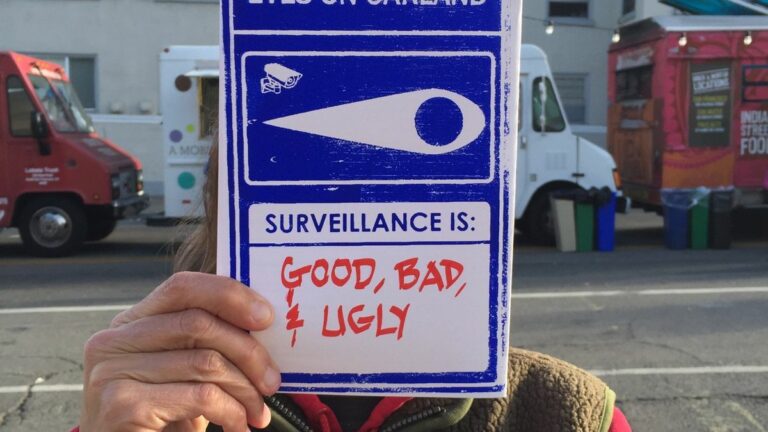
You may have seen the Eyes on Oakland project roving around Oakland in a Ford Falcon van retrofitted as a mobile newsroom. Or, it may have seen you. Eyes on Oakland is a hybrid journalism and interactive art project that aims to inform Oakland residents about the various types of surveillance used by police and give them the opportunity to share thoughts and concerns on camera. The project is an ongoing collaboration between Mobile Arts Platform and the Center for Investigative Reporting that was part of the Oakland Museum of California’s Who is Oakland? exhibit — through which many citizens’ reflections were shared, and more were gathered. So far, the project’s leaders have collected hundreds of opinions by popping up around The Town, and have staged many conversations regarding how to maintain balance between privacy and public safety. On October 2, from 5–8 p.m., Eyes on Oakland will be sharing its footage on The Great Wall of Oakland, a huge wall on West Grand Avenue, between Valley Street and Broadway. The screening is public and free, but bring something to sit on if you plan to stay a while. — Sarah Burke
Fri., Oct. 2, 5-10 p.m. Free. GreatWallofOakland.org
Boorma, a not-so-distant cousin to Middle Eastern baklava.63rd Annual Armenian Food Festival and Bazaar
The fact that the East Bay doesn’t have a proper Armenian restaurant makes this food festival — the biggest event that the St. Vartan Armenian Church (650 Spruce St., Oakland) hosts each year — all the more attractive. Where else can a person who has a taste for well-spiced lamb and buttery phyllo dough go to get his or her fix? Specialties to target at the two-day feast include koofta (a kind of stuffed lamb meatball), boereg (meat- or cheese-filled phyllo pastries), and an assortment of breads and pastries, including cigar-shaped boorma, a not-so-distant cousin to Middle Eastern baklava. Most of the food has been prepared by members of the congregation, with a la carte items priced at $3–$6 apiece. Taste something you love? Frozen versions of many dishes will be available for purchase at the popup khanoot, or country store, along with a variety of Armenian pantry staples. — Luke Tsai
Fri., Oct. 2, 5:30 p.m. $1, $3. StVartanOakland.org
The planetarium at Chabot Science Center.Lost in Space
Why would you drink beer at a bar when you could drink beer while on a mission to Mars? Once a month, the Chabot Space and Science Center (10000 Skyline Blvd., Oakland) gives guests the opportunity to do the latter — kind of — through its “Lost in Space” simulated space mission. While the center regularly hosts daytime mini missions to Mars that are for astronauts ten years old and up, “Lost in Space” missions take place during more adult hours (from 7–9 p.m.) and are partially fueled by beer and wine. Normally, participants land on the red planet and are tasked with constructing a probe to send to one of the moons of Mars. But for Chabot’s special “Spooky Halloween Lost in Space,” which takes place on October 3, things are likely to go wrong. There’s a good chance that Martians will be involved, but there’s no way of knowing whether they’ll be friendly. — S.B.
Sat., Oct. 3, 7-9 p.m. $30. ChabotSpace.org
Queens D. Lite.Ships in the Night
Ships in the Night is one of the East Bay’s most widely attended, month ly queer parties, so much so that the event’s organizers faced controversy last year for publishing an open letter that suggested that only LGBTQ people — and not straight allies — should attend. While some found this approach alienating, others agreed that a safe space for queer people, especially queer people of color, is paramount in the East Bay as gentrification progresses. With that said, this month’s Ships will be a good one: DJs Durt, Mutie, Minh La, and Rumorosa will spin party jams on the New Parish’s two dance floors. Local rapper Queens D.Light — who recently returned from an extended stay in New York City, where she worked on her forthcoming EP — will perform. While Queens’ last album, California Wildflower, featured down-tempo beats and lyrics that reflected on her Yoruba faith, her recent live shows have foregrounded unreleased tracks with more danceable production. The party’s proceeds will benefit El/La Para Trans Latinas, a nonprofit that provides a community space and Spanish-language health and counseling services to trans Latinas in the Bay Area. — N.V.
First Saturday of every month, 9 p.m. $5. TheNewParish.com
If your pockets are feelin’ light and you’re still yearning for more suggestions, we’ve got a ton, and these ones are all FREE! We’re Hungry: Got any East Bay news, events, video, or miscellany we should know about? Feed us at Sa*********@************ss.com.
Young Thug has elevated mumbling to an art form, and his often indiscernible, melodic flows set him apart as one of today’s most innovative rappers. Controversy follows the young MC, who became embroiled in a beef between his mentors, Birdman and Lil Wayne, earlier this year. Lil Wayne objected when Young Thug originally announced that he would call his...
Empty Spaces | Revisited is choreographer Rogelio Lopez’s attempt to resurface his memories of growing up as a gay man in Mexicali, Mexico — “the faint, painful, lovely, scary, lonely, and sacred reminiscence discarded in darkness,” as his description reads. The dimly lit, intimate evening of dance will take place at the homelike Shawl-Anderson Dance Center (2704 Alcatraz Ave.,...
¡sPRUNg! is the monthly dance party of Nic Feliciano and Jason Stinnett (aka Jaysonik) — formerly of the rap group Hot Tub — who, along with DJs Neto 187 and Kool Karlo, bring booty-popping jams to the Legionnaire every second Thursday. The DJs’ penchant for spinning new rap releases, Miami bass, and hyphy throwbacks makes for a vivacious dance...
With his project, Bollywood Masala Orchestra, artistic director Rahis Bharti sought to combine the big sound of a New Orleans-style brass band with traditional, Indian musical instruments and compositions. The eighteen-piece ensemble features musicians from the state of Rajasthan in North India, as well as three dancers whose performances infuse traditional routines with Bollywood choreography and acrobatics. Bollywood Masala...
Berkeley City Councilmember Lori Droste is hoping to encourage developers to build more affordable housing in the city by allowing them to construct fewer parking spaces in new buildings. Droste's "Green Affordable Housing Package " — on the agenda at tomorrow's city council meeting — requests that the city Planning Commission and City Manager's Office explore a number of policy changes that would eliminate...
Stories you shouldn’t miss:
1. The US Supreme Court rejected an appeal today by the City of San Jose, thereby effectively ending the city’s bid to attract the Oakland A’s to the South Bay, the Mercury News$ reports. The high court refused to hear San Jose’s appeal of a lower court ruling that had dismissed the city’s anti-trust claims against Major...
Hayward school Superintendent Stan “Data” Dobbs, who is alleged to have verbally abused and made physical contact with some school boardmembers at a closed session meeting last month, will keep his job. In addition, a third boardmember substantiated the violent tenor of the incident while reciting her own version of what happened.
No official announcement about Dobbs’ future was actually...
Opponents of plans to ship millions of tons of coal through Oakland filed a legal action in state court today in an effort to require a new California Environmental Quality Act (CEQA) analysis for the Oakland Bulk Oversized Terminal project. According to the groups, coal was never studied in the original environmental analysis, and the city cannot say what...
In August, the Express published a news story about the case of Chea Bou, an Oakland man who faced deportation for his involvement in a federal drug case. Immigration reform activists have rallied to Bou’s defense, noting that he has family that depends on him here, and his legal case involved no accusations of violence.
But he’s...
If the Oakland Musical Festival and Bay Area Vibes weren't enough for you last weekend, make sure to spend this whole weekend drinking in Golden Gate Park for the Hardly Strictly Bluegrass Festival. Otherwise, find five other recommended weekend activities below.
Younger Lovers
Brontez Purnell, frontman of garage rock band the Younger Lovers, is a...