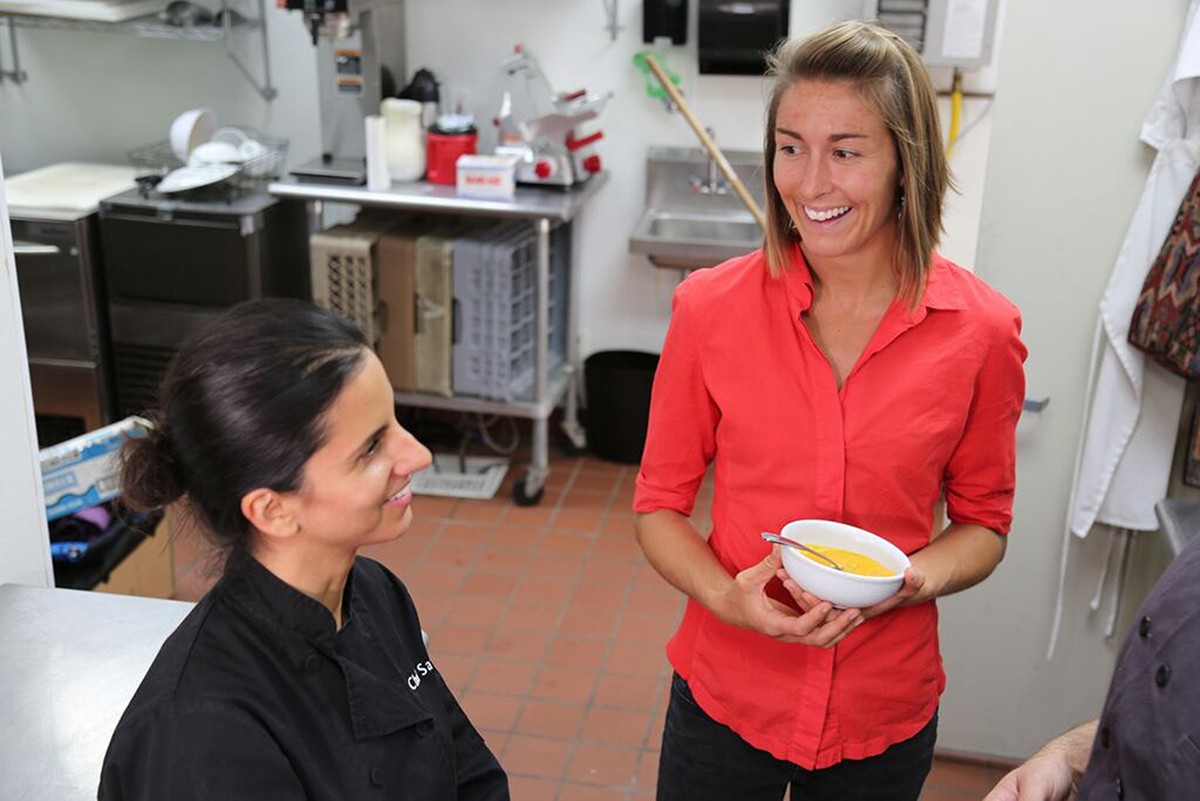
Dana Frasz deals in the currency of imperfect produce: crooked carrots, oranges with peels dotted with black spots, and potatoes shaped like snowmen. As the founder and executive director of the Oakland-based nonprofit Food Shift, Frasz spends her days finding ways to make sure that these ugly, but perfectly edible, fruits and vegetables (about six billion pounds of which never even make it off the farm each year because they’re deemed unfit for grocery stores) don’t wind up in the trash bin.
Now, Food Shift is taking on its most ambitious project yet: a kitchen facility that the organization will run in collaboration with the Alameda Point Collaborative, a housing program for the formerly homeless that happened to have an underused commercial kitchen on its premises. The new project, known as the Alameda Kitchen, aims to be a win-win for both nonprofits. It will provide Food Shift with a fully equipped kitchen that the organization can use to process large quantities of produce and other surplus food, turning all of those ugly carrots and potatoes into nutritious products that can either be given away or sold to schools, hospitals, and other meal providers. And for Alameda Point Collaborative, the kitchen will be an engine of economic development, providing hands-on job training to residents of the housing program, who will acquire skills that might allow them to go on to land jobs at restaurants or other food-related businesses.
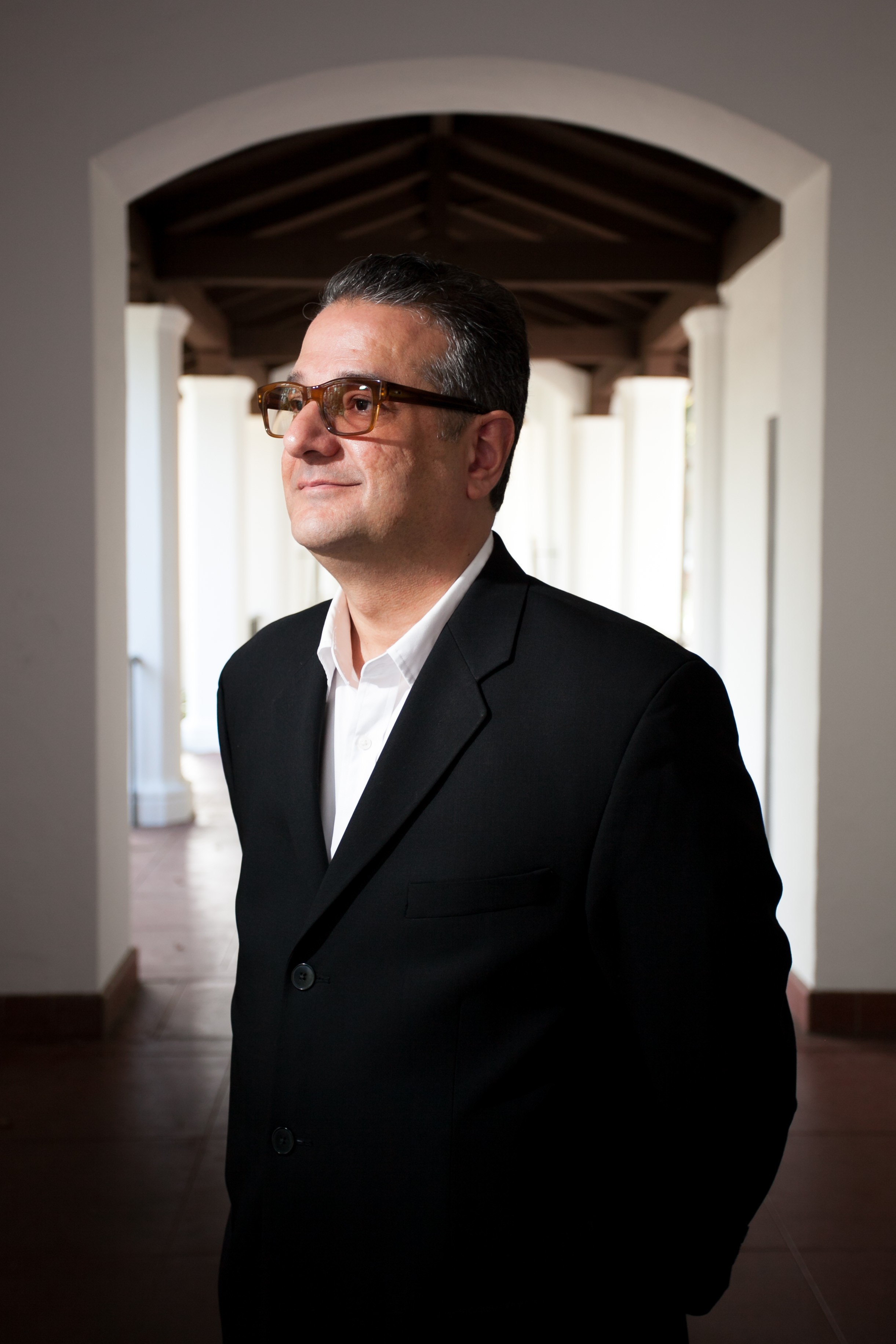
Dana Frasz.
Credits: Courtesy photo
Food Shift’s mission is an important one at a time when food insecurity and food waste are both increasingly urgent problems in the Bay Area — especially in light of the US Department of Agriculture and the US Environmental Protection Agency’s recent jointly announced goal of reducing food waste on a national level by 50 percent by 2030.
As Alameda Point Collaborative Executive Director Doug Biggs put it, “Our society has plenty of food. It’s just in the wrong place at the wrong time.”
Frasz explained that the project is loosely modeled after DC Central Kitchen, a Washington, DC-based nonprofit where she briefly volunteered in 2008 — an experience she credits with inspiring her to create Food Shift to begin with. Mostly, she was inspired by the ways in which DC Central Kitchen’s mission went beyond simply feeding people. The kitchen provides job training to individuals who come from marginalized backgrounds. And, by turning surplus food into products that can be sold by the catering company the organization runs, it has created a financially sustainable business model that employs graduates from the training program.
Similarly, the Alameda Kitchen aims to be a self-sustaining, community-oriented program that will provide both food and jobs to people who need them. In that respect, the Alameda Point Collaborative seems like the perfect partner. Almost all of the heads of household among the housing complex’s five hundred formerly homeless residents have some kind of disability. And Briggs said that aside from the obvious benefit of acquiring job skills, he believes it will be empowering for the residents to do so in a way that really gives back to the community.
Frasz said her hope is to change the current paradigm in which under-resourced food assistance organizations — soup kitchens, food banks, etc. — often struggle to find ways to use up donated food before large quantities of it go to waste. Sometimes that’s due to a lack of infrastructure, which is why, for instance, Frasz hopes to buy a food dehydrator in order to help extend the life of over-ripe fruit. And Food Shift has also enlisted the help of alumni from Stanford University’s Graduate School of Business who will do some pro bono market research to help refine the Alameda Kitchen’s business model and figure out what food products would be optimal, given Food Shift’s steady stream of discarded carrots, potatoes, and such.
Frasz is currently recruiting a chef to handle recipe development, but she already has a number of ideas for products that the Alameda Kitchen might sell. Most fall in the ultra-practical realm of soups and smoothies, but Frasz also dreams of one day stocking corner stores in East and West Oakland with $1 popsicles made from cosmetically challenged fruit — a healthier alternative to the bags of potato chips that schoolchildren might otherwise buy. And she said she has peeked into the dumpsters outside of large juice chains such as Jamba Juice often enough to know about the massive quantities of carrot pulp that they throw away each day — pulp that could form the base for a delicious veggie burger, Frasz said.
Frasz, a vegetarian, said the main focus of the project would be on produce, but she didn’t rule out the possibility of including meat or dairy if the organization got a hold of a large quantity of surplus items that would otherwise spoil.
Food Shift recently launched a $30,000 crowdfunding campaign that would help pay for the purchase of kitchen equipment, allow Frasz to hire a part-time chef, and provide employment to an initial cohort of trainees. The tentative plan is for the Alameda Kitchen to open officially in April 2016.
Sitting on a vine-covered bench in the backyard of her North Oakland home, Tammy Rae Carland made an off-handed comment about how bizarre it is to start growing gray hairs. The texture is totally unexpected, like another person’s hair growing out of your head, she remarked.
Today, fifty-year-old Carland is known mostly for her fine art photography. Her minimal photographs track the traces that people leave behind and the capacity for objects to encapsulate certain feelings. She’s a dean at the California College of the Arts, where she also teaches photography. But, once in a while, she’s also called upon to contribute to a documentary, scholarly article, or archive concerning the feminist and queer-centric punk subcultures that she was involved in during the Eighties and Nineties.
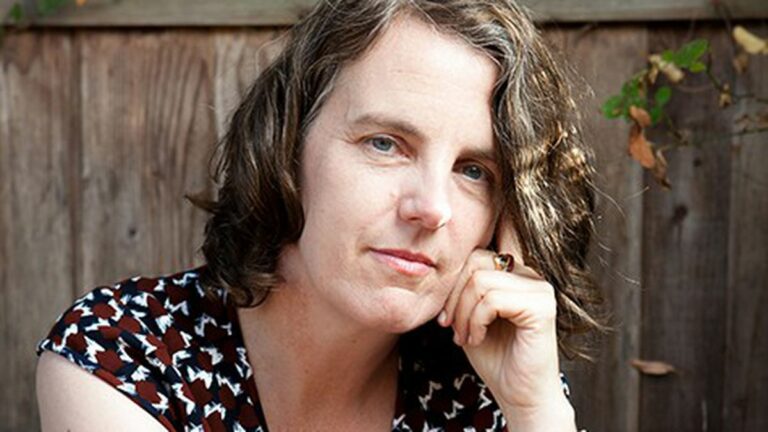
Tammy Rae Carland.
Credits: Bert Johnson
Tammy Rae Carland.
Credits: Bert Johnson
A few years ago, Carland was asked to contribute ephemera to New York University’s Fales Library Riot Grrrl Collection. She handed over about 350 riot grrrl and queercore zines that she had made in her twenties — plus, a comprehensive archive of everything put out by Mr. Lady Records and Video, the influential lesbian, feminist record label that she ran with musician Kaia Wilson from 1996 to 2004.
She was also recently on sabbatical from her teaching job, which gave her time to sift through her prolific output, taking an “emotional inventory” of her past before sending it across the country to be crystallized into history. She unearthed material that she hadn’t seen in decades, including items she inherited from close friends who eventually died of AIDS. “I became very focused on this idea of an entire part of my generation that didn’t get to make it to fifty,” she said. “That didn’t get to make it to the other side of young adulthood.”
It’s out of that contemplation that the content for Carland’s new book of photography, Some of Us Did Not Die, precipitated. The black and white publication was recently released in a run of one hundred by Land and Sea — a tiny, tasteful North Oakland press that focuses on publishing artistic work that has no other outlet. Unlike Carland’s recent photographic output, this compilation is overtly personal — diaristic, even. It offers ephemera from her most formative years, honing in on 1986, the year she turned 21.
That was the same year Carland left her home in Maine and first arrived at The Evergreen State College in Washington. For Carland, a queer woman having been involved in a straight, male-dominated East Coast punk scene, the city of Olympia was a refreshingly welcoming place (although still hetero-dominated). Throughout her time there, she began to photograph and self-publish zealously, and contributed to a political and creative community that would eventually birth the riot grrrl movement.
But by the time that riot grrrl took off, Carland was more interested in queer theory than girlhood, she said. And Some of Us Did Not Die has subtle inflections of not feeling fully represented even as women were creating a subculture centered around them. In an emotional way, its contents outline the silencing and erasure of the queer community — both socially, in terms of being “out,” and literally, due to the AIDS epidemic of the Eighties. As Carland’s singular textual inclusion states, “The book is mostly about what didn’t get said, what was withheld, what was cut short, and what was left undocumented.”
Aesthetically, Some of Us Did Not Die employs Carland’s metaphorically minimal aesthetic filtered through her familiarity with zine-making. Rather than singular photographs, most of the pages feature scanned contact sheets — revealing sprocket holes and sequencing, like a miniature film. Others hold scans of crumpled pieces of paper with esoteric notes scrawled on them or envelopes with no indication of what was inside. Many pages show mixtapes without their song lists, others: a box of letters, record sleeves, two clocks side by side, a single pin that’s reads “SILENCE = DEATH.”
Any inclusion of bodies in the book is rare and heavy with apparent intention. The layout and sequencing feels intimately deliberate, with weighted white space acting as punctuation. That aesthetic restraint evokes a sense of quiet, sad aggravation, alluding, through withholding, to the deafening silence that tragically permeated the AIDS epidemic.
The collection of analog objects also wrestles with mortality. Carland’s interest in the analog becomes a metaphor for things that were once so important, and are now gone — encapsulated in an earlier era, like so many friends that she lost. “People that I really loved and cared about who were really great thinkers and artists who had a lot to contribute didn’t even see the interweb,” she said. “It’s kind of shocking how fast and furious the height of the AIDS crisis was and then how fast technology moved. To me, there’s something about that dynamic that’s really interesting for my generation.”
Today, the internet offers online spaces for marginalized communities to connect, but Carland came of age at a time when being visible required analog interaction. Some of Us Did Not Die is segmented by sequences of “discograms” — exposures that Carland made by placing a disco ball under a dark room enlarger and letting the light refract onto photo paper, capturing the pattern you’d see on a nightclub wall. The discograms refer to a time when Carland would frequent discos, even as a punk, because that was one of the few spaces where queer people could fully exist. “I was really into this idea of the performance of dancing in a gay bar and being seen and sometimes going by yourself but being alone together,” said Carland. “[Disco balls] became kind of these memorials to people that died in a way — like trying to create a trace of them.”
For every book that Land and Sea puts out, it releases five $500 artist editions. Carland’s comes in a mirrored box with a pink, letterpress print of the lyrics to “There is a Light That Never Goes Out” by The Smiths printed backward. Only when the print is held up to a mirror, can the lyrics be decoded. Take me out tonight/ Where there’s music and there’s people and they’re young and alive/ Driving in your car/ I never want to go home/ Because I haven’t got one anymore.
It’s with loaded details like those letter-pressed lyrics that Some of Us Did Not Die manages a remarkable degree of thoughtfulness through what feels like fragments of a film. By oscillating between offering and omission, it expertly navigates the complex spectrum between visibility and invisibility in regards to both identity and politics. Meanwhile, takeaways about grief and growing older, the relationship between materiality and mortality, and the odd experience of grappling with disappearance during the rise of digitization texture the contents with conceptual nuance.
Throughout, Carland is tactfully poetic. Tucked into the end of the artist’s edition, there’s a photo strip of filmmaker Gene Barnes — a friend to whom Carland dedicates the book, and who died of AIDS-related illnesses at a young age. In a series of four frames, Barnes presents an embedded caption by holding up paper placards: “A very short film.” And below, a photo of Carland from the same era holding up her response: “Forever.”
Purveyors of various international cuisines that the stereotypical American might find intimidating could learn a thing or two from the country’s Ethiopian and Eritrean restaurateurs, who over the past few decades have made great inroads, particularly here in the Bay Area, in familiarizing diners with the vocabulary of injera and berbere. Injera, the new Ethiopian/Eritrean restaurant in Alameda, is typical in the way its menu includes detailed descriptions for every dish, as well as a lengthy narrative introduction to the cuisine: the spices that are used, the proper way to use the sourdough flatbread known as injera to scoop up the food, and so forth.
Chef Aron Haile said his goal is to serve food made in the traditional way, but to make it accessible to newcomers. In that respect, his restaurant strikes a nice balance: It serves uncompromising versions of dishes not available at more Americanized Ethiopian restaurants, and yet you don’t have to be an adventurous eater to find something you’ll enjoy.
Injera chef Aron Haile.
Credits: Bert JohnsonInjera’s tangy injera.
Credits: Bert JohnsonThe injera forms the edible base for each family-style platter.
Credits: Bert Johnson
Haile, an Eritrean native who previously owned and operated a trucking business, decided to open Injera, partly because the Alameda resident wanted to spend less time on the road away from his wife and kids, and partly because, like so many talented home cooks, he’d spent years listening to friends tell him that he just had to open a restaurant someday — and preferably on the island, which, unlike nearby Oakland and Berkeley, had a relative paucity of East African eateries.
In July, he finally took the plunge. Customers of Homeroom Racing Cafe, the eccentric Thai restaurant and slot-car racing mecca that used to occupy the space (and was the subject of my very first Express dining review), will hardly recognize the place, which had been known for looking more like a church basement or a clubhouse for pre-adolescents than it did a nice sit-down restaurant. Now, it looks clean and modern, with a display of traditional baskets on one wall the only outward indication that it’s an Ethiopian spot.
It should come as no surprise that a restaurant named Injera would be notable for its bread. As is the case at more or less every Ethiopian restaurant, the injera forms the edible base for each family-style platter, and additional pieces of bread, piled high in a basket like rolled-up hand towels, function as both side starch and dining utensil — used, as they are, in place of forks or spoons to scoop up the food.
The kitfo portion was enormous — at least two hamburgers’ worth of raw beef.
Credits: Bert Johnson
Haile uses 85 percent teff and 15 percent barley to make his injera — a proportion that yields bread that is tender and only slightly spongy, and that, compared to versions made with plain white flour, doesn’t sit quite as heavily in your stomach after you’ve eaten a large quantity. A three-day fermentation produces a fairly intense tang, which provided an excellent foil to the restaurant’s assortment of richly spiced stews and stir-frys. The bread’s sourness makes it an acquired taste, but here in the Bay Area, even less adventurous diners should be predisposed to like the stuff, considering the region’s longstanding love affair with San Francisco sourdough.
Injera enthusiasts should definitely also try the kategna, a dish I haven’t seen at any of Oakland’s multitude of Ethiopian eateries, perhaps because, according to Haile, it’s less of a restaurant dish than it is a snack that a home cook might serve with hot tea in lieu of a more extensive meal. No matter how you categorize the dish, it was delicious: The injera was toasted until the edges were crisp and the bread was the color of dark rye. Tossed with butter seasoned with berbere spice and served folded up like a French crepe, this made for an awfully addictive appetizer.
A couple of quick pointers if you’re unsure how to navigate an Ethiopian or Eritrean menu: A wat is an onion-based stew. A tibs is a stir-fry. And, if you have trouble making up your mind, the ubiquitous “veggie combo” is always a good way to go. At Injera, the off-menu option comes with scaled-down portions of five different dishes. Haile’s gomen (sautéed collard greens) and tikil gomen (a sauté of cabbage, potato, and carrot) stood out for their fresh, clean flavors — no complicated spicing to distract from the vegetables’ natural sweetness. I liked the low-burning heat of the simmered mushrooms and the soupiness of the kik alicha, a stew of yellow split peas cooked down to a sweetly earthy mash.
The best of the bunch, the red lentil stew known as mesir wat, was the ying to the kik alicha‘s yang — a similarly textured, spicy, smoky mash that was delicious both by itself and in combination with any of the other dishes. (Of course, the best part of a communal Ethiopian meal is the free-form, DIY aspect; the way you use your bare hands to mix and match the items laid out on the injera plate in whatever combination you find pleasing.)
If anything, the flavors at Injera were sometimes more muted than I would have liked. None of dishes I ordered packed enough of a punch to satisfy a true chilihead, and the doro tibs — a fajita-like stir-fry of boneless chicken breast, onions, and bell peppers — was downright bland. (That said, I had only myself to blame for choosing the “mild” version of the dish, and, to be fair, the young child in our party seemed to enjoy it well enough.)
On the other hand, the gomen bsega — a sautée of cubed beef, garlic, ginger, and collard greens — was an ideal example of Ethiopian food that was full of flavor despite not being spicy in the least. The secret, as it is with so many of the cuisine’s tastiest dishes, was butter — i.e., butter clarified in-house, then seasoned with sundry spices — that soaked into the meat and vegetables and infused the entire dish with a wonderful richness.
The injera forms the edible base for each family-style platter.
Credits: Bert Johnson
Injera also serves an excellent version of kitfo, a raw minced beef dish that’s often likened to beef tartare. You can order your kitfo cooked rare or even all the way through, but if you aren’t too squeamish, Injera is a good place to give the traditional raw preparation a try. Although the beef was ground a little finer than I like, the flavors — a mix of fiery, cardamom-tinged mitmita spice blend and more of that seasoned butter — were on point. Eating big scoops of kitfo straight-up can be a bit intense, but the order came with some collard greens and split peas on the side, either of which combined with the raw beef to make for a perfect bite. I made use of the little shaker of mitmita that was provided, for extra heat, and the tangy housemade cottage cheese, which added a creamy note and helped mellow out the intensity of the spices.
Note that the portion size is enormous — at least two hamburgers’ worth of raw meat. So, depending on how dedicated a kitfo eater you are (and how you feel about large quantities of leftover raw beef), this might be a dish best ordered when you’re sharing with a larger group. The good thing about Injera? The kitfo eater and the person who would never try kitfo will have no problem breaking bread together here.
“Racial Profiling via Nextdoor.com,” Feature, 10/7
Nextdoor Responds
We founded Nextdoor with the belief that when neighbors start talking, good things happen. Four years and 77,000 neighborhoods later, we continue to be amazed by the enthusiasm and passion that neighbors have to make their local communities stronger and safer.
The vast majority of interactions on Nextdoor are positive, but recently Nextdoor has been at the center of a few press articles, including one in the East Bay Express, about a very difficult issue facing our neighborhoods today: racial profiling.
We are incredibly saddened that some neighbors have used Nextdoor in this way. Simply stated: We consider profiling of any kind to be unacceptable. Our product is about fostering healthy conversations amongst neighbors. We explicitly prohibit profiling in our guidelines. Further, if we are notified that a member has violated these guidelines, we will take action and prohibit them from using Nextdoor.
We consider profiling of any kind to be unacceptable — and the opposite of being neighborly. Moving forward, we are creating ways to remind members of these guidelines when they post in the Crime and Safety section. We are investigating better techniques for keeping divisive discussions productive, and we are partnering with conflict resolution experts for training and product feedback. This is an important cause for us and we won’t let up.
Of course, one of the best ways to combat profiling is simply to get to know your neighbors. Racial profiling and other unneighborly behaviors often arise from not having relationships with those around us. Many neighbors tell us that they are using Nextdoor as a vehicle to create the change they want to see in their local communities. Let’s use our common bonds to come together, engage in constructive dialogue, and end profiling once and for all.
Nirav Tolia, co-founder and CEO of Nextdoor (reposted from Nextdoor.com)
Spurred to Action
Thank you for this article. I am white and my wife (who is also white) is on Nextdoor and has told me about these posts. I haven’t joined Nextdoor because I didn’t want to get involved in aggravating comment threads. This article made me realize that by not taking part, I am taking advantage of my white privilege. I am a mom, and if I had a black child I think I would feel that I had to be involved for my own child’s safety. I would want to know who in the neighborhood is profiling him/her, and other people of color, and might make a call that could create a dangerous situation for my kid. So, I am newly resolved to join Neighbors for Racial Justice and start making my voice heard on Nextdoor to support those who are trying to keep neighborhoods safe from police and private security violence.
Rebecca Peterson-Fisher, Oakland
Whites Are the Real Victims
Nextdoor is overwhelmingly used as a soapbox for militant activists and classifieds. Most of the racism I read on Nextdoor is scapegoating of white people. Amongst my circle, we call the site PoisonousNeighborNextDoor. Not surprised the Express chose a BS narrative.
Matt Chambers, Oakland
Profiling Is Rampant
The covert and not-so-covert racial bias detailed in the article is still rampant in our culture, and certainly in the hills area of Oakland. It’s not restricted to Nextdoor; the neighborhood listservs and National Crime Prevention Council groups have been operating this way for years and it has done material harm to the African-American residents in those neighborhoods. What I find most helpful about this piece is that it really goes to great lengths to interview people involved and discusses the fears, the anger, and the damage that this fear and suspicion cause. I’ll rejoin my listserv; I left it in disgust a few years ago after being annoyed by precisely this kind of behavior from some of the members.
Rick Davis, Oakland
In Berkeley, Too
It’s not just Oakland, I’ve lived in North Oakland and South Berkeley for sixty-plus years. We also have Nextdoor in Berkeley, and I’m a member, and we have the identical situation here. At least 20 percent of the communications on Nextdoor consist of alerts for “suspicious” persons of color.
I personally know of one instance where a call was made to the Berkeley Police Department by one of our newer white neighbors —on a Black senior citizen who supposedly “had something going on in his house.” The police came to the man’s house, had him down on the ground with a gun to his head, ransacked his house, took him to jail and kept him there two days before releasing him. This happened on Harmon Street in Berkeley. Since our neighborhood has become more gentrified, the Berkeley police are more aggressive and as quick to profile Black residents as the Oakland police. We own three houses in Berkeley and I’ve been stopped twice in the last year and asked “am I on probation or parole” for nothing more than being a Black man walking in my neighborhood. It’s crazy.
Reginald Pates, Berkeley
And Richmond
This stupid crap pops up in my neighborhood in Richmond as well. And people are all “if you see something, say something! Better safe than sorry!” It’s not as common as described above, but I’ve had to pipe up more than once. I’d rather be a “pc police” than a bigot, but maybe I’m just cray-zay like that.
Amy L. Keyishian, Richmond
It’s Not a Bug, It’s a Feature
The story stated: “Fear can really drive the application of bias.” Or the app of bias. Nextdoor needs slick banner ads: “Prejudice isn’t a bug, it’s a feature.”
But seriously, putting this awful stuff in writing can be an opportunity for people to see their own bias. It’s harder to say, “Oh, I didn’t mean it like that.” That is, if somebody bothers to call them out.
I would hope that the other councilmembers who have not expressed opposition to this scheme will now take a stand against it. The least they can do is speak up against this attempt by Big Coal to harass opponents. It is shocking that only three have spoken in opposition to shipping coal through Oakland to China and would put the promise of a few hundred temporary jobs over the health of Oaklanders and the planet.
What the hell is wrong with the other councilmembers? Are they ignorant or in the pocket of [Phil] Tagami and Big Coal? Perhaps they see a future in the private sector and can slip through the revolving door like Jerry Bridges and use their insider status to set up their own logistics firms, or opposition research agencies.
Paul Burton, Oakland
Fabulous Reporting
Darwin BondGraham’s incisive investigative reporting on the insidious attempts of coal industry hired guns to manipulate Oakland’s political process was an excellent piece of journalism. We should be proud and grateful to have such a talented and dedicated reporter in our midst. We should also relentlessly dissect Big Coal’s claim that coal trains will bring “jobs.” How many? How much will those jobs pay? Who will get the jobs? How long will the jobs last? I say, Coltrane, not coal trains.
Jessea Greenman, Oakland
“Can Legal Weed Save the Music Industry?” Legalization Nation, 10/7
Amoeba’s Problems Are Its Own
As a Bay Area native and lifelong music collector, I’ve never read a more inaccurate article about local music sales.
Please believe me when I say any problems Amoeba Music is having are not totally the fault of the music industry being in the dumps; the primary problem is its business practices.
Its stock sucks, its prices are high, and worse of all, its buyers alienate potential sellers by engaging in infuriating cherry-picking. The Berkeley Rasputin Music [store] has stock and prices that are about ten times as good as Amoeba’s. The Berkeley Rasputin is the number-one choice for local sellers. Amoeba’s problems are all its own.
Hopefully selling legal weed may help, but I’d guess it will only work if they sell weed far, far differently than they sell music.
Ken Hensley, Alameda
“Oakland Favors Bank Over Bus Riders,” News, 9/30
Let’s Boycott
I certainly hope folks will boycott this bank [Summit Bank] until they change their minds.
Naomi Schiff, Oakland
Other Banks Have Bus Stops Out Front
The Dimond district has a Wells Fargo and a Bank of America on opposite corners, both with bus stops in front. This is a major intersection with hundreds of people getting on and off each day and no problems. Perhaps AC Transit should do a survey of all the bus stops it has that are close to banks to see if there have been any instances of robbery that support Summit Bank’s fear.
Leslie Ann Jones, Oakland
We Don’t Need Another City Department
Mayor Libby Schaaf’s new Department of Transportation wouldn’t have changed this outcome and instead would mean less money to fix the potholes and rough pavement Line 51 travels over every day.
Scott Mace, Alameda
This Stinks!
I don’t think this is a matter of staff incompetence as much as it is bowing to political pressure with money behind it all. It’s more a matter of corruption. There are three stops in Berkeley that I can think of in front of banks. One, in fact, is the major AC Transit hub downtown with tons of people and buses. The corruption extends to so much of city business, including any matter coming up before the Planning Commission. Money-laden developers always get their variances with total disregard for zoning regulations.
Judi Sierra, Oakland
“The Gentle Thich Nhat Hanh,” Raising the Bar, 9/30
Thanks!
A wonderful, thoughtful essay about a man who elevates humanity.
Lonnie Powers, Newton, Massachusetts
“Defending Sanctuary,” News, 9/23
Thank You, Berkeley!
Berkeley has chosen to take an incredibly decisive leadership stand in the immigration debate, and I am proud that our city council got something very right. Our immigration system amounts to nothing more than global apartheid. No human being is illegal, and the clowns who are whining about “illegal” immigration should ask the Native Americans what they think about the immigrants who have been terrorizing and occupying since 1776. Look at yourself first, before pointing the finger of blame at others. That whining is not just immoral, but fundamentally un-American.
Let us not forget that America is a nation of immigrants, and it is the immigrants who are a key driver of our economy and the weavers of our basic social fabric. Enough of this racism and xenophobia. Thank you, Berkeley City Council, for taking such a clear moral stand for the basic values that make America great, and getting something very right for once.
Vladislav Davidzon, Berkeley
Berkeley Is Acting Like a Criminal
Pick and choose the laws you obey. Isn’t that exactly what criminals do? Like it or not, the City of Berkeley is within the boundaries of the United States of America, subject to US laws. If that city — or any other — chooses not to obey US immigration laws and defies enforcement, it is a city of criminals, advocating criminal behavior.
Pick and choose whether or not to feed a parking meter in Berkeley. Tear up the ticket — because, in Berkeley, California, you have the right to choose what laws are to be obeyed and which ones are to be ignored. Do so and find out how the “tolerant” City of Berkeley behaves when it comes to laws they choose to enforce.
Aries (March 21–April 19): According to the online etymological dictionary, the verb “fascinate” entered the English language in the 16th century. It was derived from the Middle French fasciner and the Latin fascinatus, which are translated as “bewitch, enchant, put under a spell.” In the 19th century, “fascinate” expanded in meaning to include “delight, attract, hold the attention of.” I suspect you will soon have experiences that could activate both senses of “fascinate.” My advice is to get the most out of your delightful attractions without slipping into bewitchment. Is that even possible? It will require you to exercise fine discernment, but yes, it is.
Taurus (April 20–May 20): One of the largest machines in the world is a “bucket wheel excavator” in Kazakhstan. It’s a saw that weighs 45,000 tons and has a blade the size of a four-story building. If you want to slice through a mountain, it’s perfect for the job. Indeed, that’s what it’s used for over in Kazakhstan. Right now, Taurus, I picture you as having a metaphorical version of this equipment. That’s because I think you have the power to rip open a clearing through a massive obstruction that has been in your way.
Gemini (May 21–June 20): Filmmaker Alfred Hitchcock did a daily ritual to remind him of life’s impermanence. After drinking his tea each morning, he flung both cup and saucer over his shoulder, allowing them to smash on the floor. I don’t recommend that you adopt a comparable custom for long-term use, but it might be healthy and interesting to do so for now. Are you willing to outgrow and escape your old containers? Would you consider diverging from formulas that have always worked for you? Are there any unnecessary taboos that need to be broken? Experiment with the possible blessings that might come by not clinging to the illusion of “permanence.”
Cancer (June 21–July 22): Terence was a comic playwright in ancient Rome. He spoke of love in ways that sound modern. It can be capricious and weird, he said. It may provoke indignities and rouse difficult emotions. Are you skilled at debate? Love requires you to engage in strenuous discussions. Peace may break out in the midst of war, and vice versa. Terence’s conclusion: If you seek counsel regarding the arts of love, you may as well be asking for advice on how to go mad. I won’t argue with him. He makes good points. But I suspect that in the coming weeks you will be excused from most of those crazy-making aspects. The sweet and smooth sides of love will predominate. Uplift and inspiration are more likely than angst and bewilderment. Take advantage of the grace period! Put chaos control measures in place for the next time Terence’s version of love returns.
Leo (July 23–Aug. 22): In the coming weeks, you will have a special relationship with the night. When the sun goes down, your intelligence will intensify, as will your knack for knowing what’s really important and what’s not. In the darkness, you will have an enhanced capacity to make sense of murky matters lurking in the shadows. You will be able to penetrate deeper than usual, and get to the bottom of secrets and mysteries that have kept you off-balance. Even your grimy fears may be transformable if you approach them with a passion for redemption.
Virgo (Aug. 23–Sept. 22): New friends and unexpected teachers are in your vicinity, with more candidates on the way. There may even be potential comrades who could eventually become flexible collaborators and catalytic guides. Will you be available for the openings they offer? Will you receive them with fire in your heart and mirth in your eyes? I worry that you may not be ready if you are too preoccupied with old friends and familiar teachers. So please make room for surprises.
Libra (Sept. 23–Oct. 22): More than any other sign, you have an ability to detach yourself from life’s flow and analyze its complexities with cool objectivity. This is mostly a good thing. It enhances your power to make rational decisions. On the other hand, it sometimes devolves into a liability. You may become so invested in your role as observer that you refrain from diving into life’s flow. You hold yourself apart from it, avoiding both its messiness and vitality. But I don’t foresee this being a problem in the coming weeks. In fact, I bet you will be a savvy watcher even as you’re almost fully immersed in the dynamic flux.
Scorpio (Oct. 23–Nov. 21): Are you an inventor? Is it your specialty to create novel gadgets and machines? Probably not. But in the coming weeks you may have metaphorical resemblances to an inventor. I suspect you will have an enhanced ability to dream up original approaches and find alternatives to conventional wisdom. You may surprise yourself with your knack for finding ingenious solutions to long-standing dilemmas. To prime your instincts, I’ll provide three thoughts from inventor Thomas Edison. 1. “To invent, you need a good imagination and a pile of junk.” 2. “Just because something doesn’t do what you planned it to do doesn’t mean it’s useless.” 3. “Everything comes to those who hustle while they wait.”
Sagittarius (Nov. 22–Dec. 21): Some unraveling is inevitable. What has been woven together must now be partially unwoven. But please refrain from thinking of this mysterious development as a setback. Instead, consider it an opportunity to reexamine and redo any work that was a bit hasty or sloppy. Be glad you will get a second chance to fix and refine what wasn’t done quite right the first time. In fact, I suggest you preside over the unraveling yourself. Don’t wait for random fate to accomplish it. And for best results, formulate an intention to regard everything that transpires as a blessing.
Capricorn (Dec. 22–Jan. 19): “A waterfall would be more impressive if it flowed the other way,” said Irish author Oscar Wilde. I appreciate the wit, but don’t agree with him. A plain old ordinary waterfall, with foamy surges continually plummeting over a precipice and crashing below, is sufficiently impressive for me. What about you, Capricorn? In the coming days, will you be impatient and frustrated with plain old ordinary marvels and wonders? Or will you be able to enjoy them just as they are?
Aquarius (Jan. 20–Feb. 18): Years ago, I moved into a rental house with my new girlfriend, whom I had known for six weeks. As we fell asleep the first night, a song played in my head: “Nature’s Way” by the band Spirit. I barely knew it and had rarely thought of it before. And yet there it was, repeating its first line over and over: “It’s nature’s way of telling you something’s wrong.” Being a magical thinker, I wondered if my unconscious mind was telling me a secret about my love. But I rejected that possibility; it was too painful to contemplate. When we broke up a few months later, however, I wished I had paid attention to that early alert. I mention this, Aquarius, because I suspect your unconscious mind will soon provide you with a wealth of useful information, not just through song lyrics but other subtle signals, as well. Listen up! At least some of it will be good news, not cautionary like mine.
Pisces (Feb. 19–March 20): When I advise you to get naked, I don’t mean it in a literal sense. Yes, I will applaud if you’re willing to experiment with brave acts of self-revelation. I will approve of you taking risks for the sake of the raw truth. But getting arrested for indecent exposure might compromise your ability to carry out those noble acts. So, no, don’t actually take off all your clothes and wander through the streets. Instead, surprise everyone with brilliant acts of surrender and vulnerability. Gently and sweetly and poetically tell the Purveyors of Unholy Repression to take their boredom machine and shove it up their humdrum.
James Vanderbilt’s Truth revisits one of the many brouhahas of the George W. Bush years, the political scapegoating of CBS News veterans Dan Rather (played by Robert Redford) and Mary Mapes (Cate Blanchett) in 2004, over a 60 Minutes piece about Bush’s career in the Texas and Alabama National Guards in the early 1970s. But where, for instance, Bridge of Spies portrays government subterfuge as a surmountable obstacle, the tone of Truth — adapted by director Vanderbilt from Mapes’ book — is dismal and defeated, as if truth itself has been banished.
Redford does a particularly fine job imitating the cadences of Rather’s vocal delivery, and he etches Rather’s dilemma with dignified restraint. Rather was the last of the “trustworthy” anchors in TV news, the figurehead of ostensible integrity. But the real star of Truth is Blanchett’s combative producer Mapes, hounded out of her job by an unseen hand for daring to imply, during a presidential election year, that POTUS used his family’s influence to essentially shirk his military duty during the Vietnam war. Resistance to this insolent reportage reverberates from the military establishment all the way down to a bull semen market in Texas. While being hounded by her bosses and the president’s men, Mapes gets grilled even at home, by her young son. She finally responds to her inquisitors in a forcefully delivered vindication speech, right before they hang her.
Cate Blanchett and Robert Redford star in Truth.
Cate Blanchett and Robert Redford star in Truth.
The movie not only raises questions about Bush, but about chicken-hearted CBS and broadcast news media in general. Maybe that’s what makes the film, well acted and incisively written as it is, such an ordeal to sit through, even for news junkies. Its implications about American citizens’ attentions spans are disheartening as well. Evidently, Bush was additionally peeved about the Abu Ghraib torture scandal, and Mapes paid the price (Rather is now back on the air; Mapes, as noted in the epilogue, has been out of broadcasting ever since). “They don’t get to smack us just for asking the fucking question,” howls Mapes. But they do. Orwell strikes again.
One day in the spring of 2013, Linda Saulsby’s family and friends staged an intervention. At the time, Saulsby was the director of the Liberal and Civic Studies Program at Saint Mary’s College of California, a private, Catholic liberal arts school in Moraga, ten miles east of Oakland. Her husband, adult sons, and a close friend sat her down and recommended that she focus on her health and well-being — and leave Saint Mary’s. “They told me, ‘You feel rotten all the time. … You’re battling all the time. You have nonstop headaches,'” she recalled in a recent interview. “They said, ‘You’ve been successful in your career and you don’t need this.'”
Saulsby realized the extent to which stress at work was taking a toll on her. Soon after, she retired. In a June 7, 2013 letter to multiple administrators, she wrote that many professors of color like her have found the college to be unsupportive — whether due to offensive remarks by other faculty members or racially biased hiring and promotion practices. “I have been subjected to verbal and threatening intimidation, disrespect, and never-ending strategizing to undermine my efforts,” wrote Saulsby, who is Black. “I have been referred to as ‘You people.’ A colleague stated to me with heartbreaking resignation: ‘This is a hard place for people of color, especially Black people.’ I have learned that the SMC culture allows this behavior.”
At Saint Mary’s College in Moraga, only 2 percent of the full-time faculty members are Black.
Credits: Bert Johnson
Professor Deepak Sawhney alleged discrimination.
Credits: Bert Johnson
Saulsby’s letter and detailed testimony about racial discrimination is part of a civil rights lawsuit that another liberal arts professor, Deepak Sawhney, filed against the college in Contra Costa County Superior Court. Sawhney is of Asian Indian descent and joined Saint Mary’s as an assistant professor of liberal and civic studies in 2002. He alleged, among multiple complaints, that he faced racial discrimination and retaliation when the college refused to promote him and later reassigned him to a position for which he was overqualified. As part of the case — which Sawhney’s attorneys are now appealing after an initial ruling in the college’s favor — seven former professors and administrators and a former student provided detailed declarations of their experiences with discrimination and racial prejudices on campus.
At Saint Mary’s College in Moraga, only 2 percent of the full-time faculty members are Black.
Credits: Bert Johnson
Although the legal case is centered on Sawhney’s ongoing employment dispute, the extensive documents and testimony that he and his attorneys collected offer a window into ongoing racial tensions at the college. The court filings — along with interviews with current and former professors, administrators, and students — paint a picture of an institution that has struggled to recruit and retain professors of color, failed to build and maintain diverse leadership, inadequately responded to complaints about discrimination, and at times retaliated against outspoken employees. As a result, professors and students said, the academic offerings have suffered from a lack of diverse perspectives — and students of color often perceive the campus to be an unfriendly environment. And, as the suit notes, the Western Association of Schools and Colleges (WASC), which evaluates and accredits the college, has repeatedly raised concerns about diversity and discrimination on campus.
Saint Mary’s, founded by the Roman Catholic Archdiocese in 1863, now serves 2,778 undergraduates and 1,331 graduate students. Over the last decade, the undergraduate population has been roughly 45 percent white, 26 percent Latino, 11 percent Asian, and 4 percent Black, according to the college. Faculty and staff at the college are overwhelmingly white: According to 2014 data, out of 498 faculty members, 67 percent — 333 professors — are white. Fifty-two faculty members are Asian, 23 are Latino, and 22 are Black. Out of 211 full-time faculty members, only thirteen (6 percent) are Latino, and only five (2 percent) are Black.
Four professors of color, including Sawhney and Saulsby, provided detailed accounts in interviews with the Express — and as part of the lawsuit — about the ways in which they felt that hiring and promotion decisions reflected racial biases. As soon as Sawhney was hired in 2002, colleagues and supervisors in his department treated him with disrespect, he alleged in the suit and in an interview. Sawhney said it seemed clear that people in the liberal and civic studies program devalued him because he is Indian and not Catholic. He said a white female supervisor frequently made disparaging remarks about his ethnicity, joking about Indian food and suggesting that Indian men don’t know how to treat women with respect.
Sawhney said his complaints to Stephen Woolpert, dean of the School of Liberal Arts, got him nowhere. According to the lawsuit, Woolpert, who is white, removed Sawhney as a coordinator in the program in 2005 in an effort to resolve conflicts with a white female supervisor. In 2011, Sawhney — then an associate tenured professor and director of the program — sought a promotion to full professor (the highest position for tenured faculty), but Woolpert recommended against it. This was despite the fact that Sawhney had positive teacher evaluations (which he shared with me), a publication record that was more extensive than other faculty members who had been promoted to full professor, and the recommendation of the chair for rank and tenure, according to the suit.
Sawhney subsequently filed a complaint with the state alleging discrimination. In July 2013, soon after Sawhney received a “right to sue” notice from the California Department of Fair Employment and Housing — the first step in a lawsuit — Woolpert reassigned the professor to the philosophy department for the academic year starting that fall, according to Sawhney. Sawhney said he was forced to teach what were effectively beginners’ courses in a small department that didn’t need more faculty members — making it clear to him that Woolpert was trying to push him out of Saint Mary’s altogether and was retaliating against him for alleging discrimination.
“I had created classes [in liberal and civic studies]. Students knew me. My DNA was all over that program, because that’s what I had been doing for so long,” Sawhney said in an interview, noting that white faculty members, including one who was non-tenured, took over his liberal and civic studies classes. Sawhney, who is tenured and has a PhD, is currently teaching two seminar courses, which are general literature and philosophy classes that are typically taught by adjuncts or lecturers.
The same summer that Sawhney was reassigned, Saulsby stepped down as director of liberal and civic studies, leaving the program with no tenured or tenure-track professors of color. “It’s so easy for students to never encounter any faculty member of color here, because their figures are so low,” Sawhney said. “That is astonishing today.”
Saulsby said that when she became director of liberal and civic studies in 2012, she was shocked that the college refused to grant her the title of adjunct associate professor and instead labeled her a “lecturer” — a position with a lower salary and inferior stature. That was despite the fact that she held the associate title at Saint Mary’s two years earlier and in the interim had gained additional experience at another university. And when she tried to run the program in a way that would make other professors of color feel comfortable speaking up, longtime white faculty members pushed back and questioned her leadership, she said in an interview.
“This was the essential struggle that most faculty of color had,” she said. “It can be a wonderful place if you are chosen to be a part of the inner circle. … But people of color are generally not chosen.”
Mindy LeVu Ware, who is Vietnamese, received undergraduate and master’s degrees from Saint Mary’s, worked in the college’s information technology department for seven years, and most recently was a lecturer in liberal and civic studies. Even though Ware helped build up the college’s IT help center in the 1990s, college officials didn’t even grant her an interview when Saint Mary’s decided to hire a director for the center, and instead hired a white man from outside of the institution, she said in an interview. “I’d been doing this a long time, and they never even gave me a chance,” she said. “They were promoting only white men in my department.”
Ware said that when she returned years later as a lecturer under Saulsby’s supervision, she felt more supported as a woman of color. “When Linda was the director, it was an inclusive community,” she said. “But all of the sudden, she’s no longer the director and all of the minority faculty have either been displaced or locked out.” Ware said that after Saulsby resigned, she was often excluded from important meetings and discussions — and last year, she decided to resign for reasons that were similar to those cited by Saulsby. “The modern Saint Mary’s, at the bottom, is a cocoon of white people and white staff, and they want to protect that cocoon,” Ware said.
Some white professors agreed with the criticisms raised by Sawhney and other faculty of color supporting his case. “There was this animus toward Deepak that seemed way out of line,” said Dan Leopard, chair of Saint Mary’s communications department, who is white and who served on the governing board of the liberal and civic studies program with Sawhney. “Any kind of dissent is automatically threatening to the college administration. … There’s a fear of difference, and one of those differences is racial,” he said, adding, “If you have a less diverse faculty, you have less diverse ideas and approaches.”
Tom Brown, a longtime dean at Saint Mary’s, who is Black and now works in education consulting, said that when the college tried to prioritize recruiting faculty of color, the institution failed to support them after they were hired. “We would manage to attract diverse faculty,” he said. “But they just found the college a very difficult place to be, and almost without exception, they left.”
Mazi Allen, a former professor in the philosophy department, who is Black, told me that his white supervisors condescendingly questioned his intelligence, and in one meeting, implied that he lacked a basic understanding of Plato’s Republic. “It was very hostile. It felt more like an ambush,” he said, recalling a meeting with supervisors regarding his teaching performance (an event he also recounted in a declaration for Sawhney’s case).
Black alumni also told me that they felt ostracized on campus and that the college failed to adequately respond to complaints about discrimination. “It felt like a lot of my professors saw me as a token minority student,” said Robert Slaughter, who attended Saint Mary’s from 2008 to 2012. “A lot of professors underestimated me, especially when it came to my intelligence.”
In a statement to the Express last week, Saint Mary’s spokesperson Michael McAlpin refuted Sawhney’s allegations, citing the court’s earlier order in the college’s favor and arguing that Sawhney was denied promotion because “he was not qualified for the position.” He declined to comment on the allegations of other faculty members. McAlpin further defended the college’s commitment to diversity, noting that from 2010 to 2014, there has been a 23 percent increase in minority faculty. He also cited the work of the College Committee for Inclusive Excellence and Bias Incident Response Team — two entities dedicated to combating discrimination and promoting diversity. “Saint Mary’s is committed to an inclusive and just community. Discrimination and harassment of any kind is not tolerated,” McAlpin wrote. He said Woolpert is out of the country and unavailable for comment.
As the Express has reported over the past year, the City of Oakland has been excruciatingly slow in dealing with the affordability crisis that has gripped the region. Unlike many other California cities, including Berkeley and Emeryville, Oakland still has no viable plan to pay for more affordable housing, even though The Town is now the sixth most expensive city in the nation and the displacement of longtime low- and middle-income residents has reached alarming levels. Over the past week or so, Oakland has started to take a few tentative steps to cope with the housing crisis — steps that deserve mentioning — although it still has a long way to go.
As Express writers Sam Levin and Darwin BondGraham reported on our website during the past week, city staffers have made two proposals that could bring some relief to the housing crisis. The first involves a forward-thinking plan to eliminate parking requirements for new housing developments in downtown and around Lake Merritt BART. As Levin noted in his recent feature, “A Green Solution to Oakland’s Housing Crisis,” (8/5), transportation, affordable housing, and environmental activists have been pushing the city to do away with outdated policies that require developers to build large, expensive parking garages for housing near mass transit. The parking requirements drive up the cost of housing and encourage car ownership at a time when the city should be promoting walking, biking, and mass transit and the reduction of greenhouse gas emissions. The city’s current policies also result in non-car owners paying higher housing costs in order to subsidize parking for car owners. In fact, a number of new housing projects slated for the downtown area include plans for massive, unneeded parking garages under the city’s existing rules.
Oakland’s new proposal also would require developers to offer residents “unbundled parking,” meaning that car owners would have to pay extra to have a dedicated parking space. This smart plan also would reduce parking requirements in other parts of the city, especially along major transit corridors, and would create incentives for developers to offer free transit passes and car-sharing to residents.
Hopefully, Oakland NIMBYs who freak out about parking and traffic every time there’s a new development proposal won’t block this new plan. In fact, we think it could be even stronger — that it should also cap the number of parking spaces that developers want to build. The city’s planning department is holding a public hearing on this proposal on Thursday, October 22.
Oakland’s second baby step involves a plan to ease the city’s overly restrictive rules on secondary housing units — also known as “granny units” — behind single-family homes. The plan, which is similar to one approved by the Berkeley City Council in March, is designed to spur the construction of backyard cottages — and the conversion of existing structures — into hundreds, perhaps thousands, of new housing units in the city. Oakland’s current strict rules have unnecessarily stifled the creation of secondary units, which tend to be more affordable and have smaller carbon footprints. The new plan also would allow property owners who live within a quarter mile of a bus station or bus rapid transit line to build a secondary unit without parking. The Planning Commission is scheduled to take up this long-overdue proposal on Wednesday, October 21.
Although these steps merit recognition, they pale in comparison to what Berkeley and Emeryville have already accomplished and what those cities are now proposing to do. For example, unlike Oakland, both cities already require developers to include affordable housing in new projects or pay a fee to build affordable units elsewhere. In fact, the Emeryville City Council this week is scheduled to vote on whether to increase the city’s housing impact fee from $20,000 to $28,000 per unit in order to create more affordable housing (Oakland has no impact fee and has been “studying” the issue for more than a year). Emeryville is also considering whether to require developers to build more two- and three-bedroom, family-friendly units.
Berkeley, meanwhile, is scheduled to take up a package of tenant-protection measures next week. The Berkeley council also will likely vote on a resolution that urges the state to overturn the Costa Hawkins Act, which greatly weakened rent control in California. The council is also expected to enact new strict rules this fall that would prevent building owners from converting existing housing into short-term rentals offered on Airbnb and other online platforms. Berkeley already has some short-term rental laws — while Oakland has none.
Effecting Change
In response to our October 7 feature, “Racial Profiling Via Nextdoor.com,” Nextdoor co-founder and CEO Nirav Tolia announced that the company plans to become more proactive in clamping down on racial profiling on the popular website. Our story noted that an increasing number of white Oakland residents have flocked to the site to report “suspicious behavior” of Black residents who have done nothing wrong. In a blogpost, Tolia stated that the company views “profiling of any kind to be unacceptable.” (See this week’s Letters)
On the edge of the Yolla Bolly Wilderness, about 15 miles north of the dusty town of Covelo, 81-year-old Richard Wilson sat across from me in a ranch house that his father constructed here in the 1940s. For much of his adult life, Wilson has defended the meaning and importance of the Round Valley area of Mendocino County and the values that he and other local people attach to it. So while the ostensible purpose of my visit was to discuss Wilson’s unique personal role in shaping California’s water engineering history, it was no surprise that he also held forth on the local impacts of the four-year-long drought.
“When we get good, wet winters, the snow packs down on the mountaintops at about 4,000 feet, then holds there into the summer,” explained Wilson in his spare and relaxed style. “As the snow melts, it keeps the grass growing, and that’s how you know where to find your cattle. In the last four years, there’s just been no snow.”
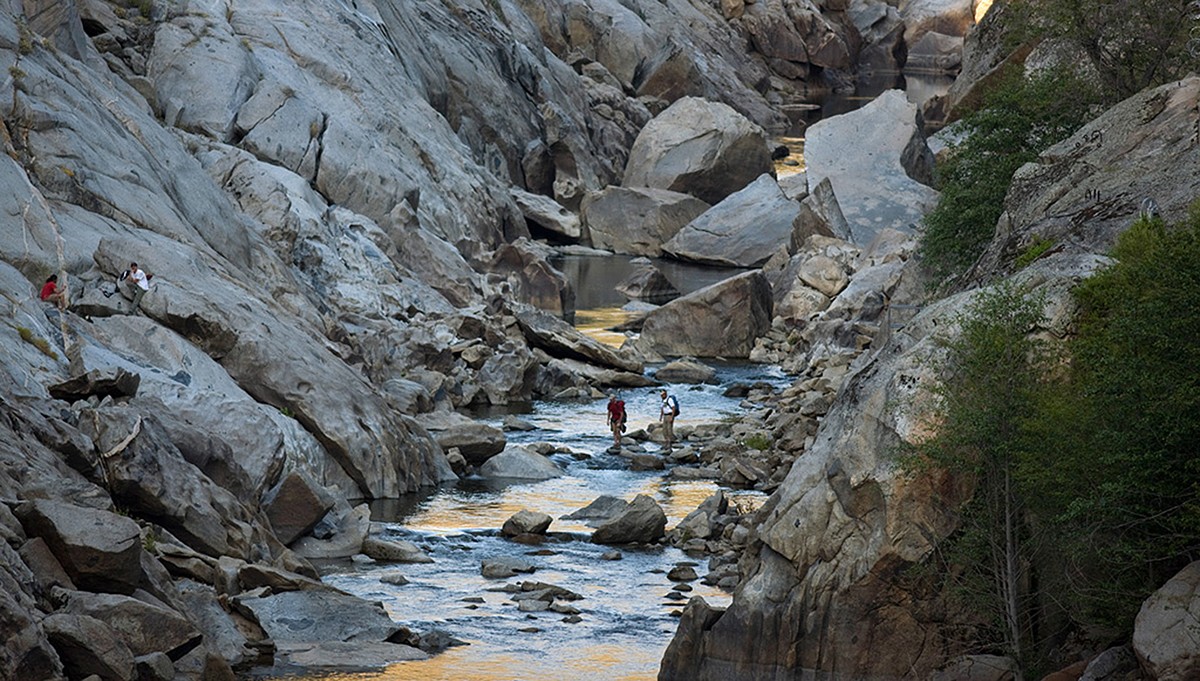
The Temperance Flat dam project is highly controversial because it would flood thousands of acres of public land in the San Joaquin River Gorge.
Credits: Bureau of Land ManagementThe Los Vaqueros project calls for raising the height of the dam in order to create a larger reservoir.
Credits: Bert Johnson
Wilson’s expansive spread, known as Buck Mountain Ranch, spans a portion of the state’s third largest watershed: the Eel River. Few places in California are more remote from urban life than Round Valley, but the watershed and Wilson are central to understanding why Governor Jerry Brown and other powerful interests are avidly pursuing several multibillion-dollar dam projects and two massive water tunnels that are strikingly similar to plans laid out in economic and engineering charts in California in the early-1950s.
In 1960, state voters narrowly approved the California Water Project, which is still the largest bond issue in the state’s history when accounting for inflation. (It cost $14.31 billion in today’s dollars.) By the end of the Sixties, the water project had blocked the Feather River in the Sierra foothills with what was then the world’s tallest dam, the Oroville Dam. The bond had paid for giant pumping stations in the Sacramento-San Joaquin River Delta to move water into canals that parallel Interstate 5 through the San Joaquin Valley, via the 444-mile-long California Aqueduct.
But the State Water Project has never fully been built, and Richard Wilson is a major reason why. In 1967, the US Army Corps of Engineers unveiled a proposal to construct the largest dam and reservoir project in California history: the so-called “Dos Rios Dam” on the Middle Fork of the Eel River. In addition to being 742 feet tall, the dam would have flooded a 40,000-acre area for its reservoir, equal in surface area to the Shasta and Oroville reservoirs combined. These liquid resources would have then passed through thirty miles of ditches and tunnels in the Mendocino National Forest and into a smaller reservoir on the west side of the Sacramento Valley.
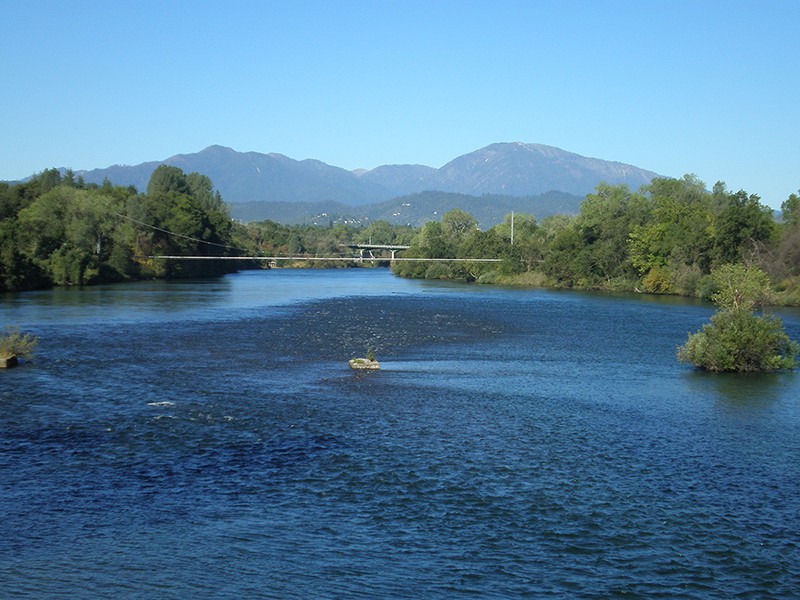
For California’s water industry, the Dos Rios Dam was the key project that would unlock a host of others. Having completed a series of mega-water projects throughout the mid 20th century, state and federal water developers had long trained their sights on California’s North Coast, where about one-third of the state’s surface water flows mostly unimpeded to the ocean through magnificent mountain ranges and redwood groves. Besides for the Eel, the US Congress had authorized feasibility studies for dams and reservoirs on the Klamath, the Lower Trinity, the Mad, and the Van Duzen rivers.
The Dos Rios reservoir would have flooded Round Valley, a 24-square-mile alluvial basin that is home to one of California’s largest Native American reservations, and which, in the late Sixties, had a population of about 1,500. Wilson and his wife, Susan, who then lived in Round Valley with their three children, mounted an opposition campaign. Although both Susan and Richard came from well-connected Republican families, they were up against interests whose power was roughly equivalent to that of the coal industry in Kentucky — or so it seemed.
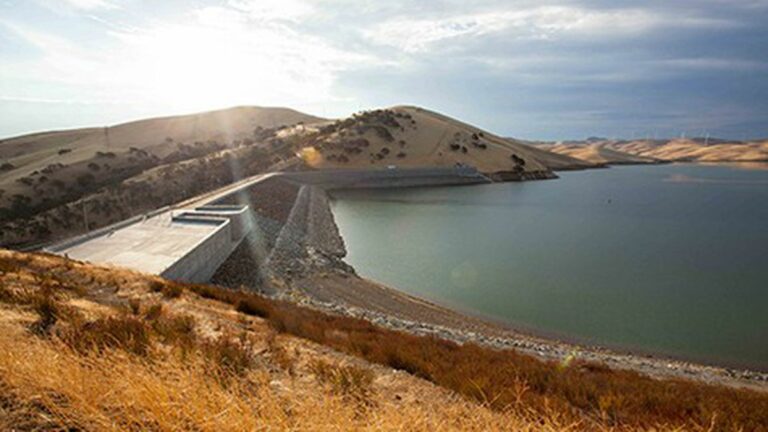
Proponents contend that dam-building will create “a new era of abundance.” But critics argue that dams, such as Los Vaqueros in Contra Costa County, are environmentally destructive and too expensive.
Credits: Bert Johnson
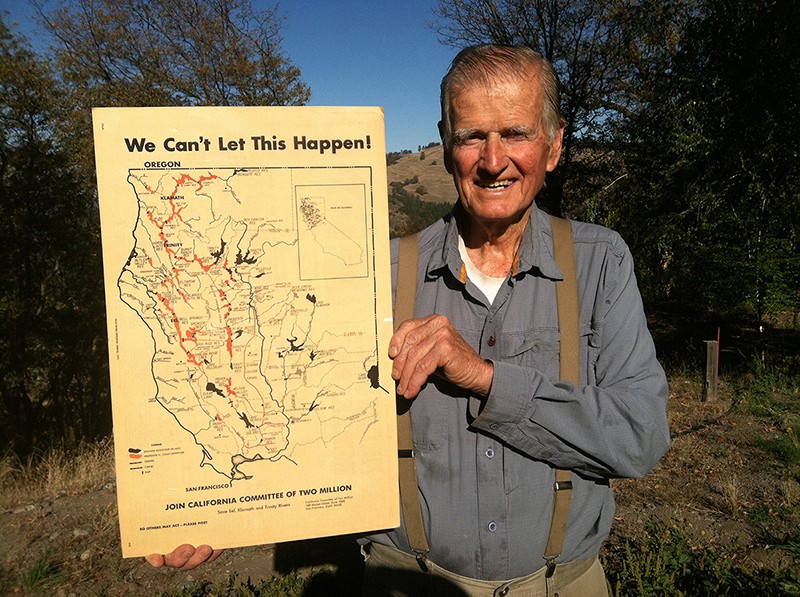
Wilson’s fireplace mantle displays memorabilia from his unique civic life, including a picture of him shaking hands with former California Governor Pete Wilson, under whom he served as director of the California Department of Forestry and Fire Protection in the 1990s. An autographed picture of former US president Richard Nixon occupies a slot nearby. But the largest item is located on the mantle’s far left: a California Department of Water Resources map depicting the state’s northern coastal rivers almost entirely submerged by reservoirs and blocked by dams. The big, bold header screams in red lettering: “We Can’t Let This Happen!”
By 1969, the opponents of Dos Rios Dam had rallied enough support in Sacramento that then-Governor Ronald Reagan declined to support the project. The environmental movement had spawned mainstream acceptance of the idea that rivers are vital natural ecosystems that should be protected, and that dams erected to divert water for agriculture, cities, and suburbs had pushed numerous fish species to the brink of extinction.
“The thing about Dos Rios was: It was really a project that was out of step with the times because I think we were moving on to other ways of looking at water,” Wilson said.
The victory over the dam marked a stunning defeat for California’s water industry. And it had a cascade of consequences. In 1972, the state legislature passed the California Wild and Scenic Rivers Act, which prohibited construction of new dams on the Smith, Klamath, Scott, Salmon, Trinity, Eel, Van Duzen, and American rivers.
Though dam proponents subsequently retreated from the North Coast, their dream of capturing large new water sources to fuel an everlasting cycle of growth and development has never fully faded. And California’s epic four-year drought, characterized by reservoirs that sport bathtub rings where water once was, has given them perhaps their last best chance to launch a new era of dam-building in California.
Advocates of other approaches to meeting the state’s water needs point out that the new dams would cost California taxpayers billions of dollars, while doing astonishingly little to relieve the state’s water woes. They also noted that the dams would lead to further destruction of fragile watersheds, the decimation of fisheries, and the ruination of Native people’s cultures and sacred sites. And some caution that they could pave the way for a renewed effort to drain the North Coast.
Inside Proposition 1, the $7.5 billion water bond that California voters enthusiastically approved last November, is a provision requiring the expenditure of $2.7 billion on water storage projects. Many environmentalists had hoped that a substantial amount of those funds would be used for groundwater storage, but according to some close observers, it appears increasingly likely that most, if not all, of the money will go to dam-building. In addition, US Senators Dianne Feinstein and Barbara Boxer, both D-California, introduced a $1.3 billion emergency drought relief bill in July of this year to “support communities affected by drought.”
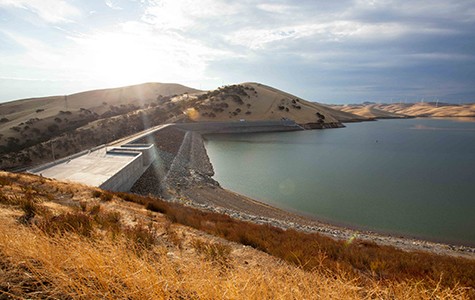
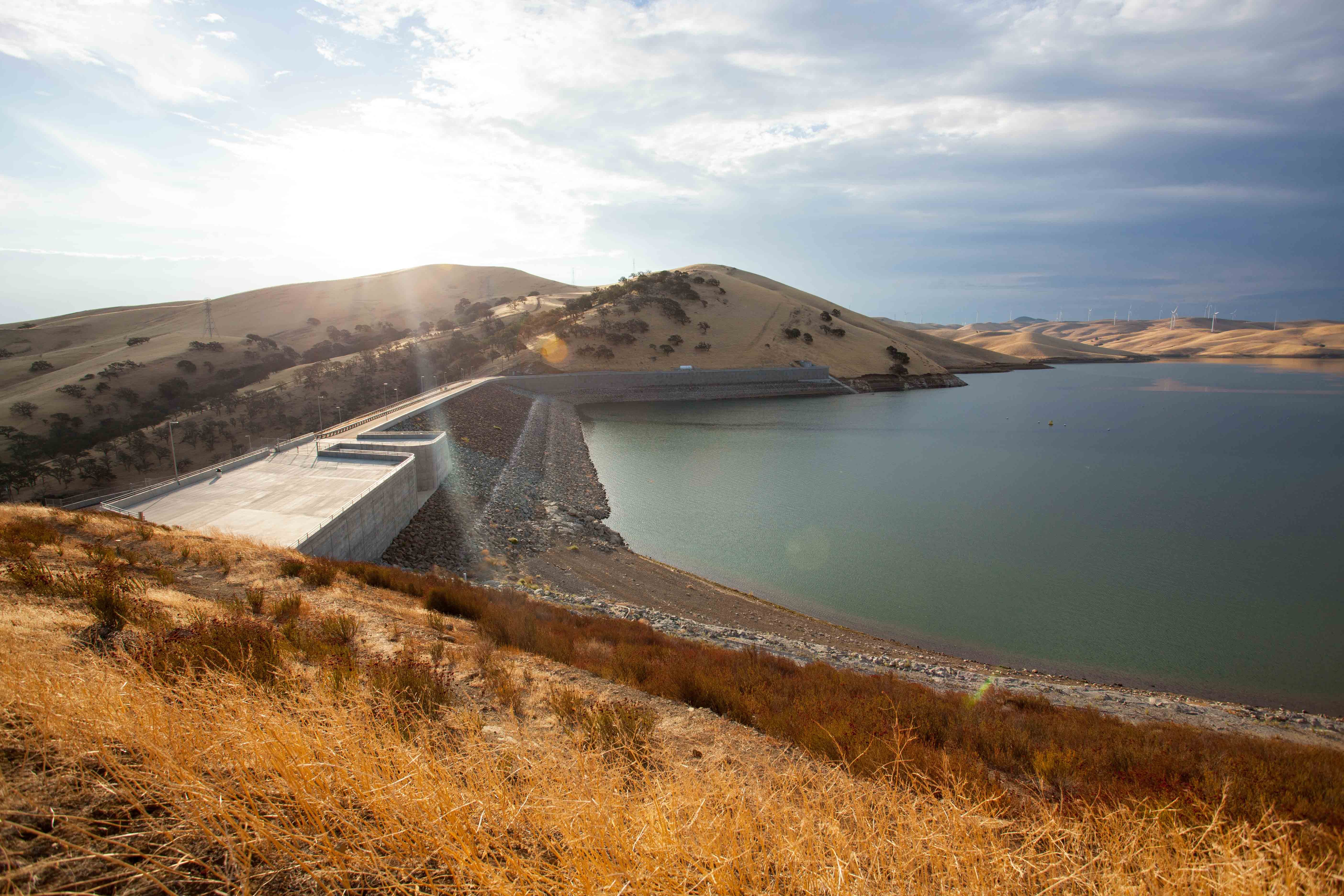
This senate bill, as presently drafted, would authorize $600 million of spending on “Calfed storage projects,” in reference to four dam-expansion and construction projects that the state and federal governments have studied since 2004: Sites, Temperance Flat, Shasta, and Los Vaqueros. The first three of these projects are in various parts of the vast Central Valley, while Los Vaqueros is located in eastern Contra Costa County.
Feinstein, a former longtime chair of the Senate subcommittee that funds the US Bureau of Reclamation, has been a key player in advancing the dam proposals. “Building or expanding these four reservoirs would result in hundreds of thousands of acre-feet of additional water storage, benefit urban and rural communities and increase the pool of water available for releases that benefit fish species,” she wrote in a 2013 San Francisco Chronicle op-ed.
Of the four projects, the most costly would be Sites Reservoir. With an estimated pricetag of about $3.9 billion, the project calls for the construction of two large dams, each about 310 feet tall, on the Sacramento River. Engineers plans to pump the water through the Tehama-Colusa and Glenn-Colusa canals, as well as a third canal built specifically for the project that would originate north of Colusa, to an off-stream storage reservoir that would flood the Antelope Valley, located just east of Mendocino National Forest, about 10 miles west of the small town of Maxwell on Interstate 5.
The Temperance Flat project calls for building a 665-foot-tall dam on the Upper San Joaquin River in the southern Sierra foothills, northeast of Fresno. The proposed dam would flood scenic canyons and historic sites along the river. It would be the second tallest dam in California, and the fifth tallest in the United States (it would be about 63 feet higher than Shasta Dam). In February, Congressmember Jim Costa, D-Fresno, introduced a bill to authorize construction of the dam — which is projected to cost as much as $3.36 billion.
Proponents contend that dam-building will create “a new era of abundance.” But critics argue that dams, such as Los Vaqueros in Contra Costa County, are environmentally destructive and too expensive.
Credits: Bert Johnson
And then there’s the proposal to expand Shasta Lake by raising Shasta Dam by up to 18.5 feet, at an estimated cost of $1.2 billion. The reservoir expansion would flood thousands of additional acres of the Trinity-Shasta National Forest and innumerable sacred sites of the Winnemem Wintu people. It would add 300,000 acre-feet of storage capacity to what is already California’s largest reservoir, with an existing capacity of 4.55 million acre-feet. And finally, the proposed expansion of Los Vaqueros dam in Contra Costa County would add 115,000 acre feet of water storage capacity and cost an estimated $840 million.
Earlier this month, US Senator Lisa Murkowski, R-Alaska, chair of the Energy and Natural Resources Committee, held a long-awaited legislative hearing on both Feinstein’s bill and drought-relief legislation produced by the Republican-controlled House of Representatives, along with several other bills dealing with Western water issues. Congressmember Kevin McCarthy, R-Bakersfield, the House majority leader, has been instrumental in advancing the new dam proposals.
Meanwhile, the California State Water Commission, the nine-member committee appointed by the governor that will rule on allocation of the Prop 1 bond money, has held meetings this month to craft guidelines for handing out the water storage money. The commission is expected to announce the guidelines next month and to allocate the funds sometime in 2017.
Some legislators have seized on the dam projects and attempted to stamp them as the start of a new era. In the mid-1990s, then-Congressmember John Doolittle, D-California, repeatedly said that the proposed construction of the Auburn Dam on the American River would “inaugurate a great new era of dam-building.” (The dam was defeated largely on environmental grounds.) A new stock phrase, courtesy of Congressmember Tom McClintock, R-Roseville, is that the new reservoir projects subject to Proposition 1 and Congressional funding will help “to build a new era of abundance.”
But opponents of the projects point out that California is already home to nearly 1,600 dams, plus thousands more of mostly small, privately owned ones. All together, more than 60 percent of the state’s water fills up behind concrete and earthen walls. With California largely leading the way, in fact, the American West as a whole was transformed during the last century into a region of dams and canals.
Critics of the current dam-building plans note that they are extremely costly compared to the amount of water that they would yield. Despite the fact that the projects would add lots of capacity to store water in the state, they would likely only yield, on average, about 400,000 acre-feet of additional water per year for California because of the lack of water available — and would cost taxpayers about $9.75 billion to construct, according to an analysis by the environmental group Friends of the River. “[M]ost of the water that would fill these dams is already being diverted,” explained Ronald Stork, senior policy advocate for Friends of the River. “For example, Temperance Flat would be built on a river, the San Joaquin, that’s already bone dry most of the time because its water is so over-allocated.”
By contrast, according to an analysis by the California Department of Water Resources, water-saving techniques — such as wastewater reuse, stormwater capture, and groundwater cleanup — have yielded the state nearly 2 million acre-feet of water per year at the far lower cost of $5.13 billion.
The view that dams are too costly was bolstered in 2014 by the release of an Oxford University study. Researchers looked at 245 large dams built between 1934 and 2007 and found that actual construction costs were, on average, nearly double the projected costs, and that construction took 44 percent longer than forecast. “Forecasts of costs of large dams today are likely to be as wrong as they were between 1934 and 2007,” the study concluded.
Dam proponents hope to take advantage of the current drought to increase the size of Shasta Lake. But environmentalists note that there is not much water available to fill up a larger reservoir.
Credits: John Mabanglo/EPA
California’s enormous and elaborate water infrastructure — dams, reservoirs, power plants, pumping plants, canals, aqueducts, gates, tunnels, and other machinations plumbed together across more than six hundred miles — is divided into numerous management regimes. The largest of these is the Central Valley Project, which is administered by the US Bureau of Reclamation and has the capacity to deliver more than 7 million acre-feet of water a year, using Shasta Dam as its linchpin.
The November 1960 water bond that authorized the State Water Project (SWP) passed by the narrowest of margins: less than one percentage point. Key to the measure’s victory was the influential Los Angeles-based Metropolitan Water District, a consortium of 14 cities and 12 municipal water districts that provides water to 18 million people in Southern California. The district only supported the bond measure after the California Department of Water Resources agreed to give it nearly half of the project’s estimated annual yield of 4.23 million acre-feet of water.
Other entities that signed contracts to receive SWP water included the Kern County Water Agency and San Luis Delta-Mendota Water Authority, both of which represent large agricultural interests in the dry San Joaquin Valley.”
But today, the State Water Project yields only half the water promised to these entities, or about 2.2 million acre feet. “In the old planners’ minds, the SWP is only half-built,” said Stork. “The question is, Where’s the missing yield? And one answer would probably be Richard Wilson’s answer, which is that the Department of Water Resources sought to turn the Eel River from a wild river into a series of reservoirs but failed.”
One month after the State Water Project’s narrow approval in 1960, the California Department of Water Resources released a blueprint for future water development entitled “Delta Water Facilities,” which describes the operation of the San Luis Reservoir, Oroville Reservoir, and the pumps in the southern section of the Sacramento-San Joaquin River Delta that move water from north to south. The bulletin encourages construction of 2 million acre-feet of reservoir capacity on the Eel River by 1981. The bulletin also anticipated the completion of new dams on the Mad, Van Duzen, and Klamath rivers by 2012.
“I can’t emphasize enough that it’s all laid out in Bulletin 76,” said Michael Jackson, a prominent water rights attorney.
The central feature of California’s existing water system is the delta, the largest estuary on the West Coast of the Americas. The delta is also a pivotal transportation bottleneck that hinders water development: Pumping too much freshwater from it increases the salinity of the remaining water, thereby causing devastating harm to the aquatic life in the estuary and diminishing the quality of water shipped to millions of Californians.
Since the 1970s, a defining question for California water planners has been whether the delta would be unblocked to permit more water to flow from north to south, or whether there would be a paradigm shift in water policy, as suggested by the water industry’s defeat at Dos Rios. The idea of building peripheral canals around the delta became the solution for delivering new water to the irrigated farms of the west side of the San Joaquin Valley and to the Metropolitan Water District.
In the early-Eighties, Jerry Brown, during his first stint as governor, and the legislature sought to deliver new water to these interests by proposing a peripheral canal. Despite being dressed up with fish ladders and screens and assurances that North Coast rivers were not the target of such a facility, the Peripheral Canal was defeated in a 1982 statewide referendum. It was the second crushing rebuke of California’s water industry, with the first being at Dos Rios.
But Big Ag in California still thirsts for more water. Los Angeles, for instance, uses about 600,000 acre-feet of water annually, while Kern County, at the southern end of the San Joaquin Valley, consumes more than four times as much — about 2.7 million acre-feet in a typical year.
In recent years, the state’s water industry, with Brown’s ardent backing, has resurrected the old peripheral canal concept as the Delta Twin Tunnels, with the same essential features. These 40-foot-diameter water pipelines would tap into the Sacramento River upstream of the delta. And, as Stork noted, “With the tunnels project back on the table, some of the firebrands are turning up heat on undoing protections for North Coast rivers.”
In July 2013, the agribusiness-dominated Tulare County Board of Supervisors made known its ongoing desire to tap the northern coastal rivers. “The continued over-drafted groundwater basins of the Central Valley are also a very serious threat to the economic future of California agriculture, and the Central Valley is in dire need of the development and importation of more surface water to eliminate mining groundwater,” the board wrote in a statement. “The legislature should revisit Wild and Scenic Rivers status of the North Coast waters, where nearly one-third of California’s water supply flows to the ocean, when there is such a demonstrated need to put available resources to their highest and best use.”
One conservative ideologue who bemoans the failure to tap California’s northern coastal waterways is Victor Davis Hanson, a senior fellow at Stanford University’s Hoover Institution – an influential right-wing think tank. Writing in the urban-policy magazine City Journal earlier this year, Hanson stated, “Had the gigantic Klamath River diversion project not been canceled in the 1970s, the resulting Aw Paw reservoir would have been the state’s largest man-made reservoir. At two-thirds the size of Lake Mead, it might have stored 15 million acre-feet of water, enough to supply San Francisco for 30 years.”
Stork sees the recent resurrection of these ideas as part of a broader strategy by south-of-Delta water interests. “From their perspective, you have to find a way to put water into the delta pumps. To do that, you have to build the tunnels. Then, you can put a little more in by raising Shasta and a bit more by constructing Sites or Temperance Flat. But the really juicy parts come from attacking North Coast rivers.”
Sites Reservoir is perhaps the most likely of California’s four prospective new dam projects to receive state and federal funding. As Bill Kier, the former water projects branch chief of California Department of Fish and Wildlife, noted, Sites is “a reincarnation” of a facility described in Department of Water Resources Bulletin 76, known as the Paskenta-Newville reservoir in Glenn County. That reservoir’s original function was to receive water diverted from the Dos Rios Reservoir, serving as a forebay to regulate the rate at which diverted Eel River water would flow into the Sacramento.
“When the North Coast rivers — the Eel and others — were given protection under the State and federal Wild and Scenic River systems in the 1970s, it was game over for Paskenta-Newville,” Kier said. “Well, Sites Reservoir is just Paskenta-Newville migrated about seventeen miles south-southeast from Glenn into Colusa County.”
Stork, who is a member of the California Water Commission’s Stakeholder Advisory Committee, says the competition for the Prop 1 funding appears to be “a shoot-out between the two new reservoirs” — Sites and Temperance Flat. Tensions concerning each dam are ratcheting up in their respective areas. Earlier this year, two Bureau of Reclamation attorneys visited the homes of residents in the town of Auberry and informed them that, should Temperance Flat Dam be constructed, the government would be taking the family’s property via eminent domain.
Richard Wilson helped bring an end to California’s last dam-building era.
Credits: Dorothy Wood
Temperance Flat is highly controversial because it would flood thousands of acres of public land in the San Joaquin River Gorge, where scenic canyons and historic sites are located. Meanwhile, an effort to promote Sites Reservoir is simultaneously ramping up in Butte and Colusa counties. On September 22, state Senator Jim Nielsen, Assemblymember James Gallagher, and Congressmember Doug LaMalfa — all Republicans — convened an event that they dubbed the North State Water Action Forum, where they encouraged attendees to flood the state water commission with comments supporting the project. But Barbara Vlamis, executive director of AquaAlliance in Chico, said the reservoir “does not have slam-dunk support up here.” She said the forum’s two hundred attendees were roughly divided among those in favor, against, and undecided.
Environmentalists also note that neither Sites nor Temperance Flat pencils out in terms of the costs to construct them and the amount of water they would yield. Sites Reservoir, for example, would be filled via the Sacramento River, and proponents of the project believe it would solve a problem of too much water racing down the Sacramento River during high flows. So they propose a “Big Gulp, Tiny Sips” approach in which Sites the would be filled by big gulps during wet years and tiny sips the rest of the time.
But the reservoir, according to Kier, also would be “an evaporation pan” on account of its hot, dry location and shallow size. And, he said, it’s “unclear whether there is sufficient water remaining in the Sacramento River even to fill the proposed Sites Reservoir, or whether it would require raising Shasta Dam and increasing the capacity of Shasta Reservoir to make the Sites scheme work.”
According to the state and federal Pacific Salmon Plan for the Sacramento River, the river’s flow past the city of Sacramento to San Francisco Bay must be 30,000 cubic-feet per second in order to provide safe downstream passage for juvenile fall-run chinook salmon — the backbone of California’s salmon fisheries — thereby allowing enough juvenile salmon migration to reach the Pacific Ocean’s rearing grounds to ensure the subsequent levels of returning adults that the plan calls for (122,000–180,000). The State Water Board has yet to make these flow levels mandatory, however.
“If the water agencies choose to ignore those delta through-flow needs in the development of projects like Sites Reservoir or raising Shasta Dam, then California’s salmon fisheries are doomed, together with the communities, economies, and cultures that they support,” Kier said.
When Shasta Dam was constructed in the 1940s, it flooded roughly 90 percent of the Winnemem Wintu’s traditional territory and eliminated the chinook salmon runs that are the Winnemem’s source of life. In exchange for appropriating the Winnemem’s land, the federal government promised to compensate the tribe — but never did.
Now, raising the dam would flood many of the Winnemem’s remaining cultural strongholds. On August 12, 2014, Winnemem Wintu Chief Caleen Sisk delivered that message to the United Nations’ 85th Session of the Committee on the Elimination of Racial Discrimination. Sisk was one of five indigenous leaders from North America selected to present to the committee, which was investigating the United States’ record of compliance with the Convention on the Elimination of Racial Discrimination.
Sisk has noted that the US government’s refusal to recognize the Winnemem prevents the tribe from having enough political standing to take on the federal government in court. In a conversation with me last year, she referred to the twin tunnels plan and associated projects under the catch-all term “Brown Water Planning,” in reference to California’s governor.
“This water plan is one big toilet,” she said at the time. “Shasta Dam is the tank. The San Francisco Bay Estuary is the bowl. And the tunnels are the exit pipes, one of which goes right to Westlands Water District to provide for their selenium-laden, poisoned crops.”
In spite of the lack of official recognition, the Winnemem have mounted a campaign to oppose the dam’s construction and cultivated alliances throughout the world. In 2003, when Feinstein introduced legislation to fast-track feasibility studies related to expanding California’s water storage capacity, including the raising of Shasta Dam, the Winnemem responded by holding a traditional war dance, the first by their people since 1887. Asserting that Shasta Dam is a Weapon of Mass Destruction that has caused great harm to the Winnemem culture, she chose September 11, 2004 as the date of the ceremony.
As the war dance was about to begin, the Winnemem people got word that then-US Senator Ben Nighthorse Campbell, R-Colorado, was preparing to introduce legislation to restore their federal tribal recognition — something they had long sought. The Winnemem were asked to cancel or postpone the war dance, to avoid attracting negative attention or arousing the wrath of politicians who favored raising the dam. But political compromise could not interfere with their spiritual beliefs, and the war dance went on.
The Sites dam project would divert more water from the Sacramento River, which environmentalists note is already over-allocated.
Credits: California Department of Fish and Wildlife
During the dance, Feinstein and Boxer presided over the passage of legislation that funded $395 million in studies on increasing California’s water storage infrastructure, including raising Shasta Dam. On the fourth day of the dance, word came that Campbell was going to remove the language recognizing the Winnemem from his proposed amendment. But the Winnemem people completed their dance and it was reported in media around the world, including in The New York Times.
While the McCloud River, which drains into Shasta Lake, is not included in the California State Wild and Scenic River System, it is protected from further dam construction in the Wild and Scenic River section of the California Public Resources Code. Therefore, the plan to raise Shasta Dam is ineligible to receive state funding unless the state legislature removes the wild and scenic designation on the McCloud. If that were to happen, it would set a precedent: neither the state nor federal government has ever removed a wild and scenic designation on a river.
In recent years, though, two of the most powerful water districts in the state — Westlands Water District and Metropolitan Water District — have been pushing to remove this protection from the McCloud. And Westlands is a notoriously influential donor to state and federal politicians, including Feinstein.
But environmentalists note that raising Shasta Dam, like the Sites and Temperance Flat projects, would cost far more than it’s worth. At $1.3 billion, it would provide no more than 133,000 acre-feet of additional water, on average, each year — because of the lack of water available to fill the expanded reservoir. The Bureau of Reclamation even points to this problem in the feasibility study it released for the dam project.
For the residents of Round Valley, the success of their campaign in the 1960s and ’70s powerfully affirmed the meaning and importance of the place where they lived and the values they attached to it. In an era marked by liberation movements of Blacks, Latinos, and American Indians, Round Valley’s indigenous people proved to be a potent force.
The Round Valley Indian Reservation, one of four California reservations that the federal government had established in the mid-19th century, was not only home to Round Valley’s original inhabitants, the Yuki, but also indigenous people from throughout Northern California whose grandparents and great grandparents had been force-marched onto the reservation by the US Army and American vigilantes.
Ernie Merrifield, 74, is a Round Valley Indian of mixed Wailaki and Pit River ancestry and was among several spokespeople to emerge in the campaign against Dos Rios. “Richard Wilson was the first to stand up against the dam,” recalled Merrifield, who has taught California Indian history at Humboldt State University and in public high schools. “In the end, we had elders going on television and saying, ‘We were force-marched here, and we’re not about to be forced to leave.”
Merrifield added a cautionary note. “My elders told me this fight will never really be over,” he said.
By the time I met Wilson, in late-September, the hills around Buck Mountain Ranch were a golden hue after weathering months of unending sunlight beating down out of cloudless skies. More than half the needles on many of the drought-stricken ponderosa pines and Douglas firs surrounding his ranch had died under the strain. As with so many landowners in California, he said it’s the driest he’s ever seen.
Nowadays, Wilson is mostly withdrawn from the day-to-day battles that characterize the world of California water politics. As a former director of Cal Fire, one of his main focuses is management of forests to reduce fuel loads. For several weeks this summer, Mendocino County and surrounding environs were blanketed with ash from wildfires that consumed roughly 150,000 acres in neighboring Lake County.
Seated beneath his mantlepiece, Wilson recalled the period after Ronald Reagan had decided against supporting the Dos Rios Dam when he worked for the passage of the California Wild and Scenic Rivers Act. “The way these developers do things is, if they get derailed, they come right back,” he said. “They will continually come back as long as they see there’s an opportunity. So, we tried to get it nailed down with as much protection as we could. It took us a couple of years running at the legislature to get [the Wild & Scenic Rivers] decision, but we finally did.”
Corrections: The original version of this story misspelled Yolla Bolly Wilderness. It also mistakenly stated that the Westlands Water District has a contract to receive water from the State Water Project. Westlands is actually a contractor of the federally operated Central Valley Project.
Thursday, October 22
Fathers (82 min., various). Seven short films; Arab Film Festival (Grand Lake Theater, Oakland, 6:00)
The Garden (80 min., 2008). Followed by panel discussion (Dwinelle Hall, UC Berkeley, 7:00)
Food Chains (83 min., 2014). (La Peña Cultural Center, Berkeley, 8:00)
Ayamma El Helwa (120 min., 1955). Arab Film Festival (Grand Lake, 8:00)
Tremors (96 min., 1990). (UA Berkeley 7, Berkeley, 9:00)
The...
Dana Frasz deals in the currency of imperfect produce: crooked carrots, oranges with peels dotted with black spots, and potatoes shaped like snowmen. As the founder and executive director of the Oakland-based nonprofit Food Shift, Frasz spends her days finding ways to make sure that these ugly, but perfectly edible, fruits and vegetables (about six billion pounds...
Sitting on a vine-covered bench in the backyard of her North Oakland home, Tammy Rae Carland made an off-handed comment about how bizarre it is to start growing gray hairs. The texture is totally unexpected, like another person's hair growing out of your head, she remarked.
Today, fifty-year-old Carland...
Purveyors of various international cuisines that the stereotypical American might find intimidating could learn a thing or two from the country's Ethiopian and Eritrean restaurateurs, who over the past few decades have made great inroads, particularly here in the Bay Area, in familiarizing diners with the vocabulary of injera and berbere. Injera, the new Ethiopian/Eritrean restaurant in...
"Racial Profiling via Nextdoor.com," Feature, 10/7
Nextdoor Responds
We founded Nextdoor with the belief that when neighbors start talking, good things happen. Four years and 77,000 neighborhoods later, we continue to be amazed by the enthusiasm and passion that neighbors have to make their local communities stronger and safer.
The vast majority of interactions on Nextdoor are positive, but recently Nextdoor has...
Aries (March 21–April 19): According to the online etymological dictionary, the verb "fascinate" entered the English language in the 16th century. It was derived from the Middle French fasciner and the Latin fascinatus, which are translated as "bewitch, enchant, put under a spell." In the 19th century, "fascinate" expanded in meaning to include "delight, attract, hold the attention of."...
James Vanderbilt's Truth revisits one of the many brouhahas of the George W. Bush years, the political scapegoating of CBS News veterans Dan Rather (played by Robert Redford) and Mary Mapes (Cate Blanchett) in 2004, over a 60 Minutes piece about Bush's career in the Texas and Alabama National Guards in the early 1970s. But where, for instance, Bridge...
One day in the spring of 2013, Linda Saulsby's family and friends staged an intervention. At the time, Saulsby was the director of the Liberal and Civic Studies Program at Saint Mary's College of California, a private, Catholic liberal arts school in Moraga, ten miles east of Oakland. Her husband, adult sons, and a close friend sat...
As the Express has reported over the past year, the City of Oakland has been excruciatingly slow in dealing with the affordability crisis that has gripped the region. Unlike many other California cities, including Berkeley and Emeryville, Oakland still has no viable plan to pay for more affordable housing, even though The Town is now the sixth most expensive...
On the edge of the Yolla Bolly Wilderness, about 15 miles north of the dusty town of Covelo, 81-year-old Richard Wilson sat across from me in a ranch house that his father constructed here in the 1940s. For much of his adult life, Wilson has defended the meaning and importance of the Round Valley area of Mendocino...