The cover of Adrian Tomine’s newest collection of graphic short stories, Killing and Dying, is partially based on Emeryville. Tomine’s illustration pictures a specific Denny’s restaurant in Pasadena, surrounded by a nondescript strip mall — an entirely concrete landscape with a solely commercial purpose. In a recent interview, the artist and author said that although the restaurant’s surroundings are nowhere in particular, they were imagined from his memories of Emeryville (he used to live in the East Bay), Sacramento (where he grew up), and parts of Southern California. Tomine, a luminary of the comic world who’s also famous for his frequent New Yorker covers, has been a Brooklynite for many years now, but he admitted that Killing and Dying is a distinctly California book.
It’s Californian most explicitly in its settings. Aside from the stories that are recognizably set is Los Angeles, others take place in suburbia or unexciting urban spaces — where everything seems shiny and pleasant, but is covered in a dull veneer of banality. Tomine’s collection of six stories — which are culled from Optic Nerve, the influential comic book series that he started when he was sixteen — have a similarly two-sided tone. In the past, Tomine’s work has mostly oscillated between cheap laughs and downcast narratives, but this collection represents the closest he’s come to balancing those two approaches — an intentional attempt to mature his work. The result is expertly delivered dark humor — stories with moments that will make you laugh and takeaways that will make you cry.
Self portrait by Adrian Tomine.
Self portrait by Adrian Tomine.
The book’s titular story, which comes second to last, is both its funniest and most affecting. It centers on two parents with a single child — a socially awkward girl with a stutter and relentless drive to cultivate hobbies that she’s not good at. This time, it’s standup comedy. Soon, the two parents become one grieving father, a jaded man who wants to keep his daughter safe but can’t figure out how to steer her away from failure without being a discouraging jerk. In a quintessentially dad-like manner, he struggles to show that he cares while also being awkwardly honest, developing nuanced layers of sadness, self-hatred, and uncertainty in just twenty pages of panels.
Tomine started making comics when he was in high school and is now a father of two, and his subject matter and illustrating style have matured as he has. The father in the story Killing and Dying is one of the book’s many older, male characters who are struggling to accurately represent themselves without fucking up. It’s easy to assume that the thematic addition is a reflection of Tomine’s new experiences with fatherhood, but he asserted that his work is not autobiographical in that sense. When his experiences do inform his narratives, it’s in ways that less obviously align with how he is perceived as a person, in a manner less literal and more emotional. In Killing and Dying, for example, he said that he identifies as much with the grizzly father as he does with the introvert daughter — an insecure adolescent who’s just trying to make people laugh, but always gets bogged down by the bleakness of reality.
Rapper L-Deez (Laurence Walker) has been active in Oakland’s underground music scene since the early Nineties, but few of his recordings have survived into the digital age. In the era of “pics or it didn’t happen,” facets of culture that aren’t meticulously archived online tend to get lost. L-Deez’ music, which he previously had only pedaled in CD form, effectively slipped under the radar until this summer, when the taste-making Brooklyn record label Fool’s Gold put out his EP, Lamborghini Ferrari.
On it, L-Deez’ gravelly voice zooms over bare-bones break beats that foreground his revved-up flow. Throughout the project’s three tracks, he delivers playful verses about fast cars and fast women with an audible, tongue-wagging grin. Lamborghini Ferrari’s pared-down production highlights L-Deez’ skills as a seasoned wordsmith, and its nostalgic beats and catchy hooks (Paint wet, drip/Young, look at that body/Go hella fast/Lamborghini Ferrari) imbue it with a pop sensibility that evokes Eighties party rap.
L-Deez’ EP Lamborghini Ferrari highlights his skills as a seasoned wordsmith.
Credits: Bert Johnson
Laurence Walker also known as L-Deez.
Credits: Bert Johnson
L-Deez’ longtime friend, the prolific East Bay rapper and beat maker Trackademicks (Jason Valerio), produced Lamborghini Ferrari and helped L-Deez gain national exposure through his relationship with Fool’s Gold. Trackademicks has worked with the label for several years and said in an interview that its founders, Nick Catchdubs and A-Trak, decided to publish the EP in a leap of faith after he played it for them in a meeting during a recent trip to New York.
“I love the fact that Fool’s Gold — they’ve never seen or met you before — wanted to put this out, no story, no nothing,” recalled Trackademicks as he turned to L-Deez, who sat beside him in front of the large desktop monitor illuminating Trackademicks’ Oakland studio. “It’s like, the music is there. [Catchdubs] was like, ‘Me and A-Trak have been looking for something like this to work with.'”
L-Deez and Trackademicks, who are both in their thirties, have been making music together since they met at the now-defunct Jack London district club Mingles in the early Aughts. At the time, Mingles was a hub for local hip-hop and its regular patrons included influential rappers such as Mistah F.A.B. and J. Stalin. L-Deez and his music collective, Rich Peasants, performed at the club on a weekly basis until it shut down in 2006, at the height of the hyphy movement, after a shooting outside its doors left a pregnant woman dead.
“I think about the Bay Area in terms of Batman’s villains, and it would definitely be the Joker because it’ll catch you off guard,” L-Deez said, reflecting on the gun violence that he has witnessed in Oakland over the years. “The Bay plays too much, and it overdoes things.”
In the years that followed the tragic incident, Rich Peasants grew into so large a collective that it became difficult to organize, and eventually, the group dissolved as its members grew older, started families, and transitioned into other careers. “When life shows up, at the end of the day, everybody has a family to feed and a lot of people don’t go out on faith like that,” said L-Deez. “A lot of people can do other things better than just make music.”
Still, L-Deez persevered with his solo project, and in 2010, released his last full-length album — an energetic collection of hyphy-inflected boast raps, MackArthur Maze Part 1. He and Trackademicks continued to collaborate on and off while Trackademicks began working with Fool’s Gold and became active with his R&B group, The HNRL, which is well known in the local music scene.
Over the past two years, L-Deez and Trackademicks began coming together in the studio on a regular basis once again. And though they’ve made music together for more than a decade, the two artists agreed that their recent work has been some of their best as a duo because they’ve learned to use each other’s strengths. Trackademicks’ production lends L-Deez’ work a cohesive, polished sound that was missing from his previous projects. Meanwhile, L-Deez has pushed Trackademicks to make rambunctious, old school-sounding beats that cater to his idiosyncratic flow.
“With L-Deez, my whole process is different from how I work with everybody,” explained Trackademicks. “Usually, I’m an introvert, and I make beats by myself and then people get on them. There’s not one beat that I’ve just given him. … I’ve learned that I need to play my position around his raps.”
High off Lamborghini Ferrari’s online popularity, L-Deez has spent the past several months in Trackademicks’ Oakland studio laying down tracks for his forthcoming album, MackArthur Maze Part 2, which he plans to release early next year. While Lamborghini Ferrari focuses on lighthearted topics, on MackArthur Maze Part 2, L-Deez parses through personal struggles, albeit with his signature sense of humor. Trackademicks’ production on the LP is more robust and melodic than the staccato rhythms on Lamborghini Ferrari — as are L-Deez’ rhymes, which prioritize storytelling over hooks.
L-Deez’ EP Lamborghini Ferrari highlights his skills as a seasoned wordsmith.
Credits: Bert Johnson
L-Deez explained that making up verses comes naturally to him as a way to process his emotions. He wrote many of the songs on MackArthur Maze Part 2 in reaction to difficult circumstances that he’s had to deal with in recent years, such as losing his home amid Oakland’s housing crisis and turning his life around after struggling with alcohol. But the record is ultimately triumphant and pays homage to the friends and family that stuck by the rapper during difficult times.
Currently, L-Deez and Trackademicks are putting finishing touches on MackArthur Maze Part 2 and plan to shop the album around to different labels in the hopes of continuing the momentum they’ve built with Lamborghini Ferrari. While L-Deez has long been one of the most original voices in Oakland’s music scene, it seems that the rapper is starting to earn his due recognition as a result of his persistence over the years.
“It’s crazy because if he had stopped rapping — there are so many amazing rappers out there who, when life shows up, can’t do this,” said Trackademicks. “I’ve been doing this for hella long and there’s probably parts of my life that I’ve neglected or not developed because I do music.”
To which L-Deez replied, “You need to follow your dreams because if you don’t, there’s nightmares you can’t get away from.”
In the spring of 2011, an officer with the Marin County Sheriff’s Office contacted a female escort via an adult erotic website to arrange a session. “Do you have time for me tomorrow? I would love to see you,” he wrote in a message, according to police records. When he showed up at the woman’s house the next day, he pulled out his badge, interrogated her, took note of her condoms and lube, seized her cellphone and laptop as evidence, and arrested her for prostitution. “[She] did not express any remorse,” another officer later wrote. “[She] told me law enforcement was the only problem she experienced as a result of her work.”
The sting operation and arrest illustrates many of the typical flaws in police agencies’ approach to prostitution, according to sex worker advocates. The sheriff’s office was wasting resources targeting a consenting adult sex worker, cops were taking away her property and depriving her of income, and the arrest would only have the effect of forcing her to conduct her work even further underground in the future — greatly increasing her risk of harm. But activists said one part of the police report in particular highlighted the unethical nature of the operation: When labeling the incident, the sheriff’s office wrote: “sex crimes children.”
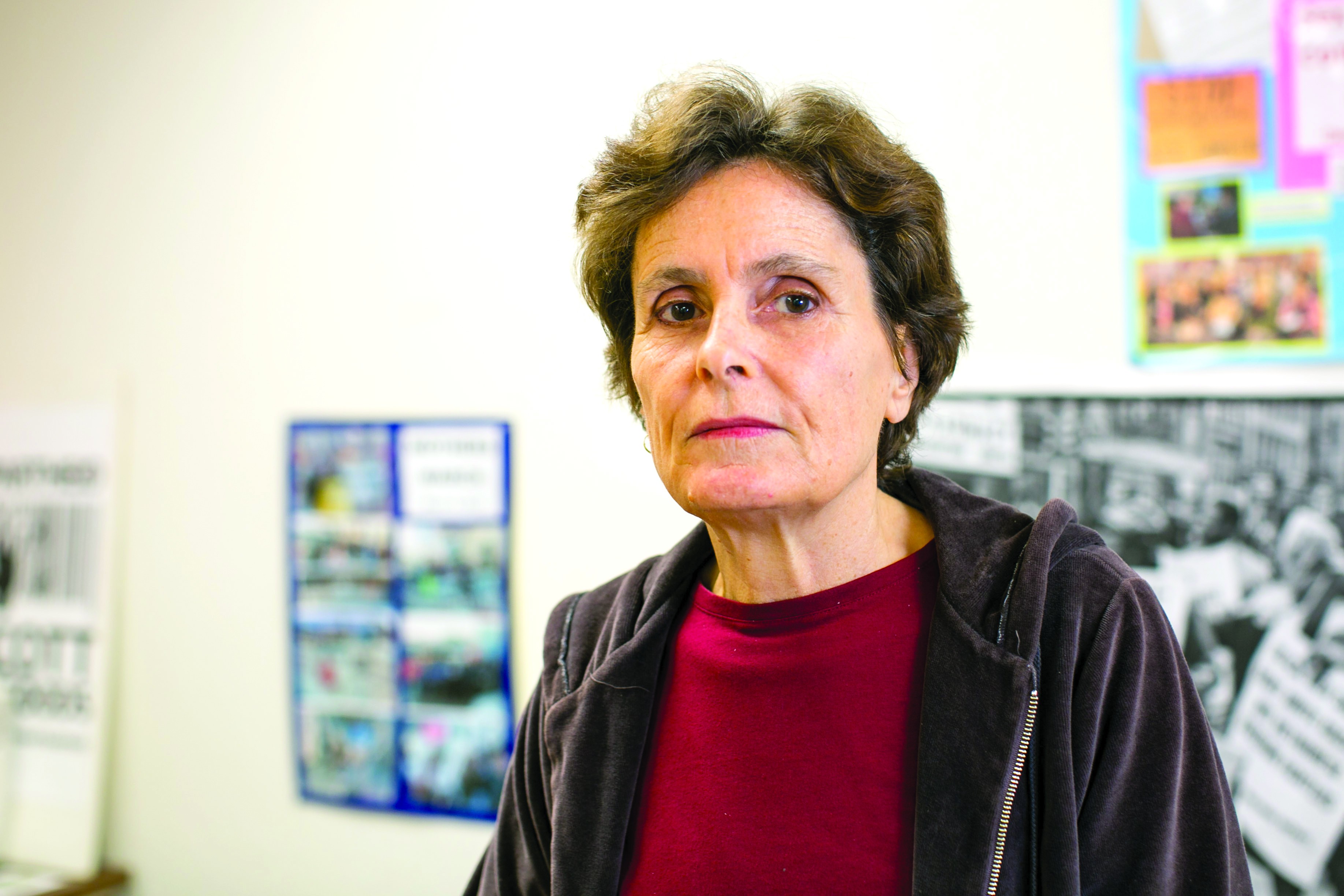
Sex worker advocate Rachel West says that police target adult prostitutes in the name of rescuing kids.
Credits: Bert Johnson/File photo
Alexandra Lutnick, researcher with RTI International, found that while California overall is arresting significantly fewer minors for prostitution, Alameda County’s rates have stayed the same.
Credits: Bert Johnson
The sex worker, an African-American woman in her late twenties, was the only suspect in the case. There were no children. In an interview, Marin County Sheriff’s Office Sergeant Nina Snyder said that the agency did not report this incident as a child sex case in its crime statistics — despite the fact that the official police report included the “sex crimes children” description. But activists and researchers say this is a common strategy across the country; law enforcement agencies arrest and charge adult sex workers — often low-income people of color and LGBT people — under the guise of protecting or rescuing child victims. Now, the Oakland City Council and Mayor Libby Schaaf have formally endorsed a controversial law enforcement initiative that activists say clearly promotes this same kind of bait-and-switch tactic.
On October 20, councilmembers Lynette Gibson McElhaney, Annie Campbell Washington, and Abel Guillén held a press conference promoting a resolution they co-sponsored with Schaaf that endorsed a national initiative called Cities Empowered Against Sexual Exploitation (CEASE). While those officials’ public statements emphasized their intent of protecting minors from trafficking and exploitation, the resolution, which the council unanimously approved, broadly targets sex work. In some places, the language makes no distinction between adult workers and child victims. The goal of CEASE is to “reduce sex-buying by 20%,” according to the Oakland resolution, which also states that the city supports one of the core values of CEASE: “The illegal commercial sex industry is inherently harmful.”
The “CEASE Network” — a collaboration of eleven municipalities across the country, including Alameda County — is a project of Demand Abolition, a Boston-based program dedicated to “eradicating the illegal commercial sex industry” by going after “demand.” That means targeting clients or “johns” who pay for sex. Demand Abolition is a program of Hunt Alternatives, the foundation of Swanee Hunt, a philanthropist and the daughter of conservative oil tycoon H.L. Hunt. The philosophy of Demand Abolition and CEASE is that the best way to stop both child trafficking and prostitution is to deter people from purchasing sex of any kind. The groups fund law enforcement and public media campaigns and advocate for stronger legal penalties. “If there’s no buyer, there’s no business,” said Lina Nealon, founding director of Demand Abolition, in an interview. “They’re the ones who are driving this entire industry.”
Critics, however, argue that when police agencies and district attorneys broadly target demand, they end up wasting resources on arrests and prosecutions that further criminalize adult sex workers and their clients — instead of prioritizing efforts to stop child traffickers. “They are using people’s justifiable horror at the abuse of children … to go after all demand,” said Rachel West, spokesperson for US PROStitutes Collective, a sex-worker advocacy group. “It’s a kind of moralistic crusade.”
Some fear the Demand Abolition approach does more harm than good by threatening the safety of marginalized workers in the sex industry. That was a concern of government officials in San Francisco, which last year ended a brief partnership with Demand Abolition after facing a backlash from adult sex workers. “Sometimes, efforts to address demand can have unintended consequences on vulnerable sex workers who are voluntarily engaging in sex work,” said Minouche Kandel, women’s policy director for the San Francisco Department on the Status of Women. Last year, the department was part of a collaborative that accepted an $80,000 Hunt Alternatives grant to participate in the national initiative that eventually became CEASE.
But after some discussion, the collaborative — which included San Francisco police, prosecutors, and service providers — ultimately decided to withdraw from the grant, according to Kandel. “We are trying to be very clear that there’s a distinction between sex work engagement by adults and sex trafficking. … We were trying to be nuanced in how we approach this,” she said. The collaborative planned to target the 20 percent reduction in sex-buying by focusing exclusively on people who purchase sex from minors and on people who commit violence against sex workers, Kandel said. But Demand Abolition insisted that San Francisco also agree to pledge that the sex industry itself is “inherently harmful.”
Nealon said survivors of prostitution and trafficking in her coalition felt strongly that all CEASE partners must support that statement.
San Francisco’s Department on the Status of Women does not take a position on prostitution, but works to ensure that women’s involvement in sex work does not prevent them from getting the help they need when they become victims of violence, Kandel explained. Activists argued that when police go after people buying sex from adults, it doesn’t eliminate prostitution, but rather forces workers to conduct their business in more covert and dangerous ways.
For example, when sex workers meet clients online, sex workers can share information with each other about violent men or offer reference checks for specific clients. But if police use these websites to target “demand” and arrest “johns,” workers can’t use the sites and lose the opportunity to vet clients. They may instead be forced to work on the streets, which is more dangerous. And when cops go after adult sex work on the streets, it can make it harder for workers to meet clients out in the open, which can lead to rushed transactions and increased safety risks.
“It doesn’t matter if it’s both parties criminalized or just one part of that equation … it pushes it further underground,” said Alexandra Lutnick, a senior research scientist with RTI International, a nonprofit research institute. “It makes clients leery. There’s not enough time to negotiate with clients or screen them for safety issues.” She noted that increased enforcement also makes it much harder for women to seek help from police when they actually need it — if a client assaults or rapes them, for example.
What’s more, adult sex workers also collect a lot of valuable information about predators, traffickers, and child victims — but they can’t share those tips with police if law enforcement is targeting them or their clients. “None of us want to see kids abused,” said Kristen DiAngelo, executive director of the Sex Workers Outreach Project Sacramento, who helped pressure San Francisco to decline the Demand Abolition grant. “These women want to help. But they can’t talk to police.”
Alexandra Lutnick, researcher with RTI International, found that while California overall is arresting significantly fewer minors for prostitution, Alameda County’s rates have stayed the same.
Credits: Bert Johnson
While some policymakers contend that their focus is on rescuing children, the reality of increased criminalization is that it can push both adult workers and minors into a criminal justice system that is more interested in prosecutions than providing services to these marginalized groups, activists said. Lutnick, who is based in San Francisco and has researched human trafficking and sex work, recently testified in Sacramento about alarming trends in arrests in Alameda County, which joined CEASE last year after San Francisco cut ties with Demand Abolition. Alameda County receives roughly $40,000 annually from Demand Abolition.
Using California Department of Justice data, Lutnick analyzed prostitution arrests by county and found that while the state on the whole is arresting fewer adults for prostitution, Alameda County’s numbers have climbed substantially. From 2006 to 2014, there was a 28 percent drop in prostitution arrests statewide, while in Alameda County, there was a 46 percent increase.
More troubling, while California overall is arresting significantly fewer minors for prostitution, Alameda County’s rates are the same as they were eight years ago, despite a 2006 California law that stated that all minors involved in the sex trade are considered trafficking victims — regardless of whether someone had coerced or forced them. Since the law was passed, California law enforcement agencies have arrested 67 percent fewer minors for prostitution. But Alameda County’s rates only dropped 5 percent. San Francisco, by contrast, has slashed its adult prostitution arrest numbers by 85 percent — and arrested only one minor for prostitution in 2013 and did not arrest any minors last year.
The data, critics say, highlights how Alameda County remains focused on criminalization — a practice that the Oakland resolution, which is a largely symbolic show of support for CEASE, only serves to reinforce. Spokespeople for Schaaf, Campbell Washington, and Guillén did not respond to multiple requests for comment for this report. Casey Farmer, spokesperson for council President Gibson McElhaney, told me that her office has not heard from any sex worker advocates. “These councilmembers have been very much focused on the impacts … on minors who are coerced,” Farmer added.
In a lengthy phone interview, Casey Bates, head of the Alameda County District Attorney’s human exploitation and trafficking unit, expressed anger at sex worker advocates’ opposition to Demand Abolition, calling the activists a “very well-organized vocal minority.” Targeting demand in the commercial sex industry is the best way to protect children from horrific abuses, he argued. “For years, we’ve only addressed the supply side. We’ve focused solely on arresting women and trying to capture the pimps. … It’s been terribly lopsided and actually really ineffective.” He argued that men who buy sex end up purchasing both adults and minors, so that when agencies arrest and prosecute all “johns,” it disrupts child trafficking.
Bates claimed that sex worker rights’ groups were essentially asking law enforcement to abandon child victims so that prostitutes could continue their business — which, he emphasized, is illegal. “To give johns a pass, which they have historically received, is not acceptable,” he said. Regarding the arrests of minors, Bates argued that in some cases, an arrest is the only way to get a child victim the help she needs to get off the street. “What’s the alternative? To leave the kid on the street to be further traumatized and raped?” he said.
Nealon, from Demand Abolition, emphasized that the group does not advocate for the arrest of sex workers or minors and instead wants CEASE partners to aggressively prosecute buyers while funding programs and services for child victims and workers. Bates and Nealon both also argued that the adult sex work industry is already underground and dangerous. “Unless we eradicate it,” Nealon said, “it’s never going to be safe.”
Oakland has no shortage of restaurants that wear their Town pride on their sleeves — a Warriors’ pennant on the wall, perhaps, or one of those This Is Oakland tourist guides propped open on the counter. But Big Momma’s Kitchen, a new family-run soul food spot in East Oakland, belongs in a category all its own.
One side of the restaurant is papered with a glossy, wall-length photo collage of professional athletes with Oakland roots — Bill Russell, Jason Kidd, Marshawn Lynch, and a dozen more. On the opposite wall, another collage functions as a who’s who of Oakland music (Hammer, Too $hort, En Vogue, and Tony! Toni! Tone! in all their glory), and a painting that memorializes the Occupy Oakland port shutdown, complete with the ghost of Malcolm X looking on beatifically from above.
The Oakland boosterism has a certain charm.
Credits: Bert Johnson
Big Momma’s signature shrimp rice.
Credits: Bert Johnson
The over-the-top boosterism has a certain charm, as does the bright, cozy-cafe vibe. But for all of the Oakland paraphernalia, New Orleans is the city to which Big Momma’s traces its culinary roots. Germane Thaxton, a manager at the restaurant, explained that chef-owner Isabella Coffey, aka Ma Bella, is a New Orleans native who has spent her past thirty-plus years in Oakland cooking, on and off, at local food festivals and for a soul food delivery service. Big Momma’s, her first restaurant, is located on a stretch of International Boulevard just outside the heart of the Fruitvale district, where taquerias and torta shops constitute the vast majority of the dining options.
The fried fish po’boy (left) and the shrimp rice were two standouts.
Credits: Bert Johnson
It’s not a part of Oakland where I’d expect to find some of the tastiest Louisiana-style po’boy sandwiches that I can recall eating in the East Bay, but that’s also part of Big Momma’s charm. Folks, these po’boys are the real deal — enjoyable precisely because they’re so simple. The fried fish version features tender pieces of cornmeal-crusted basa fillet and all the traditional po’boy toppings: lettuce, tomato, and pickles — plus pepperoncini (for a bit of pickle-y heat) and a tangy “secret sauce” whose composition the restaurant’s staff refused to divulge even in the vaguest of terms. (It fell into that Thousand-Island-dressing, remoulade-like family of secret sauces, with a just enough of a spicy kick to elevate it to a higher plane of deliciousness.)
But my favorite parts of the sandwich also happened to be the most lowbrow: the oozy layer of melted American cheese that clung to each piece of fish and the (non-traditional) soft sesame bun. The pleasure of the po’boy lay in its contrasts — the coolness of the creamy remoulade and uncommonly fresh lettuce and tomatoes against the piping-hot fried fish, whose exterior crunch made for a nice foil to the softness of the bread. Taken all together, it was like eating a suped-up, non-evil, extra-delicious version of a McDonald’s Filet-O-Fish sandwich — high praise if you like that kind of thing. A fried shrimp po’boy made up of similar components was just as good.
Aside from the po’boys, much of the rest of the menu at Big Momma’s consists of the standard array of dishes that you’ll find at any other soul food restaurant in town. It’s the kind of place where there’s a big pitcher of Kool-Aid in the fridge, and where desserts tend to be versions of classic Southern recipes, like pound cake made with 7-Up.
One point of distinction is that all of the meat is Halal-certified, a fact that may be of interest to both practicing Muslims and those looking for meat of slightly better provenance than the factory-slaughtered stuff sold at, say, your run-of-the-mill fried-chicken joint. Here, the fried chicken was better, and juicier, than average — fried until the skin blisters and puffs out, then dusted with Cajun spices. Go for the thighs and legs, though; the one time I ordered the “party wings,” they were overly salty.
The smothered turkey wings are also worth ordering. These were cooked low and slow, as they ought to be, until the meat came clean off the bone with just a nudge, and the skin took on that lush, falling-apart quality that is the hallmark of this dish. But I missed the rice and big scoop of gravy that typically comes standard with these wings — eating them naked, perfectly cooked though they were, felt a little bit sad.
Meanwhile, the sides at Big Momma’s ranged from just passable to amazingly good. I had high hopes for the red beans and rice, given that they’re a New Orleans staple, but the beans were oddly thick and starchy, so that the gravy just kind of sat on top of the rice instead of soaking in and infusing them with meaty flavor. And the mac ‘n’ cheese was that gloopy, congealed-cheese laden style that tastes good hot out of the oven, but not so much when scooped out of a warming tray, like it is at Big Momma’s. On the other hand, the collard greens, prepared with Halal-friendly smoked turkey leg instead of pork, were pitch perfect — juicy and seasoned just right.
The fried fish po’boy (left) and the shrimp rice were two standouts.
Credits: Bert Johnson
As is the case at so many traditional soul food restaurants, the food at Big Momma’s takes a long time to come out. And the dish that took the longest of all — the shrimp rice listed as the restaurant’s “signature” side — turned out to be the single most delicious item on the menu. More similar in appearance to an Asian fried rice or Italian risotto than the soupy, tomato-based dish you might imagine when you think of a New Orleans shrimp and rice, this is a dish whose aromatic foundation is what’s known in Cajun and Creole cooking as the Holy Trinity: green bell pepper, onion, and celery, all chopped very fine. Add to that a healthy dose of garlic, some kind of red-tinged, shrimp-flavor-infused oil, and a handful of plump shrimp, and you wind up with an insanely rich and flavor-packed combination. I’d serve it for Thanksgiving in a heartbeat if I could figure out the recipe.
Two months in, Big Momma’s is still in soft opening mode, which means it hasn’t yet hired and trained enough staff to start opening early for breakfast (shrimp and grits, anyone?), as it plans to do eventually, or to launch its late-night takeout window. It also means that several of the dishes that are more unique to New Orleans aren’t regularly available. I kept eyeing the fried oyster po’boy on the menu, but for now it seems as if it’s only available off and on — off during both of my visits, sadly. Same goes for the jambalaya; I only knew about it because some Yelp reviewer had posted a picture.
One of the specials I did get to try, the oxtails, showed off what Big Momma’s touts as its “clean, fresh” approach. Most of the time, that’s just so much talk. But this was a dish that walked the walk: tender meat with the sticky, chewy, gelatinous texture that any oxtail lover will appreciate. But instead of the usual flour-thickened, murky-gray gravy, these oxtails come topped with a little flurry of chopped parsley, and the rice underneath soaked up a mixture of meaty juices and soft-cooked onion and carrot. It was as much like a French pot roast au jus as it was a traditional Southern oxtails preparation — not necessarily better, but different from what I expected, and very, very good. In Oakland, that’s the kind of cooking that feels right at home.
What this article didn’t say is that before the North Coast rivers were protected, dams were built. The Klamath River has three dams, the Mad River has one, the Eel River has one, and the Trinity River has two dams. The only rivers in the North Coast area that don’t have dams now are the Smith and the Van Duzen, both low-flow rivers. (The Van Duzen is dry this year for most of its course.)
Michael Icefire, Eureka
“Tax Evasion Is Not a New Technology,” Opinion, 10/21
Agreed
I am in complete agreement that taxes should be paid by all who live, work, and profit in Oakland to support the services they enjoy. To see companies like Twitter enjoy tax breaks from San Francisco while they occupy whole buildings on Market Street, or Boeing forcing tax reductions from Washington state while it rolls in profits angers me. Why should they enjoy the benefits of an educated workforce, a peaceful environment, and lucrative governmental contracts (at least in the case of Boeing) while they refuse to pay their fair share? Do they really think the American people will continue to support their profiting from our country while they do not contribute to its continuing support? While Ms. [Rebecca] Kaplan is not necessarily the best to articulate these issues, I fully support the notions expressed in this statement.
Peter Stokes, Oakland
“Oakland Takes Baby Steps,” Seven Days, 10/21
We Need Market-Rate
The Express seems to have taken the issue of housing equity and displacement to heart — and with good reason. Only a fool would dismiss the current housing affordability crisis as negligible or not warranting robust civic response.
It’s severely misguided, though, to assert that any significant part of our current crisis is due to a failure to mandate inclusionary housing in market-rate projects. Affordable housing mandates can be a powerful tool to bring much-needed affordable units into our community, yes, but the author ignored a significant detail which negates the argument.
We aren’t building any market-rate housing in Oakland.
In 2014, we built 788 units total, of which 72 percent were affordable housing projects. If each unit holds two people, you could fit everyone who has found a home in these units on a single BART train.
We could require market-rate projects to build 50 percent affordable housing, but 50 percent of zero units is still zero units. Oakland needs to make the city attractive enough to private developers so that we can lure them from investment in Berkeley, Emeryville, and San Francisco, because until we start seeing the scale of private investment in Oakland housing that would allow us to tap into it for the public good, affordable housing mandates are nothing more than a new tap in a dry well.
Tony Albert, Oakland
“Oakland’s Big New Pot Plan,” Legalization Nation, 10/21
Lift the Cap!
“Some existing clubs don’t want the competition.” There is only one reason why you would not want to lift the cap on the number of medical cannabis dispensaries in Oakland, create competition, and drive prices downward: Rent-seeking.
This same phenomenon exists in every industry. Those who have control don’t want anyone else to have it. This inevitably creates a static and toxic environment for consumers. It’s why companies like Uber (love ’em or hate ’em) have been so successful at disrupting a broken industry like taxis. For years upon years, taxi medallion owners opposed any increase in the number of medallions despite numerous studies showing how underserved San Francisco was.
I say let’s have as many as possible and let the market decide who gets to survive (with reasonable regulations regarding the location of dispensaries). Why should consumers subsidize poorly run businesses? We shouldn’t.
Gene Keenan, Oakland
“Oakland’s Culture Clash,” Seven Days, 10/14
Oakland Needs a Housing Impact Fee
Robert Gammon offers a few suggestions to Oakland’s new residents to help ease the tensions of displacement. But beyond strolling Lake Merritt or visiting a Fruitvale taco truck, both new and long-time residents need to get engaged and hold our elected officials accountable to their recently passed Housing Equity Road Map.
As the Express has pointed out repeatedly and James Vann highlighted in a recent article, Oakland has been slow to adopt the kinds of regulations on developers that have long been the norm in other cities like Emeryville or Berkeley. An impact fee, a key recommendation of the Road Map, would help ensure that developers who benefit from Oakland’s significant investment in zoning and infrastructure pay a share of their profits forward to the community.
While some critics argue that new market-rate housing alone will relieve the region’s housing shortage and promote affordability, the Bay Area’s broken housing market will never build homes truly affordable to working families, seniors, or people with disabilities.
Many of the jobs at Uber will not be high-paying tech jobs but lower-paying clerical and administrative jobs, and those people will need homes they can afford. While the recent announcement that Uber will pay approximately $1 million for affordable housing under the city’s existing commercial linkage fee program is a big step, it’s only a first step (and another case of a big company getting kudos for simply following a law already on the books). The city has a responsibility to help generate more funds for affordable homes from residential development as well so that all Oaklanders can benefit from new economic growth, live close to jobs and transit, and stay in their long-time communities.
Asking private developers to contribute to affordable housing is by no means a silver bullet — but it’s the least we can do. And we don’t need to sell Oakland short. Yes, for years, this city lacked the kind of investment that flowed to our neighbors — and we’re due a share of that prosperity. But if Berkeley can consider charging $30,000 a unit and Emeryville can approve a $28,000 per unit impact fee, Oakland should look at these numbers as important frames of reference. Because 27 other Bay Area cities have fees or inclusionary requirements, it’s not even a risky policy move. What will take political guts is making sure that the fee is high enough to make a difference, that thousands of units in the pipeline aren’t exempted, and that most of it is devoted to housing — other crucial needs like libraries and parks should be prioritized through the city budget instead. A city as big and vibrant as Oakland — with a worsening housing affordability crisis and an incoming tech giant — can’t afford to remain behind the times.
Ask your councilmember to pass a real developer fee that will help build more permanently affordable homes. And tell them they need to enact the tenant protections, condo conversion laws, and other recommendations developed in the Housing Equity Road Map and being considered by the mayor’s housing cabinet. We need solutions now, and they’re within reach.
Gloria Bruce, executive director of East Bay Housing Organizations, Oakland
Until recently, Helen Stoltzfus had never had a conversation with a US military soldier or veteran. Like most Americans, her knowledge of the wars in Iraq and Afghanistan was limited to news reports. “Most of us experienced war at a distance. … We watched them on our TV and our computer,” she said in an interview. Four years ago, Stoltzfus and Albert Greenberg, who are co-artistic directors of the Oakland-based performing arts nonprofit Black Swan Arts and Media, decided they wanted to find a more personal and meaningful way to understand the conflicts overseas.
On November 11, Black Swan will present The Prepared Table, an interactive, multimedia performance event that grew out of that desire for better understanding. Billed as an “alternative Veterans Day event,” the one night production will feature first-person stories from US military veterans and Iraqi and Afghan refugees, a diverse mix of dance and musical performances, and an elaborate dinner feast. It’s designed to give audience members — or “dinner guests,” as the directors described them — an intimate, and at times emotional, experience.
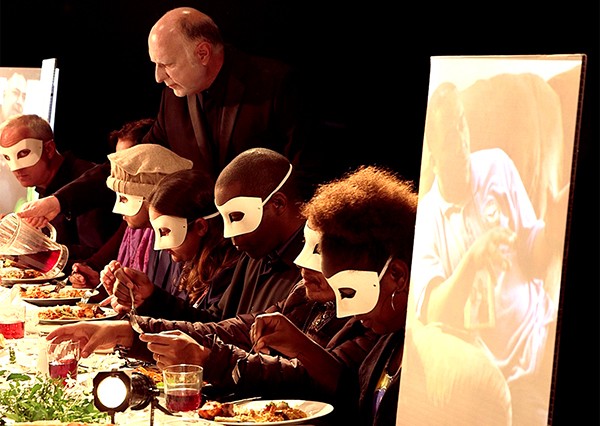
In The Prepared Table, audiences are immersed in a multimedia dining party performance.
Credits: Black Swan ArtsIn The Prepared Table, audiences are immersed in a multimedia dining party performance.
Credits: Black Swan Arts
Roughly ninety guests will crowd around tables at the Bellevue Club (525 Bellevue Ave., Oakland) for a four-course meal featuring foods from Iraq, Afghanistan, and a typical US military base. At the same time, Black Swan Arts will use screens throughout the space to project videotaped interviews with Iraqis, Afghans, and US veterans who have shared personal reflections on the impacts of war. And there will also be a series of live performances featuring roughly a dozen musicians and dancers, including a Palestinian-American vocalist who will sing a selection from the Quran; an Afghan-Filipina dancer and singer; a Latino beat-box artist; and two jazz horn players.
Black Swan Arts — formerly called ALICE Arts — partnered with a number of California immigration groups to connect with Bay Area refugees who have lived through war in Iraq and Afghanistan. The organization also collaborated with a Cal State East Bay journalism class to conduct interviews with local veterans. “Everybody’s got an opinion about war and none get close to the people who have lived it,” said Greenberg. “We live in our own bubble away from them, and it’s not healthy. We’re in an endless war, and it’s not going away.” The project — which Black Swan Arts eventually hopes to tour at museums and military bases — aims to shine a light on the atrocities of war while celebrating the Bay Area’s role as a safe harbor for both refugees and veterans.
Stoltzfus said she hopes the feast can bring people together in a way that traditional performances cannot. “The food actually tells the story. … They are literally ingesting the stories,” she said. “We wanted that direct contact.”
On Sunday afternoon, during Día de los Muertos, the Impact Hub event space in Uptown Oakland was packed to the brim with social justice activists and Slow Food types who had gathered to celebrate Decolonize Your Diet, a new Mexican-American cookbook by two Oakland-based professors. Organized by the Oakland Food Policy Council, the event had a vibe more akin to a religious revival meeting, or perhaps a call to revolution, than your typical prim-and-proper book launch.
Calpulli Coatlicue, an Aztec spiritual dance group, started the meeting with a prayer in the form of thumping drums. Food activist Bryant Terry quoted the opening lines of “Beef,” hip-hop legend KRS-One’s anthem against industrial meat. And Gustavo Arellano, the Orange County-based Mexican food expert, argued that the only truly “authentic,” precolonial Mexican cuisine was the mostly plant-based fare that is the subject of Decolonize Your Diet.
Food of the ancestors.
Credits: Tracey KusiewiczFood of the ancestors.
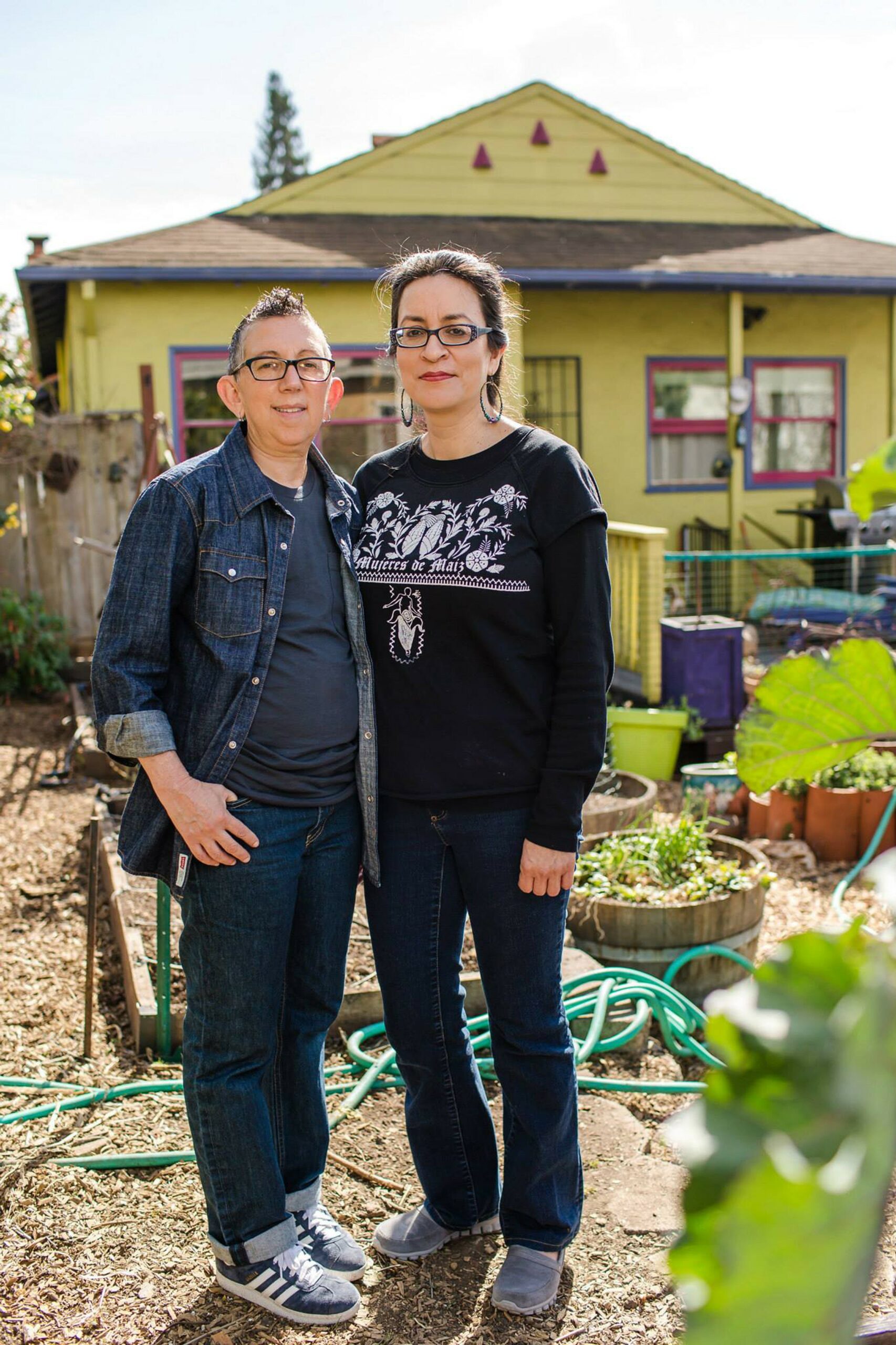
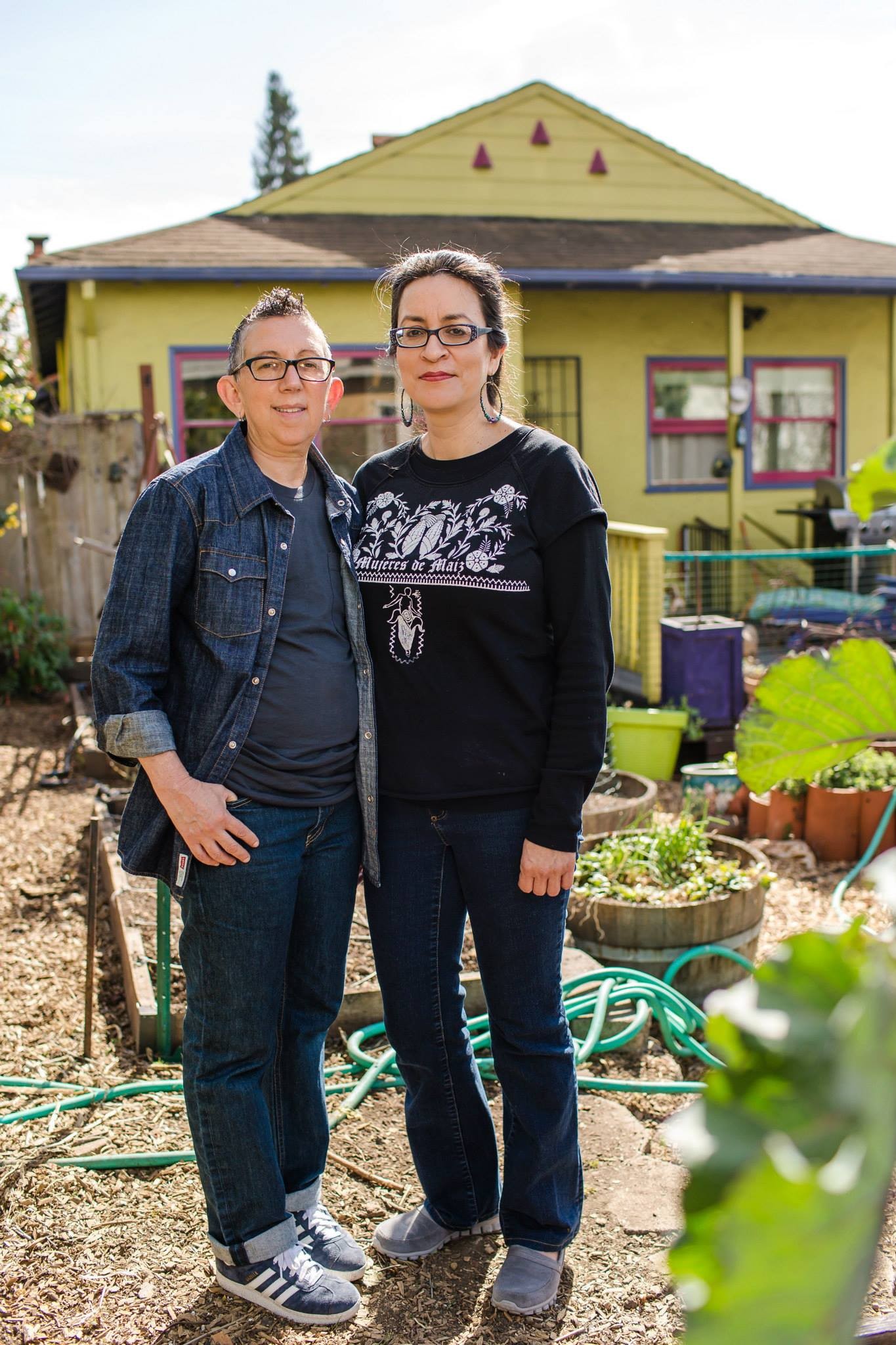
Credits: Tracey KusiewiczDecolonize Your Diet authors Luz Calvo (left) and Catriona Esquibel.
Credits: Miki Vargas
For authors and life partners Luz Calvo and Catriona Esquibel, the cookbook is the culmination of years of research and conversation. The genesis of the project was Calvo’s breast cancer diagnosis and subsequent recovery in 2006, which led the couple to reexamine their relationship to food — and how their diet, and their people’s collective health, had been impacted by Mexico’s five-hundred-year legacy of colonization, from the arrival of the Spanish to the devastating effects that the so-called Standard American Diet has had on Mexican Americans in the United States. They concluded that the healthiest way to eat would be to go back to the traditional foods of their Mesoamerican ancestors, eschewing white flour, refined sugar, and the deep-fried, cheese-laden fare that many Americans associate with Mexican cuisine.
So, they started a small urban farm at their home in the Fruitvale district and began preparing traditional recipes using corn, squash, beans, and wild herbs. The project eventually grew into a course (“Decolonize Your Diet: Food Justice in Communities of Color”) that Calvo teaches at Cal State East Bay, a Facebook group with more than 14,000 followers, and, now, a cookbook.
In an interview, Esquibel said that although Decolonize Your Diet keeps a tight focus on ancestral Mesoamerican cuisine, she and Calvo also see themselves as part of a broader conversation — one that includes Terry’s efforts to reclaim the healthy, vegetable-centric roots of soul food, for instance. And while Decolonize Your Diet only contains plant-based recipes (because Calvo and Esquibel are both vegetarians), the authors acknowledged that for some people, eating a certain amount of meat might be an essential part of their cultural heritage. They acknowledged, too, that there might be positive outcomes from different food cultures coming into contact with each other. “It’s not like we’re trying to stop things in time and go back to some mythical past,” Calvo said.
But she added that it’s good to approach such changes with a critical lens: Was a new ingredient imposed on a culture, or was it chosen freely? Was it an ingredient that brought health or one that brought sickness and death?
Perhaps the biggest fear with a cookbook that urges readers to return to a simpler, more wholesome way of eating is that the food won’t be very good — that, in this case specifically, what you’d end up with is a bland cuisine made up mostly of nuts and seeds. I can’t speak for the entirety of Decolonize Your Diet, but I did try a few bites of the sample dishes that were on offer at the book launch and had been prepared, based on Calvo’s recipes, by People’s Kitchen — a nonprofit, community-oriented, traveling restaurant of sorts based in Oakland. There was a light, tangy cashew-based crema. There was a red salsa I couldn’t stop eating — smoky, brightly acidic, and complex in its layers of flavors in a way that reminded me of a good mole.
Perhaps most interesting of all, there was a kind of pumpkin-seed dip known as requesón de semilla de calabaza — a nutty, lime-green mixture with the texture of ricotta cheese. The recipe was of particular significance to Calvo and Esquibel because they’d found it, in an obscure Mexican archaeological journal, right before the cookbook was to be published — and because the dish hails from the Sonoran region of Northern Mexico, where both authors have familial roots.
“When I put it on a warm corn tortilla to test it, it almost brought tears to our eyes,” Calvo said. “It felt like the ancestors were with us as we completed the cookbook.”
Luz Calvo (left) and Catriona Esquibel.
Credits: Miki Vargas
On Sunday afternoon, during Día de los Muertos, the Impact Hub event space in Uptown Oakland was packed to the brim with social justice activists and Slow Food types who had gathered to celebrate Decolonize Your Diet, a new Mexican-American cookbook by two Oakland-based professors. Organized by the Oakland Food Policy Council, the event had a vibe more akin to a religious revival meeting, or perhaps a call to revolution, than your typical prim-and-proper book launch.
[jump]
Calpulli Coatlicue, an Aztec spiritual dance group, started the meeting with a prayer in the form of thumping drums. Food activist Bryant Terry quoted the opening lines of “Beef,” hip-hop legend KRS-One’s anthem against industrial meat. And Gustavo Arellano, the Orange County-based Mexican food expert, argued that the only truly “authentic,” precolonial Mexican cuisine was the mostly plant-based fare that is the subject of Decolonize Your Diet.
For authors and life partners Luz Calvo and Catriona Esquibel, the cookbook is the culmination of years of research and conversation. The genesis of the project was Calvo’s breast cancer diagnosis and subsequent recovery in 2006, which led the couple to reexamine their relationship to food — and how their diet, and their people’s collective health, had been impacted by Mexico’s five-hundred-year legacy of colonization, from the arrival of the Spanish to the devastating effects that the so-called Standard American Diet has had on Mexican Americans in the United States. They concluded that the healthiest way to eat would be to go back to the traditional foods of their Mesoamerican ancestors, eschewing white flour, refined sugar, and the deep-fried, cheese-laden fare that many Americans associate with Mexican cuisine.
So, they started a small urban farm at their home in the Fruitvale district and began preparing traditional recipes using corn, squash, beans, and wild herbs. The project eventually grew into a course (“Decolonize Your Diet: Food Justice in Communities of Color”) that Calvo teaches at Cal State East Bay, a Facebook group with more than 14,000 followers, and, now, a cookbook.
The requesón de semilla de calabaza is the lime-green dip to the left.
Credits: Tracey Kusiewicz / Decolonize Your Diet
In an interview, Esquibel said that although the book keeps a tight focus on ancestral Mesoamerican cuisine, she and Calvo see themselves as part of a broader conversation — one that includes Terry’s efforts to reclaim the healthy, vegetable-centric roots of soul food, for instance. And while Decolonize Your Diet only contains plant-based recipes (because Calvo and Esquibel are both vegetarians), the authors acknowledged that for some people, eating a certain amount of meat might be an essential part of their cultural heritage. They acknowledged, too, that there might be positive outcomes from different food cultures coming into contact with each other. “It’s not like we’re trying to stop things in time and go back to some mythical past,” Calvo said.
But she added that it’s good to approach such changes with a critical lens: Was a new ingredient imposed on a culture, or was it chosen freely? Was it an ingredient that brought health or one that brought sickness and death?
Perhaps the biggest fear with a cookbook that urges readers to return to a simpler, more wholesome way of eating is that the food won’t be very good — that, in this case specifically, what you’d end up with is a bland cuisine made up mostly of nuts and seeds. I can’t speak for the entirety of Decolonize Your Diet, but I did try a few bites of the sample dishes that were on offer at the book launch and had been prepared, based on Calvo’s recipes, by People’s Kitchen — a nonprofit, community-oriented, traveling restaurant of sorts based in Oakland. There was a light, tangy cashew-based crema. There was a red salsa I couldn’t stop eating — smoky, brightly acidic, and complex in its layers of flavors in a way that reminded me of a good mole.
Most interesting of all, there was a kind of pumpkin-seed dip known as requesón de semilla de calabaza — a nutty, lime-green mixture with the texture of ricotta cheese. The recipe was of particular significance to Calvo and Esquibel because they’d found it, in an obscure Mexican archaeological journal, right before the cookbook was to be published — and because the dish hails from the Sonoran region of Northern Mexico, where both authors have familial roots.
“When I put it on a warm corn tortilla to test it, it almost brought tears to our eyes,” Calvo said. “It felt like the ancestors were with us as we completed the cookbook.”
The California Board of State and Community Corrections (BSCC) has recommended that Alameda County receive $54 million for an expansion of Santa Rita Jail — a proposal that local activists say contradicts ongoing efforts to reduce mass incarceration. Yesterday, a committee of the BSCC — a state board that oversees certain state funds available for jails — selected fifteen counties to receive a total of $500 million in jail construction financing. That executive steering committee, which reviewed “Adult Local Criminal Justice Construction” funding proposals from a total of 32 counties, recommended that the Alameda County Sheriff’s Office receive the full $54 million it requested for a new “mental health” jail unit. The BSCC will take a final vote on the recommendations at its full board meeting on November 12.
As I reported in September, East Bay activists were recently shocked to discover that Alameda County was quietly pursuing state funding for a jail expansion project. The proposal was particularly troubling given that in March, the Alameda County Board of Supervisors agreed to reduce jail funding and prioritize social services — a central goal of the “Jobs Not Jails” campaign of the Ella Baker Center for Human Rights, an Oakland-based nonprofit. Despite that March resolution, the board of supervisors over the summer authorized the Alameda County Sheriff’s Office, which oversees Santa Rita Jail in Dublin, to seek up to $80 million from the state for jail construction. The board unanimously authorized the sheriff’s request as part of an obscure package of budget and contract proposals. The sheriff’s office ultimately requested $54.3 million from the BSCC.
[jump]
In September, the sheriff’s office and the BSCC declined my public records requests (and the requests of activists) to release copies of Alameda County’s proposal, which raised further concerns about the lack of transparency surrounding this initiative. The sheriff’s office had earlier told the board in a short memo that it wanted to build a new “Mental Health Program and Services Unit” in Santa Rita Jail, which would include housing, administrative offices, mental health treatment programs, and reentry services for mentally ill inmates.
Despite the sheriff’s plans to focus on mental health services, advocates said that they oppose jail expansion projects that could incentivize the county to fill a new unit and keep offenders locked up longer than they should be. Critics have argued that counties across California should be focused on reducing their inmate populations and increasing investments in community-based mental health programs and other social services. Prisons and jails, which have a poor record of rehabilitating inmates, are not an appropriate setting for the kind of mental health treatment that many inmates require, according to advocates.
In a recently released report scrutinizing jail spending across the state, Californians United for a Responsible Budget (CURB), a coalition that opposes jail expansions, pointed out that many low-income inmates are stuck in jail awaiting trial simply because they can’t afford to pay bail. What’s more, Proposition 47 — a 2014 voter-approved measure that reclassified some minor offenses from felonies to misdemeanors — has already led many counties to reduce their jail populations. That means it’s a critical time for counties to support community-based programs and reentry services, as opposed to jail construction projects, according to CURB. The coalition attended yesterday’s BSCC committee meeting and is planning on speaking out against the construction funding recommendations at the November 12 meeting.
A “Jobs Not Jail” protest at the Alameda County Board of Supervisors earlier this year.
Credits: Courtesy of Ella Baker Center
The $500 million available for jail construction financing comes from Senate Bill 863, legislation passed in 2014. The SB 863 projects, according to state guidelines, should be focused on replacing or renovating outdated or unsafe jail facilities or building new units dedicated to rehabilitative services or mental health care. The construction projects should not increase a jail’s capacity, unless a county has evidence of a deficiency in its number of beds, according to the state.
Alameda County today sent me a copy of its 61-page proposal, though it redacted roughly ten pages throughout the report. (According to the Office of the County Counsel, the redacted portions contained sensitive information that the county is not obligated to disclose.) In the proposal, the sheriff’s office detailed deficiencies in the mental health services that the county currently offers at Santa Rita Jail. The county currently houses an average of 2,410 jail inmates per day — and roughly 20 to 25 percent of them have some kind of documented mental illness, according to the proposal. Due to limited space in Santa Rita Jail, inmates often have counseling appointments in housing units or common areas that lack privacy. “The environment is not appropriate for therapeutic care and is not conducive for the inmate to speak openly with the mental health professional,” the sheriff’s office wrote.
The new mental health unit would involve the construction of an approximately 38,000-square-foot, two-story wing that the jail would use for treatment, programs and services, housing, and administrative space.
In addition to Alameda County, the BSCC committee yesterday jail recommended funding for San Francisco, Santa Clara, Ventura, Amador, Colusa, Yuba, Trinity, Humboldt, Butte, Sonoma, Yolo, Merced, Placer, and Napa counties. Today, a board spokesperson sent me this summary of yesterday’s recommendations:
This weekend, Oakland residents can drop off unwanted mattresses and other bulky items for free at Waste Management’s Davis Street Transfer Station in San Leandro (2615 Davis Street). On Saturday, November 7 from 10 a.m. to 2 p.m., residents are allowed to dump two pieces of furniture, two large appliances, four mattresses, four passenger auto tires, and unlimited electronics, according to an announcement from Waste Management. Residents should bring proof of residence.
As part of the corporation’s new waste contract with the City of Oakland — which went into effect in July and has sparked widespread backlash over exorbitant rate increases for commercial composting and other services — the company agreed to add services aimed at helping the city tackle illegal dumping.
[jump]
As I noted in a 2013 cover story, Oakland has long suffered from an illegal dumping epidemic with mattresses, furniture, and other large items frequently piling up on streets throughout the city — contributing to significant blight in pockets of West Oakland and East Oakland in particular. Part of the problem is that many Oakland tenants have not had any affordable and convenient way to get rid of these items when they move. The new contract seeks to address this by offering four free bulky drop-off events a year and allowing residents of single-family homes and apartment buildings to schedule bulky pick-ups once a year. Waste Management also has a crew that cleans and hauls debris from 25 illegal dumpsites per day in Oakland, according to the company’s announcement.
In general, residents can drop off large items at Davis Street any day Monday through Saturday, but typically have to pay a fee for item, which often deters people from taking advantage of this option; you can read the specific rates here.
Oaklanders in single-family homes who want to schedule a bulky pickup at their home can find details here. And apartment building property managers can find information about scheduling pickups here.
The cover of Adrian Tomine's newest collection of graphic short stories, Killing and Dying, is partially based on Emeryville. Tomine's illustration pictures a specific Denny's restaurant in Pasadena, surrounded by a nondescript strip mall — an entirely concrete landscape with a solely commercial purpose. In a recent interview, the artist and author said that...
Rapper L-Deez (Laurence Walker) has been active in Oakland's underground music scene since the early Nineties, but few of his recordings have survived into the digital age. In the era of "pics or it didn't happen," facets of culture that aren't meticulously archived online tend to get lost. L-Deez' music, which he previously had only pedaled in...
In the spring of 2011, an officer with the Marin County Sheriff's Office contacted a female escort via an adult erotic website to arrange a session. "Do you have time for me tomorrow? I would love to see you," he wrote in a message, according to police records. When he showed...
Oakland has no shortage of restaurants that wear their Town pride on their sleeves — a Warriors' pennant on the wall, perhaps, or one of those This Is Oakland tourist guides propped open on the counter. But Big Momma's Kitchen, a new family-run soul food spot in East Oakland, belongs in a category all its own.
...
"Damning California's Future," Feature, 10/21
You Forgot Something
What this article didn't say is that before the North Coast rivers were protected, dams were built. The Klamath River has three dams, the Mad River has one, the Eel River has one, and the Trinity River has two dams. The only rivers in the North Coast area that don't have dams now...
Until recently, Helen Stoltzfus had never had a conversation with a US military soldier or veteran. Like most Americans, her knowledge of the wars in Iraq and Afghanistan was limited to news reports. "Most of us experienced war at a distance. ... We watched them on our TV and our computer," she said in an interview. Four years ago,...
On Sunday afternoon, during Día de los Muertos, the Impact Hub event space in Uptown Oakland was packed to the brim with social justice activists and Slow Food types who had gathered to celebrate Decolonize Your Diet, a new Mexican-American cookbook by two Oakland-based professors. Organized by the Oakland Food Policy Council, the event had a vibe more akin...
Luz Calvo (left) and Catriona Esquibel.
Credits: Miki Vargas
On Sunday afternoon, during Día de los Muertos, the Impact Hub event space in Uptown Oakland was packed to the brim with social justice activists and Slow Food types who had gathered to celebrate Decolonize Your Diet, a new Mexican-American cookbook by two Oakland-based professors. Organized by the Oakland Food Policy Council,...
The California Board of State and Community Corrections (BSCC) has recommended that Alameda County receive $54 million for an expansion of Santa Rita Jail — a proposal that local activists say contradicts ongoing efforts to reduce mass incarceration. Yesterday, a committee of the BSCC — a state board that oversees certain state funds available for jails — selected fifteen counties to...
This weekend, Oakland residents can drop off unwanted mattresses and other bulky items for free at Waste Management’s Davis Street Transfer Station in San Leandro (2615 Davis Street). On Saturday, November 7 from 10 a.m. to 2 p.m., residents are allowed to dump two pieces of furniture, two large appliances, four mattresses, four passenger auto tires, and unlimited electronics, according...