The striped bass comments from someone in the [agriculture] industry are another red herring thrown out by the very people who have caused the destruction of the Bay-Delta ecosystem. You cannot divert more than 50 percent of the water from a system and expect it to function. Striped bass and salmon thrived together before the construction of the state and federal water projects. Fish need water. Get over it, and give it to them.
Ralph Kanz, Oakland
Here’s More
Great piece! A few other resources for readers to consider as a follow-up to this report are the formal complaint filed by the California Sportfishing Protection Alliance against the state water board’s actions granting temporary waivers of water quality protections to the state and federal water projects, found at WaterBoards.Ca.Gov/WaterRights. Also, regarding the point about mismanagement of the water projects, on behalf of Restore the Delta, I analyzed this behavior in a protest to the state water board. [Both documents can be found at WaterBoards.Ca.Gov/WaterRights/Water_Issues/Programs/Drought.] Happy holidays, everyone.
Tim Stroshane, Albany
“Oakland’s Lump of Coal for Businesses,” News, 12/2
It’s a Goodwill Gesture
Since most metered spaces have a two-hour limit, the holiday parking program doesn’t provide free employee parking or space hogging, it is mostly a goodwill gesture that encourages drivers to shop and dine during that limit rather than head to a mall.
By your reasoning, it would encourage walking or biking since driving would be more difficult.
Pamela Drake, director of the Lakeshore Avenue Business Improvement District, Oakland
Sam Levin Responds
Ms. Drake, while free holiday parking might seem like a goodwill gesture, research shows that free parking in commercial districts — whether time-limited or not — tends to make it harder for everyone to find convenient available spots. And Oakland’s large “free parking” marketing campaign this season directly encourages people to drive, which means many people are likely circling shopping areas for extended periods searching for spaces. If the city wanted to encourage alternative modes of transportation, it could instead promote walking, biking, and public transit in its holiday shopping ads — and provide direct incentives for those greener options, such as special shuttles or extra bike parking.
You Missed the Real Scandal
Anyone who lives and works downtown knows that free or fee, there’s plenty of parking downtown. There’s only a shortage during shows in Uptown because so many garages close before the shows get out, creating induced scarcity. Example: The Franklin Street Garage closes at 8 p.m. Monday through Friday, 6 p.m. on Saturday and is closed all day Sunday. It’s barely one and a half blocks from The Fox [Theater] and two blocks to The Paramount [Theatre], but it’s closed at night! Almost all Uptown garages close by 9 p.m. — that’s crazy! There’s the real story, not this half-assed report on free parking that happens six days a year. Oh, and the other story — how 60 to 100 percent of street-parked cars have handicap placards in downtown Oakland, when only 10 percent of the population is permanently handicap to begin with.
Matt Chambers, Oakland
“Goodbye, Mr. Magnus,” News, 11/25
He Will Be Missed
Chief Chris Magnus of the Richmond Police Department will be missed by all. It was a sad day when I learned that he would be moving to Tucson, Arizona. Chief Magnus changed Richmond for the better in many ways. The concept of community policing was new, and it worked very well in solving problems for Richmond. The crime rate went down, residents responded to his community outreach, and he was more visible than any other police chief that I recall as a 24-year resident of Richmond. In addition, he was very responsive to questions, emails, etc., and I especially appreciated the time he took to get to know the community. He will be missed, and the Richmond community hopes that the next police chief will continue the good work started by Chris Magnus.
Almost everyone these days seems to support the idea of outfitting cops with body-worn cameras. Police watchdog groups want cameras on cops to increase transparency and accountability and reduce misconduct. Police officials want to strap cameras on cops for other reasons: The technology acts as roving surveillance devices, collecting video evidence that can be used in investigations and court. Body cameras have also been used to clear officers of alleged misconduct, so a growing number of rank-and-file cops are happily strapping them on. But by far the biggest advocates of body cameras are the companies that make and sell the devices, and the cloud computing services that store and analyze the petabytes of video that the cameras generate. Police body cameras are estimated to be a billion-dollar market, and the leading vendors are now fiercely competing to prove their wares and win lucrative contracts.
Last summer, Taser International, one of the biggest companies in the police body camera industry, deployed lobbyists to Oakland in an effort to poach the city’s existing body camera contract from Vievu, a Seattle-based maker of body cameras and video management software. Taser International is best known for the electronic stun guns it popularized over the past two decades. But the fastest growing segment of Taser’s sales is body cameras. According to Taser’s most recent quarterly financial report, its camera sales have doubled over the last year and will top out well above $20 million in 2015.
Oakland police officers began to wear body cameras in 2010.
Credits: Darwin BondGraham/File photo
Oakland police officers began to wear body cameras in 2010.
Credits: Darwin BondGraham/File photo
Taser wants to elbow in on Vievu’s business with Oakland. To do so, Taser is relying on a former Oakland City Council staff member who now works for a Bay Area lobbying firm. In the past several months, Jason Overman, who used to be Oakland Vice Mayor Rebecca Kaplan’s director of communications, set up a series of meetings with city officials and Taser executives to show off the company’s latest body cameras and video management software called Evidence.com.
In a series of emails, Overman, who now works for the Barbary Coast Consulting lobbying firm, wrote to various city officials that Vievu is “a company whose cameras are wearing out, with a storage solution that hasn’t kept pace with the technology and struggles to integrate with The Cloud.” He circulated Taser brochures which had “prepared for the City of Oakland” written across the top, listing Taser’s various body camera product features.
According to city emails obtained through a public records request, Overman met with Mayor Libby Schaaf’s chief of staff, Tomiquia Moss, on July 1 to talk about the possibility of Taser replacing Vievu. Moss then arranged an internal meeting of city officials that was held on July 21 to discuss the future of OPD’s body camera technology program.
“We had our internal meeting to discuss the [c]ity’s current operations with our provider,” Moss reported back to Overman in a July 24 email. “OPD is willing to meet with you and the Taser folks to hear about what Taser is proposing.” A subsequent meeting was convened with top officials from Oakland’s police and information technology departments to listen to Taser’s sales pitch.
In a separate email to Oliver Luby — Councilmember Dan Kalb’s policy manager — Overman wrote that OPD’s existing Vievu body cameras are “aging and will require additional expense to maintain or replace,” and that “urging may need to come from the city council” to issue a new body camera contract to give Taser a shot at taking over the contract.
In another email to Councilmember Desley Brooks, Overman wrote that Taser’s body cameras are “tools to improve community-police trust.” Overman met with Brooks, who is chair of Oakland’s public safety committee, on August 19, according to the emails.
City records show that Overman met with at least thirteen different city officials, including every city councilmember except Larry Reid between July and September. According to city records, Overman was paid $15,000 by National Strategies, Inc., a Washington, DC lobbying firm that works with Taser to market its products to local law enforcement agencies.
Vievu has been Oakland’s sole police body camera vendor since 2010 when the Oakland City Council approved a $540,048 contract to outfit OPD with 250 cameras. Since then, OPD has purchased hundreds more cameras from Vievu, and Oakland police and technology staff have worked with Vievu to tailor its software, which manages the massive amounts of video footage that Oakland cops collect in the field. The cameras have become integral to almost everything OPD does, including criminal investigations, crowd control, testing the integrity of officers, and reviewing internal affairs cases. Oakland cops have become sought-after experts, advising other police agencies on technology and policy issues related to body cameras.
Overman said he could not comment about the meetings he set up between Taser and the city. But Taser’s executives are forthcoming about their aggressive effort to replace Vievu in Oakland. “We’ve won a lot of accounts back from Vievu,” said Taser spokesman Steve Tuttle in an interview.
“I think people have wrongly perceived us as being a weapons manufacturer,” said Tuttle. “The very notion of Taser is a technology. We’ve been a technology company since day one. We’ve been way ahead on this curve.”
Taser’s Axon brand of body cameras have twelve-hour batteries, a GPS tracking feature, and the cameras constantly record with a thirty-second buffer so that when an officer hits the record button it captures the previous thirty seconds of video and audio. Taser’s cameras automatically upload data to Amazon and Microsoft cloud services, and videos can be shared with other law enforcement agencies and prosecutors through the company’s Evidence.com web service.
“We’re going after an iTunes model, building an ecosystem,” said Tuttle about Taser’s cloud video platform, “letting the back-end drive the tools. We don’t buy our music that way anymore, so why would we do video evidence that way? It’s a management service.”
Vievu representatives did not respond to requests for comment for this report, but the company’s body cameras and software services are similar to Taser’s products. In a recent interview with Bloomberg News, Vievu’s CEO Steve Ward said that Oakland is his company’s largest customer.
Oakland Police Chief Sean Whent told the city council’s public safety committee last July that the department has considered opening up the body camera contract, and that he was meeting with a possible replacement vendor. But Whent said a new contract would be expensive and would pose complications.
“I’d be willing to bet that most of the vendors at this point will sell you a camera at dirt cheap, because the real the money is to be made on the storage,” Whent told the committee members. “The top vendor in the industry right now, for their cloud storage, is charging $99 a month per officer, so obviously with 560 [officers] deployed, and as the department grows, that number will go up — it is expensive.”
Earlier this year, the US Department of Justice handed out $22.5 million in grants to outfit 73 local law enforcement agencies with 21,000 body cameras. Oakland applied for one of the grants, but did not receive funding under the program, perhaps making a new contract less likely.
Oakland’s Assistant Police Chief Paul Figueroa took part in one of the meetings with Overman and Taser’s executives earlier this year. According to Figueroa, the department may not open the body camera contract after all. “I sent [Taser] an email a few weeks ago to say that we don’t have bandwidth to do a pilot program because we’re working with Microsoft moving everything to the cloud so we can move forward with our project at Stanford to do body camera analysis,” Figueroa said in an interview.
Figueroa said Oakland is currently focused on working with Stanford University professor Jennifer Eberhardt to analyze body camera audio data in order to create new risk management tools that will flag possible officer misconduct and help with police training and accountability. Eberhardt’s research team is also using body camera data to study police stops of motorists and civilians in order to measure possible racial bias. These projects require technical coordination among OPD, Stanford, Vievu, and Microsoft, and Figueroa said switching vendors right now might interfere with the projects.
Figueroa, however, left the door open to a possible contract. “To be clear, I’m interested in what works best for the City of Oakland,” he said. “Companies are very competitive with each other.”
“We would be 100 [percent] committed to maintaining the continuity of the Oakland research study around video and audio analysis,” wrote Taser’s spokesman Tuttle, in an email to me. Tuttle added that to outfit every Oakland cop with a camera could run about $700,000, and another $15 to $79 per officer, per month, for cloud services.
Regardless of whether Oakland reopens its body camera contract, other Bay Area police agencies are currently outfitting hundreds of their officers with the devices. Last month, San Francisco issued a request for bids to purchase 1,800 body cameras over several phases. San Jose also issued a request for proposal last month to buy 963 cameras. In August, the Emeryville Police Department began issuing Vievu body cameras to its officers, according to Captain Fred Dauer. And in October, the Alameda County Sheriff’s Department purchased 275 Vievu cameras for deputies in the Glen Dyer and Santa Rita jails.
As the City of Oakland continues to “study” ways to pay for affordable housing, the Berkeley City Council is acting decisively to deal with the current affordability crisis. Last week, the Berkeley council approved a major housing project in downtown in which the developer will pay $10.5 million for affordable housing in the city. The 18-story, 302-unit market-rate project, known by its address, 2211 Harold Way, is also environmentally friendly — it will meet LEED Gold standards — and will generate about $12.5 million in additional community benefits for Berkeley.
“I don’t think I’ve heard of a residential project that provided this much in community benefits,” said Councilmember Lori Droste, in an interview.
A rendering of the development at 2211 Harold Way.
Credits: Courtesy HSR Berkeley InvestmentsA rendering of the development at 2211 Harold Way.
Credits: Courtesy HSR Berkeley Investments
It’s hard to disagree with that statement, especially when considering the lack of progress that many other East Bay cities, especially Oakland, have made in funding affordable housing over the past few years. According to a Berkeley city report, the $10.5 million paid by the developer of 2211 Harold Way for affordable housing could be leveraged with state and federal grants to build 105 affordable units in the city.
And if that were not enough, the developer, HSR Berkeley Investments, also has committed to a project labor agreement to use union workers, will spend millions to refurbish the Shattuck Cinemas’ ten-screen movie complex, and will pay $1 million into the city’s arts fund.
“I think it’s really going to be an enormous shot in the arm for downtown,” said Councilmember Laurie Capitelli, in an interview. “It’s going to renovate all those shops on Shattuck [Avenue]. … I’m really excited about it.”
The Berkeley council’s forward-thinking decision on Harold Way represents a stark contrast to the absence of concrete action in Oakland. Indeed, while the current debate in Oakland has centered on whether market-rate developers should help fund affordable housing at all, in Berkeley, one of the main arguments concerning Harold Way focused on whether the developer was paying enough.
In an interview, Councilmember Jesse Arreguín, who abstained from voting to approve Harold Way, called the development a “good project,” but said he believes that the developer should have paid an additional $2.4 million for affordable housing. Arreguín noted that HSR Berkeley Investments benefited from an earlier decision by the council to temporarily discount the city’s housing impact fee — which helps fund affordable housing — from $28,000 a unit to $20,000. “I really wanted to see more affordable housing,” he said. “This project could do more.” Arreguín also argued that the Harold Way developer should have paid more in other community benefits — an assertion echoed by numerous speakers at least week’s council meeting, according to Berkeleyside.
A rendering of the new development at 2211 Harold Way.
Credits: Courtesy HSR Berkeley Investments
But Droste noted in an interview that the Harold Way developer ended up paying more in community benefits than an independent consultant hired by the city earlier this year said was economically feasible. In addition, the total amount to be paid by HSR Berkeley Investments was millions more than the developer had wanted (a fact Arreguín acknowledged). “I strongly believe that we got the best deal for Berkeley,” Droste said.
She’s probably right. If the council had forced the developer to pay more — either for affordable housing or community benefits or both — there’s a good chance HSR Berkeley Investments would have just walked away from the deal, meaning Berkeley would’ve gotten nothing.
And that’s exactly what some opponents of Harold Way wanted. For years, anti-growth activists in Berkeley have staunchly opposed dense housing in downtown — or anywhere else in the city. Some members of this contingent even join the argument that market-rate developers should pay more for affordable housing, because they know that if developers’ costs are too high, then they won’t build in Berkeley. Members of this group are now expected to sue to block the Harold Way development. (Arreguín is not a member of this group.)
Many of these same anti-growthers also call themselves “environmentalists.” But they’re not — not by a long shot. That’s because dense urban housing, especially smart growth projects like Harold Way, are eco-friendly by definition. True environmentalists have long agreed that one of the best ways to reduce greenhouse gas emissions — and curb suburban sprawl — is to build dense housing projects in urban areas near major mass transit lines so that people won’t have to drive long distances. Harold Way will be located right next to the downtown Berkeley BART station.
Thankfully, the Berkeley council majority in recent years has staved off the anti-growthers and strongly embraced transit-oriented development. The city also has done a good job discouraging car use and encouraging more people to walk, bike, or take mass transit. The Harold Way project, for example, will only include 177 parking spots for 302 residential units — far less than the one-to-one ratio required in other cities. In addition, other recent housing projects approved by the city have included very little parking — including two that were recently greenlighted by the zoning board.
The City of Berkeley also deserves credit for encouraging student housing, especially considering the fact that UC Berkeley has done essentially nothing to create housing and has been forcing students to pack themselves into homes or commute long distances.
The city, in short, is showing how it’s done when it comes to housing.
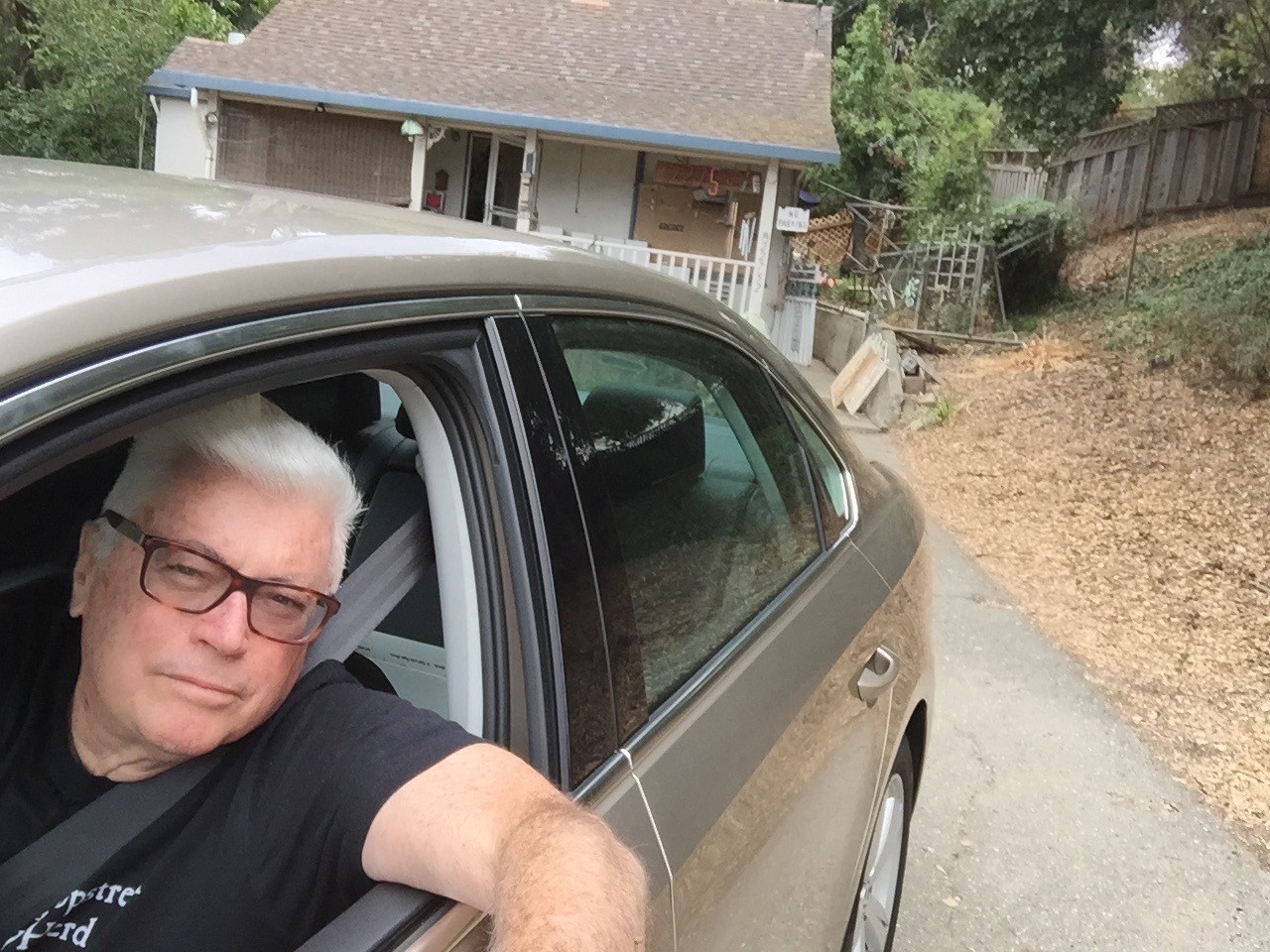
It isn’t exactly normal for a 77-year-old man to spend three months crisscrossing the country by himself in a leased Volkswagen Passat — zipping down freeways at an average speed of 85 miles an hour just so he can check out some agave distillery in Colorado he heard was experimenting with making apple brandy using crowdsourced, “found” apples. Then again, Bill Owens — the eternally curious founder and president of the American Distilling Institute and a legend in the East Bay craft brewing community — isn’t your typical 77-year-old.
“They only caught me three times exceeding the speed limit,” he said. “My attitude is catch me if you can.”
Bill Owens, at the start of his 17,000-mile road trip.
Credits: Bill OwensBill Owens traveled roughly 17,000 miles in search of the best ideas in microbreweries.
Credits: Bill Owens
The point, Owens said, is he isn’t sure how many years he has left in the tank — “and I’ve got stuff to do.” To wit: As president of a craft distillers’ trade organization, Owens plots one of these tours every three or four years. He just got back from this year’s edition, during which he covered 17,000 miles and visited 130 craft distilleries in a three-month span. His goal is mostly just to see what new and noteworthy innovations are happening in the industry he advocates for, and this year, he was struck by the fact that nearly every microdistillery he visited was trying to get bigger — adding a second still or acquiring a few extra fermentation tanks.
Bill Owens, at the start of his 17,000-mile road trip.
Credits: Bill Owens
It’s interesting, then, that Owens’ own big idea for the future is to go in the opposite direction: He wants to open a new Hayward nanobrewery — that is, a brewery that produces an even smaller volume of beer than a microbrewery — that draws its inspiration from the pop-up restaurants that are so ubiquitous in today’s dining scene.
Owens, who has a whole other career as an accomplished photojournalist, first made waves in the craft beverage world in the early Eighties, when he founded Buffalo Bill’s Brewery in Hayward shortly after California started allowing breweries to sell beer on their premises — a piece of legislation he helped advocate for — making it one of the first brewpubs in the country. One of his claims to fame? He’s widely cited as the brewer of the first commercially produced pumpkin ale in the United States. After he sold Buffalo Bill’s, Owens got so interested in distilling whiskey that he wound up founding the American Distilling Institute in 2003. That’s when he first started taking his periodic road trips.
In short, Owens has been at this for a while. But his latest idea is something that seems completely new. For his pop-up nanobrewery — which might include a “nanodistillery” component — Owens imagines that he would brew just thirty or forty gallons of beer at a time — a quantity small enough that he could sell it all in a day or two. The small volume would limit the brewery’s overhead costs, and, just as important, it would mean he could produce different beers all the time with a very short turnaround: Start brewing the beer on a Monday, and by the following Friday, he’d be ready to start selling it.
All of this is still just an “idea in formulation,” Owens said — but it’s an idea he believes is going to have its day very soon. And similar to dining pop-ups, he imagines his brewpub pop-ups would be able to set up at all different kinds of venues — restaurants, fairgrounds, art festivals, and more. He’s currently in talks with restaurateur Geoffrey Deetz, who’s plotting his own Vietnamese eatery, about the possibility of some food-oriented collaboration.
Of course, Owens’ talk of opening the tiniest, most nomadic little brewery anyone has ever seen comes at the same time the power players in alcohol industry — the Anheuser-Busches and SABMillers of the world — are only getting bigger. But Owens said he doesn’t care about all that corporate mediocrity. What he wants is to meet people who are growing their own wormwood to make absinthe — people growing their own lemongrass to put in a beer or a whiskey.
As for his own venture, his hopes are high. “I could brew a spice beer today and be selling it by Christmas Day,” he said.
On a recent evening, eight members of the female artist collective CTRL+SHFT gathered in their warehouse space in West Oakland around an edible potpourri of grapes, raspberries, candy corn, peach gummies, and chocolate cookies. Iced tea flowed and laughter echoed off the high ceilings of the 3,300 square-foot studio space and gallery, which the group had spent the last few months renovating themselves. One artist mentioned that people keep asking about the build-out in a tone expectant of failure, as if a democratic collective of twelve female artists would inevitably devolve into a cat fight. The circle resounded in agreement — every artist had been having the same experience. But each one had also been relishing the satisfaction of honestly replying, “It’s going great.”
All but two of the dozen artists in CTRL+SHFT graduated together this past May from the Masters in Fine Art program at California College of the Arts. They were nervous about finishing school — about losing a space to make art, losing their community, and attempting to navigate a world punctured by rent spikes. They found that they were all asking themselves the same questions. “How do we keep our practices going, how do we give ourselves a sense of accountability,” said member Channing Morgan, “and then also how do we do something that benefits the community at large — that’s not just about us but is about maintaining the arts in the Bay.” The only answer seemed to be to secure a space of their own.
Eight CTRL+SHFT members.
Credits: Sarah Burke
Eight CTRL+SHFT members.
Credits: Sarah Burke
The search for affordable studio space seemed almost impossible at first. They found themselves stretching the truth to skeptical landlords in an attempt to sound like anything other than twelve women wanting to make art. Finally, though, they found an empty warehouse on Chester and 34th Streets in West Oakland, a former set-building site for the theater company Shotgun Players. With scrap materials from old CCA studios that had been torn down, they built twelve studios and a gallery — the latter of which still needs finishing touches.
A large part of wanting to make the space all-female was to rid themselves of the predetermined limitations of women’s work that they feel pervade the art world. They wanted to nurture an environment unlike that of art school — which Morgan described as a “pressure cooker” with a “patriarchal” structure. “It just felt like kind of a boys’ club thing,” said Morgan, “so it didn’t feel inappropriate to take issues that were being swept under the rug and make that the focus.” And to relay that mission, “CTRL+SHFT” (a play on the computer key stroke) seemed appropriate to express their reclamation of power.
For the gallery, the focus will be a bit broader, encompassing other underserved groups in the art world as well, including artists of color and experimental artists. The gallery will open a new show every month, and curating will be done by rotating groups of two or three members. CTRL+SHFT also recently received a Southern Exposure Alternative Exposure grant that will go toward a year-long program of events that will include panel talks and film screenings in line with the group’s mission. The collective’s first show will be in mid January and will be an introduction to the work that its members make. After that, the shows will rarely include member artists in order to make room for others who might have a hard time finding wall space elsewhere.
Megan Reed, another member, said that throughout school, the Bay Area art scene seemed “precarious.” She was disheartened during her second year when she saw many crucial galleries shutter. But as she got close to graduation, she was re-inspired by the many alternative art spaces that were thriving through non-commercial methods of funding. Such spaces are constantly popping up in the East Bay, remaining resilient despite the economic circumstances. There are fewer such art spaces in New York City and Los Angeles — where artists often feel pressured to move to in order to succeed. The possibility of contributing to one such alternative space is what convinced Reed and many of the CTRL+SHFT artists to stay in the Bay Area. “Because it is so expensive around here, it’s just like in the air, people are taking less risks and they’re more scared to do things that are not proven to succeed, and that’s really not a happy space for artists,” said member Yerin Kim. “But there is always room — we got together twelve people and made room.”
Oakland singer and multi-instrumentalist Adee Roberson named her music project Tropic Green after a passage by the queer Jamaican author Michelle Cliff describing the vibrant flora of her native country. Roberson — whose family is Jamaican as well — recalled the strikingly vivid landscape that surrounded her when she last visited her ancestral homeland.
“The green wasn’t like here,” she recalled in a recent interview, fumbling to find the words to describe the precise shade of equatorial plant life.
Adee Roberson is a multi-instrumentalist and visual artist.
Credits: Bert Johnson
Adee Roberson.
Credits: Bert Johnson
Colors and nature factor prominently into Roberson’s new EP, Golden Light, which the independent label Crime on the Moon put out as a seven-inch record earlier this month. Each of the three songs on the Tropic Green project is dedicated to a different elemental force. “Golden Light” is a celebratory, sparse, dance track that celebrates the sun and people’s auras; “Ocean” is a hypnotic meditation on the vastness of unconditional love; and “In Tune with the Moon” reflects on the ways planetary movements affect human life.
“I’m a Cancer with a Pisces moon, so I’m basically just a beam that transmits energy from the moon — that’s all I got,” laughed Roberson as she explained the connections she sees between phases of the moon and aspects of her life, including her personal relationships and creativity.
“You know how people be like, ‘Aw man, the full moon is coming up. Damn, I feel stressed out — that’s the Gemini moon,'” she went on. “Or, ‘Oh shit, I feel comfortable in that Pisces moon. I got a lot of artwork done.’ It’s all about that shit.”
Though Roberson has been making music since the early Aughts, she has spent the past several years honing her visual art and massage therapy practices. Tropic Green is her first serious music project since the breakup of her previous group, New Bloods, which she started in Portland.
For the past fifteen years or so, Roberson — who is originally from South Florida — has moved around the country to different cities with strong punk enclaves: Pensacola, Florida; New Orleans; Portland; and Oakland. She has played in bands, made zines, painted, and collaged. Tropic Green represents a culmination of her visual art and music practices. She debuted the project through a music video for “Golden Light” that features her as a dancer, edited via green screen, on the Nineties, Soul Train-esque cable series The New Dance Show; she personally screenprinted each record sleeve; and her upcoming record release show on December 19 at Real Time & Space in Oakland will feature a dance performance and visual projections by members of her art collective, Black Salt Collective.
Putting out Golden Light on vinyl, she said, was a deliberate choice, as many of her previous creative endeavors have centered on tangible, DIY media. “I don’t feel good about only having something in the digital realm. I want something I can hold and look at,” she said, inviting me to look through her crate of Golden Light records. I admired the iridescent shades of purple, teal, and cobalt blue on the different sleeves, which were emblazoned with an image of the planet Saturn. “The covers are all screenprinted, double screen,” she said. “It’s energy you put into something. And I’m a visual artist, so I can’t have it be looking busted.”
While Roberson’s primary musical experience prior to Tropic Green was as a drummer, for Golden Light, she experimented with singing and electronic production. Its three tracks feature sparse, pulsating beats. Her deep, droning voice constitutes the primary melodic element, though low, distorted synth notes, laser-beam sound effects, and trembling, frenetic violin phrases mingle throughout.
Adee Roberson is a multi-instrumentalist and visual artist.
Credits: Bert Johnson
As Roberson initially produced the tracks using a keyboard and drum machine, she recruited veteran Bay Area violinist India Cooke — who has played in several prestigious orchestras and once toured with Sun Ra — to feature on the record. Cooke’s sporadic, improvisatory playing adds unexpected tension to Roberson’s steady, undulating beats, lending Golden Light a brooding quality.
Cooke is “the kind of person who you watch play and you don’t even register what’s happening, but the next day you’re crying and bawling because it’s such an energetic release,” said Roberson.
Roberson also collaborated with New York musician and sound engineer Christina Files on the record’s production. While they initially began working together long distance, Roberson eventually joined Files in New York City to finish the record. Hannah Lew of the local pop punk band Cold Beat, who is also the owner of Crime on the Moon, was also intimately involved in the recording process.
Files is “the kind of person who has the drum machine that was used on Blondie’s Heart of Glass,” said Roberson. “If you say to her, ‘I want something to sound like Black Sabbath’s album,’ she’ll be like, ‘Yeah, this synthesizer was used on it. So was this type of guitar and this type of drum set.’ That’s the kind of brain Christina has.”
Fluorescent mixed-media paintings lined the walls of Roberson’s art studio, where we spoke. Many of them are celebratory portraits of Black individuals adorned with vibrant, abstract patterns. Examining these joyous visuals, Roberson pointed out that Afrofuturist thinking informs her approach to her various creative projects and has been a fertile source of inspiration for Tropic Green. Though Roberson has spent years orbiting punk scenes in difference cities, she recalled feeling alienated as one of the only people of color in various countercultural milieus. In Oakland, she found a community of fellow Black artists with left-field aesthetic sensibilities, and the city has proven to be a welcoming place for the kind of work she is interested in making.
“It feels really important to be a musician or someone who makes art and is Black and is all about creating a vision for the future because the present is really fucking dooming and depressing,” she said. “Afrofuturism is really powerful in that sense: It’s imagining a future without violence and oppression and hoping that imagination lends itself towards that really happening.”
The King of Pentacles tarot card pictures a seasoned patriarch reclining on his throne with various symbols of affluence scattered around him. He has finally arrived at a place of leisure and abundance after years of effort, and the card represents the ultimate culmination of his worldly achievements. E-40 channels this archetypical figure on his new, self-released EP Poverty and Prosperity, a soulful, seven-track meditation on his modest beginnings and ascent to boss status.
Over the past three decades, E-40 has demonstrated a remarkable knack for adapting to changing trends while still retaining an iconic sound. His approach has always been forward-thinking, and throughout his career, he has continued to coin new slang and experiment with novel production styles rather than relying on successful gimmicks.
On Poverty and Prosperity, he unexpectedly returns to hip-hop’s old school with soul, funk, and gospel-tinged beats rife with analog instrumentation. The nostalgic production allows E-40 to time-travel to his childhood and adolescence, emerging with narrative-driven verses that detail his early life in a rough Vallejo neighborhood. E-40’s rapping is ostentatiously complex throughout, combining skillful storytelling with intricate rhyme schemes and wordplay.
At times, the record is unabashedly sentimental, especially on tracks such as “Appreciation,” on which Forty Water raps about cherishing loved ones over a church-worthy organ ballad. With the exception of “God Take Care of Babies & Fools” — which has the kind of bass-heavy, minimal beat that could make the trunk of a Cutlass Supreme quake — we don’t see much of the cocky lyricist from “707,” “Function,” and “Choices.” Instead, Poverty and Prosperity is refreshingly humble and vulnerable. As a longtime pillar of the Bay Area’s rap scene, E-40 has every right to take a moment to look back and take in his many feats and accomplishments — even if it occasionally gets a little mushy. (Heavy on the Grind Ent.)
E-40 gets surprisingly nostalgic on his new EP, Poverty and Prosperity.G-Eazy When It’s Dark Out
What if the game didn’t care I was white?/Would I still be selling out shows every night? rhymes G-Eazy on the track “What If.” Indeed, throughout his new album, When It’s Dark Out, the rapper doesn’t seem quite comfortable in his skin. Though it has some strong moments, the record bounces around a smattering of current rap trends without convincingly making any of them its own, leaving a distinct aesthetic wanting.
When It’s Dark Out has several excellent features on it, but that’s also its problem: G-Eazy’s collaborators tend to overshadow him. On “One of Them,” for instance, Big Sean’s smooth, robust flow works well over the dark, piano-sampling beat, lending his part of the song an effortless cool that G-Eazy’s lacks. Relatively unknown singer Starrah also carries “Order More,” a strip club anthem with AutoTuned rap-singing that’s one of the album’s catchiest tunes. However, it bears noticeable similarities to Rae Sremmurd’s “Throw Sum Mo,” adding to the album’s overall recycled feel.
Producer Southside — architect of many of Waka Flocka Flame and Future’s hits — produced several tracks on When It’s Dark Out. Working with a certified hit maker might have seemed like a wise move for G-Eazy, but Southside’s beats on the project at times sound like outtakes from his contributions to Future’s recent album, DS2. The screeching, alarm-bell synth lines, rapid-fire high hats, and sparse, resounding bass notes on “What If,” for instance, call to mind Future’s “Fuck Up Some Commas.” Emulating Future, one of the most groundbreaking rappers of 2015, shows a lack of vision — whether or not it was intentional.
There are instances on the album, though, during which G-Eazy manages to be genuinely clever. On “Sad Boy,” he chides himself for being depressed in spite of his success, and his internal monologue is relatable and witty. His jabs at his rivals on “Of All Things,” featuring Too Short, are hilariously biting. Unlike the other guest verses on the album, which often sound like they were commissioned rather than born out of a genuine camaraderie, Too Short’s rapping works well in tandem with G-Eazy’s.
Though G-Eazy isn’t a blatant culture vulture like fellow white rappers Iggy Azalea and Riff Raff, his success is inseparable from a discussion about race and privilege. And while, in his lyrics, he attempts to make the case that he has rightfully earned his popularity and high sales figures through hard work and talent, When It’s Dark Out isn’t original enough of a statement to dispel doubt. (RCA Records)
Kool A.D. O.K.
Kool A.D. takes a page from the Lil B playbook for O.K., an indulgently lengthy, one hundred-track mixtape filled with lush, psychedelic production and stream-of-consciousness lyricism. While it’s not uncommon for rappers to record dozens of songs before narrowing down a selection for a release, few — other than the Based God — have put out long, unfiltered projects that seem to have bypassed the editing process.
While O.K.‘s exhaustive track list doesn’t exactly make it listener-friendly (it took me two days of listening to it exclusively to properly digest it), almost all one hundred tracks are surprisingly solid and not merely there for the sake of the gimmick. And though its lack of organization makes O.K. cumbersome to parse through, its absence of time constraints gave Kool A.D. the freedom to experiment with off-kilter sounds and diverse subject matter.
Throughout the project, Kool A.D. invokes his Cuban roots, rapping about indigenous spiritual practices as well as the complexities of race in post-colonial Latin America. But even at times when he gets philosophical and academic, he remains self-effacing and self-aware, interspersing jokey, meta asides throughout. Many of the songs open with Check, check, check, rap, rap, rap or Kool A.D., best rapper in the world. On “Alice Coltrane Freestyle,” he audibly turns the pages of a notebook as if reading his lyrics from it, laughing between bars.
While a host of producers contributed to the project, Amaze 88, Toro y Moi, Kool A.D., and Keyboard Kid define O.K.’s sound with lo-fi, jazz-sampling beats that are at times crunchy like cassette recordings or warped as if submerged in water. But there are plenty of moments where O.K. strays from the formula: It includes several punk songs (including a couple with renowned Oakland rapper-activist Boots Riley) as well as glitchy, ambient electronic instrumentals, and even a dancehall track. Its many unexpected twists are a testament to Kool A.D.’s imagination and humor, and while its length might be a deterrent to some listeners, you can pretty much tune into the mixtape at any point and still have a good time. (Self-released)
After spending some years in the doldrums after having kids, my husband and I are now enjoying hot, kinky sex and the occasional free pass to fuck other people. We couldn’t be happier. I have a friend who was extremely keen for me to cage his cock with the same kind of locking male chastity device I got for my husband — a fixed-ring stainless-steel type. I have two questions: (1) It took some maneuvering to get my husband’s balls through one by one, followed by his cock, but he managed. Is it okay for his balls to swell up tight, get cold, and go purple when he’s wearing the cock cage and he is aroused? He says it doesn’t hurt, and he is wearing it only while I peg him — a couple of hours tops. I worry that even though he can squeeze into the ring, he might be cutting off circulation and doing damage. (2) My friend couldn’t get his balls and cock into the cage. His balls never dropped as a child, so he had an operation that pulled them down but fixed them in place. Consequently, they sit “high and tight” and can’t be pulled away from his body. Can you recommend a cage that might fit him? He is into total submission and orgasm denial, and he wants to experience long-term forced chastity and relinquish control of his dick to me. (Hot, right?!) If a cage can’t work for him, are there other toys/methods I can use to give him that sense of surrendered cock and loss of control?
Bitch Ably Locking Lucky Sluts Up Properly
1. “The first rule of thumb when it comes to male chastity is this: If the balls go blue or cold, take the fucking cock cage off!” said Christopher Miers, the founder and creative force behind Steelwerks (SteelWerksExtreme.com), purveyors of the world’s finest male chastity devices.
“I’m a firm believer in play safe, stay comfortable, and cause pain or discomfort only when it’s asked for and nobody is at risk of long-term damage,” said Miers. “So for the sake of their marriage and the longevity of their hot, kinky sex life, BALLSUP needs to get her guy a cage that keeps him trapped but still in the realm of safe!”
A short primer for readers who aren’t familiar with male chastity devices: Most are anchored in place by a ring that goes around the shaft and behind the balls. The penis slides into a cylinder that attaches to the top of the ring, and the cylinder prevents erections and can even punish erections. (Some are lined with spikes.) Once the chastity device is locked — cheaper ones with a wee padlock, custom ones with something more artful — there’s no way to remove it (and free the cock) without tearing the balls off.
Back to you, BALLSUP: Miers has been creating custom-made, high-quality stainless-steel male chastity devices for 15 years — so he’s the recognized expert on male chastity devices here, not your husband. Listen to Miers and toss the device you’re using now and get your husband a chastity cage that doesn’t turn his balls purple. You may have to experiment with some other designs and an assortment of cock rings before you find the one that locks his cock down without choking his balls off.
“I often hear from guys who wear cages made with a one-piece, slip-on-style cock ring that it allows them to slip in easily and comfortably — but a lot of guys can remove these chastity devices even when they’re locked,” said Miers. “But a cage with a smaller, more secure cock ring often results in a cock ring that is too tight, especially when the person is using cheaper, mass-produced cages. The best chastity devices are ones that come with a cock ring that can be opened via a hinge or taken apart — then you can get a ring that might be too small to push his balls through using the one-ball-after-the-other method, but because the ring comes apart, getting it on and off is much easier while providing the safety and inescapability both parties are looking for.”
2. “I encountered my first client with the ‘balls not dropping issue’ a few years back, and it is a challenge when it comes to chastity,” said Miers. “For most of these guys, I encourage a PA as a means of anchoring a lightweight chastity device.” (A PA, also known as a Prince Albert, involves poking a bonus hole in the urethra below the head of the cock and putting a ring through it.) “A PA combined with a chastity device is the most durable and secure way to lock a guy’s cock up for long-term orgasm denial and forced chastity play.”
But if your friend can handle some pressure on his balls, BALLSUP, a traditional style chastity device with a hinged or two-piece cock ring might work.
“Because his balls sit high and tight, it is important that the scrotal gap (the gap between the front of the cock ring and the tube opening) isn’t too tight, as this could possibly put more pressure on his balls,” said Miers. “The last option would be a full chastity belt. While some of the belts out there are incredibly sexy and completely secure, experience and client feedback tell me that in the long-term, these are not ideal for a guy who wants to be kept in chastity every day.” You can follow Christopher Miers on Twitter @SteelWerks.
I’m a 29-year-old bi female living on the East Coast, and I’ve been in a relationship for three months. It’s been a few years since I’ve dated anyone seriously, and I’m really enjoying it. We have a good relationship so far, and he’s great in a lot of ways, but that’s part of the problem. Next summer, he will be moving back to his hometown in the Midwest. I just started my dream job, so there’s no way I would follow him. I’m uncertain about doing the long-distance thing. Since we’re only three months into this, should I cut my losses and call it quits and move on? Or should I enjoy these next six months and let the chips fall where they may, whether it’s the end of the relationship or the transition to long-distance?
Impending Expiration Date
Anything could happen in the next six months. You could lose your dream job, this guy could decide not to return to his Midwestern hometown after all, or you could turn on the news and learn a mega-tsunami 300 feet high is racing toward the East Coast and you have eight hours to get the fuck out before your city is washed off the map — and at that point, your boyfriend’s hometown in the Midwest might not look so bad. So keep dating this guy because, hey, you never know. What you want and where you want to be can change radically in six months’ time.
Since you had the ability to make Santorum what he is today (a substance, not a senator), would you promote the new meme that Trump = dump? As in “I have to take a trump” or “I just took a major trump — like a transatlantic-cable trump.”
The East Bay is a region rich with the relics of shuttered theaters, from extravagant movie palaces to modest auditoriums. During the early 20th century, Oakland and Berkeley boasted dozens of theaters — with 43,300 total seats at their peak — in order to serve the public’s ravenous appetite for film during that era. There were cinemas in nearly every neighborhood, plus scores more downtown.
In 1930, 80 million Americans went to the movies each week, drawn by the promise of escapism from the country’s grim economic situation, as well as a fascination with this relatively new art form. Demand for celluloid entertainment was so great, in fact, that one downtown Oakland theater, the Telenews, showed nothing but newsreels.
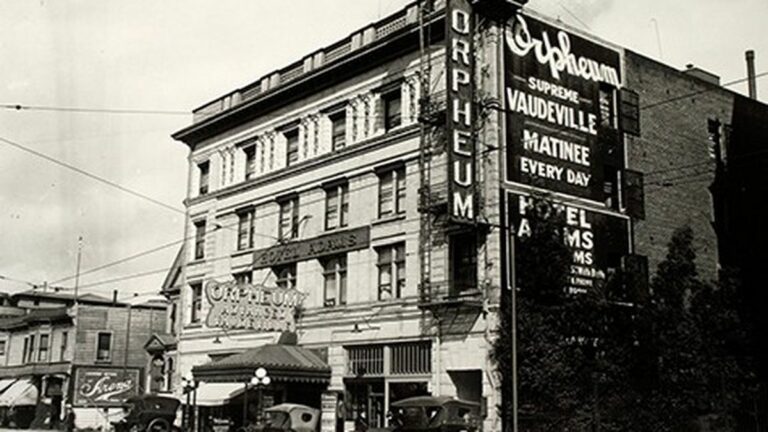
The Orpheum Theatre opened in 1907.
Credits: Courtesy of Oakland Public Library
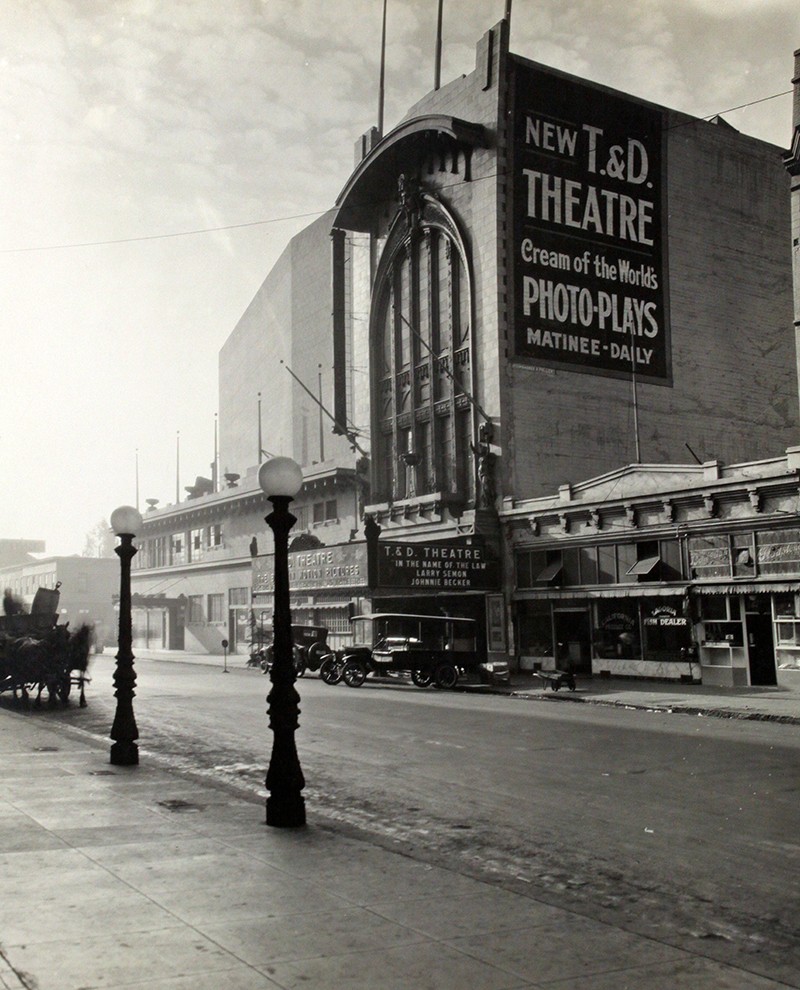
The T&D Theatre on 11th Street in Oakland was a large and grand movie theater.
Credits: Courtesy of Oakland Public Library
But with entertainment and technological advances after World War II, such as the increasing presence of television in American living rooms, weekly cinema attendance fell drastically. Why did so many theaters start closing? “We stayed home,” explained Bill Counter, a historic theater project consultant who also runs the Bay Area Historic Theatres group on Facebook. “In the Fifties, we stayed home to watch TV, in the Eighties, to watch home video. And then we lost most of the remaining [theaters] to the more favorable economics of the multiplex.” According to CinemaTreasures.org, 63 former theaters in Oakland have gone dark, and 35 of those have been torn down. In Berkeley, 24 theaters have closed and seven have been demolished. With a few notable exceptions, most of the East Bay’s venues are no more than memories.
One of the area’s first grand theaters was the French Renaissance-style Orpheum Theatre, later renamed the Twelfth Street Follies, which opened in 1907 on Oakland’s 12th Street. Like many venues at the time, this 2,561-seat theater featured live Vaudeville acts as well as silent films. According to the September 30, 1907 issue of the San Francisco Call newspaper, opening night was swarmed, attracting ordinary citizens as well as East Bay society members and the mayors of Oakland, Berkeley, and Alameda. The playhouse remained popular for a few decades, despite financial struggles and complaints from the Oakland Tribune that the building was “antiquated and inaccessible.” The Orpheum closed during the Depression and was demolished in 1958 after sitting vacant for years.
The Orpheum Theatre opened in 1907.
Credits: Courtesy of Oakland Public Library
Opened in 1916, the T&D Theatre on 11th Street in Oakland continued the trend of larger and grander movie palaces, aspiring to be more than a mere nickelodeon — the modest theaters prevalent at the time, so named because they charged a nickel for admission. “Even in the 1910s, the business was changing — old, smaller theaters closed, replaced by more opulent, larger ones,” Counter said. The T&D’s architecture featured an intricate façade, adorned with light- and steam-emitting stone jars. Seeing a show at the T&D included amenities such as a ladies’ tea parlor decorated with canary cages and a colorful fish tank, as well as live Wurlitzer organ performances before the film. In the 1950s, as movie attendance waned, the theater remained open late at night and installed a wide screen in an attempt to attract patrons. Unfortunately, like most of its contemporaries, the T&D could not maintain its previous popularity, and was eventually demolished in 1979, replaced by an office building.
Many of the East Bay’s former movie theaters were left standing, but shuttered before being repurposed, often as stores or churches. Oakland’s Palace Theatre on 23rd Avenue, for example, has seen many incarnations. Built in 1923, the 1,146-seat theater was later redesigned in the Spanish Mission style by Reid & Reid, an architectural firm that also designed the Grand Lake Theatre. The theater closed for good in 1953 and housed a church for the next sixty years, until the building was renovated by Lucid Dream Lounge, Inc. and reopened as an arts venue in July 2014.
Although most of the movie houses of the early 20th century are no longer here, the East Bay remains a region with an extremely rich theater history, and one that is fortunate enough to be the home of several surviving movie palaces and humbler venues that nonetheless retain their vintage charm. These historic theaters include Oakland’s Grand Lake, Paramount, and Piedmont theaters, the Alameda Theatre, and Berkeley’s California Theatre. Seeing a show at one of these stunning venues is an experience that harkens back to the glamorous Golden Age of cinema — sometimes even complete with a Wurlitzer performance.
More information about the history of Oakland’s theaters can be found in the book Theatres of Oakland (Arcadia Publishing) by Jack Tillmany and Jennifer Dowling.
Correction: The original version of this story misstated the number of former theaters in Oakland that have gone dark and been torn down.
Filmmaker Frederick Wiseman is widely hailed as the king of cinéma-vérité, one of the most important documentarians in the world. Beginning in the 1960s with such fly-on-the-wall portraits of reality as Titicut Follies and High School, Wiseman has packed his camera and sound crew, and almost nothing else, into an eye-openingly diverse array of locations, including his 2013 visit to the UC Berkeley campus, In Berkeley. Wiseman’s docs illuminate the inner workings of social structures and gatherings by leisurely, measured accretion of detail. And as we watch life unfold through the camera’s eye, we can glimpse the patterns and themes of people’s lives in a way no narrative can approach.
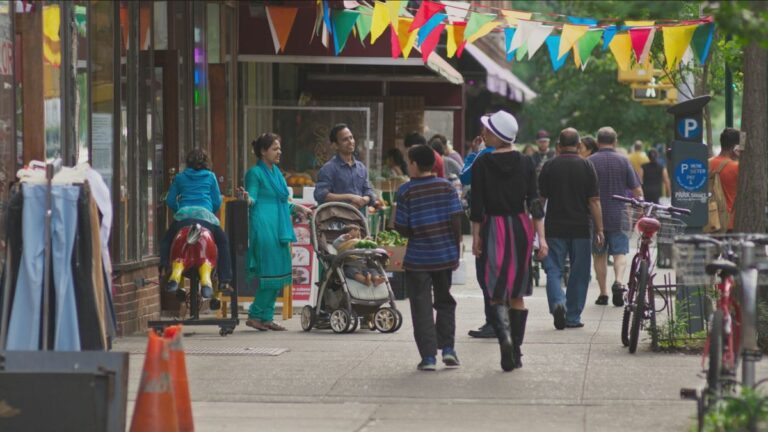
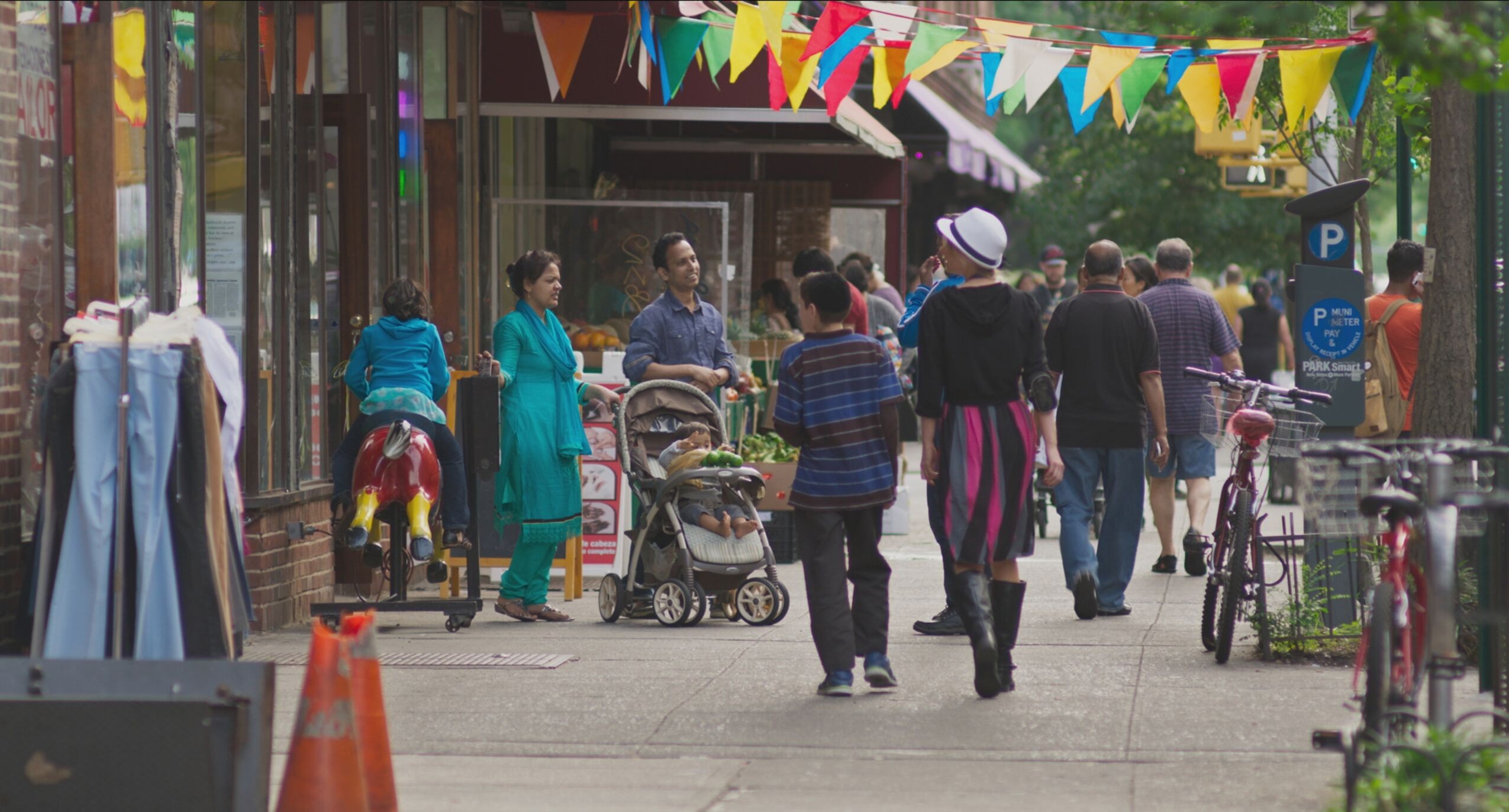
Wiseman’s latest, In Jackson Heights, takes us to that section of Queens, New York for a three-hour, ten-minute look around. Jackson Heights prides itself as a model multi-cultural neighborhood, with some 167 languages spoken on its streets (Spanish most of all). As usual, Wiseman has no pre-set point of view; what emerges is what he happens upon. And as we hang out in a madrasa; an LGBT seniors’ meeting; a salsa-music nightclub; an immigrants’ rights workshop; beauty and barber shops; a Latino transsexual support group; a belly-dancing class; a Holocaust remembrance in a Jewish temple; a tattoo parlor; a halal poultry butcher shop; a Colombian World Cup soccer party; a pedestrian safety rally; and a botanica, we begin to see in Jackson Heights an electrifying example of close-knit hometown democracy in action. People talking and listening.
As in many urban neighborhoods in America, the residents are particularly alarmed at signs of gentrification, in which moneyed newcomers — in this case from high-rent Manhattan, a short train ride away — are coming in, buying property, raising housing costs, and forcing out long-time residents, especially people of color. The City of New York’s Business Improvement District program (BID) is causing a lot of worry among la gente. Many of the scenes take place in community gatherings. No conclusions are drawn. There is no voiceover to tell us what to think. But we can see the issues of the day as they live and breathe. Thank you, Mr. Wiseman. Long may you wander and observe.
"Salmon, RIP?" Feature, 12/2
Fish Need Water, Period
The striped bass comments from someone in the industry are another red herring thrown out by the very people who have caused the destruction of the Bay-Delta ecosystem. You cannot divert more than 50 percent of the water from a system and expect it to function. Striped bass and salmon thrived together...
Almost everyone these days seems to support the idea of outfitting cops with body-worn cameras. Police watchdog groups want cameras on cops to increase transparency and accountability and reduce misconduct. Police officials want to strap cameras on cops for other reasons: The technology acts as roving surveillance devices, collecting video evidence that can be used in investigations and court....
As the City of Oakland continues to "study" ways to pay for affordable housing, the Berkeley City Council is acting decisively to deal with the current affordability crisis. Last week, the Berkeley council approved a major housing project in downtown in which the developer will pay $10.5 million for affordable housing in the city. The 18-story, 302-unit...
It isn't exactly normal for a 77-year-old man to spend three months crisscrossing the country by himself in a leased Volkswagen Passat — zipping down freeways at an average speed of 85 miles an hour just so he can check out some agave distillery in Colorado he heard was experimenting with making apple brandy using crowdsourced, "found"...
On a recent evening, eight members of the female artist collective CTRL+SHFT gathered in their warehouse space in West Oakland around an edible potpourri of grapes, raspberries, candy corn, peach gummies, and chocolate cookies. Iced tea flowed and laughter echoed off the high ceilings of the 3,300 square-foot studio space and gallery, which the group had spent the last...
Oakland singer and multi-instrumentalist Adee Roberson named her music project Tropic Green after a passage by the queer Jamaican author Michelle Cliff describing the vibrant flora of her native country. Roberson — whose family is Jamaican as well — recalled the strikingly vivid landscape that surrounded her when she last visited her ancestral homeland.
"The green...
E-40 Poverty and Prosperity
The King of Pentacles tarot card pictures a seasoned patriarch reclining on his throne with various symbols of affluence scattered around him. He has finally arrived at a place of leisure and abundance after years of effort, and the card represents the ultimate culmination of his worldly achievements. E-40 channels this archetypical...
After spending some years in the doldrums after having kids, my husband and I are now enjoying hot, kinky sex and the occasional free pass to fuck other people. We couldn't be happier. I have a friend who was extremely keen for me to cage his cock with the same kind of locking male chastity device I got for...
The East Bay is a region rich with the relics of shuttered theaters, from extravagant movie palaces to modest auditoriums. During the early 20th century, Oakland and Berkeley boasted dozens of theaters — with 43,300 total seats at their peak — in order to serve the public's ravenous appetite for film during that era. There were cinemas in nearly...
Filmmaker Frederick Wiseman is widely hailed as the king of cinéma-vérité, one of the most important documentarians in the world. Beginning in the 1960s with such fly-on-the-wall portraits of reality as Titicut Follies and High School, Wiseman has packed his camera and sound crew, and almost nothing else, into an eye-openingly diverse array of locations, including his 2013 visit...