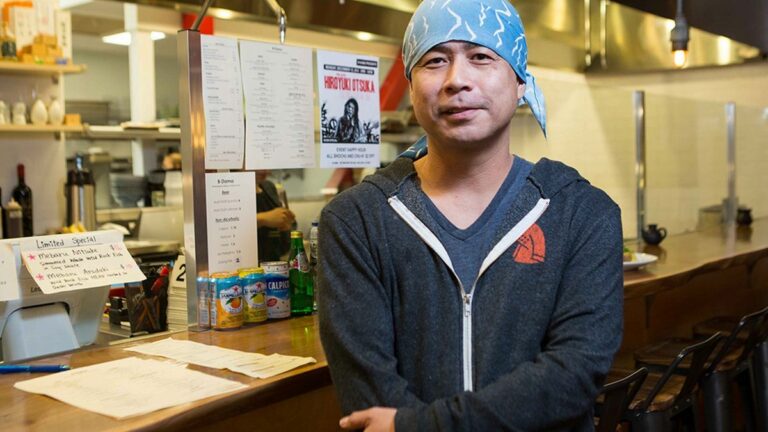
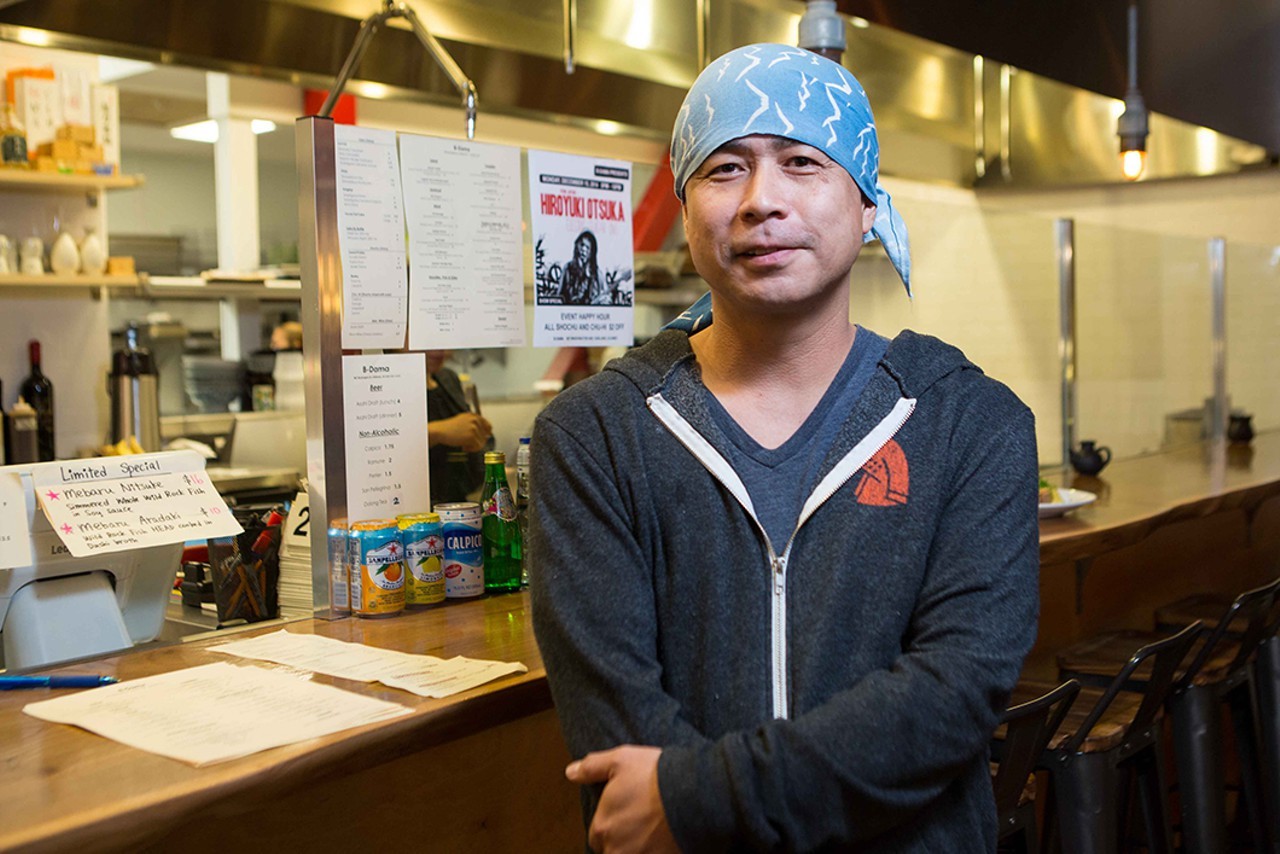
Chikara Ono.
Credits: Bert Johnson/File photo
These days, Chikara Ono doesn’t get behind the stove as often as he used to, but among his devotees, the chef is legendary — particularly for his skills with raw fish. At AS B-Dama (907 Washington St., Oakland), the popular izakaya-style Japanese restaurant located in the Swan’s Market food court, Ono plays more of a supervisory role — expediting orders and bringing dishes out to customers.
Longtime customers who have been wanting to taste more of Ono’s food might soon get there wish: The chef is opening a new sushi spot in Swan’s Market, just steps away from AS B-Dama. The yet unnamed restaurant will be located in a former bubble tea shop at 536 9th Street — next door to the Mexican eatery Cosecha, in a stand-alone space that’s separate from the larger “food court” area.
[jump]
In terms of what style of sushi he plans to serve, Ono said he hasn’t made up his mind. Right now, he’s having discussions with Asuka Nadeshiko and Shin Okamoto — the two young, talented chefs who do most of the cooking at AS B-Dama — about who will take the lead at the sushi spot. If it ends up being Nadeshiko, for instance, Ono said there might be more of a French influence to the cuisine.
Ono said all he knows is that he wants to offer some unique, harder-to-find varieties of sushi — maybe a wider selection of vegetable-centric sushi or some unusual hand rolls. What Ono is clear about, though, is what kind of sushi place the restaurant won’t be. It won’t serve American-style rolls — “no Lion King,” Ono said. And unlike AS B-Dama’s sister restaurant Geta Sushi, on Piedmont Avenue, it won’t primarily be a takeout spot.
Most importantly, Ono said he doesn’t want his restaurant to be the kind of expensive, “high-class” omakase-style sushi restaurant that you’ll find so often in San Francisco, for instance. Instead, he wants to use more local seafood and to keep his prices moderate.
The former bubble tea shop is small — maybe 700 or 800 square feet, with room for about 25 seats, Ono said. Most of that seating will be at the sushi counter, but there will also be a couple of tables inside and more on an outdoor patio. Construction is already underway, and an application for a beer and wine license is pending. If all goes well, the new restaurant will open for business in February or March.
Congress is set to extend a year-old cease-fire in the federal war on medical marijuana — sending a strong message to prosecutors to keep their hands off legal pot.
Activists in Washington, DC report that lawmakers have included a renewal of the historic Rohrabacher-Farr amendment of December 2014 in this year’s must-pass spending bill, which was unveiled last night.
The spending rider continues to bar the Department of Justice from using any federal funds to interfere in any way with state medical marijuana laws. Its authors say DOJ employees cannot investigate, arrest, or prosecute anyone complying with medical marijuana, CBD, or hemp laws in more than 35 states.
Credits: Flickr: yeahbouyee (w/ CC license)
[jump]
“The renewal of the Rohrabacher-Farr Amendment suggests most members of Congress are ready to end the federal government’s war on medical marijuana,” stated Robert Capecchi, director of federal policies for the Marijuana Policy Project. “There’s a growing sentiment that the Justice Department should not be using taxpayer dollars to arrest and prosecute people who are following their states’ medical marijuana laws.”
Marijuana Majority chair Tom Angell stated: “While marijuana was once treated like a dangerous third-rail by most elected officials, the inclusion of these provisions demonstrates how it has now become a mainstream issue at the forefront of American politics and policymaking. Polls show that a growing majority of voters support ending prohibition, and lawmakers can’t help but listen.”
In April, DOJ officials told the media they believed Rohrabacher-Farr was more narrow in scope, and only prevented them from continuing to threaten state officials with jail time for promulgating medical pot regulations.
But a federal judge in October ruled that Rohrabacher-Farr means what it says it means: “leave state-legal medical marijuana activity alone.”
“This amendment has teeth, but only as long as it keeps getting renewed,” Capecchi stated.
“This is the second year in a row that Congress is using the appropriations process to tell federal agents and prosecutors not to interfere with state medical marijuana laws. But so far the Department of Justice has taken the absurd position that these spending provisions don’t actually prevent them from going after patients and providers who operate legally under state policies,” stated Angell. “The intent of Congress is clear, and so is the will of the American people. Since the Justice Department is being so stubborn, the next step should be for lawmakers to pass permanent standalone legislation that goes beyond these temporary spending riders. Then the DEA will have a much harder time undermining Congress and voters.”
The rider is a mixed bag. Republicans happily jettisoned their belief in states rights and local control to continue a separate rider preventing the legalized District of Columbia from regulating the growth and sale of adult-use cannabis. Pot arrests in DC have dive-bombed from a high of 2,346 in 2011 to a total of seven as of November 6.
“Marijuana smokers are not going to attack and kill a cop,” DC Police Chief Cathy Lanier toldThe Daily Beast. “They just want to get a bag of chips and relax. Alcohol is a much bigger problem.”
“Marijuana is now legal for adults in the District of Columbia, and it needs to be treated like a legal product,” Capecchi stated. “It is irrational to prohibit D.C. officials from establishing a regulatory system to control the cultivation and distribution of marijuana. By renewing the Harris Amendment, Congress is posing a real threat to public health and safety in our nation’s capital.”
Other shortcomings in the spending bill: a rider to allow veterans to get a cannabis recommendation from their Veteran’s Affairs doctor failed; and a rider allowing banks to take cannabis industry deposits without federal punishment failed.
Next year, lawmakers will work again on the CARERS Act to fully protect medical marijuana rights in the U.S., and Senator Bernie Sanders will work to fully end cannabis prohibition through his new bill, the Ending Federal Marijuana Prohibition Act.
1. In a stinging defeat for PG&E and the state’s other monopoly power providers, the California Public Utilities Commission is proposing to reject a plan that would have penalized homeowners who install rooftop solar, the LA Times$ reports. The CPUC instead sided with the solar industry and is recommending a compromise plan that would establish modest fees for home solar. PG&E and other utilities wanted to steeply increase fees for home solar adopters, arguing that those customers are not paying their fair share for the power grid. But the solar industry said PG&E’s plan would have devastated the growth of home solar in California.
[jump]
3. California Assemblymember Lorena Gonzales, D-San Diego, plans to introduce legislation that would allow Uber and Lyft drivers to unionize, the Chron$ reports. Earlier this week, Seattle became the first city in the nation to let Uber and Lyft drivers to unionize. Gonzales’ legislation would also apply to other contract workers in the gig economy.
5. And the Alameda County Board of Supervisors gave final approval to adopt Laura’s Law, which allows court-ordered treatment for severely mentally ill people, the Trib$ reports. Laura’s Law has been implemented in other counties in the state.
On the first Sunday in December, I shuffled onto a public ferry scheduled to travel from San Francisco’s Embarcadero to Oakland’s Jack London Square with a group of fifty others, each of us wearing radio headsets, like conspirators on a covert mission. It was an especially chilly afternoon and the wind was moist in a numbing way. We were likely the only non-tourist passengers on the boat and surely would not have been there if it weren’t for Constance Hockaday.
We were on hand to experience You Make a Better Wall Than a Window, an audio tour performance piece by Hockaday that she broadcasted live from the front of the boat’s upper deck to be delivered in real time to our headsets. Hockaday’s earnest intonation streamed intimately into our ears as we burrowed inside our jackets to shield from the wilderness we were confronting — all of a sudden at sea. “It is a real testament of trust in the human race that you came on this ferry today,” Hockaday began. “…There are two goals of this tour, one is to get free and the other is to get real.”
Constance Hockaday gave a guerilla radio tour of San Francisco Bay from a public ferry.
Credits: Matt ShapiroConstance Hockaday gave a guerilla radio tour of San Francisco Bay from a public ferry.
Credits: Matt Shapiro
Hockaday is the Bay Area’s foremost nautical artist. In 2011, she turned old boat hulls into floating hotel rooms in a marina on the outskirts of New York City for a project called Boatel done in collaboration with the Flux Factory. Reservations for the entire summer sold out in an hour, and Hockaday was swarmed by international media members for her DIY endeavor aimed, simply, to bring people closer to the water. Last summer, for a piece called All These Darlings and Now Us, she connected four sailboats to form a peep show venue in the San Francisco Bay. During the night, six hundred people were transported to the venue on inflatable rafts to watch performers who formerly strutted at The Lusty Lady and Esta Noche — the former the nation’s only worker-owned strip club, and the latter a historic Latino gay bar, both of which had sadly shut that year. “The idea, for me, was if there’s not space for this stuff on the land, then let’s make a space on the water,” said Hockaday on a recent afternoon in her West Oakland home.
A metaphorical and literal correlation between possibility and being in bodies of water is the conceptual thread that ties Hockaday’s projects together. For You Make a Better Wall Than a Window, it manifested as a kind of research-based poetry reading rather than a spectacle. As we passed underneath the Bay Bridge, Hockaday captained an informational voyage, reconceptualizing the water as “fast moving land” that, considering the flexibility of maritime law, can function as a loophole in the way society organizes space and the way capitalism and convention determine the limitations of our lives. “No one can own the water,” she said. The simple reminder was dramatically emphasized by the overwhelming vastness of the bay.
Hockaday grew up near the ocean in South Texas with a marine biologist father. At nineteen, she had dropped out of college after coming out as queer and growing deeply depressed. Living at home again, she was working on the beach, renting umbrellas. “I remember thinking, ‘I hate all the options that exist in the world for me,'” she said. One fateful afternoon, she happened upon four handmade rafts, each one home to four shacks and sprouting massive, scavenged sails. It was the Floating Neutrinos, a legendary group of transient intellectuals who live on the water to allow themselves the type of freedom that paying rent tends to inhibit and who consider raft-building a psycho-spiritual practice. “It blew my mind,” said Hockaday. “This sort of vagabond shack building reality just didn’t exist where I grew up.”
Naturally, Hockaday went aboard. The Neutrinos taught her skills that empowered her — from sign painting (a flexible source of income) to a method for realizing that as long as she understood what she wanted to do with her life, she had the capacity to follow those desires. “That is a really fucking hard thing to learn when nobody has ever suggested that to you before,” she said.
Hockaday then embarked on a series of vision quests, a lone backpacking trip across Europe, three college degrees, and a personal raft-building project that took her up and down the Multnomah Channel in Portland, Oregon. And as she evolved into an artist, a few events most propelled her philosophical shaping. First, a research project taught her about Nancy Boggs, a woman who, in the 1870s, floated an eighty-foot crimson brothel on the Columbia River between the jurisdictions of the two towns on either bank (an obvious inspiration for All These Darlings and Now Us). And in 2006, she helped build rafts for the street artist Swoon and her “punk artist” gang to sail down the Mississippi River as a performance art piece. She ultimately joined the crew, offering little kids along the way the same mind-boggling realization she had experienced at nineteen. Two years later, she captained one of the rafts in Swoon’s similar Swimming Citiesof Serenissima project, which famously crashed the Venice Biennale with anarchic-troubadour style.
But Hockaday’s most recent performance, done in collaboration with Southern Exposure as part of the programming for Public Works: Artists’ Interventions 1970–Now, was more sobering than her past work. She highlighted the potential for oceanic freedom to support neoliberal business ventures and dwelled on the lack of land access to San Francisco Bay despite it technically being public space. As the ferry stalled next to the massive shipping cranes lining the Port of Oakland, the artist gestured toward the East Bay beasts: “White, brave beautiful fingers of globalization,” she said. “These are our arms and hands, the ones we use when we really want to make something happen in the world economic system.” Hockaday explained that the port is a trustee of tidelands, meaning that the public agency plays a leading role in deciding how the bay’s tidelands are used and to what extent they are made accessible to the public.
Lamenting the way that industry unfairly reigns over the shores of the East Bay, Hockaday urged attendees to fight for their right to the water. She framed it in terms of preservation, in terms of political justice and rightful ownership, and also in terms of psychology. Having access to the water affords us a sense of freedom and potential that’s crucial for realizing one’s own agency. She declared over the mic: “The infrastructure of our civilization defines our most private beliefs about what’s possible in our lives.”
Aries (March 21–April 19): The Neanderthals were a different human species that co-existed with our ancestors, homo sapiens, for at least 5,000 years. But they eventually died out while our people thrived. Why? One reason, says science writer Marcus Chown, is that we alone invented sewing needles. Our newborn babies had well-made clothes to keep them warm and healthy through frigid winters. Neanderthal infants, covered with ill-fitting animal skins, had a lower survival rate. Chown suggests that although this provided us with a mere one percent survival advantage, that turned out to be significant. I think you’re ready to find and use a small yet ultimately crucial edge like that over your competitors, Aries.
Taurus (April 20–May 20): Artist Robert Barry created “30 Pieces,” an installation that consisted of pieces of paper on which he had typed the following statement: “Something which is very near in place and time, but not yet known to me.” According to my reading of the astrological omens, this theme captures the spirit of the phase you’re now entering. But I think it will evolve in the coming weeks. First it’ll be “Something which is very near in place and time, and is becoming known to me.” By mid-January it could turn into “Something which is very near and dear, and has become known to me.”
Gemini (May 21–June 20): “There is in every one of us, even those who seem to be most moderate, a type of desire that is uncanny, wild, and lawless.” Greek philosopher Plato wrote that in his book The Republic, and I’m bringing it to your attention just in time for your Season of Awakening and Deepening Desire. The coming days will be a time when you can, if you choose, more fully tune in to the uncanny, wild, and lawless aspects of your primal yearnings. But wait a minute! I’m not suggesting you should immediately take action to gratify them. For now, just feel them and observe them. Find out what they have to teach you. Wait until the new year before you consider the possibility of expressing them.
Cancer (June 21–July 22): Congratulations! You have broken all your previous records for doing boring tasks that are good for you. In behalf of the other eleven signs, I thank you for your heroic, if unexciting, campaign of self-improvement. You have not only purified your emotional resources and cleared out some breathing room for yourself, but you have also made it easier for people to help you and feel close to you. Your duty has not yet been completed, however. There are a few more details to take care of before the gods of healthy tedium will be finished with you. But start looking for signs of your big chance to make a break for freedom. They’ll arrive soon.
Leo (July 23–Aug. 22): The English word “fluke” means “lucky stroke.” It was originally used in the game of billiards when a player made a good shot that he or she wasn’t even trying to accomplish. Later its definition expanded to include any fortuitous event that happens by chance rather than because of skill: good fortune generated accidentally. I suspect that you are about to be the beneficiary of what may seem to be a series of flukes, Leo. In at least one case, though, your lucky break will have been earned by the steady work you’ve done without any fanfare.
Virgo (Aug. 23–Sept. 22): You may not have to use a literal crowbar in the coming weeks, but this rough tool will serve you well as a metaphor. Wherever you go, imagine that you’ve got one with you. Why? It’s time to jimmy open glued-shut portals; to pry loose mental blocks; to coax unyielding influences to budge; to nudge intransigent people free of their fixations. Anything that is stuck or jammed needs to get unstuck or unjammed through the power of your willful intervention.
Libra (Sept. 23–Oct. 22): The coming weeks will be a favorable time for you to consort with hidden depths and unknown riches. In every way you can imagine, I urge you to go deeper down and further in. Cultivate a more conscious connection with the core resources you sometimes take for granted. This is one time when delving into the darkness can lead you to pleasure and treasure. As you explore, keep in mind this advice from author T. Harv Eker: “In every forest, on every farm, in every orchard on earth, what’s under the ground creates what’s above the ground. That’s why placing your attention on the fruits you have already grown is futile. You can’t change the fruits that are already hanging on the tree. But you can change tomorrow’s fruits. To do so, you will have to dig below the ground and strengthen the roots.”
Scorpio (Oct. 23–Nov. 21): In the coming weeks, the pursuit of pleasure could drain your creative powers, diminish your collaborative possibilities, and wear you out. But it’s also possible that the pursuit of pleasure will enhance your creative powers, synergize your alliances, and lead you to new opportunities. Which way will you go? It all depends on the kinds of pleasures you pursue. The dumb, numbing, mediocre type will shrink your soul. The smart, intriguing, invigorating variety will expand your mind. Got all that? Say “hell, no” to trivializing decadence so you can say “wow, yes” to uplifting bliss.
Sagittarius (Nov. 22–Dec. 21): Garnets are considered less valuable than diamonds. But out in the wild, there’s an intimate connection between these two gemstones. Wherever you find garnets near the surface of the earth, you can be reasonably sure that diamonds are buried deeper down in the same location. Let’s use this relationship as a metaphor for your life, Sagittarius. I suspect you have recently chanced upon a metaphorical version of garnets, or will do so soon. Maybe you should make plans to search for the bigger treasure towards which they point the way.
Capricorn (Dec. 22–Jan. 19): Ready for the Cool Anger Contest? You can earn maximum points by expressing your dissatisfaction in ways that generate the most constructive transformations. Bonus points will be awarded for your ability to tactfully articulate complicated feelings, as well as for your emotionally intelligent analyses that inspire people to respond empathetically rather than defensively. What are the prizes? First prize is a breakthrough in your relationship with an ally who could be crucial to your expansion in 2016. Second prize is a liberation from one of your limiting beliefs.
Aquarius (Jan. 20–Feb. 18): A fourth-century monk named Martin was a pioneer wine-maker in France. He founded the Marmoutier Abbey and planted vineyards on the surrounding land. According to legend, Martin’s donkey had a crucial role in lifting viticulture out of its primitive state. Midway through one growing season, the beast escaped its tether and nibbled on a lot of the grapevines. All the monks freaked out, fearing that the crop was wrecked. But ultimately the grapes grew better than they had in previous years, and the wine they produced was fabulous. Thus was born the practice of pruning, which became de rigueur for all grape-growers. What’s your equivalent of Martin’s donkey, Aquarius? I bet it’ll exert its influence very soon.
Pisces (Feb. 19–March 20): “The deepest urge in human nature is the desire to be important,” said educator John Dewey. If that’s true, Pisces, you are on the verge of having your deepest urge fulfilled more than it has in a long time. The astrological alignments suggest that you are reaching the peak of your value to other people. You’re unusually likely to be seen and appreciated and acknowledged for who you really are. If you have been underestimating your worth, I doubt you will be able to continue doing so. Here’s your homework: Take a realistic inventory of the ways your life has had a positive impact on the lives of people you have known.
Gremlins (106 min., 1984). Blockbuster night (The New Parkway Theater, Oakland, 9:30)
Jane Eyre (TBA, 2015). National Theatre Live (Rialto Cinemas Cerrito, El Cerrito, 7:00)
Friday, December 18
Good Bye, Lenin! (121 min., 2003). (Berkeley Public Library, Central Branch, Berkeley, 3:00)
Poems of Winter and Cigarettes (60 min., 2014) and LalezarStreet (TBA, 2000). Forthcoming documentary campaign closing party for Home Yet Far Away and Persian Winter Solstice festival (La Pena Cultural Center, Berkeley, 7:00)
Cloyne Court (TBA, 2015). Film screening (Omni Commons, Oakland, 7:30)
The City of Lost Children (112 min., 1995). New Parkway Cult Night (Parkway, 10:30)
Saturday, December 19
The Nutcracker (TBA, 2015). The Bolshoi Ballet 2015-16 Season (Cerrito, 10:00 a.m.)
The Express won thirteen awards, including ten first-place honors, in the 38th Greater Bay Area Journalism Awards contest. The Express won the most first-place awards of any non-daily newspaper in the annual contest for journalism excellence, sponsored by the San Francisco Peninsula Press Club. The winners were announced on December 5, and the contest was for news reports published in 2014.
Senior staff writer Sam Levin won two first-place awards. He won in the serious feature category for his October 29, 2014 cover story, “When the Mind Splits,” which explored the impacts of dissociative identity disorder and the controversy surrounding the illness. Levin also won first place in the business/technology category for his January 8, 2014 cover story, “When Corporations Want Profits, They Don’t Ask for Permission,” which examined the recent trend of large retailing companies stealing the work of independent artists.
This story and cover image both won awards.
Credits: Illustration by Roxanne Pasibe/Photo by Bert Johnson
This story and cover image both won awards.
Credits: Illustration by Roxanne Pasibe/Photo by Bert Johnson
Food editor Luke Tsai won a first-place award in the feature columns category for his dining reviews, “Pop Rocks” (12/10/14), “The Other Noodle Soup” (7/30/14), and “What Numbs the Tongue Will Warm the Heart” (3/12/14).
Staff writer Darwin BondGraham won a first-place award in the best news story category for his May 28, 2014 feature, “The Strike Force that Never Struck,” which revealed the failures of California Attorney General Kamala Harris’ mortgage fraud task force.
Art director Roxanne Pasibe and photo editor Bert Johnson shared a second-place award in the page design category for the October 29, 2014 cover of the Express, featuring the story, “When the Mind Splits.” Johnson took the award-winning photo and Pasibe did the illustration.
Arts and culture editor Sarah Burke won a third-place award in the specialty feature category for her October 15, 2014 cover story, “Moral Combat,” which explored the vicious harassment campaign leveled at women in the video gaming industry. This story also has won two other first-place awards in other journalism contests.
Editor Robert Gammon won a second-place award in the political news column category for his Seven Days columns, “When Police Kill” (12/10/14), “A Flawed Minimum Wage Measure” (7/16/14), and “Water Officials Made the Drought Worse” (2/5/14).
Former music editor Sam Lefebvre won first place in the entertainment category for his November 19, 2014 cover story, “The Tyranny of Free,” which examined Pandora’s business strategy of keeping royalty payments low to struggling musicians.
Former co-editor Kathleen Richards won first place in the light feature category for her June 25, 2014 cover story, “Hunting with a Rat,” which chronicled her outing of wild boar hunting with a motorcycle club leader.
Contributors Jake Nicol and Julian Mark shared a first-place award in the best series category for their two-part series on the healthcare giant Kaiser, called “Deadly Delays.” Nicol’s part-one story, “A Flawed Model for Care” (8/13/14), examined Kaiser’s repeated failures to provide adequate mental health care to patients. Mark’s part-two story, “Gambling with Children” (8/20/14), looked at Kaiser’s controversial decision to close pediatric care services to children in the East Bay.
Contributor David Bacon won a first-place award in the photo series category for his August 6, 2014 cover story, “Living on the Streets of Oakland,” a photo essay that examined the plight of homeless people in the Bay Area’s third largest city.
Former contributor Ali Winston won a first-place award in the analysis/investigative category for his September 17, 2014 cover story, “Why Oakland Can’t Fire Bad Cops,” which examined the biased and incompetent investigations into police misconduct in the city.
Former contributor Joaquin Palomino won a first-place award in the continuing coverage category for his groundbreaking reports on the California drought and water issues, “California’s Thirsty Almonds” (2/5/14) and “The Water Tunnel Boondoggle” (5/13/14).
In addition, Express calendar and web editor Erin Baldassari won a first-place award in the breaking news category for digital media for her coverage of Black Lives Matter protests in Berkeley and Oakland in December 2014 when she was working for Bay City News Service.
Tolstoy wrote in Anna Karenina that “all happy families are alike.” But even the most tortured Russian novelist would agree that all happy hours are definitely not created equal. Here in the East Bay, we have happy hours with $1 oysters and $1 shots and happy hours during which a stack of crumpled singles will get you good and wasted on cold beer of middling quality. And we have the Piedmont Avenue salumi bar Adesso, which has a free, late-night happy hour spread of cured meats and other assorted apertivos that is unrivaled.
But if you’re looking for a food-centric happy hour, La Marcha, a West Berkeley tapas bar that opened in late October, should be at or near the top of your list. Chef-owners Sergio Emilio Monleón and Emily Sarlatte actually host happy hours in both the afternoon (4–6 p.m.) and late evening (10 p.m.–midnight) every day except Monday, when the restaurant is closed.
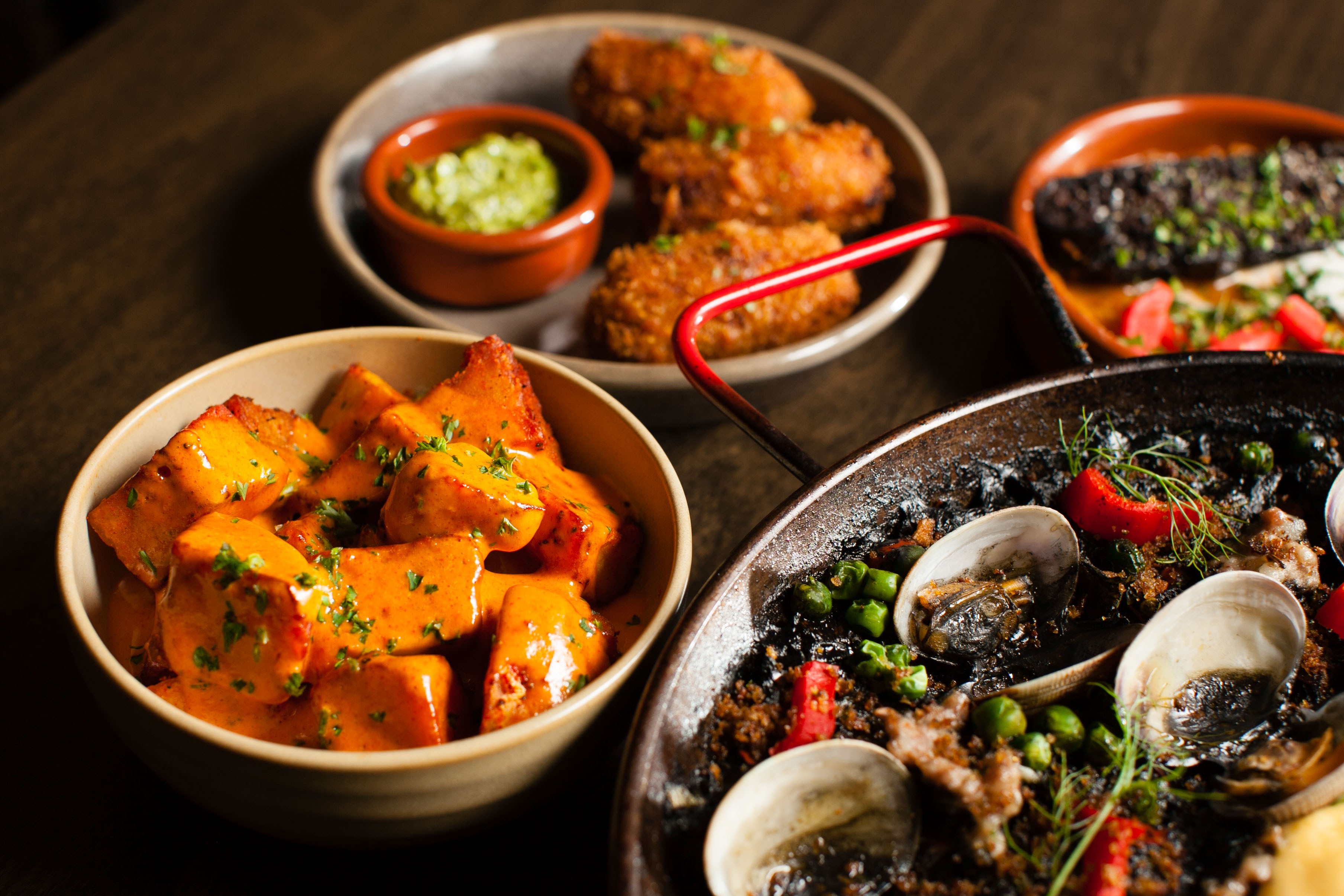
La Marcha’s morcilla.
Credits: Bert Johnson
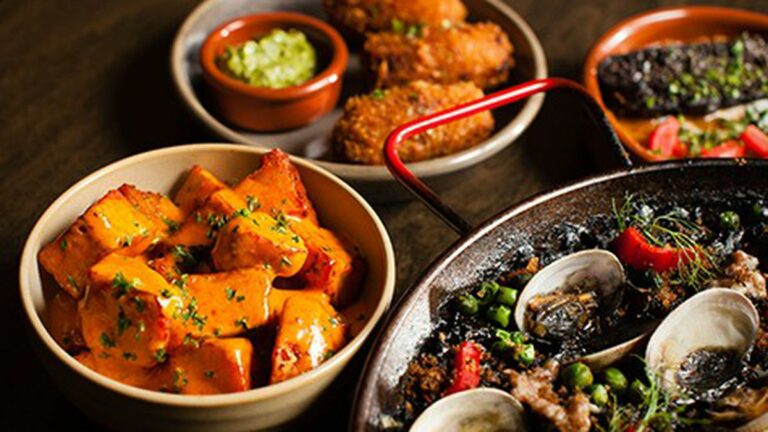
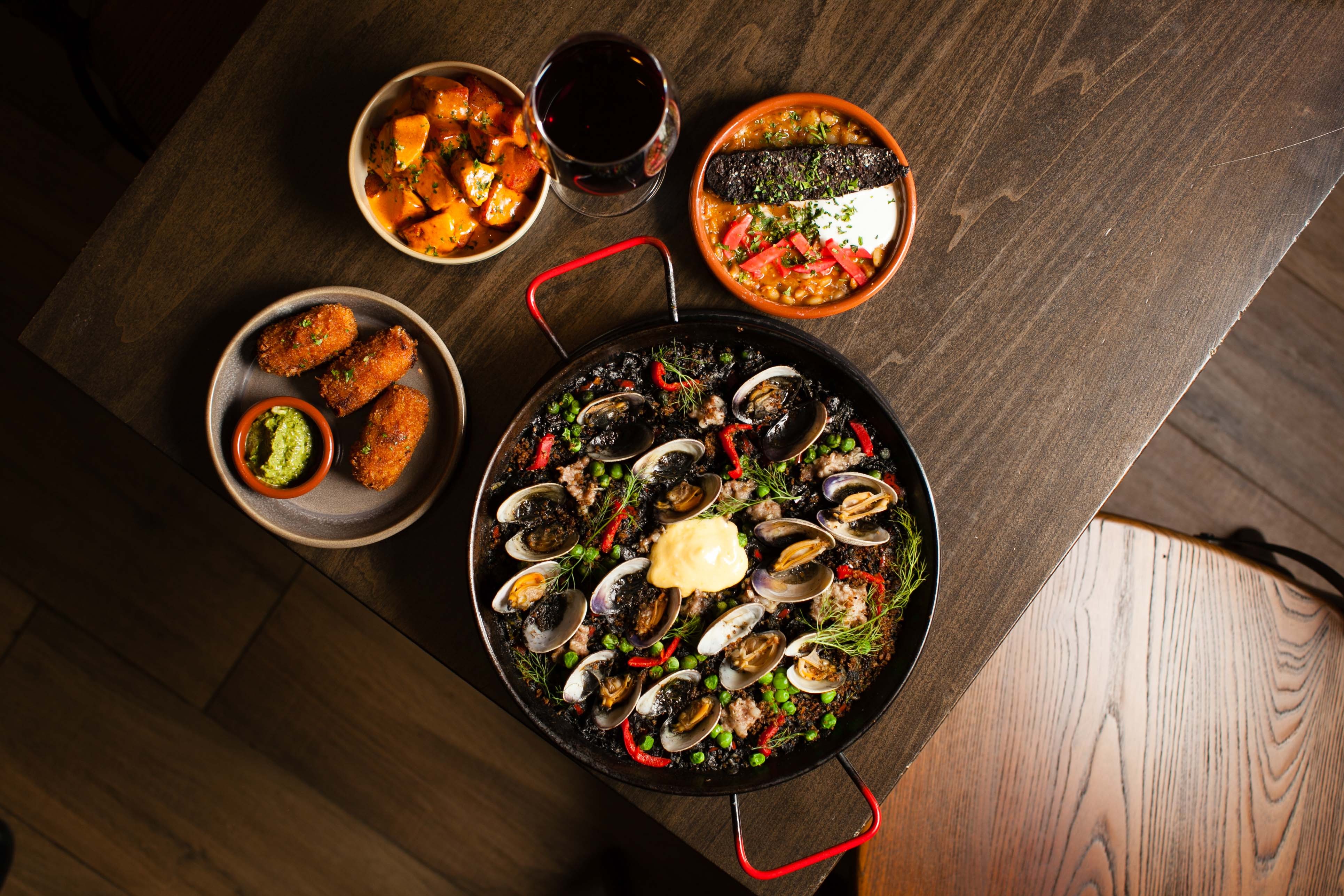
Clockwise from left: patatas bravas, mushroom croquetas, morcilla, and arroz negro.
Frugal diner, does a selection of $2 and $3 small plates, plus free food with every drink purchase, sound like something that would interest you? It doesn’t hurt that several of the dishes — including the patatas bravas and the mushroom croquetas — are among the best versions I’ve had.
The name of the restaurant is a reference to “the march” — the late-night bar crawl that is a fixture of the eating and drinking culture in Spain, where, unlike in much of the United States, tapas bars don’t tend to be high-end dining establishments. Instead, they’re just as likely to be dive bars where a customer might get a little plate of Spanish tortilla or fried squid for free with the purchase of some (also inexpensive) beverage.
La Marcha’s arroz negro.
Credits: Bert Johnson
That was the experience Sarlatte and Monleón were hoping to bring to Berkeley. Both chefs said they spent their formative years, gustatorily speaking, in Madrid — Sarlatte as a college student studying abroad, and Monleón as the child of Valencia transplants who worked his first restaurant dishwasher and prep cook gigs in Madrid. For the past four years, the two have run a catering company and mobile paella vendor called Ñora. At La Marcha, their first restaurant, Monleón and Sarlatte rotate roles from week to week, one manning the stoves while the other oversees the front of the house. More than anything, they wanted the restaurant to feel like a place you might find in Spain — a sensibility that’s reflected in everything from the imported blue accent tiles to the European soccer matches playing on the flatscreen TV behind the bar.
Of course, the food is the more important test, and in this regard, La Marcha mostly passed muster. Monleón and Sarlatte said they aren’t traditionalists, which is to say they don’t subscribe to the opinion held by so many Valencian grandmothers that paella should never stray from a single, centuries-old recipe. La Marcha’s menu is sprinkled with modern touches and seasonally appropriate local ingredients, but the tapas aren’t overly fussy. In that sense, La Marcha also stays true to the spirit of a real Spanish tapas bar.
There are twenty or so different small plates on the menu at any time. Many are versions of dishes you can find at nearly any Spanish restaurant but often with some flourish, big or small, to set them apart. Wedges of simple tortilla — thin layers of potato and onion bound together within the confines of a delicate egg omelet — were elegant in their essential Spanish-ness. Only the dash of za’atar in the accompanying aioli strayed from convention. Oven-baked albóndigas were as smooth and light as you’d want a pork meatball to be, though the use of wild boar meat wasn’t traditional. They were served in a pool of tomato cream sauce that was so tasty, it felt ungenerous to be given just two thin batons of grilled bread to sop it all up.
Meanwhile, I’ve always liked the idea of patatas bravas more than the dish itself, which too often winds up resembling glorified KFC potato wedges — sauce-drenched and overly starchy. But La Marcha’s version was in a class of its own: stunningly crisp and light. The bravas were dusted with surprisingly fiery pimentón spice and slathered with a chili-infused “Ñora” aioli. I eat a lot of fried potatoes in my line of work. These were some of the best in recent memory.
Clockwise from left: patatas bravas, mushroom croquetas, morcilla, and arroz negro.
Credits: Bert Johnson
But not every tapa was a knockout. Pimentón-spiced almonds were unappealingly clammy. The calamares, or deep-fried squid, were oddly bland, thanks to the fact that the cumin salt listed in the menu description was undetectable. And while the crispy Brussels sprouts had been expertly fried, the use of two kinds of vinegar (balsamic and aged sherry) and grapes made the dish veer too far in the sweet direction.
Regardless, I can’t stress strongly enough how good a deal the tapas are as long as you time your visit right, which is to say, during one of the happy hours, and grab a seat at the enormous, U-shaped bar counter that dominates the dining room. (That last part is pivotal: Only customers seated at the bar can order off the happy hour menu.) In keeping with the tradition of authentic tapas bars in Spain, happy hour customers get a free tapa — chosen from a streamlined list that, during my visit, included all the dishes mentioned above — with the purchase of every drink. Drinks are steeply discounted, too: $5, for instance, for a glass of house white or red wine, the latter of which turned out to be an easy-to-drink, thoroughly enjoyable tempranillo. What’s more, everything on the happy hour tapas menu costs just $2 or $3. They’re smaller portions — essentially, the tapas on the regular menu scaled down to an individual portion. Still, the upshot is that less than $20 will get you righteously stuffed.
And this isn’t generic bar food either. For instance, during my happy hour visit, the freebie I opted for was the morcilla, a kind of Spanish blood sausage — salty and very soft, and similar in appearance to braised short rib. This was served over stewed lima beans, with pickled carrots and yogurt that added a bit of brightness — a little one-pot meal all on its own. Another of my favorite bites was the croquetas de champiñones, or mushroom croquettes. The happy hour version consisted of a single croqueta served, adorably, sticking out of a tiny espresso cup half-filled with a chimichurri-like mojo verde dipping sauce. The exterior of the croquette was shatteringly crisp; when bitten into, it oozed with a rich mixture of bechamel, sautéed mushrooms, and manchego cheese.
Clockwise from left: patatas bravas, mushroom croquetas, morcilla, and arroz negro.
Credits: Bert Johnson
As enjoyable as it was to eat happy hour tapas at the bar, it’s only fair to acknowledge that, for now, La Marcha offers a less consistently enjoyable experience for diners who treat the place as a sit-down restaurant. The dining room is tiny and loud and so dominated by the bar that the regular tables wind up feeling cramped. During my dinner, service was somewhat stilted, and we wound up getting charged inadvertently for an item we didn’t order while another dish we did order never materialized.
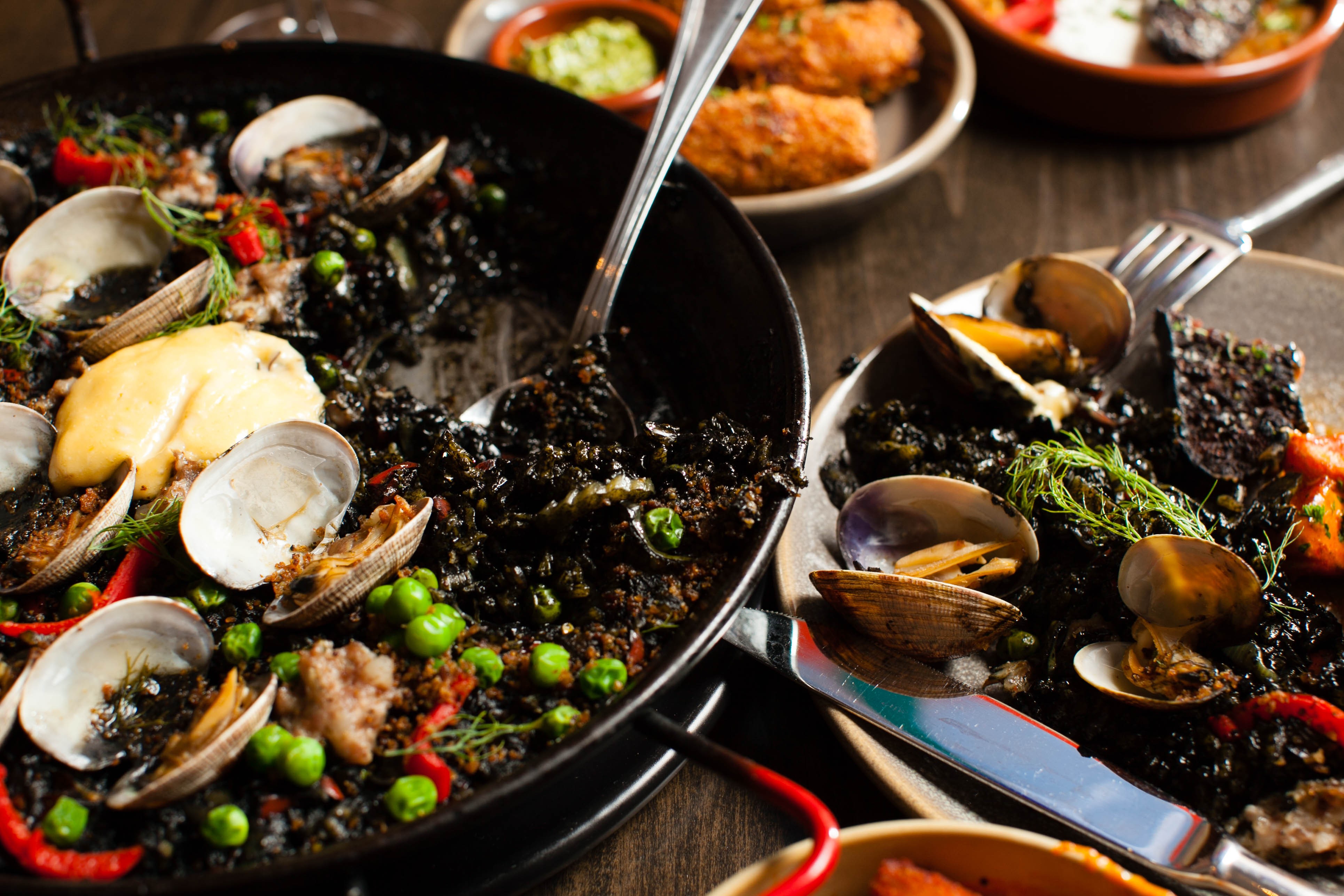
Plus, the regular menu, while not terribly expensive on the spectrum of Spanish restaurants in the Bay Area, doesn’t always offer the best value. The most egregious offense: a $12 glass of sangría that contained hardly any wine and instead consisted almost entirely of diced fruit. And I wouldn’t have minded paying $32 for a big pan of squid-ink-blackened arroz negro — my favorite type of paella — if it had been as good as other versions I’ve had in the past. This came loaded with clams, sausage, peas, and piquillo peppers, but when eaten together, all of the murky, briny flavors just muddled together. The one luxurious touch — an uni aioli — was too subtle and served in too small a portion to stand out.
If you’re in the mood for paella, go during the late-afternoon happy hour, when you can order off the whole menu. But for my money, the late-night happy hour offers the best experience of all. By a little after 10 p.m., the crowd had thinned, and regulars sidled up to the bar with a date or a paperback. Where else in Berkeley can you go this late at night, and get this good a meal for these kinds of prices?
In October, SFGate, the website of the San Francisco Chronicle, published a story entitled “The 20 Most Generous People in the World.” Finding and featuring the biggest-hearted residents of our globe is a worthy journalistic endeavor, but for the author of this story, there was only one measurement of generosity: money.
Although monetary donations can certainly be generous, when we make money the sole measure of generosity, we devalue the most important traits that bind us together: service, sacrifice, compassion, and caring. The negative effects of this money-focused stance cascade through society today.
Signs used by the Berkeley Free Clinic.
Signs used by the Berkeley Free Clinic.
There are a number of ways to confront the mainstream news media’s destructive conflation of wealth and generosity. One would be a political response, noting the dodgy origins of the riches of the top twenty and describing destructive activities attached to their giving. For example, one of the twenty, Sulaiman bin Abdul Aziz Al Rajhi of Saudi Arabia, has been accused of financing Islamist terror organizations with his philanthropy. Closer to home, another member of the list, Eli Broad, has been colluding with the heirs to the Walmart fortune and other foundations to expand privately managed charter schools in Los Angeles to include nearly one-half of the city’s children. If successful, this philanthropy, aided by tax breaks, will leave Los Angeles public schools reeling, removing resources and disempowering teachers. This may be philanthropy, but it is not generosity.
In truth, generosity is a fundamental part of what makes us human and an important factor in the evolutionary rise of our species, stemming from the natural compassion we have for others. When giving our time and energy, we sacrifice for the good of others and to the collective. Generosity, given and received, holds our families and friends together and is the glue of social support in our fractious society. It helps build a compassionate whole, neutralizing the fear and hate we feel and see on our computer screens and televisions.
When we look at our fellow humans, we can constantly appreciate acts of generosity. Simply noticing it brightens our day. Certainly, we get something when we give, but the warmth and joy we feel when doing for others is a far cry from the quid pro quo of most modern philanthropy of the wealthy.
In every community, there are countless illustrations of generosity to be savored. In the East Bay we have a sterling example, the Berkeley Free Clinic. Nearly all services at the Berkeley Free Clinic, which started in 1969, are provided by volunteers. Every year, nearly two hundred local residents spend their time providing care and education and doing the repetitive jobs required to keep the clinic running.
One of our reporters, Sam Levin, has written about all manner of local residents who give freely of their time to help others — and exhibit true generosity in the process. He recently wrote about Naima Shalhoub, an Oakland singer and public school employee who read about how women are the fastest growing segment of the US prison population and that the vast majority of women behind bars are mothers. Each week for one year, Shalhoub voluntarily provided music classes at the San Francisco County Jail, ultimately recording a live album there. You can listen to some of those moving songs on our website, (see “Naima Shalhoub: Finding a Voice Behind Bars,” 11/25). Shalhoub’s generosity gladdened the lives of many women — and her own. And in 2014, Levin wrote of Feral Change, an Oakland group concerned about stray colonies of cats throughout the East Bay. Traipsing around our community, Feral Change traps, neuters, and releases stray cats, which the group and others believe is the only humane and effective way to manage these animals in an urban environment (see “The Oakland Cat Trappers,” 1/29/14).
It is often forgotten that generosity flows through struggles for social change. Service to others motivates those who risk jail to confront racist police and undemocratic political structures and workers who fight to maintain an adequate standard of living for their families and their co-workers — like BART workers and nurses and other hospital workers in the Bay Area.
It’s good to remember the British social policy scholar, Richard Titmuss, who wrote about the “gift relationship” in which generosity focuses us on the needs of the “universal stranger.” Titmuss studied societal systems for collection of human blood. His work argues that the donation of a part of one’s body is a demonstration of human solidarity, emphasizing our shared physical frailties. He found that superior results were achieved when blood is collected by donation — not financial compensation. Ignoring the human impulse toward altruism, Titmuss believed, imperils the cornerstones of collective welfare and a just and caring society.
Life is busy and stressful, but a practice and recognition of generosity in our personal lives and in society can be constantly carried with us. And like with true love, true generosity is not for sale to the highest bidder.
I don’t know about you, but if I were thinking, “Who should make a movie about the 2008 subprime mortgage economic collapse?” my first answer would not likely be, “The guy who made Anchorman.”
But that counter-intuitiveness is almost exactly what makes The Big Short so effective. Adapting the nonfiction book by Berkeley’s own Michael Lewis, McKay and Charles Randolph lay out the stories of the investment banking insiders — including fund managers Michael Burry (Christian Bale) and Mark Baum (Steve Carell) — who saw the mortgage collapse coming as early as 2005, and began to realize how much the game was rigged.
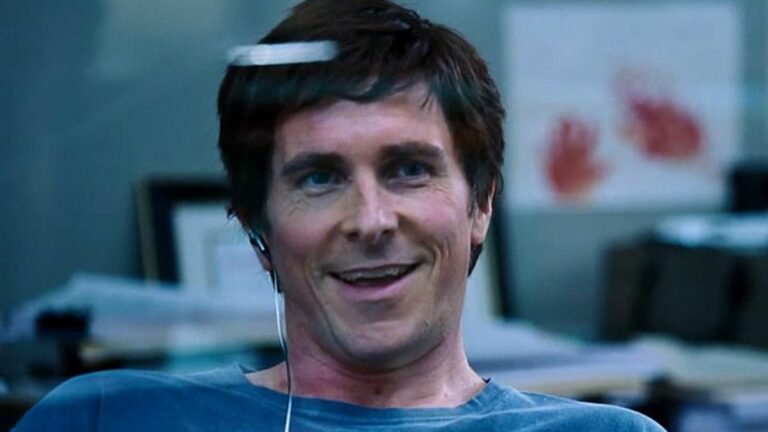
Christian Bale stars in The Big Short.
Christian Bale stars in The Big Short.
The subject is, of course, an insanely convoluted one — full of arcane banking terminology and horrible behavior by banks, government regulatory agencies, and bond-rating companies — that resulted in a cascade of bankrupt businesses, lost savings, and unemployment. McKay, however, refuses to turn it into a parade of somber finger-wagging. He wants his audience to understand what went so horribly wrong, not just feel angry about it. And he commits to that notion with puckish meta-humor that includes asides like, “Here’s Margot Robbie in a bubble bath to explain it to you.”
There’s too much ground to cover for the individual characters’ stories to make much of an emotional impact, despite McKay’s efforts at conveying, for example, the grief driving Baum’s righteousness. But The Big Short has a snappy energy that turns one of the most maddening events in recent history into something in which all the greedy pieces suddenly make sense — even the greedy pieces who are, theoretically, our protagonists, as we’re reminded that being right about this Jenga-unstable situation means real economic pain for real people. It’s more effective than any documentary when you can describe a gathering of the kind of people who facilitated this crisis as “like someone hit a piñata full of white guys who suck at golf.”
Chikara Ono.
Credits: Bert Johnson/File photo
These days, Chikara Ono doesn’t get behind the stove as often as he used to, but among his devotees, the chef is legendary — particularly for his skills with raw fish. At AS B-Dama (907 Washington St., Oakland), the popular izakaya-style Japanese restaurant located in the Swan’s Market food court, Ono plays more of a...
Congress is set to extend a year-old cease-fire in the federal war on medical marijuana — sending a strong message to prosecutors to keep their hands off legal pot.
Activists in Washington, DC report that lawmakers have included a renewal of the historic Rohrabacher-Farr amendment of December 2014 in this year’s must-pass spending bill, which was unveiled last...
Stories you shouldn’t miss:
1. In a stinging defeat for PG&E and the state’s other monopoly power providers, the California Public Utilities Commission is proposing to reject a plan that would have penalized homeowners who install rooftop solar, the LA Times$ reports. The CPUC instead sided with the solar industry and is recommending a compromise plan that would establish modest fees...
On the first Sunday in December, I shuffled onto a public ferry scheduled to travel from San Francisco's Embarcadero to Oakland's Jack London Square with a group of fifty others, each of us wearing radio headsets, like conspirators on a covert mission. It was an especially chilly afternoon and the wind was moist in a numbing way. We were...
Aries (March 21–April 19): The Neanderthals were a different human species that co-existed with our ancestors, homo sapiens, for at least 5,000 years. But they eventually died out while our people thrived. Why? One reason, says science writer Marcus Chown, is that we alone invented sewing needles. Our newborn babies had well-made clothes to keep them warm and healthy...
Thursday, December 17
Gremlins (106 min., 1984). Blockbuster night (The New Parkway Theater, Oakland, 9:30)
Jane Eyre (TBA, 2015). National Theatre Live (Rialto Cinemas Cerrito, El Cerrito, 7:00)
Friday, December 18
Good Bye, Lenin! (121 min., 2003). (Berkeley Public Library, Central Branch, Berkeley, 3:00)
Poems of Winter and Cigarettes (60 min., 2014) and Lalezar Street (TBA, 2000). Forthcoming documentary campaign closing party for Home...
The Express won thirteen awards, including ten first-place honors, in the 38th Greater Bay Area Journalism Awards contest. The Express won the most first-place awards of any non-daily newspaper in the annual contest for journalism excellence, sponsored by the San Francisco Peninsula Press Club. The winners were announced on December 5, and the contest was for news reports published...
Tolstoy wrote in Anna Karenina that "all happy families are alike." But even the most tortured Russian novelist would agree that all happy hours are definitely not created equal. Here in the East Bay, we have happy hours with $1 oysters and $1 shots and happy hours during which a stack of crumpled singles...
In October, SFGate, the website of the San Francisco Chronicle, published a story entitled "The 20 Most Generous People in the World." Finding and featuring the biggest-hearted residents of our globe is a worthy journalistic endeavor, but for the author of this story, there was only one measurement of generosity: money.
Although monetary donations can certainly be generous, when we...
I don’t know about you, but if I were thinking, “Who should make a movie about the 2008 subprime mortgage economic collapse?” my first answer would not likely be, “The guy who made Anchorman.”
But that counter-intuitiveness is almost exactly what makes The Big Short so effective. Adapting the nonfiction book by Berkeley’s own Michael Lewis, McKay and Charles Randolph...