
When Stories Hurt

During her early years as a therapist, Demitra McDonald worked at a counseling center in Sacramento, helping survivors of domestic violence and their families cope with the trauma they had endured. A few years ago, during one particularly difficult week, she was flooded with new domestic abuse clients. “It was just day after day, story after story of young … women who were practically beaten to death by those [who] they loved the most,” she said. McDonald had become accustomed to hearing similar stories from clients, but the relentlessness of that week pushed her farther than she was used to.

McDonald made it through the week. But after work one day, while walking to her car, she realized how loud it had been inside the busy center. And now, all of a sudden, it was quiet. “Something just cracked me open, and I just started to sob,” she recalled.

It wasn’t just one story that had affected her deeply. It was cumulative — all the stories had piled up inside her until she couldn’t hold them anymore. She said it hit her “that we’re all human; we’re all connected; we’re all sisters and brothers.” She identified so much with her clients that, even though she knew their abusers weren’t harming her directly, she felt the emotional and psychological pain nonetheless. “[The feeling] overwhelmed me, and once I realized that, I gave into it for a few minutes. And I said, you know, ‘Just sob for it. Sob for all of it, all of them, and all of those [who] are going to come next week. Just sob for all of them right now and let it go.'”

McDonald’s deep empathy for her clients changed her, so that after hearing their stories each day, their trauma had become her trauma. ‘”That can’t keep happening,'” she recalled saying to herself. “What happens to a puzzle when you take it out every day, and then it goes all to pieces? Eventually you pull it out, and you’ve got a piece missing, and then the next time it’s two or three pieces.”

That day, McDonald experienced a culmination of her “vicarious traumatization,” she said. She decided she had to make a choice about what kind of therapist she wanted to be. Did she want to be the kind that could only hold herself together long enough to get to the parking lot?

No. For her, it was vital that her clients knew “that if they are reaching out to me, they [are] going to have something to hold on to,” she said.

McDonald, who now works at the La Cheim Behavioral Health Services in Oakland, is not alone in her realization of the impacts that vicarious trauma — which is often the result of repeatedly hearing trauma victims’ stories — can inflict on social workers, psychologists, and other behavior health professionals. During the past decade, shelters, behavioral health clinics, and agencies around the country have attempted to begin coping with vicarious trauma by adopting a “trauma-informed care” approach, which not only acknowledges the role that past trauma plays in patients’ lives, but also emphasizes the gravity of recognizing and addressing the vicarious trauma that affects clinicians.

When social workers and mental health care providers are suffering, they can’t gauge whether they are “being present” with their clients, or if they’re inadvertently causing them harm, according to Laura van Dernoot Lipsky, who is the author of the widely read and well regarded book, Trauma Stewardship: An Everyday Guide to Caring for Self while Caring for Others, which describes “being present” as a “radical act.” It states: “[I]t’s not about what we do, what we say, or how we touch — it’s about being present in a way that tells those who are suffering that they are not and never will be alone.”

The concept of “being present” came up repeatedly in interviews that I conducted in recent weeks with behavioral health workers, psychologists, and other experts. They said it’s a vital part of providing quality care to traumatized people. If a caregiver’s own mental health is compromised, he or she cannot be fully present with clients, and thus has trouble empathizing and helping clients cope with the violence they’ve suffered. “I haven’t met a therapy bot yet,” said McDonald, stressing that an unfeeling therapist, lacking the ability to make a human connection, will always fail. “Humans survive in relation to each other. So this is also how we heal.”

But while the move toward trauma-informed care represents progress in acknowledging the existence and importance of vicarious trauma, experts say that many organizations still do not take the necessary steps to support their staffers and prevent trauma overload. Van Dernoot Lipsky, a veteran social worker and founder of the Seattle-based Trauma Stewardship Institute, said in an interview that there are still many barriers to creating environments that nurture healthy caregivers. Organizations are often under-funded and very sensitive to perceived financial challenges, she said. She asserted that there are plenty of creative, cost-free steps that can be taken, but “when you are exhausted, it’s not people’s most creative time. It can feel like a task, like one more thing to do.” Steps that require more resources, like reducing caseloads and prioritizing supportive supervisory meetings, are sometimes dismissed as unsustainable.

Stigma, too, is a barrier. According to van Dernoot Lipsky, there is “a belief that if you are good enough and tough enough and committed, you’re going to suck it up.” She doesn’t consider the grin-and-bear-it approach to be a viable option. She said that an individual or organization’s ability to process the trauma to which they’re exposed can be compared to a metabolic process. “If you are not readily metabolizing it or intentionally metabolizing [trauma], we see an individual can get saturated, and we see that a whole collective body can become saturated,” she said. “You can only stay saturated for so long before hemorrhaging may start happening.”

When the hemorrhaging starts happening, that’s when the quality of care becomes compromised on an individual, organizational, or systemic level. According to the California Health Care Foundation’s 2013 report, “Mental Health Care in California: Painting a Picture,” only half of adults and less than half of children who were prescribed medications for their mental health conditions received care that met quality standards.

California’s mental health care system is, of course, a behemoth plagued by many challenges, and vicarious trauma might seem like a small problem, but experts say that for frontline workers, dealing effectively with vicarious trauma is key to improving the quality of care for victims of crime — the source of so much trauma.

That’s especially important in cities with high violent-crime rates like Oakland. Last year, there were more than 6,000 reported violent crimes in Oakland, plus nearly 3,000 additional cases of domestic, child, and elder abuse. And while not all of those victims will seek professional help, many experts say it’s essential that those who do receive care are treated by clinicians who have the support and tools they need to avoid becoming victims themselves in order to help their clients deal with trauma.


In the early Nineties, psychologist Laurie Pearlman coined the term “vicarious trauma” to describe the transformative personal repercussions a caregiver can experience when engaging empathetically with trauma survivors. There are many types of caregivers: social workers, psychologists, shelter workers, humanitarian assistance workers, medical professionals, and first responders — anyone who works with survivors of severe violence, abuse, and neglect.

These professionals are also at risk of primary trauma, which is distinct from vicarious or secondary trauma. “A mental health worker, like myself, experiencing someone screaming at them in a fit of psychosis — that’s primary trauma,” explained Jim Caringi, a professor of social work at the University of Montana who has co-authored a paper with Pearlman.

Vicarious trauma is different because it’s a secondary experience. Caregivers experience trauma when they hear their clients’ stories.

Quantitative data on the prevalence of vicarious traumatization are scarce. According to Northeastern University’s Institute on Urban Health Research and Practice, the handful of studies that exist focus on individual sectors and have inconsistent definitions of vicarious trauma. However, several findings have reported that between 40 percent and 80 percent of helping professionals have experienced vicarious trauma, secondary trauma, or compassion fatigue.

“It’s an occupational hazard,” said Greg Merrill, director of Field Education at UC Berkeley’s School of Social Welfare. “If you work with a highly traumatized population, it actually will happen to you. It’s not whether it will or not, it’s my belief that it actually will.”

Merrill’s interest in vicarious trauma originated when he was a social worker at San Francisco General Hospital and Trauma Center from 2001 to 2005. He worked daily with victims of severe trauma: gunshots, stabs, gang rapes. He recalled one day in particular, when he walked into a client’s room as her bandages were being changed. She had been shot, and the wound from her emergency surgery stretched across her chest.

“I spoke with her at length, and she had a child. She had a lot of terror around what had happened, and because I was empathic with her, I felt very in the moment with her. And so I kind of experienced an empathic kind of terror. Just from connecting with her. And then I noted I just couldn’t stop thinking about her for days,” he said. “I had images of her wound pop up in my head.”

Merrill said that afterward, he was afraid to talk about what he was feeling with his supervisor and other social workers. “I thought it was highly unusual and probably not professional,” he said.

Merrill said that as a student and young professional, he learned to fear burnout — the emotional exhaustion that often comes with a strained workload. “What wasn’t talked about was [when] dealing with a high volume and intensity of highly traumatized individuals, there are specific and unique ways that weigh on you,” he said. “I do just think there are honestly some unique psychological things going on for people who work in high trauma settings that are just not always recognized.”

Eventually, he did talk to his supervisor, and when he spoke to other social workers, he found that they were all experiencing similar effects in response to working with severely traumatized people. He decided to become a resource to other social workers who were struggling with their trauma exposure and later developed a vicarious trauma training curriculum.

The terms “vicarious trauma,” “secondary traumatic stress,” and “compassion fatigue” are sometimes used interchangeably to signify the effects that giving care has on caregivers, but for many researchers, they are distinct concepts. The literature describes secondary traumatic stress as having symptoms that mirror post-traumatic stress disorder — like insomnia, appetite changes, and exhaustion. Compassion fatigue is often defined as the broad, predictable effects of working with suffering people.

“It can get messy,” said Caringi, when asked to separate the terms. “All of the experts in this field, including myself, are having conversations about how we deal with this nebulous, unclear set of phenomena.”

The hallmark symptom of vicarious traumatization is what the literature calls a “change in worldview” around safety, trust, and control. That can mean that the sufferer sees hazards everywhere, in places they wouldn’t otherwise occur. And they might find that they start to view other people as malevolent or untrustworthy.

Merrill recalled working with abduction survivors, and they would describe the vehicle their abductors drove. He said that later, when walking around in his neighborhood, he would see a car that resembled his client’s description. “It really freaked me out. I mean, it was just a car, but that’s the kind of thing that starts to happen to people,” he said. “You can start to feel that the world is all trauma all the time, everybody’s dangerous, everyone is out to get you.”

Caringi, a longtime clinician, echoed Merrill’s experience. Early in his career, he was working in Alaska, flying from village to village, dealing almost exclusively with tough trauma cases. At the time, his wife had just had their first child and was preparing to go back to work. “How do you think it went for me, a guy who was seeing trauma perpetrators and trauma survivors all day long, to find someone who was safe enough to watch my baby?” he asked. “It didn’t go well.”


La Cheim Behavioral Health Services, where Demitra McDonald now works, is a community mental health center in Oakland specializing in treating clients with acute psychological distress from severe depression and psychosis due to chemical dependency. According to the Center for Disease Control’s Adverse Childhood Experiences Study, which includes about 17,000 Kaiser patients, there is a strong correlation between an individual’s history of childhood abuse and problems with drug and alcohol abuse.

La Cheim sees about three hundred clients a year in its program of structured day services. “People are coming off of catastrophic crises, so there’s a lot of trauma, a lot of anxiety, a lot of fear,” said Brad Falconer, a psychologist at the center. “It can be a very over-stimulating, overwhelming environment.”

The program’s director, Frances Raeside, is committed to creating a supportive environment for the staff. She describes La Cheim’s orientation as “strength-based,” meaning that clients and staff members alike are regarded as resilient and resourceful in the face of adversity. “It’s not just helping [our clients] to hold their trauma, it’s helping us hold their trauma,” she explained.

“This room is constantly alive,” said Mical Falk, clinical director, referring to the room in the center that staff members use to seek help from each other after difficult, potentially traumatizing client sessions. “If people are experiencing it together, they are much less likely to be traumatized than if they were experiencing it alone.”

Every day, staffers take time to check in as a group and provide mutual support. The center initiated daily meetings of clinical staff members two years ago, and the organization instituted a weekly small group meeting to ensure staff members are coping well.

“The organizational support is everything to this work,” said McDonald, who has worked in the field since 2009 and joined La Cheim last fall. “Not a week has gone by since I started when I haven’t been asked, how are you doing? Is the workload going all right?” McDonald said that the affirmations and acknowledgment she receives at work empower her and help her provide better care to her clients.

Merrill sees this kind of organizational support as key to a caregiver’s longevity. “I believe people can do really hard work long-term if they are supported well,” he said.

“If you know there is an occupational hazard, and there are wraparound supports that are reasonable that could be provided by the supervisor or the organization, it’s just not responsible not to provide that,” he added.

Unfortunately, Merrill said, organizations commonly lack the resources to properly support their employees. “If we’re not helping our workers long-term, they’re toast,” he warned.


After her breakdown in the parking lot, Demitra McDonald knew she wasn’t willing to risk losing pieces of herself. She said she turned to practices that were restorative — pursuing yoga and deepening her spiritual life. She consulted with other therapists. “It helped me get my head together,” she said.

She learned that she had to foster a strong and clear identity supported by a healthy set of boundaries. “I have to be able to understand where I start and end, and where the client starts and ends,” she said.

“It takes a lot of self-reflection, a lot of observation,” said McDonald, when asked how she knows where her limits lie. “Ideally, you wouldn’t hit the limit. It’s like gas in the car. You wouldn’t wait until it ran out to gas it. You’d be checking that beforehand. … As you’re noticing that your stores are depleting, you build yourself up.”

Jewel Love, a marriage and family therapy intern at La Cheim, said he builds himself up by focusing on the basics — his relationships, eating habits, sleep patterns, extracurricular activities. “I’m just making sure that I’m balancing those areas of my life, making sure that I’m ready and up to par to come here and handle what’s thrown my way.”

“Practice wisdom” is how Merrill describes the personalized tricks and rituals he has heard in his years as a trainer. He told the story of a social worker at an Oakland hospital who, at the end of each day, would unlock her glove compartment, turn off her pager, hold it for a minute while closing her eyes, and wish her clients inside the hospital well. Then she’d lock the pager in the glove compartment. The next morning, she’d repeat the ritual in reverse. “She felt like she was able to psychologically wall it off better,” explained Merrill.

“[Pacing] the energy you give out over a thirty-year career is really hard to do,” he added. Ultimately, it comes down to choosing to take care of yourself while caring for others, and finding light in the darkness, he said.

“I feel very grateful for my life because I saw peoples’ lives taken away from them, like that,” he said, snapping his fingers. “It’s kind of incredible what people can survive, and that they can find meaning in it. Not [just] devastation, but some kind of positive meaning. If you’re aware of the impact it has on you, then you can shape how your beliefs change or what you need to do, and I believe it can actually make you greater.”

After work each day, McDonald picks up her young son from school. She said that as she drives, she focuses on what residual stress is left over from the day. “And every tick on the speedometer, every mile, I let it go,” she said. “And I tell myself, if there’s anything residual, when I see his smile, it will melt.”
The Oakland Fence Saga

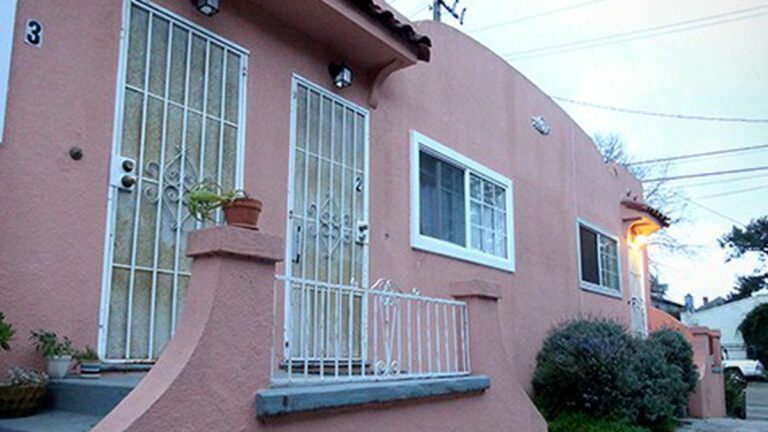
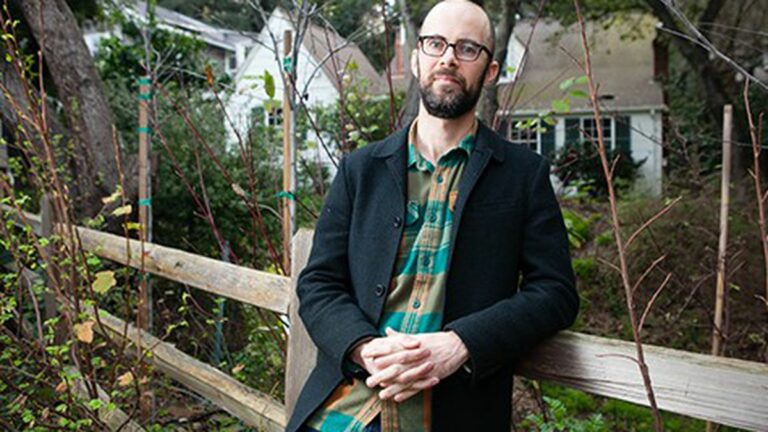
After Josh Harkinson and Rinku Patel moved into their North Oakland home in 2012, they quickly realized they needed to do something about the dilapidated fence in their front yard. Made of chicken wire, the fence was supposed to protect passersby from falling into Glen Echo Creek, which also runs through the front of their property at 3054 Richmond Boulevard. Situated between the street and the creek, the old fence was falling down and obviously presented a hazard, so Harkinson and Patel decided to replace it with a new wooden ranch-style fence and native vegetation. Harkinson believes his new fence and native plants serve a dual purpose: They prevent people from falling into the creek and inhibit erosion along an already steep bank.

But little did Harkinson and Patel realize that their three-foot-tall fence would raise the ire of not only their neighbors, but also of the City of Oakland. “This fence saga is a bureaucratic nightmare that has been nearly two years in the making,” said Harkinson, who is a reporter for Mother Jones magazine.

Not long after Harkinson installed the new fence in August 2014, some neighbors began to complain. They said the new fence was built too close to Richmond Boulevard, and because there is no sidewalk in front of Harkinson and Patel’s home, they said the new fence forces pedestrians to walk into the street when cars are parked there.

“I’ve lived here for seventeen years and nobody has ever fallen into the creek, so I feel like it’s solving one alleged hazard by building a fence that’s making an actual hazard,” said Anne Janks, in a recent interview.

Larry Smith, a disabled retiree who has lived in the neighborhood for nearly 22 years, also feels the new fence is making matters worse. “It’s a serious issue at night,” he said. “That area is very dark, and I’ve seen at least four car accidents [over the years] at that corner.”

But Harkinson pointed out that the new fence is only two feet closer to the street than the old one, and there have been no traffic incidents since he put it up. And he noted that during heavy rains, the chances of falling into the creek and drowning are dangerously high if there is no fence there.

After neighbors complained to the City of Oakland, city surveyor Gill Hayes inspected the fence and the property in October 2014 and concluded that the new fence — like the old one — was actually built on city land, which extends from the street into the middle of the creek. Harkinson told me that Hayes’ determination came as a surprise to him, and that he did not know both the old and new fences were on city property.

Soon after Hayes’ visit, city inspector Dennis Foster issued Harkinson and Patel an official Notice of Violation. However, the notice did not mention the neighbor’s qualms about safety. Instead, it ordered Harkinson to “correct the violations,” which the notice defined as “fencing installed in right-of-way without required permits.”

Harkinson doesn’t deny that he had no permits to build the new fence, but said he figured he didn’t need them because he thought the fence was on his property. He also noted that the city doesn’t require permits for wooden fences that are shorter than six feet tall.

Harkinson said that when he approached the city to find out exactly where his and the city’s property divided, the Planning and Building Department told him that in order to verify this information, he would need to have the land officially surveyed, which costs $17,000 to $19,000. Harkinson said he couldn’t afford the survey, and so he has yet to see any official evidence of where the city boundary line resides.

The city told him that because the fence was technically infringing on city property, he would either have to take it down or acquire an encroachment permit for building on city property, which, according to the permit application, costs $2,035.67. However, he had trouble acquiring the encroachment permit, because it required him to obtain private insurance, and he was turned down by two different insurance agencies, he said.

As a result, Harkinson decided to appeal the violation notice. On November 23, 2014, he filed his appeal with the city and included detailed images of the fence, along with historic documents that put surveyor Hayes’ property assessment in question. He also submitted a petition signed by nearly fifty neighbors who agreed that the fence should stay. But after presenting the material to city officials, Harkinson and Patel lost their case. Without the encroachment permit, Harkinson’s only option was to take down the fence. But rather than do so immediately, he decided to wait.

Harkinson said that in April of 2015, traffic and watershed officials from the city inspected and approved his new fence, determining that it does not prevent parking nor does it inhibit traffic flow in the area.

In a recent interview, Rachel Flynn, Oakland’s planning director, said a follow-up inspection occurred in November 2015 to see if Harkinson and Patel had corrected their Notice of Violation. “[The inspector] spoke with the homeowners, and they said they moved the fence out of the city’s right of way,” Flynn said.

In truth, Harkinson had not moved the fence. Instead, he decided to complain to the city about a neighbor’s private parking signs also being on city land. “My position had been if they’re going to allow people to put in private parking signs, why can’t this fence stay?” Harkinson said. And so city inspector Gene Martinelli arrived at the scene in January of this year to address the issue. He reiterated that Harkinson must find a way to insure the fence, or it had to come down.

When the Express spoke to officials with the city’s Planning and Building and Public Works departments, they were initially unaware of Martinelli’s visit, and disagreed on what should happen to the fence. Kristine Shaff of Public Works said her department suggested the fence should stay because it keeps people and trash away from the creek and also prevents erosion, while Flynn maintained that the fence had to either come down or get insured.

Harkinson was surprised by the response from Public Works, so he again decided to wait while city officials deliberated over the fence’s effects on public safety and creek health. Then on February 11, he received a phone call from Oakland Watershed Program Manager Lesley Estes, who told him that city officials involved with the case had met to determine the fate of the fence. But their resolution wasn’t entirely new. “They told me I can keep my fence; I just need to get an encroachment policy,” Harkinson said. “[Estes] said she pushed on the fact that I wasn’t able to get insurance, but they gave her examples of where this has worked and insurance companies that have given insurance for these things. They said I could and just wasn’t talking to the right people.”

“We wouldn’t recommend this if we didn’t think it was feasible,” Shaff told me, stressing the city’s confidence that the fence will get insured.

While Harkinson plans to contact the insurance agencies that Estes recommended, he remains skeptical about his insurance prospects and the resolution as a whole. “I’m going to reach out to those insurance people and see if it can work,” he said. “I doubt any will take just the fence, though. I will probably need an entirely new homeowners’ policy.

“It’s kind of ridiculous because with the encroachment permit, I have to pay the city for the privilege of keeping this fence which replaced the old one that was falling down,” he added. “I don’t have a choice.”

Daisy World Revels in the Ephemeral

Tracking down experimental rock outfit Daisy World’s entire discography would require the investigative skills of an anthropologist. The Oakland three-piece has a decidedly handmade approach to its work, and has released its previous material on cassettes in limited runs that have often numbered in the dozens.

In a recent interview, the band members — bassist-vocalist Monica Raden, guitarist-vocalist Adrian Saenz, and drummer Jaime Clark — said that they’ve sold some of their past releases exclusively at shows, and they admitted that they haven’t been too diligent about keeping copies of their tapes for themselves. Furthermore, they don’t thoroughly archive their material online: Daisy World’s SoundCloud page contains a smattering of tracks from previous tapes, with gritty, Xeroxed cover art — rather than discernible EP titles — delineating which songs belong to which cassette.

But that’s part of the band’s appeal: Daisy World makes music for a small, tight-knit community of listeners rather than the masses, and its work is better consumed live than on the internet. Despite having played at some notable, local institutions — including Yerba Buena Center for the Arts, where the band performed at the October 2014 opening of the museum’s riot grrrl-themed exhibit, Alien She — Daisy World mostly performs at small clubs and unofficial venues. (For instance, I first saw the band live at an abandoned West Oakland church last November.) The trio tends to avoid dealing in the currency of likes and follows. Instead, the band members opt for intimate interactions with their fans, many of whom are peers in the local punk community.

Currently, Daisy World is getting ready to release what could be referred to as its first relatively large-scale project: A self-titled, seven-inch record that comes out March 3 through the Oakland punk label Turbulent Records in a run of five hundred, though Clark, Raden, and Saenz agreed that they don’t plan to cap the number of copies if it sells out.

The new EP, which will be available on vinyl at shows and, eventually, for streaming on SoundCloud, features three brooding, tempestuous tracks with howling guitars and an aggressive, pounding rhythm section. It savvily combines the dark, atmospheric qualities of doom metal with abrasive, staccato punk elements. Throughout the EP, the members of Daisy World cultivate an atmosphere of foreboding through dense, droning instrumentation and feedback that functions as an instrument in its own right. Clark’s sturdy drumming provides a solid foundation for Saenz’ distorted, ominous guitar riffs, and he frequently dissolves the tracks’ melodies into atonal combinations of gravelly, textured chords. Saenz and Raden offset the compositions’ ambient qualities with call-and-response vocals that often sound intentionally unpolished and throaty.

I met up with the members of Daisy World at Clark’s apartment in West Oakland on a recent Tuesday night. Clutching mugs of tea and sporting messy hair and worn-in, vintage garb, the trio looked at home in Clark’s cozy, eclectic space, where seemingly every corner was dedicated to a different creative pursuit. A collection of records and cassettes containing a smattering of pop classics and local punk releases filled one corner. A sewing machine and colorful, repurposed fabrics occupied a workspace on the other side of the room; photocopied punk show fliers decorated the fridge. The three musicians are also practicing visual artists (Clark and Saenz are both photographers, and Raden does set design, sculpture, and video), and Clark’s artfully mismatched digs evoked the trio’s adamantly DIY approach to its work, individually and as a collective.

I asked the band about why it chooses to release its work in ephemeral, limited-edition formats, since that approach often limits the scope of its potential audience. “I think what appeals to me is that we can have a really personal relationship with our releases,” said Raden. “We can put them out ourselves and sort of be involved and in control of every aspect, and choose to work with friends we know and trust and have a mutual support system with.”

“With past projects, I’ve had really bad experiences working with people I don’t know who have way more control over the outcome,” added Clark.

As the bandmates’ conversation oscillated between joking around and talking business, one could sense their closeness both as friends and collaborators. Saenz and Raden, who first met as graduate students at California College of the Arts, initially started Daisy World as a duo and played their first show in 2012. At first, the two of them programmed beats on a drum machine, but Clark volunteered to drum for them after seeing them perform.

“I was like, ‘You guys don’t need a drummer. But if you wanted a drummer, I would try,'” she recalled. “I jammed with them a couple times, but I didn’t know if they liked it or not. And then after three or four times, I remember going, ‘So, am I in this band now, or what do you guys think?'”

Soon enough, Clark became a permanent member of the group. The trio agreed that having a live drummer has made their music more dynamic, though Clark added that she often channels the repetitive qualities of a drum machine in her approach to percussion. “I’m not a super precise drummer, but I try to be really forward so that Monica and Adrian can flop around a little bit,” she said, alluding to the improvisatory qualities of Daisy World’s sound.

The three bandmates agreed that their creative relationship is nearly seamless, explaining that nearly every decision they make for the band is the result of a unanimous vote. While this revelation might be hard to believe for those familiar with the exhausting nature of group work, tellingly, throughout our interview, Saenz, Raden, and Clark often began to answer in unison before bursting into laughter.

“I think all of our aesthetics are pretty locked in,” said Saenz, referring to the band’s smooth songwriting process.

Clark offered up a metaphor for each person’s role in the group: “It’s like a cool little Venn diagram, and in the center is Daisy World.”

Four Word Limit

Are you incapable of concision? Your answers are too long! You blather on, often rehashing the problem (unnecessary!) before giving four words (at most!) of (rarely!) useful advice. I’ve heard you say you have to edit letters down for space. Try this instead: Edit yourself! I want more of the letters — more from the people asking questions — and less of YOU.

Keep It Short, Savage, Expressed Sincerely

Feedback is always appreciated, KISSES.

I’m thirty, happily married, with my husband since I was seventeen. First boyfriend, kiss, etc. I never had sex with anyone else. This never bothered me because I wasn’t really into sex — but there have been big changes in the last year. I guess I am having a sexual awakening. My sex drive increased, and I’ve started reading erotica and fantasizing about getting kinky. I’ve also been having very strong urges to fuck someone else. As someone who always had strong values and opinions when it comes to sex and marriage and cheating, these feelings really confused me! So I found a safe and harmless outlet: Second Life. I created a hot avatar and have been role-playing, talking dirty, and banging people across the world for six months. I love it. I get to experience scenarios I fantasize about but would never do in real life. Before your readers start pulling the cheater card: I have talked about this with my husband, and I have his blessing. He knows I have an SL account and I’m having cybersex. Here’s where it gets murky. Most of my SL friends haven’t asked if I’m taken in RL, and I haven’t told them that I am. I flirt as if I’m single, though, because I’m worried people will treat me differently if they know I’m married. I do not wish to meet or have RL sex with anyone I meet on SL, and I make that clear to everyone. I don’t do photos/voice chat/Skype. But if someone asks me if I’m married in RL, I always tell the truth. I’m writing because I’m worried about this one guy. The cybersex is super hot, and he’s sweet. He’s my go-to guy, and I’m his go-to girl. He knows I have cybersex with other people in SL, and I have told him he is obviously allowed to have sex with others too. But I’m worried our SL relationship has become a bit more. He leaves me messages when I’m not online, telling me he misses me and “loves being with me,” and I’ve said the same to him. I’ve also made it clear I have no intention of meeting anyone from SL in RL, ever. Regardless of my intentions, I’m worried that I’m crossing the line and being unfair to my husband. I’m also worried that I’m being unfair to my guy in SL, because I’m sure he must think I’m single, even though he has never asked. Am I crossing the line and at risk of hurting my husband/SL guy? Or am I just having some harmless fun that helps me satisfy this strange new itch that’s driving me crazy?

Second Lifer And Spouse Haver

P.S. It’s important to note that SL has not negatively impacted my RL sex life and, if anything, has made it better. It has also made me happier and less cranky at home.

You’re doing nothing wrong, SLASH.

I am a kinkster. I have been since I can remember (I am now 21 years old), and I’ve never told anyone about my deep dark desires until the last year. During my time at university, I made good friends with a guy who I was able to open up to about my preferences, as he had similar desires. We created a beneficial arrangement. I suddenly no longer felt like I needed to suppress my “fucked up” masochistic needs and became extremely happy and more comfortable with them. I keep a journal, and naturally I wrote about this arrangement and a lot of the explicit details. Last summer, my mother read my entire journal and was horrified. After she read it, I received a very nasty text message from her about how our relationship was over, she couldn’t believe what I had done, and she was no longer going to help pay for my postgraduate courses, etc. She was deeply disturbed to learn that some money she had given me for my 21st birthday was spent on a hotel room where I met up with my kinky friend. (It wasn’t like we could meet in my family home!) I never wanted my mother to know about any of this, and I feel bad for how it upset her, but this was also a huge violation of my privacy. The only way to resolve the situation was for me to pretend that I deeply regretted everything, tell her I can see now how messed up those “weird” sex practices are, and say that I’m cured and will never engage in them again. Months have passed and I’m still angry with her for having read my diary. I feel sad about the lies I told and having to pretend — still — that I regret what I did. Because the truth is I’ve never felt more like myself than when I am doing BDSM. It’s not my entire world, but it is an important part of who I am. How do you think I should take things from here? She’ll never understand, so telling her isn’t an option, but that means suppressing my deep upset at her as well.

Mother Unfairly Destroyed Daughter’s Libido Entirely

Fuck mom; be you, MUDDLE.*

My husband and I met our “soul-mate parents” at our daughter’s preschool a few years ago, i.e., that rare couple with a kid the same age and the same artistic interests and political values. Our kids instantly bonded and are now BFFs. They have sleepovers, go trick-or-treating together, sled together — little girl heaven. Early on, the guy called my husband and they had a hard-drinking lunch. The guy spilled his guts about a painful previous relationship. It was weird, but we wrote it off. Three years of normal interactions and a kid later, we’re really good friends with the wife, while the guy stays in the background. I decided to start up a FetLife profile for fun — my husband and I are monogamish, and this is with his okay — and I find the guy’s profile, which clearly states that his wife does not know he’s on this site. What do I do? Pretend I never saw it? What if the wife finds out I knew? Do I tell him that I know? Most of all, I worry about the strain this would place on my daughter’s friendship. Her heart would be broken.

Has Evidence Louse Parent Making Arrangements

Mind your own business, HELPMA.

* Shit, I really can’t do this one in four words. Confront your fucking mother, MUDDLE, once you’re out of grad school (priorities!), about the awful, shitty things she did to you: reading your journal; shaming you for your sexual interests and your private, consensual, respectful, and healthy sexual explorations; and her unforgivable acts of emotional and financial blackmail. And you should wave the results of this study under her nose when you confront her: livescience.com/34832-bdsm-healthy-psychology.html. It’s just one of several studies showing that people who practice BDSM — not just fantasize about it but actually practice it — are psychologically healthier than vanilla people.

Letters for the Week of March 2, 2016

“Will Oakland Lose Its Artistic Soul?” Feature, 2/17

We Need an Arts Commission

Reestablishing an arts commission that reflects Oakland’s astonishing array of artists — and that really has a voice — and staffing it with someone that has the drive and will to advance its objectives will be an important step that’s a long time coming.

Lori Zook, Oakland

We Need Real Leaders

At its core, this is a political issue. Does the Oakland City Council support a vibrant arts community or not? Are they willing to step on the toes of the rich and powerful to enact zoning ordinances and funding mechanisms that allow the continued presence of an art scene? Bay Area economics and land use is no mystery. It is a very desirable place to live and gentrification is inevitable as the digirati multiply and invade.

It is the rare and special politician who is capable and willing to fight for the arts underclass. You must seek these individuals out and do what you must to get them elected. Otherwise, you will just be fed pablum and BS about “supporting the arts.”

A cultural arts commission, acting as a powerful citizen advisory group, would be a start. The commissioners need to educate themselves on the land use process and be powerful advocates before the city council. Don’t rely on staff! They are not your friends! Be disruptive but effective. Make proposals such as an arts zone overlay. Demand developers provide an effective mixed-use component. Suggest that when properties that formerly housed artists or galleries sell, there will be a surtax to provide replacement spaces.

It will always be a battle against the pro-development forces that just want to come in and build maximum profit condos or apartments. But through education and advocacy and getting your own candidates elected, you will hopefully reverse the tide and find a way to save your arts community. Good luck!

Steve Nash, Oxnard

“Tenant Advocates Decry Court Move,” News, 2/17

Send the Judge a Letter

Tenant and housing activists urge people to contact Judge Morris Jacobson! Write directly to Judge Jacobson and tell him that the community at large in Oakland and Berkeley totally disagrees with the decision to move the eviction case system to Hayward, because it will result in more homelessness! Our most vulnerable community members in Oakland and Berkeley may be deprived of their most basic constitutional and human rights, if the plan to consolidate eviction cases in Hayward occurs.

Send your letters ASAP to: Honorable Morris Jacobson, Alameda County Superior Court, Department 1, 1225 Fallon Street, Oakland, CA, 94612

Lynda Carson, Oakland

“People Over Profits,” What The Fork, 2/17

Down with Fear

Good luck to Restore Oakland Center! Looking forward to patronizing but hope (advertising) efforts are made to dispel perhaps overblown security concerns about Fruitvale. Last year, a bunch of us had dinner in a Fruitvale restaurant, after which a security guard near the BART stop cautioned us not to linger after 7 p.m. Especially as the location of a BART stop, the Fruitvale business district needs to grow and prosper!

Ruby MacDonald, El Cerrito

Let’s Help

This is awesome. The Kitchen of Champions program at the Oakland St. Vincent de Paul provides clean tech and chef’s training and certificates, and there is a partnership between Canticle Farms and Planting Justice on food security, restorative justice, and prison re-entry. Good partners to leverage what look to be considerable resources. Good work! I’m happy to help.

Eugenia Bowman, Oakland

Corrections

Our February 24 restaurant review, “The People’s Choice,” misspelled the name of the restaurant Enssaro.

Our February 17 news story, “Tenant Advocates Decry Court Move,” erroneously stated that the median household income for renters in Oakland in 2014 was $52,000, and that the average renter household in Pleasanton had an income of $74,000. The true median household income for Oakland renters in 2014 was $40,250, and renter households in Pleasanton had a median income of $77,645 that year.

Corrections for the Week of March 2, 2016

Our February 24 restaurant review, “The People’s Choice,” misspelled the name of the restaurant Enssaro.

Our February 17 news story, “Tenant Advocates Decry Court Move,” erroneously stated that the median household income for renters in Oakland in 2014 was $52,000, and that the average renter household in Pleasanton had an income of $74,000. The true median household income for Oakland renters in 2014 was $40,250, and renter households in Pleasanton had a median income of $77,645 that year.

Too Much Police Oversight in Richmond?

A heated dispute broke out recently among Richmond City Council members on social media over the question of how much citizen oversight is necessary to discourage misuse of police powers and to maintain a positive relationship between police officers and the community they serve. The proposal to increase citizen oversight in Richmond has been controversial because the Richmond Police Department has become a national model for successfully implementing community policing techniques that have reduced crime and created positive relationships with residents and community organizations.

At issue is a proposal to expand the Richmond Police Commission’s powers so that the nine-member body will be required to investigate every case of police-caused death or serious injury even when there is no complaint of officer misconduct. The oversight would be one of the most rigorous in the state. Currently, the commission only investigates cases in which a formal complaint has been filed. The proposed change is being driven by a 2014 case in which a Richmond police officer shot and killed 24-year-old Richard “Pedie” Perez, who was unarmed. Initially, the commission did not conduct an investigation in the Perez case because his family members didn’t file a complaint until after the thirty-day deadline. The council amended the commission’s charter last month to extend the complaint filing period to 120 days.

City staffers are examining the proposed oversight expansion to determine how much it will cost and to clarify certain elements, such as what constitutes a “serious injury.” The council has not scheduled a date to vote on the proposal.

The heated dispute has pitted Mayor Tom Butt, who opposes the oversight expansion, against the four councilmembers who support it: Jael Myrick and the three Richmond Progressive Alliance councilmembers, Gayle McLaughlin, Eduardo Martinez, and Jovanka Beckles. Butt contends that increasing the commission’s powers represents a form of “police bashing” and that it’s unnecessary and redundant. He said the council should be touting the police department’s success, instead.

Supporters argue that expanding the powers of the police commission is necessary because there is still a lack of trust between the police department and Richmond residents and that commission investigation reports could possibly make suggestions for better police training and protocols. RPA members have also cited police misconduct in other cities and states as a compelling reason for increasing citizen oversight.

Beckles, who is Black, pointed specifically to police misconduct problems in Baltimore and referenced the Black Lives Matter movement’s call for an end to police violence as a reason to increase the commission’s authority. She also contended that Butt was incapable of understanding the issue because of what she called his “white male privilege.”

In a hostile debate that has spilled into social media, Butt responded by writing, “I think [Beckles] is obsessed with what has happened at other places and other times. She cites Black Lives Matter, and Melvin Russell’s issues in Baltimore. … I think she is almost jealous of these other cities and hoping something will surface in Richmond on which to build yet another local political cause. We haven’t had a Black Lives Matter issue since the events that triggered the formation of the Police Commission over thirty years ago in 1984.”

Myrick distanced himself from his colleague’s comments, but said the fundamental idea of increased citizen oversight is sound. “Whether you’re talking about the Richmond Police Department, Chevron, or the Housing Authority, it is not the job of public officials to simply trust that people are doing the right thing,” Myrick said. “It is the job of public officials to provide oversight and enact policies that ensure that our constituents are protected.”

The issue of increased citizen oversight was raised largely due to the 2014 incident in which Officer Wallace Jensen shot and killed Perez. According to a coroner’s inquest, a clerk at Uncle Sam’s Liquor Store summoned police after Perez caused a disturbance in the store. Two investigations, one by the Contra Costa County District Attorney’s Office and an internal department review found no wrongdoing on Jensen’s part. Nonetheless, last month the city settled a suit, filed by the Perez family, for $850,000.

The officer-involved killing was the first in Richmond in seven years. To many, it was considered an anomaly in a department recognized nationally for its innovative approach to community policing, developing strong working relationships and partnerships with community groups, and for being successful at reducing crime. Last September, US Attorney Loretta Lynch praised the Richmond Police Department during a visit. “It’s clear to me that Richmond is working toward a holistic and comprehensive approach to criminal justice that is more than just an arrest but is trying to identify many of the causes that lead people to connect with the criminal justice system in the first place,” Lynch said.

Problems with police departments nationwide have been so pervasive that activists and politicians around the country are calling for increased police accountability. Last week, California state Senator Mark Leno announced a bill that would roll back the 1978 state law that keeps police misconduct and police shootings confidential. Legislators contend that the rollback will increase transparency, which in turn will increase public trust in its law enforcement agencies.

But there are questions as to whether Richmond residents actually mistrust their police department. An annual citizen survey showed public confidence in the department rose from 38 percent in 2007 to 59 percent in 2015. Citizen complaints about police misconduct have also dropped from five in 2010 to only one in 2015.

Regardless, Interim Police Chief Allwyn Brown, a longtime community policing advocate, appears to be unruffled by the controversy. Brown said in an interview that he doesn’t see any particular problem with a more muscular police commission, although he also doesn’t necessarily see a need for it. “I’m not worried to have another pair of eyes for checks and balances,” he said. “And I don’t feel the council thinks there’s a problem in the department. I just see them wanting to be leaders on this issue.”

Brown said the department has been proactive in responding to the Perez shooting by changing some protocols, including making it mandatory that officers have a baton with them any time they exit a vehicle. Brown also pointed to the department’s innovative policies when engaging the mentally ill. Last November, officers responded to a call of a disturbed man walking around an apartment complex yelling, knocking on doors and wielding a hatchet. Officers discovered the man was a resident of the complex who had a history of mental problems. When the man went into his apartment, the officers decided to leave him alone until he had a chance to calm down, which he did. The following morning, the man was arrested without incident.

“We had to balance the risk,” Brown said. “Do we forcibly enter his apartment and put somebody’s life at risk, or do we monitor from afar and not force our officers into a shooting situation.”

More Oakland Homes Turning into Hotels

Richard Wingart used to live in a five unit, rent-controlled apartment building in North Oakland, but last November his landlord forced him out of his home, and he ended up leaving the city. Now, his apartment has effectively become an extended-stay motel.

Richard Wingart’s story might be familiar to Express readers. I first wrote about Wingart’s housing problems last May after he and two neighbors who lived in a four-unit apartment building at 840 55th Street were hit with a 125-percent rent increase (see “Jacking Up Rents,” 5/20). Their new landlord, Los Altos resident and real estate investor Arlen Chou, bought the building after its previous owner, Kenneth Kolevzon, converted it from a five-unit apartment building into a four-unit condo building. Kolevzon ran into financial problems and was forced to sell at a steep discount. Chou seized the opportunity to make a big profit. On the real estate investor website BiggerPockets.com, Chou wrote, “[T]he best part of the property is that as they are condominiums, they are exempt from rent control!” Chou called the building his “own little island of rent control free property in a rising neighborhood in Oakland.”

Chou also hired the Bornstein and Bornstein law firm, which specializes in helping landlords get rid of existing tenants so that owners can maximize rents. Last October, I wrote about how Chou’s attorneys succeeded in pressuring Wingart to leave (see “Pushing Out Tenants,” 10/14). To do this, they threatened Wingart with an eviction by claiming that he hadn’t paid his full rent on time, even though Wingart insisted he had. According to Wingart, Chou demanded $1,450 a month, when Wingart’s rent had always been $600, so he and his neighbors petitioned the Oakland Rent Adjustment Program to contest the new, higher amount. The Rent Adjustment Program had responded to the petition, stating that the tenants should pay their old rent until their case was decided. But Chou’s attorneys told Wingart that if he lost the petition before the Rent Adjustment Program, he would be evicted, and that the eviction would harm both his credit record and his ability to rent apartments in the future. Unable to afford an attorney, and fearing that he would lose in court, Wingart signed an agreement to move out in November. Afterward, he said he felt tricked. “I don’t know a thing about the law,” said Wingart in a previous interview. “I was signing under distress, and I wasn’t in a clear mind.” Wingart has since moved to Pinole.

And now the latest update in Wingart’s story: His old apartment is currently renting as an extended-stay motel for two-and-a-half times more than what Wingart used to pay. Wingart’s apartment is one of thousands of short-term rentals in Oakland that are listed on platforms like Airbnb. Critics say that the problem of landlords taking units off the market and turning them into hotels is worsening the region’s housing affordability crisis. Unlike San Francisco and Berkeley, Oakland has yet to pass a single law to regulate short-term rentals.

Last week, I knocked on the door of Wingart’s old apartment. A woman named Megan answered. She said she’s a travel nurse originally from Connecticut. Her company sends her on short stints — often several months at a time — to work at different hospitals across the country. She uses Airbnb and other short-term rental platforms to find places to stay. “I was just in Fargo, North Dakota,” she said. “Right now, I’m working at Alta Bates Hospital.”

Megan said she found Richard Wingart’s old apartment by looking on Airbnb. She was browsing through listings for several Richmond apartments being operated as hotels by a man named J. Thomas Martin. When she contacted Martin through Airbnb and asked about renting one of the Richmond apartments, he instead offered her Richard Wingart’s old North Oakland studio.

“He said I’d like this one better, that it’s a nicer apartment,” said Megan. “I really like this neighborhood. It feels safe.” Inside, I could hear dogs barking. Megan said she had two dogs and that Martin allowed her to bring them without paying an extra security deposit.

When I asked Megan how much Martin is now renting the apartment for, or whether she signed any kind of contract with him, or Chou, she said I should ask Martin himself. So I sent emails to both Martin and Chou, and made several calls to both of them for this story, but neither responded. However, according to an ad posted by Martin on the website TravelNursingCentral.com, Wingart’s old apartment is now an extended-stay motel that rents for $2,195 a month. “Fully furnished,” the ad reads. “Just bring your bags!” And, “pets welcome!”

But pets aren’t welcome for the existing tenants that Chou has been trying to push out. Last year, shortly after Chou bought the building, he told one of the existing tenants, Cris Cruz, that she could not have her dog live with her anymore, and would face a $25 per day fee each day her dog stayed. Cruz subsequently gave her dog away to a friend.

When I visited the building last week, it was apparent that Chou is also refurbishing the other empty condo, and that he has split this single condo back into two separate living quarters, making the building once again a five-unit structure. According to Martin’s listing on TravelNursingCentral.com, he and Chou intend to rent at least two of the building’s units as short-term rentals.

If the name J. Thomas Martin also sounds familiar to Express readers, it’s because, like Arlen Chou, I’ve also written about Martin before. Martin is one of an unknown number of entrepreneurs in the East Bay who are taking rental housing units off the market and turning them into hotels (see “Turning Housing Into Hotels,” 9/16/15). One of Martin’s profile names on Airbnb is “Oakland!” He currently rents several studio apartments on International Boulevard near Lake Merritt for $107 a night on Airbnb. Guests get access to the apartments by obtaining a lockbox code via email. “Professionally cleaned before every stay,” Martin wrote in the ad for one of these studios. “Looks like a stylish hotel room in San Francisco, instead of the ‘lived-in dorm room’ style apartments you tend to find on Airbnb in Oakland.”

According to public records, Martin is an employee of the California Department of Finance. He also owns real estate in Richmond, and rents it through Airbnb as well. It’s unclear how Martin became Chou’s agent to run a hotel out of the apartment building at 840 55th Street, but both of them are frequent contributors to BiggerPockets.com.

East Bay Housing Organizations (EBHO), an affordable housing advocacy group, recently studied the problem of short-term rentals in Oakland using data obtained through a web scrape of Airbnb listings. According to Mia Carbajal, the author of the report, there were 1,155 Airbnb listings in Oakland as of last June. Of these, 57 percent were for entire homes. The average Oakland Airbnb listing was available 237 nights a year. Carbajal said that these numbers indicate that a significant proportion of Airbnb listings in Oakland are entire houses and apartments that have been taken off the residential rental market so that they can be operated as hotels instead.

Alison Shumer, a spokesperson for Airbnb, declined to offer data to the Express that would reveal how many apartments and houses are possibly being run as hotels in Oakland. Shumer said, however, that Airbnb disagrees with the data in the EBHO report. “When people scrape our site, it leads to inaccurate conclusions about our community,” she said.

Carbajal said Airbnb and other companies could easily make accurate data available to cities so that policymakers could understand how many housing units might be affected, but Airbnb has refused to provide this information.

The only step that Oakland has taken to better regulate short-term rentals is to sign a tax agreement with Airbnb to collect hotel taxes, but many activists criticize the deal’s secrecy. I requested a copy of the tax agreement months ago using the Public Records Act, but the city responded that the agreement is a confidential tax document, and so the public is not allowed to review its terms.

Carbajal said that without seeing the tax agreement, it’s impossible to know if Airbnb is actually transmitting to the city the full 14 percent hotel tax that it’s now collecting from its thousand-plus hosts in Oakland. In fact, Assistant City Attorney Kathleen Salem-Boyd and Revenue Administrator Margaret O’Brien declined to tell councilmember Lynette Gibson McElhaney during a finance committee meeting on January 26 how much money Airbnb has actually paid to the city, and even told her that they couldn’t disclose the information in private.

But O’Brien did tell members of the city council that Oakland will conduct a compliance audit in June of short-term rental businesses in the city. The city will obtain income tax returns from the state Department of Finance and identify short-term rental operators and then cross check this against city records to see if Airbnb hosts and those who use other platforms have obtained a business license from the city, and are paying hotel taxes.

But none of this helps Richard Wingart, one of an unknown number of Oaklanders displaced by landlords who are increasingly turning homes into hotels.

About a Boy

0

Veteran Japanese animator Mamoru Hosoda’s The Boy and the Beast opens this week in select theaters opposite Only Yesterday, the latest animated feel-gooder from Studio Ghibli. We chose to review Hosoda’s kids/martial arts/monsters film instead of the Ghibli because: 1) Ghibli’s righteousness has grown tiresome; 2) Boy-Beast is told from a strictly male perspective, generally a rarity in animated family movies these days; and 3) We liked the looks of Kumatetsu (voice of Koji Yakusho), the crude, bear-like demigod from the shadowy spirit kingdom of Jutengai, who adopts a bitter, unwanted human boy named Ren (later renamed Kyuta) off the streets of Tokyo’s Shibuya district and turns him into a caring and valiant young man.

As written and directed by Hosoda, it’s a plea for more spiritual expression in the human world, from the point of view of the traditional Japanese animal spirits who dwell in a parallel netherworld. The sugar that makes that medicine go down is Hosoda’s artwork. His depiction of modern Tokyo is more wondrous than real life could possibly be, ditto the splendiferous cityscapes of Jutengai. Meanwhile, the kid Kyuta is drawn very much in the old-fashioned manga style, especially in his exaggerated facial contortions.

The plot itself is a little less interesting. In one of his trips back to the human sphere, Kyuta meets and falls in love with a female fellow student, Kaede, also a bit of an outcast. She and his surrogate father Kumatetsu see to it that the disaffected boy learns to “hold the sword in your soul” in order to “reach a state of non-ego.” These are worthy goals for all us. Pixar and Ghibli, please note.

Cafe Eugene’s Oregon Tale

There’s a restaurant in San Francisco named after Dobbs Ferry, a not-so-famous village in New York’s Hudson Valley, and another — Tacko — that was conceived as a Nantucket-themed taqueria. I suppose there’s something of a tradition, then, of Bay Area chefs opening restaurants inspired by their faraway — and, to the average customer, perhaps somewhat obscure — hometowns.

You can add Cafe Eugene, a new Pacific Northwest-inspired restaurant in Albany, to the list. Ryan Murff and Jon Guhl — who also co-own Boss Burger, an excellent fast-food joint located two doors down — opened the restaurant two months ago in the old Little Star Pizza space. Little Star, which is also owned by Guhl, moved next door, so, all told, this one block of Solano Avenue now constitutes a mini-empire of American favorites — a kind of one-stop shop for your deep-dish pizza, your burgers, your clam chowder.

Amanda Joost Gehring, a former sous chef at Berkeley’s Cafe Rouge who admits to having “a bit of a Pacific Northwest crush,” heads up the kitchen. But it is Murff, a Eugene transplant, who has largely shaped the restaurant’s identity. Many of the dishes on the opening menu are based on family recipes and food he remembers eating when he was growing up in Oregon in the Eighties and Nineties.

If no one had bothered opening an Oregon-themed restaurant in the Bay Area prior to this, it might be because, well, at the end of the day, the food Murff grew up eating in Eugene has an awful lot in common with California cuisine. Cafe Eugene shares the same rustic farm-to-table aesthetic and honor-thy-ingredients cooking philosophy as dozens of other East Bay establishments, and even its homey, “Oregonian” decor — old, mismatched dining chairs and wood paneling like the kind you might find inside a fishing cabin — is very much in line with current Bay Area trends.

Put it this way: You could shoot Portlandia just as easily in, say, Temescal Alley as you can in Portland proper.

Murff pointed out that there are subtle culinary differences, in emphasis if not in essence. In part because of regional climate differences, Pacific Northwest cuisine tends to feature more cold-weather food (e.g., chowders and stews), and the prevalence of smoked fish points to both Scandinavian and Native American influences. The city of Eugene, in particular, has long had a Berkeley-esque, granola-hippie streak that manifests itself in a number of singular specialties — for instance, a vegan dip known as “tofu pâté.” (Cafe Eugene offers a house-made version.)

But the food at Cafe Eugene is mostly indistinguishable from what any number of Alice Waters disciples are cooking at restaurants around the Bay Area — with a little bit more seafood, perhaps. Take, for instance, the “Oregon toasts” appetizer, which were less some elusive regional delicacy than they were a slight variation on bruschetta: loosely “Oregon-style” ingredients piled onto slices of toasted Acme bread. In addition to that tofu spread (which I haven’t tried), topping options included a marinated mushroom and paddlefish caviar combo that was incredibly addictive — the briny undercurrent of the caviar accentuated by a thin coin of raw oyster mushroom (a less bougie stand-in for shaved truffle). Another version featured smoked salmon and cured trout roe, both tasty and both prepared in-house.

Likewise, the fact that there wasn’t anything particularly Pacific Northwest about a burrata and beet salad didn’t take anything away from its deliciousness. I loved the way the cheese spread on top like oozy, melted marshmallow, and the way the pickled beets offered a bright, intensely tangy counterpoint to bitter endive leaves and wholesome-tasting watercress sprouts. And the only Pacific Northwest connection in a Brussels sprout and cauliflower casserole was a Mornay sauce made with Oregon cheddar — and I found that sauce a bit too grainy to be enjoyable.

However you want to categorize Cafe Eugene, the East Bay could use another seafood-oriented farm-to-table spot, and that’s the realm where I think the restaurant really has an opportunity to shine. A bowl of steamed Prince Edward Island mussels featured absurdly plump mussels — the largest I’ve had in an East Bay restaurant this side of À Côté (though Murff said that might have been anomalous to the particular batch I was served). When shellfish is this good, you don’t need to do much. A simple pan broth made with cider, smoked pimentón butter, and slow-cooked fennel and onions — lightly pickled so that they resembled sauerkraut — commingled with the mussel juices to make the perfect dipping sauce.  

If anything, the restaurant occasionally errs too far on the side of simplicity, resulting in a few seafood dishes that were underseasoned. I liked the idea behind a clam chowder topped with leaf-shaped wedges of puff pastry — a play on potpie. But the soup itself was strangely bland, despite the inclusion of an ample amount of cream and butter. It needed salt and, more than that, a much stronger dose of actual clam flavor. Meanwhile, the pan-fried steelhead trout fillet was exactly the kind of piece of fish I expect to be served at any self-respecting restaurant on the Oregon coast — perfectly tender flesh and impeccably crisp, well-seasoned skin. On the other hand, the butter beans and broccoli rabe that came with the fish were rather boring, even if they were cooked properly.    

The best of the entrées I tried was a braised pork shoulder dish that drew its inspiration not from Portland or Eugene, but rather from an old Oaxacan recipe. The combination of lush, tender, slow-cooked pork, bright tomatillo-based chile verde-style sauce, and Cotija cheese-spiked grits (a play on Mexican tamales) was deeply comforting — like eating a bowl of savory porridge. Still, those looking for big, bold flavors might be mildly disappointed: I just wished a hot sauce had been offered on the side.

Even the booze list at Cafe Eugene isn’t as regionally specific as you might imagine. There are a handful of Oregon Pinots and craft beers, but not too many. Murff said he plans to add more after getting a little pushback from customers hoping for more Oregon hops.

On the other hand, a shortcake and marionberry sauce transported me right back to the last road trip I took up the Oregon coast, where it seemed like even the tiniest roadside shacks would feature some awesome berry-centric dessert. I loved the crisp, sugar-brushed edges of the biscuit-like shortcake, the generous dollop of yogurt-infused whipped cream, and, best of all, the pool of tart-sweet berry sauce — a taste of summer that Murff said recalled his childhood years, when his family would gather enough berries to freeze to last all the way through the winter months.

Here’s where I admit I may have screwed up: I’ve yet to try Cafe Eugene’s brunch service, which the restaurant had only just launched a week or two prior to my visits. As it turns out, brunch is going to be a real focal point of the business, so much so that starting this week Cafe Eugene is one of the only East Bay eateries I know of (diners and chain restaurants aside) that offers a full brunch menu every day — what Joost Gehring calls a “lazy all-day brunch.”

According to Murff, the brunch menu in particular leans heavily on memories of his childhood in Eugene: the specific kind of French toast his mother made, using baguettes cut into thick coins, and the pancakes she would make with yogurt, like so many brunch spots in Oregon do. For most customers, it’ll be nice just to be able to get those kinds of dishes on, say, a random Tuesday afternoon. For Murff and — he hopes — for the other Oregon transplants who visit the restaurant, maybe it will feel something like home.

When Stories Hurt

During her early years as a therapist, Demitra McDonald worked at a counseling center in Sacramento, helping survivors of domestic violence and their families cope with the trauma they had endured. A few years ago, during one particularly difficult week, she was flooded with new domestic abuse clients. "It was just day after day, story after story of young...

The Oakland Fence Saga

After Josh Harkinson and Rinku Patel moved into their North Oakland home in 2012, they quickly realized they needed to do something about the dilapidated fence in their front yard. Made of chicken wire, the fence was supposed to protect passersby from falling into Glen Echo Creek, which also runs through the front of their property at 3054 Richmond...

Daisy World Revels in the Ephemeral

Tracking down experimental rock outfit Daisy World's entire discography would require the investigative skills of an anthropologist. The Oakland three-piece has a decidedly handmade approach to its work, and has released its previous material on cassettes in limited runs that have often numbered in the dozens. In a recent interview, the band members — bassist-vocalist Monica Raden, guitarist-vocalist Adrian Saenz,...

Four Word Limit

Are you incapable of concision? Your answers are too long! You blather on, often rehashing the problem (unnecessary!) before giving four words (at most!) of (rarely!) useful advice. I've heard you say you have to edit letters down for space. Try this instead: Edit yourself! I want more of the letters — more from the people asking questions —...

Letters for the Week of March 2, 2016

"Will Oakland Lose Its Artistic Soul?" Feature, 2/17 We Need an Arts Commission Reestablishing an arts commission that reflects Oakland's astonishing array of artists — and that really has a voice — and staffing it with someone that has the drive and will to advance its objectives will be an important step that's a long time coming. Lori Zook, Oakland We Need Real...

Corrections for the Week of March 2, 2016

Our February 24 restaurant review, "The People's Choice," misspelled the name of the restaurant Enssaro. Our February 17 news story, "Tenant Advocates Decry Court Move," erroneously stated that the median household income for renters in Oakland in 2014 was $52,000, and that the average renter household in Pleasanton had an income of $74,000. The true median household income for Oakland...

Too Much Police Oversight in Richmond?

A heated dispute broke out recently among Richmond City Council members on social media over the question of how much citizen oversight is necessary to discourage misuse of police powers and to maintain a positive relationship between police officers and the community they serve. The proposal to increase citizen oversight in Richmond has been controversial because the Richmond Police...

More Oakland Homes Turning into Hotels

Richard Wingart used to live in a five unit, rent-controlled apartment building in North Oakland, but last November his landlord forced him out of his home, and he ended up leaving the city. Now, his apartment has effectively become an extended-stay motel. Richard Wingart's story might be familiar to Express readers. I first wrote about Wingart's housing problems last May...

About a Boy

Veteran Japanese animator Mamoru Hosoda's The Boy and the Beast opens this week in select theaters opposite Only Yesterday, the latest animated feel-gooder from Studio Ghibli. We chose to review Hosoda's kids/martial arts/monsters film instead of the Ghibli because: 1) Ghibli's righteousness has grown tiresome; 2) Boy-Beast is told from a strictly male perspective, generally a rarity in animated...

Cafe Eugene’s Oregon Tale

There's a restaurant in San Francisco named after Dobbs Ferry, a not-so-famous village in New York's Hudson Valley, and another — Tacko — that was conceived as a Nantucket-themed taqueria. I suppose there's something of a tradition, then, of Bay Area chefs opening restaurants inspired by their faraway — and, to the average customer, perhaps somewhat obscure — hometowns. You...
19,045FansLike
17,709FollowersFollow
61,790FollowersFollow