The Oakland Tribune, a daily newspaper founded in 1874, will become a community weekly paper starting next month, the newspaper’s parent company announced today. In addition, the daily papers that had been called the Contra Costa Times and the Oakland Tribune will be renamed the East Bay Times. The corporate rebranding will take place on April 5.
The new weekly Oakland Tribune apparently will be much like the newspaper chain’s other weeklies, such as the Montclarion, the Berkeley Voice, and the Alameda Journal. The Hayward Daily Review and the Fremont Argus will also become weekly community papers.
Sharon Ryan, president and publisher of the Bay Area News Group, said the company decided to make the changes after conducting an extensive reader survey last fall.
But judging from the reaction on Twitter today, the change is not going over well:
I’m a glass-half-full gal, but it’s dishonest to be “excited” abt ending the 142-yo Oakland Tribune. Sad for all our journalism colleagues.
The rebranding will be accompanied by buyouts and layoffs. The new round of downsizing comes as difficult news for a staff that has already been decimated. Currently, the Tribune only has one full-time reporter who is dedicated to covering Oakland: David DeBolt.
Sad day for my former colleagues at San Jose Mercury News, Oakland Tribune & Contra Costa Times – and for journalism https://t.co/38gHWKaXZX
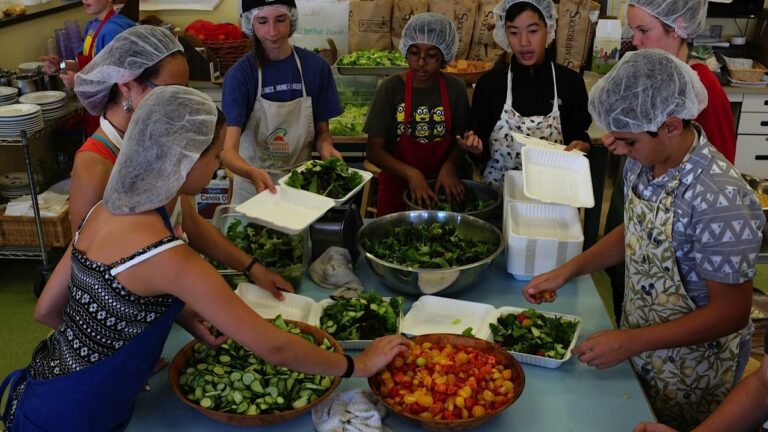
Students in the Growing Leaders class pack a salad.
Credits: Matt Tsang
Matt Tsang didn’t set out to turn Willard Middle School’s garden and cooking program into a bustling takeout restaurant.
Like many innovative ideas, Tsang’s Growing Leaders class was born out of necessity — the result of Berkeley Unified School District losing $1.9 million in federal grant money that had previously helped fund the district’s fourteen school garden and kitchen programs. When those cuts hit in 2013, individual schools and parent teacher associations scrambled to make up the difference. The upshot was that most schools wound up eliminating the cooking component altogether.
[jump]
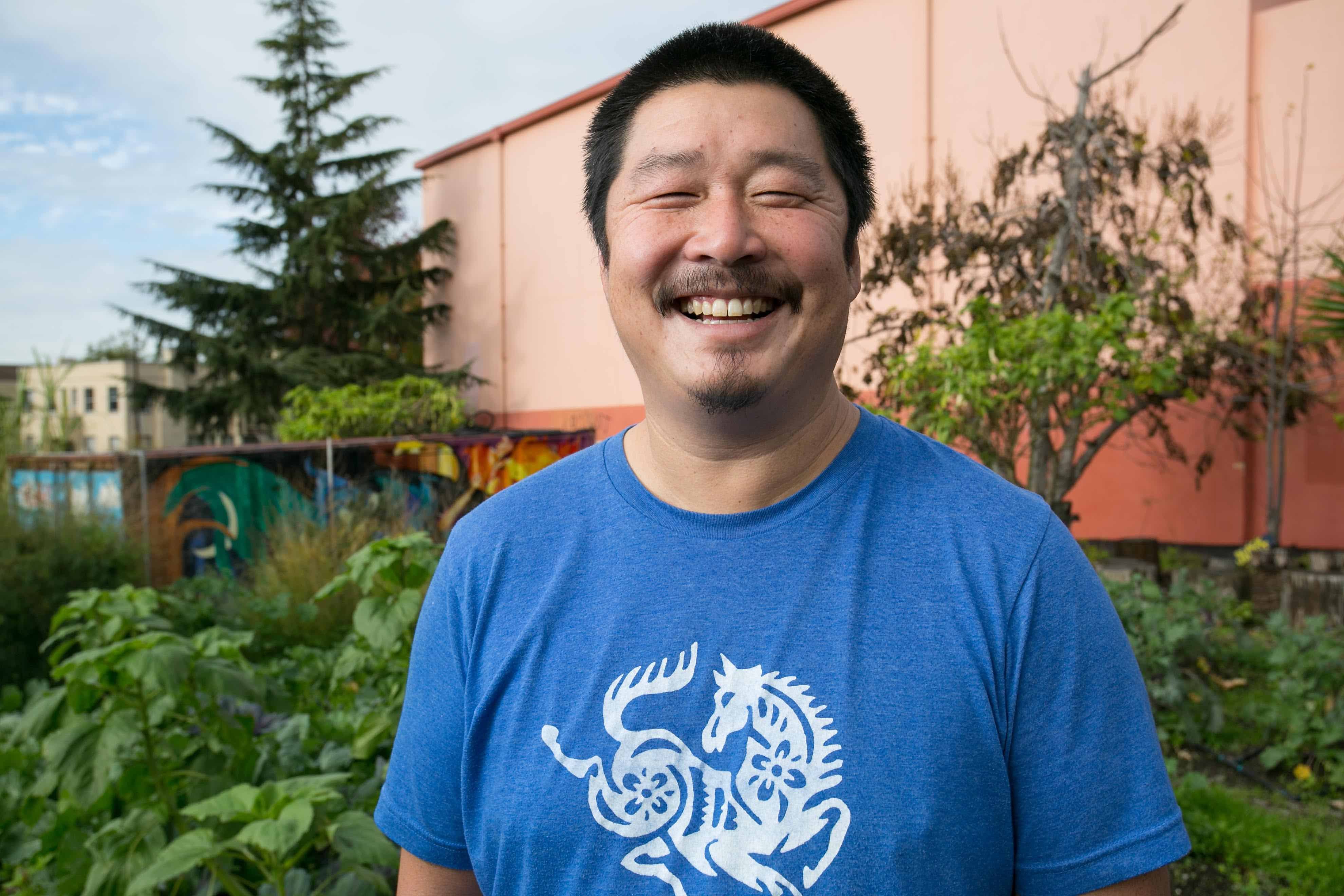
Matt Tsang is the garden teacher at Willard Middle School.
Credits: Bert Johnson
Tsang didn’t want that to happen at Willard, where he has been the gardening teacher since 1997. Tsang also runs a summer program called Growing Leaders, wherein at-risk teens grow produce and sell it to local restaurants, and he wondered if he might apply that model to a more traditional classroom setting. Fortuitously, right around the time the budget cuts hit, a new online platform called Josephine had just launched, with a mission of helping home cooks sell meals to their neighbors.
A partnership with Josephine wound up being the perfect arrangement. Tsang created a year-long Growing Leaders elective during which seventh and eighth graders who signed up would plan and cook takeout meals, and then sell those meals on Josephine every other Thursday. Tsang’s hope was that the sales would make enough money to allow sixth graders at Willard to keep their cooking program. Meanwhile, Josephine was actively looking to give back to the community through nonprofit partnerships, co-founder Charley Wang explained. So the Growing Leaders class is able to use the Josephine platform without having to pay any surcharge, and has access to the company’s full range of educational materials, which include lessons on everything from calculating profit margins to setting up one’s food service area.
All told, the collaboration has been a big success. During each biweekly Josephine sale, Tsang’s class sells between 170 and 200 take-home meals for $10–$11 each — mostly to Willard parents and teachers, but also to customers who live near the South Berkeley school and to other Josephine users who stumble upon the Growing Leaders page. During the 2014–15 school year, Growing Leaders’ Josephine sales netted a $31,000 profit, all of which went back into Willard’s sixth-grade gardening and cooking program, helping to fill what would have been a $100,000 budget shortfall. In other words, it meant Tsang had $30,000 less to raise through grant-writing and other channels to keep the program in the black. According to Wang, this year’s profits for Growing Leaders are projected to be even higher: more than $50,000 by the end of the school year.
But ultimately, it’s the process that the 33 seventh and eighth graders in the Growing Leaders class undertake that is more impressive than the end result. Tsang said his approach is to allow the students to do everything. The kids decide what dishes to make and how much to charge, and they do all of the physical tasks connected to prepping, cooking, and packaging the meals.
In many ways, the students’ weekly schedule is not so different from that of a professional cook who’s gearing up to host a pop-up. During their off week, the students test and tweak two or three recipes — for curry chicken, for instance — before deciding on which version they will sell to the public. Josephine offers customers the ability to post both public and private feedback, so students will read the reviews and decide if they need to make any changes moving forward. Then, during production week, they’ll peel and chop all the raw ingredients on Monday and Tuesday, cook on Wednesday, and then package the meals on Thursday, which is also when the kids have a chance to sit down together and eat — to enjoy the fruits of their two weeks’ labor.
Making dessert.
Credits: Matt Tsang
Tsang explained that he and one of the school’s two cooking teachers, Susanne Jensen and Marla Manlove, are always there to help facilitate each step of the process. But the underlying philosophy is to let the kids make every decision. That, Tsang said, is what makes the class such an invaluable source of real-world experience for students: “They make mistakes, and they have to pay for them.” He cited one instance when students didn’t cook enough rice for that week’s meal, so they wound up having to go to the Chinese restaurant across the street to replenish their supply — an unexpected expense that ate into their profits. But the students learned from that slip-up, Tsang said.
The entrée for the next Josephine sale — on Thursday, March 10, and available for pre-order starting this week (with the code “growingleaders,” if you’re a new Josephine user) — will be shepherd’s pie, and Tsang anticipates lively discussions around, for instance, whether they should use lamb or beef in the dish.
In many ways, Growing Leaders is a business class disguised as a gardening and cooking class. The lessons students learn about, say, unit pricing and social media marketing will be useful no matter what field they later pursue.
“We’re not trying to turn out cooks and gardeners,” Tsang said. “We’re trying to turn out kids who have options when they graduate from high school and college.”
For loyal customers, that makes the Growing Leaders takeout meals a cause worth supporting. But according to Tsang there’s a big side benefit, if you’re willing to take his word for it: The food really is delicious.
1. The US Supreme Court let stand a lower court ruling that upheld laws in many California cities that require developers to include affordable housing in condo projects, the Mercury News$ reports. The high court declined to hear an appeal of San Jose’s so-called inclusionary zoning law brought by developers and conservatives. The California Supreme Court previously upheld San Jose’s inclusionary zoning law, meaning that such laws are now clearly legal in the more than 170 cities in the state that have enacted them. In the East Bay, Berkeley and Emeryville have exclusionary zoning laws, but the Oakland City Council has refused to approve one.
3. Northern California fishermen are bracing for severe cutbacks of this year’s salmon fishing season because of the lack of fall-run chinook salmon in the Pacific Ocean, the SacBee$ reports. The fall-run has been heavily impacted by the drought. In addition, the winter-run chinook is in serious danger of extinction.
[jump]
4. Both houses of the state legislature approved a new $1.27 billion tax program on healthcare policies in order to fund Medi-Cal for low-income residents, the Mercury News$ reports. Governor Jerry Brown has said that he will sign the legislation.
5. State regulators are recommending a $112 million fine against PG&E for a gasline explosion that destroyed a Carmel cottage and damaged three other homes in 2014, the Chron reports. The state Public Utilities Commission has already fined PG&E $1.6 billion for the deadly 2010 pipeline blast in San Bruno.
6. A tenant coalition in Alameda has launched a rent-control ballot measure drive on the island, the East Bay Citizen reports. The coalition needs to gather 4,000 signatures by June to qualify the measure for the November ballot.
On March 4, DJs Richie Panic and Corey Sizemore will celebrate ten years of debauchery with a special, anniversary edition of their recurring dance party, Lights Down Low, at the Mezzanine in San Francisco. Longtime pillars of the city’s club scene, the pair started LDL as a small function at the now-defunct Tenderloin club 222 Hyde (which the San Francisco Bay Guardian once nicknamed a “rave cave”). Since then, it has expanded into an influential West Coast brand. In addition to booking internationally recognized electronic music artists, such as Simian Mobile Disco and Disclosure, Panic and Sizemore have thrown editions of the event at various clubs in Los Angeles and at the hugely popular festivals Coachella and South by Southwest. The upcoming anniversary party will feature deep house purveyors Skream and Jamie Jones. If you miss that show, there will be another ten-year anniversary celebration on April 20 at Public Works in San Francisco featuring 2ManyDJs from Belgium.
Tina Fey in Afghanistan is a concept pregnant with possibilities, albeit mostly dubious. But if the makers of Whiskey Tango Foxtrot were to get it perfectly right, watching funnywoman Fey cavort among the Taliban and warlords, lollygagging down the street wrapped in a burqa, might be just the tonic this dreary winter needs.
That doesn’t exactly happen, but Fey’s impersonation of a reporter named Kim — adapted from Kim Barker’s book, The Taliban Shuffle, by screenwriter Robert Carlock and co-directors Glenn Ficarra and John Requa — should at least get some credit for walking the fine line between slapstick sex jokes and ironic dramedy. As a rookie TV war correspondent from New York dropped into Kabul at the height of the hostilities, in 2003, Fey’s Kim wallows in the war-junkies’ extra-salty dope and canoodling escapades (“She would make a handsome boy,” observes one lusty local) but also falls in love with fellow newshound Iain MacKelpie (reconstituted Hobbit Martin Freeman) and displays true fearlessness under fire.
Tina Fey in Whiskey Tango Foxtrot.
The gags are pithy enough, the numerous in-country sequences (shot in New Mexico) ring reasonably true, but when Kim gets that sick-puppy look in her eyes and starts to wear her boyfriend’s Celtic football scarf, the sitcom-ishness of the whole thing drags it down. Perhaps we prefer our war movies meaner. Maybe her Sarah Palin shtick has made Fey too familiar. In the end, Whiskey Tango Foxtrot is never quite absurd enough to capture the blood-ugly drudgery of that never-ending theater of conflict. Nobody said getting out of Afghanistan would be easy.
Over the past several years, acts such as Death Grips, OG Maco, and Antwon have blurred the lines between hip-hop, punk, metal, and hardcore, ushering in a new generation of rappers who grew up going to basement rock shows and playing in bands instead of rhyming in cyphers. The New York trio Ratking, known for its mosh pit-inducing live shows, is of a similar ilk. The trio gained national acclaim with its debut studio album So It Goes, a gritty collage of dark, esoteric samples, pounding backbeats, and aggressive, acrobatic flows. The group reportedly wrote its follow-up project, the 2015 EP 700 Fill, in only a week, releasing it as a free download through BitTorrent instead of selling it on iTunes. On 700 Fill, the group experiments with ambient, melodic production, with Wiki, Ratking’s founder, assuming the foreground with his dexterous rhymes. Ratking opens for indie rock giant Animal Collective at The Fox Theater in Oakland on March 7.
The first annual GLAS Animation Festival, which aims to highlight innovation in animation and showcase new voices at the forefront of the field, will take place March 3–6 in Berkeley. The packed program ranges from new, experimental works to snapshots of influential moments in the history of animation. Opening night will feature Perfect Blue, a 1997 feature-length psychological thriller by acclaimed Japanese director Satoshi Kon and a series of shorts curated by Undervolt & Co., an experimental video art label. Some schedule highlights from the rest of the weekend include thoughtful compilations, such as Paranoia and Technology in Contemporary Animation and Experimental CGI, and a screening of the stop-motion movie Coraline followed by a Q&A with its internationally-famous animator Henry Selick. Events and screenings will take place at Shattuck Cinemas, the David Brower Center, and the Berkeley Art Center. Individual tickets and festival passes are available.
Perhaps it’s a podcast, or a variety show, or a piece of performance art — or all three. Self-described as a “tropical radio art experience,” KunstCapades is hosted by artists Josh Pieper and Tim Sullivan along with their bartender Marv (Robyn Carliss). And although the bi-monthly production is typically recorded in San Francisco, it’s currently in residence at Aggregate Space (801 West Grand Ave., Oakland), where its hosts have transformed the gallery into a combination tiki bar and alpine get away. On March 5, at 4 p.m., Pieper and Sullivan will host a live recording of KunstCapades Episode 32 in the space, complete with tropical cocktails. The guests will be Sarah Hotchkiss, KQED visual arts editor and one of the artists behind Stairwell’s, a walking tour series exploring stairwells around the Bay Area; and Natalia Mount, the recently-appointed executive director of Pro Arts Gallery in downtown Oakland.
San Jose DJ Turbo Sonidero Futuristico throws the recurring party Sonido Clash, which is a showcase for electronic music with Latin roots in the South Bay. He also has performed at many East Bay dance parties over the years thanks to his association with the Oakland DJ collective Trill Team 6. Turbo specializes in haunting and surreal cumbia remixes that take the upbeat South American folk genre and transform it with disorienting, hypnotic electronic effects and occasional R&B and hip-hop samples. While most cumbia is bouncy and jovial, Turbo’s productions retain the genre’s danceable feel while inserting dark and unexpected twists. He performs in Oakland at Lounge 3411 in the Laurel District at the free party Well Nourished Rhythms alongside San Francisco disco producer Jessica Hagen.
The Oakland Tribune, a daily newspaper founded in 1874, will become a community weekly paper starting next month, the newspaper’s parent company announced today. In addition, the daily papers that had been called the Contra Costa Times and the Oakland Tribune will be renamed the East Bay Times. The corporate rebranding will take place on April 5. The...
Students in the Growing Leaders class pack a salad.
Credits: Matt Tsang
Matt Tsang didn’t set out to turn Willard Middle School’s garden and cooking program into a bustling takeout restaurant.
Like many innovative ideas, Tsang’s Growing Leaders class was born out of necessity — the result of Berkeley Unified School District losing $1.9 million in federal grant money that...
The momentum is building to reform America’s harsh laws on medical and adult use of cannabis this election and legislative cycle. A full twenty states report filings of ballot initiatives on marijuana in the 2016 election. The Vermont state Senate last week fully voted to legalize it. A recreational marijuana bill has been introduced in Michigan, which has medical cannabis but no fully...
Stories you shouldn’t miss:
1. The US Supreme Court let stand a lower court ruling that upheld laws in many California cities that require developers to include affordable housing in condo projects, the Mercury News$ reports. The high court declined to hear an appeal of San Jose’s so-called inclusionary zoning law brought by developers and conservatives. The California Supreme Court previously...
On March 4, DJs Richie Panic and Corey Sizemore will celebrate ten years of debauchery with a special, anniversary edition of their recurring dance party, Lights Down Low, at the Mezzanine in San Francisco. Longtime pillars of the city’s club scene, the pair started LDL as a small function at the now-defunct Tenderloin club 222 Hyde (which the San...
Tina Fey in Afghanistan is a concept pregnant with possibilities, albeit mostly dubious. But if the makers of Whiskey Tango Foxtrot were to get it perfectly right, watching funnywoman Fey cavort among the Taliban and warlords, lollygagging down the street wrapped in a burqa, might be just the tonic this dreary winter needs.
That doesn’t exactly happen, but Fey’s impersonation...
Over the past several years, acts such as Death Grips, OG Maco, and Antwon have blurred the lines between hip-hop, punk, metal, and hardcore, ushering in a new generation of rappers who grew up going to basement rock shows and playing in bands instead of rhyming in cyphers. The New York trio Ratking, known for its mosh pit-inducing live...
The first annual GLAS Animation Festival, which aims to highlight innovation in animation and showcase new voices at the forefront of the field, will take place March 3–6 in Berkeley. The packed program ranges from new, experimental works to snapshots of influential moments in the history of animation. Opening night will feature Perfect Blue, a 1997 feature-length psychological thriller...
Perhaps it’s a podcast, or a variety show, or a piece of performance art — or all three. Self-described as a “tropical radio art experience,” KunstCapades is hosted by artists Josh Pieper and Tim Sullivan along with their bartender Marv (Robyn Carliss). And although the bi-monthly production is typically recorded in San Francisco, it’s currently in residence at Aggregate...
San Jose DJ Turbo Sonidero Futuristico throws the recurring party Sonido Clash, which is a showcase for electronic music with Latin roots in the South Bay. He also has performed at many East Bay dance parties over the years thanks to his association with the Oakland DJ collective Trill Team 6. Turbo specializes in haunting and surreal cumbia remixes...