
Oakland Mayor Libby Schaaf Unveils Ambitious Plan for Housing Affordability

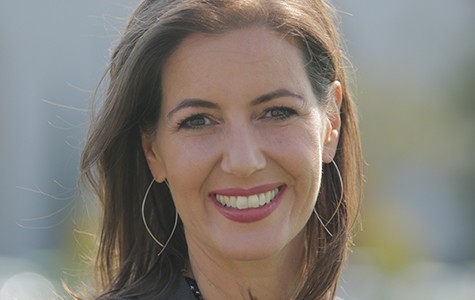
Oakland Mayor Libby Schaaf has unveiled an expansive plan to protect 17,000 existing affordable homes and apartments and build at least 17,000 new housing units over the next eight years. It’s all part of a multifaceted attempt to address Oakland’s housing affordability crisis.

Schaaf told the Express in an editorial meeting yesterday that Oakland alone cannot solve all of the problems that are causing housing insecurity and displacement, but that her administration will be focusing on a list of specific policy goals that they believe can be accomplished in the near term and will benefit the most residents.

“Protecting Oakland from displacement is our highest priority,” Schaaf said.

[jump] Schaaf’s “Oakland Housing Action Plan” builds on the city’s housing equity road map, a policy document developed during the administration of then-Mayor Jean Quan and published last year. Schaaf’s plan also incorporates feedback from a housing cabinet of experts that she convened last year to implement the road map and generate new policy ideas.

Schaaf’s sweeping plan includes modifications to existing renter protection programs and an ambitious set of funding strategies that Schaaf estimates could raise hundreds of millions of dollars in new money to build up to 5,600 affordable housing units in the next eight years and spur the production of up to 14,400 market-rate units in the same time period.

One proposal is to pursue an Alameda County affordable housing bond of as much as $500 million, of which Oakland would receive about $105 million. If used solely for production, $105 million could add 600 housing units in Oakland. The city will also explore the option of issuing a $250 million infrastructure bond, with $50 million allocated for the rehabilitation of rental housing, enough to bring 2,000 affordable units up to code. That bond measure would need approval from city voters. The mayor’s plan also calls for the city to purchase distressed rental properties, rehab them, and make them permanently affordable.

“Over the next eight years … our first priority is to protect 17,000 units that are currently affordable to Oakland residents,” the mayor said.

Two other revenue sources that Schaaf’s team is exploring include state cap-and-trade funds that will be granted by Sacramento to cities building housing near transit infrastructure and a new type of special taxing district that would tap into a funding stream similar to what city redevelopment agencies used to have access to. Schaaf estimates that Oakland could nab as much as $90 million from state cap-and-trade funds. And if the city establishes an enhanced infrastructure financing district (EIFD) with the mission of building and maintaining affordable housing, it could generate $90 million and produce as many as 800 new housing units.

“This is an action plan based on the housing equity road map,” said Schaaf, “fed through the lens of feasibility.”

Schaaf added that she has spoken to each member of the county board of supervisors and that they are all on board with the affordable housing bond measure, which would be on the November ballot. Schaaf’s plan also calls for the council to immediately approve a housing impact fee on new market-rate development in the city.

Schaaf’s set of policies to strengthen renter protections against rapidly increasing rents, no fault evictions, and other threats that lead to displacement mainly involves modifying existing city policies and programs, especially the Rent Adjustment Ordinance.

Currently, City Auditor Brenda Roberts is auditing the rent adjustment program, and her report should be completed by April. Schaaf expects that the audit will show that by increasing the rental assistance program fee, which is paid mainly by landlords, the city will be able sustain higher levels of service and better help tenants and landlords resolve disputes over rent increases, withdrawal of services, and other conflicts. Currently, the annual fee is $30, but landlords can pass 50 percent of the fee onto their tenants. Last year, the rent adjustment program staff proposed increasing the fee to $110, but objections from both tenant and landlord groups prevented any action.

Schaaf also wants to expand the Rent Adjustment Ordinance so that it covers two- and three-unit buildings that are owner occupied. Currently Oakland renters who live in apartment buildings with two to three units, one of which is occupied by the owner-landlord, are not protected by Oakland’s rent adjustment rules.

Two other big fixes that Schaaf wants to prioritize are an update to Oakland’s Condo Conversion Ordinance, and an amendment to a state law known as Costa Hawkins.

Councilmember Dan Kalb’s office has been working on an amendment to the condo conversion ordinance for about a year now. The goal is to expand protections for renters living in two-to-four-unit apartment buildings across the city against being displaced without fair compensation when their landlord converts apartments into condos. The amended ordinance would also likely require landlords across the city to replace apartments lost through condo conversion with new rental apartments. Currently, only a small portion of the city around Lake Merritt is covered by the Condo Conversion Ordinance’s strict one-for-one apartment replacement rules.

Kalb and council President Lynette Gibson McElhaney also attended the Express‘ editorial meeting. They, along with councilmembers Annie Campbell Washington and Abel Guilen, were also members of the mayor’s housing cabinet. Kalb said that the mayor’s plan “largely has buy-in from the [four] councilmembers involved.”

However, Assistant City Administrator Claudia Cappio, who also attended the editorial meeting, said not everyone in the housing cabinet supports the mayor’s plan. Some tenant advocates and affordable housing activists contend that the proposal doesn’t go far enough, while some landlord groups and developers are worried that it will stifle the production of new market-rate housing in the city.

Perhaps the most ambitious and most important landlord-tenant law change being floated by Schaaf is the need to amend the Costa Hawkins law. Costa Hawkins is a 1995 law that, in Oakland, exempts about 32,000 apartments built after 1983 from rent control. It also exempts single-family homes and condos that are owned by landlords from rent control. Schaaf believes that expanding rent control to newer units and to single-family homes and condos would help protect thousands of Oakland renters from large rent increases, which often cause displacement, and she said that Oakland will work with state legislators to try to introduce a bill that will accomplish this.

“We’re nibbling at the edges unless we can reform Costa Hawkins,” the mayor said.

What A Trump Presidency Would Mean for Marijuana Law Reform: Worry

Last night’s string of electoral primary victories for Republican candidate Donald Trump could go down as a pivotal point in US history. Like the 2000 Republican primaries that gave us George W. Bush, and his subsequent invasion of Iraq, the consequences of Trump’s Super Tuesday wins may affect the trajectory of the country for at least a generation. It’s an ominous sign that America may have taken one step too far down the road toward an Idiocracy where entertainment and shock value are paramount.

So what might a Trump Presidency mean for the medical cannabis movement and the associated adult use effort? In true Trump fashion, the man is all over the place, and could at best become a lukewarm ally for state’s rights, or at worst, the leader of a new pot pogrom akin to that of Ronald Reagan.


[jump] “Do I want Donald Trump in the White House determining marijuana policies? Absolutely not,” said Isaac Dietrich, CEO of pot social network MassRoots, in a VICE interview. “If we elect a president that’s anti-marijuana, he could choose to enforce federal law here in Colorado. He could go around and shut down all these dispensaries and put tens of thousands of people out of work and decimate local economies, so it’s a huge gamble.”

Trump’s positions on pot have been erratic. In the Nineties, he was for the legalization of all drugs.

“We’re losing badly — the war on drugs,” Trump reportedly said at the time. “You have to legalize drugs to win that war.”

But in June 2015, he said he strongly opposed Colorado legalization. “I think it’s bad, and I feel strongly about that,” Trump said, adding, “They’ve got a lot of problems going on right now in Colorado, some big problems.” 

Then in October, Trump said, “in terms of marijuana and legalization, I think that should be a state issue, state by state.”

Trump has repeatedly supported the medical use of marijuana. “Marijuana is such a big thing,” Trump said. “I think medical should happen — right? Don’t we agree? I think so.”
Last week on The O’Reilly Factor, when asked about his level of concern regarding legal Colorado pot leaking into other prohibition states, Trump reportedly said “I would really want to think about that one,” Trump said. “Because in some ways I think it’s good and in other ways it’s bad. I do want to see what the medical effects are. I have to see what the medical effects are, and, by the way, medical marijuana, medical? I’m in favor of it a hundred percent. But what you are talking about, perhaps not. It’s causing a lot of problems out there.”

A President Trump who believes state legalization is “creating a lot of problems” is unlikely to continue the current administration’s hands-off approach to state-legal pot activity.

Cannabis’ deep history is marked by cycles of tolerance and oppression. We are twenty years into a cycle of tolerance marked by California legalizing medical cannabis in 1996.

As nativist, protectionist, xenophobia sweeps across America, the notion of tolerance appears to be waning.


Residents Speak Out After Travel Article Portrays Oakland as “the Wild Side of San Francisco”

Complaints from social media users outpoured after an image from an article in AWOL, an Australian travel blog in partnership with Quantas, was brought to attention on Facebook by journalist and historian Davey D Cook. The image reads “Introducing Oakland: The Wild Side Of San Francisco”

[jump]
One commenter, Jonathan Darr King, said, “How the hell does a person not know this is colonizing, silencing, ignorant, and on… Being Oakland is enough. We are a center, not the sideshow.”

Cook posted the image Monday morning with the message, “This is how our beloved city of Oakland is being marketed by our Visitors Bureau around the world.. I just saw this photo/ad along with an article on a website in Australia sponsored by Quantas airlines.. I was shocked to see it I must say this is pretty lame..One would think with the tremendous amount of history and talent in everything from art to activism that has put Oakland, we would not be presented this way.”

In the original post, Cook also called on Oakland Mayor Libby Schaaf and several city council members to explain the image, which was earlier believed to be an ad campaign by Visit Oakland, a private, non-profit tourism organization in Oakland. “I disapprove and if any of my tax dollars went to this I really disapprove,” he said online. Cook later stated the picture was generated by Oakland visitors bureau as part of a campaign.

Several of the council members responded to the post, which as of Tuesday evening has over 1,000 “likes” and over 600 “shares.” Oakland city council president Lynette Gibson McElhaney clarified the image was in fact not part of Visit Oakland’s ad campaign. “Where did you see this? I’ve never seen it and I know it’s not the official campaign of Visit Oakland. Interested to know who did the piece. Is it a meme?” Gibson McElhaney commented.

Oakland City Councilmember Desley Brooks also responded by saying he did not agree with the image’s message. “Oakland is magnificently Oakland…not in the shadow of anything, not needing to be introduced, and not the comical ‘wild side’…I didn’t, and don’t, approve of this marketing campaign,” commented Brooks.

In a recent interview, President & CEO of Visit Oakland Alison Best told the Express that “the piece was not an ad, but an editorial piece written by an Australian journalist for an inflight magazine.” She said that the image was used at a travel conference, after which one of her staff uploaded the image to her Facebook profile, linking the image back to the organization.

Visit Oakland did provide some photos to AWOL for the article, however, which Best says is standard procedure. “When journalists write about Oakland they often contact us about photography, so when it prints, it says photos provided by Visit Oakland. But we did not provide the [header image],” Best said. 

Best also said she doesn’t know where the controversial image originated.

The article, which was published on February 15, details a traveler’s first-hand account during a visit to Oakland while en route to Burning Man. The author references how The New York Times once referred to Oakland as “Brooklyn by the Bay,” and claims, “For plenty of residents, the East Bay Area is just an outer suburb of SF, an easy commute from city jobs, gigs, and restaurants. Rents are lower across the bridge and life is a little rougher, but that’s exactly what makes Oakland such an interesting place.”

The author also describes Oakland as “a mix of hip culture, immigrant neighbourhoods and tech start-ups” but with a vibe “much grittier than its east coast cousin.”

For many, the story’s content affirmed that their city is being misrepresented in order to appeal to a certain demographic. 

“They want to make Oakland a playground for white people to enjoy the ‘Black experience’ like Harlem was a playground escape for the wealthy white New Yorkers,” Alexine Braun commented. “But Black people of course are shut out from real participation but are fine to be the servants, serving up their culture on a silver platter for whites to devour.”

Wednesday Must Reads: Park District Board Votes to Close Gun Range; Sierra Snowpack at Just 83 Percent of Normal

Stories you shouldn’t miss:

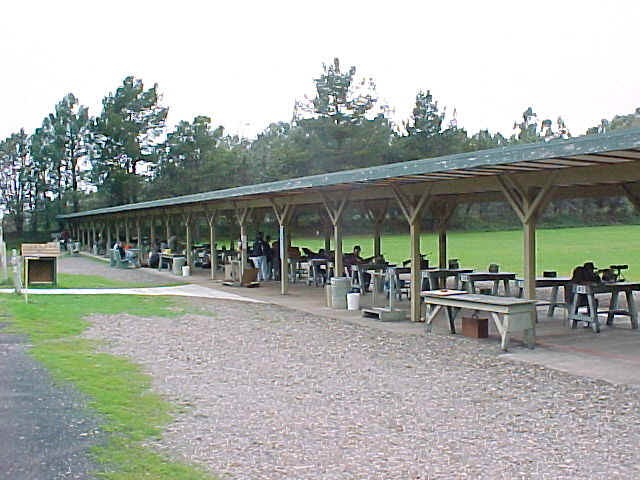
1. The East Bay Regional Park District board of directors voted unanimously to close the Chabot Gun Club because of concerns over widespread pollution from lead bullets in Anthony Chabot Regional Park, the Chron reports. Toxic lead from bullets fired at the range over the years has been leaching into nearby Lake Chabot. The cost to taxpayers to clean up the lead contamination could range between $2 million and $20 million.

2. The Sierra snowpack was at just 83 percent of normal on March 1, thereby deepening concerns that California will not emerge from its punishing drought anytime soon, the LA Times$ reports. State officials have said that the snowpack will need to be at least 150 percent of normal on April 1 for the drought to over, meaning that California would need to experience a record wet month in March.

3. The good news is that a series of storms is expected to begin rolling into Northern California tomorrow and could bring up to six inches of rain in Bay Area cities over the next ten days, the Chron reports. Higher elevations are forecast to receive up to ten inches of precipitation.

[jump] 4. A plan to build secure storage containers for homeless people in Berkeley likely will be costly — an estimated $350,000 a year, plus $50,000 in startup costs, Berkeleyside reports. Under legislation approved by the Berkeley City Council in December, the city can’t implement new rules that ban homeless people from piling up their possessions on sidewalks until the storage container program is up and running.

5. San Francisco District Attorney George Gascón has filed seventeen criminal charges against three sheriff’s deputies who ran a fight club inside San Francisco jail, pitting inmates against each other in brutal matches, the Chron reports. One of the deputies, Scott Neu, allegedly told inmates that they would be “handcuffed, maced, beaten, or shocked with a stun gun if they refused to pummel each other for his entertainment.”

6. And presidential candidate Hillary Clinton took a commanding lead in the race for the Democratic nomination on Super Tuesday, winning seven of the eleven state primaries and caucuses. Bernie Sanders won four. On the Republican side, Donald Trump also won seven state contests, and appears to be on his way to winning the GOP nomination.

Daniel Clowes, the Time-Traveling Cartoonist

On a Sunday afternoon in 2010, the Oakland-based cartoonist Daniel Clowes wanted to watch a movie. But not just any movie. As he described it in a recent phone interview, he wanted to see one of “those weird science fiction movies” that they used to make in the Sixties and Seventies “that were sort of heady and cerebral,” like the Russian space station movie, Solaris, which probes ideas of memory, identity, and what it means to love someone, or The 10th Victim, a dystopian Italian film that mixes Pop Art decor with a plot centered on a televised assassination game. “I began thinking, ‘I wish there were more of those that I could rent,'” he said. “‘I guess I’ll do my own.'”

Five years later, Clowes emerged from his home studio with Patience. The sci-fi graphic novel (which comes out on March 21) is the latest in a career that includes numerous highly acclaimed graphic novels and accompanying screenplays, including Ghost World, which later earned him an Academy Award nomination for best adapted screenplay; Wilson, whose film adaptation starring Woody Harrelson and Laura Dern is slated for release this fall; and Mister Wonderful: A Love Story, which originally ran as a serial in The New York Times Magazine in 2007 and 2008.

Patience opens on Jack and Patience, a young, financially-stressed couple, as they stare at a home pregnancy test. The stick is positive. The couple is excited, but jittery with worries about the future, and, in Patience’s case, the past as well. She fears her earlier traumas and lousy family tree will invade her daughter’s life. A single, tragic moment obliterates these concerns and launches Jack onto a path of revenge and, eventually, time travel.

As a comic artist, Clowes is no stranger to how time can move in weird ways. “The process of being an artist is very time travel-y because you go into this kind of void while working on your book and then the next thing you know, it’s five years later,” he said. The years it took to create a single comic used to drive him crazy. He was once in a bookstore shortly after the release of a comic that he had worked on for over a year. “I saw a guy take it off the shelf and read the entire thing in line. I thought of all I had been through in that year, and here a guy read it in fifteen minutes. It was really hard for me to accept that,” he said.

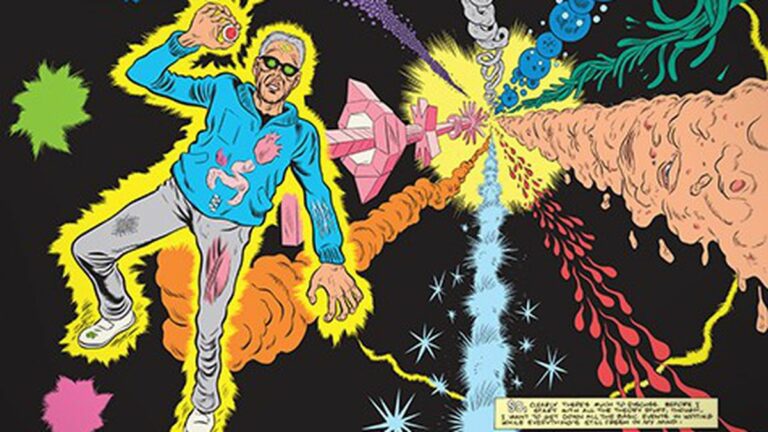
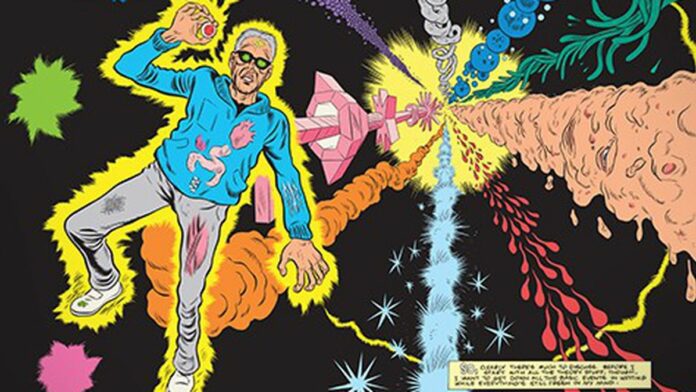
It’s easy to see a similarity between Clowes’ creative process and his male protagonist’s time-bending journey. Both men are tenacious in their efforts to create worlds that they wished existed — albeit Clowes’ work is safely confined to his drawing board while Jack rips himself through the fabric of time to right history’s wrongs. The time travel scenes in Patience are some of the most visually visceral moments of the book. In one, Jack’s skull explodes like a firecracker. Yellow shards of his body float away like confetti above a fleshy pink tree. In another, a nude, rough-hewn claylike version of himself lumbers through yellow intestinal shapes, wrapped around geometric corridors in space.

Other reviewers have likened these surreal shape-and-time-shifting spreads to the hyper-active work that influential comic book artists Jack Kirby and Steve Ditko created in The Fantastic Four, Strange Tales, and other comics for DC and Marvel. Although Clowes said he was inspired by artists like Kirby, his real inspiration came from misremembering their work. “I always imagine that Jack Kirby or somebody like that drew these huge visions where you can see behind the fabric of time,” he said. “And then you dig out your comics and try to find those things, and they don’t exist.” For Clowes, these faulty memories, “when the synapses in your brain are connecting in an odd way,” are an exciting part of the artistic process. “You make these correlations between things ­­where you can’t even imagine what the connection is, and yet somehow it’s there on some deep level,” he said. “I was almost trying to draw that into the story in the way those crazy psychedelic images look, the idea of these intersecting thoughts and memories and impulses.”

Along with the book’s phantasmagorical passages, scenes grounded in clear, specific memories play with the idea that we’re each an accumulation of events, choices, and random moments. In one, Jack visits his childhood neighborhood. As he walks down a snowy street, he thinks, “It’s crazy how it all comes back, all the little bullshit things you forget about. The shapes made by the electrical wires and the way the air smells … it’s all there in the back of your brain.” Later in the book, he realizes that “… every moment … [is] as hospitable to scrutiny as the last inning of a tied world series or the hair fibers from an unsolved kidnapping … .”

At least one concrete event from Clowes’ past informed the writing of Patience as well. In 2012, the Oakland Museum of California organized the exhibition, Modern Cartoonist: The Art of Daniel Clowes. In preparation for the show, Clowes had to dig through decades of old work that he usually prefers to keep hidden in his closet. “It was very much like having this dialogue with an earlier version of myself that I didn’t really recognize. I could see the failings and the sadnesses and the things that I wasn’t aware of at the time,” said Clowes. “It’s like if we have patience, we’re all time travelers. If we wait long enough, we’ve done it.”

The Visual Mantras of Mark Baum

Mark Baum was born in 1903 in what is now Poland, but was at the time part of the Austro-Hungarian empire. At the age of sixteen, in the midst of World War I, he attempted to immigrate to Denmark. He didn’t have the proper paperwork, but as he stood in line at the border he noticed a door left ajar — an opening to the other side. So, he sprinted through it, and the border patrol never caught up to him.

That experience seemed to stick with Baum for the rest of his life, underlying his eventual path to America and ultimately guiding his prolific artistic output later in life. In a solitary barn in Maine, the painter would eventually develop an obsession with ascendancy, producing paintings that appear to allude to spiritual enlightenment and attempting to lead viewers through mental openings into a mystical channel. An in-depth retrospective of Baum’s work that tracks the enthralling evolution of his practice is now on view at Krowswork Gallery (480 23rd St., Oakland) in the show Mark Baum: Elements of the Spirit.

Shortly after Baum made it into Denmark, he immigrated to America. Once in New York City, the alienated Jewish transplant made a name for himself painting urban and pastoral landscapes. He managed to succeed in selling art, but in the mid Forties, as World War II was coming to an end and abstract expressionism was taking over the New York art scene, he grew disenchanted with it all. Not long after his work was featured in Life Magazine, Baum moved to Maine. There, he began developing a nonfigurative visual language by which to artistically probe into philosophical musings, developing a pseudo-religious art practice that he would continue until his death at the age of 94 in 1997.

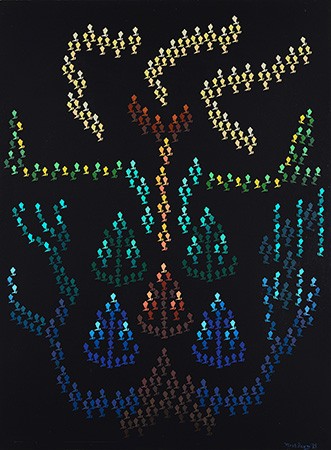
Throughout the Fifties, Baum’s compositions grew increasingly spare and abstract. Cityscapes turned to floating staircases leading allegorically up to a glowing door or lush meadow. But in the early Sixties, he made the most important pivot of his career. He whittled down his visual vocabulary to a singular “element” — a shape that resembles the silhouette of a sail boat, which for him epitomized the upward movement symbolized by staircases. Assembling the shape into various permutations in a range of remarkably vivid hues, the shape itself became a kind of medium for Baum, and the only one he employed for the rest of his career.

For the 1968 piece “Towards Certainty,” Baum arranged the symbol into triangular formations that crawl their way up the bright green canvas in colors that recall Tibetan mandalas. As Leora Lutz points out in the catalogue for the show, Baum himself likened the symbol to musical notation. The paintings do have a lyrical quality, although the melody they represent remains mysterious.Krowswork curator Jasmine Moorhead sees each of Baum’s paintings as a psychic map — a take colored by her discovery that he was an avid collector of circuit boards. For her, that hobby affirmed his interest in exploring the ways in which energy is channeled, both technologically and spiritually. “What else is his element but a code, and each of his compositions algorithms?” Moorhead writes in the introduction to the catalogue. “Yet for him, the goal was not an app or a game; he was using his element to create spiritual and emotional spaces that would resonate with those who saw them without words, beyond known language, into otherwise invisible realms.”

Moorhead first learned about Baum through his son, Billy, who lives in the Bay Area. Although Baum’s early work was collected by the Metropolitan Museum of Art in 1983, his late work was rarely shown and his paintings have never been displayed on the West Coast before. Spiritualism was still considered a passé subject to explore through fine art during Baum’s era, Moorhead pointed out. But she feels that now is the perfect time to look back at it, and the Bay Area — with its confluence of conversation around both spirituality and tech — is the ideal place to do that.

But the most fascinating aspect of the show is how vividly it allows viewers to trace Baum’s psychological evolution without offering any definitive explanation of what, exactly, he was constantly reaching to articulate. By the end, it’s clear that Baum employed his triangular element not merely as a compositional tool, but a visual mantra of sorts.

The exhibit includes one of his last paintings. On a black canvas, two rows of his elements interlock each other, repeating to form a zipper-like path that curves around the canvas in a gradient from red to orange. Then, in the upper left corner, it suddenly cuts off. And in an unusually arbitrary arrangement, a cluster of golden shapes float amid the darkness, glowing like little windows into another world.


Free Will Astrology

Aries (March 21–April 19): Actress Blythe Baird writes about the problem that arises when her dog sees her eating a peanut butter and chocolate chip bagel. Her beloved pet begs for a piece and becomes miserable when it’s not forthcoming. Baird is merely demonstrating her love, of course, because she knows that eating chocolate can make canines ill. I suspect that life is bestowing a comparable blessing on you. You may feel mad and sad about being deprived of something you want. But the likely truth is that you will be lucky not to get it.

Taurus (April 20–May 20): “I do not literally paint that table, but rather the emotion it produces upon me,” French artist Henri Matisse told an interviewer. “But what if you don’t always have emotion?” she asked him. This is how Matisse replied: “Then I do not paint. This morning, when I came to work, I had no emotion. So I took a horseback ride. When I returned, I felt like painting, and had all the emotion I wanted.” This is excellent advice for you to keep in mind, Taurus. Even more than usual, it’s crucial that you imbue every important thing you do with pure, strong emotions. If they’re not immediately available, go in quest of them.

Gemini (May 21–June 20): Some night soon, I predict you’ll dream of being an enlightened sovereign who presides over an ecologically sustainable paradise. You’re a visionary leader who is committed to peace and high culture, so you’ve never gone to war. You share your wealth with the people in your kingdom. You revere scientists and shamans alike, providing them with what they need to do their good work for the enhancement of the realm. Have fun imagining further details of this dream, Gemini, or else make up your own. Now is an excellent time to visualize a fairy tale version of yourself at the height of your powers, living your dreams and sharing your gifts.

Cancer (June 21–July 22): It’s not always necessary to have an expansive view of where you have been and where you are going, but it’s crucial right now. So I suggest that you take an inventory of the big picture. For guidance, study this advice from philosopher Friedrich Nietzsche: “What have you truly loved? What has uplifted your soul, what has dominated and delighted it at the same time? Assemble these revered objects in a row before you and they may reveal a law by their nature and their order: the fundamental law of your very self.”

Leo (July 23–Aug. 22): Sportswear manufacturer Adidas is looking for ways to repurpose trash that humans dump in the oceans. One of its creations is a type of shoe made from illegal deep-sea nets that have been confiscated from poachers. I invite you to get inspired by Adidas’s work. From an astrological perspective, now is a good time to expand and refine your personal approach to recycling. Brainstorm about how you could convert waste and refuse into useful, beautiful resources — not just literally, but also metaphorically. For example, is there a ruined or used-up dream that could be transformed into raw material for a shiny new dream?

Virgo (Aug. 23–Sept. 22): “There isn’t enough of anything as long as we live,” wrote Raymond Carver. “But at intervals a sweetness appears and, given a chance, prevails.” According to my analysis of the astrological omens, Virgo, you’ll soon be gliding through one of these intervals. Now and then you may even experience the strange sensation of being completely satisfied with the quality and amount of sweetness that arrives. To ensure optimal results, be as free from greed as you can possibly be.

Libra (Sept. 23–Oct. 22): “For a wound to heal, you have to clean it out,” says author Yasmin Mogahed. “Again, and again, and again. And this cleaning process stings. The cleaning of a wound hurts. Yes. Healing takes so much work. So much persistence. And so much patience.” According to my analysis, Libra, you should be attending to this tough but glorious task. Although the work might be hard, it won’t be anywhere near as hard as it usually is. And you are likely to make more progress than you would be able to at other times.

Scorpio (Oct. 23–Nov. 21): “The other day, lying in bed,” writes poet Rodger Kamenetz, “I felt my heart beating for the first time in a long while. I realized how little I live in my body, how much in my mind.” He speaks for the majority of us. We spend much of our lives entranced by the relentless jabber that unfolds between our ears. But I want to let you know, Scorpio, that the moment is ripe to rebel against this tendency in yourself. In the coming weeks, you will have a natural talent for celebrating your body. You’ll be able to commune deeply with its sensations, to learn more about how it works, and to exult in the pleasure it gives you and the wisdom it provides.

Sagittarius (Nov. 22–Dec. 21): In his “Dream Song 67,” poet John Berryman confesses, “I am obliged to perform in complete darkness operations of great delicacy on my self.” I hope you will consider embarking on similar heroics, Sagittarius. It’s not an especially favorable time to overhaul your environment or try to get people to change in accordance with your wishes. But it’s a perfect moment to spruce up your inner world — to tinker with and refine it so that everything in there works with more grace. And unlike Berryman, you won’t have to proceed in darkness. The light might not be bright, but there’ll be enough of a glow to see what you’re doing.

Capricorn (Dec. 22–Jan. 19): Here’s the dictionary’s definition of the word “indelible”: “having the quality of being difficult to remove, wash away, blot out, or efface; incapable of being canceled, lost, or forgotten.” The word is often used in reference to unpleasant matters: stains on clothes, biases that distort the truth, superstitions held with unshakable conviction, or painful memories of romantic break-ups. I am happy to let you know that you now have more power than usual to dissolve seemingly indelible stuff like that. Here’s a trick that might help you: Find a new teacher or teaching that uplifts you with indelible epiphanies.

Aquarius (Jan. 20–Feb. 18): According to poet Tony Hoagland, most of us rarely “manage to finish a thought or a feeling; we usually get lazy or distracted and quit halfway through.” Why? Hoagland theorizes that we “don’t have the time to complete the process, and we dislike the difficulty and discomfort of the task.” There’s a cost for this negligence: “We walk around full of half-finished experiences.” That’s why Hoagland became a poet. He says that “poems model the possibility of feeling all the way through an emotional process” and “thinking all the way through a thought.” The coming weeks will be a favorable time to get more in the habit of finishing your own feelings and thoughts, Aquarius. It will also be more important than usual that you do so! (Hoagland’s comments appeared in Gulf Coast: A Journal of Literature and Fine Arts.)

Pisces (Feb. 19–March 20): Unless you work at night and sleep by day, you experience the morning on a regular basis. You may have a love-hate relationship with it, because on the one hand you don’t like to leave your comfortable bed so early, and on the other hand you enjoy anticipating the interesting events ahead of you. But aside from your personal associations with the morning, this time of day has always been a potent symbol of awakenings and beginnings. Throughout history, poets have invoked it to signify purity and promise. In myth and legend, it often represents the chance to see things afresh, to be free of the past’s burdens, to love life unconditionally. Dream interpreters might suggest that a dream of morning indicates a renewed capacity to trust oneself. All of these meanings are especially apropos for you right now, Pisces.

Norwegians Would

0

Disaster flicks? In Norway? Even though that Scandinavian country (population: about 5 million) is best known by the average American moviegoer as a place where tall, blond people enjoy winter sports and pickled herring, the producers of The Wave want us to know that another Norwegian cliché, the ever-popular fjord, has the potential to scare audiences. How is that, you may ask? By crumbling apart, sending thousands of tons of rock hurtling into the fjord’s waters to create a massive, eighty-meter-high tsunami — at the height of the tourist season; despite the nervous apprehension of a conscientious scientist (played by Kristoffer Joner); when one of the other scientists is looking away from his monitor. Short answer: Epic destruction usually sell tickets.

Turns out there are more than three hundred unstable mountainsides in the picturesque Norwegian topography. Geologists like Kristian Eikjord (actor Joner) are well aware of the threat, and the country has in place a system of rock-stabilization structures, electronic devices, and emergency plans to cope with the destruction when — not if — a ginormous mountain like Åkerneset should finally lose its battle with gravity and crash down, in this case on unsuspecting vacationers near the scenic Western Norwegian town of Geiranger.

Kristian, his wife Idun (Ane Dahl Torp), and their two children are separated from each other when The Big One hits. Unlike the majority of H’wood disaster pics, we don’t get a roundelay of otherwise disconnected characters suddenly brought together by the cataclysm. It’s just Kristian, Idun — at her job in a resort hotel along with their skateboarding teenage son — and their little girl, running with the rest for high ground as the hellacious CGI (but careful, convincing CGI, it should be noted) wave bears down from across the Geirangerfjord, sweeping all before it. They have ten minutes to reach higher elevation or else be put into the rinse cycle with cars, cows, and other screaming folks, à la The Impossible, the film about the 2004 Indian Ocean tsunami.

Let’s take a moment to appreciate director Roar Uthaug. What a wonderful name for the maker of a movie about falling mountains. Roar. Using handheld cameras for maximum spontaneity, he herds the huge disaster into a tight frame whenever possible, moving from sweeping vistas of raging inlets to such confined spaces as a hotel basement emergency shelter quickly filling up with water, in order to bring a monumental catastrophe into close, personal focus. Sturdy actor Joner — the archetypal long-haired, stoner-looking Euro scientist — gives worried family man Kristian the same cool, level-headed, understated heroism we demand from any disaster survivor. Opposing him, in addition to the unstoppable force of nature, is the plainly presented reluctance of the authorities to unduly alarm everyone about a looming catastrophe the government has been expecting for years. Their reason: No one wants to hurt the tourism business, which is now in peak season.

One of the best things about filmmaker Uthaug’s relatively modest environmental horror story — Norway’s first disaster movie, as well as one of its most-expensive-ever film productions — is that its telescoped field of interest eliminates one of the genre’s corniest devices, the question of who makes it and who doesn’t. When the situation eventually boils down to an underwater rescue, as in The Poseidon Adventure, there isn’t any Shelley Winters to cheer for, nor an Ernest Borgnine to hiss at. Just the little family, give or take an unrelated hapless floater or two, gasping for air in a claustrophobic death trap. What could be cozier?

The old-style Seventies disaster-mobile was notorious for inflating its cast in order to provide work for low-priced, forgotten Tinseltown actors. The advantage of setting a disaster movie in Norway is that all the actors are unknown in the first place. In the midst of staging an enormous natural sorting-out, The Wave puts its stress on the human-scale dimensions of staying alive. That’s reassuring. It was either going to be that or giant killer sardines.

Allblack Finds His Purpose

0

The Bay Area is home to some of rap’s all-time greatest acts, including the raunchy Too $hort, iconoclastic Mac Dre, and slick-talking E-40. Allblack (D’Andre Sams) seeks to continue the legacy of these hyphy pioneers with his latest mixtape, NOSHAME, which the 23-year-old East Oakland native self-released in 2015.

Throughout the project, Allblack deploys fast-paced flows over hard-edged beats rife with buoyant synth riffs that evoke a sense of nostalgia for hyphy’s early days. On the surface, NOSHAME is a collection of catchy, party-oriented tracks, but the rapper also uses the mixtape to parse through the struggles of his turbulent early life.

Allblack began his music career as a hype man for the Berkeley R&B singer Kossisko, who, at the time, was rapping under the stage name 100s. 100s’ 2012 mixtape, Ice Cold Perm, positioned him as a rising Bay Area rap star, and he and Allblack opened for notable hip-hop acts, such as A$AP Mob and Cutthroat Boyz. While Allblack grew up looking up to local Nineties rappers such as Richie Rich and Dru Down, it wasn’t until 100s brought him on tour that he developed the confidence to begin making music himself.

“Growing up in Oakland, everyone claims to be a rapper at some point in their life,” he laughed. “I always loved music and felt like I had a story to tell, but I never saw myself as a rapper.” After Kossisko encouraged him, however, Allblack began to use music as an outlet for processing his troubled past.

The artist confessed that he grew up surrounded by family members with substance abuse issues, and he began selling drugs at a young age to make ends meet. As a result, he frequently had run-ins with the law in his late teens and early twenties. “I had uncles and aunts that used, and I also had uncles and aunts that distributed. I chose to go with the latter because I saw the lifestyle that came with it: Money, cars, clothes, and women.”

Furthermore, Allblack grew up on 22nd Avenue and Foothill, around the corner from International Boulevard — a notorious hub for prostitution. “I started pimping at a real young age,” he admitted. “I was doing it for almost seven years before I caught my first case.”

The rapper said that after two brief stints in jail, he was desperate for a positive outlet. That was when he decided to take the advice Kossisko gave him a few years earlier.

“Koss always told me I could stand on my own as an artist, but I was too busy doing other things,” he said. “After sitting down in some of the worst county jails America has to offer, I started thinking, ‘I have to do something else before I end up dead or in the penitentiary for life.'”

After his release from jail, he devoted himself to his rap career. He linked up with longtime friend and fellow rapper Dick Boston and worked with other local artists such as Youngin Geechi and Dizzle.

Allblack explained that though he sought to emulate hyphy’s freewheeling energy on NOSHAME, he also wanted to use his lyrics to delve into deeper subject matter. Throughout the project, his quick-witted rhymes can make listeners feel as if they’re sprinting to keep up. The track “Motif,” for instance, pays homage to Allblack’s many nights in the well-known San Jose night club of the same name. But the tape also features songs that address his drug dealing past: On “Speed Racer,” Allblack talks about the risks he took crossing state lines to make sales. While his music reflects the struggles of growing up in one of Oakland’s most dangerous neighborhoods, with its uptempo, bass-heavy beats and danceable feel, it also speaks to themes of survival and resilience.

Allblack’s freshman project has garnered attention from rap influencers in other cities, including the Atlanta DJ Trap-A-Holics, who frequently hosts mixtapes by big-name artists such as Gucci Mane and Lil Boosie. Trap-A-Holics will release Allblack’s sophomore effort, NOSHAME 2, on March 20. The positive response to his debut mixtape encouraged him to invest in better studio equipment, beats, and — most importantly — his creative process.

“With my first tape I rushed it. I was so happy to be finally making music,” he said. “This go-around, I took my time, held onto songs longer, redid verses, and was critical of the beats I chose. I also opened up more, and I think people who can relate — and those that can’t — will appreciate my truth.”

Teens Do Takeout

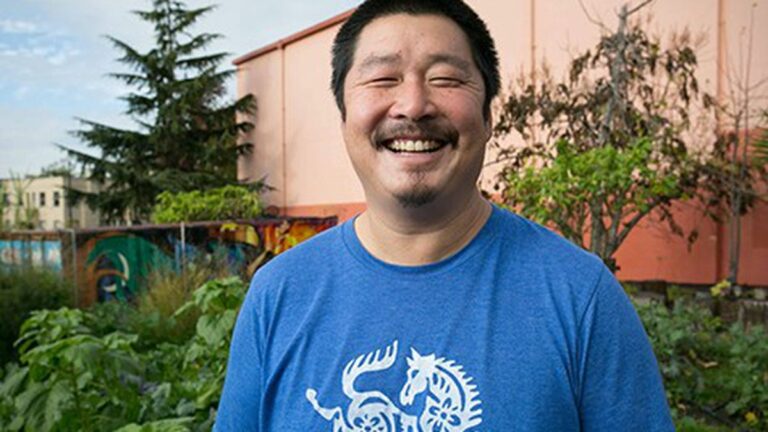
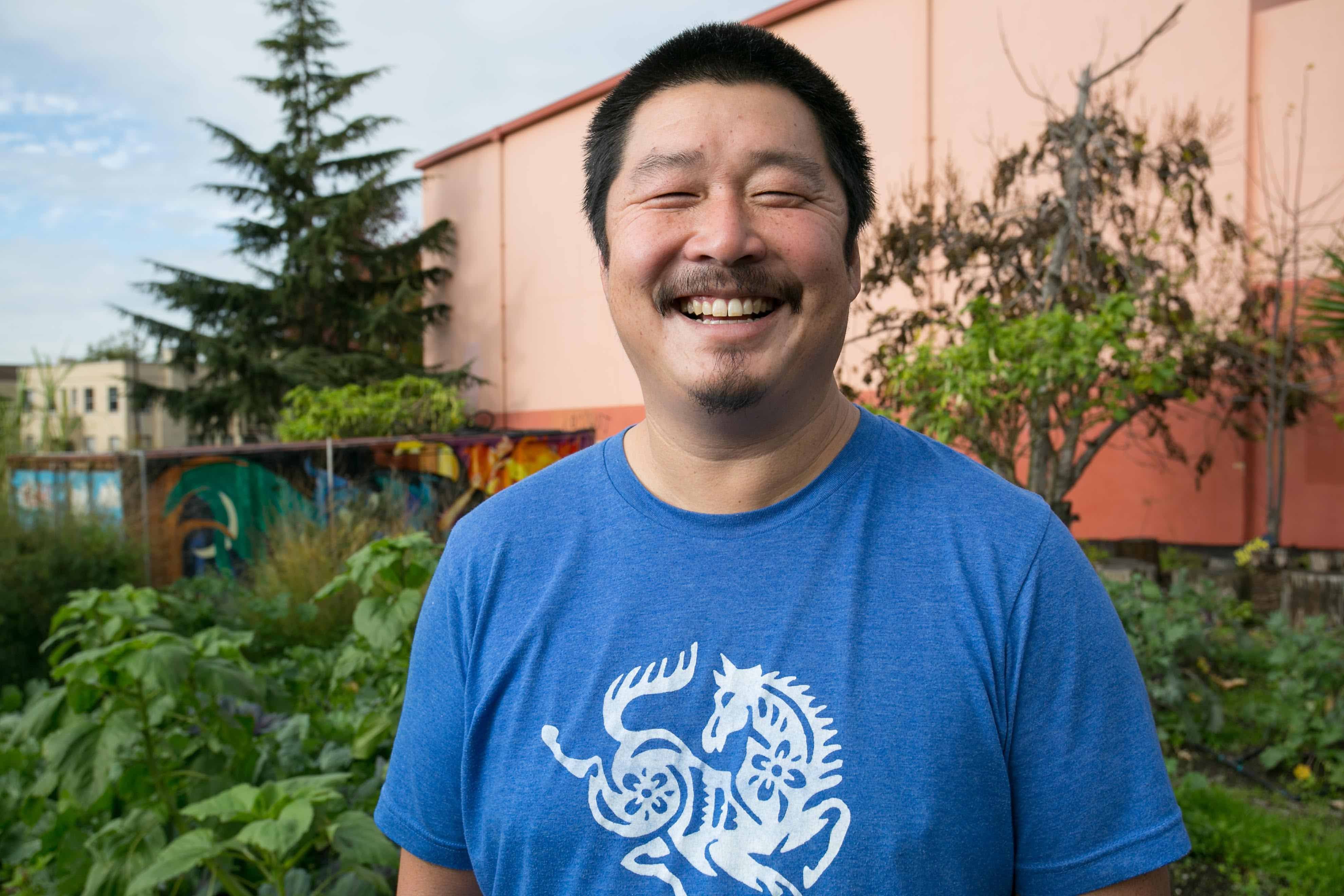
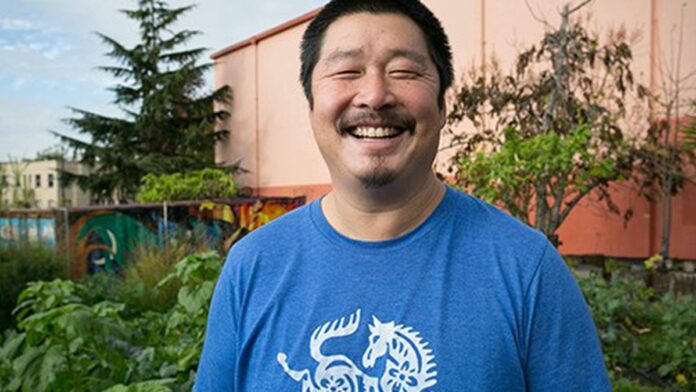
Matt Tsang didn’t set out to turn Willard Middle School’s garden and cooking program into a bustling takeout restaurant.

Like many innovative ideas, Tsang’s Growing Leaders class was born out of necessity — the result of Berkeley Unified School District losing $1.9 million in federal grant money that had previously helped fund the district’s fourteen school garden and kitchen programs. When those cuts hit in 2013, individual schools and parent teacher associations scrambled to make up the difference. The upshot was that most schools wound up eliminating the cooking component altogether.

Tsang didn’t want that to happen at Willard, where he has been the gardening teacher since 1997. Tsang also runs a summer program called Growing Leaders, wherein at-risk teens grow produce and sell it to local restaurants, and he wondered if he might apply that model to a more traditional classroom setting. Fortuitously, right around the time the budget cuts hit, a new online platform called Josephine had just launched, with a mission of helping home cooks sell meals to their neighbors.

A partnership with Josephine wound up being the perfect arrangement. Tsang created a year-long Growing Leaders elective during which seventh and eighth graders who signed up would plan and cook takeout meals, and then sell those meals via Josephine.com every other Thursday. Tsang’s hope was that the sales would make enough money to allow sixth graders at Willard to keep their cooking program. Meanwhile, Josephine was actively looking to give back to the community through nonprofit partnerships, co-founder Charley Wang explained. So the Growing Leaders class is able to use the Josephine platform without having to pay any surcharge, and has access to the company’s full range of educational materials, which include lessons on everything from calculating profit margins to setting up one’s food service area.

All told, the collaboration has been a big success. During each biweekly Josephine sale, Tsang’s class sells between 170 and 200 take-home meals for $10–$11 each — mostly to Willard parents and teachers, but also to customers who live near the South Berkeley school and to other Josephine users. During the 2014–15 school year, Growing Leaders’ Josephine sales netted a $31,000 profit, all of which went back into Willard’s sixth-grade gardening and cooking program, helping to fill what would have been a $100,000 budget shortfall. In other words, it meant Tsang had $30,000 less to raise through grant-writing and other channels to keep the program in the black. According to Wang, this year’s profits for Growing Leaders are projected to be even higher: more than $50,000 by the end of the school year.

But ultimately, it’s the process that the 33 seventh and eighth graders in the Growing Leaders class undertake that is more impressive than the end result. Tsang said his approach is to allow the students to do everything. The kids decide what dishes to make and how much to charge, and they do all of the physical tasks connected to prepping, cooking, and packaging the meals.

In many ways, the students’ weekly schedule is not so different from that of a professional cook gearing up to host a pop-up. During their off week, the students test and tweak two or three recipes — for curry chicken, for instance — before deciding on which version they will sell to the public. Josephine offers customers the ability to post both public and private feedback, so students will read the reviews and decide if they need to make any changes moving forward. Then, during production week, they’ll peel and chop all the raw ingredients on Monday and Tuesday, cook on Wednesday, and then package the meals on Thursday, which is also when the kids have a chance to sit down together and eat — to enjoy the fruits of their two weeks’ labor.

Tsang explained that he and one of the school’s two cooking teachers, Susanne Jensen and Marla Manlove, are always there to help facilitate each step of the process. But the underlying philosophy is to let the kids make every decision. That, Tsang said, is what makes the class such an invaluable source of real-world experience for students: “They make mistakes, and they have to pay for them.” He cited one instance when students didn’t cook enough rice for that week’s meal, so they wound up having to go to the Chinese restaurant across the street to replenish their supply — an unexpected expense that ate into their profits. But the students learned from that slip-up, Tsang said.

The entrée for the next Josephine sale — on Thursday, March 10, and available for pre-order starting this week (with the code “growingleaders,” if you’re a new Josephine user) — will be shepherd’s pie, and Tsang anticipates lively discussions around, for instance, whether they should use lamb or beef in the dish.

In many ways, Growing Leaders is a business class disguised as a gardening and cooking class. The lessons students learn about, say, unit pricing and social media marketing, will be useful no matter what field they later pursue.

“We’re not trying to turn out cooks and gardeners,” Tsang said. “We’re trying to turn out kids who have options when they graduate from high school and college.”

For loyal customers, that makes the Growing Leaders takeout meals a cause worth supporting. But according to Tsang there’s a big side benefit, if you’re willing to take his word for it: The food really is delicious.

Oakland Mayor Libby Schaaf Unveils Ambitious Plan for Housing Affordability

Oakland Mayor Libby Schaaf has unveiled an expansive plan to protect 17,000 existing affordable homes and apartments and build at least 17,000 new housing units over the next eight years. It’s all part of a multifaceted attempt to address Oakland’s housing affordability crisis. Schaaf told the Express in an editorial meeting yesterday that...

What A Trump Presidency Would Mean for Marijuana Law Reform: Worry

Last night’s string of electoral primary victories for Republican candidate Donald Trump could go down as a pivotal point in US history. Like the 2000 Republican primaries that gave us George W. Bush, and his subsequent invasion of Iraq, the consequences of Trump’s Super Tuesday wins may affect the trajectory of the country for at least a generation. It’s...

Residents Speak Out After Travel Article Portrays Oakland as “the Wild Side of San Francisco”

Complaints from social media users outpoured after an image from an article in AWOL, an Australian travel blog in partnership with Quantas, was brought to attention on Facebook by journalist and historian Davey D Cook. The image reads “Introducing Oakland: The Wild Side Of San Francisco” The image from AWOL's...

Wednesday Must Reads: Park District Board Votes to Close Gun Range; Sierra Snowpack at Just 83 Percent of Normal

Stories you shouldn’t miss: 1. The East Bay Regional Park District board of directors voted unanimously to close the Chabot Gun Club because of concerns over widespread pollution from lead bullets in Anthony Chabot Regional Park, the Chron reports. Toxic lead from bullets fired at the range over the years has been leaching into nearby Lake Chabot. The cost to taxpayers...

Daniel Clowes, the Time-Traveling Cartoonist

On a Sunday afternoon in 2010, the Oakland-based cartoonist Daniel Clowes wanted to watch a movie. But not just any movie. As he described it in a recent phone interview, he wanted to see one of "those weird science fiction movies" that they used to make in the Sixties and Seventies "that were sort of heady and cerebral," like...

The Visual Mantras of Mark Baum

Mark Baum was born in 1903 in what is now Poland, but was at the time part of the Austro-Hungarian empire. At the age of sixteen, in the midst of World War I, he attempted to immigrate to Denmark. He didn't have the proper paperwork, but as he stood in line at the border he noticed a...

Free Will Astrology

Aries (March 21–April 19): Actress Blythe Baird writes about the problem that arises when her dog sees her eating a peanut butter and chocolate chip bagel. Her beloved pet begs for a piece and becomes miserable when it's not forthcoming. Baird is merely demonstrating her love, of course, because she knows that eating chocolate can make canines ill. I...

Norwegians Would

Disaster flicks? In Norway? Even though that Scandinavian country (population: about 5 million) is best known by the average American moviegoer as a place where tall, blond people enjoy winter sports and pickled herring, the producers of The Wave want us to know that another Norwegian cliché, the ever-popular fjord, has the potential to scare audiences. How is that,...

Allblack Finds His Purpose

The Bay Area is home to some of rap's all-time greatest acts, including the raunchy Too $hort, iconoclastic Mac Dre, and slick-talking E-40. Allblack (D'Andre Sams) seeks to continue the legacy of these hyphy pioneers with his latest mixtape, NOSHAME, which the 23-year-old East Oakland native self-released in 2015. Throughout the project, Allblack deploys fast-paced flows over hard-edged beats rife...

Teens Do Takeout

Matt Tsang didn't set out to turn Willard Middle School's garden and cooking program into a bustling takeout restaurant. Like many innovative ideas, Tsang's Growing Leaders class was born out of necessity — the result of Berkeley Unified School District losing $1.9 million in federal grant money that had previously helped fund the district's fourteen school garden and kitchen programs....
19,045FansLike
17,709FollowersFollow
61,790FollowersFollow