“What used to be a hundred dollar violation in California now costs nearly five hundred dollars, and the costs climb into the thousands when people miss deadlines to pay fees they can’t afford,” Bay Area Legal Aid attorney Claire Johnson Raba said in a statement. “Many jobs require a driver’s license, so the loss of a license pushes families deeper into the cycle of unemployment and poverty.”
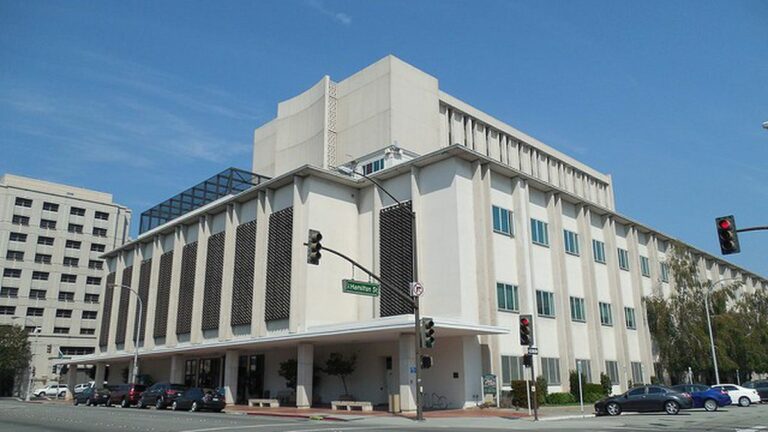
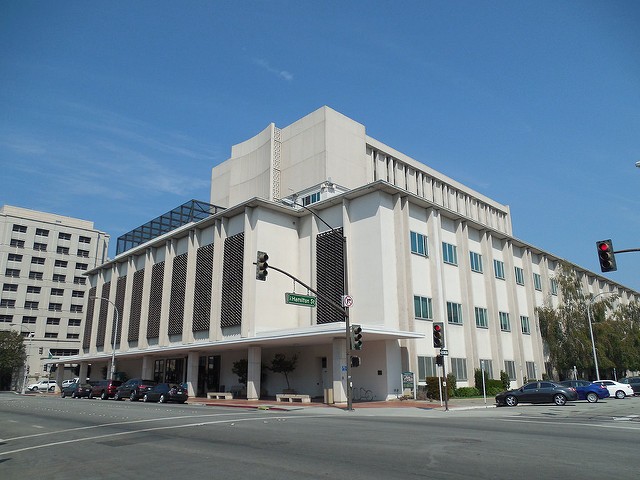
San Mateo County Courthouse
Credits: JIMMY EMERSON/ FLICKR (CC)
The demand letter, which was sent to San Mateo County Superior Court by the Lawyers’ Committee for Civil Rights of the San Francisco Bay Area (LCCR), Legal Services for Prisoners with Children, the Western Center on Law & Poverty, and the ACLU of Northern California, outlines what the traffic court must do in order to “satisfy its constitutional and statutory duties.” Included in the demands is to install a system to determine people’s ability to pay, provide information on how to access that system, and to appropriately adjust payment plans according to a person’s financial needs.
According to the letter, if the court does not comply by April 4, it will face legal action.
[jump]
“The denial of due process in traffic court is causing widespread debt and unemployment. By not taking people’s ability to pay into account, the courts are hurting families, communities, and the state as a whole,” said ACLU of Northern California staff attorney Micaela Davis, in the announcement.
Last year, a report titled “Not Just a Ferguson Problem: How Traffic Courts Drive Inequality in California” was released outlining how California courts lay out billions in traffic fines, have suspended more than four million of drivers’ licenses for the fines that go unpaid, and, as a result, have trapped many into a cycle of poverty. The report also highlighted how license suspensions disproportionately impacts people of color in California.
“These exorbitant traffic fines are part of a larger pattern in which our justice system funds itself off the backs of poor people,” Brittany Stonesifer, staff attorney at Legal Services for Prisoners with Children, said in the press release. “Because racial profiling makes police stops and traffic citations commonplace in communities of color, this practice hits people of color the hardest.”
In response, Governor Jerry Brown established the “amnesty program” in October to provide relief for low-income people struggling with debt and license suspensions. However, experts still agree much more work is needed to improve both the program and the court’s method of handling traffic citations.
“Amnesty does nothing to prevent thousands of Californians from currently being caught up in the same web of traffic debt and license suspensions,” Antionette Dozer, senior attorney at Western Center on Law & Poverty, said in the press release.
“Anyone who got a ticket after January 1, 2013 is at best only partially eligible for amnesty,” the announcement reads. “They are ineligible for a reduction in what they owe, and even if they can get their license back, courts are still allowed to suspend their license again if they miss a payment.”
Joined by Bay Area Legal Aid, the coalition also sent a letter earlier this week urging the California Judicial Council “to instruct all California traffic courts to stop suspending the driver’s licenses of people who are too poor to pay exorbitant traffic fines.” In addition, the coalition requested a meeting with the Contra Costa County Superior Court to discuss similar issues, and have engaged in collaborating with Alameda County Superior Court as well.
“We need to take much bolder action by stopping the suspension of licenses and by significantly reducing the traffic fines on low income families” said Dozer. “Courts can do that right now but they are failing to do so.”
In a story by journalist Dan Baum in the most recent issue of Harper’s magazine a former policy advisor to President Richard Nixon is quoted as saying that the war on drugs was created as a political tool to undermine Black communities and attack the anti-Vietnam War movement.
In 1994 Baum interviewed John Ehrlichman, President Nixon’s domestic-policy adviser from 1969 to 1973. Ehrlichman was a Watergate co-conspirator who spent a year and a half in prison. By 1994 he was working in Atlanta. In the interview, Ehrlichman blatantly admitted that the war on (some) drugs was designed to crush Nixon’s perceived enemies.
[jump]
“How did the United States entangle itself in a policy of drug prohibition that has yielded so much misery and so few good results?” Baum wrote in the Harper’s piece.
“You want to know what this was really all about?” [Ehrlichman] asked with the bluntness of a man who, after public disgrace and a stretch in federal prison, had little left to protect. “The Nixon campaign in 1968, and the Nixon White House after that, had two enemies: the antiwar left and black people. You understand what I’m saying? We knew we couldn’t make it illegal to be either against the war or black, but by getting the public to associate the hippies with marijuana and blacks with heroin, and then criminalizing both heavily, we could disrupt those communities. We could arrest their leaders, raid their homes, break up their meetings, and vilify them night after night on the evening news. Did we know we were lying about the drugs? Of course we did.”
Nixon’s racist views and his political motives to wage the drug war are well known known thanks to transcripts of clandestine recordings from the Nixon White House. Still, Ehrlichman’s alleged admission to Baum has sparked a firestorm this week.
Over one hundred publications have picked up the Harper’s piece “Legalize It All — How to Win the War on Drugs.” It has created a watershed moment in the magazine’s history, and the national drug policy debate.
It’s not clear why Baum sat on the quote for twenty-two years, but he’s deployed it effectively atop a long read about fully legalizing, taxing, and regulating all illicit drugs.
The problem of serious addiction is relatively small compared to the vast amount of resources we spend fighting the war on drugs, Baum writes. Fewer than four million people have a drug addiction, out of a nation of 320 million, he writes. Yet we spend $40 billion per year on “enforcement, incarcerating half a million, and quashing the civil liberties of everybody, whether drug user or not.”
It is the externalities of that war — “billions of dollars wasted, bloodshed in Latin America and on the streets of our own cities, and millions of lives destroyed by draconian punishment that doesn’t end at the prison gate; one of every eight black men has been disenfranchised because of a felony conviction” — that cost society so much. It’s time for another way, he argues.
“Now, for the first time, we have an opportunity to change course. Experiments in alternatives to harsh prohibition are already under way both in this country and abroad. Twenty-three states, as well as the District of Columbia, allow medical marijuana, and four — Colorado, Washington, Oregon, and Alaska — along with D.C., have legalized pot altogether. Several more states, including Arizona, California, Maine, Massachusetts, and Nevada, will likely vote in November whether to follow suit [….]
Depending on how the issue is framed, legalization of all drugs can appeal to conservatives, who are instinctively suspicious of bloated budgets, excess government authority, and intrusions on individual liberty, as well as to liberals, who are horrified at police overreach, the brutalization of Latin America, and the criminalization of entire generations of black men. It will take some courage to move the conversation beyond marijuana to ending all drug prohibitions, but it will take less, I suspect, than most politicians believe. It’s already politically permissible to criticize mandatory minimums, mass marijuana-possession arrests, police militarization, and other excesses of the drug war; even former attorney general Eric Holder and Michael Botticelli, the new drug czar — a recovering alcoholic — do so. Few in public life appear eager to defend the status quo.”
Everyone should read Baum’s article and never forget that despite all the justifications trotted out since 1968 — the war on (some) drugs has always really been a war on particular race or class of people.
In other news: The Supreme Court of the United States ruled Monday that the City of Oakland cannot help defend the medical cannabis dispensary Harborside Health Center from federal efforts to seize its property and shut it down. The world’s largest dispensary, and one of Oakland’s main sources of sales tax revenue, Harborside remains open today while the case continues.
The SCOTUS ruling is a setback for Oakland and Harborside. The city hoped to prove that shutting down Harborside will seriously harm the city’s budget and create a public health crisis. Harborside has over 100,000 patients.
There is a silver lining, however. The SCOTUS ruling notes that Congress itself defunded the federal war on medical marijuana in the states in 2014 and again in 2015.
But if a federal appeals court sides with the medical pot provider at the center of the case, Lynnette Shaw, the ruling could spell the end of the federal government’s war on medical marijuana — for now.
Congress could also help medical pot providers and patients by passing the pending CARERS Act to protect state-legal medical pot. On March 11, South Carolina Republican Lindsey Graham added his name as a co-sponsor to the bill, but it still faces tough odds in this lame duck session.
Welcome to the Mid-Week Menu, our roundup of East Bay food news.
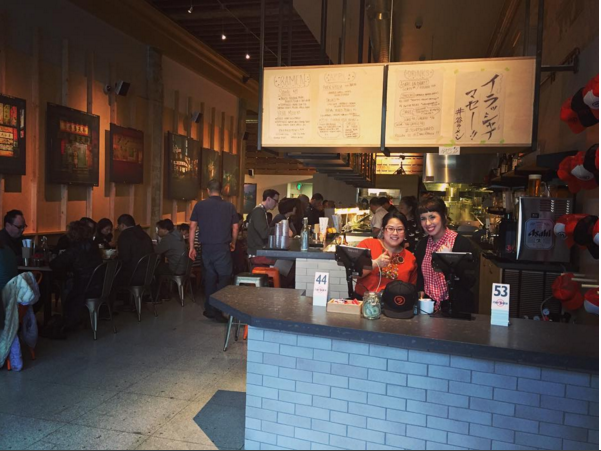
1) Fans of Hopscotch chef Kyle Itani’s ramen — which you may have sampled in its gloriously off-the-cuff pop-up iteration a couple of years ago — will be happy to know that the chef’s new ramen shop, Itani Ramen (1736 Telegraph Ave., Oakland), is almost ready, with a mid-April ETA. In the meantime, the restaurant is hosting a series of weekend pop-up preview dinners with a limited menu — two ramen options, gyoza, a salad, and some pickles the first time around.
[jump]
The next round of pop-ups will be March 26–27 (this weekend), 6 p.m.–midnight, and it will be the same deal the next two weekends after that. Check the restaurant website to confirm future pop-up dates.
The Scotch egg at Chowhaus.
Credits: Bert Johnson/File photo
2) Despite having been proclaimed by many — present company included — to be far and away the best restaurant in Oakland’s Montclair neighborhood, Chowhaus (6118 Medau Pl.) has closed, according to a message on the restaurant’s answering machine. No explanation was offered. I reached out to chef-owner Tracey Belock to ask about her future plans, but have yet to hear back. In the meantime, I’ll have to find somewhere else to go for my Scotch egg and chicken pot pie fix.
3) Over on Piedmont Avenue, Descanso (4184 Piedmont Ave.) has also shuttered. In a Facebook announcement, the owners cited “incompatibility with the landlord,” among other factors in the decision to close. The former Park Avenue Bar & Grill had adopted its current pan-Latin/barbecue theme about a year and a half ago.
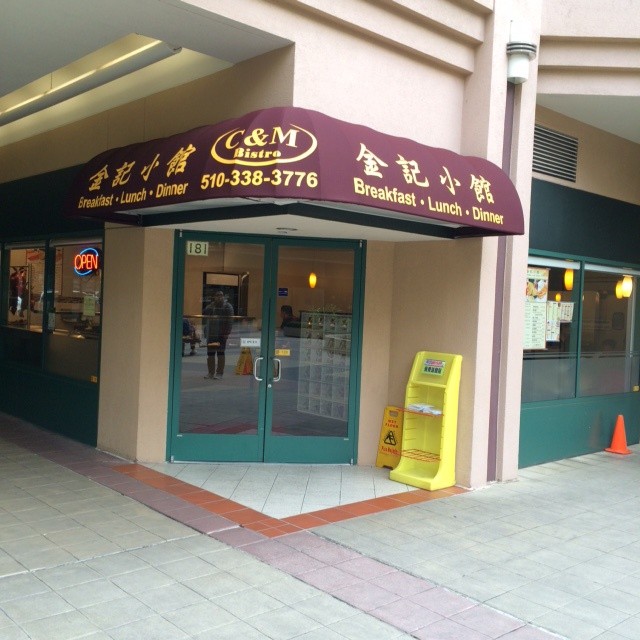
Credits: Luke Tsai
4) A few months ago, I noted the demise of Cafe 88 (388 9th St., #181), a prominently located Cantonese spot in the Pacific Renaissance Plaza in Oakland Chinatown. Good news: It’s open again under new management — rebranded as C & M Bistro, but with a fairly similar Hong Kong-inflected menu. I’ll report back after I see how the roast pig stacks up.
5) Inside Scoop reports that the new beer garden at Uptown Oakland’s Classic Cars West (411 26th St.) is now open, with a full vegan food menu courtesy of the food truck/pop-up Hella Vegan Eats.
6) Last week brought news that the food delivery startup Spoonrocket, whose launch I covered back in 2013, has shut down its service. Berkeleyside Nosh had the scoop.
8) A couple of chef shuffles to report: Longtime East Bay chef Sophina Uong, perhaps best known for her tenure at the upscale Southern restaurant Pican, is returning to Oakland to take over the kitchen at the Uptown Mexican restaurant Calavera (2337 Broadway), replacing opening chef Christian Irabien (who, according to Eater, has left to work at Cala in San Francisco). Calavera has been known, among other things, for the regional specificity of its Mexican dishes, so it will be interesting to see how the restaurant evolves under the reins of a non-Mexican chef.
Meanwhile, Inside Scoop reports that Charis Wahl has returned to her former position as chef at Berkeley’s Gather. Her successor (and, now, predecessor) Tu David Phu left to focus on Vietnamese cooking.
9) J. Weekly reports that the owners of Berkeley mainstay Saul’s Delicatessen (1475 Shattuck Ave.) are looking to sell the restaurant.
Got tips or suggestions? Email me at Luke (dot) Tsai (at) EastBayExpress (dot) com. Otherwise, keep in touch by following me on Twitter @theluketsai, or simply by posting a comment. I’ll read ‘em all.
Credits: Courtesy of Vanessa Vigil
Vanessa Vigil is only 22 years old, but the local artist and photographer has a curatorial savvy that outweighs her years. Last August, frustrated with male-dominated art spaces, Vigil curated Not Ur Baby, an all-female art show that raised nearly five hundred dollars for Oakland anti-human trafficking organizations. Now, less than a year later, Vigil is poised to repeat that success with Not Ur Baby Pt. II, another all-female group show and benefit that will be held March 26 from 1-7 p.m. at Oakland Terminal (2600 Union St., Oakland).
[jump]
Not Ur Baby Pt. II will showcase work by more than 40 female artists, vendors, and performers. The kaleidoscopic roster features everything from painting and photography to nail art, jewelry design, and spoken word poetry performances.
An example of the merchandise that will be sold at the Not Ur Baby pop-up sale prior to the March 26 art show.
Credits: Aleesha Woodson and Vanessa Vigil
In addition to ensuring that the show represents a diverse range of disciplines, Vigil also made sure to include a diverse representation of identities. “I’m really conscious of women of color and of queer women being involved in the show,” explained Vigil. “I want to give a spotlight to minorities within the art community.”
Admission to Not Ur Baby Pt. II is free, but any donations or proceeds from art sales will be donated to Regina’s Door (352 17th St., Oakland), a vintage boutique that also serves as a healing space for survivors of sex trafficking and other at-risk populations. Not Ur Baby merchandise, including tote bags, baseball caps, and matchbooks, will be available at a pop-up sale at Regina’s Door on March 25 from 12-4 p.m.
Because all of the proceeds from Not Ur Baby Pt. II will be donated, Vigil needed an alternative source of funding to pay for the show’s production costs. To do so, she created a campaign on GoFundMe.com.
Vigil had success using GoFundMe for the first Not Ur Baby show, but she also wanted to reach out to potential sponsors who had a vested interest in the East Bay arts community. On a whim, Vigil contacted Oakland-born rapper G-Eazy via Instagram. To her surprise, the famous musician responded
More pre-show merchandise.
Credits: Aleesha Woodson and Vanessa Vigil
almost immediately and has since contributed generously to the show’s GoFundMe campaign.
Vigil says that G-Eazy’s sponsorship has helped to ease much of the burden of fundraising for the show. “Now I don’t have to stress,” Vigil explained. “It makes me happy that he’s down to support the community and give his money to the community where he’s from.”
Vigil hasn’t announced any specific plans for a third show, but she does intend to continue the Not Ur Baby series, perhaps in other cities across the country. “I eventually want to take this show to L.A. and New York,” she said.
Regardless of any future travel plans, the Not Ur Baby series will remain community-centered, with the primary goal of prompting broader discussions about both human trafficking and women in the art world. “[The show] causes conversation,” she said. “I think that’s the most important part.”
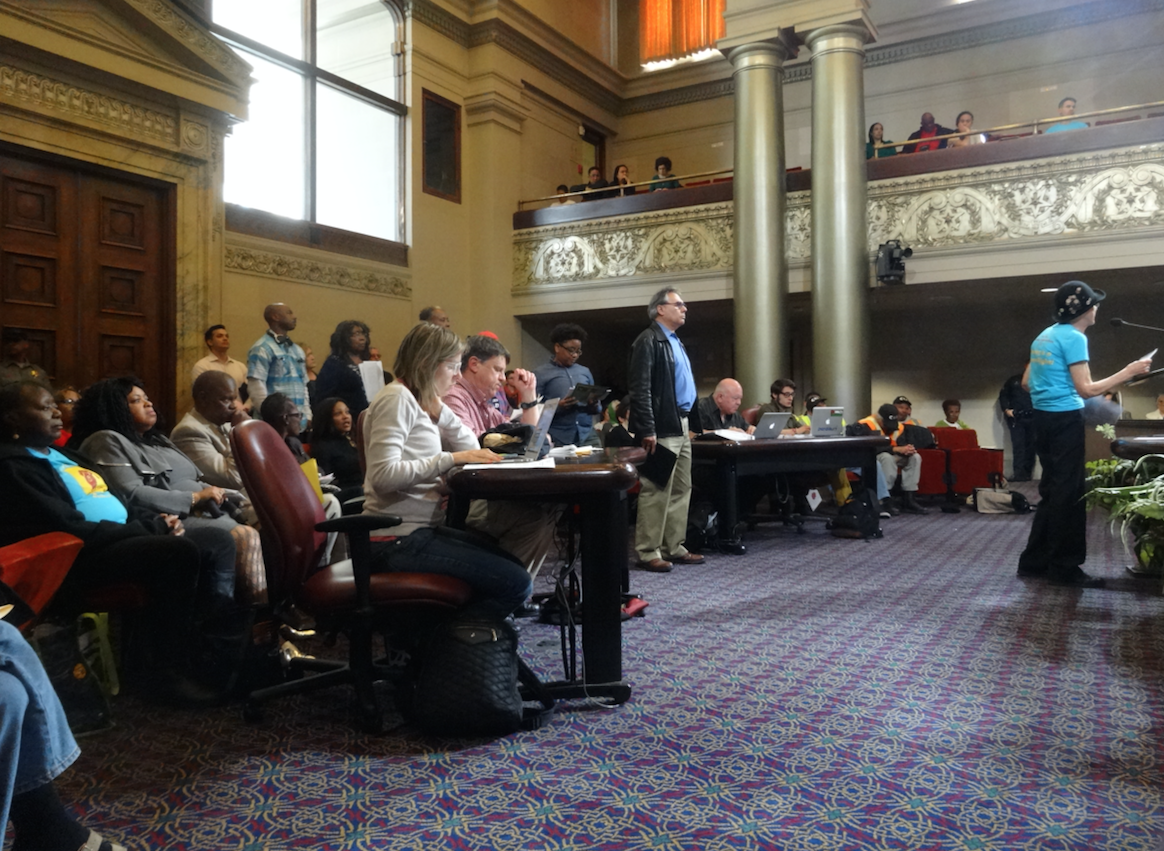
Dozens of speakers told the council’s CED committee that redefining affordable housing is a bad idea.
Credits: Darwin BondGraham
Affordable housing advocates are accusing Oakland Mayor Libby Schaaf and the city council of “gutting” housing assistance for low-income residents by redefining the definition of affordable housing. At a meeting of the city council’s Community and Economic Development Committee yesterday, dozens of people representing nonprofit housing groups condemned the city’s plan to shift millions in affordable housing subsidies away from low-income households and spend the money instead on subsidies for middle-class homebuyers.
[jump]
One of the pots of money at stake is the millions of dollars the city expects to raise from housing impact fees levied on new market-rate housing developments. The city has yet to approve the fees, but they could take effect in parts of the city as early as September of this year. City staffers are asking the council to change the definition for affordable housing so that the impact fees can be “used for moderate-income housing and not just low-income and very low-income households.”
The terms “very low-income,” “low-income” and “moderate-income” have specific definitions under federal and state law. Currently for Oakland, very low-income households are defined as those which earn approximately 50 percent of the area median income, or $41,850 for a family of three. A low-income household of three people earns no more than $64,450, or 80 percent of the area median income.
City staffers want to change the definition of affordable housing so Oakland can spend impact fee funds on “moderate-income” households. A moderate income household is defined as one which earns as much as 120 percent of the area median income, or $100,350 for a family of three.
“The city has an obligation to affirmatively further fair housing,” said David Zisser, an attorney with the nonprofit legal aid group Public Advocates, during the public comment period yesterday. “This moves us in the opposite direction by shifting resources away from low-income to moderate-income residents.”
City staffers also want to redefine affordable housing for two other affordable-housing funding sources so that middle-class families can benefit from housing subsidies. Oakland currently operates a first-time homebuyer program that makes subsidized loans to very low- and low-income renters seeking to purchase a home in Oakland. To qualify for the program, a household cannot earn more than 100 percent of the area median income, or $84,150 for a family of three. The city wants to increase this income limit to 150 percent of the area median income so that a family of three that earns as much as $126,230 a year would qualify for a subsidized home loan from the city. A borrower does not have to be an Oakland resident to qualify for these subsidized loans.
In a similar move, city staffers are proposing that so-called “boomerang funds,” which are dollars distributed to the city by the state as a result of the dissolution of its redevelopment agency, be spent on affordable-housing programs that benefit households that earn as much as 150 percent of the area median income, up from the current limit of 80 percent median income.
Zachary Murray of the Greenlining Institute told the council yesterday that these changes would further harm the ability of low-income Oakland residents to purchase homes in Oakland. Murray said that banks right now are making very few loans to Oakland residents whose income falls below the 100 percent AMI level.
“The reality is that folks who are at 120 percent AMI are receiving more loans than all other groups combined,” said Murray, about the ability of moderate-income households to obtain mortgage loans. “There is no crisis of access for these folks.”
But several council members pushed back. Councilmember Anne Campbell Washington said that changing the definition of affordable housing is necessary to help teachers and other middle-income residents stay in Oakland as real estate prices continue to rise.
“The 120 percent AMI level, I’m wondering if there’s a misperception of what that is,” said Campbell Washington during the meeting. “It’s $111,000 for four people. A family of four with two teachers as parents — that is who we’re trying to house. It’s very important for me to keep our teachers here in Oakland.”
Councilmember Lynette Gibson McElhaney said that it is “heartbreaking” to her to hear affordable housing advocates “vilifying” middle-class people. “I’m troubled by the tenor of our [affordable-housing] advocates to look at a progressive council, being vilified as if we do not care.”
But Jeff Levin of East Bay Housing Organizations said that while his group supports first-time homebuyer programs, increasing income limits will likely help few existing Oakland renters who want to purchase a home.
“There are hardly any renters in Oakland who make 120 to 150 percent of the AMI,” Levin told members of the committee. Levin pointed to US Census figures showing that the median household income for renters in Oakland is $40,250.
“You will be helping very few people who currently live in Oakland,” said Levin. “This money is going to attract higher-income folks to come live in Oakland at the expense of existing residents.”
1. Oakland’s housing market is getting worse at a faster rate for low- and middle-income buyers than any other major city in the nation, the Mercury News$ reports. From 2012 to 2016, Oakland’s unaffordability rate grew 29 percent, the biggest gain among major areas, according to a report by Trulia. The typical buyer of a starter home in Oakland — defined as being in the bottom third in price in a city — must now spend 69 percent of his or her household income on housing.
2. PG&E has eight hazardous leaks in its natural gas storage fields in California, the LA Times$ reports. However, the California Public Utilities Commission has yet to disclose where those leaks are. The revelation about PG&E’s problems were part of a report released by the CPUC showing that there were 229 gas leaks in the state. The CPUC characterized most of the leaks as minor — except for PG&E’s, which the agency classified as safety hazards.
4. UC Berkeley Law School appointed acclaimed law professor Melissa Murray as interim dean of the school, the Bay Area News Group$ reports. Murray is the first African-American woman named to the post, and will replace Sujit Choudhry, who stepped down recently because of a sexual harassment scandal.
6. And state lawmakers are proposing legislation to regulate so-called “expiration dates” on food in effort to reduce waste, the Chron reports. Currently, labels such as “best by” or “sell by” have no real meaning, are unregulated, and typically refer to when a manufacturer thinks its product will taste best. The proposed legislation “would require manufacturers to give food one of two labels in California: ‘Best if used by’ would indicate when a food will be at its best quality, and ‘expires on’ would be used solely on highly perishable foods. The latter would signify the date that they should no longer be eaten.”
A flight from Hanoi to Oakland takes approximately twenty hours. But when Oakland artist Gabby Miller flew back from her four-month stay in Hanoi last January, she said the journey felt strikingly brief. “I thought to myself, this should really take a lot longer,” she said in recent interview. Though Miller’s reaction might seem unlikely, her perspective is an indicator of how she got to Vietnam in the first place. In August of last year, she boarded a cargo ship at the Port of Oakland and rode it for 21 days across the Pacific Ocean to Vietnam. She was the only passenger on the ship, along with thirty crew members — all male — and 11,000 shipping containers. “I’ve never stared at the horizon for so many hours before,” she said.
Miller embarked on the journey as a way to further her research on global trade and gain a first-hand experience of some of the concepts at the center of her work. For the past few years, she’s grown increasingly obsessed with the history of international shipping and the ways in which it relates to Western imperialism, environmental degradation, the oil industry, and international conflict — an interest she developed through her involvement in the 2011 Occupy Oakland general strike, during which protesters shut down the Port of Oakland. So, with funding from the Asian Cultural Council (an international nonprofit), she bought a ticket and boarded the ship with a small pack of paint supplies and no expectations. Now, six months later, she’s processing the experience in an artist residency at Random Parts Gallery (1206 13th Ave., Oakland) for which she’ll present a final show on April 2.
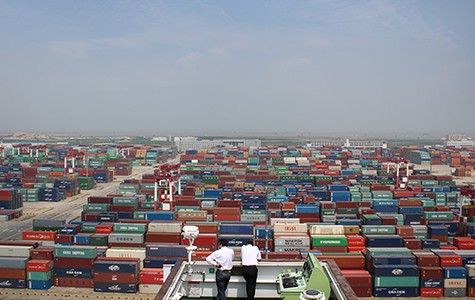
A port-side view from Gemini, the ship that Gabby Miller rode across the Pacific Ocean.
Credits: Gabby Miller
Miller was born in the East Bay and grew up in Berkeley. Her mother was born in Vietnam and raised in America, and her father is white, from Chicago. The two met in Vietnam at the height of the Vietnam War. Miller’s mother was there to do social work and her father, to start a hospital for Vietnamese children. “Their union was totally in the context of war and our family has been profoundly shaped by that,” said Miller.
When President George W. Bush was re-elected in 2004, Miller’s mother decided to quit her job and move to Vietnam. At the time, Miller was twenty years old and half way through college. Inspired, she quit school and moved to Hanoi to work in an art gallery. In Hanoi, she taught a free English class, and about sixty eager artists showed up to the first one. That’s how she fell into the city’s tight-knit, avant-garde art scene. Specifically, she became involved with Nha San, Vietnam’s first experimental artist collective, which does underground programming in order to elude government censorship.
Over the last decade, Miller has consistently traveled back and forth between California and Vietnam, making a living mostly as an art teacher. And she has gradually begun to realize that her trans-pacific journey is one with historical significance. Through research, she found that the escalation of the container industry is closely tied to the Vietnam War because the need to transport mass amounts of supplies across the ocean propelled the American government to catalyze container production. She also learned that the first container ship to arrive on the shores of Vietnam, carrying supplies for soldiers, was called The Oakland and came from the Oakland port. And looking into her own history, she found that her great grandfather on her dad’s side was a coal mine engineer — a profession she considers deeply intertwined with Western imperialism. All that knowledge has lead Miller to start doing conceptual, multidisciplinary artwork that explores the layers of her identity as a product of complex cultural histories.
On the cargo ship, Miller was made especially aware of her biracial identity. Half of the crew was Eastern-European and the other half was Filipino. Because each cultural group kept to themselves, she found herself going back and forth between them. Halfway through the trip, the ship stopped in Russia to refuel. Out of boredom, Miller took some of the crude oil from the vessel’s engine and started to paint. Before long, members of the crew were bringing her photos of their loved ones, requesting that she paint portraits of them. They allowed her to take over the small swimming pool room to use as a studio, and in the evening some of the men would join her to smoke, hang out, and paint. At the end of the journey, she tacked all of the portraits to the tiled walls of the room and held an art reception. Then, she gave each crew member their painting in exchange for a copy of the source image.
Once in Vietnam, Miller repainted many of the portraits she had given away and included them in a show at Nha San Collective that also featured a large tapestry painted with the image of a capsized cargo ship painted in crude oil that the crew bottled for her; photos of the sea from the ship; and a heap of 609 miniature container replicas — the number of containers that were on The Oakland. Now, all that work is installed at Random Parts for her residency, titled Turquoise Wake (Coal, Air, Chicken & Shit). For the show, Miller wants to work with the same ideas of Western imperialism as it relates to capitalism and climate change, but in a way that’s anchored specifically to Oakland. She’s paying particular attention to the current controversy over the Oakland City Council potentially approving a coal export terminal in the port, and the city’s gentrification problem — specifically in the neighborhood that Random Parts is part of, which is largely made up of South Vietnamese refugees from the war. Slowly, she’ll be transforming the space, taking down old work and putting up new creations. But right now, she’s still very much floating through a complex intersection of histories and ideas — still, in some ways, at sea.
One day in late 2014, when demonstrators were spilling out into streets across the country to declare that Black lives matter, author and activist Johanna Hedva found herself listening to a procession of protestors from inside her Los Angeles apartment. Incapable of getting out of bed due to a debilitating illness that regularly renders her unable to walk, drive, work, or sometimes speak or understand language for up to five months at a time, Hedva had little recourse but to watch the march move on without her. The experience got her thinking: “How do you throw a brick through the window of a bank if you can’t get out of bed?”
That question forms the basis of Hedva’s Sick Woman Theory, a manifesto for people living with chronic illnesses or disabilities, the first chapter of which was published in Mask Magazine earlier this year. It’s also the question that motivated Sick Fest, an evening of readings and performances by writers and activists who are chronically ill and disabled, including Hedva, that will take place at Chapter 510 in Oakland (2301 Telegraph Ave.) on Saturday, March 26.
Johanna Hedva.
Credits: Pamila Payne
Amy Berkowitz, one of the event organizers and an Oakland-based author whose recent book, Tender Points, delves into her experience living with fibromyalgia (an oft-misunderstood chronic illness), was instantly impressed with Hedva’s scathing polemic against capitalism and the healthcare system. While Berkowitz’s Tender Points poetically situates her chronic pain within a political context, the author said Hedva’s Sick Woman Theory makes that connection much more explicit by specifically pointing to ways in which capitalism and other social structures work to keep sick people from being cared for and actually benefit from that. Berkowitz has ample experience navigating the healthcare system, which has a long and well-documented history of discounting pain experienced by women while accepting similar complaints by men. She said that her medical experiences often maker her feel “invisible” to doctors — and to society as a whole, which frequently ignores sick bodies. So, it was refreshing for her to see another author’s work reflect those experiences.
“Nobody wants to see a sick woman’s body just the same as the way people are repulsed by menstrual blood,” Berkowitz said. “We just want to see women’s bodies if they’re sexualized.”
Hedva uses the term “Sick Woman” to define anyone who is subjugated or oppressed, or in Hedva’s words, “all of the ‘dysfunctional,’ ‘dangerous’ and ‘in danger,’ ‘badly behaved,’ ‘crazy,’ ‘incurable,’ ‘traumatized,’ ‘disordered,’ ‘diseased,’ ‘chronic,’ ‘uninsurable,’ ‘wretched,’ ‘undesirable,’ and altogether ‘dysfunctional’ bodies belonging to women, people of color, poor, ill, neuro-atypical, differently abled, queer, trans, and genderfluid people … .”
“Sick Woman” is also a term that Oakland author, editor, and Sick Fest co-organizer Emji Spero admits they can’t fully claim, especially as a transgender person who has struggled to shed the term “woman” from their identity (Spero goes by the gender-neutral pronoun “they”). But within the context of Hedva’s writing, Spero said they were able to accept the terminology as representing anyone denied privileged existence and for whom care is not guaranteed.
Spero and Berkowitz see both Sick Woman Theory and Sick Fest as part of a movement to bring greater visibility to the experiences of chronically ill and disabled people. Sick Fest will feature slightly more than an hour of performances and readings by local artists and authors, including Neve Be, Carolyn Lazard, Kiyaan Abadani, Claire Light, Liz Henry, and Berkowitz. Hedva will follow that with a presentation of new material from her forthcoming book project, This Earth, Our Hospital (Sick Woman Theory and Other Writings). It will also include donation-based body and energy work and a zine fair showcasing perspectives on chronic illness.
Berkowitz and Spero said they hope the event will provide a platform for people with disabilities or chronic illness to feel connected to a wider community, foster new modes of participation, and encourage radical discourse.
“One way that power is taken from sick and disabled people is that they are not given space to speak or tell their own story,” Berkowitz said. “In having an event like Sick Fest, we are making room for sick and disabled people to meet and collaborate and talk to each other. There’s a lot of power in that.”
Unlike the new crop of cannabis carnival barkers, real power players in the industry tend to be discrete. And few in the weed game have been as discrete, or have built up as much momentum as Maya Lapid, founder of the award-winning East Bay company Om Edibles.
Lapid is a prescient, college-educated Bay Area native, and a plugged-in, insider of fourteen years in the local medical cannabis industry who foresaw the edibles-as-superfoods trend eight years early and can no longer hide from the limelight. Still, Lapid is hesitant to fully spill the beans, particularly when it comes to her budding business relationship with superstar celebrity Whoopi Goldberg.
Maya Lapid.
“I’d love to tell you, but we’re almost, almost there,” said Lapid, referring to the details of the Goldberg partnership. “When we can get there, I will tell you.”
On March 19, Om Edibles re-posted to Instagram a picture of Lapid and Goldberg posing for a photo, smiling and sipping what looks like iced tea. The advent of a medical cannabis product partnership for the co-host of ABC’s The View — which has 3.9 million national viewers — signifies the arrival of mainstream cannabis. The Bay Area medical weed industry is abuzz about Om’s coup, but Lapid is no carnival barker. She said she has “no comment” on how she met Goldberg.
“She’s just an awesome lady, She’s one of my heroes,” Lapid said. “We have a lot in common. We have a lot of exciting things happening.”
But as reticent as Lapid is about discussing the details of her venture with Goldberg, she’s not afraid to share the secret of her company’s success. “I know exactly what my secret is, and I’m not afraid to tell it: We use the best ingredients we can and the best products we can. … We use an extreme level of care, from the root to the fruit.”
That means growing Om’s own bud outdoors on a farm run by women, and then combining the company’s top-shelf, exclusive strains with “as few ingredients as you can, as organic as possible” and lab testing for consistency, she said.
And all that dedication to excellence has paid off. Last year, Om’s CBD Raw Sipping Cacao took first place in CBD edibles at The Emerald Cup and in the High Times Medical Cannabis Cup Northern California. Om also took first place in the Jamaican High Times Cannabis Cup for its infused topical oil.
Lapid said she first got high at the age of thirteen, and by fourteen was smoking nearly every day. “It’s kind of the way I prefer to live my life,” she said. “I’m one of those people cannabis really agrees with.”
After getting a degree in psychology from San Francisco State University, she began her medical cannabis career at a San Francisco pot club in 2004. “I really connected with that role of being a resource for people to learn about cannabis,” she said. “I saw a lot of problems out there, and I loved to cook. I felt like I could create stuff, too.”
During her pot club days, Lapid budtended, became a head chef, ran a clone desk, trimmed cannabis crops up north, and perfected ice-water based extraction (bubble hash) techniques in the Bay Area. Lapid also began growing cannabis and is connected to the Cookie Fam — the Bay Area horticultural masters behind the world’s biggest current cannabis strain — Girl Scout Cookies.
Om Edibles, an all-female company, officially launched in 2008 and has racked up a string of hits. Eight years ahead of the curve, Om was the first to market cannabis infusions in super-foods, eschewing sugary, fatty desserts for items like the company’s award-winning Peanut Butter and Puffed Rice Truffles (175 milligrams THC).
Om’s latest is a CBD-rich miso with mushroom and sea kelp soup broth, part of a line of thirty Om products carried in clubs throughout California. The soup won’t get you high, but it might help manage your arthritis, back pain, or seizures.
Lapid also is not shy about predicting the next hot trend: THC-infused bath products — a potentially billion-dollar sector of moms and grandmas underserved by stoner, bro-oriented brands. “Baths are so amazing. They deserve a category of their own from topicals or edibles. It’s really just a strong body effect that’s great for sleep, aches, and pains and overall dermatological issues,” she said.
One of last year’s biggest food scandals centered on a pair of bearded brothers from Brooklyn who marketed their popular Mast Brothers chocolate bars as scratch-made, “bean-to-bar” chocolate, when, as it turned out, at least some of it was actually made by the French chocolate manufacturer Valrhona, and the brothers had simply remelted it.
It was a case of schadenfreude heard ’round the world. Even distant observers relished the details of the takedown published by DallasFood.org — the thick beards and Amish-style wardrobe favored by proprietors Rick and Michael Mast; the chocolate bars’ luxurious wrapping paper and $10 price tag; and the fact that, in the opinion of many internet pilers-on, the chocolate wasn’t any good to begin with. If you were the kind of person who believes the very existence of a $10 chocolate bar was illustrative of the folly of the One Percent, here was proof. If you were someone with strong opinions about bearded hipsters — well, what else needed to be said?
At Berkeley’s Bisou Chocolate, making bean-to-bar chocolate is a difficult, labor-intensive process.
Credits: Bert Johnson
An assortment of East Bay chocolate.
Credits: Bert Johnson
But the Mast Brothers controversy also pointed to a larger truth: Many of us just don’t know very much about chocolate. The East Bay is home to a handful of bean-to-bar chocolate companies, which run the gamut from national brands like TCHO, which recently moved its manufacturing facility to Berkeley, to scrappy operations such as Bisou Chocolate and Oakland Chocolate Company, both of which make chocolate bars in such small batches that you’re unlikely to find them outside the confines of a local farmers’ market. But while you can scarcely walk into a coffee shop in Oakland or Berkeley without a stranger offering an unsolicited opinion about roasting level or pour-over methodology, even a true food obsessive might be hard-pressed to explain what “winnowing” is, from a chocolate-making perspective, or to name even a single cacao varietal.
Part of the problem is that the bean-to-bar movement is still too new for it to have penetrated the public consciousness, explained Eli Curtis, who co-owns Bisou Chocolate along with his partner Tracey Britton. Of course, the history of chocolate goes back thousands of years, to the ancient Aztecs. But for much of this past century, almost all of the world’s chocolate has been produced by giant companies using automated, industrialized processes — chocolate “made by robots,” as Curtis put it. In 2006, when Curtis and Britton first started making chocolate, there was just a small community of people in the United States who were experimenting with making artisan chocolate, using makeshift equipment and techniques that they read about in online forums. “Other foods had grown in the craft sector, but chocolate had remained this secret, unknown process,” Curtis said.
The term “bean to bar” refers to chocolate makers who oversee the entire process of making chocolate — sourcing the cacao beans from overseas, roasting them, winnowing them (removing the husks), grinding the nibs (the inside of the bean) into a liquid, and then crystallizing that liquid to create a shelf-stable product. It’s a difficult, labor-intensive process that many have likened to alchemy. And the resulting chocolate tends to be more distinctive-tasting, yielding layers of flavors that can be as complex and wonderful as fine wine.
This stands in contrast to giant companies like Hershey’s, whose milk chocolate bar has only, as Curtis points out, “11 percent cacao in it — and it’s all really bad cacao.” But, as with coffee, the reality is that a lot of people like mass-produced, commercial brand chocolate — just as they like Starbucks coffee. For example, a “Safeway Select” dark chocolate bar, which claimed no bean-to-bar pedigree, did surprisingly well in a recent blind tasting at the Express office.
As for the extent to which the products are individually hand-crafted, there’s no comparison. Curtis and Britton, who were bike messengers in San Francisco before chocolate became their raison d’être, are Bisou’s only two employees, and they work long hours to produce a relatively modest amount of chocolate — maybe two hundred pounds a month, most of it sold at farmers’ markets.
Meanwhile, proprietor Nancy Nadel believes the Oakland Chocolate Company might be one of the smallest bean-to-bar businesses in the country, with an average output of just twenty pounds a week. In an interview, Nadel said she didn’t start making chocolate until she was in her sixties, while she was a member of the Oakland City Council. She used to share the chocolate that she made with her colleagues. “They seemed to like my chocolate more than progressive policy,” Nadel quipped.
Now retired from public office, Nadel has turned her chocolate hobby into a full-time business, which she operates out of a small workshop in West Oakland. The other unique thing about her chocolate: While most chocolate companies — even small, bean-to-bar operations — source their cacao from multiple countries, all of Nadel’s beans come from Jamaican farmers, whom she first met during a family vacation in 2006. During that first visit, the farmers had told her how difficult it was for them to get a good price in the commodity chocolate market, and she was inspired to see if she could help them.
TCHO stands out among the East Bay’s bean-to-bar companies both in scale and prominence. While the company was reluctant to release exact numbers, it’s safe to say that its annual output is more easily measured in tons than pounds. (For instance, the machine the company uses to grind cacao can handle three tons of beans in a single batch, as opposed to the 25-kilogram-capacity grinders used by a lot of smaller operations.) TCHO also touts its tech-driven approach — what the company’s marketing materials describe as “Silicon Valley start-up meets San Francisco food culture.” The website is dotted with terms like “2.0,” “Beta,” and “Cropster.”
Still, the company retains many of the hallmarks of a much smaller chocolate producer, starting with the fact that creation of each new bar or flavor is closely supervised by its two primary chocolate makers, Brad Kintzer and Zohara Mapes Bediz. (In an interview, the latter told me she’s a self-taught chocolate maker who started her career selling at farmers’ markets.)
One of the advantages of scaling up the bean-to-bar approach in the way that TCHO has is that it has the potential to have a larger impact on the global chocolate market. The aforementioned “Cropster,” for instance, is a cloud-based database that allows farmers to track when the cacao beans should be picked in order achieve the flavor profile that TCHO is looking for. This leads to fewer beans being rejected and, ultimately, farmers making more money.
None of the chocolate makers I spoke with seemed particularly fazed by the recent Mast Brothers scandal. In fact, a few argued that the controversy was actually good for the burgeoning craft chocolate industry. As Bisou’s Britton put it, “I think it helped to raise awareness for the general populace.”
And despite all of the snarky internet commentary about $10 chocolate, Curtis pointed out that even the world’s very best chocolate bars typically won’t cost you much more than $15. In that sense, chocolate is one of the world’s most affordable luxuries, Curtis said. “This is the golden age of fine chocolate.”
Tasters’ Choice
On a recent afternoon, Express staffers took part in an informal tasting of fourteen different chocolate bars made by East Bay bean-to-bar chocolate makers. A “Safeway Select” brand 78-percent dark chocolate bar and a Hershey’s “Special Dark” bar — which many of us found unspeakably sweet — were included as a “control” group. Here were some of the highlights of the tasting, in no particular order:
Though some tasters found this high-cacao bar to be too bitter, I enjoyed the bar’s earthiness and its pronounced — but pleasant — bitter, toasty flavor. The chocolate is very soft and very smooth. Buy at: SmallBatchChocolate.com, various farmers’ markets (including the Saturday Alameda farmers’ market), and a small number of retail shops such as Sacred Wheel Cheese.
2. Oakland Chocolate Company, “Very Dark Bar with Almonds,” 85-percent Jamaican cacao, 1 ounce, $2.75
None of Oakland Chocolate Company’s chocolate bars contain any vanilla. That fact, along with its very high cacao content, made this particular bar a divisive pick. While some tasters found the chocolate to be bland, I admired its toasty, roasted-nut quality, which complemented the inclusion of actual almonds. Here, you’re really tasting the cacao, and there was an almost boozy undercurrent of flavor that I found fascinating. Buy at: TheOaklandChocolateCo.com and at the Old Oakland Friday farmers’ market.
3. TCHO, “Chocolatey,” 70-percent cacao from Ghana, 2.5 ounces, $5.95
This single-origin bar is part of TCHO’s original line of chocolate bars. This was fairly sweet compared to the higher-cacao bars we sampled, but compulsively snackable, with a hint of raspberry on the finish. Buy at: TCHO.com or at any number of supermarkets.
Artisana, an Oakland-based producer of organic nut butters, also sells a line of chocolate bars made with organic Criollo cacao beans grown on one of the owners’ family farm in Venezuela — though the chocolate-making process itself takes place in Switzerland. Artisana’s 75-percent bar — the company’s middle-of-the-road option in terms of cacao content — received high marks for its mellow, balanced sweetness, and for the chocolate’s smooth texture as it melted, easily, on the tongue. A solid choice for those who like commercial dark chocolate but are looking for something of a higher quality. Buy at: Berkeley Bowl and Alameda Natural Grocery.
The American Civil Liberties Union (ACLC) announced this week that a coalition of legal organizations submitted a notice to a Bay Area court, demanding changes in the driver’s license suspension policy for people who cannot afford to pay exorbitant traffic fines.
“What used to be a hundred dollar violation in California now costs nearly five hundred dollars,...
In a story by journalist Dan Baum in the most recent issue of Harper’s magazine a former policy advisor to President Richard Nixon is quoted as saying that the war on drugs was created as a political tool to undermine Black communities and attack the anti-Vietnam War movement.
In 1994 Baum interviewed John Ehrlichman, President Nixon’s domestic-policy adviser from 1969 to 1973. Ehrlichman was...
Welcome to the Mid-Week Menu, our roundup of East Bay food news.
1) Fans of Hopscotch chef Kyle Itani’s ramen — which you may have sampled in its gloriously off-the-cuff pop-up iteration a couple of years ago — will be happy to know that the chef’s new ramen shop, Itani Ramen (1736 Telegraph Ave., Oakland), is almost ready, with a...
Vanessa Vigil is only 22 years old, but the local artist and photographer has a curatorial savvy that outweighs her years. Last August, frustrated with male-dominated art spaces, Vigil curated Not Ur Baby, an all-female art show that raised nearly five hundred dollars for Oakland anti-human trafficking organizations. Now, less than a year later, Vigil is poised to repeat...
Dozens of speakers told the council's CED committee that redefining affordable housing is a bad idea.
Credits: Darwin BondGraham
Affordable housing advocates are accusing Oakland Mayor Libby Schaaf and the city council of “gutting” housing assistance for low-income residents by redefining the definition of affordable housing. At a meeting of the city council’s Community and Economic Development Committee yesterday, dozens of...
Stories you shouldn’t miss:
1. Oakland’s housing market is getting worse at a faster rate for low- and middle-income buyers than any other major city in the nation, the Mercury News$ reports. From 2012 to 2016, Oakland’s unaffordability rate grew 29 percent, the biggest gain among major areas, according to a report by Trulia. The typical buyer of...
A flight from Hanoi to Oakland takes approximately twenty hours. But when Oakland artist Gabby Miller flew back from her four-month stay in Hanoi last January, she said the journey felt strikingly brief. "I thought to myself, this should really take a lot longer," she said in recent interview. Though Miller's reaction might seem unlikely, her perspective...
One day in late 2014, when demonstrators were spilling out into streets across the country to declare that Black lives matter, author and activist Johanna Hedva found herself listening to a procession of protestors from inside her Los Angeles apartment. Incapable of getting out of bed due to a debilitating illness that regularly renders her unable to walk, drive,...
Unlike the new crop of cannabis carnival barkers, real power players in the industry tend to be discrete. And few in the weed game have been as discrete, or have built up as much momentum as Maya Lapid, founder of the award-winning East Bay company Om Edibles.
Lapid is a prescient, college-educated Bay Area native, and a plugged-in, insider of...
One of last year's biggest food scandals centered on a pair of bearded brothers from Brooklyn who marketed their popular Mast Brothers chocolate bars as scratch-made, "bean-to-bar" chocolate, when, as it turned out, at least some of it was actually made by the French chocolate manufacturer Valrhona, and the brothers had simply remelted it.
It was a case of schadenfreude...