
Goodbye, Express Readers

So far, 2016 is turning out to be a year of significant change in East Bay journalism. On March 1, the Bay Area News Group announced that, effective April 5, the Oakland Tribune will become a weekly paper, and the daily newspapers, the Contra Costa Times and the Tribune, will be rebranded as the East Bay Times. In addition, on April 1, longtime San Francisco Chronicle East Bay columnist Chip Johnson will be leaving the paper; he said he plans to move back home to Ohio. And finally, I’m leaving the Express on March 24 after eleven and a half years as a staff writer and editor. This is my final column for the paper.

I’ve been a fan and reader of the Express since I moved to Berkeley in 1979. And I’ve had a great ride at the paper since I was hired as a reporter in August 2004. When I arrived, after having worked as a staff writer at the Oakland Tribune for six years, the Express was still owned by the alt-weekly newspaper chain, New Times, which later became known as Village Voice Media (VVM). It’s common in the newspaper business to demonize corporate media, but I liked working for New Times and VVM. Yes, the company was large and, at times, a bit impersonal, but it was dedicated to investigative journalism and invested heavily in it. Plus, it took a hands-off approach to the Express. Never once did corporate managers attempt to steer our news coverage or tell me or my fellow reporters to lay off controversial stories.


In fact, my first cover story at the Express was one that the Tribune declined to publish, apparently out of fear of angering the owner of an Oakland icon: Fentons Creamery on Piedmont Avenue. My piece, “Fire & Ice Cream” (9/22/04), revealed the dark and disturbing story behind the 2001 blaze that gutted Fentons. Then-Express editor Stephen Buel had recruited me to come work at the paper a few months earlier and was ecstatic that I arrived with a cover story in hand. I have never regretted my choice to join the Express.

I’m very proud of the paper’s staff today, but back in the early and mid Aughts, the Express was much larger and was stacked with outstanding journalists. My fellow reporters included Chris Thompson, the best long-form writer I’ve ever worked with; Will Harper, a viciously funny columnist and terrific workmate; Justin Berton, a master of the long-form narrative who taught me how to craft a cover story; and Kara Platoni, a great reporter and colleague who now teaches at the UC Berkeley School of Journalism. Our managing editor at the time was Michael Mechanic (now at Mother Jones magazine), and the editorial staff included food editor Jonathan Kauffman (now of the Chronicle); music editor Rob Harvilla; and staffers Kelly Vance (still the Express film critic), Eric K. Arnold, Stefanie Kalem, Nora Sohnen, Vicky Walker, Mark Gartland, and Justin Page.

One of the stories that I’m proudest of from this period was an in-depth piece on Chris Gafford, an innocent man who was wrongly accused of being the East Bay sniper (see “At Large,” 1/12/05). And, of course, I spent much of the Aughts investigating the shady deals of then-State Senator Don Perata, who lived in Oakland and was one of the most powerful politicians in California.

A two-part series of investigative features that I wrote on Perata in 2007 (see “Living Large” 5/23/07) were among the first cover stories printed by the Express after it went independent. In May 2007, a group of investors, including Buel, Hal Brody, and Jay Youngdahl (who is now the majority owner of the paper and its president), purchased the Express from VVM. (I should note that working for an independent Express was even more fun than under VVM.) Over the next few years, some of my favorite pieces included “The Buses from Hell” (01/23/08), an in-depth series on AC Transit, and the environmental stories “You’re Not an Environmentalist If You’re Also a NIMBY” (7/1/09) and “Sierra Water Grab” (4/29/09). And then, of course, when Perata ran for mayor of Oakland, I penned the polemic, “25 Reasons Why You Shouldn’t Vote for Don Perata” (10/13/10). It worked.

In December 2010, I became co-editor of the Express with Kathleen Richards, the best all-around journalist I’ve ever worked with (she’s now an editor at the Stranger). Over the next few years, I got to work with and edit two of the finest writers I’ve ever known: Rachel Swan (who is now at the Chronicle) and Ellen Cushing (now at BuzzFeed). I also got to edit super reporter Sam Levin (now at the Guardian US).

During this period, I also was fortunate to become the voice of the Express through my weekly column Seven Days. And although it may be immodest, I think there’s an argument to be made that the Express became the voice of Oakland and other East Bay cities. In 2012, 76 percent of the candidates and measures that we endorsed won, and in 2014, that number rose to 83 percent. No other publication came anywhere close to our record.

After Jay Youngdahl promoted me to editor of the paper in June 2014, I was fortunate to hire, edit, and work with an extremely talented and hard-working staff, including Levin, arts and culture editor Sarah Burke (who is becoming managing editor of the Express on March 25), music editors Sam Lefebvre and Nastia Voynovskaya, food editor Luke Tsai, photo editor Bert Johnson, investigative reporter Darwin BondGraham, and managing editor April Kilcrease (who is also leaving the Express on March 24). Some of my favorite stories from the past two years included Levin’s “Racial Profiling Via Nextdoor.com” (10/7/15); Burke’s “Will Oakland Lose Its Artistic Soul?” (2/7/16); Tsai’s “Shell-Shocked” (1/14/15); and BondGraham’s “Oakland’s Toxic Failure” (11/11/15).

As co-editor and editor, I also got to work with some fantastic freelance journalists, including David Bacon, Alastair Bland, Momo Chang, David Downs, John Geluardi, Joaquin Palomino (now at the Chronicle), Will Parrish, Steven Tavares, Jean Tepperman, and Ali Winston (now at Reveal).

Other Express editorial staffers and freelancers that I was lucky to work with over the years include (in no particular order) Nate SeltenrichJohn Birdsall, Lauren Gard, Anneli Rufus, Eliza Strickland, Stephen Loewinsohn, Azeen Ghorayshi, Lenika Cruz, Cassie McFadden, Will Butler, Madeleine Key, Linnea Due, John C. Osborn, Michelle Ellson, Erin Baldassari, Julian Mark, Kibby Kleiman, Zaineb Mohammed, Rin Kelly, and J. Douglas Allen-Taylor.

I also want to give a shout-out to some of the fabulous non-editorial staffers at the Express over the years, including Jody Colley, Ben Grambergu (who is leaving on March 25), Marie Ortega Haslam, Nick Wong, Justin Harris, Caitlin Albritton, Roxanne Pasibe, Bri Beaudoin, Israel Brown, and ex-staffers Brian Kelly, Annika Dukes, Jennifer Lindsay, Sonia Rude, Brent Ringwood, Terry Furry, and Kasper Koczab. (Apologies if I forgot anyone.)

If you’ve gotten this far, thanks for indulging my trip down memory lane. As I said, I’ve had a great ride at the Express. But it’s time for me to embark on a new adventure. I’m not leaving East Bay journalism; I love Oakland and the rest of the East Bay far too much for that. To find out where I land next, follow me on Twitter at @RobertGammon.

The Express will announce the appointment of the paper’s new editor in the weeks ahead.

Thanks, and thanks for reading.
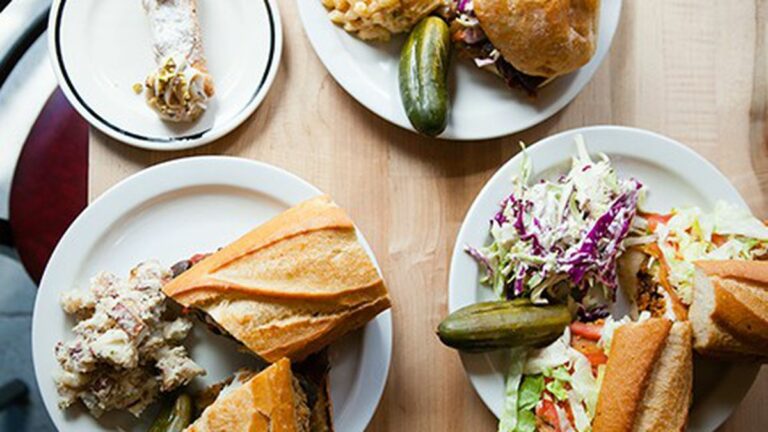
Fall into a Plant-Based Food Coma at The Butcher’s Son

Having been vegan for nearly five years, I’ve come to learn that certain places are simply off-limits to someone with dietary proclivities such as my own. Italian restaurants, for instance, are usually a no go unless I want to eat skimpy noodles while everyone else dines on meat and seafood dripping with melted cheese and butter. Same with Korean barbecue and Brazilian steakhouses — neither of which typically have much to offer for herbivores.

But rather than staying away from supposedly prohibited cuisines, the team behind Berkeley’s brand new vegan deli, The Butcher’s Son (1941 University Ave.), sees them as a challenge to innovate. The freshly minted establishment is the brainchild of chef Peter Fikaris, who honed his skills with faux meats at The Source in San Francisco, and his sister and business partner, Christina Stobing. Fikaris, who is vegan, came up with the concept for The Butcher’s Son after a trip to New York, where traditional Italian-American delis abound. The lack of vegan options he encountered inspired him to create a deli catered to those with plant-based diets.

Stobing and Fikaris’ father was the owner of Michael’s American Vegetarian Diner, which was in business on Telegraph Avenue in the 1990s, and Italian cooking was one of his specialties. While the siblings were raised vegetarian, they wanted to create vegan versions of their favorite Italian-American foods that don’t cut out any of the richness.

“You can get vegan food in different cuisines, but Italian is hard,” she said. “It’s more of a challenge to make these delicious, vegan Italian foods filled with ricotta and other delicious cheeses.”

Furthermore, one of the hardest things about going vegan isn’t necessarily forgoing certain foods: It’s missing out on social rituals that are based around particular meals. And one such experience most vegans must bid farewell is visiting an old-school, Italian-American deli and choosing items to take home by the pound — something The Butcher’s Son seeks to remedy.

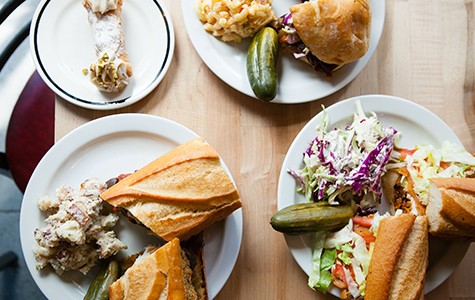
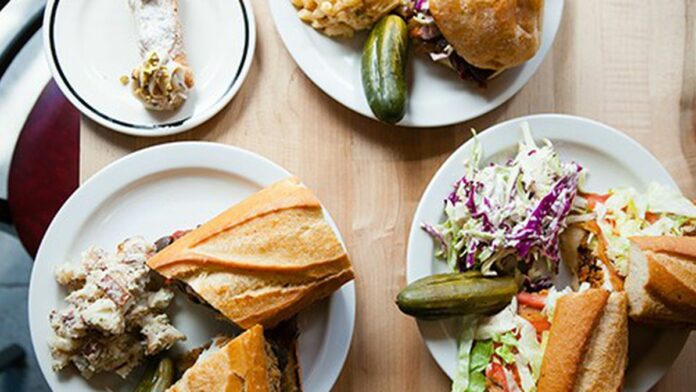
Because the deli officially opened in late February, its menu is still limited, but features a rotating selection of decadent sandwiches in addition to bulk items behind the counter. According to Stobing, its offerings will expand soon. When I came in last week, I saw pulled “pork” and a teriyaki pineapple roast available in bulk in the display case, as well as a selection of plump, vegan croissants — plain and chocolate — and egg- and dairy-free cannolis miraculously oozing with rich cream.

While the deli counter was surprisingly somewhat bare (I was looking forward to bulk vegan cheeses, which are coming soon), the sandwiches were the main attraction, and customers lined up eagerly during the entirety of my midday visit. The lunch menu was informally tacked onto the glass display case with a piece of tape and featured vegan takes on such classics as a fried mozzarella meatball sandwich, a Philly cheesesteak, and a pulled-pork sandwich.

Almost all of the fake meats at The Butcher’s Son are made in-house using a blend of seitan (a wheat gluten-based protein), mushrooms, and textured vegetable protein. I sampled the “meatball” sandwich with “mozzarella” sticks — which was exquisitely rich, with mushrooms, marinara sauce, and grilled bell peppers adding a complexity of textures and flavors to its salty and fatty main components. On the other hand, the “pulled pork,” which was made out of yuba (a tofu skin culled from the congealed layer that forms atop boiled soy milk), was somewhat chewy, especially when served on a tough ciabatta roll — though coleslaw lent the sandwich a refreshing coolness.

The Grinder, which may soon become a menu staple according to Stobing, was the best sandwich I tried, with spicy jalapeños and crunchy lettuce accenting the tender “beef” and “chicken” seitan on a flaky baguette.

While people become vegan for a variety of reasons — eating better, decreasing their carbon footprint, concern for animal welfare — The Butcher’s Son isn’t for the health-nut crowd. This a place where vegans can enjoy the delicious experience of falling into a carb-induced food coma. And while the fake meats are genuinely tasty, the amount of glutinous ingredients renders the majority of the menu a bit heavy and bready.

Still, The Butcher’s Son is in its soft opening phase, and Stobing said that, soon, its menu will include salads, lasagnas, and ravioli, as well as more types of sandwiches and bulk faux meats and cheeses. It’s off to a strong start so far and, with the recent closure of long-running vegan restaurant Café Gratitude, is a welcome addition to the East Bay’s plant-based food scene.

Wine, Au Naturel

In 2007, Lisa Costa moved across the country for a harvest internship at a renowned producer of single vineyard pinot noirs in the Russian River Valley. She had fallen in love with winemaking in her early twenties while working at small farm wineries in New York’s Hudson Valley. The internship promised a chance to work with some of the most expensive fruit being grown in the United States. The experience was an eye-opener.

“I couldn’t believe what they were asking me to put in the wine tanks. I couldn’t believe the chemical trailer they had in their backyard. … And I couldn’t believe what they were pulling over the consumers’ eyes,” said Costa, referring to the Sonoma County winery, which she declined to name. “I was offended by it. I was taking it kind of personally.”

Among the chemicals she encountered was sulfur dioxide, the most common wine additive. It has been employed to kill microbes and prevent oxidation for centuries, but the amount used by winemakers has shifted a bit since antiquity. “We were making these huge factory batches of wine, and you’re faced with a total loss if you get some sort of bacteria in there,” said Costa. “So you just overdose it. … And that’s not good for anyone.”

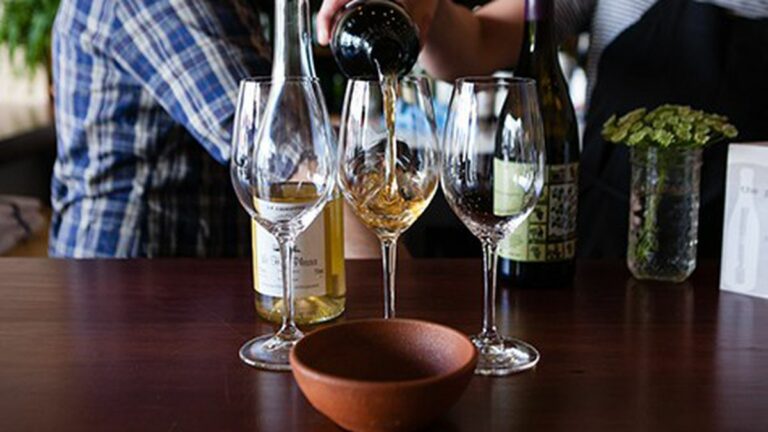
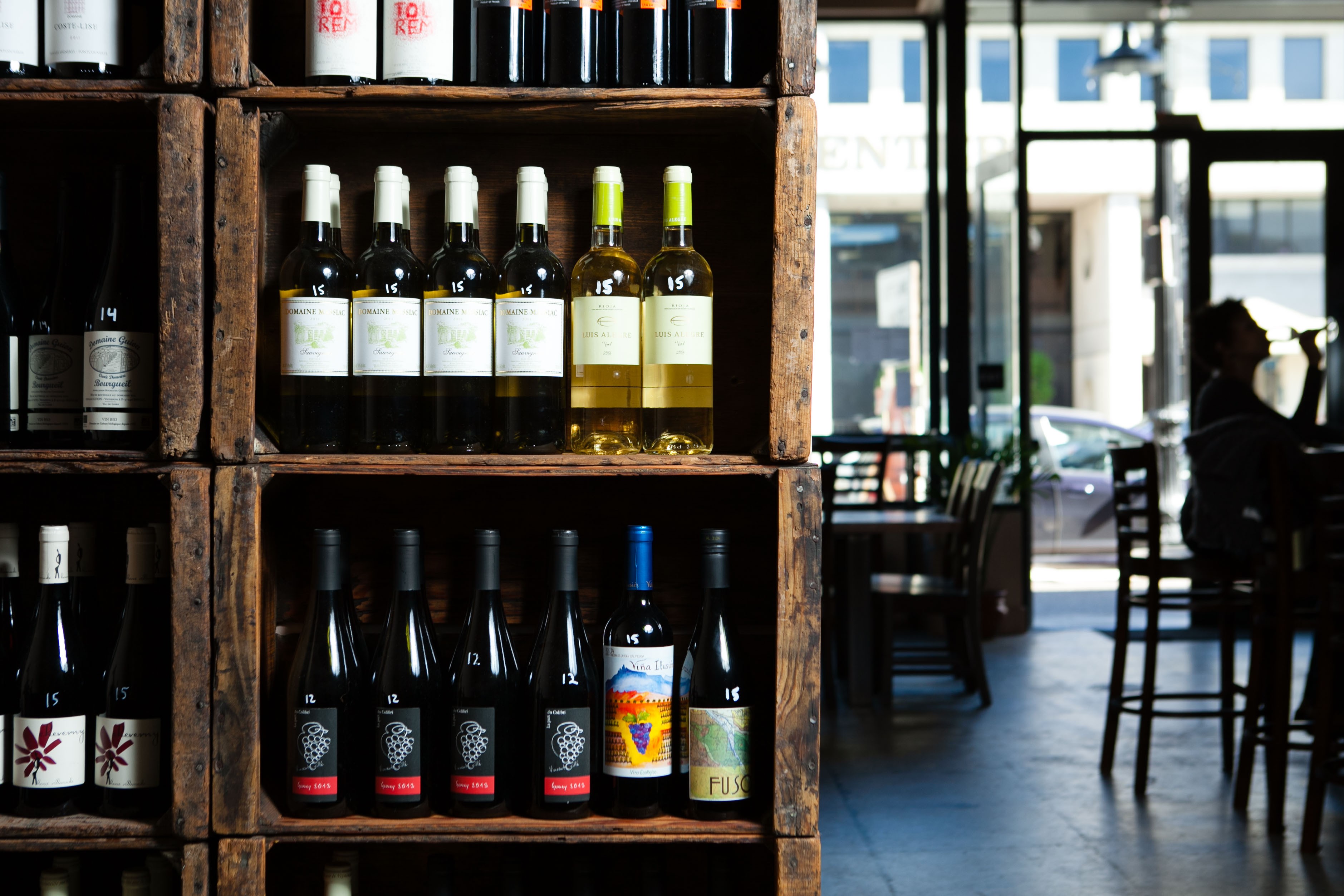
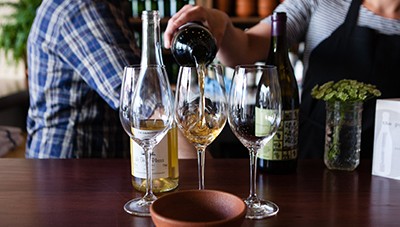
After working together at the Russian River area winery, Costa and her now fiancé, D.C. Looney, decided they wanted to do things differently. Today, the couple own the Punchdown (1737 Broadway), the recently re-opened natural wine bar and bottle shop in downtown Oakland. You won’t find the kinds of big oaky wines that dominate grocery store shelves on their list. Instead, the menu includes a white wine from Georgia described as “stinky,” an “aromatic” and “funky” French Muscat, and a “weird” orange wine from Spain. “Zero-zero,” which indicates no added sulfur and no fining or filtration, appears next to several wines.

Like other proponents of so-called natural wine, Costa and Looney believe that wine should be made with as little intervention as possible. Starting in the vineyard, this means no pesticides, herbicides, or fungicides. Grapes are tended by hand, often using organic or biodynamic (a system that views the vineyard as a living organism) farming practices. The juice ferments with native, ambient yeast rather than the lab yeasts employed by many large scale wineries.

For Costa and Looney, native yeast fermentation is the most important part of natural winemaking. According to them, ambient yeast makes natural wines more distinctive and allows for a more accurate reflection of terroir, the unique flavor of a place that comes from its particular combination of soil, climate, and, well, yeast.

As an example, Costa pointed to the Jura, one of their favorite wine regions in France. “The Jura has a very special wild yeast that only lives there. It’s like San Francisco or New York sourdough. It can only survive in certain areas where the conditions are absolutely perfect. It can’t be replicated anywhere else.”

Trusting that their grapes know what to do on their own, natural winemakers also do not add sugar, enzymes, bacteria, acid, tannins, water, coloring, or any of the other seventy-plus additives and treatments allowed by the US Alcohol and Tobacco Tax and Trade Bureau. Nor do they use reverse osmosis, micro-oxygenation, concentrators, or other high-tech tools that allow modern winemakers to engineer predictable bottles of wine.

“The grape itself naturally has all the elements necessary to make wine,” said Costa. “As long as you keep other bacteria from infecting it, you have wine that’s basically made itself. No other fruit in the world does that — only grapes.”

While many consumers assume that grapes are all that goes into a bottle of wine, a typical recipe can read more like a chemistry experiment. However, unlike processed foods, winemakers are not required to list ingredients on their labels. Those unmentioned additives can include diammonium phosphate (DAP), used to revive yeast and inhibit sulfur production; Velcorin (dimethyl dicarbonate), a microbial control agent; Mega Purple, a viscous goo that boosts color; and oak chips or oak sawdust, a cheaper alternative to oak barrels.

Costa likens the difference between natural wine and mass-produced wine to the difference between handmade bread and Wonder Bread. “Often when you’re baking sourdoughs, you’re dealing with natural yeasts, and you’re dealing with a very natural, hands-on process that’s hard to have a recipe for,” she said. On the other hand, “You can make Wonder Bread taste the same year after year.”

“A lot of wines are manipulated to taste the same way to satisfy what some people call the ‘Coca-Cola palate,'” said Costa. “Everyone likes something sweet and fruity, but you get tired of those flavors after a while, and you start to look for something new.”

Although the East Bay is ripe with organic, farm-to-table food choices, natural wines are still hard to find. “There’s a major disconnect between a lot of the local chefs who are into the organic movement,” said Looney. “They’re serving organic foods on the plate, but when it comes to wine, they’re deviating from the integrity they have for their other ingredients.”

The thirtysomething couple is hopeful that as their generation becomes curious about what is actually going (or not going) into their wines, interest in natural wine will grow. Oakland is already home to another wine bar and shop, Ordinaire (3354 Grand Ave.), as well as natural winemakers, such as Donkey & Goat, Broc Cellars, and Dashe Cellars. Some restaurants are starting to offer natural wines, too. Looney names Chez Panisse, The Ramen Shop, Kronnerburger, À Côté, Camino, Salsipuedes, and The Half Orange as standouts.

“You know, we’re all growing up and we want to drink a little bit,” said Costa. “And we prefer to not feel badly about it.”

Free Will Astrology

Aries (March 21­–April 19): When Orville and Wilbur Wright were kids, their father gave them a toy helicopter powered by a rubber band. The year was 1878. Twenty-five years later, the brothers became the first humans to sail above the earth in a flying machine. They testified that the toy helicopter had been a key inspiration as they worked to develop their pioneering invention. In the spirit of the Wright Brothers’ magic seed, Aries, I invite you to revive your connection to a seminal influence from your past. The coming weeks will be a favorable time to feed a dream that was foreshadowed in you a long time ago.

Taurus (April 20­–May 20): “The task of a writer is not to solve the problem but to state the problem correctly,” said Russian writer Anton Chekhov. Whether or not you’re a writer, Taurus, that is also your special task in the coming weeks. The riddle that has begun to captivate your imagination is not yet ripe enough for you to work on in earnest. It has not been defined with sufficient clarity. Luckily, you have the resources you need to research all the contingencies, and you have the acuity to come up with a set of empowering questions.

Gemini (May 21­–June 20): The good news is that if you eat enormous amounts of chocolate, you will boost your memory. Science has proved it. The bad news is that in order to get the full effect of the memory enhancement, you would have to consume so much chocolate that you would get sick. I propose that we consider this scenario as a metaphor for what may be going on in your life. Is it possible you’re doing things that are healthy for you in one way but that diminish you in another? Or are you perhaps getting or doing too much of a good thing — going to unbalanced extremes as you pursue a worthy goal? Now is a favorable time to figure out if you’re engaged in such behavior, and to change it if you are.

Cancer (June 21–July 22): When the young director Richard Lester got his big break, he took full advantage. It happened in 1964, when the early Beatles asked him to do their first movie, A Hard Day’s Night. Lester’s innovative approach to the project propelled his career to a higher level that brought him many further opportunities. Writing of Lester’s readiness, critic Alexander Walker said, “No filmmaker … appeared more punctually when his hour struck.” That’s what I hope you will soon be doing in your own chosen field, Cancerian. Do you understand how important it will be to have impeccable timing? No procrastination or hemming and hawing, please. Be crisply proactive.

Leo (July 23–Aug. 22): As a young man, the poet Arthur Rimbaud (1854–1891) left his home in France and settled in Abyssinia, which these days is known as Ethiopia. “I sought voyages,” he wrote, “to disperse the enchantments that had colonized my mind.” You might want to consider a similar strategy in the coming weeks, Leo. From an astrological perspective, it’s going to be an excellent time both to wander free of your usual haunts and to disperse the enchantments that have colonized your mind. Why not find ways to synergize these two opportunities?

Virgo (Aug. 23–Sept. 22): At one point in his life, author C. S. Lewis had a rude awakening as he took stock of the progress he thought he had been making. “I am appalled to see how much of the change I thought I had undergone lately was only imaginary,” he wrote. I want to make sure that something similar doesn’t happen to you, Virgo. You’re in the midst of what should be a Golden Age of Self-Transformation. Make sure you’re actually doing the work that you imagine you’re doing — and not just talking about it and thinking about it.

Libra (Sept. 23–Oct. 22): “There are questions that you don’t ask because you’re afraid of the answers,” wrote Agatha Christie. I would add that there are also questions you don’t ask because you mistakenly think you already know the answers. And then there are questions you don’t ask because their answers would burst your beloved illusions, which you’d rather preserve. I’m here to urge you to risk posing all these types of questions, Libra. I think you’re strong enough and smart enough, and in just the right ways, to deal constructively with the answers. I’m not saying you’ll be pleased with everything you find out. But you will ultimately be glad you finally made the inquiries.

Scorpio (Oct. 23–Nov. 21): If you are enmeshed in a jumble that makes you squirm or if you are caught in a tangle that stifles your self-love, you have three choices. Here’s how Eckhart Tolle defines them: 1. Get out of the situation. 2. Transform the situation. 3. Completely accept the situation. Does that sound reasonable, Scorpio? I hope so, because the time has come to act. Don’t wait to make your decision. Do it soon. After that, there will be no whining allowed. You can no longer indulge in excuses. You must accept the consequences. On the bright side, imagine the new freedom and power you will have at your disposal.

Sagittarius (Nov. 22–Dec. 21): Here’s a proposed experiment. Sidle up to a creature you’d love to be closer to, and softly sing the following lyrics: “Come with me, go with me. Burn with me, glow with me. Sleep with me, wake with me.” At this point, run three circles around the creature as you flap your arms like a bird’s wings. Then continue your singing: “Rise with me, fall with me. Work with me, play with me. Pray with me, sin with me.” At this point, leap up into the air three times, unleashing a burst of laughter each time you hit the ground. Continue singing: “Let me get high with you. Laugh with you, cry with you. Make me your partner in crime.” At this point blow three kisses toward the creature, then run away. (P.S. The lyrics I’m quoting here were composed by songwriter Fran Landesman.)

Capricorn (Dec. 22–Jan. 19): In getting energy from food, we humans have at our disposal over 50,000 edible plants. And yet we choose to concentrate on just a few. Wheat, corn, rice, and potatoes make up two-thirds of our diet, and 11 other staples comprise most of the rest. Let’s use this as a metaphor for the kind of behavior you should avoid in the coming weeks. I think it will be crucial for you to draw physical, emotional, and spiritual sustenance from a relatively wide variety of sources. There’s nothing wrong with your usual providers, but for now you need to expand your approach to getting the nurturing you need.

Aquarius (Jan. 20-Feb. 18): “We teach each other how to live.” Poet Anne Michaels said that, and now I’m passing it on to you — just in time for the phase of your cycle when acting like a curious student is your sacred duty and your best gift to yourself. I don’t necessarily mean that you should take a workshop or enroll in a school. Your task is to presume that everyone you meet and every encounter you have may bring you rich learning experiences. If you’re willing to go as far as I hope you will, even your dreams at night will be opportunities to get further educated. Even your vigils in front of the TV. Even your trips to the convenience store to buy ice cream.

Pisces (Feb. 19–March 20): In her poem “Time,” Piscean poet Lia Purpura wonders about “not picking up a penny because it’s only a little luck.” Presumably, she is referring to a moment when you’re walking down a street and you spy an almost-but-not-quite-worthless coin lying on the concrete. She theorizes that you may just leave it there. It adds next to nothing to your wealth, right? Which suggests that it also doesn’t have much value as a symbol of good fortune. But I urge you to reject this line of thought in the coming weeks, Pisces. In my astrological opinion, you’ll be wise to capitalize on the smallest opportunities. There will be plenty of them, and they will add up.

Corrections for the Week of March 23, 2016

Our March 16 Culture Spy, “The Inevitable Intersection of Art and Politics,” erroneously referred to Cat Brooks as a co-founder of Black Lives Matter. In fact, Brooks has been a member of the Black Lives Matter Bay Area chapter since its inception.

Oakland Police Commission Battle Heating Up

A coalition of grassroots political groups, labor unions, churches, and current and former city officials is pushing for a November ballot measure that they say would finally allow Oakland to get rid of bad cops. The Coalition for Police Accountability wants to create a citizen-run police commission that would have complete access to all police records, the power to hire and fire the police chief, and the authority to discipline and terminate officers.

“Public trust will grow for city government if this is approved,” said Sokhom Mao, a coalition member.

But creating a police commission also would represent a tectonic shift in how Oakland city government operates. And because the proposal requires an amendment to the city’s charter, it would have to be approved by voters. The ballot measure is expected to face stiff opposition from the Oakland police union and by elected officials who have close ties to the union.

Rashidah Grinage, another member of the Coalition for Police Accountability, said she hopes that the city council will hold hearings on the proposed ballot initiative in the weeks ahead and place it on the November ballot so that Oakland voters can decide on the plan. But last month, the coalition also filed the measure with the city clerk’s office in order to begin a parallel process of gathering signatures to place it on the ballot regardless of whether the council takes action.

“We published a notice of intent, and will start to collect signatures as a backup” in case the city council decides to gut the measure or not put it on the ballot, said Grinage.

Under the current system, both the Oakland Police Department’s Internal Affairs Division and the city’s independent Citizens Police Review Board investigate complaints made by members of the public against police officers, but the ultimate decision to discipline a cop rests solely in the hands of the city administrator. And cops who disagree with the city administrator’s decisions can force the city into arbitration — a process in which the officers frequently prevail, winning back their jobs, reversing suspensions, and nullifying other forms of punishment.

The ballot proposal calls for eliminating arbitration, thereby giving the new police commission final say on police discipline matters.

“It’s been thirteen years and thirty million bucks,” said Pamela Drake, a member of the coalition, referring to the time and money that Oakland taxpayers have spent on federal court-mandated oversight of the police department. In 2003, the city settled a lawsuit brought by Oakland residents who alleged that OPD officers were systemically violating people’s civil rights, and that the department lacked the controls to discipline bad cops. The settlement was meant to reform OPD, but the department has struggled to fulfill its requirements. And many fear that when OPD does finally exit federal oversight, it will revert back to its old ways.

“OPD has made some progress,” said Drake. “But we don’t see anything else happening when the [court] monitor leaves to ensure that these reforms become permanent.” This is why Drake and others want to establish a police commission.

Mao, who served on the Citizens Police Review Board (CPRB) from 2012 to 2015, said that a police commission would better ensure that cops who break the rules face real consequences. “The biggest change would be that the ultimate authority to decide whether or not to take disciplinary action in cases of alleged police misconduct would rest with the commission,” said Mao.

According to Mao, the existing CPRB has been hamstrung for years due to lack of funding, and the fact that it does not have the authority to enforce its decisions. “When I came on the CPRB board, we only had one manager, one policy analyst, and three full-time investigators and a part-time administrative assistant,” said Mao. The coalition’s ballot measure would require the city council to fund the commission adequately in order to maintain a minimum staff of at least one investigator for every one hundred police officers, in addition to an executive director and a staff attorney.

The charter amendment would effectively disband the CPRB and replace it with the new commission of seven members appointed by a standing “selection panel” that would itself be appointed by each of the city councilmembers and the mayor. The commission would be in charge of investigating all complaints made against police officers, except those made by other police officers and reported to the internal affairs division within OPD. Police Chief Sean Whent would be required to enforce the commission’s decisions because the commission would have the power to fire the chief — even if the mayor objected.

Ending arbitration for disciplinary matters also would address one of Oakland’s biggest obstacles against reforming its police department. An independent investigation conducted by attorney Edward Swanson for federal Judge Thelton Henderson last year characterized Oakland’s arbitration process as “a broken and inadequate system that has evaded the public’s scrutiny for too long.”

But the Oakland police union is expected to strongly oppose any ballot measure proposal that takes away an officer’s right to arbitration. If approved by voters, the ballot measure would prohibit the city from entering into a contract with the police union that contains an arbitration provision for officer discipline — once the current pact between the union and the city expires on June 30, 2019. Coalition members say they wouldn’t be surprised if the police union sues over the issue on the grounds that the ballot measure allegedly infringes on union bargaining rights in violation of federal law.

Sergeant Barry Donelan, president of the Oakland Police Officers’ Association (OPOA), did not respond to an email and phone call requesting comment.

Over the years, OPOA has been a significant force in Oakland city politics, making large political contributions and independently spending substantial amounts of money to campaign for and against city councilmembers and other elected officials. As a union, OPOA’s mission is to ensure that its members, sworn Oakland police officers, have a say in their workplace conditions.

“The biggest challenge we will have is the police union,” said Councilmember Noel Gallo, who supports many of the features outlined in the coalition’s ballot initiative. “I’ve been criticized by the police union from the start, but I didn’t get elected to represent the public works department or the police department. I got elected to represent the citizens of Oakland.”

Gallo said his constituents are demanding more accountability from the police force. Last year, Gallo helped secure a budget increase for the CPRB against opposition from other members of the council and the police union.

“When you look at Chicago or New York City or San Francisco, it’s not a perfect vehicle,” Gallo said about the police commissions of other cities. “But we’re here at the mercy of the taxpayer, and if they want a full commission to monitor the police, I have to honor that request.”

Councilmember Dan Kalb also supports the police commission ballot measure and wrote in an email that he is working to tweak the measure’s language in hopes that the council will place it on the ballot.

But some other councilmembers do not appear to back the measure. Drake said that in meetings with the coalition, Councilmember Annie Campbell Washington has not expressed support for the ballot measure. “The only time we ever met with [Campbell Washington], she brought in Barry Donelan along with her to meet with us,” said Drake. “She got a lot of support from OPOA during the election.”

According to city records, Campbell Washington received a $1,400 maximum-limit campaign contribution from the OPOA in 2014 when she ran for city council. The union also shelled out at least $17,583 in independent expenditures on behalf of Campbell Washington that year. And last September, Campbell Washington’s officeholder committee and her 2018 reelection campaign committee each received $700 contributions from the OPOA. Campbell Washington did not respond to requests for comment for this story.

In addition, Councilmember Abel Guillen received a maximum $1,400 contribution from OPOA during the 2014 election. He most recently received a $454 contribution from OPOA last August.

Guillen wrote in an email that he is “currently working with fellow councilmembers to develop legislation on this subject” and that they “expect to present a proposal in the next few weeks.” Guillen did not clarify how his proposal might differ from the proposed police commission ballot measure, but several sources said Guillen and Campbell Washington are likely teaming up to draft an alternative that is friendly to the police union.

“I’m disappointed in Guillen,” said Drake. “We met with him twice on our proposal, and he said we were taking away the council’s political power and putting it in the hands of this commission,” said Drake. “But the whole point is that police accountability shouldn’t be dependent on who is in office, it should be a system that is independent from the politics.”

Dismantling Food Deserts in an Age of Speculation

Back in the fall of 2012, food activist Brahm Ahmadi stood in front of a packed room in East Oakland’s warehouse district and made a simple pitch: Would the assorted local business owners and community organizer types who had gathered consider investing in People’s Community Market, the ambitious full-service grocery store that Ahmadi wanted to open in West Oakland? Would they do their part to bring healthy food to one of the city’s most notorious food deserts, where the primary shopping option is the corner liquor store?

Fast forward three years, and the People’s Community Market project seemed to be all but dead, despite a successful fundraising campaign that had netted $1.2 million by the end of 2013. The grocery store had been stymied, Ahmadi explained, by a soaring West Oakland real estate market that led landowners to demand upwards of $2 million for dilapidated properties. In short, Ahmadi was ready to build a grocery store, but he didn’t have any place to build it.

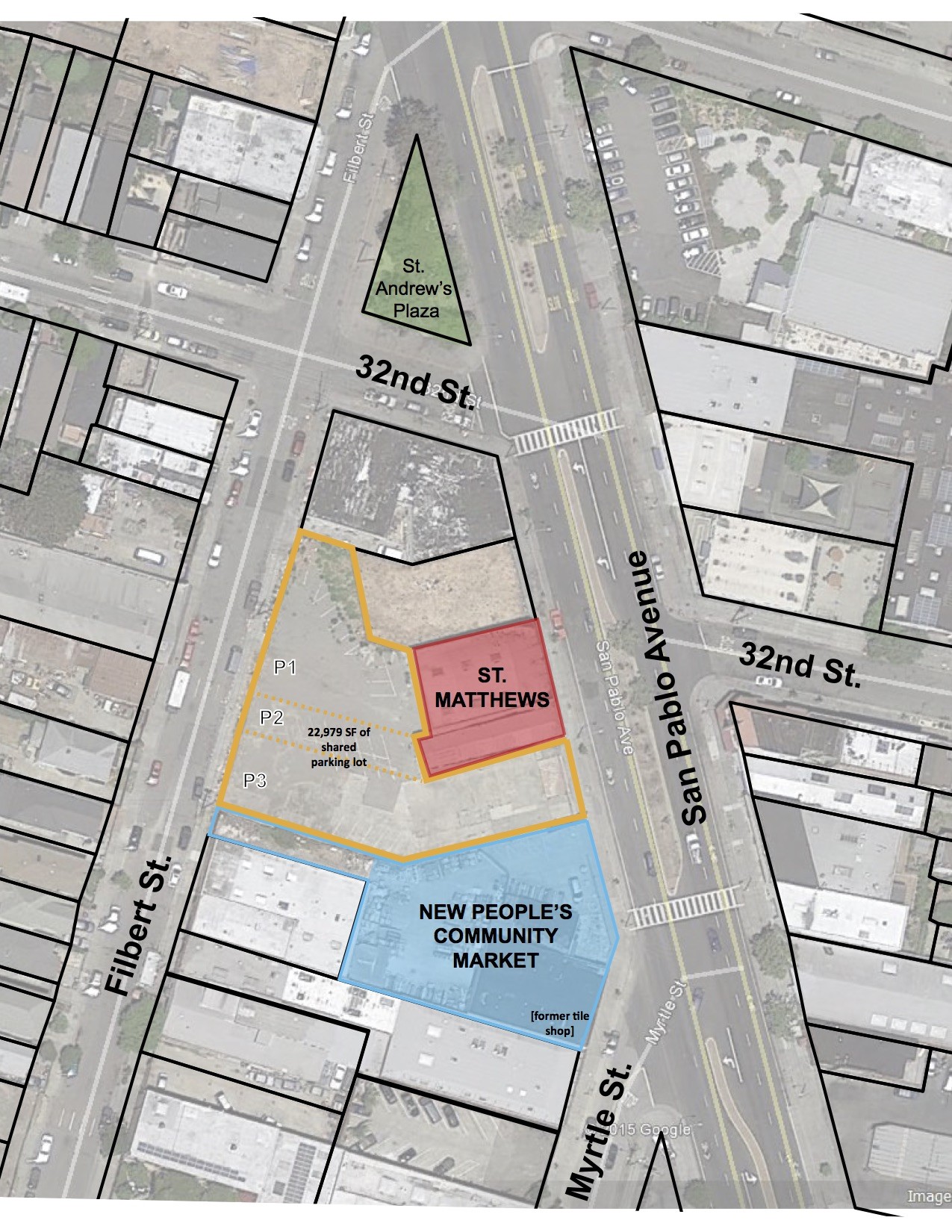
All that changed this past Monday when, after months of silence, People’s Community Market announced that it had closed escrow on a 15,000-square-foot property at 3103 Myrtle Street in the San Pablo Avenue corridor. And, just like that, West Oakland’s long-awaited grocery store appears to be back on track.

In an interview, Ahmadi explained that, all told, People’s Community Market had bid unsuccessfully on seven different properties in West Oakland, all along West Grand Avenue, over the course of the past two years. In no instance was the market actually outbid on a property. Instead, the project was kept in limbo because of what Ahmadi described as “outrageous speculative behavior” on the part of the landowners, most of whom had bought their properties cheaply in the Eighties and were now just sitting on them in hopes of a big payday — basically, in hopes that someone would pay them two or three times their market value. People’s Community Market ultimately paid $970,000 for their current proposed site — an expensive, but comparatively reasonable, $60 per square foot. Other property owners had demanded $90, or even $180, a square foot, Ahmadi said.

Even with all the fears about the looming gentrification of West Oakland, Ahmadi said the market has yet to bear out that kind of commercial real estate bubble: “All of those properties are still owned by the same people right now. They all look exactly the same — they’re all dilapidated, underutilized properties.”

It was only through a couple of key partnerships that People’s Community Market was finally able to seal the deal on its Myrtle Street site. Perhaps most importantly, an angel investor stepped in and agreed to put up cash to pay for the property. That investor has chosen to keep his identity secret, but Ahmadi described him as a former hedge fund guy who made his fortune on Wall Street and had returned to Oakland, his hometown, hoping to, in Ahmadi’s words, “reform himself” by doing something good for the community.

The second important piece was that Ahmadi brought on the East Bay Asian Local Development Corporation (EBALDC), an Oakland-based affordable housing developer, to handle the nuances of a somewhat complicated real estate transaction. Essentially, the angel investor loaned the $970,000 to EBALDC, virtually interest-free, and EBALDC will act as the grocery store’s landlord. What People’s Community Market will get out of it is a pretty good deal: three years rent-free while the business establishes itself, after which the store will negotiate a market-rate lease with EBALDC.

Joshua Simon, director of EBALDC, explained that the organization’s involvement in the grocery store is part of its Healthy Neighborhoods initiative that takes a more holistic approach to defining what makes a neighborhood healthy, beyond just affordable housing. Of course, part of that includes job opportunities and access to healthy food — hence the partnership with People’s Community Market.

A number of pressing questions about the store’s long-term viability remain, not the least of which is: Will enough people shop at a grocery store located in an area that everyone connected to the project acknowledges has had significant issues with violence and public safety? And then the other edge of that sword: If the store proves to be popular, who’s to say it won’t become a source of the very gentrifying forces that Ahmadi says he hopes to contain?

“Some businesses come in, and all they’re doing is banking on the neighborhood changing in order for it to be successful,” said Ener Chiu, a commercial planning manager with EBALDC. “Brahm is the opposite. He’s been there for ten years and wants to serve the neighborhood that’s there now.”

Ahmadi, for his part, is sanguine about the inherent tension: “The reality is that anything you do to improve the neighborhood will make it more attractive to other people as well.” That said, he cited various efforts on the part of People’s Community Market to collaborate with current West Oakland residents. One fortuitous partnership has already emerged: The grocery store will lease the parking lot of St. Matthew’s Missionary Baptist Church, a historic Black church located next door. The deal will provide revenue for the church, but according to Altheria Jinks, the church’s president and CFO, the St. Matthew’s congregation believes in the project’s mission and wants to work with the grocery store to do something positive for that stretch of West Oakland. “We need places where we can go shopping instead of taking our tax money and going to Emeryville,” Jinks said.

Beyond that, Ahmadi said that People’s Community Market will have fifty employees when it opens, mostly hired from the surrounding community. Eventually, the plan is to move toward an employee ownership model — so those fifty employees will stand to benefit even more directly from the store’s success. In addition, Ahmadi pointed to the market’s somewhat unorthodox fundraising method of using a Direct Public Offering (DPO), in which members of the community can become shareholders for a minimum $1,000 investment. The market will soon do another DPO round, and Ahmadi said he’s in talks with a foundation that wants to subsidize the bulk of that $1,000 minimum for West Oakland residents who are willing to put up, say, $100. (The exact amount of the subsidy has not yet been set.) Again, the idea would be to increase the number of people in the neighborhood who have a direct personal stake in the success of the store.

As for next steps, Ahmadi said he has to obtain permits from the city and raise another $7.5 million, mostly through loans. If all goes perfectly, People’s Community Market will be ready to open by late next summer.

Of course, Ahmadi acknowledged that there will be risks and challenges for years to come. That, he said, is the essence of why there are no grocery stores in neighborhoods like West Oakland: “It’s hard to do.”

Clarification: This story has been edited to clarify that the exact amount of the potential DPO subsidy has yet to be determined. 

Queen Crescent Talks Intersectional Feminism and Writing a Concept Album on Shrooms

Oakland prog rock four-piece Queen Crescent doesn’t care much about satisfying patriarchal social norms. Musicians Amy Martinez, Andrea Genevieve, Melissa Vu, and Eden Savage — all of whom are women of color, and some of whom are queer — began playing together around three and half years ago. And while prog rock and psych rock are known in the United States and United Kingdom as the domains of nerdy white dudes, the four bandmates take inspiration from subcultures in countries such as Cambodia, Indonesia, Nigeria, and Mexico, where rock ‘n’ roll has historically been used as a form of resistance.

“We can’t just talk about getting fucked up, or going on tour and drinking whiskey, or whatever else bands talk about, because of our experiences as women of color, and as queer women,” said Martinez, the band’s drummer, during a recent interview in Queen Crescent’s practice space at Oakland Music Complex, a West Oakland warehouse. “We experience a lot of racism, and a lot of sexism, and a lot of homophobia,” she continued. “Even if it’s not directed at us … stuff like that that happens in our community affects us, too. So it’s like, we don’t have the privilege to speak about bullshit.”

Queen Crescent by Queen Crescent

Martinez is one of the organizers of San Francisco’s popular, soul music-themed queer party Hard French, and she spins vinyl under the stage name Brown Amy. Although she’s considerably popular in the Bay Area’s queer scene as a DJ and promoter, she’s also been drumming since the age of four. A few years ago, when she traveled to Portland for a DJ gig, she connected with Genevieve, who was living in Portland at the time and had plans to move to the Bay Area.

After Genevieve relocated to Oakland, the duo began jamming and eventually decided to start Queen Crescent. They recruited bassist Savage and flutist Vu to join the band, and Queen Crescent hit the ground running. Genevieve had friends in Mexico City and the bandmates made a spur-of-the-moment decision to perform there despite the fact that they had only recently begun playing together. Soon enough, they found themselves on an international tour.

“We had been a band for maybe eight months, and we went down there and [promoters] would be like ‘You’re headlining!’ And we’d be like, ‘What?!'” said Genevieve.

“Our shows would be at midnight but they’d have us show up at seven and give us shots,” added Martinez. “We were fucked up! We also were randomly on this TV show. It was wild.”

The members of Queen Crescent returned to Oakland excited to get back to work, and their self-titled, debut album, which came out a year ago, sees the band homing in on a sound that combines elements of hard rock from the Seventies (Genevieve cited Black Sabbath as a major influence, which is apparent in her hypnotic, dark guitar riffs) with bright, melodic vocals, sprightly flute, and a booming rhythm section.

The flute, in particular, is a key element of Queen Crescent’s sound. On Queen Crescent, Vu’s graceful playing accents the galloping rhythms that Genevieve and Pela weave together with bass and guitar, which often create action-packed riffs in tandem. Because it’s in a similar register, the flute often sounds like an auxiliary to Genevieve’s voice. Her direct delivery has the intensity of a call to arms, and her soaring timbre often evokes the sturdy-yet-resonant voice of Heart’s Ann Wilson.

A hallmark of Queen Crescent’s sound is its focus on elaborate, highly skilled instrumentation — a feature of prog rock that has earned the genre a reputation for self-seriousness. And though the band’s members certainly flaunt their ostentatious, high-voltage playing — with guitar solos, flute solos, vocal harmonies, and thunderous percussion stacked within each track — they also have a sense of humor that makes their music accessible despite its dense compositions and underlying sociopolitical themes.

For instance, Queen Crescent contains the songs “I Wish a Muthafucka Would” and “Majic Moonjynuh” in addition to ones with more sober titles such as “Ancestors.” In fact, when I asked about the moon reference in the band’s name, Savage joked that they almost called themselves Majic Moonjynuh because of a black-lit mural of a moon at their first practice space (and the moon as a feminine archetype, of course). Though the bandmates thought better of it, their work does occasionally showcase their offbeat, irreverent sense of humor.

When Savage brought up their former practice space, Genevieve and Martinez began sharing anecdotes from Queen Crescent’s early days. When the bandmates were writing the tracks for Queen Crescent, they found themselves in a feud with their neighbor — who, apparently, was a co-creator of the Spongebob Squarepants theme song.

“He’d be like, ‘Shut the fuck up.’ And we’d be like, ‘Fuck you,’ at like 3 p.m.,” laughed Martinez. “The last week we were there, I was praying to start my period so I could put some bloody tampons in front of his door. But I didn’t, so it sucked.”

It’s apparent that OMC is a better-suited home for the quartet. During our conversation, several neighboring punk bands’ rehearsals drifted in through the walls. Genevieve and Martinez reclined on the couch, and Savage sparked up a joint (Vu wasn’t able to join us). The bandmates discussed new tracks they’ve been performing that they want to put out as an EP before they begin developing their next full-length record, which they said will be a concept album — though, because it’s in its nascent stages, they wouldn’t share the theme.

“I’m hoping we find a space for five days and take a bunch of mushrooms and take all our equipment somewhere and get super fucked up and write a concept album,” said Martinez.

“Yeah, get weird in the woods and record everything we do,” added Genevieve. “And then listen back after that weekend, or however long, and extract songs from that.”

Correction: A previous version of this article incorrectly stated that Queen Crescent’s former bassist Eni Loicy Pela is still in the band when the bassist is now Eden Savage.

Training the Next Generation of Concert Producers

0

In 1970, sixteen-year-old David M. Mayeri landed a job working for Bill Graham Presents at the Berkeley Community Theatre. “I got paid ten bucks cash to unload the trucks, set the stage, usher the show, tear down the stage, repack the truck,” said Mayeri. “For me, it was transformative. When I left Bill Graham Presents 35 years later, I left as the company’s chief operating officer.”

Today, Mayeri is the president of the Berkeley Music Group, the nonprofit he founded to renovate and run the long-shuttered UC Theatre Taube Family Music Hall (2036 University Ave., Berkeley). Along with transforming the dilapidated movie theater into a gorgeous concert hall, he also plans to turn it into a classroom. Through the nonprofit’s education program, Concert Career Pathways, Mayeri hopes to give young people a jump-start in the music business.

After sitting empty for fifteen years, the 99-year-old theater is reopening with an inaugural concert on Friday, March 25, with venerable quirk-rockers They Might Be Giants. The venue, which can accommodate up to 1,400 general admission attendees or 700 guests for seated shows, plans to host a variety of performances, including symphony, opera, jazz, and comedy, as well as a range of rock, electronic, and hip-hop acts. The theater’s upcoming concerts offer plenty of opportunities for interns to learn about working in the music industry — from how to budget and market a show to lighting design and sound engineering.

Under the guidance of education director Robyn Bykofsky, the theater’s Youth Advisory Board (YAB) is developing the education program in tandem with the building’s renovation. The board is made up of ten 17- to 25-year-olds (the same age range as the future interns) who are taking pilot workshops and providing feedback on the curriculum. An education committee comprised of several youth development organizations is also assisting with the curriculum and student outreach. Those nonprofits include Richmond’s RYSE youth center, which holds classes on hip-hop writing and beat production, and Youth UpRising in Oakland, which offers instruction in studio recording and engineering, as well as radio and club DJing.

When the Concert Career Pathways program officially launches in July, UC Theatre staff and other industry professionals will teach students key technical, creative, and business aspects of concert and event promotion through a series of six workshops. Students who advance beyond the workshops can move into paid internships, where they’ll gain hands-on experience working alongside staff at fifteen to twenty shows. In the beginning, participants will rotate from department to department. During the second half of the internship, they’ll settle into the area that interests them the most. After completing the full six-month program, interns will receive help finding jobs or advanced internships at Bay Area performing arts and music venues.

“A lot of young people want to be a part of the music industry, but they don’t know what it even takes. This program is teaching that,” said YAB member Shakeea Smith, a 23-year-old student at Laney College who also works as an enrichment coordinator at Youth UpRising. Although Smith hasn’t given up on her own ambitions to make it as a performer (she sings gospel, R&B, and reggae and also raps), the marketing workshop stuck with her, and she’s discovered that music promotion gives her “an adrenaline rush.”

Twenty-two-year-old Maleik Carter joined YAB to learn as much as possible about the industry. Along with being a multi-instrumentalist and rapper, Carter organizes and promotes events with his sister Jada Imani as Tatu Vision. “Maybe I’ll end up in promotion. Maybe people will love my raps and I’ll be famous off that. Who knows? I just want to keep my options open and gain as many skills as I can.

“The thing I really love about music, though, is that it builds community,” continued Carter. “It allows people to connect … and open their minds to new ideas. I want to create spaces for that to happen. I think that we need bigger changes than just making music, but I think that keeping people motivated to build better systems takes music and it takes art.”

Mayeri echoed Carter’s feelings about the invigorating power of a live performance. “There’s something special that happens between the artist and the audience that just kind of fills you with life,” he said. “Bill was a great teacher. … We worked sixteen hours a day, maybe twenty, thirty days in a row, and we loved every minute of it.”

If all goes according to plan, come December, a crop of new, perhaps slightly sleep-deprived, music industry hopefuls will walk out of the UC Theatre’s refurbished doors prepared to create some concert magic.

Fixations, Oral and Otherwise

I’m a 24-year-old male, married three years, monogamous. My wife and I are religious and were both virgins when we got married. I’m sexually frustrated with two things. (1) How can I get her to give me oral sex? (She has never given and I have never received oral sex. I regularly give her oral sex.) She is afraid to try it, saying she’s not ready yet. About every six months, I bring it up and it leads to a fight. She is a germophobe, but I think she believes fellatio is done only in porn. (I used to look at porn, which nearly ended our then-dating relationship.) (2) I feel like I’m always giving and never receiving any type of affection: massages, kisses, caresses, you name it. It’s like having sex with a sex doll — no reciprocation. How do I broaden our sex life without making her feel like we’re in a porno?

Sexually Frustrated

If you don’t already have children — you don’t mention kids — please don’t have any, SF, at least not with your first wife.

You’re a religious person, SF, a lifestyle choice I don’t fully understand. But you’re also a sexual person, and that I do understand. And if you want a lifelong, sexually exclusive, and sexually fulfilling relationship, then you must prioritize sexual compatibility during your search for the second Mrs. SF. Because your next marriage is likelier to survive for the long haul if you’re partnered with someone who is attracted to you physically and is aroused — roughly speaking — by the same sex acts, positions, and fantasies you are.

In other words: Don’t marry someone and hope she likes sucking your dick. You tried that, and it didn’t work. Find someone who likes sucking your dick and marry her.

I’m a straight woman in my early thirties, and I just don’t like receiving oral sex. I love giving blowjobs and can orgasm from PIV sex, but I seem to be one of the few women who don’t enjoy guys going down on me. I’m not uncomfortable with it, but it doesn’t get me off. I also get wet easily, so it’s not like I need it as foreplay. As I’ve gotten older, and the guys I sleep with have gotten older, it seems like most want to spend a great deal of time down there. I’ve tried being up front about not liking it in general, but guys either get offended or double down and do it more because they assume I’ve never been with a guy who “could do it right.” Any ideas on how to handle this?

Needs Oral Preference Explainer

The observation you make regarding older straight guys — older straight guys are more enthusiastic about going down on women — is something I’ve heard from other female friends. They couldn’t get guys to go down on them in their twenties, and they can’t get guys in their thirties and forties to stop going down on them. (SF, above, is clearly an outlier.) The obvious solution to your dilemma, NOPE: Only fuck guys in their twenties.

Fan from Sweden here! Question: My fetish has no name. It is a “worshipping” fetish, for want of a better term, where I am the one being worshipped. Not by one man, but all men of the earth. The worshipping itself, while sexual, is not bound to my body parts. It would be great to have this named.

Lack Of Vocabulary Enervates My Experiences

A year ago, I would’ve diagnosed you with “caligulaphilia,” LOVEME, after the Roman emperor Caligula, who considered himself a living god, and -philia, the go-to suffix meaning “abnormal appetite or liking for.” But these days, I’d say you were suffering from a bad case of “trumpophilia.”

I’m a 24-year-old female who met my 26-year-old boyfriend five months ago through Fetlife. We do not share the same fetish, but we have other overlapping interests and he is lovely, smart, and funny. He has a diaper and incontinence fetish. Not my jam, but I’m GGG. The issue: He has the most one-dimensional sexuality I have ever seen. He can get off only in the missionary position, with a diaper under us, and with incontinence dirty talk. Even with all of the above, its difficult to get him to orgasm. And it’s only very recently that we’ve been able to have penetrative sex — since he was used to getting off with his hand and a diaper — always with diapers under us and with lots and lots and lots of pee talk. But there’s only so long I can talk about losing control and peeing myself before I lose interest in the activities at hand. I do not mind getting him off this way sometimes, but this does absolutely nada for me and it’s the only way he gets off. He’s otherwise an amazing person, but I’m getting frustrated. We’ve talked about how my needs aren’t being met, and he claims he’s done standard vanilla before and managed to satisfy his partners. I’ve yet to experience it myself, however, and I’d really like to be able to enjoy some vanilla sex — let alone my kinks — with him!

Please, I’m Sexually Saddened

Your lovely, smart boyfriend is a lousy, selfish lay, PISS, and you two aren’t sexually compatible. DTMFA.

I am a 26-year-old guy and I have an overwhelming foot fetish. I cannot help but think about the male foot every hour of every day. I often find myself pushing boundaries with attractive male friends and acquaintances to satisfy my urges, which has caused me a lot of stress and anxiety. I’m obsessed with the idea of offering some of my friends and acquaintances foot massages, but I just don’t know how to bring up the subject, given my mixed experiences. A lot of people think of foot rubs as intimate and believe they should be restricted to romantic relationships. While I’ve been lucky on very random occasions, I’ve had some fuckups. I asked a gay friend whether he would like a foot massage, but he declined — and while he was polite about it in the initial exchange, he has since ignored me. I asked a straight guy, and he considered it but never followed through, and I feel weird about asking him again. I told another straight guy who was shocked that I would ever ask him such a thing, but he still talks to me and makes light of the incident. Whereas another guy unfriended me on Facebook after I messaged him and told him I liked his feet. What should I do? Is there a proper way to ask to rub someone’s feet? It’s not like I’m asking to suck on people’s toes.

Crazed About Lads’ Feet

You remind me of those straight guys who send unsolicited dick pics to women they barely know — they don’t do it because it never works, they do it because it works on rare/random occasions. But you have to ask yourself if those rare/random instances when an attractive male friend allowed you to perv on their feet — the handful of times you’ve gotten a yes — are worth the sacrificing of all the friendships you’ve lost.

Foot rubs are a form of intimacy, particularly when performed by foot fetishists, and you’ve gotta stop pestering your hot friends about their feet. There are tons of other foot fetishists out there — most male, loads gay, tons online. Go find some fellow foot pervs and swap rubs with them.

On the Lovecast, Debby Herbenick on anxiety-induced orgasms: SavageLoveCast.com

Ma**@********ve.net

@fakedansavage on Twitter

Goodbye, Express Readers

So far, 2016 is turning out to be a year of significant change in East Bay journalism. On March 1, the Bay Area News Group announced that, effective April 5, the Oakland Tribune will become a weekly paper, and the daily newspapers, the Contra Costa Times and the Tribune, will be rebranded as the East Bay Times....

Fall into a Plant-Based Food Coma at The Butcher’s Son

Having been vegan for nearly five years, I've come to learn that certain places are simply off-limits to someone with dietary proclivities such as my own. Italian restaurants, for instance, are usually a no go unless I want to eat skimpy noodles while everyone else dines on meat and seafood dripping with melted cheese and butter. Same with Korean...

Wine, Au Naturel

In 2007, Lisa Costa moved across the country for a harvest internship at a renowned producer of single vineyard pinot noirs in the Russian River Valley. She had fallen in love with winemaking in her early twenties while working at small farm wineries in New York's Hudson Valley. The internship promised a chance to work with some of the...

Free Will Astrology

Aries (March 21­–April 19): When Orville and Wilbur Wright were kids, their father gave them a toy helicopter powered by a rubber band. The year was 1878. Twenty-five years later, the brothers became the first humans to sail above the earth in a flying machine. They testified that the toy helicopter had been a key inspiration as they worked...

Corrections for the Week of March 23, 2016

Our March 16 Culture Spy, "The Inevitable Intersection of Art and Politics," erroneously referred to Cat Brooks as a co-founder of Black Lives Matter. In fact, Brooks has been a member of the Black Lives Matter Bay Area chapter since its inception.

Oakland Police Commission Battle Heating Up

A coalition of grassroots political groups, labor unions, churches, and current and former city officials is pushing for a November ballot measure that they say would finally allow Oakland to get rid of bad cops. The Coalition for Police Accountability wants to create a citizen-run police commission that would have complete access to all police records, the power to...

Dismantling Food Deserts in an Age of Speculation

Back in the fall of 2012, food activist Brahm Ahmadi stood in front of a packed room in East Oakland's warehouse district and made a simple pitch: Would the assorted local business owners and community organizer types who had gathered consider investing in People's Community Market, the ambitious full-service grocery store that Ahmadi wanted...

Queen Crescent Talks Intersectional Feminism and Writing a Concept Album on Shrooms

Oakland prog rock four-piece Queen Crescent doesn't care much about satisfying patriarchal social norms. Musicians Amy Martinez, Andrea Genevieve, Melissa Vu, and Eden Savage — all of whom are women of color, and some of whom are queer — began playing together around three and half years ago. And while prog rock and psych rock are known in the...

Training the Next Generation of Concert Producers

In 1970, sixteen-year-old David M. Mayeri landed a job working for Bill Graham Presents at the Berkeley Community Theatre. "I got paid ten bucks cash to unload the trucks, set the stage, usher the show, tear down the stage, repack the truck," said Mayeri. "For me, it was transformative. When I left Bill Graham Presents 35 years later, I...

Fixations, Oral and Otherwise

I'm a 24-year-old male, married three years, monogamous. My wife and I are religious and were both virgins when we got married. I'm sexually frustrated with two things. (1) How can I get her to give me oral sex? (She has never given and I have never received oral sex. I regularly give her oral sex.) She is afraid...
19,045FansLike
17,709FollowersFollow
61,790FollowersFollow