
Women on the Verge

I’ve been aware of my emetophilia since a very young age and have always kept it private. No need to tell me about the health risks, I’m aware, and I’ve only ever indulged this kink through videos online. The actual substance doesn’t turn me on — I have no desire to be puked on. For me, the fantasy involves being with someone as they begin to feel sick, and then taking care of them as they puke. It has something to do with the buildup and release. Who knows? I’m married, and I told my husband about my kink exactly once, a few years ago. He wasn’t judgmental, but he never brought it up again. We have a great sex life otherwise, and I’ve always assumed I’d have satisfying, normal sex with my husband and masturbate to this kink in private. But recently, on a whim, I posted a message on a kink site. A few weeks later, a guy reached out to say the description exactly mirrored his own kink. We’ve been texting for a few weeks. He makes me feel like less of a freak, it’s been super hot, and we’ve talked about meeting up and role-playing for each other. It makes me go crazy just to think about this. In light of the health risks — and the fact that I’m married — this would be a one-time thing. Do I have to tell my husband? I don’t want to have sex with this person; I just want to live out my fantasy for one night, which doesn’t necessarily involve getting naked. But obviously we will both get off, so there’s a definite sexual element. My husband and I have had threesomes, so he’s not a “strictly monogamous” guy, but it is new for me to strike out on my own. But more than that, I’m mortified at the thought of him knowing about the kind of night I’m having, asking me about it later, etc. I would just rather him not know. But is that cheating?

A Lady Emetophile Meets Her Match

The answer to your last question — is that cheating? — is obvious. If that wasn’t cheating, ALEMHM, or if you thought your husband wouldn’t regard it as cheating, you wouldn’t be asking him for permission to meet up with your vomit buddy. So let’s just run with the assumption that getting together with your VB would constitute infidelity, if the low-grade, non-penetrative, not-for-everyone kind.

So do you have to tell your husband? You could tell your husband — and lots of people will insist you must tell your husband — but I’m sitting here, in this Starbucks on Lex and 78th, wondering if your husband would rather not be told.

You shared your kink with your husband once, and he never brought it up again. We can reasonably assume that your husband isn’t interested in discussing, much less indulging, this very particular sexual interest of yours. Another reasonable assumption: Your kink may not be something your husband wants to think about. The awareness of your kink, to use Emily “Dear Prudence Emeritus” Yoffe’s phrase, could be a libido killer for him. If your husband worked at stuffing your disclosure down the memory hole, because it interferes with his ability to connect with you sexually, asking permission to spend an evening with your VB could come as an unwelcome reminder.

So you could make — as I’ve just made — an argument for sparing your husband the reminder, and sparing yourself the discomfort, by not telling and/or asking him, and then discreetly meeting up with your VB just this once. (The counterargument is also easily made: He never brought it up again because he picked up on your shame, he didn’t want to distress you, etc.) But if you decide to meet your VB, ALEMHM, weigh the risks (what happens if you get caught?) against the rewards (scratching this off your kidney dish list!), meet up with your VB in public first, and let someone know where you are and who you’re with on the big night.

I find myself in the most boring of straight white girl pickles: My boyfriend is dragging his feet on proposing. I’m 29, and he’s 31. We’ve been dating for three years. Things are great. We talk about our future a lot — buying a house, vacations, blah blah blah. Lack of proposal aside, we’re solid. But I would hate to waste another year in this city for this guy when I could have been working toward tenure somewhere else. (I’m in academia.) I’ve tried bringing this up to him several times with no concrete results.

Really Into Not Going Solo

Propose to him, RINGS. Don’t informally propose a formal proposal — don’t ask him to ask you to marry him — but go get a ring (for him) and ask him to marry you (for fuck’s sake). You have the power to pop the question and call it at the same time. Good luck, I hope he says yes.

I met a man two and a half years ago on Tinder. Our relationship was built on lies from the start. I lied to him about having a child so I could put a wedge between us. I came clean after we slept together a few times — the most mind-blowing sex I’ve ever had — because I was afraid he might want to meet my made-up child. I caught feelings. But Tinder man is married and lives in France. I see him only three times a year. Fast-forward to now. He pursues other people. Women throw themselves at him. We were at the mall, and he picked up a girl while I was getting my hair done. He’s not my boyfriend. He hurts me. I am terrified of losing him. Here comes the tricky part: My doctor found a tumor on my lymph nodes. I go in for tests on Friday. I’m ready to pick out my coffin at this point. I contacted my lover’s ex-wife and asked why they divorced, and she said because he cheated all the time. I know what he’s capable of. I don’t want to change him. I love him. I go insane when we don’t talk. He told me he doesn’t respect me any more than he respects his current wife. I’m so scared.

Help Me Please

Um… you won’t find the help you need wedged between escort ads at the back of a weekly newspaper, HMP, or on a website underneath pop-up ads for vaporizers. You need a therapist, someone who can help you work through legitimate-but-possibly-premature fears for your health (let’s wait for those test results to come back before we pick out your coffin, okay?) and your emotional dependence on a man who isn’t your boyfriend, isn’t your husband, isn’t around much, and has told you he doesn’t respect you. He’s not the kind of guy who’s going to come through for you during a health crisis — that guy couldn’t come through for you during a haircut.

Don’t get me wrong: I sleep with men, I understand the sexual appeal of a man who treats you like shit, I’m a huge Peggy Lee fan. But you can’t depend on a guy like that at a time like this. If it turns out you’re seriously ill, HMP, you need to lean on family and friends, join a support group, buy one of those vaporizers, and concentrate on getting healthy. And take comfort: If/when your health is restored, there are plenty of shitty, selfish, sadistic guys on the planet who’ll treat you badly, cheat on you flagrantly, and — not coincidentally — get you off spectacularly.

I’m sorry you may be ill, HMP, and I’m sorry you’re scared. Best wishes for a speedy physical, emotional, and sexual recovery.
Art Out of Artifacts

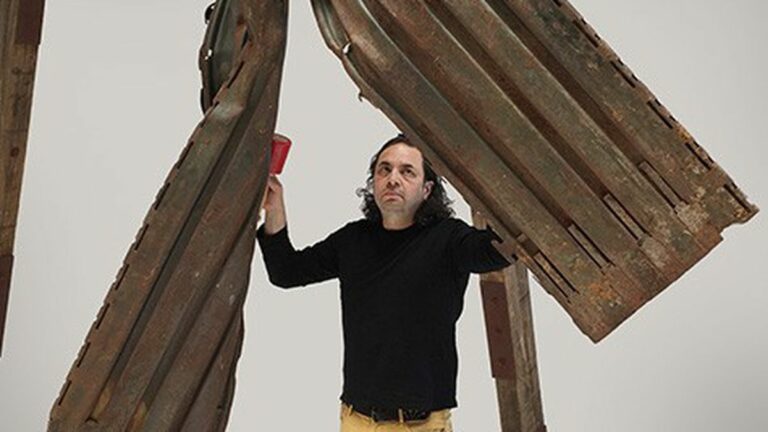
In 2011, the photographer Richard Misrach saw experimental composer and performance artist Guillermo Galindo play a five-minute composition using instruments made from migrants’ discarded belongings found near the US-Mexico border. The performance gave Misrach chills — and not just because he was moved by the music. Since 2009, the acclaimed Berkeley photographer, known internationally for his large-scale landscapes of the American West, had been focusing his lens on the 2,000 miles that run between the United States and its southern neighbor. Galindo’s ingenious instruments immediately reminded Misrach of similarly haunting objects that he had captured on film.

In the Southern California desert, Misrach had stumbled across agave sticks clothed with migrants’ discarded sweatshirts, pants, shoes, and hats. Clustered in arroyos and canyons, these human effigies eluded explanation. “I didn’t know if they were some artist’s project, or if they were warnings to migrants coming over the border, or protests against the Border Patrol,” said Misrach. Those desert scarecrows, along with the increased militarization of the border, prompted the artist to begin photographing the region and the objects he found there.

As Misrach listened to Galindo’s performance, he thought, “God, this has resonance.” Soon, a powerful collaboration was born: Misrach would continue to photograph the border’s towns, walls, and wilderness, and would send objects back to Galindo to transform into more instruments in his Oakland studio. The result of their artistic partnership, Border Cantos, is currently on view at the San Jose Museum of Art through July 31. You will not find photos of migrants slogging through arid landscapes in the show, nor people wading through the Rio Grande with black trash bags in tow. In fact, you won’t see many people at all. Instead, the exhibit, like the work that brought the two artists together, uses the disembodied evidence of migration to evoke the border’s human toll.

Back in 2004, before he seriously turned his attention to the region, the first border-related object that caught Misrach’s imagination was a blue barrel with the word “agua” stenciled on it in white letters. He photographed the barrel in its dusty, barren landscape. Next to it, what remains of a disintegrating blue flag hangs onto a thin pole. It wasn’t until years later that he learned that the barrel was one of many bottled water stations that humanitarian organizations have installed along more than 250-square-miles of the border. The large format photo opens the show in the main gallery. The work is life-size and so vivid that it seems possible to approach the barrel for a drink.

In a nearby outdoor space, Galindo has taken one of these water tanks and created a sculpture titled “Fuente de Lagrimas,” or “Fountain of Tears,” in reference to water stations that have been shot by vigilantes and Border Patrol agents. Plastic tubes protrude from holes in the barrel’s sides. Water drops thrum on a sheet of metal below. The sound resembles that of rain on a rooftop or a crowd of people running.

Much of the exhibit intentionally steers clear of standard photojournalism tropes, and instead uses beauty — both visual and auditory — to stop visitors in their tracks. Striking photos of the wall hang in the main room. Vast portraits of Corten steel walls curve like arched Richard Serra sculptures as they weigh on the backs of rolling hills or cut smooth lines through an expanse of chaparral. In another, a grid of photographs document the wide range of items that Misrach finds on the ground near the border, from treasured items to trash: rusted tuna cans, a child’s tennis shoe, an old letterpress edition of Doctor Zhivago in Spanish, a child’s bible engraved with a heart, girl’s tweezers.

“Every single one of these personal belongings has an incredible story of a human being. The journey that they took is all embedded in there, but there is no way that you can actually transcribe that,” said Misrach. “What we’re trying to do is evoke a different way to experience the border and to think about it. More of a meditation, if you will.”

If Misrach is attempting to slow people down with the formal beauty of his images, Galindo goes even further with his site-specific sound installation, “Sonic Borders,” located in a gallery across from the main space. Based off of the Aztec’s Venus calendar, which is 260 days long, the composition is four hours and twenty minutes long, or 260 minutes.

“The composition invites people on a journey,” explains Galindo. “And the time each person spends in the gallery is their own journey. … It’s designed for that. It’s the experience of the migrant.”

The room holds eight instruments that Galindo built to play the piece. In one corner, sits a wooden drum, carved to resemble a mountain pass and to sound like a teponaztli, or Aztec slit drum. Another instrument makes use of a variety of detritus, including metal cans, a plastic cup, glass bottles, piano keys, and Border Patrol ammunition boxes. In another corner, plastic water jugs filled with gravel act as rattles when shaken.

“In my photographs, those personal belongings are just objects on the ground,” said Misrach. “Then Guillermo takes them, and suddenly sound is coaxed from them. It’s a transformative process for the imagination.”

In a year of heated political rhetoric and demands to build a wall along the entire length of the border, the exhibit feels particularly timely. “In general, the politicians who are talking about this — on both sides — are just using the issue as a football, throwing it to one another just to gain power and votes,” said Galindo. “But as artists, we have the fortune of being able to speak in another language.”

Rock the Bike is Greening the Festival Experience

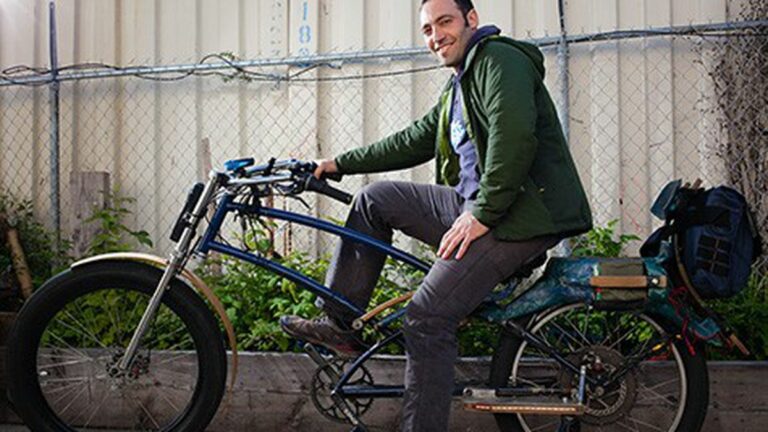
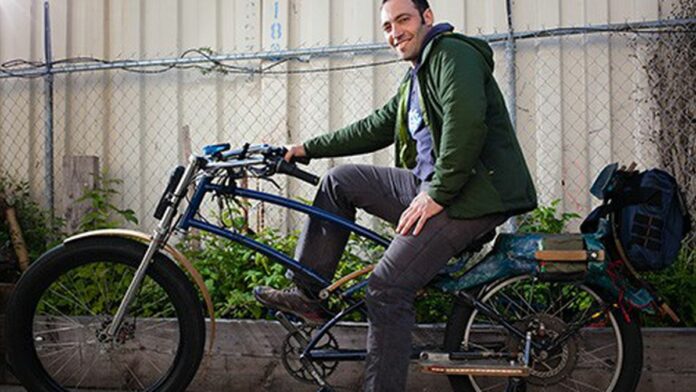
While the term “people power” might conjure images of protests, Paul Freedman — a local activist, inventor, and entrepreneur — uses the term in a more literal sense. To him, “people power” refers to what activates his bike-powered sound systems at events: sheer human strength.

With the help of colleagues, Freedman engineered his first bike-powered sound system in 2006. And though he doesn’t claim to be the originator of the technology, his Oakland company, Rock the Bike, is arguably the nation’s most prolific producer of bike-powered concerts.

Many of Freedman’s events are environmentally focused, but his bike-powered sound systems aren’t just a gimmick to promote the ethos of a green lifestyle. Indeed, they are actually more fuel-efficient than their traditional, generator-powered counterparts, Freedman said in a recent interview. Thanks to a feature on his bikes that lets riders know whether they’re pedaling too slowly (generating too little power) or too fast (overloading the system), each individual is able to adjust his or her pedaling rate so that the system uses only as much fuel as needed.

Compare that to typical sound systems at outdoor festivals, which waste diesel to ensure that there are no outages, Freedman explained. “We’re tapping into twenty or thirty brains at once and getting them to use their supercomputing powers to keep our system running stable,” he said. “So we actually have a really smart, distributed computer that runs the power grid at our pedal-powered stage, which is pretty much the opposite of what the industry standard is. … The only way they’re going to guarantee a show like Outside Lands is going to stay up is if the power system is way too big.”

Rock the Bike’s pedal-powered sound systems are also designed so that transporting one doesn’t require a car. Their parts can be broken down to small loads that are easy to take on a bike, and Freedman and his team will typically bike up to five miles to an event with their equipment in tow — with the exception of the stage, which is typically too heavy to move without a truck. They only rely on motor vehicles when absolutely necessary.

In 2007, Freedman teamed up with fellow cyclist and musician Gabe Dominguez to organize the first Bicycle Music Festival in San Francisco, and it has since grown into a popular annual event. The September 2015 BMF was the first East Bay edition and one of Rock the Bike’s most ambitious fests yet: The event coincided with the City of Oakland-sponsored neighborhood celebration, Love Our Lake Day, and doubled as a climate justice rally and traveling concert.

The event began at the Lake Merritt Amphitheater and featured an eclectic lineup that included the popular, local New Orleans-style jazz band MJ’s Brass Boppers and the roots reggae group Black Nature Band. Then, it went mobile, with art rockers Major Powers & the Lo-Fi Symphony rolling across town on a stage that cyclists towed behind them, with the audience biking alongside the band. Finally, the show landed at the anti-capitalist community center Omni Commons, where it continued with another set by acclaimed local indie rock act Waterstrider, among other performers.

Freedman said that not only are bike-powered sound systems greener: They also encourage audience participation and provide more ways for people to have fun. A sound system at a Rock the Bike event typically has around thirty bikes powering it, and is designed so that it can accommodate riders of varying skill levels — including kids, elders, and folks with disabilities. Each rider, Freedman said, usually pedals for about two songs (though there’s no official time limit), and participants often tell him that they gain a sense of satisfaction from knowing that they helped contribute to the collective experience.

“We set up a system that is rewarding,” he enthused. “You feel like, ‘Wow, my pedaling did something. Only ten or twenty of us made that much sound? My body is awesome.'”

While Rock the Bike certainly has a captive audience in environmentalist circles, Freedman said that his goal is to compete with other local production companies for doing sound at mainstream events. Indeed, Rock the Bike already has some major happenings on its schedule: Next, they’ll be at the technology festival Maker Faire in San Mateo, where they’ll be powering the main music stage on May 21 and 22.

Largely thanks to Freedman’s efforts, pedal-powered stages seem to be catching on with the general public, which bodes for a greener future for festivals in the Bay Area and beyond.

Setting Down Roots in Oakland

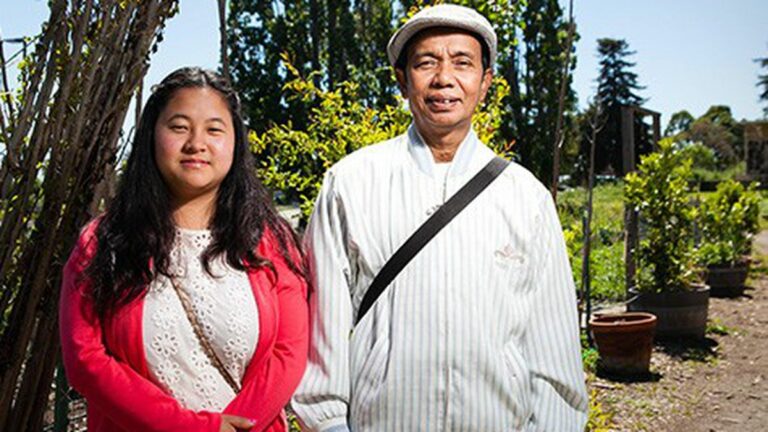
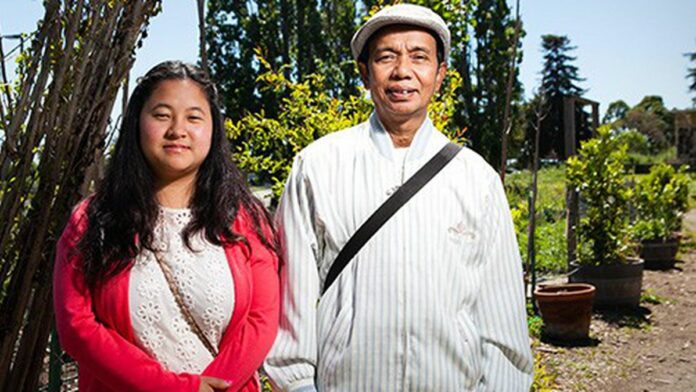
In 1997, when the ongoing civil war in his native Burma made it impossible for him to continue working, Sein Win knew it was time to leave. Following other refugees to Thailand, Win said he thought the move would only be temporary, that he, his wife, and their three daughters would be able to return when the war ended. Instead, they lived in a refugee camp for fourteen years.

One day in 2010, Thai government officials told Win his family could apply to live in the United States. Win was eager to leave the camp, hopeful that he could receive medical treatment for several chronic health problems, and optimistic that his children would have better opportunities in America. After a year of waiting and three days in transit, Win’s family landed at the Oakland International Airport and settled in Oakland. Without knowing any English, Win said it was difficult to navigate the city or to connect with any of his new neighbors. But when his daughter, Paw Ku Tee, told him about a new gardening and cooking program at her high school that pairs refugee elders with youth, he jumped at the chance to participate. A farmer in his former life in Burma, Win had spent years on the land, growing wheat, rice, and vegetables to sell.

“I was glad to be able to plant the vegetables I normally used to eat,” Win said, speaking through his daughter Tee, who translated for him. “And, I wanted the new generation to learn about how their parents worked hard to make food to put on the table.”

The Intergenerational Food Justice Internship teaches high school-aged refugees how to grow vegetables, how to prepare healthy foods (often through storytelling and with recipes from the elders’ home countries), and about food justice, said Deepa Iyer, a program manager for the International Rescue Committee (IRC), which runs the program.

Founded in 1933, the IRC assists newly arrived refugees with resettlement, operating 26 offices across the country, including one in Oakland. The internship is an offshoot of the IRC’s New Roots program, an urban farming initiative that got its start in 2007 in San Diego after several Somali refugees approached the IRC about establishing a community garden, according to IRC program coordinator Zack Reidman. Reidman helped establish the IRC’s first community garden in the East Bay in 2012.

Reidman said the IRC was able to secure space behind Laney College in Oakland, where a cohort of roughly two dozen refugees succeeded in turning a dumping ground for woodchips into neat rows of vegetables and leafy greens. Unlike many city-sponsored community gardens, where gardeners are mostly hobbyists, Reidman said many of the women and men who work the land through the New Roots program come with years of experience in subsistence farming. They need little assistance in establishing or maintaining the space.

In San Diego, the urban farms are large enough to produce food that the refugees can then sell to augment their income, but land is much more limited in the East Bay, Reidman said. Instead, the New Roots program in Oakland — which now includes a second garden at the Glenn Daniel King Estates Park, a city-owned open space in East Oakland — has been able to provide spaces where refugees can both connect with other people of similar ethnic or cultural backgrounds and carry on the agricultural traditions of their cultures.

“Almost all of the people we work with are used to farming at some sort of scale that’s larger than your typical community garden in Oakland,” Reidman said, adding that it’s a bit of a compromise to ask them to garden on a smaller scale. “It’s a reason for them to get out of their homes and a safe space for them to come, and it’s also a way to provide food for their families.”

Tee was sixteen when she arrived in the Bay Area, and it was the first time she had ever seen a city. Living most of her life in a refugee camp that had been carved out of a jungle, Tee said her family maintained a garden to subsidize their monthly allotments of rice, yellow beans, oil, and salt. When she arrived in the United States, Tee said it was difficult to complete even seemingly simple tasks, such as grocery shopping in American supermarkets. The idea that foods could contain added sugars, sodium, and other preservatives was also foreign.


“When we came here, we didn’t know whether food was healthy or not,” Tee recalled. “We didn’t really eat (processed food). We only ate vegetables.”

It’s a common experience for many refugees the IRC resettles, Iyer said. So, in addition to offering space to grow food, Reidman said the New Roots program also strives to educate refugees about the complex corporate structure of the American food system, including how to read labels on food packaging, and how to source culturally appropriate, healthy food within a limited budget.

As the New Roots program has grown, so too has its mission, Iyer said. While it began as a way to reconnect refugees with the land, the program has taken on new roles, including deepening its focus on food security and nutritional education.

When the IRC first hired Iyer in 2014 as program manager, she immediately began thinking about how to integrate youth into the work the IRC was already doing. It seemed only natural to establish a formal partnership with the Oakland International High School, which already has a community garden and was already serving refugee youth. It didn’t hurt that Reidman, who had for several years been helping to coordinate the New Roots program, also taught a community gardening and cooking program at the school.

Within their first five years in the United States, immigrants are statistically more likely to suffer from high blood pressure and diabetes than non-immigrants, Iyer said. It was with this phenomenon in mind, and with the knowledge that the most experienced farmers are often recent migrants, that she and Reidman developed the youth internship program.

The six-week summer course has now grown into a three-season program, which students can participate in for one semester or for consecutive semesters throughout the year. Youth in the program interview family members and relatives about their relationships to food and agriculture. They cook with elders and visit urban farms in the Bay Area. And recently, Iyer said they have been experimenting with the idea of having participants carry out community-based projects, which may include growing and delivering fresh produce to newcomers in need or augmenting their high school’s lunch offerings.

Although Tee graduated last year from Oakland International, she and her dad continue to participate in New Roots. Tee said she just likes working in the garden, and it’s a good opportunity to practice speaking English. For Win, it reminds him of when he was farming in Burma.

“Not only am I able to garden again,” Win said, “but I’m able to spread the knowledge about working in a garden and pass it on to future generations.”

When Meaningful Work Means Healthy Food

In last year’s Sustainable Living issue, the Express published a story about Planting Justice, a local nonprofit that advances food sovereignty and combats the prison industrial complex. Since 2009, Planting Justice has been running a program called Transform Your Yard, which employs formerly incarcerated individuals at a living wage to build gardens in backyards all over the Bay Area. The profits from this blooming business are then used to build free gardens around the homes of people who have limited access to fresh, healthy produce. Planting Justice also has an educational branch that operates in schools and jails all over the region — many of which also have urban gardens at their sites. The programs — which also employ formerly incarcerated individuals — teach gardening skills through a curriculum focused on food sovereignty and emphasizes the ways that food has played a role in social justice movements (i.e. The Black Panthers’ Free Breakfast Program).

At the time of our first story, Planting Justice had just secured a ten-acre plot of land in El Sobrante, an unincorporated community in Contra Costa County east of Richmond. The land was to be used as a working farm to grow organic produce, some of which would be sold through a CSA program, and some of which would be freely distributed or sold at a sliding scale to low-income neighbors. The El Sobrante farm would also host educational programs for youth and community members to learn permaculture farming skills. It was a massive undertaking, but now, after just one season of cultivation, the farm is flush with greenery. Some of the newly planted trees will even bear fruit this season, although it will still be a few years until all of the crops are producing at full capacity. Now, the fast-growing organization is adding yet another branch to its business model: a nursery.

Because Planting Justice follows permaculture farming practices, which rely on growing a diversity of plants together, they had until recently been purchasing plants from Rolling River Nursery in Humboldt — which Planting Justice director Gavin Raders claims has the largest and most diverse collection of certified organic tree cultivars in North America. The collection includes a whopping 1,100 varieties of fruit and nut trees — largely rare, drought-resistant, and nutrient dense — bred by farmers from all over the world. Last fall, the owners decided to retire, and they gave Planting Justice the first opportunity to buy the nursery.

The organization had already planned to buy a large number of trees from Rolling River, so Raders decided to seize the opportunity. But because it is geographically isolated from the communities they serve, Planting Justice couldn’t keep operating the nursery in Humboldt. So, earlier this year, they decided to buy a two-acre lot on 105th Avenue in East Oakland’s Sobrante Park — a neighborhood known for having the highest unemployment and crime rates in Oakland. There, they’ll set up four greenhouses, a retail site for selling trees, along with a market for affordable, fresh produce.

Planting Justice’s El Sobrante farm will become the “mother farm” for the East Oakland nursery, meaning that it will be the home to the adult plants that will be used for grafting and propagating new plants to be sold at the nursery.

Planting Justice looked all over the East Bay for a piece of land that was large enough and also close to communities that they work with. The two acres in East Oakland, which had been deserted for years, turned out to be perfect.

“It’s big enough that we can continue to grow the business, and it’s centered in a neighborhood that has long been disenfranchised by government, funding institutions, and even community-based organizations in some ways, too,” said Raders in a recent interview. “There’s hardly any access to fresh produce, to open space, to jobs — so to have it right there is really critical.” In addition, many of the Planting Justice staff members either grew up in the area or live there currently.

Because Rolling River was so far out in the boonies of Northern California, the original owners developed a savvy online ordering service through which their clientele could order plants to be shipped all across the country. So, uprooting and moving the nursery to the East Bay won’t harm its existing customer base. But Planting Justice still plans to expand that base by offering in-person retail in Oakland. Raders pointed out that for each full-grown tree, scions (small clippings of new growth) can create approximately one hundred more every season, so the possibilities for growth are wildly exponential if there’s enough demand. Planting Justice has already hired around eight workers in the past few months, and they plan to hire more as soon as the nursery opens this summer.

To pay for the East Oakland plot, Planting Justice took out loans that the organization needs help paying back, Raders said. So they recently started a fundraising campaign on KickStarter to raise $100,000 toward their $150,000 down-payment. It’s a huge amount to raise in one month, Raders admitted, but he and the rest of the Planting Justice team are optimistic that people will see the value in the work that they do — and its potential if replicated across the country.

And, of course, they’ve already started planning their next step. A portion of the property will be used as an aquaponics farm and business incubator. Aquaponics is a farming science that mimics natural ecosystems to recycle nutrients. On one end of the system, tubs of water will host fish whose feces will be circulated to the roots of aquatic plants growing out of the other end of the tub. The plants act as a water filter for the fish, so the water never has to be changed. According to Raders, the system uses 90 percent less water than in-ground planting, and because it’s all above ground, it’s a perfect setup for city gardens.

“Aquaponics is really important for hyper-urban areas that don’t have access to healthy soil any longer,” said Raders. “It’s a great technology for empty lots that are paved, or are former gas stations, or have heavy metals or other toxins, because it’s not actually using the native soil to grow food.”

Raders’ plan is to use the site as a place to train people in aquaponics so they can eventually start their own worker-owned urban farms in empty lots all around Oakland. After people train at the onsite garden, Planting Justice will help them acquire an empty lot (by finding investors) and support the business side of the operation while they’re mastering the farming side, then pass it off once the workers are ready to run it on their own. Planting Justice will also connect farming collectives with grocery stores and other buyers looking for local, organic produce. Meanwhile, the produce from the incubator at the nursery and the farm in El Sobrante will be sold in a small market onsite, offered at a sliding-scale, accepting EBT or SNAP, or distributed to local schools, churches, and community centers in the area.

The Planting Justice vision is to transform thousands of other empty urban lots that go decades without being used by anyone into resources that advance the health and economic resiliency of the community. “It really opens up a new landscape for economic justice and food justice work,” said Raders.

Planting Justice aims to undo decades of harm caused by the criminalization and mass incarceration of communities of color by offering valuable training opportunities and jobs to formerly incarcerated individuals — along with living wages and health benefits, of course. “I’m hoping that we can use this project and the success we’ve already had to help influence a more national conversation about how to stop recidivism and mass incarceration through good jobs and meaningful work,” said Nicole Deane, the media and communications coordinator at Planting Justice. In contrast with a state average of 65 percent for all people released from state and local prisons and jails, the recidivism rate for employees of Planting Justice is zero.

When we visited the Planting Justice farm last year, the Express spoke to Maurice Bell. Bell had just been released from San Quentin prison four months before, and got a job with Planting Justice immediately. Since then, Morris has gained experience in almost every branch of the operation, and is now training with Deane to take on the role of communications coordinator. When he’s ready, she’ll pass the job on to him. Bell said the educational aspect of his job is the most rewarding and meaningful thing.

“I’m quite sure I’m not the only person who feels that way,” he said. “I’m quite sure there’s a bunch of guys out there who are just getting out of prison who have never done this work before and who have the same smile on their face that I have every day — and it’s not just about being around a great group of guys, it’s the learning aspect of it.”


Organic Rules

Erik Johansen, a policy assistant in the Washington State Department of Agriculture, gives lots of public talks to farmers about pesticide use, and he usually expects a mute shrug, or maybe one or two questions. But this is not the case with cannabis growers.

“The enthusiasm for me to be there is just — they line up afterward to shake my hand, and they thank me,” said Johansen. “Cannabis growers have as many questions as you have time to answer. If you have handouts, every last one will be gone. They’re hungry for information.”

America’s amateur and professional cannabis gardeners are getting more state guidance than ever before about how to control pests and weeds and maintain a safe and healthy environment. Medical and recreational pot laws in thirty-five states have prompted officials to weigh in on what types of chemicals should be allowed on pot crops to control for bugs, fungi, bacteria and other diseases. Marijuana can easily be tainted with dangerous chemical sprays, so as the cannabis economy grows, state agencies are responding with an unprecedented effort to educate farmers about how to apply pesticides, fungicides, herbicides, and other compounds that help weed thrive. The guidelines are rudimentary, but they’re a historic start. In California, Colorado, Washington, and Oregon state regulators are now routinely posting and updating lists of approved pesticides with pot farmers in mind.

For example, California’s Water Board recently released a modest, one-page list of appropriate weed sprays. Other states have much more robust efforts. Colorado’s allowable pesticides list is twenty-six pages long, and Washington’s list is twenty-two pages long. Oregon released a list of 257 allowed pesticides this past February. New England states, meanwhile, are mandating that their medical marijuana cultivators follow a completely organic regime. Altogether this is creating a patchwork of cannabis pesticide laws, with some conflicts between states, and no federal-level regulations yet to build national standards for what could one day be a national industry.

Here’s what California’s regulators have deemed to be allowable pesticides for keeping pot plants healthy and happy and not endangering the customers who will end up smoking, vaping, eating, or rubbing on the finished bud products. For mite, flea, and beetle infestations, a farmer can use spray-on sulfur solutions. For mites and outbreaks of powdery mildew there’s neem oil. Predatory nematodes can be introduced to attack root diseases. Potassium bicarbonate and sodium bicarbonate are useful for treating powdery mildew. And azadirachtin, a chemical compound extracted from the neem plant, can deter aphids, whiteflies, gnats, leafminers, cutworms and more.

The state water board is distributing its pest management guide on its web site in hopes that cannabis farmers will grow healthier buds and not harm waterways and ecosystems near their grow sites.

All of this guidance is the first minor step in cleaning up America’s cannabis supply. Thousands of growers and consumers will likely sicken themselves or others either by improperly applying pesticides, or by consuming toxic residues on pot. Significant amounts of black market pot, as well as medical and recreational supplies are tainted, experts say. Under total prohibition, cultivators face few consequences for spraying harsh chemicals to control pests and save their crops. Unfortunately, some farmers will do anything to prevent valuable crop from being damaged by bugs.

The first medical marijuana law in 1996, and the first adult use law in 2012 have helped ignite efforts to clean up legal supplies. Since pot is still federally outlawed, no pesticide is federally approved for use on cannabis. So states are guiding growers to the most benign active ingredients already allowed for use on analogous crops like tobacco or herbaceous herbs that are meanted to be smoked or eaten. States are adapting US Environmentla Protection Agency guidelines of ‘minimal risk’ natural pesticides that are exempt from the mandatory approval process. These include essential oils, beneficial molds, fungi, insects and other animals.

“Until things change federally, it’s kind of tough,” said Johansen, who developed Washington’s allowed list. “It’s not a perfect system, but it’s a system that at least tried to address [the issue] by allowing things that are fairly low in toxicity.”

State legalization regimes also now mandate the testing of cannabis products which has helped reveal commonly banned pesticides in use. Colorado’s pesticide screening program has resulted in nineteen product recalls in nineteen weeks as of early February, affecting hundreds of thousands of items in circulation, from vaporizer cartridges to edibles.

In January, an Oregon lab caught the pesticide abamectin, a toxic chemical, in supposedly organic “Guardian Mite Spray,” which has been used in pot grows. Washington state regulators verified the finding, leading to a national advisory and the recall of Guardian from store shelves.

Washington has fined two commercial cultivators over the last year, but the state’s guidelines will arguably have the most effect on home growers who now have a concise list of safe products to use, Johansen said.

The operators of the world’s largest cannabis competition, The Emerald Cup, also recently announced they would be testing for pesticides in competition-grade weed for their 2016 event. A significant percentage of 2015 entrants failed lab tests for pesticides and bacteria, they said.

Washington cannabis farmers now have about eighty allowed active pesticide ingredients they can use. By contrast, there are about one thousand allowed pesticides for apple farmers. The state is under pressure to add more allowed chemicals to give pot growers more options.

“I think we’re being fairly conservative and there’s a reason for that. We just don’t have data to go any further,” Johansen said about the slow pace of approving pot pesticides.

Consumers who want to ensure they are inhaling clean products must either grow their own according to new guidelines, or buy products that come with an independent, third party certification for organic-grade cleanliness. In Washington there are already two companies, Certified Dank and Clean Green, that provide such certifications.

Clean Green Certified weed is also already available in the East Bay. Consumers can and should double-check a farm or retailer’s certification on the Clean Green Certified website at CleanGreenCert.com.

Unfortunately, as certification gains traction, false advertising is proliferating. “It’s tough right now, to be honest with you,” said Johansen. “I think we’re beginning to get a handle on it. The industry by and large has been very supportive.”

Jay Feldman at the non-profit Washington DC advocacy group Beyond Pesticides said America has a golden opportunity to ensure the next major legal crop is fully organic.

Colorado’s pesticide program is already too lax, Feldman said. States are giving users a false sense of security when regulators should be enforcing federal law that no pesticide has been evaluated, let alone approved, for use on cannabis. Copying EPA recommendations from tobacco “is really un-protective of public health and the environment,” Feldman said. “I would say it’s worse than nothing.”

Beyond Pesticides advocates banning all pesticides on cannabis, except organic ingredients listed by the Organic Materials Review Institute as OMRI-certified and the EPA’s minimum risk list of pesticides.

“There’s no reason at this point to open this industry to chemical dependency,” Feldman said. “That’s where the states should be right now. It’s a huge opportunity. I wish we had these opportunities in some other crops that don’t need pesticides.”

Letters for the Week of April 20, 2016

“Mental Health 911,” Feature, 4/6

Mandatory Training

Thank you for drawing attention to a very complex problem. I have suffered with mental illness and continue to do so. My opinion is that all law enforcement, and anyone in authority, no matter who they are, should be mandated to complete a crisis intervention training program and participate in continuing education on this subject. There is enough violence, enough stress, enough anger in our society already. It’s a powder keg ready to explode with extreme ramifications. But having been in the “mental health system” for over five years now, I have come to believe that the resources in place are so stretched that they clearly do not work.

Christina Chiesa, Walnut Creek

“Bad Credit Histories Scuttle Homeless Housing,” News, 4/6

Take Responsibility

Few want to see others trapped in homelessness, but those who are not homeless who are seeking non-subsidized housing also face the possible adverse results of a credit check. A person’s past behavior follows them with good or bad consequences, even if some might excuse the bad ones. The frustrating situation Anthony Dunbar faced is not isolated to the homeless, or to low-income populations. Property owners are justified in screening those who want to occupy their apartments because large investments are at stake. In Mr. Dunbar’s case, it appears the credit check had no errors about his history, only situations that had excuses, like almost all such adverse reports usually do. To his credit, Mr. Dunbar forged onward, realizing and accepting he needed to clear up the negative factors and apply for housing again. By taking responsibility to pay off old bills, he now is on a waiting list for his apartment — a welcomed outcome. It does seem some “flexibility” advocated by the article would be appropriate, but this should be up to the property owners, not enforced by society at large. Without the ability to determine the character and stability of a renter, low-income or otherwise, there would probably be even fewer rental properties available at even higher rates, making it worse for everyone.

William H. Thompson, Walnut Creek

“Oakland Housing Emergency,” Opinion, 4/6

Unanimous!

The organizations and individuals of the Post Salon Community Assembly are pleased that the “Housing State of Emergency” ordinance initiated February 29 by the assembly was adopted unanimously by the Oakland City Council on April 5. Community groups initiating the emergency housing ordinance include the Oakland Post Salon, Oakland Tenants Union, Oakland Alliance, John George Democratic Club, Wellstone Democratic Renewal Club, Black Women Organized for Political Action, OaklandWORKS, Qilombo, and Oakland Parents Together.

The council voted after three hours of heart-rending stories told by a broad and representative swath of Oakland’s community. We are pleased with our unanimous victory at council last night, and we are even more enthused about the broad-based coalition that came together to forcefully address the needs of Oakland’s current residents. We look forward to continuing to work toward real solutions with all the impacted parties, including the many landlords who strive to serve their tenants well.

We urged the council to recognize the unprecedented level of evictions and rent increases experienced by Oakland residents. More than 60 percent of Oakland residents are renters, and the median yearly income for this group is approximately $30,000 a year. The city’s housing policies must focus on this group in order to stop the displacement faced by as many as one thousand households every month. Affordable rent for this group is $750 per month, yet available two-bedroom apartments are now renting for $2,950 a month according to a city survey completed last year.

We are aiming to buck the national trend to permit all Oakland residents, who desire so, to remain in their homes. We are especially concerned that effective policies must be quickly implemented to stop the present hemorrhaging of families with school-age children and the African-American community.

More than two-hundred individuals signed up to speak on the housing ordinance at the April 5 council meeting, and many proposed creative long-term solutions. In an addendum to the ordinance, the Post Salon Assembly laid out twelve specific policy proposals for consideration by the council, staff, and community in the weeks ahead. These included proposals to stockpile and lease residential-suited city-land and buildings at no cost to the Oakland Community Land Trust for production of permanently affordable housing, and mandatory mediation in the event of intended or threatened evictions.

State and federal policies are contributing to the crisis and must also be addressed. The state Costa-Hawkins law, in particular, prevents meaningful rent control in all buildings constructed after 1983 and should be amended or repealed.

James Vann, Carroll Fife, and Kitty Kelly Epstein, Oakland

“The Art of Moving On,” Music, 4/6

From the Streets

I just read your FIRE article on Philthy Rich and I really enjoyed how you captured his story from beginning to the end. I am also from East Oakland, and I can relate to what he experienced, from the streets, to getting in trouble and making music. It’s still interesting to me how the other rappers listed created their buzz and expanded their audience.

Lee West, Jr., Oakland

“Wai Wai, Yak Cheese, and Nepalese Tang,” What the Fork, 4/6

Pull a Fast One?

Holy Land has great falafel. Another similar restaurant so close makes no sense whatsoever. I also don’t trust the Gilberts, and I wonder if somewhere down the line they will pull a fast one on the new lessees.

Rochelle Robinson, Oakland

Better Fit

This is so lame. Holy Land is already here around the corner. Cholita Linda would have been a much better fit.

Maureen Forys, Oakland

“Nebraska Beats Alabama by a Touchdown,” Movie Review, 3/30

Not Particularly Racist

From what I have read, Hank Williams, Sr. was not particularly racist, although he was a white man of his (benighted) time and place. According to The Hank William Reader (edited by Huber, Goodson & Anderson), Williams was never quoted as ever saying anything about race except that he was proud to claim that the only musician he ever learned from was a Black man, Rufus Payne, whom Williams “followed around” and played with when he was young. There is an interesting analysis of the relationship Williams had with Payne in the Reader, but he sounds, if anything, less racist than other whites from that era and place, not more so.

David Herzstein Couch, Berkeley

High Tide for Day Wave’s Jackson Phillips

0

It took Marin County native Jackson Phillips a while to find a place where he felt at home. Raised in Mill Valley, Phillips now resides in Oakland after stints living in New York, Los Angeles, and Boston, where he studied jazz drumming at the prestigious Berklee College of Music. Back in the Bay Area, he’s seeing the results of the time he’s spent on Day Wave, a solo project that has enabled him to open for Blonde Redhead and The Strokes’ Albert Hammond Jr., and get coveted spots at festivals such as Lollapalooza and Shaky Knees — all on the strength of two EPs.

Sitting at his kitchen table hours before a flight to Australia, Phillips told me why he chose a charming house in the Piedmont neighborhood as his home base.

“I was living in L.A., but I knew the only way I could make this project happen was if I moved back to the Bay Area,” he said. “I knew that was the place where I was originally most inspired to make music when I was younger. It also has this entire great outdoors for me to go hike and get away from the music, but then it also gives me the space to work on music without being bothered by the entertainment industry of L.A. and the super-trendiness of New York.”

Day Wave isn’t the sound of Oakland as much as a product of it. On two EPs — 2015’s Head Case and the recently released Hard to Read — Phillips swirls the melodic mien of Brian Wilson with the more brooding synth sensibilities of acts like New Order and Joy Division. Carousel, Phillip’s last band, was entirely synth-based — a sound he’s now trying to move away from in favor of something slightly less pristine.

Discussing his affinity for Pet Sounds, Phillips said Wilson’s attention to detail, especially when it comes to crafting a sunny atmosphere, have made a lasting impression. “Part of it, for me, is beyond the songs,” he added. Watching Love & Mercy, the Wilson biopic released last year, he found himself most immediately drawn to the sequences in the film that showed Wilson at work in the studio.

“That’s always the most interesting thing for me: watching people’s process. Growing up, I always tried to find bands, videos of them recording or writing, because I just want to see the process.”

Phillips’ process has had its own fascinating evolution. He played jazz drums and synth before picking up the guitar, the primary component of Day Wave’s sound. The synth is still present, but Phillips describes it as “the sprinkles on top,” adding washed-out embellishments to his otherwise hooky and riff-driven songwriting. Listening to Day Wave, one can feel whisked away to a beach on an overcast day, an undercurrent of fuzz fogging up the warm guitar notes. It’s a recipe that’s found more than a few admirers, including blink-182’s Mark Hoppus, who befriended Phillips after hearing the song “Drag” and later starred in the music video for Hard to Read’s lead single, “Stuck.”

Day Wave has also received critical acclaim from top music outlets such as Noisey and Pitchfork. And thanks to his newfound recognition, Phillips was invited to play a slew of showcases at last month’s South by Southwest in Austin.

“It was really pretty hectic,” he said. “It’s like two or three shows a day with press in between, so you’re kind of just running around. It’s cool though, because I met all these bands that I really like, that I’ve been listening to for the last year or so.”

Phillips recalled the excitement of meeting rising groups like Porches and Car Seat Headrest at the festival, and reverence was palpable in his voice when he told me he’ll be playing the same stage as Radiohead at Lollapalooza later this summer. Clearly, the success of Day Wave is not going to his head — but that’s not to say Phillips doesn’t have ambitions for the project.

While Day Wave nabbed a closing slot during a night at this year’s Noise Pop festival, Phillips said his upcoming show at San Francisco’s The Independent on April 25 will be his true first Bay Area headlining gig. Somewhat surprisingly, Phillips and his live band have never played a show in Oakland.

“The real goal is to play The Fox [Theater]. I think about that sometimes, like what if that was the first Day Wave show in Oakland? I think we’re still a few years away from that.”

If Day Wave continues at its current pace, it may not be as many years as Phillips thinks. With a debut full-length album on the horizon and a rapidly growing fan base, the man behind Day Wave may soon need to dream even bigger.

Oakland Hotel Approved Despite Minimum Wage Violations

Last month the Oakland Planning and Building Department gave final approval for the Patel family, operators of two East Bay hotels, to build a new seven-story, 114-room hotel in downtown Oakland, despite the fact that city investigators recently concluded that the Patels violated Oakland’s minimum wage law at one of their existing hotels, Holiday Inn Express by the Oakland Airport. Employees of the Holiday Inn Express (which isn’t unionized) and a labor union representing workers at other Oakland hotels, asked city planning staff to deny the application for the hotel on the grounds that the Patels at the time were under investigation by the city, and also because the new hotel is unlikely to provide living wage jobs with health insurance based on job conditions at the other hotels they run. But city planning officials contend that they weren’t allowed to consider labor practices and job quality when deciding on the project. And even after city investigators sustained allegations of minimum wage law violations, planning officials still approved the new hotel.

The Patels deny violating Measure FF, Oakland’s minimum wage law that was approved by voters in 2014. City records obtained by the Express through a Public Records Act request show that the Patels hired attorney Zack Wasserman — who is also a major fundraiser for several city councilmembers — to pressure city staff and elected officials to withdraw the final report concluding that the Patels had violated the minimum wage law at the Holiday Inn Express.

On the other side, hotel workers and the union UNITE HERE 2850 are pressuring the city to block the new hotel. The union has filed a formal appeal to the Planning Commission that will be heard next month.

The controversy began last year when employees of the Holiday Inn Express, located near the Oakland Airport, complained to city investigators that the Patels were failing to pay the minimum wage, unreasonably interfering with workers’ use of sick leave, removing unused vacation days in retaliation, and failing to provide adequate time for breaks. Deborah Barnes, the director of contracts and compliance for the City of Oakland — the office responsible for enforcing Oakland’s minimum wage law — issued a report in February sustaining the allegations and requiring the Patels to pay $6,999 in restitution to 37 employees.

Former employees of another hotel owned by the Patels have made similar accusations. Francisco Coronado worked at the Hampton Inn & Suites Oakland Airport, which is located in the City of Alameda, for nine months before he was laid off in 2010. Coronado said in an interview that while he was employed there he noticed discrepancies in his pay stubs. Coronado said he kept a notebook to keep track of the precise times he clocked in and out. When he compared his log to what appeared on his pay stubs, he said the differences showed he was being under-paid. After he was laid off, he got an attorney who requested payroll records, but the hotel never responded, said Coronado.

Coronado also said he was not provided with a health insurance plan and was offered no vacation days. “I have worked in restaurants, a warehouse for shoes, a food services company at the Oakland Airport, and other places,” said Coronado, who moved to Oakland in 1985 from Mexico. “I never had such a bad experience with an employer.”

“We were never asked for these records by Mr. Coronado or his attorney,” said Dan Cohen, a spokesman for the Patels. “Mr. Coronado worked for us and left his employment with us many years ago. We are confident that he was paid fully for his time on the job.”

Teresa Cheng, an organizer with UNITE HERE 2850, said that other former Patel employees have complained to the union. Cheng and Cohen both said that the Patel’s hotels are not unionized, and that UNITE HERE 2850 is not currently trying to organize them. Nevertheless, the union has gotten deeply involved in the matter of whether or not the Patels will be allowed to build a new hotel downtown.

In August of last year, Taylor Hudson, a research analyst with UNITE HERE 2850, wrote to Oakland city planner Peterson Vollman that the Patel’s proposed hotel “failed” in several ways to uphold the city’s development policies. Hudson cited a specific section of Oakland’s Planning Code that states that approval for hotels should depend upon whether “the proposal considers the impact of the employees of the hotel or motel on the demand in the City for housing, public transit, and social services.” Hudson wrote that wages paid by the Patels at their other hotels are “nowhere near what would be required to meet a family’s basic needs,” and that the new hotel’s workers would be unable to afford housing and health insurance, putting burdens on Oakland and Alameda County’s social services.

“All of the hotels want to bring in low wages, no benefits,” said Aida Gonzalez, an employee of the Oakland Marriott City Center, where UNITE HERE 2850 represents the workers. Gonzalez said she currently lives in Oakland, but might become displaced if her income drops and rents keep rising.

“I’m concerned approval of this hotel would give other hotels a reason not to accept our union, or give us a bad contract,” said Sylvia Stollger, another worker at the Marriott City Center.

Despite these protests, and despite the findings of the city’s minimum wage investigation, officials in the Oakland Planning and Building Department approved the new downtown hotel on March 15. The approval letter stated, “the proposal will create new jobs that would be available to existing Oakland residents,” and that these jobs “can help to reduce the unemployment rate within Oakland that is still higher than the California state average.”

In an email to the Express, Oakland Zoning Manager Scott Miller said that planning department staff weren’t allowed to take into account the issues that were raised about job quality and Measure FF violations at the Patel’s other hotels when making a decision. Miller did not respond to a follow-up phone call and email seeking further clarification.

The hotel workers and their union disagree. On March 24, UNITE HERE 2850 filed an appeal with the Planning and Building Department seeking to overturn approval for the new hotel, again on the grounds that the approval runs against the city’s interests in creating living wage jobs. The appeal will be heard at the May 4 meeting of the Oakland Planning Commission.

In the meantime, the Patels have hired Wasserman, the politically-connected attorney, to try to get the minimum wage investigation report concerning the Holiday Inn Express withdrawn.

Wasserman is political fundraiser with close ties to Oakland’s elected officials. According to city records, Wasserman has contributed $2,650 to sitting members of the city council since 2013, including $500 to Abel Guillen, $500 to Rebecca Kaplan, $700 to Annie Campbell Washington, $250 to Dan Kalb, and $450 to Lynette Gibson McElhaney. Wasserman was the finance chair of council President Gibson McElhaney’s 2014 campaign.

The Patels are also major political contributors. Since 2012, Pravin and Sima Patel, their son Dhruv, and companies they control, have contributed at least $7,320 to current members of the city council. Sima and Pravin Patel also made a $700 contribution to Mayor Libby Schaaf’s 2014 mayoral campaign.

In comparison, the union UNITE HERE 2850 and its employees have contributed $2,500 to current members of the city council since 2014, including a $100 contribution to Abel Guillen by research analyst Taylor Hudson. UNITE HERE 2850 also spent $5,218 supporting Measure FF in 2014.

According to city email records, Wasserman contacted Deborah Barnes of Contracts and Compliance on February 16, shortly after Barnes released her office’s report. Wasserman requested a meeting at which he and the Patels could review the city’s investigative records and offer their own evidence. But Wasserman wrote that the meeting could only happen after “the Report your office issued on February 3 is withdrawn.”

In a letter attached to his email, Wasserman wrote that the city’s investigation “had not been conducted in a manner that was adequate or fair.” Wasserman added that the city’s investigators relied on “distorted facts.”

Wasserman attached a second letter written by the Patel’s other attorney, Robert Jones of Ogletree Deakins. Jones, who was previously a deputy secretary in the California Department of Labor, wrote that the city’s minimum wage investigation and report overreached by considering legal issues outside of the city’s jurisdiction such as whether the biometric time clock used by the Patels at the Holiday Inn Express improperly rounds off minutes when employees clock in and out, thereby reducing their take home pay. Jones said the rounding method is legal under state and federal law, and that the city has no authority to investigate it.

Jones called the city’s investigation and report biased, and wrote that the Patels are very disappointed in the city for not allowing them an opportunity to respond to the allegations of former employees.

In his email to Barnes, Wasserman copied every member of the Oakland City Council and Mayor Libby Schaaf, but it’s unclear why. Wasserman did not respond to an email seeking comment.

Erica Derryck, spokeswoman for Mayor Libby Schaaf, said the mayor’s office has not made any attempt to influence the minimum wage investigation. “The City Administrator provides staff with freedom to exercise objectivity in investigations in order to reach a conclusion that is [fairest] and equitable regardless of interest groups or politics,” wrote Derryck. “Furthermore, no elected officials have attempted to influence the outcome or direction of the investigation.”

Altered State: Marijuana in California

Last week, the Oakland Museum of California (1000 Oak St.) opened Altered State: Marijuana in California. The 3,700-square-foot exhibition, which took over a year and a half-million dollars to develop, is broken into informative and interactive sections addressing the historical, cultural, environmental, and political dimensions of cannabis at the state and local levels. That means Altered State includes, in what’s surely a first for the museum, live pot plants behind glass and stems and leaves for attendees to handle with biohazard gloves. But more to the point, Altered State’s illuminating and intuitively navigable installations leave attendees with the impression that the popular perception of pot throughout history has never really been about pot, but about prevalent attitudes regarding class, race, and commerce. And commerce feels especially urgent in the show, since Altered State anticipates what will likely be a state ballot measure to legalize recreational weed in November.

Women on the Verge

I've been aware of my emetophilia since a very young age and have always kept it private. No need to tell me about the health risks, I'm aware, and I've only ever indulged this kink through videos online. The actual substance doesn't turn me on — I have no desire to be puked on. For me, the fantasy involves...

Art Out of Artifacts

In 2011, the photographer Richard Misrach saw experimental composer and performance artist Guillermo Galindo play a five-minute composition using instruments made from migrants' discarded belongings found near the US-Mexico border. The performance gave Misrach chills — and not just because he was moved by the music. Since 2009, the acclaimed Berkeley photographer, known internationally for his large-scale landscapes of...

Rock the Bike is Greening the Festival Experience

While the term "people power" might conjure images of protests, Paul Freedman — a local activist, inventor, and entrepreneur — uses the term in a more literal sense. To him, "people power" refers to what activates his bike-powered sound systems at events: sheer human strength. With the help of colleagues, Freedman engineered his first bike-powered sound system in 2006. And...

Setting Down Roots in Oakland

In 1997, when the ongoing civil war in his native Burma made it impossible for him to continue working, Sein Win knew it was time to leave. Following other refugees to Thailand, Win said he thought the move would only be temporary, that he, his wife, and their three daughters would be able to return when the war ended....

When Meaningful Work Means Healthy Food

In last year's Sustainable Living issue, the Express published a story about Planting Justice, a local nonprofit that advances food sovereignty and combats the prison industrial complex. Since 2009, Planting Justice has been running a program called Transform Your Yard, which employs formerly incarcerated individuals at a living wage to build gardens in backyards all over the...

Organic Rules

Erik Johansen, a policy assistant in the Washington State Department of Agriculture, gives lots of public talks to farmers about pesticide use, and he usually expects a mute shrug, or maybe one or two questions. But this is not the case with cannabis growers. "The enthusiasm for me to be there is just — they line up afterward to shake...

Letters for the Week of April 20, 2016

"Mental Health 911," Feature, 4/6 Mandatory Training Thank you for drawing attention to a very complex problem. I have suffered with mental illness and continue to do so. My opinion is that all law enforcement, and anyone in authority, no matter who they are, should be mandated to complete a crisis intervention training program and participate in continuing education on this...

High Tide for Day Wave’s Jackson Phillips

It took Marin County native Jackson Phillips a while to find a place where he felt at home. Raised in Mill Valley, Phillips now resides in Oakland after stints living in New York, Los Angeles, and Boston, where he studied jazz drumming at the prestigious Berklee College of Music. Back in the Bay Area, he's seeing the results of...

Oakland Hotel Approved Despite Minimum Wage Violations

Last month the Oakland Planning and Building Department gave final approval for the Patel family, operators of two East Bay hotels, to build a new seven-story, 114-room hotel in downtown Oakland, despite the fact that city investigators recently concluded that the Patels violated Oakland's minimum wage law at one of their existing hotels, Holiday Inn Express by the Oakland...

Altered State: Marijuana in California

Last week, the Oakland Museum of California (1000 Oak St.) opened Altered State: Marijuana in California. The 3,700-square-foot exhibition, which took over a year and a half-million dollars to develop, is broken into informative and interactive sections addressing the historical, cultural, environmental, and political dimensions of cannabis at the state and local levels. That means Altered State includes, in...
19,045FansLike
17,709FollowersFollow
61,790FollowersFollow