Those lucky enough to be off work on Friday should stop by Created 2 Create, an interdisciplinary artist mixer organized by local up-and-coming photographer, filmmaker, and event producer Mecca Media at Omiroo Gallery in downtown Oakland from 2 to 7 p.m. Mecca conceived of the event as a way for young artists and creatives of different disciplines to meet one another and hash out ideas. Created 2 Create will be a laid-back day party with a DJ set by Low Keno, who’s half of the DJ duo $ex $hop, which specializes in down-tempo, sexy R&B and forward-thinking beats. There will be additional surprise musical guests and a poetry reading featuring Brother Gipson, Hurricaannee, and Love Millie, plus art installations and local craft vendors posted up all day.
Chaney Turner of Social Life Productions has been throwing parties in her native Oakland for the past decade. Over the years, her events have provided many safe spaces for the East Bay’s queer people of color to turn up. Her latest event, a new hip-hop dance party called Get Low, premieres at Starline Social Club this Saturday. While billed as an event for queer people of color, allies are also welcome. DJs Lady Ryan, Motive, and Criddy will spin, while Atomic Allure provides pole dancing entertainment. Furthermore, the event promises live art and light shows. But above all else, it’ll be an inviting place for non-hetero folks to dance, have fun, and maybe get a little sexy in a setting that doesn’t prioritize the straight, male gaze.
Elvis & Nixon? What a dubious concept for a major motion picture. The December 21, 1970 White House meeting of rock music figurehead Elvis Presley and President Richard M. Nixon seemed to have been adequately summed up, once and for all, by the well known black-and-white photo of The King, in full regalia including a belt buckle the size of Rhode Island, shaking hands in front of a line of flags with Mr. “I Am Not a Crook” himself, who’s flashing his best nervous “What the hell am I doing here?” smile. Worlds collided that day, it’s true. That image was duly noted, filed, and mostly forgotten.
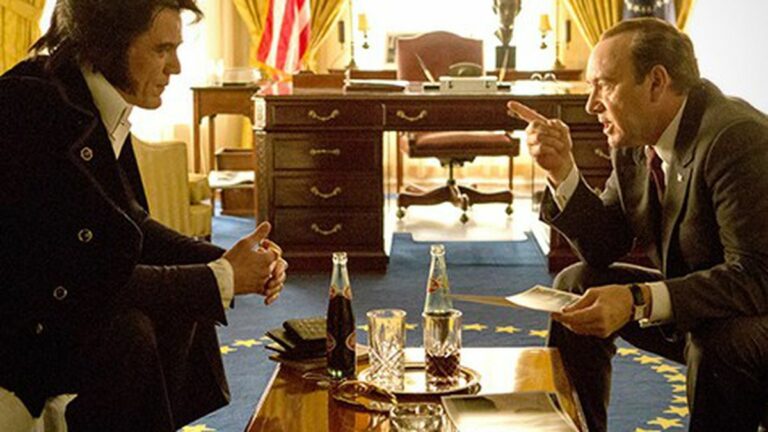
Yet here’s Elvis & Nixon, big as life and unrepentant, happening all over again, with Michael Shannon impersonating Elvis and Kevin Spacey as Nixon. The mind boggles. It’s obvious that neither of the actors really resembles his subject. Steely-eyed Shannon (99 Homes, Batman v. Superman: Dawn of Justice) is and always will be the ideal screen predator. We can’t imagine him ever breaking into “Love Me Tender,” unless it would be addressed to a tied-up hostage. As Tricky Dick, Spacey is forced to reach deep down into his untrustworthiness bag, but let’s face it, nothing in the character actor’s “rogue file” — not his work in House of Cards, Margin Call, or Casino Jack — has quite the enormity of Nixon’s crimes. Remember, the film takes place in Nixon’s first term, pre-Watergate. He was running for re-election. He would kill his grandmother to remain in the Oval Office.
Michael Shannon and Kevin Spacey have their work cut out for them in Elvis & Nixon.
So Shannon and Spacey have their work cut out for them, to portray the two most recognizable public figures of their day — the pill-popping, grilled-peanut-butter-sandwich-eating King of Rock ‘n’ Roll and the official National Wart — in recognizable human terms. Or not. There’s a case to be made that director Liza Johnson’s film, written by Joey Sagal, Hanala Sagal, and former leading man Cary Elwes, is one short step away from being a hyper-absurd riff on American pop culture — a trip to the daffy outer limits where celebrity gossip meets politics and approaches total lunacy. That’s Shannon and Spacey’s natural turf, of course. The two most notorious men in the world sit down and talk, and they’re both stone crazy. Nixon lusts for the Southern voters who worship El, and more than anything else, Elvis wants a badge from the Bureau of Narcotics and Dangerous Drugs for his collection. To get it, he’s volunteering to be an undercover federal drug agent and infiltrate subversive rock bands such as the Beatles. The King and The Prez are in love with each other and they don’t know it. Elvis & Nixon is a devilishly funny comedy, the nutty step-grandchild of Dr. Strangelove.
Actors Alex Pettyfer and Johnny Knoxville are a hoot as Elvis’ cronies Jerry Schilling and Sonny West. Colin Hanks (TV’s Fargo) turns in another apt supporting role as White House advisor Egil “Bud” Krogh, who sincerely believes his boss needs to be seen with someone as popular as Presley. Nixon is annoyed at the suggestion at first — the meeting would cut into his nap time. But it’s Shannon and Spacey who conclusively put the concept over.
It’s great fun to watch them in deep character, verbally sparring. The scene with Elvis visiting a D.C. African-American donut shop (and getting very little respect) is a miniature gem of social commentary. Ditto Elvis’ soliloquy, lamenting his situation: “I’ve become a thing, an object, no different than a bottle of Coke.” Spacey has Nixon’s herky-jerky gestures down perfectly, along with his combative insecurity — “You think I could take him?” he earnestly asks an aide, right before the big sit-down. Naturally, Elvis strolls right in and takes control of the White House. With any luck, from now on we’ll think of Shannon and Spacey every time those other guys’ names come up.
The annual Bay Area Anarchist Book Fair is back to showcase radical literature for the 21st year in a row on Saturday, April 23 from 10 a.m. to 6 p.m., this time at the recently-relocated Oakland Metro Operahouse (522 2nd St., Oakland). As usual, there will be a host of local publishers and print purveyors in attendance, all offering their own take on political resistance, from AK Press to Endless Canvas. Programming will include “Anarchists, Race, Police Brutality, and the Rise of the Right,” a discussion of anti-racism and solidarity within the anarchist movement; “We Are the Crisis of Capital, And Proud of It!,” a conversation about what anti-capitalist revolution can mean today; and the intersectional writer panel “We are All of Our Identities All of the Time: Women of Color on Punk, Parenting, and the Beautiful Struggle for Social Justice in the Face of White Anxiety.” As always, the event will be free and open to the public.
Physicist, environmentalist, and economic, food, and gender equality activist Vandana Shiva is visiting Oakland on Wednesday, April 27 to speak about Seed Sovereignty, Food Security; Women in the Vanguard of the Fight Against GMOs and Corporate Agriculture, a recently released book that she compiled and edited. The anthology is an extensive collection of essays from women around the world on topics such as seed-sharing, indigenous agricultural practices, and small-scale farming. The contributors, who are community organizers, scientists, activists, mothers, and scholars, offer first hand perspectives that speak to the various political and environmental repercussions of genetically modified crops and other industrial agriculture techniques, mostly outside of the United States. The talk will take place at the First Congregational Church of Berkeley (2345 Channing Way) at 7:30 p.m. and will be hosted by KPFA radio’s Jeannine Etter.
With recreational marijuana legalization potentially becoming a reality in California this year, drugs are what everyone wants to talk about. For the third edition of StorySlam Oakland’s annual drug-themed storytelling competition, the anecdotes will surely cover marijuana, while also going beyond into the realm of all things unconventionally addicting — from religion to candy. Storytellers will be encouraged to let their guards down and tell all about their best highs and worst trips. The event takes place at Sweet Bar Bakery (2355 Broadway, Oakland) on the last Thursday evening of every month, and this one falls on April 21. Much like a conventional open mic, people sign up on a list to perform, but the event also functions like a poetry slam with judges offering scores from 1-10 that eventually lead to a winner. Some stories are inspirational, others are devastating, and some of absurdly hilarious. And all are ten minutes or less.
San Francisco’s Blackbird Blackbird is the solo project of Mikey Maramag, who makes bubbly, sparkly dance music with uptempo rhythms and eclectic, inventive samples juxtaposed with plainspoken indie-pop vocals. His 2015 album Strawberry Light pulses with minimal house beats and glossy synth melodies; delicate harmonies, jittery percussion, and aquatic-sounding samples ornament the tracks throughout. The musician has a knack for making music that’s danceable yet surprising at every turn — whether writing pop songs or more abstract beat instrumentals. Strawberry Light also contains several remixes of tracks from his 2014 release, Tangerine Sky, a more euphoric, effervescent precursor to his most recent project. Blackbird Blackbird performs at Social Hall SF with UK singer-songwriter Chad Valley on April 23.
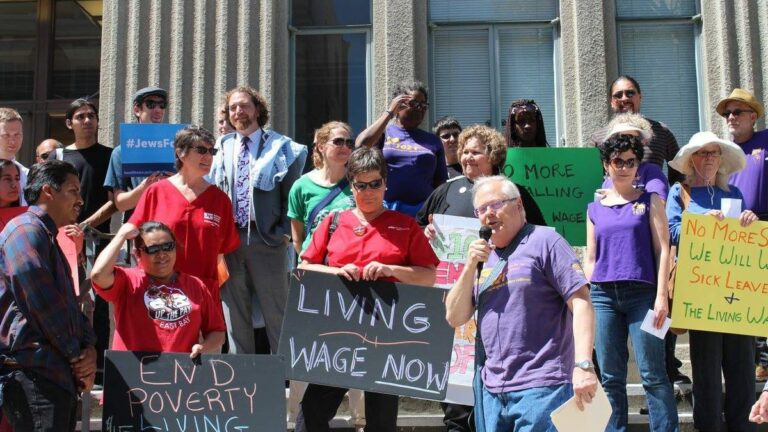
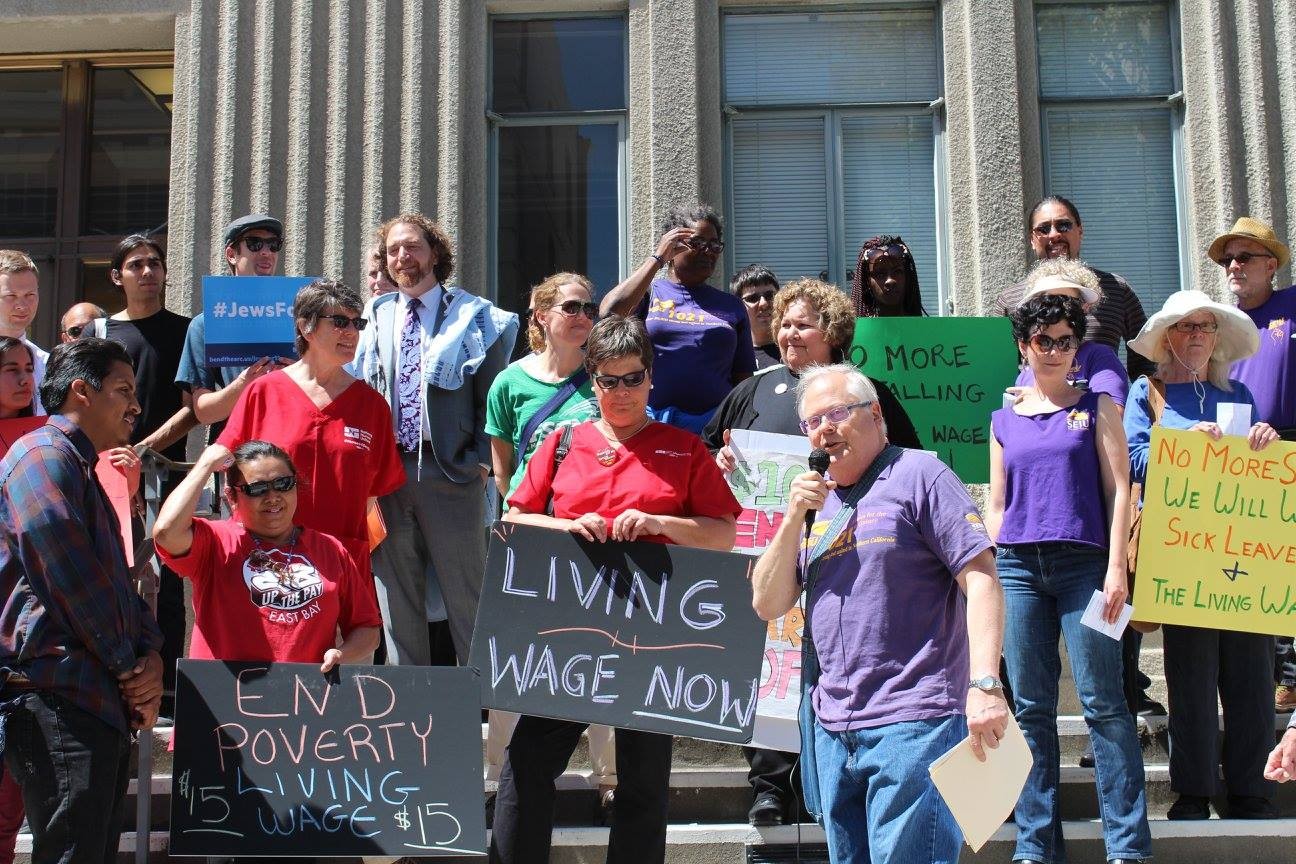
Members of the Berkeley for Working Families coalition outside Berkeley City Hall today.
Credits: Courtesy of SEIU 1021
It appears that, on November 8, Berkeley voters will get to decide whether or not to adopt the highest minimum wage in the country.
A coalition of labor unions, elected officials, students, faith groups, and other activists announced today that they have collected more than 160 percent of the signatures necessary to qualify a $15 minimum wage for Berkeley’s November ballot. At a press conference this afternoon, the coalition, called Berkeley for Working Families, delivered petitions with approximately 4,500 signatures to City Hall.
The ballot measure would increase Berkeley’s minimum wage to $15 per hour by October 2017. Thereafter, the minimum wage would increase by inflation plus 3 percent each year until it is equal to Berkeley’s official living wage, which is currently $16.37. (The Berkeley living wage is adjusted upward each year to account for inflation.)
Coalition members said they chose to gather signatures to place the minimum wage measure on the ballot following a string of city council decisions not to advance a similar minimum wage increase last year.
Berkeley’s current minimum wage is $11 per hour and is set to increase to $12.53 on October 1.
Workers and unions have called the current Berkeley minimum wage inadequate given the region’s high cost of living.
Berkeley city councilmembers Max Anderson, Jesse Arreguin, and Kriss Worthington have endorsed the coalition’s initiative.
Correction: the original version of this article stated that the City of Berkeley has no subsequent increase planned for its current minimum wage of $11 an hour. On November 10 last year the council voted to approve “in concept” an increase of Berkeley’s minimum wage to $15 by the year 2020. However, the council has not taken action yet to make this proposal the law.
A California-legal rifle with a bullet button (located between the trigger and magazine).
This week the Oakland City Council has an agenda packed with lawsuit settlements, gun policy legislation, and several key affordable housing items.
‘Overly-Aggressive’ Police Raid: In April 2013 Oakland and San Leandro cops raided an E. 22nd Street Oakland apartment in search of a suspect wanted as part of an investigation of a gang that had been “plaguing an Oakland housing complex,” according to the Oakland City Attorney. But a lawsuit filed in federal court last April alleged that after the police had searched a downstairs apartment and taken their suspect into custody, they proceeded to force a family living in a different apartment upstairs onto the street. The police ordered Monique Miles and her four children, her grown daughter Chelsea Miles, and her mother Pamela Miles to wait for approximately two hours on the sidewalk half a block away while officers “ransacked” their apartment, the lawsuit claimed. The Miles family maintained they had no connection with the suspect taken into custody by OPD.
Attorneys for the Miles family wrote that, “[w]hen the family went back inside their apartment, they found it a complete shambles, throughout. Closet doors were broken and broken off, and the contents pulled out and spread on the floor. Cabinets and bureau drawers were emptied onto the floor, shelves were cleared, furniture was turned over; and many items of property were ruined.”
According to the lawsuit, the search was conducted by San Leandro and Oakland cops.
The Miles family’s attorneys called the raid “unlawful and over-broad,” and said that it resulted in a “flagrant violation of their [clients’] basic rights.” The lawsuit specifically alleged Fourth Amendment violations – unreasonable search and seizure.
Oakland City Attorney Barbara Parker disputed the allegations and initially sought a dismissal on the grounds that OPD and SLPD officers were searching for an armed and dangerous suspect. According to court records, Parker maintained that OPD and San Leandro cops had merely been conducting a “safety check” of the Miles apartment, and that at no time did the officers do any damage to the Miles family’s property.
Bank Fraud: Starting in about 1992, two dozen of world’s largest banks, insurance companies, and securities brokers began running a massive scam operation to steal public funds from local governments across the United States. The scam targeted a little-known corner of the financial universe called “municipal derivatives.” When cities like Oakland issue bonds, they usually can’t spend all of the money immediately, so the city then invests these dollars to ensure that they don’t lose value over time while the projects the money is intended to benefit (new roads, sewers, buildings, etc.) are being built.
Financial companies are supposed to compete for the business of taking these public funds and investing them. But what the banks did was organize a conspiracy to rig bidding on municipal derivative contracts, thereby reducing the amount of money the cities would earn on the investments. The extra money went instead to banker profits. This went on for years, and untold millions were stolen.
In 2008 Oakland was one of the plaintiff cities to bring a lawsuit against the banks alleging a conspiracy to violate US antitrust laws. Over the past several years a lot of the banks at the center of this conspiracy have been settling with Oakland. The latest is National Westminster Bank, PLC, a British financial company. “NatWest” will pay Oakland $20,000 to drop claims against it.
In 2013 Wells Fargo paid Oakland $200,000 to drop claims. In 2014 GE Capital paid Oakland $281,750 to drop the lawsuit. Insurance giant AIG paid $325,000 to Oakland also in 2014. Last year JP Morgan Chase paid $200,000 and the French bank Societe Generale paid $263,089.
None of the banks have admitted wrongdoing, and no one was criminally prosecuted.
Gun Laws: The city council is set to pass five resolutions Tuesday night supporting five bills in the state legislature that would further regulate firearms.
One of the bills would close the so-called bullet-button loophole. Bullet buttons are mechanisms that detach magazines from rifles. Current law requires that magazines on certain types of rifles be fixed to the gun and not quickly removable, otherwise the gun is classified as an assault weapons and falls under the state’s ban. Gun makers responded to this law by putting bullet buttons on assault rifles so that a shooter has to use a tool or a hard object, like a bullet, and not a person’s finger, to eject the magazine. Rifles with bullet buttons are classified as a simple rifles, not assault weapons, and can be legally owned.
Still, many gun owners hate the bullet button rule and have responded to the requirement by devising all kinds of tools that make removing a magazine simple and fast. Proponents of the assault weapons ban say this has undermined the ban on assault weapons, so now the legislature hopes to completely revise the law so that rifles which have bullet buttons on them are considered assault weapons and therefore banned.
Affordable Housing Income Thresholds: The plan to redefine income limits for an affordable housing program, so that more middle-income households can purchase homes in Oakland, is on the council’s consent calendar for Tuesday night.
As I’ve previously reported, the change would allow renter households that earn up to 120 percent of the median area income to receive mortgage subsidies to purchase homes in Oakland. City staff say the change is important because an increasing number of middle class families can no longer afford to live in Oakland.
But affordable housing policy experts say the proposal is flawed because it will divert resources away from low-income Oakland renters who are in much greater danger of being displaced.
Impact Fees: The council will also vote to adopt impact fees on Tuesday night. I’ve written extensively about impact fees, perhaps the most controversial housing policy – notwithstanding the E. 12th Street land deal – that the city has dealt with over the past year.
The final version of Oakland’s impact fee scheme is as follows:
There will be three geographic zones. Each zone will have different fee levels applied to different types of new housing, and each zone will see its fees phased in over different time periods. Zone 1 includes downtown Oakland, neighborhoods around Lake Merritt, and the Oakland hills — all areas where rents and home prices are highest. This zone will have the highest fees that phase in the fastest, starting with a fee of $5,500 per new apartment unit on September 1, 2016 and ramping up to $22,000 per unit by 2020.
By contrast, Zone 3, which includes much of East Oakland, will have no impact fee on any type of new housing until 2019 when a $3,000 per-unit fee kicks in for multifamily projects. Most of West Oakland will be encompassed by Zone 2, with fees falling between Zone 1 and 3.
Developers would also have the option of not paying impact fees if they include a small number of affordable housing units on-site.
Compared to other cities in the East Bay, Oakland’s impact fees are lower and phase in over a much longer period of time. And other cities don’t appear to have used Oakland’s zoning scheme of applying different fees to different parts of the city. But if readers are aware of some examples, please let me know.
Kamala Harris
In a strongly-worded letter sent Thursday to City of Benicia officials, California Deputy Attorney General Scott J. Lichtig wrote that Valero, the City of Benicia’s planning staff, and an outside attorney advising the city have all incorrectly interpreted the law, and that Benicia has the duty to regulate land use, and must weigh in on a proposal to expand a controversial Valero oil facility.
As the Express reported earlier this week, Valero’s original proposal was presented in 2013 as a simple plan to build a couple of rail spurs from the main railroad line to its refinery, and the city announced its intention to approve the plan without doing an environmental impact review. A torrent of opposition greeted this announcement, however. As a result, the city was forced to conduct three environmental impact reviews and hold public hearings. Then, last February, Benicia’s planning commission unanimously reversed approval for the project. Now the oil facility is pending a final decision by the city council.
But Valero and Bradley Hogin, a contract attorney advising the city, have claimed that the federal government’s authority over railroads means that local governments are not allowed to make regulations that affect rail traffic — even indirectly. And when they’re deciding on a local project, cities are not allowed to consider the impact of anything that happens on a rail line. The legal doctrine Hogin is referring to is called federal preemption. Assuming the city is preempted from blocking it’s oil-by-rail project, Valero has asked the Benicia City Council to delay consideration of the project while it seeks an opinion from the Surface Transportation Board, the federal agency that regulates railroads.
The Attorney General’s letter sent yesterday included a simple response to this interpretation of the law: “we disagree.”
The letter from Harris’s office not only disagreed with Valero and Hogin’s legal opinions, but also stated that to the contrary, the California Environmental Quality Act (CEQA) actually requires the city to consider indirect impacts of the project.
“A failure to include all of a project’s potential environmental impacts . . . or to disregard that information in making a decision like the one regarding Valero’s [project], not only would defeat the purpose of CEQA, but would be an abuse of discretion,” Lichtig wrote.
Harris’ letter explained at some length that federal authority over railroads applies only to railroads. The Surface Transportation Board, the federal agency that regulates railroads, “preempts state or local regulation only if the activity at issue is performed by a rail carrier,” the letter said.
Because Valero is proposing to build the project on its own land — rail spurs and related equipment to connect its refinery to the main railroad line — the Surface Transportation Board has no jurisdiction, Harris concluded.
The attorney general’s letter “clearly shows that Valero’s request for a delay was a distraction, designed to delay the inevitable vote to deny this project,” commented Andres Soto of Benicians for a Safe and Healthly Community.
The city council is planning to reconsider the Valero project on April 18 and 19. Opponents expect the letter to strengthen their case that the council should immediately vote to deny project approval, rather than wait on the federal Surface Transportation Board to weigh in, as Valero has requested.
“This letter has immense implications for similar oil-train fights in San Luis Obispo and around the country, where the issue of federal preemption has been at the forefront of local permitting battles,” wrote Ethan Buckner of STAND.earth, another organization that is opposing the Valero crude-by-rail project.
Those lucky enough to be off work on Friday should stop by Created 2 Create, an interdisciplinary artist mixer organized by local up-and-coming photographer, filmmaker, and event producer Mecca Media at Omiroo Gallery in downtown Oakland from 2 to 7 p.m. Mecca conceived of the event as a way for young artists and creatives of different disciplines to meet...
Chaney Turner of Social Life Productions has been throwing parties in her native Oakland for the past decade. Over the years, her events have provided many safe spaces for the East Bay’s queer people of color to turn up. Her latest event, a new hip-hop dance party called Get Low, premieres at Starline Social Club this Saturday. While billed...
Elvis & Nixon? What a dubious concept for a major motion picture. The December 21, 1970 White House meeting of rock music figurehead Elvis Presley and President Richard M. Nixon seemed to have been adequately summed up, once and for all, by the well known black-and-white photo of The King, in full regalia including a belt buckle the size...
The annual Bay Area Anarchist Book Fair is back to showcase radical literature for the 21st year in a row on Saturday, April 23 from 10 a.m. to 6 p.m., this time at the recently-relocated Oakland Metro Operahouse (522 2nd St., Oakland). As usual, there will be a host of local publishers and print purveyors in attendance, all offering...
Physicist, environmentalist, and economic, food, and gender equality activist Vandana Shiva is visiting Oakland on Wednesday, April 27 to speak about Seed Sovereignty, Food Security; Women in the Vanguard of the Fight Against GMOs and Corporate Agriculture, a recently released book that she compiled and edited. The anthology is an extensive collection of essays from women around the world...
With recreational marijuana legalization potentially becoming a reality in California this year, drugs are what everyone wants to talk about. For the third edition of StorySlam Oakland’s annual drug-themed storytelling competition, the anecdotes will surely cover marijuana, while also going beyond into the realm of all things unconventionally addicting — from religion to candy. Storytellers will be encouraged to...
San Francisco’s Blackbird Blackbird is the solo project of Mikey Maramag, who makes bubbly, sparkly dance music with uptempo rhythms and eclectic, inventive samples juxtaposed with plainspoken indie-pop vocals. His 2015 album Strawberry Light pulses with minimal house beats and glossy synth melodies; delicate harmonies, jittery percussion, and aquatic-sounding samples ornament the tracks throughout. The musician has a knack...
Members of the Berkeley for Working Families coalition outside Berkeley City Hall today.
Credits: Courtesy of SEIU 1021
It appears that, on November 8, Berkeley voters will get to decide whether or not to adopt the highest minimum wage in the country.
A coalition of labor unions, elected officials, students, faith groups, and other activists announced today...
This week the Oakland City Council has an agenda packed with lawsuit settlements, gun policy legislation, and several key affordable housing items.
'Overly-Aggressive' Police Raid: In April 2013 Oakland and San Leandro cops raided an E. 22nd Street Oakland apartment in search of a suspect wanted as part of an investigation of a...
In a strongly-worded letter sent Thursday to City of Benicia officials, California Deputy Attorney General Scott J. Lichtig wrote that Valero, the City of Benicia's planning staff, and an outside attorney advising the city have all incorrectly interpreted the law, and that Benicia has the duty to regulate land use, and must weigh in on a proposal to expand...