
New Group ‘Doctors For Cannabis Regulation’ Is Going to Euthanize the War on Weed

You don’t have to be pro-marijuana to oppose the harms of prohibition — just ask a new group of leading doctors dealing a devastating blow to the drug war.

Former US Surgeon General Dr. Jocelyn Elders, integrative medicine pioneer Dr. Andrew Weil, and professors from top medical schools have teamed up to create the nation’s first doctors group to advocate for cannabis’ legalization and regulation.

Doctors for Cannabis Regulation debuted Monday with a press conference and included the most credible line-up of physician voices on cannabis policy ever assembled.
The group includes: Dr. H. Westley Clark, former director of the Center for Substance Abuse Treatment; Dr. David Lewis, founder of Brown University’s Center for Alcohol and Addiction Studies and professor emeritus of community health and medicine, Brown University Alpert Medical School; Dr. Chris Beyrer, founder and director of the Johns Hopkins Center for Public Health and Human Rights; and Dr. David Nathan, founder and president of Doctors for Cannabis Regulation.

The group has incredible intellectual power and scientific authority to counter claims from the prison-industrial complex that legalizing cannabis will harm public health. Today, the New York Times reported on how police and establishment politicians are trying to pervert the FDA-caused opioid overdose crisis into the basis for opposing cannabis regulations. (Cannabis has no functional overdose and one of the lowest dependence profiles of any drug. Meanwhile, fifty Americans will die today from overdoses of Vicodin, Oxycontin and other prescription opioids. The overdose epidemic is so bad, it has started dragging down the life expectancies for whites.)

A 2015 MedScape survey found 59 percent of doctors favor total legalization. This week, I reported for Scientific American that cannabis’ Schedule 1 designation by the Drug Enforcement Administration has become impervious to the broad opinion of scientists and doctors.


Criminal sanctions for cannabis use vastly outweighs the harms of its abuse, DCR member Dr. Clark stated in a press release.

“The potential for marijuana abuse is a serious issue, especially among our nation’s youth. And especially at a time when very powerful strains of cannabis and concentrates are available that simply didn’t exist in the past. But the consequences of being convicted under current marijuana laws are lifelong and severe, and it is beyond dispute that African Americans and Hispanics are disproportionately affected. Legalizing and regulating cannabis goes a long way towards addressing the incarceration epidemic in this country, as well as enabling research into the public health ramifications of this wide variety of cannabis.”

In February, the California Medical Association came out in favor of the Adult Ue of Marijuana Act, which should appear on California’s ballot this fall. The American Medical Association — which is currently opposed to cannabis legalization for adults — should follow suit, stated Dr. Lewis.

“The medical profession should join with the public to design a safe and effective public health approach to legalizing marijuana use. Our over-reliance on the criminal justice system has caused needless harm to thousands of families without meetings its goals. The public already ‘gets it’ that the war on drugs has failed. As always, we physicians are obligated to explain all the scientifically-proven risks of using marijuana to our patients, their families and to the public.”

Doctors have stood by as the drug war has destroyed millions of lives. Their tacit support for the drug war, and ongoing inaction amounts to negligence under the Hippocratic Oath, stated Dr. Breyer.

“As physicians we have a professional obligation to do no harm. The prohibitionist policies of the last five decades have directly and indirectly contributed to lethal violence, disease, discrimination, forced displacement, injustice and the undermining of people’s right to health. Current cannabis laws are based on ideas about drug use and drug dependence that are not scientifically grounded. They need to change, and doctors must participate in that process as stewards of the public health.”
As calls for the DEA to reschedule cannabis reach a fever pitch, it’s time for doctors to truly lead the conversation and help put science above the politics of marijuana — which are rooted in racism, culture wars, bureaucratic doublespeak, and profiteering by drug testing companies, private prisons, and police unions.

Doctors for Cannabis Regulation president Dr. David Nathan stated:
”Doctors for Cannabis Regulation is an organization whose time has come. Just as public support for cannabis legalization has been growing for the past 40 years, physicians are now increasingly willing to voice their pro-legalization views. Because no national organization has existed to represent them, however, there has often been a vacant seat at the table when legalization and regulation are debated. DFCR is a clarion call for physicians everywhere who want to promote the public health by advocating for smart government regulation of cannabis.”





The Lesbian Sex Haiku Book (with Cats!) Is a Hilarious Tribute to Queer Women (and Cats)

In 2010, Anna Pulley’s life fell apart. The Oakland author’s father was diagnosed with lung cancer, her fiancée broke up with her, and she found herself struggling with a profound case of writer’s block. “Up until that point, [writing] was how I understood the world,” she said in a recent interview. “It was really horrible to suddenly not be able to do it.”

At the time, Pulley’s job required frequent use of Twitter. And she had just begun a four-year romance with a married woman who lived on the other side of the country. Inspired by Twitter’s 140-character limit and the tumult of her new relationship, Pulley started writing haikus. “I was trying to get my groove back,” Pulley explained. “Once I started … it just sort of took off.” Now, nearly five hundred of Pulley’s haikus have been compiled in The Lesbian Sex Haiku Book (with Cats!), which was released this week by Flatiron Books.

While the book’s title only explicitly references sex and cats (the book is chock-full of cat illustrations by Pulley’s partner, Kelsey Beyer), The Lesbian Sex Haiku Book‘s eight sections traverse a huge swatch of emotional terrain, from flirting and dating to breaking up and making up. Pulley is an experienced advice columnist, and her insights into the trials and tribulations of queer dating, sex, and relationships are hilariously accurate — sometimes to an uncanny extent. (Full disclosure, Pulley was also the Express’ managing editor at one point, although I never worked with her).

In one haiku, Pulley writes: Lesbian sex is/like water polo — no one/really knows the rules. Any queer woman who has been asked one too many times about the exact mechanisms of her sex life is sure to appreciate Pulley’s tongue-in-cheek approach to demystifying what she calls “the ins and ins and some outs” of lesbian sex.

Pulley says her writing process is varied. “Often, I’ll have an emotion I want to convey … other times, I’ll have a theme [in mind],” she explained. One set of themed haikus explores what the Fifty Shades of Grey series would look like if a queer woman had written it. Pulley’s reimagined titles include prospects like “Fifty Shades of Buffet,” in which Two ladies give new/meaning to the phrase ‘all you/can eat.’ Then they nap.

Another set of haikus filters real-life lesbian porn titles through a more realistic lens, like “Hot MILFs engage in a steamy clam photo sesh,” where One arranges bread/while the other gets the best/Instagram angle. Across from this haiku is a full-page illustration of two cats arranging a plate of clams, a framed picture of their four-cat family hung on the wall behind them.

Oakland artist Kelsey Beyer’s delightfully subversive feline illustrations (think tabby cats clutching sex toys) are an apt accompaniment for Pulley’s uproarious poems. Pulley always knew she wanted the book to be illustrated but wasn’t sure how to best visually represent hundreds of three-line poems. Coincidentally, Beyer had already been drawing lesbian-themed cats for friends’ birthday cards when Pulley proposed that she illustrate the book. As Beyer explained, the idea quickly fell into place: “I just asked [Anna], ‘What if we did the whole thing with cats?'”

While much of the book’s humor, including the scandalous feline illustrations, is surely accessible to a general audience, Pulley made it clear that The Lesbian Sex Haiku Book was written with queer women in mind. “A lot of the jokes are going to make sense if you’ve ever been in a relationship, but there are definitely some that you’re not going to understand [as a straight person] unless you have a lot of queer friends or for some reason love The L Word,” she said.

This exclusivity gives the book a refreshing insider’s edge. It’s rare to find books written by and for queer women, and it is rarer still to find lesbian stereotypes reclaimed for the purpose of relatable punchlines rather than used to reinforce narrow ideas about queer identity. Pulley hopes to change this. “[One] stereotype is that lesbians aren’t funny and I think that that’s absurd,” she said. “[The book] is a counterpoint to that.”

Beyond its entertainment value, Pulley also hopes that the book will foster a sense of camaraderie among its readers. “I want people to feel a sense of … ‘Oh yes, that’s absolutely happened to me,’ a sense of, ‘Yes, I relate to that,'” Pulley explained. “Also, I really want women to start asking other women out … It’s sort of a call to action in that way.”

For any queer women confused as to how to heed Pulley’s call to action, she has a haiku for that: Introduce yourself/using the words ‘witch,’ ‘poet,’/’grad school,’/or ‘co-op.’

If all else fails, you can always bring up your cats.

The Winding Stream Gets Down to the Roots

0

The past two or three years have been an exceptionally rich period for pop music documentaries, and Beth Harrington’s The Winding Stream may well be the most soul-satisfying of the bunch. For fans who might casually admire the sound of the late Johnny Cash, watching this energetic, joyous roots-music doc can open up a wide vista on bluegrass, country, “high lonesome,” “old-time music” — whatever label you put on it — and show us where it all came from. It’s also a perceptive slice of US history from the Great Depression of the 1930s to the present.

The Carter-Cash era began in the dirt-poor, hilly hamlet of Maces Springs, Virginia, where an enterprising songwriter named Alvin Pleasant “A.P.” Carter, his wife Sara Carter, and her first cousin Maybelle (who married A.P.’s brother) formed a string band devoted to the “primal, spare, direct” (in the later words of Rosanne Cash) traditional Appalachian mountain music now known as bluegrass. Their local traveling act took off nationally when New York record producer Ralph Peer signed them to the Victor label. The Carters’ 1927 recording sessions in Bristol, Tennessee — alongside Peer’s discovery of Jimmie Rodgers, “The Yodeling Brakeman” — are generally considered as the birth of the country music industry.

As the film demonstrates, using inventive graphics and animation combined with family photos, the extended Carter Family took Depression-era America by storm, especially after performing on the powerful “border radio” station XERA, whose signal reached everywhere in North America. Vintage film segments show various Carter kin picking and grinning with Hank Williams, guitarist Chet Atkins, and folkie ambassador Pete Seeger. Claims Murry Hammond of the Old 97’s, the Carters’ down-home style, with its keening vocals, represented “a lesson in honesty.”

By the time Arkansas singer-songwriter Cash married Maybelle’s daughter June and officially joined the family, the Carters were an institution. Producer-director Harrington’s collection of performance clips and talking heads is panoramic. We get to see Sara Carter warble “Single Girl, Married Girl.” Anita Carter is joined onstage by Hank Williams to sing “I Can’t Help It (If I’m Still in Love with You”). The Nitty Gritty Dirt Band and Kris Kristofferson play “Gold Watch and Chain.” Sheryl Crow does a wonderful cover of “No Depression.” The legendary George Jones sings “Worried Man Blues.” John Prine opens the film with a romping version of “Bear Creek Blues.” The voice of Rhiannon Giddens rings out “Hello Stranger” with her Carolina Chocolate Drops band mate Dom Flemons. There’s rare commentary by Johnny Cash, who’s shown in a family sing-along shortly before his death in 2003. But perhaps the most beautiful tune in the film is Rosanne Cash’s rendition of “The Winding Stream.” For anyone with even a passing interest in pop music, Harrington’s richly textured doc is a treasure of folkloric Americana.


Farm-to-Table in Various Forms

The roots of the farm-to-table movement run wide and deep in the East Bay. Berkeley’s Chez Panisse and its co-founder and executive chef Alice Waters are icons of the movement, which promotes the use of local, organic ingredients and sustainable farming practices. Today, we see farm-to-table’s influence in everything from third wave coffee shops to school garden programs. But restaurants with innovative business models are still at the core of the trend, each applying environmental practices that work best for their menus. Here are snapshots of three East Bay eateries keeping the principles of local, sustainable cuisine close to heart — and hearth.

Camino 

3917 Grand Ave., Oakland. CaminoRestaurant.com

At Camino, the menu changes daily, but the culinary philosophy stays the same: Quality ingredients reign supreme. Chef Russell Moore, who co-owns the Grand Lake restaurant with his wife Allison Hopelain, opened Camino in 2008 following a twenty-plus-year career at Chez Panisse. When asked to describe Camino’s approach to cuisine, Moore kept it simple: “We’re kind of an idealistic restaurant.”

That idealism — which seeks to honor each ingredient as fully as possible — is grounded in a set of strict rules. All of Camino’s produce and dry goods are organic, while all meat (except for beef) is purchased as whole animals from local farms. Moore doesn’t buy non-locally or from distributors at all, even when that means sacrificing ingredients that he might otherwise want to use. 

Moore also uses a variety of vegetables and herbs grown by one of the restaurant’s neighbors who approached him about supplying Camino with produce from her home garden a few years ago. Moore, who was Chez Panisse’s produce buyer for twelve years, was initially skeptical of the offer. “[The neighbor] asked me to send her a list, and I sent her a list of many, many things,” Moore explained. “A few months later, she brought them all in.”

Now, Moore says he will sometimes receive vegetables and herbs from her up to one or two times a week, though he doesn’t usually ask for specific ingredients anymore. “I might just say, bring what you have,” he said. “Our menu’s different everyday, so it’s easy for us to roll with what we get.” He might receive anything from yácon, a type of South American tuber, to herbs like lovage, Vietnamese cilantro, or anise hyssop. In addition to trading with his neighbor, Moore also receives extra produce from a friend who runs a school garden program in Atherton. Sometimes, he brings in fig leaves and fruit from his home garden in Richmond, too. 

Moore doesn’t limit this homegrown mentality to produce. Camino also has an exchange with local beekeepers, who use Camino’s rooftop to house their beehives. In return, the restaurant receives some of their honey once or twice a year.

Grocery Cafe

2248 10th Ave., Oakland. Facebook.com/GroceryCafe

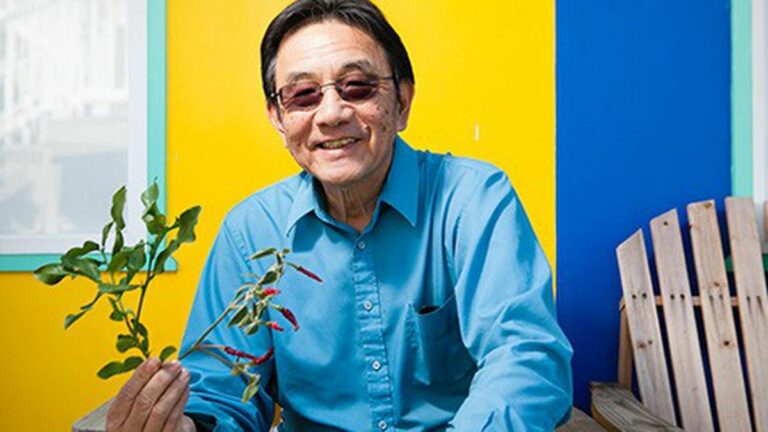
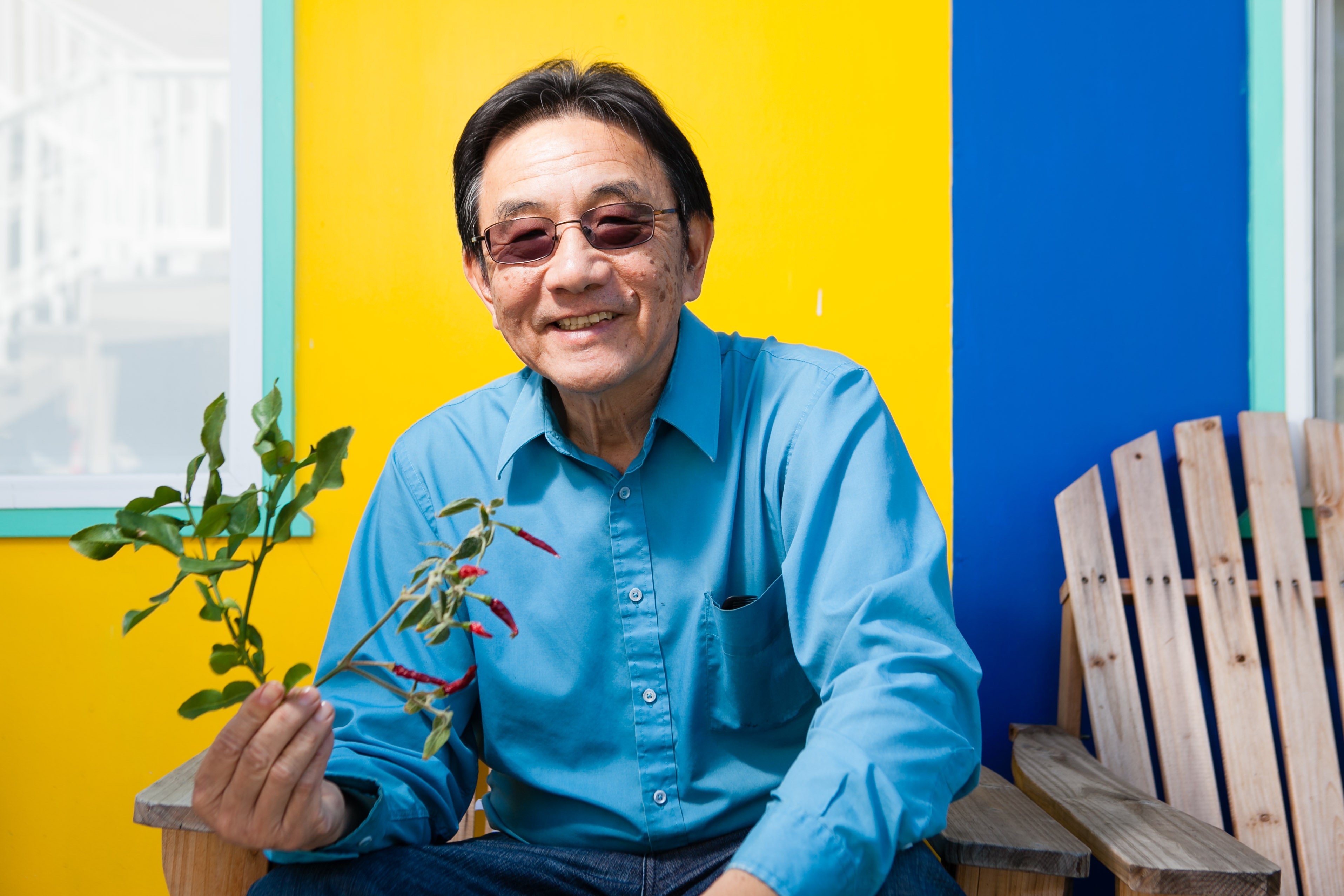
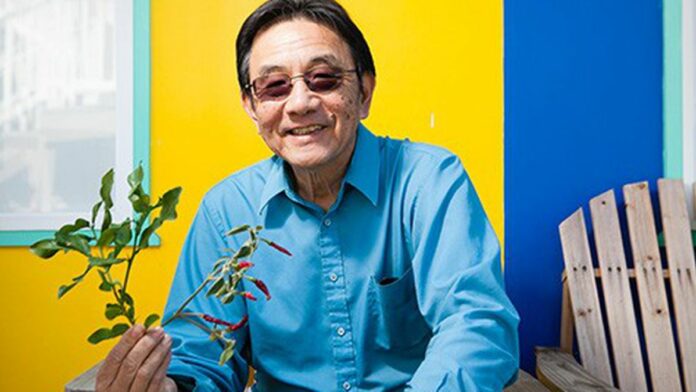
Grocery Cafe might be an unassuming name for a Burmese restaurant, but this East Oakland eatery’s cuisine is anything but bland. Its dishes are seasoned with herbs and spices grown in the restaurant’s courtyard garden, where owner William Lue tends to a variety of flavorful ingredients, including the world’s hottest chili peppers.

“Whenever someone discovers the new, hottest chili — I jump [on] it,” Lue explained. “I find the seeds and I grow [them] myself.” Right now, Lue is growing both Carolina Reaper and Trinidad Moruga Scorpion chilies, which are currently ranked the first- and second-hottest peppers in the world.

According to Lue, who has been a prominent figure in the Bay Area’s Burmese food scene since the Seventies, the weather in Oakland is perfect for growing the plants and herbs he uses. In addition to chilies, he grows a variety of standard herbs on site, including mint, basil, and chives. He also grows less familiar plants, such as Moringa and Kaffir lime trees. Kaffir lime leaves are used as a garnish for many Burmese dishes, and Lue uses the shredded leaves to add brightness and texture to nan gyi thoke, a type of cold noodle salad.

When the courtyard garden doesn’t produce what he needs, Lue turns to another local source, the Old Oakland Farmers’ Market (Fridays, 9th St. between Broadway and Clay St.), to stock up on fresh produce. He is also currently developing a partnership with Fresno farmers that he hopes will make certain ingredients, like Moringa seeds and Roselle leaves (a type of hibiscus), more accessible in the United States. 

According to Lue, Burmese cuisine’s rich flavors remain unfamiliar to a majority of American diners. He hopes to change that. “Lots of [herbs and spices] need to be introduced to Western palates,” he explained. “It feels good to be able to introduce them and be able to use them in my cooking and my restaurant.” 

Tigerlily

1513 Shattuck Ave., Berkeley. TigerlilyBerkeley.com

Tigerlily quietly opened in North Berkeley in January 2015. The restaurant is the second collaboration between Farm League Design & Management Group and East Bay restaurateur Deepak Aggarwal, who opened East Bay Spice Company together in downtown Berkeley in 2013. According to Joel DiGiorgio, co-owner of Farm League Design & Management Group, the unobtrusive opening was part of their plan.

Like East Bay Spice Company, DiGiorgio wanted Tigerlily, which combines Indian spices and cooking techniques with an emphasis on seasonal, local ingredients, to open with a flexible focus, then evolve according to the local community’s taste. Now, just a few months after Tigerlily’s first anniversary, the restaurants is looking to expand its bar menu.

According to DiGiorgio, beverage service is an often-overlooked site of sustainability in the restaurant industry. “Focusing on local beer … sounds too easy to be revolutionary, but it really is,” he said. This is because there are high environmental costs required to import foreign beer kegs, which have to be shipped on boats and then transported to California on trucks or trains. Once empty, the California restaurants then have to ship empty kegs back to their foreign breweries. “It’s extremely stressful on the environment,” said DiGiorgio.

Tigerlily’s bar menu boasts a host of beers from local breweries like Berkeley’s Fieldworks and Trumer Pils, as well as local spirits from Alameda-based St. George Spirits and Spirit Works in Sebastopol. In addition, the cocktail menu uses a variety of herbs, including mint, lemon verbena, rosemary, and lemon thyme, from DiGiorgio’s own extensive home garden. “[Tigerlily uses] a lot of garnishes, we do a lot of our own house infusions — we’re infusing our own cordials, our own syrups … and that requires botanicals and spices,” DiGiorgio said.

But Tigerlily’s emphasis on sustainability and local cuisine isn’t limited to its bar menu. Whenever possible, the restaurant uses local produce, and even sources some of it from DiGiorgio’s family’s organic farm in Sonoma County. This year and next, DiGiorgio says that Tigerlily will be using tomatoes from the family farm for its most popular dish, fried chicken tikka masala, and in cocktails such as the restaurant’s tandoori-baked pineapple Bloody Mary.

“We’re not nearly as sustainable as we truly want to be,” DiGiorgio said. “I don’t know if we ever will be.” Although Tigerlily hasn’t mastered the most optimally sustainable business model, it’s clear that DiGiorgio — and other East Bay restaurateurs — can take small steps to get there by making the most of local resources.

A Green Car Buyer’s Guide

We are all dangerously dependent on the automobile. Today, more than one billion motor vehicles clog the global commons, emitting more than a quarter of all the greenhouse gas (GHG) emissions driving climate change. In California, cars and trucks emit 40 percent of all GHG emissions. And the frustrating reality for Californians is that jobs are further away from affordable housing than they’ve ever been; mass transit still isn’t well-funded; and for most people, it’s just so much easier to get around in a car. So, it’s hard to imagine a rapid shift toward a sustainable post-automobile transit utopia. In the meantime, lots of us don’t have a choice. We’re stuck with cars.

Also, let’s face it. Cars are sexy, and fun to drive. They thrill us with a sense of freedom. They’re extensions of us, vessels of identity, meditative spaces, toys to play with. So what’s an aspiring new car owner to do?

Well, one could embrace nihilism and purchase a gauche SUV, something morbidly grotesque like the 2016 Toyota Sequoia, a $45,000 suburban insult to nature named (without irony?) after a genus of plant life — the Jurassic redwoods of California — that may very well go extinct during the coming mega-droughts and firestorms fueled by the thirteen miles per-gallon hubris of millions of proud SUV owners. Or with a little more style, one could buy a muscular dirty-tailpipe eight-cylinder classic, say a 1966 Ford Thunderbird, and careen figuratively toward the cliff that is climate change.

Or maybe the future of transportation could be different. Perhaps new technologies will virtually eliminate greenhouse gas emissions from automobiles. Recent developments in California might be just what we need to shift gears toward a future in which car buyers can make choices that don’t entail participation in ecocide.

“Cars will be here for as long as I’m here, and probably as long as my kids are here,” Richard Battersby told me in a recent interview. Battersby, who is in charge of the City of Oakland’s vehicle fleet — several thousand cars, trucks and other contraptions — said vehicle emissions are being dramatically reduced. Battersby is optimistic about the pace of technological change.

One of the trends Battersby is excited about is electrification. About ten years ago, the Toyota Prius II won Motor Trend Magazine‘s Car of the Year Award. Ever since, hybrids, which consume less gasoline by relying mainly on battery power supported by a tiny gas motor, have been multiplying on our roads. Nationwide sales of hybrids shot up from 9,000 in the year 2000 to just under 400,000 in 2015, according to the US Department of Energy. The latest models, like the 2017 Chevy Volt, are capable of obtaining 420 miles of non-stop driving with a full tank of gas and fully charged battery, and upwards of 1,000 miles on a single tank of gas if the car is regularly recharged with electricity from a plug-in station.

Battersby, who lives in Fairfield and commutes into Oakland in his plug-in hybrid, said that consumers can expect the variety of hybrids and fully electric vehicles to proliferate. In fact, fully electric vehicles are already having success. While Tesla is the dominant brand, several of the big automakers are offering fully electrical models that are significantly cheaper. For example, the Nissan Leaf costs $29,000 and can stretch 84 miles on one charge. Of course, Tesla’s technology reigns supreme, and the company’s Model 3 (price tag $35,000) can travel 215 miles on a single charge.

But the manufacturing of electrical vehicles has a negative impact on the environment as well. Mining nickel and lithium for batteries is a source of carbon emissions and toxic pollution. And many electric vehicles are recharged with energy from coal-fired power plants — no better for the environment than the nihilistic 66′ Thunderbird option. But according to a recent study by University of Minnesota scientists Christopher Tessum, Jason Hill, and Julian Marshall, hybrid and fully-electric vehicles are far better for the environment if the electricity they run on is generated from natural gas, wind, water, or solar.

That’s good news for Californians who want to buy an electric vehicle. Less than 7 percent of California’s electricity comes from coal-fired power plants, and this should drop to zero after 2025. Meanwhile, new geothermal, wind, and solar projects throughout the state are displacing fossil fuels. Renewables already account for 25 percent of electricity generated in California, and the state-mandated goal is 50 percent by 2030. So if you buy an electric car in California, you’ll be charging it with green energy and running what’s probably the cleanest car in the world.

And that’s really the secret to the automotive industry’s technological shift: California’s proactive state and local governments are creating a growing market for alternative fuel vehicles, and the state is mandating a shift in our energy grid away from fossil fuels.

Oakland’s vehicle fleet, for example, is now about 80 percent alternative fuel (excluding police cruisers), with renewable diesel (produced from plant oils) powering Fire Department and Public Works Department trucks, and hydrogen and electric vehicles serving other city departments. While the public sector is miles ahead of the private car market, Battersby thinks that new state laws and incentives are already working to catalyze a transition away from fossil fuels.

“Without regulatory assistance, the petroleum industry has been successful at killing off competition over the years,” said Battersby. “But once you build in regulatory safeguards, like low carbon and emissions standards, that’s how you encourage private industry to get on board.”

California’s suite of regulations to help electrical vehicles flourish includes millions in grants handed out over the past decade by the California Energy Commission to help establish electrical charging stations across the state, and rebate subsidies of as much as $2,500 to people who buy electric vehicles.

But the big state initiative that will usher in the era of the green car is California’s Advanced Clean Car program. The state Air Resources Board is mandating that there be 1.5 million zero emissions vehicles in California by 2025, and that 25 percent of all state fleet vehicles be zero emissions by 2020. The state is enforcing this by mandating that auto companies make a certain percentage of the cars they sell in California zero emissions vehicles. If an automaker doesn’t sell green cars, then they don’t get to sell any cars.

Ultimately the state’s goal is to push California’s green vehicle fleet to become mainly powered by hydrogen, a fuel that emits zero greenhouse gases, but matches gasoline’s range and performance. Hybrids and battery-powered electric vehicles are a bridge to this vision.

It’s going to take a lot more political and technological innovation to get there, but those who are interested in hearing more details about California’s green car programs can attend the AltCar Expo at Oakland City Hall on May 20 and 21. Oakland’s Battersby will be there extolling the benefits of renewable diesel. There will be talks by Commissioner Janea Scott of the California Energy Commission and Professor Tim Lipman of UC Berkeley’s Transportation Sustainability Research Center. And if wonky lectures about fuel cells and ozone levels aren’t your thing, automakers will of course be showing off the latest in hybrid, batter-powered, and fuel cell cars.

At Mien Tay, Pho is Not King

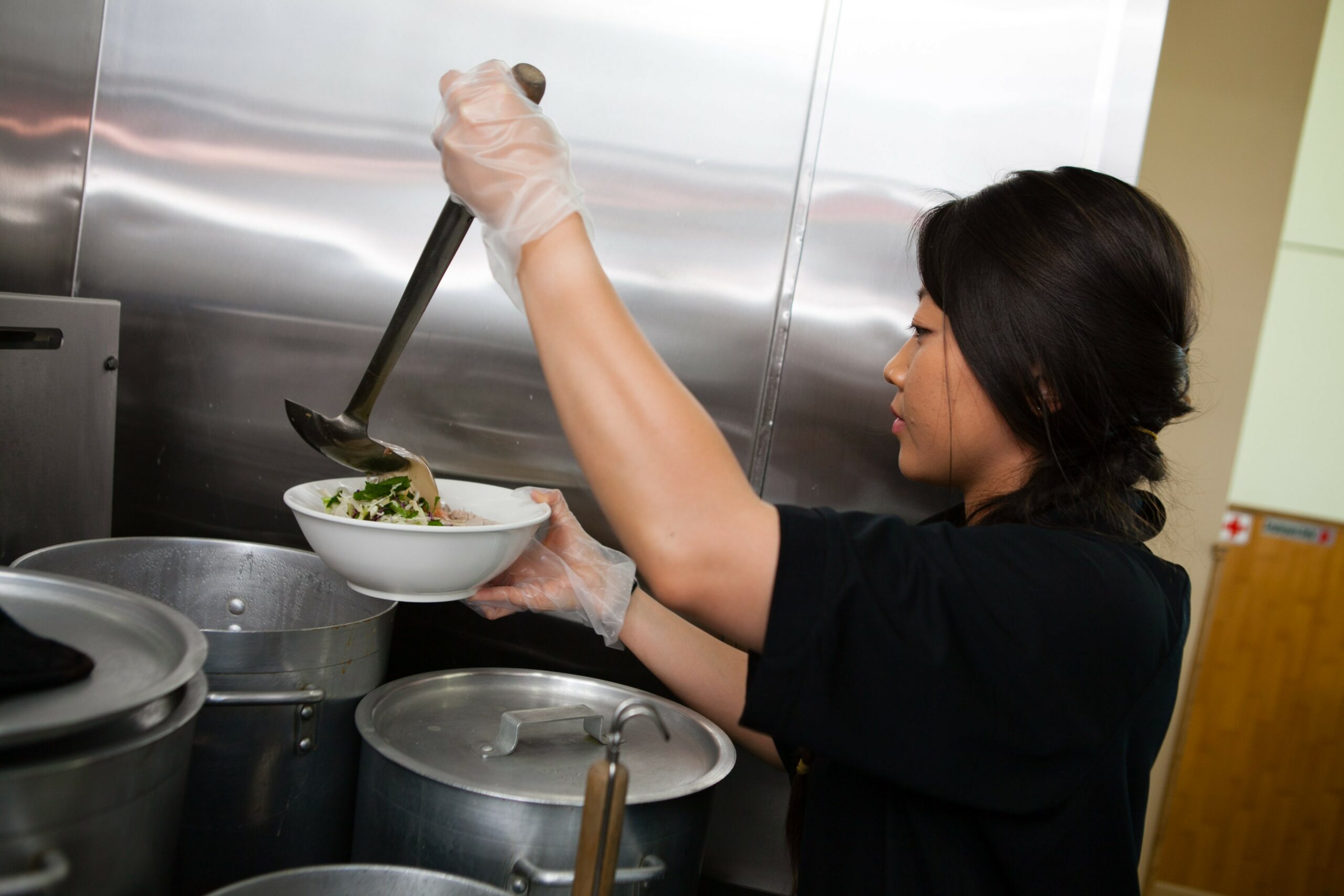
A clean, small diner-like soup spot, Mien Tay passionately focuses on southern Vietnamese cuisine and its brazen palette of tang, chili, and seafood flavors that rarely get pride of place in Bay Area restaurants — even in Vietnamese ones. Growing up in the Bay Area, I had narrowly characterized Vietnamese cuisine by the beef, star anise, and fresh herbs used in pho and banh mi, and I never made a strong connection between the flavors of Vietnamese and Filipino food until I came to Mien Tay. I think it’s an understandable mistake, considering the proliferation of banh mi, pho, the usual rice and vermicelli plates, and not much else. Part of the reason why Calvin Do and his sister Linda opened Mien Tay was that they couldn’t find the soulful food unique to their birthplace anywhere in the Bay Area.

Specifically, they couldn’t find the fish soup that’s the signature of their hometown of Trà Vinh in the Mekong Delta. On the Mien Tay menu, it’s just referred to as House Special Noodle Soup: a whole Goby fish simmered with fish mint (a pungent type of mint associated with Vietnamese cooking) to make a sharp-smelling, saliva-inducing, savory broth — so savory, a person on high-alert for MSG might raise an eyebrow. (The kitchen doesn’t use MSG, by the way.) Blue-silver-skinned morsels of fish were entangled with rice vermicelli, along with fried shallot. Lean, extra-thin slices of pork floated above. A shrimp tail curled at the center of the bowl, which was generously laced with lime and minced red chilies. It was almost as sour as the outside of a Sour Patch Kid, and its heat was sharp enough to pin a few posters to the wall.

Altogether, my bowl of soup was an agile assault of heat and salt, tempered by cooling slivers of cucumber, refreshing lime, and sweet sea smell. To top the whole thing off, just as I was sinking into its complex steam, the server delivered a cha giò — a fried egg roll of pork, shrimp, and carrot — to dip into the bowl and eat with the broth and noodles. As if more adornment were necessary. Not that it was overkill — the kitchen managed to balance the flavors with aplomb.

More intensely fishy was the bún riêu cua — the crab and tomato soup. Made with crab paste and picked crab, its steam possessed the kind of perfume that separates the bolder fish flavor aficionados from the dilettantes. I did hope to see larger lumps of crab swimming around, but in the end was satisfied with my bowl. Set in this magical elixir: rice vermicelli; a whole, ripe plum tomato, peeled and cooked soft; cubes of fried tofu that acted as sea broth sponges; and two hefty, rough-hewn pork and shrimp meatballs that were the bowl’s savory stars. Lovers of fish-funky kicks in the nose, add this soup to your list as one to try.

This isn’t to say that the spot only serves strongly flavored soups that require a taste for sea funk and sour. One of the soups I liked best was the subtle, clear Vietnamese udon (bánh canh giò heo). The simple broth, flavored with roasted ginger, roasted onions, and daikon, served as a background for translucent, pencil-thick rice noodles and a variety of pork cuts — thinly sliced, ultra-lean pork, and knobbly, gnarled pork knuckles. The pork skin had been stewed to a tasty tenderness and texture that harmonized with the chewy noodles. Though Vietnamese soups are meant to be eaten piping hot, I found that the full-bodied broth grew richer and silkier on the tongue as it cooled.

Another mild soup was the curry chicken (càri gà), which was sweet with coconut milk and soft white hunks of yam, and came with a choice of fresh bread, noodles, or rice. Without a trace of heat, the soup could soothe a child. A small dish of salt and pepper with a squeeze of fresh lime was provided for optional bite. I found it interesting to dip my meat into it, punctuating the sweetness with a little sass.

Kevin’s, a longtime pho institution, is just across the street from Mien Tay. Since it’s been closed for renovations until further notice, Mien Tay has picked up the slack, serving more typical (and quite delicious) rice plates and a good, non-greasy bowl of pho, made with dense, peppery beef meatballs, shoulder so soft you can pull morsels of it easily with your chopsticks, and rare sliced steak. It’s not a standout like Mien Tay’s other bowls of soup, but it’s better than satisfactory.

The more I eat at Mien Tay, the more it reminds me of the flavors of my Fil-Am home life growing up. It was the equivalent of Proust’s madeleines — one taste of Mien Tay’s House Special Soup, and complex, personal feelings about my childhood arose. The cha giò bore more than a striking resemblance to my mother’s lumpiang shanghai. The House Special Noodle Soup is a kissing cousin to my mom’s tangy sinigang. Even a simple grilled pork chop — served blade thin, tender enough to cut apart with a spoon and fork, and beautifully seasoned so that its sugary marinade produces a fragile char on its edges — reminded me of tocino, a Filipino breakfast meat. It was refreshing to find a familiar palette of flavors there, used differently, and so well.

There’s no carelessness about Mien Tay. Linda Do is always in the open kitchen, where she can be seen pounding steak for pho or dressing a bowl of soup. The food tastes fresh, the meats are of good quality, the tomatoes are always ripe; and each dish is thought out individually. The ingredients for the soups aren’t interchangeable — in fact, many of the broths taste strikingly different — and they never taste hollow, papery, greasy, or watered down. Even the passion fruit juice is made with real passion fruit, with edible seeds swimming about in the liquid, below the ice. In so many little ways, the restaurant’s desire to serve food true to its region shines through.

My complaints are minimal. One is that the coffee, rich and sweet as melted ice cream, is served in a paper cup, instead of a glass or mug. The other is that the accompanying plate of fresh garnishes for the soups, though adequate, may be a tad slight for some. Those accustomed to the abundance of greenery at Pho Ao Sen may take notice, though May Tien is wonderfully accommodating, and I wouldn’t feel uncomfortable asking for more.

Service is casual and friendly, and I can ask questions about the customary ways of eating things without being made to feel weird about it. With the restaurant’s ten or so tables looking clean and washed in light from the wall of windows along one side of the shop, it’s easy to linger and sink into a long conversation with a friend while the two flat screen televisions on either end of the restaurant burble with soap operas, California Music Channel, or the news.

Mien Tay struck a personal chord with me because the flavors reminded me so overwhelmingly of home. But what really encourages me to go back is the restaurant’s obvious care for its food, its friendliness, and its opening hour. Finally, a place to get Vietnamese coffee and a hot, bracing, sinus-clearing bowl of soup wider than my head, at eight in the morning.

Strong Social Justice Medicine

Here’s something to toast to on the week of 4/20: Millions of Californians with an old pot crime conviction besmirching their records could see the scarlet letters vanish if voters legalize marijuana on November 8. And those in prison for cannabis offenses that are no longer considered crimes could petition for a reduced sentence.

“If we have victory here, it will set the new standard for what can be done,” said Tamar Todd, director of legal affairs at the Drug Policy Alliance, an international group helping to fund and direct the pot legalization effort in California.

The Adult Use of Marijuana Act (AUMA) contains provisions that help end the Golden State’s mass incarceration epidemic, whereby low-level drug offenders are scooped up, tagged as felons, and marginalized for a lifetime as they cycle in and out of jails and prisons.

Ellen Flenniken, deputy director of development for the DPA, said in an April webinar that the United States has 5 percent of the world’s population, but 25 percent of the world’s prisoners. Flenniken said the US “is now addicted to mass incarceration.”

The US makes 1.5 million drug arrests for each year, about half for pot. Blacks are between two and ten times more likely than whites to be caught up in the drug war, even though statistics show that marijuana use is about equal among races.

California was one of the first states in the nation to criminalize cannabis use a century ago, and leaders deliberately targeted minorities, who they feared would initiate whites into cannabis use. In reality, cannabis tincture was on sale in pharmacies until 1947.

President Richard Nixon placed cannabis atop the federal list of the world’s most dangerous drugs in 1972, and pot’s ongoing Schedule 1 status means that in the eyes of federal law enforcement it has no medical use and a high potential for abuse. But audio recordings from the Nixon White House, and statements from his top policy aides show he used pot prohibition to target the Anti-Vietnam War left and Blacks who Nixon viewed as his political enemies. Pot arrests in California spiked to over 100,000 in 1974 and peaked again at around 80,000 in 2008.

Marijuana decriminalization spearheaded by state Senator Mark Leno in 2010 slashed those numbers to just under 20,000 in 2014. Only 6,411 people were arrested for pot misdemeanors in 2014. Even so, a study by the Oakland Museum of California included as part of their new exhibit “Altered State,” found that Blacks were disproportionately arrested for pot in Oakland.

But there is growing concern about the lack of Black marijuana business leaders. Part of the problem is the need for access to capital and real estate, two areas where whites have benefited for generations at the expense of Blacks through job and housing discrimination.

Rules that might prevent drug felons from obtaining state pot business licenses are another barrier. People with old pot convictions face job discrimination, whether it’s becoming a teacher, or obtaining a professional license, and that ironically includes a state license to sell pot under the new Medical Marijuana Regulation and Safety Act.

But California — the state that popularized the draconian “Three Strikes” law in 1994 — is trying to end its addiction to mass incarceration. Prop 47, which passed in 2014 with support conservatives reduced many drug crimes from felonies to misdemeanors.

While some pro-pot activists criticize the personal possession limits of AUMA (one ounce of flower in public, six live plants in private) they’re missing the revolutionary stuff buried in the 62-page law. It proposes to eliminate barriers to entering the new pot economy, estimated to reach $44 billion in value by 2020. AUMA contains “broad retroactive sentencing reform for other marijuana offenses on the books,” said Todd of DPA. “Most existing felonies, save a few, are reduced to misdemeanors or infractions.”

That includes low-level pot sales and possession with intent to distribute. AUMA also includes “complete decriminalization for minors and record destruction at age 18,” meaning if you get an underage pot possession ticket, your college or employer won’t be able to find it when you apply for financial aid, or a job. The federal government still bars college students from financial aid if they have a weed offense; and employers routinely reject applicants with even a whiff of weed on their record.

Incarcerated Californians would also be able to apply for a retroactive reduction in their sentence, or record expunction for crimes that are no longer crimes after legalization. “If you have an old marijuana felony for something that will no longer be a felony in the state, you can go into court and get your sentence reduced [or record expunged],” Todd said. “It will go back and undo much of the harm of prior marijuana sentencing in California, which will be significant for many individuals.”

Because of its far reaching implications for racial justice, the California NAACP came out in support of AUMA in January. However, several pro-marijuana groups, like the California Growers Association, have stated that even if legalization loses, “it would not be a failure.”

“The state legislature is listening after two decades of doing nothing,” said CGA director Hezekiah Allen. “Win or lose, we’re making progress.”

Green Room’s Triumph of the Swill

0

A touring punk-rock band gets booked into a white supremacist dance hall deep in the Oregon woods. One of the band members barges into the green room just in time to witness the aftermath of a murder. So, the neo-Nazis hold the punk-rockers in the room under the pretense of “waiting for the police,” with the intention of killing them once they emerge. The would-be victims choose to resist. Cue yelling, pit bull, shotgun, box cutter, flesh wounds, etc.

That’s the complete plot of Green Room, the latest from Jeremy Saulnier, whose eerie character study Blue Ruin was one of the best surprises of 2013. That film — written and directed by cinematographer-turned-filmmaker Saulnier — had suspenseful plot turns and small, meaningful oddities to go along with the sudden violence. There is very little that’s surprising about Green Room, except how the same director could get so dumb, so quickly.

Throughout, innocent questions arise. For instance: Star Anton Yelchin does not belong in a punk band — he’s too clean-cut and mild-mannered, far better as a novelist (5 to 7) or a Star Trek regular. Then, explain to us how a none-too-bright, none-too-successful band from Alexandria, Virginia is gigging in the Pacific Northwest, 2,800 miles from home. The Aryan cult members, led by soft-spoken but ice-cold Darcy (Patrick Stewart, in a sleepwalk performance), are almost as clumsy as the punks. How do you cover up one murder by killing another five people? (Darcy’s nutsy flunkies seem well-drilled at this sort of thing; does it happen all the time?) Scenarios like this usually take place in Flyover Land, not End-Up Land. Perhaps Green Room is part of a conspiracy to keep gullible California slackers from moving up the coast.

But those nagging inconsistencies take a back seat when the bones begin to snap. The sneak preview audience at the brew-and-movie house where I saw Green Room was well oiled with craft beer and in no mood to quibble about why who did what. Clueless college students/punk rockers in slasher flicks always need uncouth backwoods types to skirmish with, so why not use white supremacists?

When we get down to it, Imogen Poots’ flaxen-haired character Amber could have saved the movie, if they had ditched Yelchin and let her lead the revolt. Macon Blair, from Blue Ruin, is also good as one of Darcy’s less reliable storm troopers. (Maybe make the Nazis fruitier and less mumblecore.) Still, Green Room looks hastily written, if carefully produced. We suspect, we hope, that Saulnier has better projects up his sleeve. Until then, this triumph of the swill may make a useful time waster for the easily amused.

Free Will Astrology

Aries (March 21-April 19): “The writer should never be ashamed of staring,” said Aries writer Flannery O’Connor. “There is nothing that does not require his attention.” This is also true for all of you Aries folks, not just the writers among you. And the coming weeks will be an especially important time for you to cultivate a piercing gaze that sees deeply and shrewdly. You will thrive to the degree that you notice details you might normally miss or regard as unimportant. What you believe and what you think won’t be as important as what you perceive. Trust your eyes.

Taurus (April 20-May 20): The ancient Greek geographer Pausanias told a story about how the famous poet Pindar got his start. One summer day, young Pindar decided to walk from his home in Thebes to a city 20 miles away. During his trek, he got tired and lay down to take a nap by the side of the road. As he slept, bees swarmed around him and coated his lips with wax. He didn’t wake up until one of the bees stung him. For anyone else, this might have been a bother. But Pindar took it as an omen that he should become a lyric poet, a composer of honeyed verses. And that’s exactly what he did in the ensuing years. I foresee you having an experience comparable to Pindar’s sometime soon, Taurus. How you interpret it will be crucial.

Gemini (May 21-June 20): “I measure the strength of a spirit by how much truth it can take,” said philosopher Friedrich Nietzsche. Measured by that standard, your strength of spirit has been growing — and may be poised to reach an all-time high. In my estimation, you now have an unusually expansive capacity to hold surprising, effervescent, catalytic truths. Do you dare invite all these insights and revelations to come pouring toward you? I hope so. I’ll be cheering you on, praying for you to be brave enough to ask for as much as you can possibly accommodate.

Cancer (June 21-July 22): Göbekli Tepe was a monumental religious sanctuary built 11,600 years ago in the place we now call Turkey. Modern archaeologists are confounded by the skill and artistry with which its massive stone pillars were arranged and carved. According to conventional wisdom, humans of that era were primitive nomads who hunted animals and foraged for plants. So it’s hard to understand how they could have constructed such an impressive structure 7,000 years before the Great Pyramid of Giza. Writing in National Geographic, science journalist Charles C. Mann said, “Discovering that hunter-gatherers had constructed Göbekli Tepe was like finding that someone had built a 747 in a basement with an X-Acto knife.” In that spirit, Cancerian, I make the following prediction: In the coming months, you can accomplish a marvel that may have seemed beyond your capacity.

Leo (July 23-Aug. 22): In myths and folklore, the ember is a symbol of coiled-up power. The fire within it is controlled. It provides warmth and glow even as its raw force is contained. There are no unruly flames. How much energy is stored within? It’s a reservoir of untapped light, a promise of verve and radiance. Now please ruminate further about the ember, Leo. According to my reading of the astrological omens, it’s your core motif right now.

Virgo (Aug. 23-Sept. 22): Uh-oh. Or maybe I should instead say “Hooray!” You are slipping into the Raw Hearty Vivid Untamed Phase of your astrological cycle. The universe is nudging you in the direction of high adventure, sweet intensity, and rigorous stimulation. If you choose to resist the nudges, odds are that you’ll have more of an “uh-oh” experience. If you decide to play along, “hooray!” is the likely outcome. To help you get in the proper mood, make the following declaration: “I like to think that my bones are made from oak, my blood from a waterfall, and my heart from wild daisies.” (That’s a quote from the poet McKenzie Stauffer.)

Libra (Sept. 23-Oct. 22): In many cultures, the butterfly is a symbol of transformation and rebirth. In its original state as a caterpillar, it is homely and slow-moving. After its resurrection time in the chrysalis, it becomes a lithe and lovely creature capable of flight. The mythic meaning of the moth is quite different, however. Enchanted by the flame, it’s driven so strongly toward the light that it risks burning its wings. So it’s a symbol of intense longing that may go too far. In the coming weeks, Libra, your life could turn either way. You may even vacillate between being moth-like and butterfly-like. For best results, set an intention. What exactly do you want?

Scorpio (Oct. 23-Nov. 21): “I gladly abandon dreary tasks, rational scruples, reactive undertakings imposed by the world,” wrote Scorpio philosopher Roland Barthes. Why did he do this? For the sake of love, he said—even though he knew it might cause him to act like a lunatic as it freed up tremendous energy. Would you consider pursuing a course like that in the coming weeks, Scorpio? In my astrological opinion, you have earned some time off from the grind. You need a break from the numbing procession of the usual daily rhythms. Is there any captivating person, animal, adventure, or idea that might so thoroughly incite your imagination that you’d be open to acting like a lunatic lover with boundless vigor?

Sagittarius (Nov. 22-Dec. 21): “Difficulties illuminate existence,” says novelist Tom Robbins, “but they must be fresh and of high quality.” Your assignment, Sagittarius, is to go out in search of the freshest and highest-quality difficulties you can track down. You’re slipping into a magical phase of your astrological cycle when you will have exceptional skill at rounding up useful dilemmas and exciting riddles. Please take full advantage! Welcome this rich opportunity to outgrow and escape boring old problems.

Capricorn (Dec. 22-Jan. 19): “When I grow up, I want to be a little boy,” wrote novelist Joseph Heller in his book Something Happened. You have cosmic permission to make a comparable declaration in the coming days. In fact, you have a poetic license and a spiritual mandate to utter battle cries like that as often as the mood strikes. Feel free to embellish and improvise, as well: “When I grow up, I want to be a riot girl with a big brash attitude,” for example, or “When I grow up, I want to be a beautiful playful monster with lots of toys and fascinating friends who constantly amaze me.”

Aquarius (Jan. 20-Feb. 18): In one of his diaries, author Franz Kafka made this declaration: “Life’s splendor forever lies in wait around each one of us in all of its fullness — but veiled from view, deep down, invisible, far off. It is there, though, not hostile, not reluctant, not deaf. If you summon it by the right word, by its right name, it will come.” I’m bringing this promise to your attention, Aquarius, because you have more power than usual to call forth a command performance of life’s hidden splendor. You can coax it to the surface and bid it to spill over into your daily rhythm. For best results, be magnificent as you invoke the magnificence.

Pisces (Feb. 19-March 20): I’ve got a controversial message for you, Pisces. If you’re addicted to your problems or if you’re convinced that cynicism is a supreme mark of intelligence, what I’ll say may be offensive. Nevertheless, it’s my duty as your oracle to inform you of the cosmic tendencies, and so I will proceed. For the sake of your mental health and the future of your relationship with love, consider the possibility that the following counsel from French author André Gide is just what you need to hear right now: “Know that joy is rarer, more difficult, and more beautiful than sadness. Once you make this all-important discovery, you must embrace joy as a moral obligation.”

Reviewed: New Releases by Kaitlyn Aurelia Smith, Toner, and Keith Jenkins

Kaitlyn Aurelia Smith

EARS

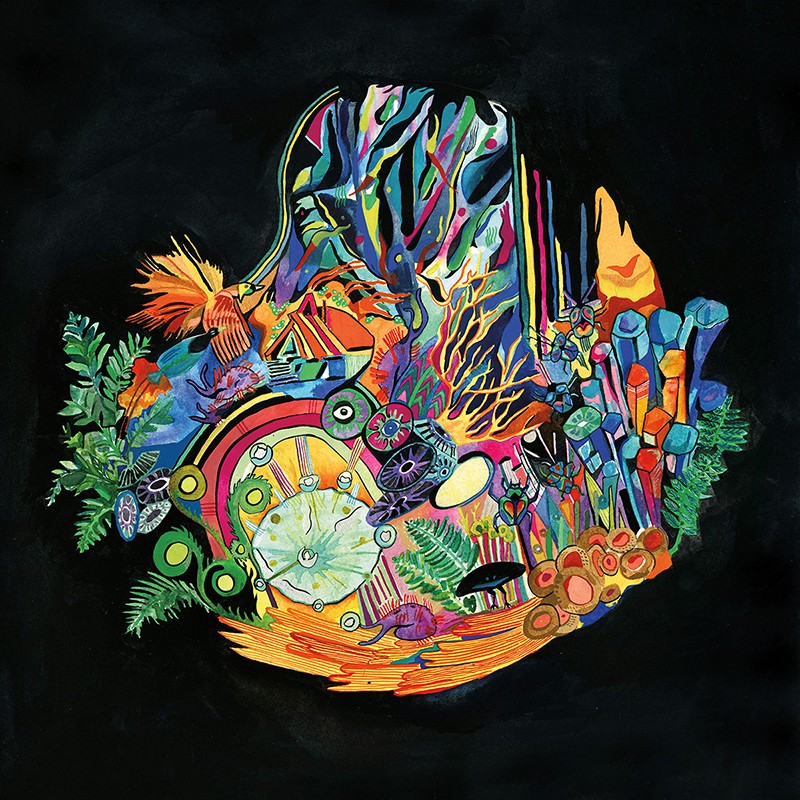
Composer and synth wiz Kaitlyn Aurelia Smith’s EARS is a more contemplative follow-up to last year’s Euclid, which had bucolic Buchla synth instrumentals so sprightly that they evoked the burbling brooks and rolling hills of the musician’s North Bay surroundings. While Euclid — with its bouncy melodies and whimsical effects — made a show out of its quirkiness, EARS explores Smith’s more challenging sonic inclinations to fascinating effect.

The record attests to Smith’s mastery and innovative uses of the synthesizer, with which she creates strikingly multifaceted compositions. At times, her Buchla playing poignantly evokes natural phenomena without mimicking the sounds of nature directly. Instead, she crafts evocative arrangements that activate listeners’ imaginations with their crescendos of textured, luminescent tones.

EARS by Kaitlyn Aurelia Smith

While the Buchla was used to create the majority of the aural alchemy on EARS, Smith composed parts of it for a woodwind quintet, whose charming flutters of Pan-like flute and maritime horns add a breathy, organic feel to the electronic album. That’s not to say that Smith’s synth playing sounds digitized. Rather, the Buchla’s warm palette melds easily with the wind instruments. Smith sings intermittently throughout the record — a rarity for her — but she uses her vocals minimally. Processed to resemble a hymn-like chorus, her voice functions as part of the instrumental tapestry, and the songs arrive to her vocal parts in a way that feels like discovering a mysterious clearing in a forest. Her voice doesn’t guide the journey through EARS: It functions more as a serendipitous detour.

While Smith’s music often eschews structural pop elements such as refrains, she has a remarkable gift for making her experimental compositions accessible even to listeners with more conventional tastes. While the current school of academic electronic musicians in the Bay Area often tests listeners’ endurance with atonal droning or arrhythmic, textured noise, EARS is unpretentious about the way it cultivates joy and wonder with its cinematic instrumentals. (Western Vinyl)


Toner

Passing Glance

PASSING GLANCE EP by TONER

Toner’s Samuelito Cruz is impressively prolific: Though he moved to Oakland from the nearby suburb of Newark less than two years ago, he’s already established himself as a punk auteur with his bands Toner, Happy Diving, and Never Young — all of which have avid, albeit overlapping followings in the local underground scene. Indeed, Cruz’ uniform of a single, dangling earring and skin-tight black jeans have made him sort of an iconic presence at house shows — probably because, since he’s in so many bands, chances he’ll get booked to play are pretty high.

Passing Glance is Toner’s third release, and the EP shows Cruz’ four-piece polishing up its shoegaze pop sound: Cruz’ guitar-playing still contains a layer of fuzz, but the distortion acts only as an embellishment to his predominantly crystalline strumming. The band incorporates enough impressionistic looseness in its instrumentation to lend the record a deliberately lo-fi sound, but Cruz’ penchant for concise and efficient pop songwriting stands out throughout — punchy bass lines underscore infectious riffs. On the title track, Cruz’ melancholic singing comes through with a robust clarity that’s new for him, though on the other four songs, he opts for the kind of mumblecore delivery that gave Toner its sad-boy charm in previous releases.

While Passing Glance is a pleasing listen, it’s missing the kind of understated-yet-poignant lyricism that set apart the band’s full-length album, Toner LP, from the slew of garage-y pop punk that’s been coming out of the Bay Area since the mid-Aughts. Toner LP contained lyrical gems such as I’m all alone/Drunk in my room/I’m thinking ah-bout it (from “Bedroom Floor”) — lines that are deceptively simple yet immediate and relatable. Passing Glance contains few memorable moments such as these, and the record feels somewhat rote without them. (Vacant Stare Records/Digital Regress)


Keith Jenkins

Pistol Keith

In his previous incarnation, Berkeley rapper Keith Jenkins performed as Stunnaman, a member of the iconic, then-teenaged rap group The Pack (of “Vans” fame). The members of The Pack have all pursued solo careers, though former bandmate Lil B’s success as a social media personality and mixtape auteur has outshone his collaborators’ efforts — until recently. Over the past two years, in addition to pursuing his career as a visual artist, Jenkins has resurfaced onto the local music scene with his Simpsons-referencing Black Bart mixtape series, which sees him adopting a darker, more aggressive sound than The Pack’s more upbeat party rap.

Not long after releasing Black Bart 3, Jenkins unexpectedly dropped Pistol Keith, a sleek, six-track mixtape entirely produced by BlizzedOut. For the project, BlizzedOut created slow ominous beats that are all about the hypnotic bass — resounding with the elasticity of a rubber band, with glitchy, digitized samples interspersed throughout.

The project knocks, but it’s tempting to say that Keith is riding the current wave of Atlanta-indebted trap dominating music blogs and SoundCloud. That’s not necessarily a detraction, though, as recent years have seen regional differences between rap subgenres dissolve. The obvious Southern influence notwithstanding, BlizzedOut’s minimal production provides a nice counterpoint to Jenkins’ course voice, which he deploys with a slow-moving, syrupy cadence. On “We All Hurt,” he raps at just above a whisper, and despite the intentionally slack-jawed laziness of his delivery and absence of a memorable hook, it’s one of the record’s catchiest songs.

Throughout Pistol Keith, Jenkins’ ice-cold pimp persona provides plenty of second-hand ego boosts: The project is a soundtrack for stunting on your enemies and flexing your dominance — which might not be very based, but feels so good. (Gold House)

Correction: A previous version of this story stated that Samuelito Cruz is from Newark, New Jersey when he is in fact from Newark, California.

New Group ‘Doctors For Cannabis Regulation’ Is Going to Euthanize the War on Weed

You don’t have to be pro-marijuana to oppose the harms of prohibition — just ask a new group of leading doctors dealing a devastating blow to the drug war. Former US Surgeon General Dr. Jocelyn Elders, integrative medicine pioneer Dr. Andrew Weil, and professors from top medical schools have teamed up to create the nation’s first doctors group...

The Lesbian Sex Haiku Book (with Cats!) Is a Hilarious Tribute to Queer Women (and Cats)

In 2010, Anna Pulley's life fell apart. The Oakland author's father was diagnosed with lung cancer, her fiancée broke up with her, and she found herself struggling with a profound case of writer's block. "Up until that point, was how I understood the world," she said in a recent interview. "It was really horrible to suddenly not be...

The Winding Stream Gets Down to the Roots

The past two or three years have been an exceptionally rich period for pop music documentaries, and Beth Harrington's The Winding Stream may well be the most soul-satisfying of the bunch. For fans who might casually admire the sound of the late Johnny Cash, watching this energetic, joyous roots-music doc can open up a wide vista on bluegrass, country,...

Farm-to-Table in Various Forms

The roots of the farm-to-table movement run wide and deep in the East Bay. Berkeley's Chez Panisse and its co-founder and executive chef Alice Waters are icons of the movement, which promotes the use of local, organic ingredients and sustainable farming practices. Today, we see farm-to-table's influence in everything from third wave coffee shops to school garden programs. But...

A Green Car Buyer’s Guide

We are all dangerously dependent on the automobile. Today, more than one billion motor vehicles clog the global commons, emitting more than a quarter of all the greenhouse gas (GHG) emissions driving climate change. In California, cars and trucks emit 40 percent of all GHG emissions. And the frustrating reality for Californians is that jobs are further away from...

At Mien Tay, Pho is Not King

A clean, small diner-like soup spot, Mien Tay passionately focuses on southern Vietnamese cuisine and its brazen palette of tang, chili, and seafood flavors that rarely get pride of place in Bay Area restaurants — even in Vietnamese ones. Growing up in the Bay Area, I had narrowly characterized Vietnamese cuisine by the beef, star anise, and fresh herbs...

Strong Social Justice Medicine

Here's something to toast to on the week of 4/20: Millions of Californians with an old pot crime conviction besmirching their records could see the scarlet letters vanish if voters legalize marijuana on November 8. And those in prison for cannabis offenses that are no longer considered crimes could petition for a reduced sentence. "If we have victory here, it...

Green Room’s Triumph of the Swill

A touring punk-rock band gets booked into a white supremacist dance hall deep in the Oregon woods. One of the band members barges into the green room just in time to witness the aftermath of a murder. So, the neo-Nazis hold the punk-rockers in the room under the pretense of "waiting for the police," with the intention of killing...

Free Will Astrology

Aries (March 21-April 19): "The writer should never be ashamed of staring," said Aries writer Flannery O'Connor. "There is nothing that does not require his attention." This is also true for all of you Aries folks, not just the writers among you. And the coming weeks will be an especially important time for you to cultivate a piercing gaze...

Reviewed: New Releases by Kaitlyn Aurelia Smith, Toner, and Keith Jenkins

Kaitlyn Aurelia Smith EARS Composer and synth wiz Kaitlyn Aurelia Smith's EARS is a more contemplative follow-up to last year's Euclid, which had bucolic Buchla synth instrumentals so sprightly that they evoked the burbling brooks and rolling hills of the musician's North Bay surroundings. While Euclid — with its bouncy melodies and whimsical effects — made a show out of its...
19,045FansLike
17,709FollowersFollow
61,790FollowersFollow