Kay DeMartini and her co-organizers for An Unruly StoryFest have an ongoing joke that a better name for the all-day storytelling event would be “vulnerability fest” — except then no one would come. In a recent interview, DeMartini, who produces the popular BustingOut Storytelling, explained that storytelling is unlike theater, unlike watching a movie, and unlike going to a reading. It’s more emotional and more honest because it’s real people telling true stories — often stories that they wouldn’t recount in another setting.
That’s likely one of the reasons that DeMartini has had so much success with BustingOut Storytelling, the monthly storytelling showcase that she has been producing in Oakland since 2013. But with An Unruly StoryFest, she is taking the narrative to the next level. The festival, which will take place at Geoffrey’s Inner Circle (410 14th St., Oakland) on September 26, will offer storytelling workshops during the day and a line-up of performances produced by five Bay Area storytelling series each presenting two stories, plus a story from Glynn Washington of NPR’s Snap Judgment, and a story slam that anyone can enter.
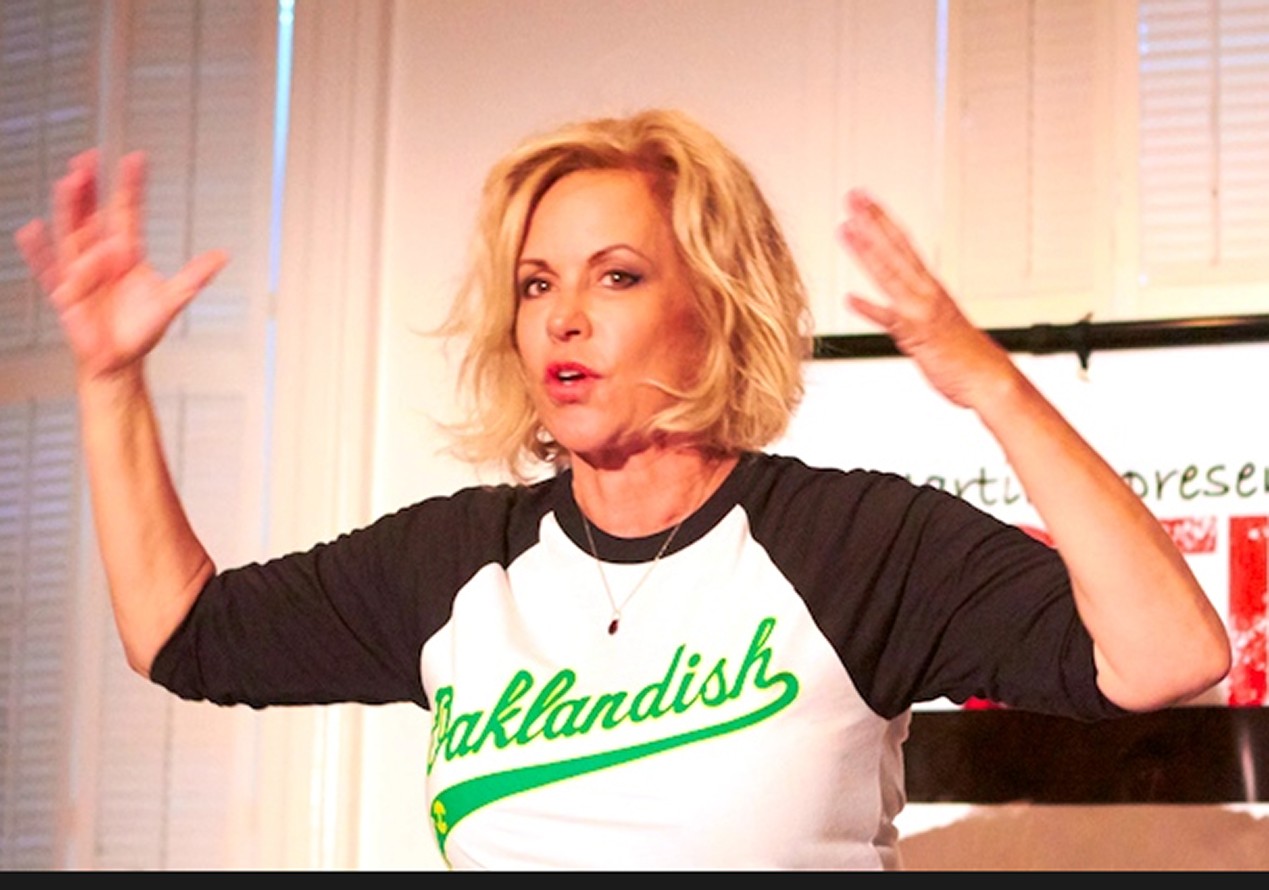
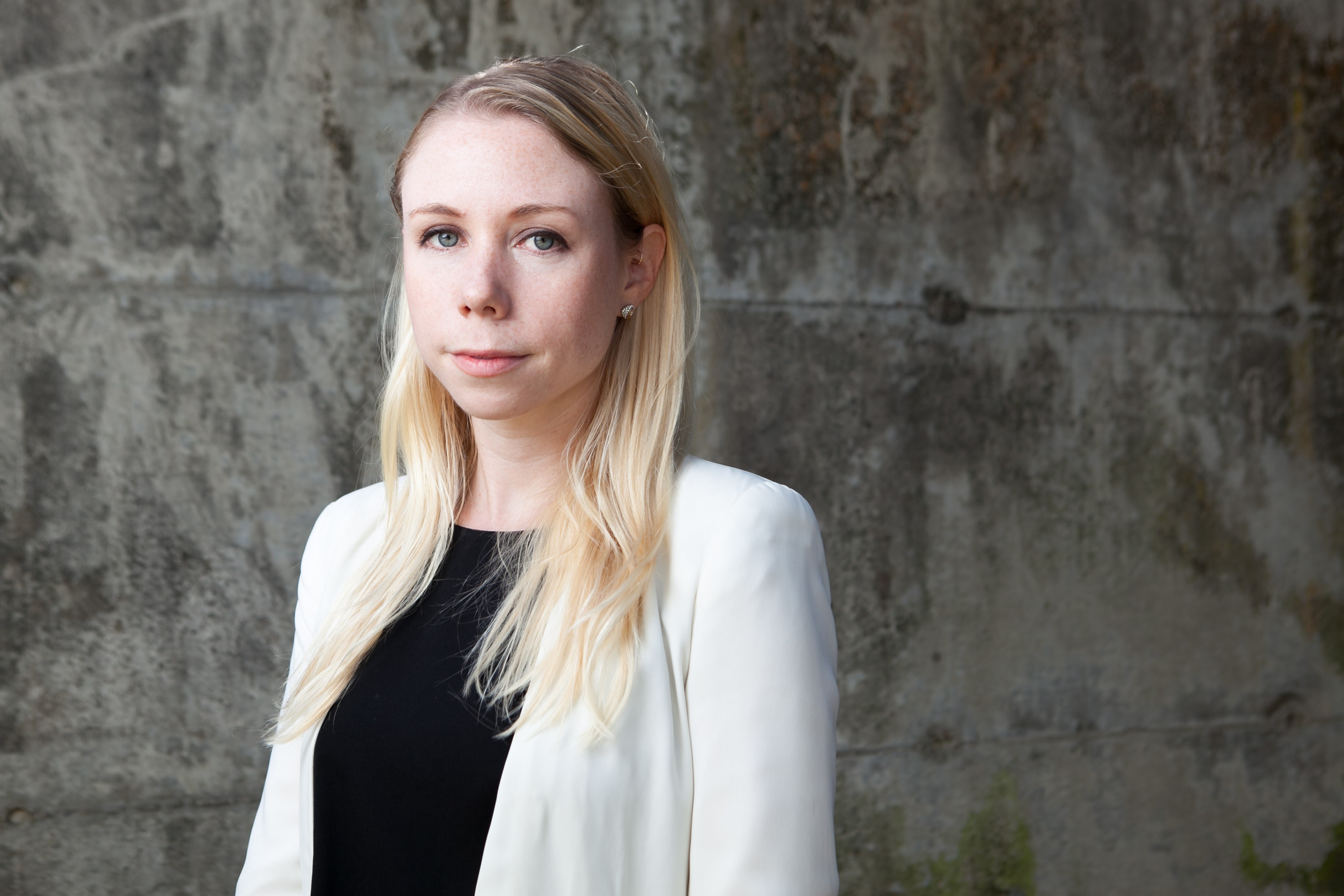
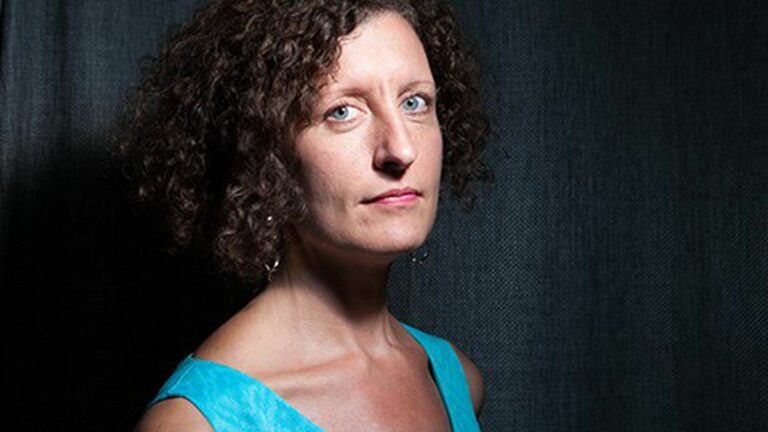
Unruly StoryFest director is also the charismatic host of BustingOut Storytelling.
Credits: Courtesy Unruly StoryFest
DeMartini got the idea for the fest when she brought BustingOut to the LA Storytelling Festival two years ago. She realized that the East Bay is such a hub of storytelling shows, that she had to bring them all together in a similar way to encourage crosspollination among producers, storytellers, and fans, while also welcoming newcomers to the scene.
On the day of the event, after the workshops, the line up will start with the Shout, a monthly showcase that normally takes place at Perch and features ten-minute awe-inspiring stories. Next, Oakland’s TMI Storytelling, hosted by comedian Gina Gold, will offer unadulterated stories that give a “hardcore” look at life. After that, “Mortified,” a Radiotopia podcast, will have people present embarrassing stories from their past. And next up, DeMartini will bring in storytellers from Los Angeles to introduce some outside flavor. Finally, local celebrity Glynn Washington will close out the show, followed by the winning story from the StorySlam, which will take place earlier in the day with the theme “firsts.” (Full disclosure: your humble author is one of the judges for the story slam.) Meanwhile, comedians will be telling funny stories on a different floor throughout the night in a show hosted by Emily Epstein-White.
For DeMartini, the more variety in a storytelling showcase, the better. She’s a proponent of getting new people on stage who have never shared stories before — such as bus drivers, sex workers, pizza makers, and tap dancers. “People need to hear stories from different walks of life,” said DeMartini. “That’s really why I’m into stories. It’s not for the sensationalism or to give people a microphone to just have them talk. I mean I really do think stories change the world. So make it a good one.”
On a sweaty afternoon in early August, approximately thirty UC Berkeley students trickled into a large lecture hall that was booming with Dr. Dre’s new album, Compton. The students were unfazed by the incongruous soundtrack to their summer course. A petite woman in a fitted, red suit with gold hoops beneath her blonde hair stood in high heels before the podium, bobbing her head to the beat and mumbling the verses under her breath. The spunky lecturer was Sarah Lappas, who was nearing the end of her first term teaching an American Cultures course called “Hip-Hop in Urban America” for the UC Berkeley music department.
American Cultures (AC) courses are often colloquially referred to as UC Berkeley’s “diversity requirement”: Each student is required to take at least one in order to graduate. Numerous departments on campus offer the courses, and they’re usually taught by some of the university’s most enthusiastic professors and lecturers. “I almost missed my exit because I was listening to this album this morning,” said Lappas, as she welcomed the class, referring to her commute to campus.
A UC Berkeley graduate student assistant, an undergraduate ACES student, and a RYSE youth member crack up between rap verses in the sound booth at the RYSE center in Richmond during Lappas’ last session there for the summer.
Credits: Bert Johnson
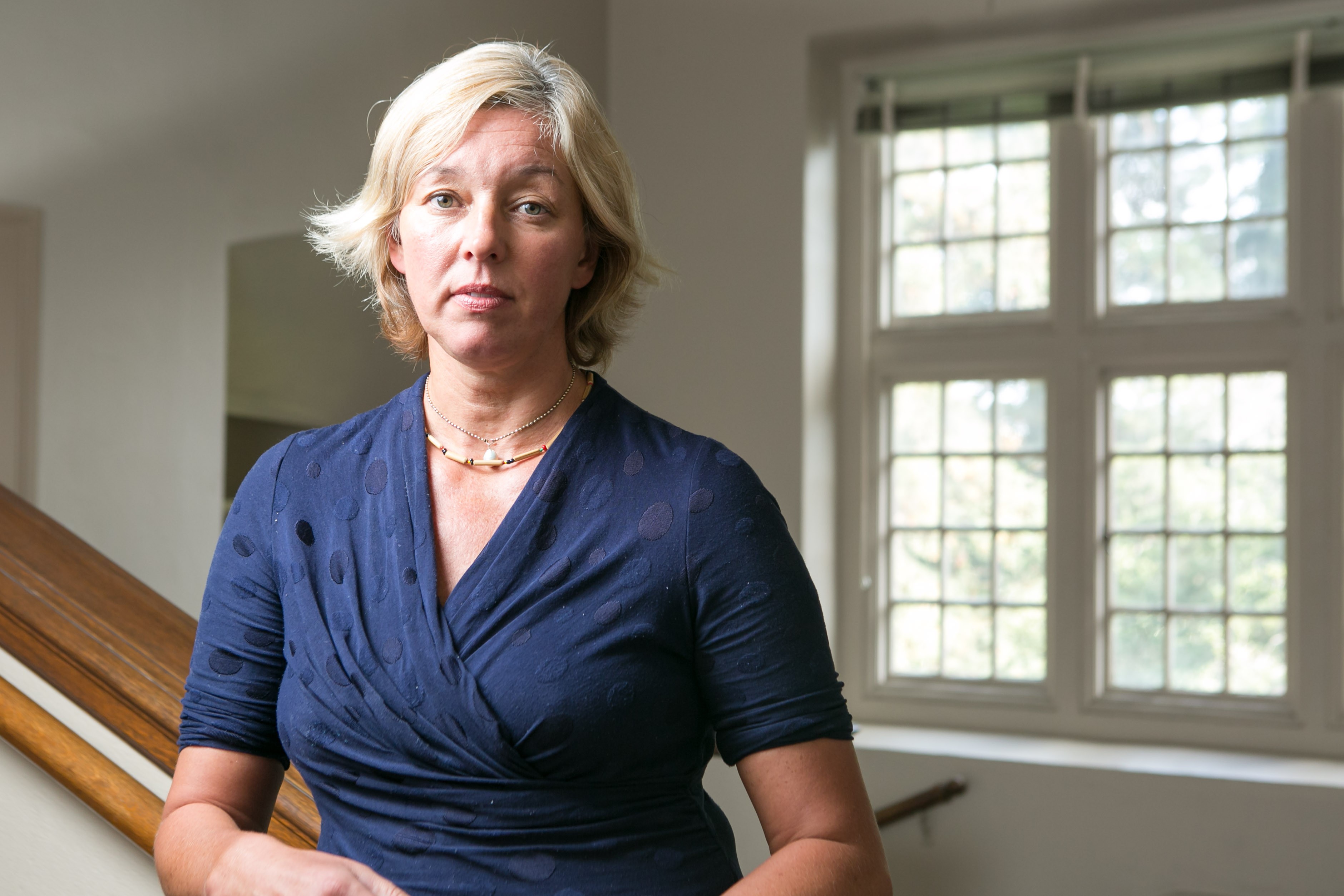
Suzan Akin is one of two members of the ACES administrative staff.
Credits: Bert Johnson
Lappas roots her course in “ethnomusicology,” a discipline that analyzes the connections between the technical facets of music and the cultural context from which it emerged, looking at music as a social product and force. “Hip-Hop in Urban America” takes the urban circumstances of the nation’s major rap cities — with a heavy focus on the Bay Area — then relates them to the most popular hip-hop that came out of those regions.
Lappas invited local musicians to speak to the class during the summer session, including the legendary Mistah F.A.B. and the more recently popular Daghe, to present their music from their perspectives. Then, at the end of the course, Lappas dived into aspects that aren’t geographically specific, such as “gender and hip-hop,” which was the topic on the afternoon I visited.
Lappas posed some questions to the class in order to kick off the discussion: “How has gender identity in hip-hop been shaped by the post-industrial urban landscape?” Toward the end of a spirited lecture that encompassed both theory by bell hooks and a debate over the merits of Nicki Minaj, one white student raised his hand and said, “I just don’t think [hip-hop] is all that deep.” That’s a critique Lappas is used to hearing. She explained to the student that for most of his life he’s been trained to consider some cultural products and forms of knowledge to be more valuable than others. But what makes Shakespeare’s poetry more worthy of discussion than contemporary rap? Rap, Lappas added, has historically been a rich artistic strategy for existing within disenfranchised communities — communities like many of the ones that exist just outside of UC Berkeley’s confines.
For students accustomed to studying a conventional curriculum, it can be difficult to see the value in work that extends beyond that realm. But four students in Lappas’ class were able to bridge that gap by literally extending themselves into the communities to which Lappas was referring. As part of an American Cultures Engaged Scholarship (ACES) supplement to the course, the four students accompanied Lappas every Tuesday and Thursday after class during the summer to volunteer at RYSE youth center in Richmond. The nonprofit offers local youth a variety of social-justice oriented programs to nurture their wellbeing, and the students assisted Lappas in teaching a condensed version of her UC Berkeley lecture on Tuesdays, then collaborated with youth to funnel personal experiences into professional-grade hip-hop songs on Thursdays.
At RYSE, it’s easier to understand how hip-hop could be “deep,” and studying it could be valuable for students. “To understand that where we’re at in the industry, what you hear on the radio, the messages that are being put out there, they have evolved and they haven’t always been and they don’t always have to be,” explained Dan Reilly, RYSE’s director of Media Arts and Innovation. “To really develop a critical ability to think about and question the world that they’re in, the world around them, the world that they want to see.”
But Lappas can only hope that in the coming semesters, Cal will continue to approve her class and fund its ACES supplement. That’s because the ACES program no longer has a stable source of funding and lacks support from the university. The program started as an experiment in 2010 when the Evelyn and Walter Haas, Jr. Fund donated $947,000 to the AC Center specifically to foster partnerships between the community and the classroom. Over the past five years, the center developed nearly forty new ACES courses that incorporate partnerships with local organizations into the curriculum. But last spring, at the end of the 2014–15, the money ran out.
Now, the ACES program is struggling to survive on temporary funds, primarily fueled by a small coalition of avid supporters with a vision of offering an engaged public education. Beyond funding, the program faces endless bureaucratic obstacles that many argue emerge from a fundamental rift between the ideologies that uphold the ACES program and the underlying ideology of the university.
And as UC Berkeley continues to move toward privatization, the ACES program presents a radical democratic alternative — breaking down the ivory tower by bringing the university’s brain power to issues in the communities that surround it, and learning directly from those communities in the process.
Troy Duster’s office is housed off-campus, in an old, annexed building. Its shingled, wooden exterior recalls another era of UC Berkeley, before People’s Park was an icon of democracy and far before the park became an encampment for homeless people. As we sat in the building’s conference room recently, Duster laughed jadedly and commented on the lack of care that the university has put into maintaining the building, pointing to the parking lot outside and recalling the flourishing garden that once grew there.
At age 79, Duster is a Chancellor’s Professor of Sociology — a comfy title — and has a unique understanding of the history of UC Berkeley. He began researching there in 1967 and started teaching in the sociology department in 1970, later becoming the chair of the department, the director of the university’s Institute for the Study of Social Change, and the head of the AC Center for a short run. Today, he’s among the most highly respected sociologists in the country, but he recalls being one of just six Black faculty members at Cal in the Seventies, out of approximately 1,350 — and the only Black professor in the social sciences.
Duster began teaching at UC Berkeley during a time of tumultuous racial and ideological tension. In the Fifties and Sixties, colleges were either 98 percent white or 98 percent Black (Native Americans barely had access to higher education and the Latino population was far smaller than it is today). Duster refers to this period as the “American apartheid” of higher education. Then, in April 1968, Martin Luther King Jr. was assassinated, sparking a dramatic shift in race relations in the United States. Within eight years, the majority of Black college students nationwide were attending historically white universities. Ivy Leagues went from 1 to 2 percent Black to 7 to 8 percent — an increase that now seems small in numbers but was culturally seismic at the time.
Similar demographic shifts occurred in corporate America and the US military, but, from Duster’s perspective, universities put up the biggest fight. “The one place you would have thought liberalism or progressive thought would have been a convenient or fertile ground for this transformation was the opposite,” he said.
As the more diverse student body demanded a more diverse education, the nearly all-white faculties at US universities fiercely guarded the notion that a proper education emerged from studying the whitewashed canon of Great Books, and viewed anything that might question the objectivity of that premise as an unwarranted political intrusion, Duster explained. “The faculty attitude around the country was, ‘We let you in here. Come in, sit down, and enjoy the show,'” he recalled.
In 1968, radical students of color at San Francisco State University and UC Berkeley had formed the Third World Liberation Front — a vanguard inspired by the Black Panthers and postcolonial thinkers such as Frantz Fanon, Che Guevara, and Malcolm X — and demanded a diverse curriculum. Through strikes and protests, groups at each campus successfully convinced their universities to establish Ethnic Studies departments. But that was only the beginning of a necessary shift toward multiculturalism for UC Berkeley. United, students of color — with the help of a few professorial allies — continued to challenge the university to stop excluding theorists of color from the curriculum.
In 1980, Michael Heyman became UC Berkeley’s chancellor. With a background in law, he was less entrenched in philosophical elitism than much of his faculty and wanted to see a more diverse university. He appointed a committee of the nation’s preeminent scholars from a range of fields to look into the students’ demands. Eventually, they determined that the curriculum, indeed, only offered a narrow view of the topics it claimed to cover. Thus, the controversial American Cultures requirement was born. From then on, the campus mandated that each student take at least one of the program’s courses, which were required to compare perspectives from at least three different cultures. In the beginning, there was not one course being taught that fulfilled the comparative frameworks requirement, and the subsequent effort to develop courses catalyzed one of the most drastic ideological changes in the university’s history.
Heyman’s term hosted the glory days of American Cultures. But over the years, the administration pushed it to the university’s backburner.
Today, however, there is a coalition of UC Berkeley students and teachers, brought together by the ACES program, who still have a radical vision for the kind of inclusivity and democratic production of knowledge that the American Cultures requirement can bring to a university. They believe that diversifying the curriculum must extend beyond the Band-Aid solution of offering multicultural perspectives to actually changing how students learn and who they learn from. Certain intellectuals at UC Berkeley, including influential Ethnic Studies professor Carlos Muñoz, have been proposing this type of education for decades, and studies have shown that engaged community scholarship work helps students understand complex structures of inequality.
“Race in this country has gone through epochal changes and shifts in attitudes and we went through an awful period … where we just celebrate differences and go away pretty much with a Rosa Parks-Martin Luther King-Cesar Chavez kind of framework in our heads,” said Victoria Robinson, current director of the AC Center and the head of the ACES program. “This is very complicated, critical diversity work that holds on to the necessities of each one of us and our roles and opportunities to create structural change and social change. … We propose that one of the best ways to achieve that complicated curriculum is through engagement with our community organizations who are often living and breathing — as well as theorizing, because they are also theorizing — the work that we think about.”
In addition to directing the AC Center and leading the ACES initiative, Robinson also teaches in Cal’s Ethnic Studies department. She’s a prolific worker who rarely has a moment to spare, yet when she sits down with you in a meeting she is fully engaged, and emits a palpable sense of caring commitment.
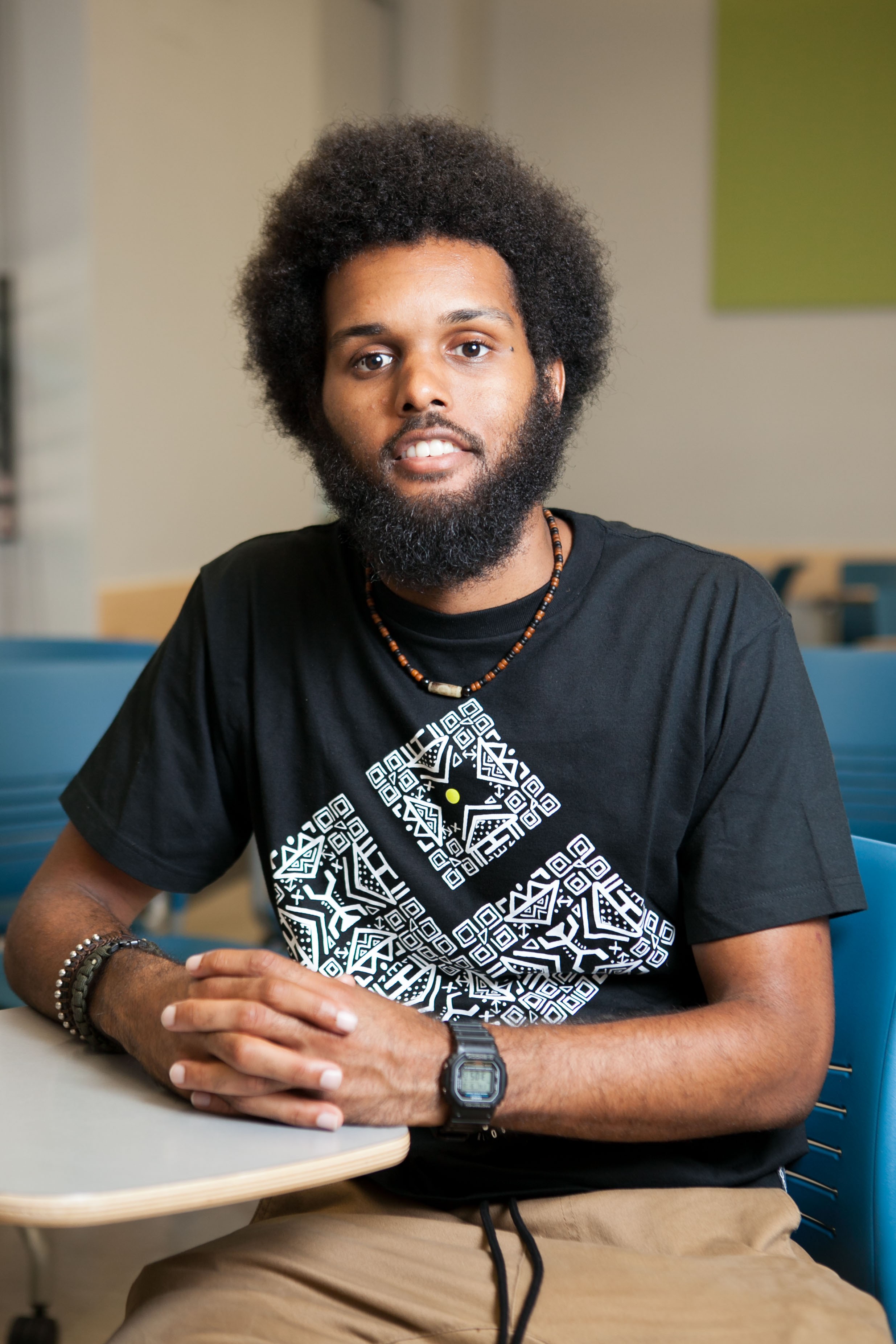
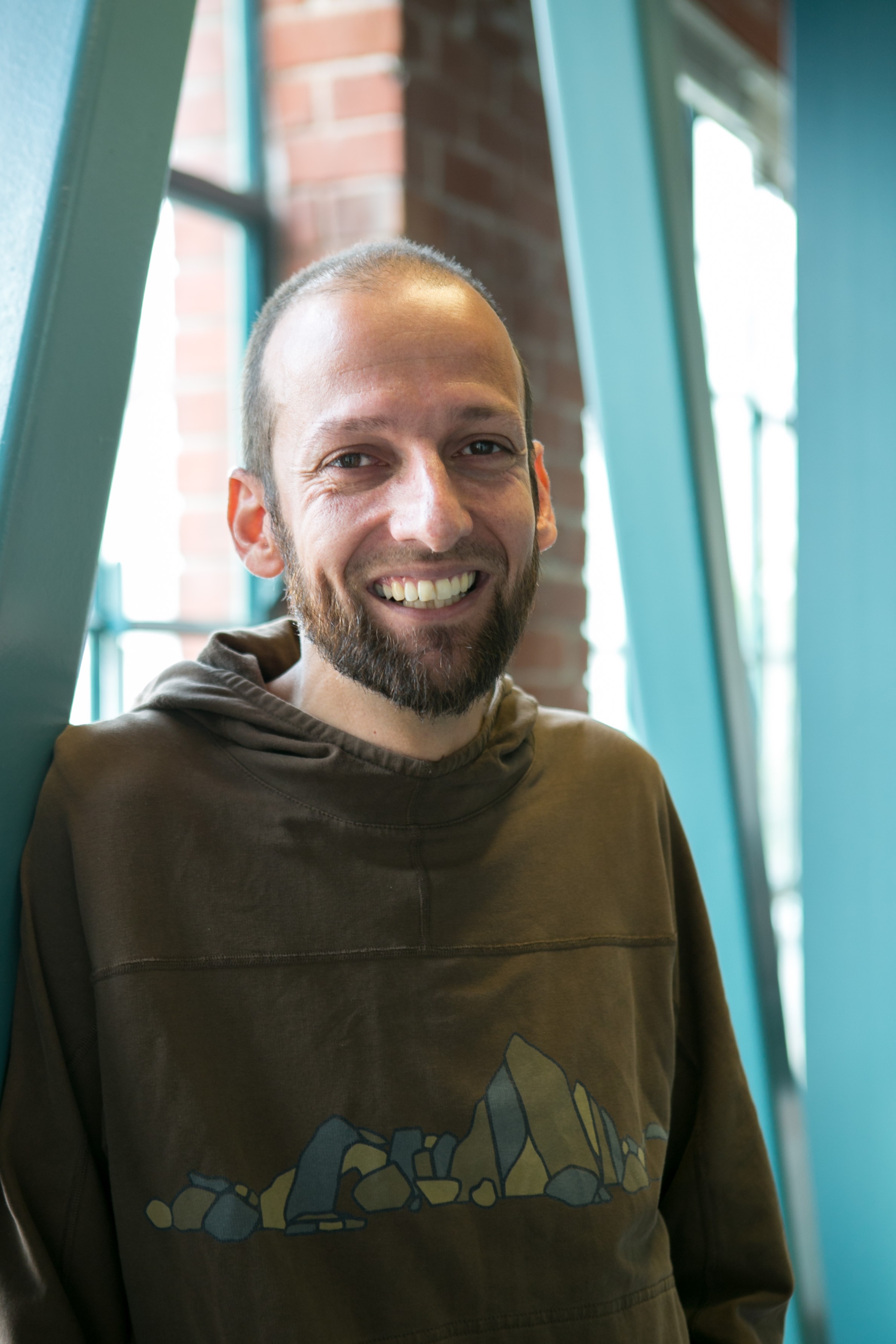
Marcel Jones, a UC Berkeley undergraduate, finds it important to organize as well as study.
Credits: Bert Johnson
ACES formed out of a partnership between the AC Center and the university’s Public Service Center, a resource that helps students find internships and volunteer opportunities with local organizations. Suzan Akin, an employee of the Public Service Center, co-leads the ACES program with Robinson. That means managing everything from administrative tasks to holding intimate debriefings with ACES teachers in Robinson’s office, huddled around a small table with a copy of UC Berkeley alum Jeff Chang’s tome on the shortcomings of cheap multiculturalism, Who We Be: The Colorization of America. Robinson and Akin are the entirety of the ACES administrative staff — and they both only work part-time on the program.
When the ACES initiative kicked off in 2010, the plan was to use the $947,000 donation to develop thirty courses over five years. By the end of that stretch, Robinson and Akin had managed to bring 38 ACES courses to fruition. ACES courses come about in a variety of ways. Sometimes a professor or lecturer wants to incorporate a community partnership into an existing American Cultures course, or they have a brand new idea for a class. Other times, Robinson and Akin have a community partner in mind and approach an instructor to teach the course, or a teacher wants to incorporate a community partner into his or her class, but needs help from Robinson and Akin to find the right partner. In some ACES courses, all the students participate in community partnerships, while in others, the ACES component is an optional supplement to an AC class. Each course receives a small stipend to employ a graduate student teaching assistant to help with the class.
The initial arrangements are flexible, but Robinson and Akin are strict about how each course turns out. Every ACES teacher is required to attend special workshops on engaged scholarship. That education is designed in part to ensure that ACES classes don’t consist merely of local organizers and advocates coming in for a guest lecture or UC Berkeley students showing up to a nonprofit organization to do administrative-type jobs. Robinson and Akin also ensure that ACES classes never consist of students entering a community-run space and preaching academic expertise. Rather, ACES partnerships are crafted so that students gain specific skills and experiential knowledge that fit into the course curriculum while also deepening the work of the partner organization by meeting a specific need — such as, finding answers to research questions, developing models, or mentoring youth. Ideally, partnerships are designed to be long-term, so that each class of students contributes to a complex goal that can take up to ten years to accomplish. “[UC Berkeley] is normally pretty faculty-centered and student-need oriented, and we’re actually trying to complicate that by looking at reciprocity and mutuality,” said Robinson. “And it’s hard. That’s a harder set of relationships to hold.”
Many students arrive at UC Berkeley with a specific image of the university in mind — one that stems from photos of the Free Speech Movement and involves bands of students uniting to fight for the change they believe in. But they often find that the political climate on campus is much less heated and far less informed than they had anticipated. Instead of a campus uprising, “Free Speech Movement” now refers to a campus cafe that sells $10 sandwiches and has a photo of Mario Savio plastered on the wall.
For young idealists, there are relatively few places on campus where they can delve into the history and practice of organizing. But Sean Burns’ ACES course, “Social Movements, Urban History, and the Politics of Memory: San Francisco Bay Area, 1769–2015,” is one of them. Burns, who is now the director of the Office of Undergraduate Research & Scholarships, has been involved in both teaching and community organizing since he was an undergraduate, and has long been interested in bridging the disconnect between them, so when the opportunity to develop an ACES course arose, he jumped on it.
Burns’ class is an abridged history of Bay Area social movements that leans heavily on guest lectures by local activists. The community partner for his course is Found SF, a San Francisco-centric online community history archive that documents marginalized narratives through crowd-sourced research and other projects. By the end of Burns’ class, each of his approximately twenty students produces a history project to contribute to the website, adding to the depth of its East Bay coverage with original interviews conducted with community members. When he taught the course last spring, project topics included the history of Oakland’s DeFremery Park and the various groups that have used the space for organizing; the history of queer spaces in the East Bay with a focus on the White Horse Inn; and the history of the East Bay punk scene as told through the evolution of the house show.
I visited Burns’ course during the late afternoon of 4/20, a time when, every year, hordes of students skip class to gather on the lawn and smoke pot. But every one of Burns’ students was present in their seats that day, eagerly listening to Ed Wolf speak about his influential work in the Eighties with HIV/AIDS victims in San Francisco. Many of these students, Burns later told me, have personal investments in the movements they chose to write about, and are seeking insight into histories and community spaces that can otherwise be difficult to access as an undergrad.
“[My class] is not just about a particular kind of knowledge production, it’s also so much about relationship-building,” said Burns. “They sort of have access and entry to communities that they yearn to be a part of. … What’s going on there is exposure to other human beings, carving their lives and modeling ways forward that are other than just get the degree and get the J-O-B job.”
Because UC Berkeley undergraduates are busy fulfilling demanding coursework, it can be difficult for them to find time to volunteer or do the types of internships that can help them land a job at a nonprofit in the Bay Area. And if a student needs to work throughout college in order to pay his or her rent, that opportunity becomes even more unrealistic. As a result, the chance to do social justice work after college becomes limited if students can’t get that experience through their coursework.
So, many of those initially bright-eyed idealists end up being sucked into the career pipeline, which churns them out with a solid skillset, but leaves them without exposure to the Bay Area beyond the Berkeley border.
Conversely, students who are passionate about extracurricular activities, or are passionately involved in a movement, often don’t get top grades in school because the university doesn’t reward their community work — including the work that Cal students do in ACES. Moreover, ACES courses require a lot of a student’s time and energy.
Lappas attempted to alleviate this problem with her summer course because she didn’t want her ACES students to be charged for extra units. In summer courses, students must pay per-unit tuition for classes, and a class with an ACES supplement costs extra because it’s worth more units (although the units usually don’t equal the amount of work the supplements require). So instead of having to pay for those extra units, Lappas allowed her ACES students to skip the two hours of required discussion section each week and go to RYSE instead. Even so, in addition to having to travel all the way to Richmond, her ACES students spent at least twice the amount of time at RYSE as they would have in a discussion section.
Marcel Jones is one of those actively engaged students who has had a difficult time juggling his personal drive to do social justice work and his academic responsibilities. Jones is a fifth-year Political Economy and Anthropology student who works frequently with local organizations, including Berkeley Cop Watch; used to be co-chair of the Black Student Union; and once co-developed an ACES course about the history of Black and Brown student organizing and the ways in which groups have dealt with being both marginalized on a college campus and away from their community.
Sean Burns is one of many UC Berkeley lecturers and professors who are working hard to create ACES courses, which allow students to learn directly from the community.
Credits: Photo by Bert Johnson.
“It’s always a series of choices,” he said recently while studying for a mid-term at a Berkeley cafe. “What do you prioritize? And sadly, it’s set so that in order to feel like you’re making change and fighting for something you believe in, you’re jumping through hoops to get a degree to help you do what you believe in.”
Brian Powers teaches an ACES course in the sociology department called “Sociology of Education” that parses the structural ways in which educational institutions reinforce structures of inequality that they claim to eliminate. For their community partnership, Powers’ students work as mentors at Oakland International High School, a school specifically designed for refugee youth who are all at varying levels of English proficiency. Powers said his students often need community engagement work in order to not feel helpless and frustrated at the end of a class that implicates them in a dismal system of inequality.
Austin Pritzkat, a fifth-year political science major with a minor in public policy and another minor in city planning, took Powers’ class when he was a freshman and has remained involved with the ACES program ever since, in part serving as an undergraduate teaching assistant for Powers. “At the end of the day, when we read about health disparities or education disparities or various other social issues, these are human beings, these are families, these are communities who are living this,” said Pritzkat. “ACES is a fundamental part of a larger process that I am engaged in about trying to challenge my understanding of my own social position in the world and in the community.”
In spring 2014, administrators in Cal’s College of Engineering sought out Khalid Kadir to teach an ACES class. It was clear at the time that the College of Engineering needed to quell the criticism over its lack of racial and gender diversity, and officials figured that a socially engaged course might do the trick. Kadir, a charismatic lecturer who teaches both engineering and political economy, was the rare person for the job. But on his way to meet with administrators, his motorcycle spun out of control and launched him onto the side of the road. He still managed to make it — albeit a bit late and quite bloody. He put off the emergency room until after the meeting. “I guess that gives you a sense of how cool I thought the idea was,” Kadir said in an interview.
The class that Kadir ultimately developed is “Engineering, the Environment, and Society,” an American Cultures course hosted by the College of Engineering with an optional ACES component. The class asks many of the questions that Kadir didn’t confront until he was attending graduate school: “What are the politics of engineering? What are the ways in which engineers depoliticize problems — how they draw a box around a thing to exclude questions of power and inequality and just deal with the technical aspects? And how does that reinforce those structures [of inequality]?” Students who take the course’s ACES supplement collaborate with local organizations such as Urban Tilth in Richmond to do research and develop engineering models that they need.
But despite his initial enthusiasm, Kadir admitted: “If I had known what I was going to have to go through for that course up front, I wouldn’t have done it.” The development was laborious, the approval process was a fight, and the reaction from his academic peers was “ugly,” he said. “I’m happy I did, but that process was painful.”
Plus, committing to the course was a huge career risk. Kadir dropped one of his usual classes to take on the ACES course, but the latter wasn’t actually approved by the College of Engineering until the opportunity to teach his usual course was long gone. If the class hadn’t been approved, Kadir’s full-time job would have become part-time that semester. It’s a risk that repeats itself, because Kadir’s course doesn’t represent any kind of core requirement for the engineering major, so it must be reapproved each semester. Although Cal students are required to take an AC course to graduate, there is no mandate that any specific department, including engineering, offer such a course. “This is a bastard stepchild of the college of engineering — just hanging out,” Kadir said of his course.
But according to Kadir, the resistance from other engineering professors was even worse than the lack of job security. While courses that incorporate social justice-oriented perspectives into the curriculum have become welcome in the humanities, Kadir found that in the technical sciences they are still seen as a threat to the objectivity of the rest of the coursework. In the undergraduate engineering department, Kadir’s is the only one that diverts students from the high-school-to-tech career pipeline by posing ethical questions. That type of questioning isn’t generally welcomed in departments like engineering.
Sarah Lappas teaches an engaged scholarship course about the history of hip-hop.
Kadir said that many people assume all engineers are only interested in working at Google, when, in actuality, lots of technical students yearn for the kinds of challenges presented by courses that explore human quandaries. However, the students just don’t have the time to take such courses. Engineering and computer science are notoriously rigorous undergraduate majors at UC Berkeley, often taking over the lives of those who wish to succeed within them. “That’s not fair because what happens is — guess what? — those students aren’t engaged in campus activities,” said Kadir. “They aren’t engaged in activism. They aren’t engaged in taking control of their education because they don’t have the fucking time — because they’re gonna fail their classes if they do.” It also means that one of the disciplines with the most potential to produce innovative solutions for community issues puts out the least.
ACES classes require extra work for the teachers as well. Kadir spends time not only maintaining his partnerships, but also staying late in the lab to help students with projects that differ from the problem sets they’re used to. Lappas is essentially teaching two classes for the price of one. And Burns said that there’s no way that he could facilitate the myriad community partnerships his class requires if he hadn’t spent years building and maintaining those relationships. The problem is that ACES requires a different kind of work — a kind that university doesn’t acknowledge.
“The American Cultures classroom is built around the complexities of culture-making, past, present, and future — particularly around the complications of race,” said Robinson. “That means it’s heavy intellectually and heavy emotionally, so those two things together — heavy and busy — mean that these classes are really far more than a regular class.” Bureaucratically, however, they’re equivalent.
Teaching an ACES class can be an especially difficult decision if an instructor is vying for tenure. If that’s the case, then the teacher should be spending all of his or her extra time doing research — and not collaborative research. The distinction between research and service can be blurry, but the former helps your career a lot more than the latter. ACES work usually falls under service. “The reality is that so many of these courses are taught by lecturers precisely because of some of the demands and politics around what is valued as research,” said Burns, adding that it doesn’t make sense for tenure-track instructors to do it. “The people who only teach are the ones pushing the pedagogical envelope at Cal.” Yet those people are the university’s disposable employees, excluded from its faculty pipeline.
Like students, tenure-track instructors are implicitly encouraged to put community engagements aside until they reach tenure. “[Administrators are] interested in high value research … assessed in dollars brought to the university,” said Kadir. “They’re not interested in things that don’t bear those fruits because they have a very economic mindset about it all, and I think unless that’s changed, things like ACES are always gonna have a real big fight.”
Still, ACES classes are constantly overflowing with students and the instructors who teach the classes say it’s worth doing, just for the fulfillment. “I work seven days a week,” said Kadir. “I’m not gonna do that for sixty grand a year and insecurity if I’m not gonna enjoy it.”
When Chancellor Nicholas Dirks arrived on campus in 2013, he called for a return to the university’s utopian ideals, and a renewed commitment to fulfilling UC Berkeley’s mission as an institution that truly serves the public. Part of that call included the announcement of an initiative to transform undergraduate education at UC Berkeley. He appointed a committee of deans and advisors, along with Catherine Koshland, vice chancellor of undergraduate education, to dissect the curriculum and rebuild it for the better.
Two years later, the campus community is still waiting to hear that plan. In a recent interview, Koshland said that the announcement is slated for next spring.
Robinson and Akin, meanwhile, are anxiously awaiting the chancellor’s priorities, which will determine whether the university considers ACES to be a failed experiment or a new commitment. The way ACES currently operates, now that the Haas donation has run out, the duo must submit their budget to the university and pray that it gets approved. That means the program has no security and no room for growth. But in order to address the structural issues that ACES faces, Robinson and Akin argue that the program needs much greater financial support.
“Our model is not an expensive model and it’s not a model we would like — really, it’s a smattering of resources that are very thin in terms of what we’re trying to achieve,” Robinson said. “If we really want to take this seriously, we need a lot more financial support.”
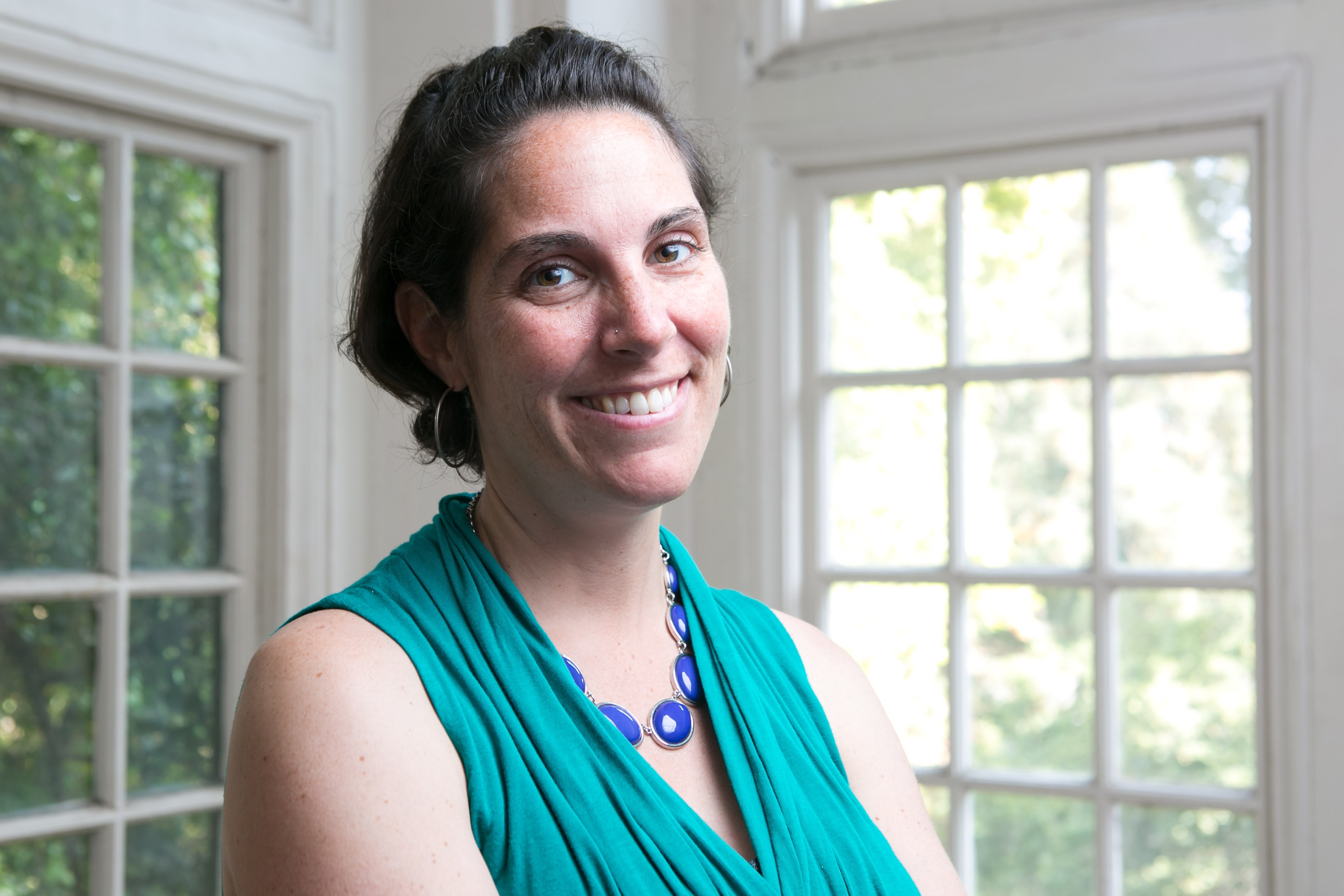
Victoria Robinson (above) is leading the ACES program along with Suzan Akin, but the pair hopes for more staff support in future years.
Credits: Bert Johnson
The university has approved Robinson and Akin’s staffing positions within ACES for the next year. But with each of them working in the ACES program only part-time, that won’t be enough to accomplish what they would like with the program in the future. Meanwhile, ACES instructor Powers argued that the AC Center as a whole should be revitalized. “Our campus is rich with resources but there’s no AC Center,” said Powers, referring to the fact the AC Center no longer has the resources and programs for teachers that it used to offer. “The AC requirement requires faculty who aren’t specialists in this fraught topic of racial formation to acquire a certain proficiency. Where are they going to acquire that if they’re focused on research?”
Many UC Berkeley students, meanwhile, still aren’t even aware of the ACES program, even though multiple student groups have declared it a priority. In 2013, the ASUC (UC Berkeley’s student government), put forth a bill requesting that the university dedicate institutionalized funding to the ACES program, and last spring semester the school’s Black Student Union included funding for ACES in its demands. Pritzkat — Powers’ devoted ACES fellow — was part of the ASUC when the bill passed. He said administrators promised that steady funding was on its way, but so far it hasn’t come. “ACES doesn’t work to completely dismantle, but at least erode, the wall that gets created between this ivory tower — the university — and the community,” said Pritzkat. “I think the university doesn’t know how to handle this type of radical academic work that is bringing community in. … We’ve been beating this drum about how cool ACES is for at least four years.”
For her part, Koshland said in an interview that she considers the program to be wildly successful. “We’ve seen the value of this kind of education,” she said, “and are committed to finding ways to continue to support it.” But ACES is tied up in the larger funding challenge on campus, she said.
Koshland said that ACES will be included in the chancellor’s undergraduate initiative priorities to some degree — likely as part of a new mandate that all undergraduates complete some kind of in-depth capstone project in order to graduate. But when asked about institutionalized funding, she said that the university will look for more philanthropic funding — like the $947,000 it received from Haas. (The AC Center and AC courses are not at risk of having no funding in the future like ACES is.)
So, even if ACES ends up being a priority, everything could stay the same. “We’re sort of in this landscape where, even if the work you’re doing is considered a priority by the campus … that doesn’t necessarily guarantee any sustainability or stability for the work or the ability to kinda continue and grow that work and do it in a deeper way,” Robinson said. At least, she and Akin added, it would be much easier for them to secure outside funding if the program is incorporated into the chancellor’s priorities for undergraduate education to be released next spring.
“Somebody said last week that the best way to describe [UC] Berkeley is: ‘Berkeley exists, despite itself,'” added Robinson. “And that’s true, you know?”
On the last day that Lappas and her ACES students spent at RYSE it was difficult to tell the difference between them all. If it wasn’t for Lappas’ white suit and her students’ required visitor tags, the UC Berkeley students and RYSE high-schoolers would have been indistinguishable as they laughed and took turns laying down rap verses in the sound booth at the center. The next week, Lappas surprised her students with a special performance by local rapper Iamsu! that followed the students’ own showcase. But during that last afternoon session, she was still double-checking whether the UC Berkeley students needed a ride to BART and whether all her RYSE participants received a piece of pizza. Yeah, it’s a lot of work, she admitted. But it’s worth it.
For RYSE — like many of the ACES community partners — partnerships are a core part of its model. Plus, it’s crucial for RYSE youth to be exposed to university students. “To be able to work closely with college students that are at a prestigious four-year university, that alone is a huge benefit to our young folks,” said Reilly. “Engaging with college professors, making college seem accessible and familiar … it’s a really empowering experience for our young folks.”
Indeed, at the end of the day, Miyosha Cooks, a junior at Kennedy High School in Richmond who claimed to be a horrible writer, offered to read me the poem she had composed during a workshop with Lappas and her students. It was called “A Cold, Pale World,” and it was a touching and articulate piece about struggling to fit in. After high school, she hopes to attend either UC Berkeley or UCLA.
Khalid Kadir teaches a rare engineering course concerned with social and environmental justice.
Credits: Bert Johnson
At a time of rapid privatization of public universities, ACES represents a refreshing reconceptualization of welcoming others in and expanding its work outward. And, as many of the ACES teachers and students have pointed out, UC Berkeley is uniquely situated to host that kind of engagement because of its history and because it’s surrounded by so much organizing and nonprofit work.
“The public interest is in our favor and higher education is under pressure to show its value,” said Robinson. “And it’s contentious, but part of the kickback from [Sacramento] is, ‘What do you for the state of California?’ and part of what I think students value of the university is an education that matters — but also matters for the kinds of communities that they came from and for the kinds of futures that they want to lead.”
Robinson and Akin hope that ACES questions who the university is accountable to in a way that changes who the university responds to and how it responds, so that barriers between the university and the community begin to crumble. “We’re not just a public institution because we were funded as a land grant, and we’re not just a public institution because we have a certain percentage of in-state students, and were not just a public institution because preeminent faculty will do public talks, right?” said Akin. “But this idea that part of being committed to being a public institution is that we are committed to all of those ideas around equity and justice. … It’s sort of like, what is the purpose of an institution like this and getting an education at a place like this if it’s only for people’s personal gain?”
Though the members of many bands consider themselves to be family, the Seshen is composed of a group of musicians who are about as close as one can get without being bloodrelated. Bassist Aki Ehara and singer Lalin St. Juste are married and the band rehearses at the couple’s El Cerrito home, which belonged to Ehara’s grandmother. Ehara, producer Kumar Butler, and keyboardist Mahesh Roa are all Richmond natives and former classmates.
Akasha Orr, the band’s other vocalist, and percussionist Mirza Kopelman are longtime friends of Ehara and St. Juste. And even though the band found drummer Chris Thalmann through Craigslist, Thalmann and St. Juste realized that they went to school together in Altadena, an LA suburb, as well as at UC Santa Cruz. “But Lalin is two years younger and I was way too cool to associate with someone like that,” Thalmann teased.
The Seshen.
Credits: Bert Johnson
The members of the Seshen crack each other up easily, which put the other musicians and venue staff at ease during soundcheck at Leo’s before their performance last week. They have been playing at the North Oakland club every Tuesday for their September residency, “Love, Oakland,” and seem to have made themselves at home. As the percussionists tested their instruments, Orr removed a healing crystal from her purse and performed a brief ritual — to clear negative energy from the space, she said, dragging the aromatic smoke of palo santo over the other bandmembers’ clothes.
The musicians spend their free time together and agree that making music almost never feels like work. “Even practice feels like hanging out,” said Ehara as the band gathered in the green room. “Usually, one of us has to be taskmaster and keep everyone on track because otherwise we’ll act moronic the whole time.”
Since the release of its debut, self-titled album in 2012, the Seshen has become well known in Oakland’s music scene for its energetic blend of indie pop and neo-soul with electronic production. Unravel, its 2014 EP, saw the band shift its focus from down-tempo tracks to the upbeat sound that now characterizes its live shows. Throughout Unravel, St. Juste and Orr’s rich voices radiate warmth as fat baselines and crunchy synth riffs swell into rhythmic grooves, while sparkly keys and percussion instruments ebulliently dance over husky, reverberating vocal samples. As the principal composer, Ehara skillfully fosters collaborations among the bandmembers so that each person has an opportunity to demonstrate his or her chops without competing. Ehara said that he intentionally sought a large ensemble in order to translate its recorded sound to its live performances.
“We seem to get typecast as a giant band,” Kopelman explained. “But we all have our specific parts. … We don’t have anything extra for bigness’ sake.”
The Seshen has been using its Leo’s residency to experiment with new material that it’s currently workshopping for its upcoming album, due out in 2016. This has imbued its performances with a sense of spontaneity that was sometimes previously lacking. Some of the band’s past shows have been so tightly rehearsed that they hardly deviated from the recorded versions of its tracks, but performing weekly at the same venue has pushed the musicians to explore new sounds. St. Juste opened last week’s set with a stripped-down Amy Winehouse cover that showcased her expansive vocal range. Later, during a particularly high-energy point of the night, Roa launched into a jubilant keyboard solo while the rest of the band danced on stage.
In addition to serving as a creative catalyst, the residency has given the musicians the opportunity to play with other local artists that inspire them. Kev Choice, an influential multi-instrumentalist and rapper, opened the first “Love, Oakland” show and drew a huge turnout.
“Everyone [who has played with us] has a passion they’re going after and contributing to the community in some way,” said St. Juste. For instance, jazz singer Naima Shaloub, last week’s opener, frequently works with incarcerated women. And Lila Rose, whose recent album We.Animals. deals with environmentalist themes, plays with the Seshen next week.
Though “Love, Oakland” takes place in the middle of the workweek, the Seshen has filled up Leo’s every Tuesday. The residency, the bandmembers explained, is a way of thanking the city that nurtured their creative growth. “We came up with ‘Love, Oakland’ as a way to celebrate what we’re experiencing in this community,” said St. Juste. “Anytime we do a show in Oakland, people are so receptive,” Kopelman enthused. “It feeds our energy and makes us love this place even more.”
It is a truism in the world of user interface design that if you make changes to a popular website, someone is going to complain — quite loudly, in all likelihood. Anyone who has lived through the past three or four iterations of Facebook can attest to that.
Even so, the overwhelmingly negative response to a recent revamp of the popular food discussion website Chowhound.com is notable for its intensity — and for its possible long-term ramifications on what had been a tight-knit, hyper-knowledgeable community, particularly here in the Bay Area. In the two weeks since the launch of the new site, longtime users have openly wondered if the Chowhound they had known and loved was either dead or dying.
On September 10, users who logged on to the website found that the old interface had been replaced by one that featured a much larger font size and sleek, oversized graphics, but was riddled with bugs and, in the words of user “mcsheridan,” was “slower than molasses in January ever was.”
Posting under the username “vipgeorges,” Georges Haddad, general manager of the San Francisco-based company, wrote a lengthy “Welcome to the New Chowhound” introduction in which he hailed a number of more fundamental changes — most significantly, that the site’s active regional discussion boards would be replaced by a “tagging”-based organizational structure.
Almost immediately, Chowhound users began to freak out. Hundreds flooded the Site Feedback board with their complaints, which ranged from lamenting the “Pinterest-like” aesthetic to describing the interface as “chaotic and nearly impossible to navigate.” One thread was posited as a simple poll of whether users preferred the old format or the new. As of Monday afternoon, 170 users had voted for the old design; only four cast ballots for the new. Many vowed to leave the site altogether.
Many of the criticisms have to do with the usability of the site. Most notably, the new design meant that instead of being able to scan the titles of fifteen or twenty discussion threads at a time, now you could only see two or three — even fewer on a mobile device. As a result, users had to do a lot more scrolling.
The other concern was the fact that the regional boards had been replaced by a “tagging” system that many users found cumbersome. The fear is that if the sense of solidarity at, for instance, the board for discussing San Francisco Bay Area restaurants is weakened enough, and enough core users choose to leave, then Chowhound will simply cease to be the area’s go-to online community for the food-obsessed.
It’s that loss of community that is of greatest concern to Felice Lu, an Oakland resident who has been posting under the username “felice” since 2002. In an interview, Lu said she had already been worried that the Bay Area board had been less active in recent months. “With the site change, it’s almost on its last legs, I worry,” she said. What’s more, Lu said many of the longtime users feel disrespected because the concerns they raised during the redesign’s beta phase seemed mostly to be ignored.
When I spoke to Haddad about the blowback, he said, “I don’t think you respect people by not innovating on their tools.” And he pointed to the bright side: “There is an increasing number of users starting to say, ‘I’ve been using this for the past few days, and it’s not that bad.'”
Haddad was quick to take responsibility for the changes, explaining that Chowhound’s parent company, CBS Interactive, hadn’t given him any directives. In fact, he said he sold his superiors on his vision for a new Chowhound around the time he was hired in March 2014. Mostly, the new design is intended to make the site more accessible to newcomers — to the person who stumbles on the forum as a result of a Google search.
Haddad also cited several improvements to the site that he believes are being overlooked; for instance, the new tagging capability means that in the future, a user might run a search on Chowhound for “mojitos,” and find not only user-generated discussions, but also recipes, videos, and image galleries. “We would have the best mojito page on the internet,” he said.
For now, many users seem to be taking an extended break: For the past two weeks, there have been anywhere from ten to twenty new comments posted each day with the “San Francisco Bay Area” tag — far fewer, longtime users say, than the hundred-plus posts a day that used to be typical.
Sampson Shen, a Palo Alto resident who posts under the username “ckshen,” is one of several longtime Chowhound users who left the site due to his disillusionment with the redesign. Even though he doesn’t have any background in website design, he’s started a new, not-for-profit site, HungryOnion.org, whose streamlined appearance recalls Chowhound’s olden days in the late Nineties.
Lu, for her part, is holding out hope that Chowhound won’t collapse outright, but she’s already made her first post — about the Uptown Oakland restaurant Calavera — on Hungry Onion.
Disclosure: I, too, am a longtime Chowhound user and have posted for many years under a pseudonymous account that I created before becoming the Express’ food editor. In the future, if I do post on the forum, I will use my real name. This decision is unrelated to Chowhound’s redesign.
Calavera, the new high-end Mexican spot, is about as buzzy and as fashionable a restaurant as you will find in Uptown Oakland, with its menagerie of colorful Oaxacan animal sculptures, handsome patio, and steady hum of lively conversation. It isn’t the kind of place where I imagined I would be eating bugs — or, to be specific, the Oaxacan street snack chapulines, or fried grasshoppers.
And yet here I was, thanks largely to the efforts of Chris Pastena, a restaurateur whose growing mini-empire (Chop Bar, Lungomare, and, until he split with his partner, Tribune Tavern) is intertwined with the rise of Oakland’s food scene. For Calavera, he’s teamed up with partners Michael Iglesias and Jessica Sackler, who curate the restaurant’s very extensive booze program and manage its day-to-day operations, and chef Christian Irabien, who was born in the Mexican state of Chihuahua and has spent much of his career cooking at fine-dining restaurants in the Washington, DC area. Most notably, Irabien did a stint as sous chef at Oyamel, the upscale Mexican eatery in DC by the Spanish-American chef José Andrés, where he briefly worked with Iglesias and Sackler.
Clockwise from left: grilled red snapper, guacamole, tuna ceviche, goat birria, and tortillas.
The food at Calavera isn’t meant to reinterpret Mexican flavors through the lens of California cuisine in the manner of so many of the East Bay’s reigning high-end Mexican restaurants — places like Comal in Berkeley and Nido in Oakland’s Jack London district. Instead, Pastena said he just wanted the restaurant to be as authentic as possible. In truth, it feels a little odd to invoke the specter of authenticity here in the New Oakland, at a restaurant that fronts the carefully curated urban hideaway known as the Hive complex, where you can spring for a $40 straight-razor shave or pay $2,200 a month to rent a small studio apartment. Calavera’s well-heeled patrons are part and parcel of that mix.
But as far as the actual food is concerned, Irabien and his team mean business — in terms of cooking technique and a broad sense of doing everything in the proper, Mexican way. So, for instance, the tortillas aren’t just hand-pressed; the nixtamal itself is made from scratch, in a labor-intensive process that starts with Anson Mills dried corn kernels and culminates on a wood-fired plancha designed specifically for cooking tortillas. Well speckled, petite, and redolent of toasted corn, the tortillas were good even lukewarm, and glorious the one time they arrived at the table piping hot. (The restaurant employs four women whose sole job is to make tortillas — a craft they’ve been perfecting since they were young girls in Mexico, Pastena said.)
Then, of course, there were those fried grasshoppers, for now available only as an add-on to the guacamole, which was excellent in its own right. Scattered on top, the chapulines — which are shipped in from Oaxaca, where they are ubiquitous — were akin to intensely lime-y dried shrimp. They had a similar crinkly-papery texture and a slight funk to their aftertaste. These are worth trying at least once, though if you’re squeamish about insects (full disclosure: I am), you might want to pop these in your mouth without looking too closely, lest you find the dainty antennae and the little folded-up legs too alarming.
Even if you pass on the six-legged critters, the various small plates sections of the menu are filled with interesting, boldly spiced dishes that offer a window into a wide swath of regional and modern influences beyond the restaurant’s Oaxacan, mezcal-centric roots. The use of seasonal ingredients is Calavera’s one nod to Californian cooking sensibilities, but the most memorable component of the restaurant’s take on an heirloom tomato salad was the sikil pak, a nutty pumpkinseed sauce with roots in the Yucatan peninsula. Queso flameado, a specialty of Irabien’s native Chihuahua, turned out to be a skillet full of stretchy melted cheese, topped with huitlacoche, aka corn fungus — little black nubs with a heady fragrance that often draws comparisons to truffles. Best of all was the ceviche de atun estile Jose: line-caught tuna topped with crunchy toasted amaranth seeds and marinated in an intensely tangy, umami-laden mixture of lime juice and Maggi sauce. The dish is Irabien’s homage to his mentor José Andrés, who created a similar ceviche at Oyamel.
Calavera also serves what are probably the prettiest tacos in town. Priced at $3.50– $5 each, they’re arranged on a rectangular plate like pieces of color-splashed artwork in miniature hanging on a white gallery wall. But there is a point of diminishing returns with an upmarket taco, and, as someone with a fierce love for the basic street taco (average price, $1.50), I often question how much you can improve — through innovation or the addition of luxury ingredients — what is already, at its core, a perfect food. The tacos at Calavera were tasty enough, but mostly they didn’t leave much of an impression: The calabacitas in one taco were practically indistinguishable from your standard grilled summer vegetable medley (despite the squares of zucchini having been scattered just so), and the fried sweetbreads in another taco weren’t so different from tripitas (pork intestines), a less rarefied lonchera standard. Cubes of black-seeded dragon fruit in the latter added visual flair but little discernible flavor.
In the end, the only one I’d go out of my way to order again was a chicken taco that featured the most satisfying mole poblano I’ve eaten in a long time. What I will say is this: Even a fancy-taco cynic such as myself has to admire the commitment of a kitchen willing to individually toast and process the thirty or so ingredients that went into that mole sauce — all just to drizzle it over a taco. No shortcuts here.
For the timid and the budget-conscious, the tacos may well be the safest option, but chances are if you’re here for dinner, you’re already splurging. And the big, shareable platos fuertes offer far deeper rewards. The goat birria, traditionally a rustic stew, had been given a bit of a modern, fine-dining makeover, with a roasted tomato broth poured over the mound of braised lamb tableside. This wasn’t just for show: I haven’t had many goat dishes this lush and tender, and the broth was concentrated with so much intense, meaty flavor.
And the huachinango asado — a grilled red snapper — was sublimely delicious even considering the fact that I have rarely met a whole fish I didn’t love. Other restaurants might grill a fish just as expertly over a wood-fired grill, yielding skin just as crisp and flesh just as delicate. But what made the dish was the array of complementary flavors and textures on the plate: a sweet, earthy paste of mashed-up black garlic; soft-cooked cipollini onions; cherry tomatoes; and a generous handful of lambsquarter, a wonderfully toothsome and wild-tasting green. Once in a while, I’d come across an intensely fiery bit of chile de árbol. No two bites were the same. (For the true chili-head, a no-joke habanero hot sauce is available by request.)
Calavera isn’t for everyone — not when it’s as easy as it is for two diners to spend upwards of $100 even after bypassing the impressive selection of cocktails, $60-plus bottles of wine, and by-the-ounce craft mezcals and tequilas. The newly launched lunch menu, which adds a few $13–$14 sandwiches to the mix, is a little bit more accessible.
But, as much as I love going to town on a boatload of street tacos, who is to say that every Mexican restaurant ought to default to that kind of everyday fare? Pastena said he and his partners wanted to model Calavera after the kind of elegant fine-dining restaurants that are increasingly prevalent in parts of Mexico, such as Oaxaca, Guadalajara, and Mexico City. If you can accept the restaurant on its own terms, and if you can buy into its proprietors’ particular vision for “authentic” Mexican cuisine, you’ll find that there’s no place like it in town.
PG&E officials are liars and consistently refuse to identify and mitigate the severe environmental pollution they have caused, which is a threat to life and limb. It is time to take the bull by the horns and stop stooping to bothering them to mitigate these problem. Rather, PG&E needs to be replaced with a public utility that cares about the environment and provides lower rates.
All across America, public power agencies do a better job than investor-owned (Wall Street) utilities. The Bay Area deserves public power, and we need to replace PG&E once and for all.
Steve Redmond, Berkeley
“Oakland’s Backward Thinking,” Seven Days, 9/9
Be a Leader, Oakland
Great opinion article. The city needs a 25-year strategic plan focused on sustainable living. In the short term, as for automobiles, make more parking spaces for quick auto rentals, like City Car Share, and place, all over the city, numerous electric car charging stations.
Oakland, get on with the big green plan. We are far behind the curve. Be a leader.
Tom Smith, Oakland
You’re Wrong about Parking, and Climate Change
“You want to encourage pedestrian activity and biking. But when you build parking, you induce driving.” That has got to be one of the most ridiculous comments in this article. The costs of car ownership are so enormous that having an available parking space is a small part of the equation.
I’ve lived in downtown Oakland for thirty years, and during a tough financial time I went a decade without any type of automobile or motorcycle. Having a parking spot wasn’t a concern, but not having a parking spot is a big concern when you can afford a car. I would not pay market rate for a condo that didn’t include a parking space. There are more than enough housing units in downtown area that do not have parking. Our streets are full of parked cars already. We don’t need any new projects that don’t include adequate parking.
I used to work construction before I retired. When I didn’t need to bring my car, I left it at home and took my bicycle or walked. But there were many job sites that I had to use my car to get to. There is no proof that our burning of fossil fuels is causing climate change. Pick a glacier that is receding and I’ll show you that it was already receding before we were burning any significant amount of these fuels.
Vince Sauve, Oakland
“Latham Square Construction Interferes with Businesses,” News, 9/9
It’s Taking too Long
This project is an example of incompetence and lack of care for local businesses. Why does it take so long? Why not work 24-7 to finish?
Lev Dagan, Oakland
“A ‘People’s Budget,'” News, 9/9
We Already Have a Democratic Budget
We elect public officials to vote on behalf of the people instead of micro-managing every little decision. It’s called the “political process.” Make sure to vote for candidates who represent your views and don’t whine about it when your candidate didn’t win because the public didn’t support your candidate. The “People’s Budget” is a waste of our resources.
Steve Kopff, Oakland
“Oakland Club Defiant in Copyright Battle,” Music News, 9/9
ASCAP May Be Right, But It’s Litigious
I think ASCAP’s case is pretty strong here, but Mr. Jackson Wagener is being disingenuous at best with his “Aw shucks, what a shame we had to file several lawsuits” routine. ASCAP is clearly a litigious organization. Let’s call a spade a spade.
In a series of quiet meetings, the businessmen behind a plan to export millions of tons of coal from the Oakland waterfront have offered local churches and environmental organizations money in exchange for their support, the Express first reported on its website on Monday. According to several sources with firsthand knowledge of the meetings, Jerry Bridges and Omar Benjamin, both former Port of Oakland executive directors who now lead Terminal Logistics Solutions (TLS), the private company that wants to export the coal from the redeveloped old Oakland Army Base, met with leaders of West Oakland environmental organizations and several churches to offer them potentially millions of dollars if they would agree to back their plan. Bridges and a paid lobbyist have also been speaking at influential Oakland churches to rally support for coal.
According to Brian Beveridge of the West Oakland Environmental Indicators Project, Bridges, who is the president and CEO of TLS, and his business partner Omar Benjamin, who is senior vice president of the company, contacted the environmental group about two months ago and asked for a meeting. Beveridge and Margaret Gordon, also of the environmental group, met with Bridges and Benjamin for lunch at Nellie’s Soulfood Restaurant and Bar near the Port of Oakland. “They said they’d be willing to offer us twelve cents a ton of coal [shipped through Oakland], placed into some kind of community fund that the community could do with as they please,” Beveridge said. “They suggested, ironically, it could support a health clinic, but I think the irony was lost on them. They said they’d be happy if we managed that fund, and they’d give our organization this money to do that.”
On Monday, businessman Jerry Bridges defended his plan to export coal through Oakland.
Credits: Darwin BondGraham
In July, Bridges told KQED that he hopes to ship approximately 4.2 million tons of coal a year from Utah through the bulk commodity terminal planned for construction at the Oakland Global site. According to the US Energy Administration, Utah coal currently sells for about $39.75 per ton. Therefore, at current prices, the value of the coal TLS wants to export from Oakland would equal about $166 million a year in value. Twelve cents on every ton, if it were used to pay off environmental groups, would generate roughly $500,000 a year.
Bridges and Benjamin of TLS did not respond to multiple phone calls and emails seeking comment for this report.
Beveridge said that he and Gordon turned down the offer. “Others have used the ‘bribe’ word, but I wouldn’t say it was that,” said Beveridge. “They were saying, in their context, they want to give the community some kind of benefit, and I understand they’re now offering that to other organizations in the community.
“As much as money is important,” Beveridge continued, “we weren’t going to sell our voice for something we knew up front wasn’t good for us.”
According to Oakland City Council President Lynette Gibson McElhaney, who represents West Oakland, where the coal export terminal would operate, Bridges also recently met with the pastors of several churches in an effort to gain their support for coal exports, again with the offer of money tied to each ton of coal shipped through the Oakland Global bulk terminal. “Churches have said to me that he was creating a community fund that they could tap into,” said Gibson McElhaney in an interview. “Seven cents a ton — that’s what ministers reported to me.”
Gibson McElhaney said last week that she has tried to avoid discussing the coal issue with lobbyists from all sides before Monday night’s public hearing on the subject, but the controversial issue keeps popping up. “Everybody wants to see the Army Base producing jobs, and that’s the spirit we’re moving forward in, but we have an obligation to consider public health and safety, and to regulate any risk to public health and safety,” she said.
Supporters of the coal export plan tout the jobs that would be created from building the terminal and shipping millions of tons of fossil fuel to overseas markets. TLS also claims that it will build a state-of-the-art enclosed coal warehouse with covered conveyor belts, all fed by enclosed rail cars, to minimize fugitive coal dust that might be blown into the surrounding community, or which would expose workers to toxic materials. In a July 15 letter to Oakland Mayor Libby Schaaf, Bridges called the type of coal his company wants to ship “low-sulfur,” and “among the cleanest burning coals in the world.”
In advance of Monday night’s city council hearing, CCIG, the master developer of the Oakland Global Project, submitted a report prepared by HDR Engineering that claims that “the amounts of coal dust emissions to the City of Oakland resulting from transport of coal … and related terminal operations will be negligible, and that impacts from coal dust emissions and deposition will not harm health or the environment.”
Opponents cite the environmental and health impacts of the coal industry, especially dust blown from trains and silos into surrounding communities. They have pointed out that there have never been health and safety studies of shipping coal in the types of train cars and terminal equipment that TLS has said it will use. Indeed, there are no covered rail cars used to transport coal anywhere in the United States today. Critics also say that enclosing coal in cars and silos could pose explosive fire hazards. Opponents also say the plan is economically risky because US and overseas markets for coal are shrinking as regulators here and abroad try to reduce carbon emissions.
And then there’s the problem of greenhouse gas emissions. In a letter submitted to the Oakland City Council and the mayor on Monday morning, the No Coal in Oakland coalition of neighborhood and environmental groups wrote that the scale of fossil fuel exports from the project would be so big it would have measurable climate change effects on a global scale. According to the groups, if one assumes that TLS exports the maximum allowable coal from the terminal for the 66-year term of its lease, it would ship about 660 million tons of coal to overseas power plants. These coal-fired plants would burn it and then release as much as 1.5 billion tons of CO2 into the atmosphere.
“The City Council is now considering the health and safety impacts of facilitating the release of over a billion tons of CO2 into the atmosphere,” stated the groups’ letter. “The incremental amounts of atmospheric carbon that will drive climate change are measured in billions of tons. A billion tons matters.”
In his efforts to drum up support for coal exports, Bridges has avoided discussing the issue of climate change and stuck to the message of jobs. The promise of jobs, even dangerous ones associated with shipping coal, resonates with many in Oakland’s flatland communities. West Oakland’s unemployment rate is 16 percent for the total population and 29 percent for Black residents, according to the US Census.
To deliver this message to churches and community groups, Bridges hired lobbyist Darrel Carey, according to several sources. Carey runs a group called the East Bay Small Business Council and is the cousin of Zachary Carey, the pastor of True Vine Ministries church in West Oakland. Darrel Carey has also written op-eds in the Oakland Post, a Black-owned newspaper, supporting the coal export plan, and attended multiple community meetings to speak in favor of coal and jobs. Carey also recently scheduled a “coal transport education” meeting at True Vine Ministries, but the meeting was cancelled, Carey told me at Monday night’s council hearing on coal.
Bridges has also been speaking before church congregations about the positive economic impact that building and operating the terminal will have on West Oakland, according to church attendees. Oakland resident Dag Sibhat said he was at Acts Full Gospel Church several weeks ago when Bridges took the stage for several minutes to promote coal exports from Oakland. “The pastor said he wanted everyone to sign on and support him,” said Sibhat about the introduction given to Bridges. “They made him seem like he was an African-American businessman who was trying to succeed in the world, but they didn’t state it as, you know, ‘He’s a representative of the coal industry.'”
According to Sibhat, Bridges described himself as a former senior executive of the Port of Oakland and said that coal exports from the new terminal would be environmentally safe because of new technologies and designs. He drove home the message that coal would provide jobs.
“He didn’t say anything specific or detailed about the design, just that it was going to be ‘revolutionary,'” said Sibhat. “That’s why I was questioning his claims. I know the low-income areas would get jobs from this, but the whole safety and environmental thing is important, and a lot of people do take advantage of low-income communities.”
At Monday’s council hearing on coal, Pastor Kevin Hope of Acts Full Gospel, an East Oakland church, told me he was unaware of any offer of money by Bridges to Hope’s church in return for its support for the coal project. At Monday’s hearing, Hope backed the project.
Monday’s hearing ended late after approximately seven hundred speakers signed up to address the council (many people ceded time so their representatives could speak at length). The council ultimately approved a motion by Councilmember Dan Kalb to extend the public hearing on coal until October 5. Kalb invited members of the public to continue submitting comments and expert evidence on the health and safety impacts of coal until that date. The council will then make a final decision by December 8 on whether to prohibit coal in Oakland.
For years, Jill Jenkins struggled with drug addiction and repeatedly got caught committing minor offenses, such as petty theft. The 48-year-old Oakland woman would try to move her life forward and get clean, but her criminal record made it nearly impossible to find employment, she said. “Once I got the rejection, it gave me a mental setback, and I would start using and committing petty crimes again,” she said. “That’s how I got caught up in this cycle.” Eventually, she was arrested for stealing a sandwich — an offense that resulted in a felony conviction due to her past theft cases.
Today, however, Jenkins no longer has this felony on her record. Earlier this year, a judge agreed to reduce her conviction to a misdemeanor, which meant she was no longer on supervised probation and had a clean slate. She earned this reduction under Proposition 47, a 2014 statewide ballot measure that reclassified certain minor, nonviolent offenses from felonies to misdemeanors with the goal of creating fairer sentencing practices and reducing jail and prison populations. Jenkins is now a law clerk at the Alameda County Public Defender’s Office and has become a vocal advocate for Prop 47 with a story that clearly demonstrates how less harsh punishments can enable people convicted of low-level offenses to get back on track.
Lenore Anderson, co-author of Prop 47, says opponents are misrepresenting the measure.
Credits: Bert Johnson
Public defenders and criminal justice reform advocates say Jenkins is one of hundreds of thousands of people now benefiting from Prop 47 across California. But in recent months, the reform measure has faced significant backlash from police departments, prosecutors, and media commentators who argue that Prop 47 has led to a spike in crime. In news reports throughout the state, law enforcement officials and some mainstream journalists are casting doubts on Prop 47, claiming that cities and counties are facing crime upticks because the measure allegedly released dangerous inmates from jails and prisons and that milder punishments make it easier for offenders to get away with crimes or even embolden them to commit offenses.
But the many articles that have advocated this viewpoint have failed to include any credible evidence or data linking the ballot measure to crime trends, according to experts and advocates who argue that it’s too soon to judge Prop 47. Supporters of the measure further worry that this kind of fear-mongering could pose obstacles for future progressive initiatives aimed at reducing incarceration and tough-on-crime sentencing — or could lay the groundwork for efforts to repeal the reforms that California has already implemented.
“I think there is a concerted effort in conservative counties to make sure Proposition 47 fails. … They want to send more people back to prison,” said Alameda County Public Defender Brendon Woods, in an interview last week. The pushback is troubling, he added, given that the state is finally recognizing that jails and prisons have failed to rehabilitate low-level offenders or reduce recidivism rates. “I don’t have clients who say, ‘I’m not going to commit a petty theft because I’m worried about prison.’ In the moment that they commit a petty theft, they are hungry. They are worried about food, about trying to provide for their family. Prison isn’t a deterrent.”
Woods noted that he has not heard any concerns about the effects of Prop 47 from Alameda County law enforcement officials, although District Attorney Nancy O’Malley vocally opposed the measure last year, arguing that it would jeopardize public safety. In one op-ed, she described the initiative as a “frightening fraud with irrevocable and far-reaching repercussions.” Spokespeople for O’Malley and the Oakland Police Department declined to comment on Prop 47 for this report. In Oakland, the number of robberies and burglaries have remained fairly consistent from 2014 to 2015 so far — and drug-related offenses have dropped 31 percent, according to OPD data.
Heavy-handed denunciations of Prop 47 are prominent in Los Angeles and San Francisco, but have cropped up in smaller jurisdictions as well. Los Angeles Mayor Eric Garcetti recently argued that Prop 47 may have played a role in an 11 percent increase in property crimes this year, according to the Los Angeles Times. And the Los Angeles County Sheriff, citing a 7 percent increase in property crimes in 2015, recently told the Associated Press that crime has spiked in the county since the threat of a felony is no longer in place for some offenses.
San Francisco Chronicle columnist Debra Saunders also recently wrote about an increase in crime in San Francisco in 2015 — theft from cars is up 47 percent, robberies are up 23 percent, and aggravated assaults are up 2 percent. She suggested that Prop 47 may deserve some of the blame due to the release of inmates and because the ballot measure has led cops and prosecutors to be less aggressive in arresting and punishing offenders. Meanwhile, police officials in Ventura, Fresno, and Yolo counties have all contended that although Prop 47 only impacted nonviolent offenses, the initiative has resulted in an increase in violent crimes because low-level offenders are now out on the streets allegedly committing worse offenses.
There are many reasons why the claims that Prop 47 has caused crime upticks are flawed, according to criminologists and the measure’s defenders. For starters, critics are overstating the reach of the initiative, and are referencing crime trends that have nothing to do with Prop 47, said Lenore Anderson, executive director of Californians for Safety and Justice and one of the co-authors of the measure. Prop 47, which was approved by 60 percent of California voters in November, allows individuals to apply for reductions from felonies to misdemeanors in cases of simple drug possession; petty theft and shoplifting under $950; forgery and writing a bad check under $950; and receipt of stolen property under $950. This reclassification is available for people currently serving time and for those with a past felony on their records. The initiative further stipulated that the financial savings in prison costs would go toward mental health and drug treatment programs, programs for at-risk K-12 students, and recovery services for crime victims.
According to data collected by Californians for Safety and Justice, a pro-Prop 47 group, as of September, the state has released 4,000 people from prison under the ballot measure while county jails have released roughly 10,000 inmates. As of May, more than 160,000 people have petitioned the courts to have felonies reclassified under Prop 47. In Alameda County, roughly 5,000 people currently on probation are eligible to have felony convictions reduced to misdemeanors under the initiative, according to John Jones, an organizer at the Oakland-based Ella Baker Center for Human Rights who has led Prop 47 outreach work.
Jones argued that if thousands of people were no longer on probation, it would make it easier for them to find employment — and would save the county a lot of money. “The purpose is not only simply to allow people to work,” he said, “but to make sure the funding goes to programs and services that are evidence-based and cost-effective.”
Barry Krisberg, UC Berkeley criminologist, further argued that given Prop 47’s very recent implementation, police departments simply don’t have enough data to draw meaningful conclusions about how the policy correlates to crime patterns. Further, he said there’s no compelling evidence that these jurisdictions or California as a whole are actually experiencing a notable crime uptick in the first place. “You can cherry-pick and create a crime wave,” he said.
Additionally, past research suggests that a reform measure such as Prop 47 is not likely to result in an increase in crime. State and local efforts to decriminalize minor drug offenses, such as marijuana possession, for example, have not resulted in crime upticks. Krisberg said there also have been no meaningful crime increases associated with Governor Jerry Brown’s “Public Safety Realignment” initiative, which shifted certain low-level, nonviolent offenders out of state prisons and into the custody of counties with the goal of reducing the prison population. A recent study from the Center on Juvenile and Criminal Justice concluded that since the implementation of realignment in 2011, statewide violent crime and property crime has generally decreased — following the downward crime trend of the past twenty years.
Advocates argued that it’s also premature to judge Prop 47 given that its long-term positive impact remains to be seen. That’s because the huge financial savings from the reform have not yet gone into critical programs and services. “Proposition 47 provides a real opportunity to open up pathways of productivity and stability for hundreds of thousands of people,” Anderson said.
Last month, the US House of Representatives approved House Resolution 3009, the “Enforce the Law for Sanctuary Cities Act,” a bill that would punish communities if their officials don’t cooperate with US Immigrations and Customs Enforcement (ICE) and turn over undocumented immigrants to the federal agency. The bill, which was sponsored by California Congressmember Duncan Hunter, R-El Cajon, would withhold federal funding for certain law enforcement initiatives in sanctuary cities, including community policing programs. It was drafted in response to the killing of Pleasanton resident Kathryn Steinle in San Francisco — a city whose status as a sanctuary city has been blamed for the tragedy.
Steinle’s killer, Juan Francisco Lopez- Sanchez, is an undocumented immigrant and was released from jail prior to the shooting because San Francisco prosecutors dismissed a decades-old marijuana possession charge against him. Prior to Lopez-Sanchez’s release, ICE officials had filed a request that the San Francisco County Sheriff’s Department notify them before Lopez-Sanchez was to be set free. But because of San Francisco’s sanctuary policy, the department did not cooperate, due to the fact that he had not been arrested on suspicion of a violent crime.
Manuel De Paz says the current immigration system re-victimizes people who have already suffered greatly.
Credits: Bert Johnson
While HR 3009 has yet to be approved by the GOP-controlled US Senate, the tone of national discourse has become decidedly reactionary toward numerous sanctuary cities throughout the country. Public officials and commentators from across the political spectrum have weighed in to demand an end to the practice, and even California’s own US Senator Dianne Feinstein has said that sanctuary cities such as San Francisco, Oakland, and Berkeley should cooperate with ICE requests.
In spite of the backlash, at last week’s Berkeley City Council meeting, Councilmember Kriss Worthington introduced a recommendation that the city officially oppose HR 3009. The council then unanimously approved his resolution. Indeed, the proposal was so popular that Councilmembers Lori Droste and Jesse Arreguín both asked to be added as co-sponsors of it during the meeting. The resolution includes language that calls on legislators to “focus on addressing the root causes of crime, including poverty, mental health issues, substance abuse, and gun violence,” rather than place blame on sanctuary cities. It also includes a provision that calls on senators Feinstein and Barbara Boxer to also oppose the legislation.
“When you have an attack on a vulnerable community, fair-minded people really need to speak up and stand up and support them,” Worthington said in an interview. “I think it’s really important that we have a strong, overwhelming show of opposition to these mean-spirited measures.”
Worthington criticized what he called the “schizophrenic” climate surrounding immigration, in which there is greater public support for undocumented workers than ever before, but also extreme hostility toward that community. He advocates for the United States to adopt comprehensive immigration reform, which he believes can be achieved if a broad coalition of pro-reform activist groups receives support from local governments. He sees Berkeley’s City of Refuge policies as a way for the city to express its support of that wider reform: “We hope that having multiple cities around the state and around the country be sanctuary cities does send some kind of a message to the federal government,” he said.
In a separate interview, Berkeley Mayor Tom Bates also defended the City of Refuge policy. “We go to the wall to make sure that people who haven’t violated any health or safety laws … aren’t subject to being arrested or deported,” he said, adding that if Berkeley police arrest someone wanted by ICE and they do pose a safety risk, or if a court orders that they be turned over, then Berkeley will comply. For his part, Bates said he believes that San Francisco probably should have notified ICE about Lopez Sanchez’s release, but he also expressed fears that an isolated case will lead to sanctuary cities being needlessly punished, even when their policies are designed to prioritize public safety.
But other local public officials have begun to toe the ICE line, including Alameda County Sheriff Greg Ahern, whose department recently launched a policy of fully cooperating with ICE requests for notification of release — even for inmates who haven’t been charged with violent crimes. Whether HR 3009 becomes law or not, the policy changes it inspires, like that by Alameda County, may lead to increased numbers of deportations around the country, including from communities that have historically offered sanctuary. In response to Ahern’s new policy, Worthington said that Berkeley is looking at legal ways to prevent the sheriff from subverting the will of the city’s voters, since those arrested in Berkeley often end up in Santa Rita Jail, the county’s sheriff-run facility in Pleasanton.
The safety-net role of Berkeley’s City of Refuge policy for immigrants is profound, according to immigrants’ rights advocates with the Berkeley-based East Bay Sanctuary Covenant (EBSC). Representatives of EBSC, which gives legal aid, English language training, and other support to undocumented immigrants and asylum-seekers, say Berkeley’s policy, and a similar one in Oakland, protects their clients when they have to interact with city officials and can help alleviate some of the stress and fear caused by being undocumented.
Manuel De Paz, EBSC’s Community Development and Education Program director, fled the Salvadoran Civil War in 1990 and came to the United States after watching the conflict ravage his family: “I had my two brothers — one was decapitated and the other was hacked to pieces,” he said. One of his cousins, only eight years old, was also decapitated. Upon his arrival in the United States, he was taken in by Oakland Catholic Worker, an organization that provided him with a place to stay for free for two months while he got on his feet in a new city. Later, he sought the support of the EBSC and ultimately attained US citizenship. Now that he works for the organization, De Paz is well aware of the ordinances that make Berkeley a City of Refuge, but as a newly arrived asylum- seeker, he had no idea that those types of protections were in place. According to EBSC’s Executive Director Sister Maureen Duignan, undocumented immigrants are usually unaware of City of Refuge policies. “The city of refuge isn’t the starting point for immigrants,” she explained.
Duignan said that the concept of political refuge began in the early 1980s with the Sanctuary Movement, an interfaith coalition whose members welcomed undocumented immigrants into their congregations and offered support. “There were refugees in flight from El Salvador and Guatemala, and they were being deported back to their deaths — some of them. In conscience, [faith leaders] felt they just couldn’t see this happen, so they opened their congregations to refugees.”
At the time, the US government did not extend political asylum to those who fled political violence in El Salvador and other Central America nations, because those countries were considered allies in the Cold War, so their governments enjoyed US financial and military support. By offering sanctuary in their faith communities and through other types of activism, East Bay congregations and church leaders influenced municipal governments, including Berkeley, to extend similar protections: Berkeley declared itself a City of Refuge for undocumented Central American immigrants in 1986. Members of the Sanctuary Movement also lobbied national lawmakers, who approved temporary protected status for Central American refugees in 1990, then passed the Nicaraguan Adjustment and Central American Relief Act in 1997, which allowed them to apply for permanent residence.
Supporters of sanctuary policies say that they benefit the communities that adopt them. Many undocumented workers contribute payroll taxes, helping fund government services. Worthington also noted that Berkeley’s policy has enabled undocumented residents to come forward as witnesses in criminal investigations without fear of deportation.
De Paz thinks the federal government should prioritize immigration reform because the current system — especially in non-sanctuary cities — re-victimizes people who have already suffered greatly. For an immigrant who’s been in the United States for twenty or thirty years, “to go back means total devastation,” he said. After so long in another country, people don’t know anyone in the communities they fled from, and many Central American countries remain dangerous. De Paz has heard stories of deportees being murdered immediately upon their forced return to their home countries. He also believes that the US government owes a debt to the people of poor countries. In Latin America especially, he points to the legacy of colonialism and American support of repressive regimes. “The poorer the country is, the harder the policies are,” he said. He argued that comprehensive immigration reform would be an important step in easing that legacy.
I’m a 26-year-old single bi woman. Sometimes my roommate/best friend and I have drunken threesomes with men. We’ve had some great one-night stands (less scary with a friend!), but recently we slept with a man I’ve been (drunkenly) sleeping with over a period of months, my “friend with benefits.” I shared my FWB with my roommate because she wanted to have sex, and I shared my roommate with my FWB because he wanted to experience a threesome. I told my roommate afterward that I wouldn’t like it if she slept with my FWB on her own, and I told my FWB that we should have discussed having a threesome before it happened. We went out drinking another night, I left early, and they wound up sleeping together. I was upset with my roommate, because she knew how I felt. But I am disgusted and angry with my FWB because he had to “work” to convince my roommate to get her into bed. I have forgiven my roommate — she says she is mad at herself and at him — but it’s hard to blame these two friends for hurting me because people make mistakes when they’re drunk. Still, this whole ordeal has made me reconsider my friendship with my FWB. He thinks we’re just friends, but I have now realized that I have deeper feelings for him. I feel very close to him, and we do a lot of fun things together. I’ve been pretty open with him about my feelings, but he hasn’t shared how he feels. Can I continue being friends with my FWB? Or do I need to break off my friendship with my FWB because I actually want something more with him? What can my FWB do to mend this? What can I do?
Best Friend Fucker
I had to read your letter three times to figure out who did what — and I had to shorten it considerably (and edit for clarity) — and honestly, BFF, I’m still a little fuzzy on the violations. But I think it goes like this: You asked your roommate not to fuck your FWB in your absence despite having already invited her to fuck him in your presence and your roommate went ahead and fucked your FWB anyway (violation number one), and you told your FWB that a threesome with your roommate without prior discussion was a misdemeanor so he should’ve known that initiating a twosome with your roommate would be a felony but he went ahead and twosomed the shit out of your roommate anyway (violation number two).
Taking your questions one at a time: Can you continue being friends with your FWB? That depends on what your roommate means by “work.” If she means your FWB overcame her initial reluctance to fuck him solo with some flirty talk and assurances that you wouldn’t mind, then, yeah, you can continue to be friends with your FWB. People have managed to salvage friendships out of relationships that imploded much more spectacularly, BFF. If someone can get past an infidelity or a betrayal or a child conceived with a piece-on-the-side and remain on friendly terms with their cheating, lying, breeding ex, you should be able to work through this. But if what your roommate means by “work” is that your FWB coerced her into having sex, you shouldn’t want to salvage a friendship with that rapey POS.
Do you need to break off your friendship with your FWB because you’ve realized you want something more from him, i.e., a committed relationship? Someone in a FWB arrangement wanting to be more than friends — boyfriend or girlfriend or nonbinaryfriend — is the leading cause of death for FWB arrangements. And while normally the friend who wants to keep things casual is the one who ends the arrangement, BFF, if you want more and you know he can’t give it to you, or if you fear you can’t trust him around current and future roommates, then feel free to end it. But if you really like him — despite the violation and, emphasizing this again, only if the “work” he did on your roommate wasn’t coercive or rapey — then go ahead and ask him to upgrade your FWB arrangement to GF/BF relationship.
What can your FWB do to mend this? He can apologize to you and your roommate and toss his dick around more considerately in the future.
What can you do? You can try to see this for what it was: Two people who’d already fucked — two people who fucked in front of you at your invitation — got drunk and fucked again. You can choose to see that encounter as a violation that requires drastic retaliatory measures (friendships ended, leases broken), BFF, or you can choose to see it as the messy denouement of an ill-advised/rushed threesome that you set in motion.
What does it mean when you find a pair of tit clamps in your “vanilla” boyfriend’s dresser?
Told Him I’m Not Kinky
It means he’s the pope — what the fuck do you think it means? It means he owns a pair of tit clamps. It could mean he’s slightly less vanilla than he’s let on, THINK, or it could mean he has a kinky ex who left a pair of tit clamps behind, or it could mean he got a pair of tit clamps as a dirty Secret Santa gift and isn’t phobic about being perceived as even slightly kinky so he tossed them in a drawer without a second thought.
Straight man, married for twelve years, love my wife very much. We have a great relationship, and I cannot see myself being with anyone else. A few years ago, she came out to me as bisexual. At the time, it hit me harder than I would have expected. Part of the reason was she explained that she often fantasizes about women when we have sex in order to come. She says she is attracted to me and loves our sex life. We have exhausted the topic of bringing someone else into our relationship and recommitted to monogamy. Is it inevitable that she will cheat to satisfy her curiosity? She says she wouldn’t, and I have to trust that, but it is always in the back of my head. What do I do?
Just One Exception
I can’t promise you that your wife won’t ever cheat — not because she’s bisexual, JOE, but because she’s human. Women who are 100 percent straight cheat on their husbands every day; husbands who are 100 percent straight cheat on their wives every day. And while on the one hand, it’s unfortunate your wife told you she sometimes has to think about women to get off during sex with you (not everything has to be shared, people), the fact that she trusted you/burdened you with that information says a lot about your relationship.
So what do you do? Two things: Continue to put your trust in your wife, while at the same time reassuring yourself that your absolute worst-case scenario — your wife sleeps with a woman — will result in the destruction of your marriage only if you define a single infidelity as a relationship-extinction-level event. A pass to fuck a woman at some point in her life may not be something you can let your wife have, JOE, but it may be something you could let yourself forgive.
Kay DeMartini and her co-organizers for An Unruly StoryFest have an ongoing joke that a better name for the all-day storytelling event would be "vulnerability fest" — except then no one would come. In a recent interview, DeMartini, who produces the popular BustingOut Storytelling, explained that storytelling is unlike theater, unlike watching a movie, and unlike going to a...
On a sweaty afternoon in early August, approximately thirty UC Berkeley students trickled into a large lecture hall that was booming with Dr. Dre's new album, Compton. The students were unfazed by the incongruous soundtrack to their summer course. A petite woman in a fitted, red suit with gold hoops beneath her blonde hair stood in high heels before...
Though the members of many bands consider themselves to be family, the Seshen is composed of a group of musicians who are about as close as one can get without being bloodrelated. Bassist Aki Ehara and singer Lalin St. Juste are married and the band rehearses at the couple's El Cerrito home, which belonged to Ehara's grandmother. Ehara, producer...
It is a truism in the world of user interface design that if you make changes to a popular website, someone is going to complain — quite loudly, in all likelihood. Anyone who has lived through the past three or four iterations of Facebook can attest to that.
Even so, the overwhelmingly negative response to a recent revamp of the...
Calavera, the new high-end Mexican spot, is about as buzzy and as fashionable a restaurant as you will find in Uptown Oakland, with its menagerie of colorful Oaxacan animal sculptures, handsome patio, and steady hum of lively conversation. It isn't the kind of place where I imagined I would be eating bugs — or, to be specific,...
"One Big Spill," Feature, 9/9
We Need Public Power!
PG&E officials are liars and consistently refuse to identify and mitigate the severe environmental pollution they have caused, which is a threat to life and limb. It is time to take the bull by the horns and stop stooping to bothering them to mitigate these problem. Rather, PG&E needs to be replaced...
In a series of quiet meetings, the businessmen behind a plan to export millions of tons of coal from the Oakland waterfront have offered local churches and environmental organizations money in exchange for their support, the Express first reported on its website on Monday. According to several sources with firsthand knowledge of the meetings, Jerry Bridges and Omar Benjamin,...
For years, Jill Jenkins struggled with drug addiction and repeatedly got caught committing minor offenses, such as petty theft. The 48-year-old Oakland woman would try to move her life forward and get clean, but her criminal record made it nearly impossible to find employment, she said. "Once I got the rejection, it gave me a mental setback, and I...
Last month, the US House of Representatives approved House Resolution 3009, the "Enforce the Law for Sanctuary Cities Act," a bill that would punish communities if their officials don't cooperate with US Immigrations and Customs Enforcement (ICE) and turn over undocumented immigrants to the federal agency. The bill, which was sponsored by California Congressmember Duncan Hunter, R-El Cajon, would...
I'm a 26-year-old single bi woman. Sometimes my roommate/best friend and I have drunken threesomes with men. We've had some great one-night stands (less scary with a friend!), but recently we slept with a man I've been (drunkenly) sleeping with over a period of months, my "friend with benefits." I shared my FWB with my roommate because she wanted...