Hidden away in an East Oakland residential neighborhood, Grocery Cafe (2248 10th Ave., Oakland) is already a one-of-a-kind restaurant. Regulars at this tiny Burmese cafe sit on repurposed church pews while feasting on tamarind-spiked deep-fried samusas, steaming bowls of catfish chowder, and the most potent fermented tea leaf salad in town. And if chef-owner William Lue has his way, customers will soon be able to enjoy one more hard-to-find specialty: Burmese-style barbecue.
To help make that a reality, Lue recently spearheaded a successful $10,000 Kiva microloan campaign. The money will pay for the construction of an outdoor grilling/dining area in front of the restaurant that will have room to seat nineteen diners. Lue said his tentative plan is to purchase a rotisserie grill equipped with a spit, which he hopes to use to host a weekly suckling pig roast once the weather warms up.
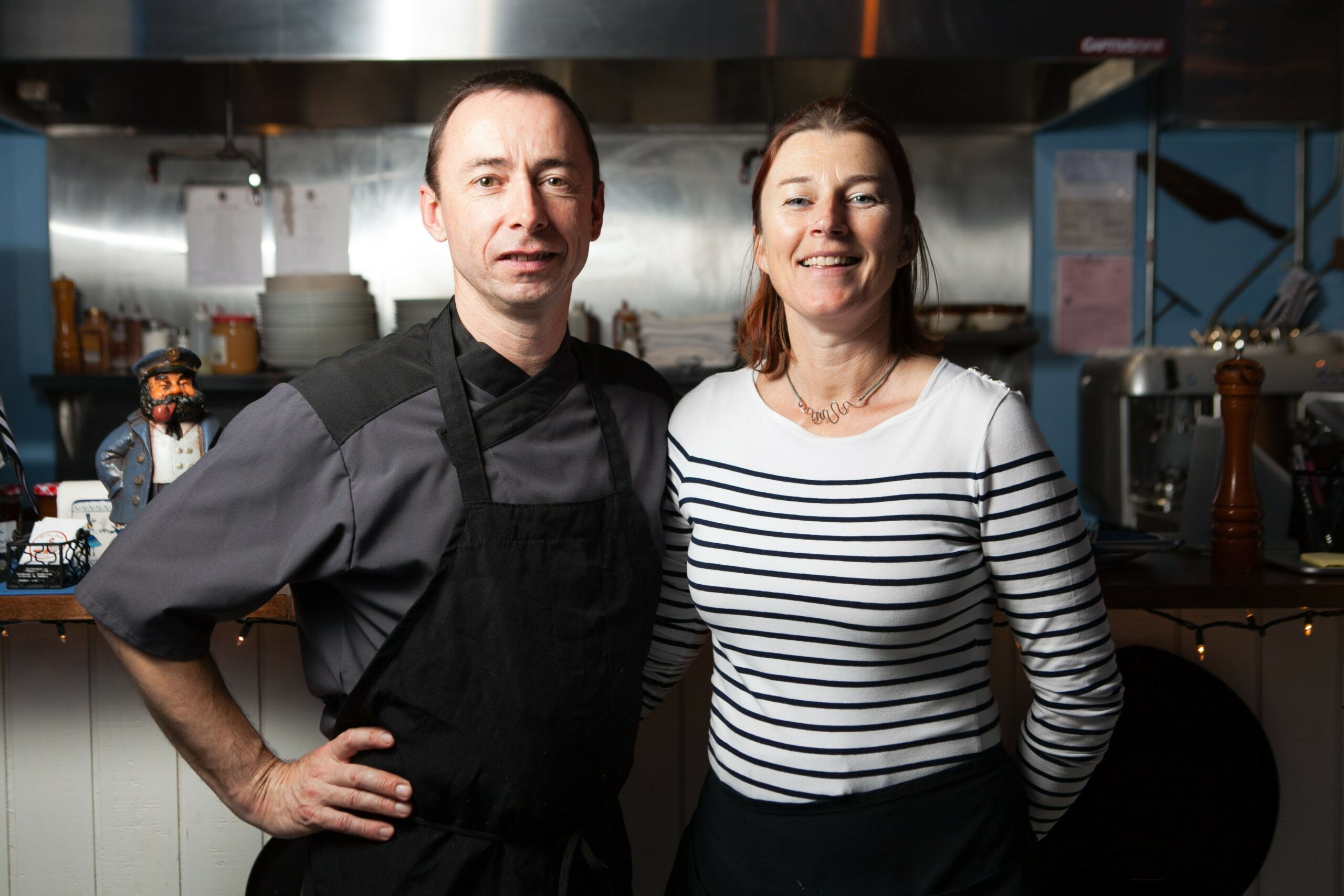
William Lue(center) and the chefs of Grocery Cafe.
Credits: File photo/Bert Johnson
In terms of what Burmese barbecue actually entails, think more along the lines of grilled meat skewers rather than the slow-smoked meats of the American South. Lue explained that the meats will be marinated with aromatics such as cilantro, shallots, lemongrass, and moringa. Tamarind is used as a souring agent instead of vinegar. And Lue said that if customers are receptive to it, he hopes to grill many of the innards and other offal cuts that are ubiquitous at Burmese street stalls — the snouts, gizzards, intestines, and such.
Lue said the construction of the outdoor barbecue area, which he hopes will be complete by April, is part of recent efforts to expand the Burmese offerings at Grocery Cafe. In a similar street food vein, he plans to designate Fridays as “Fry Days,” during which the restaurant will serve various fried street snacks, including one that Lue likened to Burmese-style ballpark garlic fries.
On the other end of the spectrum, the restaurant also recently started serving formal Burmese banquets, available with at least one day’s notice for groups of eight diners or more. For roughly $25 a person, diners can share eight family-style dishes, including several that aren’t on the regular menu — for instance, a Burmese seafood “cioppino.”
Banquet customers can bring their own beer or wine with no corkage fee, and sometimes, if Lue is in a particularly good mood, he’ll even pick up his accordion and play a few tunes. To our knowledge, no other Burmese restaurant in the Bay Area regularly offers this kind of banquet.
Baja by the Lake
East Bay fans of Baja-style fried fish tacos won’t find a much better version than the one served at Cholita Linda’s farmers’ market stands and its popular Telegraph Avenue restaurant. Now, you can add another brick-and-mortar location to the list: The owners of Cholita Linda plan to open their second branch in the old Burrito Shop location at 3256 Lakeshore Avenue.
That spot was the subject of some controversy last fall when The Burrito Shop’s owners, who occupied the location for nearly thirty years, were unable to persuade the landlord to renew their lease. At the time, the prevailing rumor was that the Peet’s next door was planning to expand into the space. That never came to fruition, and, as it turns out, Lakeshore will be home to a Mexican restaurant after all — though it will be fish tacos, not burritos, that will be the specialty of the house.
Co-owner Murat Sozeri said the basic setup of the restaurant will be the same as their Telegraph Avenue location, and that they plan to make at least one notable addition to the menu. Vanessa Chavez, the chef (and Sozeri’s wife), had been wanting to add Peruvian-style rotisserie chicken — aka pollo a la brasa — to the menu for quite some time, but decided that operating a rotisserie wasn’t feasible with their kitchen setup. Instead, both of the Cholita Linda locations will add a grilled chicken plate and grilled chicken sandwich to the menu, prepared using the same flavors as a traditional pollo a la brasa, but without the rotisserie.
If all goes according to plan, the new Cholita Linda will open in the late summer or early fall.
Farewell, Bun Mam
Sad news for fans of hard-to-find Vietnamese noodle soups: Bun Mam Soc Trang (1326 E. 18th St., Oakland), which, for my money, was the best Vietnamese restaurant in Oakland, has closed.
Co-owner Hien Tran, who ran the popular noodle shop, along with her mother Dieu Tran, said Bun Mam Soc Trang’s last day of business was December 21. Tran’s initial plan had been to take a brief year-end vacation — but then, without warning, her landlord delivered the unexpected news that the restaurant’s lease wouldn’t be renewed when it expired at the end of January. According to Tran, the landlord said the restaurant attracted too many customers for such a small space. Regardless, the Trans ultimately decided it wouldn’t make sense to reopen for only a few weeks.
Tran hopes to eventually reopen at a different East Bay location, but she said that, like many small business owners, she has found the current commercial real estate market to be daunting. Customers can visit BunMamSocTrang.com — for now just a placeholder website — for updates.
Most people recognize the Berkeley Art Museum and Pacific Film Archive building as the old monolithic beast on Bancroft Way and College Avenue. The imposing, concrete hull is a quintessential piece of brutalist architecture. Inside, heavy cantilevers jut into the building’s central atrium, connected with ramps to create a spiral incline of gallery spaces. From any given vantage point, the collage of concrete slabs evoked a desaturated painting by Hans Hoffman — the influential Abstract Expressionist who planted the seed for BAMPFA in 1963 when he donated 45 paintings and $250,000 to UC Berkeley for a new art gallery.
The Ciampi building, as museum staff used to call it, in reference to its architect Mario Ciampi, housed BAMPFA from 1964 through 2014, during which time it presented solo exhibitions for such seminal artists as Chuck Close, Robert Mapplethorpe, Jay DeFeo, and Bruce Nauman. But for more than a decade, museum administrators knew the Ciampi building was seismically unsound, and it was eventually shuttered at the end of 2014. After a year-long transition, BAMPFA will reopen its doors on January 31 in its sleek new facility at 2155 Center Street (at Oxford Street).
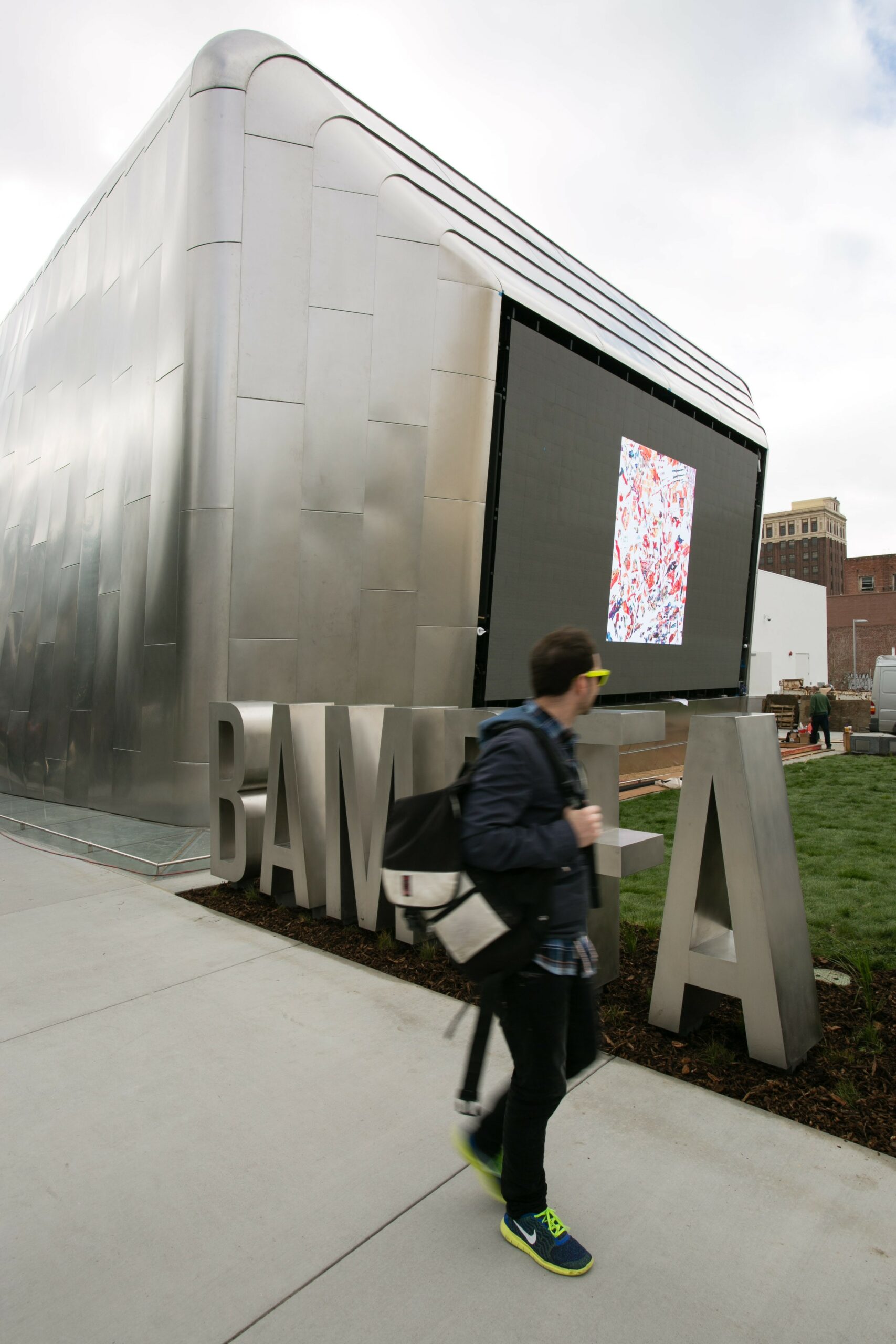
The museum’s outdoor LED movie screen.
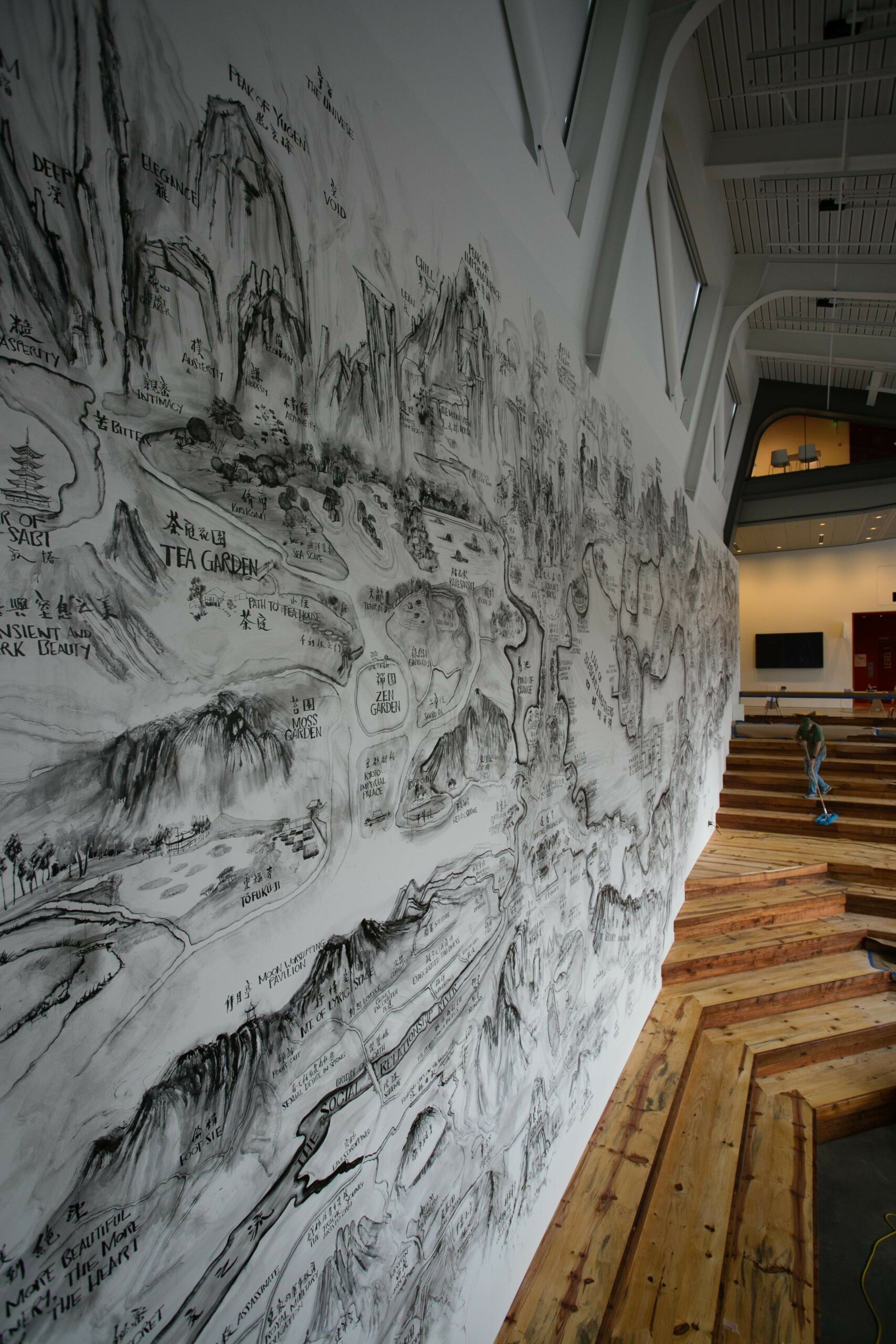
Credits: Bert JohnsonA site-specific mural by Qiu Zhijie above the amphitheater designed by Paul Discoe.
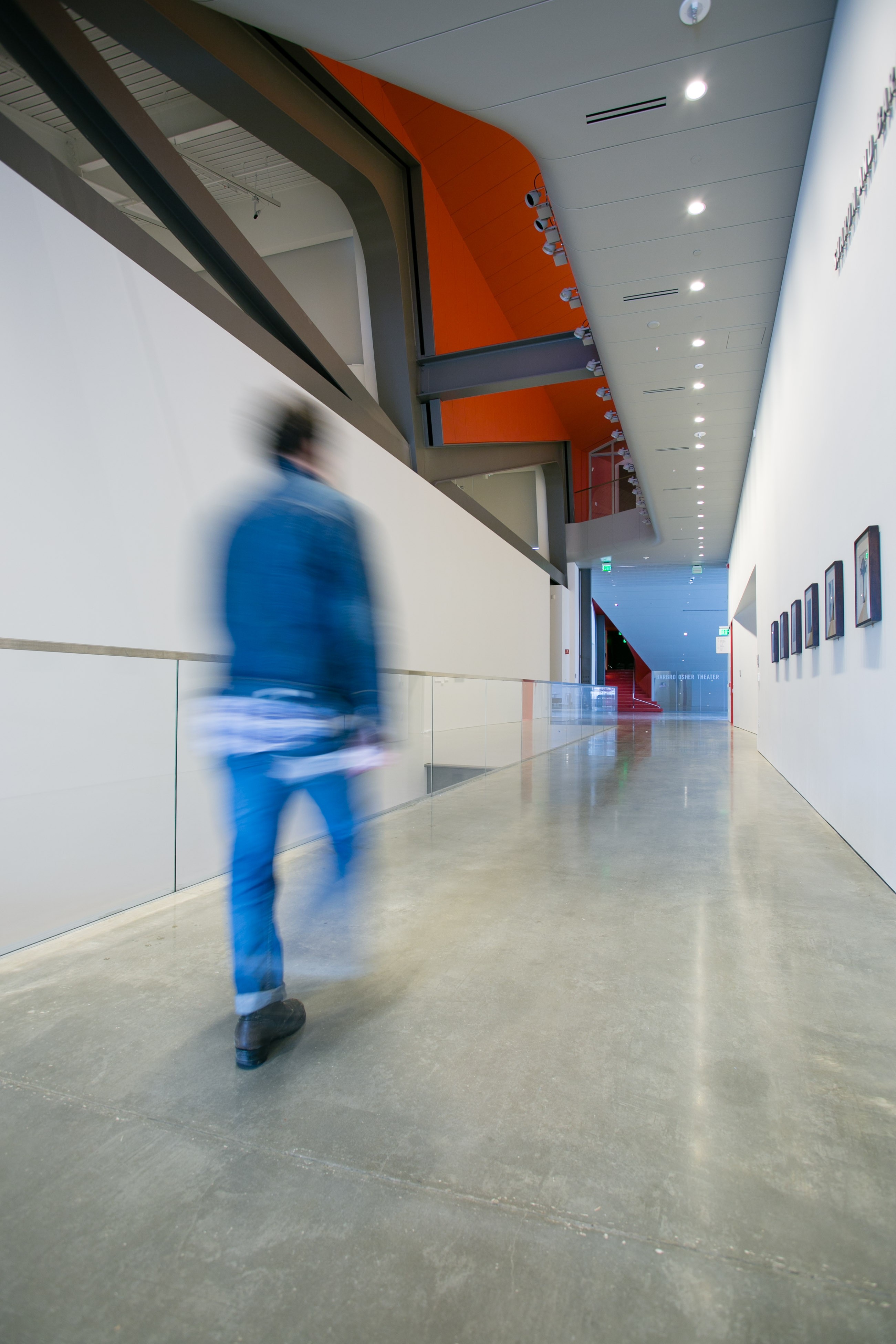
Credits: Bern JohnsonInside the new BAMPFA.
Credits: Bert Johnson
BAMPFA’s new site, an 82,670 square-foot building by esteemed New York City design partners Diller Scofido + Renfro, looks partially like a biomorphic space shuttle. While the south end, which is a renovated printing plant that was built in 1939, appears traditionally rectangular, the expansion on the north end slopes off the original structure like a graceful, metallic exoskeleton. The slope culminates in a futuristic face — a thirty-foot-wide LED screen facing outward. Equipped with a Meyer Sound system of directional speakers, the screen will work to both draw in the public with artistic teasers and entertain them outside with open air cinema, rendering the boundaries of the museum newly porous.
Architects don’t often attain celebrity status, but Diller Scofido + Renfro comes pretty close. The firm’s past projects include the first mile of New York City’s High Line and the new Broad museum in Los Angeles. Later this year, the firm will unveil its expansion of the Museum of Modern Art, also in New York City. BAMPFA’s new building holds up to the reputation. The interior contrasts Ciampi’s elemental simplicity with a dynamic orchestra of angular spaces created by dramatic meetings of brick red and white — the only two colors used in the building, besides its metallic accents.
Although the new site is technically smaller in square footage than the previous one, it feels far more expansive. (That’s partially due to the museum moving most of its storage offsite.) The galleries maintain the factory feel of the printing plant, with concrete floors and high, vaulted ceilings. They’re made up of straightforward white walls that can be reconfigured for different exhibitions, which BAMPFA director Larry Rinder said will allow curators much more freedom with installation than they previously enjoyed in the Ciampi building. With all temporary walls out of the way, the biggest gallery can be as large as 10,000 square feet.
The new building’s entrance opens to a massive wall where the museum will host an ongoing series of commissioned mural projects — the first is by renowned Chinese artist Qiu Zhijie.
Below it, an amphitheater designed by celebrated local wood joinery craftsman Paul Discoe and made from pine trees cut down during the site’s construction welcomes visitors with performances and lounging opportunities. The museum’s film library, which was once an obscured closet-like space, is now a spacious study center with more than 300,000 film-related documents and ephemera. The facility also has an experimental fiction and poetry reading room, and study centers for scholars in three other fields: works on paper, Asian art, and conceptual art. An all-ages art lab has been added as well, for regular hands-on art workshops. And a digital engagement touchscreen will allow visitors to easily peruse the museum’s entire collection. Babette, the museum’s beloved cafe, inhabits the peak of the building, in a futuristic cove lit by a towering, triangular window.
Credits: Bert Johnson
But the building’s best new element is the 232-seat Barbro Osher Theater, which will feature the majority of BAMPFA’s treasured film programming, replacing the converted UC Berkeley lecture hall that the museum once used. It boasts top-of-the-line technology, including a Meyer Sound System and the ability to screen in virtually any film format, as well as a stage for live musical accompaniment. There is also a smaller theater, just 33 seats, for research and special viewings.
As one of the country’s foremost film archives, BAMPFA will finally be able to showcase its collection with the facilities it deserves — and in a space not annexed from the art. It’s clear from the bright marquee above the entrance that the institution is ready to bring film to the forefront of its programming. Plus, museum visitors may as well stay for a film, because tickets to the theater provide access to the galleries, but not the other way around.
The first film series in the new theater will be Cinema Mon Amour, which will highlight classics from throughout film history presented by both local and international filmmakers, scholars, and critics. The series will inaugurate the theater on February 3 with Ingmar Bergman’s The Seventh Seal, chosen and presented by Barbro Osher herself. This year will also feature retrospective series for directors Nuri Bilge Ceylan, Jean Epstein, Lucrecia Martel, Nicholas Ray, and many others.
In the galleries, the first show will be the Architecture of Life, a survey of architectural works that reflects on structure as a metaphor for life experience and the ability for design to shape the social reality of the world we live in. The exhibition features work that spans a timeline of two millennia and originates from all over the world. And it’s explicitly a celebration of the museum’s new architectural artifact, prompting visitors to take in the new building not only as a facility, but also as the largest addition to the museum’s collection — itself a piece of art.
Trains carrying crude oil produced from Canadian tar sands may soon be traveling through the Bay Area and along the California coast, thereby posing serious risks to human health, wildlife, and the environment. Two planning commissions — one in Benicia and the other in San Luis Obispo County — have scheduled votes for early February to decide the future of the planned crude-by-rail projects. At the same time, environmental groups are going ahead with a lawsuit that seeks to stop a related project in the Bay Area.
A vigorous opposition movement — in the East Bay and throughout the state — is now focusing on San Luis Obispo County. There, Phillips 66 is seeking permission to build a rail spur connecting its Nipomo refinery to rail lines running from the Bay Area south along the California coast. The trains would carry crude oil from Canadian tar sands — and possibly highly explosive Bakken crude fracked in North Dakota — on rail lines that go through the East Bay and then south to the San Luis Obispo refinery for preliminary processing. The oil would then travel back up to the East Bay by pipeline to the Phillips 66 plant in Rodeo for further refining.
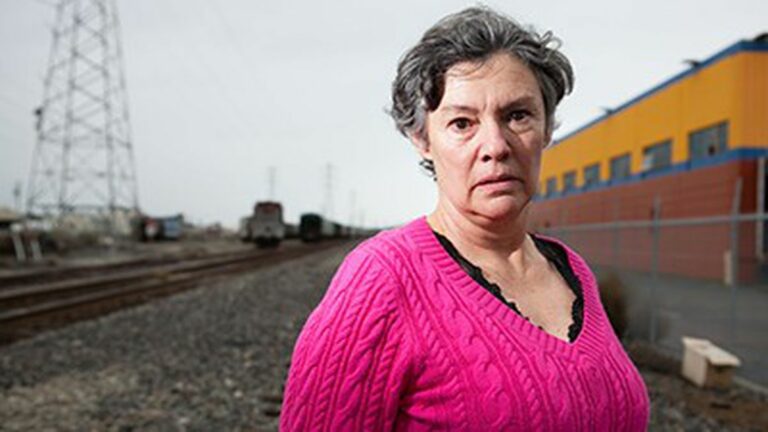
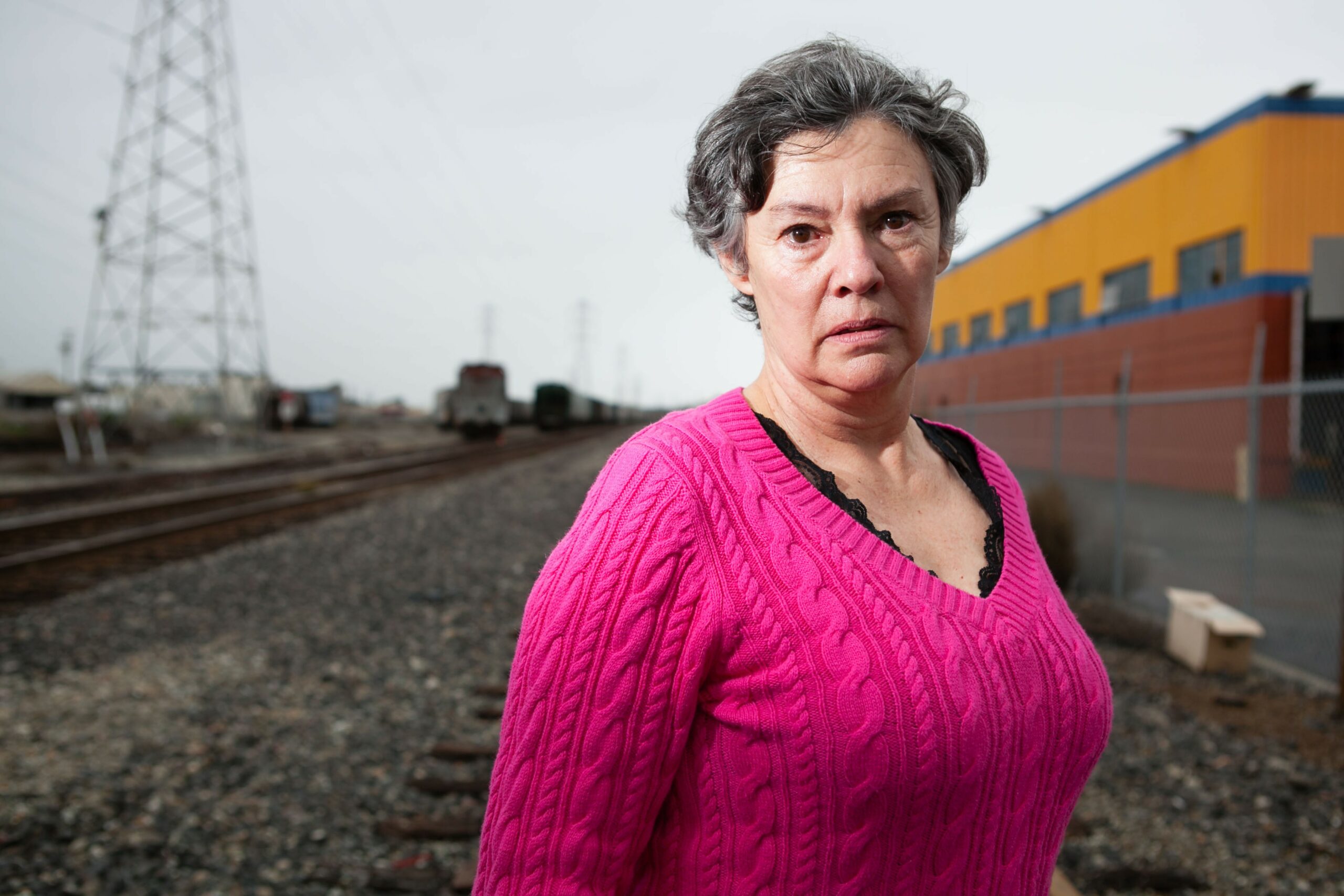
Maureen Forney.
Credits: Bert Johnson
Valerie Love, an Oakland-based clean-energy campaigner for the conservation group Center for Biological Diversity (CBD), said opposition to the San Luis Obispo rail project “started in a retirement community next to the refinery, when they realized it would be a huge offloading facility.” Love said that when the first public report on the project came out in November 2014, “residents sounded the alarm, wrote lots of letters, retained lawyers, and met with people from CBD, the Sierra Club, and other organizations. We said, ‘We’re going to make this a statewide issue. It’s going to affect everybody up and down the rail lines in California.'”
In the past few years, the alarming increase in derailments, fires, and explosions of oil trains have increased public awareness of the dangers of carrying crude by rail. A derailment last week of three train cars carrying sulfuric acid in Martinez underscored this concern.
Oakland resident Beth Kean, a retired staffer for the California Nurses Association (CNA), said that when she heard about the Phillips 66 plan, she realized “it was an issue” for Oakland, Berkeley, Richmond, and other bayside cities where rail lines pass through residential areas. Kean ended up spending most of her time from April to November 2015 working as a volunteer organizer in San Luis Obispo County.
San Leandro teacher Maureen Forney said that in December 2014, she was attending a meeting of her local school board, listening to a presentation about disaster planning, when she had an epiphany about the crude-by-rail plan. “I thought, ‘Holy Cow! What if there was an explosion or firestorm? I’m responsible for the children! What would I do?'”
So she brought up the issue in that very meeting. The school district, the city of San Leandro, and the local union all subsequently took stands opposing the project. “Then it gathered momentum,” Forney continued. “Union after union, school board after school board said, ‘This is not healthy for children or the community.’ So many children and schools are endangered. It’s a real threat.”
The Center for Biological Diversity published a report last September, showing that more than 1 million children — 250,000 in the East Bay — attend school within one mile of a current or proposed oil train line. Another environmental organization, Forest Ethics, published a map showing areas that would be in an “oil train blast zone” if there were an explosion.
In the East Bay, a dozen school boards, including Oakland Unified and Peralta Community College districts, passed resolutions or sent letters opposing the project. The Berkeley, San Leandro, Oakland, and Fremont city councils followed suit, as have local and statewide teachers and nurses unions, the National Education Association, and the Alameda County Public Health Department. Opponents held a statewide day of local actions against oil trains last July, and East Bay residents traveled to San Luis Obispo for “canvassing weekends” to build local opposition. The county received more than 23,000 comments, almost all opposing the project.
San Luis Obispo County Supervisor Adam Hill said the issue “has probably received as much attention as any project I can remember. The opposition group has been able to mobilize people throughout the county concerned about rail safety and climate change.
“It’s rare that any of our land-use decisions reverberate like this,” he continued. “I think [the statewide concern] is valid. I will certainly take it into consideration.”
Organizer Kean said that until statewide opposition developed, “a lot of people didn’t know they were in the hot seat about this decision. We said, ‘You’re the only group that has the authority to stop it.’ That led to a switch in how people thought about how important it was for them to be involved.
“Phillips 66 is number six on the Fortune 500,” Kean added. “This is a small county. For them to stand up to Phillips 66 requires a lot of support.”
When I called Amber Johnson, the campaigner whom Phillips 66 hired to promote the project, she referred me to the company’s website. The rail spur, according to the website, is needed to help the refinery, with its two hundred jobs, “remain viable” as the supply of California crude oil declines. “The proposed rail project is designed with safety as the top priority,” the description continued. “Every railcar used to transport crude in our fleet exceeds current regulatory safety standards.”
The San Luis Obispo County Planning Commission will hold its hearing on the project on February 4. Environmental organizations are arranging carpools for Bay Area residents to travel to the hearings, coordinated by the Sierra Club’s organizer Ratha Lai.
The following week, on February 8, the Benicia Planning Commission will review the Valero refinery’s proposal for a similar rail spur in that city. There, too, company officials have announced plans to bring in crude from both Canadian tar sands and Bakken fracking operations. The group Benicians for a Safe and Healthy Community, which was organized to fight the project, has waged a long campaign similar to the one in San Luis Obispo.
In addition, Communities for a Better Environment (CBE) and other groups have filed a lawsuit against Contra Costa County for approving a proposed project at the Phillips 66 refinery in Rodeo. The suit charges that the county’s environmental review illegally considered the project separately from the Nipomo plan in San Louis Obispo County, even though Phillips 66 considers the two plants part of the same refinery. CBE has also submitted a technical analysis challenging the company’s data and its denial that the project will mean refining tar sands oil. A hearing on the suit is expected in late spring.
Opponents of all these projects cite the dangers posed by tar sands oil to the climate as well as to the health and safety of people who live near railroad tracks and refineries. San Leandro teacher Forney noted that despite the urgent need to keep fossil fuel in the ground in order to prevent catastrophic climate change, “there’s a huge push to get these products to market.” But she said people can block this push by “doing something about the offloading and processing facilities.”
She added that oil companies have “$7 trillion worth of assets under development. They will not go down without a fight. This is the fight.”
It’s standard order for French restaurants in the United States to fashion themselves after the kind of place you might find in France — say, that little bistro you remember from your vacation in Paris all those years ago. Brittany Crepes, a new creperie in West Berkeley, checks off more boxes than most. There is, of course, the misty-eyed accordion music and the flower-lined faux balcony. The walls are painted in that particular shade of baby blue. And during my visits, I seemed to be the only person in the room who wasn’t speaking French.
All in all, it’s not quite what you might expect to find at a place that sits next to a copy store and a real estate office in a no-man’s-land stretch of University Avenue, halfway between the posh boutiques of Fourth Street and the hub of diverse restaurants clustered around San Pablo Avenue. The restaurant sits in the space formerly occupied by Wrap N Roll, a quick-service lunch spot known for its gyros and kathi rolls, but I barely recognized it.
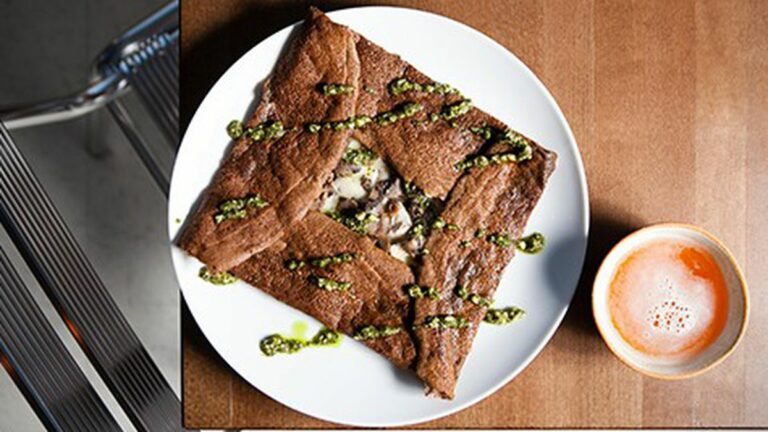
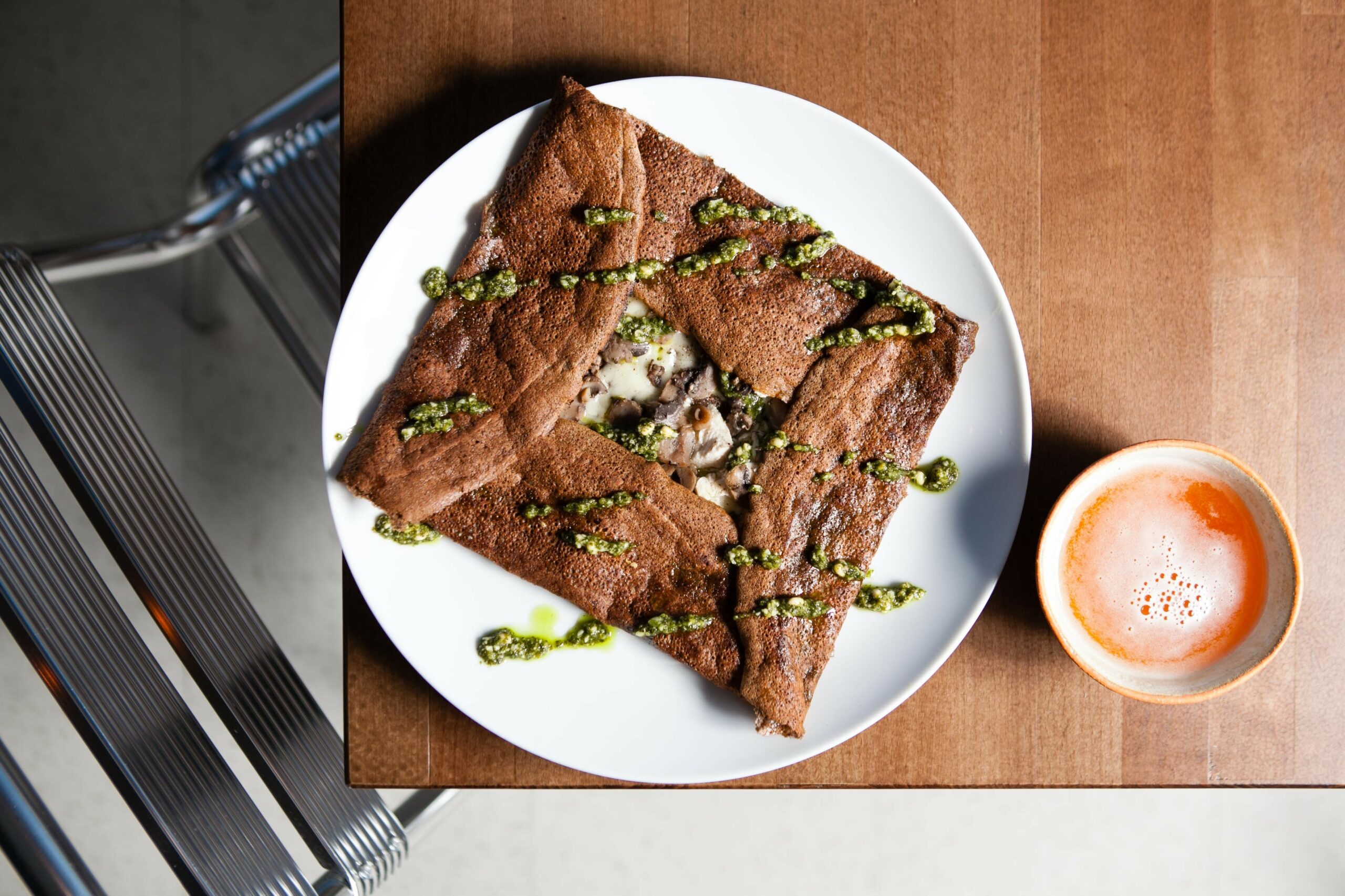
A chicken pesto galette with a bolée of French cider on the side.
Credits: Bert JohnsonLaurent and Carole Le Barbier.
Credits: Bert Johnson
Mainly, though, it’s the food that will transport diners to the northwestern coast of France — to the small village of Arradon, where husband-and-wife co-owners Laurent and Carole Le Barbier lived before moving to the United States twenty years ago. In 2006, the couple opened Brittany Crepes as a mobile food and catering business that has since become a fixture at Bay Area farmers’ markets, but their cozy Berkeley storefront — for now, only open for dinner — is their first brick-and-mortar restaurant.
Most of the other creperies I’ve encountered in the Bay Area have chosen to go the Cal-fusion route, committing the same kinds of atrocities that, say, California Pizza Kitchen has been inflicting on thin-crust pizza for years. Grilled tofu crepe, anyone? There is (maybe) a time and a place for that kind of thing. After all, as Laurent, the main chef, explained, even in France there aren’t really any rules when it comes to crepes. When he was growing up, his parents and grandparents would fill the buckwheat galettes they made at home with whatever leftovers they had on hand. Any kind of meat or fish would do.
But by and large, Brittany Crepes sticks to the ingredients you’d find at a traditional creperie in Brittany. Start with the batter itself, which for the galettes, or savory crepes, is made with a buckwheat flour batter that is characteristic of the Breton style — it’s both dairy- and gluten-free, Laurent noted. The buckwheat batter yields a heartier, slightly nuttier flavor than a wheat-flour crepe, and each brown pancake is served folded at the edges to form a kind of square-shaped envelope, with the center open so you can see the filling. The galette filled with ham and melted Emmentaler cheese was one of those quintessential French meals: simple but very satisfying. Get it topped with a fried egg to make it a “complète.” During another visit, I was in the mood for something a little bit more elaborate, so I ordered the L’Armoricaine, which was topped with sautéed sea scallops and leeks that had cooked slowly in butter until they were soft — another classic French combination. The deeply savory leeks were a great complement to the mild ocean funk of the shellfish.
And my favorite galette, La Campagnarde, was filled with chicken, mushrooms, cheese, and a basil pesto — the one less obviously French ingredient (though, of course, what the French call pistou is a popular condiment in southern France). I liked this one best because the pesto added an extra element of savoriness and moisture, because, if the galettes at Brittany Crepes have a flaw, it’s that they tend to be a bit dry — probably a result of the cook’s tendency to put a lot less butter on the griddle than they do in France. Laurent doesn’t use butter at all at his farmers’ market stands in an effort to appeal to health-conscious Californians. But he said customers at the restaurant, which he wanted to be more traditionally French, can always ask for more. Next time, I will.
Otherwise, everything about the place is about as French as it gets — not just the ambience and decor, but also the Krampouz heavy-duty cast-iron crepe griddles that just about every serious creperie in France has, and the wide ceramic bowls, or bolées, that are used to serve good French cider — the traditional beverage to accompany a meal of galettes and crepes.
In addition to the galettes, Brittany Crepes offers a very concise menu of other savory options, the highlight of which is a charcuterie board that includes some excellent duck rillettes and pate de campagne made by Fabrique Delices, a Hayward-based company.
I wish I could say the same about the two soups that I tried, both of which were vegetarian. The vegetable soup du jour is always some kind of vegetable purée (of leeks or broccoli, for instance), but on the night I ordered it, it tasted more like a lightly flavored onion water — severely undersalted and served scalding hot, so I couldn’t even slurp it down quickly and move on. The French onion soup, on the other hand, arrived at the table lukewarm. This was presented in the traditional way, topped with a thick slice of baguette and a metric ton of stretchy, partially-browned Emmentaler cheese, but there was no savory element to balance the overwhelming sweetness of the caramelized onion base. A hearty beef broth — or, at the very least, a big pinch of salt — would have helped.
Seasoning issues aside, it’s nice to have a place where you can enjoy this kind of simple, unpretentious French meal. And of course, at any creperie worth its salt — or, ahem, sugar — you wouldn’t even think to skip dessert. The sweet crepes are made with a flour batter and are more akin to what most Americans know and recognize as a crepe — very thin and tender on the inside, with curled edges that offer a hint of crispness. The more elaborate dessert combinations, filled with caramelized apples and such, will fight for your attention. But you can’t go wrong with the simple butter-and-sugar Bretonne, with an optional squeeze of lemon juice. It makes for the perfect sweet ending to the meal, especially if you wash it down with one of the restaurant’s well-pulled espressos — another real rarity as far as Bay Area restaurants go.
Even viewed in the most optimistic light, Brittany Crepes’ location is less than ideal. The recent spate of wet, chilly weather probably didn’t help, but during my visits there was no foot traffic to speak of, and most cars zoomed right past en route to the Interstate 80 onramp.
Still, despite the glum optics of a mostly empty dining room, it’s easy to imagine how the place might grow into the kind of bustling French cafe that East Bay Francophiles have been waiting for. After all, readers are always asking me to recommend a place where they might sit down and share a dessert in the evening, after all the bakeries and coffee shops have closed. Why couldn’t Brittany Crepes be that place? Especially with its aura of romance — the candles and fresh flowers at every table, the sound of French being spoken all around you. For now, anyway, the place still feels like an undiscovered secret.
Aries (March 21–April 19): Do you know Emily Brontë’s novel Wuthering Heights? At one point, the heroine Catherine tells her friend about Edgar, a man she’s interested in. “He wanted all to lie in an ecstasy of peace,” Catherine says, “and I wanted all to sparkle and dance in a glorious jubilee. I said his heaven would be only half alive; and he said mine would be drunk: I said I should fall asleep in his; and he said he could not breathe in mine.” If you’re a typical Aries, you’re more aligned with Catherine than with Edgar. But I’m hoping you might consider making a temporary compromise in the coming weeks. “At last, we agreed to try both,” Catherine concluded, “and then we kissed each other and were friends.”
Taurus (April 20–May 20): People turn to you Tauruses for help in staying grounded. They love to soak up your down-to-earth pragmatism. They want your steadfastness to rub off on them, to provide them with the stability they see in you. You should be proud of this service you offer! It’s a key part of your appeal. Now and then, though, you need to demonstrate that your stalwart dependability is not static and stagnant — that it’s strong exactly because it’s flexible and adaptable. The coming weeks will be an excellent time to emphasize this aspect of your superpower.
Gemini (May 21–June 20): When winter comes, pine trees that grow near mountaintops may not be able to draw water and minerals from the ground through their roots. The sustenance they require is frozen. Luckily, their needle-like leaves absorb moisture from clouds and fog, and drink in minerals that float on the wind. Metaphorically speaking, Gemini, this will be your preferred method for getting nourished in the coming weeks. For the time being, look up to obtain what you need. Be fed primarily by noble ideals, big visions, divine inspiration, and high-minded people.
Cancer (June 21–July 22): We all go through phases when we are at odds with people we love. Maybe we’re mad at them, or feel hurt by them, or can’t comprehend what they’re going through. The test of our commitment is how we act when we are in these moods. That’s why I agree with author Steve Hall when he says, “The truest form of love is how you behave toward someone, not how you feel about them.” The coming weeks will be an important time for you to practice this principle with extra devotion — not just for the sake of the people you care about, but also for your own physical, mental, and spiritual health.
Leo (July 23–Aug. 22): After fighting and killing each other for years on end, the Roman and Persian armies agreed to a truce in 532 AD The treaty was optimistically called “The Endless Peace.” Sadly, “endless” turned out to be just eight years. By 540, hostilities resumed. I’m happy to announce, though, that your prospects for accord and rapprochement are much brighter. If you work diligently to negotiate an endless peace anytime between now and March 15, it really is likely to last a long time.
Virgo (Aug. 23–Sept. 22): “I shiver, thinking how easy it is to be totally wrong about people, to see one tiny part of them and confuse it for the whole.” Author Lauren Oliver wrote that, and now I’m offering it to you, just in time for your Season of Correction and Adjustment. The coming weeks will be a favorable time for you to get smarter about evaluating your allies — and maybe even one of your adversaries, as well. I expect you will find it relatively easy, even pleasurable, to overcome your misimpressions and deepen your incomplete understandings.
Libra (Sept. 23–Oct. 22): In June 1942, the US Navy crushed Japanese naval forces at the Battle of Midway. It was a turning point that was crucial to America’s ultimate victory over Japan in World War II. One military historian called it “the most stunning and decisive blow in the history of naval warfare.” This milestone occurred just six months after Japan’s devastating attack on U.S. forces at Pearl Harbor. To compare your life to these two events may be bombastic, but I’m in a bombastic mood as I contemplate your exciting possibilities. I predict that in the second half of 2016, you’ll claim a victory that will make up for a loss or defeat you endured during the last few months of 2015. And right now is when you can lay the groundwork for that future triumph.
Scorpio (Oct. 23–Nov. 21): Playwright Edmond Rostand (1868-1918) had a lot of friends, and they often came to visit him uninvited. He found it hard to simply tell them to go away and leave him alone. And yet he hated to be interrupted while he was working. His solution was to get naked and write for long hours while in his bathroom, usually soaking in the bathtub. His intrusive friends rarely had the nerve to insist on socializing. In this way, Rostand found the peace he needed to create his masterpiece Cyrano de Bergerac, as well as numerous other plays. I suggest you consider a comparable gambit, Scorpio. You need to carve out some quality alone time.
Sagittarius (Nov. 22–Dec. 21): “I opened my mouth, almost said something. Almost. The rest of my life might have turned out differently if I had. But I didn’t.” The preceding reminiscence belongs to a character in Khaled Hosseini’s novel The Kite Runner. I bring it up in hopes that you will do the opposite: Say the words that need to be said. Articulate what you’re burning to reveal. Speak the truths that will send your life on a course that’s in closer alignment with your pure intentions.
Capricorn (Dec. 22–Jan. 19): According to some traditional astrologers, you Capricorns are vigilant to avoid loss. Old horoscope books suggest that you may take elaborate measures to avoid endangering what you have accumulated. To ensure that you will never run out of what you need, you may even ration your output and limit your self-expression. This behavior is rooted in the belief that you should conserve your strength by withholding or even hiding your power. While there may be big grains of truth in this conventional view of you Capricorns, I think it’s only part of the story. In the coming weeks, for instance, I bet you will wield your clout with unabashed authority. You won’t save yourself for later; you’ll engage in no strategic self-suppression. Instead, you will be expansive and unbridled as you do whatever’s required to carry out the important foundation work that needs to be done.
Aquarius (Jan. 20–Feb. 18): “It seems that the whole time you’re living this life, you’re thinking about a different one instead,” wrote Latvian novelist Inga Abele in her novel High Tide. Have you ever been guilty of that, Aquarius? Probably. Most of us have at one time or another. That’s the bad news. The good news is that the coming months will bring you excellent opportunities to graduate forever from this habit. Not all at once, but gradually and incrementally, you can shed the idea that you should be doing something other than what you’re doing. You can get the hang of what it’s like to thoroughly accept and embrace the life you are actually living. And now is an excellent time to get started in earnest on this project.
Pisces (Feb. 19–March 20): “Even nightingales can’t be fed on fairy tales,” says a character in Ivan Turgenev’s novel Fathers and Sons. In other words, these marvelous birds, which sing sublimely and have long been invoked by poets to symbolize lyrical beauty, need actual physical sustenance. They can’t eat dreamy stories. Having acknowledged that practical fact, however, I will suggest that right now you require dreamy stories and rambling fantasies and imaginary explorations almost as much as you need your daily bread. Your soul’s hunger has reached epic proportions. It’s time to gorge.
Interdisciplinary artist Sarah Biscarra Dilley’s family are descendants of the Chumash people, a Native-American tribe that once populated Southern California’s coast near modern-day Santa Barbara. The Spanish invasion decimated the Chumash population, and the last native speaker of its last surviving language, Smuwic, died in 1965. For Biscarra Dilley, learning about her people’s culture and native tongue took digging. She discovered information about her family tree through anthropological archives, referring to her great-grandmother’s stories to navigate her research.
“[Archives are] kind of how our representation as people of color in any sort of canon has been allowed to be present,” she said in a recent interview. “It’s this kind of fixed, outsider read on our communities.”
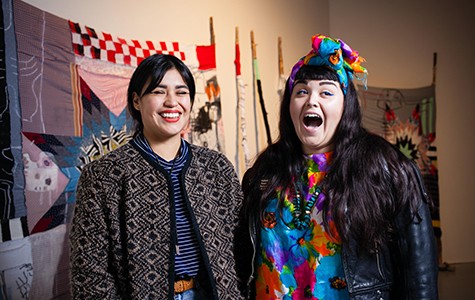
Grace Rosario Perkins (L) and Sarah Biscarra Dilley are members of the Black Salt Collective.
Credits: Bert Johnson
Given that Western anthropology was once inextricably tied to colonialism, ethnographic archives have long been a tool for constructing the concept of the cultural and racial “other” from a white, Eurocentric point of view. This concept is something the Black Salt Collective — of which Biscarra Dilley is a member — brilliantly subverts with its exhibition, Visions into Infinite Archives. The show features the work of Biscarra Dilley and fellow Black Salt artists Grace Rosario Perkins, Anna Luisa Petrisko (aka Jeepneys), and Adee Roberson, as well as dozens of other interdisciplinary artists of color from different parts of the country — particularly those with indigenous, Black, and Latino backgrounds.
The works in Infinite Archives are rooted in cultural history, but are also very contemporary. The artists put elements of their ancestry in dialogue with their lived experiences through inventive juxtapositions, many offering visions of utopian futures.
The exhibit also playfully embraces qualities that might conventionally be negatively perceived. Many of its works are made from ephemeral materials (resisting the archive altogether), while others incorporate crafting techniques, such as weaving and quilting, which the fine art world has traditionally rejected. There’s evidence of glue and tape marks in Biscarra Dilley’s collages of fragmented desert landscapes. And there are uneven stitches and messy, feverish scrawl in Natalie Ball’s quilt piece, “Incident at Fort Klamath,” which takes inspiration from the last armed resistance of the Modoc people of Northern California and Southern Oregon in the 1870s. Jeepneys created a large-scale, neon sculptural installation in collaboration with some times, incorporating video of one of her previous performances that examined Filipino culture and servitude, despite the fact that she had initially deemed the performance unsuccessful. The piece is one of the most commanding in the show, and its element of self-reflection adds layers of meaning.
Rather than presenting the work tidily, Infinite Archives is boisterous and loud. Its intention, Biscarra Dilley said, is to reimagine the archive as a “living, breathing” entity that adapts according to people’s lived experiences and celebrates diverse communities’ resilience. “We’re trying to shift that narrative by engaging an idea of an archive that is limitless and is born of our communities and ourselves, and is always changing.”
Correction: A previous version of this story neglected to state that Jeepneys’s sculptural installation is a collaboration with some times.
On July 10, 2013, an armed carjacker kidnapped Rolando Lucas’ youngest child. It happened in the blink of an eye. Lucas had pulled into a gas station at the corner of High Street and Foothill Boulevard in East Oakland. He parked his Honda Odyssey minivan beside a pump and walked with his eleven-year-old son to the station’s store to pay. His wife, Modesta Ramirez, waited in the front passenger seat as his six-year-old son sat in the rear seat of the van. Lucas’ twenty-month-old boy was sleeping in a child seat secured in the minivan’s middle row. Lucas paid for the gas, and as his oldest son worked the pump, he got back into the driver’s seat.
Court records describe what happened next: A man flung the driver’s side door open. Lucas turned and found himself staring down the barrel of a semi-automatic pistol. The gunman was eighteen-year-old Adriell Williams. Williams ordered Lucas out of the van at gunpoint. Ramirez screamed and reached behind the seats to rescue her baby. But Williams quickly jumped into the driver’s seat, pushing her out of the vehicle with the butt of his gun. Lucas’ six-year-old son scrambled out of the back passenger door as Williams turned the ignition. Lucas frantically yanked on the back passenger door handle to reach his youngest child, but the van’s doors automatically locked when the engine started. The baby was trapped inside as Williams sped away.
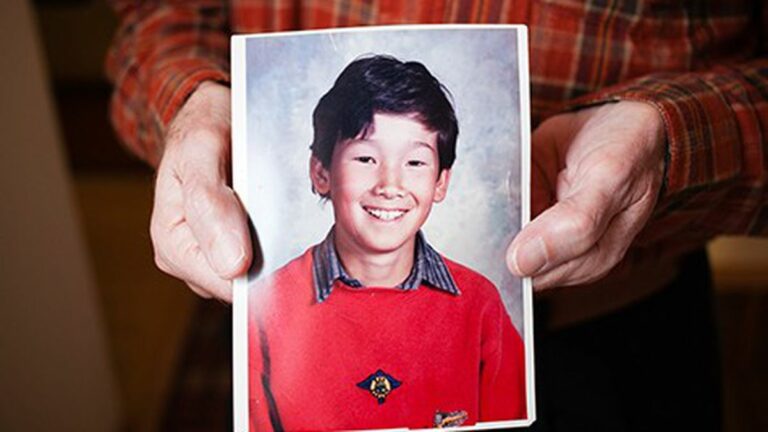
Kenzo Dix (shown in the photo) was accidentally shot and killed at a friend’s house at the age of fifteen.
Credits: Bert Johnson
Credits: Illustration by Roxanne Pasibe
US Postal Service investigators intercepted one of Edward Purry’s gun shipments on August 8, 2013.
The feds also intercepted Purry’s shipment of illegal magazines from Nevada to Oakland.
Griffin Dix, co-chair of the Oakland chapter of the Brady Campaign to Prevent Gun Violence, has studied ATF data and concludes that California’s firearm mortality rate has dropped faster than the national average thanks to the state’s strict gun control laws.
Credits: Bert Johnson
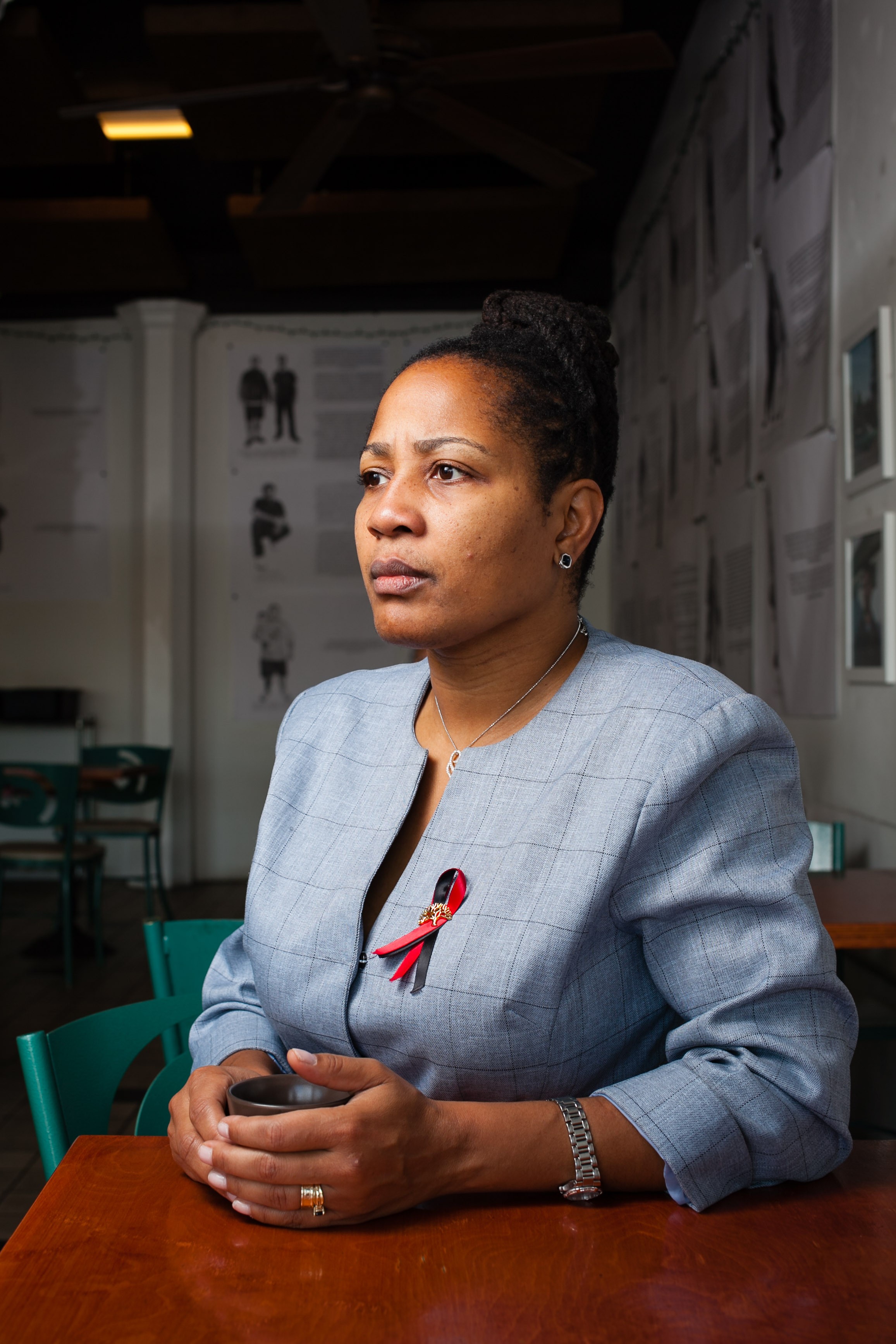
Oakland City Council President Lynette Gibson McElhaney lost her grandson to gun violence in December.
Credits: Bert Johnson
Thirty minutes later, an Oakland police officer found the baby, still in his child passenger seat, which was sitting on a sidewalk three blocks away. A jacket was covering the kid. Surprisingly, he was asleep and unharmed.
The next evening, Jose Perez was sitting in his parked car on 70th Avenue in East Oakland. Something moving in the rearview mirror caught his eye. He looked back and saw a man approaching, menacingly, gripping a pistol. Before he could react, the gunman, identified later in court as Adriell Williams — the teen who carjacked Lucas’ family the day before — pointed the weapon at Perez’s temple and yanked him from the driver’s seat. Williams swung the butt of the gun down into Perez’s scalp. As Perez stumbled backward from the blow, Williams jumped in the car and drove away.
Three weeks later, Oakland police officers Joel Ruiz and Billy Matthews responded to a call concerning three men who appeared to be casing an East Oakland taco truck and preparing to rob it. The caller saw handguns tucked into their pants. When Ruiz and Matthews got to the 5800 block of Bancroft Avenue, they spotted Adriell Williams and his associates. And Williams spotted the cops. All three took off running.
“I immediately noticed that the subject matching the description provided by dispatch began to hold his right hand into his right vest pocket,” Ruiz later wrote in a police incident report. “It was consistent with him holding a firearm.” According to Ruiz’s narrative: “A second subject was also holding his front waistband as if he was trying to hold an object in place. This action is consistent with a person holding a firearm in place while running. He was later identified as Adriell Williams.”
Ruiz chased the men on foot. Matthews followed in their police cruiser. When they captured Williams several blocks away, they found a Glock handgun that Williams had hastily discarded in a yard nearby. Twelve rounds were in the clip and one in the chamber. Officer Matthews said he recognized Williams as a suspect in the carjackings from earlier that month. Williams later pleaded guilty.
In the context of a city with a high-crime rate like Oakland, the offenses committed by Williams were not unusual. In the same week, there were six other carjackings in addition to the two committed by Williams. There were also 49 total robberies at gunpoint and nine assaults in which a firearm was discharged. Oakland’s streets are saturated with guns, and gun violence is a regular occurrence. There were 2,737 robberies at gunpoint and 469 shootings in 2013. In 2014 and 2015, firearms crimes have remained stubbornly common.
The fact that Williams used a gun to carry out the carjackings and robberies was also unremarkable. But there was one aspect to Williams’ crime spree that is worthy of closer attention: The Glock .40-caliber pistol that police officers recovered when they arrested Williams had recently been trafficked from Nevada through Oakland’s underground weapons market.
An Oakland gun trafficker had purchased the Glock from a licensed dealer outside of Las Vegas, and then illegally smuggled the weapon to Oakland, before selling it to Williams just a few weeks before his arrest. And around the same time that Williams was casing taco trucks, stealing minivans, and pistol-whipping his victims, a joint investigation by federal agents and the Oakland Police Department was zeroing in on the source of dozens of firearms that were turning up in shootings, robberies, and mayhem across the Bay Area — including the gun that Williams used in his crime spree. And the guns all led back to one gunrunner.
The story of how these weapons ended up in Oakland provides a window into the East Bay’s underground market for “hot” guns that are used frequently in robberies, assaults, and murders. But it’s also a tale that illustrates how California’s uniquely strong firearms regulations not only helped nail the gunrunner whose weapon was used to kidnap Rolando Lucas’ twenty-month-old boy, but also have succeeded in making it harder for felons to get their hands on guns.
Williams’s handgun was one of an estimated ninety pistols illegally trafficked into California by Edward Purry. In 2012, Purry was a California state-licensed bodyguard with a firearms permit working mostly in Oakland and Las Vegas. He claimed to have once worked security detail for boxing champ Floyd Mayweather, but his usual gig was guarding high-stakes gamblers toting cash around Las Vegas. In Oakland, Purry would sometimes ride along with big shipments of marijuana being delivered to cannabis dispensaries. He eventually hit upon the idea of buying guns in Nevada and re-selling them in the East Bay for a steep profit. The scheme would net him as much as $100,000, but it would also land him in prison.
In July 2013, Purry made several trips to Las Vegas to go gun shopping, and he purchased firearms at ten different gun stores. According to government records, he bought Springfield Armory .45-caliber handguns, Glock pistols ranging from 9mm to .45 caliber in size, and even a Brazilian manufactured Taurus .45-caliber pistol. All the weapons he bought were very popular and powerful. He then illegally shipped them back to California and sold them on the streets of Oakland.
On August 8, 2013, Purry was in Nevada browsing cases of weaponry at the Las Vegas Gun Range & Firearms Center and at a gun shop called Urban Civil Defense. Purry bought two Glock .357-caliber pistols and two Glock .40-caliber pistols. As he did with his previous purchases, he packaged the guns in a cardboard box and drove to a US post office in Henderson, a suburb of Las Vegas. In the return address field, Purry scribbled what he told police later was the first name that had popped into his head: Kenny Clutch, the Oakland rapper who was famously and gruesomely killed during a drive-by shooting on the Las Vegas Strip in February 2013. Purry used a Las Vegas PO Box as the return address for his gun shipment. He mailed the box of six handguns to a friend’s apartment on 73rd Avenue in Oakland.
Investigators later determined that Purry shipped nearly one hundred pistols from Nevada to California this way before federal agents and Oakland police finally caught up to him.
The trail to Purry began on August 8, 2013, when US Postal Service Inspectors intercepted a shipment containing six Glocks (US attorney spokesperson Natalie Collins declined to say how the inspectors knew to target the shipment). The postal inspectors then informed ATF agents about what they had intercepted. Around the same time, one of the gun dealers who had sold guns to Purry in Las Vegas became suspicious of him and contacted the ATF, according to Michael Delvecchio, assistant special agent in charge of the agency’s San Francisco Field Division. The ATF then obtained surveillance video of Purry walking up to the counter of the Henderson post office with the box that the postal inspectors later intercepted. ATF agents contacted Oakland police Captain Ersie Joyner to try to understand where the guns were being shipped to. Joyner is 25-year veteran of OPD who had noticed expensive new guns turning up on the streets and had wondered about their origin. He worked with the feds to unravel the case.
In addition to the six handguns intercepted on August 8, 2013, the postal inspectors also intercepted ten 13-round magazines for .40-caliber and .357-caliber Glock semi-automatic pistols and one 22-round, .40-caliber magazine. California prohibits the importation and possession of gun magazines with a capacity greater than ten rounds. California also requires anyone transporting guns into the state to register them with the state attorney general. And Purry was selling the weapons on the street in undocumented sales, which is also a state crime. But the most pivotal crimes committed by Purry were federal: lying on federal dealer paperwork that he resided in Nevada in order to obtain nearly one hundred guns. On October 2, 2013, federal agents arrested Purry.
In an interrogation conducted by ATF agents Roger Martin and Ernesto Diaz, Purry admitted to making at least ten shipments of firearms from Las Vegas to Oakland, public records show. Purry told the agents he liked to fly to Las Vegas and play craps. He said that on some days, he bet upwards of $10,000 and won. Sometimes, he lost. He frequented the Sunset Station, an off-strip casino and hotel. And on each trip, Purry bought pistols, mostly .40- and .45-caliber Glocks, similar to what many police officers carry. After dropping boxes of guns off at the Henderson post office, Purry would board a plane and fly back to Oakland. In Oakland, he would pick up his arms shipments and begin marketing the guns at double their retail price.
At first, Purry told the agents questioning him that his sole customer was an impeccably dressed Mexican man named Pablo who had a “full Rick Ross beard” and drove a Mercedes CLS. “He always is looking suave,” said Purry during a recorded interrogation, “like he was going out, or he was going to a business meeting or something.” The skeptical agents asked Purry if Pablo was a member of a drug cartel. Purry said he had no idea. And he claimed his connection to Pablo came about by accident.
ATF agents then used the classic good-cop-bad-cop strategy to squeeze a confession out of Purry. Agents initially told him that if he provided information to get the guns off the streets, they would recommend that federal prosecutors in Nevada reduce the number of charges against him, shaving years off the time he was facing in prison. But Purry told the investigators that he assumed the pistols had been shipped by the mysterious Pablo to Mexico, and that he had no further information to give them. Sensing Purry was holding out, the feds ratcheted up the pressure.
“Here’s the concern I got,” Special Agent Diaz told Purry. “You may think the guns are going to Mexico, but guess what? They’re not.”
“They’re staying in Oakland,” said Special Agent Martin.
“They’re showing up in shootings in Oakland,” said Diaz. “And it’s on you. So you’d better come up with more information on Pablo, other than he buys everything and he’s about whatever.”
Purry tried to stick to his story.
“There’s already been one shooting,” pressed agent Martin, referring to an attempted robbery at a marijuana grow in the Fruitvale district.
“And they’re gonna come back to you,” said agent Diaz, raising his voice. “So you’d better think real hard right now about this Mr. Pablo and how the fuck we can find him to get these guns back! All right?”
Then the feds turned up the heat. Wesley Grinder, an ATF task force agent, entered the room and called Purry a liar. Grinder told Purry he would rot for decades in prison unless he gave them information that led to the recovery of the guns.
“The stuff you’re talking about is bullshit. It is complete bullshit,” Grinder said to Purry. ‘”‘Cause this, this Mexican guy,’ and that’s bullshit. Oh my gosh, that, brother, that’s complete bullshit, and you know it.”
Purry caved under the pressure. He confessed to selling boxes of pistols to a man named Ramon and guns to a different Pablo who lived down the street from his mother’s house in East Oakland. He admitted to selling guns to people he met in The Nacho Spot, a restaurant that used to operate out of a strip mall on 98th Avenue. Purry admitted to selling pistols to another man named Hal, and even to a random stranger in a restaurant one day. “I took the gun out, popped the bullets out,” Purry told the agents about the transaction. “Cha-chi. Here you go. Gave me the thousand dollars.” He claimed he sold another gun to a “white man” in the parking lot of a casino in Las Vegas. But Purry said he sold most of the guns in Oakland, mostly in street deals just off MacArthur Boulevard near the San Leandro border.
When they concluded the interrogation, the federal agents told Oakland police what they had learned, but according to OPD, most of Purry’s guns were still on the streets. “The ATF fed us information as timely as they got it,” Captain Joyner told me. “We followed up as fast as we could, but in the end, it just didn’t pan out.”
In November, Purry was convicted of lying on federal firearms purchase forms and was sentenced to eight and half years in prison. At least 23 of Purry’s guns have been recovered to date, mostly by Oakland police, but a few have turned up in San Francisco, San Leandro, Antioch, and as far away as Los Angeles, said Delvecchio.
In July 2013, an Oakland police officer took a .380 Jimenez Arms pistol off a man who was wanted in connection with the shooting of a two-year-old child. Investigators later traced the gun back to Purry. In May 2014, an Oakland cop wrestled an HS Products .45-caliber pistol out of a suspect’s hands before the man escaped on foot. Records revealed that Purry bought the gun on July 21, 2013 at the Las Vegas Gun Range & Firearms Center. In July 2014, Oakland cops responded to a call of shots fired at a sideshow. An armed man sprinted away from several officers and then dove through the open passenger window of another car as it sped away. But the car then crashed into a house. The man with the gun escaped on foot, but the police later recovered a .40-caliber Glock that they believe he had stashed behind a nearby fence. Investigators again traced the Glock back to Purry. In May of last year, several San Francisco cops recovered another Jimenez Arms .380 from a man who had fired the gun’s entire magazine into the front of a house occupied by his pregnant girlfriend. A child was injured by falling glass in the attack. That gun also traced back to Purry.
According to Captain Joyner, gun trafficking operations like the one Purry ran are a major source of the most dangerous weapons on Oakland’s streets. Other gunrunners employing less brazen strategies — for example, purchasing guns in private sales, or at gun shows and flea markets in other states, where no paperwork is required to trace the sale, and then driving them into California — are likely bringing in a far higher number of firearms into the East Bay each year.
In 2014, the ATF conducted traces on 34,890 firearms recovered by California cops. This total included seven of Purry’s guns that turned up in the Bay Area. According to the ATF’s trace data, most guns used to commit crimes in California were originally sold by an in-state dealer, but 29 percent were sold by dealers in other states — mainly Arizona and Nevada — and then brought into California, often illegally.
And a big number of guns recovered by California cops, and traced by the ATF, were fresh off the shelves of gun shops. One-quarter of traced guns in California ended up being used in a crime less than three years after they were purchased from a gun dealer, a sign that new firearms are a key source of weaponry for the underground market.
ATF’s Delvecchio said that gunrunners like Purry are responsible for bringing a significant number of firearms into cities like Oakland. In 2009, Delvecchio worked a very similar case: Jeffrey Moore, a 26-year-old man living in Canton, Georgia ran at least 65 guns, mostly pistols, into Oakland and Vallejo. The guns turned up quickly in violent crimes all over the Bay Area.
On first glance, the tens of thousands of crime guns recovered by cops each year in California might seem like a bottomless supply being diverted from the legal market into the underworld, and that little can be done to stop it. But the ATF’s data actually reveals just how hard it is for traffickers, straw buyers, and corrupt dealers to supply guns to those intent on committing a crime. Purry, for example, had to leave California in order to buy the types and quantity of guns he wanted. That’s because California’s firearms laws are better at preventing trafficking. California imposes a one-gun-per-month limit on purchases, and a mandatory ten-day waiting period. And California bans the types of gun magazines that Purry wanted to sell — those that can hold more than ten cartridges. Nevada, by contrast, allows people to buy an unlimited number of guns with no time restrictions and no waiting periods, and it doesn’t restrict magazine sizes. Purry successfully dodged California’s tougher gun laws to traffic nearly one hundred pistols into Oakland, but by crossing over into Nevada, he came onto the radar of federal investigators who shut him down. In fact, if he had sold the guns in Las Vegas — rather than Oakland — he might never have been caught.
Purry’s case, in other words, refutes the claim that gun control is ineffective. Skeptics often claim that if tougher gun laws worked, then cities like Oakland, or entire states like California, which have some of the most comprehensive firearms regulations, would have few instances of gun violence. But, of course, California and the city of Oakland are by no means free from gun violence. In fact, Oakland is plagued by it. Foes of more effective gun regulations turn this fact into folksy sayings like “if you outlaw guns, only outlaws will have guns,” and “gun laws don’t work because criminals by definition don’t follow the law.” But in Purry’s case, California’s tough gun laws helped shut down his trafficking activities.
There’s also good reason to believe that California’s more stringent gun regulations are reducing gun violence, suicides, and accidents. According to Griffin Dix, co-chair of the Oakland chapter of the Brady Campaign to Prevent Gun Violence, California is doing a better job at reducing gun violence than most other states because it has enacted proven regulations that make it very difficult for prohibited persons to get their hands on a gun.
Dix reached this conclusion after years of studying the ATF’s firearms-trace data. He has also examined gun-injury data from the federal Centers for Disease Control, which tracks homicides, suicides, and accidents involving firearms in all fifty states. “Every year, I do an update on California firearm mortality data,” Dix said in an interview. “I look at total mortality, including homicide and suicide rates in California, and I compare this with rest of the country.” According to Dix’s research, ever since the state began passing more effective gun regulations in the early 1990s, California has become safer, and malicious shootings and accidents have become less frequent than they otherwise would be.
According to data that Dix provided, California’s firearms mortality rate in 1990 was 15.5 out of every 100,000 people. But by 2015, California’s rate dropped to 7.5, a reduction of 52 percent. The rest of the United States hasn’t done as well. The firearms mortality rate for all other states, excluding California, actually started off lower in 1990, at 14 people out of every 100,000, but as of last year, the national rate had only dropped by 25 percent, to 10.7 people per 100,000. In other words, back in 1990, Californians were more likely to be fatally shot than residents of most other states. But today, Californians are much less likely to be killed by a gun.
Dix credits gun regulations like mandatory background checks for all gun sales and transfers, including those between private parties, a ten-day waiting period between the sale and transfer of a gun, one-gun-per-month purchase limits, and bans on so-called “junk guns,” among other laws, for causing California’s firearms mortality rate to drop faster than the national average.
“My research actually kind of understates the effect of California’s laws,” said Dix, noting that states with gun laws similar to those in California, like New York, actually push the national firearms mortality rate closer to that of California. “If I was to compare all the states with good gun laws against those that don’t do much to regulate firearms, I think you’d find that states that passed similar good gun laws pulled farther away from those that didn’t.”
Dix’s journey into the world of gun policy is deeply personal. In 1994, his fifteen-year-old son, Kenzo, was accidentally shot and killed at a friend’s house. “His friend decided to show him his father’s gun,” Dix recalled. The friend retrieved the firearm, ejected the magazine, and put an empty magazine in the pistol while Kenzo waited in another room. The friend had shot the Beretta pistol at the range with his father before and thought he knew how to disarm it. He came into the room and pulled the trigger thinking it would just go “click.” But there was still a bullet in the chamber, and the gun didn’t have a prominent chamber loaded indicator, a mechanism that firearms manufacturers and the NRA oppose. “If the gun had had a chamber loaded indicator, he would have known the bullet was still in the chamber,” said Dix. “That bullet killed my son.”
In 2003, Dix helped win passage of legislation requiring all new guns sold in California to have a built-in chamber loaded indicator — a law that has likely saved hundreds of lives.
Dix is a grieving parent on a mission, but he also came at the gun problem with the eyes of a social scientist, seeking root causes and practical ways to address them. “I was interested in cultural and social systems and how things work,” said Dix, an anthropologist who taught cultural anthropology at Santa Clara University before he retired. “That made me want to understand the whole system that led to my son’s death.” Dix readily admits that his research doesn’t use the most advanced statistical methods to control for other variables, and that in addition to California’s gun laws, there are other reasons that the firearms mortality rate has declined.
But researchers who have spent their careers using the best available data and methods have also found reason to believe that California’s firearms regulations are reducing the availability of guns to people who intend to commit crime. In 2014, Glenn Pierce, a research scientist at the School of Criminology and Criminal Justice at Northeastern University who has spent decades studying firearms violence and gun markets, examined ATF firearms tracing data from the years 2003 to 2006. Pierce and his colleagues concluded that California’s stricter gun sales laws and meticulous state record-keeping have had a significant impact on reducing illegally trafficked guns.
“It indicates that it’s harder for criminals to get a gun,” said Pierce. “Does that translate into a lower number of gun crimes than there otherwise would be? You can infer that it should be,” said Pierce. “But it’s hard to do that type of research with the restrictions we have on data — because of the Tiahrt Amendment.”
The Tiahrt Amendment, named after former-Congressmember Todd Tiahrt, R-Kansas, effectively banned the ATF from making its gun tracing data available to anyone except law enforcement agencies. That makes it impossible for researchers like Pierce to examine how the legal firearms market feeds the underground market for crime guns.
But even with this legislative roadblock in place, Pierce said the evidence supports California-style regulations. Trafficked firearms bought from licensed dealers are a prime source of crime guns, and anything that clogs this pipeline of weapons has a positive effect.
“Most of the guns already owned by private individuals, as the NRA often says, are owned by upstanding and responsible citizens and won’t end up in the hands of criminal,” said Pierce. “If it’s the leader of the Mafia, do they know how to get a gun? Of course. But the people who end up committing most gun crimes are not that sophisticated, and better laws could make it more likely on a probabilistic basis that they won’t be able to obtain a firearm.”
Dix said for all the progress California has made, the state’s gun problem is still an epidemic that needs to be addressed, and that there are pockets in California where guns are still far too easy to get because of trafficking. “As we know, there’s still a big problem in places like Oakland,” Dix said. “It’s still too easy to traffic guns from other states, and there’s so many guns already around.”
Delvecchio said that the ATF’s San Francisco Field Division office sometimes has to decline requests from local police agencies for extra assistance in serious firearms cases. “We only have so many people and resources based on what headquarters gives us, and headquarters only has as much as Congress gives them,” said Delvecchio. “Sometimes, we have to say ‘no.’ Sometimes, I have to tell [local police] I can’t give them a body on a full-time basis.”
Two weeks ago, Audrey Candy Corn, the mother of Torian Hughes, told family and friends gathered at his memorial service that shortly before Hughes was gunned down, he said he was scared to walk the streets of Oakland. He was afraid of the ubiquitous threat of gun violence and worried constantly about being shot in a robbery or a random confrontation. On December 20, Hughes’s fears came true at the corner of Mandela Parkway and 8th Street in West Oakland.
Two men approached him in broad daylight. One of them pulled a gun and fatally shot Hughes. This was the second to last homicide in Oakland in 2015, a year that ended with 93 killings, almost all of them committed with a gun.
“People treat shootings like a personal tragedy, but the truth is, after Torian was killed, people keep coming up to me and telling me that they, too, have lost a family member to gun violence,” said Oakland City Council President Lynette Gibson McElhaney, in an interview. Although Audrey Corn was not related by blood to Gibson McElhaney and her husband Clarence, the couple treated her like she was their daughter, and Torian, like a grandson. They helped raise Torian and, at times, provided support to Corn. Gibson McElhaney also worried about Torian, not because of anything he ever did, but because of who he was. In Oakland, anyone can become a shooting victim, but the Black community suffers disproportionately, and Black men and boys are especially vulnerable.
Gibson McElhaney was a peacemaker long before her grandson was killed, but the incident is transforming her. The suspect arrested in Torian’s death earlier this month is a fifteen-year-old boy. Gibson McElhaney said everything about the tragic event — one child killing another — points to the failure of Americans to overcome political polarization on gun policy and to adopt sensible laws that have been proven to reduce the availability of firearms to people who have no business possessing them.
“I have a brother by marriage who owns a gun store and gun range in Texas. I’m not anti-gun,” said Gibson McElhaney. “I took my son down to Texas so that he could learn about gun safety from his uncle. My father owned guns and hunted.”
Gibson McElhaney rejects the claim that there is an inherent conflict between the Second Amendment and the types of laws that would reduce gun violence, suicides, and accidental shootings. But she notes that because of the policy gridlock at the federal level, cities like Oakland become flooded with guns, which, in turn, become available to children and people with violent criminal backgrounds. This produces trauma and fear, she noted.
Gibson McElhaney said that several years ago, she was going door to door in West Oakland, canvassing the neighborhood during a political campaign. As she walked through the City Towers apartments, a high-rise, affordable-housing community, she noticed bullet holes in the walls. She spoke with a middle-aged couple that lived in one of the buildings who told her about their fear of stepping outside at the wrong time of day or night, of being robbed at gunpoint, or caught in the crossfire of a shooting. The couple told her they went so far as to alter their work schedules and sneak out to their cars to avoid certain areas at certain times. The conversation stuck with her.
“No one should have to live like that,” said Gibson McElhaney. “That’s not freedom.”
The fear of gun violence, the way it distorts everyday life in Oakland, and stunts the development of youngsters who grow up traumatized by the sound of gunfire and the murder of their friends and loved ones, is a form of imprisonment, said Gibson McElhaney. It’s the opposite of the freedom that both libertarians and some on the radical left associate with the Second Amendment.
Gibson McElhaney said people must come to terms with the fact that the nation’s existing gun laws are more a source of oppression than a wellspring of liberty. “Too many people are dying, and there’s trauma in our community,” she said. “And because of this trauma, people are fearful. They don’t get to live fully human, fully expressed lives.”
As an example of laws that would further reduce gun violence and make Americans safer and freer, Gibson McElhaney points to President Obama’s recent executive action to expand the definition of a firearms dealer and require all dealers to register with the government, conduct background checks, and file paperwork on gun sales. Obama’s action, if enforced, would help to close the gun-show loophole that allows for millions of firearms every year to be traded and sold without any tracking mechanism. Law enforcement officials suspect that this loophole is exploited by gun traffickers to divert tens of thousands of firearms each year into the underground market and onto the streets of cities like Oakland.
“Ninety-two percent of Americans, including card-carrying members of the NRA, support universal background checks,” said Gibson McElhaney, referring to a recent poll showing widespread support for checking the criminal and mental health histories of all gun buyers. Gibson McElhaney said that she believes measures like these, which are known to reduce gun violence, and which are broadly supported, are likely being blocked by the gun industry and firearms dealers. “Citizens in every state have to push back against this minority interest that’s very powerful and entrenched, and, I think, profit-driven.”
Gibson McElhaney acknowledges that Oakland’s borders are porous. But she said that the city needs to do whatever it can to reduce gun violence, even if it means passing laws that are as much symbolic as they are substantive. “The city and its residents have a role to play in amplifying this message so that it matters on a national level,” she said.
“We failed Torian. The question is: How can we work to make sure there isn’t another victim?”
When we think of movie adventures at sea, a few obvious favorites come to mind: The Perfect Storm, Das Boot, Titanic, All Is Lost, Master and Commander: The Far Side of the World, and The Endurance. Craig Gillespie’s The Finest Hours, a dramatized retelling of a true-story rescue operation in the frigid North Atlantic, may have aspirations to join that club but falls a bit short in several key departments. The best we can say about it is that it seems to know what a first-class maritime actioner should look like and strives to get it right, in its way, before it sinks.
During a horrendous snowy Nor’easter in the winter of 1952, the oil tanker Pendleton breaks in two in heavy seas off the coast of Cape Cod. The bow goes down with the captain and some crewmen aboard, but the stern section continues to operate while slowly filling with water, and it’s up to Chief Engineer Ray Sybert (Casey Affleck) to take command of the survivors. After a fierce debate with some of the crew, Sybert elects to run the ship aground on a shoal and await rescue while the storm rages.
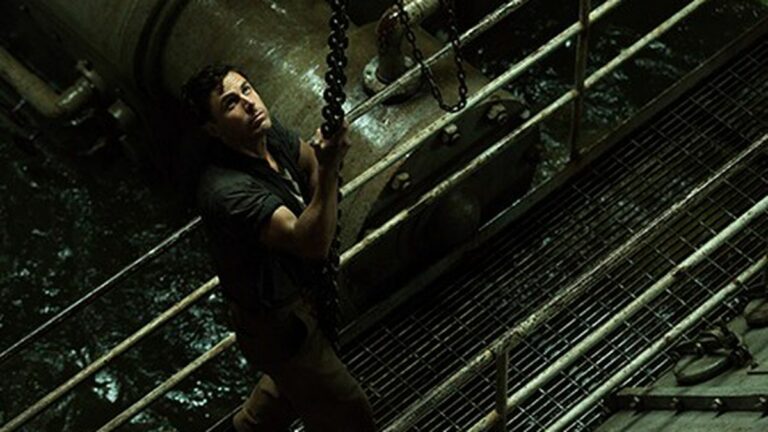
Casey Affleck stars in The Finest Hours.
Meanwhile, onshore at the Chatham Lifeboat Station, after learning of the shipwreck, Coast Guard Boatswain’s Mate Ernie Webber (Chris Pine) volunteers to take a 36-foot wooden motorized lifeboat with three other sailors out into the storm to rescue the men of the Pendleton (another tanker, the Mercer, also breaks up at the same time, but the movie chooses to follow only one thread). To do this they have to cross the treacherous Chatham Bar in sixty-foot seas, then locate the stricken tanker by sight after their radio fails.
Affleck’s Sybert is characterized as an outcast aboard his ship, neither well-liked nor respected. Likewise, Pine’s Webber is considered a lightweight, a shy, tongue-tied junior crewman with little experience. So both the main protagonists are underrated individuals with something to prove, against enormous odds. Nothing wrong with that. Virtually all of the action at sea is computer-generated, with mixed results. Compared to the oceanic fury in the above-named all-time films, the storm sequences in The Finest Hours have a faked, animated look to them. We find ourselves suspending our disbelief for so long, it starts to capsize at the same rate as the wounded tanker. Maybe this movie would have been more effective as a full-fledged animation, à la Hayao Miyazaki’s Ponyo, yet another far superior tale of the sea.
Then there’s the love story subplot between Webber and his strong-willed wife, Miriam (kewpie-doll-faced Holliday Grainger), who’s visibly worried about her husband risking his life. Throughout the film, just as the action reaches its peak, we cut away to scenes of Miriam back on land, arguing with Webber’s commander (Eric Bana), getting her car stuck in a snowdrift, and so on. Fitfully convincing action figure Pine (Into the Woods, Jack Ryan: Shadow Recruit, Star Trek) needs all the help he can get while being heroic — the numerous cutaways do nothing but distract from the business at hand.
Director Gillespie, who made the entertaining cross-cultural baseball comedy Million Dollar Arm, comes in for his share of the blame, as does the tag team of writers adapting Casey Sherman and Michael J. Tougias’ book. Despite a few well-thought-out scenes on the turbulent ocean — the rope ladder rescue of 32 Pendleton crewmen onto the tiny dory while the seas heave is particularly good — the lasting impression is of a film that Disney saw wasn’t holding together, so they decided to send it to Davy Jones’ Locker. Or as we call it, the last week of January.
Chris Thompson, a former longtime staff writer and columnist at the Express, died unexpectedly last week, apparently from heart problems. He was 46.
Thompson, who was a staff writer at the Express from 1998 to 2007, is perhaps best known for his November 2002, award-winning, two-part series, “Blood & Money,” which examined the life of North Oakland cult leader Yusuf Bey and the violent crime family behind Your Black Muslim Bakery. After Thompson’s investigative stories appeared in the Express, he was forced into hiding because members of Bey’s family were stalking him. Five years after Thompson’s exposé, Bey’s family members murdered Oakland journalist Chauncey Bailey.
Chris Thompson.
Thompson, of course, won numerous accolades for his work beyond the Beys. A watchdog journalist who took pride in holding powerful figures accountable, Thompson was loved, especially by his colleagues at the Express, for his quick wit and contagious sense of humor. Some of us decided to share our memories of him for this week’s issue:
John Raeside
If there ever was a person who was destined to be a part of the alternative press, particularly that which existed before the rise of our current internet-saturated and social media-dominated press culture, it was Chris Thompson. When his byline first appeared in these pages in the mid-nineties, this newspaper, and others like it were still proudly setting ourselves against a mainstream press, which was far from the enfeebled beast it is today.
We fancied ourselves, in those days, to be hip and irreverent, smart and courageous. Fortunately for us, we occasionally attracted a talented, hard-working, no-bullshit, let-the-chips-fall-where-they-may writer who actually embodied the qualities we so glibly claimed. Chris was whip-smart, indefatigable, and, above all, fearless. He was a superb stylist who seemed to take his chops for granted, a clear-eyed newshound who never let his narratives get ahead of the facts that he was uncovering. He was not put off by the chaotic, low-paid, journalistic enterprise that this paper was when he started; for a man blessed with so much talent, he had not an apparent shred of vanity. He merely needed a bike, a desk, a telephone to glue to his ear, and stories to tell that would require all of his prodigious political insight and intelligence. Throughout the management and ownership changes that this paper absorbed, Chris continued to thrive at the Express for many years.
Now, both those of us who were lucky enough to know Chris in person, and the readers who only encountered him in print, are struggling to adjust to the reality that someone so energetic and full of life is no longer with us. But we are also very grateful that he chose to spend the years with us that he did. He kept us honest.
John Raeside edited the Express from 1978 to 2001.
Stephen Buel
Chris Thompson was one of the two most agile thinkers I have ever encountered. His sweep of interests was as endless — and occasionally as maddening — as his range of opinions. Chris would often have missed the deadline for his weekly column when he would amble into my office all worked up about something completely unrelated to his topic. He had obviously spent the past hour chasing his interests rather than completing his assignment.
Such was the origin of the most famous project that Chris ever initiated. One day in 2003, Chris sauntered into my office with an astounding observation. The 2003 recall election had just been certified for California’s ballot, and Chris noticed that it would only take $3,000 and 75 signatures to field a candidate for governor. As a satire, Chris suggested that the Express run Berkeley City Councilmember Kriss Worthington for governor. We ran with the concept, but replaced his suggested candidate with someone more in keeping with his intent: the actor Gary Coleman. Although our satire backfired, Coleman received more votes per dollar spent than any of the other 134 candidates.
More typically, though, the breadth of Chris’ passions made him a fascinating read on an incredible range of topics, from his prescient warning about mortgage fraud more than a year before the Great Recession, to his blunt assessment of Jerry’s Brown’s tenure as mayor (good salesman, bad manager), to his fascinating portraits of subcultures as diverse as the Acts Full Gospel Church, Berkeley Medical Herbs, the Rossmoor retirement community and, most enduringly, Your Black Muslim Bakery.
For me, talking to Chris was as rewarding as talking to Bill Clinton. You never knew where the conversation might lead, but the end result was always worth the journey.
Stephen Buel edited the Express from 2002 to 2010.
Kara Platoni
Chris Thompson and I were the two-person staff-writer team at the Express around the turn of the millennium. It was my first reporting job, and I looked up to Chris like a big brother — a smarter, more fearless, endlessly loyal pro who knew everyone and everything. One of our friends says she remembers us dividing our beats into “comforting the afflicted” and “afflicting the comfortable.” If you were a reader back then, you can guess who was in charge of which.
I have a million good memories of Chris. The way he somehow covered the epic tire fire in Westley, even though it was eighty miles from Berkeley, and he had never learned to drive. The time we pulled an all-nighter at the office to write 8,000 words on Proposition 209, with one of us sitting at the computer and the other one lying on the floor yelling directions. The way we’d hole up in my office and talk about whatever while eating our terrible lunches. We bickered like brother and sister, too, once so loudly that movie critic Kelly Vance, who sat somewhere in between us, shouted, “If you kids don’t stop fighting, I’m turning this building around, and we’re going home!”
But the thing everyone knows about Chris — more than his fearsome intellect, more than his elegant prose, more than his perpetual wearing of cargo shorts — is that he was a true news reporter, totally driven by the endlessly unfolding story. He began every conversation by asking: “Have you read The New York Times?” (He didn’t mean a particular story. He meant the whole thing.) Even after he left the Express for the East Coast, he would call you at all hours with the latest on the latest.
My very favorite memory is of a late night call. It was election night 2000, the year of the hanging chad. Chris and I and a crew of reporters camped out in front of the TV, trying to breathe. Florida went for Gore. Then for Bush. That seemed to be that.
I drove home, exhausted, and fell asleep. And then around 3 a.m. the phone rang, and it was Chris: “It’s still in play.”
Maybe that sounds like nothing much, but this is the thing about reporters: When the news breaks, when the story pivots, when it’s too close to call, you want to hear about it. And there is no one you’d rather hear it from than Chris.
Kara Platoni was an Express staff writer from 1999 to 2007.
Mike Mechanic
It is surreal to wake up in the morning and remember that Chris Thompson isn’t here anymore. I knew him before we worked together at the Express, but that’s when I really got to know and value him. Chris loved to talk a story out as he reported it. Even though I wasn’t his main editor, he would always be dropping in to share the latest tidbit, or get an opinion about where to take a story. I looked forward to those visits. He was always curious and interested in the world, in people and what motives them.
His groundbreaking series on Yusuf Bey’s Black Muslims came out of one of those conversations. Bey was under indictment at the time, accused of having sex with underage girls at his compound, a few blocks from our Emeryville office. We were reminiscing about some of the crazy things the Beys had been into over the years. The local dailies had covered them piecemeal, and I commented that nobody had ever really connected the dots and done the definitive story on the Beys. They were such a part of the Oakland fabric that reporters took them for granted. Chris’ eyes lit up. He went off to huddle in his corner, read a bunch of clips, and start making phone calls, and before long he was deep into it.
His exposé, edited by Stephen Buel, won all kinds of awards and got other media interested — and that was the beginning of the end for this local criminal enterprise, which later assassinated another reporter for asking too many questions.
Chris also was a hilarious wiseass. I wish I could relive story meetings where columnist Will Harper would do irreverent impersonations of editor Buel (in his presence) and Chris would throw out nutty ideas, some of which stuck — such as having the paper run Gary Coleman for governor. Chris always turned in pieces that were too long, but his insightful thinking made his work hard to cut. He was also a loyal friend. Long after we were no longer working together, he would reliably call me out of the blue just to see what I was doing and suggest we get together soon. I was always happy to hear from him, but kids and work and life usually got in the way of following up. I guess I figured Chris would always be around. Now I wish I’d accepted those invitations more often.
Mike Mechanic was the managing editor of the Express from 2002 to 2007.
Will Harper
When I came to work at the Express, my initial observations about Chris were that he smelled terrible, he always wore shorts (even in the rain), and that he was brilliant. Chris was the kind of guy who threw around words like “hegemony” (which, unlike me, he could pronounce correctly) and would casually allude to Potemkin Village while discussing East Bay politics. But he wasn’t pretentious. He was brilliant, but he was also a goofball. I loved that about him. People mostly remember him for his work exposing the brutality and corruption of the Bey family, but he was also the brains behind our stunt to run Gary Coleman for governor.
Chris thrived on debate and the exchange of ideas. While most Express staff writers dismissed our weekly story meetings as a plot by our editors to hold us hostage for an hour, Chris looked forward to them. He genuinely enjoyed sitting at a table with his colleagues and discussing the merits and shortcomings of their pitches and the underlying issues their stories raised.
After Chris left the Express, he went to New York to work for the Village Voice. He didn’t last a year there. New York just didn’t get Chris Thompson. He was the kind of conundrum only Berkeley and the Bay Area could properly appreciate. It makes me sad that in the years after he left the Express, no major news publication could find a way to harness his amazing talent and put it to use.
I can still see Chris pacing in our cubicle while writing his column. When on deadline and in deep thought, he had this tic where he’d vigorously rub his hands together, which sounded like sandpaper on wood. I ended up adopting the hand-rubbing tic myself — I still do it to this day when I’m trying get something out of my head and onto paper. I guess it’s my way of trying to channel the Thompson brilliance into my own work. And, now, it will sadly serve as an homage to a terrific colleague who died too young.
Will Harper was an Express staff writer from 2001 to 2006.
Robert Gammon
I first remember Chris Thompson when I was at the Oakland Tribune, he was at the Express, and we were both covering the highly dysfunctional Oakland public schools, circa 1999. I remember thinking, “I like this guy.”
I became a fan of his weekly columns and occasional in-depth cover stories. And, god, did I love his writing. But I didn’t fully grasp his greatness as a reporter until 2002, when the Express published his epic two-part series on the Oakland child rapist/crime boss/cult leader/mayoral candidate Yusuf Bey. I remember at once being both in awe and pissed off. I stood up in the Tribune newsroom and yelled, “Why the fuck didn’t we have this story?”
It was then that I decided that I needed to go work with Chris and the folks at the Express — Stephen Buel, Mike Mechanic, Kara Platoni, Will Harper, et al. And I’ve been there ever since.
Good bye, Chris. You were the best writer I ever worked with.
Express editor Robert Gammon has been at the paper since 2004.
Down to business: Christmas came and went, and every present I bought for my extraordinary husband could be opened in front of our children. He deserves better, and I have a particular gift in mind for Valentine’s Day. My husband has expressed an interest in sounding, something we’ve attempted only with my little finger. He seemed to enjoy it! But the last thing I want to do is damage his big beautiful dick. So is sounding a fun thing? Is sounding a safe thing? Recommendations for a beginner’s sounding kit? Or should I scrap the idea and just get him another butt plug?
Safety Of Sounding
P.S. Here is a picture of the big beautiful dick I don’t want to damage.
Sounding, for those of you who didn’t go to the same Sunday school I did, involves the insertion of smooth metal or plastic rods into the urethra. Sounding is sometimes done for legitimate medical purposes (to open up a constricted urethra, to locate a blockage), and it’s sometimes done for legitimate erotic purposes (some find the sensation pleasurable, and others are turned on by the transgression, particularly when a man is being sounded, i.e., the penetrator’s penetrator penetrated).
So, yeah, some people definitely think sounding is a fun thing, SOS.
“But whether or not something is a safe thing depends on knowledge of the risks/pitfalls and an observance of proper technique,” said Dr. Keith D. Newman, a urologist and a Fellow of the American College of Surgeons. “The urethral lining has the consistency of wet paper towels and can be damaged easily, producing scarring. And the male urethra takes a bend just before the prostate. Negotiating that bend takes talent, and that’s where most sounding injuries occur.”
Recreational cock sounders — particularly newbies — shouldn’t attempt to push past that bend. But how do you know when you’ve arrived at that bend?
“SOS’s partner should do the inserting initially,” said Dr. Newman, “as the bend in the urethra is easily recognized by the soundee. Once he is clear on his cues — once he understands the sensations, what works, and when the danger areas are reached — SOS can participate safely with insertion.”
And cleanliness matters, SOS, whether you’re sounding the husband or serving burritos to the public.
“Infection is always an issue,” said Dr. Newman. “Clean is good, but the closer to sterile the better. And be careful about fingers. They can be more dangerous than sounds because of the nails and difficulty in sterilizing.”
So for the record, SOS: Your previous attempts at sounding — those times you jammed your little finger into your husband’s piss slit — were more dangerous than the sounding you’ll be doing with the lovely set of stainless-steel sounding rods you’ll be giving your hubby on Valentine’s Day.
Moving on…
“Spit is not lube,” said Dr. Newman. “Water- or silicone-based lubes are good; oil-based is not so good with metal instruments.” (You can also go online and order little single-serving packets of sterile lubricant. Don’t ask me how I know this.) Using “glass or other breakable instruments” as sounds is a Very Bad Idea. Dr. Newman was pretty emphatic on this point — and while it sounds like a fairly obvious point, anyone who’s worked in an ER can tell you horror stories about all the Very Bad Ideas they’ve retrieved from people’s urethras, vaginas, and rectums.
Now let’s go shopping!
“Choosing the best ‘starter kit’ is not hard: Pratt Dilators are not hard to find online, they’re not that expensive, and they will last a lifetime,” said Dr. Newman. (I found a set of Pratt Dilators on Amazon for less than $30.) And when your set arrives, SOS, don’t make the common mistake of starting with the smallest/skinniest sound in the pack. “Inserting something too small allows wiggle room on the way in and for potential to stab the urethral wall,” said Dr. Newman.
The doc’s next safety tip will make sense after you’ve seen a set of Pratt Dilators: “Always keep the inserted curve facing one’s face, meaning the visible, external curve facing away toward one’s back.”
You can gently stroke your husband’s cock once the sound is in place, SOS; you can even blow him. Vaginal intercourse is off the table, obviously, and you might not wanna fuck his big beautiful dick with a sound until you’re both feeling like sounding experts. And when that time comes: Don’t stab away at his cock with a sound in order to sound-fuck him. A quality sound has some weight and heft — hold his erection upright, slowly pull the well-lubricated, non-glass sound until it’s almost all the way out, and then let go. It will sink back without any help from you.
Your husband’s butt should be plug-free during your sounding sessions, SOS, as a plug could compress a section of his urethra. If you’re skilled enough to work around the bend — or if you’re foolish enough to push past it — the sound could puncture his compressed urethra. And a punctured urethra is every bit as unpleasant as it sounds. (Sorry.)
Finally, SOS, what about coming? Will your husband’s balls explode if he blows a load while a metal rod is stuffed in his urethra?
“Coming with the sound in place is a matter of personal preference,” said Dr. Newman. “There is no particular danger involved.”
P.S. Thank you for the picture.
My wife and I have an amazing relationship. Our sex life is as hot as it can be given a child and two careers. A couple of years ago, I bought her one of those partial-body sex dolls (it has a cock and part of the stomach). We took videos and pictures while using it. Very hot for both of us. We later got a black version of the same toy. (We are white.) Even hotter videos. I have kept the videos in a secure app on my iPad. Over the past year, I have created Photoshop porn of my wife with black men using screenshots from commercial porn. I haven’t shared this with my wife. We never discussed what to do with the videos and pics we made. I assumed she trusted me not to share these images with anyone. (I haven’t and won’t!) Is it okay that I have a porn stash that features my wife? Is it okay that I have a stash of Photoshop porn of my wife fucking black men? Should I share this info — and my fantasies — with her? I’ve always fantasized about her being with a black man, but I’m not sure either of us would truly want that to happen.
Secretly Keeping Encrypted Porn That Isn’t Clearly Allowed Lately
You need to speak to your wife about those pics and videos, about the way you’ve manipulated them, and about your fantasies — but that’s a lot to lay on her at once, SKEPTICAL, so take it in stages.
Find a time to ask her about those old pics and videos and whether she wants them discarded or if you can continue to hang on to them. At a different time, bring up your racially charged fantasies and let her know what those partial-body sex dolls were doing for you. And finally, SKEPTICAL, if she reacts positively to your having held on to the photos and to your fantasies, ask her how she feels about you creating a few images using Photoshop of her hooking up with a black man for fantasy purposes only. It’s a little dishonest — you’re asking for permission to do what you’ve already done — but you’ll know what you need to do if her answer to the Photoshop question is “No, absolutely not!” (To be clear: You’ll need to delete those Photoshopped pics.)
All that said, SKEPTICAL, if the images you’re holding on to — the originals and/or the manipulated ones — could destroy your marriage and/or your wife’s life and/or your wife’s career if they got out (computers can be hacked or stolen, clouds may not be as secure as advertised), don’t wait: Delete all of the images now.
Hidden away in an East Oakland residential neighborhood, Grocery Cafe (2248 10th Ave., Oakland) is already a one-of-a-kind restaurant. Regulars at this tiny Burmese cafe sit on repurposed church pews while feasting on tamarind-spiked deep-fried samusas, steaming bowls of catfish chowder, and the most potent fermented tea leaf salad in town. And if chef-owner William Lue has his way,...
Most people recognize the Berkeley Art Museum and Pacific Film Archive building as the old monolithic beast on Bancroft Way and College Avenue. The imposing, concrete hull is a quintessential piece of brutalist architecture. Inside, heavy cantilevers jut into the building's central atrium, connected with ramps to create a spiral incline of gallery spaces. From any given...
Trains carrying crude oil produced from Canadian tar sands may soon be traveling through the Bay Area and along the California coast, thereby posing serious risks to human health, wildlife, and the environment. Two planning commissions — one in Benicia and the other in San Luis Obispo County — have scheduled votes for early February to decide the future...
It's standard order for French restaurants in the United States to fashion themselves after the kind of place you might find in France — say, that little bistro you remember from your vacation in Paris all those years ago. Brittany Crepes, a new creperie in West Berkeley, checks off more boxes than most. There is, of course, the misty-eyed...
Aries (March 21–April 19): Do you know Emily Brontë's novel Wuthering Heights? At one point, the heroine Catherine tells her friend about Edgar, a man she's interested in. "He wanted all to lie in an ecstasy of peace," Catherine says, "and I wanted all to sparkle and dance in a glorious jubilee. I said his heaven would be only...
Interdisciplinary artist Sarah Biscarra Dilley's family are descendants of the Chumash people, a Native-American tribe that once populated Southern California's coast near modern-day Santa Barbara. The Spanish invasion decimated the Chumash population, and the last native speaker of its last surviving language, Smuwic, died in 1965. For Biscarra Dilley, learning about her people's culture and native tongue took digging....
On July 10, 2013, an armed carjacker kidnapped Rolando Lucas' youngest child. It happened in the blink of an eye. Lucas had pulled into a gas station at the corner of High Street and Foothill Boulevard in East Oakland. He parked his Honda Odyssey minivan beside a pump and walked with his eleven-year-old son to the station's store to...
When we think of movie adventures at sea, a few obvious favorites come to mind: The Perfect Storm, Das Boot, Titanic, All Is Lost, Master and Commander: The Far Side of the World, and The Endurance. Craig Gillespie's The Finest Hours, a dramatized retelling of a true-story rescue operation in the frigid North Atlantic, may have aspirations to join...
Chris Thompson, a former longtime staff writer and columnist at the Express, died unexpectedly last week, apparently from heart problems. He was 46.
Thompson, who was a staff writer at the Express from 1998 to 2007, is perhaps best known for his November 2002, award-winning, two-part series, "Blood & Money," which examined the life of North Oakland cult leader Yusuf...
Down to business: Christmas came and went, and every present I bought for my extraordinary husband could be opened in front of our children. He deserves better, and I have a particular gift in mind for Valentine's Day. My husband has expressed an interest in sounding, something we've attempted only with my little finger. He seemed to enjoy it!...