
PG&E’s Assault on Solar Power

During the past twenty years, California has led the nation in transitioning to solar energy. The state has more homes with rooftop solar panels than any other, and solar power is now California’s number-one renewable energy source. Researchers have pointed to California’s innovative incentive programs, which have made switching to solar relatively affordable for consumers, as the primary reason for the state’s success. But over the past year, PG&E and California’s other investor-owned utilities have attempted to dramatically roll back the state’s incentive programs and slow the pace of solar adoption, apparently to protect their own profits.

In December, the California Public Utilities Commission (CPUC), which is supposed to regulate the utilities and protect the rights of consumers, sided with PG&E and the other utilities in a decision that could substantially impact the expansion of clean-energy projects in the state. And this week, the utilities are asking the CPUC to curtail the financial viability of rooftop solar. If the CPUC agrees, a national model for renewable-energy adoption will be shattered.

This week’s scheduled CPUC vote, which could occur on Thursday, concerns the amount of money that utilities must pay homeowners who generate more electricity than they need from their rooftop solar panels. Under current rules known as “net-energy-metering,” PG&E and the other utilities must credit rooftop solar owners on their energy bills at the standard retail prices for the excess power they send back to the grid. Rooftop solar owners can thereby reduce their energy bills to zero.

But PG&E, Southern California Edison, and San Diego Gas & Electric want to slash the rates they pay for rooftop solar, and they want the CPUC to establish costly connection and usage fees for new solar users. Solar proponents say that if the commission gives in to the utilities’ demands, then it will effectively snuff out the future of solar power in California. “Simply put, this would gut [net-energy-metering] … and deter customer solar,” said Mark Ferron, a former CPUC commissioner, speaking as a private citizen, according to the Los Angeles Times.

CPUC staffers are recommending against the utilities’ overall plan (although they are proposing connection fees for new rooftop solar owners of up to $150 per customer). But last month, the commission itself voted against renewable-energy consumers and advocates, and in favor of the utilities on another issue that could have wide-ranging impacts on large green-energy projects.

In that decision, the CPUC established steep financial penalties for consumers who live in cities that choose to sever ties with PG&E or another utility and create or join a renewable-energy consortium — known as Community Choice Aggregation (CCA). During the past few years, an increasing number of municipalities have voted to join or create CCAs. The City of Richmond joined the Marin County CCA, known as Marin Clean Energy. San Francisco is currently launching its own CCA, and Alameda and Contra Costa counties are expected to follow suit. CCAs spur the growth of large green-energy projects, like industrial-size solar farms, because they buy the renewable energy directly from the producer, rather than relying on PG&E.

But the CPUC’s vote in December promises to slow the proliferation of CCAs. That’s because the commission decided to hike the fees paid by consumers who live in cities that join or create CCAs by 95 percent. According to Richmond Mayor Tom Butt, the commission’s decision means that Marin Clean Energy customers will have to pay an additional $36 million to PG&E this year.

Butt said in an interview that the CPUC’s vote likely will “make it more politically difficult” for other cities and counties to join or create CCAs. “The irony is that this happened [the commisson’s vote] right after we got back from Paris,” the mayor said, referring to the UN Climate Talks in December.

The CPUC’s decision also contradicted research findings on the state’s solar-energy incentive programs. In 2014, researchers for the Center for American Progress concluded that California’s programs have been “very successful” and called them a “model” for the rest of the nation. “California’s programs and policies have increased solar adoption rates and have made it easier for middle- and lower-income households to adopt solar,” the report stated.

So why does PG&E want to wreck California’s model programs? The utility has used the same argument for hiking rates for CCA adopters and slashing what it pays for rooftop-solar electricity: “fairness.” That is, the utility claims that the growth of CCAs and rooftop solar has resulted in fewer PG&E customers, who then must shoulder a larger share of paying for the utility’s power system. PG&E argues that slashing incentives for CCAs and rooftop solar makes it “fairer” for everyone.

In truth, however, PG&E and other utilities seem to be more worried about losing additional customers and thus becoming less profitable and, perhaps, less viable.

Of course, the state’s utilities wouldn’t have such worries if they were switching more quickly to renewable energy. After all, one of the biggest reasons that cities and counties are joining and creating CCAs is because they’re dismayed that PG&E and the other utilities are still overly dependent on fossil fuels.

Moreover, if we’re going to stave off catastrophic climate change, then we should be increasing incentives for renewable energy adoption, not rolling them back. If it becomes more expensive to live in cities that don’t join or create CCAs, then that will put pressure on those places to go green. The same goes for rooftop solar. If it becomes less expensive than the status quo, then more people will adopt it.

Nevada provides a perfect example of the power of incentives. Last year, Nevada decided to agree to the demands made by its utilities and establish stiff penalties for rooftop solar users. What happened? The renewable energy giant Solar City immediately vacated the Nevada solar market, and the solar industry there is now in a death spiral.

The CPUC should view Nevada as a cautionary tale and reject PG&E’s proposal to inflict the same kind of harm on California.


Burmese Barbecue Is Coming to Oakland

Hidden away in an East Oakland residential neighborhood, Grocery Cafe (2248 10th Ave., Oakland) is already a one-of-a-kind restaurant. Regulars at this tiny Burmese cafe sit on repurposed church pews while feasting on tamarind-spiked deep-fried samusas, steaming bowls of catfish chowder, and the most potent fermented tea leaf salad in town. And if chef-owner William Lue has his way, customers will soon be able to enjoy one more hard-to-find specialty: Burmese-style barbecue.

See also:
This Hole-in-the-Wall Is Doing What No Other Restaurant in Oakland Is


[jump] To help make that a reality, Lue recently spearheaded a successful $10,000 Kiva microloan campaign, as a poster on the food discussion forum Hungry Onion first noted. The money will pay for the construction of an outdoor grilling/dining area in front of the restaurant that will have room to seat nineteen diners. Lue said his tentative plan is to purchase a rotisserie grill equipped with a spit, which he hopes to use to host a weekly suckling pig roast once the weather warms up.

In terms of what Burmese barbecue actually entails, think more along the lines of grilled meat skewers rather than the slow-smoked meats of the American South. Lue explained that the meats will be marinated with aromatics such as cilantro, shallots, lemongrass, and moringa. Tamarind is used as a souring agent instead of vinegar. And Lue said that if customers are receptive to it, he hopes to grill many of the innards and other offal cuts that are ubiquitous at Burmese street stalls — the snouts, gizzards, intestines, and such.

Lue said the construction of the outdoor barbecue area, which he hopes will be complete by April, is part of recent efforts to expand the Burmese offerings at Grocery Cafe. In a similar street food vein, he plans to designate Fridays as “Fry Days,” during which the restaurant will serve various fried street snacks, including one that Lue likened to Burmese-style ballpark garlic fries.

On the other end of the spectrum, the restaurant also recently started serving formal Burmese banquets, available with at least one day’s notice for groups of eight diners or more. For roughly $25 a person, diners can share eight family-style dishes, including several that aren’t on the regular menu — for instance, a Burmese seafood “cioppino.”

Banquet customers can bring their own beer or wine with no corkage fee, and sometimes, if Lue is in a particularly good mood, he’ll even pick up his accordion and play a few tunes. To our knowledge, no other Burmese restaurant in the Bay Area regularly offers this kind of banquet.

Bun Mam Soc Trang Closes Suddenly Due to Expired Lease

Sad news for fans of hard-to-find Vietnamese noodle soups: Bun Mam Soc Trang (1326 E. 18th St., Oakland), which, for my money, was the best Vietnamese restaurant in Oakland, has closed. 

When reached by phone, co-owner Hien Tran, who ran the popular noodle shop along with her mother Dieu Tran, said Bun Mam Soc Trang’s last day of business was December 21.

See also:
The Other Noodle Soup

[jump] Tran’s initial plan had been to take a brief year-end vacation — but then, without warning, her landlord delivered the unexpected news that the restaurant’s lease wouldn’t be renewed when it expired at the end of January. According to Tran, the landlord said the restaurant attracted too many customers for such a small space. Regardless, the Trans ultimately decided it wouldn’t make sense to reopen for only a few weeks.

The restaurant’s signature dish was, of course, its bun mam, a soup whose characteristic tang came from the use of fermented mudfish. But the other home-style regional noodle soups — especially the crab-infused bun rieu — were just as notable.

Tran hopes to eventually reopen at a different East Bay location, but she said that, like many small business owners, she has found the current commercial real estate market to be daunting. In the meantime, customers can visit this placeholder website for updates.

Tuesday Must Reads: Judge Orders State to Justify Withholding Brown’s Emails; Experts Question Whether Raiders’ Oakland Plans Will Work

Stories you shouldn’t miss:

1. A San Francisco judge has ordered the California Public Utilities Commission to legally justify its refusal to release emails involving Governor Jerry Brown and the shutdown of a nuclear power plant in Southern California, the Chron reports. Consumers’ attorneys are seeking the emails to determine whether Brown’s office was involved in illegal backchannel talks with Southern California Edison and San Diego Gas and Electric Company, co-owners of the shuttered San Onofre nuclear facility. Consumer advocates are upset about the shutdown deal because it forces ratepayers to cover 70 percent of the costs. The CPUC maintains that only state appellate courts have the right to order the release of the governor’s emails.

2. Some real estate professionals question whether the Oakland Raiders’ plans for building a new stadium at the Coliseum will pencil out, the Bay Area News Group$ reports. The experts say the 120-acre site is not large enough to accommodate both the Raiders’ demands for huge amounts of surface parking and the ancillary development that the team wants to build to make up its $300 million financing shortfall.


[jump] 3. Housing developers are bullish on building in Berkeley, and there are now 2,500 housing units in the development pipeline in the city, Berkeleyside reports. Developers say the combination of a pro-smart growth city council and high rents is making Berkeley financially and politically viable for housing development.

4. San Francisco Mayor Ed Lee has asked for a US Department of Justice investigation into the police killing of Mario Woods, in a move that mayor said was intended to repair the relationship between police and people of color in the city, the Chron reports. The fatal shooting of Woods, which was captured on cellphone video, has sparked outrage in the city’s African-American community.

5. And California Insurance Commissioner Dave Jones wants insurance companies to divest from coal and is “requiring insurers to annually disclose their carbon-based investments, including holdings in oil, gas, and coal,” the AP reports (via the Orange County Register; h/t Rough & Tumble). Jones, who is the first US state regulator to make such moves, said, “The movement away from coal and the rest of the carbon economy poses a potential financial risk to insurance companies.”

Juvies

The Express recently published a two-part feature called “Trapped” (see 1/6 and 1/13) that reported on the difficulty for inmates sentenced to life with the possibility of parole to actually attain parole. On February 2, The New Parkway (474 24th St., Oakland) will be screening Juvies, a documentary that explores similar cases, but in regards to youthful offenders. The 2004 film follows several children who were sent to prison with little chance of returning home. At this special screening, one of the film’s subjects who achieved release after the completion of the film will be present for a discussion. Topics will include Senate Bills 260 and 261, which created the possibility of parole for life-term prisoners who were convicted in their youth.

Elujay

The title of Oakland rapper Elujay’s new single, “Soul Food,” featuring rising Chicago vocalist Saba, doesn’t just refer to the retro-sounding samples at the core of his production. Like the Southern cuisine from which it gets its name, “Soul Food” is a feel-good track with a warm, earthy palette — one that could be a source of comfort in the face of adversity. On the surface, “Soul Food” is about having a good time, but Elujay positions enjoying life and thriving as a way to resist white supremacy and police brutality. Though it broaches sober topics and current events, “Soul Food” is ultimately uplifting and imparts the message that a better, more equitable reality is within reach. Elujay performs at The Legionnaire in Oakland this Thursday, along with Armani, Just Kristofer, Alma Rose, Donnie Parker, Cartier King, and DJs Red Corvette and Jack. He’s been known to bring a live band with him to the stage, fleshing out his vintage, jazzy production with analog instrumentation that makes his live show even more dynamic.

Metro Boomin

If Young Metro don’t trust you/I’m gon’ shoot you, Future croons softly before the beat drops on his now-iconic hit with Drake, “Jumpman,” from their collaborative 2015 mixtape What a Time to be Alive. Metro Boomin, the 22-year-old Atlanta producer who made the majority of the beats on WATTBA, also gets plenty of shout-outs on Future’s brand new tape, Purple Reign. A sample of one of Drake’s lines from “Digital Dash,” Esco and Boomin/They got it on smash, echoes throughout the thirteen-track project, giving due credit to one of the key architects of Future’s sound. These endorsements from Future and other established artists have revolutionized Metro Boomin’s career, making him one of the most sought-after beatmakers in the industry — and for good reason. His hit-making ability, so far, has been bulletproof. Metro Boomin DJs at 1015 Folsom in San Francisco on January 29.

Gene Yang at Escapist

Oakland native Gene Yang was recently named the National Ambassador for Young People’s Literature by the Library of Congress. The honor is deserved. His most famous graphic novel is American Born Chinese, a profound yet accessible meditation on the experience of being Asian American that ends in a revelatory plot twist. His other books include Avatar Last Airbender, Level Up, Boxers and Saints, The Shadow Hero, and most recently, Secret Coders. He also currently writes Superman for Marvel Comics. You may or may not have heard of that one. Yang will be at Escapist Comics (3090 Claremont Ave., Berkeley) on January 30 at 2 p.m. to sign books, talk about his work, and give a talk on how to break into the comic industry. For anyone interested in a graphic novel career, or is just a fan of Yang, this event will be a treat.

The Gospel of Lovingkindness

Ubuntu Theater Project’s latest production, The Gospel of Lovingkindness, is a heartbreaking parable on gun violence. Written by celebrated Oakland native Marcus Gardley and performed in an intimate chamber in the Oakland City Church (2735 MacArthur Blvd.), the play does more than engage with a topical debate. Rather, the Ubuntu cast brings heart to cold statistics and case studies regarding gun violence by illustrating the issue’s root in systemic inequality through the death of one young, Black South Chicago youth and the life obstacles of another. Excellently acted and directed, the production confronts both serious politics and emotion in a manner somehow synchronously relatable and enlightening. By the end, every audience member is implicated, literally taking part in a moving vigil for all those lost to gun violence.

Toyota

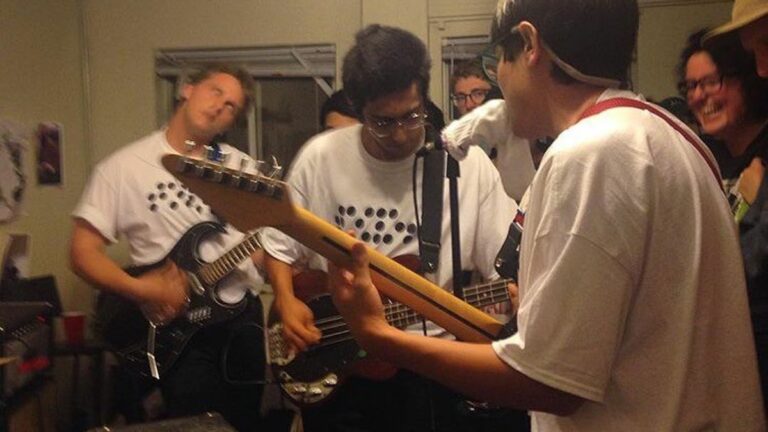
When the members of San Francisco band Toyota recently met with me for an interview, they stayed in character the entire time, presenting themselves as representatives of a nebulous corporation optimizing the production of punk. While the bandmates were clearly trolling me, their charade illuminated the prevalent motifs of outdated mass production and bootleg branding throughout their body of work. The members of Toyota are the founders of the record label Discontinuous Innovation Inc. and their mixtape, Concept Model(s) I-V, also plays on the theme. But gimmicks aside, Concept Model(s) I-V was one of 2015’s best punk releases, with short bursts of jittery instrumentation and hyperactive, jeering vocals destabilizing its melodies and lending it many unexpected twists. Toyota performs at Thee Parkside in San Francisco on January 28 alongside CCR Headcleaner, Violence Creeps, Casual Hex, and Never Young.

Concept Model(s) I-V by Toyota

PG&E’s Assault on Solar Power

During the past twenty years, California has led the nation in transitioning to solar energy. The state has more homes with rooftop solar panels than any other, and solar power is now California's number-one renewable energy source. Researchers have pointed to California's innovative incentive programs, which have made switching to solar relatively affordable for consumers, as the primary reason...

Burmese Barbecue Is Coming to Oakland

Grocery Cafe is expanding its Burmese offerings to go way beyond tea leaf salad. Credits: Bert Johnson/File photo Hidden away in an East Oakland residential neighborhood, Grocery Cafe (2248 10th Ave., Oakland) is already a one-of-a-kind restaurant. Regulars at this tiny Burmese cafe sit on repurposed church pews while feasting on tamarind-spiked deep-fried samusas, steaming bowls of catfish chowder, and the...

Bun Mam Soc Trang Closes Suddenly Due to Expired Lease

The signature dish. Credits: Chris Duffey/File photo Sad news for fans of hard-to-find Vietnamese noodle soups: Bun Mam Soc Trang (1326 E. 18th St., Oakland), which, for my money, was the best Vietnamese restaurant in Oakland, has closed.  When reached by phone, co-owner Hien Tran, who ran the popular noodle shop along with her mother Dieu Tran, said Bun Mam...

Tuesday Must Reads: Judge Orders State to Justify Withholding Brown’s Emails; Experts Question Whether Raiders’ Oakland Plans Will Work

Stories you shouldn’t miss: 1. A San Francisco judge has ordered the California Public Utilities Commission to legally justify its refusal to release emails involving Governor Jerry Brown and the shutdown of a nuclear power plant in Southern California, the Chron reports. Consumers’ attorneys are seeking the emails to determine whether Brown’s office was involved in illegal backchannel talks with Southern...

Juvies

The Express recently published a two-part feature called “Trapped” (see 1/6 and 1/13) that reported on the difficulty for inmates sentenced to life with the possibility of parole to actually attain parole. On February 2, The New Parkway (474 24th St., Oakland) will be screening Juvies, a documentary that explores similar cases, but in regards to youthful offenders. The...

Elujay

The title of Oakland rapper Elujay’s new single, “Soul Food,” featuring rising Chicago vocalist Saba, doesn’t just refer to the retro-sounding samples at the core of his production. Like the Southern cuisine from which it gets its name, “Soul Food” is a feel-good track with a warm, earthy palette — one that could be a source of comfort in...

Metro Boomin

If Young Metro don’t trust you/I’m gon’ shoot you, Future croons softly before the beat drops on his now-iconic hit with Drake, “Jumpman,” from their collaborative 2015 mixtape What a Time to be Alive. Metro Boomin, the 22-year-old Atlanta producer who made the majority of the beats on WATTBA, also gets plenty of shout-outs on Future’s brand new tape,...

Gene Yang at Escapist

Oakland native Gene Yang was recently named the National Ambassador for Young People’s Literature by the Library of Congress. The honor is deserved. His most famous graphic novel is American Born Chinese, a profound yet accessible meditation on the experience of being Asian American that ends in a revelatory plot twist. His other books include Avatar Last Airbender, Level...

The Gospel of Lovingkindness

Ubuntu Theater Project’s latest production, The Gospel of Lovingkindness, is a heartbreaking parable on gun violence. Written by celebrated Oakland native Marcus Gardley and performed in an intimate chamber in the Oakland City Church (2735 MacArthur Blvd.), the play does more than engage with a topical debate. Rather, the Ubuntu cast brings heart to cold statistics and case studies...

Toyota

When the members of San Francisco band Toyota recently met with me for an interview, they stayed in character the entire time, presenting themselves as representatives of a nebulous corporation optimizing the production of punk. While the bandmates were clearly trolling me, their charade illuminated the prevalent motifs of outdated mass production and bootleg branding throughout their body of...
19,045FansLike
17,709FollowersFollow
61,790FollowersFollow