This Saturday, the Oakland small press Timeless, Infinite Light will be celebrating the release of its latest publication, Oil and Candle. The author, Gabriel Ojeda-Sague, is a Latino, queer poet living in Philadelphia, Pennsylvania, and the first winner of Timeless’ TRACT series, for which the press solicits submissions of cross-genre and experimental literary work to be sifted through by guest judges. The winning work is described as a piece that “traces imagined rituals, failed rituals, and magical objects of Santería in confronting issues of race, warfare, and the precarity of Latino lives.” The release party will be at Diesel, a Bookstore (5433 College Ave., Oakland) on March 5 at 7 p.m. In addition to Ojeda-Sague, readers will include Cheena Marie Lo, author of the forthcoming A Series of Un/Natural/Disasters (Commune Editions) and co-editor of the literary journal HOLD, and Hugo García Manríquez, a Mexico-born bilingual poet who most recently released Two Poems (Hooke Press). The night will also feature a performance by Lukaza Branfman-Verissimo, whose social practice artwork often involves collecting stories related to cultural identity.
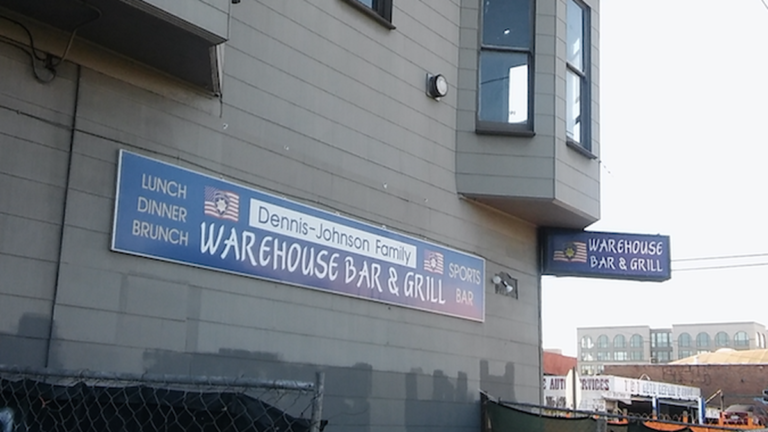
The Warehouse Bar and Grill.
Credits: Darwin BondGraham
The Warehouse Bar and Grill, Oakland’s historic watering hole for police officers, located at 402 Webster Street in the Jack London district, has been sold to a group of investors who plan to significantly renovate the building and redecorate the bar and restaurant. The Warehouse will be closed for several months in order to add windows, a new bar, and to change the layout of the interior, according to several bartenders I spoke with recently. Additionally, the new owners plan to renovate the building’s upstairs, which is currently unused, and transform it into several new apartments.
[jump]
“All of the owners are proud Oakland residents and love the Jack London District,” Monica Plazola, one of the new owners, wrote in an email to the Express.
Plazola declined to name the other investors who purchased the building for $2.4 million, but she hinted that some of the bar’s existing flavor will be preserved.
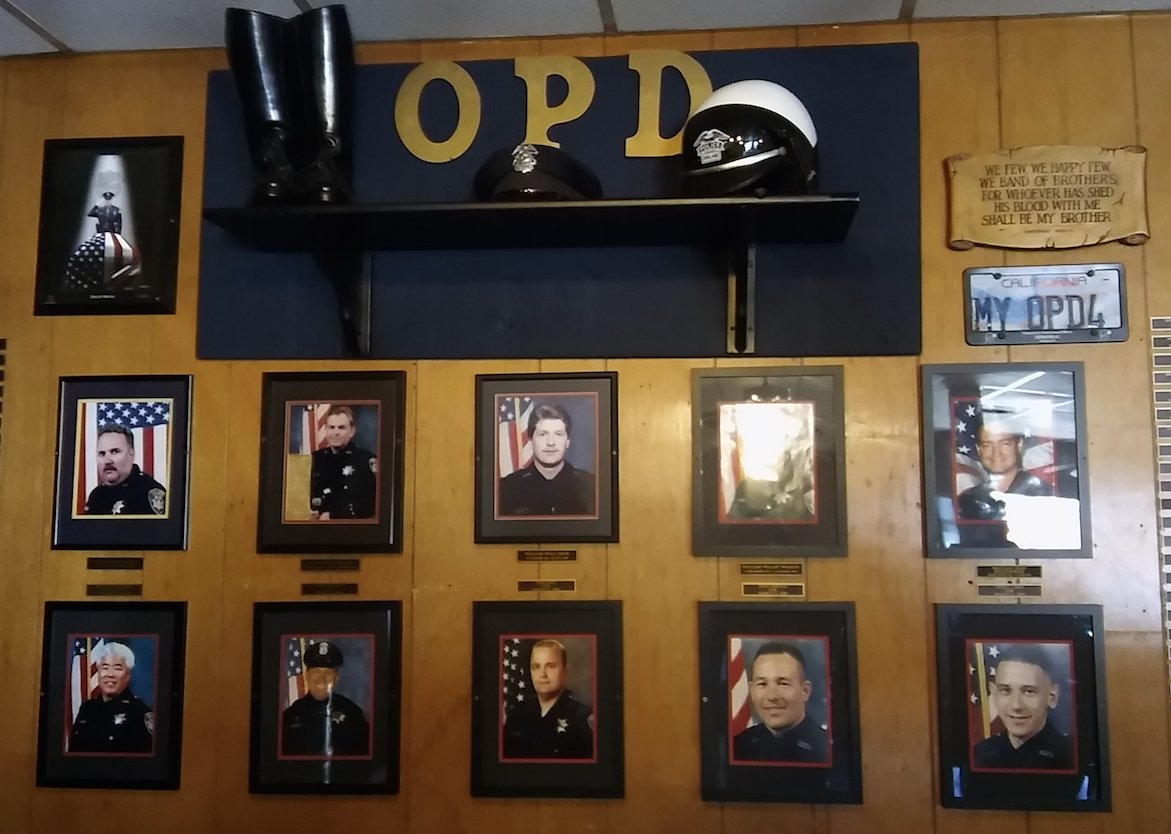
Memorial to Oakland Police Officers killed in the line of duty.
Credits: Darwin BondGraham
“To be able to own a bar that has so much history in the community is really a unique and wonderful opportunity,” wrote Plazola. “Over the last few months we’ve gotten to know the regulars and have heard so many amazing stories about things that have taken place there over the years.”
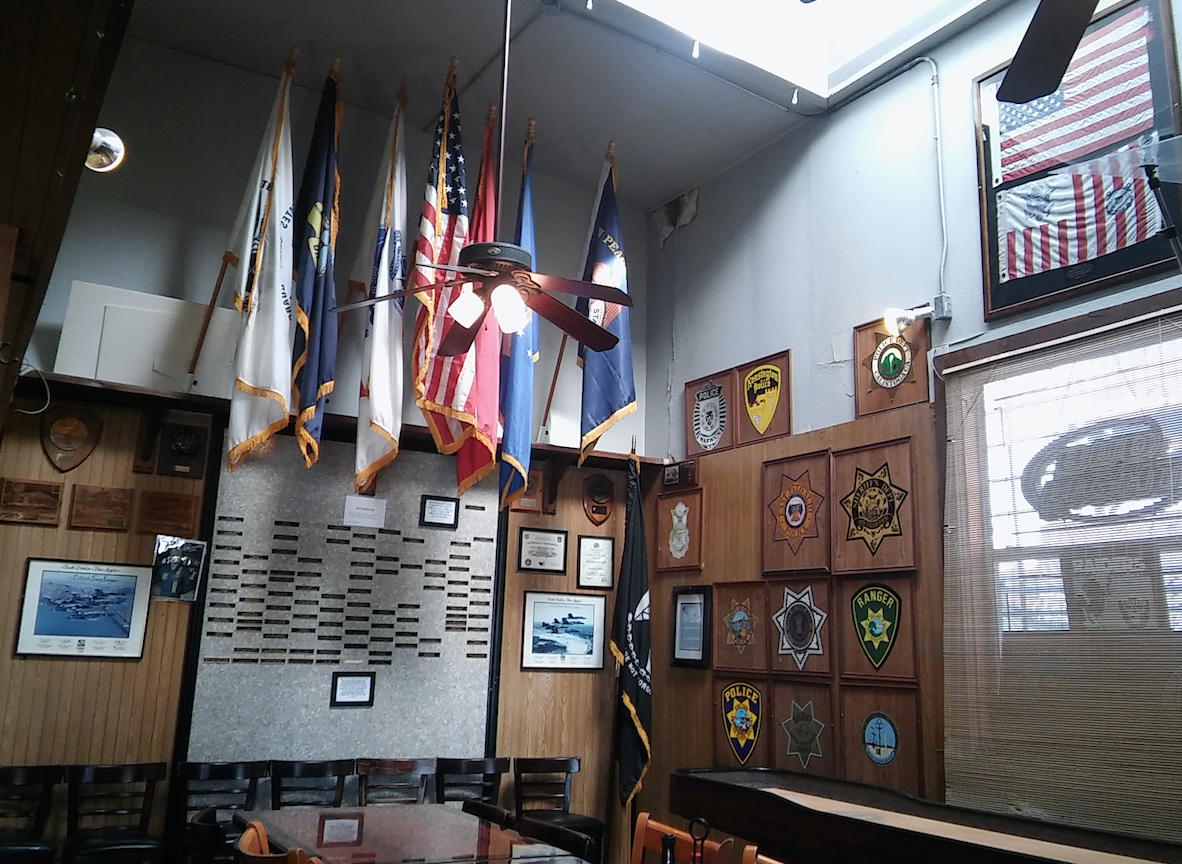
The Warehouse has a storied history of catering to and supporting law enforcement officers, as well as firefighters, paramedics, and soldiers and sailors. The bar’s walls are adorned with badges from numerous Bay Area police agencies, and from some departments as far away as Mississippi and even Australia. One wall serves as a memorial to Oakland police officers killed in the line of duty.
In 2009, the Warehouse hosted a “Fallen Heroes” fundraiser in honor of Oakland police officers John Hege, Mark Dunakin, Erv Romans, and Daniel Sakai who were killed in the line of duty by Lovelle Mixon. The event drew hundreds of attendees and closed off the streets surrounding the warehouse late into the night.
Because of the Warehouse’s links to law enforcement agencies, it has also been a target of anti-police brutality protesters. In 2012, the bar had one of its windows smashed during a march in response to the fatal shooting of Alan Blueford by Oakland Police Officer Miguel Masso earlier that year.
And the bar has always been a good place to stay abreast of gossip in the law enforcement community. In 2011, word of the police crackdown against the Occupy Oakland protest encampment on the lawn of City Hall was spread by chatty off-duty cops who were drinking at the Warehouse. As the Chronicle’s Phil Matier and Andy Ross reported, “Oakland City Council members Larry Reid and Pat Kernighan first got word that the big Occupy crackdown was in the works not from the mayor or the police chief, but from a guy who overheard cops talking about the upcoming action at the Warehouse Bar and Grill down by Jack London Square.”
One longtime bartender at the Warehouse told me that the new owners will likely be removing most of the police memorabilia, but that some of the badges and other regalia will likely be preserved when the bar reopens, likely under a new name.
Badges for the Mississippi Highway Patrol and the Apache Junction Police Department hang on the wall inside the Warehouse Bar and Grill.
Credits: Darwin BondGraham
Flags and shields adorn the walls inside the Warehouse Bar and Grill.
Credits: Darwin BondGraham
The public’s perception of marijuana has steadily changed over the past twenty years, and a new poll in California shows that trend is continuing. People most likely to vote in California’s November 2016 elections say they are supportive of legalizing marijuana for recreational use.
The new poll conducted by Probolsky Research is a further indication that legalization may be at hand. Nearly 60 percent of likely voters support marijuana legalization. Those kind of numbers should dramatically shift the debate around legalization in California and the nation. State Democrats were the largest supporters of legalization — 69.4 percent — which is a supermajority, while a majority of Republicans still oppose legalization — 57.8 percent.
[jump]
Those numbers are encouraging for legalization advocates who suffered a defeat of a similar ballot measure, Proposition 19, in 2010. Prop 19 did not have unified support of legalization advocates because of the way it was written, and because it was put before voters in a non-presidential election cycle, which typically has fewer young voters.
So far, more than twenty proposed ballot legalization measures have been submitted to California Attorney General’s Office for consideration. But one measure, the Adult Use of Marijuana Act, has seems to have garnered the most support. The proposed initiative has by far the biggest campaign warchest, $2.25 million, including a $1 million donation by former Facebook President Sean Parker.
The Adult Use of Marijuana Act has also been endorsed by Lieutenant Governor Gavin Newsom, a 2018 gubernatorial hopeful. Last year, Newsom chaired a Blue Ribbon Commission that brought together a wide variety of community stakeholders, including law enforcement, elected officials, and parents’ groups to consider the best ways to regulate the legal recreational use of marijuana.
Furthermore, the initiative will culminate a trend in the state legislature that has shown a great willingness to normalize the medical marijuana industry through regulation. In the past two years, legislators have considered some twenty medical marijuana related bills, including allowing medical marijuana patients to qualify for organ transplants, farming regulations, and various licensing regulations.
This week, at a special meeting of the Oakland City Council’s Community and Economic Development committee, three developer teams, vying to purchase the E. 12th Street Remainder Parcel, will make their final presentations, and the public will have a chance to weigh in on what the city should do with the publicly owned acre of land by Lake Merritt that became a lightening rod last year in the affordable housing debate.
In Alameda, tenant activists say they will be submitting a charter amendment for the fall ballot to strengthen tenant protections. And according to the Piedmont Police Department’s recently published annual crime report for 2015, the automated license plate reader surveillance system that Piedmont installed in 2013 at intersections along the city’s borders with Oakland, has caught numerous criminals and contributed to a reduction in crime.
E. 12th Parcel: Tonight the public will get to see three different visions for the future of the E. 12th Street Parcel, the city-owned land by Lake Merritt that was created in 2013 when the city realigned E. 12th Street. City staffers are recommending that the council select the developer team of UrbanCore and the East Bay Asian Local Development Corporation (EBALDC). UrbanCore previously had been selected through a no-bid process to purchase the land for $4.6 million and build an all market-rate apartment tower on it, but that plan was scuttled after a leaked city attorney memo showed that the deal would have violated the state Surplus Land Act.
This time around, UrbanCore has joined up with EBALDC, an affordable housing developer, and is proposing to purchase the land for $4.7 million, and to build a 26-story, 190-unit market-rate apartment tower next to an 8-story, 90-unit affordable housing mid-rise. The two towers would share a single lobby, according to the developers.
Bridge Housing and AVI Avant are proposing to buy the land for $4.4 million and build a 27-story tower of 364 apartments, of which 104 would be priced affordable.
Satellite Affordable Housing Associates (SAHA) and the E. 12th Wishlist Design Team are proposing buy the land for $1 million and to build a 7-story building with 133 units of affordable housing. Although the SAHA/E. 12th Wishlist Design Team proposal includes the most affordable housing at the deepest levels of affordability, city staff who reviewed all the developer proposals have ranked it third because it is not as “dense” as the other two proposals, and because it doesn’t maximize revenue for the city on the land sale.
Alameda renters: The Alameda Renters Coalition plans to deliver a ballot initiative to the Alameda City Clerk’s office today that, if approved by voters in the fall, would enact rent control, establish an elected rent board, and create a just-cause-for-eviction ordinance. Unlike Oakland and Berkeley, Alameda currently has no rent control or just-cause-for-eviction laws. But like other East Bay cities, rents in Alameda have been drastically increasing in recent years. While the Alameda City Council has debated how to address the affordable housing crisis for its tenant population, evictions have continued to drive low-income and middle-class renters off the island. Last year, several renter activists were brutally arrested outside the city council’s chambers after tensions flared over access to the meeting.
“What we’ve been asking for consistently is rent stabilization, and, other than evictions allowed by state law, to restrict no-fault evictions,” said Catherine Pauling of the Alameda Renters Coalition.
Pauling said her group has spent six months studying rent stabilization and just cause laws in California, and that their initiative will be modeled on the best practices from cities like Santa Monica, San Francisco, and Berkeley.
Stationary ALPR camera array at the intersection of Linda Avenue and Kingston Avenue installed by the City of Piedmont in 2014.
Credits: Darwin BondGraham
Piedmont auto surveillance: The Piedmont Police Department is calling its recently installed automated license plate reader surveillance system a “force multiplier” and is crediting the system with catching numerous auto theft suspects. According to the police department’s 2015 end of year crime report, the city’s ALPR system led to 49 arrests either as a direct result of locating suspects, or through investigative follow-up, and police were able to recover 4l stolen vehicles valued at over $225,000. Piedmont’s ALPR system works by digitally photographing every car that drives past cameras located at major intersections on the city’s borders. A computer program then automatically “reads” the license plate of the vehicle and runs it through police databases to determine whether it is stolen or associated with a person wanted on a warrant or suspected of a crime. This information can then be fed in real-time to police officers who can intercept a vehicle and make an arrest.
1. State lawmakers have introduced a package of bills designed to clear up the backlog of untested rape kits in California and to make sure that all kits are tested in a timely manner, the Chron$ reports. No one knows exactly how many untested kits there are in the state, but one partial count found that there are at least 6,100. The legislation would upgrade the state’s rape-kit database; standardize rape kits; allow victims to track the tests; and would lift the ten-year statute of limitations on rape cases.
2. The California Supreme Court is allowing Governor Jerry Brown to collect signatures on his prison-reform ballot initiative while the legal dispute over the measure plays out, the LA Times$ reports. A lower court judge had blocked the measure, ruling that the governor illegally gutted another initiative and replaced it with his prison-reform plan, which, if approved by voters, would grant early release to nonviolent inmates. The state Supreme Court will consider in March whether to affirm or overturn the lower court’s ruling.
Planners expect a huge increase in the amount of freight traveling over Bay Area highways and railroads in the next couple of decades. That worries residents of communities near the Port of Oakland and along major rail and trucking routes, because they already have higher rates of asthma, cancer, heart disease, and traffic accidents than people in other areas. “People should not be paying with their lives for the movement of goods,” said Margaret Gordon, a longtime leader of West Oakland environmental-justice campaigns.
So when transportation agencies adopted ambitious new “goods movement” plans this week, a coalition of health, environmental, and community organizations was ready with its own proposal. Thursday, the Alameda County Transportation Commission unanimously passed a resolution developed by the Ditching Dirty Diesel Collaborative and championed by Oakland City Councilmember Rebecca Kaplan, calling for measures to prevent freight-hauling changes from adding to health and environmental problems.
[jump]
Ditching Dirty Diesel has been fighting for more than a decade to protect communities from the devastating effects of “diesel particulate matter” and other pollutants that cause high rates of illness in impacted communities. With the West Oakland Environmental Indicators Project, Communities for a Better Environment, and other community groups, Ditching Dirty Diesel has won major improvements in port and trucking practices to reduce pollution in West Oakland and East Oakland.
Plans adopted by the Metropolitan Transportation Commission Wednesday and the Alameda County Transportation Commission Thursday lay out a broad range of measures to move more freight through the region more efficiently. One strategy is eliminating traffic bottlenecks with highway and road construction. A central goal is to use more rail and less trucking to ship freight to and from ships at the Port of Oakland and the old Oakland Army Base.
The plans also call for improving logistics to make goods move more efficiently and using cleaner trucks, trains, and loading equipment. A “zero emissions and near-zero emissions technology advancement program” will help develop new machinery. In addition, the plans call for reducing the health impacts on communities by measures like separating trucking and trains from residential areas and installing air filters in schools and community centers. Many of these ideas come out of struggles by community groups in West Oakland and East Oakland to reduce the impact of diesel trucking in their communities.
Jill Ratner of the Rose Foundation and Ditching Dirty Diesel acknowledged that MTC and ACTC made efforts to include community health in their plans. But she said the plans don’t include “data on the health impacts of the various strategies.” To fill in this gap, Ditching Dirty Diesel and the Alameda County Public Health Department did a detailed study of its own.
The study, “Making a Good Move for Health,” came out this month. It reviews data on the health problems of people in the communities most affected by goods movement – West Oakland, East Oakland, and areas along the 580 and 880 corridors in Hayward, San Leandro, and Newark. It notes that “residents of the county’s freight-impacted communities are predominantly low-income, African American and Latino.” The study also projects the health impacts of specific proposals in the transportation plans and lists recommendations for mitigating those impacts.
Gordon said the study included not only data analysis by the health department but also community-based participatory research. She said the powerful findings in the report and the Ditching Dirty Diesel Collaborative’s “methodology of doing outreach to every elected official” paved the way for the resolution on protecting community health.
The resolution commits the ACTC to studying the specific environmental and health impacts of each transportation project and taking steps to make sure the projects “do not result in an increase in health inequities for residents of communities affected by freight transportation.” It also includes commitments to direct programs toward the communities most affected and to trying to find funding to implement measures to protect community health.
Funding, though, could be the catch. Many of the projects described in the plans, from cleaner trucks and trains to community safety, depend on massive investments from private corporations and public agencies. “Much of the goods movement system is owned and operated by the private sector, “ the MTC notes in the introduction to its goods-movement plan. “The public sector has limited control over the actions of these private goods-movement stakeholders.”
“A lot of the plan is built around increasing the percentage of freight that moves by rail,” said Ratner. “In a perfect world, that would be great — if we had electric trains. The question is where the money for zero-emissions engines would come from. Railroads are already kicking and screaming about using cleaner technology.”
Another question is who will be making the decisions about plans that affect community health. The ACTC resolution on health impacts calls for planners to “meaningfully engage communities and residents affected by the county’s freight transportation system” in implementing the plan. But it’s not yet clear whether residents will have any real decision-making power. “Meaningful community engagement can mean a lot of different things to different people,” Ratner remarked.
The Associated Students of the University of California (ASUC) approved a resolution Wednesday night that recommends banning the University of California Police Department (UCPD) from taking part in highly militarized Urban Shield trainings.
Credits: John Martinez Pavliga/Flickr (CC)
The resolution, which was passed unanimously by the ASUC Senate, called for the “cessation of UCPD participation in, and funding for participation in, Urban Shield competitions, vendor expos, and seminars.” It stated that under the resolution, various campus officials, including the ASUC External Affairs vice president, the UC Berkeley Police Department chief, the vice chancellor of Student Affairs, and the Police Review Board will work together “to ensure the detrimental effects of Urban Shield are not found on our campus and to work on reforming policies to train UCPD effectively.”
Urban Shield is a full‐scale regional preparedness exercise funded by the Bay Area Urban Areas Security Initiative (UASI), a project financed by the US Department of Homeland Security. It assesses the Bay Area UASI Region’s response capabilities within multi‐discipline procedures, organization, planning, policies, equipment and training. During the Urban Shield trainings, participants are allowed to use military grade weapons, gear, and munitions, much of which is available for purchase at event’s vendor show.
Boomer Vicente, ASUC senator and primary sponsor of the resolution, said in a recent interview that the removal of Urban Shield trainings is crucial to student safety and comfort around campus. “Our senators do not support [Urban Shield] because of it’s racist trainings and how it promotes militarization on campus. The training itself promotes this idea that people of color are always a threat or are terrorists. The resolution calls to reform training policies that UCPD participates in so the department no longer perpetuates racism and Islamophobia,” he said.
[jump]
Vicente said the UC Berkeley Graduate Assembly plans to write a bill in support of the ASUC’s decision. In addition, the resolution calls for a reformation of police training policy on all UC campuses. “The resolution asks the External Affairs vice president to work with the UC Student Association and ask to reform UCPD training statewide so not only Berkeley won’t participate, but so other campus police departments won’t participate either,” said Vicente.
According to UCPD Administrative Sergeant Sabrina Reich, UCPD has participated in Urban Shield since the program’s launch in 2007. “Urban Shield provides realistic scenario-based training that our officers cannot get anywhere else. Our officers bring this training and experience back to the campus so we can better prepare and respond to a variety of emergency situations,” Reich said in an email.
Reich also said UCPD officers receive cultural competency training. “We recently hosted the Islamic Networks Group who provided Muslim cultural awareness training to our police officers and professional staff,” she said.
However, Vicente stresses that many students and community members, including himself, feel threatened by the level of police militarization the Urban Shield trainings promote.
The resolution highlights the alleged beating and harm on students by UCPD during the Occupy Cal Movement, as well as how UCPD took part in a training scenario in which a Muslim man was said to have been fired from his job and began “screaming that he wanted to hurt the Jews,” and that he frequently visited pro-jihadist websites, anti-Semitic websites, and websites with information on how to build weapons of mass destruction.
The document also points to how a shirt on sale at the 2015 Urban Shield Expo read, “Black Rifles Matter,” which the resolution says reveals a “blatant disregard for #BlackLivesMatter as a political and social movement, apparent anti‐blackness, and white supremacist messages present at this expo.”
“Modern technologies have made the blatant racism that is internalized within police departments apparent. With this in mind it is imperative that the influences of racist, anti‐black, ideologies be recognized and prevented on a systematic level,” the resolution also states.
According to Reich, UCPD currently intends to participate in this year’s Urban Shield training, which will take place on September 9-12.
“This resolution is symbolic of how students on campus are not comfortable with this,” Vicente said. “UCPD needs to listen to what students are demanding. If they don’t then there is no trust, which increases the distrust we as students have with the departments on our own campus.”
Shasta Lake.
1. The El Niño weather pattern that was supposed to drench California in rain and snow this winter is looking increasingly like a dud, the SacBee$ reports. A staggeringly warm and dry February means that the state is not close to emerging from its five-year-long drought. Parts of the state have received just half the amount of precipitation they did during the last two major El Niño events, in 1998 and 1983, and California’s three largest reservoirs remain far below capacity. Climate scientists say the only hope now is for an extraordinarily wet March and April.
[jump]
3. SeaWorld officials acknowledged that they ordered park staffers to infiltrate animal rights groups and undermine the groups’ efforts to end the practice of using killer whales for amusement, the AP reports (via the Trib$). The revelation followed accusations by members of the People for the Ethical Treatment of Animals who said that a SeaWorld employee had infiltrated their group and attempted to incite violence. SeaWorld said it would end the infiltration practice.
Peel yourself away from politics for a moment and look outside. Not only is it sunny, it’s the weekend! Here’s a list of ways to enjoy yourself over the next few days. Then you can go back to shaking your fist at the TV.
DJ Spinn.Teklife’s DJ Spinn and DJ Earl
Chicago footwork is a fast-paced, percussive style of house music with an accompanying DIY street dancing culture. And while the footwork scene in the Windy City is pretty underground, it has many appreciators in the Bay Area, where turfing occupies a similar niche in the hip-hop and DJ scenes. So the untimely death of DJ Rashad, one of footwork’s pioneers, in 2014 was deeply felt in Oakland’s music community, with many artists and DJs expressing their condolences for the legendary producer on social media. Footwork fans in the Bay Area can rejoice, however, as DJ Spinn and DJ Earl of Rashad’s original Teklife crew are coming to Oakland to play at Brix on February 27. Sela Oner, a Vallejo producer who considers footwork a major influence, is also on the bill, alongside up-and-coming Bay Area DJs Namaste Shawty, Drea Faux Real, and Shruggs.— Nastia Voynovskaya
Sat., Feb. 27, 9 p.m. $12-$15.
[jump]
Green Day performs at 924 Gilman.
Credits: Bert JohnsonDookie: A benefit for 924 Gilman DAY PARTY
924 Gilman is a longstanding, all-ages punk venue in Berkeley where many legendary bands — such as Green Day — got their start. Since 1986, the venue has served as a talent incubator for up-and-coming punk and hardcore acts, as well as a hospitable place for underground touring bands to perform. Currently, as rents rise astronomically in the Bay Area, many cultural hubs are pursuing strategies to secure their longevity amid the competitive real estate market. The Gilman is currently in the middle of a fundraising campaign that organizers hope will gather enough money over the next three or four years to secure a permanent location. To help the cause, The Night Light, a bar with punk roots in Oakland’s Jack London district, is hosting Dookie: A Benefit for 924 Gilman Day Party on February 28. The show, which features Bill Collins, Cinder Block, and DJ Jesse Luscious, will benefit this endeavor, as well as the Gilman’s efforts to lower door prices and expand its outreach to underserved populations.— N.V.
Sun., Feb. 28, 4 p.m. $25. TheNightLightOakland.com
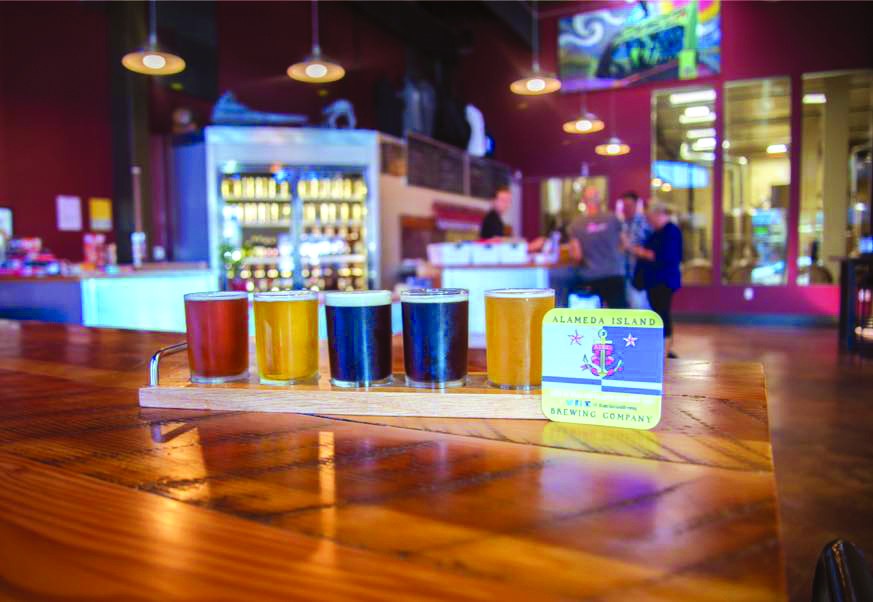
A beer flight at Alameda Island Brewing Company.Alameda Island Brewing Company One-Year Anniversary
A member in good standing of Alameda’s burgeoning craft booze boom, the Alameda Island Brewing Company (1716 Park St.) will celebrate its one-year anniversary on Saturday with an all-day bash that will feature brewery tours led by head brewer Matthew Fox, a continuous lineup of live music, and Oakland-made Salt Point pretzels to snack on (because who doesn’t like a nice warm soft pretzel with their beer?). Fittingly, though, the main focus of the event will be the beer itself. The anniversary celebration will double as a release party for the brewery’s new cask-conditioned ale, as well as for its very first bottled beer: a very limited (five hundred-bottle) release of imperial oatmeal stout aged in bourbon barrels.— Luke Tsai
Sat., Feb. 27, 12-11 p.m. Free. Facebook Event.
Fauxnique.
Credits: Bobby MillerGIRL!
Shotgun Players (1901 Ashby Ave., Berkeley) recently began BLAST, its new annual month-long series celebrating difference through a line up of boundary-bending performances by local and international theater artists. This week, the series will offer GIRL!, “a cabaret-style evening of theatrical drag and drag-fueled theater with some of San Francisco’s finest champions of both.” The well-known San Francisco drag queen Monique Jenkinson (aka Fauxnique) and character artist Evan Johnson (who performs as Martha T. Lipton) have brought together a diverse group of artists who will riff on drag traditions in order to offer unexpected performances. The lineup includes Gina La Divina, Trixxie Carr, Miss Rahni, Dulce De Leche, and Katya Smirnoff Skyy. Performances are at 8 p.m. on February 25 and 26. They will, indeed, surely be a blast.— Sarah Burke
Thu., Feb. 25, 8-10 p.m. and Fri., Feb. 26, 8-10 p.m. 510-841-6500. $15-$20. ShotgunPlayers.org
Breaking the Silence Town Hall
As the culmination of Conjure Circle, its six-month-long art and activism event series, Impact Hub Oakland’s Omi Gallery (2323 Broadway) will be holding a town hall meeting on Saturday, February 27 to focus on the experiences of girls and women of color. The event is part of the national “Breaking the Silence Town Hall” series put on by the African American Policy Forum, which offers a platform for communities across the country to engage in a discussion about the experiences of women and girls of color as they relate to displacement, police violence, criminalization, sexual assault, domestic violence, and poverty. And as the event’s description reads: “We hope to create opportunities for local decision makers to listen to participants about the challenges they experience on a daily basis in their homes, schools, and communities, and identify opportunities for intervention.” The African American Policy Forum began the series in 2014, with the goal of creating a more gender inclusive racial justice vision. Since, the events have taken place in New York; Los Angeles; Miami; Washington, DC; Baltimore; Chicago; and Atlanta. The event is free, but registration is required.— S.B.
Sat., Feb. 27, 12-4 p.m. Free. BTSOak.EventBrite.com
“Gratitude” by Mark Baum.
Credits: Courtesy KrowsworkMark Baum: Elements of the Spirit
Mark Baum was born in what is now Poland in 1903 and barely survived emigrating to the United States in 1919. For thirty years thereafter, the painter succeeded in the New York art scene. But despite the popularity of his work, he decided in the 1950s to move away from his representational paintings, and until his death in 1997, developed an abstract art practice that merged spirituality with creativity. Eventually, Baum moved to Maine to paint fulltime from a converted barn and continue to contemplate spirituality. During that time, Baum began using a singular diamond-like symbol in various iterations to create all of his compositions, which he considered psychic maps to an enlightened existence. A retrospective of Baum’s late work, which has never been shown before, is now on view at Krowswork Gallery (480 23rd St., Oakland) in the show Mark Baum: Elements of the Spirt. At 2:30 p.m. on February 27, the gallery will host a free panel discussion on the artist’s life featuring the Contemporary Jewish Museum of San Francisco’s chief curator Renny Pritikin; UC Berkeley’s Center for Arts, Religion, and Education director Elizabeth Pena; and Baum’s son, Billy.— S.B.
Through March 12. Free. Krowswork.com
If your pockets are feelin’ light and you’re still yearning for more suggestions, we’ve got a ton, and these ones are all FREE! We’re Hungry: Got any East Bay news, events, video, or miscellany we should know about? Feed us at Sa*********@************ss.com.
At a news conference yesterday, a married Oakland couple said that members of the the Oakland Police Department attempted to cover up a home invasion and assault perpetrated by at least two drunken off-duty Oakland cops, and that multiple Oakland police officers investigating the incident pressured them to change their story about what happened.
[jump]
As the Express first reported on its website Tuesday, two off-duty Oakland police officers wearing plain clothes attempted to break into the Oakland hills home of Olga and Nemesio Cortez on the evening of December 7. One of the cops, identified as Oakland police Officer Cullen Faeth, was “banging” on the Cortez’s front door and yelling “let me in,” and “open the fucking door,” according to a claim filed yesterday with the City of Oakland by attorney Melissa Nold.
Another officer, who has been identified as Oakland police Sergeant Joseph Turner, went around the back of the house in an apparent attempt to gain entry. Mr. Cortez went out front to try to get Faeth to leave, but Faeth allegedly kicked him in the stomach, the complaint states. Both Mr. and Mrs. Cortez then saw Turner “running out of their backyard from their side gate.” Turner “placed his hand under his shirt and appeared to point a gun at Mrs. Cortez from underneath his shirt.” Then Turner ran up the street and disappeared, but the Cortezes held down Faeth with the help of their neighbors until on-duty Oakland police officers arrived.
The incident was not made public by the police department until I obtained a copy of the police report through a Public Records Act request. The police report described only one suspect taken into custody as a result of the attempted home invasion and assault — Faeth, an Oakland police officer who was hired in December 2013. John Burris and Melissa Nold, attorneys for the Cortez family, identified the second suspect who fled the scene as Sergeant Turner.
Oakland Police Department spokesman Officer Marco Marquez declined to tell the Express whether Turner was one of the suspects. So far, the department has only issued a statement claiming that four officers have been placed on paid administrative leave while an internal affairs investigation is underway, but besides Faeth, the department has not named the three other officers. The incident report also noted that Faeth was arrested for assault and being drunk in public.
But according to the Cortez family and their attorneys, Sergeant Turner not only fled the scene and wasn’t taken into police custody that night, he in fact communicated with on-duty officers who were responding to the crime scene, and then got into a civilian vehicle and left the area.
“Witnesses recount seeing a man [Turner] running up the middle of the street, at the time of the incident, who was stopped by the first responding City of Oakland Police Department patrol car,” wrote Nold in the claim filed with the city yesterday. “The fleeing second man leaned into the police car, appeared to speak to the officer and was then permitted to leave. The fleeing second man got into a non-police vehicle, occupied by at least one other person, and left the scene.”
According to the police report, the first responding officers to the scene were Christopher Lorenz and Huy Nguyen, but the department redacted most of the report making it impossible to tell if officers Lorenz and Nguyen did in fact speak with Turner before he left the scene.
The police report authored by officer Lorenz described Faeth’s demeanor when they arrived as “calm” and “polite.” But multiple witnesses told the Cortez family’s attorneys that Faeth was acting “wild,” and that when Faeth was placed into a police cruiser, he began to bang his head against the vehicle’s windows and shake the vehicle.
According to the Cortez family, three hours after the Faeth was arrested three Oakland police officers came to their home at 12:30 am. Cortez and her husband said that the officers identified themselves as a captain, sergeant, and officer, and Mrs. Cortez, who herself is a county probation department officer, found it strange that such a high ranking police official would be visiting her home to investigate the incident. At this point the Cortezes still did not know the identities of the men who attacked them the previous night, nor that they were Oakland police officers.
Then according to the Cortez family and their attorneys, three hours later, at 3:30 in the morning, five more Oakland police officers came to their home and wanted to interview Mr. and Mrs. Cortez separately.
“During Mrs. Cortez’s interview officers were trying to get her to change her statement and relay the events in a way that would be more favorable to the man who was arrested,” attorneys for the Cortez family wrote in their claim. “An officer tried to convince Mrs. Cortez to change her story and relay that the first man was simply knocking on on the front door, instead of the reality that he was banging, rattling the door, pushing the door and demanding entry. The officer was also trying to get Mrs. Cortez to say that the first man simply knocked her over while falling down, instead of the reality that the man put both arms around her in a bear hug and knocked her to the ground.”
The claim states that these officers were trying to get the Cortez family to “sanitize their story,” and that the officers “would not answer any questions about the suspect.”
Two weeks then went by, and according to Mrs. Cortez, the Oakland police would not provide any further information about the suspect. She then began hearing rumors that the suspect who was arrested, and the man who fled the scene, were Oakland cops. According to the claim filed with the city, Mrs. Cortez was then told by Lieutenant Roland Holmgren that the two men were Oakland police officers, and that they mistakenly went to her house looking for a party, and that they were just “being silly.”
This Saturday, the Oakland small press Timeless, Infinite Light will be celebrating the release of its latest publication, Oil and Candle. The author, Gabriel Ojeda-Sague, is a Latino, queer poet living in Philadelphia, Pennsylvania, and the first winner of Timeless’ TRACT series, for which the press solicits submissions of cross-genre and experimental literary work to be sifted through by...
The Warehouse Bar and Grill.
Credits: Darwin BondGraham
The Warehouse Bar and Grill, Oakland's historic watering hole for police officers, located at 402 Webster Street in the Jack London district, has been sold to a group of investors who plan to significantly renovate the building and redecorate the bar and restaurant. The Warehouse will be closed for several months in order...
The public’s perception of marijuana has steadily changed over the past twenty years, and a new poll in California shows that trend is continuing. People most likely to vote in California’s November 2016 elections say they are supportive of legalizing marijuana for recreational use.
The new poll conducted by Probolsky Research is a further indication that legalization may be...
This week, at a special meeting of the Oakland City Council's Community and Economic Development committee, three developer teams, vying to purchase the E. 12th Street Remainder Parcel, will make their final presentations, and the public will have a chance to weigh in on what the city should do with the publicly owned acre of land by Lake Merritt...
Stories you shouldn’t miss:
1. State lawmakers have introduced a package of bills designed to clear up the backlog of untested rape kits in California and to make sure that all kits are tested in a timely manner, the Chron$ reports. No one knows exactly how many untested kits there are in the state, but one partial count found...
Planners expect a huge increase in the amount of freight traveling over Bay Area highways and railroads in the next couple of decades. That worries residents of communities near the Port of Oakland and along major rail and trucking routes, because they already have higher rates of asthma, cancer, heart disease, and traffic accidents than people in other areas....
The Associated Students of the University of California (ASUC) approved a resolution Wednesday night that recommends banning the University of California Police Department (UCPD) from taking part in highly militarized Urban Shield trainings.
The resolution, which was passed unanimously by the ASUC Senate, called for the “cessation of UCPD participation...
Stories you shouldn’t miss:
1. The El Niño weather pattern that was supposed to drench California in rain and snow this winter is looking increasingly like a dud, the SacBee$ reports. A staggeringly warm and dry February means that the state is not close to emerging from its five-year-long drought. Parts of the state have received just half the amount of...
Peel yourself away from politics for a moment and look outside. Not only is it sunny, it's the weekend! Here's a list of ways to enjoy yourself over the next few days. Then you can go back to shaking your fist at the TV.
Teklife’s DJ Spinn and DJ Earl
Chicago footwork is a fast-paced, percussive style of...
At a news conference yesterday, a married Oakland couple said that members of the the Oakland Police Department attempted to cover up a home invasion and assault perpetrated by at least two drunken off-duty Oakland cops, and that multiple Oakland police officers investigating the incident pressured them to change their story about what happened.
...