
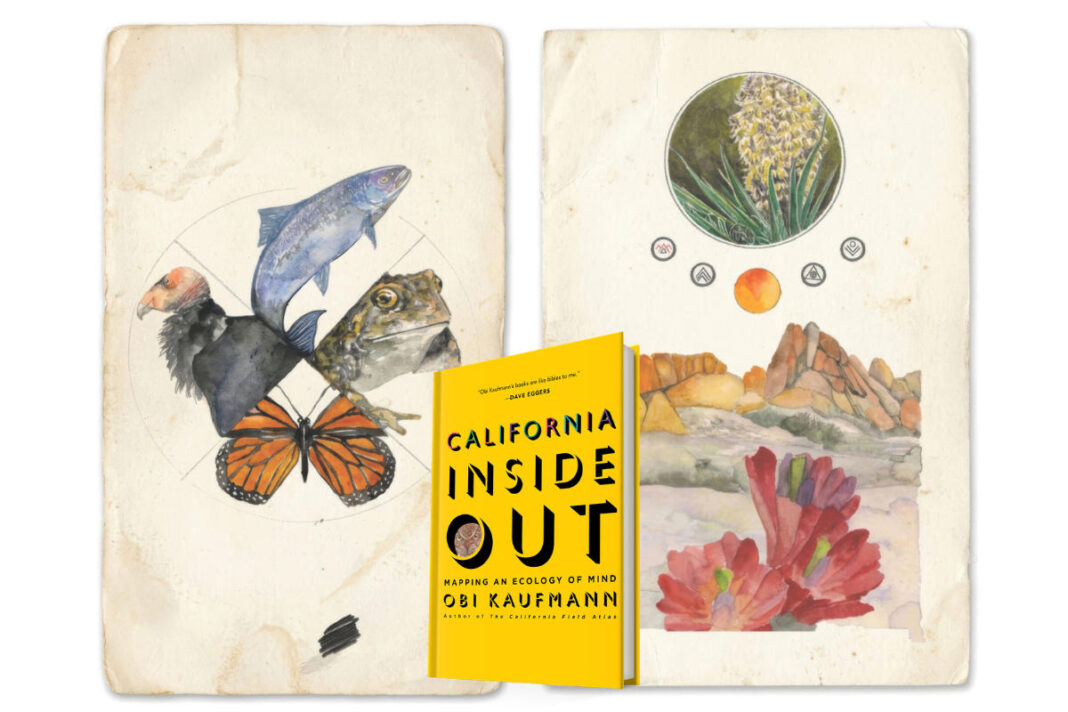
Does California exist at all, in the way we usually conceive it?
No, says Oakland naturalist/author/painter Obi Kaufmann in his new book, California Inside Out: Mapping an Ecology of Mind. The book’s first page lays out Conservation International’s definition of the California Floristic Province, “the evolutionary island of California, the ecologically distinct area…isolated by the Sierra Nevada from the rest of the North American continent.”
In his book, Kaufmann posits that in order to move to a 22nd-century California that has evolved beyond “environmentalism” and into an embrace of what he calls “anthropic ecology,” a monumental reframing is needed.
“California rivals any comparable land area on the planet Earth for its biodiversity,” he writes. But 20th-century “conservation” is not enough to preserve it. The thousands of years of Indigenous peoples’ relationship to the land provides the blueprint: California’s habitat spaces “[are] largely the product of a consistent, multimillenia-long product of human stewardship.”
In Kaufmann’s view, the environmental movement has been largely co-opted by Big Business, and also suffers from an “anti-human ethic.” Instead, he says, a new language will emerge, connecting the past with the future, and “illuminating a throughline of unrealized justice and equity among human and more-than-human communities.”
Chapter Two is titled “California Is Fire.” In a phone interview, Kaufmann said, “Nowhere do fires destroy everything. There is incredible regeneration. But getting right with fire is one of the primary ways to engage California’s natural fecundity.” He notes that until Spanish settlers arrived, Indigenous peoples burned between 6 million and 10 million acres every year.
This enabled the plants and trees that depend on fire to propagate—most famously conifers and redwoods—as well as the game and fish populations that benefitted from the “cascading” effects, to flourish. Kaufmann lists four points: “Fire is always on the way./ Fire will not be denied./ In California, trees are made of fire, waiting to burn./ California burns because of decisions people make.” Megafires can only be avoided, he writes, by returning to the system that both acknowledged and used the benefits of fire.
In Chapter Three, “The Meaning of Birds,” Kaufmann delves into the word “meaning.” Here the book shifts into exploring what the author is getting at with the idea of “more-than-human.” In stories and legends that feature birds, “the bird is a placeholder for any piece of the interconnected more-than-human world.” Again, he argues for a significant mindshift from the concept that the value of land, water and other beings can be “appraised,” and that their value becomes zero if it cannot be assessed in that way.
The chapter also begins the thread on multiple forms of intelligence, a theme continued in the final two chapters. Chapter Four, “Thinking Like a Watershed,” asks, “What if it isn’t only the brain that makes thoughts?” California’s watersheds, he says, are in fact thinking ecosystems that respond to multiple stimuli. The watershed has priorities to function in a healthy way.
If it could “talk,” Kaufmann says, it might point out “how California since statehood has worked to undo much of its core functionality, and how the degraded watershed affects the human community as much as its own body.”
Later in the chapter, the author discusses what has now become a topic of global relevance: the establishment of rivers as “persons,” such as New Zealand’s Whanganui River. Kaufmann noted in the interview that he will do an author event in the new year with Marin author Nina Schuyler, whose novel Open the Floodgates is a fictional exploration of a river on trial about its personhood.
Finally, in Chapter Five, “The Mind of the Forest,” the forest is revealed as, again, a living entity, its soil alone rivaling the human brain in its complexity. Much has now been written about what is being called “the Wood-Wide Web,” in which tiny fungal filaments wrap around or enter tree roots, linking individual trees and allowing them to communicate stresses. But when biodiversity is lost, Kaufmann emphasizes, “ … the personality of the forest unravels. An analogy to human mental illness emerges.”
Kaufmann explores the ongoing conversation about what constitutes sentience. He cites Zoe Schlanger’s bestseller The Light Eaters, which, as he does, posits that “mind does not require resemblance to the human mind.”
Ultimately, California Inside Out and its author offer a message of hope. Kaufmann concluded the interview by saying, “There is an ecosystem that has survived everything. There is power inside of Gaia that cannot be touched.”
Author events will take place at 6pm on Oct. 28 at the 20th Annual Heyday Harvest celebration at Freight & Salvage, 2020 Addison St., Berkeley, and at 7pm on Jan. 27 at Green Apple Books, 1231 9th Ave., San Francisco (with Nina Schuyler). For other events, visit heydaybooks.com/events.
‘California Inside Out: Mapping An Ecology Of Mind,’ 95 pages. $20 hardcover. Heyday Books, Berkeley.