
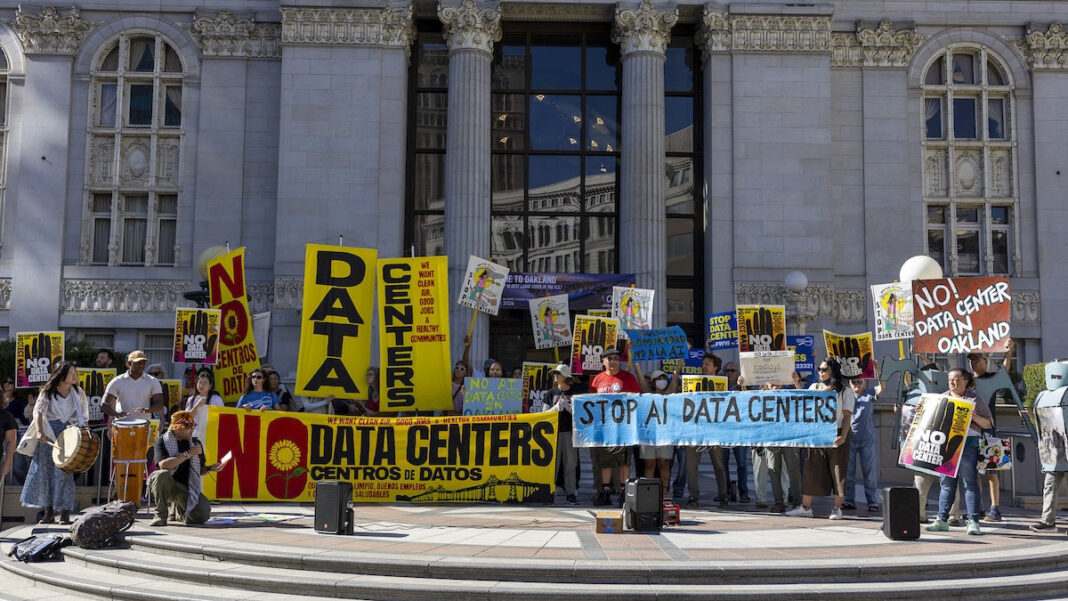
On Nov. 10, the Oakland City Council voted unanimously to extend the moratorium on building data centers for another 10 months, through Oct. 5, 2027. The council had already authorized a 45-day moratorium on Oct. 6, effectively blocking the development of a 20,000-square-foot center in downtown Oakland.
Oakland joins Richmond; Pittsburg; Oakley; Hayward; and further north, Gilroy; and across the Bay, San Francisco, in enacting moratoriums. In this, cities are reflecting nationwide pushback to the unlimited construction of data centers. A CBS News exit poll, published Nov. 6, found that big majorities in all the Senate battleground states opposed having data centers built in their communities, and that opposition to data centers was a major factor for more than half of the 2026 midterm votes.
On Nov. 8, Politico reported: “Local victories against data center projects are emboldening activists to take their fight to state lawmakers and launch a broader fight over data center expansion.”
Slate reported on Nov. 10, “Last Tuesday, voters across the country approved dozens of ballot initiatives calling for moratoria, reduced tax credits, or outright bans on data center projects. Ohio alone had 18 such measures on the ballot—and all of them passed.”
Even the notably non-leftist Republican Sen. Josh Hawley, of Missouri, on Nov. 11 endorsed a nationwide moratorium on building new data centers.
Oakland was the first city in Alameda County to adopt a data center moratorium. A coalition of organizations supporting the measure, jointly called Stop Data Centers in Alameda County, headed the push for this. Coalition members include Communities for a Better Environment (CBE), Food & Water Watch, Fossil Free California, Frontline Catalysts, Local Clean Energy Alliance, Oil & Gas Action Network, Reclaim Our Power, West Oakland Environmental Indicators Project, Wholly H2O and 350 Bay Area.
Adele Watts, CBE NorCal program co-director for East Oakland, said CBE’s initial push occurred in Richmond, where organizers held meetings and listening sessions with residents to determine what knowledge about data centers’ impact already existed. CBE then began reaching out to organizations it has partnered with in the past, offering support with legal and research needs.
In Oakland, she said, concern about data center construction already existed in West Oakland, for decades overburdened with harmful environmental impacts. According to an August report published by insider.govtech.com, “Prometheus, an AI startup co-founded by Bezos and former Google executive Vik Bajaj, recently signed a lease for 100,000 square feet of space in the American Steel Blocks building on Mandela Parkway in West Oakland…Tesla also signed a lease for another 40,000 square feet in the same building.”
Behring Companies announced plans to use a building at 415 20th St. for tech/AI data center use. CBE and its partners were also concerned by the nondisclosure agreements being used by these companies. “Our concern is that these data centers are being developed on a blank slate” without community input, Watts said.
Citing the many years in which primarily BIPOC communities have not had voices in determining what can be built within their neighborhoods, she said, “Corporations assume [these communities] won’t stand up, but we are at a turning point.” She saluted Oakland City District 3 Councilmember Carroll Fife for her leadership in passing the moratoriums and newly elected Richmond Mayor Claudia Jimenez for hers.
After the extended moratorium’s passage, NBC Bay Area quoted Fife as saying, “The importance of extending the moratorium is to give the city the adequate amount of time for our staff… to come back to the council with some firm guidelines.”
Community concerns about AI data centers include water use, keeping fossil fuels online, driving more pollution and raising utility bills. “These centers rely on diesel or natural gas generators,” said Watts, potentially increasing air pollution in areas already suffering from high rates of asthma, for example. “The centers run 24 hours a day, 365 days a year,” and have been the subject of multiple complaints about noise pollution, she noted.
Community forums have also expressed preferences for using available land for more housing and increased public parks and open spaces. “Communities want a voice about unfettered development, which is part of a broader conversation about environmental justice,” Watts said.
The “blue tsunami” of the midterms will add strength to the anti-data-center movement, which is about more than just the centers themselves, she said. Residents are deeply concerned about the unbridled growth of AI and its intrusion into multiple aspects of daily life. Recently re-elected Oakland Mayor Barbara Lee and newly elected Richmond Mayor Jimenez are firmly on the side of deeply examining further development before committing to it.
“There is a narrative that data centers and AI are inevitable,” Watts said. “That narrative is coming from the tech bros.”
Communities, cities and voters, however, make it clear they see a different narrative.