
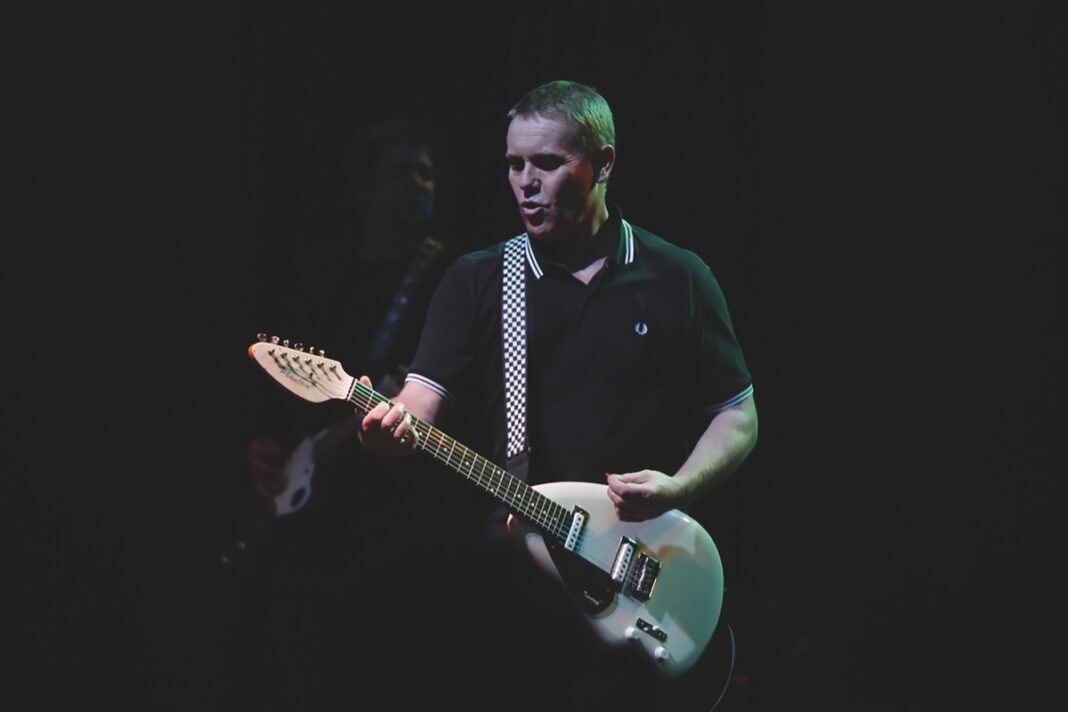
The British ska movement launched in the late ’70s with ska/rock-steady acts like the Skatalites, Prince Buster and Desmond Dekker as founding influences. A generation of youth fused punk-rock’s aggression with ska sounds to address racial tensions in Margaret Thatcher-era Britain. Among the predominantly multiracial acts leading the charge were the Specials, the Selecter and the Beat—known as the English Beat in the U.S.
Fast forward to 2026 and Dave Wakeling’s English Beat carries on his band’s legacy. Following the release of 1982’s Special Beat Service, the last album by the original group, offshoot groups emerged, including General Public, Fine Young Cannibals, the Beat featuring Ranking Roger and the Beat starring Dave Wakeling.
With Ranking Roger having passed in 2019 and with Beat founding members Andy Cox and David Steele creatively M.I.A., Wakeling continues to wave the English Beat banner. Demand is unwavering despite the last album’s four-decades-plus-old lineup.
“I’m shocked that on Sirius/XM there are something like 10 or 12 of our songs spread all over the channels between [the English Beat and General Public],” Wakeling said in a recent interview. “It’s probably more like 16 or 20 songs if you include Fine Young Cannibals. That’s really quite remarkable to achieve. And that people still come and still remember the words. Even though their knees aren’t as flexible as they used to be, they can still move them in time to our tunes.”
When one thinks about the impact the English Beat had on third-wave ska outfits that commercially blew up in the ’90s—Mighty Mighty Bosstones, No Doubt, Reel Big Fish—it’s difficult to believe the former’s original run was only from 1978 to 1983. Wakeling, whose roots lay in competitive swimming and water polo, recalled how things came together once he pivoted from the pool to music and began writing songs when he was about 17. During that time the core of the Beat—Wakeling, bassist Steele, guitarist Cox and drummer Everett Morton—came together. Toaster Ranking Roger and legendary ska saxophonist Saxa were later recruited.
“I met Andy [Cox], who became the other guitarist in the Beat, at school,” Wakeling said. “We played a couple of times, got an apartment together and then moved to the Isle of Wight. Then we wrote some songs, talked about being in a group, moved back to Birmingham and started a group. Within about six months I think, we did the first gig. Not many months later, we were No. 6 in the charts.”
Between the myriad U.K. hits the Beat started landing—“Mirror in the Bathroom,” “Save It for Later” and a cover of “Tears of a Clown”—and the band’s infectious live show, they were an in-demand support act for acts including Talking Heads, the Police and the Clash.
Touring/recording burnout caught up with the English Beat and as new parents, Wakeling and Ranking Roger chose to form General Public in 1983. Steele and Cox re-emerged with vocalist Roland Gift a year later as Fine Young Cannibals. General Public’s 1984 debut, All the Rage, featured ex-Clash guitarist Mick Jones playing on six of the songs—although Wakeling points out he was never an official band member—and yielded the international top 40 hit, “Tenderness.”
A cover of the Staple Singers’ “I’ll Take You There” for the soundtrack to the 1994 dramedy, Threesome, yielded another top 40 hit a decade later. In the end, geography proved to be General Public’s downfall with Wakeling decamping to California and Ranking Roger remaining in the U.K.
“With Roger living in England and me in America, it cost $10,000 just to do a rehearsal,” Wakeling said. “The timing and scheduling were really difficult.”
Nowadays, the English Beat enjoy the kind of nostalgia-fueled success new-wave acts ranging from Duran Duran to Depeche Mode and OMD are experiencing. And in having the combination of longevity and a rich catalog to pull from, Wakeling has found the perfect cross-generational presentation that keeps fans repeatedly coming out to shows.
“Generally, at a concert you want to keep them moving and keep up the enthusiasm,” he said. “Quite often, the audience chooses what song they want to hear next. We have a set list, but we also keep an eye on the crowd. Do they want something a bit faster? Do they want something a bit slower? Are they starting to flag and need a break?
“Everyone is going through really testing times at the moment,” he continued. “You can see it in people’s faces. They feel relieved to have a nice dance within your own peer group, go home and nothing controversial or outrageous happened.”
The English Beat plays Friday, Nov. 27, 9pm at Cornerstone, 2367 Shattuck Ave., Berkeley. cornerstoneberkeley.com