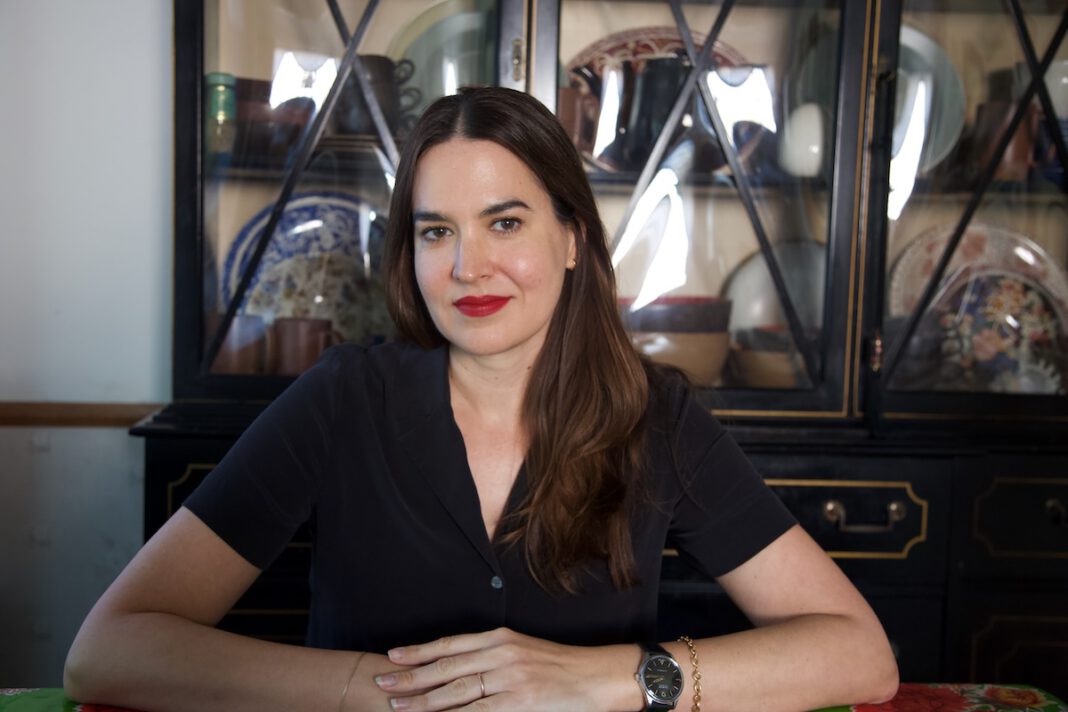
Grace Krilanovich is preoccupied with acid.
Not the molecule, or ion, or aqueous liquid with a pH below 7 squeezed onto guacamole or used to dissolve gold. Not the mind-altering substance, either.
Instead of on her tongue, she drops it into conversation as a prefix descriptor the same way record-shop employees parse albums in the bins. Acid rock. Acid jazz. She calls the genre of her second novel “Acid Western,” having forebears like Rudolph Wurlitzer’s The Drop Edge of Yonder, which she credits with inspiring Jim Jarmusch’s film Dead Man, her own inspiration. It’s even in her novel’s title, Acid Green Velvet, which she’ll read from at Tally Ho! Books Oct. 20.
Instead of a phrase uttered by a character or a narrator, it’s Krilanovich’s tribute to Hwy 129, which she drove frequently from her current home of Los Angeles to her hometown of Santa Cruz.
“It’s a reference to the rolling hills around San Juan Baptista and Hollister,” she says. “At certain times of the year, from a distance, they look acid green?”
She’s enamored with “transitional landscapes,” like hilly forests that thin to flat marsh that becomes a beach lagoon.
“I knew early on that’s where I wanted to set this,” she says, referring to the novel’s fictional Central Coast town of Anzar. The “when” was more nebulous. She thought it would be “rich territory” to “imagine a kind of time warp between the 19th century and the 1960s. What if the Age of Aquarius were seeping into this Gilded Age setting?”
Her prose is a mind-altering substance. It’s not the moon a first-person narrator sees, but a “pitted kneecap blurred with horsehair.” A man is a “deflated sunbeam.”
Acid guru Timothy Leary preached turning on, tuning in and dropping out, and Krilanovich likens parenting young children to the “self-imposed isolation” of the latter.
“There’s a lot of stuff about dropping out of society as a new parent, where you just lose touch with people, and going out,” she says. “Your world becomes very narrow.”
She fed those feelings into the narrative of Paulette, a young woman running from her tramp past, shacking up with wannabe socialist Johnny Hasley in his mansion as legions of tramps, “vags” and “‘boes”—Krilanovich researched the subculture’s slang and caste system—descend on the property. Revolution is in the air, and Krilanovich makes leisure and luxury feel like squalor.
Much of the novel was distilled during the pandemic, when her view narrowed to one landscape.
“Stuck at home, everything else being canceled, everything falling away, really did shape this book,” she says.
Some writers suddenly found themselves with too much time on their hands. With children aged 3, 5 and 8 in 2020, that was not Krilanovich’s problem.
“There was no possibility of anything more than just jotting down notes,” she says. “Thinking about the story, letting it percolate. I guess that in itself is productive. It’s still kind of developing in this abstract way.”
Once Covid’s shadow receded in 2023, she practically took up residence at The Huntington Library, Art Museum, and Botanical Gardens to research, calling it “one of the premier, if not the premier, collections of California literature and materials of the West.”
She describes with admiration its strenuous attempts at preservation.
“They make you give up all your notebooks, pens and such,” she says. “You have to write your notes on their stationery. With pencil. You can check out primary sources of old maps, original ancient books. You put them on these special pillows so they don’t get damaged. You sit in really ornate reading rooms with all these other scholars.”
It’s kismet that Acid Green Velvet would flower in a place like this, considering its genesis: as the former mansion of Henry E. Huntington, heir to uncle Collis, one of the “Big Four” railroad tycoons. The Huntingtons, like Krilanovich, might call the wealth of today’s tech barons—or of AI hedge fund manager Leopold Aschenbrenner, who lost upwards of $35 billion in 72 hours—“unfathomable.” She thinks sociologists who call this the Second Gilded Age are correct, with a caveat.
“In some ways, we’ve surpassed it,” she says. “We’ve gone farther as far as the disparities, and also with the added complexity of surveillance. All these capabilities of those in power to lock it in and defend it with all these new tools.”
Krilanovich hopes to write her next novel in The Huntington. She might set it again in California, because she likes the “leeway” writing characters seeking reinvention here.
“Here you can start over in a way that’s your own interior ideal self,” she says. “We’re weirdos who came here to do weird stuff.”
Grace Krilanovich will be in conversation with Kate Folk at 7pm on Oct. 20 at Tally Ho! Books, 3941 Piedmont Ave., Oakland. Admission is free, but RSVP at tallyhobookstore.com.