A new exhibit in the 30,000-square-foot concrete bunker underneath the Henry J. Kaiser Center for the Arts in Oakland is an optometrist’s futuristic, improbable dream. Visitors entering the Banksy Art Exhibit in the 1915 Beaux Arts-style building’s newly activated basement space have the opportunity to come with one set of eyes and depart with a new, entirely fresh vision. Illuminated by the show, the beauty of Banksy’s street art shines. Carried away is greater awareness of the art form’s value and the East Bay’s long, rich, public art history and practices.
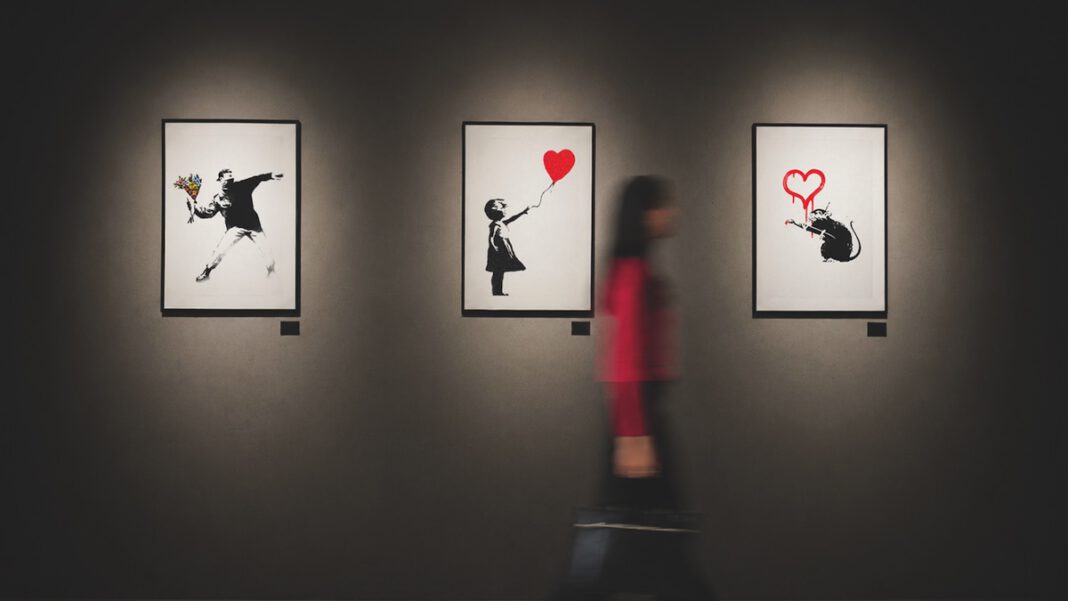
The Banksy exhibit features 2-D and 3-D pieces in a collection of never-before-seen-together artwork by the internationally renowned, anonymous British artist. His work addresses—often provocatively—serious social issues like migration, refugees, surveillance, hypercommercialism and the police state.
Humor and satire are the connecting factors in well-known works such as “Girl with Balloon,” “Flower Thrower” and “Rude Copper.” Other works hold surprises, weaving rats, apes, wasps, a Mona Lisa adorned with a smiley-face sticker, trash-filled shopping carts amid Monet’s famous waterlilies and other elements into works that appear on buildings and other unusual, highly visible locations.
The exhibit runs Wed-Sun through Jan. 3. Timed in 30-minute increments, the event entrance is via a private elevator on 10th Street. Notably, a protective weather tunnel leading to the entrance and a ramp into the exhibit display murals created by artists of the Oakland-based Bay Area Mural Program (BAMP). The award-winning nonprofit public art organization founded in 2018 has created more than 100 murals in the Bay Area and has partnered with the Valkyries, Golden State Warriors, YMCA, Amazon and others.
In an interview, Kaiser Center CEO Terri Trotter said the exhibit includes roughly 50 original artworks and fills 7,550 square feet of the basement. “The art comes from private collectors,” Trotter said. “Starvox [based in Canada] brought a Banksy show to San Francisco’s Palace of Fine Arts in 2021 and has recently done a show in Tampa. We decided to change out the art to show all new works.”
Videos about Banksy and individually themed sections expand on the artist’s possible identity, the inherent temporality of street art and other explorations. Underscored throughout is how public art’s bold, enduring messages paradoxically pair with its vulnerability. Street art is subject to decay or destruction due to any number of reasons including aging, weather and tagging. Although designed for lasting impact on cultures or societies, it seems destined to disappear.
“Street art is about and for the community in ways that happen only in the public sphere,” Trotter said. “It’s ‘of the moment,’ changes rapidly. It becomes part of our daily lives. When I go to work, I walk these same six blocks and a mural or building is incorporated into my everyday life. We might take public art for granted or disrespect it, but we notice when it changes over time. If a mural gets removed, you notice it.”
Artist and BAMP Executive Director Andre Jahmora—a.k.a. Natty Rebel—in a separate conversation said Oakland and the broader Bay Area have a symbiotic relationship with street art. “Whether it’s geographic or revolutionary, from the Black Panthers to Silicon Valley, there’s resilience; the mentality to take nothing and create something, to redefine and establish yourself. It perpetuates the art in Oakland like no other city,” Jahmora said.
The aura, he continued, is rebellious, expressing free speech and creativity made by street artists, some of whom have no formal art education or training. Many have no budget for making art, but find ways to circumvent obstacles and leave their mark. “There are some artists with more skills than I’ve seen in galleries,” he said. “From portraits to texturing to landscapes, so many different disciplines and styles are captured.”
Trotter said tying the local community into events at the center is a primary goal. “We knew with this exhibit from the beginning we wanted to engage with local street artists. The BAMP people are so good at taking the ethos of a place and putting it into the work. The center is so rooted in the history of Oakland, you’re hard-pressed to find someone without a connection. It was a natural fit,” he said.
Jahmora said the opportunity to raise the visibility of local artists is huge. “The exciting part is everyone in the world knows Banksy,” he said. “Visual art is not as popular, and the name recognition is not as high as it is with performing artists. With someone of this magnitude we revel in his being an artist, and there’s 100 construction people just working on the installation. It’s great for our artists to ride his coattails.”
The future of street art around the world and in the East Bay is secure and special, according to Jahmora. “It will always be a catalyst for the past, present and future,” he said. “BAMP can partner with any company, youth group or community because we illustrate their mission. If you want to know about a civilization, you don’t study their politics prior to studying their artwork.
“Street art speaks to the times and pays tribute to the past. It’s the things that can be or are possible, painted or crafted by human hands. In this AI-saturated world, it’s old-school. Handmade art is the language of the people because you can’t mainstream the creative mind, especially when it wants to oppose the majority,” he added.
That futuristic view has Trotter imagining a wide assortment of highly interactive, intimate events and shows for the center’s uniquely flexible and spacious underground basement. That same mindset energizes Jahmora’s vision of an involved community taking ownership of public art because it resonates with local stories and daily lives.
For tickets and event information, visit thehenryj.org/banksy-exhibit.