
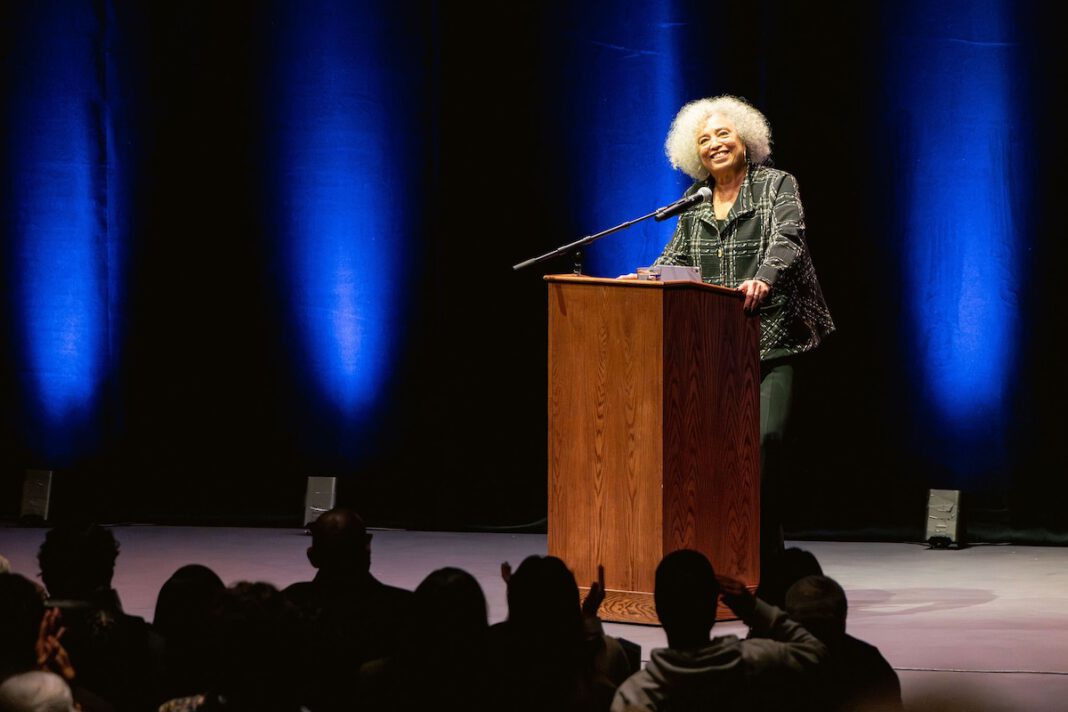
Appearing Oct. 28 at Zellerbach Hall on the UC Berkeley campus, activist, author and educator Angela Davis delivered a strikingly musical performance.
The program’s title and theme anchored on jazz-pianist and composer Billy Taylor’s iconic song, “I Wish I Knew How It Would Feel to Be Free.” Recorded by Nina Simone in 1967, it became emblematic of the Civil Rights Movement. As Davis connected the song, slavery, prison abolition and civil rights movements to the sociopolitical realities of 2026, music was evident in her voice, the composition of her ideas and the repetition of key phrases.
Co-presented by Cal Performances with UC Berkeley Graduate Lectures, “Movements for Liberation and Transfigurations of Freedom” was part of the Jefferson Memorial Lecture Series and The Program in Critical Theory. A professor emerita at UC Santa Cruz, Davis became a national figure in the 1970s through her work in Black liberation, feminist, queer and prison abolitionist movements. Her incarceration after being placed on the FBI’s Ten Most Wanted list sparked the international “Free Angela Davis” campaign. She is the author of 11 books.
After a standing ovation and a moment of silence for labor leader and feminist activist Dolores Huerta, Davis got straight to the business at hand. She found the relabeling of the 1960s Freedom Movement to the Civil Rights Movement, limiting. “Civil Rights only captures one dimension of that struggle for freedom, which six-and-half decades later continues to unfold,” she said.
Davis offered connections from examples of poetry, documentary films, stage plays, novels and songs to express the movement’s “collective agency to affect change in the world.”
To underline the emphasis on collectivism, Davis referenced civil rights leader Fanny Lou Hamer’s famous phrase, “Nobody is free until everybody is free.” Then, reflecting on writer Toni Morrison’s words, she added, “The very purpose of freedom is to guarantee the freedom of someone else.”
Freedom, Davis insisted, is never static or reserved for one gender, race or class. Historically, it prioritized white male property owners. She asked, “Why am I rehashing all of this in the year 2026? More than 160 years after the abolition of slavery, why take risks?”
Davis said it was necessary because the same forces are still at play. Select races and genders are excluded, capitalism rules the day and the prison system delivers a “civil death” to incarcerated people. “Imprisonment has become parasitically attached to the bourgeois democratic notion of freedom,” she said. Democracy is shattered by the dual hammers of individualism and capitalism “so much so that we’ve barely begun to challenge the necessity of imprisonment.”
Concepts that challenged slavery are in kinship with arguments to abolish imprisonment, according to Davis. The historical forces of oppression are seen in the Holocaust, the current Gaza war, anti-immigrant attitudes in America and other recent global events. Davis summed up the present environment as narcissistic, with freedom achieved in isolation at the expense of others.
Resistance is best when it comes collectively and is accompanied by courage, according to Davis. She said elections in the U.S. are important—but not the be-all, end-all. Looking at Brazil’s recent elections, she said, “I suggest the U.S. relinquish its claim to represent the bearer of freedom to the rest of the world.” When people most denied freedom rise up, she suggested, the possibility of change increases.
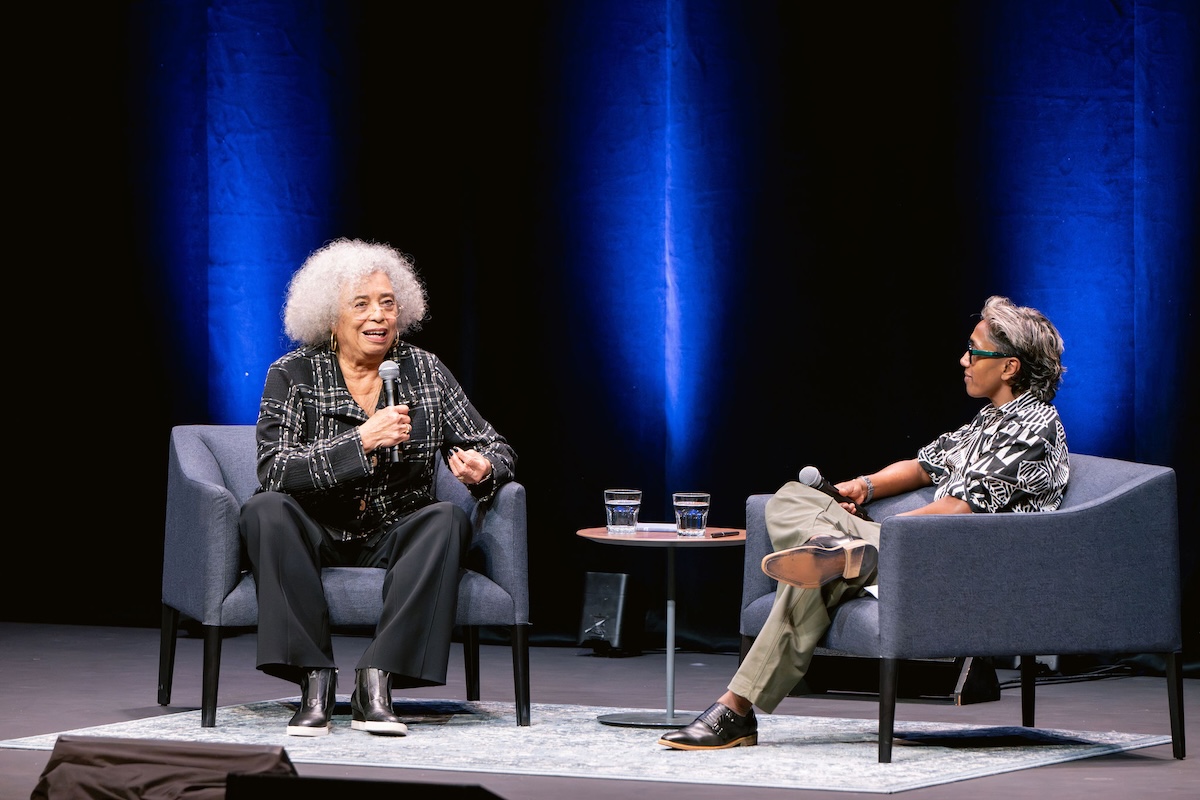
Joined in conversation by Poulomi Saha—UC Berkeley associate professor of English and chair of the program in critical theory—the discussion returned to music and the “collective feelings” it generates.
“This is one of the wonderful dimensions of music. When we listen together, we feel it,” Davis said. Words sometimes fail to embody an idea. In that void, she has found music “consumed collectively” conveys the ideas and visceral nature of liberty.
Their conversation quickly turned to what Saha called “this dark global moment” and a question about where and to whom Davis looks for hope.
“I don’t think that person who’s currently occupying the White House is a model for most people in the country and the world. People are more intelligent than that,” Davis said. Instead, she pointed to South America, young activists worldwide and freedom movements in Mexico. She called for organized resistance to capitalism. By building safe, accessible places for expression, and engaging in the revolutionary practice of creating and generating unfettered freedom, she holds onto the conviction that freedom is achieved only when it is available to everyone.