
There’s a lot of talk of broken systems of late, from the criminal justice system to inequities in global climate impacts. Instead of understanding systems by what is broken, recall this simple check for a healthy system: Functional systems provide positive outputs from available inputs.
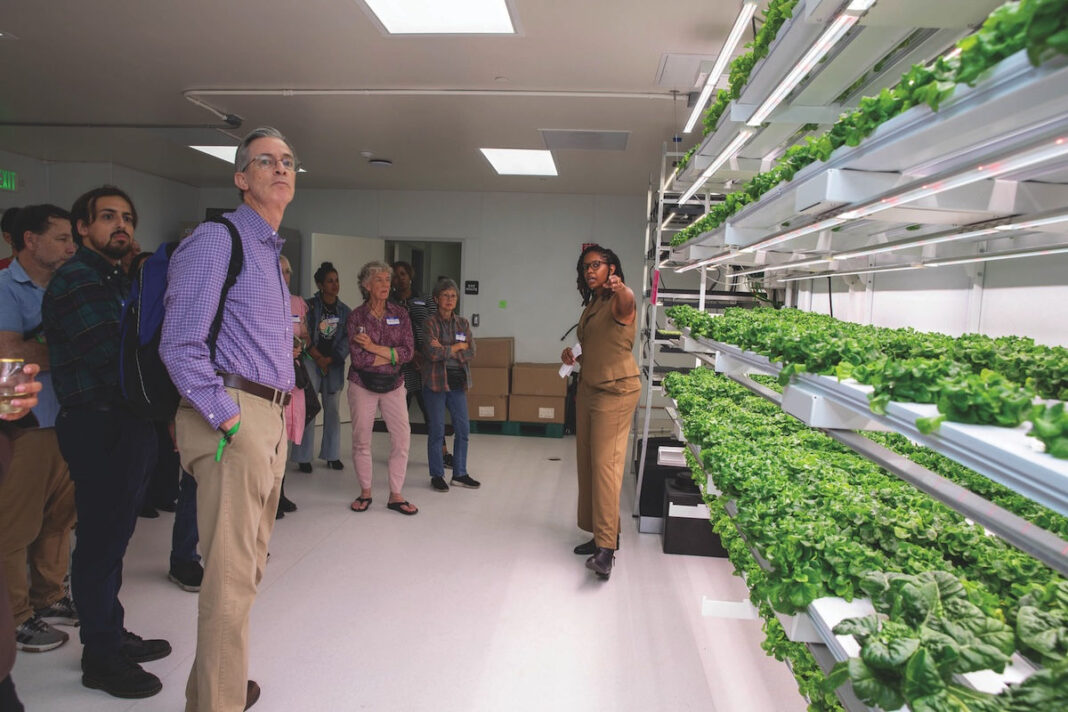
Growing Justice, a program of the Oakland-based nonprofit Impact Justice, is one of those functional systems, a modular vertical garden already in operation at test installations within carceral facilities in South Carolina and California. The environmentally controlled farms—made from an assemblage of four standard shipping containers—produce several benefits for the workers engaged with them, the first being fresh produce. At the demonstration farm newly installed within Impact Justice’s Lake Merritt offices, this means leafy greens, rows of them looking very juicy.
“So we have green oak, we have some butterheads, some romaine, some sweet crisp, some multileaf and some red hook,” said Kristina Bell, the director of Growing Justice, on the tour she led recently during Oakland Tech Week. “But hydroponics can accommodate lots of different crops.”
Tomatoes, berries, mushrooms, tubers—the list goes on. This particular setup is optimized for leafy greens, because the turnaround time from seed to harvest is as little as 40 days. Because of this and because the hydroponics allow the crop to be grown all year, these stacked, life-growing machines produce plentiful food for the space they require: 20 times the food and 90% less water. And as this office shows, such a farm can fit almost anywhere.
“That is why we wanted it to be a part of Tech Week,” Bell said. “Tech isn’t just software, it’s hardware.”
The plants sit in nutrient films of water in neat rows awash in controlled-spectrum light, the LED strips adjustable from an app. Far from feeling removed from nature, these thriving, funny, fractal sets of leaves grown from cups in the best nutrients look ripe and ready to eat.
These particular greens are donated to Oakland organizations on the front line of food insecurity here in the East Bay. The food grown in prisons goes into the meals of prisoners in the same location where it was grown in the prison yard.
Prison Talk
The farm in the office is maintained by workers who were formerly incarcerated or otherwise impacted by the justice system. That’s the mission here, to have a path to employment for human beings who need something different, something more, than what they’ve been getting.
Those workers learn to work with life itself in a new way. Unlike the backbreaking work of outdoor farming, these clean-room, hydroponic gardens are easy to navigate, optimized for positive output.
If that’s starting to sound like Brave New World, I have to say, having been in that room, that the lettuce heads are gorgeous. Life speaks for itself, and these little gems were happy. It showed all over their leaves; they beamed. Bringing food growth into local labs may be disconnecting us from the land in theory, but this growing method provides tangible benefits directly from those positive outputs: food, pay and proximity to living things.
Prisons are invisible food deserts. Growing Justice’s two test farms in women’s incarceration centers, as well as this farm across the street from Lake Merritt, in a room upstairs, demonstrate a viable pathway to food security for workers in all the many communities they live and work in. Paying for this work moves one important lever on the economic system.
I asked Aishatu Yusuf, climate impact VP of innovation programs at Impact Justice, to provide an idea of which levers this project pulls that can help to shift our out-of-whack systems back to proper functioning, to balance out the outputs.
“People call them levers. Some people call them opportunities,” Yusuf said. “Impact Justice as a national organization really looks at how to use innovation to create change.”
With food production, those opportunities innovate along several paths at once: being affordably replicated, feeding good-paying jobs and feeding people. The growers benefit, as do the eaters, the job searcher, the neighborhood family. The project represents an innovation in the food/ag system that moves levers in the justice system.
“We see everyone as impacted by the justice system, [and] that’s partially because we live in communities together,” Yusuf said. “That’s partially because we’re in the grocery stores together.”
The open house itself felt like one such coming-together, a space of intentional conversations seeking actionable solutions.
“[The] ethos of Impact Justice is to bring multiple viewpoints, multiple types of people to a space to think about what solutions can look like, and that we can all be a part of solutions,” Yusuf said. “The event was a demonstration of what we are doing every day.”
Pulling levers. Seeing what moves.
For more info visit impactjustice.org.