
Concert posters, those advertisements, underappreciated art forms,
and 20th-century pop culture relics, get their overdue fifteen minutes
of fame in a new documentary, American Artifact: The Rise of
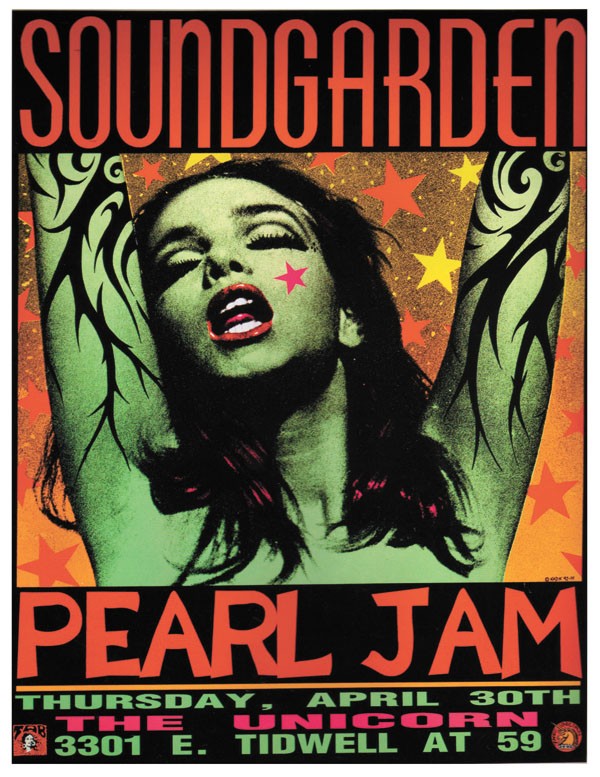
American Rock Poster Art. Beginning with the trippy, acid-inspired
posters of the 1960s — when catchy posters were a marketing
necessity for controversial, radio-banned music — the film leads
us through four decades of an edgy and underground pop art scene, with
the Bay Area as its arguable epicenter.
Four years ago, as she was working a “cushy corporate television
job,” Merle Becker (former MTV staffer and founder of indie film
company Freakfilms) stumbled across The Art of Modern Rock, a
then newly published coffee-table book of rock posters. She says she
was “blown away.”

“I’ve always been a fan of rock imagery: music videos, album covers,
etc., and up until that point, I had no idea that rock posters were
still even being made,” said Becker. “I thought the Sixties rock poster
art had come and gone, and that was it.” Some Internet research brought
her to GigPosters.com, a site
featuring — you guessed it — gig posters from about 20,000
different artists, all working independently, with no corporate
backing. “It was then that I realized that it’s actually this huge art
movement going on right now in America,” she said. Already feeling
jaded and burnt-out from life in the corporate world, Becker soon quit
her job to tour the United States and interview various poster artists
from different decades.
The story begins in the hash-induced haze of the psychedelic
Sixties, in San Francisco, where Becker says “the rock concert as we
know it today” first started. As the Fillmore in particular began
rising to fame as a nationally famous venue and hippie counterculture
hotspot, cryptic posters began to gain popularity as they advertised
the shows mainstream media wouldn’t dare publicize. Forty years later,
it’s hard to imagine how controversial Janis Joplin or the Grateful
Dead could be, but Becker does a beautiful job of recreating the era
through artist interviews. These early moments contain some of the
film’s most precious dialogue, as artists begin to discuss the
intention behind the characteristic bubbly, incomprehensible lettering
in standard Sixties poster art.
“It was a game: ‘Can you read this?'” asserts artist Victor Moscoso,
who did many of the Fillmore’s early posters. “We were talking to our
friends.” If you couldn’t read it, well then, perhaps the message
hadn’t been meant for you. Consciously rebelling against what art
school had taught him, Moscoso made lettering as illegible and the
poster’s message as oblique as possible, with colors that would vibrate
and “irritate the eye,” thus drawing in viewers to stop and examine the
work, rather than digest the message quickly as traditional advertising
wants viewers to.
“The lettering was — you had to puzzle over it,” agrees a
gesticulating Winston Smith, an artist most famous for his work with
the Dead Kennedys. “If you were stoned, you could read it,” he laughs,
“but if you were too square, you couldn’t see it. It was kind of a
Rorschach blot for hipness.”
So follows a lengthy and well-deserved tribute to the historically
and currently essential Fillmore, a veritable mecca of rock ‘n’ roll
art, where the art is both preserved and perpetuated more faithfully
than any other venue, in its poster lounges.
“I remember the first time I walked into those poster lounges,” said
Becker. “People had told me about them, and what an amazing collection
it was to see, but I don’t think I was prepared for exactly how
profound an experience it was. There was all this beautiful work
staring back at me — the bands, the shows that came and went. It
felt like I was looking history in the eye.”
The late Bill Graham himself is one of several interviewees who
reminisce on the venue’s early days, alongside rock art collectors,
artists, and fans. Artist Jeff Wood reveals a little known rock ‘n’
roll folklore secret: the tradition of collecting a poster
post-Fillmore show began as a crowd-control method. “At the end of the
shows, to get people out, the first 500 people out the door got a
poster,” he states, “and it was to clear out the music hall.” Thus
began a beloved and unique Bay Area tradition, immortalized still on
the Fillmore’s walls.
Becker continues through the decades, pausing to examine work from
Sixties and Seventies psychedelic icons, continuing on to the Xeroxed
punk flyers of the 1980s (the pre-Internet networking model of choice
— the “MySpace of the Eighties”), through the dark and creative
grunge posters of the 1990s. The film turns into a loose history of
late-20th-century pop culture, using the posters as a common thread to
link the disjointed rock subcultures of different eras. Much like the
origins of Becker’s film itself, the work praised here survives in, and
is often necessitated by, stark opposition to the corporate world. And
so begins the high art versus low art discussion: As rock posters
elevate to fine art status (whose rules, as Moscoso argued, defined the
very framework that rock art shatters), can the rebellious spirit of
rock ‘n’ roll still reign? What really respects the intention of the
rock poster: to frame it in a museum as a relic, or staple it on a
telephone pole?
Becker says she’d like to see rock posters being preserved both as
an affordable memento by music fans, and as part of America’s cultural
history. “Every musical era throughout history has had visual artwork
that has accompanied it: classical, baroque, etcetera,” she said. “In
America, we’re currently in the era of rock ‘n’ roll. The rock posters
are the inspired visual artwork of this era. They deserve to be
celebrated and preserved.”