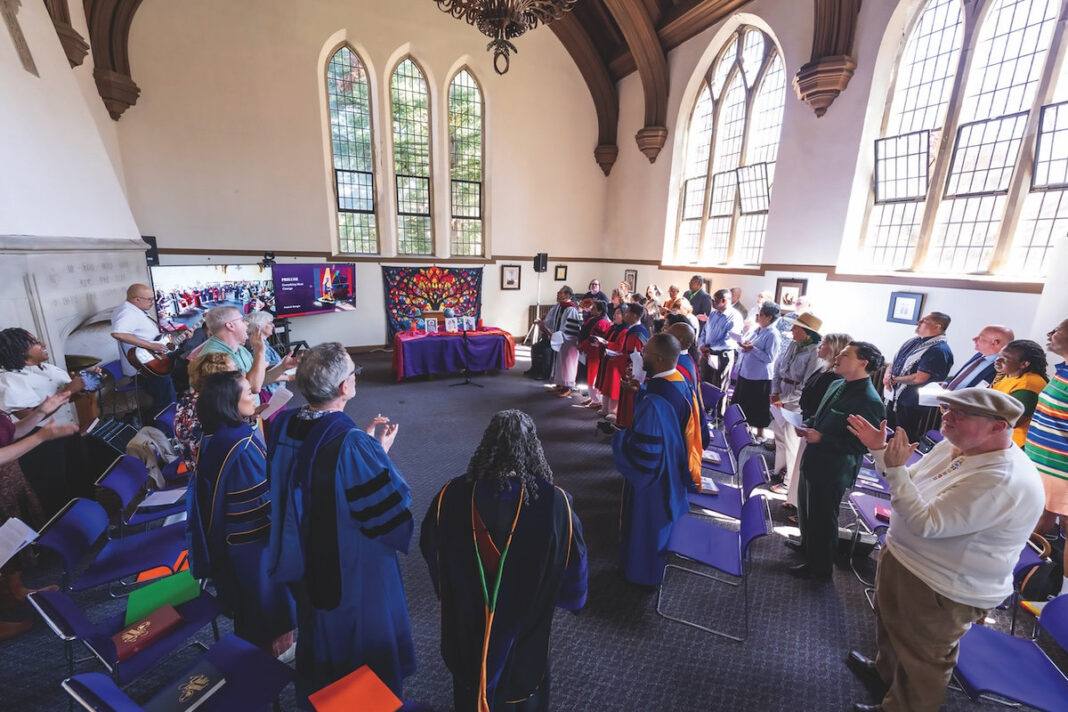
On Oct. 17, as communities across the East Bay and the country mobilized for No Kings/Vote Early, students, staff and instructors from Berkeley’s Pacific School of Religion (PSR) were among the participants.
The school issued a statement reading, “On Saturday, October 17, people in cities and towns across the country will gather again under a simple banner—No Kings—and a specific call: vote early, plan, and protect the right of every eligible neighbor to be counted on November 3.
“Pacific School of Religion will move with them. The word move has shaped our 160-year history. When we see injustice, we move. When we see oppression, we move. When the long valley of the shadow stretches to consume everything in its path, we move.”
In an era of “faith-based misinformation,” as the school describes it, the school committed to “remind a frightened world that grace still lives…No kings. No fear. A world where all can thrive.”
PSR, established in 1866 as Pacific Theological Seminary, changed its name in 1916. The change reflected PSR’s new nondenominational status and the faculty’s growing interest in the importance of the world’s religions to the Christian faith, according to PCR’s website.
The school moved to Berkeley in 1901. It maintains “covenantal” relationships with the United Church of Christ, the United Methodist Church and the Disciples of Christ, but also has ties to the Unitarian Universalist Association, the Universal Fellowship of Metropolitan Community Churches, the African Methodist Episcopal Church and other denominations.
PSR president Rev. Dr. David Vásquez-Levy said in a phone interview that recognizing political power is how communities are transformed. Noting how diverse the East Bay is, he emphasized that the absence of exercising political power creates setbacks. “We encourage our communities to participate,” he said. Diversity is key at PSR: 70% of its students are people of color, and a large percentage identify as LGBTQ+.
This affects more than just its East Bay student body, he said, because PSR has a large online student presence. He pointed to an event in Southern California called “Bless the Vote,” in which students participated. “It was very moving,” he said.
Asked why he believes there has been a rise in Christian nationalism, he noted that globally there has been an increase in religious fundamentalism across all faiths. “People think, ‘There was a better past in which we were dominant,’” he said. This creates fear of the present day. Vásquez-Levy faulted the progressive movement for its reluctance to recognize the “animating power of religion to challenge that worldview, to step up and wrestle what a multi-religious world would look like.”
This struggle was brought into clear focus, for example, in the Michigan Senate race, when candidate Abdul El-Sayed was confronted by a man who repeatedly asked him to “disavow the Muslims.”
El-Sayed responded, “… the reality of it is this: I’m never going to tell you what faith you can or can’t practice. I want to protect your right to practice your faith as you choose, as a Christian man. It seems like you don’t want to protect my right to practice as I choose. Do you disavow any attempt to read any religious doctrine into the laws of our country? You don’t disavow that. So I think it’s you who needs to understand the Constitution now.”
The acknowledged “father of the Constitution,” James Madison, subscribed to beliefs combining aspects of Deism and Unitarianism. According to the National Constitution Center, “He championed the ‘free exercise’ of religion, believing that an individual’s conscience belonged strictly to God rather than civil authorities.”
Vásquez-Levy said some PSR students have begun to wear symbols of their religious beliefs as a way of saying, “We stand in the space to engage in conversations.”
He added, “In every classroom, we ask, ‘Can you speak with conviction so you are not threatened by the views of others?’” The word “Thinking” is in the title of all of PSR’s first classes. Three goals are emphasized: “Blow Your Mind,” “Embolden Your Heart” and “Strengthen Your Hand.”
“Our master’s of divinity helps people think much bigger … moving you out of a tiny world,” he said of the first goal. “Embolden” addresses the anxiety that grips many people, “helping is to come together and deepen our well,” while “Strengthen” is about skill development, and how to bring people together.
At a time, Vásquez-Levy said, when media coverage focuses on the decline in church attendance, churches and religious gatherings remain at the heart of many communities, providing services such as food distribution, child care and senior services.
PSR, he said, “speaks from a very particular space,” and views its role as helping churches see themselves differently in “what role we play” in faith as liberation, dignity and expansive belonging, and multiracial, multifaith coalitions for democracy.
For more information about the Pacific School of Religion, visit psr.edu.