
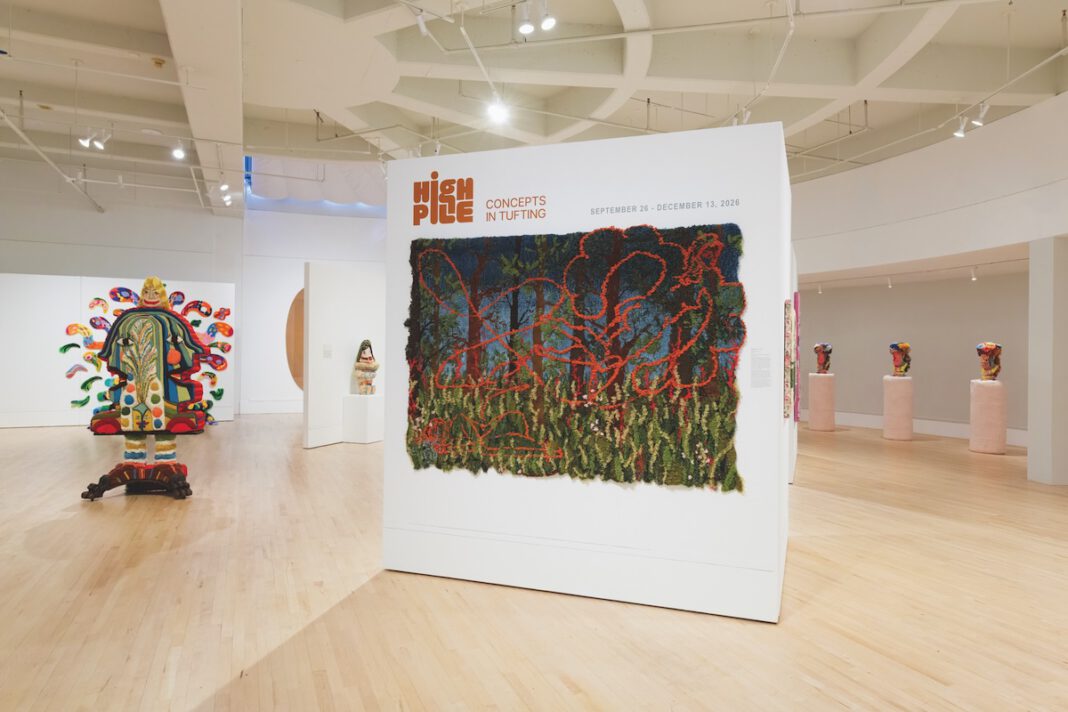
The pandemic cannot take credit for elevating tufting to a fine art. OK, maybe it can a little bit.
The centuries-old hand craft, believed to have originated in ancient Persia, involves punching yarn through a stretched backing fabric, then pulling loops of extra yarn through the fabric from the outside. Used primarily to make rugs and wool garments, it was mechanized in the late 1920s and is still used today in commercial rug making.
But as a hobby for making rugs and wallhangings, Americans first embraced it in 2018, when Tim Eads and Tiernan Alexander created the website “Tuft the World,” eventually making affordable tufting guns widely available. Then, as so many hobbies did, it took off during the pandemic. Artists were not slow to notice how it could be used to create art pieces, and thus, “High Pile: Concepts in Tufting” at Walnut Creek’s Bedford Gallery brings together the work of 20 artists from across the country working in the medium.
“Part of my vision is to explore the merging of fine art and craft, elevating craft into the fine art conversation,” said Bedford Gallery curator of exhibitions and programs Emilee Enders. She is also drawn in by the fact that much craftwork has traditionally been done by women. Eighteen of the artists exhibiting in “High Pile” are female.
It’s taken nine years for the exhibition to come together. Enders first saw the work of influential tufting artist Trish Anderson in 2017 on Instagram. Her work is now featured in “High Pile.” From there, she explained, gallery staff started to research and compile information about artists working in the medium. “Many people were developing their processes,” she said, noting that some work entirely with the various kinds of tufting guns, while others combine that with hand work.
One of these is Ohio-based artist Mychaelyn Michalec, who has two pieces in the show: All my geese are swans 2 and Knock on Wood. “I have been doing more by hand, using the punch needle for details,” she said in a phone interview. Michalec, whose work has received national attention, is known for her exploration of gender and feminism issues.
She had been painting and drawing for years when, like Enders, her attention was drawn to tufting, first by a video of someone operating a rug-tufting machine and then by the work of Trish Anderson. “I had experience with knitting and weaving,” she said, “but they take much time to build up an image.”
By 2020, she realized the tufting trend had gone beyond just an internet algorithm. The appeal of a technique that had been passed down by women through generations, that fit with her focus on the perceived failures of post-second-wave feminism, and that took a form of creativity which has been dismissed as “second class” by the male-dominated art world, was irresistible.
She has created an entire series of work featuring birds alongside depictions of parts of her own body. Throughout history, she said, women have been compared to birds, sometimes positively, if dismissively, and sometimes negatively, as “harpies.” Her process involves drawing and sketching, as she envisions the piece, with the final image projected onto the cloth that will be used for tufting. Her work All my geese are swans 2 is an example of this.
Michalec has also been inspired by the work of the late feminist artist Ree Morton, and her second piece in “High Pile,” Knock on Wood, is what she describes as a “remake” of Morton’s 1974 Weeping Willow.
Another creator with work featured in the exhibition, Portland-based Melissa Monroe, is a self-taught artist who discovered tufting in 2021. Like both Enders and Michalec, she was inspired by seeing Trish Anderson’s work. “She tufted a runner for stairs,” Monroe said in a phone interview, and the runner’s vibrant color and general sassiness spoke to her.
“I always loved textiles, but I didn’t have the patience [for many of the craft forms],” she said. With tufting, she uses multiple types of tufting guns, then cuts in details. She has two pieces in “High Pile,” Cape of Faces and Believable Rumor. Cape of Faces is a large, whimsical sculpture, and Believable Rumor, a new piece, uses a ceramic stool and other components.
Monroe finds inspiration in antique stores and vintage furniture shops, in folk art and in her own imagination. “I want the work to surprise me,” she said. As a mother, she also sees the connection between tufting and childhood memories. Many children watched grandmothers and mothers at work on textile crafts.
She suggested visitors to the show take time to appreciate how the artists have accomplished their imagery. “There are so many techniques involved,” she said. And if some people are inspired to take a workshop to learn tufting, even better.
“People are drawn to it because it is such a tactile art form,” Michalec said. It’s natural to want to reach out and touch but, of course, that isn’t permitted at the exhibition.
“The show is joyful playing with color,” Enders said. Tufting, she said, is partially a response to AI- and computer-generated art. “There is interest in going back to handmade.”
“[The exhibition] is an opportunity to expand your understanding of what fine art can be,” she added. “Take your time, come back and spend more time with your favorite pieces.”
Special event: Bedford Gallery’s “Cocktails & Conversations” featuring “High Pile,” 5:30-7pm Nov. 5, with curators Emilee Enders and Erica Schultz. Tour, cocktails and light bites. $30.
‘High Pile: Concepts in Tufting,’ through Dec. 13, Bedford Gallery, Lesher Center for the Arts, 1601 Civic Dr., Walnut Creek. bedfordgallery.org