Dr. Angela Wellman spent 20 years passing Black music from one pair of hands to the next. Now she’s stepping down, and her conservatory still rents in a city that zeroed out its general-fund arts grants.
The video is old: Victor McElhaney, young, drumming with the Oakland Public Conservatory of Music (OPC) at the Art & Soul Festival. His father, Clarence McElhaney Jr., watched it the other day.
“It’s been 20-years-plus,” McElhaney said.
Victor would be 30 next year.
Across town, Dr. Angela Wellman holds up OPC’s first class schedule, dated January 2006. Jazz for string players. Afro-Cuban rumba. Steel pans. Count Basie’s big band book, taught by Wellman herself.
“This is memory, right here,” Wellman said.
The body will always remember.
On Saturday, Oct. 24, OPC turned 20 with a gala honoring Rhiannon Giddens, Mary Watkins and Steve Turre and, posthumously, pianist Ed Kelly and Victor McElhaney. It is also Wellman’s goodbye. The trombonist, 70, built OPC to teach Black music as the root of American music. She steps down at year’s end, and OPC has not named a successor. It still rents, in a city that zeroed out its general-fund arts grants two years ago.
The ledger
Art & Soul, the festival in that video, ran downtown every year from 2001. After the pandemic, the city cut its support from $120,000 to $20,000. Even that check sat for months in city backlogs, along with grants for 42 other groups.
Organizers canceled the 23rd Art & Soul, the first time it went dark for any reason but Covid.
In December 2024, facing a $130 million deficit, the Oakland City Council cut $683,532 from its arts grants. That wiped out every dollar the general fund had put toward them. Forty-eight arts groups and festivals were counting on it.
Meanwhile, Oakland’s more-than-200 arts nonprofits generate over $85 million a year and employ about 1,500 people, according to former city cultural affairs manager Roberto Bedoya.
Eighty-five million dollars a year from the arts. Zero from the general fund.
“An organization run by a Black woman that’s playing jazz and stuff,” said Laurie Cahn, a former OPC board member. “It’s not high on the priority.”
This summer Wellman took four grant rejections in a row. “A lot of people don’t even know this place exists,” she said.
McElhaney keeps a different ledger. When asked how he wants his son remembered he said, “He loved OPC.”
It started with bucket drumming at Berkeley Maynard Academy. Then an older friend, Ayinde Webb, told Victor about OPC. One rehearsal, and Victor was in.
The drummers didn’t practice. They shed. Victor shed in the basement at all hours. “You gotta let him practice,” his father said. “He was a kid with an old spirit.”
A life in music
Wellman came up the way Victor did, in a school that elders built for children. Kansas City. Missouri, not Kansas. Wellman will correct you.
Her mother sang as Jean Baker. When she auditioned for The Ed Sullivan Show, someone at the door told her they weren’t looking for any negroes. She sang with her brother’s band, the Kansas City New Breed Orchestra. That brother, Eddie Baker Sr., went to high school with Charlie Parker and founded the Charlie Parker Academy of the Arts. Wellman picked up a trombone in sixth grade and grew up in that school.
Years later, in Oakland, Cahn taught Wellman tai chi and heard the plan: a school like Uncle Eddie’s. “It was a good idea,” Cahn said. “And here we are 20 years later.”
In the 1980s, trombonist Steve Turre came through Kansas City on tour with trumpeter Woody Shaw. Wellman found him after the show and told him she played trombone. At her apartment, he asked what she wanted to learn. She picked Charlie Parker’s “Donna Lee,” a bebop line built for saxophone and brutal on a slide trombone. They stayed close, and a National Endowment for the Arts jazz study grant later sent Wellman to New York to study with him.
Then Turre played with McCoy Tyner’s big band at Kimball’s East in Emeryville. He had to leave before the last night, and he wanted Wellman in his chair. “Oh, girl, you ready,” she remembers him saying.
No rehearsal. Wellman learned the charts off the vinyl. On the bandstand, a local trumpeter leaned over her chair and asked, “Angela, what are you doing here?”
She told him, “Same thing you’re doing here.”
B-flat blues, first solo of the night. Wellman opened with “Nobody Knows the Trouble I’ve Seen.” Tyner grinned and fed her a chord. Afterward he asked, “So when are you coming to New York? People need to know you.”
Wellman said, “The feeling of that is still living in me.”
She toured with DIVA, the all-women big band, and shared stages with Joe Williams, Al Grey and Nancy Wilson. Later came Dee Dee Bridgewater’s big band and a doctorate.
“The woman has mad skills,” McElhaney said.
Wellman came to Oakland in 1984 meaning to stay a year. She subbed, then taught music in Oakland’s public schools, including Cole, the West Oakland arts magnet.
“When you walk around Oakland with Angela, it’s always just, ‘Miss Wellman, Miss Wellman, remember me?’” Cahn said. “Nobody forgets her. Nobody.”
The music we inherit
One likely ancestor of the banjo is the akonting, three strings fixed to a gourd, a lute the Jola people of Senegambia still play. The secret is the stroke: a fingernail strikes down across the strings, and the thumb catches the short string on the way back up. Enslaved Africans carried that stroke across the Atlantic, where they and their descendants built the banjo. Banjo players call the stroke “clawhammer,” for the hand curled loose like a hammer’s claw.
Strike down. Catch on the way back up. That’s how Wellman teaches. She demands the hard thing, then catches the kid.
That kind of knowledge moves from hand to ear and ear to hand. In 1893, Henry Ossawa Tanner painted the handoff in The Banjo Lesson. An old man sits with a boy on his knee. The banjo is too big for the child. The boy plays anyway. The old man’s arms circle him. He is not performing. He is holding space for the child to learn.
McElhaney believes Victor felt that line of hands. At five, Victor described African people who came to him when he played. “They tell me what to play, and they like to hear me play,” McElhaney remembers him saying.
“If you watch some of his solos,” McElhaney said, “you can tell he played with a sense of honoring the ancestors.”
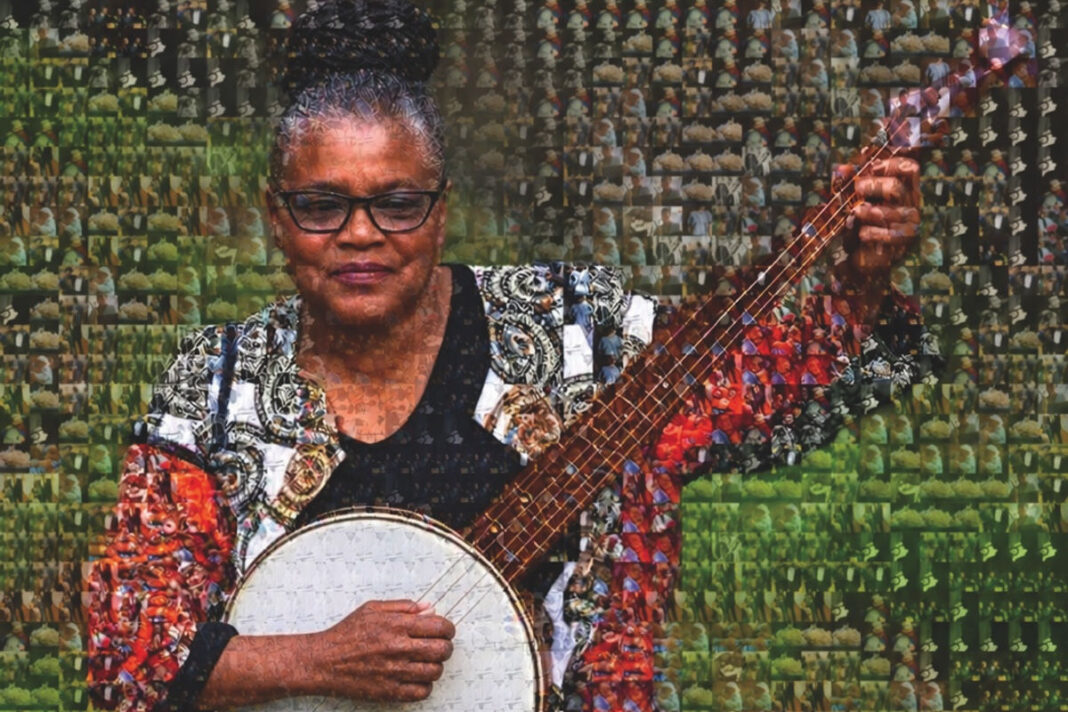
OPC teaches the banjo the same way, as an inheritance. Amina Scott learned it there one summer, and the conservatory now runs a Black banjo and fiddle fellowship. On Saturday, banjoist Rhiannon Giddens took OPC’s National Treasure Award.
A home for the music
An inheritance needs a house.
“When you have your own space, you can do your own thing,” Wellman said.
That was 1616 Franklin St.: 4,400 square feet, open until sunup, a hall that carried Ed Kelly’s name, a schedule full of rumba, steel pan and Basie. “What does that speak to?” Wellman said. “Diaspora.”
Nine years in, the rent doubled. Three years without a home. Seven at the California Hotel, until the water came in one time too many. “No more water,” Wellman said. The third home is too small, board member Sonja Scott said.
Wellman wants OPC to own its building next, maybe with rental units or housing to carry the cost. She taught herself board development, grant writing and human resources, she said, all “while flying the damn plane.”
She said, “A space like this needs to exist. I really think the city needs to support it, hands down, more than it does.”
Where young musicians belong
Inside those walls, the kids came first. In 2008, a friend invited Scott’s daughter Amina, 13, to an OPC student jam. “She finally found her people,” Scott said. Marcus Shelby taught her. John Handy fed her dinner. Other schools say they’re for the people, Scott said, “but they’re not necessarily for my people.”
Cahn watched the Frederick Douglass Youth Ensemble, 10-year-olds, play Chick Corea’s “Spain.” “I literally cried because they were so good,” Cahn said. “So good and so young.”
Wellman overheard Amina working on an original tune. “Y’all playing that,” Scott remembers Wellman saying. “Get that ready.” At Art & Soul, the teenagers played their own songs. “That’s who Angela is,” Scott said. “She’s like, ‘You could do this. You got this.’”
Then Lima, Peru, for a diaspora festival. “That has changed how my daughter travels to this day,” Scott said. “She doesn’t like to stay in expensive hotels. She likes to stay with the people.”
Pete Escovedo once called Victor up with his band. “They said, ‘Oh, he’s just a little kid,’” McElhaney said. “But then he showed out.”
The parents drove every weekend. McElhaney’s title: “Board member, babysitter, chauffeur.”
He said: “Nothing’s given to you. You gotta work. But then you gotta learn to work with others to help others along the way. You need each other to make the music, to tell the story.”
Not every room was that open. At USC, McElhaney said, a teacher asked Victor how to bring more Black students into jazz. Victor said the music had new gatekeepers. “But we are the ones who invented it,” McElhaney said.
Wellman spent a decade on a dissertation about that gate. She studied how racism keeps Black students out of music education, using her own life as evidence: The rooms that let a little Black girl with a trombone in, the rooms that shut her out, the rooms that let her in because they had to.
Writing it pushed her to say out loud what she had kept quiet for 20 years. “This place is founded by queer women, and that’s not a part of the conversation,” she said. “And it needs to be.”
The jazz world she came up in was “such a homophobic place,” she said. OPC was built to be its opposite. “It’s such a loving, open, welcoming space for all people,” she said. “And I don’t take no mess either.”
The violence behind the music
Victor, a social-justice-minded artist, knew the world outside the music, too. In 2019, someone shot and killed him near USC. He was 21. “That same violence took my son’s life,” McElhaney said.
A Berkeley youth music program once turned Victor down, and he came home heartbroken. Years later, a teacher who’d seen him play made him his main drummer.
“If you don’t get it here, it’s meant for you to get it,” McElhaney said. “It’s going to come about, just not the way you think it should come about. Kids need to have a place just to make their mistakes in a safe space.”
The old man. The boy on his knee. Sometimes violence takes the boy. The arms keep the shape.
Who holds the boy?
On Saturday, Amina Scott, Ayinde Webb and Jasim Perales reunited with Turre for the first time since OPC’s 10th anniversary gala. “I’m going to have to make sure I go to the rehearsal so I can have that moment out,” her mother, Sonja Scott, said, “so I can keep myself together on the day of.”
Victor won’t be on that stage. His name will.
Wellman is 70. She wants time to sit and shed again. “I am so much more, believe it or not, than this place,” she said. Leaving is one more leap, and she has made plenty.
“This whole 20 years has been a risk,” she said. “Don’t talk to me about risk.”
Cahn isn’t worried. “Those are big shoes to fill,” she said. “But she’s done her job. It’s going to be here 20 years from now.”
Wellman is not setting the banjo down. She is passing it on, the way the old man in Tanner’s painting does. The boy learns the stroke. The arms weave their shape around him. Twenty years of kids carry that memory in their hands and that shape in their bodies. Who holds the boy now? Who teaches the hands? Who keeps the shape of the arms when the city lets go?
The hands remember what the city budget has chosen to forget.
Oakland Public Conservatory of Music, 492 Ninth St., Suite 906B, Oakland. 510.836.4649. opcclasses.squarespace.com