Californians might sell about $2 billion per year in legal cannabis under full legalization. That back-of-the-envelope estimate comes from the latest data out of Washington, where fifteen months of legal marijuana has resulted in $357 million in sales of pot products, reports indicate. California is 5.5 times more populous than Washington. Californians are almost certain to vote on at least one legalization initiative in November 2016.
[jump]
Washington officials reported today that $357 million was sold from the start of legal sales through August 31.
The sales figures count all types of transactions, from wholesaling to retailing, but retail sales comprised the bulk of the revenue at $250 million.
Sales are most brisk around Seattle ($82 million in Kings county), while several conservative eastern counties such as Walla Walla and Columbia reported $0 in legal cannabis revenue — a boon to the ongoing black market.
“The state’s two biggest stores, based on sales, are in Vancouver, where New Vansterdam and Main Street Marijuana reported sales of more than $13.5 million each. Their initial sales may have been boosted by visitors from Oregon, a situation that could change because that state recently legalized recreational marijuana.”
Cannabis sales have also generated an estimated $90 million in taxes — revenue that would otherwise be entirely flowing to criminals and gangs. (Colorado has generated more than $100 million in sales taxes as well.)
Washington legalized cannabis in 2012 and began recreational sales in the middle of 2014, with just a few stores open, short supplies, and high prices.
Since then, more than 100 stores have opened and Washington growers produced a glut of marijuana so big, it equaled a ten year’s supply of the drug. Prices for wholesale marijuana crashed to as low as $1 per gram, growers report.
Yesterday, Washington officials also announced the state’s first deal with a Native American tribe that wants to get into cannabis. The Suquamish tribe agreed to charge the state’s excise tax to non-tribal customers on tribal lands. The tribe’s first shop opens in November.
A Hayward police officer holding a shotgun loaded with less-lethal ammunition in Berkeley last December.
The ACLU of Northern California and the law offices of Amitai Schwartz filed a lawsuit against the Hayward Police Department on Tuesday, alleging that the agency is charging exorbitant fees that effectively prevent the public from obtaining police body camera video footage. The lawsuit comes as a result of a Public Records Act request filed by the National Lawyers Guild (NLG) in January of this year. The NLG was seeking video taken by Hayward police officers who were called into Berkeley in December 2014 to respond to Black Lives Matter protests. During those protests, police, including the Hayward PD, used less-than-lethal weapons against protesters.
(See the end of this post for a copy of the lawsuit, and a Hayward police body camera video clip obtained by the NLG.)
See also:The Case for Body Cameras See also: The Express Views Videos of Recent Fatal Encounters with Oakland Police
[jump]
According to the lawsuit, the Hayward Police Department informed the NLG on May 15 that it would turn over approximately ten and a half hours of police body camera video only after the NLG paid $2,938.58. The NLG paid the fee under protest, and Hayward turned over some of video footage that the group was requesting. But the NLG has asked for the city to return its money, stating that the fee is illegal. And the NLG has asked Hayward to provide more video footage sought in the original request.
A Hayward police officer holding a 40mm gun.
“The NLG always protested the charge, but they wanted the videos,” said Alan Schlosser, Senior Counsel with the ACLU of Northern California.
Schlosser said the purpose of the Public Records Act would be thwarted if Hayward is allowed to charge high fees for the body camera video footage. “I don’t know of any cities that are imposing this kind of fee on body camera footage,” Schlosser added.
The Hayward Police Department did not return a phone call seeking comment.
The NLG also asked for body camera footage from the Oakland police, but Oakland has not responded yet to the group’s request.
“This over-charging is part of the larger problem of lack of public access to video footage,” said Rachel Lederman, NLG chapter president. Last month, the Oakland police selectively let members of the media watch footage from recent fatal police incidents, but claimed the videos remained exempt from public release. Oakland only released the footage (at no cost) after several media outlets filed records requests.
In one of the Hayward police body camera videos from last December obtained by the NLG, a group of Hayward police officers appear to be holding a line against a protesters, blocking them from passing through a parking lot. One Hayward cop then says, “Alright, we’re going to start fucking blasting them.” Moments later the same officer fires what appears to be a less-than-lethal shotgun round and says, “Got him in the hip.” Other officers can be heard complaining about rocks being thrown at them. Some Hayward police officers in the video appear to be wielding 40 mm exact impact round weapons, which fire “sponge rounds,” plastic oblong projectiles with a foam tip.
1. Fire officials are warning that the death toll from the fast-moving Valley Fire in Lake County could rise, as they receive more reports of missing residents, the Santa Rosa Press Democrat reports (h/t Rough & Tumble). Leonard Neft, a former reporter for the San Jose Mercury News, is among those reported missing, the Chron reports. One person is already confirmed dead — a former teacher who had advanced multiple sclerosis and was unable to flee the blaze.
The Rough Fire is one of three major blazes still burning in the state.
2. Firefighters battling three major blazes in the state could get some relief today, because light rain is expected to roll into Northern California, the Chron reports. The storm could also bring some snow to the Northern Sierra in areas above 7,000 feet.
3. The Obama administration has agreed to deal that would forgive a $350 million debt owed by the Westlands Water District, a powerful agency that represents large agricultural interests in the dry Western San Joaquin Valley, the LA Times$ reports. Westlands owed the money from the construction of the Central Valley Water Project, which brought Northern California water to San Joaquin Valley farms. In return for the debt forgiveness, the federal government will not to pay for drainage of toxic land in Westlands. Environmentalists quickly decried the deal, which still must be approved by Congress.
Eli Leon’s quaint house in the Temescal district of Oakland is filled from floor to ceiling with quilts. He is one of the country’s preeminent contemporary quilt collectors, with a specific interest in improvisational quilts made by African-American artists. Rather than following the tradition of creating symmetrical patterns, these artists piece together compositions reminiscent of abstract paintings — like a Hans Hofmann piece in textile form. Leon is a proponent of quilts as an expressive art form to be valued on the level of fine art, as is Carin Adams, the associate curator of Art and Material Culture at the Oakland Museum of California (1000 Oak St.), where her selections from Leon’s collection are now on view in the show Yo-Yos & Half Squares: Contemporary California Quilts.
Rather than simply building a collection, Leon built a network of relationships with local quilters, acting as both a nurturing patron and a friend. One of those quilters was the late Effie Mae Howard, more commonly known by her quilting name, Rosie Lee Tompkins. Leon met Tompkins at the Marin Flea Market in 1985, where she was selling housewares. The two got to talking. Tompkins was an extremely private mother of five who lived in Richmond, worked as a nurse, and had been making quilts since she was a young girl growing up in Arkansas. Leon convinced her to invite him over to see her work. He left that first visit with a gem in hand: a large, velvet quilt top made from boldly mismatched black and red squares that was lying on her floor, being used as a blanket by her dog. Over the years, the two became dear friends. Tompkins came to be recognized as a nationally acclaimed improvisational quilter — largely thanks to exposure from Berkeley Art Museum director Lawrence Rinder. Leon now has the largest collection of her work.
Rosie Lee Tompkins is one of many Bay Area quiltmakers featured in Yo-Yos Half Squares.
Credits: Courtesy Oakland Museum of California
Tompkins’ quilts are the standout pieces in Yo-Yos & Half Squares. Her work is exuberant, matching shapes and patterns like an ecstatic churchgoer channeling God. Indeed, Tompkins was a devout Christian, and regarded her quilting as a form of spiritual expression. Her smaller pieces — much too small to be used as a blanket — make it clear that, although she learned to quilt out of necessity, her art was no longer utilitarian once her career began to bloom.
Her most memorable piece in the show is an unevenly cut kelly green quilt only a little more than one foot long and three feet wide. In bold, black, Basquiat-esque lettering, Tompkins crudely embroidered her given name, a series of numbers that were likely her address, the name of one of her sons, and a biblical reference. Five black Yo-Yos — scrunched, round pieces of cloth usually made as a practice template for sleeves — punctuated with three thick, black crosses. The piece is both vibrant and melancholic. Most of all, though, it feels honest — not entrenched in any particular aesthetic canon. It’s obvious to note that Yo-Yos & Half-Squares defies the distinction between “art” and “craft,” proving that quilts are a valuable fine art form. But the pieces themselves don’t seem steeped in the desire to achieve that categorization. Rather, these quilts strip “craft” of its kitschy connotations, elevating the medium to its most expressive capacities.
At Scott Galbraith’s chain of West Oakland hotels, you can book a room in a cozy Victorian, built circa 1895, refurbished and stocked with modern technology and a spacious kitchen. The luxurious beds are cushioned with memory foam, and there is an upright piano in one of the suites for the traveling musician. Or, you can reserve a couple of weeks in a colonial revival house in the increasingly hip Dogtown neighborhood. If you’re on a budget, and your visit will be brief, Galbraith offers rooms in a little Victorian Stick-style house on Linden Street in West Oakland’s McClymonds neighborhood. Rooms go for $59 a night, and like his other accommodations, there’s a full kitchen. Galbraith also offers rooms in a single-story Italianate house near the West Oakland BART station for travelers who want easy access to San Francisco. Or, if you would rather just stay in San Francisco, Galbraith operates a hotel in a three-bedroom apartment on Rose Street in the Lower Haight neighborhood.
But if you’re planning on staying in one of Galbraith’s establishments, you should be aware of this fact: His business appears to be illegal. Galbraith’s Oakland accommodations are actually single-family residential homes, most of which he bought in foreclosure. And according to city records, he has never obtained a business license required to operate a hotel, let alone five. He also hasn’t obtained the permits needed to run a bed and breakfast, which is only legal in Oakland if the owner also lives onsite. And Galbraith hasn’t obtained the business license needed to operate as a landlord in the city, nor has he paid Oakland’s hotel tax, or the city’s residential rental landlord taxes. And according to reviews posted on the Airbnb ad for his San Francisco hotel, that apartment probably is not his primary residence, therefore he also could be violating San Francisco’s new short-term rentals law.
Oakland City Councilmember Rebecca Kaplan introduced the idea of taxing Airbnb and other short-term rental companies last year.
Credits: Bert Johnson
Galbraith advertises this home on Center Street in West Oakland for $65 a night on Airbnb.
Galbraith’s hotel business is one of a growing number of scofflaw companies that for years have benefited from a lack of political will to address the negative impacts of short-term rentals. Part of the misleadingly named “sharing economy,” short-term rentals have now expanded far beyond the rental of spare bedrooms to the unlawful practice of renting entire houses and fully furnished apartments exclusively to paying customers year-round. A short-term rental can be as short as one night to as long as several months, but there’s never a lease agreement or any legal contract that would establish a tenant-landlord relationship.
Almost everyone agrees that there’s nothing wrong with renting out a spare bedroom to travelers, and there’s not even much harm in renting your entire house for a month or two if you’re on vacation and would like to earn a little extra income. But what was once a small, on-the-margins practice of occasionally sharing one’s home with travelers for a few bucks has morphed into a behemoth and avaricious global marketplace for transforming residential housing into hotels. This short-term rental economy has been powered by the rise of companies such as Airbnb and Homeaway, which have apps that allow landlords to list properties and connect with an endless stream of customers. But critics say the mass commodification of housing through these platforms has serious drawbacks: It’s harming renters; it’s helping drive up the cost of rental housing by taking homes and apartments off the rental market; and it’s upending the character of neighborhoods.
No one knows for certain how many housing units landlords have withdrawn from the Bay Area’s rental housing stock, but tenants, housing policy experts, and a growing caucus of local and state politicians worry that the short-term rental market is severely impacting affordability in some areas. And while short-term rentals have created thousands of new places for visitors to stay in the East Bay, and given homeowners, and some tenants, an extra source of income, they could also be harming traditional motels and hotels, and simultaneously reducing city revenues provided by hotel taxes.
In West Coast cities such San Francisco, Portland, and Santa Monica, where the short-term rental markets are biggest, the harms have been undeniable. Because of this, several cities have imposed limits on when and how landlords can rent their property as virtual hotels. The East Bay, however, remains a wild west for short-term rentals. Right now almost anything goes. And of the existing laws that should pertain to short-term rentals here, enforcement has been almost nonexistent, despite the fact that both Oakland and Berkeley already each have more than 1,000 short-term rental listings posted on various platforms. In Oakland, less than two dozen of the people who rent housing through Airbnb and other platforms have paid the city’s hotel tax, which applies to anyone renting a living space on a less-than weekly basis. And the market for these virtual hotels in the East Bay is growing rapidly.
Whether short-term rentals will wreak as much havoc on communities in the East Bay as they have in San Francisco depends on when and how cities take action. Regulation will definitely happen, but it remains to be seen whether there will be a crackdown on short-term rentals, or a surrender to the corporate power of the new “sharing” economy — or whether the East Bay will try to chart a path of less acrimony and smarter regulation based on the lessons learned in San Francisco and other battlegrounds.
This fall, the Berkeley City Council will vote on a proposed package of regulations to legalize, but strictly limit short-term rentals. Emeryville leaders are also beginning to discuss the problem. But according to veterans of the war over short-term rentals in San Francisco, East Bay cities will need to do a lot more if they’re going to protect affordable rental housing stock and ensure that landlords don’t abuse these new markets and drive up housing costs even further in the region.
Scott Galbraith is probably the biggest hotel operator in West Oakland. But I found many other East Bay commercial short-term rental businesses while browsing Airbnb’s website. For example, the upscale home at 1001 Winsor Avenue in Oakland, on the Piedmont border, owned by Elliott Blumberg, is available to host wedding parties and business retreats, according to reviews. Blumberg lists six different accommodations, including the 2,600-square-foot, two-bedroom, two-bathroom main residence with an air hockey table and a hot tub. The house is set on a 15,000-square-foot lot with palm tree shaded gardens. In back, is a cottage that has a full kitchen and bathroom, also for rent. The entire property rents for $440 a night, or $9,000 a month. Although he has operated a hotel out of this house since September 2013 through Airbnb, Blumberg only obtained a business tax license from the city on August 10 of this year, according to Oakland’s finance department. That means he didn’t pay business taxes for two years, and according to City of Oakland official records, Blumberg has never paid any hotel taxes either.
Credits: Illustration by Roxanne Pasibe
In Berkeley, landlord Margaret Phillips advertises short-term accommodations in four rent-controlled properties that she owns near the UC campus. Her virtual hotel includes studios and one-bedroom apartments in two large apartment buildings, and several detached backyard cottages in the Elmwood district. Most have full kitchens and bathrooms. She also rents out a townhouse on the north side of the UC campus, near the Gourmet Ghetto.
Phillips was featured in a May 26 KQED/Berkeleyside report about Berkeley’s growing short-term rental problem after one of her tenants complained to the city’s Rent Board about being locked out of his building, and having to endure the many inconveniences that come from living in a residential building that is morphing into a hotel. Based on the fact that Phillips’ listings were still on Airbnb as of last week, and that multiple guests have reviewed her Berkeley hotel rooms as recently as August, it appears that the city has done nothing to address the complaints against her.
I recently messaged Galbraith through Airbnb to ask about his business. He responded that he only rents his properties as long-term month-to-month rentals. “I generally use Airbnb as an advertising platform to list for people moving to town, and [I] don’t accept anything for less than a month,” he wrote.
But numerous guests have stated in online reviews that they only stayed a few days in Galbraith’s houses. And while others might have stayed for weeks or months, it’s clear the houses are being run as hotels, not as homes for Oakland residents. For example, in a recent review, a guest from Connecticut recounted, “I did not get a chance to meet Scott but I did however meet his friend, Chris, as I checked in. The key was left in a lockbox outside of the house so checking in was a breeze, albeit quite impersonal.” The traveler went on to describe the clientele he bunked with at Galbraith’s 10th Street establishment. “Most of the people I met were transient lodgers that were staying for an extended amount of time (I.e. Weeks).”
Galbraith declined to answer other questions about his business. As for his assertion that he’s merely acting as a traditional landlord, renting out properties on a month-to-month basis, city records show that Galbraith has never acquired the business license needed to be a landlord in Oakland nor has he paid the required taxes on long-term rentals. As for Blumberg, the operator of the hotel-mansion near the Piedmont border, he did not reply to messages I sent to him through Airbnb.
It’s clear that turning residential housing into commercial hotels can be very profitable for property owners and investors. Apartments and homes can be rented out as short-term rentals at far higher prices than what a landlord could get on the traditional long-term rental market. The glimmer of gold in the eyes of East Bay investors is perhaps best exemplified by J. Thomas Martin, an amateur real estate speculator with at least two East Bay Airbnb listings. One of them is a studio tucked away on the second floor of a commercial building on International Boulevard, just one block from Lake Merritt. The space is advertised as a minimum-hassle motel: “BART & SF close. EZ check in,” reads the Airbnb ad, which Martin recently reposted after I contacted him, removing his real name and calling himself “Oakland!” instead. Martin’s Airbnb ad also contains instructions for customers much like others on the website: Arrive whenever, get the keys yourself, and show yourself in — there’s no need to interact with the host because there isn’t one. Keys are in a lockbox and the code is emailed to guests before they arrive. Martin rents the studio for $69 a night or $4,200 a month. He’s marketing it specifically to tech industry conference-goers and tourists. A professional cleaning service prepares the studio for each guest, according to the listing. A second listing that Martin added to Airbnb in the past couple weeks appears to be a second studio in the same building, but this one has a full kitchen. Despite operating this micro-hotel, Martin has no business license with the city and has not paid Oakland’s hotel tax, according to city records.
Last fall, at his Airbnb micro-hotel, Martin hosted a meeting of real estate investors looking to cash in on the East Bay short-term rental market. “I have been speaking with short-term furnished rental owners who rent to workers or other travelers, and operate near national parks like Yosemite, in urban areas like Oakland and San Francisco,” wrote Martin in an invitation to the meeting. “The common thread is that they tend to pull in 2-3 times the gross rents of an unfurnished long-term rental.
Credits: Illustration by Roxanne Pasibe
“Pricing above any normal long-term rental, but generally below an equivalent hotel rate can create significant additional income from the property,” Martin waxed like a real estate pro in the invite. “I think high-cost metro areas (and or tech/liberal) like San Francisco, New York, Austin, Portland, Seattle, and many more would be good targets.”
Targets for conversion from residential housing to short-term hotel-like accommodations abound throughout the East Bay. “It’s an especially big problem in the rent controlled jurisdictions across the state,” said Dean Preston, executive director of Tenants Together, an affordable rental housing group based in San Francisco. “The reason is simple,” explained Preston. “In rent control cities, landlords are always looking for ways to escape limits and maximize the money they can make off a unit.” Among East Bay cities, Oakland and Berkeley have laws restricting rent increases and protecting tenants from arbitrary eviction.
According to Preston, short-term rental platforms such as Airbnb have given landlords a new, powerful tool to subvert rent control. By definition, short-term rentals are limited enough in time so as to avoid triggering rent control protections for tenants, so the market they create — connecting thousands of tourists and travelers with thousands of landlords — is perfectly geared to help a landlord convert protected housing into an unregulated hotel.
“Rent-controlled housing is irreplaceable,” said Preston. The Costa Hawkins Rental Housing Act prohibits the application of rent control to newly constructed multi-family rental units. In Oakland the cut-off date is after 1983. In Berkeley, it’s 1980 for most rental housing. “Short-term rentals are the latest wave of this effort, and it’s a huge wave, of landlords trying to get around rent control protections” of buildings constructed before those respective years in each city, said Preston.
San Francisco has the one of the strongest municipal rent control laws in the state, and it has studied the problem of short-term rentals several times. Still, it’s hard to measure how many short-term rentals there are, and how many are for entire housing units that have been effectively withdrawn from the rental market. Airbnb hides its data from cities and researchers, and other companies such as VRBO don’t collect data sufficient to calculate estimates. Even so, there are some known quantities.
Scott Galbraith advertises this home at 1690 10th Street in Oakland for $375 a week on Airbnb.
One recent study, a May 2015 report written by Alex Marqusee, a UC Berkeley master’s student in urban planning, for San Francisco’s Planning Department, estimated that there are between 4,000 and 5,000 unique Airbnb listings in San Francisco. There are possibly hundreds, even several thousand more short-term rentals listed through other platforms, such as VRBO and Craigslist, but Airbnb is considered to be the dominant player in the industry, and in San Francisco, where Airbnb is headquartered, the company has a hometown advantage. Based on several different data scrapes — extractions of information from Airbnb’s website by researchers using specially written computer programs — Marqusee estimated that there are probably 550 Airbnb landlords who list multiple units. From this, Marqusee concluded that there are probably between 497 and 725 total housing units that have been removed from the rental market in San Francisco.
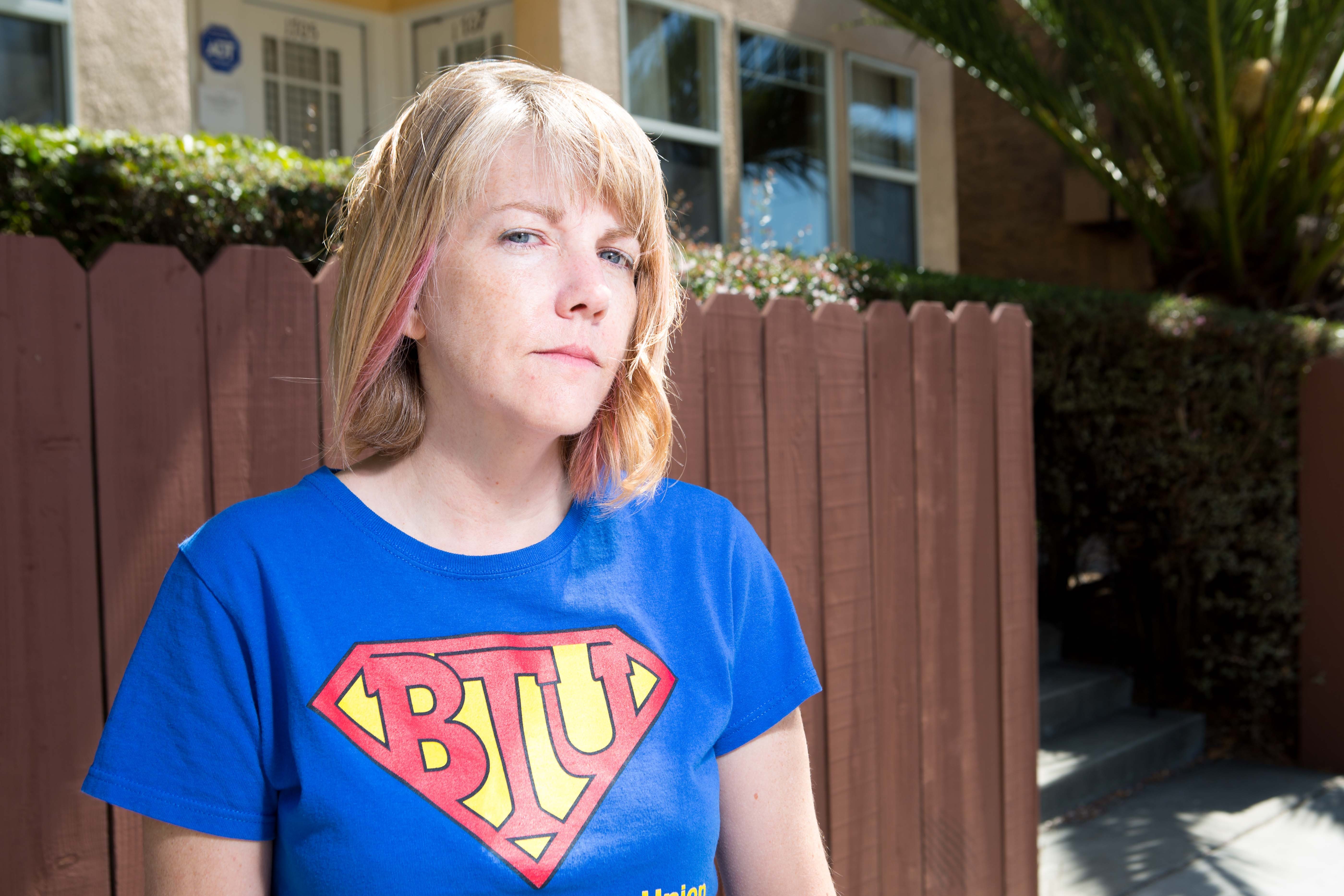
In the East Bay, only Berkeley has attempted to gather information about short-term rentals and how they might be affecting the housing market. “There are about eight hundred short-term rentals in Berkeley, four hundred of which are whole units, so it’s already having a significant impact,” said Katherine Harr, a commissioner on Berkeley’s rent board, and a landlord of a rent-controlled cottage behind her Berkeley home. Harr is also the leader of the Berkeley Tenants Union, a group that supports legalizing short-term rentals in Berkeley, but only if strict rules are enforced to prevent the loss of affordable housing and other impacts.
Harr said her group has identified landlords — including the above-mentioned Margaret Phillips — who seem to be in the process of clearing out whole buildings, replacing leased apartments that have traditionally housed long-term residents with hotel-style rooms that serve a steady churn of tourists and business travelers. “These are some of the largest landlords in Berkeley doing this,” said Harr.
Berkeley’s short-term rental landlords agree that their industry is already having a big impact on the city, but they believe it’s a positive one. In a June 23 letter to the Berkeley Planning Commission, the Berkeley Home Sharers, a landlord advocacy group with close ties to Airbnb, wrote that the conversion of hundreds of housing units into illegal hotels is pumping millions of dollars into the city’s economy and providing tax dollars for the city budget.
Whatever the impact, renting out a housing unit in Berkeley for less than fourteen days is currently illegal. As was the case in San Francisco until earlier this year, Berkeley has a ban on vacation rentals. Berkeley adopted its ban during the first dotcom boom after it came to light that SRO hotel owners were shuffling tenants from one room to another in order to prevent tenants from gaining rent control protections. And just like San Francisco’s vacation-rental ban, Berkeley’s was effective until the emergence of short-term rental platforms such as Homeaway (founded in 2005) and Airbnb (founded in 2008) that created a massive opportunity for some landlords to convert housing into hotels.
What nearly everyone is aiming for now in Berkeley is the legalization of short-term rentals with regulations designed to prevent landlords from taking housing units off the market. Ancillary goals include collecting tax revenues owed by these new businesses, and mitigating the impacts that hundreds of tiny hotels are having on residential neighborhoods in which many residents don’t want to live next to a vacation rental.
The Berkeley City Council is expected to consider legislation later this month that will be similar to the rules San Francisco recently adopted: Short-term rentals of entire housing units would be legal, but only if the homes are the primary residences of the landlords offering them and the landlord lives there no less than nine months of the year; short-term rentals without the host present would be capped at ninety days; if the host is present, he or she can offer rooms in the home year-round; and landlords must obtain a business license and also pay the city’s hotel tax. Berkeley also wants to require short-term rental landlords to post their business license number on their online listings in order to make enforcement efforts possible. In San Francisco, landlords have to obtain a special short-term residential rental registration number, and post it on their listings, but few currently do. Berkeley would also impose an enforcement fee on short-term rental landlords, paid to the city to fund staffers who will investigate violations.
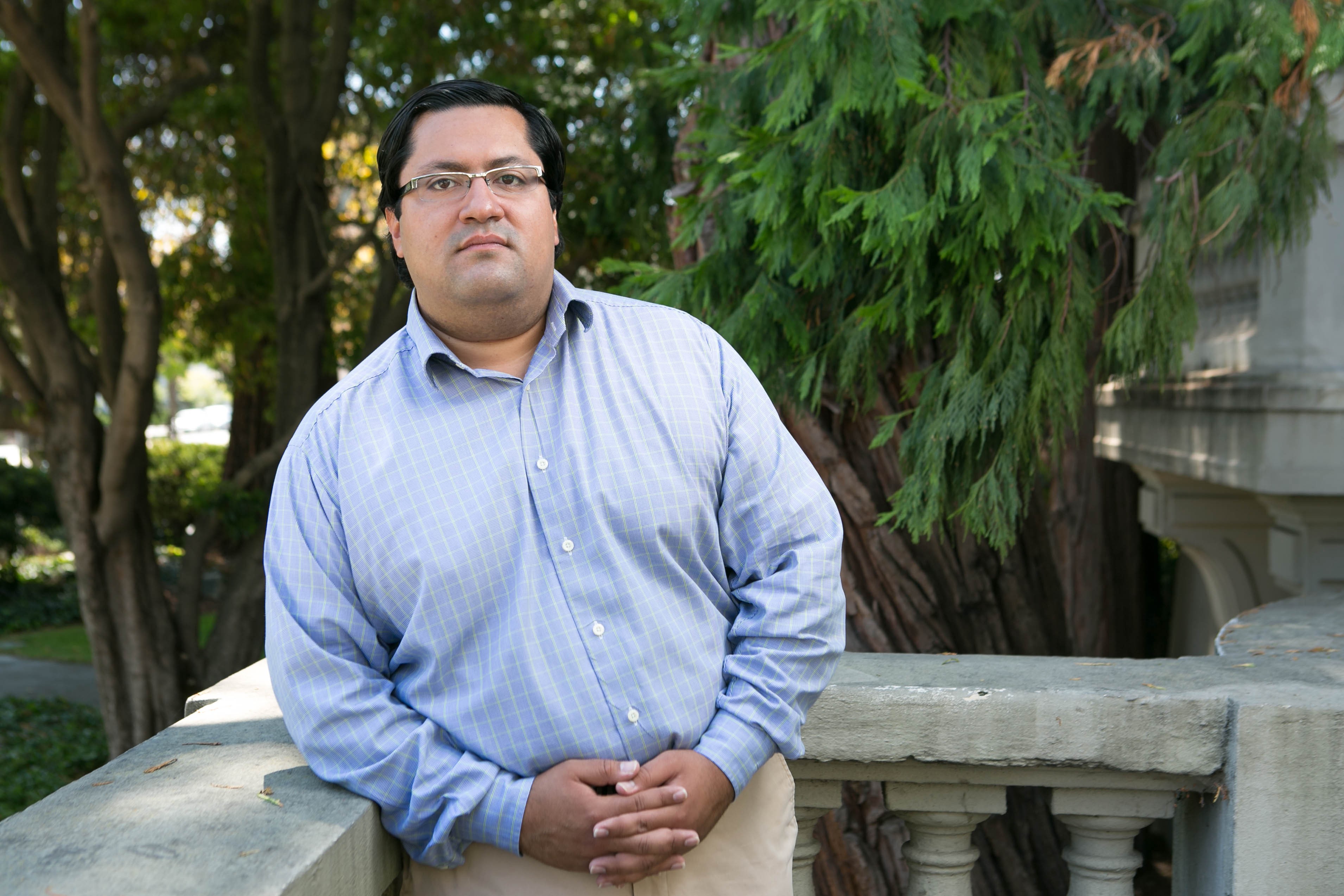
“Right now, short-term rentals are not legal in Berkeley, so regulating them is a step forward,” said Berkeley Councilmember Jesse Arreguín. Arreguín’s district lies just west of UC Berkeley and is filled with renters who live in multi-family apartment buildings and single-family homes, many of which are split into multiple units. Many have backyard cottages outfitted with full kitchens and bathrooms.
“We don’t want to stifle the sharing economy,” said Arreguín, “but at a time when we’re facing a regional housing crisis, we cannot be trading incentives for units to be removed from the market.”
Elliott Blumberg advertises his property on Winsor Avenue for $440 a night, or $9,000 a month, on Airbnb.
According to Arreguín, one of the biggest threats Berkeley faces is the conversion of secondary units, mostly backyard cottages, into short-term rentals. This is why the current legislative proposal would ban the short-term rental of secondary units. Back in March, Berkeley Mayor Tom Bates sponsored a measure to ease rules to promote the construction of new secondary units throughout the city’s residential zones. The goal was to incentivize homeowners to build hundreds, if not thousands, of new affordable housing units, especially near transit. That initiative explicitly banned renting newly built secondary units as short-term rentals.
“We need to create more housing,” said Arreguín. “If we’re streamlining rules to create more units, why would we allow people to remove them from the market to create miniature hotels? It wouldn’t accomplish what we wanted.”
The Berkeley Home Sharers group has objected to most of the rules sought by Bates, Arreguín, Harr, and the majority of the rent board, and the city’s planning and housing advisory commissions. In a June 23 letter to the Planning Commission, the group requested that secondary units be allowed for year-round operation as hotels. According to the Home Sharer’s letter, secondary units already account for 25 percent of short-term rentals in Berkeley. The Home Sharers group doesn’t believe the removal of these units from the housing market feeds into the city’s affordability crisis, but the group did warn the city that banning short-term rentals in secondary units will reduce the city’s tax revenues. According to the group, prohibiting short-term rentals among the approximately two hundred secondary units currently run as hotels in Berkeley could cost the city as much as $450,000 in hotel taxes. (The group’s estimate is based on the assumption that Berkeley landlords will start paying hotel taxes.)
The Berkeley Home Sharers group also objects to requiring short-term rental landlords to post business license numbers on their listings, and to a proposed mandate that landlords notify their neighbors of their intent to rent housing as hotels. The group also wants to extend the cap on renting one’s primary residence when not present from 90 days to 180 days per year, and to bar neighbors and housing organizations from suing landlords who violate the law. The group wants to place enforcement responsibilities entirely on the city.
But Jennifer Fieber of the San Francisco Tenants Union said the proposed rules in Berkeley already appear to be too weak — even before the Homes Sharers group’s requested amendments — and that what the city is considering looks a lot like what has failed in San Francisco. “The rule allowing year-round short-term rentals if the host is present is basically unenforceable because you have no way of knowing if the host is at home, or just saying so,” said Fieber. “The rule sounds like it was written by Airbnb itself — as was the case in San Francisco. We and our elected officials have always lobbied hard for a cap on rentals, even when the owner is present, but the Home Sharers astroturf lobby was too strong.”
Fieber said the short-term rental platforms also need to face penalties if they allow illegal postings. “It sounds like Berkeley is only saying it would be nice if Airbnb listed business license numbers, but what if they don’t? Airbnb will fiercely protect the privacy of the hosts who are violating the rules, so it will be really hard for the enforcers to do their job.”
The failure of San Francisco’s short-term rental laws is readily apparent among the thousands of listings on Airbnb offering entire homes and apartments. Very few listings include a unique registration number for the offered unit, which the city requires landlords to post online. There are also ample tip-offs that many listings are for entire homes and apartments rented year-round as hotels by landlords who don’t live in the home or apartment being rented. It only takes a few minutes scrolling through reviews to find comments such as “the owner lives right on the upper flat so you can always count with his presence,” meaning that the owner of this short-term rental, an apartment in a three-story townhouse on the 800 block of Hayes Street that I spotted after a few minutes of clicking through listings, has very likely transformed an entire apartment beneath his residence into a hotel. Pictures of the flat show a spacious quarters with a full kitchen and bathroom. A San Francisco family probably once lived there. Now the flat serves as a hotel for affluent tourists priced $500 a night.
Yet another listing, “Dolores Park Apartment,” rented out by a “Lorenzo,” offers a three-bedroom, two-bathroom apartment with a full kitchen. Lorenzo states bluntly on the Airbnb listing: “I do not live at the property.” Despite being exposed in several news report last May, Lorenzo is still renting multiple illegal hotels in San Francisco, with five guest reviews in July and two in August for several properties around Dolores Park, and also a “farmhouse” hotel in Berkeley.
Katherine Harr, a Berkeley rent board commissioner, said short-term rentals are already having a “significant impact” in her city.
Credits: Bert Johnson
Murray Cox, an independent researcher and journalist, scraped data from Airbnb’s website last May. His InsideAirbnb.com website lists the biggest Airbnb hosts in San Francisco, landlords with multiple listings of entire housing units in apparent violation of San Francisco’s laws. Despite the fact that Cox posted this data online in an easy to browse map format, many of these big landlords are still operating, and new landlords with multiple listings available seemingly year-round have sprouted up.
“Airbnb practically wrote the current law with Supervisor David Chiu,” said Preston about San Francisco’s existing short-term rental law. “The planning department has admitted Chiu’s law is unenforceable.”
The weakness of San Francisco’s existing law is leading to a showdown in November. A broad-based coalition including tenants groups, San Francisco’s main rental housing landlord association (many landlords object to short-term rentals because tenants sometimes turn apartments into hotels without the landlord’s knowledge and permission), US Senator Dianne Feinstein, the San Francisco Labor Council, and four of the city’s Supervisors and three of its planning commissioners are co-sponsoring a ballot initiative that would put a 75-night cap on all short-term rentals, impose fines on platforms that list unregistered units, and allow neighbors to take home-sharing hosts to court if the city fails to enforce the law.
In a city where popular sentiment about short-term rentals has been soured by years of experiencing the negative impacts, the question of whether the initiative to further regulate them will succeed depends very much on how much money Airbnb throws behind a counter-campaign. In 2015 alone, Airbnb has already spent $103,466 on five lobbyists who are in constant contact with San Francisco officials. And since 2012, the company has been pouring money into San Francisco elections. Now, Airbnb is raising a warchest in an effort to fend off further regulation.
While San Francisco has tried and failed, and while Berkeley is trying (albeit with the same rules that haven’t worked in San Francisco), Oakland hasn’t even tried to regulate short-term rentals. This not only upsets affordable housing advocates, but also some short-term rental landlords who fear that greedy investors will worsen Oakland’s housing crisis and lead the city to eventually crack down so hard that even law-abiding landlords will be impacted.
Colleen Calhoun and her husband rent a studio in their Oakland hills home through Airbnb. They are constantly booked with tourists from France, Italy, and the United Kingdom, as well as business people seeking a quiet place to stay within a short drive of San Francisco. “They’re looking for an experience they won’t get from a hotel,” said Calhoun in an interview. “And it’s amazing the amount of money that’s being pumped into Oakland because they’re shopping at grocery stores and other businesses.”
The Calhouns have paid Oakland’s 14 percent hotel tax since they began renting their unit. “It’s better to just do it all above board,” said Calhoun. “We were sure there were others who were not doing it — that’s how it looks in San Francisco.”
According to City of Oakland records, the Calhouns are one of only 22 short-term rental landlords who have complied with Oakland’s hotel tax requirements, even though there are more than 1,000 short-term Oakland rentals listed on Airbnb. City law requires that landlords of all those rentals pay the city’s hotel tax each time they rent a room to a new customer. It’s unclear how much revenue the city has lost as a result.
As a short-term rental operator, Calhoun sees Oakland’s affordable housing crisis up close. Multiple families have contacted her through Airbnb asking to rent her studio, but she believes that her unit, far from transit, attached to her home, and without a full kitchen, would be a poor long-term rental, especially for a family. Even so, she worries that the short-term rental market is a source of upward pressure on Oakland’s increasingly unaffordable rents.
“We had a lot of people contact us and say, ‘Can we stay for three months, we’re looking for a place to live,’ or, ‘My landlord is kicking me out,'” said Calhoun. “We’ve gotten this deep insight into what landlords are doing all over the city. That’s the flipside, I guess, to Airbnb. You don’t want everybody to be listing homes on Airbnb that could go to someone in Oakland who is looking for a place to live.
“It is a problem,” continued Calhoun, referring to the conversion of housing into hotels. “It’s something the city should do something about because there are people who are just exploiting the way it’s set up. This is something cities have a right to complain about.
“A real estate investor with nine properties and a lock box where the guests serve themselves — that’s not hosting,” added Calhoun. “You read these reviews where the guests say, ‘I didn’t meet the host, but I did meet the maid.’ I wonder why Airbnb doesn’t do something about this.”
I contacted Airbnb to ask exactly this question. But company spokesperson Christopher Nulty declined to be interviewed for this story. Airbnb representatives have said in various public venues, however, that their company is misunderstood and maligned. Airbnb claims that the percentage of hosts who use its platform to remove rental units from the market and operate them as hotels is tiny. Airbnb officials also claim that it’s difficult for them to police the company’s own listings, and that they shouldn’t be required to report data, such as how many nights a landlord rented his or her unit, because it would constitute an invasion of privacy. Finally, Airbnb representatives believe it would be unfair if their company had to comply with 34,000 different rules in all the 34,000 cities in which the company now claims to operate.
But there are traditional hotel companies, such as Intercontinental and Hilton, that operate in thousands of local jurisdictions, and they don’t seem to have a problem complying with local zoning and tax laws. For example, the Intercontinental Hotels Group operates 4,840 hotels in nearly 100 countries. Hotels also already turn over the kind of information that many cities are seeking from Airbnb — records showing how many guests stayed in a facility and for how many nights. Nevertheless, Airbnb’s position, in essence, is that all 34,000 cities in which it now operates should bend to its business model.
Berkeley City Councilmember Jesse Arreguín argues that the city should not be allowing landlords to convert homes into hotels during a housing shortage.
Credits: Bert Johnson
In every way except one, Oakland has bent to Airbnb’s business model and the commercial landlords who use it, and to other platforms that help property owners turn housing into hotels. The one step Oakland has taken to tackle the short-term rental problem is to sign a tax agreement with Airbnb. The agreement, which the city says is secret, purportedly requires Airbnb to collect Oakland’s hotel tax from each individual listing, and remit this to the city. (The city maintains that the agreement is secret because it contains Airbnb’s proprietary information.)
Councilmember Rebecca Kaplan introduced the idea of taxing Airbnb and other short-term rental companies last year, and as of July 1, Airbnb is paying the money to the city. “There’s two main goals accomplished with this,” said Kaplan in an interview. “One is revenue. It’s important because we have public needs like senior centers and parks and not enough money to fill potholes in our roads.
“Second, it’s about fairness,” she continued. “Under-taxing any segment of the economy isn’t fair to those who are paying their full taxes. And part of what incentivizes people to abuse the system by taking housing off the market and renting it as a short-term rental is that they’re getting away with not paying taxes.” Kaplan said she doesn’t want to hinder the average person from renting out a room occasionally, but that landlords with multiple units could become a major problem.
David McPherson, Oakland’s head of revenue, said Airbnb will be paying between $500,000 and $700,000 to the city each year, and that his department intends to collect taxes from other short-term rental platforms soon, too. “Our goal was to get the big player who has the market share, and then we can focus on the 20 to 25 percent of the rest of the market,” said McPherson.
“I believe we will ultimately need regulation because we’re not in San Francisco’s place yet, and we don’t want to get there,” said Kaplan.
Mia Carbajal, a staff member at East Bay Housing Organizations, said her group is beginning to look into the scale of the short-term rental market in Oakland. “A big issue is that Airbnb isn’t providing the data that cities need to really figure out what the impact is and how best to regulate it,” said Carbajal. “So that’s the void we’d trying to fill.”
According to Carbajal, Murray Cox, the researcher who runs InsideAirbnb.com, scraped Airbnb data for Oakland in June, and the results shed some light on the numbers of units that may be missing from Oakland’s rental market because they’ve been converted into hotels. The scrape revealed about 1,155 listings for Oakland, 659 of which were for entire units.
Colleen Calhoun and her husband, who rent out a studio through Airbnb, said the conversion of entire homes into short-term rentals in Oakland is a problem that the city needs to address.
Credits: Bert Johnson
Carbajal has drilled down into the data to try to isolate listings that are likely housing units which have been removed from the rental market. “In Oakland, there are about 480 listings that have been reviewed frequently and are highly available, meaning [that] when you look at the calendars to book them, they’re open year-round,” explained Carbajal. “That sends a red flag because probably no one lives there.” Carbajal said that about 250 of the 480 listings are for entire units, therefore Oakland could be missing 250 units of housing that have been turned, via Airbnb, into hotels. But Carbajal said that it’s too early to tell, and more research needs to be done. The one thing Carbajal and her group are ready to advocate for is that the hotel taxes being collected from short-term rental landlords through Airbnb, and perhaps soon from other platforms, should be dedicated to Oakland’s affordable housing programs.
Whatever the scope of the problem in Oakland, the concentration of short-term rentals in some Oakland neighborhoods is impossible to ignore. And the areas with the highest concentrations of short-term rentals are not in older, wealthier neighborhoods, but in up-and-coming ones near transit: Bushrod, Golden Gate, Temescal, Adams Point, Eastlake, and much of West Oakland and downtown. In Berkeley, the entire city is dotted with short-term rentals, and residents of apartments buildings in Emeryville are increasingly complaining about strangers coming and going as if they’re living in a hotel.
Airbnb is already prepping for a fight as East Bay cities explore ways to regulate their business model. Airbnb lobbyists have been meeting with Berkeley officials over the past few months in an effort to shape that city’s proposed short-term rental laws, according to city staff members. And in Oakland, in a sign of the city’s rapidly growing short-term rental market, Airbnb recently registered a full-time lobbyist with the Public Ethics Commission. So if San Francisco’s grueling debate over short-term rentals is any indication, the battle is just getting started in the East Bay, with possible ballot initiatives, billboard ads, lawsuits, and much more coming soon.
The Audience (160 min., 2013). National Theatre Live (Rialto Cinemas Elmwood, Berkeley, 7:00)
Güeros (106 min., 2015). (The New Parkway, Oakland, 8:50)
Lost in Translation (101 min., 2003). (UA Berkeley 7, Berkeley, 9:00)
Airplane! (88 min., 1980). (Parkway, 9:30)
Friday, September 18
Kumu Hina (75 min., 2014). Followed by Q&A with Hawaiian transgender pioneer Aunty Anita (Oakland Museum of California, Oakland, 7:00)
Time to Choose (96 min., 2015). Followed by discussion with director Charles Ferguson (Sibley Auditorium, Bechtel Engineering Center, UC Berkeley, 7:00)
Mad Max (88 min., 1979). Paramount Movie Classics (Paramount Theatre, Oakland, 8:00)
Out of the Woods (105 min., 2015). Film premiere with appearances from cast and crew, live music (Humanist Hall, Oakland, 8:00)
Mad Max II: The Road Warrior (94 min., 1982). (Parkway, 10:30)
Saturday, September 19
Special Circumstances (56 min., 2007). (La Peña Cultural Center, Berkeley, 12:00)
Locally Grown Docs (Parkway, 3:00)
Sunday, September 20
This Kind of Love (45 min., 2014). Proceeds benefit Against Child Trafficking (Parkway, 12:30)
Tuesday, September 22
I Just Wanna Ball (30 min., 2013) and Solutions Not Suspensions (2014). The Truth from our Youth. Followed by Q&A with directors and youth performances (Parkway, 7:00)
Black Angel (81 min., 1946). (California Theatre, Berkeley, 6:00 and 9:40)
In the Red (70 min., 2015). Benefit for Bay Area Youth EMT program (Grand Lake Theater, Oakland, 7:00)
We the Tiny House People (82 min., 2012). Rebel Architecture (Humanist Hall, 7:30)
OR7: The Journey (67 min., 2014). Followed by Q&A session with filmmaker Clemens Schenk and Aramoq Weiss of the Center for Biological Diversity (Elmwood, 7:30)
Ride the Pink Horse (101 min., 1947). (California Theatre, 7:45)
My son, who is almost thirty years old, was married four years ago. He just shared with us that for the last three years, he and his wife have been practicing polyamory. They are committed to their relationship but have each had relationships with both men and women. We are trying to get our heads around this, as we come from a more traditional background (we’ve been married forty years in a loving and respectful relationship), and we find ourselves feeling very sad. We are accepting and nonjudgmental, just trying to understand how he came to this decision. He feels that to make love “finite,” to love only one person, is “not being true,” and that their kind of relationship prevents dishonesty and is based on truth. He shared that his wife was the first one to broach this idea — and after many deep conversations, he eventually overcame his jealousy and is embracing this practice. They do not have children or plan to have children. I asked my son if he’s happy, and he says he is.
Sad Mama
If your son says he’s happy, SM, you should believe him and be happy for him.
It’s unfortunate that your son framed the news about his choices and his marriage — which make him happy — in what sounds like a clumsy critique of your choices and your marriage. (If that’s what he did, SM. I’ve only got your characterization of his comments to go on, not a tape recording of them, and it has been my experience that monogamous folks sometimes hear critiques of their choices when we nonmonogamous folks talk about our own choices. “We’re not doing what you’re doing” ≠ “You’re doing it wrong.”)
There’s nothing necessarily “finite,” untruthful, limiting, or dishonest about monogamy. If that’s what two people want, SM, and it makes those two people happy, that’s great. Monogamy is what you and your husband wanted, it’s what made you and your husband happy, and it worked for your marriage. You could see your son’s choice to be nonmonogamous as a rejection of everything you modeled for him, or you could see his choice as modeled on the fundamental bedrock stuff — for lack of a better word — that informed the choice you made. Your son and his wife are doing what they want, they’re doing what makes them happy, and they’re doing what works for their marriage. They’re not doing monogamy (or kids), but they’re doing what’s right for them and what works for them — just like his mom and dad did.
There are lots of people out there in happy, fulfilling open/poly relationships, SM, and lots of people out there in happy, fulfilling monogamous relationships. (And there are lots of miserable people in both kinds of relationships.) There are also lots of people in happy, fulfilling monogamous relationships they will one day choose to open, and lots of people in happy, fulfilling nonmonogamous relationships they will one day choose to close. It’s happiness, consent, and mutual respect that matters, not whether a relationship is monogamous or nonmonogamous.
If your son is happy, SM, you should be happy for him. But if he states — or clumsily implies — that you and his dad couldn’t be happy because you’re not doing the same thing he and his wife are doing, you tell him from nonmonogamous me that he’s full of nonmonogamous shit.
Two pieces of recommended reading: the book Open: Love, Sex, and Life in an Open Marriage by Jenny Block, and an informative interview poly activist and frequent Savage Lovecast guest Diana Adams did with the Atlantic. But I don’t think you need to do a whole lot of homework about this. Love your son, respect his choices, don’t blame or shame his wife, and be kind to any partners they introduce you to. Having a poly kid is a lot simpler than you think.
Many years ago, what was for me a bizarre sexual incident happened to me, and while I’ve largely laughed it off with no traumatic effects, the incident has always puzzled me. For the record, I’m a straight man in a good, loving marriage with no sexual issues to report. I was off on a golf weekend with a bunch of über-hetero buddies. We stayed in a condo that didn’t have enough beds for everyone, so I ended up sharing a bed with an ex-marine. In the middle of the night, I thought my girlfriend was waking me up with a blowjob, and a damn fine one at that. However, as I gradually became awake, I realized the mouth on my penis wasn’t my girlfriend’s. I called this guy’s name, and — this is the interesting part — he sprang up suddenly, like I just woke him up. I was also a little afraid, because he was a big guy who could have easily pummeled me to death out of embarrassment. But he jumped out of bed, went into the bathroom, and gargled before coming back into bed. Neither of us said a word afterward about what happened. Needless to say, I didn’t sleep too well after that. (And frankly, I was a little offended by the gargling.) So the question is: Can you fellate in your sleep? Can you sleep-blow and still be a straight guy?
Blown Latently One Wild Night
Sexsomnia is a real thing — sleepwalking plus sex — but it’s an exceedingly rare thing. Closeted guys are a lot more common, BLOWN, and guys who seem über-hetero are often more successfully closeted than your lighter-in-the-loafer guys. Three other details lead me to believe this was a crime/blowjob of opportunity: It’s typically pretty difficult to wake a sleepwalker/sleep-blower (it takes more than calling out a name), the skills on display during the incident (it takes practice to give a “damn fine” blowjob), and his actions after he woke up with your dick in his mouth (rushing to the bathroom to gargle) smack of overcompensation.
I have no disagreement with what you said to letter writer WHIFFING (the man who wanted to know how to broach the subject of a female partner’s unpleasant vaginal odor). But I wanted to add something that seems to be largely unknown: A common side effect of long-term SSRI use is that the scent and amount of sweat can change to be offensive and copious. While it’s worth getting checked out if the person is unaware of the cause of an offensive groin smell (it could be a health issue), sometimes the cause turns out to be something the person is not willing to change because of the benefit it brings to their life. I’ve been in this position. Nothing I did to treat the sweating (beta blockers were offered to reduce the amount but couldn’t change the odor) made a difference, and my intimacy with my partner really suffered. We could basically be intimate only after I just showered; it took months for my partner even to bring it up. When I finally discovered the sweating in a list of side effects in a medical app, it was quickly confirmed by my prescriber as common but not talked about because it’s not physically harmful, so other SSRI users may not be aware of the connection. Just wanted to let your other readers know!
The two-story building at the corner of West Grand Avenue and Martin Luther King Jr. Boulevard that houses the Starline Social Club is on its fifth or sixth lifetime, at least. The place was built as an Odd Fellows Hall in the 1890s and has subsequently been home, variously, to a saloon, a janitorial supply store, a dance club, and a union hall for the deaf. For a big chunk of the past two decades, though, the building sat abandoned, until local artist Adam Hatch acquired the space in 2011 and decided to turn it into a kind of popup event venue, and, now, a full five years later, a bonafide bar and restaurant, with an upstairs ballroom that’s been used to host everything from hip-hop shows to weddings to a rollerskating disco night.
Hatch has cobbled together a handful of partners, the most prominent of which, on the food side, are Ramen Shop co-owner Sam White and chef Austin Holey, a Berkeley native who worked at Pizzaiolo and at Bones (in Paris), and who said he remembers friends throwing parties in the building when he was in high school, when the space was more or less derelict.
If you eat fried chicken primarily for the batter, you’ll like the Starline’s version.
Credits: Bert Johnson
Chef Austin Holey is a Berkeley native.
Credits: Bert Johnson
With its high ceilings, plaster walls, and winding, asymmetrical bar, the downstairs bar and restaurant section has a kind of old-fashioned grandeur that speaks to all those years of Oakland history — and, of course, also to the contradictions that shape today’s rapidly changing Uptown district. On this particular street corner, a few steps away from a highway overpass, the Starline stands out as by far the fanciest place within a span of several blocks. The menu is tiny (maybe ten dishes total on any given night), changes all the time, and seems random if you’re expecting the standard elevated-comfort-food playbook you’ll find at most upscale bars. Instead, Holey’s food is straight-up California cuisine, not all that different from what you might find a pedigreed establishment like, say, Camino — with comparably high prices to boot.
If you eat fried chicken primarily for the batter, you’ll like the Starline’s version.
Credits: Bert Johnson
What I can say is that much of the food is very good — like what I imagine a fine-dining chef might serve you if he or she invited you over for a backyard cookout. A rustic late-summer sauté of grilled Monterey squid, sweet corn, bacon lardons, and cilantro was a flavor-packed reimagining of a traditional succotash. Sweet, salty, and smoky elements mixed harmoniously, and a splash of lime juice made all the flavors really sing.
The rack of lamb, meanwhile, brought our table to contemplative silence: four thick rib chops fanned out elegantly on the plate, with the long ends of the bones and the blood-rare flesh exposed. The outer edge of each chop had a gorgeous, well-seasoned crust, and the meat was tender enough to render steak knives totally unnecessary. Better to put politeness aside and pick the damn thing up by the bone. A bed of toothsome spaetzle soaked up the meaty juices, and a scattering of adorable baby turnips with their leaves attached added crunch and raw vegetal heat.
I gave the side-eye to the $28 price tag for Holey’s contribution to Oakland’s growing fried chicken pantheon, but my outrage was tempered when I saw how huge the portion was — an entire half-chicken, served mostly in one piece over a mound of deliciously tangy slow-cooked collard greens. If you eat fried chicken primarily for the batter, this is the style of chicken for you — the buttermilk crust is the thick kind that breaks off in big shards that never lose their crunch. Holey drizzles the chicken with caramelized honey at the very end, so you end up with a sticky, savory-sweet effect, somewhat akin to Korean fried chicken.
The only dish that fell flat was a watermelon salad that featured, on the one hand, the sweetest and most chin-dribbling-ly juicy melon I had the pleasure of eating this summer. On the other hand, the non-watermelon ingredients never cohered in a way that made sense — not the sliced figs, or the peppery cress, or the few smears of “spicy crème fraîche” (which wasn’t spicy at all), to say nothing of the pickled watermelon rind, which was listed in the menu description but never made it onto the plate. It was like eating a bowl of watermelon with an entirely unrelated salad on the side.
If none of this sounds much like food you’d expect to find at a bar, that’s more or less the point. Hatch and Holey spoke of a desire to straddle the line between highbrow and lowbrow — between a customer’s expectation of what bar food ought to be and, well, something a little more ambitious. It’s by design that the Starline is a place where you can linger over a craft cocktail, but also where you can drop $28 on fried chicken and wash it down with a $3 beer. As Hatch put it, “I like the idea of punks coming in and ordering a High Life and a steak tartare.”
And the beer-battered onion rings, the one stereotypically bar-snack-y item on the menu, were delicious — thick-cut and juicy, dusted with seaweed salt that evoked, for me, the innumerable nori-wrapped snacks of my Asian-American youth. Frugal bar patrons will want to note, however, that this was the least expensive item on the menu — but the $8 price, for maybe half an onion’s worth of rings, is the most I can recall ever paying for onion rings.
Ultimately, it was the service — which was idiosyncratic, despite everyone being friendly enough — that reminded me that I was eating at a bar. During one meal, our server was attentive to the point of being hovering. She came over to our table every five minutes, smiling amiably until we wound down our conversation, and then asking, simply, “Is everything alright?” I couldn’t tell if she was hoping we’d run up a bigger drinks tab, or if someone on staff had spotted me for a critic, though my next visit seemed to dispel the latter possibility. Seated at the bar, I was mostly ignored for the 45 minutes it took before the aforementioned fried chicken — the only food item I ordered — finally came out.
From the very beginning, though, Hatch and his compatriots intended the venue to be many different things beyond just a restaurant. Only a few months since it officially opened, the Starline — both bar and ballroom — already seems to be filling several niches: as a place to go dancing, or to do yoga while accompanied by live music, or to eat rack of lamb at 11 p.m. on a Thursday night. If you strip away all the extras and just treat the Starline as a restaurant, it’s kind of a weird place, but not a wholly unlovable one — not when the food is as good, and feels as personal and unique, as it is.
In March, East Bay human rights activists scored a major victory when the Alameda County Board of Supervisors passed a resolution to shift funding away from the county jail and increase investments in community-based organizations that support people reentering society after incarceration. For years, activists lamented the fact that the county allocated a significant majority of its so-called Public Safety Realignment budget to Santa Rita Jail — and failed to adequately fund social services that are critical for people caught up in the criminal justice system. The March resolution stated that in the 2015–16 budget, the county would for the first time spend 50 percent of this public safety funding on programs outside of jail.
But three months later, on June 30, the board quietly approved a resolution that appeared to have the opposite intent — authorizing the Alameda County Sheriff’s Office to seek up to $80 million in state funds for a jail expansion. There was no public discussion of the proposal, which the board unanimously approved as part of a package of obscure resolutions related to budgets and contracts. In a short memo, Sheriff Greg Ahern told the board of supervisors that his office, which oversees Santa Rita Jail, was seeking funding to construct a two-story, 30,000-square-foot unit at Santa Rita. Tash Nguyen, organizer with the Ella Baker Center for Human Rights — an Oakland-based nonprofit that closely monitors the sheriff’s budget and had pushed for the passage of the March resolution — said she only learned of the potential expansion when reading a recent news article that peripherally mentioned it.
Ella Baker Center organizer Tash Nguyen says Alameda County should not expand its jail.
Credits: Bert Johnson
Nguyen and a group of criminal justice reform advocates from across the state are now pushing Alameda County to reconsider any potential jail expansion — but because the board approved the sheriff’s initiative months ago, it may be too late. What’s more, now that advocates are asking questions about the grant, the sheriff’s office is declining to provide basic information on its project and is refusing to release a copy of the formal proposal it recently submitted to the state. This lack of transparency only further fuels activists’ fears that the jail expansion is a regressive proposal that directly contradicts local and state efforts to reduce incarceration rates and prioritize community-based services.
Critics say that, in addition to wasting taxpayer money on construction and future operating costs, the growth of the jail could incentivize the county to fill the new unit and keep offenders locked up longer than they should be. And the sheriff’s efforts are coming at a time when experts and lawmakers have increasingly recognized that jails and prisons do a poor job of rehabilitating inmates and that local governments need to invest in programs that help people move forward — by providing access to housing, jobs, drug treatment, education, and other services.
“We know that these resources should be in the community,” said Nguyen, who recently met with the sheriff’s office to discuss the expansion. “Let’s find a means to sustainably reduce jail populations … and divert people who shouldn’t even be there in the first place.”
Assistant Sheriff Brett Keteles declined to comment on the expansion proposal and said his office would not be releasing the application to the public at this time. Alameda County Counsel Donna Ziegler contended in an interview that the application is not a public record because it’s part of an ongoing competitive bid process.
According to the board of supervisors’ short resolution permitting the sheriff to pursue the funding, the department is seeking up to $80 million in state funds that are available to county jails through Senate Bill 863, legislation that passed in 2014. That bill authorizes the state to award up to $500 million in construction financing for county adult jails. The projects, according to state guidelines, should be geared toward replacing or renovating outdated or unsafe jail facilities or building new units focused on rehabilitative services or mental health treatment. SB 863 further stipulates that the projects should not increase a jail’s capacity — unless a county has documented a clear deficiency in its number of beds.
The Board of State and Community Corrections (BSCC), which reviews and selects applications, doled out a first round of jail construction funds to thirteen counties in 2013 as part of Senate Bill 1022, similar legislation that Governor Jerry Brown signed in 2012. As of last week, 32 counties had submitted proposals for the second round of funds through SB 863, and BSCC is beginning the process of reviewing applications, according to spokesperson Tracie Cone. The board will select proposals in November, she said. BSCC also declined to provide me with a copy of Alameda County’s proposal.
The Alameda County Sheriff’s Office, which did not apply for funding through the 2012 legislation, told the board that it wants to build a new “Mental Health Program and Services Unit” in Santa Rita Jail. That wing, according to the board resolution, would include housing, administrative offices, mental health treatment programs, and reentry services for mentally ill inmates. The county selected a private firm, Vanir Construction Management, to prepare the application. (Vanir representatives did not respond to a request for comment). The project, which would not increase the county’s jail capacity, could address a major gap in mental health services at the facility, according to Ahern’s three-page memo to the board of supervisors.
Currently, roughly 20 to 25 percent of county jail inmates suffer from mental illness. In recent months, the county has housed an average of roughly 2,800 total inmates per day in Santa Rita and in Glenn Dyer Jail in Oakland. There are no reentry programs in the county geared toward mentally ill inmates, and when they are released, they are given one week’s worth of medication and a referral to a local mental health clinic, according to the sheriff.
In addition to better supporting inmates with mental illnesses, the expansion project would also help ensure that the facility is in compliance with state and federal laws that require the jail to be accessible to disabled people, according to Ahern’s memo. It’s unclear, however, if potential concerns about Americans with Disabilities Act (ADA) violations are driving the expansion proposal. Keteles, the assistant sheriff, told me in an email, “We do consider Santa Rita to be ADA accessible, but we are always looking to improve this.”
While efforts to make the facility more accommodating for people with mental illnesses may sound promising, advocates said that Santa Rita Jail is an inappropriate setting for people to receive the kind of care and treatment they require. On the contrary, studies have shown how jails and prisons can lead inmates to develop mental illnesses or exacerbate existing ones. And at Santa Rita Jail in particular, a number of recent controversies and lawsuits have shed light on how the sheriff’s office has disregarded the mental health and medical needs of the people living in its jails, critics say. The county and its Santa Rita Jail health care contractor recently agreed to pay an $8.3 million settlement to the family of Martin Harrison who died behind bars after allegedly receiving inadequate healthcare treatment. And in July, another inmate, Mario Martinez, died from an asthma attack after he had complained that he was having trouble breathing, his family has said.
“We know this jail has no regard for human life,” said Nguyen, adding, “I’m personally really fearful of jails becoming the new social service providers.” She argued that law enforcement agencies should focus on ways to divert mentally ill people from jail and get them treatment outside of the criminal justice system.
Lizzie Buchen, statewide advocacy and communications co-coordinator with Californians United for a Responsible Budget, a group that has protested jail expansions, noted that the vast majority of Alameda County jail inmates are awaiting trial and have not yet been convicted. Many, she said, are stuck behind bars because they can’t afford to pay bail, which means mentally ill inmates needlessly suffer the harms of incarceration. From January through March of this year, 2,173 out of 2,791 inmates (78 percent) were awaiting trial in Alameda County, according to state data.
If the county prioritized efforts to divert inmates who don’t pose a public safety risk, it could significantly reduce its jail population and save money, Buchen said. The sheriff’s office could then invest those savings into programs that ensure that the people who truly need to be locked up receive humane and rehabilitative treatment behind bars. This, she said, would be a much more progressive solution than expanding the facility to serve consistently high rates of inmates.
“A jail is not an effective place to administer mental health treatment,” Buchen added. “You have no sense of control. You’re separated from your social network and your family.”
Meanwhile, the proposed jail expansion is coming at a time when the county has, in fact, reduced its jail population. From January to March of 2014, the county housed an average of 3,301 inmates per day — 510 more than the same time period this year.
Nationally, jails and prisons have, by default, become mental health providers, because community-based mental health programs have remained woefully underfunded, experts note. But most jails are not designed to serve this population, according to Martin Horn, a John Jay College of Criminal Justice lecturer and a former New York City corrections official. “The very physical environment is counter-therapeutic,” he said. But, he added, “This is where our society has chosen to put people with mental illnesses in very large numbers, and it’s unfair to them and unfair to the jailers to deny them resources to do the job.”
When a White House staffer called Regina Evans in 2011 to thank her for bringing awareness to human trafficking, Evans was understandably surprised. It had been more than two years since the Oakland activist wrote to President Barack Obama to inform him about the Bay Area’s human trade crisis and invite him to her newest play confronting the issue. Although a lot had changed since Evans sent the letter — for one, the play she mentioned had long since ended its run — the president’s delayed response came at the perfect moment.
“I hadn’t been writing, and I was working a retail job that I hated every minute of,” said Evans in a recent interview. “So I took it as a sign. I mean, how often do you hear from the White House? The only thing I could hear in my spirit after that was, ‘Tell their stories.'”
Regina Evans uses both performance and retail to fight sex trafficking.
Credits: Bert Johnson
The call prompted Evans — who describes herself as a “Bay Area abolitionist” — to write 52 Letters, a one-woman monologue about modern slavery that will be staged at the Flight Deck (1540 Broadway, Oakland) on September 18 and 19. Though Evans has been performing the play since 2013, these upcoming renditions hold a special significance for her: they commemorate one year since opening her vintage boutique Regina’s Door (352 17th Street, Oakland). In partnership with the anti-trafficking organization Love Never Fails, Evans uses the business to provide employment, rehabilitation, and protection to trafficking survivors and at-risk youth. The dress shop operates under the motto “compassion is always in fashion,” and recently won Evans the 2015 Oakland Indie Award for Social Changemaker.
During the upcoming performances of 52 Letters, Evans will combine her own experiences as a survivor of sex trafficking with the stories of women and young girls she has met through her advocacy efforts. As she weaves the stories together, she uses poetic devices and elements of dramatic theater to draw comparisons between past forms of slavery and the modern incarnations found in trafficking rings. As a storyteller, Evans is not afraid to make audiences uncomfortable. Her primary goal is not to entertain, she said, but to educate and incentivize viewers to do something about an issue that continues to grow as it is ignored. From Evans’ perspective, something as simple as writing a letter can help, but even that takes active participation and awareness.
“This is a hard fight that requires the hearts and hands of the beloved community,” said Evans. “I want people to leave the play thinking about the twelve-, thirteen-, and fourteen-year-old child out on the track. I want them to leave the theater thinking about what their responsibility to that child is.”
Californians might sell about $2 billion per year in legal cannabis under full legalization. That back-of-the-envelope estimate comes from the latest data out of Washington, where fifteen months of legal marijuana has resulted in $357 million in sales of pot products, reports indicate. California is 5.5 times more populous than Washington. Californians are almost certain to vote on at least one legalization...
The ACLU of Northern California and the law offices of Amitai Schwartz filed a lawsuit against the Hayward Police Department on Tuesday, alleging that the agency is charging exorbitant fees that effectively prevent the public from obtaining police body camera video footage. The lawsuit comes as a result of a Public Records Act request filed by the National Lawyers Guild...
Stories you shouldn’t miss:
1. Fire officials are warning that the death toll from the fast-moving Valley Fire in Lake County could rise, as they receive more reports of missing residents, the Santa Rosa Press Democrat reports (h/t Rough & Tumble). Leonard Neft, a former reporter for the San Jose Mercury News, is among those reported missing, the Chron reports. One...
Eli Leon's quaint house in the Temescal district of Oakland is filled from floor to ceiling with quilts. He is one of the country's preeminent contemporary quilt collectors, with a specific interest in improvisational quilts made by African-American artists. Rather than following the tradition of creating symmetrical patterns, these artists piece together compositions reminiscent of abstract paintings — like...
At Scott Galbraith's chain of West Oakland hotels, you can book a room in a cozy Victorian, built circa 1895, refurbished and stocked with modern technology and a spacious kitchen. The luxurious beds are cushioned with memory foam, and there is an upright piano in one of the suites for the traveling musician. Or, you can reserve...
Thursday, September 17
The Audience (160 min., 2013). National Theatre Live (Rialto Cinemas Elmwood, Berkeley, 7:00)
Güeros (106 min., 2015). (The New Parkway, Oakland, 8:50)
Lost in Translation (101 min., 2003). (UA Berkeley 7, Berkeley, 9:00)
Airplane! (88 min., 1980). (Parkway, 9:30)
Friday, September 18
Kumu Hina (75 min., 2014). Followed by Q&A with Hawaiian transgender pioneer Aunty Anita (Oakland Museum of California, Oakland, 7:00)
Time...
My son, who is almost thirty years old, was married four years ago. He just shared with us that for the last three years, he and his wife have been practicing polyamory. They are committed to their relationship but have each had relationships with both men and women. We are trying to get our heads around this, as we...
The two-story building at the corner of West Grand Avenue and Martin Luther King Jr. Boulevard that houses the Starline Social Club is on its fifth or sixth lifetime, at least. The place was built as an Odd Fellows Hall in the 1890s and has subsequently been home, variously, to a saloon, a janitorial supply store, a...
In March, East Bay human rights activists scored a major victory when the Alameda County Board of Supervisors passed a resolution to shift funding away from the county jail and increase investments in community-based organizations that support people reentering society after incarceration. For years, activists lamented the fact that the county allocated a significant majority of its so-called Public...
When a White House staffer called Regina Evans in 2011 to thank her for bringing awareness to human trafficking, Evans was understandably surprised. It had been more than two years since the Oakland activist wrote to President Barack Obama to inform him about the Bay Area's human trade crisis and invite him to her newest play confronting the issue....