In the days following Tuesday, September 29, West Oakland featured prominently in national headlines — a rare occurrence that, unfortunately, usually follows violence. That morning, 27-year-old artist Antonio Ramos was fatally shot while painting a mural in a West Oakland underpass as part of a community-fueled beautification project. The story was too tragic not to bite: A young martyr mauled by the monster he was charitably trying to tame.
In an October 3 New York Times article, “Mural Painter’s Killing Reminds Oakland that Revival Can Be Slow,” reporter Laura M. Holson framed the shooting as an omen that Oakland isn’t yet prepared for the rapid development it’s being graced with by companies such as Uber, which recently “agreed to transform one of the city’s barren department stores into a gleaming technology beacon.” The piece described Oakland as being in the midst of a culture war, referring to the shooting as “a reminder of the stubborn grit and crime that still cling to the city despite the gentrification boom that has fueled its reputation as Brooklyn by the Bay.” And, further underscoring that violence and beautification lie at opposite ends of that divide, the article referred to the mural as a “peace” mural.
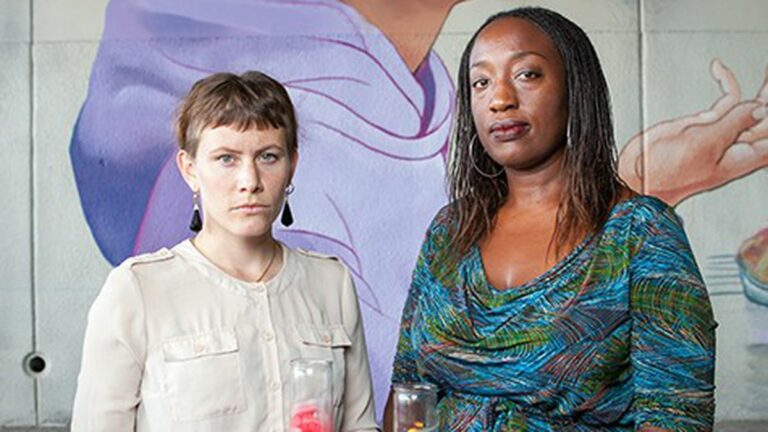
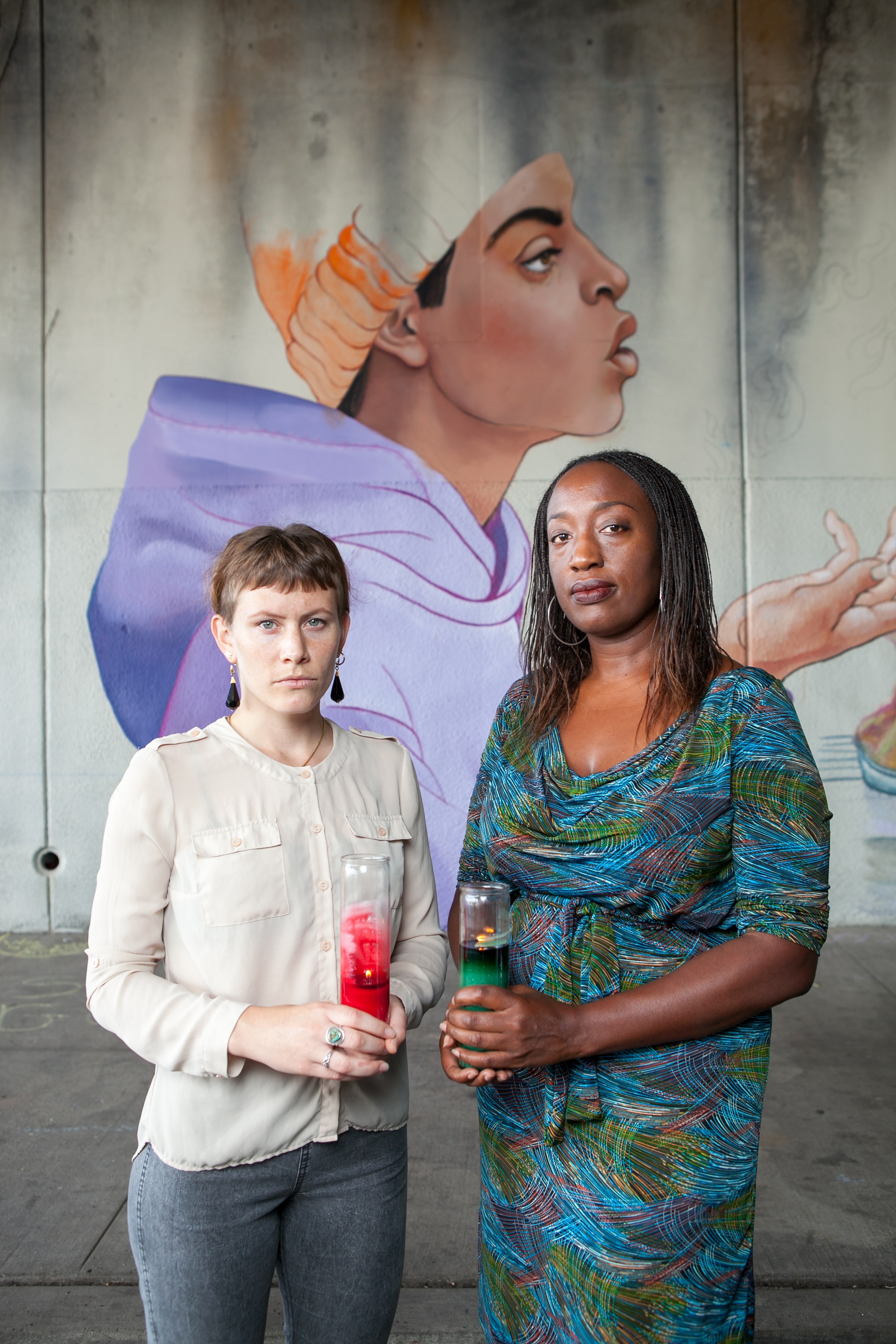
Erica Wheeler-Dubin (L) and Amana Harris.
Credits: Bert Johnson
The mural on West and 35th Streets is now dedicated to Antonio Ramos.
Credits: Bert Johnson
But the blanketing notion of peace is an ultimately simplistic description for the complicated community empowerment work that Attitudinal Healing Connection of Oakland, the force behind the Oakland Super Heroes Mural Project that Ramos was working on, has been doing in West Oakland for more than 25 years. And, based on a recent interview with leaders of the organization, to rhetorically align the group with Uber is to conflate two fundamentally different ideas about the kind of development that Oakland needs, and where it should come from.
Attitudinal Healing Connection (AHC) of Oakland is based out of a pink house just blocks away from where Ramos was shot. The organization runs various programs that engage youth and community members with creative engagements to promote empowerment, healing, and community transformation at the root level.
Amana Harris, executive director of AHC Oakland, formulated the Super Heroes Mural Project because she was disgusted by the neglected conditions of underpasses in West Oakland, the neighborhood in which she has lived for most of her life. The project utilizes an in-depth curriculum called “Self as Super Hero” that Harris developed about a dozen years ago. It engages youth in a process of identifying role models who are heroes to them — specifically for their positive impacts on society — then envisioning themselves as similar heralds of change and placing those imagined selves into narratives that involve fighting relevant issues in their community.
For the mural project, which has been underway since 2012, Harris brings that coursework into West Oakland elementary and high schools through the art education branch of AHC Oakland called ArtEsteem. She and ArtEsteem project manager Erica Wheeler-Dubin then hire a local lead artist to visualize a design for each mural based on the narratives imagined by the youth. The students then work with the lead and other muralists to bring the piece to fruition beneath an underpass near the school. The goal is for the students to recognize that they have the power to manifest the world that they envision. “That’s really the idea, is getting our young people to dream about how to solve these problems,” said Harris. “We’re not these passive citizens here — victims of our communities. … This can’t just be it for so many young people. We have to be able to create a better reality.”
The mural on West and 35th Streets is now dedicated to Antonio Ramos.
Credits: Bert Johnson
The mural that Ramos was working on is the third of six planned for the project — which has resumed. With the first two murals — and throughout the history of the organization — it’s been difficult gathering funds, and frustrating waiting for the city to issue permits for the projects. But the third mural, in particular, presented extra obstacles even before Ramos’ death.
The 4,000 square foot wall, which is on West Street underneath Interstate 580 between 35th and 36th streets, was covered in bird feces when Harris and Wheeler-Dubin chose it for revitalization. A small gap between the wall and the underpass offers a surface for pigeons to nest, so AHC Oakland needed the city to first clean the wall, then install metal guards so that the birds wouldn’t return. They requested that maintenance in February, when the wall was initially slated to be painted. But for approximately seven months, their request was tied up in a protracted process of permitting between the City of Oakland and Caltrans — the California Department of Transportation — which must approve all maintenance that the city performs on its structures.
The city finally cleaned the wall at the end of August, which allowed AHC’s artists to embark on their one month of allotted painting time in mid September. But the city has yet to install metal guards and didn’t put in anything to ward off the birds until the end of last week, when the mural was nearly completed and was already being stained by bird feces. Instead of the guards, the city installed metal mesh around the gap — a solution that AHC Oakland staffers consider to be a haphazard Band-Aid fix that reflects a rushed job on the part of Caltrans and the city. “The city completely failed to go about this in a strategic fashion,” said Wheeler-Dubin on Monday. “It’s just been such a failed process from start to finish.”
For Harris and Wheeler-Dubin, the slow response by the city is a too familiar matter of basic urban maintenance in West Oakland being pushed to the backburner. “This is not even about the [pigeon guard] job. This is about public spaces that are neglected by the city and the decrepit state of filth and neglect on the city’s part as well as Caltrans,” said Harris. “And I’m like, if this was Rockridge, this would not be happening.”
For those at AHC Oakland, Ramos’ death is not a reminder of a crime problem that is holding back Oakland from entering a shiny, new era of development. It’s an example of ongoing issues faced by the community they’ve been a part of for decades. And it’s an extension of West Oakland’s complex circumstances of disenfranchisement that are, in part, manifested in inequities as seemingly mundane as the lack of pigeon guards in a freeway underpass as well as tragedies like Ramos’ death.
The mural, which is near completion, features a joyfully colored row of houses with children playing among them, and a portrait of Ramos emitting a ray of light on one end. It now also holds a bed of candles and photos at its base, in remembrance of Ramos.
Moving forward, AHC Oakland plans to continue its fundraising for the three forthcoming walls. The next, which will be designed in conjunction with students at Hoover Elementary, will include a full super hero modeled after Ramos using input from his family. Eventually, Harris also hopes to raise money for the full narrative behind the latest mural, along with a dedication to Ramos and the names of the mural’s other artists, to be engraved into the sidewalk, impressing a mark of permanence.
“The ultimate goal for this project is to really create a ‘there, there,’ for our city, for our citizens, for our young people,” said Harris. “So it’s not just about painting on the wall. It’s about how to create a historical legacy for young people in our communities in times of gentrification and in transition and change.”
Vanessa Camarena-Arredondo of Studio Grand, an activist-centric venue in Oakland, approached local singer and multi-instrumentalist Krystle Ahmadyar to do an artist residency at a time when the musician was dealing with a flurry of mixed emotions.
Ahmadyar, who is known for her soulful, vocal-driven solo project, Ruby Mountain, had just returned from visiting Afghanistan for the first time with her father, who hadn’t been back to his native country for more than forty years. She spent weeks accompanying him on emotional reunions with relatives and childhood friends, and met many family members whom she had previously only seen in photos. But what made the trip bittersweet was that, for the first time, Ahmadyar personally witnessed the difficulties of life in her family’s homeland.
Krystle Ahmadyar’s pop project, Ruby Mountain, draws from Afghan folk songs and noise music.
Credits: Bert Johnson
Krystle Ahmadyar’s pop project, Ruby Mountain, draws from Afghan folk songs and noise music.
Credits: Bert Johnson
Ahmadyar was born in Oakland. When she was ten years old, she moved to Omaha, Nebraska, where she grew up among an Afghan-American community. She credits her father, who is a singer and harmonium player, for introducing her to music at a young age and passing down cultural traditions through folklore, song, and dance.
During her trip to Afghanistan, Ahmadyar found herself grappling with the realities of life in a war-torn society, which seemed a world away from her father’s recollections of his youth. “The Afghanistan I grew up hearing about was like, ‘During full moons, we’d go out and have a picnic in the mountains and everyone would sing and stay up really late,'” she recalled in an interview. “So there’s this sense of safety and connection to the land.”
When she arrived, however, the differences she witnessed between public and private life in Kabul struck her. While she felt like she could be herself in relatives’ homes, she recalled seeing almost no other women in public places, and her presence attracted curious glances from strangers. Family members warned her not to stay out late for fear of getting kidnapped, and she worried that being a foreigner would give her trouble at military checkpoints.
“When we went to visit, [Afghanistan was] completely changed. The stories I heard no longer can happen, and my father was devastated to see it,” she said. Ahmadyar’s father had immigrated to the United States before the 1978 Saur Revolution, and had been absent during years of civil war, the Soviet invasion, Taliban rule, and the War on Terror and its aftermath. “A lot of the time [Kabul] felt like a prison within a city,” she continued, “because there were so many tall walls and barbed wire covering up all the buildings that he used to know.”
However, the visit provided many joyous occasions, as well. Surrounded by extended family, Ahmadyar spent much of her journey singing folksongs, listening to elders’ stories, and taking field recordings of conversations and nature sounds.
Upon returning from her trip, which she described as simultaneously “heartbreaking and beautiful,” the musician yearned to pour her experiences into song. The opportunity of a residency at Studio Grand prompted her to take her Ruby Mountain project in a new direction, combining pop song structures with elements of experimental, electronic production, traditional Afghan music, and multimedia inspired by the impactful visit.
The residency, which began in August and ends in December, gives her access to Studio Grand’s space for rehearsals and requires her to throw one show per month. This has given Ahmadyar an impetus to explore the connections between the various sonic and conceptual threads in her different music projects. (In addition to Ruby Mountain, she performs Afghan folk music with her father and fronts the down-tempo rock band Los Sirenas.) Part of her goal for the residency, she said, is to impart pieces of her Afghan culture to her listeners in novel ways. And on a personal level, the residency has served as an opportunity for her to process her reactions to the strife she saw in Afghanistan and her appreciation for the richness of her heritage.
Ahmadyar started writing songs shortly after graduating from Mills College in 2008, where she studied under Maggi Payne, a prominent figure in the local electronic music community. While Ahmadyar grew up playing Afghan folk music that utilizes instruments such as the harmonium and tabla, at Mills, she created avant-garde sound collages that incorporated field recordings, singing, and electronic noise.
When she began performing as Ruby Mountain around 2011, Ahmadyar gravitated away from both Afghan folk music and experimental electronic music toward a stripped-down pop sound. Ruby Mountain’s current song catalogue prominently features her textured, throaty singing over subtle ukulele or guitar melodies and, occasionally, understated beats. On her recent single, “Into You,” for instance, Ahmadyar explores the edges of her raspy timbre as she gently strums an acoustic guitar. On the track “Oak Tree,” her voice resonates over the gentle taps of a drum machine.
For her upcoming show at Studio Grand on October 28, Ahmadyar will play a Ruby Mountain set that will incorporate elements of field recordings and folk songs from Afghanistan, as well as new, electronic elements that hark back to her early days of making noise music. The show will feature collaborations with electronic musician Puzzle and visual artist David Chacon, who helped Ahmadyar transform her photos from Afghanistan into hypnotic visual projections that will accompany the music. Though in the past, Ahmadyar has separated herself as an Afghan folk singer, a pop artist, and an experimental musician, she is working toward integrating these facets of her creative output in her forthcoming releases as Ruby Mountain.
“Ruby Mountain is a project where I get to be real about what’s happening to me and what’s happening in the community. … The project really comes from my experience of being taught about storytelling from Afghan people,” she said. “I have a rich history of people in my family being writers, poets, storytellers, and singers, and they’ve all used it to speak their truths.” The tools she was searching for, it appears, have been with her all along.
By his own account, rapper Beejus (Brandon Robinson) never quite felt like he fit in while growing up in West Oakland.
Raised in a middle-class household, he attended a magnet program in elementary school in the Oakland hills. For much of his life, Beejus said he was insulated from the economic turmoil of his deFremery Park neighborhood. He remembered sticking out among his peers because he was more interested in video games and comic books than shoes and girls. After repeatedly getting beat up as a teenager, he adopted a tougher look and attitude to blend in.
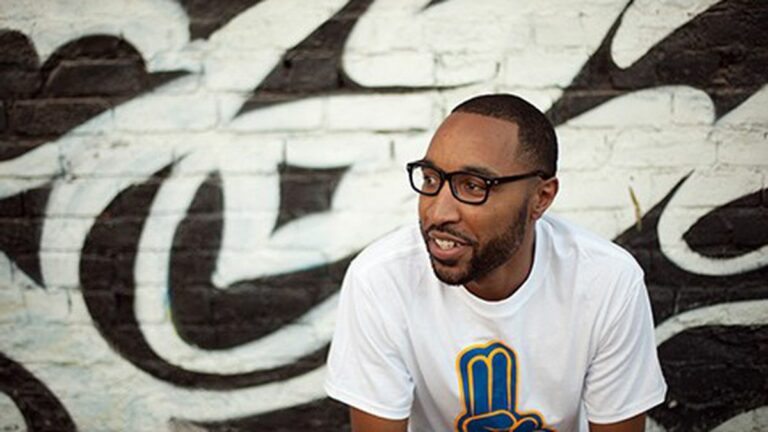
Beejus.
Credits: Erin BaldassariBeejus.
Credits: Erin Baldassari
“I was 16 years old and 98 pounds — a scrawny little kid walking around by myself. … I was like, ‘I can’t keep walking around looking like a target,’ which I was for a while,” he said. “Then I started to adopt more of the hood mentality because it was really just a plea for me to fit in, and I was sick of standing out.”
Now thirty years old with a child of his own, Beejus said he no longer feels the need to play a part. When I met him on a recent afternoon, he spoke with an effusive energy. Sporting multicolored socks, patterned sneakers, cut-off shorts, and thick-rimmed glasses, he said he’s finally embracing the slightly nerdy, goofball persona he tried to hide — qualities that permeate his latest release, FreeSpirit: The Album.
Produced by Oops (Tyrone Jenkins), who often raps alongside Beejus, the record features feel-good rhymes and intersperses dreamy, laid-back tracks with bubbly summer anthems. Beejus’ sandpaper voice and liquid flow complement Oops’ super-fast spitting. Oops, who began collaborating with Beejus when they were both adolescents, is a surprising star on the album.
While mostly staying surface level in his lyrics, Beejus occasionally reveals his inner life with bars that touch on his insecurities about his music or guilt over not being a better parent. But throughout the record, he remains optimistic. “I never had anybody give me real, good positive reinforcement,” Beejus explained. “That’s the message I want to get out: As long as you’re moving forward and trying to be something better, then it’s okay to make mistakes.”
The album sticks to mostly safe topics – repping West Oakland, supporting family, having fun, working hard, getting laid – making it almost instantly relatable but also leaving it without a clear message or focus. Beejus explained that much of his creative process is about going with his gut and not overthinking the content of his music. “I’ve always been all over the place. I might make a song like ‘Take That’ that’s super raunchy, but I also might do one where I’m rapping about my family and my daughter and stuff,” he said. “But that’s what it is. I’m free thinking, free living, and I can say ‘free spirit’ without having to really get deep down and explain it.”
When FreeSpirit dropped in March, Beejus celebrated by throwing a hip-hop showcase, FreeSpirit Fest at the Legionnaire Saloon in Oakland, in which he highlighted several other notable, local MCs, including Erk Tha Jerk and Caleborate. Beejus said he was tired of relying on promoters and wanted to create an event that furthered the FreeSpirit brand while spotlighting other rising Oakland artists. The second fest in September featured Oops, Legendvry, Tia Nomore, and Anthony Dragons.
While up-tempo jams define much of Beejus’ sound, the rapper said his forthcoming release, set to drop sometime early next year, will take on a more introspective tone. BeeSmoove 2 features more melodic songs with slower rhythms. Beejus said the record will reflect on a recent dark time in his life when he wasn’t feeling like the funny, buoyant guy he often portrays.
“It’s really touching on the stages when, a couple years ago, I was really depressed,” Beejus said. “But it’s not really me talking about my depression… it’s more about the times I was in my rut and how I got out of it.”
Oops will handle most of the album’s production once again. But unlike FreeSpirit — which featured J. Lately, Tyrese Johnson, and Champlu — there will be fewer guest verses, a direction Beejus said resulted from his growing self-confidence.
“If I really look at myself now the way that someone else looks at me, I realize that it’s actually good. I’m actually doing something and creating a platform. … That’s what I want from my music,” he said. “I want people to feel accepted because I never did.”
Imagine a world where, with a simple tap of your smartphone, you could summon a jug of your favorite craft beer to your doorstep, to be enjoyed at your leisure in the comfort of your own home. For the beer lover, this — more than the self-driving car or the face-mounted computer — is the dream of the future.
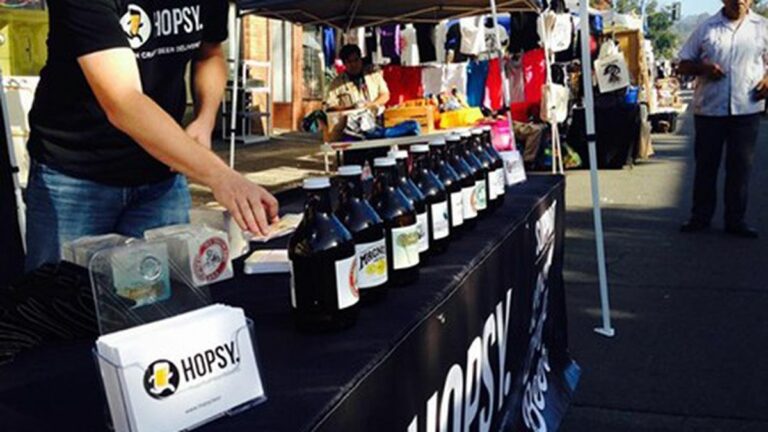
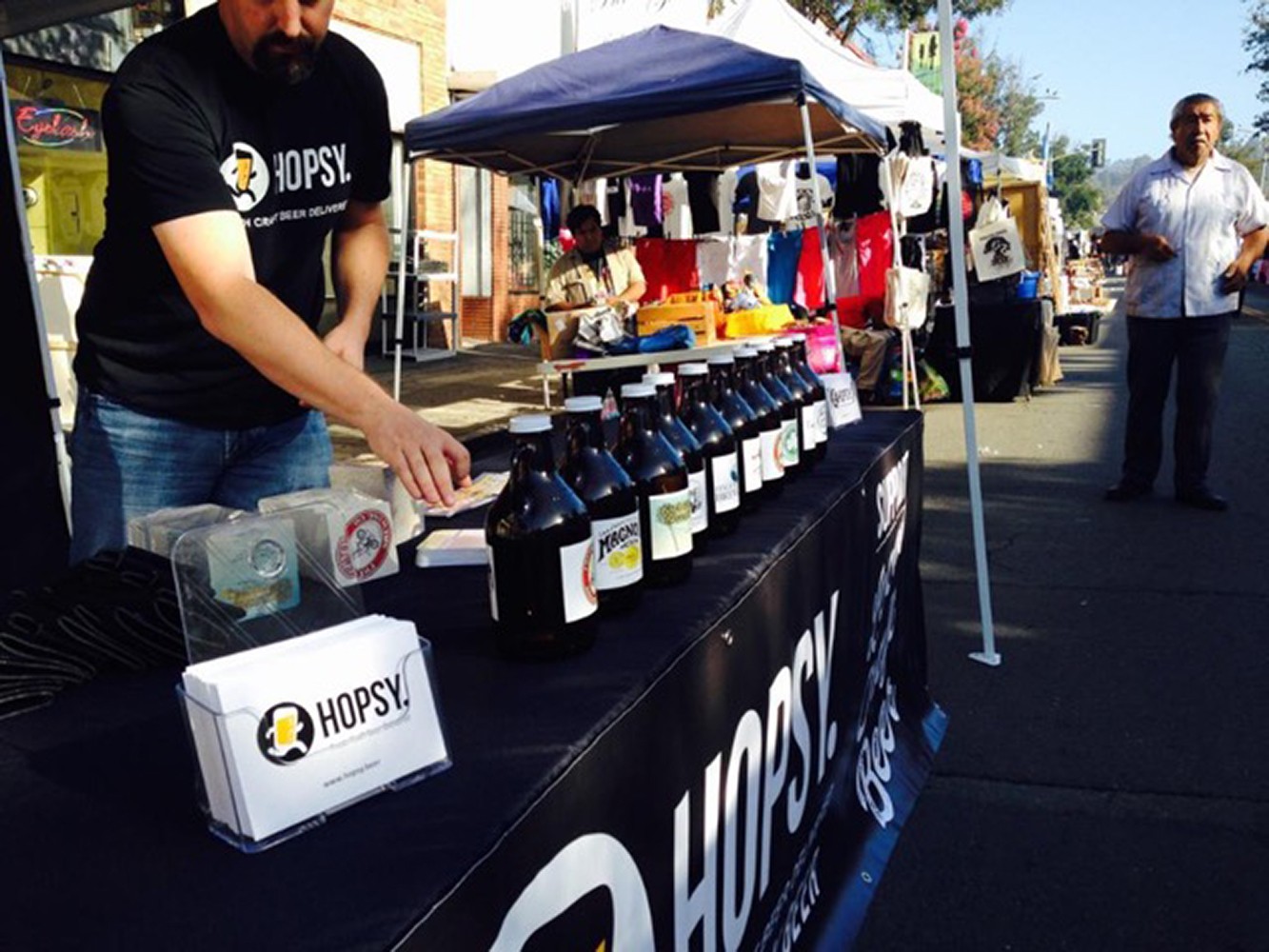
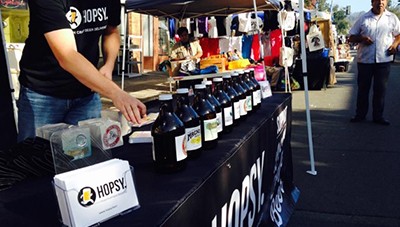
Now, thanks to Hopsy, an Albany-based delivery service that’s set to launch in November, the future is upon us. Founded by Sebastien Tron, Andrew Perroy, and Bodie Paden, Hopsy touts itself as the country’s very first app-based and online delivery service for growlers — i.e., to-go containers for draft beer — allowing customers to have draft beers, some of which might not even be available in canned or bottled form, delivered from the brewery directly to their home. Initially, Hopsy will only offer delivery to the East Bay, but will eventually expand its service to San Francisco and the North Bay.
The growler delivery service launches in November.
Credits: Courtesy photo.
The growler delivery service launches in November.
Credits: Courtesy photo.
In addition, the company’s brick-and-mortar Albany storefront at 1137 Solano Avenue will be the Bay Area’s first growler store, where customers can buy pre-filled containers of draft beer from a selection of local craft breweries.
Tron believes the service will be a game-changer in terms of making draft beer more accessible to the person who wants to drink it at home. The modern-day growler — a reusable jug, often made of dark glass, that’s used to transport and store draft beer — has been around for several decades, but for the most part, it’s an innovation that the casual beer drinker rarely uses. That’s because it’s a bit of a hassle: You have to figure out which brewpub has a growler station, or, if you want the freshest beer, you have to drive to the brewery itself. You have to procure a growler to begin with, and then you have to figure out how to clean it, and navigate regulations about labeling it properly.
But Tron said the demand is definitely there, as evidenced by the fact that, despite the hassle, a typical brewery might wind up filling about 2,000 growlers every month. How many more might get filled if a customer could do so without even getting up from his or her couch?
Other companies have attempted to launch similar services in the past, including a Seattle startup with a subscription-based model that ended up folding last year. Tron believes Hopsy will succeed where past efforts have failed in part because the craft beer industry has exploded, particularly here in the Bay Area, meaning the company can offer beers from a much greater number of breweries without its drivers traveling unreasonable distances.
New technology now also exists that can support this kind of service — for instance, CO2-powered pressurized growler-filling technology that allows the beer to stay fresh for an entire month instead of just a week or two. Even more importantly, the advent of companies like Caviar and other food delivery services mean that user-friendly platforms have already been created that make seamless what would otherwise be a logistically daunting transaction.
Hopsy’s opening roster will include East Bay breweries such as Ale Industries (Oakland), Alameda Island Brewing Co. (Alameda), and Cleophus Quealy (San Leandro), as well as several other standouts that are located a little farther afield — Magnolia Brewing in San Francisco, FreeWheel Brewing in Redwood City, and Moylan’s Brewery in Novato, for instance. All told, the company will offer a lineup of draft beer from ten different Bay Area breweries, with more to be added later, Tron said.
Like many such services, Hopsy will make money by taking a cut from both the buyer and the seller: Breweries will offer their beer to the company at wholesale rates while customers wind up paying a couple dollars more for each 32-ounce growler than they would if they went to the brewery themselves. One big perk is that by not going through a traditional distributor — like, for instance, Safeway — more of the customer’s money actually goes to the brewery.
One caveat: Hopsy isn’t yet an on-demand service. Unlike with comparable services such as Uber (for cars) or Caviar (for food), a customer can’t simply tap a button and expect that growler of fresh beer to show up at his or her doorstep within the hour — at least not for now. Instead, Hopsy customers will have until the end of the workday on Mondays to put in an order. To start out, the company will deliver growlers on Thursdays and Fridays.
But the goal, Tron said, is to offer next-day draft beer delivery, and, eventually, same-day delivery. Once that becomes a reality, how much further away are we from that Jetsons-like future of instant gratification via pneumatic tube?
Aries (March 21–April 19): Here’s actor Bill Murray’s advice about relationships: “If you have someone that you think is The One, don’t just say, ‘Okay, let’s pick a date. Let’s get married.’ Take that person and travel around the world. Buy a plane ticket for the two of you to go to places that are hard to go to and hard to get out of. And if, when you come back, you’re still in love with that person, get married at the airport.” In the coming weeks, Aries, I suggest you make comparable moves to test and deepen your own closest alliances. See what it’s like to get more seriously and deliriously intimate.
Taurus (April 20–May 20): Some firefighters use a wetter kind of water than the rest of us. It contains a small amount of biodegradable foam that makes it ten times more effective in dousing blazes. With this as your cue, I suggest you work on making your emotions “wetter” than usual. By that I mean the following: When your feelings arise, give them your reverent attention. Marvel at how mysterious they are. Be grateful for how much life force they endow you with. Whether they are relatively “negative” or “positive,” regard them as interesting revelations that provide useful information and potential opportunities for growth.
Gemini (May 21–June 20): Jonathan Strange and Mr. Norrell is a BBC TV mini-series set in the early 19th century. It’s the fictional story of a lone wizard, Mr. Norrell, who seeks to revive the art of occult magic in order to accomplish practical works, like helping the English navy in its war against the French navy. Norrell is pleased to find an apprentice, Jonathan Strange, and draws up a course of study for him. Norrell tells Strange that the practice of magic is daunting, “but the study is a continual delight.” If you’re interested in taking on a similar challenge, Gemini, it’s available.
Cancer (June 21–July 22): We humans have put buttons on clothing for seven millennia. But for a long time these small knobs and disks were purely ornamental — meant to add beauty but not serve any other function. That changed in the 13th century, when our ancestors finally got around to inventing buttonholes. Buttons could then serve an additional purpose, providing a convenient way to fasten garments. I foresee the possibility of a comparable evolution in your personal life, Cancerian. You have an opening to dream up further uses for elements that have previously been one-dimensional. Brainstorm about how you might expand the value of familiar things.
Leo (July 23–Aug. 22): You would be wise to rediscover and revive your primal innocence. If you can figure out how to shed a few shreds of your sophistication and a few slivers of your excess dignity, you will literally boost your intelligence. That’s why I’m inviting you to explore the kingdom of childhood, where you can encounter stimuli that will freshen and sweeten your adulthood. Your upcoming schedule could include jumping in mud puddles, attending parties with imaginary friends, having uncivilized fun with wild toys, and drinking boisterously from fountains of youth.
Virgo (Aug. 23–Sept. 22): While still a young man, Virgo author Leo Tolstoy wrote that “I have not met one man who is morally as good as I am.” He lived by a strict creed. “Eat moderately” was one of his “rules of life,” along with “Walk for an hour every day.” Others were equally stern: “Go to bed no later than ten o’clock,” “Only do one thing at a time,” and “Disallow flights of imagination unless necessary.” He did provide himself with wiggle room, however. One guideline allowed him to sleep two hours during the day. Another specified that he could visit a brothel twice a month. I’d love for you to be inspired by Tolstoy’s approach, Virgo. Now is a favorable time to revisit your own rules of life. As you refine and recommit yourself to these fundamental disciplines, be sure to give yourself enough slack.
Libra (Sept. 23–Oct. 22): Many astronomers believe that our universe began with the Big Bang. An inconceivably condensed speck of matter exploded, eventually expanding into thousands of billions of stars. It must have been a noisy event, right? Actually, no. Astronomers estimate that the roar of the primal eruption was just 120 decibels — less than the volume of a live rock concert. I suspect that you are also on the verge of your own personal Big Bang, Libra. It, too, will be relatively quiet for the amount of energy it unleashes.
Scorpio (Oct. 23–Nov. 21): For now, you are excused from further work on the impossible tasks that have been grinding you down. You may take a break from the unsolvable riddles and cease your exhaustive efforts. And if you would also like to distance yourself from the farcical jokes the universe has been playing, go right ahead. To help enforce this transition, I hereby authorize you to enjoy a time of feasting and frolicking, which will serve as an antidote to your baffling trials. And I hereby declare that you have been as successful at weathering these trials as you could possibly be, even if the concrete proof of that is not yet entirely visible.
Sagittarius (Nov. 22–Dec. 21): One afternoon in September, I was hiking along a familiar path in the woods. As I passed my favorite grandmother oak, I spied a thick, six-foot-long snake loitering on the trail in front of me. In hundreds of previous visits, I had never before seen a creature bigger than a mouse. The serpent’s tail was hidden in the brush, but its head looked more like a harmless gopher snake’s than a dangerous rattler’s. I took the opportunity to sing it three songs. It stayed for the duration, then slipped away after I finished. What a great omen! The next day, I made a tough but liberating decision to leave behind a good part of my life so as to focus more fully on a great part. With or without a snake sighting, Sagittarius, I foresee a comparable breakthrough for you sometime soon.
Capricorn (Dec. 22–Jan. 19): Canadian author Margaret Atwood has finished a new manuscript. It’s called Scribbler Moon. But it won’t be published as a book until the year 2114. Until then, it will be kept secret, along with the texts of many other writers who are creating work for a “Future Library.” The project’s director is conceptual artist Katie Paterson, who sees it as a response to George Orwell’s question, “How could you communicate with the future?” With this as your inspiration, Capricorn, try this exercise: Compose five messages you would you like to deliver to the person you will be in 2025.
Aquarius (Jan. 20–Feb. 18): Every hour of your life, millions of new cells are born to replace old cells that are dying. That’s why many parts of your body are composed of an entirely different collection of cells than they were years ago. If you are 35, for example, you have replaced your skeleton three times. Congratulations! Your creativity is spectacular, as is your ability to transform yourself. Normally these instinctual talents aren’t nearly as available to you in your efforts to recreate and transform your psyche, but they are now. In the coming months, you will have extraordinary power to revamp and rejuvenate everything about yourself, not just your physical organism.
Pisces (Feb. 19–March 20): The coming weeks will not be a favorable time to seek out allies you don’t even like that much or adventures that provide thrills you have felt a thousand times before. But the near future will be an excellent time to go on a quest for your personal version of the Holy Grail, a magic carpet, the key to the kingdom, or an answer to the Sphinx’s riddle. In other words, Pisces, I advise you to channel your yearning toward experiences that steep your heart with a sense of wonder. Don’t bother with anything that degrades, disappoints, or desensitizes you.
Just southeast of Lake Merritt, pedestrians and cyclists who cross over the Union Pacific Railroad tracks and under the Interstate 880 freeway reach a mostly vacant plot of land along the Oakland Estuary. The waterfront site — which people can only access via Embarcadero Street in the Jack London district or 5th Avenue by Laney College — is the future home of Brooklyn Basin, a massive mixed-use development project now under construction. The 64-acre project by Signature Development Group is slated to include 3,100 units of housing and 200,000 square feet of retail and commercial space. For civic groups that have followed the project for years, one of the most anticipated features of the plan is the proposed revitalization of the waterfront through a series of public parks along the shore.
The first park slated for construction is Shoreline Park at Embarcadero Street near 9th Avenue on a site that currently houses the historic Ninth Avenue Terminal. The public currently has little access to this area, and the project presents a rare opportunity to build and expand waterfront parkland not far from downtown Oakland. But if Shoreline Park moves forward with its current design plans, activists fear few people will visit. That’s because, according to the latest drawings from Signature Development, the park’s main feature is a giant wooden platform the size of roughly two football fields — and little else. In advance of an October 21 vote on the park proposal by the Oakland Planning Commission, activists have been pressuring city officials and Signature to revise and improve the design, and to create a park that will have enough greenery and attractions to make it a destination for Oaklanders and visitors.
The waterfront park will offer views of San Francisco.
Credits: Signature Development Group
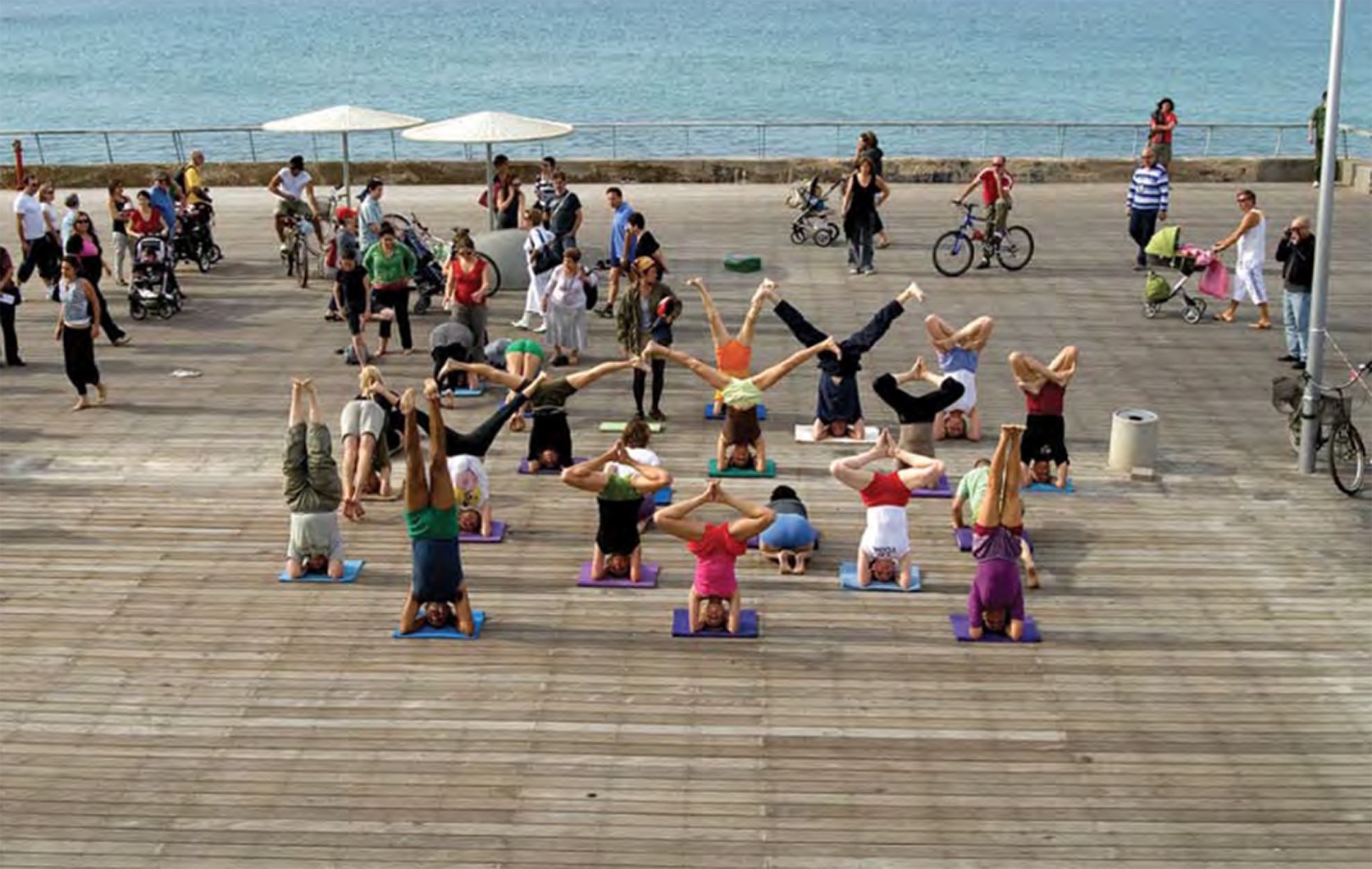
Developers of the park anticipate that the wooden deck will make for an appropriate space for yoga.
Credits: Signature Development Group
“The platform is boring, uninteresting, uninviting, and unimaginative,” said John Sutter, an East Bay Regional Park District board member whose district includes Brooklyn Basin. “We can do a lot better.”
Waterfront advocates have requested that the Brooklyn Basin proposal for Shoreline Park include more greenery and other features that would make the site a destination for Oakland residents.
Credits: Signature Development Group
Waterfront activists have long advocated for the massive mixed-use development to include features that will benefit the broader public, including high-quality parks and a local marsh restoration (see “An Environmental Setback at Brooklyn Basin,” 11/5/14). The Brooklyn Basin project — which was previously called “Oak to Ninth” and gained initial city approvals in 2006 — has faced numerous legal challenges from citizens over the years. That includes a lawsuit by preservationists who attempted to block the demolition of the Ninth Avenue Terminal, a cargo shipping facility constructed in 1930. After that challenge failed, the developer moved forward with plans to demolish most of the terminal building and construct in its place a roughly ten-acre park.
Shoreline Park is the first of five adjacent parks that Brooklyn Basin will bring to the waterfront, and Signature Development aims to break ground in spring 2016, according to company vice president, Patrick Van Ness. But because the park will be the first that is fully designed and constructed, activists said it was critical that the developer includes features that are proven to draw the public — especially considering its relatively remote location. “As a new park, it really needs to be special — one that establishes a standard and immediately attracts people,” said James Vann, a representative of the Coalition of Advocates for Lake Merritt, which has requested that the developer add a number of features to the proposal.
According to a 39-page design proposal that Van Ness shared with me last week, the park’s main attraction will be a “central plaza” that will function as a “civic gathering place that recalls [the site’s] maritime heritage and creates opportunities for a variety of activities.” The proposal states that the park’s main wooden “deck” — which will be roughly 600 feet long and will include recycled materials from the terminal building — is one way that the park will honor the maritime history of the location. Although Signature’s renderings show this platform crowded with people, activists said it is unlikely that Oaklanders will regularly visit if the deck is the main draw — especially if it lacks any creative structures that provide protection from the sun and wind.
“Are we making another invisible, unusable park?” said Naomi Schiff, a member of the board of directors of the Oakland Heritage Alliance. Schiff — one of the advocates who had fought unsuccessfully for the preservation of the terminal — argued that the freeway and the large new housing development could make it difficult for many Oaklanders to even realize that the new park is there. What’s more, Schiff noted, earlier design plans from Signature had implied that this park would include significant greenery such as grass or turf, which makes the lack of a traditional park landscape all the more frustrating.
“Two football fields of rough wood flooring? That’s not a park like anything I know,” said Vann. Vann, Schiff, and Sutter wrote a lengthy letter to numerous city departments and commissions last week requesting that officials push Signature to enhance the project before granting final approvals. The advocates have also suggested that Signature conduct more extensive outreach about its plans given that the public has had little opportunity to review and comment on the latest designs.
In their letter, the activists requested that the city require Signature to add “shade protection” and benches and picnic tables to the plaza, so that people will want to spend time there. They also requested the addition of “wind-protected areas,” which they argued would be a basic amenity for this kind of waterfront park. The letter further cited a range of additional features that could make the park a more vibrant public space, including turf or grass areas, more trees, a fishing pier, historical monuments, and a visible canopy-type entryway.
In an interview, Van Ness said Signature has made some modifications in response to the activists’ requests, including adding portable umbrella structures that the park could use on sunny days. But because Signature is building the park on top of a concrete deck above water, the site would require too much soil to sustainably build and maintain a grass lawn, he said. He further argued that, given the windy shoreline location, he doesn’t believe it’s possible for structures to provide wind protection without interfering with views of the water.
Waterfront advocates have requested that the Brooklyn Basin proposal for Shoreline Park include more greenery and other features that would make the site a destination for Oakland residents.
Credits: Signature Development Group
Van Ness also noted that the project is on land that is in the “public trust,” which means the State Lands Commission has jurisdiction over the park and prohibits the construction of certain kinds of features, such as basketball courts or children’s playgrounds. The future parks of Brooklyn Basin — which Signature will build to the northwest of Shoreline Park, closer to Jack London Square — will also have more opportunities for greenery, he said. “The vision is as you go along the estuary … you’ll have a variety of experiences,” he said, noting that Shoreline Park will feel more industrial, while the other parks will have more natural landscapes.
Brooklyn Basin’s private maintenance company — which residents’ property taxes will fund to cover some park services — could also provide support for future events that would draw crowds to the area, according to Van Ness. He cited a kite festival, farmers’ market, and food-truck events as examples of potential future programming for Shoreline Park. “This would be a large gathering place where people can come on the waterfront,” he said.
Representatives from the city’s planning department did not respond to requests for comment.
Chris Pattillo, planning commission member and principal with local architecture firm PGAdesign, said that even if the park works well for large events that happen a few times a year, it should be built in a way that encourages consistent use. “It’s going to be a huge, vast somewhat undifferentiated space. How do they program that space to make it feel comfortable when there are twenty people there?” she said, adding, “My overall reaction to the design is that it feels dated — kind of old-fashioned. It doesn’t excite me. But it’s such an exciting piece of property, and it’s going to set the stage for everything that follows.”
When Sonoma State University professor Carl Jensen started looking into the new media’s practice of self-censorship in 1976, the internet was only a dream and most computers were still big mainframes with whirling tape reels and vacuum tubes. Back then, the vast majority of Americans got all of their news from one daily newspaper and one of the three big TV networks. If a story wasn’t on ABC, NBC or CBS, it might as well not have happened.
Forty years later, the media world is a radically different place. Today, Americans are more likely to get their news from several different sources through Facebook than they would from CBS Evening News. Daily newspapers all over the country are struggling and, in some cases, dying. A story that appears on one obscure outlet can suddenly become a viral sensation reaching millions of readers at the speed of light.
Credits: Khalil BendibCredits: Khalil Bendib
And yet, as Jensen’s Project Censored found, there are still numerous big, important news stories that receive very little exposure.
As Project Censored staffers Mickey Huff and Andy Lee Roth note, 90 percent of US news media — the traditional outlets that employ full-time reporters — are controlled by six corporations. “The corporate media hardly represent the mainstream,” the staffers wrote in the current edition’s introduction.
“By contrast, the independent journalists that Project Censored has celebrated since its inception are now understood as vital components of what experts have identified as the newly developing ‘networked fourth estate.'”
Jensen set out to frame a new definition of censorship. He put out an annual list of the ten biggest stories that the mainstream media ignored, arguing that it was a failure of the corporate press to pursue and promote these stories that represented censorship — not by the government — but by the media itself.
“My definition starts with the other end, with the failure of information to reach people,” he wrote. “For the purposes of this project, censorship is defined as the suppression of information, whether purposeful or not, by any method — including bias, omission, underreporting, or self-censorship, which prevents the public from fully knowing what is happening in the world.”
Jensen died in April, 2015, but his project was inherited and carried on by Sonoma State sociology professor Peter Phillips and Huff.
Huff teaches social science and history at Diablo Valley College in Pleasant Hill. Under their leadership, the project, has at times, veered off into the looney world of conspiracies and 9/11 “truther” territory. A handful of stories included in the annual publication — to be kind — were difficult to verify. That’s caused a lot of us in the alternative press to question the validity of the annual list.
But Huff, who is now project director, and Roth, associate director, have expanded and tightened up the process of selecting stories. Project staffers and volunteers first fact-check nominations that come in to make sure they are “valid” news reports. Then a panel of 28 judges, mostly academics with a few journalists and media critics, finalize the top 10 and the 15 runners-up.
The results are published in a book that was released on October 6 by Seven Stories Press.
I’ve been writing about Project Censored for 25 years, and I think it’s safe to say that the stories on this year’s list are credible, valid — and critically important. And, even in an era when most of us are drunk with information, overloaded by buzzing social media telling us things we didn’t think we needed to know, these stories haven’t gotten anywhere near the attention they deserve.
Credits: Roxanne Pasibe
1. Half of Global Wealth Owned by the One Percent
We hear plenty of talk about the wealth and power of the top 1 percent of people in the United States, but the global wealth gap is, if anything, even worse. And it has profound human consequences.
Oxfam International, which has been working for decades to fight global poverty, released a January 2015 report showing that, if current trends continue, the wealthiest 1 percent, by the end of this year, will control more wealth than everyone else in the world put together.
As reported in Project Censored, “The Oxfam report provided evidence that extreme inequality is not inevitable, but is, in fact, the result of political choices and economic policies established and maintained by the power elite, wealthy individuals whose strong influence keeps the status quo rigged in their own favor.”
Another stunning fact: The wealth of 85 of the richest people in the world combined is equal to the wealth of half the world’s poor combined.
The mainstream news media coverage of the report and the associated issues was spotty at best, Project Censored notes: A few corporate television networks, including CNN, CBS, MSNBC, ABC, FOX, and C-SPAN covered Oxfam’s January report, according to the TV News Archive. CNN had the most coverage with about seven broadcast segments from January 19 to 25, 2015. However, these stories aired between 2 a.m. and 3 a.m., far from primetime.
Sources
Larry Elliott and Ed Pilkington, “New Oxfam Report Says Half of Global Wealth Held by the 1%,” Guardian, Jan. 19, 2015, http://tinyurl.com/mqt84tg
Sarah Dransfield, “Number of Billionaires Doubled Since Financial Crisis as Inequality Spirals Out of Control–Oxfam,” Oxfam, Oct. 29, 2014, http://tinyurl.com/nzox3t8
Samantha Cowan, “Every Kid on Earth Could Go to School If the World’s 1,646 Richest People Gave 1.5 Percent,” TakePart, Nov. 3, 2014, http://tinyurl.com/worldswealthiest.
2. Oil Industry Illegally Dumps Fracking Wastewater
Fracking, which involves pumping high-pressure water and chemicals into rock formations to free up oil and natural gas, has been a huge issue nationwide. But there’s been little discussion of one of the side effects: The contamination of aquifers.
The Center for Biological Diversity reported in 2014 that oil companies had dumped almost 3 billion gallons of fracking wastewater into California’s underground water supply. Since the companies refuse to say what chemicals they use in the process, nobody knows exactly what the level of contamination is. But wells that supply drinking water near where the fracking waste was dumped tested high in arsenic, thallium, and nitrates.
Credits: Roxanne Pasibe
According to Project Censored, “Although corporate media have covered debate over fracking regulations, the Center for Biological Diversity study regarding the dumping of wastewater into California’s aquifers went all but ignored at first. There appears to have been a lag of more than three months between the initial independent news coverage of the Center for Biological Diversity revelations and corporate coverage.
“In May 2015, the Los Angeles Times ran a front-page feature on Central Valley crops irrigated with treated oil field water; however, the Los Angeles Times report made no mention of the Center for Biological Diversity’s findings regarding fracking wastewater contamination.”
Sources
Dan Bacher, “Massive Dumping of Wastewater into Aquifers Shows Big Oil’s Power in California,” IndyBay, Oct. 11, 2014, http://tinyurl.com/DumpingWastewater
“California Aquifers Contaminated with Billions of Gallons of Fracking Wastewater,” Russia Today, October 11, 2014, http://tinyurl.com/nbtoa6j.
Donny Shaw, “CA Senators Voting NO on Fracking Moratorium Received 14x More from Oil & Gas Industry,” MapLight, June 3, 2014, http://tinyurl.com/FrackingMoratorium.
3. 89 percent of Pakistani Drone Victims Not Identifiable as Militants
The United States sends drone aircraft into combat on a regular basis, particularly in Pakistan. The Obama administration says the drones fire missiles only when there is clear evidence that the targets are Al Qaeda bases. Secretary of State John Kerry insists that “the only people we fire a drone at are confirmed terrorist targets at the highest levels.”
But the Bureau of Investigative Journalism, which keeps track of all the strikes, reported that only 4 percent of those killed by drones were Al Qaeda members and only 11 percent were confirmed militants of any sort.
That means 89 percent of the 2,464 people killed by US drones could not be identified as terrorists.
In fact, 30 percent of the dead could not be identified at all.
The New York Times has covered the fact that, as one story noted, “most individuals killed are not on a kill list, and the government does not know their names.” But, overall, the mainstream news media ignored the Bureau of Investigative Journalism reporting.
Sources
Jack Serle, “Almost 2,500 Now Killed by Covert US Drone Strikes Since Obama Inauguration Six Years Ago,” Bureau of Investigative Journalism, Feb. 2, 2015, www.thebureauinvestigates
Jack Serle, “Get the Data: A List of US Air and Drone Strikes, Afghanistan 2015,” Bureau of Investigative Journalism, Feb. 12, 2015, http://tinyurl.com/pvospem
Abigail Fielding-Smith, “John Kerry Says All Those Fired at by Drones in Pakistan Are ‘Confirmed Terrorist Targets’ — But with 1,675 Unnamed Dead How Do We Know?” Bureau of Investigative Journalism, Oct. 23, 2014, http://preview.tinyurl.com/unameddead.
Jack Serle, “Only 4% of Drone Victims in Pakistan Named as al Qaeda Members,” Bureau of Investigative Journalism, Oct. 16, 2014, http://tinyurl.com/DroneVictimsinPakistan.
Jeremy Scahill, “Germany is the Tell-Tale Heart of America’s Drone War,” Intercept, April 17, 2015, http://tinyurl.com/o4ke8bt.
4. Popular Resistance to Corporate Water-Grabbing
For decades, private companies have been trying to take control of water supplies, particularly in the developing world. Now, as journalist Ellen Brown reported in March 2015, corporate water barons, including Goldman Sachs, JPMorgan Chase, Citigroup, the Carlyle Group, and other investment firms “are purchasing water rights from around the world at an unprecedented pace.”
However, over the past 15 years, more than 180 communities have fought back and re-municipalized their water systems. “From Spain to Buenos Aires, Cochabamba to Kazakhstan, Berlin to Malaysia, water privatization is being aggressively rejected,” Victoria Collier reported in CounterPunch.
Meanwhile, in the United States, some cities — in what may be a move toward privatization — are radically raising water rates and cutting off service to low-income communities.
The mainstream media response to the privatization of water has been largely silence.
Larry Gabriel, “When the City Turned Off Their Water, Detroit Residents and Groups Delivered Help,” YES! Magazine, Nov. 24, 2014, http://tinyurl.com/CityTurnedOffWater.
Madeline Ostrander, “LA Imports Nearly 85 Percent of Its Water — Can It Change That by Gathering Rain?,” YES! Magazine, Jan. 5, 2015, http://tinyurl.com/LAImportsWater.
5. Fukushima Nuclear Disaster Deepens
More than four years after a tsunami destroyed Japan’s Fukushima nuclear plant, causing one of the worst nuclear accidents in human history, radiation from the plant continues to leak into the ocean.
But the story has largely disappeared from the news.
As Project Censored notes:
“The continued dumping of extremely radioactive cooling water into the Pacific Ocean from the destroyed nuclear plant, already being detected along the Japanese coastline, has the potential to impact entire portions of the Pacific Ocean and North America’s western shoreline. Aside from the potential release of plutonium into the Pacific Ocean, Tokyo Electric Power Company (TEPCO) recently admitted that the facility is releasing large quantities of water contaminated with tritium, cesium and strontium into the ocean every day.”
We’re talking large amounts of highly contaminated water getting dumped into the ocean. The plant’s owner, Tokyo Electric Power Company, “admitted that the facility is releasing a whopping 150 billion becquerels of tritium and seven billion becquerels of cesium- and strontium-contaminated water into the ocean every day.” The potential for long-term problems all over the world is huge — and the situation hasn’t been contained.
Sources
“TEPCO Drops Bombshell About Sea Releases; 8 Billion Bq Per Day,” Simply Info: The Fukushima Project, Aug. 26, 2014, www.fukuleaks.org/web/?p=13700.
Sarah Lazare, “Fukushima Meltdown Worse Than Previous Estimates: TEPCO,” Common Dreams, Aug. 7, 2014, http://tinyurl.com/q9hwkhg.
Michel Chossudovsky, “The Fukushima Endgame: The Radioactive Contamination of the Pacific Ocean,” Global Research, Dec. 17, 2014, http://tinyurl.com/FukushimaEndGame.
Credits: Khalil Bendib
6. Methane and Arctic Warming’s Global Impacts
We all know that carbon emissions from the burning of fossil fuels are a huge threat to climate stability. But there’s another giant threat out there that hasn’t made much news.
The Arctic ice sheets and permafrost, which are rapidly melting in some areas, contain massive amounts of methane — a greenhouse gas that’s way worse than carbon dioxide. And, as the ice recedes and the permafrost melts, that methane is getting released into the atmosphere.
Dahr Jamail, writing for Truthout, notes that all of our predictions about the pace of global warming and its impacts might have to be re-evaluated in the wake of revelations about methane releases:
“A 2013 study, published in Nature, reported that a 50-gigaton ‘burp’ of methane is ‘highly possible at any time.’ As Jamail clarified, ‘That would be the equivalent of at least 1,000 gigatons of carbon dioxide,’ noting that, since 1850, humans have released a total of about 1,475 gigatons in carbon dioxide. A massive, sudden change in methane levels could, in turn, lead to temperature increases of four to six degrees Celsius in just one or two decades — a rapid rate of climate change to which human agriculture, and ecosystems more generally, could not readily adapt.”
Jamail quoted Paul Beckwith, a professor of climatology and meteorology at the University of Ottawa: “Our climate system is in early stages of abrupt climate change that, unchecked, will lead to a temperature rise of 5 to 6 degrees Celsius within a decade or two.” Such changes would have “unprecedented effects” for life on Earth.
A huge story? Apparently not. The major news media have written at length about the geopolitics of the Arctic region, but there’s been very little mention of the methane monster.
7. Fear of Government Spying Is Chilling Writers’ Freedom of Expression
Writers in Western liberal democracies may not face the type of censorship seen in some parts of the world, but their fear of government surveillance is still causing many to think twice about what they can say.
Lauren McCauley, writing for Common Dreams, quoted one of the conclusions from a report by the writers’ group PEN America:
If writers avoid exploring topics for fear of possible retribution, the material available to readers — particularly those seeking to understand the most controversial and challenging issues facing the world today — may be greatly impoverished.
According to Project Censored, a PEN America survey showed that “34 percent of writers in liberal democracies reported some degree of self-censorship (compared with 61 percent of writers living in authoritarian countries, and 44 percent in semi-democratic countries). Almost 60 percent of the writers from Western Europe, the United States … indicated that U.S. credibility ‘has been significantly damaged for the long term’ by revelations of the U.S. government surveillance programs.”
Other than from Common Dreams, the PEN report attracted almost no major media attention.
Sources
Lauren McCauley, “Fear of Government Spying ‘Chilling’ Writers’ Speech Worldwide,” Common Dreams, Jan. 5, 2015, http://tinyurl.com/GovernmentSpying.
Lauren McCauley, “Government Surveillance Threatens Journalism, Law and Thus Democracy: Report,” Common Dreams, July 28, 2014, http://tinyurl.com/q6agfn9.
8. Who Dies at the Hands of Police — and How Often
High-profile police killings, particularly of African-American men, have made big news over the past few years. But there’s been much less attention paid to the overall numbers — and to the difference between how many people are shot by cops in the United States and in other countries.
In the January 2015 edition of Liberation, Richard Becker, relying on public records, concluded that the rate of US police killing was 100 times that of England, 40 times that of Germany, and 20 times the rate in Canada.
In June 2015, a team of reporters from the Guardian concluded that 102 unarmed people were killed by US police in the first five months of that year — twice the rate reported by the government.
Furthermore, the Guardian wrote, “black Americans are more than twice as likely to be unarmed when killed during encounters with police as white people.” The paper concluded that, “Thirty-two percent of black people killed by police in 2015 were unarmed, as were 25 percent of Hispanic and Latino people, compared with 15 percent of white people killed.”
And as far as accountability goes, the Washington Post noted that in 385 cases of police killings, only three officers faced charges.
Sources
Richard Becker, “U.S. Cops Kill at 100 Times Rate of Other Capitalist Countries,” Liberation, Jan. 4, 2015, http://tinyurl.com/nntxdrm/.
Jon Swaine, Oliver Laughland, and Jamiles Lartey, “Black Americans Killed by Police Twice as Likely to be Unarmed as White People,” Guardian, June 1, 2015, http://tinyurl.com/BlackAmericansKilledbyPolice.
Credits: Khalil Bendib
9. Millions in Poverty Get Less Media Coverage than Billionaires Do
The news media in the United States doesn’t like to talk about poverty, but it loves to report on the lives and glory of the super-rich.
The advocacy group, Fairness and Accuracy in Reporting, analyzed the three major television news networks and found that 482 billionaires got more attention than the 50 million people who live in poverty.
This shouldn’t be a surprise to anyone who follows the mainstream media, or pays much attention to the world of social media and the blogosphere. The top rung of society gets vast amounts of attention, for good and for ill — but the huge numbers of people who are homeless, hungry, and often lacking in hope just aren’t news.
“The notion that the wealthiest nation on Earth has one in every six of its citizens living at or below the poverty threshold reflects not a lack of resources, but a lack of policy focus and attention — and this is due to a lack of public awareness to the issue,” Frederick Reese of MintPress News wrote.
From Project Censored: “The FAIR study showed that between January 2013 and February 2014, an average of only 2.7 seconds per every 22-minute episode discussed poverty in some format. During the 14-month study, FAIR found just 23 news segments that addressed poverty.”
Sources
Steve Rendall, Emily Kaufmann, and Sara Qureshi, “Even GOP Attention Can’t Make Media Care about Poor,” Extra!, Fairness and Accuracy in Reporting, June 1, 2014, http://tinyurl.com/GOPsPoorAttention.
“Millions in Poverty Get Less Coverage Than 482 Billionaires,” Fairness and Accuracy in Reporting, June 26, 2014, http://tinyurl.com/MillionsinPoverty.
10. Costa Rica Is Setting the Standard on Renewable Energy
Is it possible to meet a modern nation’s energy needs without any fossil-fuel consumption? Yes. Costa Rica has been doing it.
To be fair, that country’s main industries — tourism and agriculture — are not energy-intensive, and heavy rainfall in the first part of the year made it possible for the country to rely heavily on its hydropower resources.
But even in normal years, Costa Rica generates 90 percent of its energy without burning any fossil fuels.
Iceland also produces the vast majority of its energy from renewable sources.
The transition to 100 percent renewables will be harder for larger countries — but as the limited reporting on Costa Rica notes, it’s possible to take large steps in that direction.
Chantaly (98 min., 2013). In Lao with English subtitles; CSEAS Film Series (UC Berkeley, Doe Library, Room 180, Berkeley, 5:00)
Batman (126 min., 1989). (UA Berkeley 7, Berkeley, 9:00)
Beetlejuice (92 min., 1988). (The New Parkway, Oakland, 9:30)
Friday, October 16
Life Itself (120 min., 2014). (Berkeley Public Library, Central Branch, Berkeley, 3:00)
Wallace and Gromit (85 min., 2005). (Oakland Zoo, Oakland, 6:30)
The Boxtrolls (96 min., 2014). Redwood Heights Movies in the Park (Redwood Heights Recreation Center, Oakland, 7:00)
The Shining (146 min., 1980). (Parkway, 10:00)
Saturday, October 17
Otello (210 min., 2015). METLive event (AMC Bay Street 16, Emeryville, 9:55 a.m.)
Mind/Game: The Unquiet Journey of Chamique Holdsclaw (56 min., 2015). Followed by a discussion with the producer/director, Rick Goldsmith, along with Dr. Doug Moorhead, Gigi Crowder and Andrea Lappen (La Pena Cultural Center, Berkeley, 10:00 a.m.)
Eighteen Springs/Affair of Half a Lifetime (126 min., 1997). With both Chinese and English subtitles (BPL Central, 1:45)
Jack Pierce: The Maker of Monsters (82 min., 2015). Followed by a post-film Q&A with director Stephon Taylor (Parkway, 3:00)
Sunday, October 18
Selma (128 min., 2014). Commemorating the 50th anniversary of the Selma-to-Montgomery march (Parkway, 3:00)
The Hunger Games: Mokingjay Part 1 (123 min., 2014) and Part 2 (138 min., 2015). (Grand Lake Theatre, Oakland, 4:30).
My Fair Lady (170 min., 1964). (Rialto Cinemas Elmwood, Berkeley, 7:00)
The Secret of the Seven Sisters, Episodes 1 and 2 (2012). Geopolitics of Oil Series (Humanist Hall, Oakland, 7:30)
Monday, October 19
My Fair Lady (170 min., 1964). (Elmwood, 7:00)
The Beaux’ Strategem (45 min., 2015). National Theater Live (Elmwood, 7:00)
Tuesday, October 20
Killing the Seven Generations: Reproductive Abuses against Indigenous Women (2010). Followed by a discussion with speakers from local Native American communities (Oakland Public Library, César E. Chávez Branch, Oakland)
Three Still Standing (90 min., 2014). (Parkway, 7:00)
The Shining (146 min., 1980) and Nightmare on Elm Street (91 min., 1984). Halloween Movie Night (Forbidden Island, Alameda, 7:00)
I’ve been cutting way back on meat to reduce my carbon footprint. Whether I go all the way vegan or not, it would feel great to support these businesses and to feed my sweets addiction at the same time.
Christopher Fallis, Alameda
“Oakland Favors Bank Over Bus Riders,” News, 9/30
It’s About Political Connections
This is disgraceful that city staff and other city officials would bow to the demands of Summit Bank. It’s not safe to have a bus stop in front of the bank? What does that tell you about the attitude of Summit Bank toward bus riders like myself? And, for those who say the bus stop at Hawthorne is fine, they obviously don’t know the neighborhood because the block the new Sprouts is going into is a very large block, essentially a double block. Indeed, it is the equivalent of walking two blocks and is uphill from 30th Street. So now the new CVS, the new Sprouts, and the existing Grocery Outlet — all stores that lower income folks and bus riders shop at, will not have bus stops convenient to them from one direction. I’d say that’s bad planning — but it isn’t, it’s kowtowing to class fears from a bank that is politically connected.
Scott Pearson, Oakland
“The Gentle Thich Nhat Hanh,” Raising the Bar, 9/30
Why Reproach the Dalai Lama?
Thank you for such a lovely tribute to Thich Nhat Hanh. I do object however to the slightly reproachful tone of the comment regarding his holiness the Dalai Lama. It is not necessary to disparage one figure to extol the virtues of another. Both figures are of such inspiration that making such a speculative remark regarding his holiness can only be detrimental to the spirit of Buddhism that they practice and encourage others to follow. His holiness has shown time and time again an openness to learning, respecting others’ perspectives, and encourages people to always listen and to use your own mind to make decisions. I should hope that the author reconsiders his own judgment and follows their example.
Betty Tran, San Francisco
“Defending Sanctuary,” News, 9/23
Borders Divide Us
Immigration policies and extreme restrictions placed upon the movement of people tears apart love relationships and divides families. The concept of “nation” is artificial and divides us. Anything that reduces these restrictions and promotes kindness and connection among all peoples on this Earth has my vote. It is, in fact, the only way that we will survive this current Earth crisis with any degree of success.
Segue Fischlin III, Oakland
“Chowhound in Crisis,” Food, 9/23
Flickr Got Screwed First
It’s worth noting that by Chowhound General Manager Georges Haddad’s own account, he was also responsible for the 2013 Flickr redesign, which Flickr users hated. That redesign prioritized slick looks over usability, undermined the community aspect of the site, increased loading times, and generally ignored the things people most used and valued about Flickr. So the Chowhound clusterfuck is not exactly without historical precedent.
Tom Hilton, San Francisco
Goodbye, Chowhound
I am a longtime user — back when we would send money to Jim Leff to help keep the site going. When I tried the Beta version of the redesign, I was highly underwhelmed. I tried it a few more times to get dining info for an upcoming trip. I am dropping out of the Chowhound community as it is now. Luckily many of us “founding members” have been setting up discussions on Facebook. RIP Chowhound.
I am a cis woman in my mid twenties. I get a pang or a spasm of pain in a place deep in my clit/urethra area. I can’t pinpoint which part exactly. It takes me by surprise every time it happens, so I jerk around and press my crotch for a hot second — which doesn’t help, but it’s about the only thing I can do. This obviously does not look cool in public, and regardless of when it happens, the episode irritates me. Around four or five convulsions happen and then quickly it’s over. There’s no pattern — it happens at random times and anywhere from one to four times daily. It started about a week ago. It doesn’t hurt when I pee, apply pressure to the area, work out, masturbate, or orgasm. I wonder if my lady spasms are associated with stress. I started a new job in September that I love, but it’s very demanding of my time, which has taken a toll on my mental and physical health (i.e., doing work things all fucking day, having no “me” time). What’s going on down there? What’s the solution? Will doing Kegels help me manage these spasms? (P.S. I’m a lesbian if that detail is helpful.)
Super Perplexed About Spasms Mostly
I shared your letter with Dr. Lori Brotto, an associate professor in the Department of Gynecology at the University of British Columbia. Dr. Brotto has done extensive research on vaginal/vulval pain and is a recognized expert on this subject and lot of others. Brotto shared your letter with Dr. Jonathan Huber, an Ottawa-based gynecologist with expertise in treating genital pain. “SPASM definitely needs to see a physician as soon as possible to have her vulva and vagina examined,” Dr. Brotto and Dr. Huber wrote in their joint response. “The collection of symptoms she describes does not map perfectly onto any single diagnosis, so these ideas below are best guesses.”
Before we get to those best guesses, a word of warning for the hypochondriacs in my readership: If you’re the kind of person who can’t read about mysterious symptoms and their possible causes without immediately developing those symptoms — particularly vagina-having hypochondriacs — you might want to skip the rest of this response. Okay, back to the good doctors…
“Sudden onset, intermittent genital pain can be caused by a number of simple things, such as abrasions, an infection, an allergic reaction, buildup of smegma, dermatosis, etc.,” Dr. Brotto and Dr. Huber continued. “Although these things are unlikely to be the cause of her pain, they’re easy to rule out and treat, if necessary.” (“Wait just a minute,” I hear some of you crying. “Women don’t have problems with smegma — that’s just a dudes-with-foreskins* problem.” Dr. Brotto responds: “Women get smegma, too. We don’t hear about smegma in women because yeast infections get a lot more attention. But smegma in women is the same as smegma in men: a harmless buildup of skin cells and oils.”)
“SPASM’s symptoms most closely map onto a condition called ‘interstitial cystitis’ (IC) or bladder pain syndrome,” Dr. Brotto and Dr. Huber explained. “IC is diagnosed when there is chronic bladder or urethral pain in the absence of a known cause. It’s typically described as having the symptoms or sensations of a bladder infection, without actually having an infection. Although IC usually has a gradual onset and presents with pressure more often than pain, some women do describe a sudden onset, with pain as the most prominent symptom as opposed to pressure. Since IC often coexists with vulvodynia (vulval pain), dysmenorrhea (painful periods), and endometriosis (when endometrial tissue grows outside the uterus), if this individual has any of these other diagnoses, then IC may be more likely to account for her pain.”
How can you determine if it’s IC? “IC is best assessed by a urologist, who may choose to do further urine tests, like examination of urine under a microscope, and even a cystoscopy — putting a narrow camera through the urethra into the bladder to take a look.”
Another possible cause: a urethral diverticulum. “It’s like an outpouching along the tube of the urethra,” Dr. Brotto and Dr. Huber wrote. “This is kind of like a dead-ended cave where urine and other debris can collect, which can possibly lead to infection and pain.” A gynecologist might be able to diagnose a diverticulum during a normal exam — just by feeling around — but you’ll most likely need to have a tiny camera stuffed up your urethra to diagnose this one too, SPASM. Moving on…
“Some of her symptoms also sound like the beginnings of ‘persistent genital arousal disorder’ (PGAD), a condition of unwanted genital sensations and arousal in the absence of sexual desire. PGAD can be triggered by stress and temporarily relieved with orgasms. For some women with PGAD, it is related to starting or stopping a medication (especially antidepressants).” The good news: You don’t need to cram a selfie stick up your urethra to determine whether you’ve recently stopped taking antidepressants. More good news: There are treatments for all of these conditions.
“In sum, we feel she should see a gynecologist first and possibly get a referral to a urologist,” Dr. Brotto and Dr. Huber concluded. “She also asks about whether Kegel exercises will help. Sometimes pelvic floor dysfunction can contribute to vaginal/vulval pain, and seeing a pelvic floor physiotherapist to learn proper pelvic floor exercises (including, but not limited to, Kegels) can help. A good gynecologist will be able to test her pelvic floor strength and control, and advise whether she should be seeing a pelvic floor physiotherapist.”
Follow Dr. Brotto on Twitter @DrLoriBrotto, and follow Dr. Huber @DrJonathanHuber.
(P.S. Lesbians, in my experience, are always helpful.)
I am a 23-year-old Italian girl and I have been in a long-distance relationship for one year. We love to have sex, and when we are far away, we send each other hot pictures and videos. At least two times per week, we masturbate on Skype. There is something that confuses me about the way I masturbate when I am alone. My boyfriend watches pornos daily when we are far away. This is something I don’t like, but I have not asked him to give up watching pornos. I think there is nothing wrong in pornos by themselves: Sometimes I watch them, and when we are together, it’s me who suggests to watch them together or I let him watch them while I’m giving something to him. However, I’m not a fan of him watching pornos when he is alone. But when I masturbate, I think only about him watching porno alone. What’s wrong with my sexual fantasies?
Confused Italian Asking Obviously
There’s nothing wrong with your sexual fantasies, CIAO, you’re just experiencing a little cognitive dissonance and residual sex-negativity — and that particular tension can both distress and arouse. But seeing as your boyfriend is going to look at porn (and other women) whether you want him to or not (just as you look at porn and other men), and since you enjoy porn together, I would advise you to err on the side of embracing your fantasies. And don’t feel like you have to overcome the cognitive dissonance. The naughtiness of it, the transgression, and the symbolic betrayal — all of that turns you on. So live with it, lean into it, and enjoy it.
* For the record, quickly, before Tumblr explodes: Some women have penises! Some women with penises are uncut! A tiny percentage of uncut-penis-having women have poor personal hygiene practices and consequently have smegma under their foreskins! #TheMoreYouKnow
In the days following Tuesday, September 29, West Oakland featured prominently in national headlines — a rare occurrence that, unfortunately, usually follows violence. That morning, 27-year-old artist Antonio Ramos was fatally shot while painting a mural in a West Oakland underpass as part of a community-fueled beautification project. The story was too tragic not to bite: A...
Vanessa Camarena-Arredondo of Studio Grand, an activist-centric venue in Oakland, approached local singer and multi-instrumentalist Krystle Ahmadyar to do an artist residency at a time when the musician was dealing with a flurry of mixed emotions.
Ahmadyar, who is known for her soulful, vocal-driven solo project, Ruby Mountain, had just returned from visiting Afghanistan for the first time with her...
By his own account, rapper Beejus (Brandon Robinson) never quite felt like he fit in while growing up in West Oakland.
Raised in a middle-class household, he attended a magnet program in elementary school in the Oakland hills. For much of his life, Beejus said he was insulated from the economic turmoil of his deFremery Park neighborhood. He remembered sticking...
Imagine a world where, with a simple tap of your smartphone, you could summon a jug of your favorite craft beer to your doorstep, to be enjoyed at your leisure in the comfort of your own home. For the beer lover, this — more than the self-driving car or the face-mounted computer — is the dream of the future.
Now,...
Aries (March 21–April 19): Here's actor Bill Murray's advice about relationships: "If you have someone that you think is The One, don't just say, 'Okay, let's pick a date. Let's get married.' Take that person and travel around the world. Buy a plane ticket for the two of you to go to places that are hard to go to...
Just southeast of Lake Merritt, pedestrians and cyclists who cross over the Union Pacific Railroad tracks and under the Interstate 880 freeway reach a mostly vacant plot of land along the Oakland Estuary. The waterfront site — which people can only access via Embarcadero Street in the Jack London district or 5th Avenue by...
When Sonoma State University professor Carl Jensen started looking into the new media's practice of self-censorship in 1976, the internet was only a dream and most computers were still big mainframes with whirling tape reels and vacuum tubes. Back then, the vast majority of Americans got all of their news from one daily newspaper and one of...
Thursday, October 15
Chantaly (98 min., 2013). In Lao with English subtitles; CSEAS Film Series (UC Berkeley, Doe Library, Room 180, Berkeley, 5:00)
Batman (126 min., 1989). (UA Berkeley 7, Berkeley, 9:00)
Beetlejuice (92 min., 1988). (The New Parkway, Oakland, 9:30)
Friday, October 16
Life Itself (120 min., 2014). (Berkeley Public Library, Central Branch, Berkeley, 3:00)
Wallace and Gromit (85 min., 2005). (Oakland Zoo, Oakland,...
"Plant-Based Sweets and Treats," Taste, 9/30
It's About the Environment
I've been cutting way back on meat to reduce my carbon footprint. Whether I go all the way vegan or not, it would feel great to support these businesses and to feed my sweets addiction at the same time.
Christopher Fallis, Alameda
"Oakland Favors Bank Over Bus Riders," News, 9/30
It's About Political Connections
This...
I am a cis woman in my mid twenties. I get a pang or a spasm of pain in a place deep in my clit/urethra area. I can't pinpoint which part exactly. It takes me by surprise every time it happens, so I jerk around and press my crotch for a hot second — which doesn't help, but it's...