In Cyndi Lauper’s 1984 music video for her controversially risqué song “She Bop,” the Eighties pop idol dances circles around a line of “Burger Klone” customers marching out of the restaurant in matching, white outfits. Lauper, on the other hand, is wearing a green bustier; huge, studded belts; and a floral wrap over gold lamé leggings — all of which clash with her garishly orange hair. The video is rich with indulgent camp. Meanwhile, Lauper repeats her bubbly euphemism for unabashed self-pleasure — She bop, he bop, we bop.
“She Bop” is also the title of Maria Guzmán Capron’s current solo show at City Limits Gallery (300 Jefferson St., Oakland). Capron mostly makes large, quilted sculptures pieced together from loud fabrics found at discount stores. They vaguely mimic figures and body parts, but only of the oddly amorphous sort. In She Bop, huge hands folding into each other form a large, puddle-like shape on the wall, patterned with blue, tropical leaves, cheetah print, pastel sea shells, and plaid. The hanging piece is also adorned with handmade ceramic charms — a flower, an ice cream cone, a heart.
Maria Guzmán Capron’s work is made mostly from discounted fabrics.
Credits: Sarah Burke
Maria Guzmán Capron’s work is made mostly from discounted fabrics.
Credits: Sarah Burke
The centerpiece of the show is a fort-like installation made from a quilt that’s draped over a wooden structure slightly resembling the skeleton of a house with three languid hands emerging from its façade. The front is dotted with shiny, ceramic, red anthuriums that highlight the apples in the fruit-covered fabric at the back. To tie the show together, soft, purple spots cover the gallery’s open wall space like reflections from a disco ball.
The fabrics that Capron uses deliberately clash, and her ceramics have a cheesy charm. More bluntly, the work is tacky. But it embodies tackiness in a tricky way. “I think sometimes they really don’t work, but that’s what works,” said Capron of the way she pairs her fabrics. “Sometimes, I’m like, ‘Oh, this is so ugly. I love it.'” Capron’s aesthetic embraces kitsch so sincerely that conventional measures of taste fall into irrelevance, which premises the show on a recalibration of cool altogether. If She Bop was an adolescent, it would relish being outside of the in-crowd.
Capron, who is based in Oakland, was born in Milan, Italy to a Peruvian mother and Colombian father. When she was fourteen, she moved to Colombia for a few years, then to Houston at the age of seventeen. After overcoming her culture shock, she found she felt most at home in Houston’s sprawling thrift stores. She began to collect cute decorations, kitschy items, and unstylish clothing. She was drawn to the honey-sweet appeal of their aesthetics, and liked the fact that it represented something untrendy — out of line with the prescribed fashion taste at the time. That disregard felt creatively freeing.
Capron is clear that her intention is not to reclaim crafting mediums that are considered domestic. While she’s not at all opposed to that reclamation, she’s not interested in fighting for the inclusion of kitsch into the elite club of fine art. Rather, her work is about pleasure — specifically, eliciting pleasure from aesthetics so indulgently focused on pleasing the eye that they are often discarded as cheap tricks. She likes that quilted fabrics remind her of the suppleness of the human body, and that she can manipulate them to also evoke muscularity — exploring the ambiguous relationship between gender and bodily forms. But, in regards to those conceptual ventures, Capron, again, holds no agenda. In that way, She Bop functions like one of the tchotchkes she used to collect: Not meant as a means beyond being enjoyable to look at. And it is enjoyable.
Our October 7 feature, “Racial Profiling Via Nextdoor.com,” erroneously stated that Oakland resident James Fisher, a teen who faces profiling in his Upper Dimond neighborhood, is mixed-race Black. James, who was adopted, is not mixed-race. And our October 7 Culture Spy, “Health, Poetry, and Life” listed the incorrect host for the Life Is Living festival’s skate zone. It was Keith Williams, not Karl Watson. 
The Watergate break-in occurred in June 1972, but didn’t figure into the presidential election that year. While journalists look back on Watergate as a journalistic triumph, due to developments after the election, Carl Jensen took a different view. He saw the failure to recognize Watergate’s importance until after the election as a symptom of systemic failures in the media.
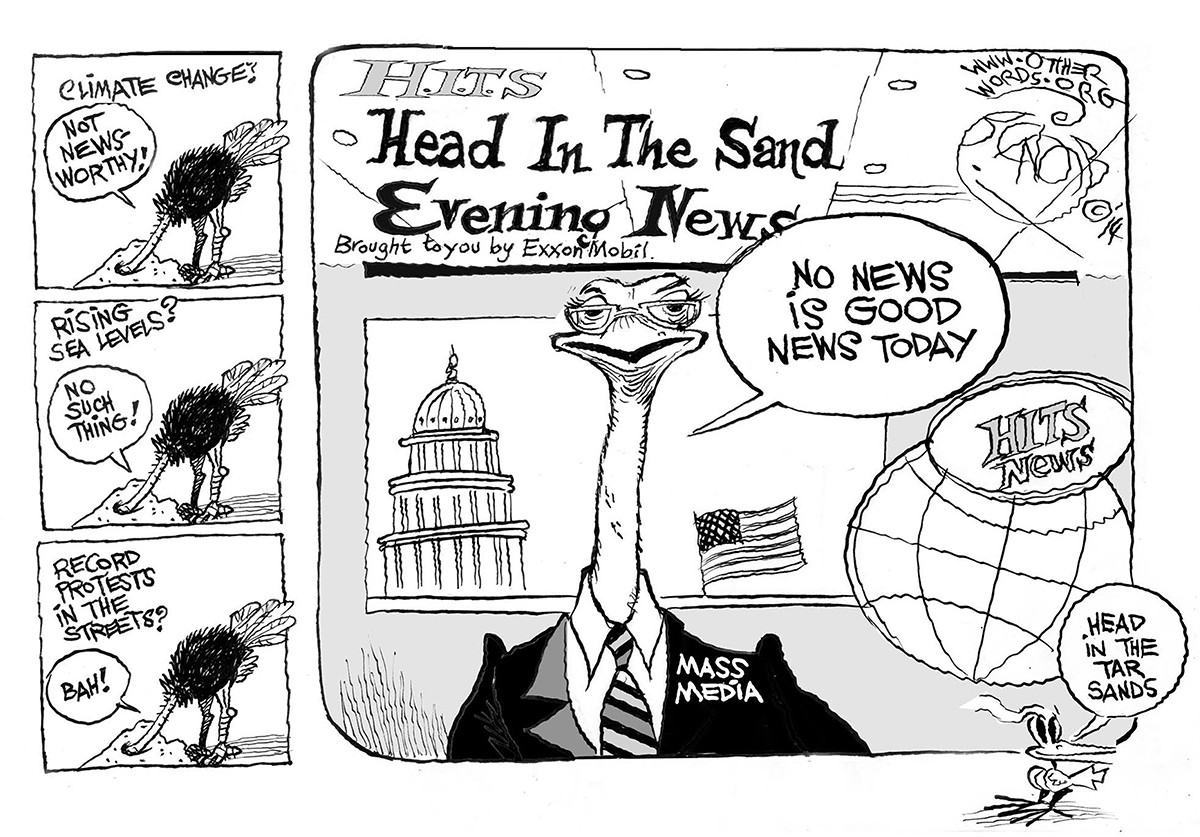
In 1976, Jensen began Project Censored as a way to attack this systemic failure head-on. The best-known aspect of this attack on the problem has been the development and distribution of an annual list of censored stories — not censored by the government, but by the media itself. Yet Jensen also knew that it wasn’t just a problem of important stories being buried, it was also a problem of what buried them: a distracting flood of trivial, irrelevant, sensationalist, or simply entertaining stories. Individually, they might be harmless, but collectively, as a steady diet, they starved the public of the knowledge needed for democratic self-government. They were, simply put, “Junk Food News,” the analysis of which was an important supplement to the highlighting of censored stories every year.
Credits: Khalil Bendib
Credits: Khalil Bendib
When Jensen stepped down as director of Project Censored, his successor, Peter Phillips, created an offshoot category of analysis, “News Abuse,” to encompass stories that involve inherently newsworthy subjects, but which are covered in a way that diminishes their value. The two categories are described and explored in Project Censored’s most recent publication from Seven Stories Press, Censored 2016: The Top Censored Stories and Media Analysis of 2014–15, in Chapter 3, “A Vast Wasteland.” The distinction between them is clear-cut, in theory at least:
“Viewers often know they are watching Junk Food News and have lamented its increase over the years. But News Abuse is a different calamity because while viewers believe they are being well informed about important matters, the actual coverage of the stories acts to manipulate, misinform, and even disinform — i.e., News Abuse is a form of propaganda.”
But, in practice, there seems to be less of a clear-cut line dividing them — rather, they often seem more like intertwining threads. While examples such as “deflategate” or the prolonged media obsession over the death of Robin Williams seem like fairly straightforward instances of Junk Food News, the same cannot be said for other stories. And that’s not an outside critic’s perspective. In a section devoted to the exposure of fabrications by NBC’s Brian Williams and Fox’s Bill O’Reilly, the Project Censored authors write:
“While the O’Reilly versus Williams coverage had the flare of Junk Food News, it qualifies as News Abuse because it was obfuscated into a liberal versus conservative debate rather than proof of the institutional obfuscation, disinformation, and manipulation of the corporate news industry. In fact, the only area where Williams and O’Reilly differed was in their apology. Williams admitted fault while O’Reilly did not; instead the latter continuously amended his statements while claiming to be the victim of the liberal media. This contributed to the false corporate news media narrative that the claims against O’Reilly were not factually based, but an ideological attack by the ‘liberal left.'”
As is noted in a Mother Jones story cited in the text, O’Reilly has not only lied repeatedly about being under fire in the Falklands War (no Americans made it to the war zone), he has used that false claim to bully others ideologically into silence. Critical examination of the issues raised by these two fabricators could have been deeply enlightening — which is why the mishandling clearly falls into the realm of News Abuse. But the juvenile finger-pointing way in which it was mostly covered also dragged it down into the Junk Food News realm as well.
Another example cited of News Abuse was former New York Times reporter Judith Miller’s book-length attempt to rehabilitate her reputation for her duplicitous reporting that helped pave the way to war with Iraq: “In a series of television appearances promoting the book, Miller argued that the invasion of Iraq was not her fault because her sources, mostly from Bush administration connections and insiders, had lied to her and her editors published them. Of course a journalist’s job is not only to find evidence but to verify it, but that did not happen in this case. Miller acted unfamiliar with that elementary rule of journalism.”
But as the authors note, Miller’s revisionism was just one small part of the larger story, which allowed both MSNBC and The New York Times to rewrite their own history as well: “MSNBC allowed New York Times reporter Nick Confessore to lambaste Miller over her excuses for the false reporting that led to the Iraq invasion,” Project Censored noted. But this let The Times off the hook for publishing her stories in the first place — stories that other, more careful reporters (particularly at Knight-Ridder) — were simultaneously punching holes in. MSNBC also reinforced its positioning “as the anti-war, pro-truth, corporate network,” which may have become somewhat accurate after the fact — but not when the war began:
“[I]t was MSNBC that sacked antiwar programmers such as Phil Donahue and Jesse Ventura from their network to make space for more pro-war voices in the year leading up to the 2003 Iraq invasion. In fact, according to MSNBC’s own internal memos, they let go of their antiwar voices to increase ratings. Thus, while the corporate press lambasted Judith Miller for rewriting history, they were rewriting their own, excluding the role they played in the calamitous 2003 invasion of Iraq, which by 2015 had cost US taxpayers over three trillion dollars, the lives of thousands of Americans, and over a million dead Iraqis.”
Other examples fall more clearly into the category of News Abuse alone, particularly those involving stigmatized groups: the Ebola “crisis” used “as a Trojan horse to instill fear in Americans while inciting anti-immigrant sentiments,” a variety of related Islamophobic narratives, and, of course, good old fashioned racism. The corporate media treatment of anti-Muslim violence typifies how such groups are treated:
“[I]n February 2015, three Muslim American students were shot and killed by Craig Stephen Hicks, a white neighbor in Chapel Hill, North Carolina. Major corporate news outlets such as CNN, the New York Times, and Fox News initially remained silent on the attack and President Obama waited two days to issue an official statement. No corporate coverage labeled the triple homicide as an act of domestic terrorism — rather, Hicks was referred to as a lone loon.”
The corporate media has been similarly reluctant to see the systemic police violence which has sparked the Black Lives Matter movement:
“The ‘justifiable homicides’ of Michael Brown in Ferguson, Missouri, and Freddie Gray in Baltimore, Maryland, erupted in politically charged protests and public debates across the country. The corporate coverage of these killings and their aftermaths blamed African-Americans for their own deaths while justifying police behavior and excusing whites for the same crime. This coverage distracts from the racism built into the legal system and results in public sympathy for state violence. …”
Fox News and The New York Times degraded Brown with phrases such as “bad guy” and “no angel.” Weeks after the Brown shooting, The New York Times asked citizens to give police the benefit of the doubt.
Reinforcing racial stereotypes and preconceptions, rather than focusing on the facts that contradict them — that’s the very definition of News Abuse.
The media has the power to inform and inspire people to change the world. Or it can amuse them to death. Or direct them toward convenient scapegoats. To really know what you’re missing, you have to get the larger picture — the stories you’re not getting everyday, and a clear understanding of what you’re getting instead. Project Censored provides both. 
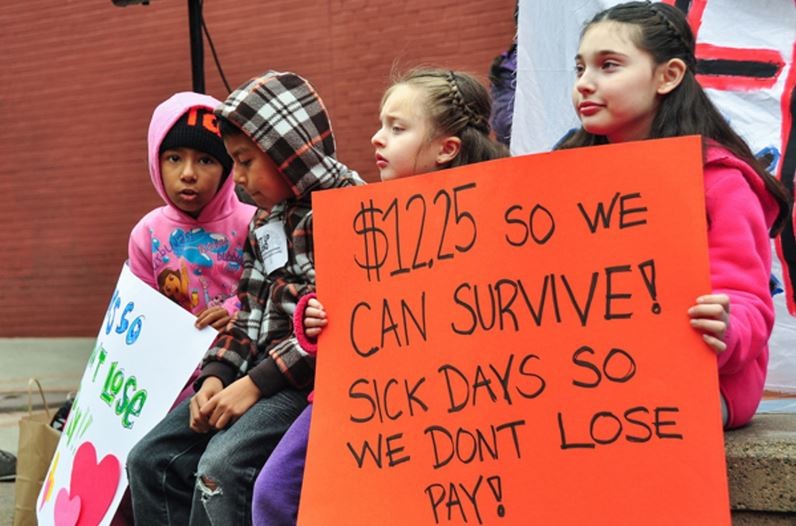
Children at a campaign rally for Oakland’s minimum wage initiative in 2014.
Credits: Brooke Anderson / file photo
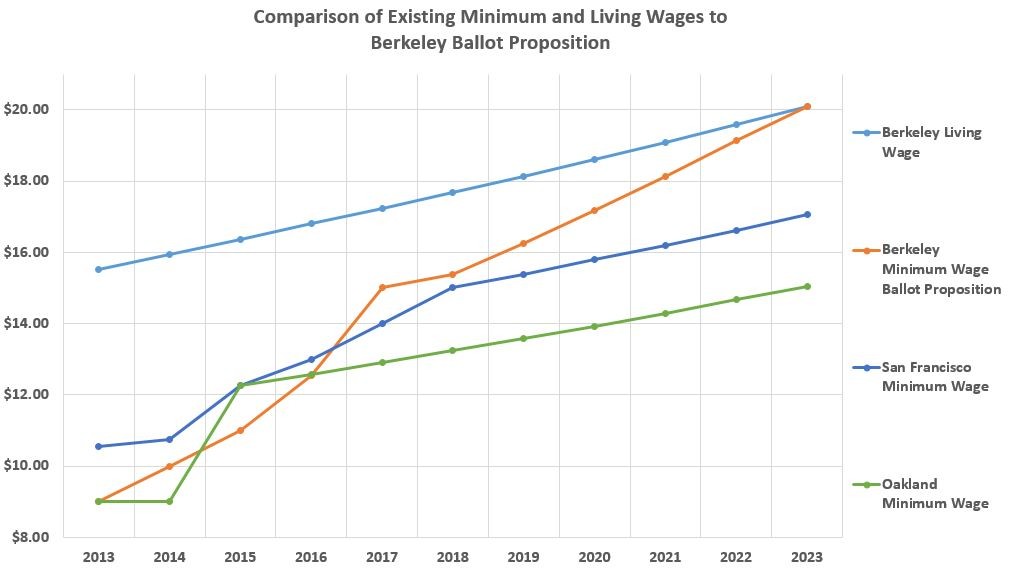
A coalition of community organizations and labor unions announced today that they have filed paperwork to place a proposition on Berkeley’s 2016 ballot that would raise the city’s minimum wage to $15 in 2017, and then increase it in subsequent years until the minimum wage is the same as the city’s living wage. If passed, the measure would institute the highest local minimum wage in the United States.
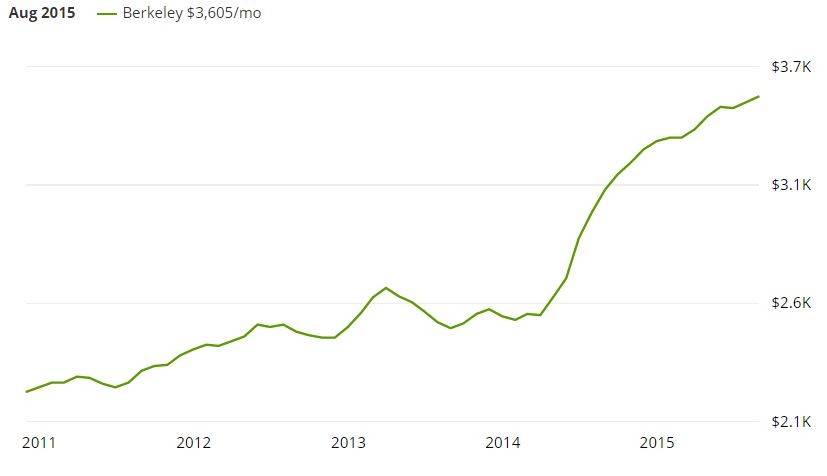
Berkeley is one of the most expensive communities in the United State to live and work in, especially with respect to home prices and rents. Many minimum wage workers in Berkeley commute from nearby cities where housing prices have also spiked.
Members of the coalition who filed the ballot proposition said they have lost patience with the Berkeley City Council and mayor over the question of when and how to raise the city’s minimum wage. They also said that Berkeley’s existing minimum wage law lacks features that have made similar laws in nearby cities more successful.
Credits: Darwin BondGraham
[jump]
“Our efforts are modeled after the successful campaigns in Oakland and San Francisco which were approved by 82% and 78% of the voters respectively,” said Steve Gilbert, a retired SEIU 1021 member. “Our research indicates we can expect the same results in Berkeley.”
Berkeley’s existing law sets the minimum wage at $11 an hour. Next October, the city will increase its minimum wage one final time to $12.53 an hour. But Berkeley’s city council didn’t peg the city’s minimum wage to inflation, meaning that its value will immediately begin declining in 2016.
Credits: Zillow
Unlike Oakland, Emeryville, San Francisco, and other Bay Area cities, Berkeley’s minimum wage law also did not include mandatory paid sick leave for workers, nor did it include protections against employers keeping service charges in lieu of collecting tips. Labor unions and workers centers claim that some employers have raised wages by eliminating tips and charging service fees which the business then keeps, instead of the workers who provided the services.
Berkeley’s living wage, which the city requires its contractors to pay their employees, is currently $16.37 an hour, or $14.04 per hour if an employer pays at least $2.33 toward employee’s health benefits, and it rises with inflation each year. After increasing the city’s minimum wage to $15 in 2017, the ballot measure filed today, proposes to increase the wage by an extra 3 percent in order to bring it to parity with the living wage. The two wages would converge sometime after 2020.
Clarification: the original version of this story stated that the Berkeley city council rejected a minimum wage increase proposal last month. The council, however, voted to delay any decision, and take up the issue again in November.
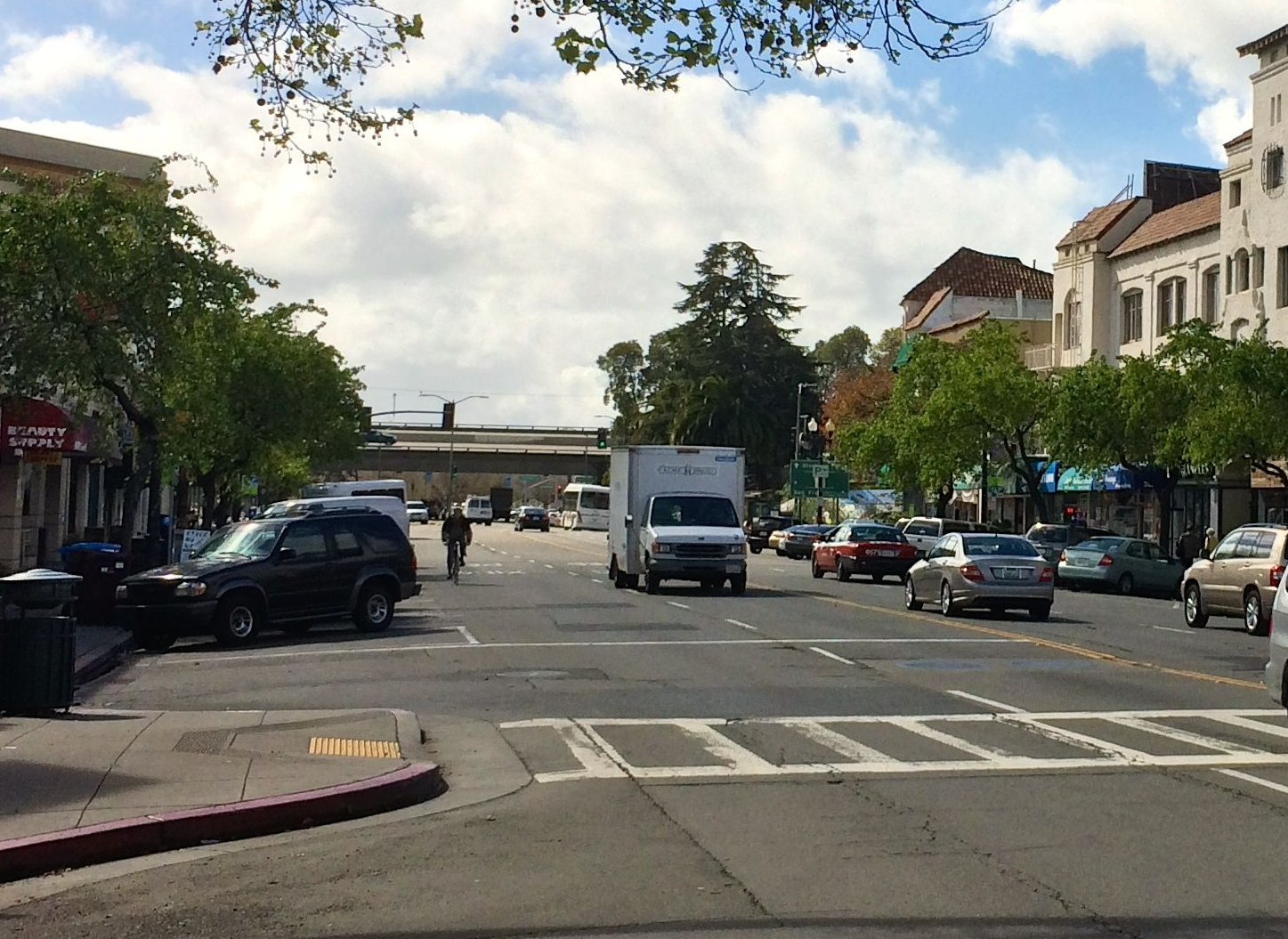
Grand Avenue is one of the most popular roads for cyclists in Oakland — and by some measures is also one of the most dangerous. That’s according to the city’s own research, which has found that parts of Grand Avenue near downtown and Lake Merritt attract very high volumes of cyclists, but have also had a high number of collisions over the years. Part of the problem, according to bike advocates, is that the bike lane on Grand Avenue is inconsistent — cyclists riding east from downtown toward the Grand Lake district are forced to leave the bike lane and merge into car traffic near the Grand Lake Theater.
Now, the city is proposing adding new bike lanes on Grand Avenue between Elwood Avenue and Jean Street in the Grand Lake district — a reconfiguration of the road that could make it a lot more comfortable for cyclists to travel between the Adams Point neighborhood and Piedmont. While bike advocates say this would be an important step in making the busy thoroughfare significantly more bike-friendly, some worry that the plan does not go far enough in building a truly connected bike path for cyclists in the area.
[jump]
The proposal — which the Oakland City Council’s Public Works Committee reviewed today and unanimously approved — calls for the removal of a car travel lane in either direction to make room for separate, five-foot bike lanes. Currently, the Grand Lake section of Grand Avenue has two car lanes in either direction and bike markings called “sharrows” on the road, which indicate that cars and cyclists should share the street.
As I noted in “Shifting Gears,” a March Express cover story on the city’s bicycle infrastructure, advocates were disappointed when the city recently repaved this northern section of Grand Avenue as part of its general street maintenance — but failed to add bike lanes in the process (instead only painting sharrows on the road). That was despite the fact that the city’s surveys had found that during rush hour, Grand Avenue attracts incredibly high rates of cyclists; for example, in a two-hour period, the city counted as many as 460 cyclists on Grand and Bay Place (near Whole Foods). And a city analysis of crash data from 2007 to 2011 (full report here) found that Grand north of the lake and in Uptown was one of the city’s most dangerous corridors for both bicyclists and pedestrians.
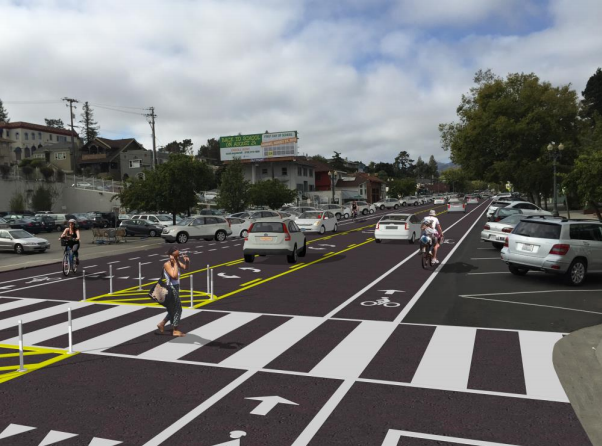
While the city in March initially said it had no immediate plans to add new bike lanes to Grand Avenue once the general repaving was finished, officials have since revisited the Grand Lake section of the road. And now, the Public Works Agency is pushing forward with a proposal to once again repave and redesign this section of the street — this time with distinct bikeways. The city’s proposal — full reports viewable here and here — would not result in a reduction of parking spaces. Here’s a rendering from the city, which shows a bike lane and car lane in either direction, and a center turn lane for cars:
Beyond making the road safer for cyclists, this redesign would also make the street safer for pedestrians, according to city officials and advocates. That’s because, a reduction in travel lanes would likely reduce the speed of cars, which have consistently driven above the speed limit on Grand, according to the city’s surveys. The addition of bike lanes would also make it easier for vehicles to see pedestrians crossing, according to the city. The city predicts the redesign would have a very minimal impact on cars passing through, while greatly reducing the risk of collisions affecting pedestrians and cyclists. The City of Piedmont also adopted an identical bike lane design on its section of Grand Avenue last year, which means cyclists would have a connected bikeway from Oakland to Piedmont.
Advocates with Walk Oakland Bike Oakland, who have closely followed this project, have argued that there are two major ways this redesign does not go far enough in terms of bike and pedestrian safety. For starters, the advocates have asked that the city extend the bike lane south to Lake Park Avenue to fully connect to the existing bike lanes on Grand by Lake Merritt. Otherwise, cyclists will still have to weave in and out of the bike lane at the busy and complicated intersection by the Grand Lake Theater. Without a fully connected bike lane, cyclists who are less comfortable on the road may be discouraged from riding to the neighborhood.
Although that extension south would effectively only expand the bike infrastructure by one block, the city said in its latest report that it does not have funding to increase the project boundaries and that the city would need to do more traffic analysis and outreach. The city could consider an extension of the bike lane if this first phase is successful, the report said.
Walk Oakland Bike Oakland has also requested that the city adopt so-called “back-in/head-out” angled parking spaces, which means cars back into the spaces, instead of driving into them and facing the sidewalk. This gives drivers significantly more visibility when exiting, making it much safer for them to enter traffic and avoid potential collisions with cyclists or other cars. But the city’s report argued that this would be inconsistent with other segments of Grand Avenue and that drivers may have trouble backing into spaces. The city also said that back-in angled parking sometimes requires larger spaces, which means the city could potentially have to reduce the number of parking spaces on the street if it made this switch.
If the full council approves the proposal, the city would add the bike lanes to Grand later this fall or in spring 2016.
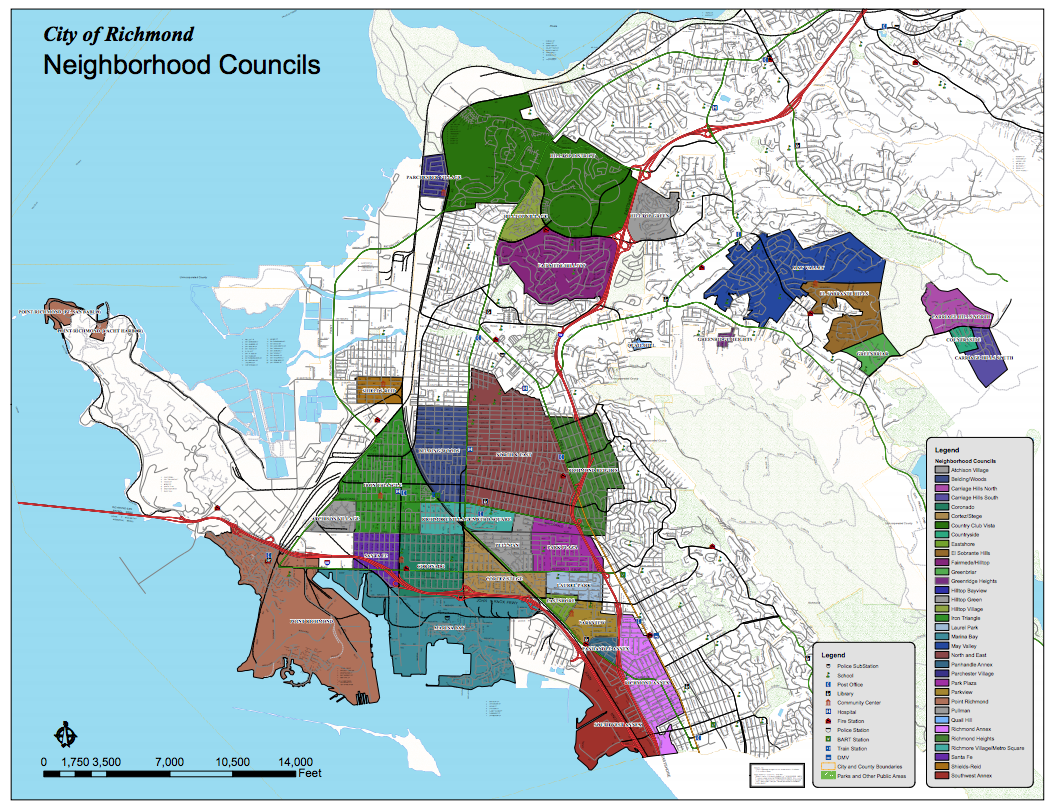
A small group of residents is hoping to make elections in Richmond more inclusive by instituting district elections, as opposed to allowing each councilmember to run citywide. The group, called Richmond Citizens for District Elections, is aiming to get a voter initiative placed on the November 2016 ballot that would create six district seats and allow the mayor to run at-large, said Cesar Zepeda, president of the Hilltop District Neighborhood Council and the group’s spokesperson.
Zepeda said that after being sidelined for years, it’s time for councilmembers to focus not only on where the votes come from – mainly, the more affluent areas of the city – but on each neighborhood’s needs.
“This came about because people from different parts of the city feel they are not being represented,” Zepeda said. “If they are not constantly going to City Hall, then no one is looking at them and talking to them.”
Zepeda lamented that for years, the Hilltop Mall, which is in his neighborhood, descended into economic stagnancy and his group had to tell the council it was going into foreclosure. After bringing the issue to Mayor Tom Butt, who was elected last November, Zepeda said Butt made it a priority to revitalize the area but only after it was brought to his attention.
“Unless you’re the squeaky voice, you’re not going to be heard,” Zepeda said. “But the loudest voices usually come from the people who have the time and money to go to City Council meetings and make their voices heard.”
[jump]
In March, Vice Mayor Jael Myrick floated the idea of directing staff to explore the feasibility of shifting to district-wide elections but he was summarily shot down. The council voted to table the idea with only Myrick abstaining from the vote.
According to the meeting minutes, Councilmember Nat Bates said councilmembers should represent all areas of the city and he warned that if a councilmember was unpopular then he or she wouldn’t be able to get the council to vote on needed projects. District elections would also serve to divide a city that has worked hard to unite itself, said Councilmember Jovanka Beckles.
“We’ve done so much work to change that whole culture of ‘this is my hood, my neighborhood,’ and we’ve worked so hard to create one Richmond that I think district elections would sabotage that effort,” Beckles said.
There are currently 37 neighborhood councils in Richmond that already serve to bring attention to localized needs, she said.
Myrick pointed to the past election cycle, however, when the Richmond Progressive Alliance (RPA) was able to elect three of its members despite Chevron spending some $3 million to defeat them, as an indication that big money is still in control, even when corporate influences are defeated.
“How do you make it so that regular community leaders who just want to serve their community and aren’t necessarily connected to major political organizations or corporate institutions can get elected?” Myrick said. “The way it is now, you have to either roll with the RPA and agree with everything the RPA is standing for or you have to roll with corporate Chevron.”
Jael Myrick
Myrick is uniquely positioned to push the issue because he said he was one of those regular community leaders who didn’t necessarily want to jump onboard with preexisting groups. The first time he ran for a council seat, he estimated that he raised around $27,000, including in-kind contributions, and lost. The second time he ran, it was after he had been appointed and had already served some time on the council and after he raised an estimated $100,000, plus garnering the support of independent expenditure groups that also raised money on his behalf.
“If your job is no longer to talk to an entire city but rather to talk to your neighbors, then that becomes much less expensive,” he said. “With district elections, you wouldn’t need to raise tens of thousands of dollars.”
Zepeda said he’s working with a lawyer to iron out the language of the ballot initiative and would soon begin circulating it to gather the requisite signatures in time for a November deadline. He’s hoping that the presidential election will draw more voters to the polls than a typical municipal election and that his group’s can assuage concerns that the city won’t just be gerrymandered into maintaining the status quo.
If the ballot initiative is passed, residents would have to apply to be part of a group that selects the districting committee. People chosen for the districting committee will be barred from having been involved in political organizing for the past four years and commit to refraining from political activities for the next decade.
Districts would be redrawn every ten years and would be both geographically contiguous, exactly equal in population, and comprised of “communities of interest,” Zepeda said.
He admitted it won’t be an easy task.
“Whoever starts redrawing the district, they will have a very difficult task but it will be a very rewarding one,” he said. “It can be done.”
In the immortal words of Vice President Joe Biden: “You know, this is a big fucking deal.”
The California cannabis industry and patients continue to digest three massive new laws signed Friday by Governor Brown to regulate medical cannabis for the first time.
Mostly, the opinions are positive, though plenty of patients, growers, and collectives have problems with various aspects of the Medical Marijuana Regulation and Safety Act (MMRSA).
Legislative Harvest: the 2015 crop will be among the last to lack a track and track system.
Credits: David Downs
[jump]
First off, East Bay Assemblymember Rob Bonta secured a major piece of his legacy with the passage of the act. Bonta wrote:
“Patients will have assurances that their products are safe. Law enforcement will have a foundation for identifying drugged drivers and increased funding to protect the public. The environment will be protected from neglect, destruction, and water diversion. And the medical marijuana industry itself will be able to come out of the shadows and receive the same protections under the law as other state-licensed businesses, creating jobs and contributing to the economy.”
The bills’ passage is also proof that California can still tackle real problems. Assembly Speaker Toni Atkins stated: “[F]rom the very first day of the Legislative session, the Assembly sent a clear message: this is the year we will pass a smart and comprehensive framework to regulate the industry. The Act Governor Brown signed today is the final step in fulfilling that commitment.”
Co-author Assemblymember Ken Cooley (D-Rancho Cordova) called the process “historic for its method —- robust and extensive engagement with a team of lawmakers and staff who spent thousands of hours refining the language with the input of stakeholders, Assembly and Senate leadership, and the sage guidance of the Governor himself.”
Assemblymember Tom Lackey (R-Palmdale), the only Republican author of AB 266, emphasized how the legislation improves public safety. “For nearly 20 years, California has not had a statewide strategy for curbing drugged driving (DUID). Today that begins to change as the University of California will begin critical research on marijuana-impaired driving which will lead to better roadside tools for law enforcement.”
California Cannabis Industry Association lobbyist Nate Bradley celebrated a new, more legal phase for the industry: “California will now be able to take it’s rightful place as the center of investment and innovation in the cannabis economy. … Today’s signing represents the most significant victory for the industry since WA and CO legalized recreational use in 2012.”
The new regulations should mark the beginning of the end of federal raids on lawful operators in the state, he said. “We believe this should bring an end to federal interference with businesses that are in compliance with state regulations.”
Dale Gieringer from California NORML encouraged all cannabis businesses to begin complying with regulations to assure their future. The bills promise to kick off the biggest round of industry outreach to local officials in medical marijuana’s 20-year history: “Cal NORML strongly advises anyone who wants to participate in the legal marijuana industry – medical or otherwise – to prepare by (1) registering with the Board of Equalization, and (2) securing permits from their local governments, or, if those aren’t available, calling on their local governments to establish a permit process.”
Lauren Vazquez for Marijuana Policy Project noted that many patients were left behind enemy lines in prohibition counties such as Fresno. They have no dispensaries and face cultivation bans as well:
“We hope localities that have banned medical marijuana establishments will rethink their policies now that these establishments have clear and uniform rules to follow. Seriously ill patients in many of these areas are being forced to travel many miles to legally obtain medical marijuana. Communities should be working to make life easier for their most vulnerable citizens, not placing additional burdens on them.”
One affected patient is Fresno activist Bud Green who wrote on Facebook: “[D]ual licensing, which will unleash a frenzy of state/local license applications in other parts of California while leaving Fresno-area patients and businesses in the dark. That seems to be just fine with state lawmakers, and Gov. Brown, and UFCW/Teamsters, and a new generation of growers and dispensary owners already scheming for new licenses, all bought and paid for with the spoils of their currently unregulated ‘non-profits.’ But, hey, we get an advisory task force, maybe, to develop ‘best practices’ for the many, many Fresnos in California that won’t like MMRSA any more than you will. ”
California has world’s largest and oldest medical cannabis market estimated at $1.3 billion in annual sales and nearly half the legal US market.
Hezekiah Allen from the Emerald Growers Association celebrated the unprecedented giveaways to small farmers in the laws. In a telling development, small farmers on the political left and police on the political are uniting to block “Big Marijuana” in California.
“The legislation is very strong on protections for independent businesses,” Allen said. “By preventing the consolidation of large conglomerates, the legislation creates opportunity for existing independent businesses to transition to regulation. It is important to the success of this program that it be accessible to currently operating cannabis businesses. Otherwise, this legislation will have little effect.”
The legislative package is also one of the biggest wins for organized labor in modern times. All medi-pot businesses of twenty or more employees must have a “labor neutrality agreement” or face license revocation.
Jim Araby, executive director of United Food and Commercial Workers (UFCW) Western States Council stated: “Consumers deserve to know they are getting safe products, and will receive the products they pay for. Workers who can speak up with confidence provide a much-needed line of defense to protect consumers. With these bills signed, UFCW will be assessing how the proposed 2016 cannabis ballot measures have the potential to move the industry forward in an open, transparent way.”
Assemblymember Bonta concluded, “The Medical Marijuana Regulation and Safety Act was just the beginning. The Legislature must continue to lead as California implements this bill. I commit to working with state agencies, local governments, and businesses across the state to make this new system a success.”
Americans for Safe Access will hold a “What’s Next for Medical Cannabis… Regulation, Legalization, and More” webinar on Thursday, October 15.
The MMRSA takes effect on January 1.
Seeds & Stems:
One minor oversight in the new regulations — the acronyms.
The Medical Marijuana Regulation and Safety Act (MMRSA) sounds a lot like a deadly antibiotic resistant staph infection MRSA.
And the new Bureau of Medical Marijuana Regulation (BMMR) reads a lot like “Bummer”.
The acronyms will probably not be a target for clean-up language.
[jump]
3. California prison officials are proposing to deploy inmates with violent criminal records to fight wildfires because the pool of low-level offenders who fight fires has dwindled as the state has sought to relieve overcrowding in prisons, the SacBee$ reports. Some firefighters are concerned about the proposal, but corrections officials say they would only deploy inmates who have exhibited good behavior and are no longer considered high risk.
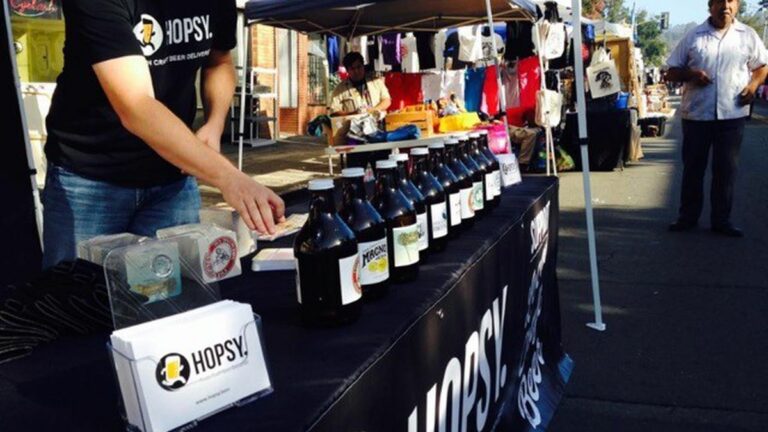
Hopsy celebrated Oaktoberfest in Oakland’s Dimond district.
Credits: Hopsy
Imagine a world where, with a simple tap of your smartphone, you could summon a jug of your favorite craft beer to your doorstep, to be enjoyed at your leisure in the comfort of your own home. For the beer lover, this — more than the self-driving car or the face-mounted computer — is the dream of the future.
[jump]
Now, thanks to Hopsy, an Albany-based delivery service that’s set to launch in November, the future is upon us. Founded by Sebastien Tron, Andrew Perroy, and Bodie Paden, Hopsy touts itself as the country’s very first app-based and online delivery service for growlers — i.e., to-go containers for draft beer — allowing customers to have draft beers, some of which might not even be available in canned or bottled form, delivered from the brewery directly to their home. Initially, Hopsy will only offer delivery to the East Bay, but will eventually expand its service to San Francisco and the North Bay.
In addition, the company’s brick-and-mortar Albany storefront at 1137 Solano Avenue will be the Bay Area’s first growler store, where customers can buy pre-filled containers of draft beer from a selection of local craft breweries.
Tron believes the service will be a game-changer in terms of making draft beer more accessible to the person who wants to drink it at home. The modern-day growler — a big, reusable jug, often made of dark glass, that’s used to transport and store draft beer — has been around for several decades, but for the most part, it’s an innovation that the casual beer drinker rarely uses. That’s because it’s a bit of a hassle: You have to figure out which brewpub has a growler station, or, if you want the freshest beer, you have to drive to the brewery itself. You have to procure a growler to begin with, of course, and then you have to figure out how to clean it, and navigate state regulations about labeling it properly.
But Tron said the demand is definitely there, as evidenced by the fact that, despite the hassle, a typical brewery might wind up filling about 2,000 growlers every month. How many more might get filled if a customer could do so without even getting up from his or her couch?
Other companies have attempted to launch similar services in the past, including a Seattle startup with a subscription-based model that ended up folding last year. Tron believes Hopsy will succeed where past efforts have failed in part because the craft beer industry has exploded, particularly here in the Bay Area, meaning the company can offer beers from a much greater number of breweries without having to have its drivers travel unreasonable distances.
New technology now also exists that can support this kind of service — for instance, CO2-powered pressurized growler-filling technology that allows the beer to stay fresh for an entire month instead of just a week or two. Even more importantly, the advent of companies like Caviar and other food delivery services mean that user-friendly platforms have already been created that make seamless what would otherwise be a logistically daunting transaction.
Hopsy’s opening roster will include East Bay breweries such as Ale Industries (Oakland), Alameda Island Brewing Co. (Alameda), and Cleophus Quealy (San Leandro), as well as several other standouts that are located a little farther afield — Magnolia Brewing in San Francisco, FreeWheel Brewing in Redwood City, and Moylan’s Brewery in Novato, for instance. All told, the company will offer a lineup of draft beer from ten different Bay Area breweries, with more to be added later on, Tron said.
Like many such services, Hopsy will make money by taking a cut from both the buyer and the seller: Breweries will offer their beer to the company at wholesale rates while customers wind up paying a couple dollars more for each 32-ounce growler than they would if they went to the brewery themselves. One big perk is that by not going through a traditional distributor — like, for instance, Safeway — more of the money from a customer’s purchase actually goes to the brewery.
One caveat: Hopsy isn’t yet an on-demand service. Unlike with comparable services such as Uber (for cars) or Caviar (for food), a customer can’t simply tap a button and expect that growler of fresh beer to show up at his or her doorstep within the hour — at least not for now. Instead, Hopsy customers will have until the end of the workday on Mondays to put in an order. To start out, the company will deliver growlers on Thursdays and Fridays.
But the goal, Tron said, is to offer next-day draft beer delivery, and, eventually, same-day delivery. Once that becomes a reality, how much further away are we from that Jetsons-like future of instant gratification via pneumatic tube?
PCF3 (which translates to Politically Correct Third Fridays, according to co-curator Jon Lady) is a monthly concert series at Sgraffito Gallery, a new art space and venue in West Oakland. This month’s edition features local musician Zanna Nera, whose particularly ominous brand of dance music pulsates with dark, distorted synths and disco-inflected drum machines that evoke Eighties industrial acts such as Skinny Puppy. Night Work, which joins Nera on the bill, combines similarly old school, danceable song structures with abrasive feedback and experimental sound palettes — though some of its tracks eschew pop compositions in favor of pure electronic noise. Also featured on the lineup is Zërowolf, whose climactic, lengthy electronic instrumentals evoke the soundtracks of role-playing video games, and NO, an industrial goth band so new it’s not on the internet yet. DJs Lady Jah Jah and Protoghost will keep the party going after the bands perform.
In Cyndi Lauper's 1984 music video for her controversially risqué song "She Bop," the Eighties pop idol dances circles around a line of "Burger Klone" customers marching out of the restaurant in matching, white outfits. Lauper, on the other hand, is wearing a green bustier; huge, studded belts; and a floral wrap over gold lamé leggings — all of...
Our October 7 feature, "Racial Profiling Via Nextdoor.com," erroneously stated that Oakland resident James Fisher, a teen who faces profiling in his Upper Dimond neighborhood, is mixed-race Black. James, who was adopted, is not mixed-race. And our October 7 Culture Spy, "Health, Poetry, and Life" listed the incorrect host for the Life Is Living festival's skate zone. It was...
The Watergate break-in occurred in June 1972, but didn't figure into the presidential election that year. While journalists look back on Watergate as a journalistic triumph, due to developments after the election, Carl Jensen took a different view. He saw the failure to recognize Watergate's importance until after the election as a symptom of systemic failures in the media.
In...
Children at a campaign rally for Oakland's minimum wage initiative in 2014.
Credits: Brooke Anderson / file photo
A coalition of community organizations and labor unions announced today that they have filed paperwork to place a proposition on Berkeley's 2016 ballot that would raise the city's minimum wage to $15 in 2017, and then increase it in subsequent years until the...
Current conditions on Grand Avenue.
Credits: WOBO
Grand Avenue is one of the most popular roads for cyclists in Oakland — and by some measures is also one of the most dangerous. That's according to the city's own research, which has found that parts of Grand Avenue near downtown and Lake Merritt attract very high volumes of cyclists, but have also...
A small group of residents is hoping to make elections in Richmond more inclusive by instituting district elections, as opposed to allowing each councilmember to run citywide. The group, called Richmond Citizens for District Elections, is aiming to get a voter initiative placed on the November 2016 ballot that would create six district seats and allow the mayor to run at-large,...
In the immortal words of Vice President Joe Biden: “You know, this is a big fucking deal.”
The California cannabis industry and patients continue to digest three massive new laws signed Friday by Governor Brown to regulate medical cannabis for the first time.
Mostly, the opinions are positive, though plenty of patients, growers, and collectives have...
Stories you shouldn’t miss:
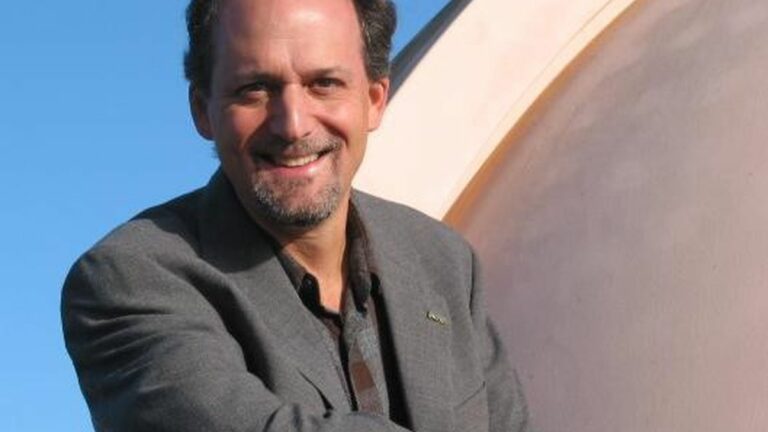
1. UC Berkeley faculty members are calling for the ouster of famed astronomer Geoff Marcy following revelations that he sexually harassed at least four women on campus from 2001 to 2010, Buzzfeed News reports. Astronomy professors, students, and other campus employees are outraged that UC Berkeley has allowed Marcy to keep teaching despite the fact that the...
Hopsy celebrated Oaktoberfest in Oakland's Dimond district.
Credits: Hopsy
Imagine a world where, with a simple tap of your smartphone, you could summon a jug of your favorite craft beer to your doorstep, to be enjoyed at your leisure in the comfort of your own home. For the beer lover, this — more than the self-driving car or the face-mounted computer...
PCF3 (which translates to Politically Correct Third Fridays, according to co-curator Jon Lady) is a monthly concert series at Sgraffito Gallery, a new art space and venue in West Oakland. This month’s edition features local musician Zanna Nera, whose particularly ominous brand of dance music pulsates with dark, distorted synths and disco-inflected drum machines that evoke Eighties industrial acts...