In 2023, John Janosko and other members of the Wood Street Commons encampment lost the land they were living on and, with it, the majority of their belongings.
West Oakland’s Wood Street Commons was once the largest homeless encampment in Northern California, with approximately 300 members at its peak.
When the city conducted the encampment sweep three years ago, many lost their laptops, a pivotal resource for any community, but especially one that relies on self-advocacy. An additional barrier was put on tasks such as administrative organization and negotiating with the City of Oakland.
“There was this period where nobody had a laptop, and it was just making things really hard,” said Janosko, Wood Street’s current executive director.
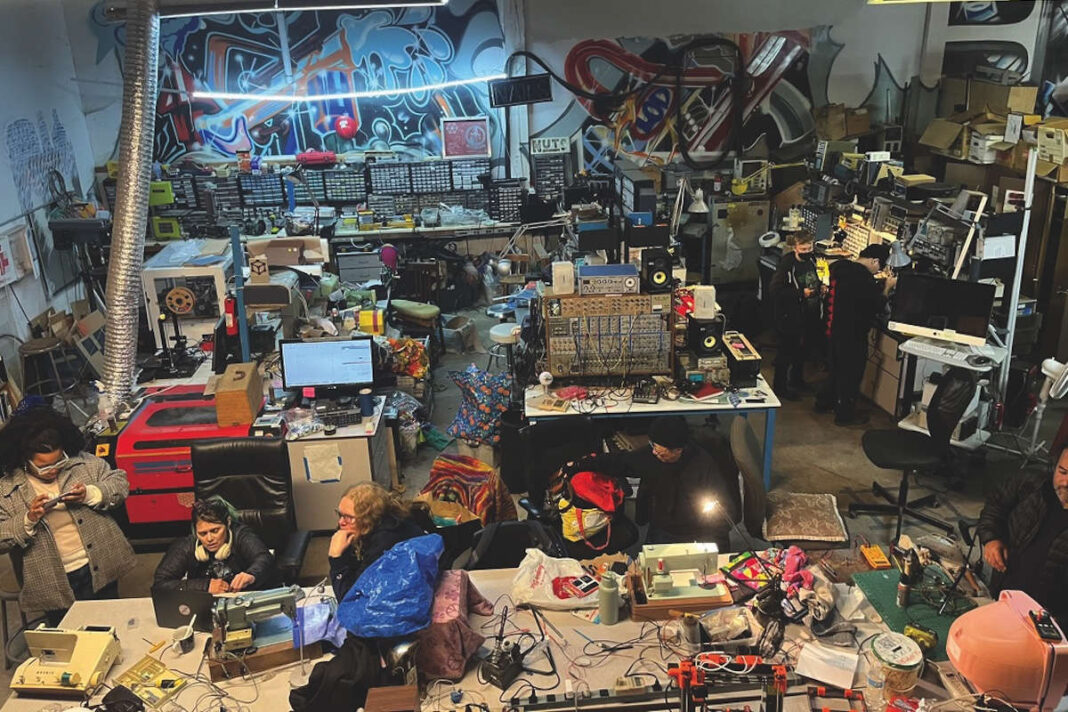
Rather than buying new laptops they couldn’t afford, members began to use Chromebooks provided by Sudo Room, a hackerspace running out of Omni Commons in Oakland.
According to Freeway Blalock, another member of Wood Street Commons, the Chromebooks arrived as the encampment became more formally organized and shifted to its current status as a mutual aid and advocacy group.
The collective wanted to remain self-governed after what Blalock describes as a forced eviction, requiring work that was difficult to complete on a phone. A city official told Wood Street that in order to reach its goals, the collective would have to file to be considered a 501(c)(3)—or nonprofit—organization. The members completed the process, becoming eligible for grants and funding, all done with the help of converted Chromebooks.
Chromebooks are laptops that run Google’s Chrome operating system, heavily marketed to and used in K-12 schools across the country. Google makes this special class of cloud-based laptops with tools that allow schools to register devices, connect them to district systems and block inappropriate websites. This is a plus, especially for school districts that don’t have the resources to create their own educationally focused electronic system.
Peter Mui, founder of Fixit Clinic—an initiative that takes place every Tuesday night at Omni Commons, where volunteers reduce electronic waste through prioritizing repair over replacement—began the Chromebook project around three years ago.
He noticed that schools were “e-wasting” Chromebooks at an exorbitant rate. Schools were often forced to recycle their Chromebooks every five years due to the preset expiration Google set on these devices by no longer supporting the operating system they come with. In September 2023, this expiration date was changed from five years to 10, following a report published by the U.S. Public Interest Research Group Education Fund. This report found that doubling the lifespan of Chromebooks would be equivalent to cutting the emissions from 900,000 cars for a year.
East Bay Express asked Google why the expiration is still capped at 10 years, but received no response to a request for comment.
Mui was involved in this report, and continues to fight the electronic waste created by Chromebooks. He partners with school districts in Alameda County, taking the laptops they would have otherwise thrown away and giving them new life by replacing Google’s operating system with Linux, an open-source operating system without a predetermined expiration date.
“You can use the device without being beholden to Google and its ecosystem,” Mui said.
Mui is interested in reducing the environmental toll these devices take. He also focuses on the potential that these “liberated” laptops, as he calls them, hold for creating the most digitally literate community possible.
In addition to providing Chromebooks for Wood Street Commons, Mui has also worked with Ashby Village, a senior community that focuses on providing mutual aid for older adults in the East Bay. Hilary Naylor, currently part of the tech team at Ashby Village, was once tech support at Lincoln Elementary School in Oakland, where she remembers receiving the first set of Chromebooks 10 years ago.
“I’m not even sure the school district knew they were going to expire,” Naylor said. “I don’t remember hearing anything about that at all.”
She’s now on the other side of the Chromebook exchange. Naylor provided a laptop that the Sudo Room converted to 91-year-old Ashby Village member Claudette Sigg. It started when Sigg attempted to buy tickets to the Oakland Museum, but was unable to due to the fact that her 2012 MacBook no longer supported browser updates. Making financial transactions became difficult for her on multiple websites, and she even had trouble submitting her poetry and writing through online portals.
“Like many elderly people, I can’t afford to buy a new computer at the drop of a hat,” Sigg said. The Chromebook, which she calls the “little computer,” provided her with a temporary solution to these problems until she found something more permanent.
The Chromebooks that Sudo Room converts have been distributed to community members via its free store—which runs out of Omni Commons—as well as to the Berkeley Free Clinic, Mills College and even some school districts, to prevent them from having to buy entire new sets of Chromebooks.
“The supply is basically limited only by how much time people have to convert them,” said Elaine, a regular volunteer at Sudo Room and a street medic in training with the Berkeley Free Clinic, who requested that only her first name be used.