If you want to inspire voters, perhaps the best way is to be straight to the point — and that’s why marijuana legalization activist set up a table across from the San Jose City Hall last Friday and gave away up to 2,000 free grams of pot.
Well, the nonprofit Weed4Votes didn’t actually give away weed, but organizers did give away vouchers to adults who offered their contact information and were willing to listen to a short spiel about two proposed measures to legalize marijuana for recreational use, which will be on the California ballot in November. There was no requirement to sign any petitions, and according to the organizer, Dave Hodges, participating medical marijuana dispensaries will redeem the vouchers after Election Day provided voters legalize marijuana for recreational use.
And that was just the first Weed4Votes event. Hodges has promised to give away 10,000 pounds of marijuana through three separate campaign programs. One program, Weed4Donations, will match any contributions to any pro-legalization political action committee or nonprofit with weed. Those who can verify they contributed to the cause will receive a certificate redeemable after Election Day.
“California needs your help to make legalization in your state a reality and I want to give you free marijuana for your support,” Hodges said.
[jump]
The third program, Weed4Signitures, will give signature gatherers a free gram for each validated signature on two pro-legalization petitions.
The giveaway strategy has raised questions about legality. After all, it’s a federal offense to actually buy votes. But Hodges claims on his Weed4Votes website that what he’s doing is not illegal because he is not requiring supporters to vote in any particular way. He is only asking that potential voters donate to a political action committee or get involved in some other way. There is also the question of giving away an illegal substance, which Hodges downplayed. “The stance from my criminal attorneys is that I am not doing anything illegal because I won’t be doing anything illegal when 2016 comes around.”
Hodges is actively support two of three petitions for marijuana legalization. The Marijuana Control, Legalization and Revenue Act and the California Cannabis Hemp Initiative. Both petitions would legalize recreational use of marijuana for those 21 years old and allow local control but prevent outright bans unless approved by voters.
A third petition, the Adult Use of Marijuana Act, would not participate in the free weed strategy.
Hodges operated the All American Cannabis Club in San Jose until last year when it was shut down due to changes in the city’s zoning regulations. The new regulations drastically cut the number of medical cannabis clubs in San Jose from eighty to sixteen.
Prince at the 2015 American Music Awards.
Credits: Kevin WInter/Getty Images
Pop legend Prince is notoriously unpredictable. Though he’s a world-renowned superstar, he frequently opts to play intimate concerts rather than huge arenas, often announcing his shows on the fly.
Prince decided to surprise his Oakland fans last night when he declared on Twitter that he’d be playing two back-to-back shows at Paramount Theatre this Sunday, February 28, at 7 p.m. and 10 p.m. Tickets for both shows go on sale today, February 24, at noon, and are available exclusively through Ticketmaster.
[embed-1]
If you remember how quickly Kendrick Lamar tickets sold out last year (literally within seconds), you might want to have your browser ready at 11:59 a.m. sharp to vie for a spot.
The performance is part of Prince’s Piano & a Microphone concert series, where he’ll be performing stripped-down, acoustic versions of his hits.
Credits: Greenlining Institute.
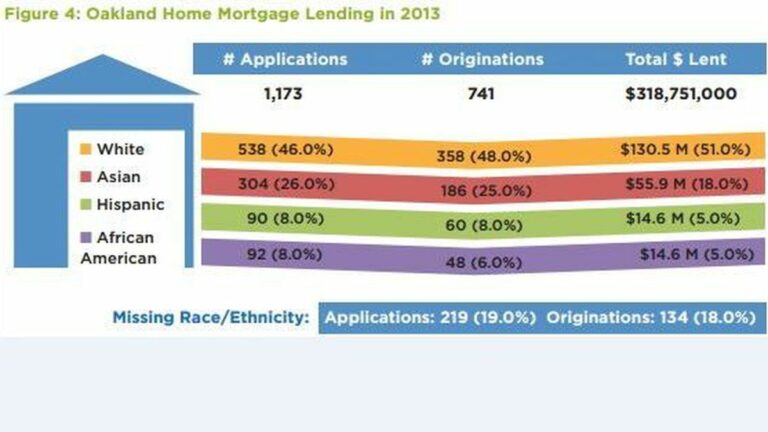
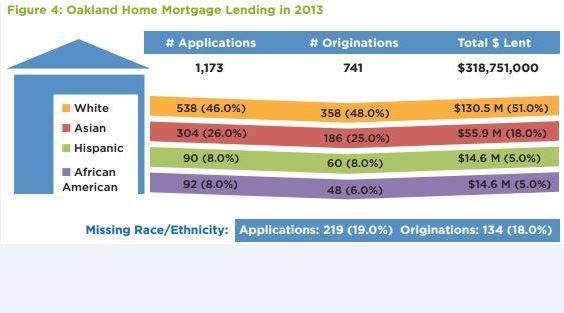
According to a research report published today, Blacks and Latinos are “severely underrepresented” among borrowers who obtained a loan from a major bank to purchase a home in the city of Oakland.
The report, by the Greenlining Institute and Urban Strategies Council, also found that banks issued a much smaller total number of home mortgage loans in Oakland compared to Fresno and Long Beach, two other cities analyzed in the study. And Black and Latino borrowers in Oakland applied for home loans at very low rates, and were approved at lower rates than whites. This dearth in mortgage lending by major banks in Oakland, compounded by low numbers of mortgage loan applications from Black and Latino customers, and lower loan approval rates, is perpetuating and exacerbating wealth disparities, the authors of the study concluded.
[jump]
The study analyzed bank lending data for the year 2013 that was obtained from the federal government. The twelve largest banks, measured by the total dollar amount of loans originated in California, were included in the study. The authors compared Oakland, Fresno, and Long Beach because these cities are of similar size and have racially diverse populations, and they represent different geographic areas of the state with different economies.
The data analyzed by the Greenlining Institute and Urban Strategies Council showed that major banks are making far fewer total mortgage loans in Oakland compared to Fresno and Long Beach. “Despite comparable populations, Oakland had less than one quarter as many loan applications and originations as Long Beach and Fresno,” the report states. It’s unclear why major banks are approving fewer home loans in Oakland, but it may be due to Oakland’s increasingly unaffordable prices, and the presence of cash investors who crowd out buyers who need bank loans to close a deal.
Whatever the cause, this lower level of bank lending in Oakland is compounded by racial disparities. According to the report, Black and Latino residents make up 56 percent of Oakland’s total population, but they received just 10 percent of the total dollars lent by major banks for home purchases.
“Across the board, what the report shows is that Black and Latino communities were way under-represented when it comes to obtaining mortgage loans,” said Zachary Murray of the Greenlining Institute, one of the authors of the report.
Greenlining Institute and Urban Strategies Council found that in 2013 the top twelve banks only approved a total of four loans for Black borrowers to purchase homes in the city of Oakland. The other 44 home mortgage loans made to Black borrowers in Oakland were refinance loans. In the same year, Latinos only obtained sixty mortgage loans in Oakland, and just seven of these were to purchase a home. By contrast, white borrowers obtained 358 mortgage loans in 2013 and 40 of these were to purchase homes. Asians obtained 186 mortgage loans, and 37 of these were to buy a home.
Particular banks exhibited wide racial disparities in their mortgage lending activities. According to the report, Wells Fargo Bank, US Bank, and CashCall all exhibited much lower loan origination rates for Blacks and Latinos than for Asians and whites. A loan origination rate measures what percent of applicants for a loan are approved and receive the loan. Some banks, including Chase and Bank of America did better, originating loans at almost equal rates for Black and Latino customers as they did for white and Asian customers. But for all of the twelve banks analyzed in the report, white and Asian customers were more likely to have their loans approved than Black and Latino customers.
Sasha Werblin of Greenlining, one of the authors of the study, said that lower average household wealth and income could be one reason that Blacks and Latinos are less able to obtain home loans. The economic crisis and recession of 2007-2010, and the foreclosure crisis that peaked in 2011-2012 reduced the savings of many families, and had a disproportionately harmful impact on Black and Latino households in California. But Werblin said that it is also incumbent on banks to offer sustainable and quality financial products that help them build wealth and secure housing. “What are banks doing to market to these individuals? Do they have products that would fit the needs of these individuals?” said Weblin in a previous interview.
1911 Telegraph Ave.
Credits: Gensler
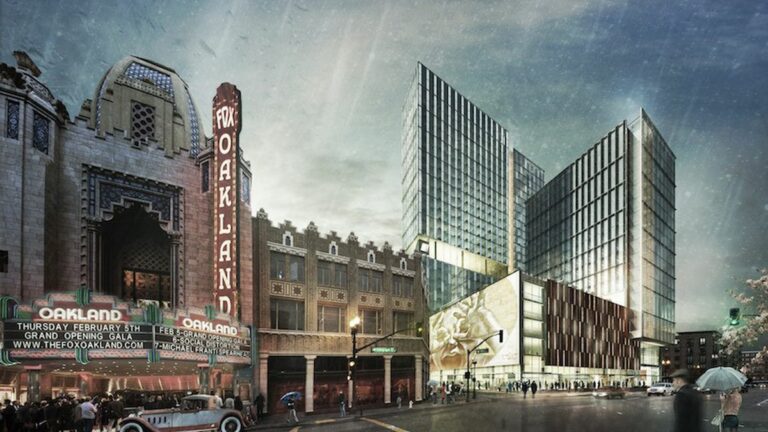
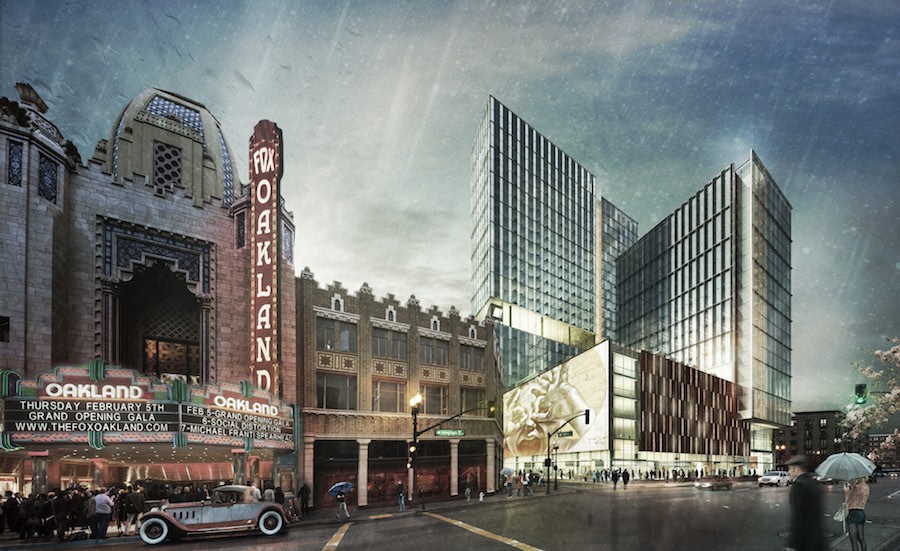
1. An Oakland City Council committee greenlighted a plan to build a high-rise hotel and apartment tower in the city’s Uptown district, the Chron$ reports. The 27-story project by San Diego developers Oliver McMillan and Oakland’s Strategic Urban Development Alliance includes 330 residential units, including about fifty affordable units on a city-owned lot at 19th Street and Telegraph Avenue. The project must still be approved the full city council.
2. Richmond tenants launched a rent control initiative for the November ballot, the CoCo Times$ reports. The measure would cap rent hikes in Richmond to no more than 3 percent and would mandate landlord-financed relocation assistance for evicted tenants. Richmond renters have until June to gather the needed petition signatures. The ballot measure would replace a rent control law that was passed by the city council last year, but then overturned by landlord groups.
4. A group of California district attorneys has sued to block a prison-reform measure backed by Governor Jerry Brown from appearing on the November ballot, the AP reports (h/t Rough & Tumble). Brown’s measure would allow for earlier parole for non-violent inmates, but state prosecutors say the governor violated the law when he filed the measure.
5. Environmentalists launched a ballot-measure campaign to prohibit fracking in Monterey County, following successful bans of the fossil-fuel extraction method in Santa Cruz, San Benito, and Mendocino counties, the Mercury News$ reports.
7. The three-alarm fire that destroyed the Oakland Cambodian Buddhist Temple at 5212 E. 10th Street and gutted adjacent homes appears to have been started by burning candles, the Chron reports.
8. And real estate magnate Donald Trump trounced his opponents in the Nevada Republican presidential caucuses, and now appears to be on his way to winning the GOP nomination.
In this age of infinite food blogs, carefully calibrated PR hype, and Yelp reviews posted five minutes after a restaurant first puts up a sign in its window, it’s easy for a food writer to get caught up in the chase for the Next Big Thing. In food, as in most things, we tend to prioritize the new and exciting over the steady and established — or what Bette Kroening, co-owner of the 34-year-old Bette’s Oceanview Diner (1807 4th St., Berkeley), calls the “old and exciting.”
But look: It’s a minor miracle if a restaurant can keep itself afloat for even three years — to say nothing of ten, twenty, or ninety years, as has been the case for Genova Delicatessen (5095 Telegraph Ave., Oakland), which has anchored Oakland’s Temescal neighborhood since 1926, but will likely be forced to close this spring due to a looming rent hike.
Bette’s Oceanview Diner is still going strong after 34 years.
Credits: Bert Johnson
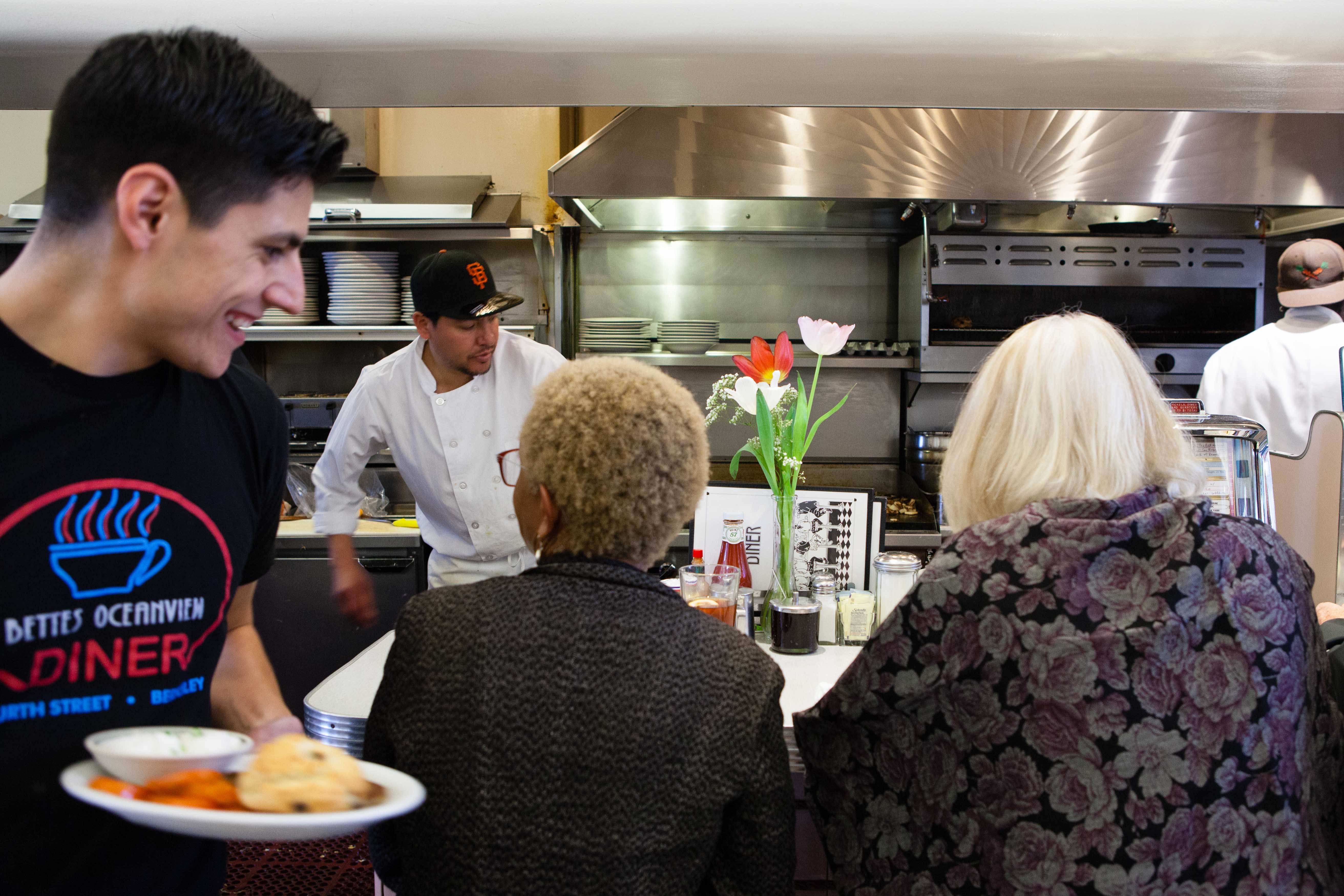
Bette’s Oceanview Diner is still going strong after 34 years.
Credits: Bert Johnson
It’s instructive, then, to consider what “secret sauce” — to borrow a phrase from Oakland Mayor Libby Schaaf — has helped keep these iconic eateries plugging along, as deliciously as ever, for all these years. When you sit down to eat a stack of pancakes at Bette’s or stand in the sandwich line at Genova, you’re getting a food experience that hasn’t been shaped by the latest culinary fad. What’s more, you are in a small but tangible way making a connection to East Bay history — a history that is, in the face of rising costs and displacement, in danger of being forgotten.
Perhaps the most amazing thing about Bette’s and Genova is how little the places have changed over the years. Kroening said that when she opened Bette’s — with her husband Manfred Kroening and her friend Sue Conley, now the proprietor of the Point Reyes Station-based Cowgirl Creamery — in 1982, she drew inspiration from a diner that she frequented when she was growing up in Teaneck, New Jersey. A giant slice of cherry pie hangs from the ceiling near the entrance. An old-fashioned jukebox boasts an enormous, eclectic collection of 45s — and was acquired by Kroening and her partners even before they purchased the diner’s stove.
Then and now, the menu covered the gamut of American breakfast standards: pancakes, corned beef hash, home fries, and lots of crispy bacon. But instead of embracing your typical greasy spoon aesthetic, Kroening wanted her diner to have more of a fine-dining ethic. Everything is made with a little bit more care than you might expect from a short-order breakfast cook — the Eggs Benedict is topped with a beurre blanc sauce instead of hollandaise, and scrambled eggs are served soft and custardy like how the French prefer them. The menu has expanded a bit over the years, but Kroening has essentially been serving the same food for the past three-plus decades.
If anything has changed, it’s just that the restaurant has gotten a lot more popular — thanks, in part, to a 2010 appearance on the Food Network show Diners, Drive-ins, and Dives, which Kroening credits/blames for the fact she can never take the diner’s famed soufflé pancakes — which are cloud-like and “kind of a pain” to make — off the menu.
Of course, with popularity comes a certain shift in clientele. When Bette’s first opened, Berkeley’s ritzy Fourth Street shopping district was mostly populated by home improvement stores — catering to hippies who had saved up enough money to buy a Victorian, Kroening said. Many of her early customers were carpenters and contractors. But even if Bette’s has become more of a tourist destination, for Kroening, the restaurant is still defined by its regulars. Come at 6:30 a.m. on a weekday, and you’ll see the same people crowded at the counter every day — many of them blue-collar folks enjoying a beer at the end of a graveyard shift.
Recently, I braved the famously long line for weekend brunch for the first time in at least two years, and, if anything, the food was even better than I remembered — the omelet, tender in the middle and stuffed, French-style, with a simple filling of herbed cream cheese; the bacon, extra-crispy; the pancakes, fluffier than just about any other version in town.
Meanwhile, Genova Delicatessen’s second-generation co-owner David DeVincenzi, whose father bought the business in the Fifties, said the deli is one of the last vestiges of the time when Temescal was a thriving Italian-American enclave. DeVincenzi, too, has been working at Genova since he was six years old, when he’d get picked up every day at Sacred Heart Grammar School and dropped off to learn the trade from the old Italian guys in the back.
“You either learned or you got kicked out,” he said.
The sad news is DeVincenzi doesn’t have much hope that the deli will be saved — citing the fact that the landlords are being “completely unreasonable.” At most, he’ll try to install a counter inside the Genova’s factory on Broadway so that customers can buy prepared lasagnas and ravioli. But the deli counter will be no more. “All I can say is, ‘Goodbye,'” DeVincenzi said.
If that’s true, it’s a damn shame, because there isn’t any other place like Genova in Oakland — nowhere else where you’ll find a whole lineup of wise-cracking deli men and bad-ass deli ladies who will assemble your sandwich to order meticulously, weighing out each portion of prosciutto, fresh mozzarella, and roasted peppers. There’s a strong case to be made that the “Genova Salami” — a monster of a deli sandwich stuffed with salami, prosciutto, mortadella, provolone, marinated mushrooms, and a nice hit of oil and vinegar — is the best cold sandwich you can buy in the East Bay, bar none.
So I plan to stop in for lunch every chance I get until the deli’s last day of business — probably sometime around May 1, DeVincenzi said. And, barring some final-hour miracle, that will be that.
That’s the basic truth of the matter: We need to appreciate places like Bette’s and Genova while they’re here. Because once they’re gone, they’ll be gone forever.
Art galleries are a public cultural benefit. They open their doors to allow anyone to enjoy the art in their exhibitions for free; they are not traditional retail stores with steady sales or ticketed performance venues. The value visitors receive occurs without the exchange of money. What galleries do is create a way for people to walk into a space and have their life changed in an instant by a piece of art that speaks to them.
Oakland Art Murmur was founded as a way to share this experience with as many people as possible. As a 501(c)3 nonprofit organization, we serve all of the art spaces of Oakland. And our city’s art spaces are under siege. In the last year, we have lost three art spaces in the Uptown neighborhood due to rising rents. This includes Rock Paper Scissors, one of the founding members of Oakland Art Murmur and the last of the original six galleries to remain in business ten years after its founding. Many art spaces faced 40 to 50 percent rent increases in the last year, and more closures are soon to follow.
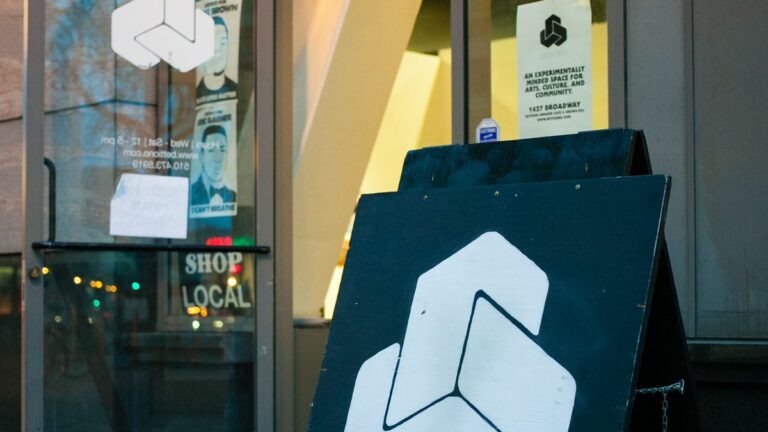
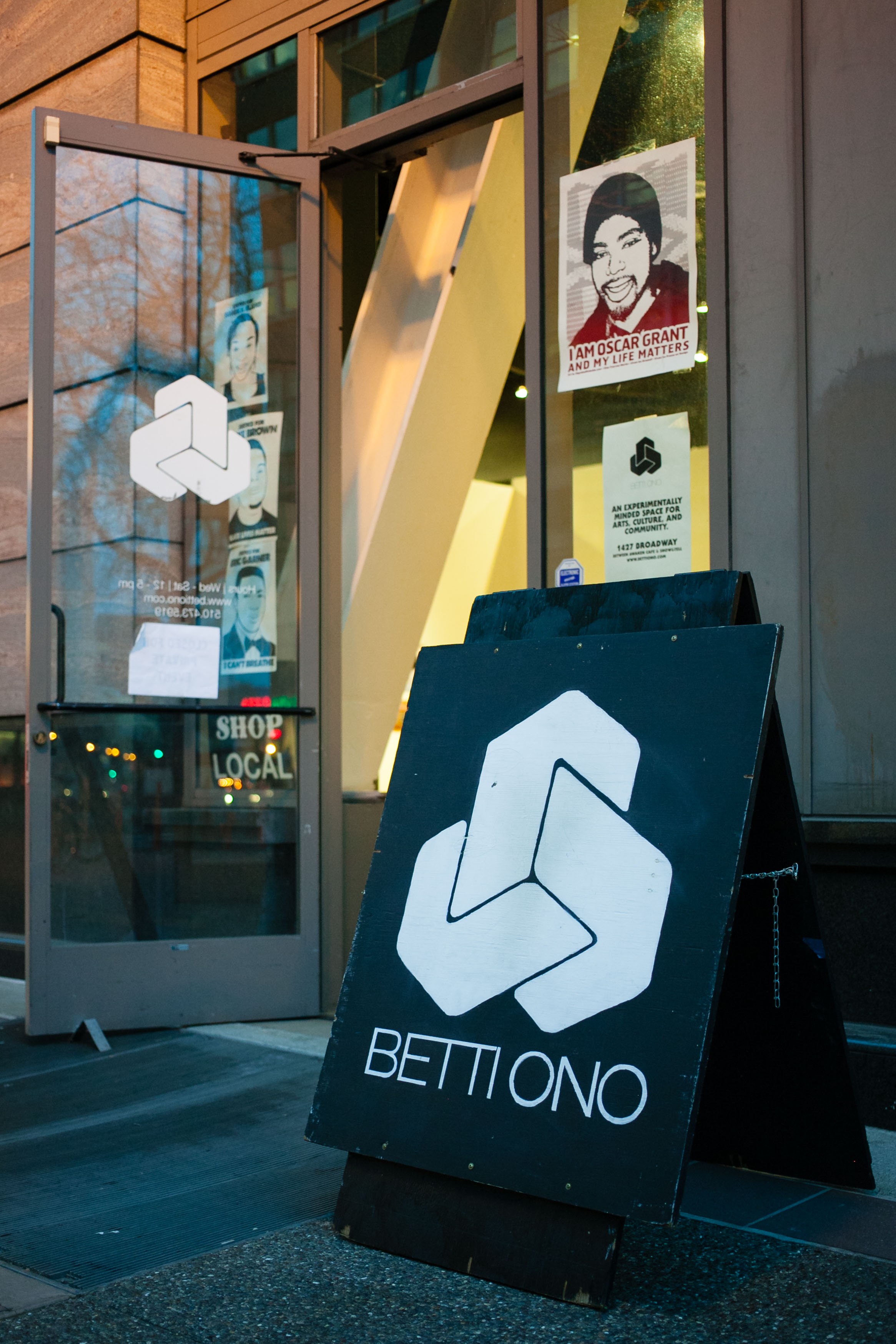
Betti Ono Art Gallery in downtown Oakland is at risk of being displaced.
Credits: Bert Johnson
Oakland Art Murmur’s mission is to strengthen Oakland’s diverse visual arts communities by providing access to resources, programming, and experiences. We connect and sustain Oakland’s vibrant visual arts culture to engage and enrich the Oakland community. Beginning this year, dues are voluntary so that all art spaces with curated exhibitions can benefit from being a member of Oakland Art Murmur. Our operating budget is $30,000 per year, and our website, print publications, and community outreach are managed by one part-time employee and a dedicated group of volunteers. We have never received money from the City of Oakland in support of our brochures, public walking tours, or our website, which gets nearly 10,000 hits on any given First Friday. Our current membership of more than forty galleries and art exhibition spaces all across Oakland attract hundreds of people from all over the Bay Area every month to enjoy art and spend time in Oakland.
Our city officials need to pay more than just lip service to the arts; if the city doesn’t have money to invest in the arts, how can they claim it as a priority? We currently have a city government more interested in giving discretionary funds and tax breaks to bring in new businesses than using those resources to keep our existing businesses and jobs stable. As new business is drawn to our city, the places that have made Oakland so great are starting to fall away.
Also concerning is that from a leadership standpoint, our city has no Cultural Arts Commission; even if the city were to receive foundational funds in support of the arts, there would be no officials qualified to dispense them.
If Oakland is to remain an important, diverse, cultural arts destination, we need your help. Oakland Art Murmur can’t do it alone. We urge you to contact your city council representative and tell him or her how much the arts in Oakland mean to you. Tell them that we need city policies that protect, retain, and preserve our cultural art spaces, art galleries, and most of all, our artists.
#SaveOaklandArt
Sincerely,
Oakland Art Murmur Board of Directors
Conrad Meyers, president (director/co-founder, Aggregate Space Gallery)
Dasha Matsuura, vice president and gallery liaison (gallery associate, Chandra Cerrito Contemporary)
Ron Scrivani, treasurer (property owner, Warehouse 416)
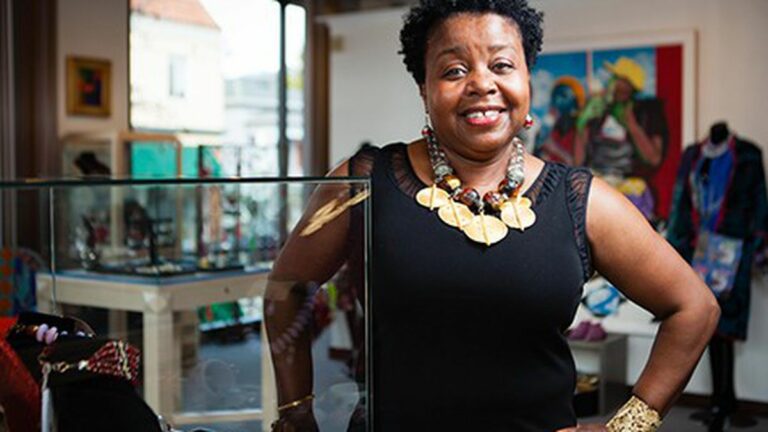
For 23 years, Thelma Harris Gallery has been a burst of color on College Avenue. It’s a gleaming trove of both historical and contemporary works by artists of color from around the world. Imported African masks and sculptures reign over the space, while bold, colorful paintings cover the walls. The gallery’s eponymous owner and curator specializes in contemporary painting and sculpture by Black artists and deals sought after pieces by WPA artists and Harlem Renaissance icons, including Palmer Hayden and Aaron Douglas. While Oakland’s largely DIY art scene tends to favor local emerging artists, Thelma Harris Gallery has matured into an anomalous destination for international collectors.
Much like their gallery, Thelma and her husband Terry Harris are vibrant and loaded with art world insights. They both speak with a speed that hits you like a jolt of caffeine, and they interrupt each other constantly to digress into nostalgic anecdotal tangents. The couple said they started the gallery simply because they’ve always been “art addicts.” Of course, the full story was slightly more complicated than that.
Thelma Harris has been dealing art for nearly thirty years.
Credits: Bert Johnson
Thelma Harris has been dealing art for nearly thirty years.
Credits: Bert Johnson
When she moved to Oakland in the mid-Seventies, Thelma Harris wanted to collect art by Black artists, but couldn’t find it anywhere, she said. After searching for years, in 1987 she finally decided that she should fill that void herself by becoming an art dealer. She hoped to become a platform for artists of color to sell their work, and a resource for local people like her who wanted to buy it. So, she took out a loan for $5,000 and started to collect imported African art.
Harris, who was working an office job at the time, wasn’t yet an expert on contemporary Black art. In school, Black history had basically been omitted, she said. “I think one time they mentioned, maybe, Jacob Lawrence. But if you blinked, you would have missed it.” But, throughout the late Eighties, Harris became intimately familiar with the scene by travelling to see shows specifically focused on showcasing Black artists.
Then one Thursday in 1990, Harris’ framer suggested that she start a gallery. That Sunday, Harris drove to a vacant storefront on Grand Avenue that had caught her eye. At nine the next morning, she called the owner from work in San Ramon and by her lunch break she was sitting in his office, showing off her paintings and artist roster. That evening, she returned to seal the deal. She offered him what money she could and paid for the rest in artwork. Not long after, in November of 1990, the gallery had its first show.
Despite having a gorgeous 45,000-square-foot storefront and a well-attended opening, Harris didn’t sell a single piece for the first few months. At that point, she and her husband considered giving up — maybe there just wasn’t a local market for original art by Black artists. But, based on advice from Terry’s uncle — “You just gotta be there when they’re ready” — they decided to wait it out a few more months. Business picked up a bit, and two years later, they moved into their current Rockridge location. “Here we are 25 years later,” said Thelma Harris. “You just gotta stick in there.”
That motto has repeatedly worked out for Thelma Harris over the years. For the first four years that she brought Bay Area artwork to a New York art fair, she didn’t sell a thing. People want to buy work by artists they recognize, she explained, even if they only recognize them because their work was at the booth the year before. Simply re-presenting the artists proved crucial. Many of the artists that Harris has worked with closely were still somewhat neglected by a white-washed art world when she began collecting their work. Now, their work is being bought by museums.
By continuously promoting artists like Claude Clark, Jonathan Green, Artis Lane, and Ed Dwight, the couple has played a crucial role in garnering recognition of and appreciation for their work. “Appreciation does not just mean money,” said Thelma Harris, “but appreciation of a culture.”
Last Thursday afternoon, Azha Ayanna Luckman and Apryl Fuentes were at B4bel4b Gallery in Oakland prepping a table that was draped with pink satin and sprinkled with glitter for a pop-up art party that night. As a creative duo, the two 22-year-olds produce Shade Magazine, a Tumblr-based platform for showcasing the work, experiences, and identities of young queer people of color. Fuentes scrawled “@ShadeZine,” their project’s Instagram handle, onto the back of light pink stickers featuring a rose graphic and the mag’s logo, as Luckman carefully laid out zines and arranged votive candles decorated with of-the-moment celebrity mugs — ranging from Bernie Sanders to David Bowie. That night would be a rare offline appearance for the Oakland-based mag, although it has a robust online following. “We originate from the internet,” Luckman explained. “Our home is the internet.”
Unlike the typical Oakland artist whose creative community is largely local, Luckman and Fuentes are part of a growing movement of mostly young women who are celebrating their sexualities and identities through queer and feminist artwork that’s primarily consumed via social media — thus, their artistic peers and fans are spread out all over the world. That night at B4bel4b, they had been invited by a popular Brooklyn-based publication called Alt Citizen (the creators are currently traveling across the country in a baby blue school bus). At the end of the month, they will be part of a feature in Nylon Japan.
Credits: Mancy GantCredits: Mancy Gant
Still, while Shade could be considered part of a growing international trend in female-centric art — in which publicly posted photos of menstrual blood on frilly undies are a staple — Luckman and Fuentes stand out as one of few participants with an adamantly intersectional approach, which pays particular attention to the ways that race, gender, and sexuality overlap to create distinct life experiences. (Also, they don’t consider their content gender-specific). “I can’t relate to body positivity and period art when my people are dying,” said Luckman, who is Black. “I can’t relate when I can’t get a job but you can, but you’re upset ’cause you can’t show your tits.”
Fuentes and Luckman first became frustrated by the lack of representation for intersectional experiences online through what they saw on Tumblr, of which they have been avid users for years. For many subcultures, the social blogging platform is a crucial space for online congregation, yet neither Fuentes nor Luckman were seeing their experiences reflected in the conversations they encountered there. “I think openness about being queer and non-binary and all those things … that was kind of like a white topic,” said Luckman. “You didn’t have anything [like that] for Black kids and other kids of color.”
Fuentes and Luckman set out to change that by starting Shade Magazine in early 2013, and they emerged alongside a wave of other people and projects who had apparently also recognized that void. “We came in at a very pivotal moment,” said Fuentes. Today, Tumblr is rich with entries exploring intersectional identities, and for many queer youths who feel alienated from peers or family, it can provide a sense of community — a home.
Luckman and Fuentes met in 2011 in astronomy class at San Francisco State University. But it wasn’t until the summer of 2012, when the two were both working retail on Haight Street in San Francisco, that they became inseparable. “We were on a bus crying, and [Azha is] like, ‘I don’t want to sound weird, but can we be best friends this summer?'” Fuentes recalled. For the rest of the season, they camped out in another friend’s apartment (because neither had a place to live) and shared struggles they’ve had with working through queer identities and feeling excluded by their peers. “I had never met anyone who looked like me who I could talk to about that,” said Luckman, “I didn’t feel like I had anyone to relate to.” Not long after, they started Shade.
Azha Ayanna Luckman and Apryl Fuentes are the founders of Shade Magazine.
Credits: Courtesy Mancy Gant
Beyond the blogging that they do on Tumblr, which largely features their own photoshoots (many in collaboration with photographer Mancy Gant) or artwork and that of others that they like, the duo also produces zines in collaboration with graphic designer Kayla Jones. Their first was a digital booklet entitled Xicanas in Suburbia that, in part, dealt with Fuentes’ experience coming into her own as a young Chicana in a Southern California suburb and feeling unaccepted by both whites and Chicanos for being atypical.
Their first print zine was titled Sassy, and it interrogates the way that labels like “sassy” and “bitchy” are used to delegitimize and disempower female frustration through portraits of women of color accompanied by quotes exploring what those terms mean to them. The best friends are currently working on two more as well: I’m Sorry We Lied will be a zine of artwork inspired by their artistic role models such as Devonté Hynes and Solange Knowles, and Searching for Him In All of You will be about “us struggling with men our age and monogamous relationships being nonexistent,” as Luckman put it.
The duo chose the name Shade because it alludes to shades of skin, but also because it invokes the lingo of young, queer communities in the Eighties — specifically, they were inspired by the drag ball performers in the documentaryParis is Burning. Fuentes pointed out that she would never have known about the stories of that queer subculture if that movie hadn’t been made. She and Luckman are hoping to offer similar documentation to their generation of queer youth of color. “If you don’t record your own history … especially as young people of color, that is not going to exist beyond your lived experience,” she said, “because that’s not the shit you see in textbooks and mass media.”
Joaquin Miller once described the Bay Area as a “careless, languid Arcady,” freighted with the perfume of yucca blossoms, softened by warm sea winds drowsing over dreamy hilltops. That seems a far cry from today’s Bay Area: 8 million restless souls roaring across superhighways of cars and superhighways of information through the epicenter of the future. In Miller’s time, the late 19th and early 20th century, there was a thirst for lyrical tales of a wild American West, and Miller gave Eastern audiences, and locals, a vision of California untamed, a majestic vista so rugged that it earned him the nickname “Poet of the Sierras.”
Miller was larger than life. He joined the filibusterer William Walker’s mercenary assault on Nicaragua in 1844. He variously fought against, and alongside Native Americans, protecting their land from white settlers. He was briefly an Oregon judge. He was a horse thief, and some said a compulsive liar. But it was Miller’s bardic Occidental poetry that won him lasting notoriety.
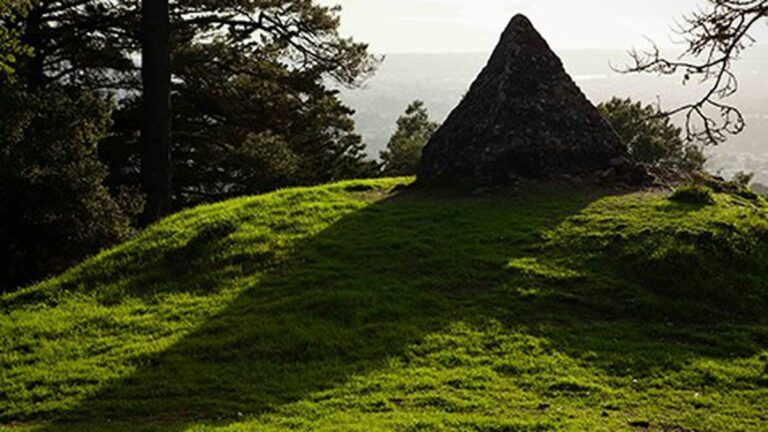
Joaquin Miller erected this stone pyramid in honor of the prophet Moses.
Credits: Bert Johnson
Joaquin Miller erected this stone pyramid in honor of the prophet Moses.
Credits: Bert Johnson
A wanderer in many lands was I/a weary Ishmaelite, Miller wrote in “An Indian Summer.” [I] had seen the Crescent-mosques/had seen, The Druid oaks of Aberdeen.
In old age, Miller made his home in the Oakland hills, at a place he called “The Hights.” It was a dusty treeless escarpment. There, Miller re-planted the timber that had been cut to build San Francisco, and his saplings grew into the majestic redwoods and oaks that today shade Joaquin Miller Park.
At roughly five hundred acres, with trails that wind through canyons and loop atop ridges, Joaquin Miller Park is big enough to spend an entire day hiking in. Miller’s peculiar art, like a hybrid cross of William Blake and Buffalo Bill Cody, is physically evident in the weird monuments he scattered about his land. These include a secular tribute to explorer John C. Fremont in the form of a squat stone tower with a narrow window; the Browning Monument, a circular rook-like structure the poet raised to honor his friends; and the most bizarre — a stone pyramid that Miller erected in honor of the prophet Moses. The crumbling, ten-foot-tall pointed temple embodies the spiritual polyglot that Miller invoked in his poetry: Strangely wooing are yon worlds above us/Strangely beautiful is the Faith of Islam/Strangely sweet are the songs of Solomon/Strangely tender are the teachings of Jesus/Strangely cold is the sun and mountains/Strangely mellow is the moon on old ruins, goes a stanza in “Even So.”
Despite the forest it has become, Joaquin Miller Park is still urban. It’s located entirely inside the city of Oakland. It’s noisy, sometimes crowded, and littered with human artifacts, and much of the vegetation was seeded by human hands. Even so, visitors can still see a faded, mystical impression of what California once was, or what misfits like Miller imagined it to be: Here, cedars sweep the stream, wrote Miller about a California before its despoliation by civilization, and here/among the boulders moss’d and brown/that time and storms have toppled down/from towers undefiled by man/low cabins nestle as in fear.
Twenty miles south of Miller’s old home, in a similarly secluded fork of canyons branching into the East Bay Hills, was the hideaway of Agapius Honcherenko. Born in 1832 in Ukraine, Honcherenko helped wage a long and successful campaign against the tsar of Russia to end the institution of serfdom. A Russian Orthodox priest, Honcharenko wrote righteous tracts inciting serfs to rebel against their masters. For this, he was arrested and briefly imprisoned in a Constantinople dungeon. Freed eventually, Honcharenko was smuggled from Turkey to London, while the tsar’s secret police and hired assassins — whom he called “Muscovite tyrants” — pursued him. He was shot, stabbed, beaten, and even drugged, but he survived to campaign against the Russian empire. He fled to New York City, and finally, in 1865, he escaped to the most unlikely fortress, a lonesome farm in the hills above Hayward. There, Honcharenko lived until 1916, all the time publishing a subversive newspaper that was smuggled into Russia and its territories.
Garin Regional Park now surrounds Honcharenko’s old “Ukraina” farmstead. The trails in Garin follow shaded creeks and arc up treeless sun-baked ridges, covered in sag brush and oats. Remnants of the old farm remain: gnarled fruit trees, rusted tractor parts. Cattle still graze private land nearby. Honcharenko’s house was destroyed long ago, but you can hike to the gravesite where he and his wife Albina rest eternal. And if you journey far back into Garin park and climb down into a steep ravine cloaked in olive and bay, you can visit the most unusual formation of rocks that protrude from the mountainside. Here, in the shade and shadows, more than a century ago, Honcharenko led spiritual ceremonies in a sandstone grotto to sustain his battle against tyranny.
If you want to inspire voters, perhaps the best way is to be straight to the point — and that’s why marijuana legalization activist set up a table across from the San Jose City Hall last Friday and gave away up to 2,000 free grams of pot.
Well, the nonprofit Weed4Votes didn’t actually give away weed, but organizers did...
Prince at the 2015 American Music Awards.
Credits: Kevin WInter/Getty Images
Pop legend Prince is notoriously unpredictable. Though he's a world-renowned superstar, he frequently opts to play intimate concerts rather than huge arenas, often announcing his shows on the fly.
Prince decided to surprise his Oakland fans last night when he declared on Twitter that he'd be playing two back-to-back shows at...
According to a research report published today, Blacks and Latinos are “severely underrepresented” among borrowers who obtained a loan from a major bank to purchase a home in the city of Oakland.
The report, by the Greenlining Institute and Urban Strategies Council, also found that banks issued a much smaller total number of home...
Stories you shouldn’t miss:
1911 Telegraph Ave.
Credits: Gensler
1. An Oakland City Council committee greenlighted a plan to build a high-rise hotel and apartment tower in the city’s Uptown district, the Chron$ reports. The 27-story project by San Diego developers Oliver McMillan and Oakland’s Strategic Urban Development Alliance includes 330 residential units, including about fifty affordable units on a city-owned lot at...
In this age of infinite food blogs, carefully calibrated PR hype, and Yelp reviews posted five minutes after a restaurant first puts up a sign in its window, it's easy for a food writer to get caught up in the chase for the Next Big Thing. In food, as in most things, we tend to prioritize the new and...
Art galleries are a public cultural benefit. They open their doors to allow anyone to enjoy the art in their exhibitions for free; they are not traditional retail stores with steady sales or ticketed performance venues. The value visitors receive occurs without the exchange of money. What galleries do is create a way for people to walk into a space and have their life changed in...
For 23 years, Thelma Harris Gallery has been a burst of color on College Avenue. It's a gleaming trove of both historical and contemporary works by artists of color from around the world. Imported African masks and sculptures reign over the space, while bold, colorful paintings cover the walls. The gallery's eponymous owner and curator specializes in contemporary painting...
Last Thursday afternoon, Azha Ayanna Luckman and Apryl Fuentes were at B4bel4b Gallery in Oakland prepping a table that was draped with pink satin and sprinkled with glitter for a pop-up art party that night. As a creative duo, the two 22-year-olds produce Shade Magazine, a Tumblr-based platform for showcasing the work, experiences, and identities of young...
Joaquin Miller once described the Bay Area as a "careless, languid Arcady," freighted with the perfume of yucca blossoms, softened by warm sea winds drowsing over dreamy hilltops. That seems a far cry from today's Bay Area: 8 million restless souls roaring across superhighways of cars and superhighways of information through the epicenter of the future. In Miller's time,...