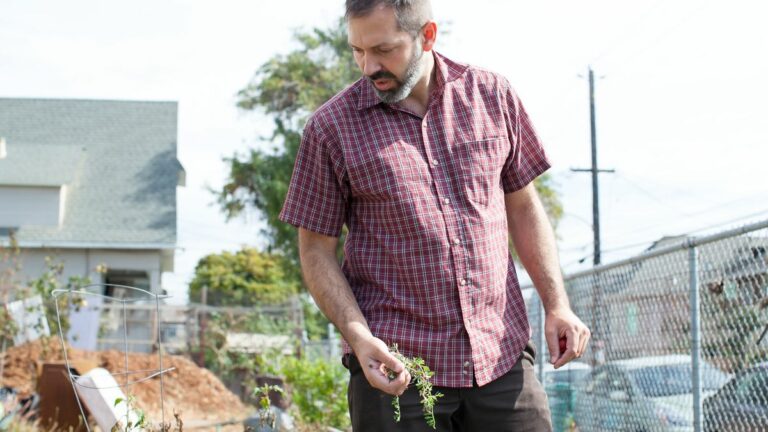
Steven DeCarpio.
Credits: Bert Johnson/File photo
Three years ago, Oakland resident Steven DeCaprio made headlines when he successfully achieved ownership of a house that he had been squatting in for more than a decade. DeCaprio employed the Adverse Possession Law, a legal doctrine that allows occupants to claim properties that have suffered from long-term abandonment.
According to census data, there may be up to 18,000 units of vacant housing in Oakland. This is in the face of a housing crisis in which 4,000 people are homeless in Alameda County, while countless more are being displaced by soaring rent prices. Many of the empty housing units are being held by speculators, driving up prices and fueling the forces of displacement.
In January, Patrick Xu, a Bay Area housing rights activist, was arrested from his home in Oakland, while he was in the midst of an adverse possession case to obtain the property. Xu and three other housing activists, including DeCaprio, are now facing felony and misdemeanor charges, including charges for trespassing and conspiracy, and could be sentenced to up to 8.5 years in prison and slapped with $89,000 in fines.
[jump]
Of the four activists facing charges, two are staff members of Land Action, a nonprofit housing rights advocacy organization founded by DeCaprio in 2012. Land Action and DeCaprio were featured in an October 2015 Express story, which noted that the group was working with other organizations to create community farms and activist housing on long-abandoned properties in Oakland.
Land Action was allied with Xu and his roommate, who had both been struggling with homelessness, to legally obtain their home in January when the Alameda County District Attorney’s Office brought charges against the four activists, two of whom were part of the housing project, while the other two were staffers of Land Action.
In an interview, Xu questioned authorities for “using tax dollars to come after some homeless people for living in a crumbling house.”
Others involved with the case have expressed frustration that public resources are being used to prosecute housing rights activists, while the bankers that caused the Great Recession haven’t been charged at all.
Three civil rights attorneys, Tony Serra, Walter Riley, and Dan Siegel, have stepped up to defend the activists, who are being called “The Land Action 4.”
The defense team has filed a motion to drop the charges, and a public hearing has been scheduled for April 1, 9 a.m., at the Wiley W. Manuel Courthouse in Oakland.
A benefit to raise funds for the activists’ legal fees is being held on March 27 at 6 p.m. at the Lobot Gallery at 1800 Campbell Street, Oakland.
Blacks are underrepresented as owners of legal marijuana businesses, BuzzFeed reports in a sweeping story this week. About 1 percent of the estimated 3,200 to 3,600 storefront pot shops are owned by Blacks.
Institutional racism targets Blacks for drug felonies, then bars drug felons from holding legal pot licenses, further stacking the deck against minorities.
“It really does piss me off,” Henderson said. His friend still works at that dispensary, and makes a lot more money than Henderson does. “And to see a lot of people come to Colorado to work in weed, that pisses me off even more. They’re coming here, living comfortable, and it’s like, I could be doing the same thing, but I can’t, because of my past with marijuana.”
Moreover, vast amounts of cash and land are often required to enter the legal trade, and the group with the most access to raw capital tend to be old white dudes.
California’s loose medical marijuana laws have given Blacks the most opportunity, Lewis finds, while East Coast state medical pot regimes are all but shut.
The overwhelming whiteness of the legal pot industry is even greater outside of states with relatively open markets, such as California and Michigan. In most states that allow the medical use of marijuana, a small, unelected commission determines who will receive a limited number of business licenses. With almost no oversight or transparency, the licensing has been rife with accusations of cronyism. At least six states and Washington, D.C., emphasize vague and coded qualifications like “character.”
A cannabis investing event in the Twitter building in San Francisco in 2015 lacks diversity.
Credits: David Downs
[jump]
It’s a good, deep dive, even if Lewis skimps on fair comment from law enforcement. Cops demand drug felons do not receive licenses in an effort to weed outlaws from the rolls of licensees.
And there’s much actually being done about the problem: from Washington expungement clinics, to new interest groups like Supernova — “a space for women of color in cannabis”. Supernova hosts “Shades of Green: The State of Cannabis in California for People of Color” on March 24 in San Francisco.
You can follow more Black voices in the legalization debate, like Ngaio Bealum and Professor Carl Hart who weighed in on this same topic a year ago.
LN: … What do you make of the critique that rich, white males stand to gain the most from legalization?
Hart: Yeah, you know I sympathize with that person, obviously. I mean, I sold marijuana, you know? But the fact is this: We can’t expect one fledgling, developing industry alone to solve this major problem in the United States, which the republic has ignored since we came out of slavery. That’s not even logical.
Other companies and industries don’t even have to deal with these questions. No one’s asking the lottery [industry about this]. My aunt for many years ran numbers. She got put out of business when Florida got the lottery. No one was talking about that. … Black folks got shut out.
So yeah, we can expect to see the same thing in this industry if we don’t put pressure on [canna-business] to hire them, but we shouldn’t say, “Well, we should not have this industry, because of that.” That’s nonsense — more people going to jail as a result.
1. Electrical woes caused a commute nightmare yesterday on BART, and the transit system continued to suffer outages during this morning’s commute, the Chron reports. A mysterious power surge between the Pittsburg/Bay Point and North Concord stations knocked about fifty train cars out of service, causing systemwide delays. This is the second time in a month that the agency has been rocked by power surges. BART is unsure as to what’s causing the problems. This morning, the agency had to use buses to ferry passengers between Pittsburg/Bay Point and North Concord.
2. The plastics industry and its allies have pumped $5 million into a statewide ballot measure campaign to block California’s ban on plastic bags from ever going into effect, the SacBee$ reports. The ban was supposed to begin on July 1 of this year, but the plastic bag industry successfully delayed the start date until at least the November election.
[jump]
4. Charter schools in California suspend students at a higher rate than traditional public schools, the LA Times$ reports, citing a new UCLA study. “In the 2011–12 school year, charter schools had an average out-of-school suspension rate of 7.8 percent, as opposed to 6.7 percent in traditional public schools — meaning the rate in charter schools was 16 percent higher.”
Emeryville is set to fully legalize medical marijuana deliveries in thirty days and could see its first dispensary, as well as cannabis labs in the coming year.
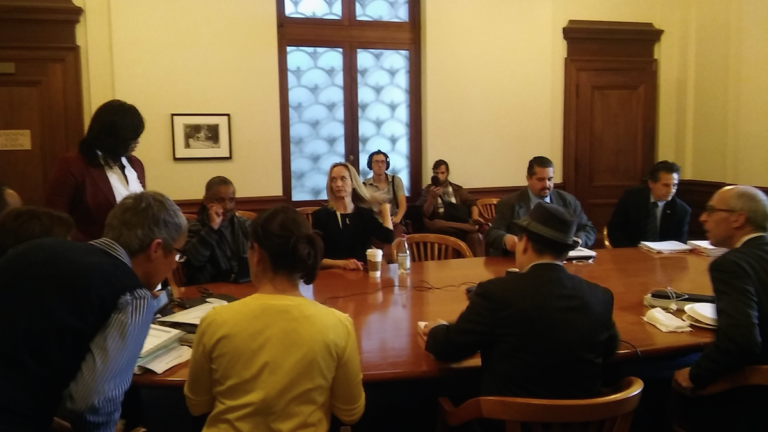
In a special study session on Tuesday evening, Emeryville city councilmembers called for an urgency ordinance to immediately legalize delivery of medical marijuana into Emeryville by current regional providers. “I have heard from people who are in pain,” said Councilmember Nora Davis.
The council also will permit at least one medical marijuana dispensary to serve its 10,000-person population and could make Emeryville a cannabis laboratory hub, analogous to its thriving biotech industry.
The historic session on Tuesday marked a new chapter in the tiny, strategically located city and its marijuana history — it has total bans on all pot activity — and is one of the clearest examples yet of statewide regulations incubating local progress.
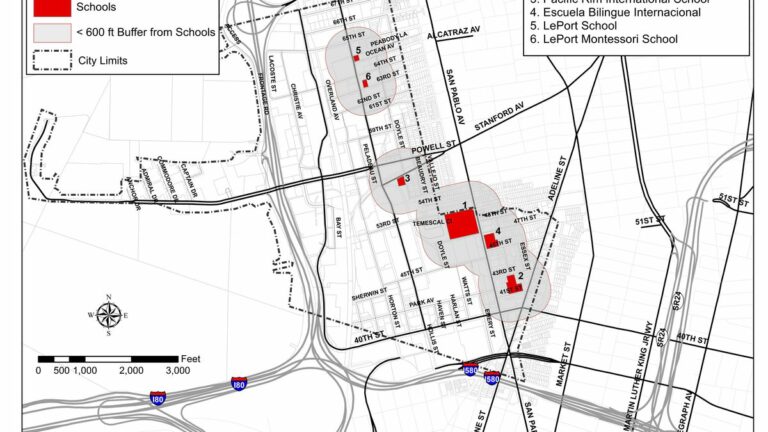
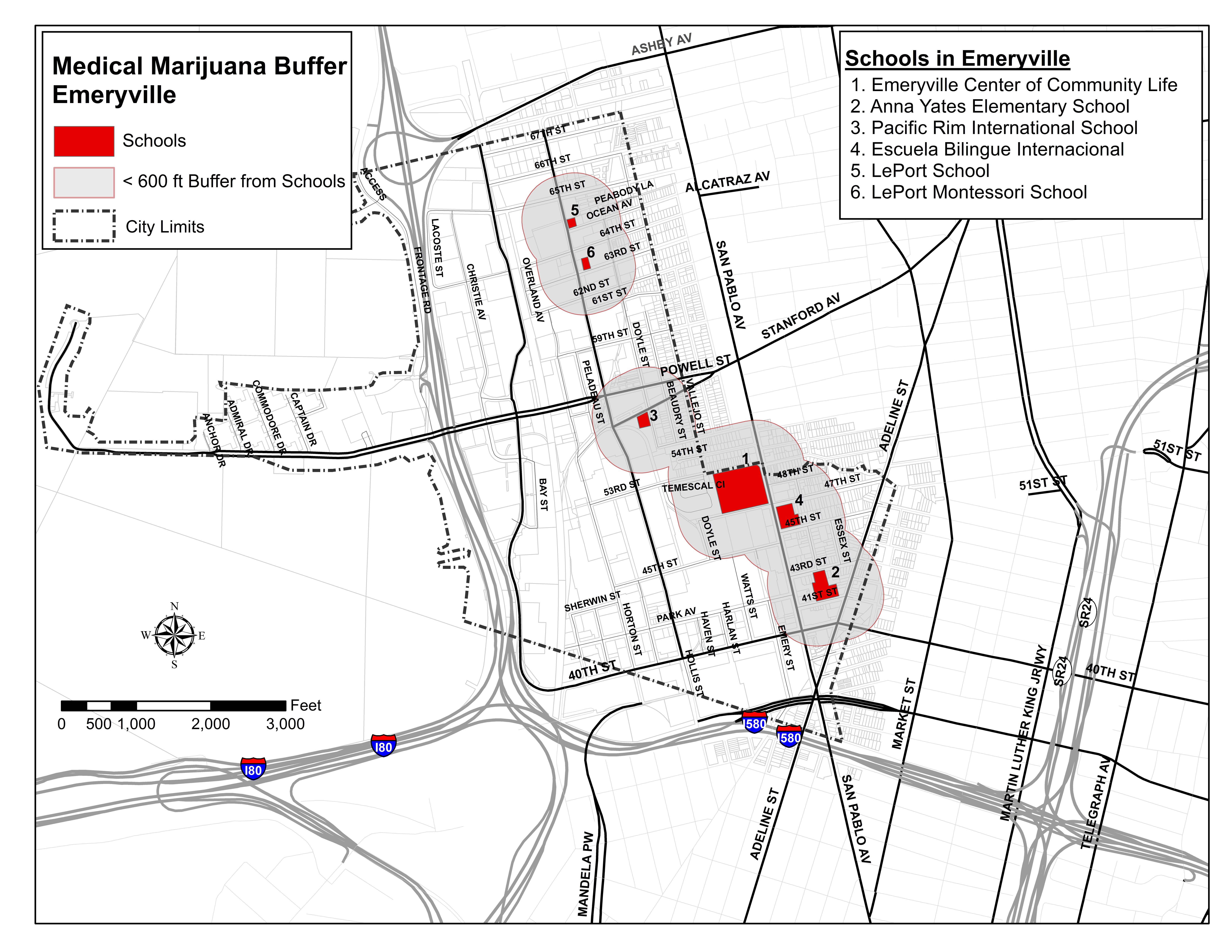
Emeryville could permit one dispensary outside state-mandated buffers from its schools.
Credits: Emeryville
[jump]
The enaction of new state regulations — the Medical Marijuana Regulation and Safety Act (MMRSA) — is bringing the issue of what exactly to do about marijuana to city councils and county boards like never before.
MMRSA’s dual licensing structure calls for both local and state permits, and initially forced jurisdictions to either ban, punt, or craft local rules.
Most cities have gone the easiest route: a ban. But each week and month, more are beginning to allow deliveries, dispensaries, and sometimes cultivation.
In response to MMRSA, Emeryville staff attorneys prepared a report and set of questions for council.
At City Hall last night, just a Frisbee’s throw from the famous animation studio, Pixar, Emeryville Mayor Dianne Martinez and councilmembers Nora Davis, Ruth Atkin, and Jac Asher began to ascend the learning curve of regulating medical pot. They asked city staffers and experts in the audience about how to get medical marijuana cards and how much a growing pot plant might stink.
By the end, Davis called for an immediate urgency ordinance to legalize medical pot deliveries. She said providers have refused to deliver in Emeryville for lack of clarity and patients are suffering. The idea was approved unanimously. The urgency ordinance could come back at the next council meeting in a month and be effective immediately.
Longer term, the council wants details on where to put a single dispensary that could convert to a recreational shop if state voters legalized it.
Emeryville also said ‘no’ to cannabis farming, due to space constraints. The city is just 640 acres and has a policy of approving permits based on the “highest and best use” for the space.
“Let’s leave [farming] to Humboldt,” quipped one council member.
Instead, the council wants more detailed options for cannabis distribution permits, and cannabis labs, they told staff.
The city can generate a substantial amount of local tax revenue from the industry. Staff noted that San Leandro’s dispensary alone could kick in about $61,000 in local taxes in 2016, and around $110,000 in 2017.
“I think this could be very important in setting the table … so that we will be well-poised to take advantage of medical marijuana as an industry,” said Martinez.
“The council wants to chase drug money,” Atkins quipped.
Representatives from the Emeryville Police Department had one comment — calling for adequate security among any providers.
Several citizens spoke in favor of the plan, as well as full legalization. Davis also called for a council vote in support of full legalization. “I’m talking about a basic commitment to living free,” Davis said.
She got nervous laughs from colleagues, who wanted more details.
Atkins also spoke in favor of vape lounges for patients who could not consume in multi-unit dwellings.
And Davis wanted it made clear that ‘mobile marijuana’ did not mean some type of “food truck” setup. “It’s not our intent here,” she said. Emeryville is part of a quirky patchwork of East Bay medical pot regimes, running from total prohibitions in Albany and Alameda, to robust industries in Oakland and Berkeley. San Leandro has permitted one club, and has a model Asher wants to follow.
Because of its blanket ban, Emeryville also has a blank slate. It can capitalize on MMRSA in specific ways cities with legacy laws cannot, staff attorneys notes. For example, San Leandro doesn’t do a distribution layer.
It’s a strategic gob of land sticking into a huge natural bay. First an indigenous Ohlone village, the land the property of one guy, Emery, who owned some railroads, wikipedia reports. It was the site of massive commerce and industry for a century and a half. It was once called ‘Butchertown’.
“Emeryville used to be as well known for its gambling houses and bordellos as it was for its booming industrial sector; then Alameda County district attorney, later California governor and then Chief Justice of the United States Earl Warren once famously called it ‘the rottenest city on the Pacific Coast’. During the Depression, Emeryville was jammed with speakeasies, racetracks and brothels and became known as a somewhat lawless center for entertainment.”
After big industry collapsed in the ‘60s, Emeryville reinvented itself with biotech office space, and the Bay Street Shopping Center. The five-councilperson city has three termed out members in 2016.
Last night’s Oakland City Council meeting was held behind locked doors in the mayor’s office after a disruption.
Credits: Darwin BondGraham
Activists opposing the sale of city-owned land to private developers briefly shut down a meeting of the Oakland City Council last night. The council reconvened, however, behind locked doors in the offices of Mayor Libby Schaaf to approve another step in the controversial land deal. Protesters called the closed meeting a violation of the Brown Act, but city officials said that state law allows them to convene in private if a public meeting becomes “unfeasible” due to purposeful disruptions.
[jump]
Over the past year, the one-acre slice of land near Lake Merritt known as the E. 12th Street Remainder Parcel has been a lightning rod in Oakland’s affordable housing debate. Last May, affordable housing advocates completely shut down a city council meeting, preventing the councilmembers from voting on a proposal to sell the land to the developer UrbanCore for $4.6 million. UrbanCore intended to build a 24-story tower consisting of 298 units of all market-rate housing. A leaked city attorney opinion later revealed that the city council had been advised that the deal would have violated the state Surplus Land Act. The Surplus Land Act states that public land intended for sale must be offered first to affordable housing developers, and that the city should prioritize proposals that offer the highest number of affordable units at the deepest levels of affordability.
After the Express reported on city attorney’s memo, the city reopened bidding for the land. Five developer teams submitted plans, all of which included affordable housing on the site. But city officials all along have appeared to favor UrbanCore, which has now teamed up with the affordable housing developer EBALDC. The UrbanCore/EBALDC team are currently proposing to purchase the land for $4.7 million, and to build a 26-story market-rate apartment tower next to an 8-story affordable housing mid-rise building. The project would have a total of 360 housing units, of which 108 would be affordable, according to the city.
Neighborhood activists calling themselves the E. 12th Wishlist Design Team partnered with the developer Satellite Affordable Housing Associates (SAHA) and are proposing to buy the land for $1 million, and to build a seven-story building made up entirely of 133 units of affordable housing, with no market-rate units, according to the city. Although the SAHA/E. 12th Wishlist Design Team proposal includes the most affordable housing at the deepest levels of affordability, city staffers who reviewed all the proposals have ranked it third because it is not as dense as the other two proposals and because it doesn’t maximize revenue for the city on the land sale.
Councilmember Abel Guillen after last night’s vote.
Credits: Darwin BondGraham
During the city council’s meeting in the mayor’s office last night, Councilmember Abel Guillen said that negotiations over the E. 12th Street Remainder Parcel have been the hardest issue he’s faced during his first term on the city council. The parcel is located in Guillen’s district.
Guillen said the UrbanCore/EBALDC plan will provide the greatest number of housing units, and noted that it’s a mixed-income development. He also said it would require the smallest public subsidy from the city.
“We can’t build a wall around Oakland,” Guillen said about market-rate housing developments in lower-income neighborhoods like Eastlake, which many activists fear portends gentrification and displacement as property values rise.
Councilmember Anne Campbell Washington said that the council “understands the pain of the housing crisis,” but that activists have projected too much importance onto one piece of land — a parcel that cannot solve the city’s need for more housing.
Council President Lynette Gibson McElhaney, who joined the meeting by telephone, said before the vote that one of the benefits of the UrbanCore/EBALDC proposal is that it will create the highest property values on the site, which will flow to the city in the form of property taxes and real estate transfer taxes.
Councilmember Dan Kalb said before the vote that he believes the city has now fully complied with the state Surplus Land Act’s requirements, and he cited the UrbanCore/EBALDC proposal as a “model” for addressing the housing crisis.
Councilmember Noel Gallo voted against moving ahead with the deal to sell the city land to UrbanCore/EBALDC.
Credits: Darwin BondGraham
Councilmembers Noel Gallo and Desley Brooks used the discussion before the vote to argue about the law, and about the role of public land.
Brooks asked pointed questions to the city attorney about whether Oakland had ever violated the Surplus Land Act in the first place. According to Brooks, the city was in compliance all along with state law, and the city attorney’s opinion was incorrect and should never have prevented the city from selling the land to UrbanCore last year.
According to city records, the city attorney had commissioned a second legal opinion on whether the Surplus Land Act barred the city from selling the E. 12th Street Remainder Parcel to UrbanCore under the terms of the first deal last year. It’s unclear what this second legal opinion states, but last November Brooks and Kaplan tried to schedule a motion to require the city attorney to release this second legal opinion to the public. The motion was never brought to the full council for a vote, however.
Gallo cast the sole dissenting vote on the land deal last night. “The people I represent in Fruitvale are being displaced,” Gallo said. “We should never sell public land.” When the final vote was taken Gallo voted “no,” telling other members of the council he was doing so “with honor.”
The result of last night’s vote is that Oakland city staff will enter into a six-month exclusive negotiating agreement with UrbanCore and EBALDC to strike a final deal for the land. The council will still be required to vote on the final land sale to UrbanCore and EBALDC later this year.
Correction: the original version of this story stated that the UrbanCore/EBALDC project was a 190-unit market rate apartment tower with a 90-unit affordable housing mid-rise. The actual unit totals are 252 market rate units and 108 affordable units.
Merrick Garland.
1. President Barack Obama nominated a centrist judge — Merrick B. Garland — to the US Supreme Court, The News York Times$ reports. Garland, a well-respected moderate, currently serves on US Court of Appeals for the District of Columbia Circuit and would replace the late conservative justice, Antonin Scalia, on the high court. However, Senate Republicans have vowed to block any Supreme Court nomination by President Obama, contending that the next president should select Scalia’s successor.
2. After affordable housing activists disrupted last night’s Oakland City Council meeting, the council moved to the mayor’s private conference room and voted 6-1 to approve a controversial housing proposal that is to be built on public property near Lake Merritt, the Trib$ reports. The activists wanted the council to select an all affordable-housing plan for the East 12th Street site, but the council instead backed a mixed-housing plan that will include both affordable and market-rate units.
5. UC Berkeley head basketball coach Cuonzo Martin knew that a female reporter was having problems with one of his assistants — Yann Hufnagel — at least two months before the university launched a sexual harassment investigation of Hufnagel, the Chron reports, citing internal campus emails. The university fired Hufnagel after a campus investigation concluded that he sexually harassed the female reporter relentlessly, and then blocked her from doing her job when she refused his advances. She was then fired from an unnamed news organization.
Aries (March 21–April 19): Artist Steven Spasuk works exclusively with an unusual medium: soot from candles and torches. He spreads the stuff across a blank canvas, then uses various instruments to sculpt the accidental blobs into definitive forms. I’ve seen the results, and they’re both well-done and intriguing. What would be the metaphorical equivalent, in your world, of using soot to make beautiful and interesting things? I think you’re primed to turn waste into building blocks, rot into splendor, and lead into gold. (See Spazuk’s work at spazuk.com.)
Taurus (April 20–May 20): Carl Sagan said that science thrives on “two seemingly contradictory attitudes: an openness to new ideas, no matter how bizarre or counterintuitive, and the most ruthless skeptical scrutiny of all ideas, old and new.” Whether or not you are a scientist, Taurus, I recommend that you practice this approach in the coming weeks. It’s the tool that’s most likely to keep you centered and free of both rigidity and illusion. As Sagan concluded, this is “how deep truths are winnowed from deep nonsense.”
Gemini (May 21–June 20): “Excess on occasion is exhilarating,” said British author W. Somerset Maugham. “It prevents moderation from acquiring the deadening effect of a habit.” Now would be an excellent time to take that advice to heart, Gemini. According to my analysis of the astrological omens, you not only have a license to engage in rowdy fun and extravagant pleasures; it’s your sacred duty. So get out there and treat yourself to an orgy of naughty adventures — or at least a celebration of meaningful thrills. You can return to the rigors of discipline and order once you have harvested the healthy benefits that will come from escaping them.
Cancer (June 21–July 22): At one point in Friedrich Nietzsche’s book Thus Spoke Zarathustra, the hero is having a conversation with himself. “You have wanted to pet every monster,” he says. “A whiff of warm breath, a little soft tuft on the paw — and at once you were ready to love and to lure it.” If I were you, Cancerian, I would regard that type of behavior as forbidden in the coming weeks. In fact, I will ask you not to pet any monsters at all — not even the cute ones; not even the beasties and rascals and imps that have slight resemblances to monsters. It’s time for maximum discernment and caution. (PS: One of the monsters may ultimately become a non-monstrous ally if you are wary toward it now.)
Leo (July 23–Aug. 22): On a social media site, I posted the following quote from self-help teacher Byron Katie: “Our job is unconditional love. The job of everyone else in our life is to push our buttons.” One commenter took issue with this. “‘Pushing buttons’ is a metaphor that’s long past its expiration date,” she wrote. “Can’t you come up with something fresher?” So I did. Here are a few potential substitutes for “push our buttons”: “tweak our manias” … “prank our obsessions” … “glitter-bomb our biases” … “squeeze our phobias” … “badger our compulsions” … “seduce our repressions” … “prick our dogmas.” Whichever expression you prefer, Leo, find a graceful way to embrace your fate: Your current job is unconditional love. The job of everyone else in your life is to tweak your manias and prick your dogmas.
Virgo (Aug. 23–Sept. 22): In the coming weeks, you will have maximum power to revise and reinvigorate your approach to cultivating intimate relationships. To aid your quest, I offer this paraphrased advice from Andrew Boyd: Almost every one of us seeks a special partner who is just right. But there is no right person, just different flavors of wrong. Why? Because you yourself are “wrong” in some ways — you have demons and flaws and problems. In fact, these “wrongs” are essential components of who you are. When you ripen into this understanding, you’re ready to find and be with your special counterpart. He or she has the precise set of problems you need — is the person who is wrong for you in just the right ways. (See Boyd’s original quote: tinyurl.com/boydquote.)
Libra (Sept. 23–Oct. 22): In her book The Winter Vault, Anne Michaels says, “We become ourselves when things are given to us or when things are taken away.” If she’s right, does it mean we should be grateful for those times when things are taken away? Should we regard moments of loss as therapeutic prods that compel us to understand ourselves better and to create ourselves with a fiercer determination? Meditate on these possibilities, Libra. In the meantime, I’m pleased to announce that the things-getting-taken-away period of your cycle is winding down. Soon you’ll begin a new phase, when you can become a deeper, stronger version of yourself because of the things that are given to you.
Scorpio (Oct. 23–Nov. 21): “I’ll make love when the lust subsides,” sings Denitia, one-half of the electro-pop band Denitia and Sene. That would be a good motto for you to play around with in the coming days, Scorpio — in both literal and metaphorical ways. I’ll enjoy seeing how your emotional intelligence ripens as the white-hot passion of recent weeks evolves into a more manageable warmth. As fun as the intensity has been, it has blinded you to some of the possibilities for collaborative growth that have been emerging. You may now be ready to explore and appreciate sweeter, subtler pleasures.
Sagittarius (Nov. 22–Dec. 21): “The poems I have loved the most are those I have understood the least,” said T. S. Eliot. I’m going to steal and expand upon his idea for the purpose of giving you an accurate horoscope. In the coming days, Sagittarius, I suspect that the experiences you love most will be those that you understand the least. Indeed, the experiences you need the most will be those that surprise and mystify and intrigue you. Luckily, life will be ingenious in bypassing your analytical intelligence so as to provide you with rich emotional stimuli for your soul.
Capricorn (Dec. 22–Jan. 19): Capricorn painter Henri Matisse made the following testimony about his creative process: “At each stage I reach a balance, a conclusion. At the next sitting, if I find that there is a weakness in the whole, I make my way back into the picture by means of the weakness — I re-enter through the breach — and I reconceive the whole. Thus everything becomes fluid again.” I recommend this approach to you in the coming days, Capricorn. You’ve been making decent progress on your key project. To keep up the good work, you should now find where the cracks are, and let them teach you how to proceed from here.
Aquarius (Jan. 20–Feb. 18): “We all lead three lives,” said Austrian novelist Thomas Bernhard, “an actual one, an imaginary one, and the one we are not aware of.” I suspect you’ll get big glimpses of your third life in the coming weeks, Aquarius: the one you’re normally not aware of. It might freak you out a bit, maybe unleash a few blasts of laughter and surges of tears. But if you approach these revelations with reverent curiosity, I bet they will be cleansing and catalytic. They are also likely to make you less entranced by your imaginary life and better grounded in your actual life.
Pisces (Feb. 19–March 20): “The greatest illusion is not religion,” says aphorist Michael Lipsey. “It’s waking up in the morning imagining how much you’re going to get done today.” But even if that’s often true, Pisces, I suspect that you have the power to refute it in the coming weeks. Your ability to accomplish small wonders will be at a peak. Your knack for mastering details and acting with practical acumen may be unprecedented. For the immediate future, then, I predict that you’ll largely be able to get done what you imagine you can get done.
This is the clearest example of bureaucracy gone wild. The City of Oakland should reimburse Josh Harkinson for the cost of the fence on city property, and it should insure the fence and any issues concerning the creek. The pride of ownership and concern for the safety of one’s neighbors without any personal financial gain is the kind of behavior that we should be encouraging not preventing.
Gary Stein, Walnut Creek
Leave the Fence Alone
As usual, the City of Oakland continues to cut off its nose to spite its face. If that great neighbor does remove the fence and someone gets hurt, our taxes will pay for the lawsuit. If there is erosion, our taxes will pay to fix the problem with a possible lawsuit as well. As usual, bureaucracy wins over common sense. Instead of paying or receiving monies, the city should call it even and leave the fence with a proper encroachment permit.
Saying “no” to coal should be a no-brainer — because of global warming, because coal dust causes respiratory problems. We need to keep fossil fuels in the ground or we could literally cause our own extinction as a species. Or if it is not that bad, we could easily see large parts of the Bay Area underwater due to sea level rise — not to mention worse droughts, worse floods, worse storms. It is madness to even consider this plan.
Chris Darling, Richmond
Miscellaneous Letter
I Was Screwed by Fannie Mae
Being priced out of the Oakland market, my partner and I recently started looking in Richmond. We found a boarded up Home Path- (Fannie Mae) owned property that had been bought at auction in January 2015 by Fannie Mae for $182,000 and immediately put on the market at $400,000. The property had been on the market for over 130 days by the time we encountered it, and had been reduced to $389,000 after two price reductions, but when we called the listing agent to view the property, we were met with obfuscation and resistance. Bewildered, we proceeded to enlist another real estate agent who also had a difficult time with the listing agent, describing him as belligerent and slow to respond to emails and phone calls.
When we finally saw the home and decided to put in an offer to Fannie Mae, we were notified that “suddenly” there were multiple offers and we were given 24 hours to raise our offer. After raising our offer and waiting almost two weeks for a response, Fannie Mae sent back the offer, but claimed that the listing was still active. By the time our agent was able to file a third offer on a Tuesday just two business days later, we received the news that the house had been sold.
In the aftermath of this emotional assault, we have a lot of unanswered questions for a corporation that we taxpayers bailed out to the tune of $1 billion just seven years ago. Why is a large corporation like Fannie Mae using an obscure “one-man” real estate outfit in Oakland to represent its holdings in Richmond? Why was this agent so reluctant to show us a property that had been on the market for more than ten months? Why was our offer suddenly swarmed with “multiple offers”? Why did Fannie Mae not respond to our complaints about the listing agent? And why did our offer take two weeks to be considered and a new offer accepted in a matter of hours?
We are hearing a lot about home price inflation and have witnessed the competitive frenzy among homebuyers to purchase an affordable property in the East Bay. It is now common knowledge that this overheated real estate market is sparked by ruthless speculators hoping to cash in by flipping properties, but we didn’t expect publicly supported companies like Fannie Mae to be part of fanning the flames of house inflation, by making negotiations that are questionable with dealers that are unprofessional and highly suspicious.
We will continue to track the fate of this property, but we suspect it will be given a facelift and put back on the market within the year. Fannie Mae will have made a profit and so will the agent and the “successful” buyer. It was a real estate gang-bang, and we, serious homebuyers looking for affordable long-term, permanent residences, are the victims.
There have been other movies about drone warfare, but Gavin Hood’s Eye in the Sky has something the other ones don’t: Helen Mirren. Unfortunately, that’s the best thing we can say about it. In director Hood’s topical war story, Mirren is a British Army colonel trying to stop a suicide-bomber attack in Nairobi, Kenya, by launching a missile strike — from her office on another continent — on a house where insurgents are strapping on bomb vests. But there are complications. A nine-year-old Kenyan girl named Alia (Aisha Takow) is selling bread in the street outside the target, and is almost certain to be killed in the air raid as it is planned. It’s bad public relations to blow a kid to smithereens, and the brass are worried about leaked footage. A workable solution must be found.
As in previous drone movies — they’re almost always presented from the point of view of whoever looks at the screen and pushes the button — much is made about the true objectives behind dealing instant death from above. Mirren’s Colonel Powell is the war hawk, a hard-hearted huntress unafraid of collateral damage (such as little Alia), just as long the bad guys are neutralized and terrorism is prevented. We never learn more about her, because Hood and his screenwriter, TV vet Guy Hibbert, don’t stay on her long enough for us to conduct our own critical blitz.
Helen Mirren in Eye in the Sky.
A decent cast of actors gets glossed over in the same way: including the late Alan Rickman, in his last screen role, as a vacillating general; Aaron Paul as the US Air Force officer who pulls the trigger from his hut in the Nevada desert; and Somalian actor Barkhad Abdi (the villain from Captain Phillips) as a Kenyan spy spotting targets on the ground for the United States and United Kingdom. Once the little girl is sighted as a potential victim, an unintentionally comical game of musical chairs takes place up and down the command ladder as various political and military types calculate their own best interest. We sit there encased in our comfy theater seats, and wonder: Does this much discussion happen with every drone strike?
The character we learn the most about is Alia, the one who plays with her hula hoop, dusts off the bread when it falls in the dirt, and whose chewed-up body gets pulled from the rubble afterwards. Hood, maker of Rendition, is a smart, socially conscious filmmaker trying to get Eye in the Sky to mean something on the subject of drone warfare. But the screenplay cannot or will not carry the load.
To say Mows (or @Mows510, as he’s known on Instagram) doesn’t look like a stereotypical “vandal” would be an understatement. On the night we met, the 54-year-old tech worker was dressed in light blue jeans and sensible brown walking shoes; glasses hung from the neck of his beige fleece. Despite his decidedly Dad vibe, the father of three has created sixty illegal, albeit adorable, street installations on walls and telephone poles in Alameda and Oakland.
Mows (pronounced “mouse”) agreed, under the condition of anonymity, to let me tag along on one of his weekly outings. He opened the back of his minivan and showed me the goods: four three-by-four-inch “urban mouse doors” made out of resin with matching windows and door mats. Then, we hopped in and drove to the first location, a wall of murals and mosaics in Jingletown.
A tiny door with a chevron pattern by Mows.
Credits: Courtesy of @Mows510
Because the pieces are made ahead of time, the installation process was incredibly quick. Mows placed the door where he wanted it and pressed. Concrete adhesive did the rest. The whimsical power of the tiny door was immediate. Suddenly, the otherwise flat wall appeared to open into another world. As one admirer of the doors said, “They create magic.”
The unlikely street artist’s obsession began in 2009 when he spotted a purple hippopotamus by Mosko et Associes (French duo Michel Allemand and Gérard Laux) stenciled on a Paris wall. Soon, he was taking 600 or more photos of street art on his frequent business trips to Paris and London. He was particularly drawn to the three-dimensional pieces he saw, including Giger-esque wall sculptures by Cityzen Kane, Gregos’ face molds, and Ronzo’s cartoony concrete figures.
“I guess all along I kind of wanted to do street art, but I didn’t know what to do,” said Mows. Then, in August of last year, he saw a piece in London by the Polish artist Above.Love.Art that pushed him over the edge. Shaped like a rectangular Pac-Man ghost, the blue creature was “so simple,” said Mows. “I was like, ‘Shoot, I’m just going to go do it.'”
Mows installed his first door on November 15, 2015, along Alameda’s estuary. Some of his doors are painted a solid color; others are themed. A pot leaf decorates the entryway he placed near Oaksterdam University. Yellow crime-scene tape crisscrosses a door he originally installed in the Alameda police station parking lot. (“I chickened out and came and got it that evening,” said Mows.) One pedestrian favorite references Mondrian with its squares of primary colors and black and white grid. Another features reproductions of pieces by GATS, Swampy, IROT, and other local graffiti artists that Mows admires.
For some aerosol artists, the appreciation is mutual. “The doors appeal to my inner child,” wrote GATS, a prolific Bay Area graffiti artist, in an email. “They make you imagine a whole little business or miniature underground club inside.” GATS said the pieces reminded him of “a mix between The Little People Project (a London-based artist who photographs miniature figurines doing politically witty things in the streets) and the vinyl toy culture that encourages artists to collaborate by decorating another artists’ sculpture series.”
At first, Mows assumed nobody would notice the doors. But every time he went to check on them, he’d find kids squatting around them, or someone with a stroller would be stopped in front. “There are children who have hung out for a long time just to see who will come out [the door],” said Mows.
Thanks in part to his Instagram account where he accepts requests (such as the Oaksterdam piece), his audience continues to grow. Oakland-based Crooked City Cider has offered to trade cider for a door with the company’s logo on it. DB Burkeman, author of Stickers: From Punk Rock to Contemporary Art, contacted Mows for photos of his doors to include in his second compendium of stickers. Mows has also done long-distance collaborations, including a heart-covered door he designed with his inspiration-turned-friend, Above.Love.Art. The Alameda Island Fairy Doors Facebook group started to pay attention to his work, too, and soon he was embraced by a community that he hadn’t known existed.
As it turns out, Mows is not the only one on the island making mini doors. Fred Hogenboom, owner of the auto repair shop Fred’s Wrenchouse, has made approximately fifty wooden fairy doors with his granddaughter since last year. A Girl Scout troop has gotten in on the game, too. And with more fairy-door-making parties in the works, the island is sure to see even more diminutive doors soon.
“There are people in that Facebook group who are alerting other people that such and such a door is broken,” said Mows. “They’ll post pictures of doors I’ve done where they’re debating which adhesive to use to put it back together.”
Some fans have started to add to Mows’ front porch scenes as well. In Jingletown, someone placed a petite Adirondack chair next to the door. “I love that it’s become this interactive thing,” said Mows.
Now that he’s realized that people are finding joy in the doors, he plans to hit high foot traffic areas in Oakland next, such as Lake Merritt and Chinatown. “Maybe I can inspire some different neighborhoods,” he said.
Steven DeCarpio.
Credits: Bert Johnson/File photo
Three years ago, Oakland resident Steven DeCaprio made headlines when he successfully achieved ownership of a house that he had been squatting in for more than a decade. DeCaprio employed the Adverse Possession Law, a legal doctrine that allows occupants to claim properties that have suffered from long-term abandonment.
According to census data, there may be...
Blacks are underrepresented as owners of legal marijuana businesses, BuzzFeed reports in a sweeping story this week. About 1 percent of the estimated 3,200 to 3,600 storefront pot shops are owned by Blacks.
Institutional racism targets Blacks for drug felonies, then bars drug felons from holding legal pot licenses, further stacking the deck against minorities.
...
Stories you shouldn’t miss:
1. Electrical woes caused a commute nightmare yesterday on BART, and the transit system continued to suffer outages during this morning’s commute, the Chron reports. A mysterious power surge between the Pittsburg/Bay Point and North Concord stations knocked about fifty train cars out of service, causing systemwide delays. This is the second time in a month...
Emeryville is set to fully legalize medical marijuana deliveries in thirty days and could see its first dispensary, as well as cannabis labs in the coming year.
In a special study session on Tuesday evening, Emeryville city councilmembers called for an urgency ordinance to immediately legalize delivery of medical marijuana into Emeryville by current regional providers. “I have heard...
Last night's Oakland City Council meeting was held behind locked doors in the mayor's office after a disruption.
Credits: Darwin BondGraham
Activists opposing the sale of city-owned land to private developers briefly shut down a meeting of the Oakland City Council last night. The council reconvened, however, behind locked doors in the offices of Mayor Libby Schaaf to approve another...
Stories you shouldn’t miss:
1. President Barack Obama nominated a centrist judge — Merrick B. Garland — to the US Supreme Court, The News York Times$ reports. Garland, a well-respected moderate, currently serves on US Court of Appeals for the District of Columbia Circuit and would replace the late conservative justice, Antonin Scalia, on the high court. However, Senate Republicans have...
Aries (March 21–April 19): Artist Steven Spasuk works exclusively with an unusual medium: soot from candles and torches. He spreads the stuff across a blank canvas, then uses various instruments to sculpt the accidental blobs into definitive forms. I've seen the results, and they're both well-done and intriguing. What would be the metaphorical equivalent, in your world, of using...
"The Oakland Fence Saga," News, 3/2
Bureaucracy Gone Wild
This is the clearest example of bureaucracy gone wild. The City of Oakland should reimburse Josh Harkinson for the cost of the fence on city property, and it should insure the fence and any issues concerning the creek. The pride of ownership and concern for the safety of one's neighbors without any...
There have been other movies about drone warfare, but Gavin Hood's Eye in the Sky has something the other ones don't: Helen Mirren. Unfortunately, that's the best thing we can say about it. In director Hood's topical war story, Mirren is a British Army colonel trying to stop a suicide-bomber attack in Nairobi, Kenya, by launching a missile strike...
To say Mows (or @Mows510, as he's known on Instagram) doesn't look like a stereotypical "vandal" would be an understatement. On the night we met, the 54-year-old tech worker was dressed in light blue jeans and sensible brown walking shoes; glasses hung from the neck of his beige fleece. Despite his decidedly Dad vibe, the father of three has...