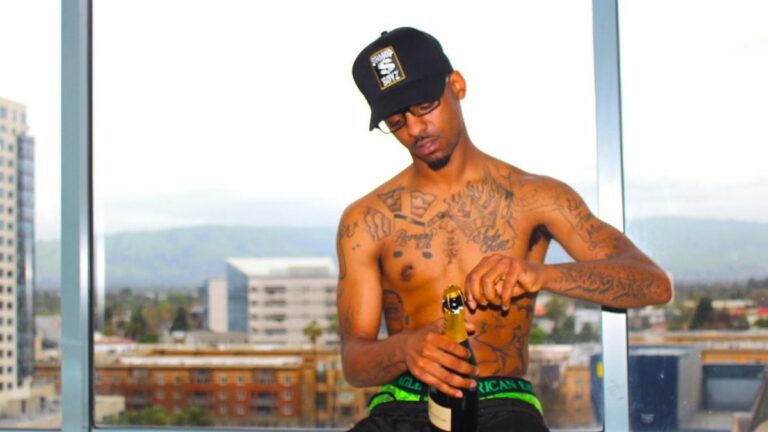
There are a number of ways to take a stand on important social issues. East Bay rapper Aka Frank did so in an unabashedly sleazy fashion with his single “Racist (My Dick Ain’t),” an anthem for those whose attraction knows no bounds as far as culture and ethnicity are concerned. The song was an underground hit when it came out three years ago and was played frequently at local dance parties and DJ nights. Since then, Aka has been hugely prolific. As a former member of Diligentz, a teenage rap group that was active in the Aughts and also featured Jay Ant from HBK Gang, he frequently works with HBK and Shmoplife artists and released an excellent collaborative mixtape with IAMSU last summer titled Biggie Smalls. The tape featured gems such as the morning-after soundtrack, “Backwoods and Backrubs,” as well as “Lane Switching,” which features Lil Uzi Vert, who has since become a viral sensation. Now, Aka Frank is back with Aka Frank Vol. 3, a nineteen-track album rife with hyperactive party tracks and features from prominent East Bay artists such as Lil B and J. Stalin. He celebrates the album’s release with a day party at Brick & Mortar Music Hall this Saturday.
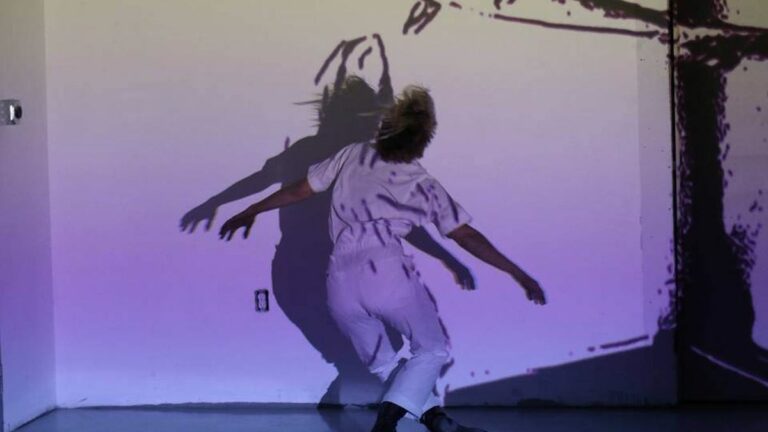
SALTA, an East Bay experimental dance collective that holds a monthly roaming dance series with the goal of activating unlikely spaces with movement, is teaming up with the similarly non-traditional performance platform AUNTS to take over the Berkeley Art Museum and Pacific Film Archive (2155 Center St., Berkeley) on Friday, March 25, from 6–9 p.m. The dancers aim to turn the museum’s new home into a “dance deck, disco, shrine” by performing throughout the galleries, responding to the architecture and the artwork within it. SALTA and AUNTS have curated a lineup of over sixty performers to fill the space, ranging widely in discipline. More than fifteen video artists will also be there to light up the galleries with projected imagery. The first one hundred people to attend will receive free entry. After that, the event will be free with museum admission.
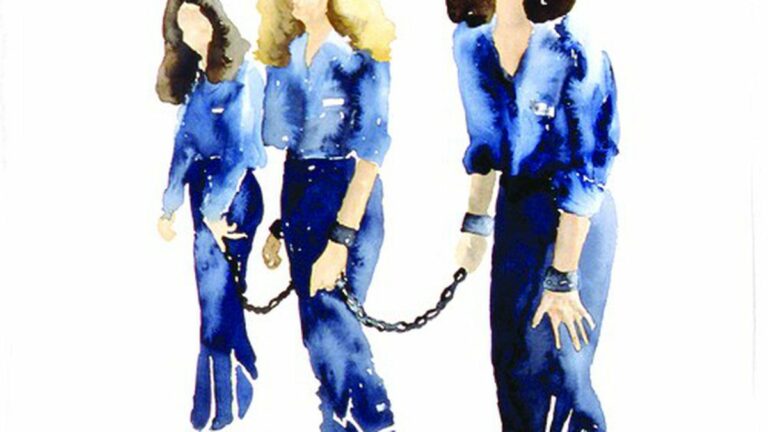
In Good Times, artist Kelly Inouye’s second solo show at Interface Gallery (486 49th St., Oakland), Inouye invokes worlds that feel subtly familiar and yet distinctly strange. The water color painter uses scenes from Seventies and Eighties television shows — such as Dynasty, Good Times, Fantasy Island, Flipper, Gentle Ben, and Lassie — as source imagery for her fluid renderings that wash in and out of realism and abstraction. In doing so, the work poetically speaks to the way that fragmented memories of media linger in contemporary culture, lacing current creative output with nostalgia. As the show description reads: “Dissolving into negative space, these manufactured scenes of everyday life hint at a larger narrative context and amplify the sense of odd sentimentality associated with pop culture of a bygone era that was not so long ago.” At the artist’s reception on April 1 (6–9 p.m.), Interface will release a limited-edition book of Inouye’s work.
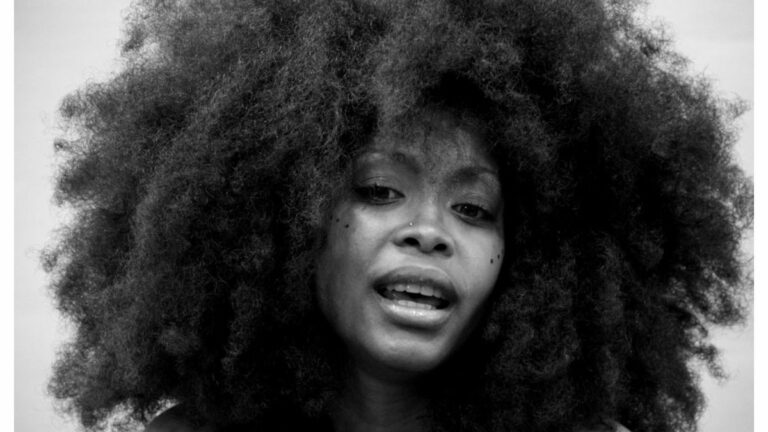
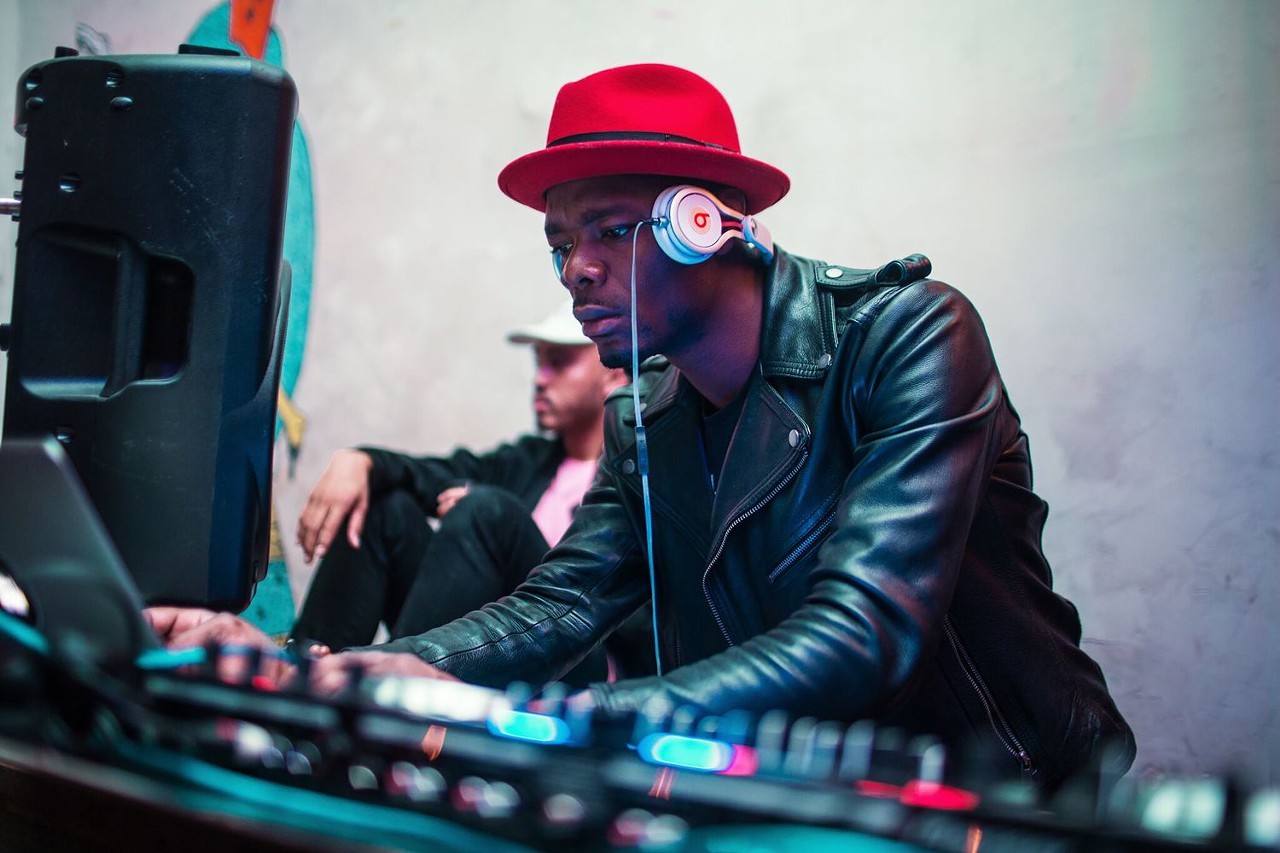
Not only is Erykah Badu the queen of late Nineties/early Aughts neo-soul, she was also a key figure in bringing Afrofuturist thought and aesthetics into the pop culture zeitgeist. Basically, everything Badu does is next level — from her socially conscious lyrics that speak out against oppression to her public actions that challenge harmful social norms. She proudly takes selfies that showcase her graying hair — giving the middle finger, so to speak, to unattainable beauty standards — and, in addition to being a Platinum-selling recording artist, she’s also a practicing doula. Until 2015, Badu had been quiet since the release of her phenomenal 2010 album New Amerykah Part Two (Return of the Ankh). But last year, she dropped the mixtape But You Caint Use My Phone, a collection of quick, fun, “Hotline Bling”-inspired tracks that stoked fans’ appetites for her next album. Badu DJs at 1015 Folsom in San Francisco on March 25 under her alter ego, Lo Down Loretta Brown.
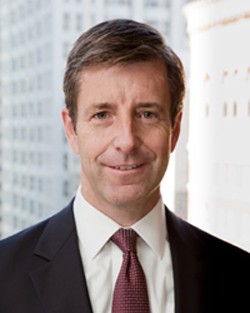
Court-appointed investigator and attorney Edward Swanson.
Credits: Courtesy of Swanson & McNamera LLP
An investigator appointed by federal Judge Thelton Henderson to examine the Oakland Police Department’s disciplinary system issued a second report today, finding that the Oakland Police Department and the city attorney have made significant progress fixing problems that have undermined efforts to hold police officers accountable for breaking department policies and the law.
Last April the investigator, attorney Edward Swanson, published a scathing report that characterized Oakland’s police discipline process as “a broken and inadequate system that has evaded the public’s scrutiny for too long.” In today’s report, Swanson wrote that developments over the past year are “encouraging,” and that the city has fixed some major problems. But Swanson also questioned whether recent improvements can be made sustainable, and whether OPD will hold supervising officers accountable for giving bad orders and providing improper training.
According to the court-appointed investigator, over the past year OPD and the city attorney have begun working together as a team to prepare for police discipline cases, whereas previously they blamed one another for breakdowns in the process. Lawyers from the City Attorney’s Office are now involved in discipline cases from their inception, and when outside attorneys are hired to assist, the city contracts with attorneys who have experience in police discipline cases, and they they are brought in early in the process.
“We have just received the report and are currently reviewing its recommendations,” Oakland Police Chief Sean Whent wrote in a statement. “We are absolutely committed to police accountability and are always looking for ways to appropriately improve our accountability system.”
“There have been some improvements and I’m gratified to see that,” said James Chanin, one of the attorneys who seventeen years ago sued the city on behalf of a group of Black Oakland residents who alleged that OPD officers were systematically violating their civil rights. Oakland settled that lawsuit in 2003 by agreeing to put its police department under the oversight of Judge Henderson in a reform process called a “consent decree.”
But Chanin, who has closely monitored OPD’s consent decree efforts ever since, said that Swanson’s latest report still raises serious issues about Oakland’s police discipline system. Chanin singled out two issues of particular concern: Can Oakland sustain the progress it has made without a federal court overseeing its cops? And will OPD begin to discipline supervising officers, rather than heaping punishment mainly on rank-and-file cops who are often just following orders, or acting with insufficient training and supervision?
“The most disappointing thing is that it seems the real action only takes place when the court points it out and starts complaining, rather than self-initiated behavior by the city, and the city attorney, in particular,” said Chanin. “That’s the sustainability issue we’re looking at right now.”
Chanin’s concerns are echoed in Swanson’s new report. Swanson wrote that despite marked progress:
“Time and again it has taken the Court’s intervention to get the City to take necessary steps to improve police discipline. Before the Court ordered the first investigation, little was being done by the City administration, OPD or OCA to fix the City’s broken police discipline system. After the Court issued its order, the City took steps to improve its discipline process.”
Swanson also wrote that despite the city attorney’s improved coordination with OPD to prepare for police discipline cases, the City Attorney’s Office remains “deficient in its overall support” for the police department. “OCA has not properly fulfilled its role as ‘general counsel’ to the Department,” wrote Swanson. “The Department often feels it gets little guidance from OCA on policy matters, and that guidance frequently is of limited value or comes too late to be of use.”
Swanson also wrote that he “strongly disagree[d]” with the city’s claim that it has been holding supervising police officers accountable when they contribute to police officer misconduct. According to Swanson, OPD’s internal affairs investigators currently do not consider whether a supervisor ordered a subordinate officer to undertake an action that resulted in misconduct, nor whether a supervisor failed to sufficiently oversee an officer accused of misconduct.
Chanin said the case of Scott Olsen illustrates how supervisors traditionally haven’t been held accountable by OPD. Olsen, an Iraq War vet who was attending an Occupy Oakland protest march on October 25, 2011, was struck in the head by a shotgun-fired lead beanbag round by an officer who was never identified. As Olsen lay prone on the street, Oakland police Officer Robert Roche lobbed a flash-bang grenade into a small group of people who had rushed to help Olsen. Roche was fired for his actions, but his union, the Oakland Police Officers Association (OPOA), later won Roche his job back by arguing that he had been commanded to throw the flash-bang grenade by his supervisor. Roche’s supervisor was never punished.
“In the wake of the decision for Roche, I found myself agreeing with many of OPOA’s points,” said Chanin. “Here’s a guy who was told to fire. Who gave that order? Who was disciplined for giving that order? Who was disciplined for designing those tactics? That’s the argument the union made, and it’s unfortunately correct.”
Credits: City of Oakland
This week, the Oakland City Council is scheduled to hold hearings on a massive infrastructure bond that would raise hundreds of millions to fix Oakland’s streets, sewers, parks, and even to rehabilitate housing. The council will also consider extending a contract with a technology firm that has installed a sprawling gunshot detection system around the city. And housing impact fees are back before the council. This time, city staffers are presenting a detailed plan and ordinance.
[jump]
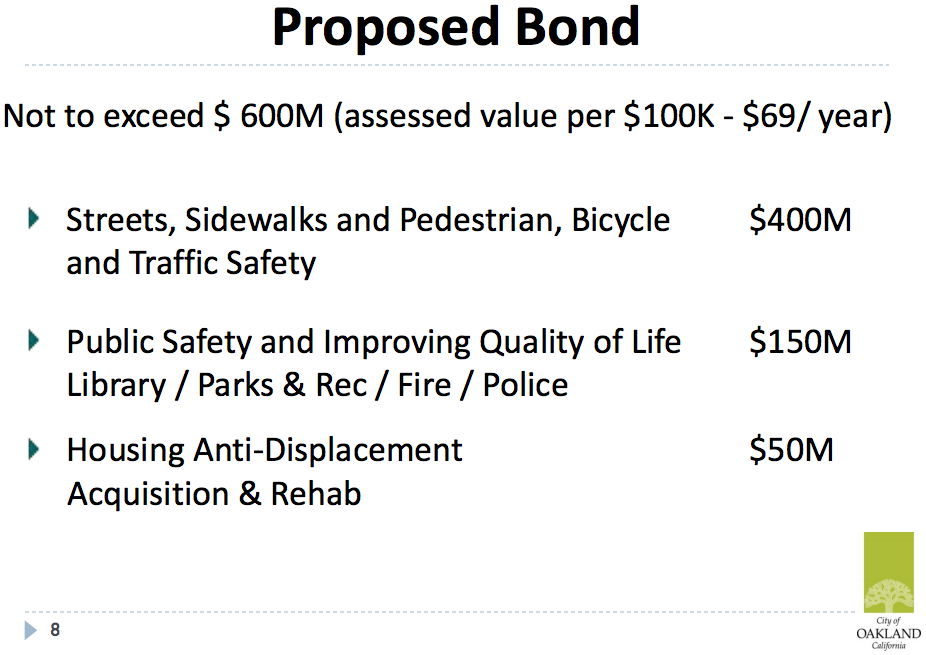
Infrastructure Bond: Oakland is hella big. The Town has 806 miles of paved streets, 1,000 miles of sidewalks, a 929-mile labyrinth of sewers, and 304 public buildings. And for years, the city hasn’t had enough cash to properly maintain all of this public infrastructure. In fact, there’s a $2.5 billion cost to the city’s deferred maintenance — the patching and paving we haven’t done. Crumbling public infrastructure imposes costs on the city too: In an average year, Oakland pays out $2.5 million to settle trip-and-fall lawsuits filed by people injured from dangerous roads and sidewalks, according to the Public Works Department. So Oakland is considering an infrastructure bond to fix some problems. At Tuesday’s Finance and Management and Public Works committee meetings, staffers will present a plan to issue $600 million in bonds: $400 million would go toward fixing roads, sidewalks, and bike paths. Another $150 million would be used to improve city buildings like libraries and fire stations. And $50 million would be used to fund acquisition and rehabilitation of affordable housing.
An infrastructure bond would have to be approved by voters in the November election. But the city already commissioned a poll to see if voters are willing to pass a bond, and the initial results indicate that Oaklanders are willing to tax themselves to spruce up The Town.
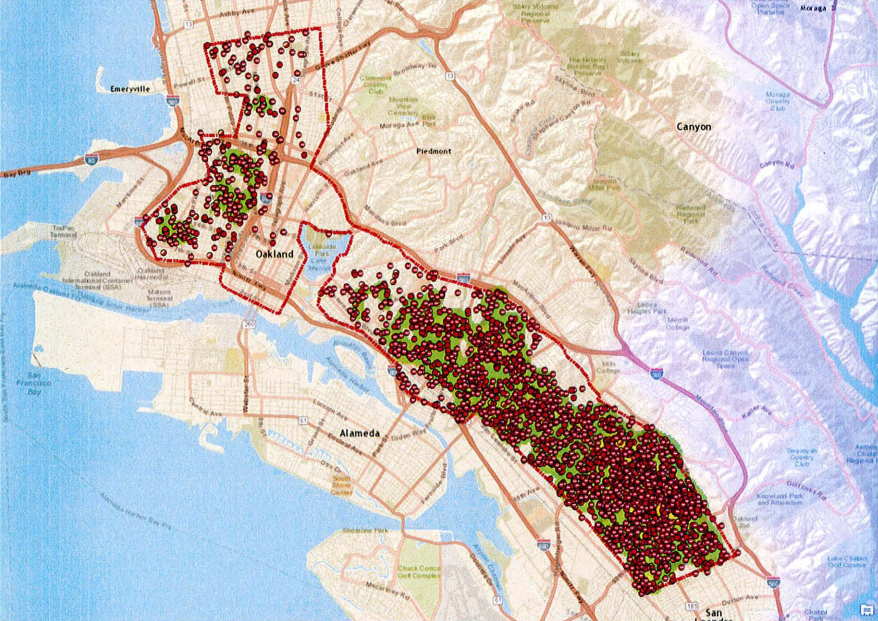
Map of gunshots detected by Shotspotter in Oakland during 2015.
Credits: Shotspotter/City of OaklandShotspotter: At Tuesday’s Public Safety Committee meeting, city councilmembers will consider entering into a four-year $1.9 million contract to consolidate a gunshot detection system that covers about 25 percent of Oakland’s geographic area. The system is called Shotspotter. It’s composed of microphones mounted on streetlamps and utility poles that record the sounds of gunshots, and then alerts police to the location of gunfire. According to Shotspotter and Oakland police, the system can pinpoint the location of a gunshot, and even tell if multiple shooters are firing different weapons. Oakland police has used Shotspotter since 2006. Last year, Shotspotter recorded 3,646 gunshots in Oakland.
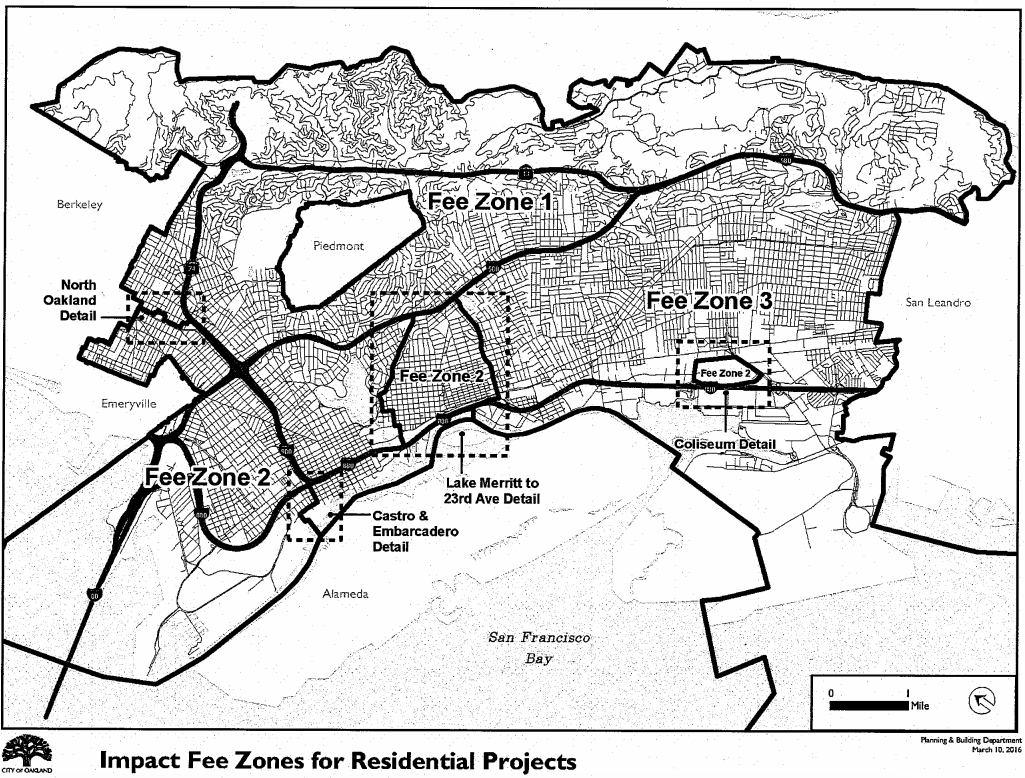
Proposed impact fee areas.
Credits: City of OaklandImpact Fee Adoption: In order to raise money for affordable housing, city staffers have drafted a detailed proposal for impact fees on new development in Oakland. The proposal will be presented at Tuesday’s Community and Economic Development Committee. It would create three different geographic zones that would cover specific parts of the city. Each zone would impose different fee levels on new housing development within its boundaries. But the zones wouldn’t be contiguous; rather, they would carve up the city into big swaths and little islands creating a complicated patchwork.
Making matters more confusing, the fee levels would also depend on the type of housing a developer is building, with the fee on single-family homes being higher than on multi-family apartments. Finally, the fees would be phased in between now and 2020, with fee levels in each of the three geographic zones, and for each different type of housing, increasing by different amounts each year.
Under the staff proposal, there would also be an onsite affordable housing option for developers who don’t want to pay the fees. Under the city’s proposal, a developer who sets aside 5 percent of the units in a development for very low-income renters would not have to pay the affordable housing impact fee. If the developer chooses to include units that are priced for low- and moderate-income renters, they would need to set aside 10 percent to avoid paying the housing impact fee.
Many affordable housing advocates think that the city’s housing impact fee plan sets fee levels too low, phases them in too slowly, and that the onsite option requires developers to build too few affordable units in exchange for not having to pay impact fees. For example, East Bay Housing Organizations, an advocacy group that represents affordable housing groups, presented the city with an onsite option that would require developers to ensure 22 percent of their building’s units are priced for very low- and low-income tenants.
1. The BART line between the Pittsburg-Bay Point and North Concord stations remain closed this morning, and the agency still does not know what caused the power surges that knocked fifty cars out of service last week, the Chron reports. The agency was able to bring 36 more cars on line today than on Friday but it’s still forty below what it has in service on a normal weekday because of power surges in February in West Oakland.
Dungeness crab.
Credits: Bert Johnson/File photo.
2. The commercial Dungeness crab season is scheduled to finally open this Saturday, March 26, in the Bay Area and along the Central Coast, the Chron reports. Fishery managers said that the dangerous neurotoxin that had infected the crabs earlier this season has now dissipated to “low or undetectable levels.” Crabbing, however, is still banned north of Mendocino County because of the domoic acid problem.
[jump]
3. California has the $21 billion needed to complete the first major section of the high-speed rail line between the Central Valley and San Jose, the LA Times$ reports, citing a new report from the nonpartisan Legislative Analyst’s Office. However, the state has yet to identify the other $44 billion it needs to complete the 500-mile long rail line between Los Angeles and San Francisco.
5. And Digital First Media, which owns the Oakland Tribune, Contra Costa Times, and the San Jose Mercury News, has acquired the Orange County Register and the Riverside Press-Enterprise, after a judge halted the proposed purchase of the Southern California papers by Tribune Publishing, the owner of the Los Angeles Times, the LA Times$ reports. The judge blocked the sale to the Tribune after the US Department of Justice said the deal violated federal anti-trust rules.
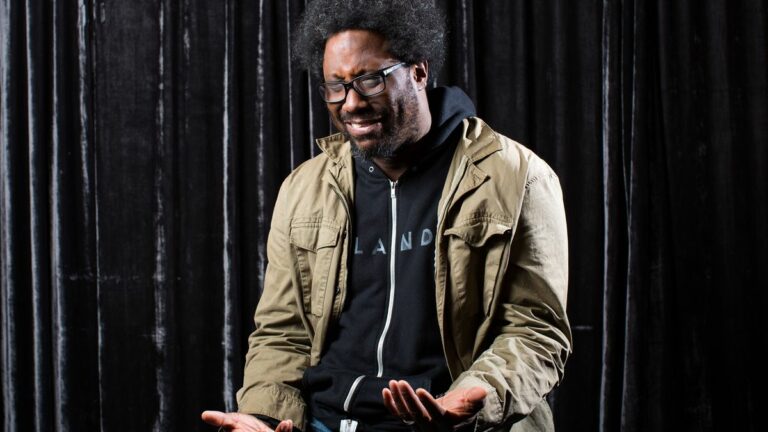
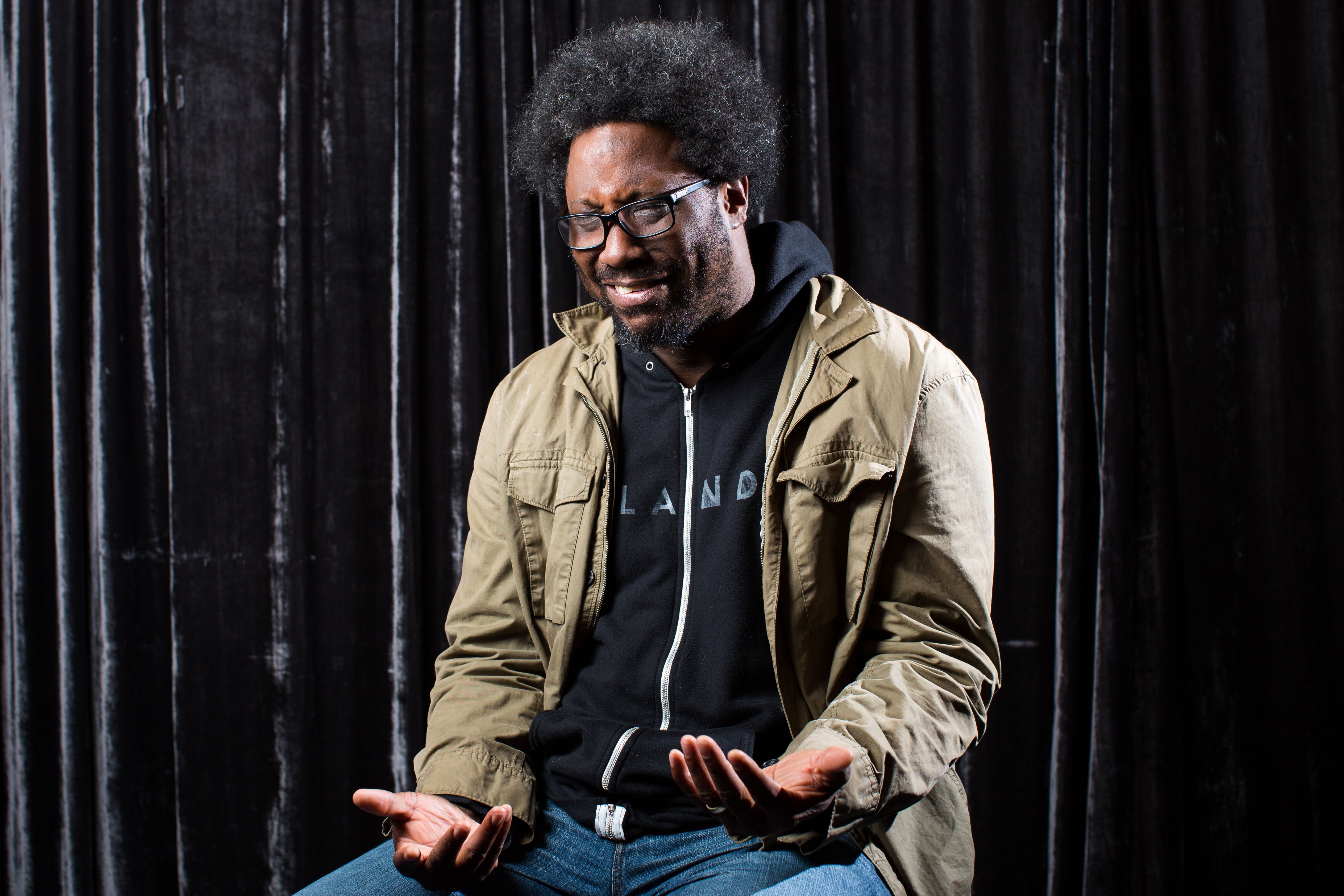
Last night, for the fourth installment of Kamau Right Now!, political comedian W. Kamau Bell had an incredibly awkward conversation with Oakland Mayor Libby Schaaf. During the KALW radio segment, Schaaf joined Bell on stage in front of a packed house at Oakland Impact Hub for a segment literally called “An Awkward Conversation with W. Kamau Bell.”
Bell began by reading Schaaf tweets that he received from fans after he announced that she would be a guest on the show. In the posts, fans lamented that although they love the show, they would not be able to attend because they dislike Schaaf so much. Bell followed up by asking if she felt like she was in a “hot seat,” to which Schaaf replied that she knows she can’t make everyone happy and that she feels like she’s doing “the right thing when everyone’s just slightly unhappy.”
But judging by the consistent heckling and hissing from the crowd, the audience seemed a little more than just slightly unhappy about the topics being discussed.
[jump]
Bell went on to grill Schaaf on the housing crisis, Uber’s imminent arrival in Oakland, an affordable housing proposal for the city’s East 12th Street property, and the meaning of “tequity” — a word the mayor often uses when talking about equity and tech. He mentioned that he’s been trying to move to Oakland, but can’t find a place to live, saying “Can you help me in any way? I don’t need the key to the city, just a key to one apartment.”
After hecklers in the crowd yelled out about the city’s attempted back room deal to sell the East 12th Street parcel to a developer intending to build only market-rate housing, Bell asked Schaaf why the city council decided to go with a developer that is going to build a mix of affordable and market rate housing as opposed to only affordable housing. “The Urban Core proposal will do way more to prevent displacement of Oaklanders than the so-called Peoples’ Proposals,” said Schaaf. “Way more.”
Bell later played the mayor a clip of Center for Media Justice director Malkia A. Cyril likening her to a pimp because she uses made up words like “tequity,” and asked what the word meant. Schaaf’s initial response was, “The great thing about making up words is they can mean different things to different people.”
Subscribe to the podcast here, or listen to the full episode below:
And here are some recaps and live tweets from the heated conversation:
1. The number of homicides In Oakland has plummeted so far this year, and the city is on track to record the fewest killings in three decades, the Chron$ reports. Currently, the city has had just seven homicides in 2016, compared to eighteen in each of the last two years at this time. Oakland police attribute the homicide drop to an increased emphasis on criminal investigations and to better cooperation with witnesses and city residents in solving crime.
5. The state Fair Political Practices Commission voted to tighten lobbying rules, closing a loophole that effectively had allowed ex-legislators to avoid registering as lobbyists and instead call themselves “experts,” the SacBee$ reports.
6. The US Justice Department sued to block the parent company of the Los Angeles Times from buying the bankrupt Orange County Register and Riverside Press Enterprise, alleging that the purchase violates anti-trust rules, the LA Times$ reports. The DOJ contends that the deal would give Tribune Publishing, which owns the LA Times, an unfair monopoly on daily papers in Southern California.
We hope you’re not too hung over from St. Patrick’s day, because between experimental electronic shows, spiritual zine releases, and art shows about queer dating platforms, you’re going to be pretty busy this weekend. See below.
Beast Nest, Un Operator, Slanted Square, and Flower Pattern
Emeryville’s Sgraffito Gallery took a brief hiatus from its monthly music showcase, PFC3, but is back once again with an electronic music lineup featuring several artists with an experimental edge. Beast Nest is the project of interdisciplinary Oakland performer Sharmi Basu, whose ambient, psychedelic sound collages have political underpinnings. As a queer artist of South Asian descent, Basu uses her work to invoke her feminist, anti-colonial politics in subtle ways. For instance, she dedicated her latest piece, #tfuugly (Or, “That Feeling When You’re Ugly”), to Black and Brown girls who are thriving despite Eurocentric beauty standards. Meanwhile, Un Operator, who is based in Utah, makes thumping, minimal house music that’ll get the party moving. Slanted Square, on the other hand, is a noise artist whose droning compositions share similarities with Beast Nest’s abstract work and Flower Pattern’s atonal, reverb-laden synth playing.— Nastia Voynovskaya
Fri., March 18, 8 p.m. $5. Facebook.com/Sgraffito
[jump]
Daghe Digital.Turnt
After throwing an epic birthday bash at the newly reopened Uptown Nightclub, featuring performances by up-and-coming Bay Area rappers Kamaiyah, Kool John, Jay Ant, and Larry June, Oakland DJ Daghe Digital is back at it with his next event, Turnt. The party’s theme is “06 Hyphy” (2006 was the year E-40’s seminal hyphy joints “Tell Me When to Go,” “Muscle Cars,” and “U & Dat” came out). And now that the kids who were in high school during the hyphy movement’s peak are in their twenties, nostalgia for Bay Area music from the mid-Aughts is at an all-time high. Nic Nac, an Oakland-bred producer who has worked with superstar vocalists such as Chris Brown, and Sake-One, the DJ behind the popular Thursday night party at Somar, Ultrawave, will be joining Daghe behind the decks. Rapper and FreeSpirit ambassador Beejus — who just dropped his conscious slap project BeeSmoove2 — will perform, as well.— Nastia Voynovskaya
Fri., March 18, 10 p.m. $13-$25
Justin Bieber in concert.Justin Bieber
Last year, I did something risky. I came out — as a Belieber. For the better part of 2014 and ’15, Justin Bieber had made a concerted effort to rid himself of his clean-cut child star image by any means necessary. But through messy public antics that made their way into the tabloids — such as egging his neighbor’s house — he also acquired the reputation of a major douche. And while perhaps this rebellious phase was necessary for his personal growth, he really could have skipped the drama and just released his excellent album Purpose, which won over a new crowd of grown-up fans and made any memories of JB’s teeny bopper days fade into the distance. Purpose shows Bieber maturing into a sultry vocal style that works well with sexy R&B production (such as the dark, sensual “No Sense” featuring Travi$ Scott) as well as house (like the Diplo- and Skrillex-produced “Where Are Ü Now”). Catch Bieber fever at Oracle Arena on March 18. — Nastia Voynovskaya
Fri., March 18, 7:30 p.m. $86-$126, OracleArena.com
Spirit Zine Release
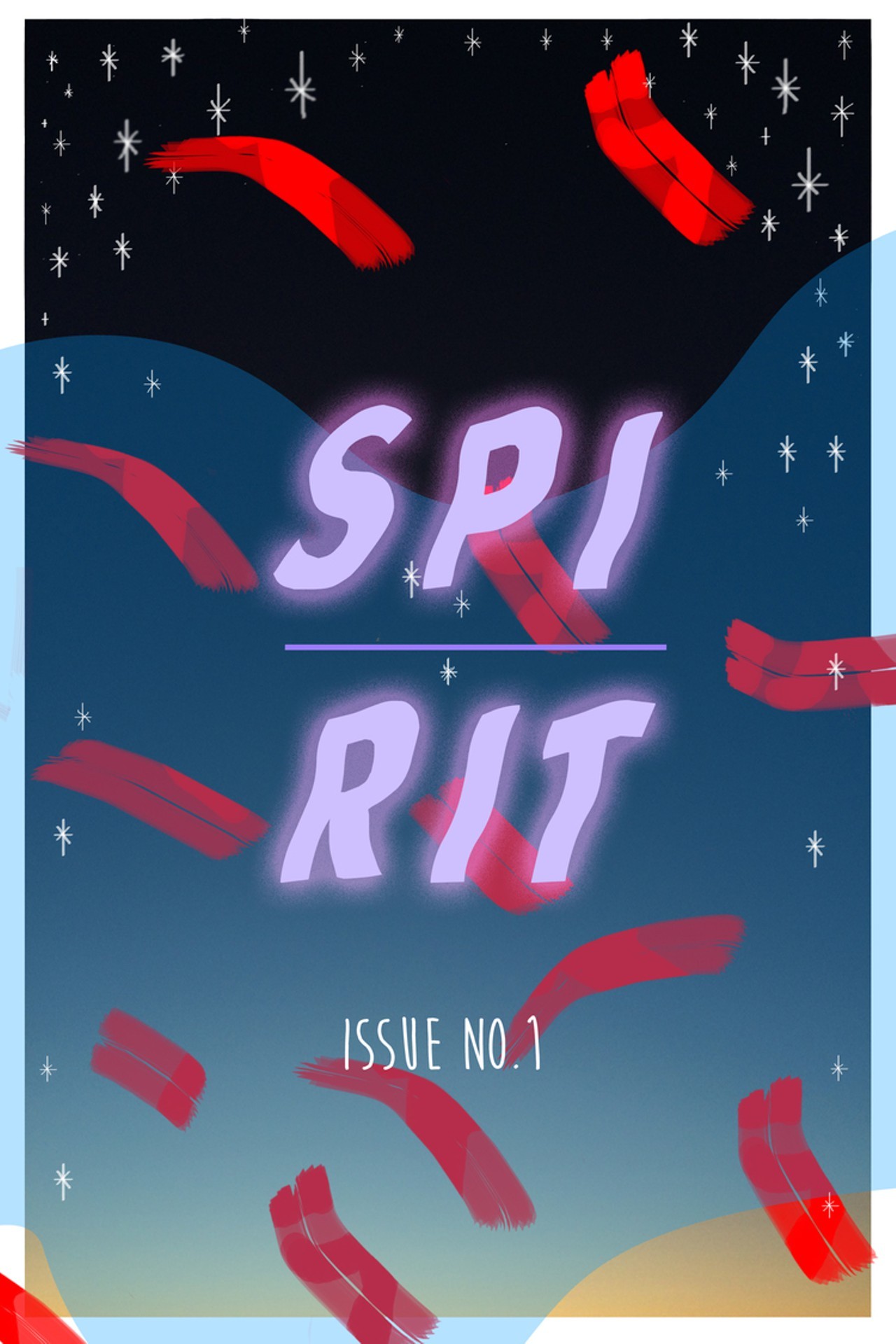
On March 19, Yetunde Olagbaju will release the first issue of Spirit, her new zine series intended to highlight spiritual practices by people of color. As she describes it, “the zine acts as an archive for folks to find connections between artistry, expression, spiritual practice, oppression, sexuality, and the ways these aspects collide within our respective lineages and ancestries.” The release party will take place at Qulture Collective (1714 Franklin St., Oakland) from 7–11 p.m. and will feature a collaborative performance by Kiyan Williams, an Oakland-based multi-disciplinary performance artist whose work incorporates movement, installation, and storytelling; and Jaleesa Johnston, a Bay Area mixed-media artist whose work explores the Black female body as both subject and medium. The event will also include a visual art exhibition of work from all over the country, including Oakland’s own Olagbaju, House of Malico, and Soleil Summers. — Sarah Burke
Sat., March 19, 7-11 p.m. $5–$10. YetundeOlagbaju.com
“Labeija Patio Set” by Adrian Clutario.WYD WYD is internet shorthand for “what you doing?” It’s also the title of Oakland artist and performer Adrian Clutario’s one-night-only solo show on March 19 at B4bel4b (184 10th St., Oakland) as part of its Emergent Media Lab series, which showcases contemporary Bay Area new media art. For the show, Clutario interrogates his experiences on social media platforms targeted towards gay men, honing in on his perspective as a queer, femme, person of color. Specifically, Clutario will be presenting paintings, sculpture, and performance that confront themes of objectification, racial fetishism, and internalized misogyny. Clutario’s work is also informed by his relationship to his drag alter ego, Adriana Clitaria, who the show’s description refers to as a “gender binary blur.”— Sarah Burke
Sat., March 19, 7:30 p.m. Free. B4bel4b.com
If your pockets are feelin’ light and you’re still yearning for more suggestions, we’ve got a ton, and these ones are all FREE! We’re Hungry: Got any East Bay news, events, video, or miscellany we should know about? Feed us at Sa*********@************ss.com.
There are a number of ways to take a stand on important social issues. East Bay rapper Aka Frank did so in an unabashedly sleazy fashion with his single “Racist (My Dick Ain’t),” an anthem for those whose attraction knows no bounds as far as culture and ethnicity are concerned. The song was an underground hit when it came...
SALTA, an East Bay experimental dance collective that holds a monthly roaming dance series with the goal of activating unlikely spaces with movement, is teaming up with the similarly non-traditional performance platform AUNTS to take over the Berkeley Art Museum and Pacific Film Archive (2155 Center St., Berkeley) on Friday, March 25, from 6–9 p.m. The dancers aim to...
In Good Times, artist Kelly Inouye’s second solo show at Interface Gallery (486 49th St., Oakland), Inouye invokes worlds that feel subtly familiar and yet distinctly strange. The water color painter uses scenes from Seventies and Eighties television shows — such as Dynasty, Good Times, Fantasy Island, Flipper, Gentle Ben, and Lassie — as source imagery for her fluid...
Not only is Erykah Badu the queen of late Nineties/early Aughts neo-soul, she was also a key figure in bringing Afrofuturist thought and aesthetics into the pop culture zeitgeist. Basically, everything Badu does is next level — from her socially conscious lyrics that speak out against oppression to her public actions that challenge harmful social norms. She proudly takes...
Court-appointed investigator and attorney Edward Swanson.
Credits: Courtesy of Swanson & McNamera LLP
An investigator appointed by federal Judge Thelton Henderson to examine the Oakland Police Department’s disciplinary system issued a second report today, finding that the Oakland Police Department and the city attorney have made significant progress fixing problems that have undermined efforts to hold police officers accountable for breaking...
This week, the Oakland City Council is scheduled to hold hearings on a massive infrastructure bond that would raise hundreds of millions to fix Oakland’s streets, sewers, parks, and even to rehabilitate housing. The council will also consider extending a contract with a technology firm that has installed a sprawling gunshot detection system around the city. And housing impact...
Stories you shouldn’t miss:
1. The BART line between the Pittsburg-Bay Point and North Concord stations remain closed this morning, and the agency still does not know what caused the power surges that knocked fifty cars out of service last week, the Chron reports. The agency was able to bring 36 more cars on line today than on Friday but it’s...
Last night, for the fourth installment of Kamau Right Now!, political comedian W. Kamau Bell had an incredibly awkward conversation with Oakland Mayor Libby Schaaf. During the KALW radio segment, Schaaf joined Bell on stage in front of a packed house at Oakland Impact Hub for a segment literally called "An Awkward Conversation with W. Kamau Bell." ...
Stories you shouldn’t miss:
1. The number of homicides In Oakland has plummeted so far this year, and the city is on track to record the fewest killings in three decades, the Chron$ reports. Currently, the city has had just seven homicides in 2016, compared to eighteen in each of the last two years at this time. Oakland police attribute...
We hope you're not too hung over from St. Patrick's day, because between experimental electronic shows, spiritual zine releases, and art shows about queer dating platforms, you're going to be pretty busy this weekend. See below.
Beast Nest, Un Operator, Slanted Square, and Flower Pattern
Emeryville’s Sgraffito Gallery took a brief hiatus from...