The hallmarks of King Hu’s Dragon Inn — the set-ups, the soundtrack score, the actors’ makeup, the voiceover narration, everything about it — are so different from today’s costumed action movies that Hu’s adventure seems beamed in from a far-away galaxy. That’s a reasonably accurate first impression.
Dragon Inn was produced in Taiwan in 1967, years after the first wuxia (heroic martial arts) pics were made for Chinese audiences. But actor-turned-writer-director Hu’s vision of a desert battle between ruthless agents of the imperial court and a desperate band of outsiders takes a familiar old story to new heights. The colorful spectacle that wowed Asian moviegoers when it was first released and eventually became a worldwide cause-célèbre.
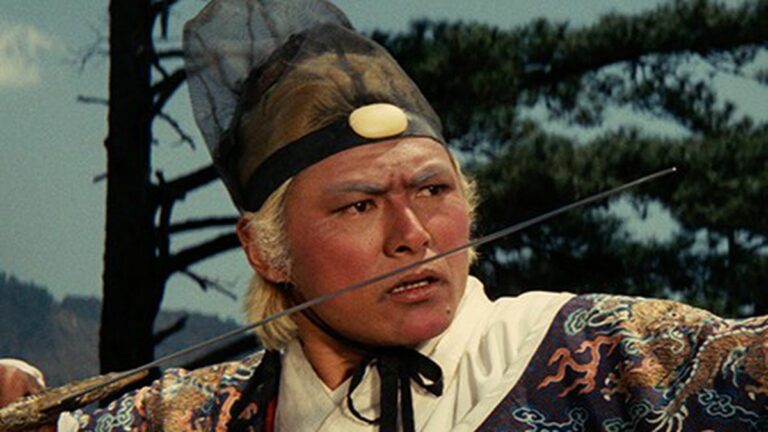
Bai Ying in Dragon Inn.
That was in a time before actors Jackie Chan, Bruce Lee, Jet Li, and such filmmakers as John Woo, Tsui Hark, and Ang Lee stamped their personalities on the martial arts film scene; and before Hollywood had thoroughly homogenized production values. Dragon Inn, made one year after Hu’s 1966 hit Come Drink with Me, is unapologetically Chinese. That undeniable otherness is part of its appeal, as is the fact that for years afterward Dragon Inn was generally unavailable except in tribute spinoffs such as Tsai Ming-liang’s postmodern art film, Good Bye Dragon Inn. But now the original is back, in a 4K digital restoration that puts its legendary ingredients on full display.
At the dusty title location, an authority-resistant Gang of Four led by cool-headed wanderer Xiao Shaozi (Shi Jun) and a beautiful swordswoman named Miss Chu (Shang Kuan Ling-Feng) interrupts the sinister strategies of one Cao Shaoqi, a power-hungry — and lethally combative — eunuch of the imperial court, played by actor Bai Ying with a shock of white hair and a permanent sneer on his face. Cao is determined to wipe out the family members of a rival by assassinating them on their exile trail to Dragon Inn, thus eliminating obstacles. This plan seems grossly unfair to Xiao, Miss Chu, and their friends, and the fur begins to fly.
It’s easy to see how Dragon Inn acquired a mythical status during its absence. Hu’s widescreen compositions are superb, with sweeping desert vistas capped by a mountain-top battle royale finale. The female warrior, hardly a novelty in 1967 Chinese epics, gains a new dimension with Shang’s balletic grace — offscreen, she achieved second-degree black belts in karate and tae kwon do. And if Hu’s settings and deliberate pacing seem reminiscent of Sergio Leone (his spaghetti westerns were already famous when Hu began directing), then Shi Jun is certainly Hu’s Clint Eastwood — a cool, laconic stranger with deadly sword skills. But Bai Ying’s extravagantly weird shadow-emperor, Cai, steals the show. Despite the castrato jokes from his adversaries, he’s magisterially creepy with his white hair and red cape. (Worse still, halfway through the climactic fight his mussed hair makes him look like Donald Trump.) The director peppers the buildup scenes with such playful stunts as a noodle bowl tossed across a room, sight gags with poisoned liquor, sneak attacks at bedtime, etc.
Janus Films recently acquired both Dragon Inn and Hu’s 1971 follow-up A Touch of Zen for theatrical re-release and home video via its Criterion Collection. As such, they’re the event of the year for wuxia fanatics. For audiences even vaguely attracted to sweeping visual extravagance and indelible characters, Hu’s work represents a quantum leap forward for Chinese-language fantasy. See it and shiver with delight.
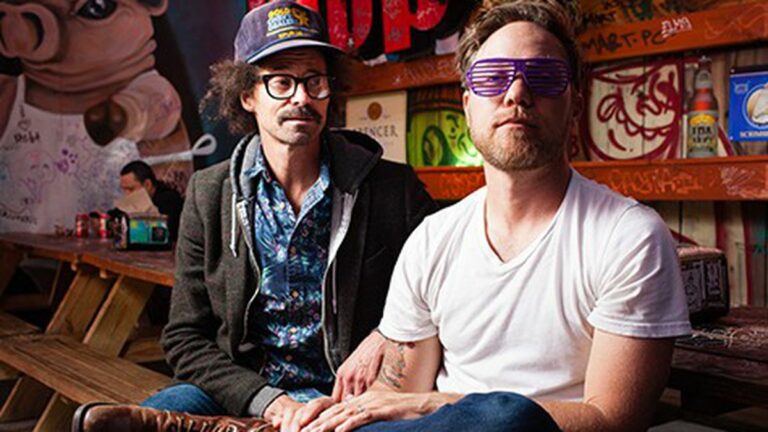
Zach Rogue and Pat Spurgeon of Rogue Wave sat at Telegraph Beer Garden, enjoying sandwiches and brew on a recent afternoon. The duo reminisced about playing a show once in the parking lot: in 2004, with freak-folk duo CocoRosie, before either band had blown up. This was back when the café was still called Mama Buzz, and two years before Oakland Art Murmur started as a tiny block party around the corner, not the large-scale street fair it is today.
Rogue and Spurgeon were among the wave of white, middle-class artistic types that moved to Oakland in the early 2000s — part of the so-called “new creative class” that developers and politicians loved to advertise to outside investors.
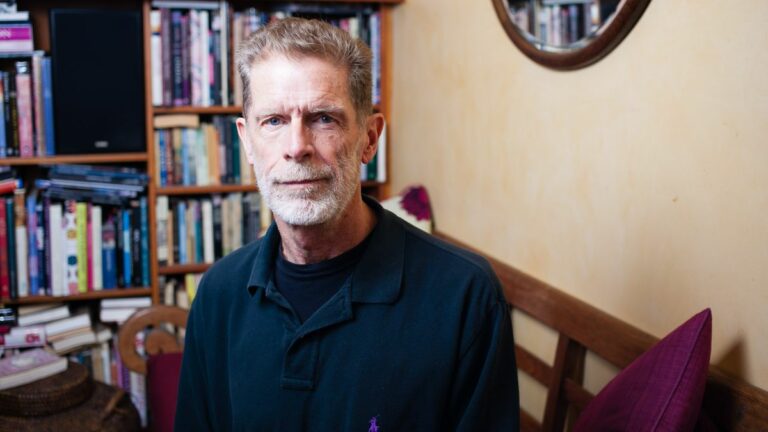
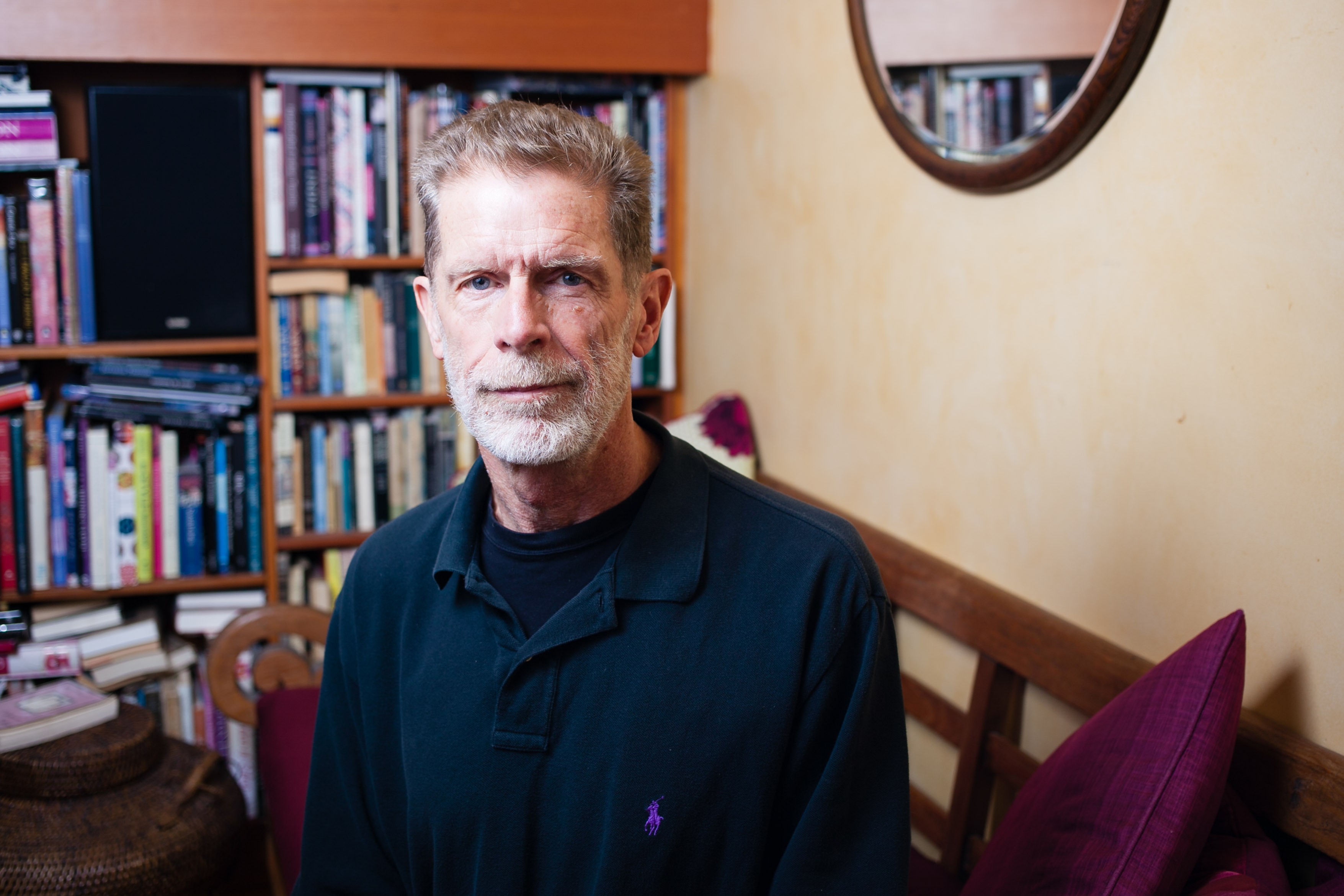
Pat Spurgeon (L) and Zach Rogue.
Credits: Bert Johnson.
Now, the members of Rogue Wave say they can’t afford to live in Oakland, so they’ve scattered about the Bay Area. Singer, guitarist, and chief songwriter Rogue and versatile multi-instrumentalist Spurgeon moved to Marin County. A father of two, Rogue remarked that his mortgage now is less than Oakland rent.
Rogue Wave’s been a band in the Bay Area for a decade-and-a-half, and its evolution has taken place amid this backdrop of tense civic evolutions and rampant gentrification. And Delusions of Grand Fur, its latest album, reveals a band grappling with how to make thoughtful rock music amid a pop-culture climate where audiences are conscientious of how artists fit into their surrounding social and political climates.
There’s more: Just as Oakland grew increasingly gentrified over the course of the band’s career, indie rock became commercialized — and less subversive. What began as a DIY genre — one that offered an alternative to the supposedly more capitalist realm of pop — turned into palatable background music for car commercials. Popular festivals such as Coachella begot a veritable music festival industrial complex. Now, companies cash out tens of thousands of dollars to put up merch booths at fests, and tickets sell out before lineups are even announced.
So, in the process of writing Delusions, the question of rock music’s fading impact weighed heavily on Rogue, and he wanted to sway people. Case in point: The cover of the album features a desecrated portrait of Confederate General P.G.T. Beauregard, with his eyes missing as if gouged out. Having a confederate general on the cover could be read as somewhat of a tone-deaf choice (and not unfairly so). But the intention behind it, as Rogue explained it, was to allude to white America’s blindness to the violence of its imperialist past and present.
Though the group enjoyed considerable commercial success during the 2000s — including a deal with influential Sub Pop Records and licensing music to The O.C. — Rogue and Spurgeon decided to return to their DIY roots and write and record this album in a studio they set up in Oakland.
The duo gleefully recalled breaking industry standards during the process, now that they weren’t working with a team of producers and engineers. They recorded some of the instruments with professional microphones, and others using iPhones. Instead of making demos and re-recording more polished versions of the tracks, as they had previously done, Rogue and Spurgeon put down songs in quick takes that sought to capture the excitement of the process.
“The guy who was mixing our record felt the brunt of that,” joked Spurgeon.
“He’d be like, ‘You need one guitar, not fourteen here,” Rogue laughed.
Despite its heavier conceptual underpinnings, Delusions is a light, breezy pop record that conveys the easygoing, experimental process behind it. But there’s gravity to it, too. Rogue passionately talked about poring over news reports of bombings in Syria, and the ongoing refugee crisis, while songwriting. That was how he came up with the name of the album: To cope with the horrors of this world, everyone indulges in one delusion or another, he reasoned.
“We live in a very highly dysfunctional society, and it requires a certain amount of make-believe for us to be who we are,” he said. However, as an easy-to-listen-to record with its ideological points largely cloaked in metaphor, Delusions of Grand Fur isn’t an obvious rebellion. But it’s an invitation for listeners, especially ones with privilege, to consider issues of racial inequality and the growing class divide — issues to which they may have previously had the luxury of turning a blind eye.
I’m a 31-year-old straight woman. I have a good job, great friends, and average attractiveness. I’ve dated close to 30 men at this point, and I can’t wrap my head around this: I’ve never had a boyfriend or dated anyone for more than a couple months. It’s really starting to wear on my self-esteem. I don’t believe anything is wrong with me, but the more time goes on, the more I think I have to be doing something wrong. The guys ghost me or things fizzle out or we’re not at the same point in our lives. This is particularly true for one guy I’ve remained friends with (common social circle) who is struggling with his career, though things are still awkward because it’s clear there’s still something there. Another area of concern: I’m still a virgin. Catholic guilt resulted in me being a late bloomer, with my first kiss at 21. Once I got more into dating, my low self-esteem coupled with the fact that I’ve basically decided I want to be in a monogamous committed relationship with a guy before having sex, relationships just never happened. I don’t have unrealistic expectations that I’ll marry the first dick that sticks itself into me — but I’ve waited this long, so I’m not going to jump into the sack with just anyone without knowing that I can at least trust them. The only guy I really do trust is Somewhat Depressed Guy, but propositioning him could further complicate our already awkward friendship. Is something wrong with me, and what the hell should I do?
What’s Wrong With Me?
I get variations on the first half of your question — is something wrong with me? — all the time. But it’s not a question I’m in a position to answer, WWWM, as I would need to depose a random sampling of the guys you’ve dated, interrogate your friends, and grill you under a bare lightbulb for a few days to figure out what’s wrong with you.
And you know what? Nothing could be wrong with you. You may have pulled the short straw 30 times in a row, and you just need to keep getting out there and eventually you’ll pull a guy who won’t ghost or fizzle on you.
As for the second half of your question…
What the hell should you do? Well, gee. What you’ve been doing hasn’t worked, WWWM, so maybe it’s time to do something else. Like fuck some dude on the first date. Or if that’s too drastic, fuck some dude on the second date. Or better yet, go to Somewhat Depressed Guy and say: “I don’t think you want a relationship right now, and I’m not sure I do either. But I like you and trust you, and I could really use your help with something…”
While the commitment-and-monogamy-first approach has worked for some, WWWM, it hasn’t worked for you. And being a virgin at 31 isn’t boosting your self-esteem.
Somewhat Depressed Guy might be somewhat less depressed if he was getting some, you might have higher self-esteem if you finally got some, and dispensing with your virginity might make dating after you part ways — if you part ways with him (you never know) —seem a lot less fraught.
I’m a virgin in my late 20s. I’m not waiting until marriage, just for the right person. I’ve dated enough and had enough fun to continue being a happy, normal, socially competent guy, much to the disbelief of my various knuckle-dragging, vagina-blinded pals. I’ve been dating this gal for a few months. She’s special — we have tons of chemistry and she cares about me. We had a brief conversation about my lack of sexperience when we first started dating, and she was very cool about it. I really like this girl, but I’m not sure yet if she’s the future Mrs. I am a worrier (thanks, mom!), and I find myself thinking that if I share this with her and somewhere down the road we end up breaking up, she’s going to be even more devastated because I shared my first time with her. Am I just having silly virgin worries? Not only am I concerned about her feelings if things don’t work out, but I’m also concerned that I might become vagina-blinded — that I might immediately tell this girl I want to spend my life with her just because she’s having sex with me only to find myself a few years down the road feeling trapped. What should I do?
Very Indecisive, Really Gettin’ Naughty
You should fuck this girl already — provided, of course, that this girl wants to fuck you.
You could wind up saying things you come to regret or have to walk back — her vagina might be that bedazzling — but that’s an unavoidable risk, and not one that’s unique to virgins. The right vagina, ass, face, skill set, or bank balance can blind a fucker with decades of experience. The only way to avoid vagina-blindness — or ass-blindness, etc. — is to never have sex with anyone. And I don’t think you’re interested in celibacy, so stop freaking out about the risk that you’ll imprint, duckling-like, on the first vagina your pee-pee sees the inside of.
You must also eliminate “sexperience” from your vocabulary, VIRGN, as it’s equal parts cloying and annoying.
I’ve been with my boyfriend for more than a year. He’s the first person I’ve had sex with. Four times now while we were having passionate sex, he has slipped out of my vagina and accidentally penetrated me anally. That shit hurts, and I can’t help but cry. I know he feels super guilty each time. I love sex, but I’m kind of scared every time we have it now. We’ve engaged in a little anal play before, and I wasn’t really a fan. But I’m not adverse to the idea of using a butt plug. Do you think this would work? Surely other people have this problem too, right?
Wrong Hole, Anal Torment
My own personal sexperience with anal led me to doubt claims of accidental anal penetration, WHAT, as anal penetration always required focus, precision, and proper breathing techniques — in my own sexperience. But listeners of the Savage Lovecast schooled me in Episode 340, and I’m now convinced that accidental anal penetration is something too many women have sexperienced. (Do you see how annoying that is, VIRGN?)
A strategically deployed butt plug sounds like a sexcellent solution to the problem, WHAT, but get yourself a plug with a wider-than-usual base to prevent your boyfriend’s misdirected cock from pushing the plug, base and all, all the way in you (ouch) or his misdirected cock from sliding in alongside the plug. (If you hate single penetration, you’ll really hate double penetration.)
If the problem persists even with a plug — if your boyfriend’s cock is constantly slamming into the plug in a way that you find uncomfortable — a thumbtack glued to the base of the plug will inspire your boyfriend to be more focused and precise.
And speaking of the Savage Lovecast, we’re coming up on our 500th episode, which is a significant milestone for this relatively new genre/platform/doohickey. If you’re not already listening, find it here: SavageLovecast.com. And a big thanks to Nancy Hartunian, the Lovecast‘s producer since Episode 1, and to the tech-savvy, at-risk youth who pushed me to start podcasting before it was cool.
It’s a daunting premise, but one that the cast of director Mark Jackson’s Hamlet pulled off with wild success: seven actors learned every part in the play, and, minutes before show time, assembled on stage to pick their roles out of a prop skull. After a few minutes of preparation, the show began. The production opened at Shotgun Players (1901 Ashby Ave., Berkeley) on March 31 and will run through May 15, with regular repertory performances after that. But with 5,040 possible casting combinations, it’s likely that no two performances will be the same.
By opening up Hamlet to thousands of possible casting combinations, Jackson inevitably defies traditional assumptions about the gender, age, and race of the play’s well-known characters. For instance, the titular Hamlet might be played by a woman and his love interest, Ophelia, might be decades older than the young prince. Rather than hampering the performance, this spontaneous diversity seizes upon the universality of Shakespeare’s work in a way that many other productions fail to — fully revealing the kernels of common humanity within each character.
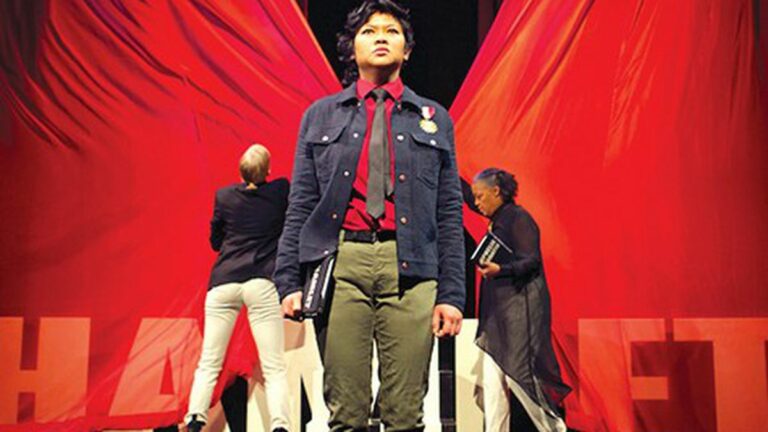
El Beh as Hamlet.
Credits: Pak Han
The performance I attended included a completely nontraditional cast, including women in the roles of Hamlet (El Beh) and Polonius (Beth Wilmurt), Ophelia’s father. Meanwhile, Hamlet’s mother and stepfather, Queen Gertrude and King Claudius, were played by Nick Medina and Megan Trout in a compelling, gender-swapped pairing. The production took a few scenes to find its footing, but Beh’s powerful performance as a delightfully snide, dark-humored Prince of Denmark soon set the tone for a dark but decidedly witty Hamlet.
As if the rotating casting wasn’t challenging enough, several actors played not one, but two roles throughout the night. Medina and Trout, who played Gertrude and Claudius, also played the inept courtiers Rosencrantz and Guildenstern, allowing the duo to stay together throughout most of the performance. Similarly, Cathleen Riddley played both Horatio, Hamlet’s best friend, and Ophelia, Hamlet’s love interest. This casting combination was the only one that proved less-than-stellar on the night that I observed, as Riddley was forced to move between two very different roles — and a hefty amount of dialogue — in rapid succession.
But for the most part, the unconventional casting allowed the audience to experience the nuances of the play’s key relationships — such as those between Ophelia and her father, Gertrude and Claudius, and Hamlet and, well, everybody — without being clouded by preconceived notions about how men, women, lovers, or families are “supposed” to relate to one another.
The overall production was meticulously paced with few discernible missteps. Perhaps that’s due to the cast’s grueling rehearsal process that began in February, which involved round robin-style scene work in which all members of the cast would rehearse each part in any given scene. In addition, Jackson worked with the actors to cut the original text down to its final two-and-a-half-hour runtime. All that preparation clearly paid off: The cast’s timing and dialogue delivery were both outstanding.
Besides its casting and rehearsal practices, the production is also cleverly self-reflexive. Sparse set design by Nina Ball consisted of one onstage platform shrouded by two sets of red curtains, plus an illuminated applause sign that was deployed at strategic moments. Rather than disguising the theater, the set up emphasized its aesthetic tropes, reminding the audience of the play’s “play-ness” even as they watched it unfold.
Similarly, the actors held onto their scripts — bound in black covers and embossed with their respective characters’ names — throughout the performance. Presumably, the books served as safety blankets — although they were never used for emergency line retrieval in the production I attended. But, with some imagination, they also functioned as impromptu props, like the gravedigger’s shovel or a dossier of Hamlet’s love letters to Ophelia.
At the start of the show, holding the skull that contained the evening’s cast list, director Mark Jackson offered some sage advice about life and theater. “We all know where we end up,” he said, gesturing to the skull. “The journey is the thing.” Indeed, Shotgun Players’ Hamlet is an exhilarating journey, and one that manages to stoke the audience’s appreciation for the very mechanics of theater while its powerhouse cast brings new vitality — and vigor — to a well-known play.
Perhaps you snagged a copy of this week’s Express, took one look at Donald Trump’s rug on the cover, and thought to yourself, “No thanks.”
I feel you. We all want this Trump soap opera to disappear, for the man to exit political stage right — tiny hands in his pockets, coif hopelessly ruffled — and return to hosting some half-rate reality show. Last summer, I even recommended implementing a “Trumpatorium” at my former paper, the Sacramento News & Review.
The Express will still be a vital City Hall watchdog … unlike Bernie, the new editor’s best friend.
Credits: Nick Miller
That’s right: This is my first issue as
editor-in-chief of the Express. And Trump is on the cover. What have I done?!
In all seriousness, while I’m not thrilled to lend The Donald this fine paper’s primo front-page real estate, I know it’s crucial. Traditional journalists keep validating the man — I’m talking to you, cable TV news — so it’s become the adopted role of the weekly paper to skewer him. (Dive in for more on page 12.)
Anyway, I’m new to town. Or, The Town. My last 12 years were at SN&R, the free weekly in this state’s capital. During the last four, I was co-editor, which means I oversaw features, news and investigations, and occasionally dabbled in some food or music reporting.
That paper’s mission aligns with the tradition of smart journalism here at the Express. So don’t fret: This paper will still be the East Bay’s watchdog. It will still dig into public records and keep the powerful in check. It will still dish on exciting and worthy food spots, art galleries and musicians. And it will definitely still raise hell.
But the Express will also change in the coming year. There will be new voices. In twelve months, my hope is that you’ll
flip through these pages and read
columns and stories by a diverse mix of writers who better reflect the East Bay community.
I’m also mindful that journalism is changing, and that honest and clearheaded reporting is more important than ever in the East Bay.
To that end, you’re probably asking why I’m qualified to carry the Express torch, what with all the terrific folk who’ve pounded keyboards in this building over the years. Fair question. (And our prez asked me to brag a little.)
My departure from SN&R last month ended on a high note. In March, I
accepted the Northern California Society of Professional Journalists James Madison Freedom of Information Award, for our reporting on Sacramento mayor and former NBA star (and Cal standout) Kevin Johnson. My drama with K.J. is a marathon tale — he sued my paper! — but shoot me an email and I’ll share more over coffee. (It’s Ni*********@************ss.com.)
More crowing about awards? OK, fine: This past Saturday, I was on the 32nd floor of the Westin St. Francis near Union Square holding in my hand the California Newspaper Publishing Association’s first place “General Excellence” plaque. This is awarded each year to the best weekly paper in the state. That was a sweet moment.
Writers I collaborated with also took home first-place prizes: for best investigative reporting (exposing incompetence, and worse, at City Hall and saving Sacto water users north of $65 million), and for local-government reporting (on how Sacramento’s sheriff issued more concealed-carry gun permits than any other major California lawman).
So, why leave a good thing? Why skip on my hometown for the Bay? It’s simple: I love it here. I was actually born in the Bay Area. My dog is named Bernie (after Coco Crisp and Bernie Lean, not Sanders). I’ve always admired this region’s political grit, and the audacity of its creatives. Oaklanders and Berkeley residents are unafraid to dare, be it challenging the establishment at City Hall or rolling the dice on a local business that celebrates a neighborhood. I dig that. And I’m thrilled to have parachuted into this place, to be accepted as a part of it. It’s a privilege to spend my days sharing your stories.
I’m looking forward to it — and to focusing a lot less on Trump.
With apologies to Alice Waters of Chez Panisse, it is the Cal-Italian restaurant that is, in many ways, the quintessential East Bay eatery. There’s a reason why places like Dopo and Pizzaiolo — two of the first restaurants I fell in love with in Oakland — remain reliable favorites for Town natives looking to impress out-of-town guests. It’s a simple formula for success: gorgeous salads, seasonally-topped wood-fired pizzas, and maybe a pasta dish or two. Rinse and repeat.
But there’s one Cal-Italian restaurant you may not have heard of, despite the fact that it has been open for four years, with a chef who is an alumnus of such well-regarded restaurants as Oliveto and Dopo. That’s because — well, it’s in Kensington.
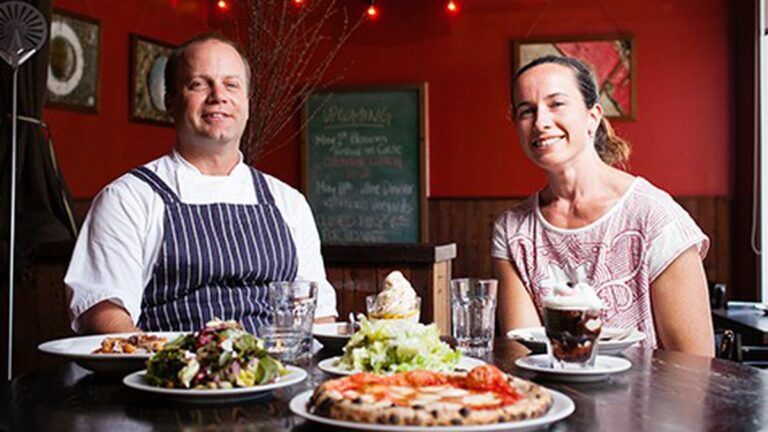
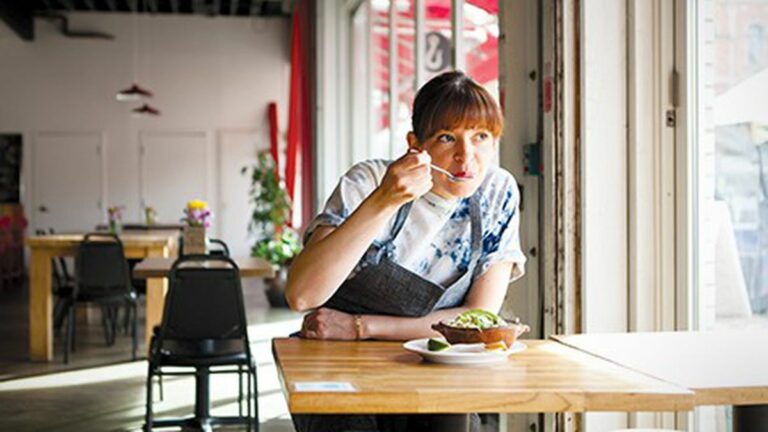
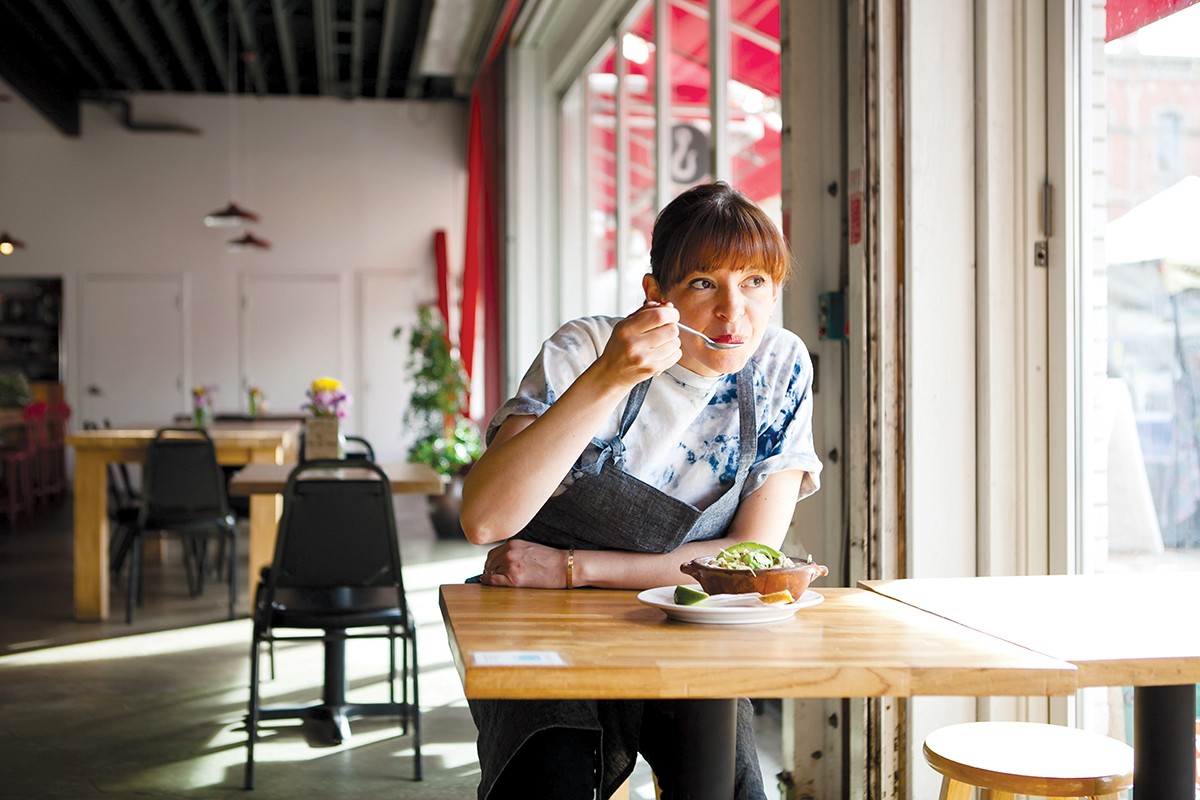
Owners Peter and Melissa Swanson sit down for a meal at Benchmark Pizzeria.
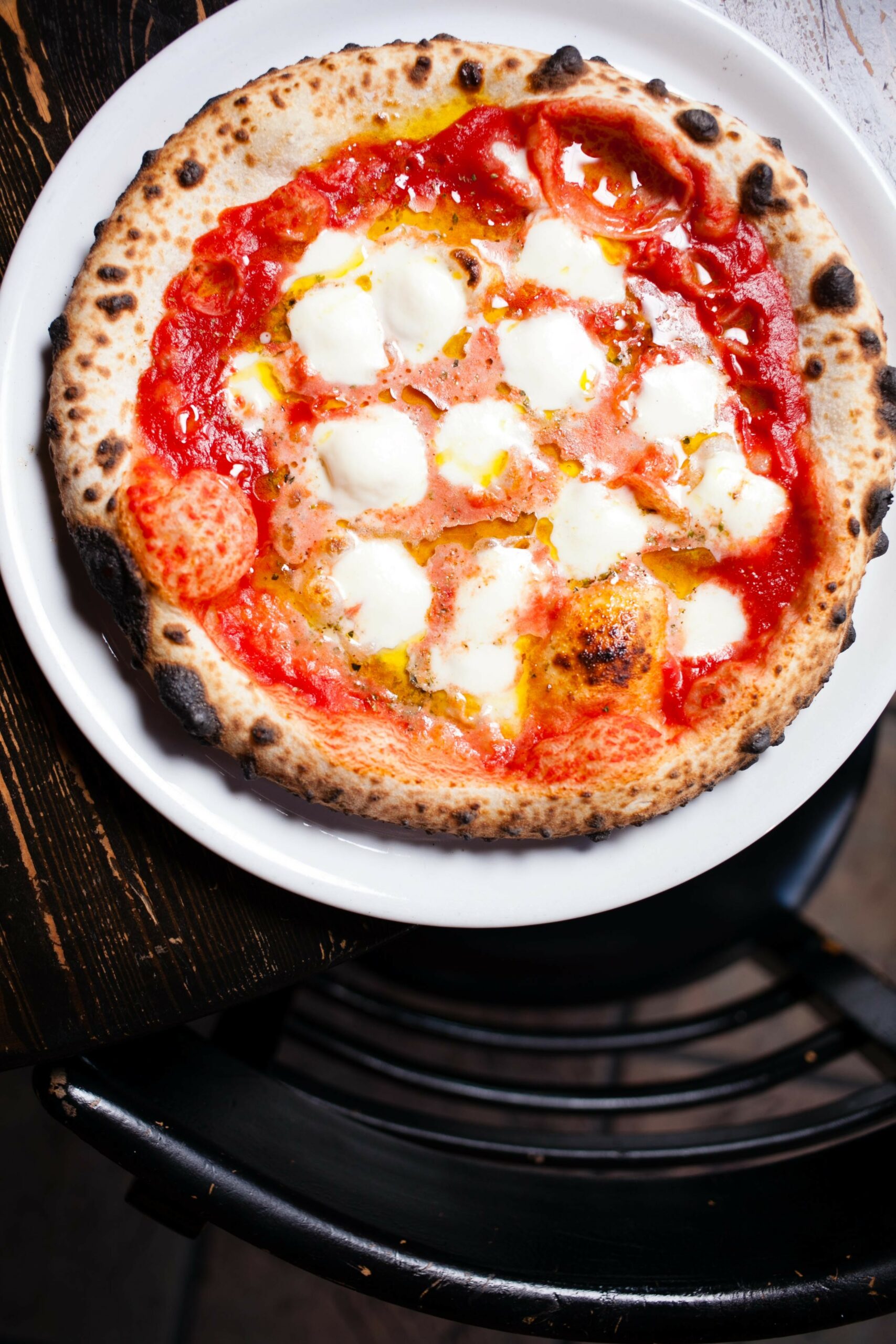
Credits: Bert JohnsonBenchmark’s take on a margherita pie.
Credits: Bert Johnson
Husband-and-wife team Peter and Melissa Swanson opened Benchmark Pizzeria in 2012 in the quaint little traffic circle that constitutes Kensington’s main commercial strip. Melissa, who runs the front of the house, has worked as a host and server at various East Bay restaurants, including Oliveto. That’s where she met her husband, Peter, who worked as a line cook there until he left to help launch Dopo as its opening sous chef.
Named after the survey markers — i.e., the literal “benchmarks” — that Peter Swanson’s geologist dad used to seek out during family hiking trips, the restaurant prominently displays its longitudinal and latitudinal coordinates as part of its official logo. I suppose this is handy, given that so many East Bay residents seem to be blissfully unaware of where the heck Kensington is. (For the record, the unincorporated community sits just to the west of El Cerrito — or a few blocks north of Solano Avenue, if you prefer.)
The Swansons said they chose to open Benchmark in Kensington’s Colusa Circle neighborhood in part because their home is just a few blocks away. In their view, the fact that it’s away from the main nexus of Oakland’s recent restaurant renaissance has been a mixed blessing. On the one hand, Benchmark hasn’t really had to compete with, say, a nearby Dopo or Pizzaiolo. On the other hand, even after four successful years, the restaurant still flies almost completely under the radar among non-Kensingtonians. (This also makes Benchmark not a bad choice if you’re looking for someplace nice to bring your side piece. I’m just saying.)
The Bay Area has no shortage of high-quality wood-fired pizza, but Benchmark’s is good enough to merit special recognition. Swanson describes the style as “Neo-Neapolitan,” which really just means the chef takes a certain number of liberties with both the toppings and the crust.
The signature “Benchmark” — Swanson’s take on a classic margherita pizza — is fairly traditional: fresh mozzarella that the chef hand-stretches in-house each morning, a simple tomato sauce, high-quality California olive oil, and a scattering of dried Sicilian oregano. (Basil, margherita pizza’s standard greenery, is only used in season.) Other pies paid no mind at all to the officially sanctioned ingredient list of the True Neapolitan Pizza Association (a real thing), even if the flavors were still more or less Italian — pizza topped with sage and brown butter, or sausage and radicchio. Diners who don’t mind a bolder-tasting pizza will dig the pie that married the bright fruitiness of Calvestrano olives with the pungency of whole anchovy fillets.
What I loved most about the pizzas was the crust itself, which was thicker and quite a bit chewier than the kind of floppy, “knife-and-fork” pizza typically associated with the Neapolitan style. These are more of a hybrid: Cooked in the wood oven at around 800 degrees Fahrenheit, the pizzas come out blistered — or “leoparded,” in pizza-making parlance — enough to please any thin-crust connoisseur. But the crust is also sturdy enough, and crisp-bottomed enough, that you can fold it in half and eat it like a New York slice.
One advantage Benchmark has over its more famous Oakland counterparts is that the food is less expensive. The restaurant’s daily prix-fixe is one of the better dinner deals around: $18 for the Benchmark pizza and a salad, which could easily feed two diners of modest appetite. Go for the Caesar — a big mound of well-dressed romaine hearts showered generously with curlicues of Parmesan cheese.
What’s notable, too, is the way the restaurant sometimes veers away from the usual Cal-Italian flavor palette. For instance, a salad of spicy carrots was a showcase for intensely sweet shredded carrots, golden raisins, almonds, and mint. The ingredient list read Middle Eastern, but the bright acid and chili heat reminded me of Thai-style papaya salad more than anything else. Other times, the menu might feature dishes from Swanson’s childhood in Georgia — boiled peanuts or pickled green beans, for instance.
And while avocado toast is one of those on-trend Californian dishes that you’ll find at dozens of Bay Area restaurants, Benchmark’s is the only one I’ve eaten that had a thick slice of deep-fried bread as its base and that featured the spicy tang of a pickled Calabrian chili spread. My only complaint was that it was awfully difficult to eat: The bread was so crispy that we were given a serrated steak knife to slice it up, and because the avocado was presented as large slices instead of the usual mash, the whole thing tended to fall apart.
On the other hand, the rotating selection of three or four fresh pasta dishes aren’t so much a vehicle for creativity as they are rustic comfort food — pure and simple. Spaghetti carbonara has long been one of my favorite pasta dishes, in part because it was one of the first things I learned how to cook, yet I rarely see it served at restaurants. So, it took me about one second to decide to order Benchmark’s very spring-like version, which came tossed with chopped asparagus and cubes of smoky pancetta. My only regret: The rich, egg yolk-based sauce came pre-mixed, denying me the pleasure of stirring in the raw yolk myself — my favorite part of eating a carbonara.
The best of the pasta dishes was the strozzapreti Bolognese, which features my favorite pasta shape name — the Italian, translated literally, means “priest stranglers,” and is one of those food words with an entomology that has a half-dozen apocryphal explanations. No matter: The narrow crevices of these squiggly, double-barreled noodles were ideal for picking up bits of the classic Bolognese — an extra-savory mix of Marin Sun Farms ground chuck, pancetta, tomatoes, and thin shavings of Parmesan that melted into sauce.
One of the most striking things about Benchmark is how kid-friendly it is. If you dine on the earlier side, you’ll find that a toddler presides over nearly every table. The kids’ menu, which includes kid-safe pizzas that are just as big as their grownup counterparts, is one of the most appealing in the East Bay, and the entirety of the dessert menu — with its Coke floats, chocolate chip cookies, and soft-serve ice cream sundaes — is like an eight-year-old’s dream come true.
More than anything, I appreciated the warm, easy-going service and the way the restaurant felt more approachable and less precious than many of its Cal-Italian counterparts in Oakland or Berkeley — despite the fact that the food was just as good and the sourcing of ingredients just as conscientious. The bottom line: Now I have a reason to go to Kensington.
Is Berkeley’s latest minimum-wage plan a sincere attempt to boost worker pay—or a “cynical ploy”?
That’s what some debated after last week’s Berkeley City Council meeting, when the council voted to place an initiative on the November ballot to increase its minimum wage to $15 by 2019. Several dissenting councilmembers said the proposal is actually a plan to torpedo an existing minimum wage initiative that arguably would do more for workers by confusing voters and possibly splitting the vote — which could result in no pay increase whatsoever.
David Fielder said Councilmember Capitelli’s minimum wage initiative falls short of a living wage.
Credits: Bert Johnson
“This is such cynical politics,” Councilmember Jesse Arreguin said of the maneuver, which was proposed by Councilmember Laurie Capitelli and supported by Mayor Tom Bates and a majority on the council. “It’s a way for Capitelli and the chamber of commerce to kill the minimum wage initiative that’s already going to be on the ballot,” he said.
The other minimum wage initiative Arreguin was referring to is sponsored by labor unions and dozens of activists, who have gathered thousands of signatures over the past half year to place it on the 2016 general-election ballot. It would increase Berkeley’s minimum wage to $15 by 2017, and then increase this amount each year by 3 percent, plus inflation, until it reaches the city’s defined living wage. The current living wage, as defined by the city, is $16.37 an hour, and it rises each year to keep up with inflation.
The activist-sponsored measure would also provide Berkeley workers with sick days, a provision not included in Capitelli’s initiative.
Councilmember Kriss Worthington, who also voted against Capitelli’s motion, said last week’s decision is the latest turn in a drawn-out battle over the city’s minimum wage in which Capitelli and Bates have delayed votes and switched positions so as to minimize chances that Berkeley workers will receive a pay boost.
“The mayor has not been a very progressive mayor,” said Worthington. “And Capitelli’s motion is what the [Berkeley] Chamber of Commerce has been proposing — to add a confusing additional ballot measure.”
Bates told the Express that he voted in favor of Capitelli’s motion to place the second, competing initiative on the ballot not to sow confusion or delay anything, but instead to give voters a choice. “The thinking is if you have one [initiative], you might as well have two and give voters a choice,” said Bates. “One [of the initiatives] is more rapid and one is slower.”
Bates said he is concerned that many small businesses in Berkeley simply won’t be able to keep up with the more ambitious minimum-wage increase and that some might go out of business, lay off employees, or cut back workers’ hours.
When asked if he would campaign for the ballot initiative proposed by Capitelli, he said “probably.”
“I’m personally in favor of a more moderate increase,” said Bates, who has said he won’t run for re-election.
Capitelli, who is vying to replace Bates as mayor, didn’t respond to a request for an interview, but the minimum wage issue will likely play a big role in the city’s November election.
Capitelli, a real estate agent with strong ties to Berkeley’s business community, is one of the more conservative members of the council. As Berkeley has debated the minimum wage, he has expressed concerns that raising pay for low-wage workers could hurt Berkeley businesses.
Worthington and Arreguin, two of the more progressive members of the council, have both repeatedly said that by delaying votes on various proposed minimum wage increases since 2014, Capitelli and Bates have harmed the city’s working poor. Arreguin is challenging Capitelli in the mayor’s race.
David Fielder, a Berkeley resident and one of the leading activists pushing for a minimum wage increase, said that Capitelli has been an obstacle to raising the minimum wage for more than two years. Fielder said Capitelli’s maneuver last week wasn’t an honest effort to provide voters with a choice, but instead another roadblock.
“Back in May of 2014, a group of activists was trying to negotiate a minimum wage increase with the council,” Fielder recalled. He said a deal was struck whereby the city council would pass an ordinance, avoiding a costly ballot initiative campaign, but that Capitelli walked away from the pact. “We went to a special meeting of the council after a deal had been hammered out … and at that meeting Capitelli got up and said, ‘I renege on the deal that I made last night.'”
Archived video of the council meeting from May 6, 2014, does show Capitelli abandoning the deal. “I made a pledge last Thursday to bring it to a vote,” said Capitelli at the meeting, “but I am now in a position where I have to renege, because I think we need more time.” Boos from workers and cheers from business owners filled the room.
“He broke his promise,” said Fielder. “After Capitelli reneged, we got together and said ‘never again.’ We’ll have a line in the sand, an initiative.”
Last year, Fielder and dozens of activists, plus several labor unions, circumvented the council and began collecting signatures to place $15 by 2017 on the ballot. Calling themselves Berkeley for Working Families, the coalition announced on April 18 that they had collected 4,500 voter signatures, approximately 160 percent of what’s necessary to qualify the initiative.
Meanwhile, Capitelli was crafting his own measure: $15 by 2020 for small employers, and $15 an hour by 2018 for companies with 55 or more employees. Although less than the wage hike proposed by the Berkeley for Working Families coalition, many supporters of that initiative also backed Capitelli’s ordinance, calling it a step in the right direction, as it wouldn’t interfere with the ballot initiative.
But at council’s February 9 meeting, when the ordinance was scheduled for a hearing and first vote, Mayor Tom Bates made a motion to delay voting until April 26. Members of the public and several councilmembers responded angrily to the mayor’s move.
“When there comes a time to consider addressing crises in the city that are legion and manifest all around us in housing problems, the living wage problem, we get delay after delay after delay,” said Max Anderson, another progressive member of the council, during the meeting. “That’s a calculated thing that’s going on… Big money is driving this,” complained Anderson.
Video of the February council meeting shows Bates chuckling after Anderson made the “big money” allegation. Anderson responded: “May be funny to you, but it’s not funny to that worker.”
In between the February 9 and April 26 council meetings, the Berkeley for Working Families coalition turned in signatures to qualify their higher minimum wage increase for the November ballot. And at last week’s council meeting, Capitelli changed his ordinance into an initiative and a majority of the council voted to place it on the ballot, despite protests from Arreguin, Worthington, Anderson and many members of the public.
Fielder said all of Capitelli and Bates’ proposals have fallen far short of the pay that workers actually need to survive in the East Bay. “What they’re doing is unconscionable,” he said. “It doesn’t come close.” Fielder said that because the cost of living is so much higher in Berkeley than it is in other regions, the city’s current minimum wage of $11 an hour actually provides less support to workers than the minimum wage in Omaha, Nebraska. In fact, Fielder computed a comparison of Berkeley and Omaha and found that because of differences in housing prices and other expenses, $9 an hour in Omaha is actually equivalent to about $14.40 in Berkeley. A check of several cost of living calculators confirms Fielder’s findings.
“For some members of the council to crow that we hope to eventually pay $15 in 2020, for them to say that this is so high, that Berkeley is among the top cities leading the way on raising the minimum wage, it is a lie,” said Fielder. “It’s misleading at best.”
Mayor Bates doesn’t dispute Fielder’s observation. “The whole thing is unfair,” Bates said. “You can’t live on $15 an hour in Berkeley. There’s no way a single person can do that. But on the other hand… there’s only so much [businesses] can raise their prices and still stay in business. You can only charge so much for an omelet.”
The thing Dominica Rice-Cisneros remembers the most about Cinco de Mayo was how excited she was to learn the Mexican Hat Dance in elementary school. What does the chef-owner of the Mexican restaurant Cosecha (907 Washington St., Oakland) say she doesn’t remember? Anyone in her family, or from the broader Mexican-American community in Los Angeles, taking the holiday as an opportunity to go to a restaurant and get blindingly drunk on tequila shots or oversized margaritas.
But for a large chunk of America — and here I should be clear that I’m mostly referring to White America — the fifth day of May is largely synonymous with that kind of drunken, culturally appropriative merrymaking.
Dominica Rice-Cisneros.
Credits: Bert Johnson/File photo
That’s why, this year, Rice-Cisneros has taken it upon herself to host her first-ever “Decolonizing Cinco de Mayo” dinner at Cosecha (on Thursday, May 5, 5–9:30 p.m.) — a night she says is an effort to reclaim the holiday on her own terms.
For restaurateurs, Cinco de Mayo is particularly fraught — and not just because “Drinko de Mayo,” a truly awful expression, exists as part of the Millennial American lexicon. I lost track of how many PR pitches I received these past few weeks from non-Mexican (again, mostly white-owned) businesses wanting to cash in by serving vaguely Mexican-sounding specials — the deli that decided to sling tortas for the day, the seafood restaurant with the margarita special, and the snack food purveyor that wanted me to know that its jalapeño-flavored popcorn would be an essential addition to my Cinco de Mayo spread.
According to Rice-Cisneros, even these types of cultural appropriations are mild compared to the worst offenders: the kind of Mexican restaurant whose entire reason for being is to be a place where white people can feel comfortable wearing their sombreros and, essentially, celebrating Cinco de Mayo all year round. As Rice-Cisneros put it, where “you can get shit-faced with your frat bros every day, and it’s acceptable.”
Hence the chef’s inaugural effort to “decolonize” the holiday — though she stressed that this doesn’t mean she’s celebrating it the way people in Mexico proper do. Ironically, in Mexico, the holiday isn’t typically feted with much pomp and circumstance, at least outside of Puebla, where the Mexican army defeated a much larger force of French occupiers on May 5, 1862. Instead, the celebration at Cosecha will pay tribute to a lesser-known event in Mexican-American history: the birth of Pio Pico — the last Mexican governor of what is now California — on May 5, 1801.
According to Rice-Cisneros, Pico was a fascinating character. A native Californian whose ancestry was part indigenous and part African, Pico was a gambler, politician, landowner, and food enthusiast — he opened one of the first French restaurants in Los Angeles. (The chef’s husband, Carlos Salomon, an ethnic studies professor at Cal State East Bay, wrote a book about Pico and helped come up with the idea for the event.)
To celebrate, Rice-Cisneros plans to supplement Cosecha’s regular menu with a few specials. In honor of Pico’s heritage, she’ll serve grilled artichokes with chile de Misantla, which she described as a kind of indigenous romesco sauce made with pumpkin seeds and dried chilis. As a nod to his love of French food, she’ll also serve her duck carnitas — normally a weekend special — which are braised using the same technique as French duck confit.
Rice-Cisneros said the event will be relatively low-key — no lecture or anything like that, though she’ll probably raise a toast to Pio Pico at some point in the night. Mostly, she said she just wants to provide a venue for folks — Mexican or non-Mexican — who would like not to co-opt Cinco de Mayo, but rather celebrate it in a respectful way.
Pub Ouster
In today’s Oakland, it’s a tale that is unfortunately becoming all too common: After nearly 25 years in Rockridge, Barclay’s Pub (5940 College Ave.) will be forced to find a new home. According to Derek Bromstead, the general manager, the building’s owners were unwilling to negotiate a new long-term lease. The pub’s last day of business in its current location will be July 15
“I personally think the situation is crazy, and I don’t understand it,” Bromstead said. For now, he’s working on trying to find a new spot not too far away — hopefully in time for Barclay’s to celebrate its 25th anniversary in October.
Correction: In the original version of this report, we incorrectly listed the date of the Cinco de Mayo event at Cosecha as March 5. The correct date is, of course, May 5.
Editor’s note: This story was published before Sen. Ted Cruz suspended his GOP presidential campaign.
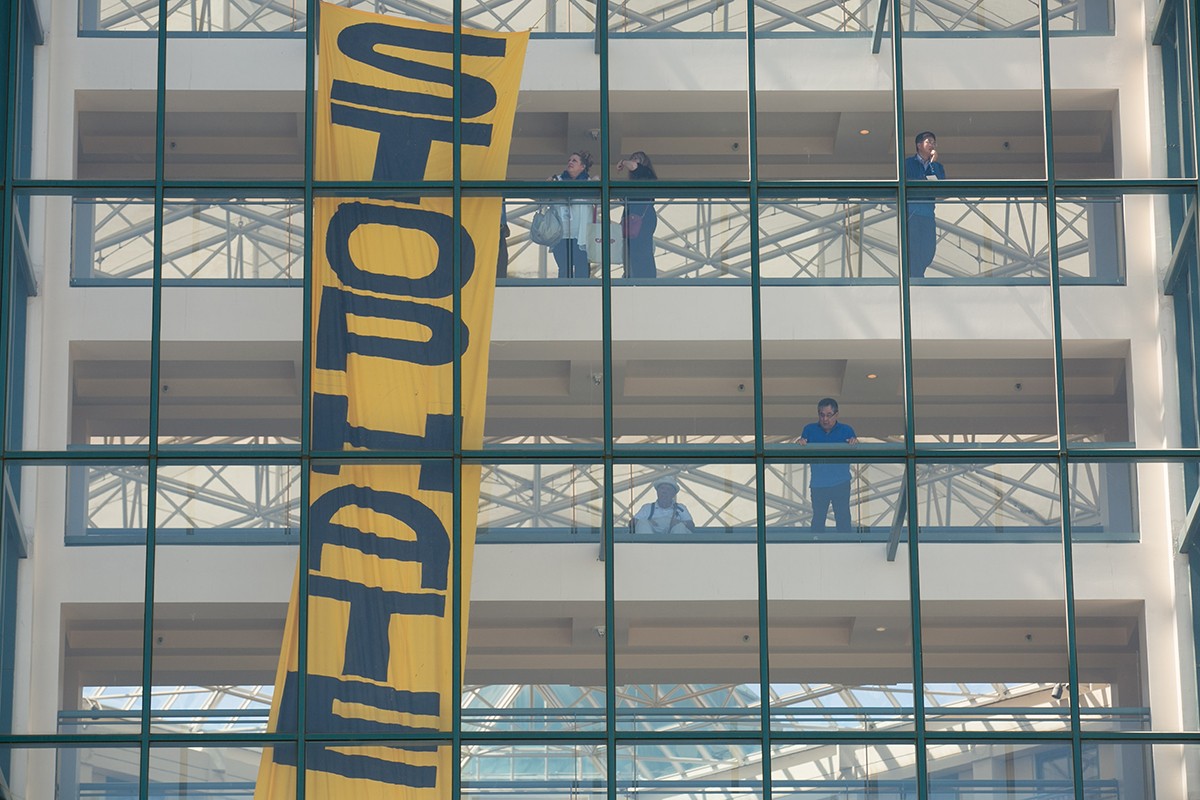
A text message flashed on my phone’s screen: “Fifth floor.” Boom: I power-walked to the nearest elevator, passing law-enforcement officers in riot-gear-style helmets and hotel security waving walkie-talkies. A few floors up, and I was the lone journalist to see the deed from high: A mustard-yellow banner some three stories tall dangling over the Hyatt Regency’s lobby. Workers and guests craned their necks upward. Custodians groaned as they prepared to fish it down. Through the hotel’s glass façade, passers-by could read the words emblazoned on the banner for blocks:
Activists used mountaineering gear to hang a “Stop Hate” anti-Trump banner inside the Hyatt Regency in Burlingame, which hosted the state GOP convention last week.
Credits: Bert Johnson
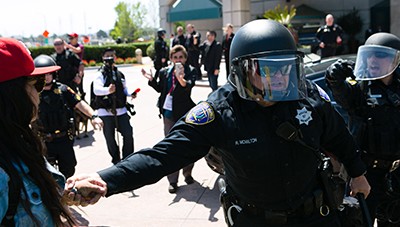
A law-enforcement officer grabs a woman’s hand outside the Hyatt Regency this past Friday.
Credits: Bert Johnson
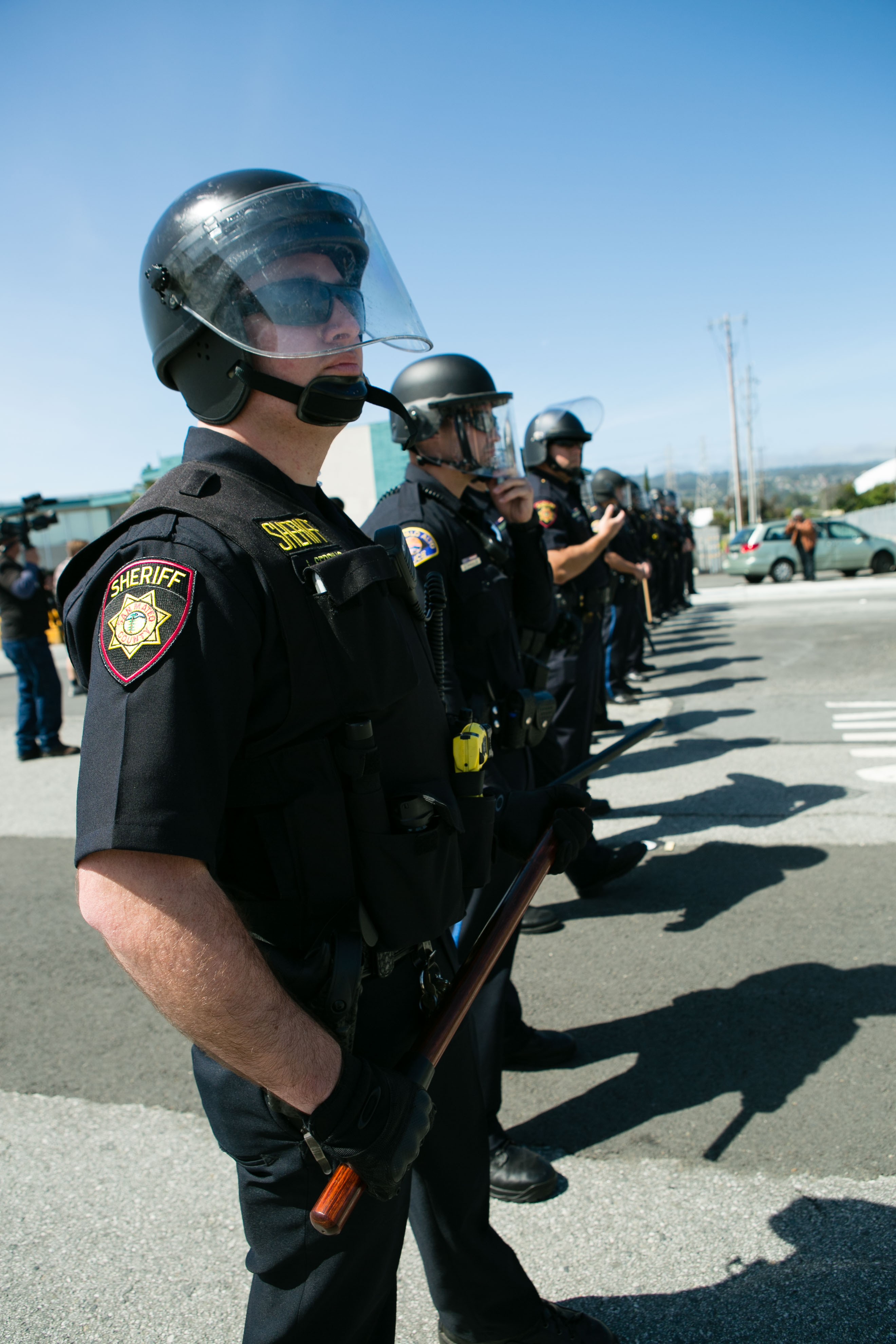
Deputies, police, and CHP officers from multiple jurisdictions worked to block Trump protesters.
Credits: Bert Johnson
Luisa Aranda of nearby Brentwood says her familyand friends call her a traitor for supporting Trump.
Credits: Nick Miller
Only a couple dozen Trump supporters rallied for their candidate outside of the Hyatt.
Credits: Bert Johnson
There were zero Trump signs at the convention, but there was a cardboard cutout.
Credits: Nick Miller
A Trump supporter does media inside the banquet hall.
Credits: Nick Miller
“Stop Hate.”
Somehow, a trio of protesters armed with the banner and some mountaineering gear weaseled through security on Friday in Burlingame, day one of the California Republican Party’s annual convention. They straddled a beam perched hundreds of feet above the ground, wiggled their butts to its edge, and hung the declaration.
It was a glorious feat for the Bay Area’s civilly disobedient, not unlike flying a Warriors championship banner in Oracle’s rafters. A “yuge” success: the words “Stop Hate” unfurled just as Donald Trump and the Republican Party were unraveling downstairs.
This went down just before the brash and bombastic Trump’s lunch in the Bay commenced on Friday. Feverish starfuckers queued for hours to kiss his ring, but the party establishment was chagrined by his arrival. And his presence also triggered ferocious, creative protests by the Bay’s most prominent activist groups — which will surely be the norm in blue cities nationwide if Trump seals the nominee deal.
Many likened the Hyatt that morning to a hotel under siege (see Sam Lefebvre’s sidebar feature for more on the protests, page 20.)
And there I was, man on the inside, behind enemy lines, with a pass to Trump’s sold-out, $150-a-pop banquet lunch. It would be an unequaled window into this bizarre collision of a celebrity politician, Big Money power, and one very angry mob. Pass the bread rolls, please.
Hours before the banner incident, Burlingame was its sleepy suburban self. Seven California Highway Patrol officers stood near their vehicles at the Hyatt’s offramp, all but one wearing shades as the sun inched into the Bay sky. This was 8:30 a.m. Traffic was breezy. One of my colleagues, Lefebvre, took a smartphone pic of the officers. Irked, they shot us a look, then snapped a photo back.
The Hyatt stretches nearly the length of a city block. Law-enforcement officers from a smorgasbord of jurisdictions dotted its front lawn, a waist-high metal fence separating them from a smattering of early-arrival protesters. Hotel employees wouldn’t even let this writer enter through the front doors. Later, at a side entrance, they patted down my black hoodie (George Zimmerman style) but didn’t even search by backpack. Finally, two kindly volunteers granted me into the media pen. I made it.
A woman in all black shouted directions to more than a dozen volunteers wearing red Sen. Ted Cruz T-shirts. “We’re here to be positive about Ted Cruz,” she instructed. “Don’t argue or fight with anyone.” Was this a GOP convention, or Wrestlemania?
Cruz signs dominated nearly every wall, corridor, staircase and lounge inside the hotel. Not a single Trump sign or banner, though — and there wouldn’t be any by the time I left in the afternoon, either. Talk about ground game.
The security they had would make TSA blush. Organizers corralled journalists and made them enter the luncheon banquet room two full hours before Trump’s speech was scheduled to begin. The line inched forward slower than the queue at the latest trendy bagel spot. Secret Service told photo- and video-journalists to dump their gear in a pile, where a police dog sniffed it all at once.
Then, yelling. A woman and a megaphone. A Trump protester! She’d infiltrated the convention, her shouts reverberated through the lobby. A media scrum of dozens shot toward her. Pack journalism at its finest. Hotel security snatched the woman by her limbs and dragged her out of the building.
Convention-goers whispered concerns in the men’s restroom. “I’m a little worried about security because I saw a woman wearing an SEIU T-shirt,” a man confessed while washing his hands.
I heard at least four “You’re Fired!” jokes. Quota met. At ease, GOP jesters.
The vibe at the convention skewed more nervous than enthusiastic, which was odd, given that GOP presidential primaries have not mattered in California in decades.
“California’s going to be decisive,” reminded Jon Fleischmann, a prominent conservative blogger and consultant who’s been attending conventions since 1988. “It’s not like Trump is going to clinch the nomination before June 7.” He noted that absentee ballots beging to go out next week, and that the near-constant electioneering in the Golden State will make it feel like election month.
“The stakes are pretty high,” he said.
Party loyalists should be stoked, right? Reality check: One of the most progressive states in the nation will decide if Trump will be anointed— and nobody is thrilled.
How will it all work? California awards three delegates per Congressional district, which means there are a total of 30 in play in the greater Bay Area. The Golden State also bestows an additional 10 delegates to whoever wins the state outright. There’s a total of 172 in play for the Reeps, and the state’s bounty will make or break Trump hitting the magic 1,237 number.
This likely means more Trump appearances in the Bay. And, by turn, more Trump fanatics and their “papier-mâché crazy shit,” as Fleischmann put it. (He’s pro- Cruz and, like a majority of his party, “can see through [Trump’s] bullshit,” he says.)
Kevin Krick, a former President George W. Bush adviser and current chairman of the Bay Area GOP, wouldn’t go so far as to malign Trump or endorse a candidate. He’d only say that it’s exciting to play “kingmaker” during an election. “We’re usually the final pitcher in the ninth inning, but typically the games already a blowout,” he said.
As for Trump, Krick dug up an old adage: Any press is good press. “And Trump drawing attention to the Republican process is a great thing,” he said.
Fleischmann was unpersuaded. He urged this writer to reach out and chat with Trump supporters, to peel away the layers. “And you’ll understand the nature of the people,” he assured.
Thing is, you don’t actually have to sniff out Trump supporters to speak with them: They tackle you.
Luisa Aranda is Latina. She was also wearing an oversized white T-shirt with black lettering that spelled out “Latinos for the wall.”
And she literally tugged on my press placard and shouted —”Talk to us, you’re media!” — as I walked past, bringing me to a halt.
The mom from Brentwood, which is about 45 miles east of Oakland, was waiting in the never-ending Secret Service line to see Trump. To bide the time, she wanted to complain to me about how people cussed her out and called her a “traitor” on her way into the hotel. I pointed to her shirt — hello! — to which she explained, “Hell yes, I’m for the wall. We need a wall.”
I asked her how much it will cost. “It’s going to cost a lot?”
I asked her what the wall stops. “It’s going to stop a lot of drug-trafficking,” she answered.
Her friend, Cheryl McDonald, interjected: “All the ISIS coming over the wall.”
McDonald is president of the East Contra Costa Republican Women Federated group. Blinking lights decorated her red, white and blue cowgirl hat. (I didn’t have the heart to tell her that ISIS cannot enter the country by mounting a wall that does not yet exist.)
McDonald says she founded ECCRWF some 35 years ago, but warned that she would bail on the organization for The Donald. “If he leaves the party, I go with him,” she promised.
Aranda is a member of this group, too, and echoed her sentiment. She said this was her first convention, and that she’d “never been passionate” about a candidate before Trump — except, you know, when she voted for Obama in 2008.
“I was a Democrat. I’m allowed to change my mind,” Aranda rationalized. Now, she’s a Trump Mom. And fanatical to boot: “I was in New York and I ate at his restaurant. I read Art of the Deal.”
Ridicule aside, the Trump supporters I met at the convention were by no means stupid. These women were articulate, armed with data and examples, and they launched them with vitality and even good humor. It’s just that they’re wildly misinformed, lied to by a carnival barker in an expensive suit. Latinos for the wall? I’m saddened.
Inside the banquet hall, Sheryl Crow’s “All I Wanna Do” blasted on the speakers. Round tables draped in white-cloths were dressed with plates of green salad, cherry tomatoes, and asparagus. The room was redolent of raspberry vinaigrette. And there were an underwhelming number of people with “Make America Great Again” caps. Only six, by my count.
Trump clones ate up the hearty media presence. A man dressed in a powdered blue suit, white shirt, and red Trump cap rushed from news camera to news camera. If Trump’s candidacy truly qualifies as a movement, then this guy is poster boy. He rattled on about how Hillary Clinton should be in prison. And how Trump is going to keep China in check. A TV journalist nodded, as if saying, “Yes, of course, that all completely makes sense.”
After a 45-minute delay, the luncheon began with a prayer, a Psalm, something about leading the United States out of despair — which the pastor used as a not-so-veiled ding on Obama. The blue-chip sponsors trickled in and filled stage-front tables.
When Trump finally arrived, the applause was muted — but only because most everyone was videotaping with their phones. He first cracked a joke about how, because of the protesters, he allegedly had to hop a fence and scurry through a field before sneaking through a back door. He compared his adventure to “crossing the border.”
Sorry, Donald: More than 100 bodies are found each year along migration routes from Mexico, according to the Los Angeles Times. What he experienced was basically a flat tire on Highway 101.
His speech, a mishmash of greatest hits (the wall, Lyin’ Ted, Crooked Hillary), felt rushed, if a bit frazzled. Not frantic, per se, but perhaps hastened by the protesters. Also, it wasn’t much of a speech — more a braggadocio, devoid of issues or policy. Perhaps he was rattled, or at the very least hurried, by unexpected detours upon arrival. For all the fanfare and scalped tickets and hours-long security queues, it lasted barely more than 20 minutes. (Enter your own joke about Trump not lasting.)
Anyway, he dedicated his opening remarks to a roundup of favorable poll numbers and prior delegate wins. Then, he pivoted to full-on insult mode: from Cruz to Kasich to Carly, and even the very GOP delegates in the room. “Folks, I’m a conservative — but at this point who cares?” he blurted at one point, a glib dismissal of pretty much every card-carrying Reep. This came after ridiculing the GOP establishment as “disgusting” and “losers.”
You know, run-of-the-mill Trump fare.
A man in the hall yelled out “Build the wall!” Of course he did. They love that damn wall. It’s the quintessential rallying cry for xenophobic, oh-there’s-a-brown-person-better-hold-my-purse-tighter America. Obama had “hope”; Trump has a wall. That afternoon, the wall costs $10 billion. Who knows what it will cost tomorrow.
Despite calls for Trump to curb his diatribes, the man came across as wholly uninterested in appearing presidential on Friday. At one point, he made fun of Cruz by imitating a whining child. “Mommy!” he mocked, rubbing his eyes, as if crying. The audience reacted with equal parts muffled laughter and icy silence.
His speech was the political equivalent of a rapper talking smack on a hip-hop album’s outro track.
And then it was mic-drop time. Trump’s stump was a dump, and he ended with jokes about escaping the hotel-protest mess and returning to Indiana: “They’re going to take me under a fence, through a field,” he joked. “You have no idea.”
Trump’s escape on Friday mirrored the Republican Party conundrum: How will the GOP ever crawl out from under the ignominy of having that man as their presidential nominee?
And it’s not just that he’s in continuous attack mode. It’s also his crude method. Compare Trump’s speech to Obama’s much-discussed final White House Correspondents Dinner comedy set this past Saturday. Whereas Trump was a loudmouth on the attack, likening his enemies to infants and criminals, Obama zinged and skewered his adversaries with delicate self-deprecating humor. Trump’s approach was like using a brick to shoo a fly; Obama simply cracked a window and sipped a cocktail.
It’s also clear that the Republican establishment, because of Trump — and because of years of inefficacy in Washington, spurred by the Tea Party’s evolution — has finally lost control over its narrative. As New York Times columnist Nicholas Kristof wrote in his most recent Sunday column, Trump’s brutish maneuvering is tantamount to “playing the man card,” a faux pas of faux pas, and his speech the type of invective a drunken golfer might rant after a bad round and a few too many at the 19th hole.
Kristof wrote that conservatives are often “indignant” when accused of sexism or misogyny. And that, to their defense, those accusations were often overblown—that is “until Donald Trump showed up,” the columnist zinged.
It’s true: The party let a man who shows nary a modicum of respect for it snag the megaphone. He’s unhinged — and the party is spilling apart like a loose ball of yarn.
Even Charlie Munger, whose son bankrolls a majority of conservative causes in California and who helped fund this weekend’s GOP convention, told Yahoo Finance last week that Trump was “a form of sickness.” And this from a guy who himself writes some beefy checks to the Republican National Committee.
So, after Trump’s talk, people wanted out. But police and security wouldn’t let this writer, or even hotel guests, exit through any of the main doors, because of the protests out front. We had to pull our own Trump and leave out a side door — then walk through a parking garage, which spit us out a half-block away from the venue.
I wandered back to the hotel, where hundreds of activists waved flags and hollered at law enforcement. A woman screamed into a bullhorn while protesters encircled a burning American flag: “Fuck what the American flag stands for. We don’t stand for that shit.” The flag lay on the grass, shredded and smoldering.
California’s counties are sleeping giants when it comes to medical marijuana, but Alameda County is beginning to stir.
One of California’s most populous, large, centrally located and progressive counties is moving to modernize its pot-shop rules. Alameda plans to allow the sale of extracts and marijuana-infused products such as edibles, as well as legalize deliveries within and from outside the county, in addition to adding one to three new dispensaries.
According to Supervisor Nate Miley, phase two of the county’s medical-marijuana-modernization efforts would permit indoor and greenhouse-cannabis farms in some of the county’s vast agricultural land, as well as permit, tax, and regulate kitchens that prepare edibles, cannabis oil extraction facilities, testing labs, and distribution warehouses.
Time is of the essence: Advocates say medical-cannabis patients, particularly rural seniors, are underserved in Alameda. There’s also potentially tens of millions of dollars in annual tax revenue for the county, as well as high-paying jobs on the line as California jurisdictions jostle to corner aspects of the newly legitimized medical-pot trade.
“Folks who need cannabis could suffer,” Miley explained. “As far as our safety nets and services, [lack of access] has an effect on the needy, the unfortunate, the vulnerable populations who might possibly need this medicine.”
He also acknowledged that there’s a lot of revenue at stake. “We could suffer if we’re not in the picture. … If we haven’t put ourselves in a place to benefit from [medical cannabis], maybe we won’t get that revenue stream, or as much as had we been at the ground floor in helping to shape this as we move forward.”
California legalized medical cannabis in 1996 but finally regulated it statewide last year. The legal medical-cannabis trade generates several billion dollars in estimated revenue statewide. One in 20 California adults are thought to have used pot for a serious medical condition, and 92 percent of those users thought it worked, according to a study by the Drug and Alcohol Review journal. New rules under the Medical Marijuana Regulation and Safety Act put cities and counties in the driver’s seat on regulations.
Cities like Oakland, Adelanto, and Emeryville have been the first to respond to MMRSA’s call for local laws to match state rules. Oakland is aggressively moving to license and tax its fast-growing indoor-cultivation industry, as well as add more licensed dispensaries, deliveries, as well as edibles kitchens and extraction labs.
This spring, the Emeryville City Council voted to immediately legalize medical-cannabis deliveries and is planning to potentially become a cannabis biotech hub by licensing labs that test marijuana.
The desert town of Adelanto is working to corner the Southern California market for licensed mega-farms. The city of Santa Rosa began receiving applications for cultivation licenses last week.
But California’s counties are much slower and less nimble, Miley said, likening them to aircraft carriers. “It’s takes a long time to turn them.
Indeed, Alameda County has barely evolved on cannabis since Miley was elected. He did shepherd legislation that created the county’s three dispensary permits. Just two pot shops are open in all of unincorporated Alameda County. Both are ruled over by the Sheriff’s Department, and are not allowed to sell edibles, or extracts — both of which are very popular with marijuana patients.
“It took a lot to get that through,” said Miley, “and one of the ways was to give the Sheriff’s Department control over it.
“I’m hoping there’s more acceptance and tolerance of dispensaries now than there was in the early 2000s.”
The passage of MMRSA is causing counties statewide into a reckoning with the reality of medical marijuana — after 20 years of state and local politicians sticking their head in the sand, he said. “We’ve been waiting for the state to come forward for forever. The rules of the game are in place now.”
Updating Alameda County’s laws won’t be easy, though. Conservatives in law enforcement think cannabis is a gateway drug, and its medical use is a ruse, Miley said. Sheriff’s have tolerated the two dispensaries “begrudgingly,” he said.
Miley — who leads county efforts to battle the prescription drug overdose epidemic, which kills 50 Americans per day — says that “just because something is abused doesn’t mean you don’t make it legitimately available to people who need it.”
Some in the county bureaucracy would also prefer the Alameda wait for more leadership in Sacramento, but Miley insists that is not the right move. “We have the opportunity to be at the vanguard.”
The county’s plans are currently under review and could go before the full Board of Supervisors in late summer or fall. Phase two plans could be up for Board approval by spring 2017.
The hallmarks of King Hu's Dragon Inn — the set-ups, the soundtrack score, the actors' makeup, the voiceover narration, everything about it — are so different from today's costumed action movies that Hu's adventure seems beamed in from a far-away galaxy. That's a reasonably accurate first impression.
Dragon Inn was produced in Taiwan in 1967, years...
Zach Rogue and Pat Spurgeon of Rogue Wave sat at Telegraph Beer Garden, enjoying sandwiches and brew on a recent afternoon. The duo reminisced about playing a show once in the parking lot: in 2004, with freak-folk duo CocoRosie, before either band had blown up. This was back when the café was still called Mama Buzz, and two years...
I'm a 31-year-old straight woman. I have a good job, great friends, and average attractiveness. I've dated close to 30 men at this point, and I can't wrap my head around this: I've never had a boyfriend or dated anyone for more than a couple months. It's really starting to wear on my self-esteem. I don't believe anything is...
It's a daunting premise, but one that the cast of director Mark Jackson's Hamlet pulled off with wild success: seven actors learned every part in the play, and, minutes before show time, assembled on stage to pick their roles out of a prop skull. After a few minutes of preparation, the show began. The production opened at Shotgun Players...
Perhaps you snagged a copy of this week's Express, took one look at Donald Trump's rug on the cover, and thought to yourself, "No thanks."
I feel you. We all want this Trump soap opera to disappear, for the man to exit political stage right — tiny hands in his pockets, coif hopelessly ruffled — and return to hosting some...
With apologies to Alice Waters of Chez Panisse, it is the Cal-Italian restaurant that is, in many ways, the quintessential East Bay eatery. There's a reason why places like Dopo and Pizzaiolo — two of the first restaurants I fell in love with in Oakland — remain reliable favorites for Town natives looking to impress out-of-town guests. It's a simple...
Is Berkeley's latest minimum-wage plan a sincere attempt to boost worker pay—or a "cynical ploy"?
That's what some debated after last week's Berkeley City Council meeting, when the council voted to place an initiative on the November ballot to increase its minimum wage to $15 by 2019. Several dissenting councilmembers said the proposal is actually a plan to torpedo an...
The thing Dominica Rice-Cisneros remembers the most about Cinco de Mayo was how excited she was to learn the Mexican Hat Dance in elementary school. What does the chef-owner of the Mexican restaurant Cosecha (907 Washington St., Oakland) say she doesn't remember? Anyone in her family, or from the broader Mexican-American community in Los Angeles, taking the...
Editor's note: This story was published before Sen. Ted Cruz suspended his GOP presidential campaign.
A text message flashed on my phone's screen: "Fifth floor." Boom: I power-walked to the nearest elevator, passing law-enforcement officers in riot-gear-style helmets and hotel security waving walkie-talkies. A few floors up, and I was the lone journalist to see the deed from high: A...
California's counties are sleeping giants when it comes to medical marijuana, but Alameda County is beginning to stir.
One of California's most populous, large, centrally located and progressive counties is moving to modernize its pot-shop rules. Alameda plans to allow the sale of extracts and marijuana-infused products such as edibles, as well as legalize deliveries within and from outside the...